Chapter 1: TheRole of Business Research
CourseTeacher:
Dr. Niluthpaul Sarker
Professor
Department of Accounting, JnU.
Research Methodology
2.
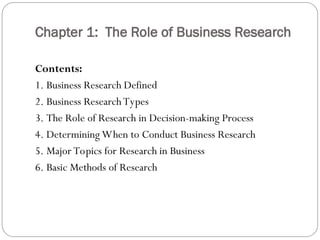
Chapter 1: TheRole of Business Research
Contents:
1. Business Research Defined
2. Business Research Types
3. The Role of Research in Decision-making Process
4. Determining When to Conduct Business Research
5. Major Topics for Research in Business
6. Basic Methods of Research
3.
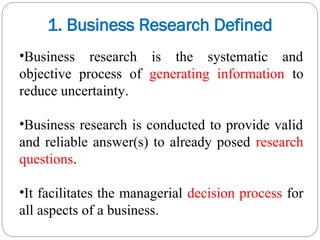
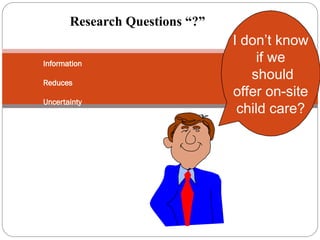
•Business research isthe systematic and
objective process of generating information to
reduce uncertainty.
•Business research is conducted to provide valid
and reliable answer(s) to already posed research
questions.
•It facilitates the managerial decision process for
all aspects of a business.
1. Business Research Defined
4.
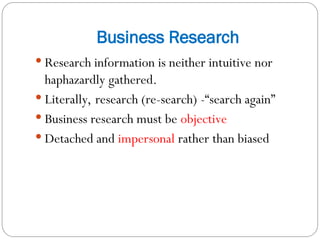
Business Research
Researchinformation is neither intuitive nor
haphazardly gathered.
Literally, research (re-search) -“search again”
Business research must be objective
Detached and impersonal rather than biased
Data versus Information
Data—the raw facts—record measures of
certain phenomena which are necessary to
provide
Information—facts in a form suitable for
managers to base decisions on.
2. Business ResearchTypes
Basic Research:
• Attempts to expand the limits of knowledge.
• Not directly involved in the solution to a pragmatic
problem.
Applied Research:
• Conducted when a decision must be made about a
specific real-life problem
9.
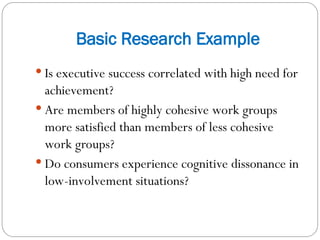
Basic Research Example
Is executive success correlated with high need for
achievement?
Are members of highly cohesive work groups
more satisfied than members of less cohesive
work groups?
Do consumers experience cognitive dissonance in
low-involvement situations?
10.
Applied Research Examples
Should McDonalds add Italian pasta dinners to its
menu?
Business research told McDonald’s it should not
Should Procter & Gamble add a high-priced
home teeth bleaching kit to its product line?
Research showed Crest Whitestrips would sell
well at a retail price of $44
11.
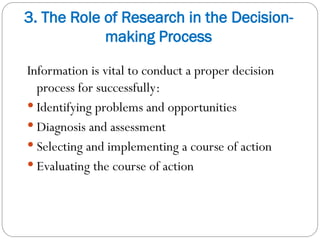
3. The Roleof Research in the Decision-
making Process
Information is vital to conduct a proper decision
process for successfully:
Identifying problems and opportunities
Diagnosis and assessment
Selecting and implementing a course of action
Evaluating the course of action
12.
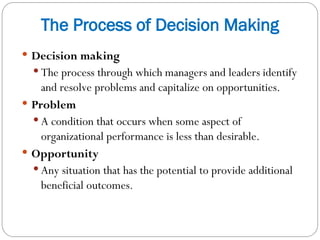
The Process ofDecision Making
Decision making
The process through which managers and leaders identify
and resolve problems and capitalize on opportunities.
Problem
A condition that occurs when some aspect of
organizational performance is less than desirable.
Opportunity
Any situation that has the potential to provide additional
beneficial outcomes.
13.
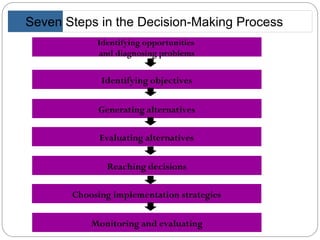
Seven Steps inthe Decision-Making Process
Identifying opportunities
and diagnosing problems
Identifying objectives
Generating alternatives
Evaluating alternatives
Choosing implementation strategies
Monitoring and evaluating
Reaching decisions
14.
Step 1: IdentifyingOpportunities and
Diagnosing Problems
The clear identification of opportunities or the
diagnosis of problems that require a decision.
An assessment of opportunities and problems will
only be as accurate as the information on which it is
based.
15.
Step 2: IdentifyingObjectives
Objectives reflect the results the organization wants to
attain. Also called targets, standards or ends.
The quantity and quality of the desired results should be
specified, for these aspects will ultimately guide the
decision maker in selecting the appropriate course of
action.
Objectives can be measured on a variety of dimensions
(monetary units, output per hour, % of defects, etc.)
and whether the objectives are long-term versus short-
term.
16.
Step 3: GeneratingAlternatives
Once an opportunity has been identified or a
problem diagnosed correctly, a manager develops
various ways to solve the problem and achieve
objectives.
The alternatives can be standard and obvious as
well as innovative and unique.
17.
Step 4: EvaluatingAlternatives
Determining the value or adequacy of the alternatives
generated.
Predetermined decision criteria may be used in the
evaluation process.
Quality desired
Anticipated costs
Benefits
Uncertainties
Risks
18.
Step 5: ReachingDecisions
Decision making is commonly associated with making a final
choice.
Although choosing an alternative would seem to be a
straightforward proposition, in reality the choice is rarely
clear-cut.
19.
Step 6: ChoosingImplementation
Strategies
The bridge between reaching a decision and evaluating the
results.
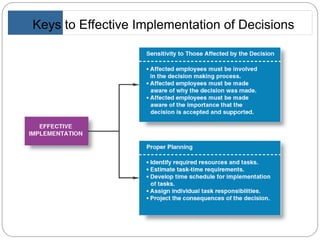
The keys to effective implementation are:
Sensitivity to those who will be affected by the decision.
Proper planning and consideration of the resources necessary to
carry out the decision.
Step 7: Monitoringand Evaluating
No decision-making process is complete until the impact of
the decision has been evaluated.
Managers must observe the impact of the decision as
objectively as possible and take further corrective action if it
becomes necessary.
22.
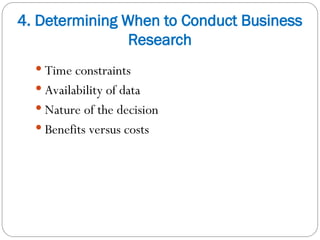
4. Determining Whento Conduct Business
Research
Time constraints
Availability of data
Nature of the decision
Benefits versus costs
23.
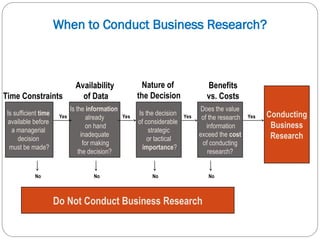
Is sufficient time
availablebefore
a managerial
decision
must be made?
Is the information
already
on hand
inadequate
for making
the decision?
Is the decision
of considerable
strategic
or tactical
importance?
Does the value
of the research
information
exceed the cost
of conducting
research?
Conducting
Business
Research
Do Not Conduct Business Research
Time Constraints
Availability
of Data
Nature of
the Decision
Benefits
vs. Costs
Yes Yes
Yes
Yes
No No No No
When to Conduct Business Research?
24.
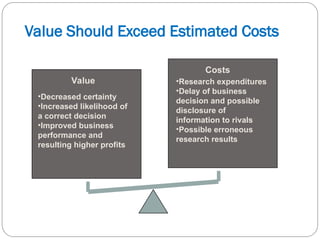
Value
•Decreased certainty
•Increased likelihoodof
a correct decision
•Improved business
performance and
resulting higher profits
Costs
•Research expenditures
•Delay of business
decision and possible
disclosure of
information to rivals
•Possible erroneous
research results
Value Should Exceed Estimated Costs
25.
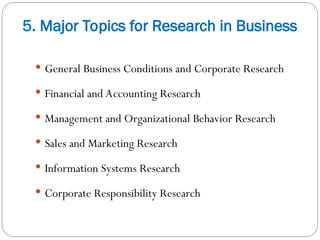
5. Major Topicsfor Research in Business
General Business Conditions and Corporate Research
Financial and Accounting Research
Management and Organizational Behavior Research
Sales and Marketing Research
Information Systems Research
Corporate Responsibility Research
26.
6. Basic Methodsof Research
Surveys
Experiments
Secondary data
Observation
27.
Classification of SurveyMethods
3.4. Communication with the respondents:
Qustionnaires administered by an interviewer
* Door-to door interviews
* Mall intercepts
* Telephone interviews
Self-administered questionnaires
* sent by mail, fax, or e-mail
* Internet questionnaires