WORKING WITH PUBLIC CLOUDS
by
Ambrish Gangal
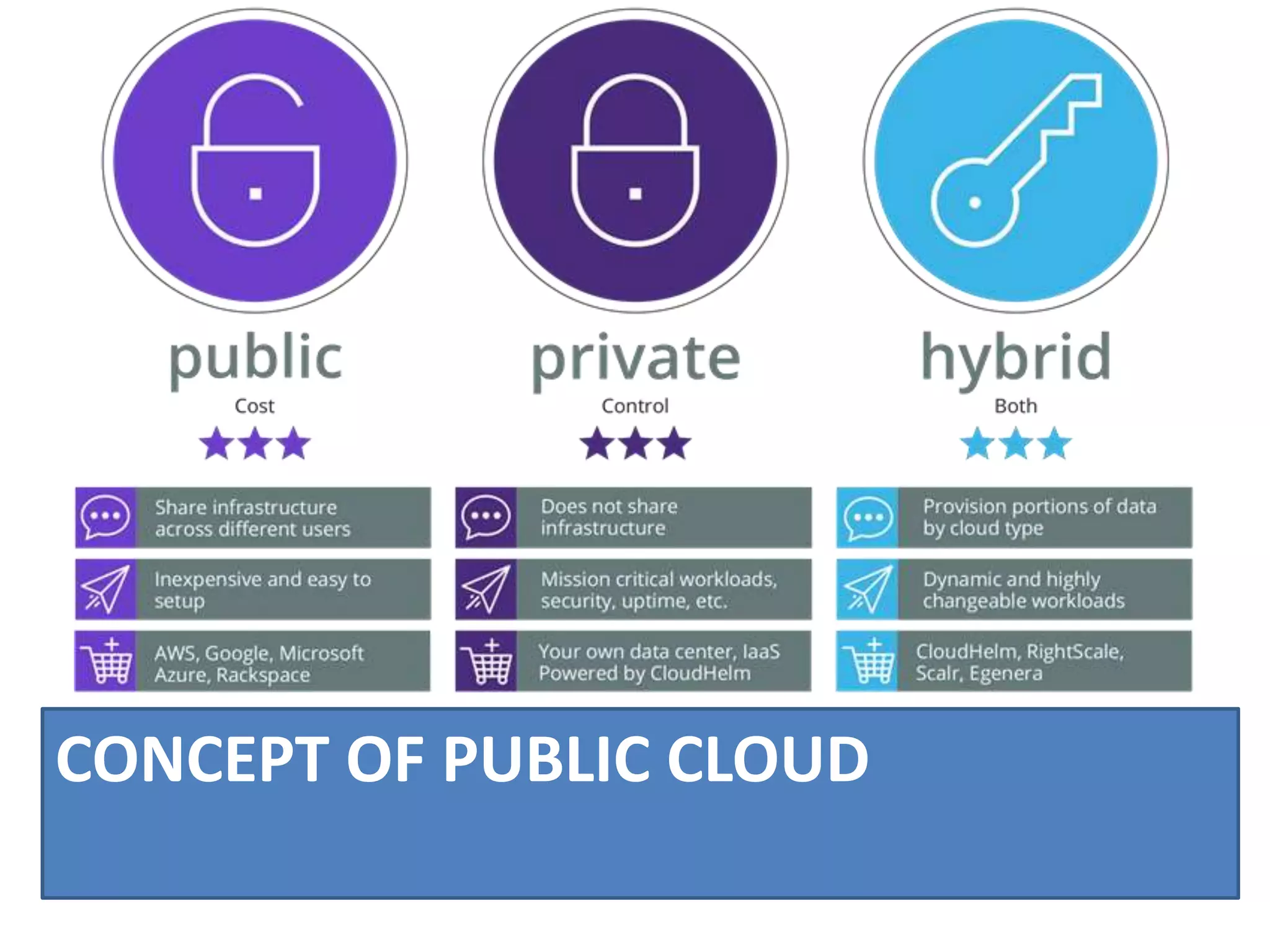
CONCEPT OF PUBLIC CLOUD
What is Public Cloud ??
• A public cloud is one based on the
standard cloud computing model, in which a
service provider makes resources, such as
virtual machines (VMs), applications or
storage, available to the general public over
the internet.
• Public cloud services may be free or offered
on a pay-per-usage model.
BENEFITS OF USING A PUBLIC CLOUD
• The main benefits of using a public cloud service
are:
• it reduces the need for organizations to invest in
and maintain their own on-premises IT resources;
• it enables scalability to meet workload and user
demands; and
• there are fewer wasted resources because
customers only pay for the resources they use.
NOTE : Public cloud also include other major
benefits of Cloud computing eg. Mobility ,etc
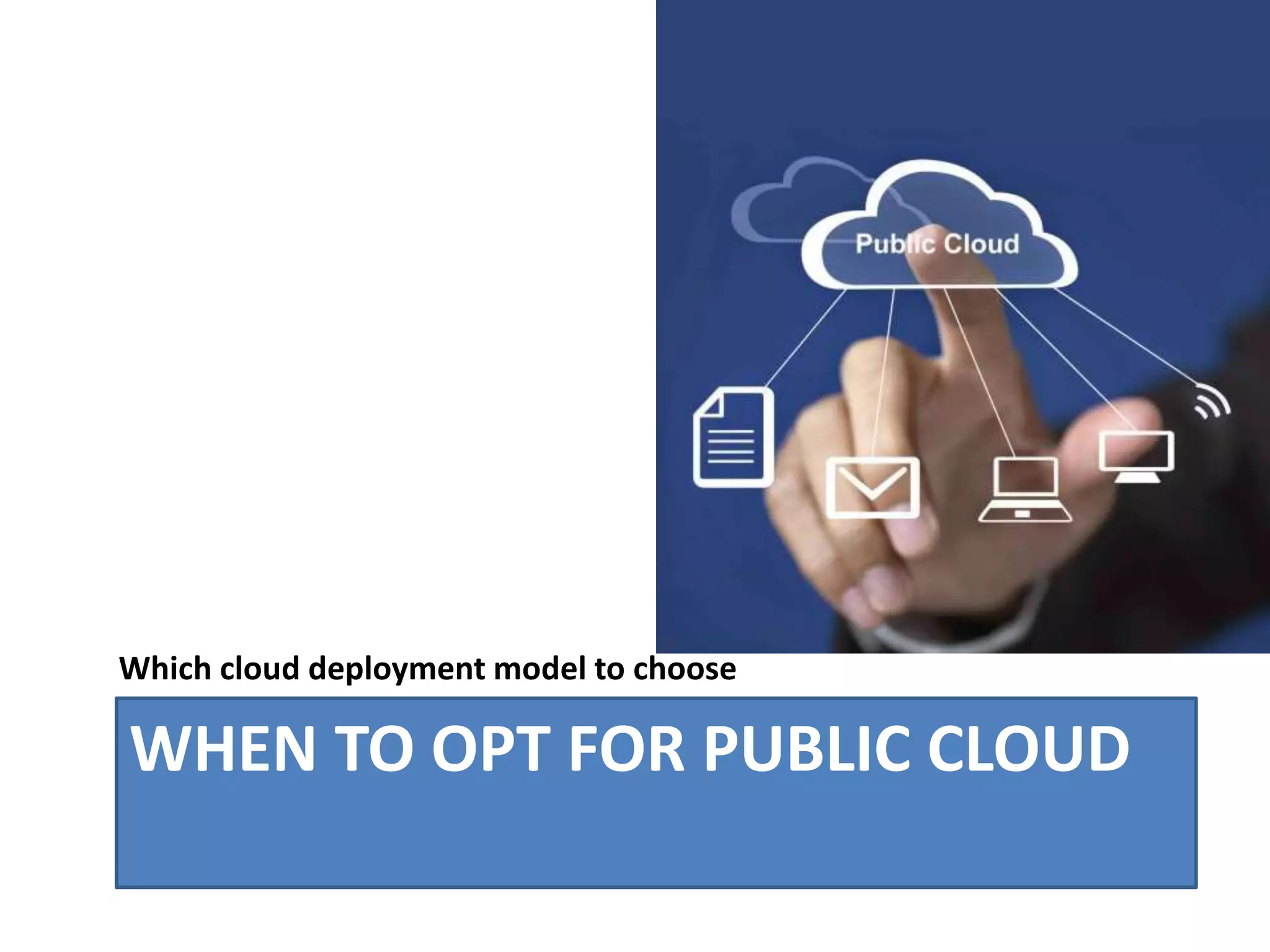
WHEN TO OPT FOR PUBLIC CLOUD
Which cloud deployment model to choose
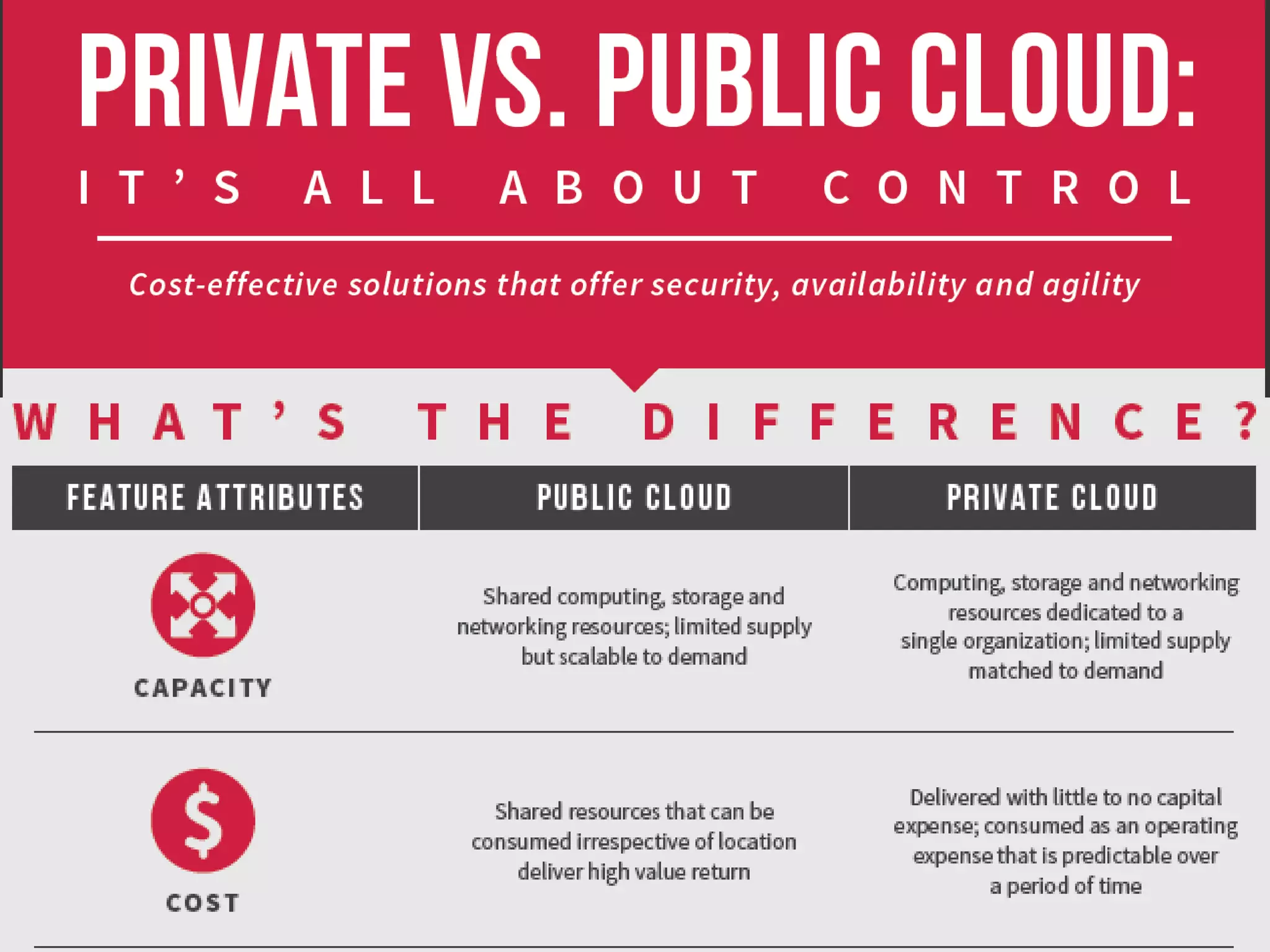
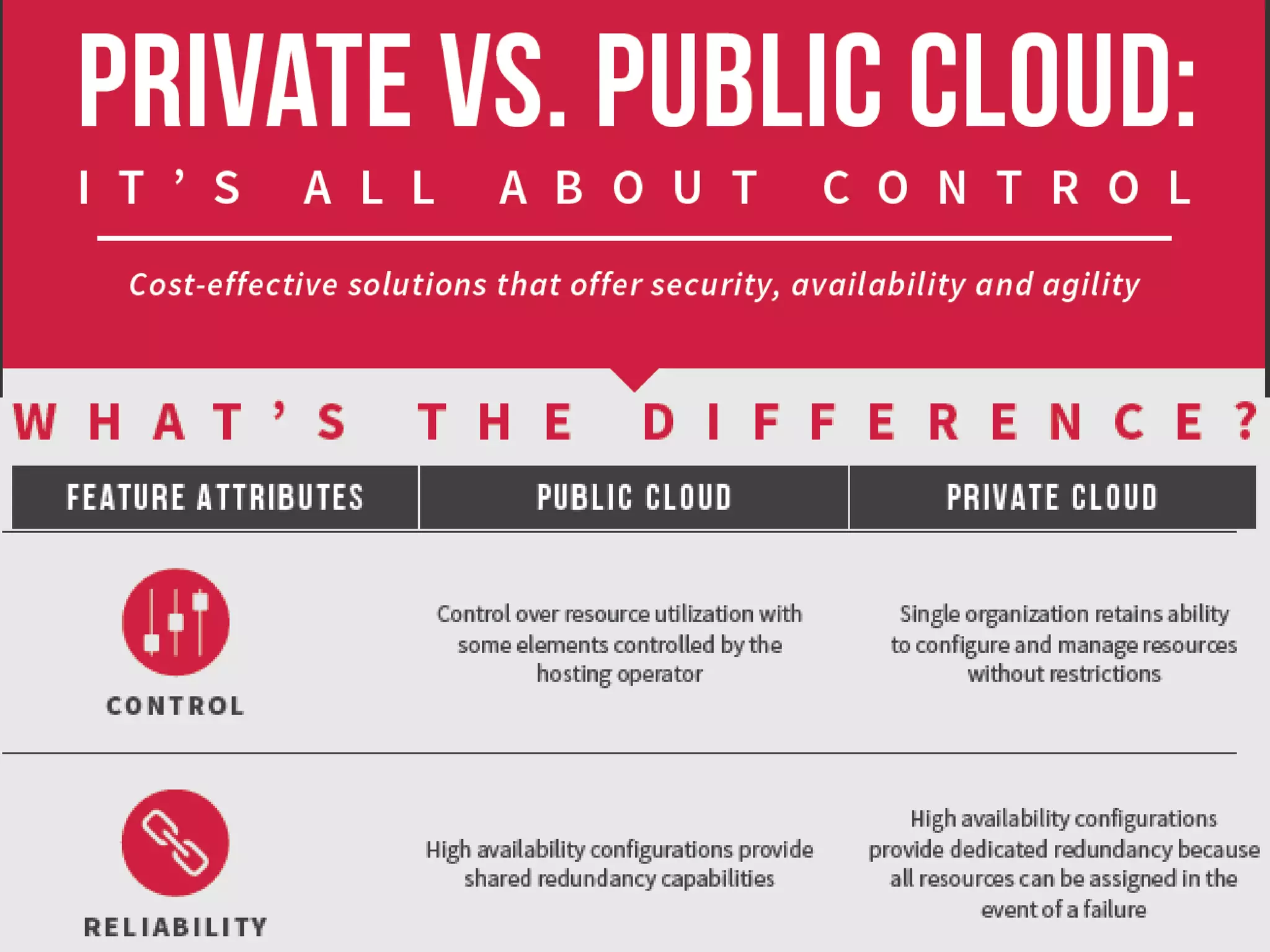
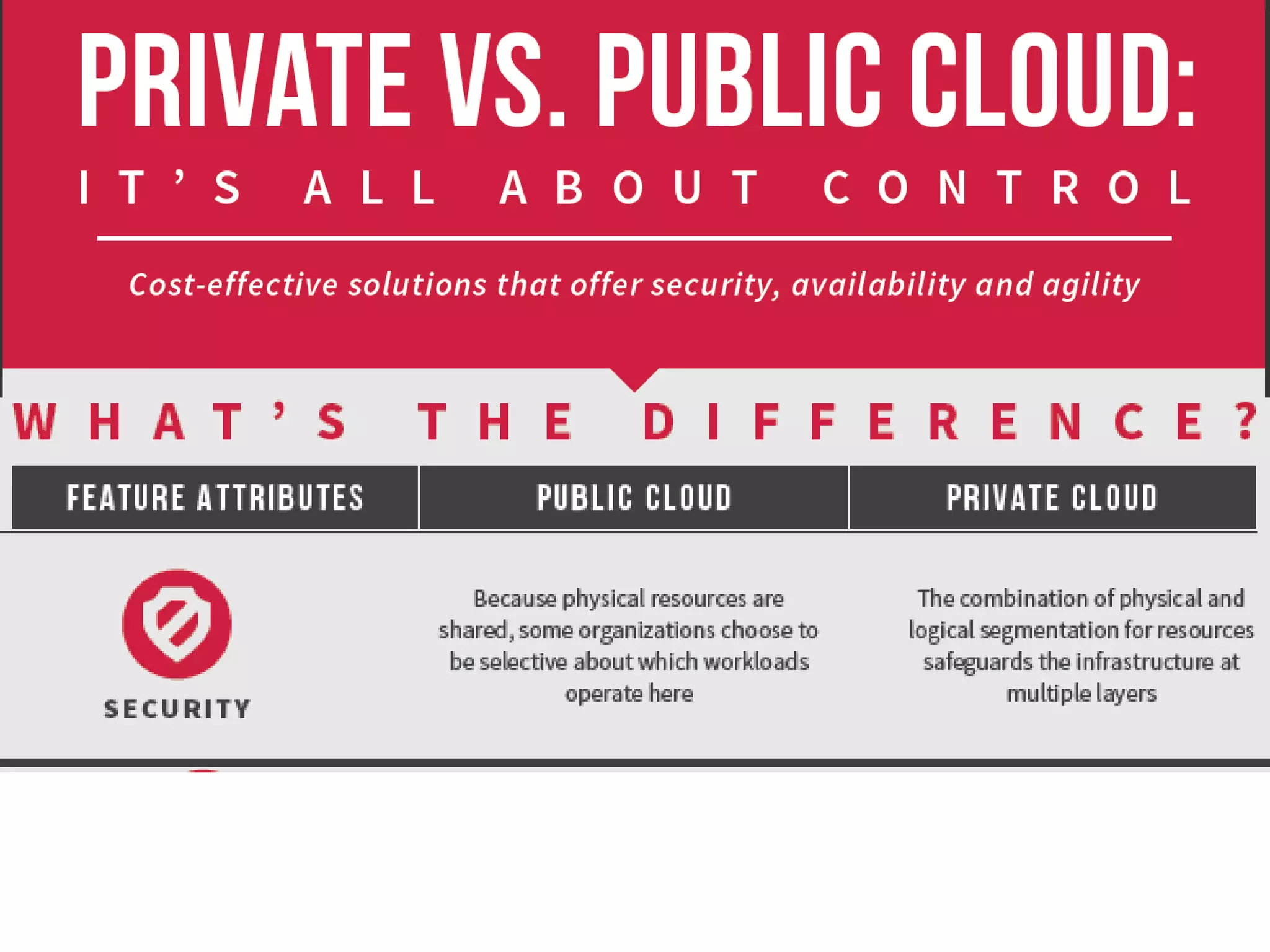
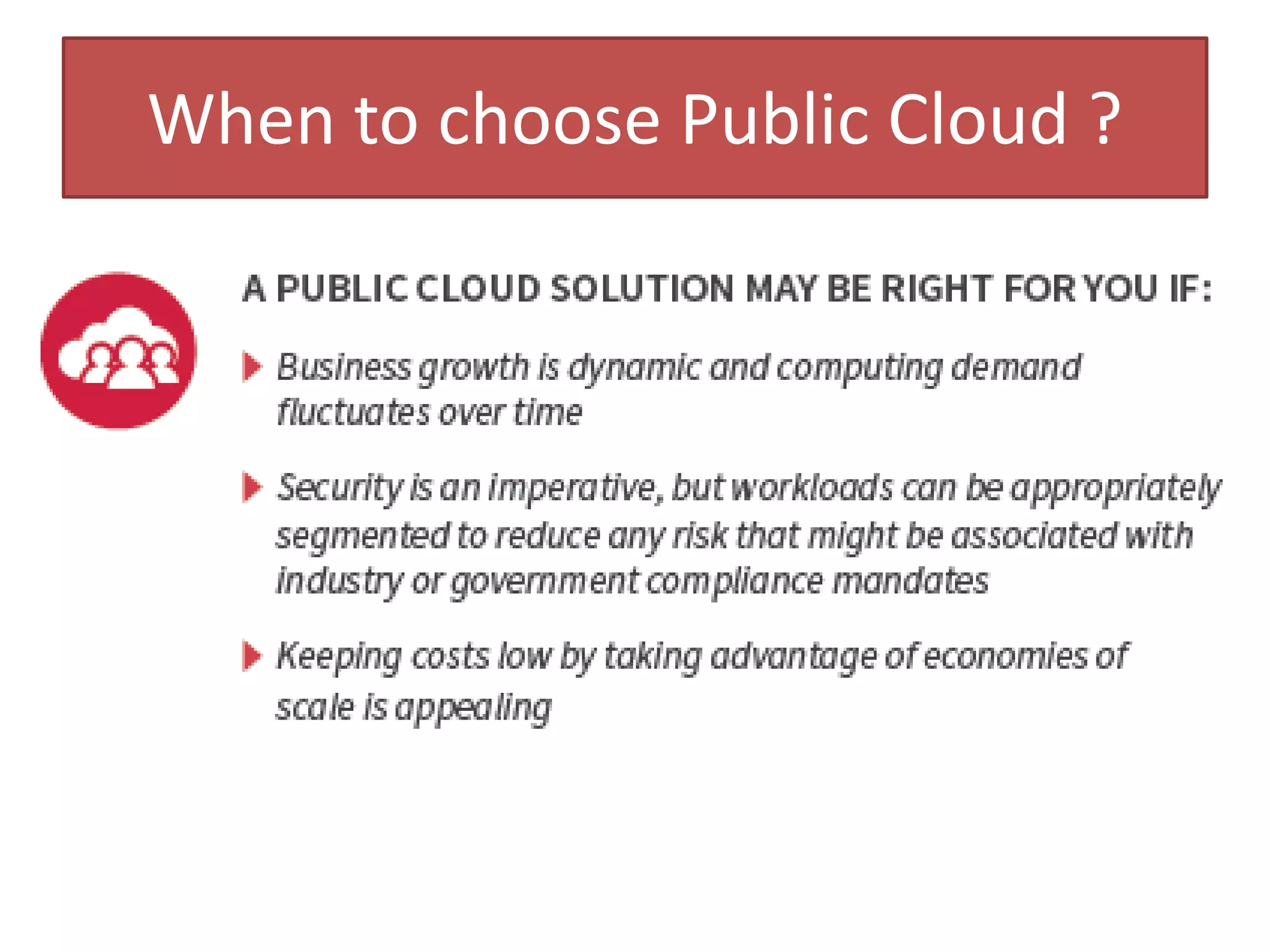
When to choose Public Cloud ?
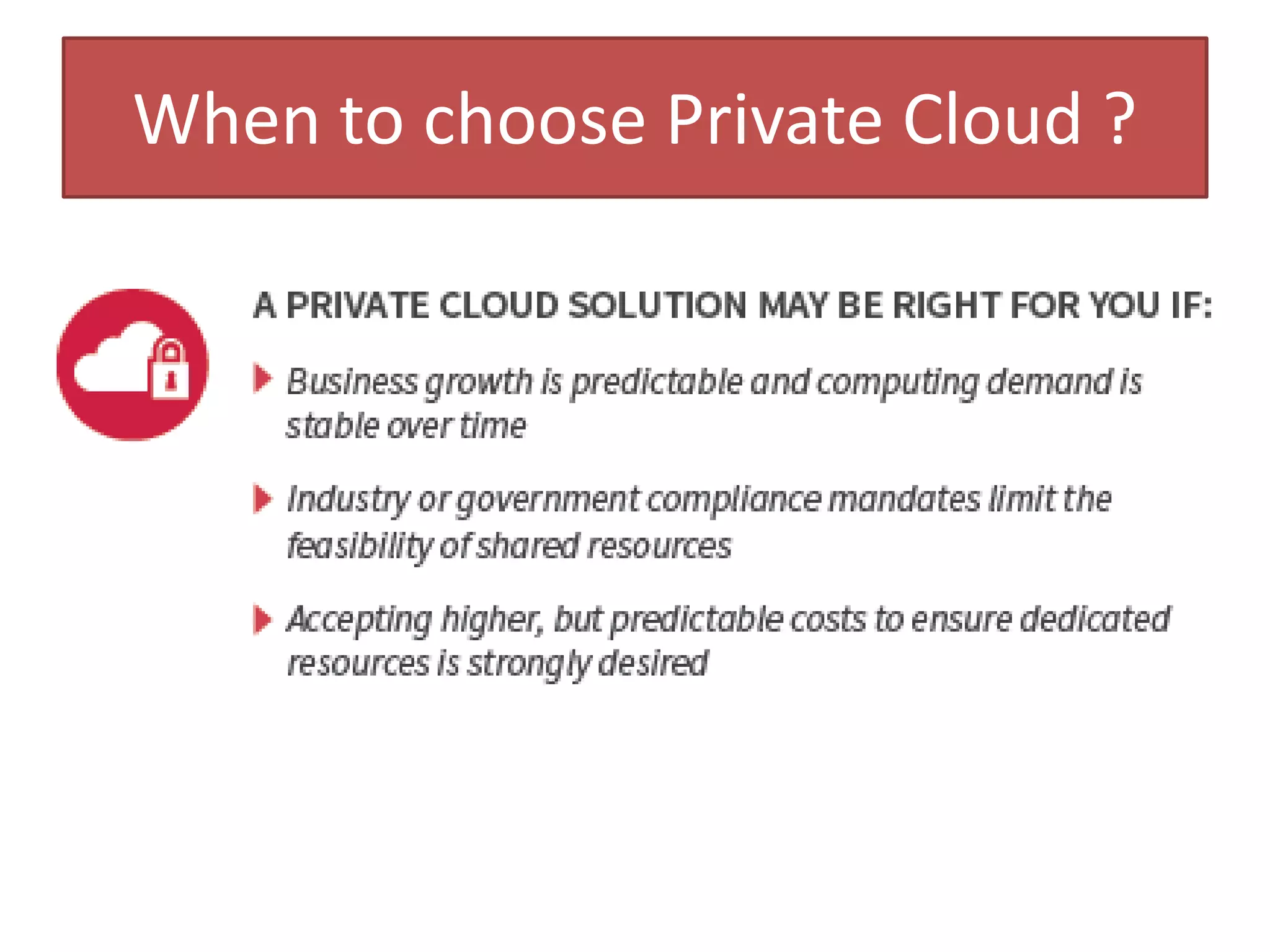
When to choose Private Cloud ?
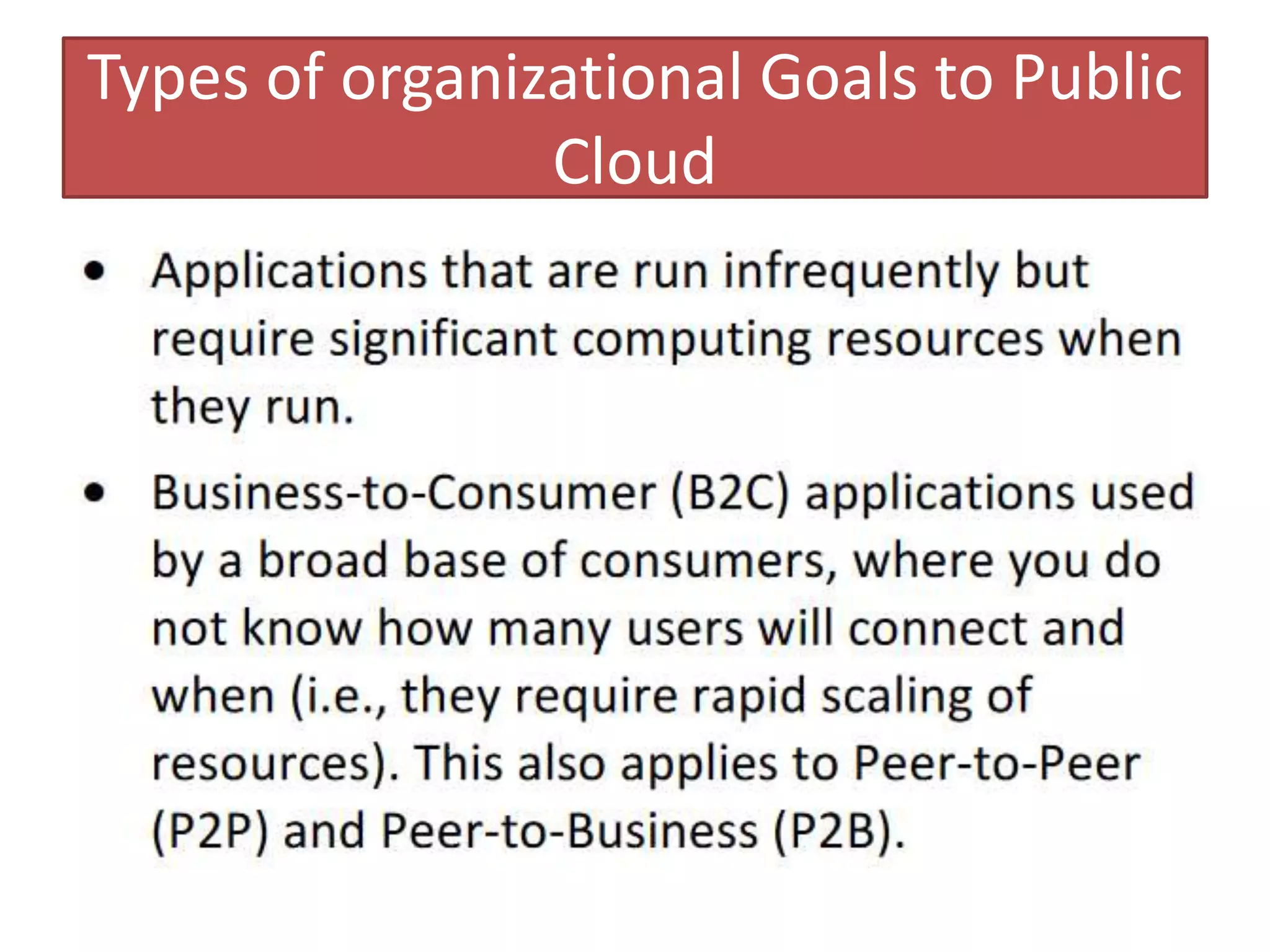
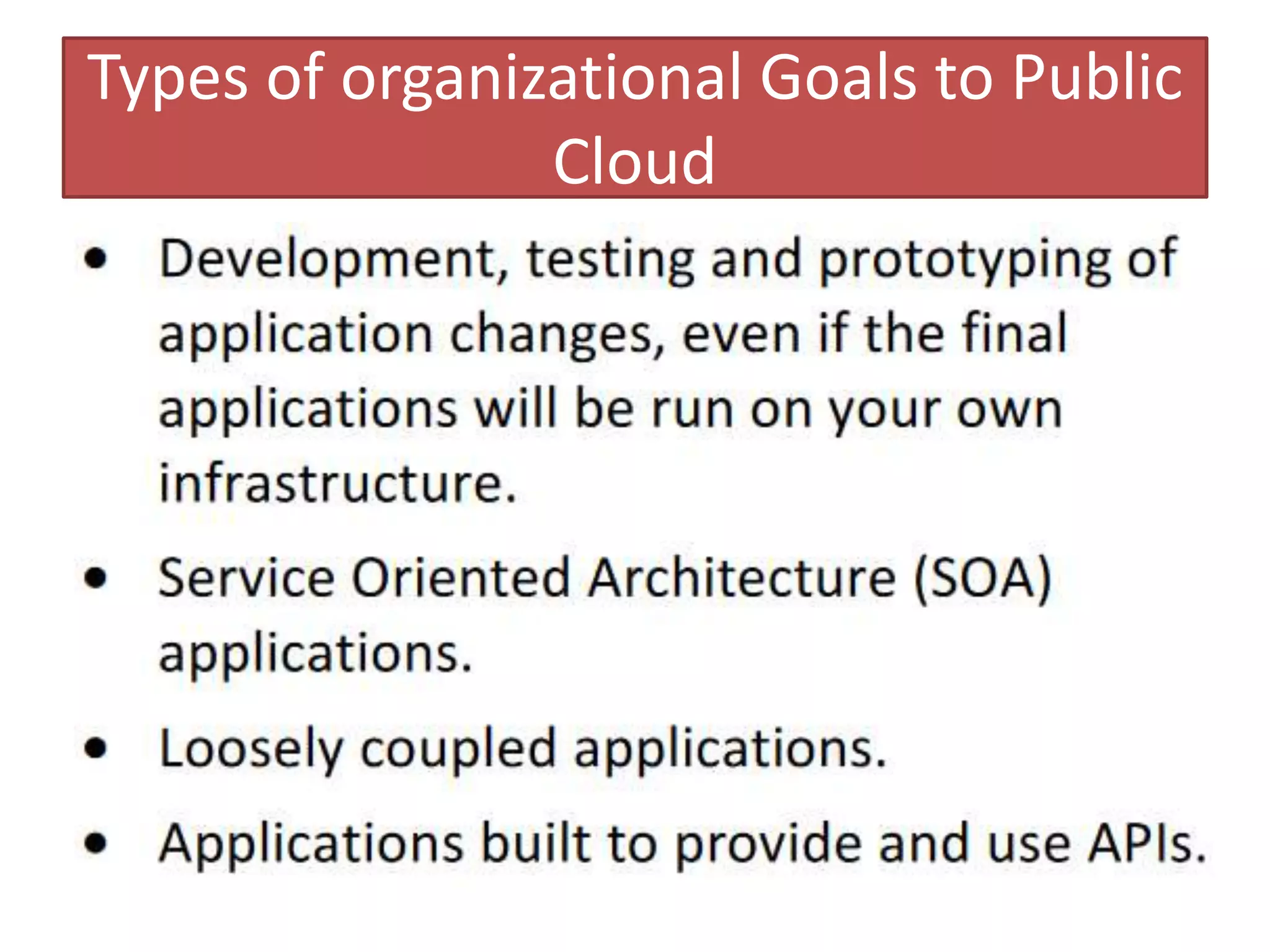
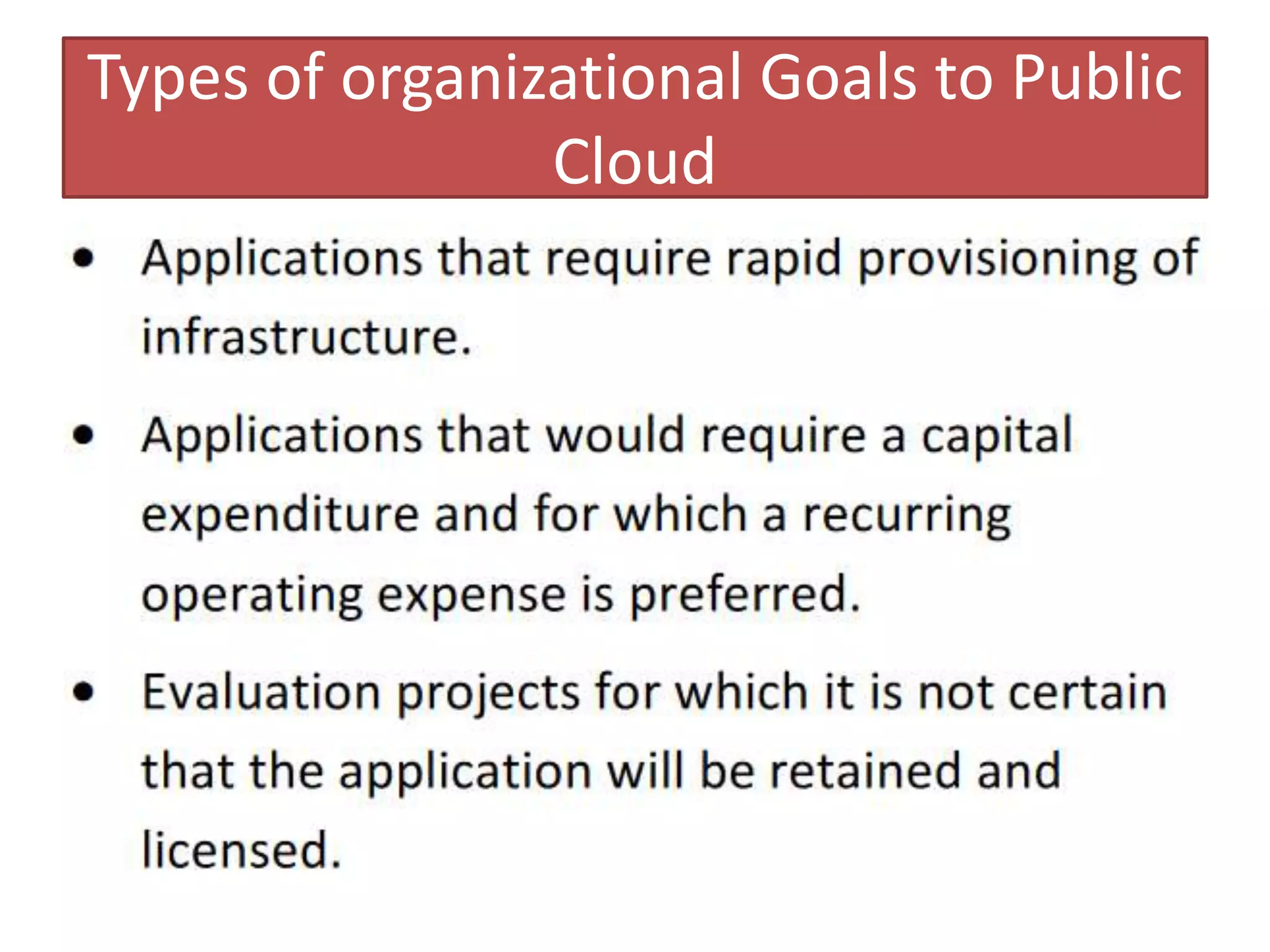
Types of organizational Goals to Public
Cloud
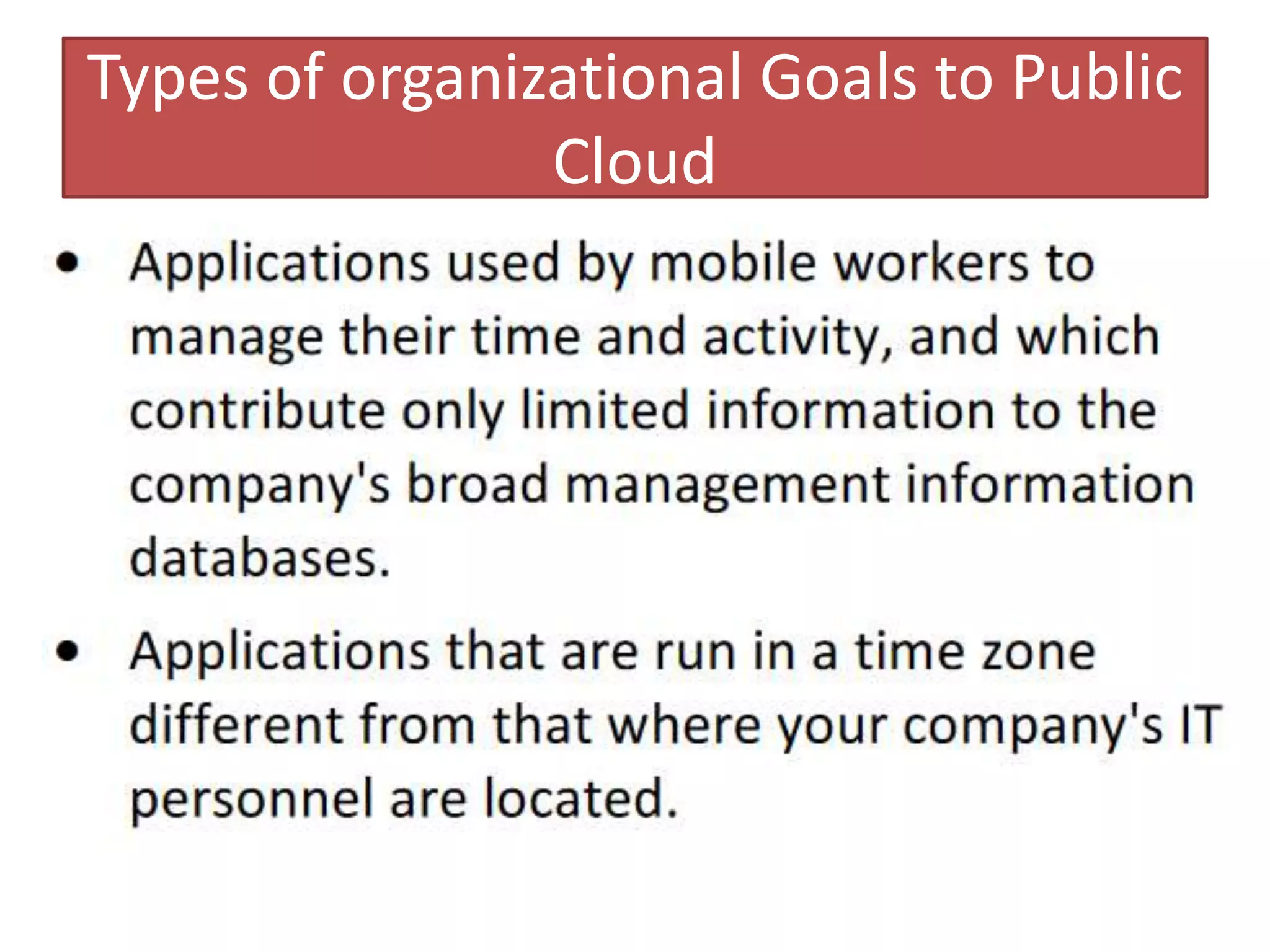
Types of organizational Goals to Public
Cloud
Types of organizational Goals to Public
Cloud
Types of organizational Goals to Public
Cloud
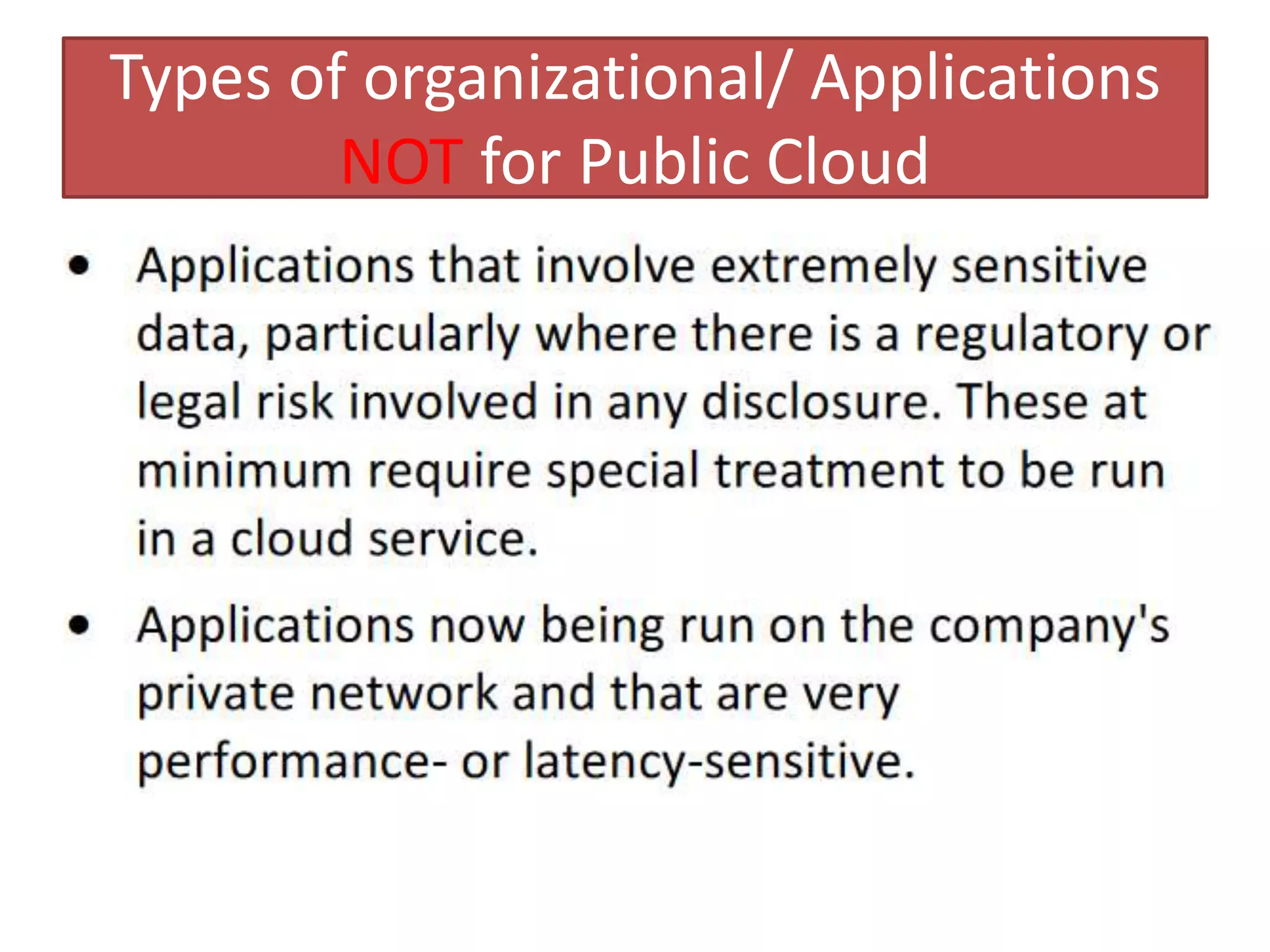
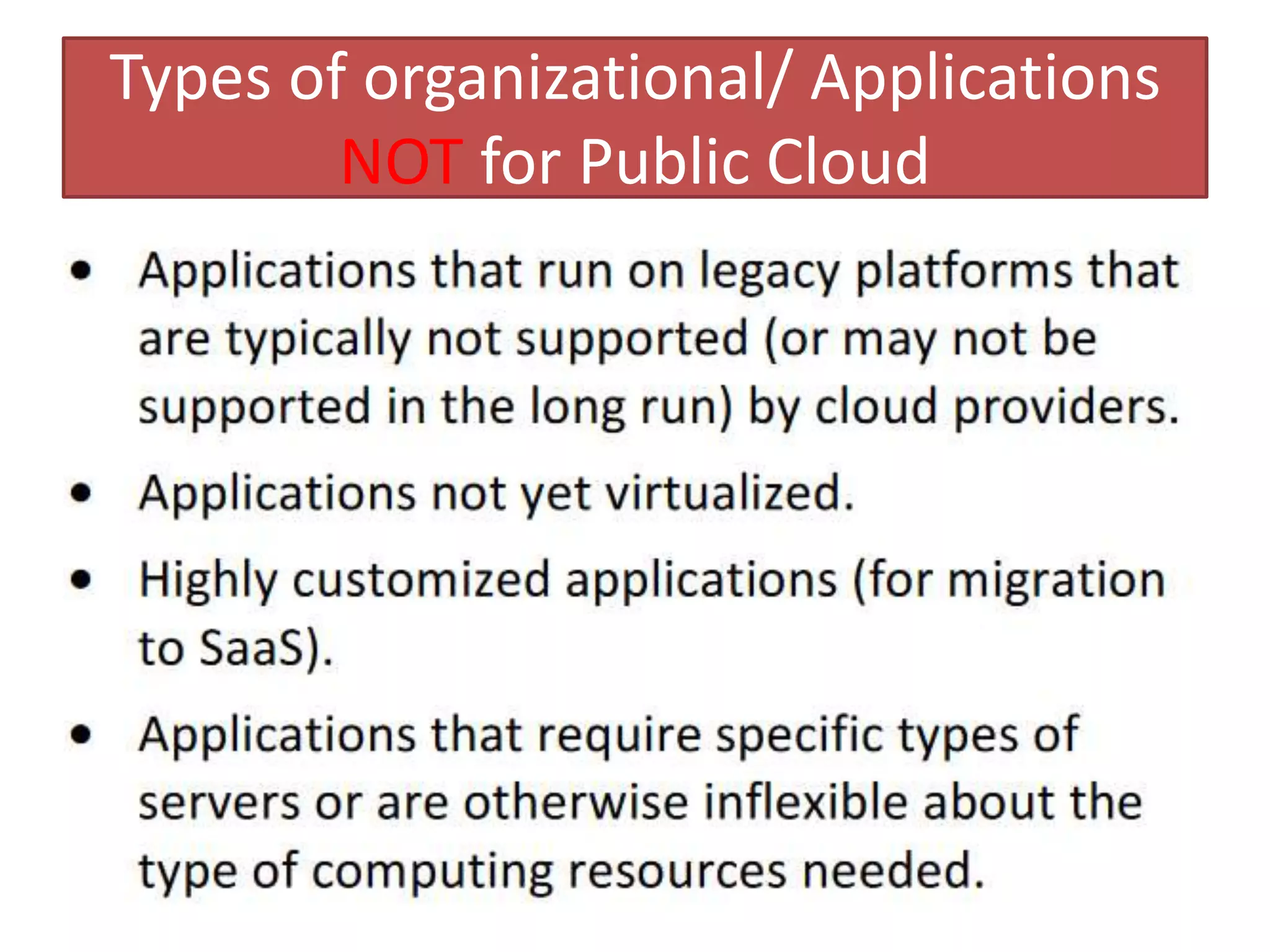
Types of organizational/ Applications
NOT for Public Cloud
Types of organizational/ Applications
NOT for Public Cloud
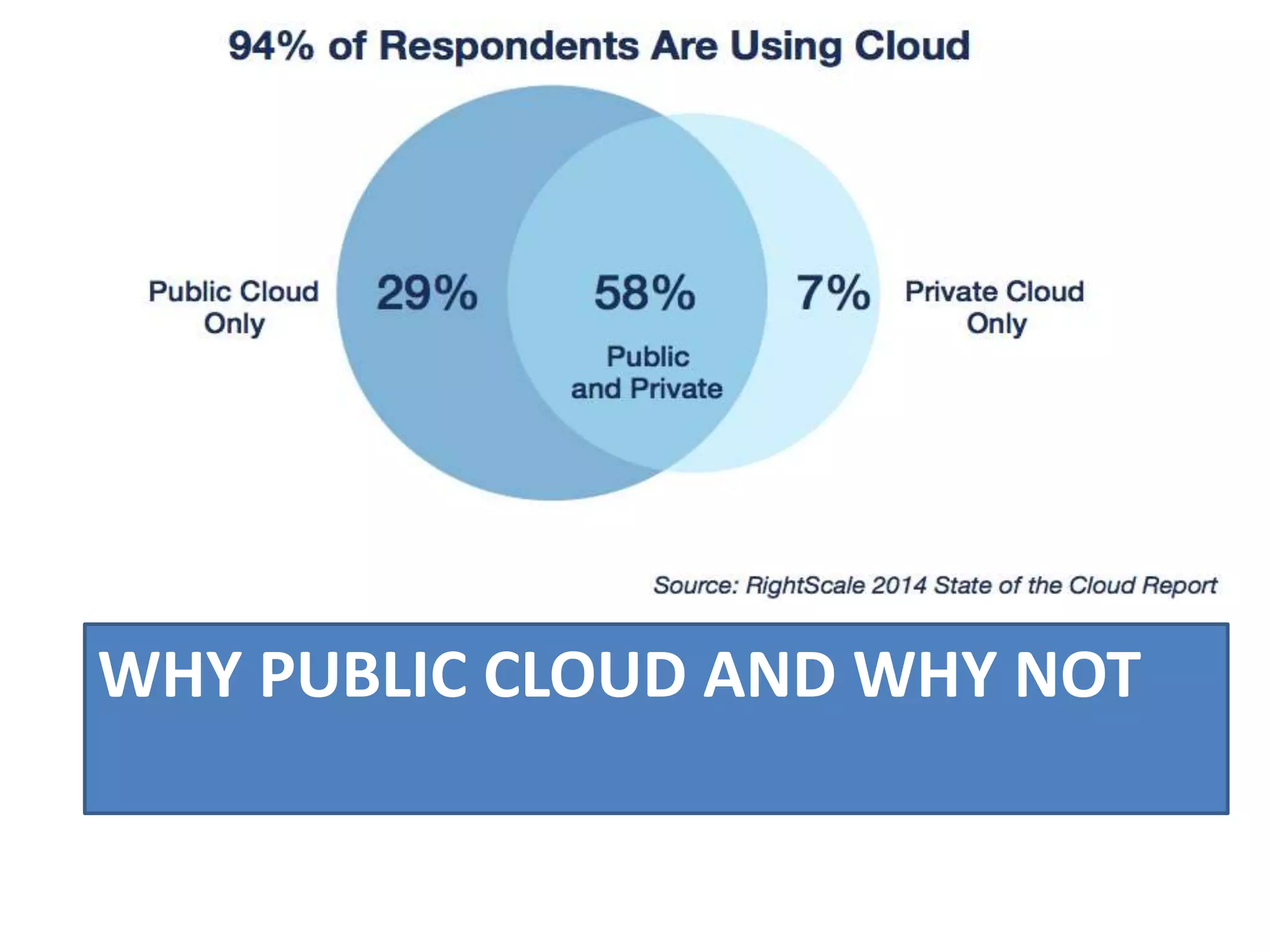
WHY PUBLIC CLOUD AND WHY NOT
Opportunities and Challenges
• The use of the cloud provides a number of
opportunities:
– It enables services to be used without any understanding
of their infrastructure.
– Cloud computing works using economies of scale:
• It potentially lowers the outlay expense for start up companies, as
they would no longer need to buy their own software or servers.
• Cost would be by on-demand pricing.
• Vendors and Service providers claim costs by establishing an
ongoing revenue stream.
– Data and services are stored remotely but accessible from
“anywhere”.
Opportunities and Challenges
• In parallel there has been backlash against cloud computing:
– Use of cloud computing means dependence on others and that could
possibly limit flexibility and innovation:
• The others are likely become the bigger Internet companies like Google
and IBM, who may monopolise the market.
• Some argue that this use of supercomputers is a return to the time of
mainframe computing that the PC was a reaction against.
– Security could prove to be a big issue:
• It is still unclear how safe out-sourced data is and when using these
services ownership of data is not always clear.
– There are also issues relating to policy and access:
• If your data is stored abroad whose policy do you adhere to?
• What happens if the remote server goes down?
• How will you then access files?
• There have been cases of users being locked out of accounts and losing
access to data.
ADVANTAGES OF PUBLIC CLOUD
Advantages of Public Cloud Computing
• Lower computer costs:
– You do not need a high-powered and high-priced computer
to run cloud computing's web-based applications.
– Since applications run in the cloud, not on the desktop PC,
your desktop PC does not need the processing power or hard
disk space demanded by traditional desktop software.
– When you are using web-based applications, your PC can be
less expensive, with a smaller hard disk, less memory, more
efficient processor...
– In fact, your PC in this scenario does not even need a CD or
DVD drive, as no software programs have to be loaded and
no document files need to be saved.
Advantages of Public Cloud Computing
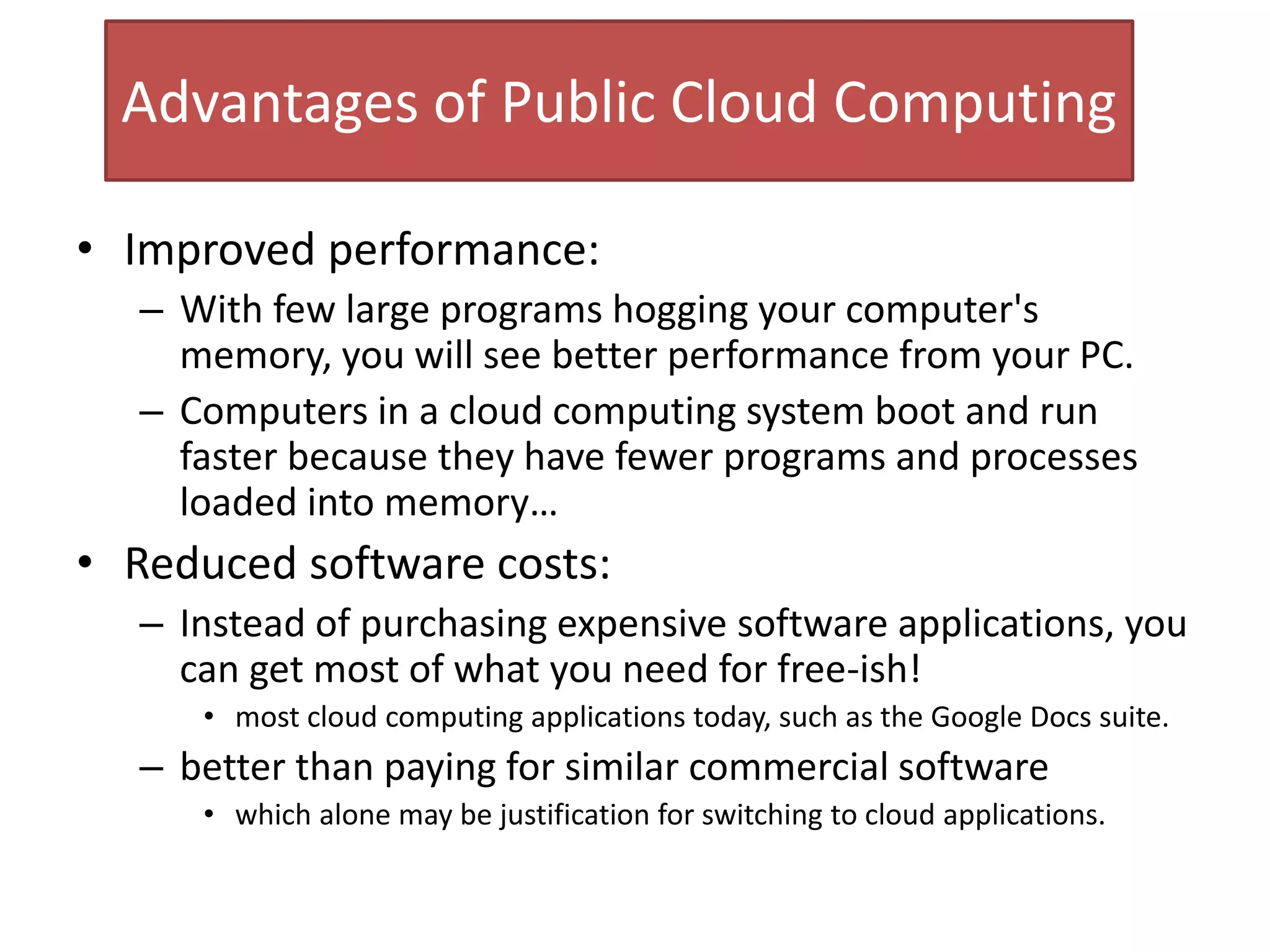
• Improved performance:
– With few large programs hogging your computer's
memory, you will see better performance from your PC.
– Computers in a cloud computing system boot and run
faster because they have fewer programs and processes
loaded into memory…
• Reduced software costs:
– Instead of purchasing expensive software applications, you
can get most of what you need for free-ish!
• most cloud computing applications today, such as the Google Docs suite.
– better than paying for similar commercial software
• which alone may be justification for switching to cloud applications.
Advantages of Public Cloud Computing
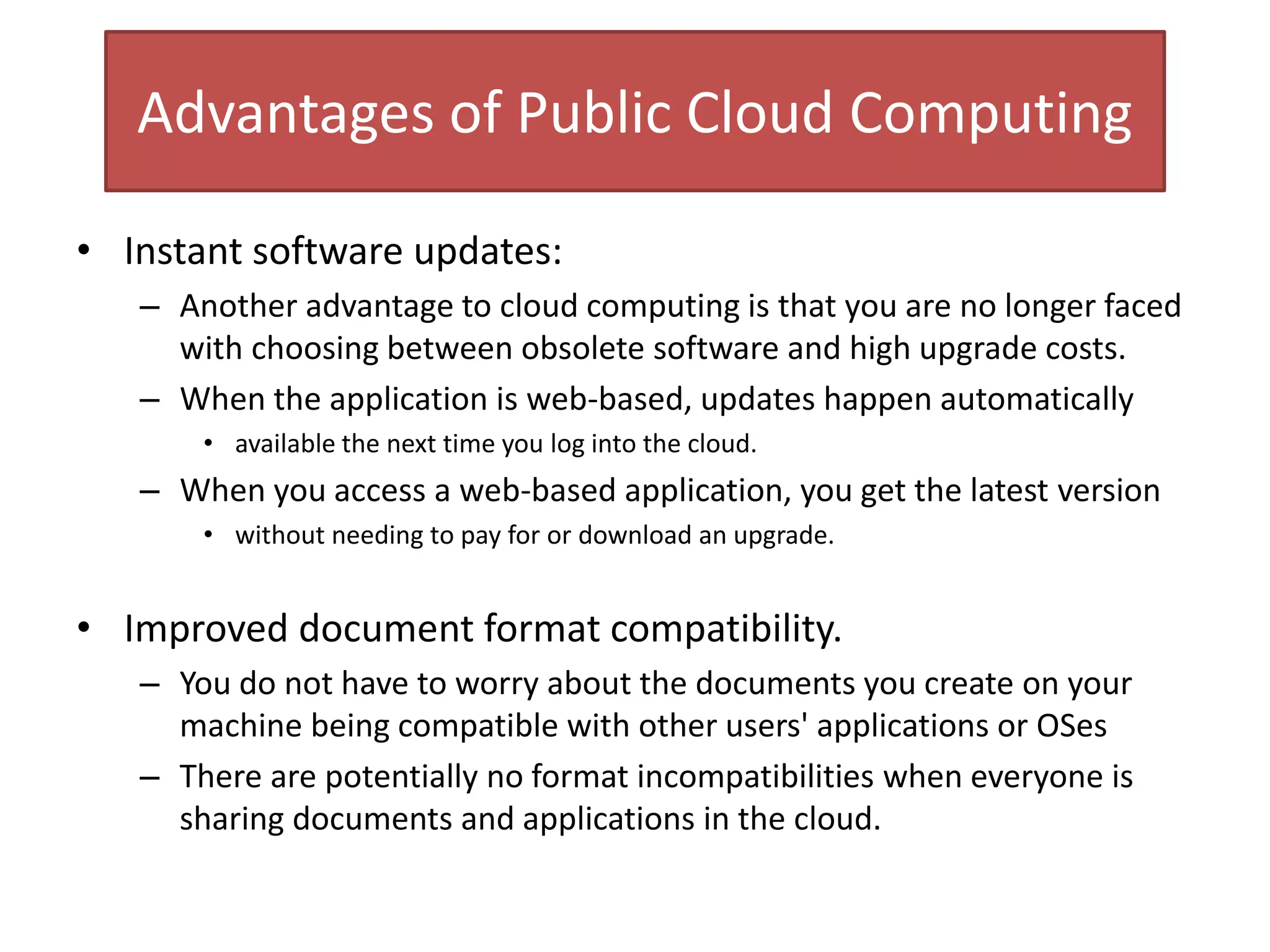
• Instant software updates:
– Another advantage to cloud computing is that you are no longer faced
with choosing between obsolete software and high upgrade costs.
– When the application is web-based, updates happen automatically
• available the next time you log into the cloud.
– When you access a web-based application, you get the latest version
• without needing to pay for or download an upgrade.
• Improved document format compatibility.
– You do not have to worry about the documents you create on your
machine being compatible with other users' applications or OSes
– There are potentially no format incompatibilities when everyone is
sharing documents and applications in the cloud.
Advantages of Public Cloud Computing
• Unlimited storage capacity:
– Cloud computing offers virtually limitless storage.
– Your computer's current 1 Tbyte hard drive is small
compared to the hundreds of Pbytes available in the cloud.
• Increased data reliability:
– Unlike desktop computing, in which if a hard disk crashes
and destroy all your valuable data, a computer crashing in
the cloud should not affect the storage of your data.
• if your personal computer crashes, all your data is still out there in
the cloud, still accessible
– In a world where few individual desktop PC users back up
their data on a regular basis, cloud computing is a data-
safe computing platform!
Advantages of Public Cloud Computing
• Universal document access:
– That is not a problem with cloud computing, because you
do not take your documents with you.
– Instead, they stay in the cloud, and you can access them
whenever you have a computer and an Internet connection
– Documents are instantly available from wherever you are
• Latest version availability:
– When you edit a document at home, that edited version is
what you see when you access the document at work.
– The cloud always hosts the latest version of your documents
• as long as you are connected, you are not in danger of having an outdated
version
Advantages of Public Cloud Computing
• Easier group collaboration:
– Sharing documents leads directly to better collaboration.
– Many users do this as it is an important advantages of cloud
computing
• multiple users can collaborate easily on documents and projects
• Device independence.
– You are no longer tethered to a single computer or network.
– Changes to computers, applications and documents follow
you through the cloud.
– Move to a portable device, and your applications and
documents are still available.
DISADVANTAGES OF PUBLIC CLOUD
Disadvantages of Public Cloud Computing
• Requires a constant Internet connection:
– Cloud computing is impossible if you cannot connect to the
Internet.
– Since you use the Internet to connect to both your
applications and documents, if you do not have an Internet
connection you cannot access anything, even your own
documents.
– A dead Internet connection means no work and in areas
where Internet connections are few or inherently
unreliable, this could be a deal-breaker.
Disadvantages of Public Cloud Computing
• Does not work well with low-speed connections:
– Similarly, a low-speed Internet connection, such as that
found with dial-up services, makes cloud computing
painful at best and often impossible.
– Web-based applications require a lot of bandwidth to
download, as do large documents.
• Features might be limited:
– This situation is bound to change, but today many web-
based applications simply are not as full-featured as their
desktop-based applications.
• For example, you can do a lot more with Microsoft PowerPoint
than with Google Presentation's web-based offering
Disadvantages of Public Cloud Computing
• Can be slow:
– Even with a fast connection, web-based applications can
sometimes be slower than accessing a similar software
program on your desktop PC.
– Everything about the program, from the interface to the
current document, has to be sent back and forth from your
computer to the computers in the cloud.
– If the cloud servers happen to be backed up at that
moment, or if the Internet is having a slow day, you would
not get the instantaneous access you might expect from
desktop applications.
Disadvantages of Public Cloud Computing
• Stored data might not be secure:
– With cloud computing, all your data is stored on the cloud.
• The questions is How secure is the cloud?
– Can unauthorized users gain access to your confidential data?
• Stored data can be lost:
– Theoretically, data stored in the cloud is safe, replicated
across multiple machines.
– But on the off chance that your data goes missing, you have
no physical or local backup.
• Put simply, relying on the cloud puts you at risk if the cloud lets you
down.
Disadvantages of Public Cloud Computing
• HPC Systems:
– Not clear that you can run compute-intensive HPC
applications that use MPI/OpenMP!
– Scheduling is important with this type of application
• as you want all the VM to be co-located to minimize communication
latency!
• General Concerns:
– Each cloud systems uses different protocols and different APIs
• may not be possible to run applications between cloud based systems
– Amazon has created its own DB system (not SQL 92), and
workflow system (many popular workflow systems out there)
• so your normal applications will have to be adapted to execute on
these platforms.
PUBLIC CLOUD SERVICE MODELS,
AND PUBLIC CLOUD PLAYERS
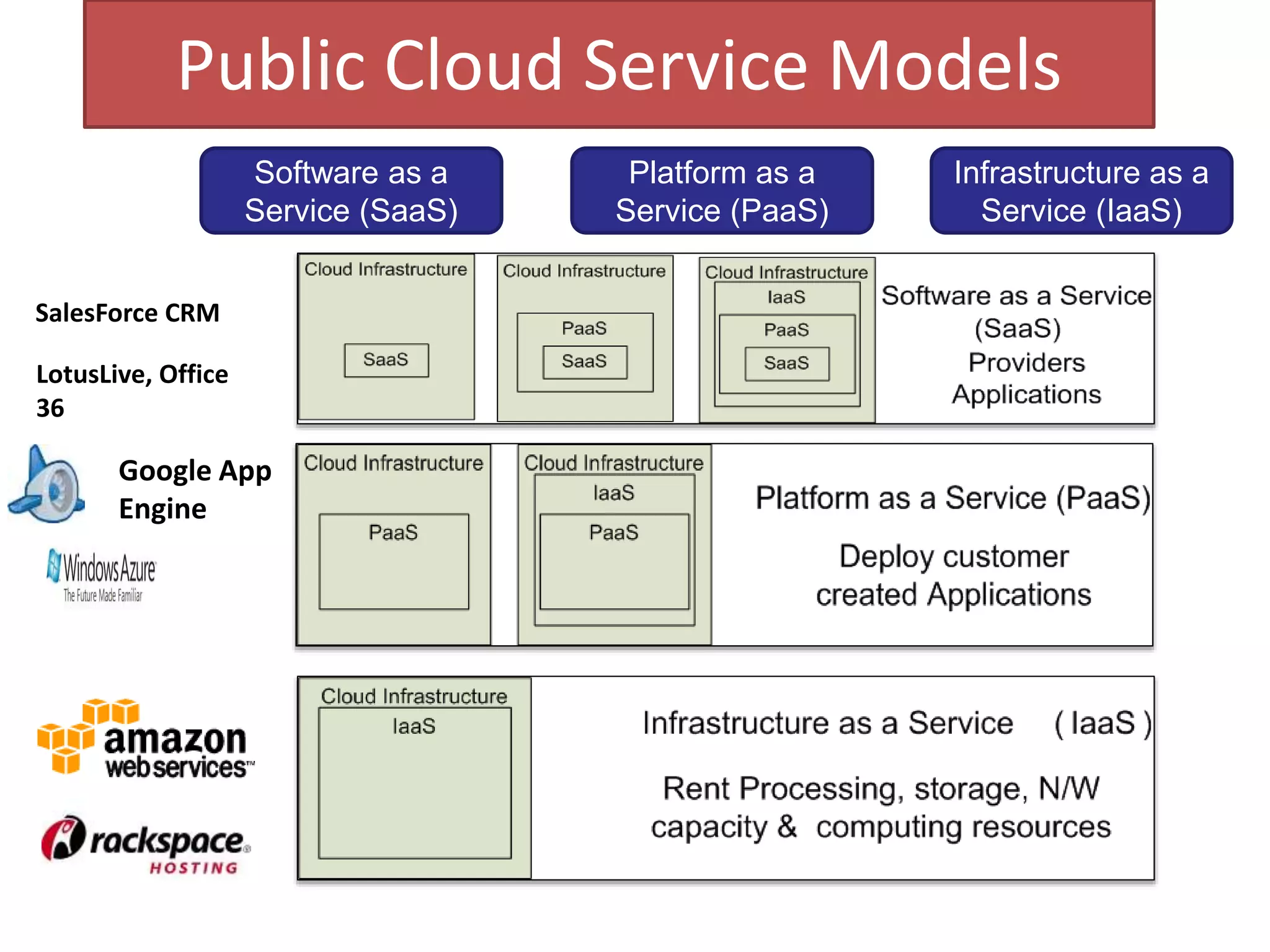
Public Cloud Service Models
Software as a
Service (SaaS)
Platform as a
Service (PaaS)
Infrastructure as a
Service (IaaS)
Google App
Engine
SalesForce CRM
LotusLive, Office
36
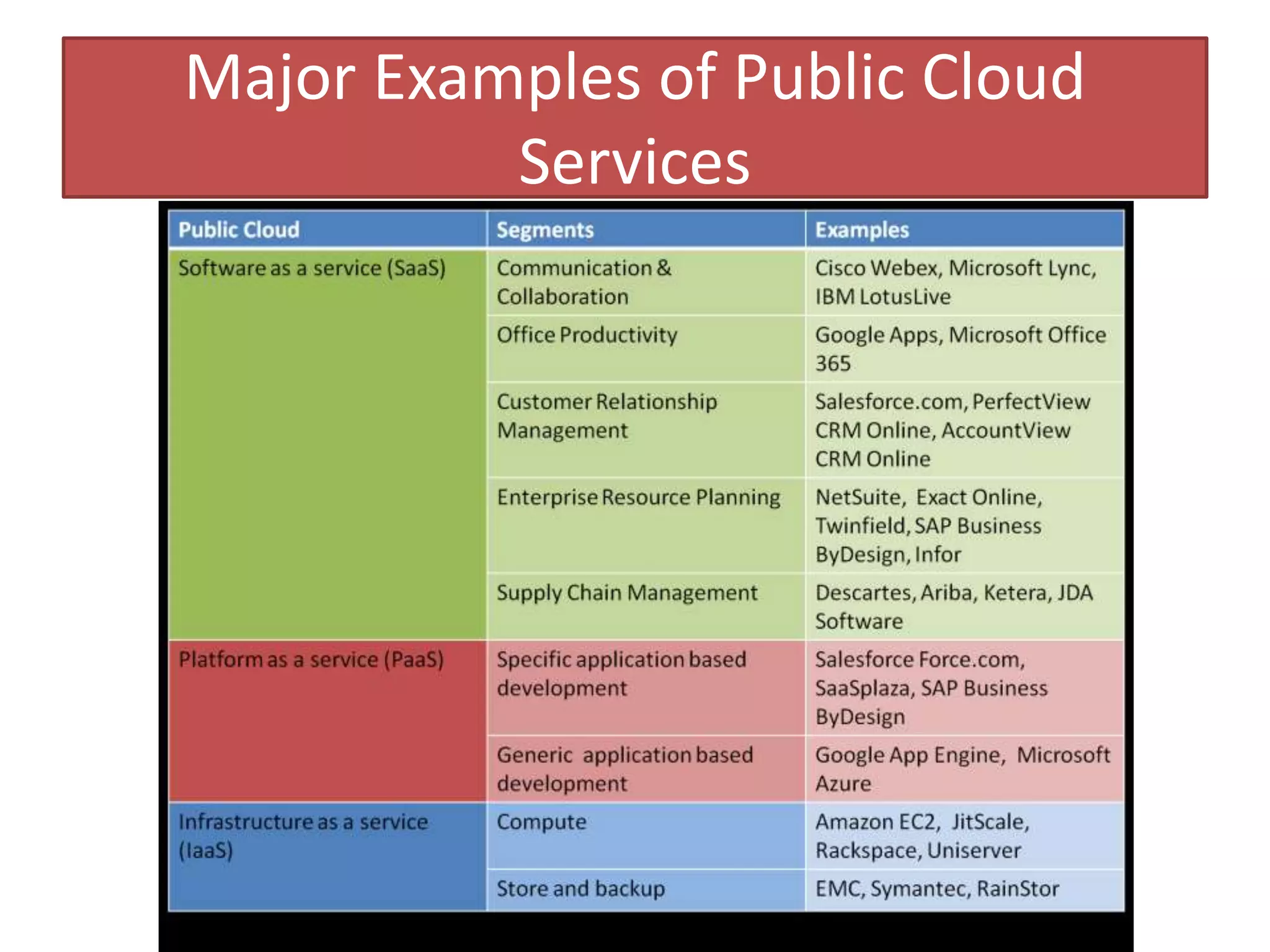
Major Examples of Public Cloud
Services
Introduction to public cloud

Introduction to public cloud

  • 1.
    WORKING WITH PUBLICCLOUDS by Ambrish Gangal
  • 2.
  • 3.
    What is PublicCloud ?? • A public cloud is one based on the standard cloud computing model, in which a service provider makes resources, such as virtual machines (VMs), applications or storage, available to the general public over the internet. • Public cloud services may be free or offered on a pay-per-usage model.
  • 4.
    BENEFITS OF USINGA PUBLIC CLOUD • The main benefits of using a public cloud service are: • it reduces the need for organizations to invest in and maintain their own on-premises IT resources; • it enables scalability to meet workload and user demands; and • there are fewer wasted resources because customers only pay for the resources they use. NOTE : Public cloud also include other major benefits of Cloud computing eg. Mobility ,etc
  • 5.
    WHEN TO OPTFOR PUBLIC CLOUD Which cloud deployment model to choose
  • 9.
    When to choosePublic Cloud ?
  • 10.
    When to choosePrivate Cloud ?
  • 11.
    Types of organizationalGoals to Public Cloud
  • 12.
    Types of organizationalGoals to Public Cloud
  • 13.
    Types of organizationalGoals to Public Cloud
  • 14.
    Types of organizationalGoals to Public Cloud
  • 15.
    Types of organizational/Applications NOT for Public Cloud
  • 16.
    Types of organizational/Applications NOT for Public Cloud
  • 17.
    WHY PUBLIC CLOUDAND WHY NOT
  • 18.
    Opportunities and Challenges •The use of the cloud provides a number of opportunities: – It enables services to be used without any understanding of their infrastructure. – Cloud computing works using economies of scale: • It potentially lowers the outlay expense for start up companies, as they would no longer need to buy their own software or servers. • Cost would be by on-demand pricing. • Vendors and Service providers claim costs by establishing an ongoing revenue stream. – Data and services are stored remotely but accessible from “anywhere”.
  • 19.
    Opportunities and Challenges •In parallel there has been backlash against cloud computing: – Use of cloud computing means dependence on others and that could possibly limit flexibility and innovation: • The others are likely become the bigger Internet companies like Google and IBM, who may monopolise the market. • Some argue that this use of supercomputers is a return to the time of mainframe computing that the PC was a reaction against. – Security could prove to be a big issue: • It is still unclear how safe out-sourced data is and when using these services ownership of data is not always clear. – There are also issues relating to policy and access: • If your data is stored abroad whose policy do you adhere to? • What happens if the remote server goes down? • How will you then access files? • There have been cases of users being locked out of accounts and losing access to data.
  • 20.
  • 21.
    Advantages of PublicCloud Computing • Lower computer costs: – You do not need a high-powered and high-priced computer to run cloud computing's web-based applications. – Since applications run in the cloud, not on the desktop PC, your desktop PC does not need the processing power or hard disk space demanded by traditional desktop software. – When you are using web-based applications, your PC can be less expensive, with a smaller hard disk, less memory, more efficient processor... – In fact, your PC in this scenario does not even need a CD or DVD drive, as no software programs have to be loaded and no document files need to be saved.
  • 22.
    Advantages of PublicCloud Computing • Improved performance: – With few large programs hogging your computer's memory, you will see better performance from your PC. – Computers in a cloud computing system boot and run faster because they have fewer programs and processes loaded into memory… • Reduced software costs: – Instead of purchasing expensive software applications, you can get most of what you need for free-ish! • most cloud computing applications today, such as the Google Docs suite. – better than paying for similar commercial software • which alone may be justification for switching to cloud applications.
  • 23.
    Advantages of PublicCloud Computing • Instant software updates: – Another advantage to cloud computing is that you are no longer faced with choosing between obsolete software and high upgrade costs. – When the application is web-based, updates happen automatically • available the next time you log into the cloud. – When you access a web-based application, you get the latest version • without needing to pay for or download an upgrade. • Improved document format compatibility. – You do not have to worry about the documents you create on your machine being compatible with other users' applications or OSes – There are potentially no format incompatibilities when everyone is sharing documents and applications in the cloud.
  • 24.
    Advantages of PublicCloud Computing • Unlimited storage capacity: – Cloud computing offers virtually limitless storage. – Your computer's current 1 Tbyte hard drive is small compared to the hundreds of Pbytes available in the cloud. • Increased data reliability: – Unlike desktop computing, in which if a hard disk crashes and destroy all your valuable data, a computer crashing in the cloud should not affect the storage of your data. • if your personal computer crashes, all your data is still out there in the cloud, still accessible – In a world where few individual desktop PC users back up their data on a regular basis, cloud computing is a data- safe computing platform!
  • 25.
    Advantages of PublicCloud Computing • Universal document access: – That is not a problem with cloud computing, because you do not take your documents with you. – Instead, they stay in the cloud, and you can access them whenever you have a computer and an Internet connection – Documents are instantly available from wherever you are • Latest version availability: – When you edit a document at home, that edited version is what you see when you access the document at work. – The cloud always hosts the latest version of your documents • as long as you are connected, you are not in danger of having an outdated version
  • 26.
    Advantages of PublicCloud Computing • Easier group collaboration: – Sharing documents leads directly to better collaboration. – Many users do this as it is an important advantages of cloud computing • multiple users can collaborate easily on documents and projects • Device independence. – You are no longer tethered to a single computer or network. – Changes to computers, applications and documents follow you through the cloud. – Move to a portable device, and your applications and documents are still available.
  • 27.
  • 28.
    Disadvantages of PublicCloud Computing • Requires a constant Internet connection: – Cloud computing is impossible if you cannot connect to the Internet. – Since you use the Internet to connect to both your applications and documents, if you do not have an Internet connection you cannot access anything, even your own documents. – A dead Internet connection means no work and in areas where Internet connections are few or inherently unreliable, this could be a deal-breaker.
  • 29.
    Disadvantages of PublicCloud Computing • Does not work well with low-speed connections: – Similarly, a low-speed Internet connection, such as that found with dial-up services, makes cloud computing painful at best and often impossible. – Web-based applications require a lot of bandwidth to download, as do large documents. • Features might be limited: – This situation is bound to change, but today many web- based applications simply are not as full-featured as their desktop-based applications. • For example, you can do a lot more with Microsoft PowerPoint than with Google Presentation's web-based offering
  • 30.
    Disadvantages of PublicCloud Computing • Can be slow: – Even with a fast connection, web-based applications can sometimes be slower than accessing a similar software program on your desktop PC. – Everything about the program, from the interface to the current document, has to be sent back and forth from your computer to the computers in the cloud. – If the cloud servers happen to be backed up at that moment, or if the Internet is having a slow day, you would not get the instantaneous access you might expect from desktop applications.
  • 31.
    Disadvantages of PublicCloud Computing • Stored data might not be secure: – With cloud computing, all your data is stored on the cloud. • The questions is How secure is the cloud? – Can unauthorized users gain access to your confidential data? • Stored data can be lost: – Theoretically, data stored in the cloud is safe, replicated across multiple machines. – But on the off chance that your data goes missing, you have no physical or local backup. • Put simply, relying on the cloud puts you at risk if the cloud lets you down.
  • 32.
    Disadvantages of PublicCloud Computing • HPC Systems: – Not clear that you can run compute-intensive HPC applications that use MPI/OpenMP! – Scheduling is important with this type of application • as you want all the VM to be co-located to minimize communication latency! • General Concerns: – Each cloud systems uses different protocols and different APIs • may not be possible to run applications between cloud based systems – Amazon has created its own DB system (not SQL 92), and workflow system (many popular workflow systems out there) • so your normal applications will have to be adapted to execute on these platforms.
  • 33.
    PUBLIC CLOUD SERVICEMODELS, AND PUBLIC CLOUD PLAYERS
  • 34.
    Public Cloud ServiceModels Software as a Service (SaaS) Platform as a Service (PaaS) Infrastructure as a Service (IaaS) Google App Engine SalesForce CRM LotusLive, Office 36
  • 35.
    Major Examples ofPublic Cloud Services

Editor's Notes

  • #20 Freedom of Information == FOI
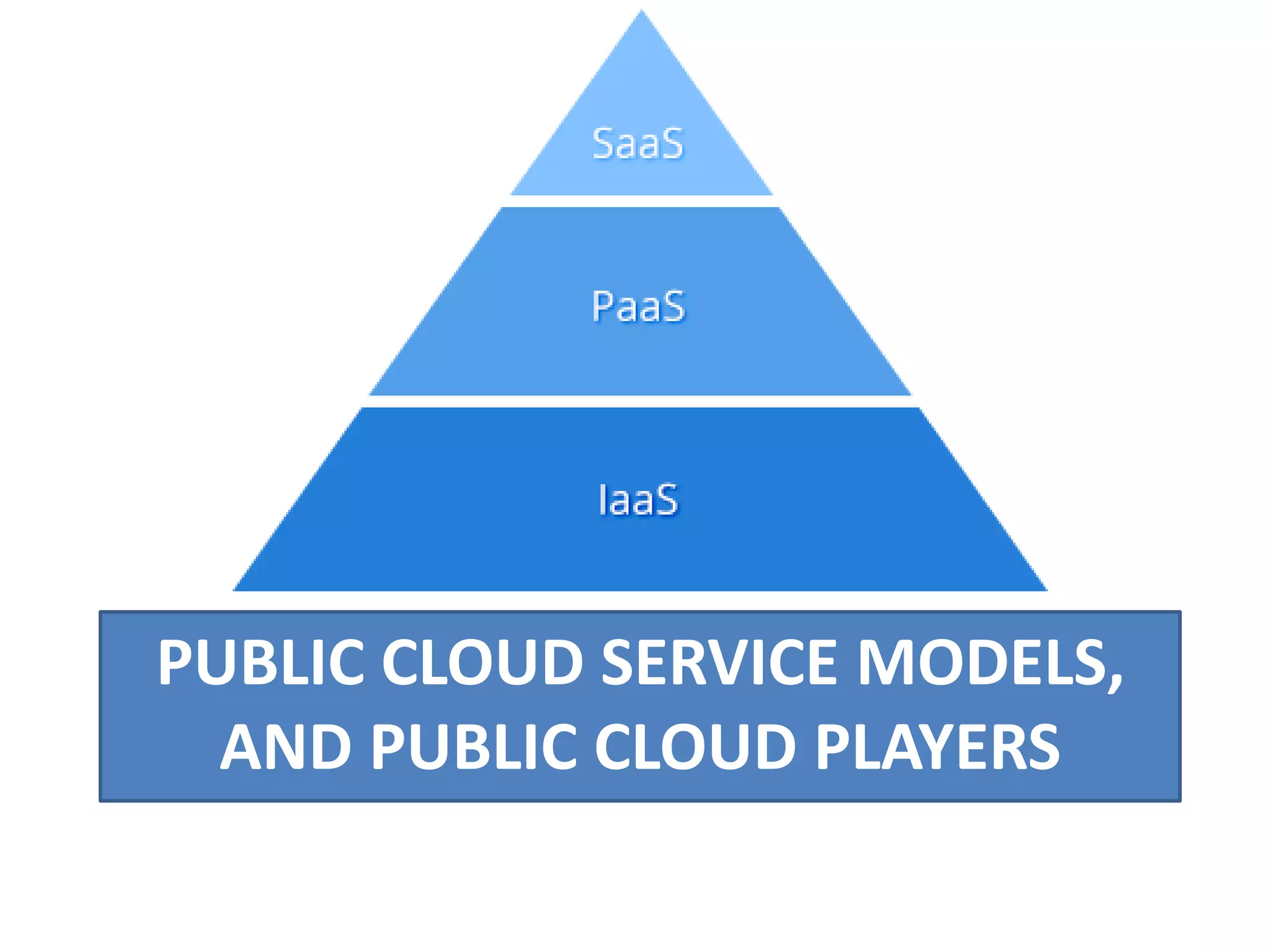
  • #35 IaaSdelivers computer infrastructure, typically a platform virtualization environment, as a service. Rather than purchasing servers, software, data center space or network equipment, clients instead buy those resources as a fully outsourced service. PaaSdeliver a computing platform where the developers can develop their own applications. SaaSis a model of software deployment where the software applications are provided to the customers as a service.