11
IntroductionIntroduction
to the Plantto the Plant
KingdomKingdom
copyright cmassengalecopyright cmassengale
22
Early AncestorsEarly Ancestors
Aquatic to TerrestrialAquatic to Terrestrial
LifeLife
copyright cmassengalecopyright cmassengale
33
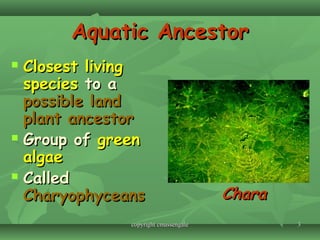
Aquatic AncestorAquatic Ancestor
 Closest livingClosest living
speciesspecies to ato a
possible landpossible land
plant ancestorplant ancestor
 Group ofGroup of greengreen
algaealgae
 CalledCalled
CharyophyceansCharyophyceans CharaChara
copyright cmassengalecopyright cmassengale
44
Algae & Land PlantAlgae & Land Plant
SimilaritiesSimilarities
 Both containBoth contain chlorophyllschlorophylls aa andand bb
 HaveHave chloroplastschloroplasts with stacks ofwith stacks of
thylakoidsthylakoids
 StoreStore starchstarch inin plastidsplastids
 CelluloseCellulose inin cell wallscell walls
 Go throughGo through Alternation of GenerationsAlternation of Generations
life Cyclelife Cycle
copyright cmassengalecopyright cmassengale
55
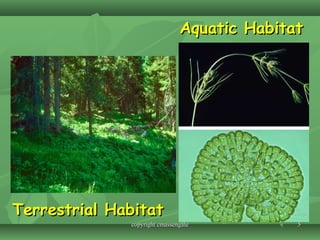
Terrestrial HabitatTerrestrial Habitat
Aquatic HabitatAquatic Habitat
copyright cmassengalecopyright cmassengale
66
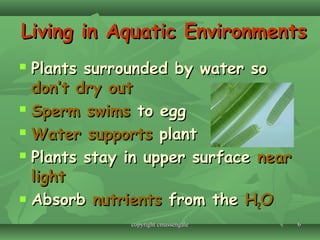
Living in Aquatic EnvironmentsLiving in Aquatic Environments
 Plants surrounded by water soPlants surrounded by water so
don’t dry outdon’t dry out
 Sperm swimsSperm swims to eggto egg
 Water supportsWater supports plantplant
 Plants stay in upper surfacePlants stay in upper surface nearnear
lightlight
 AbsorbAbsorb nutrientsnutrients from thefrom the HH22OO
copyright cmassengalecopyright cmassengale
77
Plant Adaptations to LandPlant Adaptations to Land
Problems:Problems:
 Need mineralsNeed minerals
 GravityGravity
 Increase inIncrease in
Height for LightHeight for Light
 Adaptations forAdaptations for
DrierDrier
environmentenvironment
 ReproductionReproduction
Solutions:Solutions:
 RootsRoots absorb Habsorb H22O &O &
mineralsminerals
 Lignin & celluloseLignin & cellulose in cellin cell
wallswalls
 VascularVascular TransportTransport
SystemSystem
 Waxy cuticleWaxy cuticle &&
stomatastomata with guardwith guard
cellscells
 PollenPollen containing spermcontaining spermcopyright cmassengalecopyright cmassengale
88
How Are PlantsHow Are Plants
All Alike?All Alike?
copyright cmassengalecopyright cmassengale
99
Plant CharacteristicsPlant Characteristics
 MulticellularMulticellular
 AutotrophicAutotrophic (photosynthesis)(photosynthesis)
 ChlorophyllsChlorophylls aa andand bb in thylakoidin thylakoid
membranesmembranes
 Surrounded bySurrounded by cell wallscell walls containingcontaining
cellulose (polysaccharide)cellulose (polysaccharide)
 Store reserve food asStore reserve food as amyloseamylose
(starch)(starch)
copyright cmassengalecopyright cmassengale
1010
Plant ReproductionPlant Reproduction
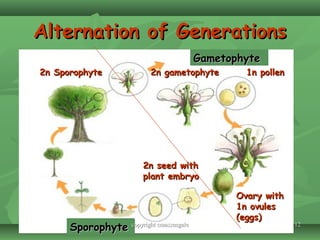
 Alternation of generationsAlternation of generations lifelife
cyclecycle
 Diploid (2n)Diploid (2n) sporophytesporophyte stagestage
 Haploid (1n)Haploid (1n) gametophytegametophyte stagestage
 ProduceProduce multicellular embryomulticellular embryo
protectedprotected inside multicellularinside multicellular
haploidhaploid (gametophyte egg sac)(gametophyte egg sac)
tissuetissue
copyright cmassengalecopyright cmassengale
1111
Plant ReproductionPlant Reproduction
 Diploid (2n)Diploid (2n) sporophytesporophyte stagestage
producesproduces haploid sporeshaploid spores byby
meiosismeiosis
 Haploid spores undergoHaploid spores undergo mitosismitosis toto
produceproduce gametophytegametophyte stagestage
 Gametophyte makesGametophyte makes gametesgametes
(eggs and sperm)(eggs and sperm) byby meiosismeiosis
 ZygoteZygote (2n) produces the new(2n) produces the new
sporophytesporophyte
copyright cmassengalecopyright cmassengale
1212
Alternation of GenerationsAlternation of Generations
2n Sporophyte2n Sporophyte 2n gametophyte2n gametophyte 1n pollen1n pollen
Ovary withOvary with
1n ovules1n ovules
(eggs)(eggs)
2n seed with2n seed with
plant embryoplant embryo
SporophyteSporophyte
GametophyteGametophyte
copyright cmassengalecopyright cmassengale
1313
PlantPlant
DivisionsDivisions
copyright cmassengalecopyright cmassengale
1414
TaxonomyTaxonomy
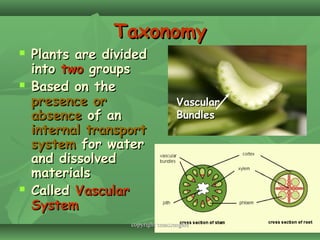
 Plants are dividedPlants are divided
intointo twotwo groupsgroups
 Based on theBased on the
presence orpresence or
absenceabsence of anof an
internal transportinternal transport
systemsystem for waterfor water
and dissolvedand dissolved
materialsmaterials
 CalledCalled VascularVascular
SystemSystem
VascularVascular
BundlesBundles
copyright cmassengalecopyright cmassengale
1515
Vascular SystemVascular System
 XylemXylem tissue carriestissue carries waterwater andand
mineralsminerals upward from the rootsupward from the roots
 PhloemPhloem tissue carriestissue carries sugarssugars mademade
by photosynthesis from the leavesby photosynthesis from the leaves
to where they will be stored orto where they will be stored or
usedused
 SapSap is the fluid carried inside theis the fluid carried inside the
xylem or phloemxylem or phloem
copyright cmassengalecopyright cmassengale
1616
Nonvascular PlantsNonvascular Plants
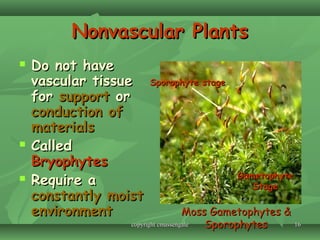
 Do not haveDo not have
vascular tissuevascular tissue
forfor supportsupport oror
conduction ofconduction of
materialsmaterials
 CalledCalled
BryophytesBryophytes
 Require aRequire a
constantly moistconstantly moist
environmentenvironment Moss Gametophytes &Moss Gametophytes &
SporophytesSporophytes
Sporophyte stageSporophyte stage
GametophyteGametophyte
StageStage
copyright cmassengalecopyright cmassengale
1717
Nonvascular PlantsNonvascular Plants
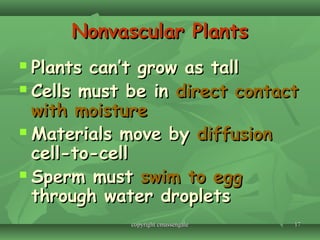
 Plants can’t grow as tallPlants can’t grow as tall
 Cells must be inCells must be in direct contactdirect contact
with moisturewith moisture
 Materials move byMaterials move by diffusiondiffusion
cell-to-cellcell-to-cell
 Sperm mustSperm must swim to eggswim to egg
through water dropletsthrough water droplets
copyright cmassengalecopyright cmassengale
1818
Nonvascular PlantsNonvascular Plants
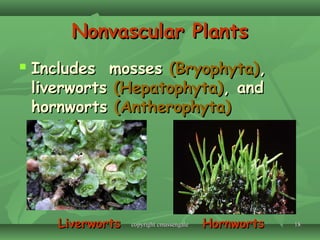
 Includes mossesIncludes mosses (Bryophyta)(Bryophyta),,
liverwortsliverworts (Hepatophyta)(Hepatophyta), and, and
hornwortshornworts (Antherophyta)(Antherophyta)
LiverwortsLiverworts HornwortsHornwortscopyright cmassengalecopyright cmassengale
1919
Main Parts of VascularMain Parts of Vascular
PlantsPlants
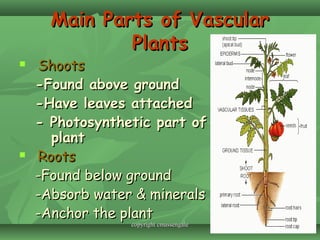
 ShootsShoots
-Found above ground-Found above ground
-Have leaves attached-Have leaves attached
- Photosynthetic part of- Photosynthetic part of
plantplant
 RootsRoots
-Found below ground-Found below ground
-Absorb water & minerals-Absorb water & minerals
-Anchor the plant-Anchor the plant
copyright cmassengalecopyright cmassengale
2020
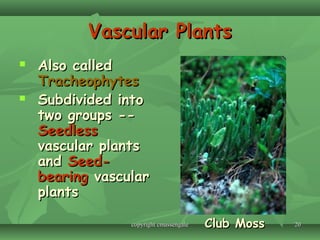
Vascular PlantsVascular Plants
 Also calledAlso called
TracheophytesTracheophytes
 Subdivided intoSubdivided into
two groups --two groups --
SeedlessSeedless
vascular plantsvascular plants
andand Seed-Seed-
bearingbearing vascularvascular
plantsplants
Club MossClub Mosscopyright cmassengalecopyright cmassengale
2121
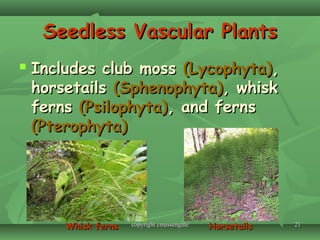
Seedless Vascular PlantsSeedless Vascular Plants
 Includes club mossIncludes club moss (Lycophyta)(Lycophyta),,
horsetailshorsetails (Sphenophyta)(Sphenophyta), whisk, whisk
fernsferns (Psilophyta)(Psilophyta), and ferns, and ferns
(Pterophyta)(Pterophyta)
HorsetailsHorsetailsWhisk fernsWhisk ferns copyright cmassengalecopyright cmassengale
2222
Seed-Producing VascularSeed-Producing Vascular
PlantsPlants
 Includes two groups –Includes two groups –
GymnospermsGymnosperms andand AngiospermsAngiosperms
 GymnospermsGymnosperms havehave naked seedsnaked seeds inin
conescones
 AngiospermsAngiosperms havehave flowers thatflowers that
produce seedsproduce seeds to attractto attract
pollinators and produce seedspollinators and produce seeds
copyright cmassengalecopyright cmassengale
2323
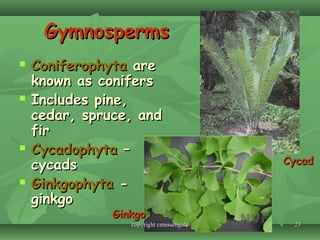
GymnospermsGymnosperms
 ConiferophytaConiferophyta areare
known as conifersknown as conifers
 Includes pine,Includes pine,
cedar, spruce, andcedar, spruce, and
firfir
 CycadophytaCycadophyta ––
cycadscycads
 GinkgophytaGinkgophyta --
ginkgoginkgo
GinkgoGinkgo
CycadCycad
copyright cmassengalecopyright cmassengale
2424
GymnospermsGymnosperms
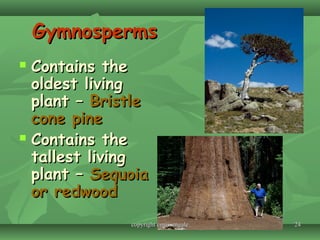
 Contains theContains the
oldest livingoldest living
plant –plant – BristleBristle
cone pinecone pine
 Contains theContains the
tallest livingtallest living
plant –plant – SequoiaSequoia
or redwoodor redwood
copyright cmassengalecopyright cmassengale
2525
AngiospermsAngiosperms
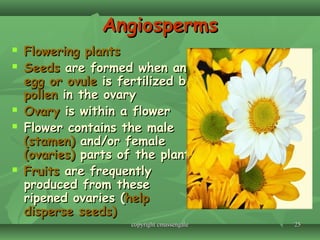
 Flowering plantsFlowering plants
 SeedsSeeds are formed when anare formed when an
egg or ovuleegg or ovule is fertilized byis fertilized by
pollenpollen in the ovaryin the ovary
 OvaryOvary is within a floweris within a flower
 Flower contains the maleFlower contains the male
(stamen)(stamen) and/or femaleand/or female
(ovaries)(ovaries) parts of the plantparts of the plant
 FruitsFruits are frequentlyare frequently
produced from theseproduced from these
ripened ovaries (ripened ovaries (helphelp
disperse seeds)disperse seeds)
copyright cmassengalecopyright cmassengale
2626
AngiospermsAngiosperms
 DivisionDivision AnthophytaAnthophyta
 Subdivided into two groups –Subdivided into two groups –
Monocots and DicotsMonocots and Dicots
 MonocotsMonocots have a single seedhave a single seed
cotyledoncotyledon
 DicotsDicots have two seed cotyledonshave two seed cotyledons
copyright cmassengalecopyright cmassengale
2727
MonocotsMonocots
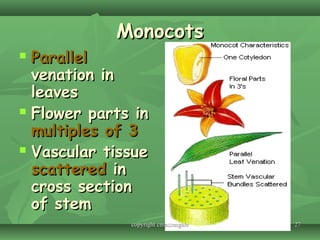
 ParallelParallel
venation invenation in
leavesleaves
 Flower parts inFlower parts in
multiples of 3multiples of 3
 Vascular tissueVascular tissue
scatteredscattered inin
cross sectioncross section
of stemof stem
copyright cmassengalecopyright cmassengale
2828
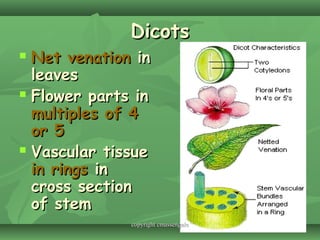
DicotsDicots
 Net venationNet venation inin
leavesleaves
 Flower parts inFlower parts in
multiples of 4multiples of 4
or 5or 5
 Vascular tissueVascular tissue
in ringsin rings inin
cross sectioncross section
of stemof stem
copyright cmassengalecopyright cmassengale
2929
Plant UsesPlant Uses
copyright cmassengalecopyright cmassengale
3030
Why We Can’t do WithoutWhy We Can’t do Without
Plants!Plants!
 Produce oxygen for theProduce oxygen for the
atmosphereatmosphere
 Produce lumber for buildingProduce lumber for building
 Provide homes and food for manyProvide homes and food for many
organismsorganisms
 Prevent erosionPrevent erosion
 Used for foodUsed for food
copyright cmassengalecopyright cmassengale
3131
More Reasons We Can’t doMore Reasons We Can’t do
Without Plants!Without Plants!
 Produce wood pulp for paperProduce wood pulp for paper
productsproducts
 Source of many medicinesSource of many medicines
 Ornamental and shade for yardsOrnamental and shade for yards
 Fibers such as cotton for fabricFibers such as cotton for fabric
 DyesDyes
copyright cmassengalecopyright cmassengale
3232copyright cmassengalecopyright cmassengale

Introduction to plants

  • 1.
    11 IntroductionIntroduction to the Planttothe Plant KingdomKingdom copyright cmassengalecopyright cmassengale
  • 2.
    22 Early AncestorsEarly Ancestors Aquaticto TerrestrialAquatic to Terrestrial LifeLife copyright cmassengalecopyright cmassengale
  • 3.
    33 Aquatic AncestorAquatic Ancestor Closest livingClosest living speciesspecies to ato a possible landpossible land plant ancestorplant ancestor  Group ofGroup of greengreen algaealgae  CalledCalled CharyophyceansCharyophyceans CharaChara copyright cmassengalecopyright cmassengale
  • 4.
    44 Algae & LandPlantAlgae & Land Plant SimilaritiesSimilarities  Both containBoth contain chlorophyllschlorophylls aa andand bb  HaveHave chloroplastschloroplasts with stacks ofwith stacks of thylakoidsthylakoids  StoreStore starchstarch inin plastidsplastids  CelluloseCellulose inin cell wallscell walls  Go throughGo through Alternation of GenerationsAlternation of Generations life Cyclelife Cycle copyright cmassengalecopyright cmassengale
  • 5.
    55 Terrestrial HabitatTerrestrial Habitat AquaticHabitatAquatic Habitat copyright cmassengalecopyright cmassengale
  • 6.
    66 Living in AquaticEnvironmentsLiving in Aquatic Environments  Plants surrounded by water soPlants surrounded by water so don’t dry outdon’t dry out  Sperm swimsSperm swims to eggto egg  Water supportsWater supports plantplant  Plants stay in upper surfacePlants stay in upper surface nearnear lightlight  AbsorbAbsorb nutrientsnutrients from thefrom the HH22OO copyright cmassengalecopyright cmassengale
  • 7.
    77 Plant Adaptations toLandPlant Adaptations to Land Problems:Problems:  Need mineralsNeed minerals  GravityGravity  Increase inIncrease in Height for LightHeight for Light  Adaptations forAdaptations for DrierDrier environmentenvironment  ReproductionReproduction Solutions:Solutions:  RootsRoots absorb Habsorb H22O &O & mineralsminerals  Lignin & celluloseLignin & cellulose in cellin cell wallswalls  VascularVascular TransportTransport SystemSystem  Waxy cuticleWaxy cuticle && stomatastomata with guardwith guard cellscells  PollenPollen containing spermcontaining spermcopyright cmassengalecopyright cmassengale
  • 8.
    88 How Are PlantsHowAre Plants All Alike?All Alike? copyright cmassengalecopyright cmassengale
  • 9.
    99 Plant CharacteristicsPlant Characteristics MulticellularMulticellular  AutotrophicAutotrophic (photosynthesis)(photosynthesis)  ChlorophyllsChlorophylls aa andand bb in thylakoidin thylakoid membranesmembranes  Surrounded bySurrounded by cell wallscell walls containingcontaining cellulose (polysaccharide)cellulose (polysaccharide)  Store reserve food asStore reserve food as amyloseamylose (starch)(starch) copyright cmassengalecopyright cmassengale
  • 10.
    1010 Plant ReproductionPlant Reproduction Alternation of generationsAlternation of generations lifelife cyclecycle  Diploid (2n)Diploid (2n) sporophytesporophyte stagestage  Haploid (1n)Haploid (1n) gametophytegametophyte stagestage  ProduceProduce multicellular embryomulticellular embryo protectedprotected inside multicellularinside multicellular haploidhaploid (gametophyte egg sac)(gametophyte egg sac) tissuetissue copyright cmassengalecopyright cmassengale
  • 11.
    1111 Plant ReproductionPlant Reproduction Diploid (2n)Diploid (2n) sporophytesporophyte stagestage producesproduces haploid sporeshaploid spores byby meiosismeiosis  Haploid spores undergoHaploid spores undergo mitosismitosis toto produceproduce gametophytegametophyte stagestage  Gametophyte makesGametophyte makes gametesgametes (eggs and sperm)(eggs and sperm) byby meiosismeiosis  ZygoteZygote (2n) produces the new(2n) produces the new sporophytesporophyte copyright cmassengalecopyright cmassengale
  • 12.
    1212 Alternation of GenerationsAlternationof Generations 2n Sporophyte2n Sporophyte 2n gametophyte2n gametophyte 1n pollen1n pollen Ovary withOvary with 1n ovules1n ovules (eggs)(eggs) 2n seed with2n seed with plant embryoplant embryo SporophyteSporophyte GametophyteGametophyte copyright cmassengalecopyright cmassengale
  • 13.
  • 14.
    1414 TaxonomyTaxonomy  Plants aredividedPlants are divided intointo twotwo groupsgroups  Based on theBased on the presence orpresence or absenceabsence of anof an internal transportinternal transport systemsystem for waterfor water and dissolvedand dissolved materialsmaterials  CalledCalled VascularVascular SystemSystem VascularVascular BundlesBundles copyright cmassengalecopyright cmassengale
  • 15.
    1515 Vascular SystemVascular System XylemXylem tissue carriestissue carries waterwater andand mineralsminerals upward from the rootsupward from the roots  PhloemPhloem tissue carriestissue carries sugarssugars mademade by photosynthesis from the leavesby photosynthesis from the leaves to where they will be stored orto where they will be stored or usedused  SapSap is the fluid carried inside theis the fluid carried inside the xylem or phloemxylem or phloem copyright cmassengalecopyright cmassengale
  • 16.
    1616 Nonvascular PlantsNonvascular Plants Do not haveDo not have vascular tissuevascular tissue forfor supportsupport oror conduction ofconduction of materialsmaterials  CalledCalled BryophytesBryophytes  Require aRequire a constantly moistconstantly moist environmentenvironment Moss Gametophytes &Moss Gametophytes & SporophytesSporophytes Sporophyte stageSporophyte stage GametophyteGametophyte StageStage copyright cmassengalecopyright cmassengale
  • 17.
    1717 Nonvascular PlantsNonvascular Plants Plants can’t grow as tallPlants can’t grow as tall  Cells must be inCells must be in direct contactdirect contact with moisturewith moisture  Materials move byMaterials move by diffusiondiffusion cell-to-cellcell-to-cell  Sperm mustSperm must swim to eggswim to egg through water dropletsthrough water droplets copyright cmassengalecopyright cmassengale
  • 18.
    1818 Nonvascular PlantsNonvascular Plants Includes mossesIncludes mosses (Bryophyta)(Bryophyta),, liverwortsliverworts (Hepatophyta)(Hepatophyta), and, and hornwortshornworts (Antherophyta)(Antherophyta) LiverwortsLiverworts HornwortsHornwortscopyright cmassengalecopyright cmassengale
  • 19.
    1919 Main Parts ofVascularMain Parts of Vascular PlantsPlants  ShootsShoots -Found above ground-Found above ground -Have leaves attached-Have leaves attached - Photosynthetic part of- Photosynthetic part of plantplant  RootsRoots -Found below ground-Found below ground -Absorb water & minerals-Absorb water & minerals -Anchor the plant-Anchor the plant copyright cmassengalecopyright cmassengale
  • 20.
    2020 Vascular PlantsVascular Plants Also calledAlso called TracheophytesTracheophytes  Subdivided intoSubdivided into two groups --two groups -- SeedlessSeedless vascular plantsvascular plants andand Seed-Seed- bearingbearing vascularvascular plantsplants Club MossClub Mosscopyright cmassengalecopyright cmassengale
  • 21.
    2121 Seedless Vascular PlantsSeedlessVascular Plants  Includes club mossIncludes club moss (Lycophyta)(Lycophyta),, horsetailshorsetails (Sphenophyta)(Sphenophyta), whisk, whisk fernsferns (Psilophyta)(Psilophyta), and ferns, and ferns (Pterophyta)(Pterophyta) HorsetailsHorsetailsWhisk fernsWhisk ferns copyright cmassengalecopyright cmassengale
  • 22.
    2222 Seed-Producing VascularSeed-Producing Vascular PlantsPlants Includes two groups –Includes two groups – GymnospermsGymnosperms andand AngiospermsAngiosperms  GymnospermsGymnosperms havehave naked seedsnaked seeds inin conescones  AngiospermsAngiosperms havehave flowers thatflowers that produce seedsproduce seeds to attractto attract pollinators and produce seedspollinators and produce seeds copyright cmassengalecopyright cmassengale
  • 23.
    2323 GymnospermsGymnosperms  ConiferophytaConiferophyta areare knownas conifersknown as conifers  Includes pine,Includes pine, cedar, spruce, andcedar, spruce, and firfir  CycadophytaCycadophyta –– cycadscycads  GinkgophytaGinkgophyta -- ginkgoginkgo GinkgoGinkgo CycadCycad copyright cmassengalecopyright cmassengale
  • 24.
    2424 GymnospermsGymnosperms  Contains theContainsthe oldest livingoldest living plant –plant – BristleBristle cone pinecone pine  Contains theContains the tallest livingtallest living plant –plant – SequoiaSequoia or redwoodor redwood copyright cmassengalecopyright cmassengale
  • 25.
    2525 AngiospermsAngiosperms  Flowering plantsFloweringplants  SeedsSeeds are formed when anare formed when an egg or ovuleegg or ovule is fertilized byis fertilized by pollenpollen in the ovaryin the ovary  OvaryOvary is within a floweris within a flower  Flower contains the maleFlower contains the male (stamen)(stamen) and/or femaleand/or female (ovaries)(ovaries) parts of the plantparts of the plant  FruitsFruits are frequentlyare frequently produced from theseproduced from these ripened ovaries (ripened ovaries (helphelp disperse seeds)disperse seeds) copyright cmassengalecopyright cmassengale
  • 26.
    2626 AngiospermsAngiosperms  DivisionDivision AnthophytaAnthophyta Subdivided into two groups –Subdivided into two groups – Monocots and DicotsMonocots and Dicots  MonocotsMonocots have a single seedhave a single seed cotyledoncotyledon  DicotsDicots have two seed cotyledonshave two seed cotyledons copyright cmassengalecopyright cmassengale
  • 27.
    2727 MonocotsMonocots  ParallelParallel venation invenationin leavesleaves  Flower parts inFlower parts in multiples of 3multiples of 3  Vascular tissueVascular tissue scatteredscattered inin cross sectioncross section of stemof stem copyright cmassengalecopyright cmassengale
  • 28.
    2828 DicotsDicots  Net venationNetvenation inin leavesleaves  Flower parts inFlower parts in multiples of 4multiples of 4 or 5or 5  Vascular tissueVascular tissue in ringsin rings inin cross sectioncross section of stemof stem copyright cmassengalecopyright cmassengale
  • 29.
    2929 Plant UsesPlant Uses copyrightcmassengalecopyright cmassengale
  • 30.
    3030 Why We Can’tdo WithoutWhy We Can’t do Without Plants!Plants!  Produce oxygen for theProduce oxygen for the atmosphereatmosphere  Produce lumber for buildingProduce lumber for building  Provide homes and food for manyProvide homes and food for many organismsorganisms  Prevent erosionPrevent erosion  Used for foodUsed for food copyright cmassengalecopyright cmassengale
  • 31.
    3131 More Reasons WeCan’t doMore Reasons We Can’t do Without Plants!Without Plants!  Produce wood pulp for paperProduce wood pulp for paper productsproducts  Source of many medicinesSource of many medicines  Ornamental and shade for yardsOrnamental and shade for yards  Fibers such as cotton for fabricFibers such as cotton for fabric  DyesDyes copyright cmassengalecopyright cmassengale
  • 32.