Introduction to
Philosophy
A. Meaning of Philosophy
B. Goals of Philosophy
C.Scope of Philosophy
D. Importance of Philosophy
E.Philosophical Methods
F.Divisions of Philosophy
G.Relation to the other Discipline
H. Nature of Religion
I. Nature of Reality
J.Nature of Value
Course Outline
A. Meaning of
Philosophy
Back to course outline
1. Common Definition
1. Philosophy of life-a person overall theory or outlook.
Keep thinking/think and excess.
Rene Descartes-“cogito ergo sum” (Latin), meaning
“I think Therefore I Exist”
2. Business Philosophy-the way we ran/manage our own
business.
3. Motto/Slogan- the philosophy of the owner
Motto-is for personal only not intended for majority.
Slogan-intended for the majority.
Motto and Slogan- theory of a simple minded person.
Philosophy- synonyms to outlook/viewpoint
Back to course outline
A. Meaning of Philosophy
Etymology- or etymological definition of Philosophy
-derived for Greek words etimos and logos
Etimos-root, origin, cause, basis, history
Logos-study
Etymology-study of the history of the word
Philosophy comes from the Geek Words Philia and Sofia.
Sofia-wisdom
Philia-love, desire for, interest in
Philia and Sofia join by Pythagoras-600 B.C.
Episteme-means knowledge
Wisdom-defining deeply, wise, according to etymology
-is an awareness of something which is basic.
-knowledge of the basic principle.
Knowledge-is only a million formation
-simple data that comes from the outside that pass to our
senses.
Back to course outline
2. Etymology
A. Meaning of Philosophy
Connotation- is an indirect explanation of a
situation, event, person, circumstance, or
thing by considered to be right
-It implies an attempt to discover the most
general and yet underlying principle of
things.
Experience-the different aspect or dimension
of life that we are always examining.
Back to course outline
3. Connotation
A. Meaning of Philosophy
3 Categories:
1. Intellectual/Mental Experience
2. Physical or Material Experience
3. Spiritual or Divine Experience
Back to course outline
4. Physical, mental, spiritual
experiences
A. Meaning of Philosophy
Concrete Definition- the exact explanation
of a situation, event, person
Philosophy is a systematic and
comprehensive study of truth about life,
about the universe, and everything
including events, relationships, and
experience.
Back to course outline
5. Concrete Definition
A. Meaning of Philosophy
Philosophers’ definition-arises out of wonder, out of
curiosity, out of desire to learn, and to understand things.
-According to the Philosopher, Philosophy is a process of
analysis, criticism, interpretation and speculation
Analysis-if we know how to synthesis and antithesis.
Synthesis- put idea together or event of the same
characteristic.
Antithesis- remove from or put it out, removing ideas
Criticism- is a process of commenting or giving a
judgment, even if its positive or negative.
Interpretation-demonstration of ideas.
Speculation-being satisfied.
Back to course outline
6. Philosophers’ definition
A. Meaning of Philosophy
B. Goals of
Philosophy
Back to course outline
1. Philosophy tries to discover the nature of truth as well as the
nature of knowledge.
Nature- the essence, quality, attribute of a particular situation,
event, or thing.
Nature of Truth- factors that make a particular situation is true.
-product of fantasy.
Factors that makes something true:
-It must have an opposite
-perceivable (things which has an opposite)
-encourage us to believe
-it has always an appearance or reality.
-It may also be a product of fantasy.
Nature of Knowledge-just a product of truth, produces ability.
Back to course outline
B. Goals of Philosophy
Knower---know ability----known
Know-it is to be perceived
Knower-the ability to perceive/perceiver
Truth-source of knowledge
Know ability-connect the know and knower.
Product of knowledge
Back to course outline
B. Goals of Philosophy
2. It searches for what is basic value
and of importance in life.
Priority-that is the most important thing/
value in life.
3. Philosophy examines the relationship
between individuals and the society as
well as humanity and nature.
4. Wisdom-main goal of Philosophy
Back to course outline
B. Goals of Philosophy
C. Scope of
Philosophy
Back to course outline
 nature of the universe
-totality of everything
Universe-consists of concrete and non-concrete things
Non-concrete-it includes emotion
Back to course outline
C. Scope of Philosophy
 standard of justice and conduct of life
conduct-analysis of right and wrong
justice-process of giving what is due and receiving something
that is due.
Standard- basis for our action for something to be done.
Standard of Justice-a norm applied for everybody
Injustice-given what is not due.
Morality- the recognition of right or wrong
Behavior-actualization of conduct manifestation of right or wrong
Manner- way or mode of expressing of right or wrong
Back to course outline
C. Scope of Philosophy
 validity of knowledge
Validity-in accordance with the majority
Acceptable to the majority
 concrete application of reason
reason-act of the mind.
-expression of right thinking
-if there is no reason, there is no application
Back to course outline
C. Scope of Philosophy
 criteria of beauty
Beauty-conditions that brings drive, interests,
desirability, attraction, appeal to our senses.
 relationship between languages and
thought
Language-expression of thought or product of though
Thought- root, causes, source of language.
Back to course outline
C. Scope of Philosophy
Kinds of Language
-Oral Language
-Written Language
-Sign Language
-Body Language
-Electronic Language- combination of sign and
written language
Back to course outline
C. Scope of Philosophy
D. Importance
of Philosophy
Back to course outline
•People can clarify what they are believing
Rejection of Philosophy-is an act of philosophizing
•We can be stimulated to think of ultimate question
Ultimate question-question appearing i the last part of out
awareness
•Philosophy promises us better understanding of
ourselves
•It helps the student to systematize and evaluate the uses
of information that he or she seeks from various sources.
Back to course outline
D. Importance of Philosophy
E. Philosophical
Methods
Back to course outline
Logical and speculative reasoning
-common tool of philosophy
Reasoning-is a explanation of a permission or denial.
Speculative-to look for more things/ideas to influence
others.
Logical-means being to correct
Correct-must be valid and true
Analysis
-most outstanding tool of philosophy
Back to course outline
E. Philosophical Methods
Reflection
-is the voice within us
-the examination of ourselves, most serious tool
of philosophy
-the spiritual tool of philosophy
Discernment-is listening to the spirit of god and voice
of holy spirit
Mediation-thinking about something i relation to god.
Contemplation-putting yourself in center of universe
Back to course outline
E. Philosophical Methods
F. Divisions of
Philosophy
Back to course outline
Classifications:
Pure Philosophy- is not based on observation but
purely based on the mind
Applied Philosophy-compilation on ideas based on
observation on practical aspects.
1. Systematic Philosophy
Back to course outline
F. Divisions of Philosophy
A. Theoretical Philosophy-thoughts produced by
intellectual that cannot put into practice and cannot
help to develop our analysis.
B. Practical Philosophy-is based on opinions on
theories (that are purely based on the mind put into
practice.
Comes from ethic-come from Greek word Ethos
which means character or behavior, conduct,
attitude, manner or value.
Back to course outline
Category of Pure Philosophy
F. Divisions of Philosophy
•Metaphysics investigates principles of reality transcending
those of any particular science.
•Cosmology and ontology are traditional branches of
metaphysics. It is concerned with explaining the fundamental
nature of being and the world.
•Someone who studies metaphysics would be called either a
"metaphysician“ or a "metaphysicist".
•The word derives from the Greek words μετά (metá) (meaning
"beyond" or "after") and φυσικά (physiká) (meaning
"physical"), "physical" referring to those works on matter by
Aristotle in antiquity. The prefix meta- ("beyond") was attached
to the chapters in
Back to course outline
A.1. Metaphysics
F. Divisions of Philosophy
 Ontology
(from the Greek ν, genitive ντος:ὄ ὄ of being <neuter
participle of ε ναι:ἶ to be> and -λογία, -logia: science,
study, theory) is the philosophical study of the nature of
being, existence or reality in general, as well as of the
basic categories of being and their relations. Traditionally
listed as a part of the major branch of philosophy known
as metaphysics, ontology deals with questions
concerning what entities exist or can be said to exist, and
how such entities can be grouped, related within a
hierarchy, and subdivided according to similarities and
differences.
Back to course outline
F. Divisions of Philosophy
 Cosmology
(from Greek κοσμολογία - κόσμος, kosmos,
"universe"; and -λογία, -logia, "study") is the study of
the Universe in its totality, and by extension, humanity's
place in it. Though the word cosmology is recent (first
used in 1730 in Christian Wolff's Cosmologia Generalis),
study of the universe has a long history involving
science, philosophy, esotericism, and religion.
Back to course outline
F. Divisions of Philosophy
Epistemology (from Greek πιστήμηἐ - episteme-,
"knowledge, science" + λόγος, "logos") or theory of
knowledge is the branch of philosophy concerned with
the nature and scope (limitations) of knowledge. It
addresses the questions:
What is knowledge?
How is knowledge acquired?
What do people know?
How do we know what we know?
Why do we know what we know?
Back to course outline
A.2. Epistemology
F. Divisions of Philosophy
The term theodicy comes from the Greek θεός
(theós, "god") and δίκη (díkē, "justice"), meaning literally
"the justice of God," although a more appropriate phrase
may be "to justify God" or "the justification of God". The
term was coined in 1710 by the German philosopher
Gottfried Leibniz in a work entitled Essais de Théodicée
sur la bonté de Dieu, la liberté de l'homme et l'origine du
mal ("Theodicic Essays on the Benevolence of God, the
Free will of man, and the Origin of Evil").
Back to course outline
A.3. Theodicy
F. Divisions of Philosophy
The division of philosophy into a practical and a
theoretical discipline has its origin in Aristotle's moral
philosophy and natural philosophy categories. In Sweden
and Finland courses in theoretical and practical
philosophy are taught separately, and are separate
degrees. Other countries may use a similar scheme--
some Scottish universities, for example, divide
philosophy into logic, metaphysics, and ethics--but in
most universities around the world philosophy is taught
as a single subject.
Back to course outline
B. Practical Philosophy
F. Divisions of Philosophy
Logic, from the Greek λογική (logiké) is defined as
"The formal systematic study of the principles of valid
inference and correct reasoning".
Logic is the art of conforming one's thoughts to the
Law of Identity. In one respect, thoughts have to conform
to the Law of Identity, as does everything else. This has to
do with the nature of thoughts. Ideas have a different
nature than memories, which are different from emotions.
In this respect, all thoughts conform to the Law of Identity.
Back to course outline
B.1. Logic
F. Divisions of Philosophy
Aesthetics (also spelled æsthetics or esthetics) is
commonly known as the study of sensory or sensori-
emotional values, sometimes called judgments of
sentiment and taste. More broadly, scholars in the field
define aesthetics as "critical reflection on art, culture and
nature." Aesthetics is a sub discipline of axiology, a
branch of philosophy, and is closely associated with the
philosophy of art. Aesthetics studies new ways of seeing
and of perceiving the world
Aesthetics is the study of art. It includes what art
consists of, as well as the purpose behind it.
Back to course outline
B.2. Aesthetic
F. Divisions of Philosophy
Semantics is the study of meaning. The word
"semantics" itself denotes a range of ideas, from the
popular to the highly technical. It is often used in ordinary
language to denote a problem of understanding that
comes down to word selection or connotation.
The word is derived from the Greek word
σημαντικός (semantikos), "significant", from σημαίνω
(semaino), "to signify, to indicate" and that from σήμα
(sema), "sign, mark, token".
In linguistics, it is the study of interpretation of
signs or symbols as used by agents or communities
within particular circumstances and contexts.
Back to course outline
B.3. Semantics
F. Divisions of Philosophy
Ethics (also known as moral philosophy) is a branch of
philosophy which seeks to address questions about morality, such
as what the fundamental semantic, ontological, and epistemic
nature of ethics or morality is (meta-ethics), how moral values
should be determined (normative ethics), how a moral outcome can
be achieved in specific situations (applied ethics), how moral
capacity or moral agency develops and what its nature is (moral
psychology), and what moral values people actually abide by
(descriptive ethics).
Ethics is the branch of study dealing with what is the proper
course of action for man. It answers the question, "What do I do?" It
is the study of right and wrong in human endeavors. At a more
fundamental level, it is the method by which we categorize our
values and pursue them.
Back to course outline
B.4. Ethics
F. Divisions of Philosophy
G. Relation to
the other
Discipline
Back to course outline
1. Philosophy and Science
Science-studies the natural phenomena and all the phenomena
of the society.
-Study outward and more on demonstrations and
experimentation
-cannot study itself.
-has attained a definite and tested knowledge of many
matters.
-resolve disagreement
Philosophy of Science-study of science itself.
-study of something inward.
Back to course outline
G. Relations to the other Discipline
Differences:
Philosophy-make a disagreement
-comparable to different fields of studies
-because of philosophy, we are motivated to think more. It
demonstrate than there is the existence of god.
-It is inquiring the existence of everything
Similarities:
-They both answer questions
-both share a significant role
-they both seek to discover the truth
-both of them satisfy our curiosity
-both of them provoke further questions
Back to course outline
G. Relations to the other Discipline
Relationship:
-because of religion there is philosophy
-philosophical questions are based on religion
-more on emotion
Religious questions
A philosopher of religion does not ask "What is God?",
for such is a complex question in that it assumes the existence
of God and that God has a knowable nature. Instead, a
philosopher of religion asks whether there are sound reasons
to think that God does or does not exist.
Back to course outline
2. Philosophy and Religion
G. Relations to the other Discipline
Still, there are other questions studied in the
philosophy of religion. For example: What, if
anything, would give us good reason to believe that a
miracle has occurred? What is the relationship
between faith and reason? What is the relationship
between morality and religion? What is the status of
religious language? Does petitionary prayer
(sometimes still called impetratory prayer) make
sense? Are salvo-lobotomies (lobotomies performed
to keep believers from sinning) moral actions?
Back to course outline
G. Relations to the other Discipline
Existence of God
Arguments for and against the existence of God have
been proposed by scientists, philosophers, theologians, and
others. In philosophical terminology, "existence-of-God"
arguments concern schools of thought on the epistemology of
the ontology of God.
A wide variety of arguments exist which can be
categorized as metaphysical, logical, empirical, or subjective.
Although rarely studied scientifically given the generally held
belief of religion and science as non-overlapping magisterial,
the question of the existence of God is subject to lively debate
both in philosophy— the philosophy of religion being almost
entirely devoted to the question — and in popular culture.
Back to course outline
G. Relations to the other Discipline
Concern of Religion
The one-word answer for "What is hidden at first,
but then revealed by loose cognition?" is "determinism"
or "Fatedness", not "unity" or "consciousness". The
word "determinism" lends itself better to having these
ideas attached, than the word "unity" or "love" or
"consciousness" or "enlightenment". Enlightenment
amounts to determinism, more than enlightenment is
unity or consciousness.
Back to course outline
G. Relations to the other Discipline
H. Nature of
Religion
Back to course outline
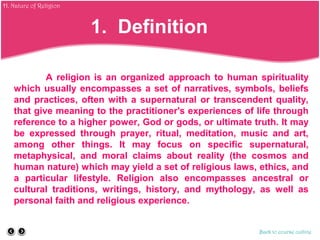
A religion is an organized approach to human spirituality
which usually encompasses a set of narratives, symbols, beliefs
and practices, often with a supernatural or transcendent quality,
that give meaning to the practitioner's experiences of life through
reference to a higher power, God or gods, or ultimate truth. It may
be expressed through prayer, ritual, meditation, music and art,
among other things. It may focus on specific supernatural,
metaphysical, and moral claims about reality (the cosmos and
human nature) which may yield a set of religious laws, ethics, and
a particular lifestyle. Religion also encompasses ancestral or
cultural traditions, writings, history, and mythology, as well as
personal faith and religious experience.
Back to course outline
1. Definition
H. Nature of Religion
 Etymology
It comes form the latin word re which means “back,
again” and ligare which means “to bind”
The word religion is derived from Latin "religio" (what
attaches or retains, moral bond, anxiety of self-consciousness,
scruple) used by the Romans, before Jesus Christ, to indicate
the worship of the demons.
The origin of "religion" is debated since antiquity. Cicero said
it comes from "relegere" (to read again, to re-examine
carefully, to gather) in the
meaning "to carefully consider the things related to the
worship of gods".
Back to course outline
H. Nature of Religion
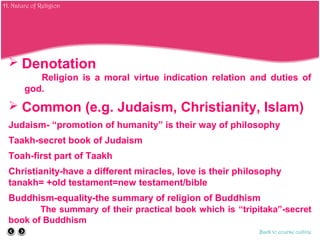
 Denotation
Religion is a moral virtue indication relation and duties of
god.
 Common (e.g. Judaism, Christianity, Islam)
Judaism- “promotion of humanity” is their way of philosophy
Taakh-secret book of Judaism
Toah-first part of Taakh
Christianity-have a different miracles, love is their philosophy
tanakh= +old testament=new testament/bible
Buddhism-equality-the summary of religion of Buddhism
The summary of their practical book which is “tripitaka”-secret
book of Buddhism
Back to course outline
H. Nature of Religion
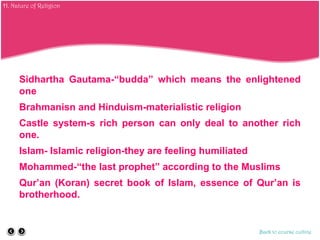
Sidhartha Gautama-“budda” which means the enlightened
one
Brahmanisn and Hinduism-materialistic religion
Castle system-s rich person can only deal to another rich
one.
Islam- Islamic religion-they are feeling humiliated
Mohammed-“the last prophet” according to the Muslims
Qur’an (Koran) secret book of Islam, essence of Qur’an is
brotherhood.
Back to course outline
H. Nature of Religion
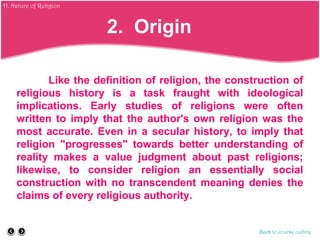
Like the definition of religion, the construction of
religious history is a task fraught with ideological
implications. Early studies of religions were often
written to imply that the author's own religion was the
most accurate. Even in a secular history, to imply that
religion "progresses" towards better understanding of
reality makes a value judgment about past religions;
likewise, to consider religion an essentially social
construction with no transcendent meaning denies the
claims of every religious authority.
Back to course outline
2. Origin
H. Nature of Religion
I. Nature of
Reality
Back to course outline
There is a saying that “truth is stranger than fiction”
and this certainly applies to the nature of reality, because
in the light of increasing evidence, what we have accepted
to be the ‘truth’ about our everyday reality is much more
like the ‘fiction’ of our everyday reality.
Our most basic understanding of ‘reality’ is that we
are born, we live, and we die. But for many of us this is
not enough; we instinctively ‘feel’ that there is more to life
than just producing the next generation of humanity and
trying to do our best in our allotted ‘three score years and
ten’.
Back to course outline
I. Nature of Reality
Science and religion have been at loggerheads for
hundreds of years in their attempts to prove their
worldview as the correct one. Despite each gaining the
upper hand from time to time, they both divide reality into
two, the ‘physical’ and the ‘spiritual’. In truth, neither of
them has provided a satisfactory explanation of the
human experience, nor have they been able to unite to
form a single, all-encompassing worldview.
Back to course outline
I. Nature of Reality
It is therefore obvious that there is something
drastically wrong with the prevailing scientific and
religious worldviews; with the common understanding of
the so-called ‘physical’ and ‘spiritual’ worlds and the
general explanations provided by either science or
religion.
The quest to find answers for our modern times
has been taken up by the ‘new science’ of quantum
physics. Discoveries of the last 100 years have taken
physicists investigating the quantum world to new
understandings that are truly astounding.
Back to course outline
I. Nature of Reality
J. Nature of
Value
Back to course outline
1. Schematic Circle of Value
There are three usual positions advocated ethical values
could be:
Objective: depending only on the object of inquiry, and
hence independent of what we think, hope or expect to
find
Subjective: Depending on the subject doing the inquiring
Intersubjective: Depending on agreement between
subjects
Back to course outline
J. Nature of Value
Axiology (from Greek ξί ,ἀ ᾱ axiā, "value, worth"; and
-λογία, -logia) is the study of quality or value. It is often
taken to include ethics and aesthetics — philosophical
fields that depend crucially on notions of value — and
sometimes it is held to lay the groundwork for these
fields, and thus to be similar to value theory and meta-
ethics. The term was first used in the early 20th century
by Paul Lapie, in 1902, and E. von Hartmann, in 1908.
Back to course outline
J. Nature of Value
2. Axiology, Ethics, Aesthetics
Ethics (also known as moral philosophy) is a
branch of philosophy which seeks to address questions
about morality, such as what the fundamental semantic,
ontological, and epistemic nature of ethics or morality is
(meta-ethics), how moral values should be determined
(normative ethics), how a moral outcome can be
achieved in specific situations (applied ethics), and how
moral capacity or moral agency develops and what its
nature is (moral psychology).
Back to course outline
Ethics
J. Nature of Value
Aesthetics (also spelled æsthetics or esthetics)
is commonly known as the study of sensory or
sensori-emotional values, sometimes called
judgments of sentiment and taste. More broadly,
scholars in the field define aesthetics as "critical
reflection on art, culture and nature." Aesthetics is a
subdiscipline of axiology, a branch of philosophy, and
is closely associated with the philosophy of art.
Aesthetics studies new ways of seeing and of
perceiving the world.
Back to course outline
Aesthetics
J. Nature of Value
-END-

Introduction to Philosophy

  • 1.
  • 2.
    A. Meaning ofPhilosophy B. Goals of Philosophy C.Scope of Philosophy D. Importance of Philosophy E.Philosophical Methods F.Divisions of Philosophy G.Relation to the other Discipline H. Nature of Religion I. Nature of Reality J.Nature of Value Course Outline
  • 3.
  • 4.
    1. Common Definition 1.Philosophy of life-a person overall theory or outlook. Keep thinking/think and excess. Rene Descartes-“cogito ergo sum” (Latin), meaning “I think Therefore I Exist” 2. Business Philosophy-the way we ran/manage our own business. 3. Motto/Slogan- the philosophy of the owner Motto-is for personal only not intended for majority. Slogan-intended for the majority. Motto and Slogan- theory of a simple minded person. Philosophy- synonyms to outlook/viewpoint Back to course outline A. Meaning of Philosophy
  • 5.
    Etymology- or etymologicaldefinition of Philosophy -derived for Greek words etimos and logos Etimos-root, origin, cause, basis, history Logos-study Etymology-study of the history of the word Philosophy comes from the Geek Words Philia and Sofia. Sofia-wisdom Philia-love, desire for, interest in Philia and Sofia join by Pythagoras-600 B.C. Episteme-means knowledge Wisdom-defining deeply, wise, according to etymology -is an awareness of something which is basic. -knowledge of the basic principle. Knowledge-is only a million formation -simple data that comes from the outside that pass to our senses. Back to course outline 2. Etymology A. Meaning of Philosophy
  • 6.
    Connotation- is anindirect explanation of a situation, event, person, circumstance, or thing by considered to be right -It implies an attempt to discover the most general and yet underlying principle of things. Experience-the different aspect or dimension of life that we are always examining. Back to course outline 3. Connotation A. Meaning of Philosophy
  • 7.
    3 Categories: 1. Intellectual/MentalExperience 2. Physical or Material Experience 3. Spiritual or Divine Experience Back to course outline 4. Physical, mental, spiritual experiences A. Meaning of Philosophy
  • 8.
    Concrete Definition- theexact explanation of a situation, event, person Philosophy is a systematic and comprehensive study of truth about life, about the universe, and everything including events, relationships, and experience. Back to course outline 5. Concrete Definition A. Meaning of Philosophy
  • 9.
    Philosophers’ definition-arises outof wonder, out of curiosity, out of desire to learn, and to understand things. -According to the Philosopher, Philosophy is a process of analysis, criticism, interpretation and speculation Analysis-if we know how to synthesis and antithesis. Synthesis- put idea together or event of the same characteristic. Antithesis- remove from or put it out, removing ideas Criticism- is a process of commenting or giving a judgment, even if its positive or negative. Interpretation-demonstration of ideas. Speculation-being satisfied. Back to course outline 6. Philosophers’ definition A. Meaning of Philosophy
  • 10.
    B. Goals of Philosophy Backto course outline
  • 11.
    1. Philosophy triesto discover the nature of truth as well as the nature of knowledge. Nature- the essence, quality, attribute of a particular situation, event, or thing. Nature of Truth- factors that make a particular situation is true. -product of fantasy. Factors that makes something true: -It must have an opposite -perceivable (things which has an opposite) -encourage us to believe -it has always an appearance or reality. -It may also be a product of fantasy. Nature of Knowledge-just a product of truth, produces ability. Back to course outline B. Goals of Philosophy
  • 12.
    Knower---know ability----known Know-it isto be perceived Knower-the ability to perceive/perceiver Truth-source of knowledge Know ability-connect the know and knower. Product of knowledge Back to course outline B. Goals of Philosophy
  • 13.
    2. It searchesfor what is basic value and of importance in life. Priority-that is the most important thing/ value in life. 3. Philosophy examines the relationship between individuals and the society as well as humanity and nature. 4. Wisdom-main goal of Philosophy Back to course outline B. Goals of Philosophy
  • 14.
    C. Scope of Philosophy Backto course outline
  • 15.
     nature ofthe universe -totality of everything Universe-consists of concrete and non-concrete things Non-concrete-it includes emotion Back to course outline C. Scope of Philosophy
  • 16.
     standard ofjustice and conduct of life conduct-analysis of right and wrong justice-process of giving what is due and receiving something that is due. Standard- basis for our action for something to be done. Standard of Justice-a norm applied for everybody Injustice-given what is not due. Morality- the recognition of right or wrong Behavior-actualization of conduct manifestation of right or wrong Manner- way or mode of expressing of right or wrong Back to course outline C. Scope of Philosophy
  • 17.
     validity ofknowledge Validity-in accordance with the majority Acceptable to the majority  concrete application of reason reason-act of the mind. -expression of right thinking -if there is no reason, there is no application Back to course outline C. Scope of Philosophy
  • 18.
     criteria ofbeauty Beauty-conditions that brings drive, interests, desirability, attraction, appeal to our senses.  relationship between languages and thought Language-expression of thought or product of though Thought- root, causes, source of language. Back to course outline C. Scope of Philosophy
  • 19.
    Kinds of Language -OralLanguage -Written Language -Sign Language -Body Language -Electronic Language- combination of sign and written language Back to course outline C. Scope of Philosophy
  • 20.
  • 21.
    •People can clarifywhat they are believing Rejection of Philosophy-is an act of philosophizing •We can be stimulated to think of ultimate question Ultimate question-question appearing i the last part of out awareness •Philosophy promises us better understanding of ourselves •It helps the student to systematize and evaluate the uses of information that he or she seeks from various sources. Back to course outline D. Importance of Philosophy
  • 22.
  • 23.
    Logical and speculativereasoning -common tool of philosophy Reasoning-is a explanation of a permission or denial. Speculative-to look for more things/ideas to influence others. Logical-means being to correct Correct-must be valid and true Analysis -most outstanding tool of philosophy Back to course outline E. Philosophical Methods
  • 24.
    Reflection -is the voicewithin us -the examination of ourselves, most serious tool of philosophy -the spiritual tool of philosophy Discernment-is listening to the spirit of god and voice of holy spirit Mediation-thinking about something i relation to god. Contemplation-putting yourself in center of universe Back to course outline E. Philosophical Methods
  • 25.
  • 26.
    Classifications: Pure Philosophy- isnot based on observation but purely based on the mind Applied Philosophy-compilation on ideas based on observation on practical aspects. 1. Systematic Philosophy Back to course outline F. Divisions of Philosophy
  • 27.
    A. Theoretical Philosophy-thoughtsproduced by intellectual that cannot put into practice and cannot help to develop our analysis. B. Practical Philosophy-is based on opinions on theories (that are purely based on the mind put into practice. Comes from ethic-come from Greek word Ethos which means character or behavior, conduct, attitude, manner or value. Back to course outline Category of Pure Philosophy F. Divisions of Philosophy
  • 28.
    •Metaphysics investigates principlesof reality transcending those of any particular science. •Cosmology and ontology are traditional branches of metaphysics. It is concerned with explaining the fundamental nature of being and the world. •Someone who studies metaphysics would be called either a "metaphysician“ or a "metaphysicist". •The word derives from the Greek words μετά (metá) (meaning "beyond" or "after") and φυσικά (physiká) (meaning "physical"), "physical" referring to those works on matter by Aristotle in antiquity. The prefix meta- ("beyond") was attached to the chapters in Back to course outline A.1. Metaphysics F. Divisions of Philosophy
  • 29.
     Ontology (from theGreek ν, genitive ντος:ὄ ὄ of being <neuter participle of ε ναι:ἶ to be> and -λογία, -logia: science, study, theory) is the philosophical study of the nature of being, existence or reality in general, as well as of the basic categories of being and their relations. Traditionally listed as a part of the major branch of philosophy known as metaphysics, ontology deals with questions concerning what entities exist or can be said to exist, and how such entities can be grouped, related within a hierarchy, and subdivided according to similarities and differences. Back to course outline F. Divisions of Philosophy
  • 30.
     Cosmology (from Greekκοσμολογία - κόσμος, kosmos, "universe"; and -λογία, -logia, "study") is the study of the Universe in its totality, and by extension, humanity's place in it. Though the word cosmology is recent (first used in 1730 in Christian Wolff's Cosmologia Generalis), study of the universe has a long history involving science, philosophy, esotericism, and religion. Back to course outline F. Divisions of Philosophy
  • 31.
    Epistemology (from Greekπιστήμηἐ - episteme-, "knowledge, science" + λόγος, "logos") or theory of knowledge is the branch of philosophy concerned with the nature and scope (limitations) of knowledge. It addresses the questions: What is knowledge? How is knowledge acquired? What do people know? How do we know what we know? Why do we know what we know? Back to course outline A.2. Epistemology F. Divisions of Philosophy
  • 32.
    The term theodicycomes from the Greek θεός (theós, "god") and δίκη (díkē, "justice"), meaning literally "the justice of God," although a more appropriate phrase may be "to justify God" or "the justification of God". The term was coined in 1710 by the German philosopher Gottfried Leibniz in a work entitled Essais de Théodicée sur la bonté de Dieu, la liberté de l'homme et l'origine du mal ("Theodicic Essays on the Benevolence of God, the Free will of man, and the Origin of Evil"). Back to course outline A.3. Theodicy F. Divisions of Philosophy
  • 33.
    The division ofphilosophy into a practical and a theoretical discipline has its origin in Aristotle's moral philosophy and natural philosophy categories. In Sweden and Finland courses in theoretical and practical philosophy are taught separately, and are separate degrees. Other countries may use a similar scheme-- some Scottish universities, for example, divide philosophy into logic, metaphysics, and ethics--but in most universities around the world philosophy is taught as a single subject. Back to course outline B. Practical Philosophy F. Divisions of Philosophy
  • 34.
    Logic, from theGreek λογική (logiké) is defined as "The formal systematic study of the principles of valid inference and correct reasoning". Logic is the art of conforming one's thoughts to the Law of Identity. In one respect, thoughts have to conform to the Law of Identity, as does everything else. This has to do with the nature of thoughts. Ideas have a different nature than memories, which are different from emotions. In this respect, all thoughts conform to the Law of Identity. Back to course outline B.1. Logic F. Divisions of Philosophy
  • 35.
    Aesthetics (also spelledæsthetics or esthetics) is commonly known as the study of sensory or sensori- emotional values, sometimes called judgments of sentiment and taste. More broadly, scholars in the field define aesthetics as "critical reflection on art, culture and nature." Aesthetics is a sub discipline of axiology, a branch of philosophy, and is closely associated with the philosophy of art. Aesthetics studies new ways of seeing and of perceiving the world Aesthetics is the study of art. It includes what art consists of, as well as the purpose behind it. Back to course outline B.2. Aesthetic F. Divisions of Philosophy
  • 36.
    Semantics is thestudy of meaning. The word "semantics" itself denotes a range of ideas, from the popular to the highly technical. It is often used in ordinary language to denote a problem of understanding that comes down to word selection or connotation. The word is derived from the Greek word σημαντικός (semantikos), "significant", from σημαίνω (semaino), "to signify, to indicate" and that from σήμα (sema), "sign, mark, token". In linguistics, it is the study of interpretation of signs or symbols as used by agents or communities within particular circumstances and contexts. Back to course outline B.3. Semantics F. Divisions of Philosophy
  • 37.
    Ethics (also knownas moral philosophy) is a branch of philosophy which seeks to address questions about morality, such as what the fundamental semantic, ontological, and epistemic nature of ethics or morality is (meta-ethics), how moral values should be determined (normative ethics), how a moral outcome can be achieved in specific situations (applied ethics), how moral capacity or moral agency develops and what its nature is (moral psychology), and what moral values people actually abide by (descriptive ethics). Ethics is the branch of study dealing with what is the proper course of action for man. It answers the question, "What do I do?" It is the study of right and wrong in human endeavors. At a more fundamental level, it is the method by which we categorize our values and pursue them. Back to course outline B.4. Ethics F. Divisions of Philosophy
  • 38.
    G. Relation to theother Discipline Back to course outline
  • 39.
    1. Philosophy andScience Science-studies the natural phenomena and all the phenomena of the society. -Study outward and more on demonstrations and experimentation -cannot study itself. -has attained a definite and tested knowledge of many matters. -resolve disagreement Philosophy of Science-study of science itself. -study of something inward. Back to course outline G. Relations to the other Discipline
  • 40.
    Differences: Philosophy-make a disagreement -comparableto different fields of studies -because of philosophy, we are motivated to think more. It demonstrate than there is the existence of god. -It is inquiring the existence of everything Similarities: -They both answer questions -both share a significant role -they both seek to discover the truth -both of them satisfy our curiosity -both of them provoke further questions Back to course outline G. Relations to the other Discipline
  • 41.
    Relationship: -because of religionthere is philosophy -philosophical questions are based on religion -more on emotion Religious questions A philosopher of religion does not ask "What is God?", for such is a complex question in that it assumes the existence of God and that God has a knowable nature. Instead, a philosopher of religion asks whether there are sound reasons to think that God does or does not exist. Back to course outline 2. Philosophy and Religion G. Relations to the other Discipline
  • 42.
    Still, there areother questions studied in the philosophy of religion. For example: What, if anything, would give us good reason to believe that a miracle has occurred? What is the relationship between faith and reason? What is the relationship between morality and religion? What is the status of religious language? Does petitionary prayer (sometimes still called impetratory prayer) make sense? Are salvo-lobotomies (lobotomies performed to keep believers from sinning) moral actions? Back to course outline G. Relations to the other Discipline
  • 43.
    Existence of God Argumentsfor and against the existence of God have been proposed by scientists, philosophers, theologians, and others. In philosophical terminology, "existence-of-God" arguments concern schools of thought on the epistemology of the ontology of God. A wide variety of arguments exist which can be categorized as metaphysical, logical, empirical, or subjective. Although rarely studied scientifically given the generally held belief of religion and science as non-overlapping magisterial, the question of the existence of God is subject to lively debate both in philosophy— the philosophy of religion being almost entirely devoted to the question — and in popular culture. Back to course outline G. Relations to the other Discipline
  • 44.
    Concern of Religion Theone-word answer for "What is hidden at first, but then revealed by loose cognition?" is "determinism" or "Fatedness", not "unity" or "consciousness". The word "determinism" lends itself better to having these ideas attached, than the word "unity" or "love" or "consciousness" or "enlightenment". Enlightenment amounts to determinism, more than enlightenment is unity or consciousness. Back to course outline G. Relations to the other Discipline
  • 45.
    H. Nature of Religion Backto course outline
  • 46.
    A religion isan organized approach to human spirituality which usually encompasses a set of narratives, symbols, beliefs and practices, often with a supernatural or transcendent quality, that give meaning to the practitioner's experiences of life through reference to a higher power, God or gods, or ultimate truth. It may be expressed through prayer, ritual, meditation, music and art, among other things. It may focus on specific supernatural, metaphysical, and moral claims about reality (the cosmos and human nature) which may yield a set of religious laws, ethics, and a particular lifestyle. Religion also encompasses ancestral or cultural traditions, writings, history, and mythology, as well as personal faith and religious experience. Back to course outline 1. Definition H. Nature of Religion
  • 47.
     Etymology It comesform the latin word re which means “back, again” and ligare which means “to bind” The word religion is derived from Latin "religio" (what attaches or retains, moral bond, anxiety of self-consciousness, scruple) used by the Romans, before Jesus Christ, to indicate the worship of the demons. The origin of "religion" is debated since antiquity. Cicero said it comes from "relegere" (to read again, to re-examine carefully, to gather) in the meaning "to carefully consider the things related to the worship of gods". Back to course outline H. Nature of Religion
  • 48.
     Denotation Religion isa moral virtue indication relation and duties of god.  Common (e.g. Judaism, Christianity, Islam) Judaism- “promotion of humanity” is their way of philosophy Taakh-secret book of Judaism Toah-first part of Taakh Christianity-have a different miracles, love is their philosophy tanakh= +old testament=new testament/bible Buddhism-equality-the summary of religion of Buddhism The summary of their practical book which is “tripitaka”-secret book of Buddhism Back to course outline H. Nature of Religion
  • 49.
    Sidhartha Gautama-“budda” whichmeans the enlightened one Brahmanisn and Hinduism-materialistic religion Castle system-s rich person can only deal to another rich one. Islam- Islamic religion-they are feeling humiliated Mohammed-“the last prophet” according to the Muslims Qur’an (Koran) secret book of Islam, essence of Qur’an is brotherhood. Back to course outline H. Nature of Religion
  • 50.
    Like the definitionof religion, the construction of religious history is a task fraught with ideological implications. Early studies of religions were often written to imply that the author's own religion was the most accurate. Even in a secular history, to imply that religion "progresses" towards better understanding of reality makes a value judgment about past religions; likewise, to consider religion an essentially social construction with no transcendent meaning denies the claims of every religious authority. Back to course outline 2. Origin H. Nature of Religion
  • 51.
    I. Nature of Reality Backto course outline
  • 52.
    There is asaying that “truth is stranger than fiction” and this certainly applies to the nature of reality, because in the light of increasing evidence, what we have accepted to be the ‘truth’ about our everyday reality is much more like the ‘fiction’ of our everyday reality. Our most basic understanding of ‘reality’ is that we are born, we live, and we die. But for many of us this is not enough; we instinctively ‘feel’ that there is more to life than just producing the next generation of humanity and trying to do our best in our allotted ‘three score years and ten’. Back to course outline I. Nature of Reality
  • 53.
    Science and religionhave been at loggerheads for hundreds of years in their attempts to prove their worldview as the correct one. Despite each gaining the upper hand from time to time, they both divide reality into two, the ‘physical’ and the ‘spiritual’. In truth, neither of them has provided a satisfactory explanation of the human experience, nor have they been able to unite to form a single, all-encompassing worldview. Back to course outline I. Nature of Reality
  • 54.
    It is thereforeobvious that there is something drastically wrong with the prevailing scientific and religious worldviews; with the common understanding of the so-called ‘physical’ and ‘spiritual’ worlds and the general explanations provided by either science or religion. The quest to find answers for our modern times has been taken up by the ‘new science’ of quantum physics. Discoveries of the last 100 years have taken physicists investigating the quantum world to new understandings that are truly astounding. Back to course outline I. Nature of Reality
  • 55.
    J. Nature of Value Backto course outline
  • 56.
    1. Schematic Circleof Value There are three usual positions advocated ethical values could be: Objective: depending only on the object of inquiry, and hence independent of what we think, hope or expect to find Subjective: Depending on the subject doing the inquiring Intersubjective: Depending on agreement between subjects Back to course outline J. Nature of Value
  • 57.
    Axiology (from Greekξί ,ἀ ᾱ axiā, "value, worth"; and -λογία, -logia) is the study of quality or value. It is often taken to include ethics and aesthetics — philosophical fields that depend crucially on notions of value — and sometimes it is held to lay the groundwork for these fields, and thus to be similar to value theory and meta- ethics. The term was first used in the early 20th century by Paul Lapie, in 1902, and E. von Hartmann, in 1908. Back to course outline J. Nature of Value 2. Axiology, Ethics, Aesthetics
  • 58.
    Ethics (also knownas moral philosophy) is a branch of philosophy which seeks to address questions about morality, such as what the fundamental semantic, ontological, and epistemic nature of ethics or morality is (meta-ethics), how moral values should be determined (normative ethics), how a moral outcome can be achieved in specific situations (applied ethics), and how moral capacity or moral agency develops and what its nature is (moral psychology). Back to course outline Ethics J. Nature of Value
  • 59.
    Aesthetics (also spelledæsthetics or esthetics) is commonly known as the study of sensory or sensori-emotional values, sometimes called judgments of sentiment and taste. More broadly, scholars in the field define aesthetics as "critical reflection on art, culture and nature." Aesthetics is a subdiscipline of axiology, a branch of philosophy, and is closely associated with the philosophy of art. Aesthetics studies new ways of seeing and of perceiving the world. Back to course outline Aesthetics J. Nature of Value
  • 60.