ORGANIZATIONAL BEHAVIOR
O B J E C T I V E S
                      AFTER STUDYING THIS CHAPTER AND
                      LISTENING TO MY LECTUER,I HOPE THTAT
                      YOU WILL BE ABLE TO:


                      1. Define organizational behavior (OB).
                      2. Discuss the historical perspective of OB.
L E A R N I N G


                      3. OB as a multi Disciplinary Field
                      4. Describe why managers require a knowledge of OB.
                      5. The major challenges and opportunities for managers to
                         use OB concepts.
                      6. Knowledge Management
What Managers Do
 Managers
 Individuals who achieve goals through other people.


                        Managerial Activities
                         Managerial Activities
                        •Make decisions
                         •Make decisions
                        •Allocate resources
                         •Allocate resources
                        •Direct activities of others
                         •Direct activities of others
                         to attain goals
                          to attain goals

                         1–3
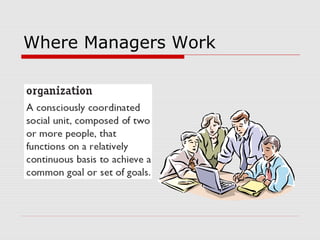
Where Managers Work
Enter Organizational Behavior


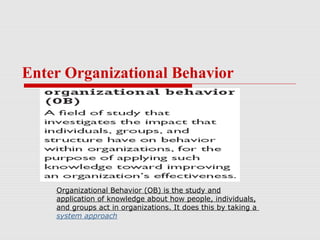
    Organizational Behavior (OB) is the study and
    application of knowledge about how people, individuals,
    and groups act in organizations. It does this by taking a
    system approach
system approach
  Systematic study of behavior is a meaning to
  make accurate predictions. By systematic study
  we mean,
   Examining relationship.
   Cause and effects relation.
   Base our conclusion on scientific method.


Systematic study augments intuitions.
Historical Perspective
 Scientific Management.
An approach to management which emphases the
formulation of precise processes which are regarded as
the best methods to achieve work goals.
The Hawthorne Studies


 Conducted from 1927-1932 at the Western
 Electric Hawthorne Works in Chicago

 Conducted by Harvard Business School Professor
 Elton Mayo who examined productivity and work conditions

 The studies grew out of preliminary experiments at the plant
 On the effect of light on productivity

 Those experiments showed no clear connection between
 Productivity and the amount of illumination
The Studies?
Variables Affecting Productivity
1. Rest Breaks
                           Mayo took 6 women from the assembly line,
2. Work Hours            segregated from rest of the factory and put them
3. Temperature         under the eye of a supervisor who was more friendly
4. Humidity                       observer than a disciplinarian

      Feedback Mechanism
       Throughout the series of experiments, an observer sat with the girls in the
       workshop noting all that went on, keeping the girls informed about the
       experiment, asking for advice and listening to their complaints.
       Each experiment began by introducing various changes, each of which
       was continued for a test period of four to twelve weeks.
Conditions and Results
   Under normal conditions with a 48 hour week, including
   Saturdays, and no rest pauses. The girls produced 2,400
   relays a week each.
 They were then put on a piece-work for eight hours----Output went UP
 Two five minute rest pauses, morning and afternoon, were introduces for a period of
  five weeks-----Output went UP once more
 The rest pauses were lengthened to ten minutes each----Output went up sharply
 Six five minute pauses were introduced, and the girls complained that their work
  rhythm was broken by the frequent pauses----output fell slightly
 Return to the two rest pauses, the first with a hot meal supplied by the company free
  of charge----Output went up
 The girls were dismissed at 4:30 p.m. instead of 5:00 p.m.----output went ip
 They were dismissed at 4:00 p.m.----output remain the same
The Results
  Finally all the improvements were taken away and
  the girls went back to 48 hours working with no
  piece-work, rest–breaks and no free meals. This
  state of affairs lasted for a period of 12 weeks.

 Output was the highest ever recorded averaging
  3000 relays a week


                Confused?
What Happened during the Experiments?


 Six individuals became a team and the team gave itself wholeheartedly
  and spontaneously to co-operation in the experiment.
 They were themselves satisfied that they were working under less
  pressure than ever before.
 The group had considerable amount of freedom of movement. They
  were not pushed around or bossed by anyone.
 Under these conditions they established an increased sense of
  responsibility and instead of discipline from higher authority being
  imposed, it came from within the group.
Organization behavior: Past,
       present and future.

 Organizational behavior is a multi-disciplined science.

          Human relation approach
            Psychology.
             Social psychology.
             Anthropology.
             Political Science.
Human relation approach:

        The study of interaction among people with
        The study of interaction among people with
              the aim of developing mutually
               the aim of developing mutually
                    beneficial outcomes
                     beneficial outcomes

                           .
     Psychology:
 The systematic study of human behavior & cognitive
 events.
     Social Psychology:
 Is concerned with understanding behavior in a group
 context.
 Anthropology:
Is to study the society & their culture.


    Political science:
   Focuses on the behavior of individuals and groups in a political
   environment.
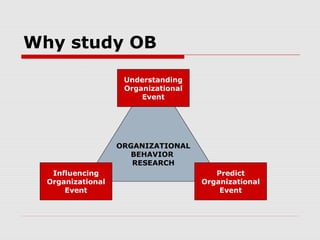
Why study OB

                    Understanding
                    Organizational
                        Event


                   ORGANIZATIONAL
                      BEHAVIOR
                      RESEARCH
   Influencing                          Predict
  Organizational                     Organizational
      Event                              Event
Challenges and
 Opportunities of OB

Challenges?

Opportunities?
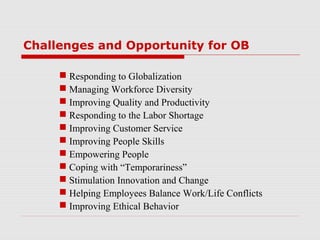
Challenges and Opportunity for OB

      Responding to Globalization
      Managing Workforce Diversity
      Improving Quality and Productivity
      Responding to the Labor Shortage
      Improving Customer Service
      Improving People Skills
      Empowering People
      Coping with “Temporariness”
      Stimulation Innovation and Change
      Helping Employees Balance Work/Life Conflicts
      Improving Ethical Behavior
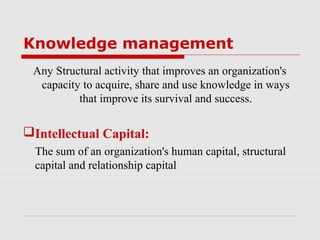
Knowledge management
 Any Structural activity that improves an organization's
  capacity to acquire, share and use knowledge in ways
          that improve its survival and success.

Intellectual Capital:
  The sum of an organization's human capital, structural
  capital and relationship capital
 Human Capital:
      This is the knowledge that employees possess and
       generate including their skills, experience and
       creativity.
 Structural Capital:
      This is the knowledge captured and retained in an
       organization's system and structures. It is the
       knowledge that remains after all the human capital
       has gone home.
 Relationship Capital:
      This is the value derived from an organization's
       relationships with customer, suppliers and other
       external stakeholders.
Knowledge management process


    Knowledge acquisition.
    Knowledge sharing.
    Knowledge use.
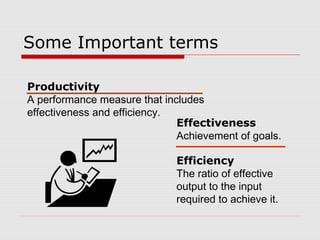
Some Important terms

Productivity
A performance measure that includes
effectiveness and efficiency.
                              Effectiveness
                              Achievement of goals.

                             Efficiency
                             The ratio of effective
                             output to the input
                             required to achieve it.
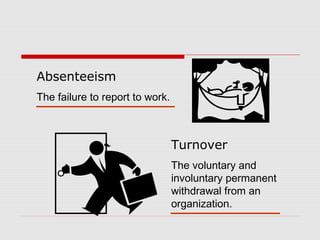
Absenteeism
The failure to report to work.


                                 Turnover
                                 The voluntary and
                                 involuntary permanent
                                 withdrawal from an
                                 organization.
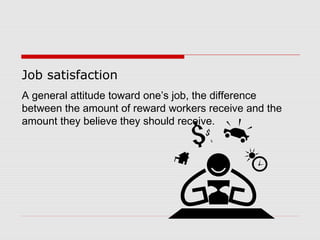
Job satisfaction
A general attitude toward one’s job, the difference
between the amount of reward workers receive and the
amount they believe they should receive.
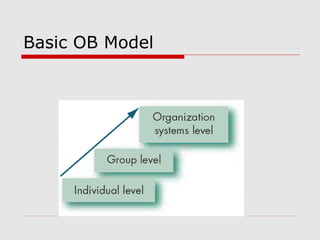
Basic OB Model

Introduction to Organization Behavior

  • 1.
  • 2.
    O B JE C T I V E S AFTER STUDYING THIS CHAPTER AND LISTENING TO MY LECTUER,I HOPE THTAT YOU WILL BE ABLE TO: 1. Define organizational behavior (OB). 2. Discuss the historical perspective of OB. L E A R N I N G 3. OB as a multi Disciplinary Field 4. Describe why managers require a knowledge of OB. 5. The major challenges and opportunities for managers to use OB concepts. 6. Knowledge Management
  • 3.
    What Managers Do Managers Individuals who achieve goals through other people. Managerial Activities Managerial Activities •Make decisions •Make decisions •Allocate resources •Allocate resources •Direct activities of others •Direct activities of others to attain goals to attain goals 1–3
  • 4.
  • 5.
    Enter Organizational Behavior Organizational Behavior (OB) is the study and application of knowledge about how people, individuals, and groups act in organizations. It does this by taking a system approach
  • 6.
    system approach Systematic study of behavior is a meaning to make accurate predictions. By systematic study we mean,  Examining relationship.  Cause and effects relation.  Base our conclusion on scientific method. Systematic study augments intuitions.
  • 7.
  • 8.
     Scientific Management. Anapproach to management which emphases the formulation of precise processes which are regarded as the best methods to achieve work goals.
  • 9.
    The Hawthorne Studies Conducted from 1927-1932 at the Western Electric Hawthorne Works in Chicago Conducted by Harvard Business School Professor Elton Mayo who examined productivity and work conditions The studies grew out of preliminary experiments at the plant On the effect of light on productivity Those experiments showed no clear connection between Productivity and the amount of illumination
  • 10.
    The Studies? Variables AffectingProductivity 1. Rest Breaks Mayo took 6 women from the assembly line, 2. Work Hours segregated from rest of the factory and put them 3. Temperature under the eye of a supervisor who was more friendly 4. Humidity observer than a disciplinarian  Feedback Mechanism Throughout the series of experiments, an observer sat with the girls in the workshop noting all that went on, keeping the girls informed about the experiment, asking for advice and listening to their complaints. Each experiment began by introducing various changes, each of which was continued for a test period of four to twelve weeks.
  • 11.
    Conditions and Results Under normal conditions with a 48 hour week, including Saturdays, and no rest pauses. The girls produced 2,400 relays a week each.  They were then put on a piece-work for eight hours----Output went UP  Two five minute rest pauses, morning and afternoon, were introduces for a period of five weeks-----Output went UP once more  The rest pauses were lengthened to ten minutes each----Output went up sharply  Six five minute pauses were introduced, and the girls complained that their work rhythm was broken by the frequent pauses----output fell slightly  Return to the two rest pauses, the first with a hot meal supplied by the company free of charge----Output went up  The girls were dismissed at 4:30 p.m. instead of 5:00 p.m.----output went ip  They were dismissed at 4:00 p.m.----output remain the same
  • 12.
    The Results Finally all the improvements were taken away and the girls went back to 48 hours working with no piece-work, rest–breaks and no free meals. This state of affairs lasted for a period of 12 weeks.  Output was the highest ever recorded averaging 3000 relays a week Confused?
  • 13.
    What Happened duringthe Experiments?  Six individuals became a team and the team gave itself wholeheartedly and spontaneously to co-operation in the experiment.  They were themselves satisfied that they were working under less pressure than ever before.  The group had considerable amount of freedom of movement. They were not pushed around or bossed by anyone.  Under these conditions they established an increased sense of responsibility and instead of discipline from higher authority being imposed, it came from within the group.
  • 14.
    Organization behavior: Past, present and future.  Organizational behavior is a multi-disciplined science.  Human relation approach  Psychology.  Social psychology.  Anthropology.  Political Science.
  • 15.
    Human relation approach: The study of interaction among people with The study of interaction among people with the aim of developing mutually the aim of developing mutually beneficial outcomes beneficial outcomes .  Psychology: The systematic study of human behavior & cognitive events.  Social Psychology: Is concerned with understanding behavior in a group context.
  • 16.
     Anthropology: Is tostudy the society & their culture.  Political science: Focuses on the behavior of individuals and groups in a political environment.
  • 17.
    Why study OB Understanding Organizational Event ORGANIZATIONAL BEHAVIOR RESEARCH Influencing Predict Organizational Organizational Event Event
  • 18.
    Challenges and Opportunitiesof OB Challenges? Opportunities?
  • 19.
    Challenges and Opportunityfor OB  Responding to Globalization  Managing Workforce Diversity  Improving Quality and Productivity  Responding to the Labor Shortage  Improving Customer Service  Improving People Skills  Empowering People  Coping with “Temporariness”  Stimulation Innovation and Change  Helping Employees Balance Work/Life Conflicts  Improving Ethical Behavior
  • 20.
    Knowledge management AnyStructural activity that improves an organization's capacity to acquire, share and use knowledge in ways that improve its survival and success. Intellectual Capital: The sum of an organization's human capital, structural capital and relationship capital
  • 21.
     Human Capital:  This is the knowledge that employees possess and generate including their skills, experience and creativity.  Structural Capital:  This is the knowledge captured and retained in an organization's system and structures. It is the knowledge that remains after all the human capital has gone home.  Relationship Capital:  This is the value derived from an organization's relationships with customer, suppliers and other external stakeholders.
  • 22.
    Knowledge management process  Knowledge acquisition.  Knowledge sharing.  Knowledge use.
  • 23.
    Some Important terms Productivity Aperformance measure that includes effectiveness and efficiency. Effectiveness Achievement of goals. Efficiency The ratio of effective output to the input required to achieve it.
  • 24.
    Absenteeism The failure toreport to work. Turnover The voluntary and involuntary permanent withdrawal from an organization.
  • 25.
    Job satisfaction A generalattitude toward one’s job, the difference between the amount of reward workers receive and the amount they believe they should receive.
  • 26.

Editor's Notes

  • #9 What scientific management contribute to O.B ?
  • #12 Piece-work?
  • #14 Do they now not bossed by anyone?