

MySQL : Lecture - 1
Ajay Khatri
Senior Assistant Professor
Acropolis Institute of Technology & Research
www.ajaykhatri.in
9 June 2020 ajaykhatri.in 2
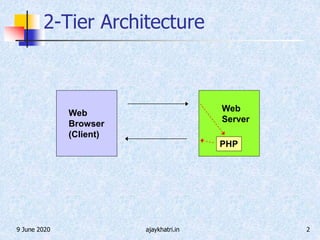
2-Tier Architecture
Web
Browser
(Client)
Web
Server
PHP
9 June 2020 ajaykhatri.in 3
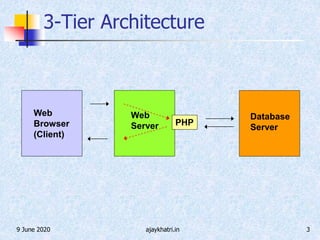
3-Tier Architecture
Web
Browser
(Client)
Database
Server
Web
Server PHP
9 June 2020 ajaykhatri.in 4
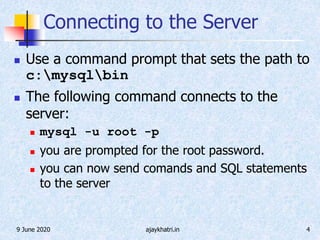
Connecting to the Server
 Use a command prompt that sets the path to
c:mysqlbin
 The following command connects to the
server:
 mysql -u root -p
 you are prompted for the root password.
 you can now send comands and SQL statements
to the server
9 June 2020 ajaykhatri.in 5
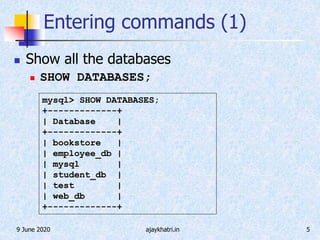
Entering commands (1)
 Show all the databases
 SHOW DATABASES;
mysql> SHOW DATABASES;
+-------------+
| Database |
+-------------+
| bookstore |
| employee_db |
| mysql |
| student_db |
| test |
| web_db |
+-------------+
9 June 2020 ajaykhatri.in 6
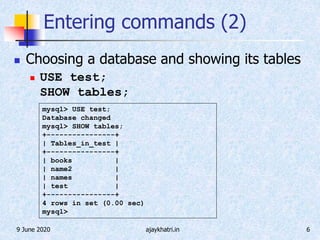
Entering commands (2)
 Choosing a database and showing its tables
 USE test;
SHOW tables;
mysql> USE test;
Database changed
mysql> SHOW tables;
+----------------+
| Tables_in_test |
+----------------+
| books |
| name2 |
| names |
| test |
+----------------+
4 rows in set (0.00 sec)
mysql>
9 June 2020 ajaykhatri.in 7
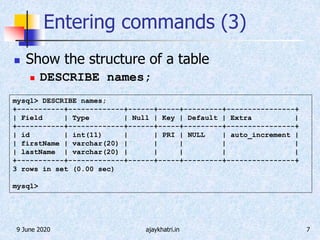
Entering commands (3)
 Show the structure of a table
 DESCRIBE names;
mysql> DESCRIBE names;
+-----------+-------------+------+-----+---------+----------------+
| Field | Type | Null | Key | Default | Extra |
+-----------+-------------+------+-----+---------+----------------+
| id | int(11) | | PRI | NULL | auto_increment |
| firstName | varchar(20) | | | | |
| lastName | varchar(20) | | | | |
+-----------+-------------+------+-----+---------+----------------+
3 rows in set (0.00 sec)
mysql>
9 June 2020 ajaykhatri.in 8
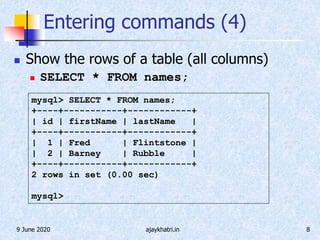
Entering commands (4)
 Show the rows of a table (all columns)
 SELECT * FROM names;
mysql> SELECT * FROM names;
+----+-----------+------------+
| id | firstName | lastName |
+----+-----------+------------+
| 1 | Fred | Flintstone |
| 2 | Barney | Rubble |
+----+-----------+------------+
2 rows in set (0.00 sec)
mysql>
9 June 2020 ajaykhatri.in 9
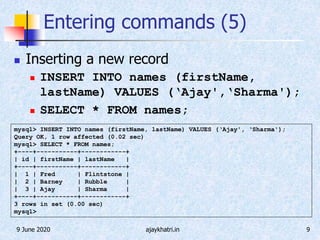
Entering commands (5)
 Inserting a new record
 INSERT INTO names (firstName,
lastName) VALUES (‘Ajay',‘Sharma');
 SELECT * FROM names;
mysql> INSERT INTO names (firstName, lastName) VALUES (‘Ajay', ‘Sharma');
Query OK, 1 row affected (0.02 sec)
mysql> SELECT * FROM names;
+----+-----------+------------+
| id | firstName | lastName |
+----+-----------+------------+
| 1 | Fred | Flintstone |
| 2 | Barney | Rubble |
| 3 | Ajay | Sharma |
+----+-----------+------------+
3 rows in set (0.00 sec)
mysql>
9 June 2020 ajaykhatri.in 10
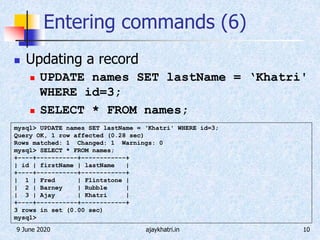
Entering commands (6)
 Updating a record
 UPDATE names SET lastName = ‘Khatri'
WHERE id=3;
 SELECT * FROM names;
mysql> UPDATE names SET lastName = ‘Khatri' WHERE id=3;
Query OK, 1 row affected (0.28 sec)
Rows matched: 1 Changed: 1 Warnings: 0
mysql> SELECT * FROM names;
+----+-----------+------------+
| id | firstName | lastName |
+----+-----------+------------+
| 1 | Fred | Flintstone |
| 2 | Barney | Rubble |
| 3 | Ajay | Khatri |
+----+-----------+------------+
3 rows in set (0.00 sec)
mysql>
9 June 2020 ajaykhatri.in 11
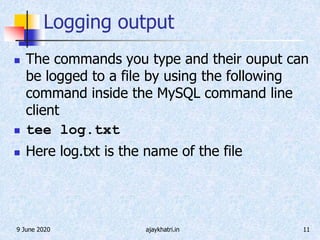
Logging output
 The commands you type and their ouput can
be logged to a file by using the following
command inside the MySQL command line
client
 tee log.txt
 Here log.txt is the name of the file
9 June 2020 ajaykhatri.in 12
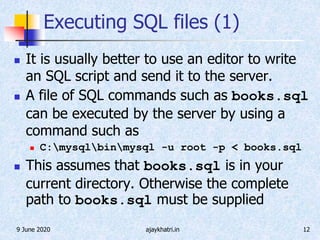
Executing SQL files (1)
 It is usually better to use an editor to write
an SQL script and send it to the server.
 A file of SQL commands such as books.sql
can be executed by the server by using a
command such as
 C:mysqlbinmysql -u root -p < books.sql
 This assumes that books.sql is in your
current directory. Otherwise the complete
path to books.sql must be supplied
9 June 2020 ajaykhatri.in 13
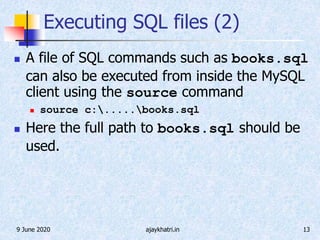
Executing SQL files (2)
 A file of SQL commands such as books.sql
can also be executed from inside the MySQL
client using the source command
 source c:.....books.sql
 Here the full path to books.sql should be
used.
9 June 2020 ajaykhatri.in 14
Documentation
 MySQL comes with a tutorial and complete
documentation in a HUGE file:
 c:mysqlDocsmanual.html
 Table of contents with links:
 c:mysqlDocsmanual_toc.html
 Use this file to locate the link to the topic
you are interested in.
9 June 2020 ajaykhatri.in 15
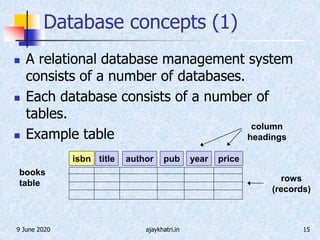
Database concepts (1)
 A relational database management system
consists of a number of databases.
 Each database consists of a number of
tables.
 Example table
isbn title author pub year price
books
table
rows
(records)
column
headings
9 June 2020 ajaykhatri.in 16
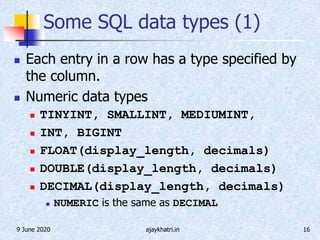
Some SQL data types (1)
 Each entry in a row has a type specified by
the column.
 Numeric data types
 TINYINT, SMALLINT, MEDIUMINT,
 INT, BIGINT
 FLOAT(display_length, decimals)
 DOUBLE(display_length, decimals)
 DECIMAL(display_length, decimals)
 NUMERIC is the same as DECIMAL
9 June 2020 ajaykhatri.in 17
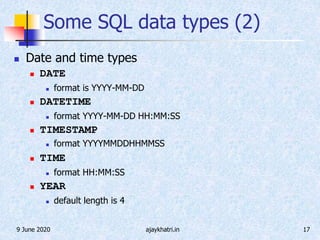
Some SQL data types (2)
 Date and time types
 DATE
 format is YYYY-MM-DD
 DATETIME
 format YYYY-MM-DD HH:MM:SS
 TIMESTAMP
 format YYYYMMDDHHMMSS
 TIME
 format HH:MM:SS
 YEAR
 default length is 4
9 June 2020 ajaykhatri.in 18
SQL data types (3)
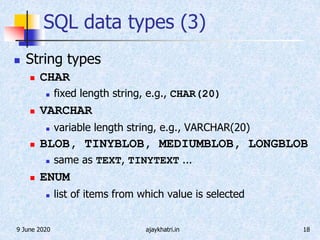
 String types
 CHAR
 fixed length string, e.g., CHAR(20)
 VARCHAR
 variable length string, e.g., VARCHAR(20)
 BLOB, TINYBLOB, MEDIUMBLOB, LONGBLOB
 same as TEXT, TINYTEXT ...
 ENUM
 list of items from which value is selected
9 June 2020 ajaykhatri.in 19
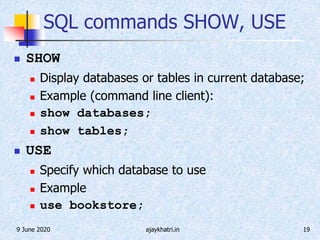
SQL commands SHOW, USE
 SHOW
 Display databases or tables in current database;
 Example (command line client):
 show databases;
 show tables;
 USE
 Specify which database to use
 Example
 use bookstore;
9 June 2020 ajaykhatri.in 20
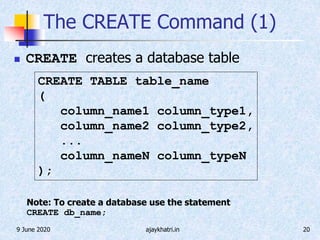
The CREATE Command (1)
 CREATE creates a database table
CREATE TABLE table_name
(
column_name1 column_type1,
column_name2 column_type2,
...
column_nameN column_typeN
);
Note: To create a database use the statement
CREATE db_name;
9 June 2020 ajaykhatri.in 21
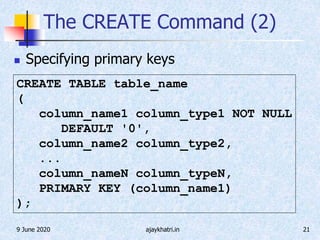
The CREATE Command (2)
 Specifying primary keys
CREATE TABLE table_name
(
column_name1 column_type1 NOT NULL
DEFAULT '0',
column_name2 column_type2,
...
column_nameN column_typeN,
PRIMARY KEY (column_name1)
);
9 June 2020 ajaykhatri.in 22
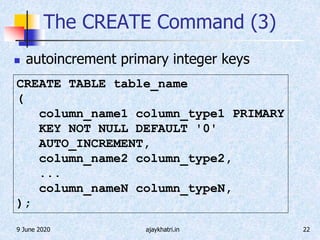
The CREATE Command (3)
 autoincrement primary integer keys
CREATE TABLE table_name
(
column_name1 column_type1 PRIMARY
KEY NOT NULL DEFAULT '0'
AUTO_INCREMENT,
column_name2 column_type2,
...
column_nameN column_typeN,
);
9 June 2020 ajaykhatri.in 23
The CREATE Command (4)
 Can also create UNIQUE keys. They are
similar to PRIMARY KEYS but can have NULL
values.
 Can also create INDEX fields.
9 June 2020 ajaykhatri.in 24
Conditional Creation
 Conditional database creation
 CREATE DATABASE IF NOT EXISTS
db_name;
 Conditional table creation
 CREATE TABLE IF NOT EXISTS
table_name;
9 June 2020 ajaykhatri.in 25
The DROP Command
 To delete databases and tables use the
DROP command
 Examples
 DROP DATABASE db_name;
 DROP DATABASE IF EXISTS db_name;
 DROP TABLE table_name;
 DROP TABLE IF EXISTS table_name;
Note: Don't confuse DROP with DELETE which deletes rows
of a table.
9 June 2020 ajaykhatri.in 26
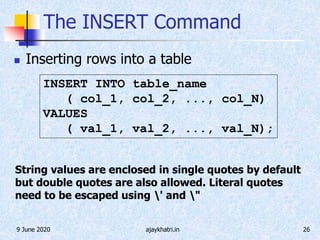
The INSERT Command
 Inserting rows into a table
INSERT INTO table_name
( col_1, col_2, ..., col_N)
VALUES
( val_1, val_2, ..., val_N);
String values are enclosed in single quotes by default
but double quotes are also allowed. Literal quotes
need to be escaped using ' and "
9 June 2020 ajaykhatri.in 27
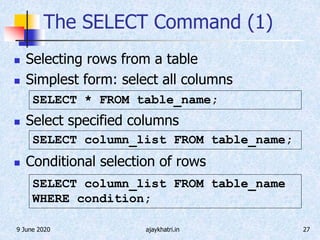
The SELECT Command (1)
 Selecting rows from a table
 Simplest form: select all columns
 Select specified columns
 Conditional selection of rows
SELECT column_list FROM table_name;
SELECT * FROM table_name;
SELECT column_list FROM table_name
WHERE condition;
9 June 2020 ajaykhatri.in 28
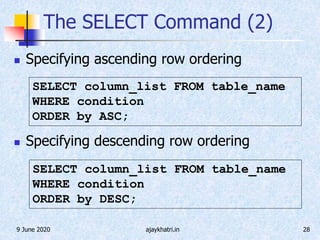
The SELECT Command (2)
 Specifying ascending row ordering
 Specifying descending row ordering
SELECT column_list FROM table_name
WHERE condition
ORDER by ASC;
SELECT column_list FROM table_name
WHERE condition
ORDER by DESC;
9 June 2020 ajaykhatri.in 29
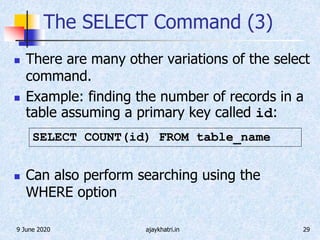
The SELECT Command (3)
 There are many other variations of the select
command.
 Example: finding the number of records in a
table assuming a primary key called id:
 Can also perform searching using the
WHERE option
SELECT COUNT(id) FROM table_name
9 June 2020 ajaykhatri.in 30
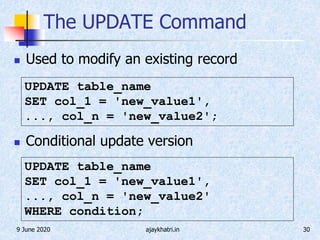
The UPDATE Command
 Used to modify an existing record
 Conditional update version
UPDATE table_name
SET col_1 = 'new_value1',
..., col_n = 'new_value2';
UPDATE table_name
SET col_1 = 'new_value1',
..., col_n = 'new_value2'
WHERE condition;
9 June 2020 ajaykhatri.in 31
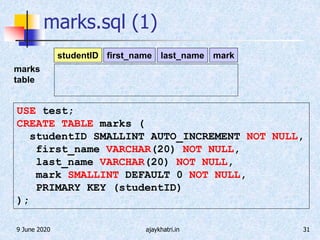
marks.sql (1)
studentID first_name
USE test;
CREATE TABLE marks (
studentID SMALLINT AUTO_INCREMENT NOT NULL,
first_name VARCHAR(20) NOT NULL,
last_name VARCHAR(20) NOT NULL,
mark SMALLINT DEFAULT 0 NOT NULL,
PRIMARY KEY (studentID)
);
marks
table
last_name mark
9 June 2020 ajaykhatri.in 32
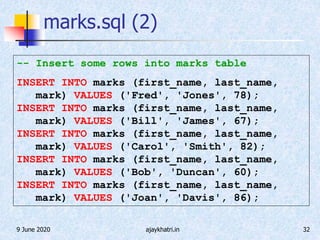
marks.sql (2)
-- Insert some rows into marks table
INSERT INTO marks (first_name, last_name,
mark) VALUES ('Fred', 'Jones', 78);
INSERT INTO marks (first_name, last_name,
mark) VALUES ('Bill', 'James', 67);
INSERT INTO marks (first_name, last_name,
mark) VALUES ('Carol', 'Smith', 82);
INSERT INTO marks (first_name, last_name,
mark) VALUES ('Bob', 'Duncan', 60);
INSERT INTO marks (first_name, last_name,
mark) VALUES ('Joan', 'Davis', 86);
9 June 2020 ajaykhatri.in 33
Executing The Script
 within MySQL use a command such as
 source c:/.........../marks.sql
 This adds the marks table to the test
database
9 June 2020 ajaykhatri.in 34
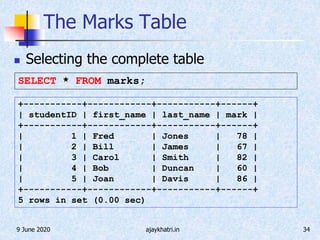
The Marks Table
 Selecting the complete table
SELECT * FROM marks;
+-----------+------------+-----------+------+
| studentID | first_name | last_name | mark |
+-----------+------------+-----------+------+
| 1 | Fred | Jones | 78 |
| 2 | Bill | James | 67 |
| 3 | Carol | Smith | 82 |
| 4 | Bob | Duncan | 60 |
| 5 | Joan | Davis | 86 |
+-----------+------------+-----------+------+
5 rows in set (0.00 sec)
9 June 2020 ajaykhatri.in 35
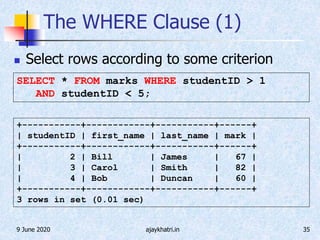
The WHERE Clause (1)
 Select rows according to some criterion
SELECT * FROM marks WHERE studentID > 1
AND studentID < 5;
+-----------+------------+-----------+------+
| studentID | first_name | last_name | mark |
+-----------+------------+-----------+------+
| 2 | Bill | James | 67 |
| 3 | Carol | Smith | 82 |
| 4 | Bob | Duncan | 60 |
+-----------+------------+-----------+------+
3 rows in set (0.01 sec)
9 June 2020 ajaykhatri.in 36
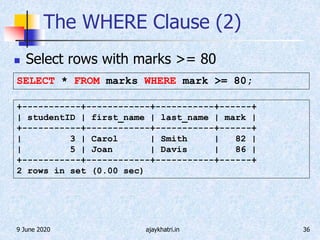
The WHERE Clause (2)
 Select rows with marks >= 80
SELECT * FROM marks WHERE mark >= 80;
+-----------+------------+-----------+------+
| studentID | first_name | last_name | mark |
+-----------+------------+-----------+------+
| 3 | Carol | Smith | 82 |
| 5 | Joan | Davis | 86 |
+-----------+------------+-----------+------+
2 rows in set (0.00 sec)
9 June 2020 ajaykhatri.in 37
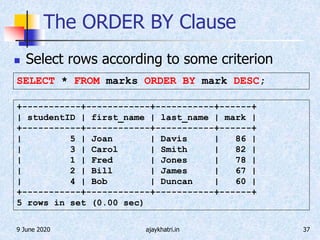
The ORDER BY Clause
 Select rows according to some criterion
SELECT * FROM marks ORDER BY mark DESC;
+-----------+------------+-----------+------+
| studentID | first_name | last_name | mark |
+-----------+------------+-----------+------+
| 5 | Joan | Davis | 86 |
| 3 | Carol | Smith | 82 |
| 1 | Fred | Jones | 78 |
| 2 | Bill | James | 67 |
| 4 | Bob | Duncan | 60 |
+-----------+------------+-----------+------+
5 rows in set (0.00 sec)
9 June 2020 ajaykhatri.in 38
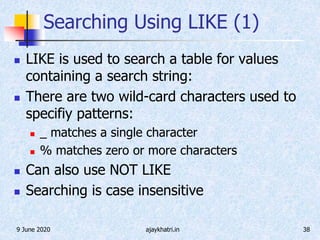
Searching Using LIKE (1)
 LIKE is used to search a table for values
containing a search string:
 There are two wild-card characters used to
specifiy patterns:
 _ matches a single character
 % matches zero or more characters
 Can also use NOT LIKE
 Searching is case insensitive
9 June 2020 ajaykhatri.in 39
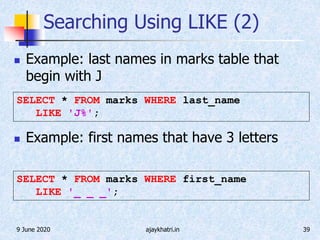
Searching Using LIKE (2)
 Example: last names in marks table that
begin with J
 Example: first names that have 3 letters
SELECT * FROM marks WHERE last_name
LIKE 'J%';
SELECT * FROM marks WHERE first_name
LIKE '_ _ _';
9 June 2020 ajaykhatri.in 40
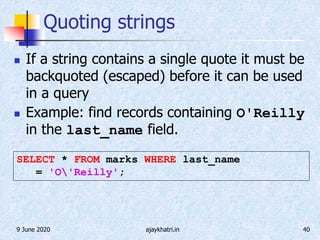
Quoting strings
 If a string contains a single quote it must be
backquoted (escaped) before it can be used
in a query
 Example: find records containing O'Reilly
in the last_name field.
SELECT * FROM marks WHERE last_name
= 'O'Reilly';
9 June 2020 ajaykhatri.in 41
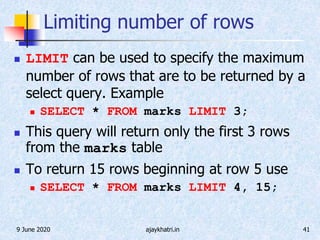
Limiting number of rows
 LIMIT can be used to specify the maximum
number of rows that are to be returned by a
select query. Example
 SELECT * FROM marks LIMIT 3;
 This query will return only the first 3 rows
from the marks table
 To return 15 rows beginning at row 5 use
 SELECT * FROM marks LIMIT 4, 15;
9 June 2020 ajaykhatri.in 42
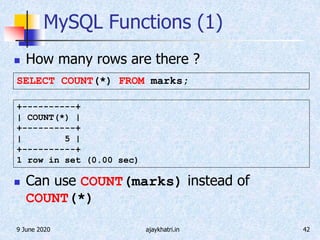
MySQL Functions (1)
 How many rows are there ?
 Can use COUNT(marks) instead of
COUNT(*)
SELECT COUNT(*) FROM marks;
+----------+
| COUNT(*) |
+----------+
| 5 |
+----------+
1 row in set (0.00 sec)
9 June 2020 ajaykhatri.in 43
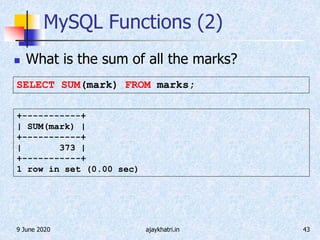
MySQL Functions (2)
 What is the sum of all the marks?
SELECT SUM(mark) FROM marks;
+-----------+
| SUM(mark) |
+-----------+
| 373 |
+-----------+
1 row in set (0.00 sec)
9 June 2020 ajaykhatri.in 44
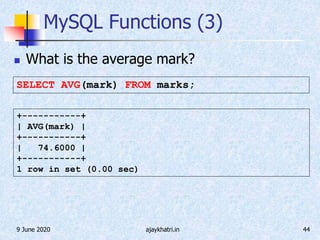
MySQL Functions (3)
 What is the average mark?
SELECT AVG(mark) FROM marks;
+-----------+
| AVG(mark) |
+-----------+
| 74.6000 |
+-----------+
1 row in set (0.00 sec)
9 June 2020 ajaykhatri.in 45
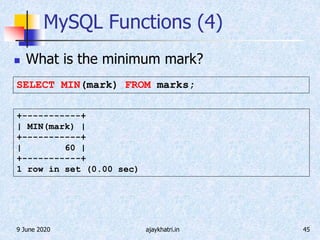
MySQL Functions (4)
 What is the minimum mark?
SELECT MIN(mark) FROM marks;
+-----------+
| MIN(mark) |
+-----------+
| 60 |
+-----------+
1 row in set (0.00 sec)
9 June 2020 ajaykhatri.in 46
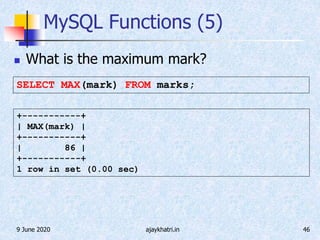
MySQL Functions (5)
 What is the maximum mark?
SELECT MAX(mark) FROM marks;
+-----------+
| MAX(mark) |
+-----------+
| 86 |
+-----------+
1 row in set (0.00 sec)
9 June 2020 ajaykhatri.in 47
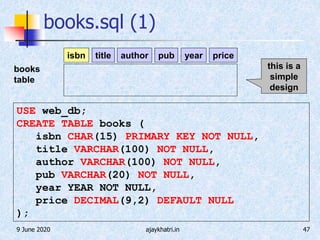
books.sql (1)
isbn title author pub year price
USE web_db;
CREATE TABLE books (
isbn CHAR(15) PRIMARY KEY NOT NULL,
title VARCHAR(100) NOT NULL,
author VARCHAR(100) NOT NULL,
pub VARCHAR(20) NOT NULL,
year YEAR NOT NULL,
price DECIMAL(9,2) DEFAULT NULL
);
books
table
this is a
simple
design
9 June 2020 ajaykhatri.in 48
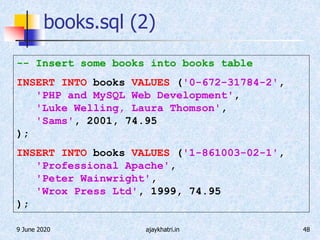
books.sql (2)
-- Insert some books into books table
INSERT INTO books VALUES ('0-672-31784-2',
'PHP and MySQL Web Development',
'Luke Welling, Laura Thomson',
'Sams', 2001, 74.95
);
INSERT INTO books VALUES ('1-861003-02-1',
'Professional Apache',
'Peter Wainwright',
'Wrox Press Ltd', 1999, 74.95
);
9 June 2020 ajaykhatri.in 49
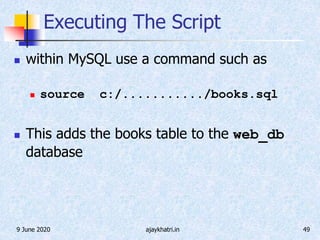
Executing The Script
 within MySQL use a command such as
 source c:/.........../books.sql
 This adds the books table to the web_db
database
9 June 2020 ajaykhatri.in 50
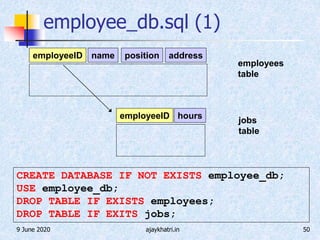
employee_db.sql (1)
employeeID name position address
CREATE DATABASE IF NOT EXISTS employee_db;
USE employee_db;
DROP TABLE IF EXISTS employees;
DROP TABLE IF EXITS jobs;
employeeID hours
employees
table
jobs
table
9 June 2020 ajaykhatri.in 51
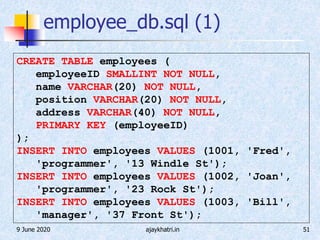
employee_db.sql (1)
CREATE TABLE employees (
employeeID SMALLINT NOT NULL,
name VARCHAR(20) NOT NULL,
position VARCHAR(20) NOT NULL,
address VARCHAR(40) NOT NULL,
PRIMARY KEY (employeeID)
);
INSERT INTO employees VALUES (1001, 'Fred',
'programmer', '13 Windle St');
INSERT INTO employees VALUES (1002, 'Joan',
'programmer', '23 Rock St');
INSERT INTO employees VALUES (1003, 'Bill',
'manager', '37 Front St');
9 June 2020 ajaykhatri.in 52
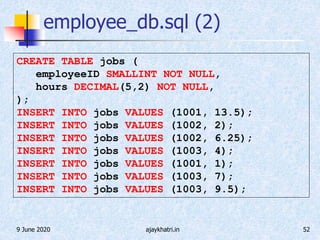
employee_db.sql (2)
CREATE TABLE jobs (
employeeID SMALLINT NOT NULL,
hours DECIMAL(5,2) NOT NULL,
);
INSERT INTO jobs VALUES (1001, 13.5);
INSERT INTO jobs VALUES (1002, 2);
INSERT INTO jobs VALUES (1002, 6.25);
INSERT INTO jobs VALUES (1003, 4);
INSERT INTO jobs VALUES (1001, 1);
INSERT INTO jobs VALUES (1003, 7);
INSERT INTO jobs VALUES (1003, 9.5);
9 June 2020 ajaykhatri.in 53
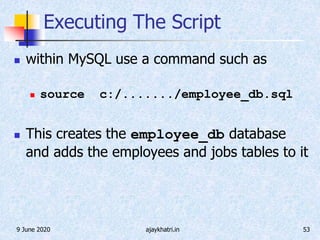
Executing The Script
 within MySQL use a command such as
 source c:/......./employee_db.sql
 This creates the employee_db database
and adds the employees and jobs tables to it
9 June 2020 ajaykhatri.in 54
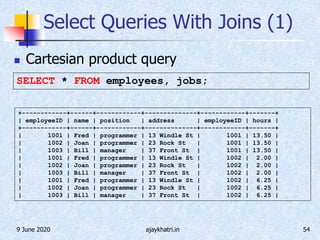
Select Queries With Joins (1)
 Cartesian product query
SELECT * FROM employees, jobs;
+------------+------+------------+--------------+------------+-------+
| employeeID | name | position | address | employeeID | hours |
+------------+------+------------+--------------+------------+-------+
| 1001 | Fred | programmer | 13 Windle St | 1001 | 13.50 |
| 1002 | Joan | programmer | 23 Rock St | 1001 | 13.50 |
| 1003 | Bill | manager | 37 Front St | 1001 | 13.50 |
| 1001 | Fred | programmer | 13 Windle St | 1002 | 2.00 |
| 1002 | Joan | programmer | 23 Rock St | 1002 | 2.00 |
| 1003 | Bill | manager | 37 Front St | 1002 | 2.00 |
| 1001 | Fred | programmer | 13 Windle St | 1002 | 6.25 |
| 1002 | Joan | programmer | 23 Rock St | 1002 | 6.25 |
| 1003 | Bill | manager | 37 Front St | 1002 | 6.25 |
9 June 2020 ajaykhatri.in 55
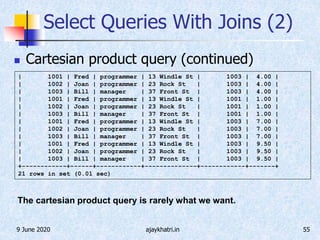
Select Queries With Joins (2)
 Cartesian product query (continued)
| 1001 | Fred | programmer | 13 Windle St | 1003 | 4.00 |
| 1002 | Joan | programmer | 23 Rock St | 1003 | 4.00 |
| 1003 | Bill | manager | 37 Front St | 1003 | 4.00 |
| 1001 | Fred | programmer | 13 Windle St | 1001 | 1.00 |
| 1002 | Joan | programmer | 23 Rock St | 1001 | 1.00 |
| 1003 | Bill | manager | 37 Front St | 1001 | 1.00 |
| 1001 | Fred | programmer | 13 Windle St | 1003 | 7.00 |
| 1002 | Joan | programmer | 23 Rock St | 1003 | 7.00 |
| 1003 | Bill | manager | 37 Front St | 1003 | 7.00 |
| 1001 | Fred | programmer | 13 Windle St | 1003 | 9.50 |
| 1002 | Joan | programmer | 23 Rock St | 1003 | 9.50 |
| 1003 | Bill | manager | 37 Front St | 1003 | 9.50 |
+------------+------+------------+--------------+------------+-------+
21 rows in set (0.01 sec)
The cartesian product query is rarely what we want.
9 June 2020 ajaykhatri.in 56
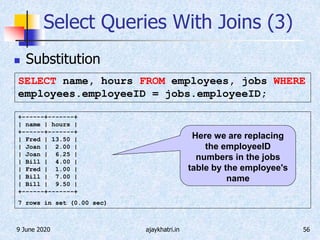
Select Queries With Joins (3)
 Substitution
+------+-------+
| name | hours |
+------+-------+
| Fred | 13.50 |
| Joan | 2.00 |
| Joan | 6.25 |
| Bill | 4.00 |
| Fred | 1.00 |
| Bill | 7.00 |
| Bill | 9.50 |
+------+-------+
7 rows in set (0.00 sec)
Here we are replacing
the employeeID
numbers in the jobs
table by the employee's
name
SELECT name, hours FROM employees, jobs WHERE
employees.employeeID = jobs.employeeID;
9 June 2020 ajaykhatri.in 57
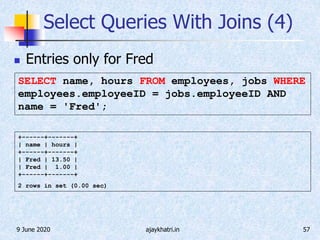
Select Queries With Joins (4)
 Entries only for Fred
+------+-------+
| name | hours |
+------+-------+
| Fred | 13.50 |
| Fred | 1.00 |
+------+-------+
2 rows in set (0.00 sec)
SELECT name, hours FROM employees, jobs WHERE
employees.employeeID = jobs.employeeID AND
name = 'Fred';
9 June 2020 ajaykhatri.in 58
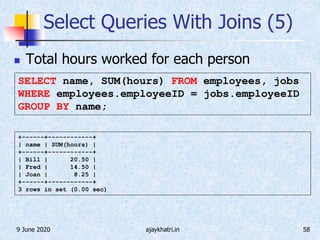
Select Queries With Joins (5)
 Total hours worked for each person
+------+------------+
| name | SUM(hours) |
+------+------------+
| Bill | 20.50 |
| Fred | 14.50 |
| Joan | 8.25 |
+------+------------+
3 rows in set (0.00 sec)
SELECT name, SUM(hours) FROM employees, jobs
WHERE employees.employeeID = jobs.employeeID
GROUP BY name;
9 June 2020 ajaykhatri.in 59
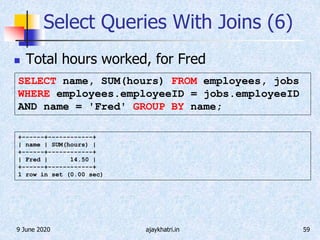
Select Queries With Joins (6)
 Total hours worked, for Fred
+------+------------+
| name | SUM(hours) |
+------+------------+
| Fred | 14.50 |
+------+------------+
1 row in set (0.00 sec)
SELECT name, SUM(hours) FROM employees, jobs
WHERE employees.employeeID = jobs.employeeID
AND name = 'Fred' GROUP BY name;
Learn MySQL Offline
https://play.google.com/store/apps/details?id=learn.apps.learndbms

Introduction To MySQL Lecture 1

  • 1.
    MySQL : Lecture- 1 Ajay Khatri Senior Assistant Professor Acropolis Institute of Technology & Research www.ajaykhatri.in
  • 2.
    9 June 2020ajaykhatri.in 2 2-Tier Architecture Web Browser (Client) Web Server PHP
  • 3.
    9 June 2020ajaykhatri.in 3 3-Tier Architecture Web Browser (Client) Database Server Web Server PHP
  • 4.
    9 June 2020ajaykhatri.in 4 Connecting to the Server  Use a command prompt that sets the path to c:mysqlbin  The following command connects to the server:  mysql -u root -p  you are prompted for the root password.  you can now send comands and SQL statements to the server
  • 5.
    9 June 2020ajaykhatri.in 5 Entering commands (1)  Show all the databases  SHOW DATABASES; mysql> SHOW DATABASES; +-------------+ | Database | +-------------+ | bookstore | | employee_db | | mysql | | student_db | | test | | web_db | +-------------+
  • 6.
    9 June 2020ajaykhatri.in 6 Entering commands (2)  Choosing a database and showing its tables  USE test; SHOW tables; mysql> USE test; Database changed mysql> SHOW tables; +----------------+ | Tables_in_test | +----------------+ | books | | name2 | | names | | test | +----------------+ 4 rows in set (0.00 sec) mysql>
  • 7.
    9 June 2020ajaykhatri.in 7 Entering commands (3)  Show the structure of a table  DESCRIBE names; mysql> DESCRIBE names; +-----------+-------------+------+-----+---------+----------------+ | Field | Type | Null | Key | Default | Extra | +-----------+-------------+------+-----+---------+----------------+ | id | int(11) | | PRI | NULL | auto_increment | | firstName | varchar(20) | | | | | | lastName | varchar(20) | | | | | +-----------+-------------+------+-----+---------+----------------+ 3 rows in set (0.00 sec) mysql>
  • 8.
    9 June 2020ajaykhatri.in 8 Entering commands (4)  Show the rows of a table (all columns)  SELECT * FROM names; mysql> SELECT * FROM names; +----+-----------+------------+ | id | firstName | lastName | +----+-----------+------------+ | 1 | Fred | Flintstone | | 2 | Barney | Rubble | +----+-----------+------------+ 2 rows in set (0.00 sec) mysql>
  • 9.
    9 June 2020ajaykhatri.in 9 Entering commands (5)  Inserting a new record  INSERT INTO names (firstName, lastName) VALUES (‘Ajay',‘Sharma');  SELECT * FROM names; mysql> INSERT INTO names (firstName, lastName) VALUES (‘Ajay', ‘Sharma'); Query OK, 1 row affected (0.02 sec) mysql> SELECT * FROM names; +----+-----------+------------+ | id | firstName | lastName | +----+-----------+------------+ | 1 | Fred | Flintstone | | 2 | Barney | Rubble | | 3 | Ajay | Sharma | +----+-----------+------------+ 3 rows in set (0.00 sec) mysql>
  • 10.
    9 June 2020ajaykhatri.in 10 Entering commands (6)  Updating a record  UPDATE names SET lastName = ‘Khatri' WHERE id=3;  SELECT * FROM names; mysql> UPDATE names SET lastName = ‘Khatri' WHERE id=3; Query OK, 1 row affected (0.28 sec) Rows matched: 1 Changed: 1 Warnings: 0 mysql> SELECT * FROM names; +----+-----------+------------+ | id | firstName | lastName | +----+-----------+------------+ | 1 | Fred | Flintstone | | 2 | Barney | Rubble | | 3 | Ajay | Khatri | +----+-----------+------------+ 3 rows in set (0.00 sec) mysql>
  • 11.
    9 June 2020ajaykhatri.in 11 Logging output  The commands you type and their ouput can be logged to a file by using the following command inside the MySQL command line client  tee log.txt  Here log.txt is the name of the file
  • 12.
    9 June 2020ajaykhatri.in 12 Executing SQL files (1)  It is usually better to use an editor to write an SQL script and send it to the server.  A file of SQL commands such as books.sql can be executed by the server by using a command such as  C:mysqlbinmysql -u root -p < books.sql  This assumes that books.sql is in your current directory. Otherwise the complete path to books.sql must be supplied
  • 13.
    9 June 2020ajaykhatri.in 13 Executing SQL files (2)  A file of SQL commands such as books.sql can also be executed from inside the MySQL client using the source command  source c:.....books.sql  Here the full path to books.sql should be used.
  • 14.
    9 June 2020ajaykhatri.in 14 Documentation  MySQL comes with a tutorial and complete documentation in a HUGE file:  c:mysqlDocsmanual.html  Table of contents with links:  c:mysqlDocsmanual_toc.html  Use this file to locate the link to the topic you are interested in.
  • 15.
    9 June 2020ajaykhatri.in 15 Database concepts (1)  A relational database management system consists of a number of databases.  Each database consists of a number of tables.  Example table isbn title author pub year price books table rows (records) column headings
  • 16.
    9 June 2020ajaykhatri.in 16 Some SQL data types (1)  Each entry in a row has a type specified by the column.  Numeric data types  TINYINT, SMALLINT, MEDIUMINT,  INT, BIGINT  FLOAT(display_length, decimals)  DOUBLE(display_length, decimals)  DECIMAL(display_length, decimals)  NUMERIC is the same as DECIMAL
  • 17.
    9 June 2020ajaykhatri.in 17 Some SQL data types (2)  Date and time types  DATE  format is YYYY-MM-DD  DATETIME  format YYYY-MM-DD HH:MM:SS  TIMESTAMP  format YYYYMMDDHHMMSS  TIME  format HH:MM:SS  YEAR  default length is 4
  • 18.
    9 June 2020ajaykhatri.in 18 SQL data types (3)  String types  CHAR  fixed length string, e.g., CHAR(20)  VARCHAR  variable length string, e.g., VARCHAR(20)  BLOB, TINYBLOB, MEDIUMBLOB, LONGBLOB  same as TEXT, TINYTEXT ...  ENUM  list of items from which value is selected
  • 19.
    9 June 2020ajaykhatri.in 19 SQL commands SHOW, USE  SHOW  Display databases or tables in current database;  Example (command line client):  show databases;  show tables;  USE  Specify which database to use  Example  use bookstore;
  • 20.
    9 June 2020ajaykhatri.in 20 The CREATE Command (1)  CREATE creates a database table CREATE TABLE table_name ( column_name1 column_type1, column_name2 column_type2, ... column_nameN column_typeN ); Note: To create a database use the statement CREATE db_name;
  • 21.
    9 June 2020ajaykhatri.in 21 The CREATE Command (2)  Specifying primary keys CREATE TABLE table_name ( column_name1 column_type1 NOT NULL DEFAULT '0', column_name2 column_type2, ... column_nameN column_typeN, PRIMARY KEY (column_name1) );
  • 22.
    9 June 2020ajaykhatri.in 22 The CREATE Command (3)  autoincrement primary integer keys CREATE TABLE table_name ( column_name1 column_type1 PRIMARY KEY NOT NULL DEFAULT '0' AUTO_INCREMENT, column_name2 column_type2, ... column_nameN column_typeN, );
  • 23.
    9 June 2020ajaykhatri.in 23 The CREATE Command (4)  Can also create UNIQUE keys. They are similar to PRIMARY KEYS but can have NULL values.  Can also create INDEX fields.
  • 24.
    9 June 2020ajaykhatri.in 24 Conditional Creation  Conditional database creation  CREATE DATABASE IF NOT EXISTS db_name;  Conditional table creation  CREATE TABLE IF NOT EXISTS table_name;
  • 25.
    9 June 2020ajaykhatri.in 25 The DROP Command  To delete databases and tables use the DROP command  Examples  DROP DATABASE db_name;  DROP DATABASE IF EXISTS db_name;  DROP TABLE table_name;  DROP TABLE IF EXISTS table_name; Note: Don't confuse DROP with DELETE which deletes rows of a table.
  • 26.
    9 June 2020ajaykhatri.in 26 The INSERT Command  Inserting rows into a table INSERT INTO table_name ( col_1, col_2, ..., col_N) VALUES ( val_1, val_2, ..., val_N); String values are enclosed in single quotes by default but double quotes are also allowed. Literal quotes need to be escaped using ' and "
  • 27.
    9 June 2020ajaykhatri.in 27 The SELECT Command (1)  Selecting rows from a table  Simplest form: select all columns  Select specified columns  Conditional selection of rows SELECT column_list FROM table_name; SELECT * FROM table_name; SELECT column_list FROM table_name WHERE condition;
  • 28.
    9 June 2020ajaykhatri.in 28 The SELECT Command (2)  Specifying ascending row ordering  Specifying descending row ordering SELECT column_list FROM table_name WHERE condition ORDER by ASC; SELECT column_list FROM table_name WHERE condition ORDER by DESC;
  • 29.
    9 June 2020ajaykhatri.in 29 The SELECT Command (3)  There are many other variations of the select command.  Example: finding the number of records in a table assuming a primary key called id:  Can also perform searching using the WHERE option SELECT COUNT(id) FROM table_name
  • 30.
    9 June 2020ajaykhatri.in 30 The UPDATE Command  Used to modify an existing record  Conditional update version UPDATE table_name SET col_1 = 'new_value1', ..., col_n = 'new_value2'; UPDATE table_name SET col_1 = 'new_value1', ..., col_n = 'new_value2' WHERE condition;
  • 31.
    9 June 2020ajaykhatri.in 31 marks.sql (1) studentID first_name USE test; CREATE TABLE marks ( studentID SMALLINT AUTO_INCREMENT NOT NULL, first_name VARCHAR(20) NOT NULL, last_name VARCHAR(20) NOT NULL, mark SMALLINT DEFAULT 0 NOT NULL, PRIMARY KEY (studentID) ); marks table last_name mark
  • 32.
    9 June 2020ajaykhatri.in 32 marks.sql (2) -- Insert some rows into marks table INSERT INTO marks (first_name, last_name, mark) VALUES ('Fred', 'Jones', 78); INSERT INTO marks (first_name, last_name, mark) VALUES ('Bill', 'James', 67); INSERT INTO marks (first_name, last_name, mark) VALUES ('Carol', 'Smith', 82); INSERT INTO marks (first_name, last_name, mark) VALUES ('Bob', 'Duncan', 60); INSERT INTO marks (first_name, last_name, mark) VALUES ('Joan', 'Davis', 86);
  • 33.
    9 June 2020ajaykhatri.in 33 Executing The Script  within MySQL use a command such as  source c:/.........../marks.sql  This adds the marks table to the test database
  • 34.
    9 June 2020ajaykhatri.in 34 The Marks Table  Selecting the complete table SELECT * FROM marks; +-----------+------------+-----------+------+ | studentID | first_name | last_name | mark | +-----------+------------+-----------+------+ | 1 | Fred | Jones | 78 | | 2 | Bill | James | 67 | | 3 | Carol | Smith | 82 | | 4 | Bob | Duncan | 60 | | 5 | Joan | Davis | 86 | +-----------+------------+-----------+------+ 5 rows in set (0.00 sec)
  • 35.
    9 June 2020ajaykhatri.in 35 The WHERE Clause (1)  Select rows according to some criterion SELECT * FROM marks WHERE studentID > 1 AND studentID < 5; +-----------+------------+-----------+------+ | studentID | first_name | last_name | mark | +-----------+------------+-----------+------+ | 2 | Bill | James | 67 | | 3 | Carol | Smith | 82 | | 4 | Bob | Duncan | 60 | +-----------+------------+-----------+------+ 3 rows in set (0.01 sec)
  • 36.
    9 June 2020ajaykhatri.in 36 The WHERE Clause (2)  Select rows with marks >= 80 SELECT * FROM marks WHERE mark >= 80; +-----------+------------+-----------+------+ | studentID | first_name | last_name | mark | +-----------+------------+-----------+------+ | 3 | Carol | Smith | 82 | | 5 | Joan | Davis | 86 | +-----------+------------+-----------+------+ 2 rows in set (0.00 sec)
  • 37.
    9 June 2020ajaykhatri.in 37 The ORDER BY Clause  Select rows according to some criterion SELECT * FROM marks ORDER BY mark DESC; +-----------+------------+-----------+------+ | studentID | first_name | last_name | mark | +-----------+------------+-----------+------+ | 5 | Joan | Davis | 86 | | 3 | Carol | Smith | 82 | | 1 | Fred | Jones | 78 | | 2 | Bill | James | 67 | | 4 | Bob | Duncan | 60 | +-----------+------------+-----------+------+ 5 rows in set (0.00 sec)
  • 38.
    9 June 2020ajaykhatri.in 38 Searching Using LIKE (1)  LIKE is used to search a table for values containing a search string:  There are two wild-card characters used to specifiy patterns:  _ matches a single character  % matches zero or more characters  Can also use NOT LIKE  Searching is case insensitive
  • 39.
    9 June 2020ajaykhatri.in 39 Searching Using LIKE (2)  Example: last names in marks table that begin with J  Example: first names that have 3 letters SELECT * FROM marks WHERE last_name LIKE 'J%'; SELECT * FROM marks WHERE first_name LIKE '_ _ _';
  • 40.
    9 June 2020ajaykhatri.in 40 Quoting strings  If a string contains a single quote it must be backquoted (escaped) before it can be used in a query  Example: find records containing O'Reilly in the last_name field. SELECT * FROM marks WHERE last_name = 'O'Reilly';
  • 41.
    9 June 2020ajaykhatri.in 41 Limiting number of rows  LIMIT can be used to specify the maximum number of rows that are to be returned by a select query. Example  SELECT * FROM marks LIMIT 3;  This query will return only the first 3 rows from the marks table  To return 15 rows beginning at row 5 use  SELECT * FROM marks LIMIT 4, 15;
  • 42.
    9 June 2020ajaykhatri.in 42 MySQL Functions (1)  How many rows are there ?  Can use COUNT(marks) instead of COUNT(*) SELECT COUNT(*) FROM marks; +----------+ | COUNT(*) | +----------+ | 5 | +----------+ 1 row in set (0.00 sec)
  • 43.
    9 June 2020ajaykhatri.in 43 MySQL Functions (2)  What is the sum of all the marks? SELECT SUM(mark) FROM marks; +-----------+ | SUM(mark) | +-----------+ | 373 | +-----------+ 1 row in set (0.00 sec)
  • 44.
    9 June 2020ajaykhatri.in 44 MySQL Functions (3)  What is the average mark? SELECT AVG(mark) FROM marks; +-----------+ | AVG(mark) | +-----------+ | 74.6000 | +-----------+ 1 row in set (0.00 sec)
  • 45.
    9 June 2020ajaykhatri.in 45 MySQL Functions (4)  What is the minimum mark? SELECT MIN(mark) FROM marks; +-----------+ | MIN(mark) | +-----------+ | 60 | +-----------+ 1 row in set (0.00 sec)
  • 46.
    9 June 2020ajaykhatri.in 46 MySQL Functions (5)  What is the maximum mark? SELECT MAX(mark) FROM marks; +-----------+ | MAX(mark) | +-----------+ | 86 | +-----------+ 1 row in set (0.00 sec)
  • 47.
    9 June 2020ajaykhatri.in 47 books.sql (1) isbn title author pub year price USE web_db; CREATE TABLE books ( isbn CHAR(15) PRIMARY KEY NOT NULL, title VARCHAR(100) NOT NULL, author VARCHAR(100) NOT NULL, pub VARCHAR(20) NOT NULL, year YEAR NOT NULL, price DECIMAL(9,2) DEFAULT NULL ); books table this is a simple design
  • 48.
    9 June 2020ajaykhatri.in 48 books.sql (2) -- Insert some books into books table INSERT INTO books VALUES ('0-672-31784-2', 'PHP and MySQL Web Development', 'Luke Welling, Laura Thomson', 'Sams', 2001, 74.95 ); INSERT INTO books VALUES ('1-861003-02-1', 'Professional Apache', 'Peter Wainwright', 'Wrox Press Ltd', 1999, 74.95 );
  • 49.
    9 June 2020ajaykhatri.in 49 Executing The Script  within MySQL use a command such as  source c:/.........../books.sql  This adds the books table to the web_db database
  • 50.
    9 June 2020ajaykhatri.in 50 employee_db.sql (1) employeeID name position address CREATE DATABASE IF NOT EXISTS employee_db; USE employee_db; DROP TABLE IF EXISTS employees; DROP TABLE IF EXITS jobs; employeeID hours employees table jobs table
  • 51.
    9 June 2020ajaykhatri.in 51 employee_db.sql (1) CREATE TABLE employees ( employeeID SMALLINT NOT NULL, name VARCHAR(20) NOT NULL, position VARCHAR(20) NOT NULL, address VARCHAR(40) NOT NULL, PRIMARY KEY (employeeID) ); INSERT INTO employees VALUES (1001, 'Fred', 'programmer', '13 Windle St'); INSERT INTO employees VALUES (1002, 'Joan', 'programmer', '23 Rock St'); INSERT INTO employees VALUES (1003, 'Bill', 'manager', '37 Front St');
  • 52.
    9 June 2020ajaykhatri.in 52 employee_db.sql (2) CREATE TABLE jobs ( employeeID SMALLINT NOT NULL, hours DECIMAL(5,2) NOT NULL, ); INSERT INTO jobs VALUES (1001, 13.5); INSERT INTO jobs VALUES (1002, 2); INSERT INTO jobs VALUES (1002, 6.25); INSERT INTO jobs VALUES (1003, 4); INSERT INTO jobs VALUES (1001, 1); INSERT INTO jobs VALUES (1003, 7); INSERT INTO jobs VALUES (1003, 9.5);
  • 53.
    9 June 2020ajaykhatri.in 53 Executing The Script  within MySQL use a command such as  source c:/......./employee_db.sql  This creates the employee_db database and adds the employees and jobs tables to it
  • 54.
    9 June 2020ajaykhatri.in 54 Select Queries With Joins (1)  Cartesian product query SELECT * FROM employees, jobs; +------------+------+------------+--------------+------------+-------+ | employeeID | name | position | address | employeeID | hours | +------------+------+------------+--------------+------------+-------+ | 1001 | Fred | programmer | 13 Windle St | 1001 | 13.50 | | 1002 | Joan | programmer | 23 Rock St | 1001 | 13.50 | | 1003 | Bill | manager | 37 Front St | 1001 | 13.50 | | 1001 | Fred | programmer | 13 Windle St | 1002 | 2.00 | | 1002 | Joan | programmer | 23 Rock St | 1002 | 2.00 | | 1003 | Bill | manager | 37 Front St | 1002 | 2.00 | | 1001 | Fred | programmer | 13 Windle St | 1002 | 6.25 | | 1002 | Joan | programmer | 23 Rock St | 1002 | 6.25 | | 1003 | Bill | manager | 37 Front St | 1002 | 6.25 |
  • 55.
    9 June 2020ajaykhatri.in 55 Select Queries With Joins (2)  Cartesian product query (continued) | 1001 | Fred | programmer | 13 Windle St | 1003 | 4.00 | | 1002 | Joan | programmer | 23 Rock St | 1003 | 4.00 | | 1003 | Bill | manager | 37 Front St | 1003 | 4.00 | | 1001 | Fred | programmer | 13 Windle St | 1001 | 1.00 | | 1002 | Joan | programmer | 23 Rock St | 1001 | 1.00 | | 1003 | Bill | manager | 37 Front St | 1001 | 1.00 | | 1001 | Fred | programmer | 13 Windle St | 1003 | 7.00 | | 1002 | Joan | programmer | 23 Rock St | 1003 | 7.00 | | 1003 | Bill | manager | 37 Front St | 1003 | 7.00 | | 1001 | Fred | programmer | 13 Windle St | 1003 | 9.50 | | 1002 | Joan | programmer | 23 Rock St | 1003 | 9.50 | | 1003 | Bill | manager | 37 Front St | 1003 | 9.50 | +------------+------+------------+--------------+------------+-------+ 21 rows in set (0.01 sec) The cartesian product query is rarely what we want.
  • 56.
    9 June 2020ajaykhatri.in 56 Select Queries With Joins (3)  Substitution +------+-------+ | name | hours | +------+-------+ | Fred | 13.50 | | Joan | 2.00 | | Joan | 6.25 | | Bill | 4.00 | | Fred | 1.00 | | Bill | 7.00 | | Bill | 9.50 | +------+-------+ 7 rows in set (0.00 sec) Here we are replacing the employeeID numbers in the jobs table by the employee's name SELECT name, hours FROM employees, jobs WHERE employees.employeeID = jobs.employeeID;
  • 57.
    9 June 2020ajaykhatri.in 57 Select Queries With Joins (4)  Entries only for Fred +------+-------+ | name | hours | +------+-------+ | Fred | 13.50 | | Fred | 1.00 | +------+-------+ 2 rows in set (0.00 sec) SELECT name, hours FROM employees, jobs WHERE employees.employeeID = jobs.employeeID AND name = 'Fred';
  • 58.
    9 June 2020ajaykhatri.in 58 Select Queries With Joins (5)  Total hours worked for each person +------+------------+ | name | SUM(hours) | +------+------------+ | Bill | 20.50 | | Fred | 14.50 | | Joan | 8.25 | +------+------------+ 3 rows in set (0.00 sec) SELECT name, SUM(hours) FROM employees, jobs WHERE employees.employeeID = jobs.employeeID GROUP BY name;
  • 59.
    9 June 2020ajaykhatri.in 59 Select Queries With Joins (6)  Total hours worked, for Fred +------+------------+ | name | SUM(hours) | +------+------------+ | Fred | 14.50 | +------+------------+ 1 row in set (0.00 sec) SELECT name, SUM(hours) FROM employees, jobs WHERE employees.employeeID = jobs.employeeID AND name = 'Fred' GROUP BY name;
  • 60.

Editor's Notes

  • #17 If the scale is 0, DECIMAL values contain no decimal point or fractional part. The maximum number of digits for DECIMAL is 65, but the actual range for a given DECIMAL column can be constrained by the precision or scale for a given column. When such a column is assigned a value with more digits following the decimal point than are permitted by the specified scale, the value is converted to that scale. (The precise behavior is operating system-specific, but generally the effect is truncation to the permissible number of digits.)