Understanding Human Activity
from Visual Data
Mehrsan Javan
CTO
Sportlogiq
Outline
• Introduction and definitions
• Industry applications – why sports
• Technology evolution & core concepts
• Classical feature-based approaches combined with structured output models
• Deep learning, transformer-based architectures & large models
• Vision-Language Models (VLMs)
• Computational & deployment challenges
• Conclusion & future directions
© 2025 Sportlogiq 2
Fine-Grained Understanding Is the First Building Block
• Activity Detection: Identifies where
and when an activity occurs
• Activity Recognition: Labels without
spatio-temporal localization
• Action Grounding: Maps specific
actions to visual cues in a video in
response to a textual query
• Video Captioning: Generates natural
language descriptions for video
content, often capturing a sequence
of activities and their relationships.
© 2025 Sportlogiq 3
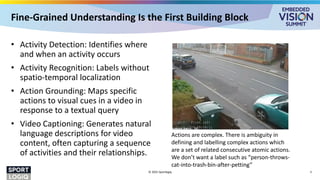
Actions are complex. There is ambiguity in
defining and labelling complex actions which
are a set of related consecutive atomic actions.
We don’t want a label such as “person-throws-
cat-into-trash-bin-after-petting”
Why It Is Difficult
• Many applications need spatio-
temporal localization
• Challenges
• Large variation in appearances and
viewpoint & occlusions, non-rigid
motion, temporal inconsistencies
• Prohibitive manual collection of
training samples & rare occurrences
• Complex actions and not well-
defined action vocabularies
• Existing datasets are still small
© 2025 Sportlogiq 4
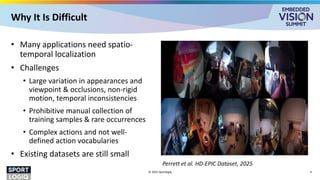
Perrett et al. HD-EPIC Dataset, 2025
Industry Applications
• Surveillance, autonomous cars,
robotics, retail, etc.
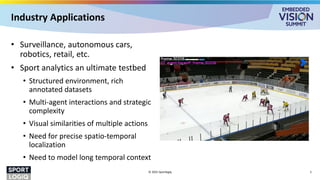
• Sport analytics an ultimate testbed
• Structured environment, rich
annotated datasets
• Multi-agent interactions and strategic
complexity
• Visual similarities of multiple actions
• Need for precise spatio-temporal
localization
• Need to model long temporal context
© 2025 Sportlogiq 5
Sports as an Ultimate Testbed
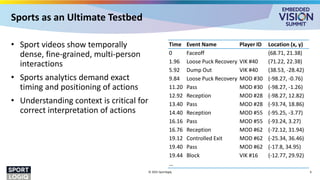
• Sport videos show temporally
dense, fine-grained, multi-person
interactions
• Sports analytics demand exact
timing and positioning of actions
• Understanding context is critical for
correct interpretation of actions
© 2025 Sportlogiq 6
Time Event Name Player ID Location (x, y)
0 Faceoff (68.71, 21.38)
1.96 Loose Puck Recovery VIK #40 (71.22, 22.38)
5.92 Dump Out VIK #40 (38.53, -28.42)
9.84 Loose Puck Recovery MOD #30 (-98.27, -0.76)
11.20 Pass MOD #30 (-98.27, -1.26)
12.92 Reception MOD #28 (-98.27, 12.82)
13.40 Pass MOD #28 (-93.74, 18.86)
14.40 Reception MOD #55 (-95.25, -3.77)
16.16 Pass MOD #55 (-93.24, 3.27)
16.76 Reception MOD #62 (-72.12, 31.94)
19.12 Controlled Exit MOD #62 (-25.34, 36.46)
19.40 Pass MOD #62 (-17.8, 34.95)
19.44 Block VIK #16 (-12.77, 29.92)
…
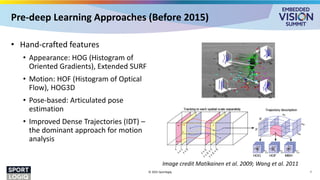
Pre-deep Learning Approaches (Before 2015)
• Hand-crafted features
• Appearance: HOG (Histogram of
Oriented Gradients), Extended SURF
• Motion: HOF (Histogram of Optical
Flow), HOG3D
• Pose-based: Articulated pose
estimation
• Improved Dense Trajectories (IDT) –
the dominant approach for motion
analysis
© 2025 Sportlogiq 7
Human Action Recognition ",
ICCV 2009
+ ECCV 2012 extension
H. Wang, A. Klaser, C. Schmid, C.-L. Liu,
"Action Recognition by Dense Trajectories",
CVPR 2011
P. Matikainen, R. Sukthankar and M. Hebert
"Trajectons: Action Recognition Through the
Motion Analysis of Tracked Features"
ICCV VOEC Workshop 2009,
•
•
•
Human Action Recognition ",
ICCV 2009
+ ECCV 2012 extension
H. Wang, A. Klaser, C. Schmid, C.-L. Liu,
"Action Recognition by Dense Trajectories",
CVPR 2011
P. Matikainen, R. Sukthankar and M. Hebert
"Trajectons: Action Recognition Through the
Motion Analysis of Tracked Features"
ICCV VOEC Workshop 2009,
•
•
Image credit Matikainen et al. 2009; Wang et al. 2011
Pre-deep Learning Approaches (Before 2015)
• Inference mechanisms
• Bag of Features (BoF) and Fisher Vectors
• Structured SVMs, HMMs, and CRFs
• Interaction modeling: Probabilistic graphical models (Bayesian Networks, Markov
Random Fields)
• Limitations
• Small datasets with simple activities (e.g., KTH – 6 classes, Weizmann – 10 classes)
• Limited ability to model group dynamics and complex interactions
• Lack of generalization and poor performance in unconstrained environments
© 2025 Sportlogiq 8
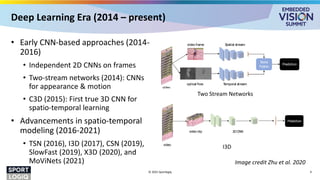
Deep Learning Era (2014 – present)
• Early CNN-based approaches (2014-
2016)
• Independent 2D CNNs on frames
• Two-stream networks (2014): CNNs
for appearance & motion
• C3D (2015): First true 3D CNN for
spatio-temporal learning
• Advancements in spatio-temporal
modeling (2016-2021)
• TSN (2016), I3D (2017), CSN (2019),
SlowFast (2019), X3D (2020), and
MoViNets (2021)
© 2025 Sportlogiq 9
S
core
Fusion
Prediction
video
video frame
optical flow
S
patial stream
T
emporal stream
S
egmental
Consensus
Prediction
video segments C
NN
Two-stream Networks
T
emporal Segment Networks(TSN)
S
core
Fusion
Prediction
video
optical flow T
emporal stream
S
egmental
Consensus
Prediction
video segments C
NN
video
Two-stream Networks
T
emporal Segment Networks(TSN)
video clip 3DCNN
Prediction
I3D
Prediction
Two Stream Networks
I3D
Image credit Zhu et al. 2020
Deep Learning Era (2014 – present)
• 3D CNN models issues
• Short temporal attention span up to a
few seconds
• Longer video understanding needs
attention-based layers
• Don’t scale well with more data
• Difficulties in scaling to action
detection and distinguishing actions
with subtle differences
• They still stand a chance compared
to transformers for action
recognition with small training sets
© 2025 Sportlogiq 10
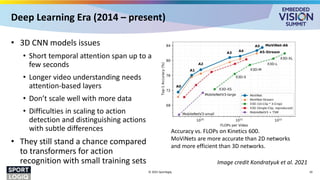
Accuracy vs. FLOPs on Kinetics 600.
MoViNets are more accurate than 2D networks
and more efficient than 3D networks.
Image credit Kondratyuk et al. 2021
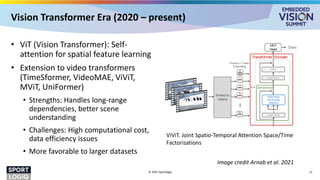
Vision Transformer Era (2020 – present)
• ViT (Vision Transformer): Self-
attention for spatial feature learning
• Extension to video transformers
(TimeSformer, VideoMAE, ViViT,
MViT, UniFormer)
• Strengths: Handles long-range
dependencies, better scene
understanding
• Challenges: High computational cost,
data efficiency issues
• More favorable to larger datasets
© 2025 Sportlogiq 11
…
1
CLS
0
3
2
N
Position + Token
Embedding
MLP
Head
Class
Fact
Enc
L×
K V Q
Self-Attention
Transformer Encoder
MLP
Layer Norm
Layer Norm
Multi-Head
Dot-Product
Attention
Embed to
tokens
Sp
Sp
Tem
Tem
2
1
Figure1: Weproposeapure-transformer architecturefor video classification, ins
To effectively process a large number of spatio-temporal tokens, we develop se
of the transformer encoder over the spatial- and temporal-dimensions. As show
attention patterns over spaceand time.
2. Related Work
Architectures for video understanding havemirrored ad-
blocks
Alth
ViViT. Joint Spatio-Temporal Attention Space/Time
Factorizations
Image credit Arnab et al. 2021
Transformers for Video Understanding (2020-Present)
• Transformer characteristics:
• Scale with larger datasets
• Can naturally handle any input which
can get “tokenized”
• Inherent attention mechanism for
spatio-temporal information
encoding
• Handle long-range dependencies,
better scene understanding
• Can accommodate multiple
modalities
© 2025 Sportlogiq 12
3.1. Overview of Vision Transformers (ViT)
Vision Transformer (ViT) [18] adapts the transformer
architecture of [68] to process 2D images with minimal
changes. In particular, ViT extracts N non-overlapping im-
age patches, xi 2 Rh⇥w
, performs a linear projection and
then rasterises them into 1D tokens zi 2 Rd
. The sequence
of tokensinput to the following transformer encoder is
z = [zcls, Ex1, Ex2, . . . , ExN ] + p, (1)
wheretheprojection by E isequivalent to a2D convolution.
Asshown in Fig. 1, an optional learned classification token
zcl s is prepended to this sequence, and its representation at
the final layer of the encoder serves as the final represen-
tation used by the classification layer [17]. In addition, a
learned positional embedding, p 2 RN ⇥d
, is added to the
tokens to retain positional information, as the subsequent
self-attention operations in the transformer are permutation
invariant. The tokens are then passed through an encoder
consisting of asequenceof L transformer layers. Each layer
` comprisesof Multi-Headed Self-Attention [68], layer nor-
malisation (LN) [2], and MLPblocks asfollows:
y`
= MSA(LN(z`
)) + z`
(2)
z` + 1
= MLP(LN(y`
)) + y`
. (3)
The MLP consists of two linear projections separated by a
#
!
"
Figure 2: Uniform frame sampling: Wesimply sample nt frames,
and embed each 2D frameindependently following ViT [18].
!
"
#
Figure3: Tubelet embedding. Weextract and linearly embed non-
overlapping tubelets that span thespatio-temporal input volume.
Tubelet embedding An alternate method, as shown in
Fig. 3, is to extract non-overlapping, spatio-temporal
Image credit Arnab et al. 2021
3.1. Overview of Vision Transformers (ViT)
Vision Transformer (ViT) [18] adapts the transformer
architecture of [68] to process 2D images with minimal
changes. In particular, ViT extracts N non-overlapping im-
age patches, xi 2 Rh⇥w
, performs a linear projection and
then rasterises them into 1D tokens zi 2 Rd
. The sequence
of tokens input to thefollowing transformer encoder is
z = [zcl s, Ex1, Ex2, . . . , ExN ] + p, (1)
wheretheprojection by E isequivalent to a2D convolution.
As shown in Fig. 1, an optional learned classification token
zcl s is prepended to this sequence, and its representation at
the final layer of the encoder serves as the final represen-
tation used by the classification layer [17]. In addition, a
learned positional embedding, p 2 RN ⇥d
, is added to the
tokens to retain positional information, as the subsequent
self-attention operations in the transformer are permutation
invariant. The tokens are then passed through an encoder
consisting of asequenceof L transformer layers. Each layer
` comprisesof Multi-Headed Self-Attention [68], layer nor-
malisation (LN) [2], and MLPblocks asfollows:
y`
= MSA(LN(z`
)) + z`
(2)
z`+ 1
= MLP(LN(y`
)) + y`
. (3)
The MLP consists of two linear projections separated by a
#
!
"
Figure 2: Uniform frame sampling: Wesimply sample nt frames,
and embed each 2D frame independently following ViT [18].
!
"
#
Figure3: Tubelet embedding. Weextract and linearly embed non-
overlapping tubeletsthat span thespatio-temporal input volume.
Tubelet embedding An alternate method, as shown in
Fig. 3, is to extract non-overlapping, spatio-temporal
“tubes” from theinput volume, and tolinearly project thisto
Spatial Embedding
Tubelet Embedding
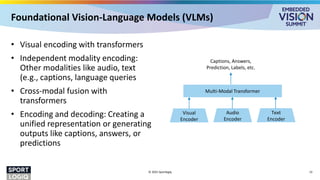
Foundational Vision-Language Models (VLMs)
• Visual encoding with transformers
• Independent modality encoding:
Other modalities like audio, text
(e.g., captions, language queries
• Cross-modal fusion with
transformers
• Encoding and decoding: Creating a
unified representation or generating
outputs like captions, answers, or
predictions
© 2025 Sportlogiq 13
Visual
Encoder
Audio
Encoder
Text
Encoder
Multi-Modal Transformer
Captions, Answers,
Prediction, Labels, etc.
Foundational Vision-Language Models (VLMs)
• Input tokenization
• Video: Pre-trained visual encoders, e.g., TimeSformer, ViViT, VideoMAE
• Audio: Embeddings with pre-trained models, e.g., wav2vec 2.0 or HuBERT
• Text: Queries, captions, and metadata tokenized using BPE (in LLaMA, T5, or GPT)
• Transformer-based processing
• Cross-modal fusion through shared attention layers
• Common architectures
• InternVideo2, Video-LLaMA, OmniVL
© 2025 Sportlogiq 14
Foundational Vision-Language Models (VLMs)
• Architectures tailored for activity understanding
• Activity-focused encoders process spatio-temporal features, e.g., motion patterns,
actor interactions, e.g., InternVideo, TimeSformer
• InternVideo2: Supports temporal video QA, event localization, trained on activity
datasets
• Video-LLaMA / OmniVL: Aligns video frames with fine-grained descriptions of actions
© 2025 Sportlogiq 15
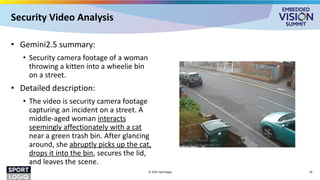
Security Video Analysis
• Gemini2.5 summary:
• Security camera footage of a woman
throwing a kitten into a wheelie bin
on a street.
• Detailed description:
• The video is security camera footage
capturing an incident on a street. A
middle-aged woman interacts
seemingly affectionately with a cat
near a green trash bin. After glancing
around, she abruptly picks up the cat,
drops it into the bin, secures the lid,
and leaves the scene.
© 2025 Sportlogiq 16
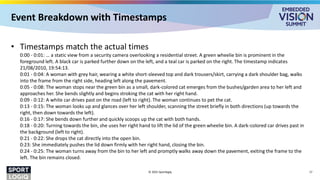
Event Breakdown with Timestamps
• Timestamps match the actual times
0:00 - 0:01: … a static view from a security camera overlooking a residential street. A green wheelie bin is prominent in the
foreground left. A black car is parked further down on the left, and a teal car is parked on the right. The timestamp indicates
21/08/2010, 19:54:13.
0:01 - 0:04: A woman with grey hair, wearing a white short-sleeved top and dark trousers/skirt, carrying a dark shoulder bag, walks
into the frame from the right side, heading left along the pavement.
0:05 - 0:08: The woman stops near the green bin as a small, dark-colored cat emerges from the bushes/garden area to her left and
approaches her. She bends slightly and begins stroking the cat with her right hand.
0:09 - 0:12: A white car drives past on the road (left to right). The woman continues to pet the cat.
0:13 - 0:15: The woman looks up and glances over her left shoulder, scanning the street briefly in both directions (up towards the
right, then down towards the left).
0:16 - 0:17: She bends down further and quickly scoops up the cat with both hands.
0:18 - 0:20: Turning towards the bin, she uses her right hand to lift the lid of the green wheelie bin. A dark-colored car drives past in
the background (left to right).
0:21 - 0:22: She drops the cat directly into the open bin.
0:23: She immediately pushes the lid down firmly with her right hand, closing the bin.
0:24 - 0:25: The woman turns away from the bin to her left and promptly walks away down the pavement, exiting the frame to the
left. The bin remains closed.
© 2025 Sportlogiq 17
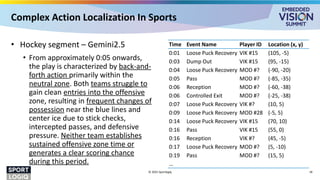
Complex Action Localization In Sports
• Hockey segment – Gemini2.5
• From approximately 0:05 onwards,
the play is characterized by back-and-
forth action primarily within the
neutral zone. Both teams struggle to
gain clean entries into the offensive
zone, resulting in frequent changes of
possession near the blue lines and
center ice due to stick checks,
intercepted passes, and defensive
pressure. Neither team establishes
sustained offensive zone time or
generates a clear scoring chance
during this period.
© 2025 Sportlogiq 18
Time Event Name Player ID Location (x, y)
0:01 Loose Puck Recovery VIK #15 (105, -5)
0:03 Dump Out VIK #15 (95, -15)
0:04 Loose Puck Recovery MOD #? (-90, -20)
0:05 Pass MOD #? (-85, -35)
0:06 Reception MOD #? (-60, -38)
0:06 Controlled Exit MOD #? (-25, -38)
0:07 Loose Puck Recovery VIK #? (10, 5)
0:09 Loose Puck Recovery MOD #28 (-5, 5)
0:14 Loose Puck Recovery VIK #15 (70, 10)
0:16 Pass VIK #15 (55, 0)
0:16 Reception VIK #? (45, -5)
0:17 Loose Puck Recovery MOD #? (5, -10)
0:19 Pass MOD #? (15, 5)
…
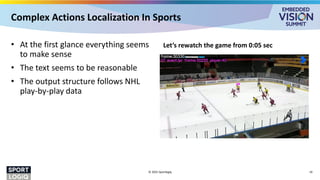
Complex Actions Localization In Sports
• At the first glance everything seems
to make sense
• The text seems to be reasonable
• The output structure follows NHL
play-by-play data
Let’s rewatch the game from 0:05 sec
© 2025 Sportlogiq 19
Complex Actions Localization In Sports
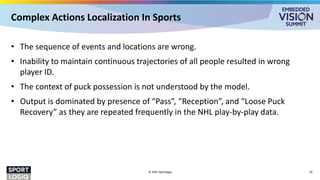
• The sequence of events and locations are wrong.
• Inability to maintain continuous trajectories of all people resulted in wrong
player ID.
• The context of puck possession is not understood by the model.
• Output is dominated by presence of “Pass”, “Reception”, and “Loose Puck
Recovery” as they are repeated frequently in the NHL play-by-play data.
© 2025 Sportlogiq 20
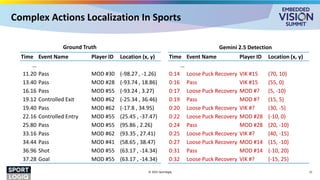
Complex Actions Localization In Sports
© 2025 Sportlogiq 21
Time Event Name Player ID Location (x, y)
…
11.20 Pass MOD #30 (-98.27 , -1.26)
13.40 Pass MOD #28 (-93.74 , 18.86)
16.16 Pass MOD #55 (-93.24 , 3.27)
19.12 Controlled Exit MOD #62 (-25.34 , 36.46)
19.40 Pass MOD #62 (-17.8 , 34.95)
22.16 Controlled Entry MOD #55 (25.45 , -37.47)
25.80 Pass MOD #55 (95.86 , 2.26)
33.16 Pass MOD #62 (93.35 , 27.41)
34.44 Pass MOD #41 (58.65 , 38.47)
36.96 Shot MOD #55 (63.17 , -14.34)
37.28 Goal MOD #55 (63.17 , -14.34)
Time Event Name Player ID Location (x, y)
…
0:14 Loose Puck Recovery VIK #15 (70, 10)
0:16 Pass VIK #15 (55, 0)
0:17 Loose Puck Recovery MOD #? (5, -10)
0:19 Pass MOD #? (15, 5)
0:20 Loose Puck Recovery VIK #? (30, -5)
0:22 Loose Puck Recovery MOD #28 (-10, 0)
0:24 Pass MOD #28 (20, -10)
0:25 Loose Puck Recovery VIK #? (40, -15)
0:27 Loose Puck Recovery MOD #14 (15, -10)
0:31 Pass MOD #14 (-10, 20)
0:32 Loose Puck Recovery VIK #? (-15, 25)
Ground Truth Gemini 2.5 Detection
Limitations of VLMs for Activity Understanding
• Most reasoning and understanding in VLMs for action detection is handled by
large-scale language models, while visual encoding has seen limited
improvements
• Challenges in visual encoding
• Compression on motion information and losing temporal granularity
• Frame sampling and keyframe-based processing resulting in motion discontinuity
• Multiple human interactions and group dynamics are left to be learnt implicitly
• Lack of hierarchical action modeling in current VLMs
© 2025 Sportlogiq 22
Why VLMs Capabilities Are Limited
• Text dominates reasoning
• VLMs repurpose frozen vision encoders (ViT, TimeSformer, CLIP) and rely on LLMs to
infer actions from text-based descriptions
• Most VLMs are trained on narration-based datasets (e.g., HowTo100M, YouCook2)
rather than detailed action labels.
• Existing motion models are underutilized
• Traditional models (e.g., I3D, SlowFast, CSN) were designed for detailed motion
capture, but VLMs often discard their benefits in favor of high-level features
• Lack of high-quality fine-grained datasets
© 2025 Sportlogiq 23
Conclusion –
Deep Learning Models (CNNs, 3D ConvNets, Transformers)
• Strengths:
• Precise spatial and temporal localization, when trained on well-annotated datasets
• Fine-grained motion encoding and modeling short-to-medium range context
• Highly tunable for domain-specific tasks (e.g., sports, surgery, surveillance)
• Limitations:
• Require large labeled datasets to generalize well
• Poor transferability to out-of-distribution scenarios
• Lack semantic reasoning (e.g., understanding “why” actions happen)
© 2025 Sportlogiq 24
Conclusion –
Vision-Language Models (VLMs / Foundation Models)
• Strengths:
• Zero-shot or few-shot generalization via language prompts
• Global scene understanding and coarse temporal queries
• Semantic search, semantic localization, video QA, and descriptive understanding
• Limitations:
• Weak spatio-temporal grounding, especially for fine-grained or multi-person actions
• Low temporal resolution and limited motion encoding
• Relies heavily on text-based reasoning, not designed for frame-accurate detection
© 2025 Sportlogiq 25
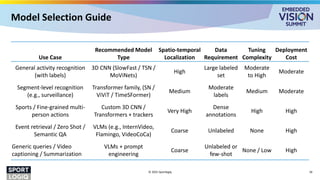
Model Selection Guide
© 2025 Sportlogiq 26
Use Case
Recommended Model
Type
Spatio-temporal
Localization
Data
Requirement
Tuning
Complexity
Deployment
Cost
General activity recognition
(with labels)
3D CNN (SlowFast / TSN /
MoViNets)
High
Large labeled
set
Moderate
to High
Moderate
Segment-level recognition
(e.g., surveillance)
Transformer family, (SN /
ViViT / TimeSFormer)
Medium
Moderate
labels
Medium Moderate
Sports / Fine-grained multi-
person actions
Custom 3D CNN /
Transformers + trackers
Very High
Dense
annotations
High High
Event retrieval / Zero Shot /
Semantic QA
VLMs (e.g., InternVideo,
Flamingo, VideoCoCa)
Coarse Unlabeled None High
Generic queries / Video
captioning / Summarization
VLMs + prompt
engineering
Coarse
Unlabeled or
few-shot
None / Low High
Combining Best of Both Worlds
• Combination of strong visual
embedding and long context
temporal sequence models
• An example of Sportlogiq’s sport
video processing output
© 2025 Sportlogiq 27
Future Directions
• Better motion encoding in foundation models
• Integrate temporal modeling (e.g., from SlowFast, I3D) into VLMs
• Improve frame sampling strategies and motion tokenization
• Multi-agent interaction modeling
• Develop graph-based reasoning modules within transformers
• Capture group dynamics in sports, team-based tasks, and surveillance
• Efficient deployment
• Lightweight video encoders (e.g., MoViNets, TinyVLMs)
• Compress and distill foundation models for edge inference
© 2025 Sportlogiq 28
Pre-deep learning era
Matikainen et al. 2009 Trajectons
Wang et al. 2011, Dense Trajectories
Wang et al. 2013 IDT
Early deep learning
Karpathy et al. 2014 Deepvideo
Simonyan et al. 2014, Two-Stream
Networks
Tran et al. 2015 C3D
Wang et al. 2016 TSN
Carreira et al. 2017, I3D
Feichtenhofer et al. 2019 SlowFast
Tran et al. 2019 CSN
Feichtenhofer 2020 X3D
Zhu et al. 2020, A Comprehensive
Study of Deep Video Action
Recognition
Kondratyuk et al. 2021, MoViNets
© 2025 Sportlogiq 29
Resources
Transformers and VLMs
Radford et al. 2021 CLIP
Dosovitskiy et al. 2021 ViT
Bertasius et al. 2021 TimeSformer
Arnab et al. 2021 ViViT
Li et al. 2021 MViT
Tong et al. 2022 VideoMAE
Li et al. 2022 UniFormer
Wang et al. 2022 OmniVL
Alayrac et al. 2022, Flamingo
Yan et al. 2023 Video CoCa
Wang et al. 2023 VideoMAEv2
Zhang et al. 2023 Video-LLaMA
Wang et al. 2024 InternVideo2
Lu et al. 2024 FACT
Perrett et al. 2025 HD-EPIC
© 2025 Sportlogiq 30
Resources

“Understanding Human Activity from Visual Data,” a Presentation from Sportlogiq

  • 1.
    Understanding Human Activity fromVisual Data Mehrsan Javan CTO Sportlogiq
  • 2.
    Outline • Introduction anddefinitions • Industry applications – why sports • Technology evolution & core concepts • Classical feature-based approaches combined with structured output models • Deep learning, transformer-based architectures & large models • Vision-Language Models (VLMs) • Computational & deployment challenges • Conclusion & future directions © 2025 Sportlogiq 2
  • 3.
    Fine-Grained Understanding Isthe First Building Block • Activity Detection: Identifies where and when an activity occurs • Activity Recognition: Labels without spatio-temporal localization • Action Grounding: Maps specific actions to visual cues in a video in response to a textual query • Video Captioning: Generates natural language descriptions for video content, often capturing a sequence of activities and their relationships. © 2025 Sportlogiq 3 Actions are complex. There is ambiguity in defining and labelling complex actions which are a set of related consecutive atomic actions. We don’t want a label such as “person-throws- cat-into-trash-bin-after-petting”
  • 4.
    Why It IsDifficult • Many applications need spatio- temporal localization • Challenges • Large variation in appearances and viewpoint & occlusions, non-rigid motion, temporal inconsistencies • Prohibitive manual collection of training samples & rare occurrences • Complex actions and not well- defined action vocabularies • Existing datasets are still small © 2025 Sportlogiq 4 Perrett et al. HD-EPIC Dataset, 2025
  • 5.
    Industry Applications • Surveillance,autonomous cars, robotics, retail, etc. • Sport analytics an ultimate testbed • Structured environment, rich annotated datasets • Multi-agent interactions and strategic complexity • Visual similarities of multiple actions • Need for precise spatio-temporal localization • Need to model long temporal context © 2025 Sportlogiq 5
  • 6.
    Sports as anUltimate Testbed • Sport videos show temporally dense, fine-grained, multi-person interactions • Sports analytics demand exact timing and positioning of actions • Understanding context is critical for correct interpretation of actions © 2025 Sportlogiq 6 Time Event Name Player ID Location (x, y) 0 Faceoff (68.71, 21.38) 1.96 Loose Puck Recovery VIK #40 (71.22, 22.38) 5.92 Dump Out VIK #40 (38.53, -28.42) 9.84 Loose Puck Recovery MOD #30 (-98.27, -0.76) 11.20 Pass MOD #30 (-98.27, -1.26) 12.92 Reception MOD #28 (-98.27, 12.82) 13.40 Pass MOD #28 (-93.74, 18.86) 14.40 Reception MOD #55 (-95.25, -3.77) 16.16 Pass MOD #55 (-93.24, 3.27) 16.76 Reception MOD #62 (-72.12, 31.94) 19.12 Controlled Exit MOD #62 (-25.34, 36.46) 19.40 Pass MOD #62 (-17.8, 34.95) 19.44 Block VIK #16 (-12.77, 29.92) …
  • 7.
    Pre-deep Learning Approaches(Before 2015) • Hand-crafted features • Appearance: HOG (Histogram of Oriented Gradients), Extended SURF • Motion: HOF (Histogram of Optical Flow), HOG3D • Pose-based: Articulated pose estimation • Improved Dense Trajectories (IDT) – the dominant approach for motion analysis © 2025 Sportlogiq 7 Human Action Recognition ", ICCV 2009 + ECCV 2012 extension H. Wang, A. Klaser, C. Schmid, C.-L. Liu, "Action Recognition by Dense Trajectories", CVPR 2011 P. Matikainen, R. Sukthankar and M. Hebert "Trajectons: Action Recognition Through the Motion Analysis of Tracked Features" ICCV VOEC Workshop 2009, • • • Human Action Recognition ", ICCV 2009 + ECCV 2012 extension H. Wang, A. Klaser, C. Schmid, C.-L. Liu, "Action Recognition by Dense Trajectories", CVPR 2011 P. Matikainen, R. Sukthankar and M. Hebert "Trajectons: Action Recognition Through the Motion Analysis of Tracked Features" ICCV VOEC Workshop 2009, • • Image credit Matikainen et al. 2009; Wang et al. 2011
  • 8.
    Pre-deep Learning Approaches(Before 2015) • Inference mechanisms • Bag of Features (BoF) and Fisher Vectors • Structured SVMs, HMMs, and CRFs • Interaction modeling: Probabilistic graphical models (Bayesian Networks, Markov Random Fields) • Limitations • Small datasets with simple activities (e.g., KTH – 6 classes, Weizmann – 10 classes) • Limited ability to model group dynamics and complex interactions • Lack of generalization and poor performance in unconstrained environments © 2025 Sportlogiq 8
  • 9.
    Deep Learning Era(2014 – present) • Early CNN-based approaches (2014- 2016) • Independent 2D CNNs on frames • Two-stream networks (2014): CNNs for appearance & motion • C3D (2015): First true 3D CNN for spatio-temporal learning • Advancements in spatio-temporal modeling (2016-2021) • TSN (2016), I3D (2017), CSN (2019), SlowFast (2019), X3D (2020), and MoViNets (2021) © 2025 Sportlogiq 9 S core Fusion Prediction video video frame optical flow S patial stream T emporal stream S egmental Consensus Prediction video segments C NN Two-stream Networks T emporal Segment Networks(TSN) S core Fusion Prediction video optical flow T emporal stream S egmental Consensus Prediction video segments C NN video Two-stream Networks T emporal Segment Networks(TSN) video clip 3DCNN Prediction I3D Prediction Two Stream Networks I3D Image credit Zhu et al. 2020
  • 10.
    Deep Learning Era(2014 – present) • 3D CNN models issues • Short temporal attention span up to a few seconds • Longer video understanding needs attention-based layers • Don’t scale well with more data • Difficulties in scaling to action detection and distinguishing actions with subtle differences • They still stand a chance compared to transformers for action recognition with small training sets © 2025 Sportlogiq 10 Accuracy vs. FLOPs on Kinetics 600. MoViNets are more accurate than 2D networks and more efficient than 3D networks. Image credit Kondratyuk et al. 2021
  • 11.
    Vision Transformer Era(2020 – present) • ViT (Vision Transformer): Self- attention for spatial feature learning • Extension to video transformers (TimeSformer, VideoMAE, ViViT, MViT, UniFormer) • Strengths: Handles long-range dependencies, better scene understanding • Challenges: High computational cost, data efficiency issues • More favorable to larger datasets © 2025 Sportlogiq 11 … 1 CLS 0 3 2 N Position + Token Embedding MLP Head Class Fact Enc L× K V Q Self-Attention Transformer Encoder MLP Layer Norm Layer Norm Multi-Head Dot-Product Attention Embed to tokens Sp Sp Tem Tem 2 1 Figure1: Weproposeapure-transformer architecturefor video classification, ins To effectively process a large number of spatio-temporal tokens, we develop se of the transformer encoder over the spatial- and temporal-dimensions. As show attention patterns over spaceand time. 2. Related Work Architectures for video understanding havemirrored ad- blocks Alth ViViT. Joint Spatio-Temporal Attention Space/Time Factorizations Image credit Arnab et al. 2021
  • 12.
    Transformers for VideoUnderstanding (2020-Present) • Transformer characteristics: • Scale with larger datasets • Can naturally handle any input which can get “tokenized” • Inherent attention mechanism for spatio-temporal information encoding • Handle long-range dependencies, better scene understanding • Can accommodate multiple modalities © 2025 Sportlogiq 12 3.1. Overview of Vision Transformers (ViT) Vision Transformer (ViT) [18] adapts the transformer architecture of [68] to process 2D images with minimal changes. In particular, ViT extracts N non-overlapping im- age patches, xi 2 Rh⇥w , performs a linear projection and then rasterises them into 1D tokens zi 2 Rd . The sequence of tokensinput to the following transformer encoder is z = [zcls, Ex1, Ex2, . . . , ExN ] + p, (1) wheretheprojection by E isequivalent to a2D convolution. Asshown in Fig. 1, an optional learned classification token zcl s is prepended to this sequence, and its representation at the final layer of the encoder serves as the final represen- tation used by the classification layer [17]. In addition, a learned positional embedding, p 2 RN ⇥d , is added to the tokens to retain positional information, as the subsequent self-attention operations in the transformer are permutation invariant. The tokens are then passed through an encoder consisting of asequenceof L transformer layers. Each layer ` comprisesof Multi-Headed Self-Attention [68], layer nor- malisation (LN) [2], and MLPblocks asfollows: y` = MSA(LN(z` )) + z` (2) z` + 1 = MLP(LN(y` )) + y` . (3) The MLP consists of two linear projections separated by a # ! " Figure 2: Uniform frame sampling: Wesimply sample nt frames, and embed each 2D frameindependently following ViT [18]. ! " # Figure3: Tubelet embedding. Weextract and linearly embed non- overlapping tubelets that span thespatio-temporal input volume. Tubelet embedding An alternate method, as shown in Fig. 3, is to extract non-overlapping, spatio-temporal Image credit Arnab et al. 2021 3.1. Overview of Vision Transformers (ViT) Vision Transformer (ViT) [18] adapts the transformer architecture of [68] to process 2D images with minimal changes. In particular, ViT extracts N non-overlapping im- age patches, xi 2 Rh⇥w , performs a linear projection and then rasterises them into 1D tokens zi 2 Rd . The sequence of tokens input to thefollowing transformer encoder is z = [zcl s, Ex1, Ex2, . . . , ExN ] + p, (1) wheretheprojection by E isequivalent to a2D convolution. As shown in Fig. 1, an optional learned classification token zcl s is prepended to this sequence, and its representation at the final layer of the encoder serves as the final represen- tation used by the classification layer [17]. In addition, a learned positional embedding, p 2 RN ⇥d , is added to the tokens to retain positional information, as the subsequent self-attention operations in the transformer are permutation invariant. The tokens are then passed through an encoder consisting of asequenceof L transformer layers. Each layer ` comprisesof Multi-Headed Self-Attention [68], layer nor- malisation (LN) [2], and MLPblocks asfollows: y` = MSA(LN(z` )) + z` (2) z`+ 1 = MLP(LN(y` )) + y` . (3) The MLP consists of two linear projections separated by a # ! " Figure 2: Uniform frame sampling: Wesimply sample nt frames, and embed each 2D frame independently following ViT [18]. ! " # Figure3: Tubelet embedding. Weextract and linearly embed non- overlapping tubeletsthat span thespatio-temporal input volume. Tubelet embedding An alternate method, as shown in Fig. 3, is to extract non-overlapping, spatio-temporal “tubes” from theinput volume, and tolinearly project thisto Spatial Embedding Tubelet Embedding
  • 13.
    Foundational Vision-Language Models(VLMs) • Visual encoding with transformers • Independent modality encoding: Other modalities like audio, text (e.g., captions, language queries • Cross-modal fusion with transformers • Encoding and decoding: Creating a unified representation or generating outputs like captions, answers, or predictions © 2025 Sportlogiq 13 Visual Encoder Audio Encoder Text Encoder Multi-Modal Transformer Captions, Answers, Prediction, Labels, etc.
  • 14.
    Foundational Vision-Language Models(VLMs) • Input tokenization • Video: Pre-trained visual encoders, e.g., TimeSformer, ViViT, VideoMAE • Audio: Embeddings with pre-trained models, e.g., wav2vec 2.0 or HuBERT • Text: Queries, captions, and metadata tokenized using BPE (in LLaMA, T5, or GPT) • Transformer-based processing • Cross-modal fusion through shared attention layers • Common architectures • InternVideo2, Video-LLaMA, OmniVL © 2025 Sportlogiq 14
  • 15.
    Foundational Vision-Language Models(VLMs) • Architectures tailored for activity understanding • Activity-focused encoders process spatio-temporal features, e.g., motion patterns, actor interactions, e.g., InternVideo, TimeSformer • InternVideo2: Supports temporal video QA, event localization, trained on activity datasets • Video-LLaMA / OmniVL: Aligns video frames with fine-grained descriptions of actions © 2025 Sportlogiq 15
  • 16.
    Security Video Analysis •Gemini2.5 summary: • Security camera footage of a woman throwing a kitten into a wheelie bin on a street. • Detailed description: • The video is security camera footage capturing an incident on a street. A middle-aged woman interacts seemingly affectionately with a cat near a green trash bin. After glancing around, she abruptly picks up the cat, drops it into the bin, secures the lid, and leaves the scene. © 2025 Sportlogiq 16
  • 17.
    Event Breakdown withTimestamps • Timestamps match the actual times 0:00 - 0:01: … a static view from a security camera overlooking a residential street. A green wheelie bin is prominent in the foreground left. A black car is parked further down on the left, and a teal car is parked on the right. The timestamp indicates 21/08/2010, 19:54:13. 0:01 - 0:04: A woman with grey hair, wearing a white short-sleeved top and dark trousers/skirt, carrying a dark shoulder bag, walks into the frame from the right side, heading left along the pavement. 0:05 - 0:08: The woman stops near the green bin as a small, dark-colored cat emerges from the bushes/garden area to her left and approaches her. She bends slightly and begins stroking the cat with her right hand. 0:09 - 0:12: A white car drives past on the road (left to right). The woman continues to pet the cat. 0:13 - 0:15: The woman looks up and glances over her left shoulder, scanning the street briefly in both directions (up towards the right, then down towards the left). 0:16 - 0:17: She bends down further and quickly scoops up the cat with both hands. 0:18 - 0:20: Turning towards the bin, she uses her right hand to lift the lid of the green wheelie bin. A dark-colored car drives past in the background (left to right). 0:21 - 0:22: She drops the cat directly into the open bin. 0:23: She immediately pushes the lid down firmly with her right hand, closing the bin. 0:24 - 0:25: The woman turns away from the bin to her left and promptly walks away down the pavement, exiting the frame to the left. The bin remains closed. © 2025 Sportlogiq 17
  • 18.
    Complex Action LocalizationIn Sports • Hockey segment – Gemini2.5 • From approximately 0:05 onwards, the play is characterized by back-and- forth action primarily within the neutral zone. Both teams struggle to gain clean entries into the offensive zone, resulting in frequent changes of possession near the blue lines and center ice due to stick checks, intercepted passes, and defensive pressure. Neither team establishes sustained offensive zone time or generates a clear scoring chance during this period. © 2025 Sportlogiq 18 Time Event Name Player ID Location (x, y) 0:01 Loose Puck Recovery VIK #15 (105, -5) 0:03 Dump Out VIK #15 (95, -15) 0:04 Loose Puck Recovery MOD #? (-90, -20) 0:05 Pass MOD #? (-85, -35) 0:06 Reception MOD #? (-60, -38) 0:06 Controlled Exit MOD #? (-25, -38) 0:07 Loose Puck Recovery VIK #? (10, 5) 0:09 Loose Puck Recovery MOD #28 (-5, 5) 0:14 Loose Puck Recovery VIK #15 (70, 10) 0:16 Pass VIK #15 (55, 0) 0:16 Reception VIK #? (45, -5) 0:17 Loose Puck Recovery MOD #? (5, -10) 0:19 Pass MOD #? (15, 5) …
  • 19.
    Complex Actions LocalizationIn Sports • At the first glance everything seems to make sense • The text seems to be reasonable • The output structure follows NHL play-by-play data Let’s rewatch the game from 0:05 sec © 2025 Sportlogiq 19
  • 20.
    Complex Actions LocalizationIn Sports • The sequence of events and locations are wrong. • Inability to maintain continuous trajectories of all people resulted in wrong player ID. • The context of puck possession is not understood by the model. • Output is dominated by presence of “Pass”, “Reception”, and “Loose Puck Recovery” as they are repeated frequently in the NHL play-by-play data. © 2025 Sportlogiq 20
  • 21.
    Complex Actions LocalizationIn Sports © 2025 Sportlogiq 21 Time Event Name Player ID Location (x, y) … 11.20 Pass MOD #30 (-98.27 , -1.26) 13.40 Pass MOD #28 (-93.74 , 18.86) 16.16 Pass MOD #55 (-93.24 , 3.27) 19.12 Controlled Exit MOD #62 (-25.34 , 36.46) 19.40 Pass MOD #62 (-17.8 , 34.95) 22.16 Controlled Entry MOD #55 (25.45 , -37.47) 25.80 Pass MOD #55 (95.86 , 2.26) 33.16 Pass MOD #62 (93.35 , 27.41) 34.44 Pass MOD #41 (58.65 , 38.47) 36.96 Shot MOD #55 (63.17 , -14.34) 37.28 Goal MOD #55 (63.17 , -14.34) Time Event Name Player ID Location (x, y) … 0:14 Loose Puck Recovery VIK #15 (70, 10) 0:16 Pass VIK #15 (55, 0) 0:17 Loose Puck Recovery MOD #? (5, -10) 0:19 Pass MOD #? (15, 5) 0:20 Loose Puck Recovery VIK #? (30, -5) 0:22 Loose Puck Recovery MOD #28 (-10, 0) 0:24 Pass MOD #28 (20, -10) 0:25 Loose Puck Recovery VIK #? (40, -15) 0:27 Loose Puck Recovery MOD #14 (15, -10) 0:31 Pass MOD #14 (-10, 20) 0:32 Loose Puck Recovery VIK #? (-15, 25) Ground Truth Gemini 2.5 Detection
  • 22.
    Limitations of VLMsfor Activity Understanding • Most reasoning and understanding in VLMs for action detection is handled by large-scale language models, while visual encoding has seen limited improvements • Challenges in visual encoding • Compression on motion information and losing temporal granularity • Frame sampling and keyframe-based processing resulting in motion discontinuity • Multiple human interactions and group dynamics are left to be learnt implicitly • Lack of hierarchical action modeling in current VLMs © 2025 Sportlogiq 22
  • 23.
    Why VLMs CapabilitiesAre Limited • Text dominates reasoning • VLMs repurpose frozen vision encoders (ViT, TimeSformer, CLIP) and rely on LLMs to infer actions from text-based descriptions • Most VLMs are trained on narration-based datasets (e.g., HowTo100M, YouCook2) rather than detailed action labels. • Existing motion models are underutilized • Traditional models (e.g., I3D, SlowFast, CSN) were designed for detailed motion capture, but VLMs often discard their benefits in favor of high-level features • Lack of high-quality fine-grained datasets © 2025 Sportlogiq 23
  • 24.
    Conclusion – Deep LearningModels (CNNs, 3D ConvNets, Transformers) • Strengths: • Precise spatial and temporal localization, when trained on well-annotated datasets • Fine-grained motion encoding and modeling short-to-medium range context • Highly tunable for domain-specific tasks (e.g., sports, surgery, surveillance) • Limitations: • Require large labeled datasets to generalize well • Poor transferability to out-of-distribution scenarios • Lack semantic reasoning (e.g., understanding “why” actions happen) © 2025 Sportlogiq 24
  • 25.
    Conclusion – Vision-Language Models(VLMs / Foundation Models) • Strengths: • Zero-shot or few-shot generalization via language prompts • Global scene understanding and coarse temporal queries • Semantic search, semantic localization, video QA, and descriptive understanding • Limitations: • Weak spatio-temporal grounding, especially for fine-grained or multi-person actions • Low temporal resolution and limited motion encoding • Relies heavily on text-based reasoning, not designed for frame-accurate detection © 2025 Sportlogiq 25
  • 26.
    Model Selection Guide ©2025 Sportlogiq 26 Use Case Recommended Model Type Spatio-temporal Localization Data Requirement Tuning Complexity Deployment Cost General activity recognition (with labels) 3D CNN (SlowFast / TSN / MoViNets) High Large labeled set Moderate to High Moderate Segment-level recognition (e.g., surveillance) Transformer family, (SN / ViViT / TimeSFormer) Medium Moderate labels Medium Moderate Sports / Fine-grained multi- person actions Custom 3D CNN / Transformers + trackers Very High Dense annotations High High Event retrieval / Zero Shot / Semantic QA VLMs (e.g., InternVideo, Flamingo, VideoCoCa) Coarse Unlabeled None High Generic queries / Video captioning / Summarization VLMs + prompt engineering Coarse Unlabeled or few-shot None / Low High
  • 27.
    Combining Best ofBoth Worlds • Combination of strong visual embedding and long context temporal sequence models • An example of Sportlogiq’s sport video processing output © 2025 Sportlogiq 27
  • 28.
    Future Directions • Bettermotion encoding in foundation models • Integrate temporal modeling (e.g., from SlowFast, I3D) into VLMs • Improve frame sampling strategies and motion tokenization • Multi-agent interaction modeling • Develop graph-based reasoning modules within transformers • Capture group dynamics in sports, team-based tasks, and surveillance • Efficient deployment • Lightweight video encoders (e.g., MoViNets, TinyVLMs) • Compress and distill foundation models for edge inference © 2025 Sportlogiq 28
  • 29.
    Pre-deep learning era Matikainenet al. 2009 Trajectons Wang et al. 2011, Dense Trajectories Wang et al. 2013 IDT Early deep learning Karpathy et al. 2014 Deepvideo Simonyan et al. 2014, Two-Stream Networks Tran et al. 2015 C3D Wang et al. 2016 TSN Carreira et al. 2017, I3D Feichtenhofer et al. 2019 SlowFast Tran et al. 2019 CSN Feichtenhofer 2020 X3D Zhu et al. 2020, A Comprehensive Study of Deep Video Action Recognition Kondratyuk et al. 2021, MoViNets © 2025 Sportlogiq 29 Resources
  • 30.
    Transformers and VLMs Radfordet al. 2021 CLIP Dosovitskiy et al. 2021 ViT Bertasius et al. 2021 TimeSformer Arnab et al. 2021 ViViT Li et al. 2021 MViT Tong et al. 2022 VideoMAE Li et al. 2022 UniFormer Wang et al. 2022 OmniVL Alayrac et al. 2022, Flamingo Yan et al. 2023 Video CoCa Wang et al. 2023 VideoMAEv2 Zhang et al. 2023 Video-LLaMA Wang et al. 2024 InternVideo2 Lu et al. 2024 FACT Perrett et al. 2025 HD-EPIC © 2025 Sportlogiq 30 Resources