Vision-Language Models
on the Edge
Cyril Zakka, MD
Health Lead
Hugging Face
© 2025 Hugging Face
Overview
• What is Hugging Face?
• What is a VLM?
• Building SmolVLM
• Data Preparation
• Training
• Evaluation and Benchmarks
• Demo
2
© 2025 Hugging Face
What is Hugging Face?
https://huggingface.co/
3
© 2025 Hugging Face
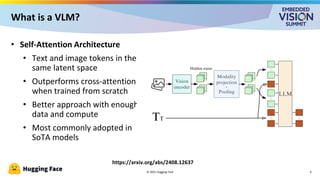
What is a VLM?
• Vision Language Models (VLMs) are a type of neural network architecture
trained on text and image tokens
• Text + Image + Video In → Text Out
• Two general approaches for unifying text and image tokens:
• Cross-Attention Architecture
• Self-Attention Architecture
4
© 2025 Hugging Face
What is a VLM?
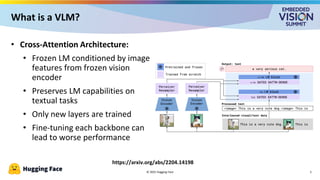
https://arxiv.org/abs/2204.14198
5
• Cross-Attention Architecture:
• Frozen LM conditioned by image
features from frozen vision
encoder
• Preserves LM capabilities on
textual tasks
• Only new layers are trained
• Fine-tuning each backbone can
lead to worse performance
© 2025 Hugging Face
What is a VLM?
https://arxiv.org/abs/2408.12637
6
• Self-Attention Architecture
• Text and image tokens in the
same latent space
• Outperforms cross-attention
when trained from scratch
• Better approach with enough
data and compute
• Most commonly adopted in
SoTA models
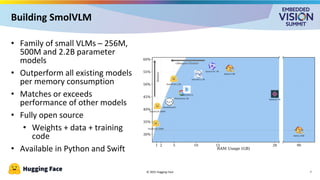
• Family of small VLMs ─ 256M,
500M and 2.2B parameter
models
• Outperform all existing models
per memory consumption
• Matches or exceeds
performance of other models
• Fully open source
• Weights + data + training
code
• Available in Python and Swift
© 2025 Hugging Face
Building SmolVLM
7
• Get large scale data – make your own or use the Common Crawl as a starting
point.
• Filter data:
• URL filtering: Blocklists, words, language classifier, repetition filters
• Content filtering: Language, Gopher, minHash, C4 and other custom
heuristics or filters
• Other: Personally Identifiable Information (PII) removal
© 2025 Hugging Face
SmolVLM: Data Preparation – Text
8
© 2025 Hugging Face
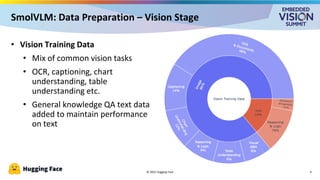
SmolVLM: Data Preparation – Vision Stage
9
• Vision Training Data
• Mix of common vision tasks
• OCR, captioning, chart
understanding, table
understanding etc.
• General knowledge QA text data
added to maintain performance
on text
© 2025 Hugging Face
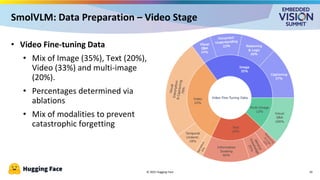
SmolVLM: Data Preparation – Video Stage
10
• Video Fine-tuning Data
• Mix of Image (35%), Text (20%),
Video (33%) and multi-image
(20%).
• Percentages determined via
ablations
• Mix of modalities to prevent
catastrophic forgetting
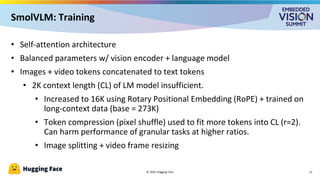
• Self-attention architecture
• Balanced parameters w/ vision encoder + language model
• Images + video tokens concatenated to text tokens
• 2K context length (CL) of LM model insufficient.
• Increased to 16K using Rotary Positional Embedding (RoPE) + trained on
long-context data (base = 273K)
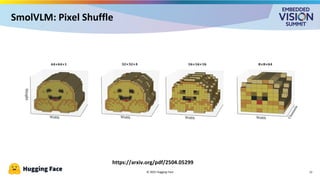
• Token compression (pixel shuffle) used to fit more tokens into CL (r=2).
Can harm performance of granular tasks at higher ratios.
• Image splitting + video frame resizing
© 2025 Hugging Face
SmolVLM: Training
11
© 2025 Hugging Face
SmolVLM: Pixel Shuffle
12
https://arxiv.org/pdf/2504.05299
© 2025 Hugging Face
SmolVLM: Family of Models
13
• SmolVLM-256M:
• < 1 GB of GRAM
• 93 M SigLIP-B/16 vision encoder + SmolLM2-135M LM
• SmolVLM-500M:
• Balance between memory efficiency and performance
• 93 M SigLIP-B/16 vision encoder + SmolLM2-360M LM
• SmolVLM-2.2B:
• 400 M SigLIP-SO vision encoder + SmolLM2-1.7B LM
• Maximizes performance + deployable on higher end edge devices
© 2025 Hugging Face
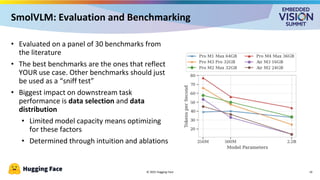
SmolVLM: Evaluation and Benchmarking
14
• Evaluated on a panel of 30 benchmarks from
the literature
• The best benchmarks are the ones that reflect
YOUR use case. Other benchmarks should just
be used as a “sniff test”
• Biggest impact on downstream task
performance is data selection and data
distribution
• Limited model capacity means optimizing
for these factors
• Determined through intuition and ablations
© 2025 Hugging Face
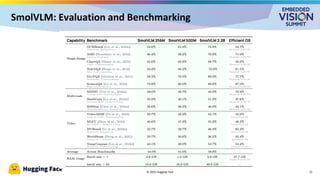
SmolVLM: Evaluation and Benchmarking
15
© 2025 Hugging Face
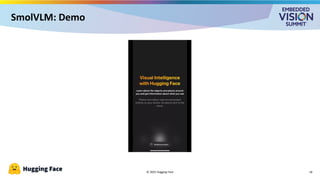
SmolVLM: Demo
16
© 2025 Hugging Face
Conclusion
17
• Data, data, data:
• Good data reflective of your downstream tasks goes a long way
• Small decisions impact small models in a big way:
• For every change that you make to the model or training parameter,
perform ablations
• Goodhart’s Law:
• When a measure becomes a target, it ceases to be a good measure
• Test different models on a dataset reflective of your task
© 2025 Hugging Face
Learn More
Building and better understanding vision-language models: insights and future directions
https://arxiv.org/pdf/2408.12637
SmolVLM: Redefining small and efficient multimodal models
https://arxiv.org/pdf/2504.05299
Dataset Curation Best Practices: Fine-Web
https://huggingface.co/spaces/HuggingFaceFW/blogpost-fineweb-v1
HuggingSnap iOS Code + Demo
https://github.com/huggingface/HuggingSnap
18
Resources

“Vision-language Models on the Edge,” a Presentation from Hugging Face

  • 1.
    Vision-Language Models on theEdge Cyril Zakka, MD Health Lead Hugging Face
  • 2.
    © 2025 HuggingFace Overview • What is Hugging Face? • What is a VLM? • Building SmolVLM • Data Preparation • Training • Evaluation and Benchmarks • Demo 2
  • 3.
    © 2025 HuggingFace What is Hugging Face? https://huggingface.co/ 3
  • 4.
    © 2025 HuggingFace What is a VLM? • Vision Language Models (VLMs) are a type of neural network architecture trained on text and image tokens • Text + Image + Video In → Text Out • Two general approaches for unifying text and image tokens: • Cross-Attention Architecture • Self-Attention Architecture 4
  • 5.
    © 2025 HuggingFace What is a VLM? https://arxiv.org/abs/2204.14198 5 • Cross-Attention Architecture: • Frozen LM conditioned by image features from frozen vision encoder • Preserves LM capabilities on textual tasks • Only new layers are trained • Fine-tuning each backbone can lead to worse performance
  • 6.
    © 2025 HuggingFace What is a VLM? https://arxiv.org/abs/2408.12637 6 • Self-Attention Architecture • Text and image tokens in the same latent space • Outperforms cross-attention when trained from scratch • Better approach with enough data and compute • Most commonly adopted in SoTA models
  • 7.
    • Family ofsmall VLMs ─ 256M, 500M and 2.2B parameter models • Outperform all existing models per memory consumption • Matches or exceeds performance of other models • Fully open source • Weights + data + training code • Available in Python and Swift © 2025 Hugging Face Building SmolVLM 7
  • 8.
    • Get largescale data – make your own or use the Common Crawl as a starting point. • Filter data: • URL filtering: Blocklists, words, language classifier, repetition filters • Content filtering: Language, Gopher, minHash, C4 and other custom heuristics or filters • Other: Personally Identifiable Information (PII) removal © 2025 Hugging Face SmolVLM: Data Preparation – Text 8
  • 9.
    © 2025 HuggingFace SmolVLM: Data Preparation – Vision Stage 9 • Vision Training Data • Mix of common vision tasks • OCR, captioning, chart understanding, table understanding etc. • General knowledge QA text data added to maintain performance on text
  • 10.
    © 2025 HuggingFace SmolVLM: Data Preparation – Video Stage 10 • Video Fine-tuning Data • Mix of Image (35%), Text (20%), Video (33%) and multi-image (20%). • Percentages determined via ablations • Mix of modalities to prevent catastrophic forgetting
  • 11.
    • Self-attention architecture •Balanced parameters w/ vision encoder + language model • Images + video tokens concatenated to text tokens • 2K context length (CL) of LM model insufficient. • Increased to 16K using Rotary Positional Embedding (RoPE) + trained on long-context data (base = 273K) • Token compression (pixel shuffle) used to fit more tokens into CL (r=2). Can harm performance of granular tasks at higher ratios. • Image splitting + video frame resizing © 2025 Hugging Face SmolVLM: Training 11
  • 12.
    © 2025 HuggingFace SmolVLM: Pixel Shuffle 12 https://arxiv.org/pdf/2504.05299
  • 13.
    © 2025 HuggingFace SmolVLM: Family of Models 13 • SmolVLM-256M: • < 1 GB of GRAM • 93 M SigLIP-B/16 vision encoder + SmolLM2-135M LM • SmolVLM-500M: • Balance between memory efficiency and performance • 93 M SigLIP-B/16 vision encoder + SmolLM2-360M LM • SmolVLM-2.2B: • 400 M SigLIP-SO vision encoder + SmolLM2-1.7B LM • Maximizes performance + deployable on higher end edge devices
  • 14.
    © 2025 HuggingFace SmolVLM: Evaluation and Benchmarking 14 • Evaluated on a panel of 30 benchmarks from the literature • The best benchmarks are the ones that reflect YOUR use case. Other benchmarks should just be used as a “sniff test” • Biggest impact on downstream task performance is data selection and data distribution • Limited model capacity means optimizing for these factors • Determined through intuition and ablations
  • 15.
    © 2025 HuggingFace SmolVLM: Evaluation and Benchmarking 15
  • 16.
    © 2025 HuggingFace SmolVLM: Demo 16
  • 17.
    © 2025 HuggingFace Conclusion 17 • Data, data, data: • Good data reflective of your downstream tasks goes a long way • Small decisions impact small models in a big way: • For every change that you make to the model or training parameter, perform ablations • Goodhart’s Law: • When a measure becomes a target, it ceases to be a good measure • Test different models on a dataset reflective of your task
  • 18.
    © 2025 HuggingFace Learn More Building and better understanding vision-language models: insights and future directions https://arxiv.org/pdf/2408.12637 SmolVLM: Redefining small and efficient multimodal models https://arxiv.org/pdf/2504.05299 Dataset Curation Best Practices: Fine-Web https://huggingface.co/spaces/HuggingFaceFW/blogpost-fineweb-v1 HuggingSnap iOS Code + Demo https://github.com/huggingface/HuggingSnap 18 Resources