A Lightweight Camera Stack
for Edge AI
Karthick Kumaran, Jui Garagate
Staff Software Engineer / Camera Software
Engineer
Meta Platforms Inc
Topics
• Problem statement
• Approach
• Measurement methodology
• Threading model
• Memory allocations
• Camera metadata
• Camera HAL API
• Results
• Summary
2
Meta Platforms Inc
Problem Statement
• Mobile phones use one camera for video calling, recording, snapshots, even if
they have multiple cameras.
• Camera applications on mobile phones run in the foreground and consume all
the hardware resources they require.
• Typically, the camera software stack is not well optimized!
• Silicon vendors provide the same camera stack for all the product segments.
• IOT devices, automotive, robots, AR/VR devices often have multiple cameras
and their operations are quite different from mobile
3
Meta Platforms Inc
Problem Statement – Emerging Technologies
• Emerging technologies
requirements are quite different
from mobile.
• Multiple cameras operate concurrently
• Multiple camera applications and services
running in the background
• Hardware resources should be shared
across the features and applications.
• Requires lightweight camera software to
run more features (AI DNN, CV, recording,
streaming, etc.,)
4
Meta Platforms Inc
Approach – Lightweight Strategy
• Performance of the camera software is a major concern.
• Camera software stack should
• Consume less compute, memory, power
• Allow multiple camera applications / services to run in parallel
• Default camera software stack from silicon vendors
• Consumes > 40% of the CPU
• Allocates more memory and is not fixed (dynamically increasing)
• Written for color camera use cases
• Not optimized for mono cameras used for various CV / AI applications
• Develop tools to identify bottlenecks
• Develop a strategy for optimization
5
Meta Platforms Inc
Why Focus on Mono Camera Optimization?
• Color cameras used for video streaming, recording, snapshot (for human visual)
and object recognition (computer vision)
• Mono cameras used for various AI and CV use cases
• Object detection
• Object tracking
• Simultaneous localization and tracking
• Eye tracking
• Hand tracking
• Scene understanding etc.,
Meta Platforms Inc 6
Measurement Methodology
• Use same terminology for measuring CPU performance
• CPU clusters – Big Little architecture
• Ultimate performance CPU : ARM Cortex-X1
• High performance CPU : ARM Cortex-A73
• High efficiency CPU : ARM Cortex-A53
• We came up with the methodology "CPU Units"
• Overcomes differences between
• CPU cores, frequencies and SoCs
• Allows apple-to-apple CPU performance comparison
7
Meta Platforms Inc
Tools Used
• Pnp
• Perfetto
• https://perfetto.dev
• Flamegraph
• Graphical representation of CPU consumption
• CPU Units – Meta internal dhrystone benchmark based tool
• Simpleperf
• Cache misses
• Page faults
• CPU cycles
8
Meta Platforms Inc
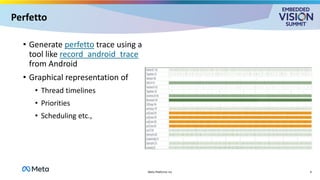
Perfetto
• Generate perfetto trace using a
tool like record_android_trace
from Android
• Graphical representation of
• Thread timelines
• Priorities
• Scheduling etc.,
9
Meta Platforms Inc
Flamegraph
• Graphical representation of
• CPU consumption of the code
• Identify threads consuming more
CPU
10
Meta Platforms Inc
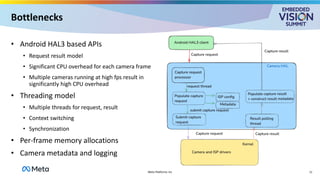
Bottlenecks
• Android HAL3 based APIs
• Request result model
• Significant CPU overhead for each camera frame
• Multiple cameras running at high fps result in
significantly high CPU overhead
• Threading model
• Multiple threads for request, result
• Context switching
• Synchronization
• Per-frame memory allocations
• Camera metadata and logging
11
Meta Platforms Inc
Memory Allocations
• Per-frame requests have mallocs()
• Degrades performance significantly
• We found ~40K mallocs() per second
• mallocs() are expensive
• Can cause cache misses
• Impacts system performance
• Varying memory load
• Use tools like "bpftrace"
• For measuring mallocs()
12
Meta Platforms Inc
Memory Allocations (continued)
• Developed internal tools for profiling memory
• We created containers
• Operate like C++ STL containers
• But won't allocate dynamic memory
• Vector usage throughout camera software
• Explicitly allocate memory at startup
• For high frame rate per-frame operations
• Reduced mallocs() from ~40k to 8k per second
• Resulted in significant CPU load reduction
13
Meta Platforms Inc
Camera Metadata
• Performance profiling showed camera software code is memory-bound
• Memory bound – CPU stalls for memory access
• Camera metadata – main contributor
• Android camera metadata
• Contains huge set of metadata tags
• Searching / reading / writing / updating metadata is expensive
• Some use cases don’t need all the metadata
• Identify the required metadata for your features / use cases
14
Meta Platforms Inc
Camera Metadata (continued)
• Mobile phones require an extensive set of camera metadata
• But always running (multiple) cameras used for AI / CV features don't:
• Several metadata tags not relevant for AI / CV
• Remove unnecessary metadata
• Simpler caching
• Refactor the metadata search / update code
• Above optimizations resulted in significant performance improvement
15
Meta Platforms Inc
Camera Hardware Pipeline
Camera Hardware Architecture ISP Hardware Blocks
Credits: OpenISP
16
Meta Platforms Inc
Threading Model
• Multiple threads
• Capture request
• Capture result
• Synchronization
• Having the right thread priorities for each thread is critical
• Real time priorities for camera threads
• Stream multiple cameras
• Work under high memory pressure scenarios
• Reduce number of threads and context switching
17
Meta Platforms Inc
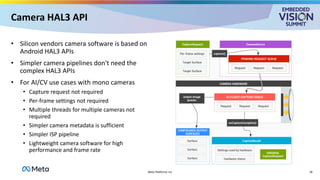
Camera HAL3 API
• Silicon vendors camera software is based on
Android HAL3 APIs
• Simpler camera pipelines don't need the
complex HAL3 APIs
• For AI/CV use cases with mono cameras
• Capture request not required
• Per-frame settings not required
• Multiple threads for multiple cameras not
required
• Simpler camera metadata is sufficient
• Simpler ISP pipeline
• Lightweight camera software for high
performance and frame rate
18
Meta Platforms Inc
Camera HAL3 API (continued)
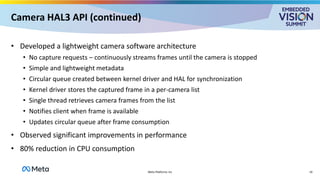
• Developed a lightweight camera software architecture
• No capture requests – continuously streams frames until the camera is stopped
• Simple and lightweight metadata
• Circular queue created between kernel driver and HAL for synchronization
• Kernel driver stores the captured frame in a per-camera list
• Single thread retrieves camera frames from the list
• Notifies client when frame is available
• Updates circular queue after frame consumption
• Observed significant improvements in performance
• 80% reduction in CPU consumption
19
Meta Platforms Inc
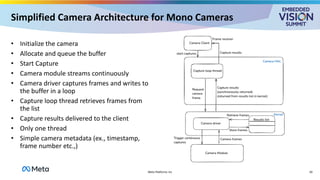
Simplified Camera Architecture for Mono Cameras
• Initialize the camera
• Allocate and queue the buffer
• Start Capture
• Camera module streams continuously
• Camera driver captures frames and writes to
the buffer in a loop
• Capture loop thread retrieves frames from
the list
• Capture results delivered to the client
• Only one thread
• Simple camera metadata (ex., timestamp,
frame number etc.,)
20
Meta Platforms Inc
Results
Cameras CPU Utilization (CPU Units) Memory Allocations
Before After Before After
Mixed Reality
(Color cameras)
1200 326
(73% gain)
22k-40k 7.5k
(66% gain)
Virtual Reality
(Mono cameras)
530 20
(95% gain)
18k 1.3k
(90% gain)
21
Meta Platforms Inc
Summary
• Use and build tools to identify bottlenecks in the camera software
• Build a strategy to optimize the code
• Identify and remove unused features
• Refactor / Re-architect the code if necessary
• Optimizations explained in this talk can be applied to most mono cameras software and applies to
all silicon vendors camera software stack
• Some optimizations can be used to any software stack
• Lightweight camera software helps to
• Add new features
• Reduce memory throughput, CPU load, power consumption
22
Meta Platforms Inc
Resources
• https://www.brendangregg.com/flamegraphs.html
• https://android.googlesource.com/platform/external/perfetto/+/master/tools/r
ecord_android_trace
• https://android.googlesource.com/platform/hardware/libhardware/+/refs/hea
ds/main/include_all/hardware/camera3.h
• https://perfetto.dev/
• https://android.googlesource.com/platform/system/media/+/refs/heads/main/
camera/include/system/camera_metadata_tags.h
23
Meta Platforms Inc

“A Lightweight Camera Stack for Edge AI,” a Presentation from Meta

  • 1.
    A Lightweight CameraStack for Edge AI Karthick Kumaran, Jui Garagate Staff Software Engineer / Camera Software Engineer Meta Platforms Inc
  • 2.
    Topics • Problem statement •Approach • Measurement methodology • Threading model • Memory allocations • Camera metadata • Camera HAL API • Results • Summary 2 Meta Platforms Inc
  • 3.
    Problem Statement • Mobilephones use one camera for video calling, recording, snapshots, even if they have multiple cameras. • Camera applications on mobile phones run in the foreground and consume all the hardware resources they require. • Typically, the camera software stack is not well optimized! • Silicon vendors provide the same camera stack for all the product segments. • IOT devices, automotive, robots, AR/VR devices often have multiple cameras and their operations are quite different from mobile 3 Meta Platforms Inc
  • 4.
    Problem Statement –Emerging Technologies • Emerging technologies requirements are quite different from mobile. • Multiple cameras operate concurrently • Multiple camera applications and services running in the background • Hardware resources should be shared across the features and applications. • Requires lightweight camera software to run more features (AI DNN, CV, recording, streaming, etc.,) 4 Meta Platforms Inc
  • 5.
    Approach – LightweightStrategy • Performance of the camera software is a major concern. • Camera software stack should • Consume less compute, memory, power • Allow multiple camera applications / services to run in parallel • Default camera software stack from silicon vendors • Consumes > 40% of the CPU • Allocates more memory and is not fixed (dynamically increasing) • Written for color camera use cases • Not optimized for mono cameras used for various CV / AI applications • Develop tools to identify bottlenecks • Develop a strategy for optimization 5 Meta Platforms Inc
  • 6.
    Why Focus onMono Camera Optimization? • Color cameras used for video streaming, recording, snapshot (for human visual) and object recognition (computer vision) • Mono cameras used for various AI and CV use cases • Object detection • Object tracking • Simultaneous localization and tracking • Eye tracking • Hand tracking • Scene understanding etc., Meta Platforms Inc 6
  • 7.
    Measurement Methodology • Usesame terminology for measuring CPU performance • CPU clusters – Big Little architecture • Ultimate performance CPU : ARM Cortex-X1 • High performance CPU : ARM Cortex-A73 • High efficiency CPU : ARM Cortex-A53 • We came up with the methodology "CPU Units" • Overcomes differences between • CPU cores, frequencies and SoCs • Allows apple-to-apple CPU performance comparison 7 Meta Platforms Inc
  • 8.
    Tools Used • Pnp •Perfetto • https://perfetto.dev • Flamegraph • Graphical representation of CPU consumption • CPU Units – Meta internal dhrystone benchmark based tool • Simpleperf • Cache misses • Page faults • CPU cycles 8 Meta Platforms Inc
  • 9.
    Perfetto • Generate perfettotrace using a tool like record_android_trace from Android • Graphical representation of • Thread timelines • Priorities • Scheduling etc., 9 Meta Platforms Inc
  • 10.
    Flamegraph • Graphical representationof • CPU consumption of the code • Identify threads consuming more CPU 10 Meta Platforms Inc
  • 11.
    Bottlenecks • Android HAL3based APIs • Request result model • Significant CPU overhead for each camera frame • Multiple cameras running at high fps result in significantly high CPU overhead • Threading model • Multiple threads for request, result • Context switching • Synchronization • Per-frame memory allocations • Camera metadata and logging 11 Meta Platforms Inc
  • 12.
    Memory Allocations • Per-framerequests have mallocs() • Degrades performance significantly • We found ~40K mallocs() per second • mallocs() are expensive • Can cause cache misses • Impacts system performance • Varying memory load • Use tools like "bpftrace" • For measuring mallocs() 12 Meta Platforms Inc
  • 13.
    Memory Allocations (continued) •Developed internal tools for profiling memory • We created containers • Operate like C++ STL containers • But won't allocate dynamic memory • Vector usage throughout camera software • Explicitly allocate memory at startup • For high frame rate per-frame operations • Reduced mallocs() from ~40k to 8k per second • Resulted in significant CPU load reduction 13 Meta Platforms Inc
  • 14.
    Camera Metadata • Performanceprofiling showed camera software code is memory-bound • Memory bound – CPU stalls for memory access • Camera metadata – main contributor • Android camera metadata • Contains huge set of metadata tags • Searching / reading / writing / updating metadata is expensive • Some use cases don’t need all the metadata • Identify the required metadata for your features / use cases 14 Meta Platforms Inc
  • 15.
    Camera Metadata (continued) •Mobile phones require an extensive set of camera metadata • But always running (multiple) cameras used for AI / CV features don't: • Several metadata tags not relevant for AI / CV • Remove unnecessary metadata • Simpler caching • Refactor the metadata search / update code • Above optimizations resulted in significant performance improvement 15 Meta Platforms Inc
  • 16.
    Camera Hardware Pipeline CameraHardware Architecture ISP Hardware Blocks Credits: OpenISP 16 Meta Platforms Inc
  • 17.
    Threading Model • Multiplethreads • Capture request • Capture result • Synchronization • Having the right thread priorities for each thread is critical • Real time priorities for camera threads • Stream multiple cameras • Work under high memory pressure scenarios • Reduce number of threads and context switching 17 Meta Platforms Inc
  • 18.
    Camera HAL3 API •Silicon vendors camera software is based on Android HAL3 APIs • Simpler camera pipelines don't need the complex HAL3 APIs • For AI/CV use cases with mono cameras • Capture request not required • Per-frame settings not required • Multiple threads for multiple cameras not required • Simpler camera metadata is sufficient • Simpler ISP pipeline • Lightweight camera software for high performance and frame rate 18 Meta Platforms Inc
  • 19.
    Camera HAL3 API(continued) • Developed a lightweight camera software architecture • No capture requests – continuously streams frames until the camera is stopped • Simple and lightweight metadata • Circular queue created between kernel driver and HAL for synchronization • Kernel driver stores the captured frame in a per-camera list • Single thread retrieves camera frames from the list • Notifies client when frame is available • Updates circular queue after frame consumption • Observed significant improvements in performance • 80% reduction in CPU consumption 19 Meta Platforms Inc
  • 20.
    Simplified Camera Architecturefor Mono Cameras • Initialize the camera • Allocate and queue the buffer • Start Capture • Camera module streams continuously • Camera driver captures frames and writes to the buffer in a loop • Capture loop thread retrieves frames from the list • Capture results delivered to the client • Only one thread • Simple camera metadata (ex., timestamp, frame number etc.,) 20 Meta Platforms Inc
  • 21.
    Results Cameras CPU Utilization(CPU Units) Memory Allocations Before After Before After Mixed Reality (Color cameras) 1200 326 (73% gain) 22k-40k 7.5k (66% gain) Virtual Reality (Mono cameras) 530 20 (95% gain) 18k 1.3k (90% gain) 21 Meta Platforms Inc
  • 22.
    Summary • Use andbuild tools to identify bottlenecks in the camera software • Build a strategy to optimize the code • Identify and remove unused features • Refactor / Re-architect the code if necessary • Optimizations explained in this talk can be applied to most mono cameras software and applies to all silicon vendors camera software stack • Some optimizations can be used to any software stack • Lightweight camera software helps to • Add new features • Reduce memory throughput, CPU load, power consumption 22 Meta Platforms Inc
  • 23.
    Resources • https://www.brendangregg.com/flamegraphs.html • https://android.googlesource.com/platform/external/perfetto/+/master/tools/r ecord_android_trace •https://android.googlesource.com/platform/hardware/libhardware/+/refs/hea ds/main/include_all/hardware/camera3.h • https://perfetto.dev/ • https://android.googlesource.com/platform/system/media/+/refs/heads/main/ camera/include/system/camera_metadata_tags.h 23 Meta Platforms Inc