DENODO WEBINARS
Introduction to Modern Data
Virtualization
Speakers
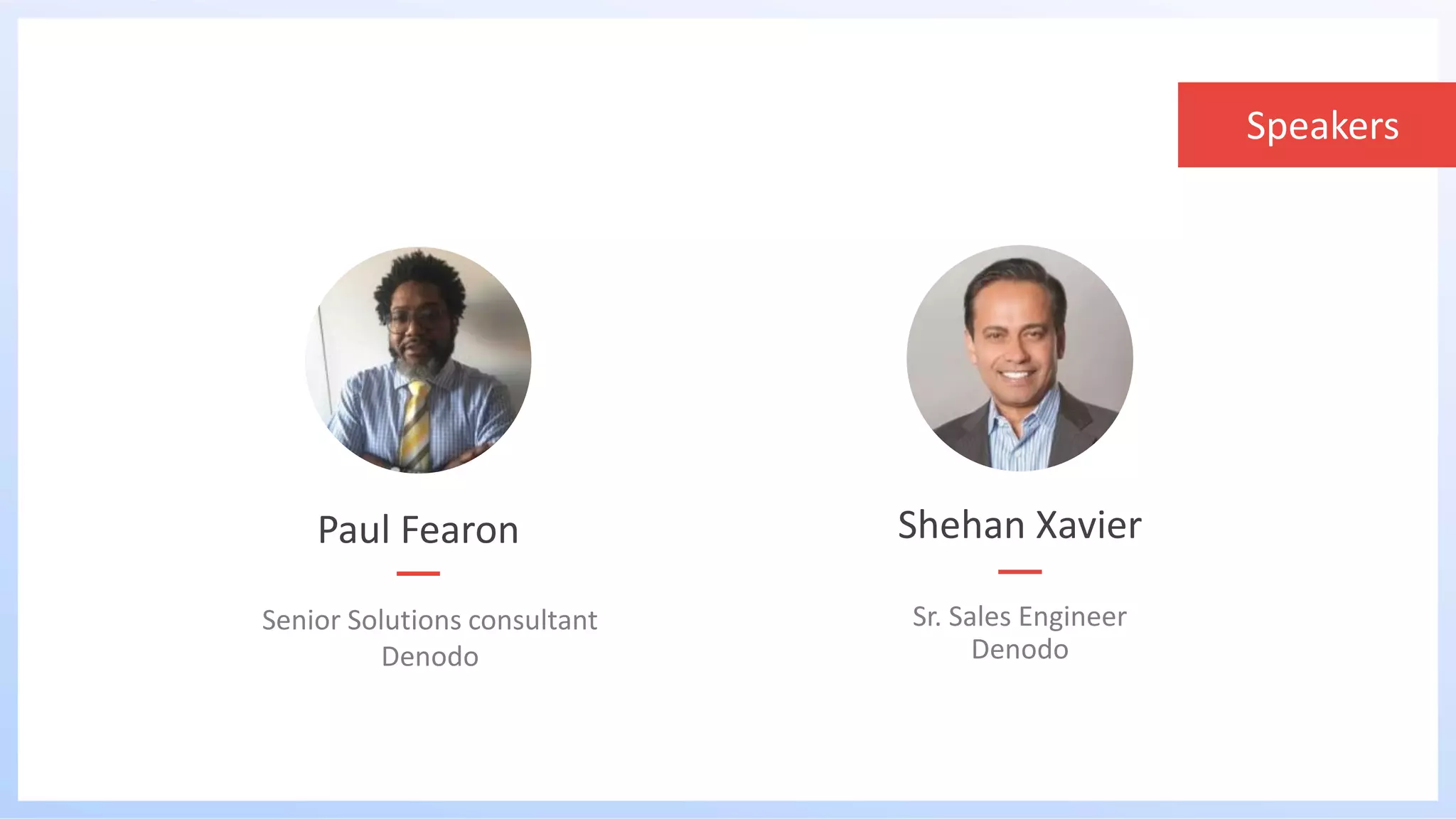
Paul Fearon
Senior Solutions consultant
Denodo
Sr. Sales Engineer
Denodo
Shehan Xavier
Agenda
❖ Challenges of Data Management
❖ What is Modern Data Virtualization?
❖ And how does it work.
❖ Benefits of Data Virtualization
❖ Introducing Denodo Standard
❖ Q&A
Challenges of Data Management
#DenodoDataFest
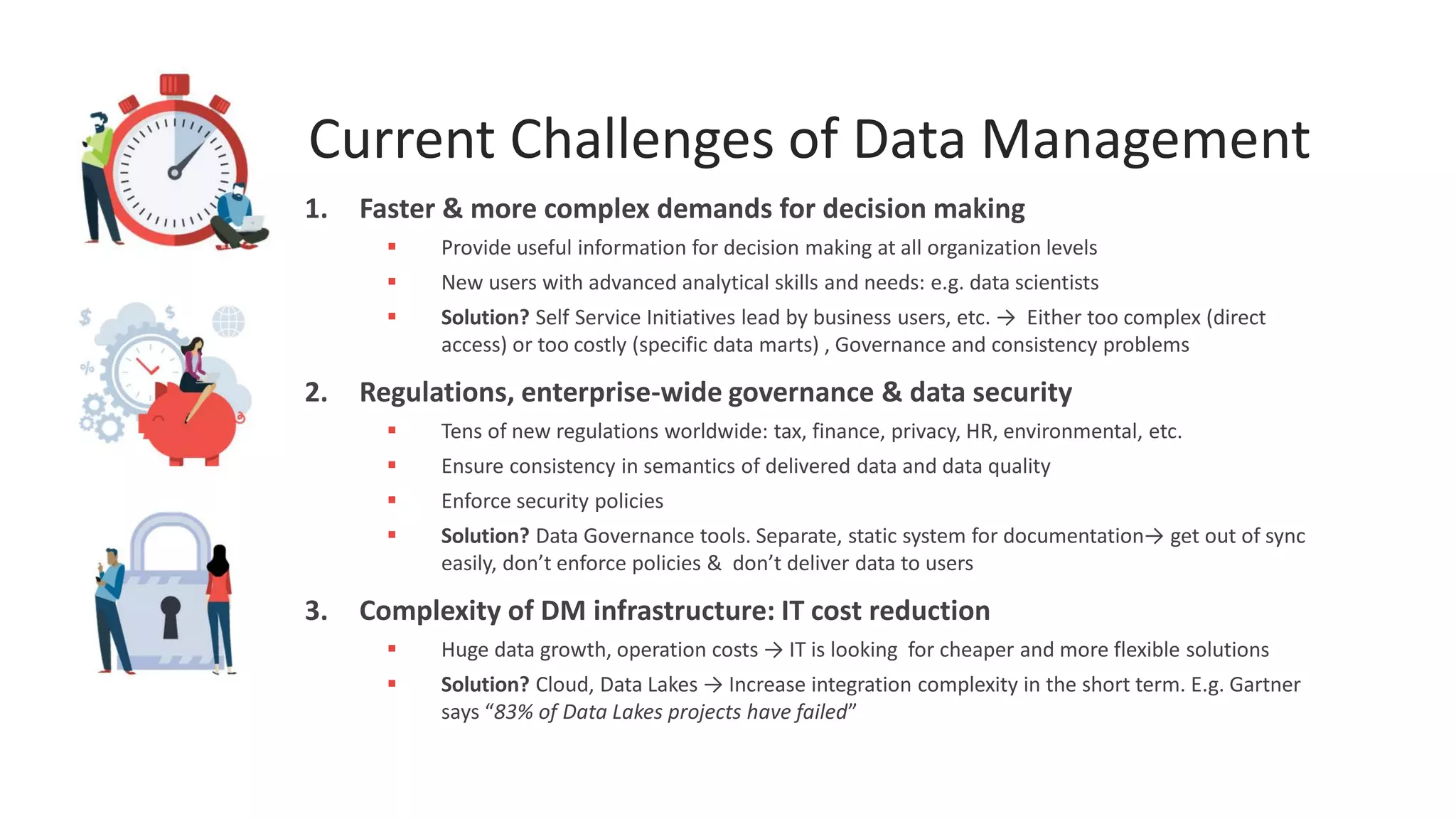
Current Challenges of Data Management
1. Faster & more complex demands for decision making
▪ Provide useful information for decision making at all organization levels
▪ New users with advanced analytical skills and needs: e.g. data scientists
▪ Solution? Self Service Initiatives lead by business users, etc. → Either too complex (direct
access) or too costly (specific data marts) , Governance and consistency problems
2. Regulations, enterprise-wide governance & data security
▪ Tens of new regulations worldwide: tax, finance, privacy, HR, environmental, etc.
▪ Ensure consistency in semantics of delivered data and data quality
▪ Enforce security policies
▪ Solution? Data Governance tools. Separate, static system for documentation→ get out of sync
easily, don’t enforce policies & don’t deliver data to users
3. Complexity of DM infrastructure: IT cost reduction
▪ Huge data growth, operation costs → IT is looking for cheaper and more flexible solutions
▪ Solution? Cloud, Data Lakes → Increase integration complexity in the short term. E.g. Gartner
says “83% of Data Lakes projects have failed”
6
“Point-to-point integration is the simplest form of integration, but it can
introduce technical debt with a complex spaghetti architecture that is hard
to manage and change.”
Gartner 2018, Where Does Point-to-Point Integration Belong in Your Integration Strategy?
The end result of this approach for enterprises was described by Gartner as:
“…unregulated, chaotic integration spaghetti.”
Gartner 2017, Accelerating Digital Transformation in Insurance
7
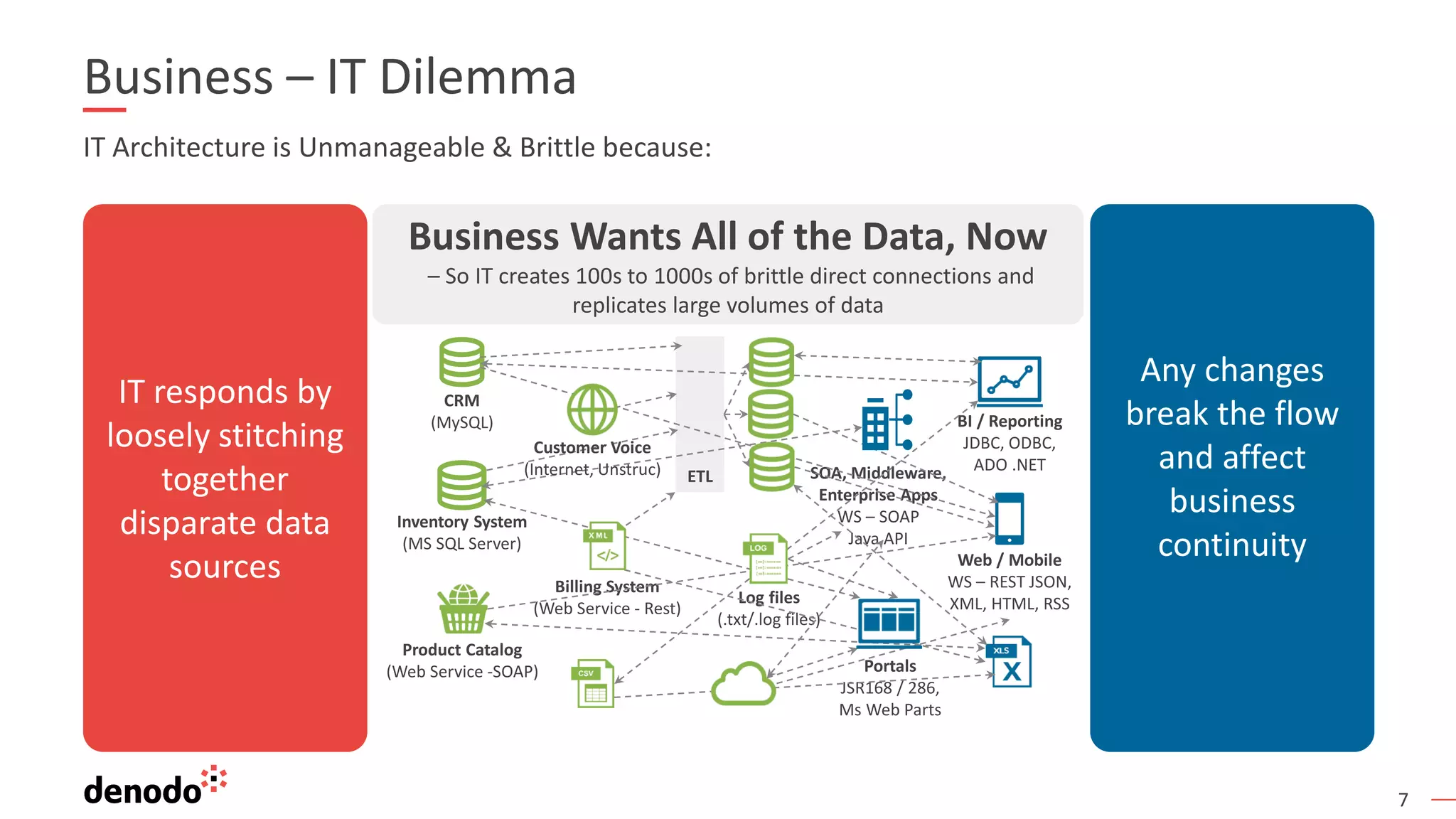
IT Architecture is Unmanageable & Brittle because:
Business – IT Dilemma
IT responds by
loosely stitching
together
disparate data
sources
Any changes
break the flow
and affect
business
continuity
Business Wants All of the Data, Now
– So IT creates 100s to 1000s of brittle direct connections and
replicates large volumes of data
Inventory System
(MS SQL Server)
Product Catalog
(Web Service -SOAP)
BI / Reporting
JDBC, ODBC,
ADO .NET
Web / Mobile
WS – REST JSON,
XML, HTML, RSS
Log files
(.txt/.log files)
CRM
(MySQL)
Billing System
(Web Service - Rest)
ETL
Portals
JSR168 / 286,
Ms Web Parts
SOA, Middleware,
Enterprise Apps
WS – SOAP
Java API
Customer Voice
(Internet, Unstruc)
What is Data Virtualization?
9
Source: “Gartner Market Guide for Data Virtualization, November 16, 2018”
Data virtualization can be used to create virtualized and
integrated views of data in-memory rather than executing
data movement and physically storing integrated views in a
target data structure. It provides a layer of abstraction
above the physical implementation of data, to simplify
query logic.
10
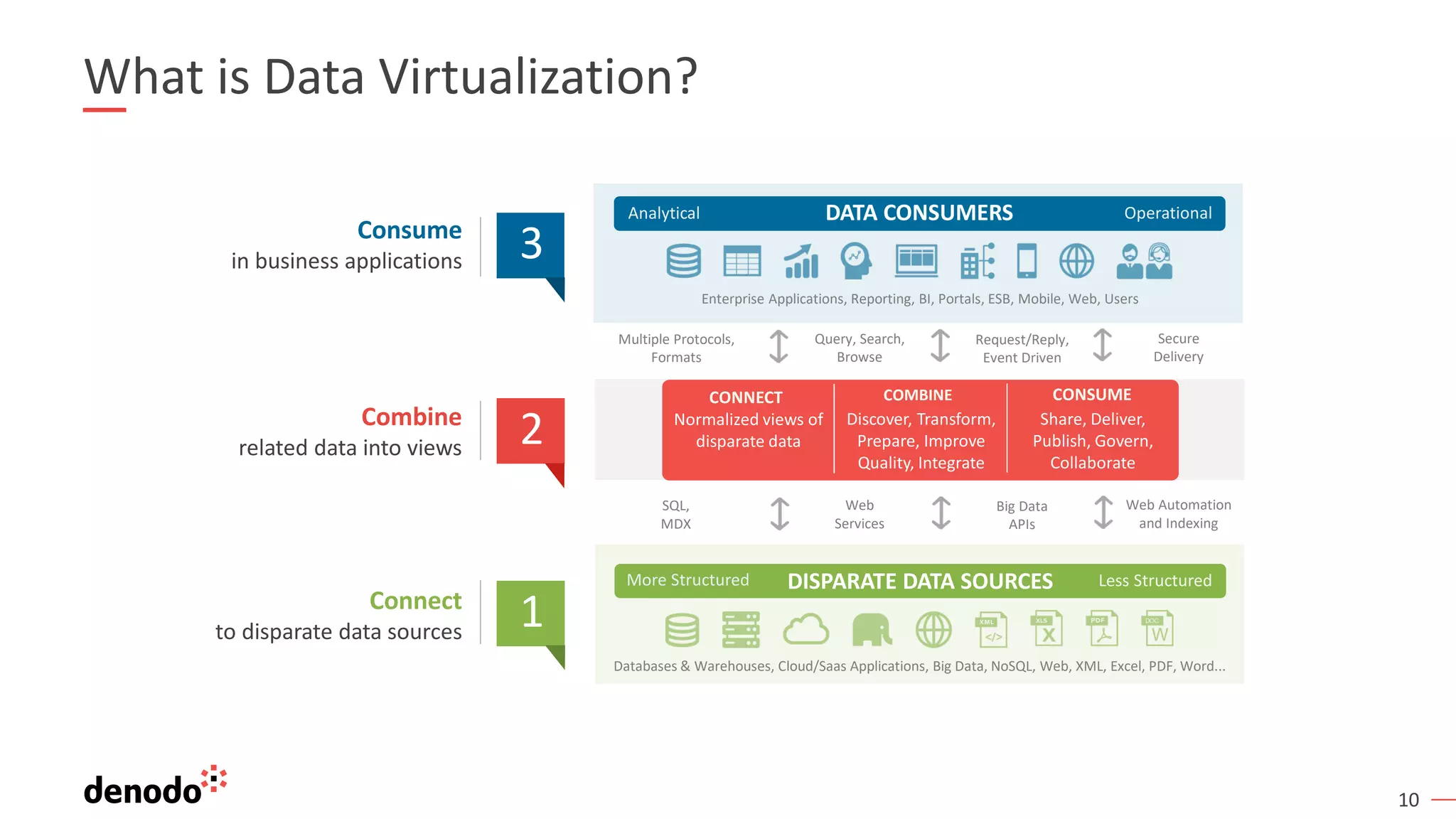
What is Data Virtualization?
Consume
in business applications
Combine
related data into views
Connect
to disparate data sources
2
3
1
DATA CONSUMERS
DISPARATE DATA SOURCES
Enterprise Applications, Reporting, BI, Portals, ESB, Mobile, Web, Users
Databases & Warehouses, Cloud/Saas Applications, Big Data, NoSQL, Web, XML, Excel, PDF, Word...
Analytical Operational
Less Structured
More Structured
CONNECT COMBINE PUBLISH
Multiple Protocols,
Formats
Query, Search,
Browse
Request/Reply,
Event Driven
Secure
Delivery
SQL,
MDX
Web
Services
Big Data
APIs
Web Automation
and Indexing
CONNECT COMBINE CONSUME
Share, Deliver,
Publish, Govern,
Collaborate
Discover, Transform,
Prepare, Improve
Quality, Integrate
Normalized views of
disparate data
11
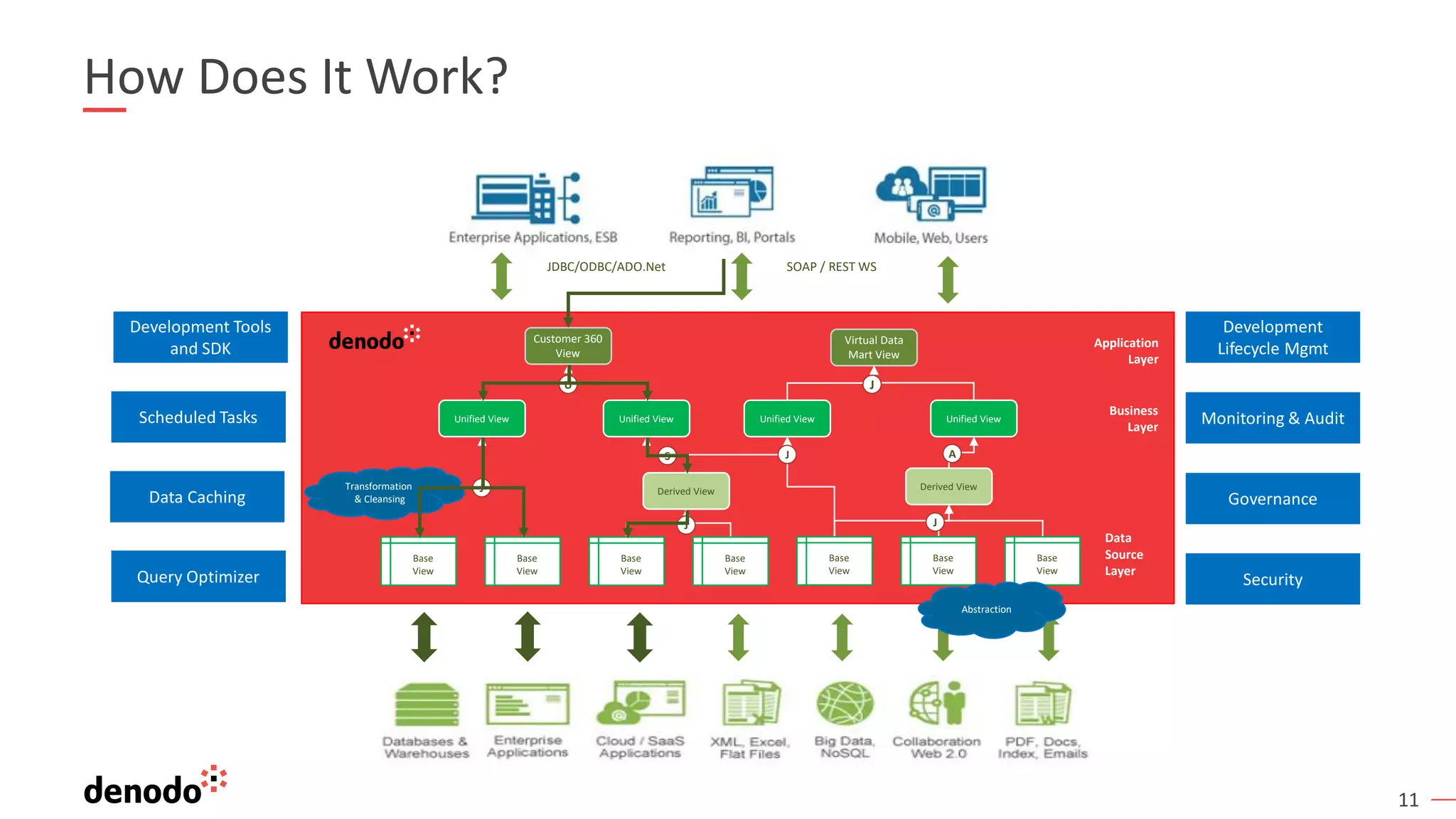
How Does It Work?
Development
Lifecycle Mgmt
Monitoring & Audit
Governance
Security
Development Tools
and SDK
Scheduled Tasks
Data Caching
Query Optimizer
JDBC/ODBC/ADO.Net SOAP / REST WS
U
Customer 360
View
Virtual Data
Mart View
J
Application
Layer
Business
Layer
Unified View Unified View
Unified View
Unified View
A
J
J
Derived View Derived View
J
J
S
Transformation
& Cleansing
Data
Source
Layer
Base
View
Base
View
Base
View
Base
View
Base
View
Base
View
Base
View
Abstraction
Why Data Virtualization?
13
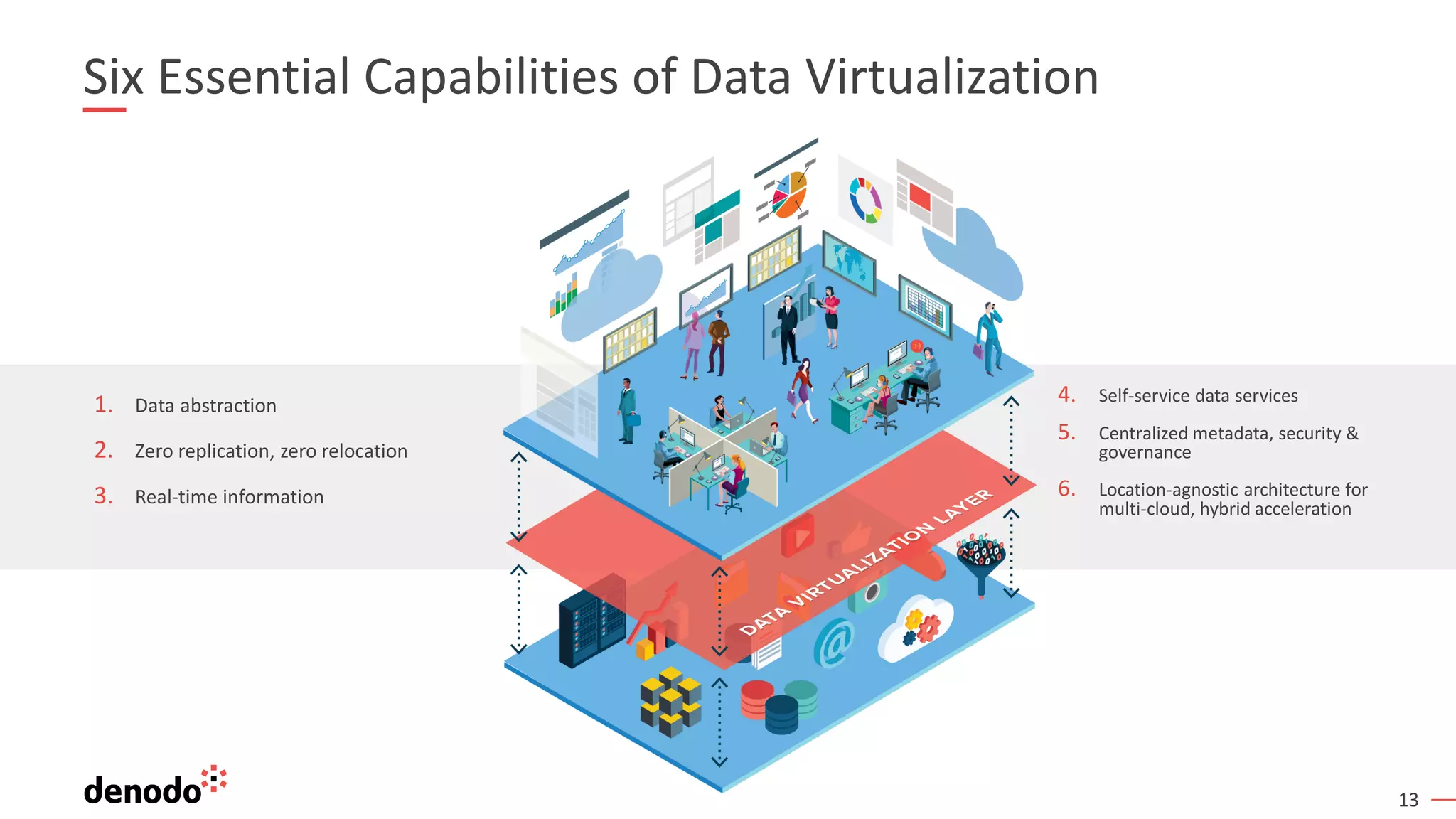
Six Essential Capabilities of Data Virtualization
4. Self-service data services
5. Centralized metadata, security &
governance
6. Location-agnostic architecture for
multi-cloud, hybrid acceleration
1. Data abstraction
2. Zero replication, zero relocation
3. Real-time information
14
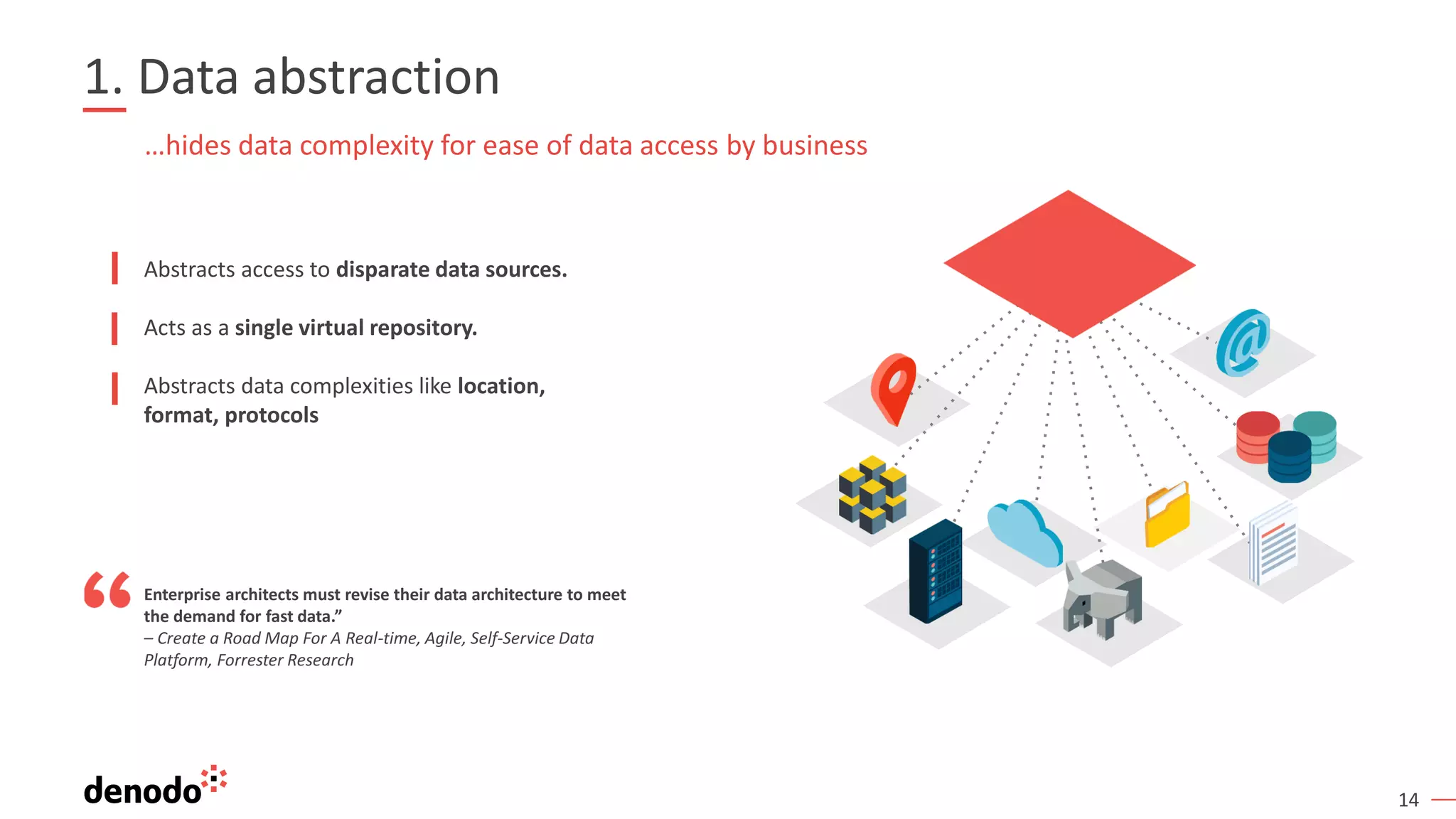
1. Data abstraction
Abstracts access to disparate data sources.
Acts as a single virtual repository.
Abstracts data complexities like location,
format, protocols
…hides data complexity for ease of data access by business
Enterprise architects must revise their data architecture to meet
the demand for fast data.”
– Create a Road Map For A Real-time, Agile, Self-Service Data
Platform, Forrester Research
15
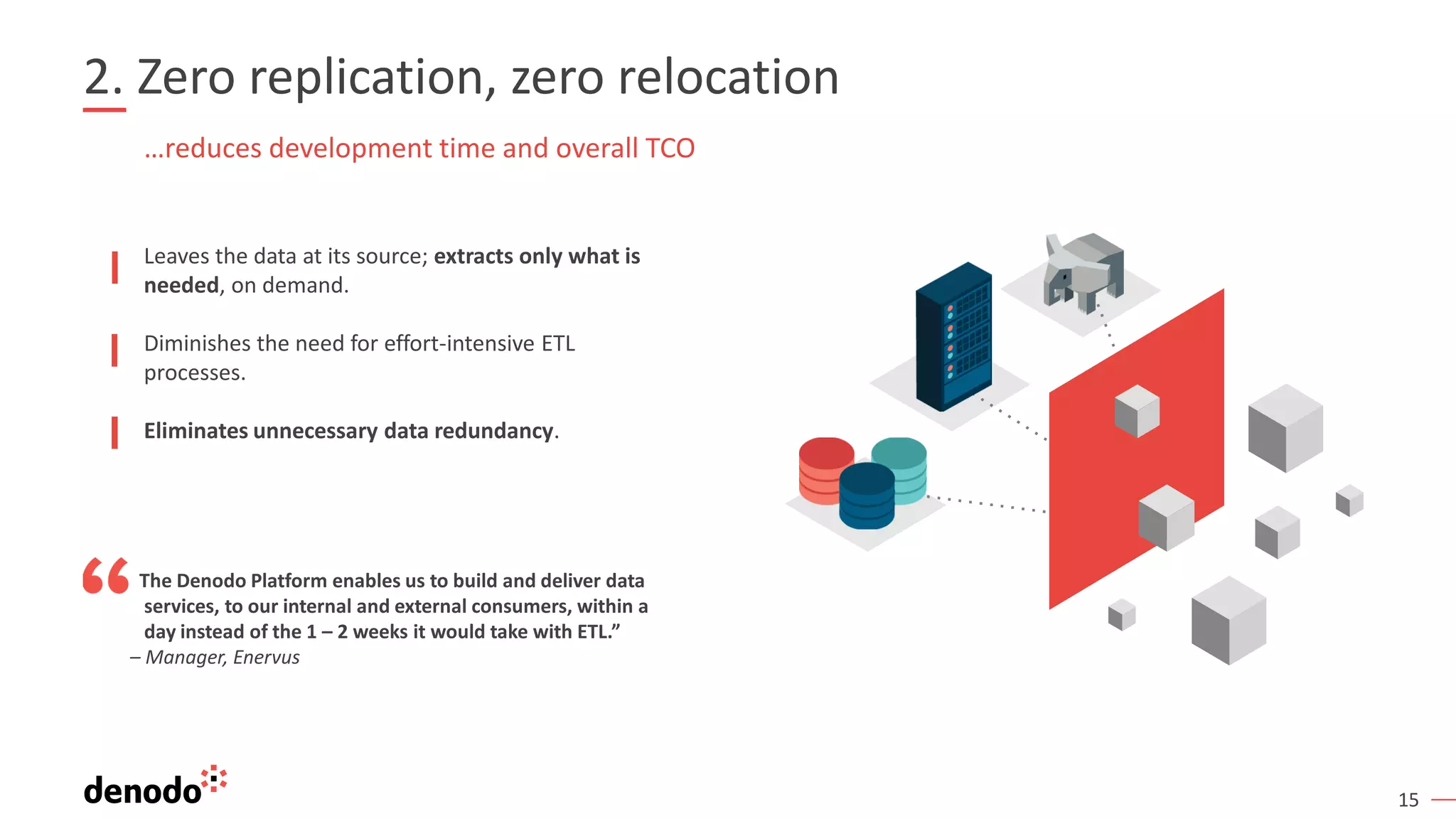
2. Zero replication, zero relocation
…reduces development time and overall TCO
The Denodo Platform enables us to build and deliver data
services, to our internal and external consumers, within a
day instead of the 1 – 2 weeks it would take with ETL.”
– Manager, Enervus
Leaves the data at its source; extracts only what is
needed, on demand.
Diminishes the need for effort-intensive ETL
processes.
Eliminates unnecessary data redundancy.
16
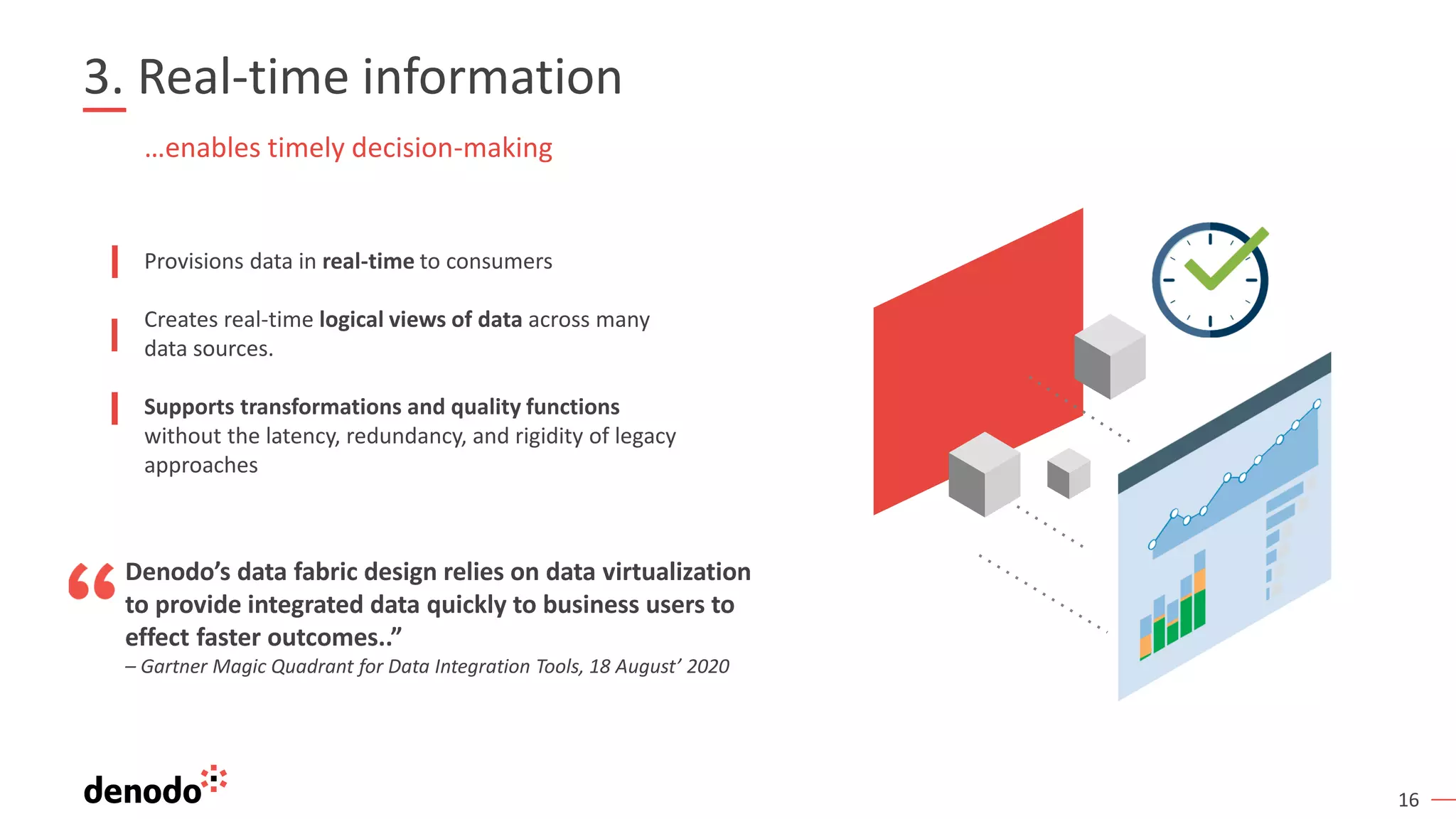
3. Real-time information
Provisions data in real-time to consumers
Creates real-time logical views of data across many
data sources.
Supports transformations and quality functions
without the latency, redundancy, and rigidity of legacy
approaches
…enables timely decision-making
Denodo’s data fabric design relies on data virtualization
to provide integrated data quickly to business users to
effect faster outcomes..”
– Gartner Magic Quadrant for Data Integration Tools, 18 August’ 2020
17
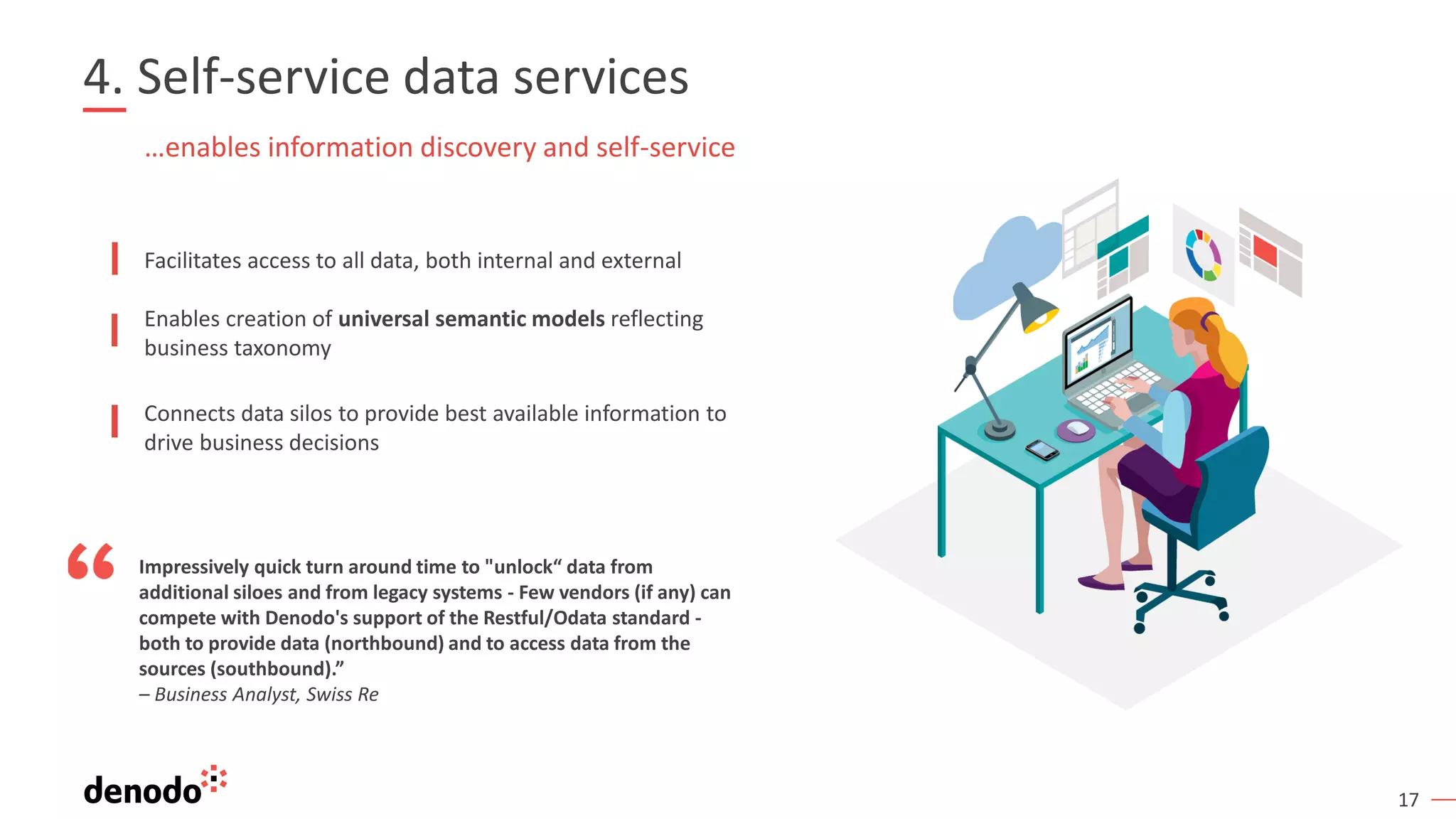
4. Self-service data services
Facilitates access to all data, both internal and external
Enables creation of universal semantic models reflecting
business taxonomy
Connects data silos to provide best available information to
drive business decisions
…enables information discovery and self-service
Impressively quick turn around time to "unlock“ data from
additional siloes and from legacy systems - Few vendors (if any) can
compete with Denodo's support of the Restful/Odata standard -
both to provide data (northbound) and to access data from the
sources (southbound).”
– Business Analyst, Swiss Re
18
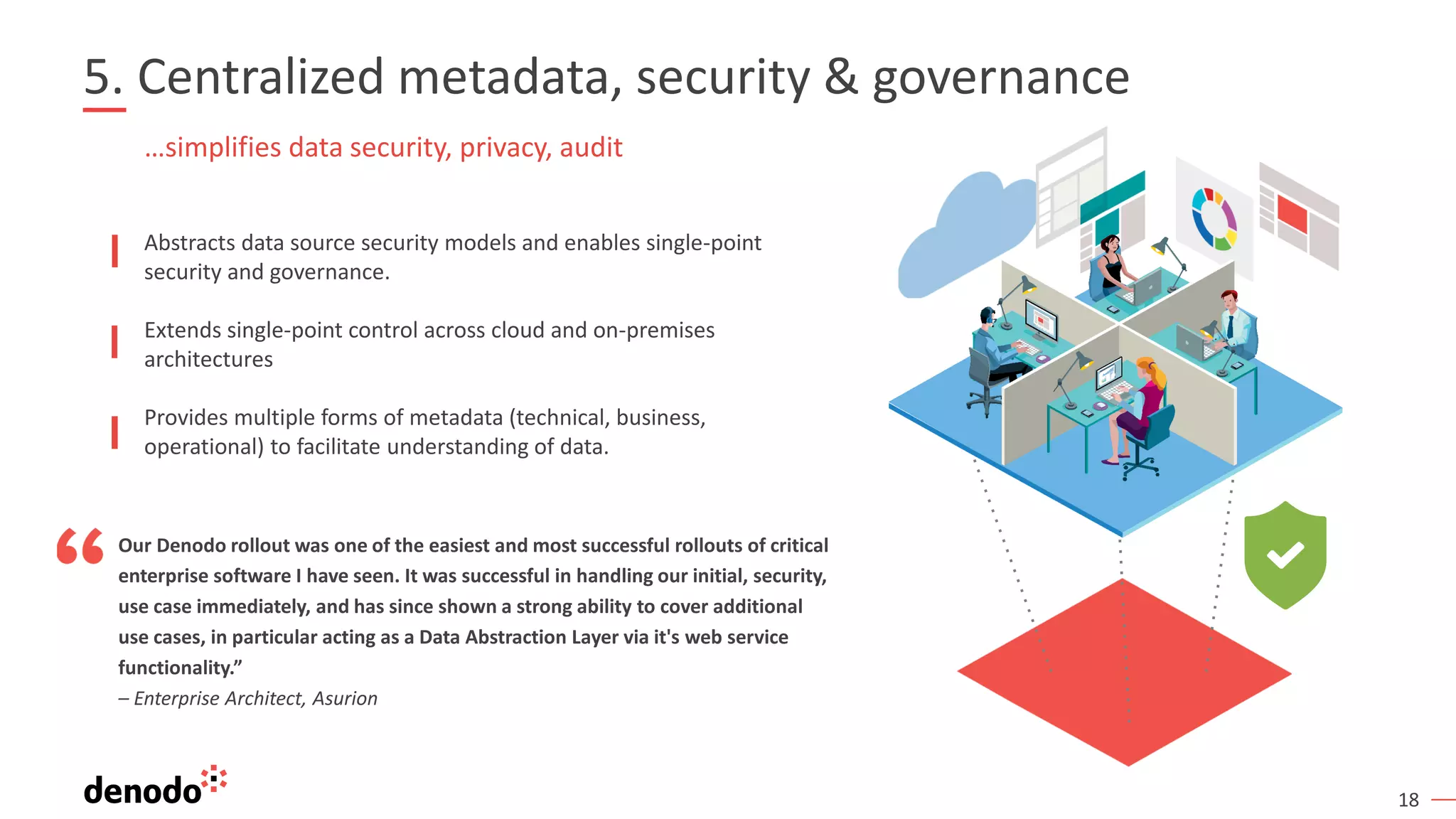
5. Centralized metadata, security & governance
Abstracts data source security models and enables single-point
security and governance.
Extends single-point control across cloud and on-premises
architectures
Provides multiple forms of metadata (technical, business,
operational) to facilitate understanding of data.
…simplifies data security, privacy, audit
Our Denodo rollout was one of the easiest and most successful rollouts of critical
enterprise software I have seen. It was successful in handling our initial, security,
use case immediately, and has since shown a strong ability to cover additional
use cases, in particular acting as a Data Abstraction Layer via it's web service
functionality.”
– Enterprise Architect, Asurion
19
6. Location-agnostic architecture for multi-cloud, hybrid acceleration
Optimizes costs by migrating data, applications, and analytics
workloads to cloud without impacting the business
Enables creation of hub architecture to support integration of
data across mixed workloads.
End-to-end management of migrations/promotions and
continuous delivery processes.
…enables cloud adoption
Impressively quick turn around time to "unlock“ data from
additional siloes and from legacy systems - Few vendors (if any) can
compete with Denodo's support of the Restful/Odata standard -
both to provide data (northbound) and to access data from the
sources (southbound).”
– Business Analyst, Swiss Re
20
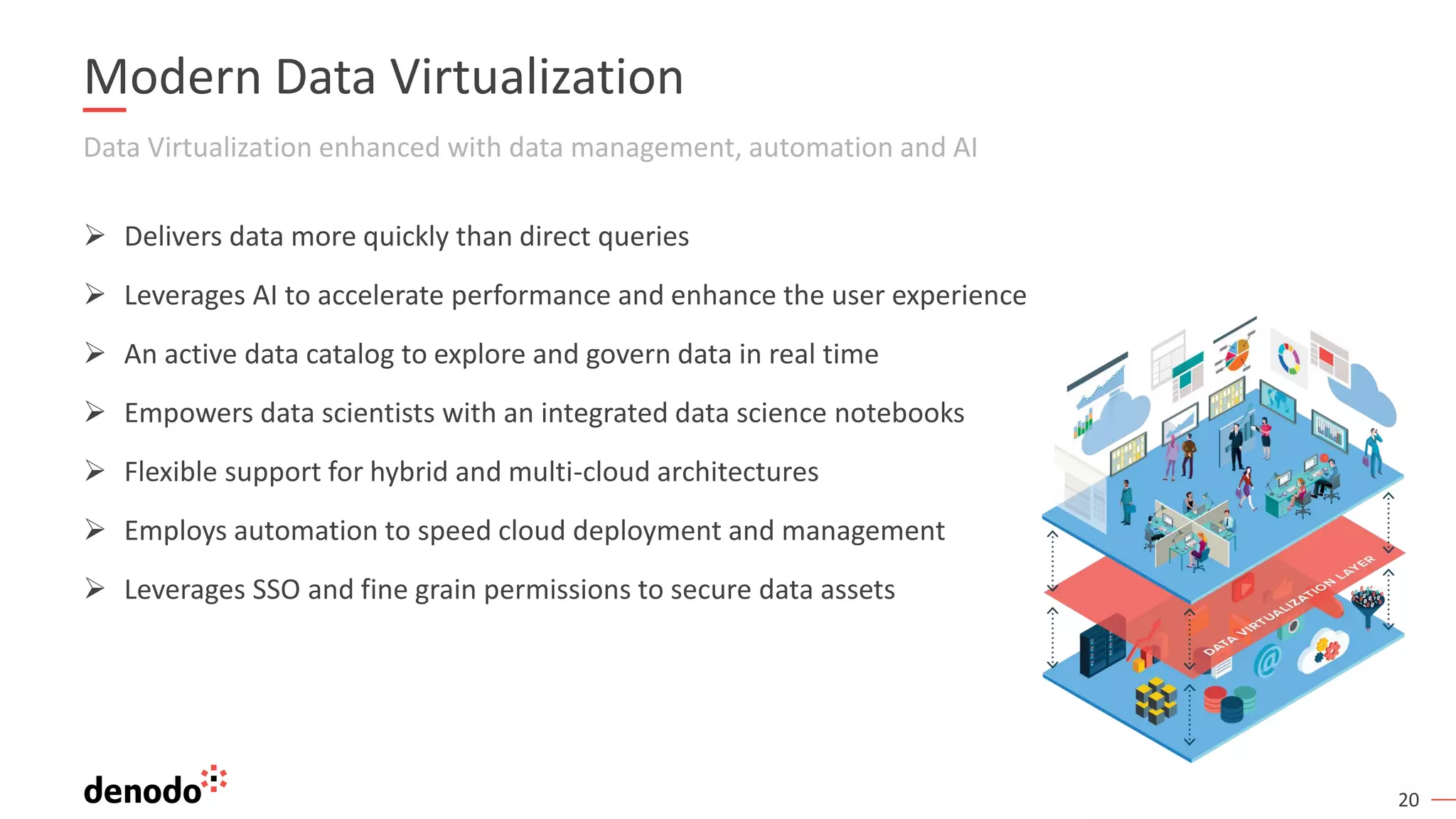
Modern Data Virtualization
Data Virtualization enhanced with data management, automation and AI
➢ Delivers data more quickly than direct queries
➢ Leverages AI to accelerate performance and enhance the user experience
➢ An active data catalog to explore and govern data in real time
➢ Empowers data scientists with an integrated data science notebooks
➢ Flexible support for hybrid and multi-cloud architectures
➢ Employs automation to speed cloud deployment and management
➢ Leverages SSO and fine grain permissions to secure data assets
21
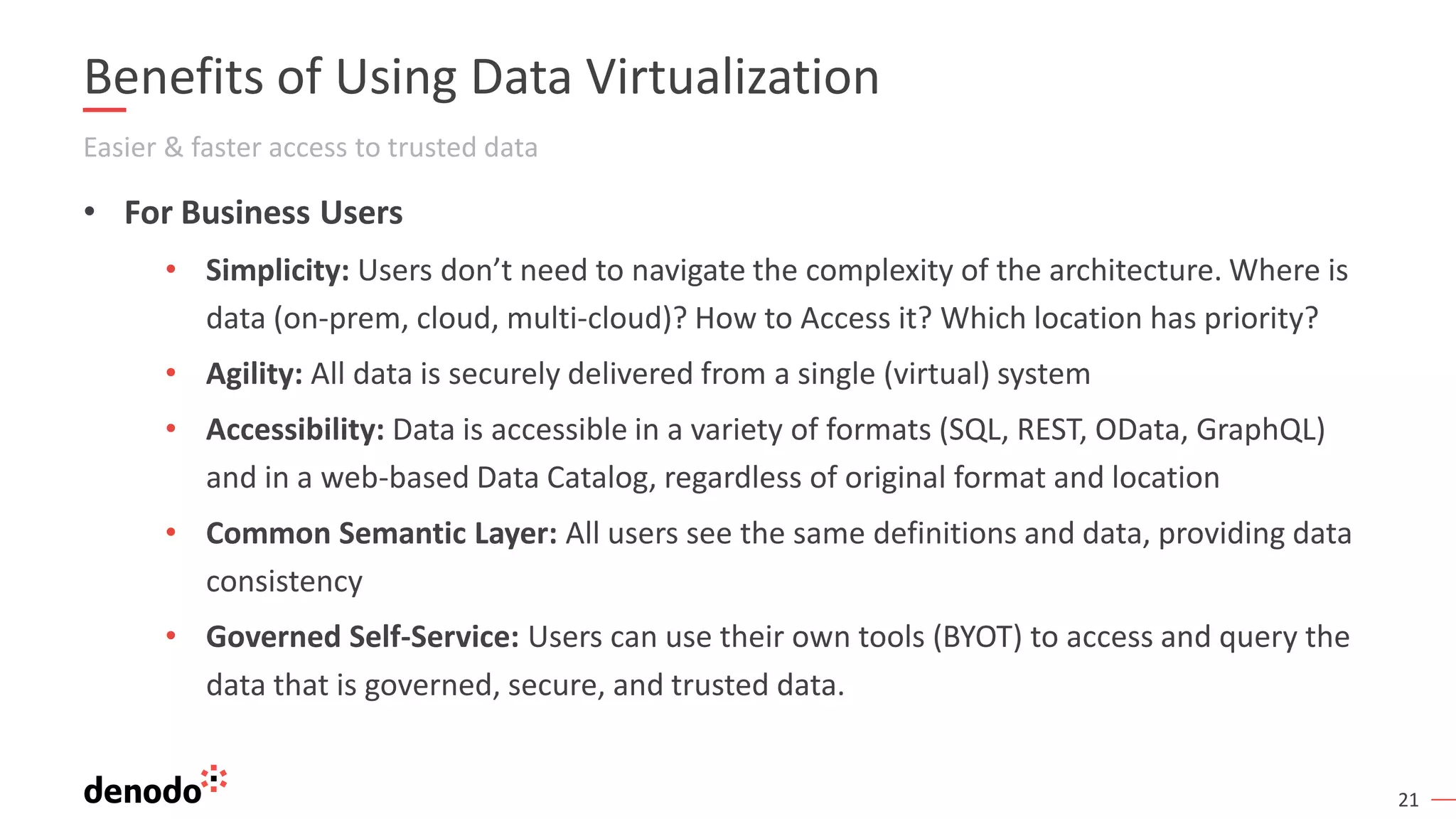
Benefits of Using Data Virtualization
Easier & faster access to trusted data
• For Business Users
• Simplicity: Users don’t need to navigate the complexity of the architecture. Where is
data (on-prem, cloud, multi-cloud)? How to Access it? Which location has priority?
• Agility: All data is securely delivered from a single (virtual) system
• Accessibility: Data is accessible in a variety of formats (SQL, REST, OData, GraphQL)
and in a web-based Data Catalog, regardless of original format and location
• Common Semantic Layer: All users see the same definitions and data, providing data
consistency
• Governed Self-Service: Users can use their own tools (BYOT) to access and query the
data that is governed, secure, and trusted data.
22
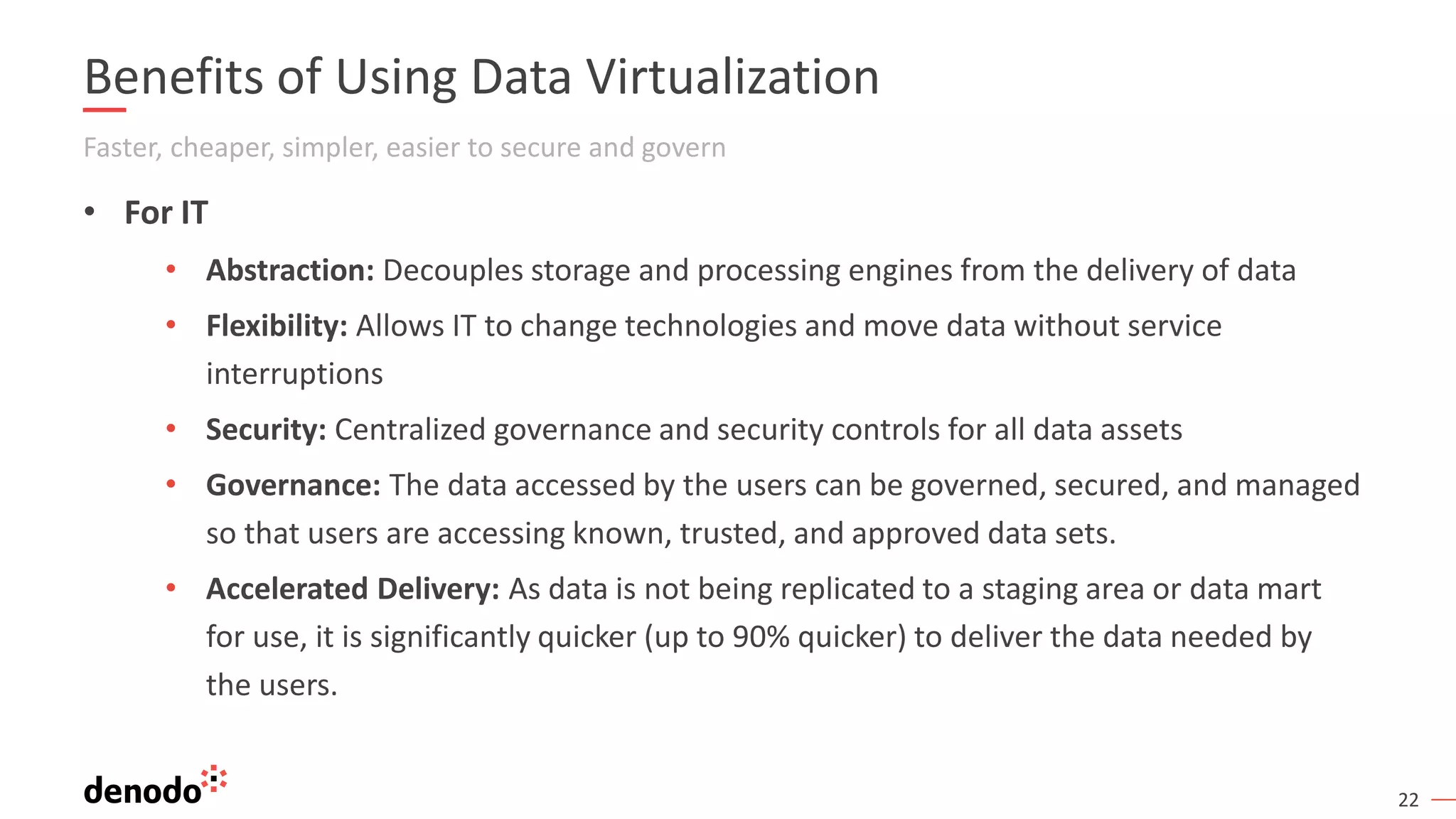
Benefits of Using Data Virtualization
Faster, cheaper, simpler, easier to secure and govern
• For IT
• Abstraction: Decouples storage and processing engines from the delivery of data
• Flexibility: Allows IT to change technologies and move data without service
interruptions
• Security: Centralized governance and security controls for all data assets
• Governance: The data accessed by the users can be governed, secured, and managed
so that users are accessing known, trusted, and approved data sets.
• Accelerated Delivery: As data is not being replicated to a staging area or data mart
for use, it is significantly quicker (up to 90% quicker) to deliver the data needed by
the users.
23
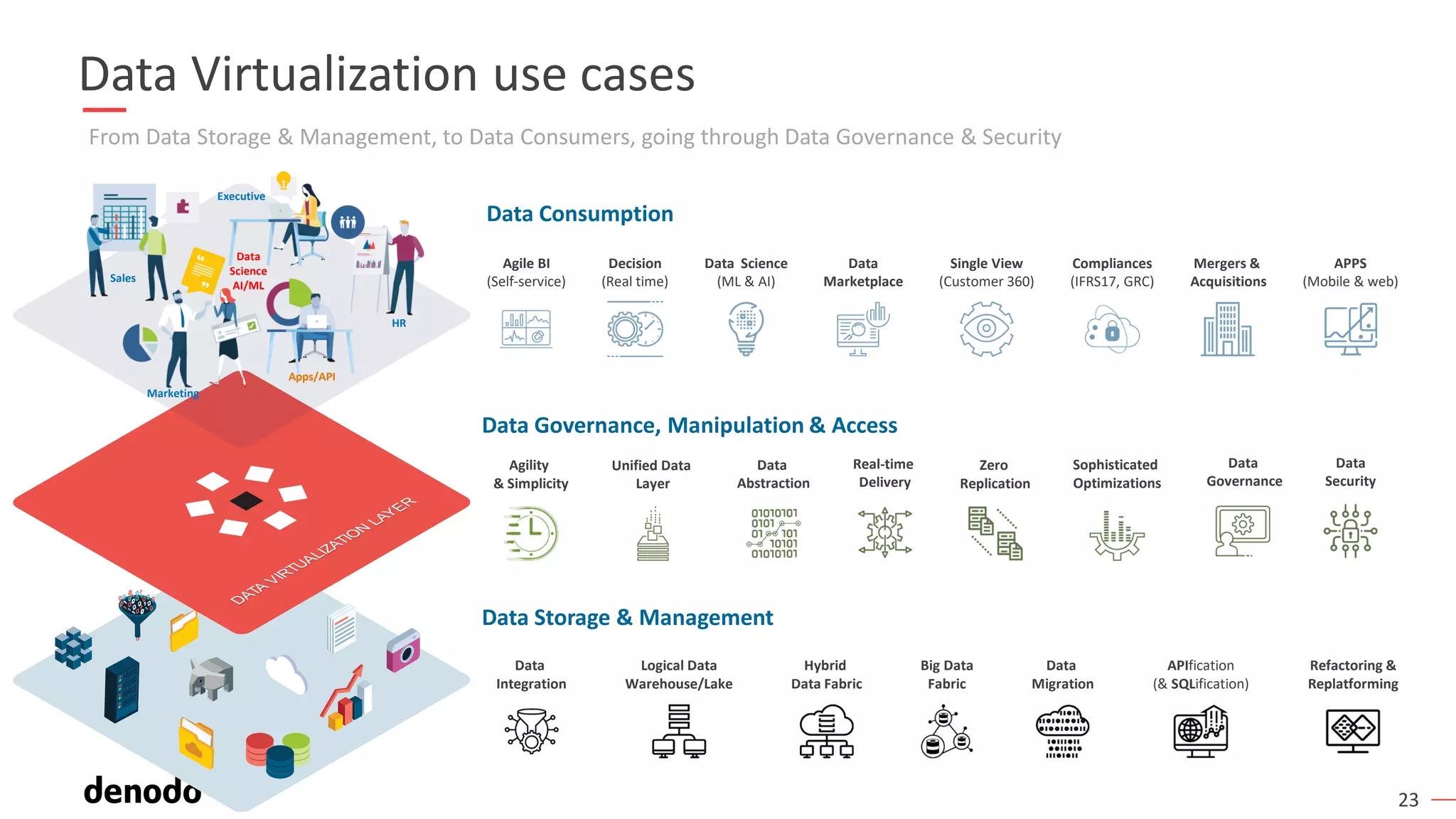
Data Virtualization use cases
From Data Storage & Management, to Data Consumers, going through Data Governance & Security
Decision
(Real time)
Single View
(Customer 360)
Agile BI
(Self-service)
Data Science
(ML & AI)
APPS
(Mobile & web)
Mergers &
Acquisitions
Data
Marketplace
Compliances
(IFRS17, GRC)
Data
Security
APIfication
(& SQLification)
Unified Data
Layer
Agility
& Simplicity
Real-time
Delivery
Data
Abstraction
Zero
Replication
Data
Governance
Sophisticated
Optimizations
Logical Data
Warehouse/Lake
Big Data
Fabric
Hybrid
Data Fabric
Data
Integration
Data
Migration
Refactoring &
Replatforming
Data Consumption
Data Storage & Management
Data Governance, Manipulation & Access
Sales
HR
Executive
Marketing
Apps/API
Data
Science
AI/ML
Denodo Standard
25
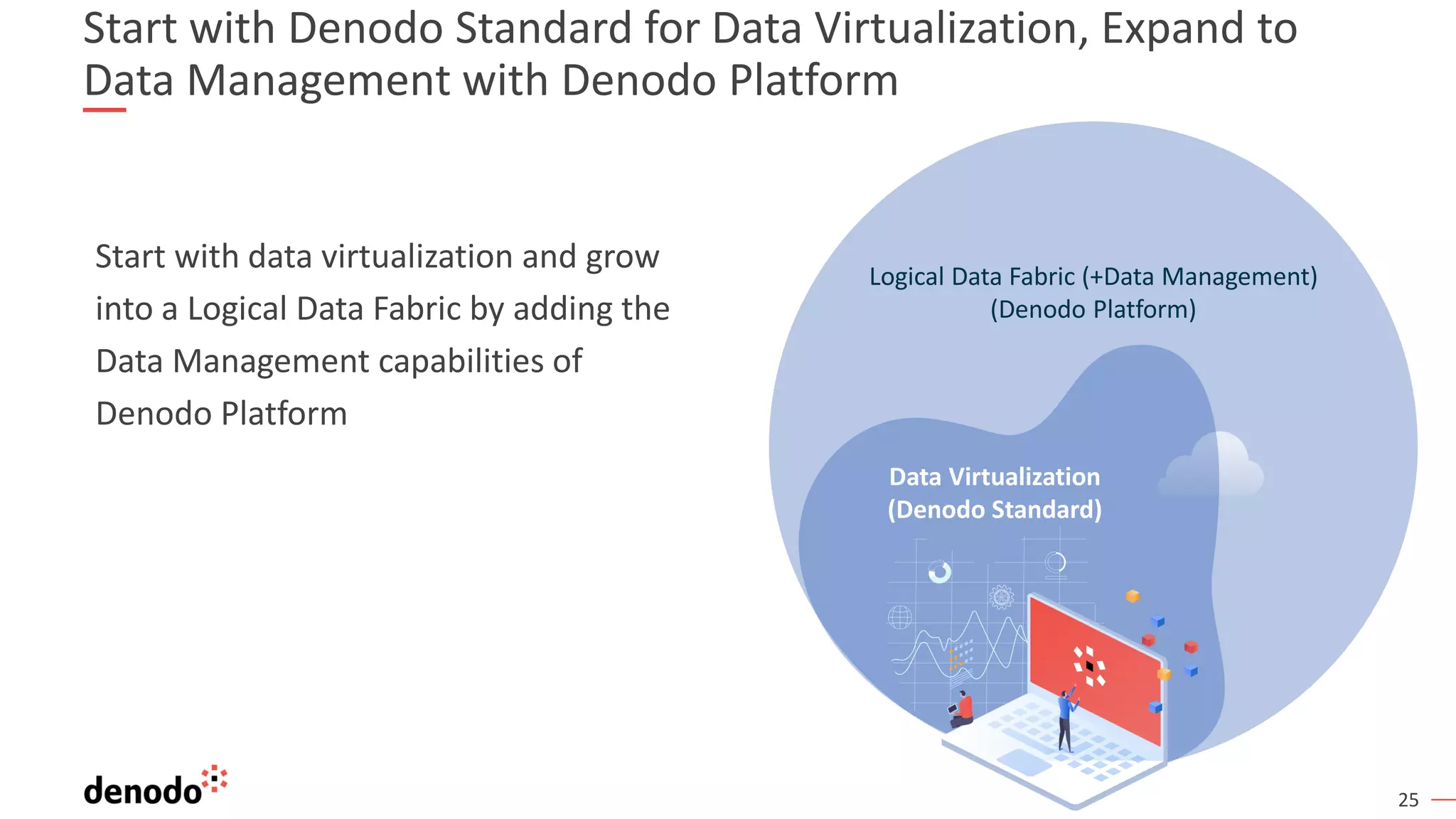
Start with Denodo Standard for Data Virtualization, Expand to
Data Management with Denodo Platform
Start with data virtualization and grow
into a Logical Data Fabric by adding the
Data Management capabilities of
Denodo Platform
Data Virtualization
(Denodo Standard)
Logical Data Fabric (+Data Management)
(Denodo Platform)
26
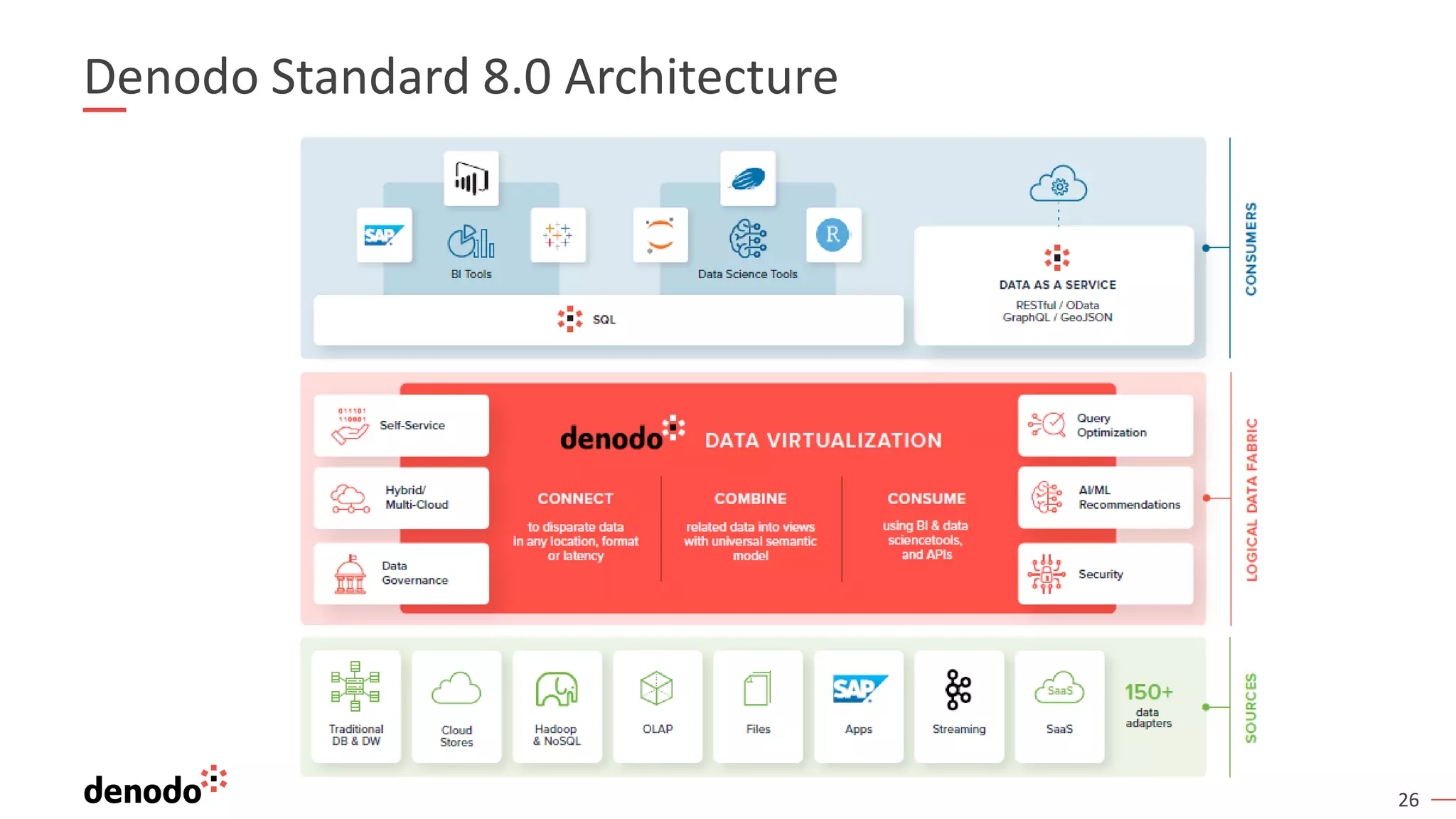
Denodo Standard 8.0 Architecture
DENODO WEBINARS
Product Demonstration
Shehan Xavier
Sr. Sales Engineer, Denodo
28
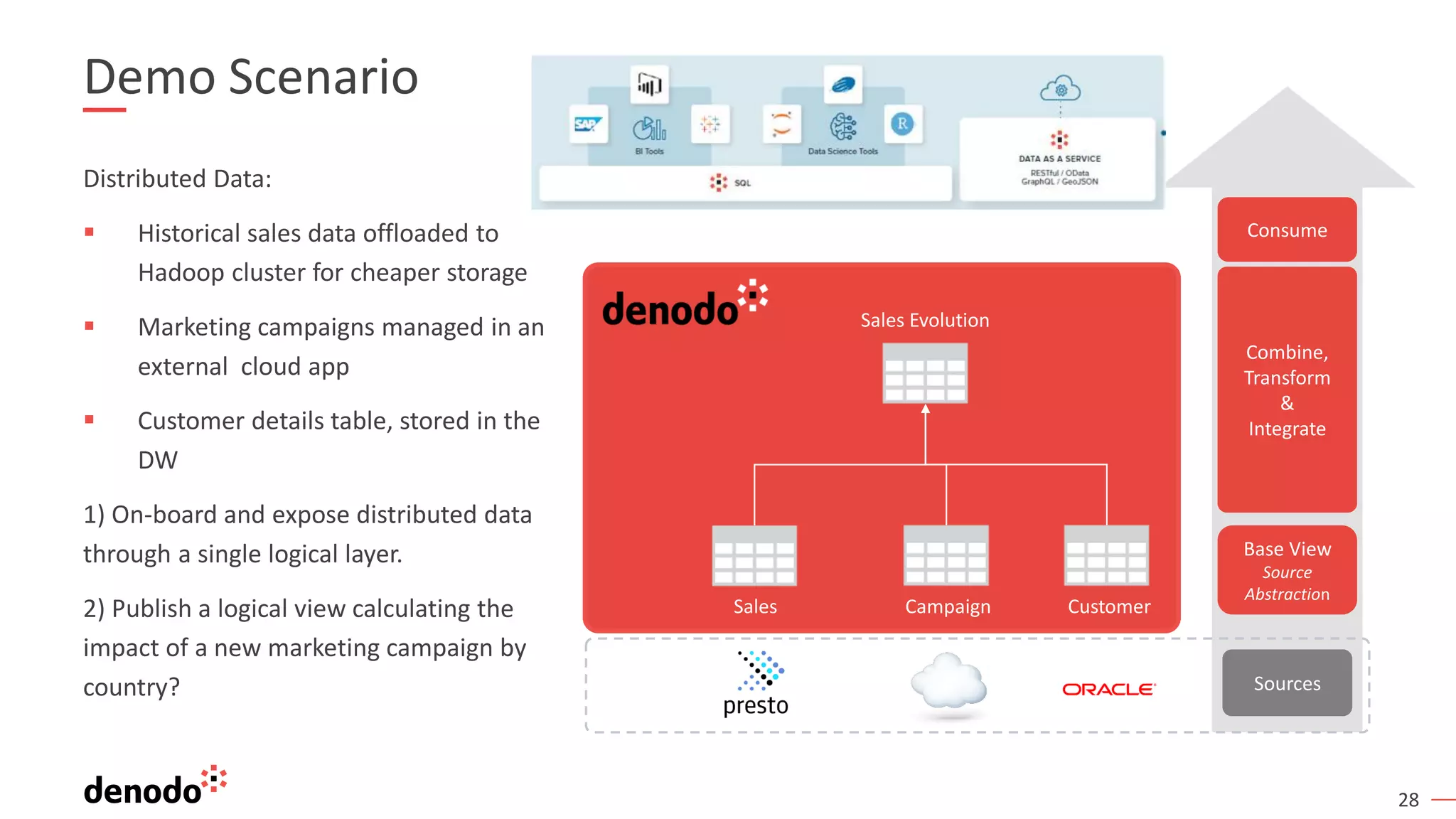
Demo Scenario
Distributed Data:
▪ Historical sales data offloaded to
Hadoop cluster for cheaper storage
▪ Marketing campaigns managed in an
external cloud app
▪ Customer details table, stored in the
DW
1) On-board and expose distributed data
through a single logical layer.
2) Publish a logical view calculating the
impact of a new marketing campaign by
country? Sources
Combine,
Transform
&
Integrate
Consume
Base View
Source
Abstraction
Sales Campaign Customer
Sales Evolution
29
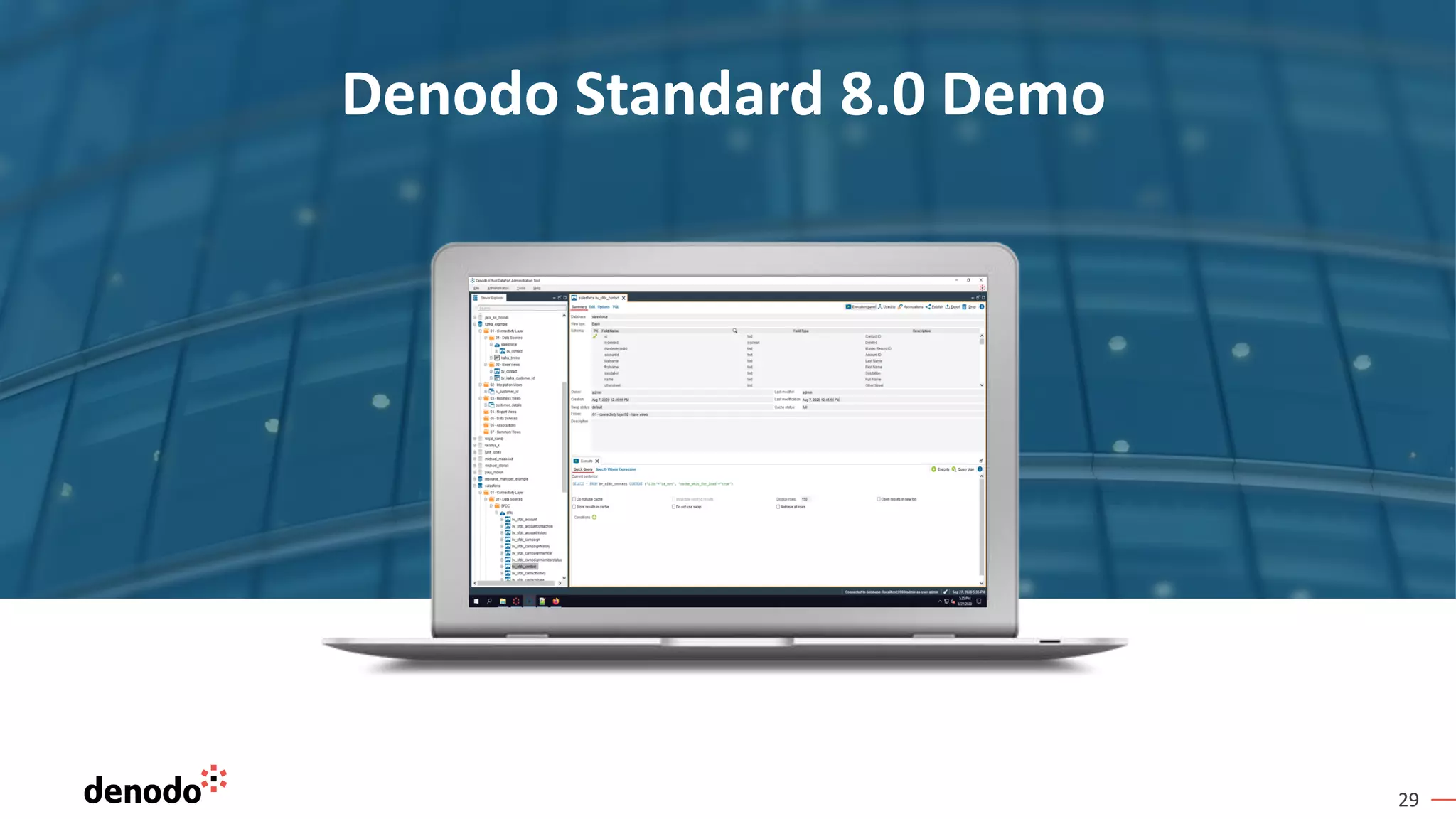
Denodo Standard 8.0 Demo
Key Takeaways
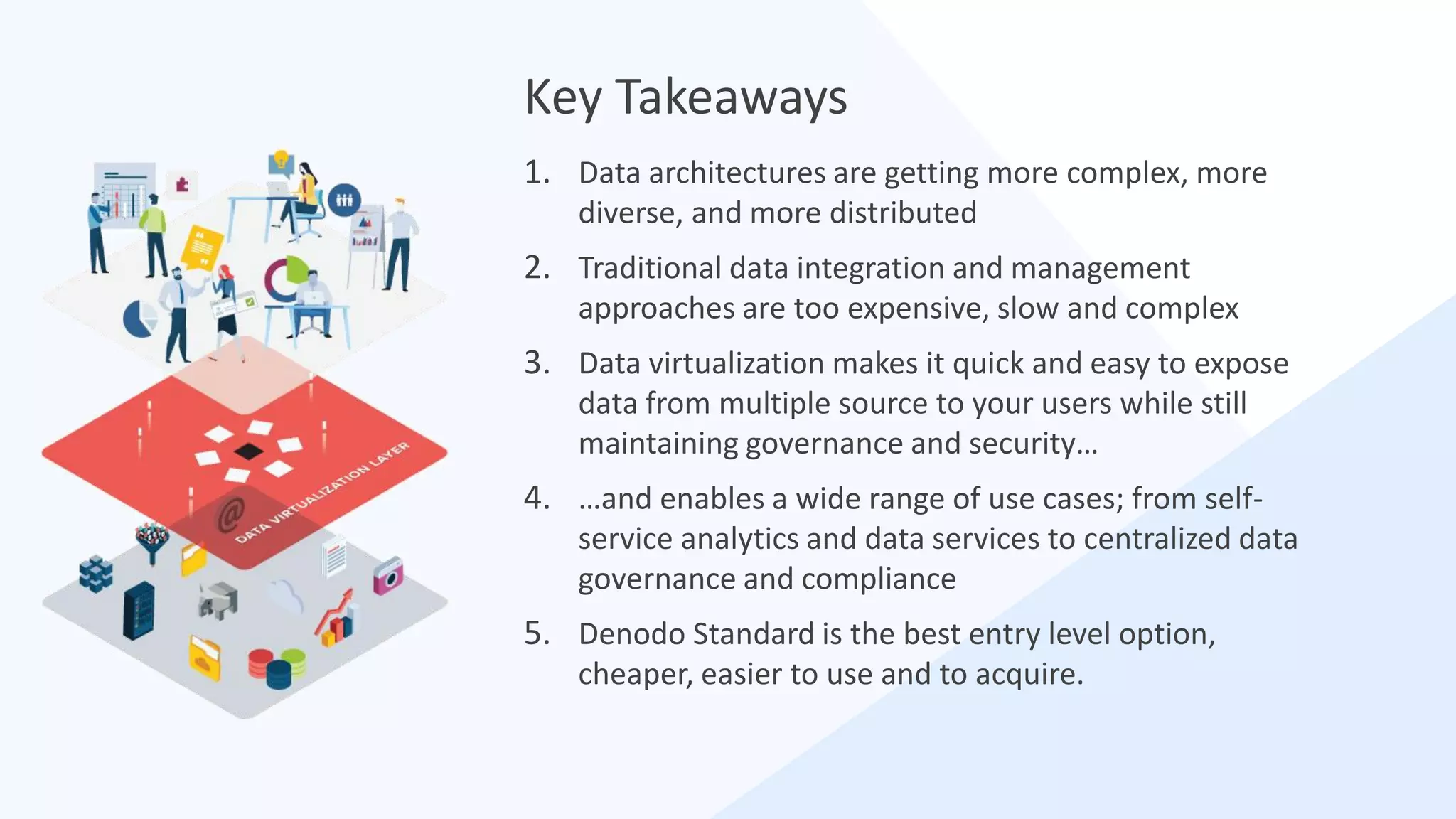
1. Data architectures are getting more complex, more
diverse, and more distributed
2. Traditional data integration and management
approaches are too expensive, slow and complex
3. Data virtualization makes it quick and easy to expose
data from multiple source to your users while still
maintaining governance and security…
4. …and enables a wide range of use cases; from self-
service analytics and data services to centralized data
governance and compliance
5. Denodo Standard is the best entry level option,
cheaper, easier to use and to acquire.
Key Takeaways
Q&A
33
Next Steps
Try Denodo Standard today for free!
www.denodo.com/free-trials
GET STARTED TODAY
www.denodo.com info@denodo.com
© Copyright Denodo Technologies. All rights reserved
Unless otherwise specified, no part of this PDF file may be reproduced or utilized in any for or by any means, electronic or mechanical, including photocopying and microfilm,
without prior the written authorization from Denodo Technologies.

Introduction to Modern Data Virtualization (US)

  • 1.
    DENODO WEBINARS Introduction toModern Data Virtualization
  • 2.
    Speakers Paul Fearon Senior Solutionsconsultant Denodo Sr. Sales Engineer Denodo Shehan Xavier
  • 3.
    Agenda ❖ Challenges ofData Management ❖ What is Modern Data Virtualization? ❖ And how does it work. ❖ Benefits of Data Virtualization ❖ Introducing Denodo Standard ❖ Q&A
  • 4.
  • 5.
    #DenodoDataFest Current Challenges ofData Management 1. Faster & more complex demands for decision making ▪ Provide useful information for decision making at all organization levels ▪ New users with advanced analytical skills and needs: e.g. data scientists ▪ Solution? Self Service Initiatives lead by business users, etc. → Either too complex (direct access) or too costly (specific data marts) , Governance and consistency problems 2. Regulations, enterprise-wide governance & data security ▪ Tens of new regulations worldwide: tax, finance, privacy, HR, environmental, etc. ▪ Ensure consistency in semantics of delivered data and data quality ▪ Enforce security policies ▪ Solution? Data Governance tools. Separate, static system for documentation→ get out of sync easily, don’t enforce policies & don’t deliver data to users 3. Complexity of DM infrastructure: IT cost reduction ▪ Huge data growth, operation costs → IT is looking for cheaper and more flexible solutions ▪ Solution? Cloud, Data Lakes → Increase integration complexity in the short term. E.g. Gartner says “83% of Data Lakes projects have failed”
  • 6.
    6 “Point-to-point integration isthe simplest form of integration, but it can introduce technical debt with a complex spaghetti architecture that is hard to manage and change.” Gartner 2018, Where Does Point-to-Point Integration Belong in Your Integration Strategy? The end result of this approach for enterprises was described by Gartner as: “…unregulated, chaotic integration spaghetti.” Gartner 2017, Accelerating Digital Transformation in Insurance
  • 7.
    7 IT Architecture isUnmanageable & Brittle because: Business – IT Dilemma IT responds by loosely stitching together disparate data sources Any changes break the flow and affect business continuity Business Wants All of the Data, Now – So IT creates 100s to 1000s of brittle direct connections and replicates large volumes of data Inventory System (MS SQL Server) Product Catalog (Web Service -SOAP) BI / Reporting JDBC, ODBC, ADO .NET Web / Mobile WS – REST JSON, XML, HTML, RSS Log files (.txt/.log files) CRM (MySQL) Billing System (Web Service - Rest) ETL Portals JSR168 / 286, Ms Web Parts SOA, Middleware, Enterprise Apps WS – SOAP Java API Customer Voice (Internet, Unstruc)
  • 8.
    What is DataVirtualization?
  • 9.
    9 Source: “Gartner MarketGuide for Data Virtualization, November 16, 2018” Data virtualization can be used to create virtualized and integrated views of data in-memory rather than executing data movement and physically storing integrated views in a target data structure. It provides a layer of abstraction above the physical implementation of data, to simplify query logic.
  • 10.
    10 What is DataVirtualization? Consume in business applications Combine related data into views Connect to disparate data sources 2 3 1 DATA CONSUMERS DISPARATE DATA SOURCES Enterprise Applications, Reporting, BI, Portals, ESB, Mobile, Web, Users Databases & Warehouses, Cloud/Saas Applications, Big Data, NoSQL, Web, XML, Excel, PDF, Word... Analytical Operational Less Structured More Structured CONNECT COMBINE PUBLISH Multiple Protocols, Formats Query, Search, Browse Request/Reply, Event Driven Secure Delivery SQL, MDX Web Services Big Data APIs Web Automation and Indexing CONNECT COMBINE CONSUME Share, Deliver, Publish, Govern, Collaborate Discover, Transform, Prepare, Improve Quality, Integrate Normalized views of disparate data
  • 11.
    11 How Does ItWork? Development Lifecycle Mgmt Monitoring & Audit Governance Security Development Tools and SDK Scheduled Tasks Data Caching Query Optimizer JDBC/ODBC/ADO.Net SOAP / REST WS U Customer 360 View Virtual Data Mart View J Application Layer Business Layer Unified View Unified View Unified View Unified View A J J Derived View Derived View J J S Transformation & Cleansing Data Source Layer Base View Base View Base View Base View Base View Base View Base View Abstraction
  • 12.
  • 13.
    13 Six Essential Capabilitiesof Data Virtualization 4. Self-service data services 5. Centralized metadata, security & governance 6. Location-agnostic architecture for multi-cloud, hybrid acceleration 1. Data abstraction 2. Zero replication, zero relocation 3. Real-time information
  • 14.
    14 1. Data abstraction Abstractsaccess to disparate data sources. Acts as a single virtual repository. Abstracts data complexities like location, format, protocols …hides data complexity for ease of data access by business Enterprise architects must revise their data architecture to meet the demand for fast data.” – Create a Road Map For A Real-time, Agile, Self-Service Data Platform, Forrester Research
  • 15.
    15 2. Zero replication,zero relocation …reduces development time and overall TCO The Denodo Platform enables us to build and deliver data services, to our internal and external consumers, within a day instead of the 1 – 2 weeks it would take with ETL.” – Manager, Enervus Leaves the data at its source; extracts only what is needed, on demand. Diminishes the need for effort-intensive ETL processes. Eliminates unnecessary data redundancy.
  • 16.
    16 3. Real-time information Provisionsdata in real-time to consumers Creates real-time logical views of data across many data sources. Supports transformations and quality functions without the latency, redundancy, and rigidity of legacy approaches …enables timely decision-making Denodo’s data fabric design relies on data virtualization to provide integrated data quickly to business users to effect faster outcomes..” – Gartner Magic Quadrant for Data Integration Tools, 18 August’ 2020
  • 17.
    17 4. Self-service dataservices Facilitates access to all data, both internal and external Enables creation of universal semantic models reflecting business taxonomy Connects data silos to provide best available information to drive business decisions …enables information discovery and self-service Impressively quick turn around time to "unlock“ data from additional siloes and from legacy systems - Few vendors (if any) can compete with Denodo's support of the Restful/Odata standard - both to provide data (northbound) and to access data from the sources (southbound).” – Business Analyst, Swiss Re
  • 18.
    18 5. Centralized metadata,security & governance Abstracts data source security models and enables single-point security and governance. Extends single-point control across cloud and on-premises architectures Provides multiple forms of metadata (technical, business, operational) to facilitate understanding of data. …simplifies data security, privacy, audit Our Denodo rollout was one of the easiest and most successful rollouts of critical enterprise software I have seen. It was successful in handling our initial, security, use case immediately, and has since shown a strong ability to cover additional use cases, in particular acting as a Data Abstraction Layer via it's web service functionality.” – Enterprise Architect, Asurion
  • 19.
    19 6. Location-agnostic architecturefor multi-cloud, hybrid acceleration Optimizes costs by migrating data, applications, and analytics workloads to cloud without impacting the business Enables creation of hub architecture to support integration of data across mixed workloads. End-to-end management of migrations/promotions and continuous delivery processes. …enables cloud adoption Impressively quick turn around time to "unlock“ data from additional siloes and from legacy systems - Few vendors (if any) can compete with Denodo's support of the Restful/Odata standard - both to provide data (northbound) and to access data from the sources (southbound).” – Business Analyst, Swiss Re
  • 20.
    20 Modern Data Virtualization DataVirtualization enhanced with data management, automation and AI ➢ Delivers data more quickly than direct queries ➢ Leverages AI to accelerate performance and enhance the user experience ➢ An active data catalog to explore and govern data in real time ➢ Empowers data scientists with an integrated data science notebooks ➢ Flexible support for hybrid and multi-cloud architectures ➢ Employs automation to speed cloud deployment and management ➢ Leverages SSO and fine grain permissions to secure data assets
  • 21.
    21 Benefits of UsingData Virtualization Easier & faster access to trusted data • For Business Users • Simplicity: Users don’t need to navigate the complexity of the architecture. Where is data (on-prem, cloud, multi-cloud)? How to Access it? Which location has priority? • Agility: All data is securely delivered from a single (virtual) system • Accessibility: Data is accessible in a variety of formats (SQL, REST, OData, GraphQL) and in a web-based Data Catalog, regardless of original format and location • Common Semantic Layer: All users see the same definitions and data, providing data consistency • Governed Self-Service: Users can use their own tools (BYOT) to access and query the data that is governed, secure, and trusted data.
  • 22.
    22 Benefits of UsingData Virtualization Faster, cheaper, simpler, easier to secure and govern • For IT • Abstraction: Decouples storage and processing engines from the delivery of data • Flexibility: Allows IT to change technologies and move data without service interruptions • Security: Centralized governance and security controls for all data assets • Governance: The data accessed by the users can be governed, secured, and managed so that users are accessing known, trusted, and approved data sets. • Accelerated Delivery: As data is not being replicated to a staging area or data mart for use, it is significantly quicker (up to 90% quicker) to deliver the data needed by the users.
  • 23.
    23 Data Virtualization usecases From Data Storage & Management, to Data Consumers, going through Data Governance & Security Decision (Real time) Single View (Customer 360) Agile BI (Self-service) Data Science (ML & AI) APPS (Mobile & web) Mergers & Acquisitions Data Marketplace Compliances (IFRS17, GRC) Data Security APIfication (& SQLification) Unified Data Layer Agility & Simplicity Real-time Delivery Data Abstraction Zero Replication Data Governance Sophisticated Optimizations Logical Data Warehouse/Lake Big Data Fabric Hybrid Data Fabric Data Integration Data Migration Refactoring & Replatforming Data Consumption Data Storage & Management Data Governance, Manipulation & Access Sales HR Executive Marketing Apps/API Data Science AI/ML
  • 24.
  • 25.
    25 Start with DenodoStandard for Data Virtualization, Expand to Data Management with Denodo Platform Start with data virtualization and grow into a Logical Data Fabric by adding the Data Management capabilities of Denodo Platform Data Virtualization (Denodo Standard) Logical Data Fabric (+Data Management) (Denodo Platform)
  • 26.
  • 27.
    DENODO WEBINARS Product Demonstration ShehanXavier Sr. Sales Engineer, Denodo
  • 28.
    28 Demo Scenario Distributed Data: ▪Historical sales data offloaded to Hadoop cluster for cheaper storage ▪ Marketing campaigns managed in an external cloud app ▪ Customer details table, stored in the DW 1) On-board and expose distributed data through a single logical layer. 2) Publish a logical view calculating the impact of a new marketing campaign by country? Sources Combine, Transform & Integrate Consume Base View Source Abstraction Sales Campaign Customer Sales Evolution
  • 29.
  • 30.
  • 31.
    1. Data architecturesare getting more complex, more diverse, and more distributed 2. Traditional data integration and management approaches are too expensive, slow and complex 3. Data virtualization makes it quick and easy to expose data from multiple source to your users while still maintaining governance and security… 4. …and enables a wide range of use cases; from self- service analytics and data services to centralized data governance and compliance 5. Denodo Standard is the best entry level option, cheaper, easier to use and to acquire. Key Takeaways
  • 32.
  • 33.
    33 Next Steps Try DenodoStandard today for free! www.denodo.com/free-trials GET STARTED TODAY
  • 34.
    www.denodo.com info@denodo.com © CopyrightDenodo Technologies. All rights reserved Unless otherwise specified, no part of this PDF file may be reproduced or utilized in any for or by any means, electronic or mechanical, including photocopying and microfilm, without prior the written authorization from Denodo Technologies.