Unlocking Data Sharing
Velocity with Data
Virtualization
BITanium MasterClass Series
Kevin McKerr BITanium Consulting
Vincent Gaorekwe BITanium Consulting
Chris Fitzpatrick Denodo
Agenda
1. The Data Sharing Challenge
2. How does Data Virtualisation enable Data Sharing?
• Data abstraction
• Zero replication, zero relocation
• Real time information
• Self-service data services
• Centralized metadata, security & governance
• Location agnostic architecture
3. The three foundation capabilities
• Connect to any data
• Combine any data
• Consume any data
4. Q&A
The Data Sharing Challenge
4
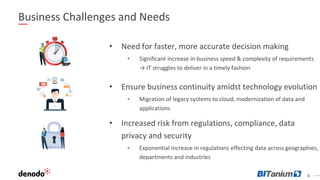
Business Challenges and Needs
• Need for faster, more accurate decision making
▪ Significant increase in business speed & complexity of requirements
→ IT struggles to deliver in a timely fashion
• Ensure business continuity amidst technology evolution
▪ Migration of legacy systems to cloud, modernization of data and
applications
• Increased risk from regulations, compliance, data
privacy and security
▪ Exponential increase in regulations effecting data across geographies,
departments and industries
5
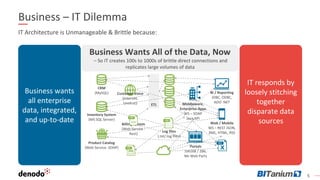
IT Architecture is Unmanageable & Brittle because:
Business – IT Dilemma
Business wants
all enterprise
data, integrated,
and up-to-date
IT responds by
loosely stitching
together
disparate data
sources
Business Wants All of the Data, Now
– So IT creates 100s to 1000s of brittle direct connections and
replicates large volumes of data
Inventory System
(MS SQL Server)
Product Catalog
(Web Service -SOAP)
BI / Reporting
JDBC, ODBC,
ADO .NET
Web / Mobile
WS – REST JSON,
XML, HTML, RSS
Log files
(.txt/.log files)
CRM
(MySQL)
Billing System
(Web Service -
Rest)
ETL
Portals
JSR168 / 286,
Ms Web Parts
SOA,
Middleware,
Enterprise Apps
WS – SOAP
Java API
Customer Voice
(Internet,
Unstruc)
6
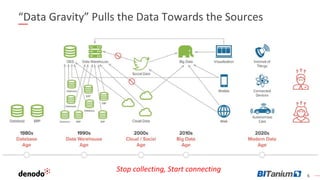
“Data Gravity” Pulls the Data Towards the Sources
Stop collecting, Start connecting
7
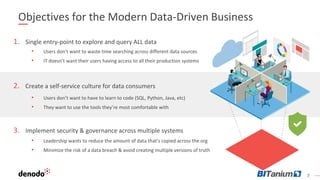
Objectives for the Modern Data-Driven Business
1. Single entry-point to explore and query ALL data
• Users don’t want to waste time searching across different data sources
• IT doesn’t want their users having access to all their production systems
2. Create a self-service culture for data consumers
• Users don’t want to have to learn to code (SQL, Python, Java, etc)
• They want to use the tools they’re most comfortable with
3. Implement security & governance across multiple systems
• Leadership wants to reduce the amount of data that’s copied across the org
• Minimize the risk of a data breach & avoid creating multiple versions of truth
How Data Virtualization enables
Data Sharing
9
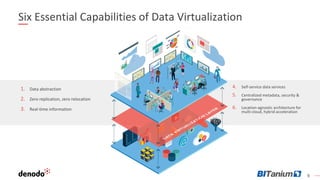
Six Essential Capabilities of Data Virtualization
4. Self-service data services
5. Centralized metadata, security &
governance
6. Location-agnostic architecture for
multi-cloud, hybrid acceleration
1. Data abstraction
2. Zero replication, zero relocation
3. Real-time information
10
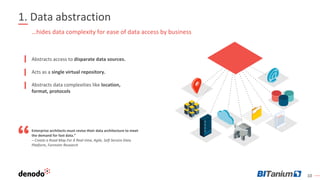
1. Data abstraction
Abstracts access to disparate data sources.
Acts as a single virtual repository.
Abstracts data complexities like location,
format, protocols
…hides data complexity for ease of data access by business
Enterprise architects must revise their data architecture to meet
the demand for fast data.”
– Create a Road Map For A Real-time, Agile, Self-Service Data
Platform, Forrester Research
11
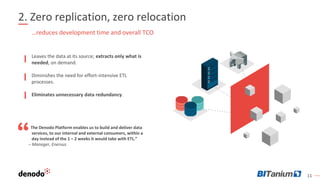
2. Zero replication, zero relocation
…reduces development time and overall TCO
The Denodo Platform enables us to build and deliver data
services, to our internal and external consumers, within a
day instead of the 1 – 2 weeks it would take with ETL.”
– Manager, Enervus
Leaves the data at its source; extracts only what is
needed, on demand.
Diminishes the need for effort-intensive ETL
processes.
Eliminates unnecessary data redundancy.
12
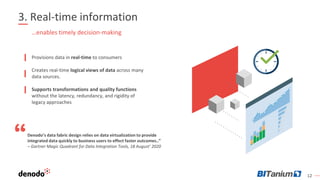
3. Real-time information
Provisions data in real-time to consumers
Creates real-time logical views of data across many
data sources.
Supports transformations and quality functions
without the latency, redundancy, and rigidity of
legacy approaches
…enables timely decision-making
Denodo’s data fabric design relies on data virtualization to provide
integrated data quickly to business users to effect faster outcomes..”
– Gartner Magic Quadrant for Data Integration Tools, 18 August’ 2020
13
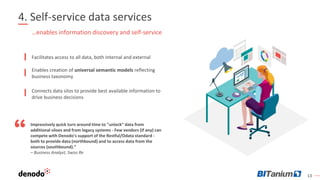
4. Self-service data services
Facilitates access to all data, both internal and external
Enables creation of universal semantic models reflecting
business taxonomy
Connects data silos to provide best available information to
drive business decisions
…enables information discovery and self-service
Impressively quick turn around time to "unlock“ data from
additional siloes and from legacy systems - Few vendors (if any) can
compete with Denodo's support of the Restful/Odata standard -
both to provide data (northbound) and to access data from the
sources (southbound).”
– Business Analyst, Swiss Re
14
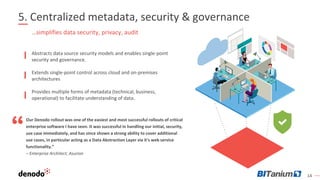
5. Centralized metadata, security & governance
Abstracts data source security models and enables single-point
security and governance.
Extends single-point control across cloud and on-premises
architectures
Provides multiple forms of metadata (technical, business,
operational) to facilitate understanding of data.
…simplifies data security, privacy, audit
Our Denodo rollout was one of the easiest and most successful rollouts of critical
enterprise software I have seen. It was successful in handling our initial, security,
use case immediately, and has since shown a strong ability to cover additional
use cases, in particular acting as a Data Abstraction Layer via it's web service
functionality.”
– Enterprise Architect, Asurion
15
6. Location-agnostic architecture for multi-cloud, hybrid acceleration
Optimizes costs by migrating data, applications, and analytics
workloads to cloud without impacting the business
Enables creation of hub architecture to support integration of
data across mixed workloads.
End-to-end management of migrations/promotions and
continuous delivery processes.
…enables cloud adoption
Impressively quick turn around time to "unlock“ data from
additional siloes and from legacy systems - Few vendors (if any) can
compete with Denodo's support of the Restful/Odata standard -
both to provide data (northbound) and to access data from the
sources (southbound).”
– Business Analyst, Swiss Re
16
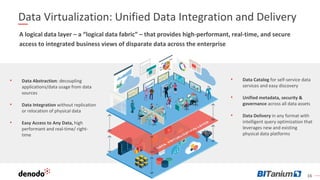
Data Virtualization: Unified Data Integration and Delivery
• Data Abstraction: decoupling
applications/data usage from data
sources
• Data Integration without replication
or relocation of physical data
• Easy Access to Any Data, high
performant and real-time/ right-
time
• Data Catalog for self-service data
services and easy discovery
• Unified metadata, security &
governance across all data assets
• Data Delivery in any format with
intelligent query optimization that
leverages new and existing
physical data platforms
A logical data layer – a “logical data fabric” – that provides high-performant, real-time, and secure
access to integrated business views of disparate data across the enterprise
17
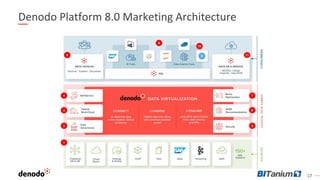
Denodo Platform 8.0 Marketing Architecture
1
2
3
4
5
6
7
8
9
10
11
18
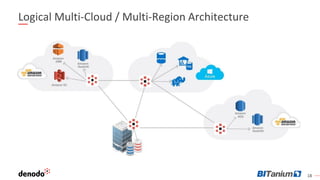
Logical Multi-Cloud / Multi-Region Architecture
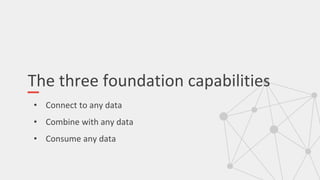
The three foundation capabilities
• Connect to any data
• Combine with any data
• Consume any data
Q&A
www.denodo.com info@denodo.com
© Copyright Denodo Technologies. All rights reserved
Unless otherwise specified, no part of this PDF file may be reproduced or utilized in any for or by any means, electronic or mechanical, including photocopying and microfilm,
without prior the written authorization from Denodo Technologies.

MasterClass Series: Unlocking Data Sharing Velocity with Data Virtualization

  • 1.
    Unlocking Data Sharing Velocitywith Data Virtualization BITanium MasterClass Series Kevin McKerr BITanium Consulting Vincent Gaorekwe BITanium Consulting Chris Fitzpatrick Denodo
  • 2.
    Agenda 1. The DataSharing Challenge 2. How does Data Virtualisation enable Data Sharing? • Data abstraction • Zero replication, zero relocation • Real time information • Self-service data services • Centralized metadata, security & governance • Location agnostic architecture 3. The three foundation capabilities • Connect to any data • Combine any data • Consume any data 4. Q&A
  • 3.
  • 4.
    4 Business Challenges andNeeds • Need for faster, more accurate decision making ▪ Significant increase in business speed & complexity of requirements → IT struggles to deliver in a timely fashion • Ensure business continuity amidst technology evolution ▪ Migration of legacy systems to cloud, modernization of data and applications • Increased risk from regulations, compliance, data privacy and security ▪ Exponential increase in regulations effecting data across geographies, departments and industries
  • 5.
    5 IT Architecture isUnmanageable & Brittle because: Business – IT Dilemma Business wants all enterprise data, integrated, and up-to-date IT responds by loosely stitching together disparate data sources Business Wants All of the Data, Now – So IT creates 100s to 1000s of brittle direct connections and replicates large volumes of data Inventory System (MS SQL Server) Product Catalog (Web Service -SOAP) BI / Reporting JDBC, ODBC, ADO .NET Web / Mobile WS – REST JSON, XML, HTML, RSS Log files (.txt/.log files) CRM (MySQL) Billing System (Web Service - Rest) ETL Portals JSR168 / 286, Ms Web Parts SOA, Middleware, Enterprise Apps WS – SOAP Java API Customer Voice (Internet, Unstruc)
  • 6.
    6 “Data Gravity” Pullsthe Data Towards the Sources Stop collecting, Start connecting
  • 7.
    7 Objectives for theModern Data-Driven Business 1. Single entry-point to explore and query ALL data • Users don’t want to waste time searching across different data sources • IT doesn’t want their users having access to all their production systems 2. Create a self-service culture for data consumers • Users don’t want to have to learn to code (SQL, Python, Java, etc) • They want to use the tools they’re most comfortable with 3. Implement security & governance across multiple systems • Leadership wants to reduce the amount of data that’s copied across the org • Minimize the risk of a data breach & avoid creating multiple versions of truth
  • 8.
    How Data Virtualizationenables Data Sharing
  • 9.
    9 Six Essential Capabilitiesof Data Virtualization 4. Self-service data services 5. Centralized metadata, security & governance 6. Location-agnostic architecture for multi-cloud, hybrid acceleration 1. Data abstraction 2. Zero replication, zero relocation 3. Real-time information
  • 10.
    10 1. Data abstraction Abstractsaccess to disparate data sources. Acts as a single virtual repository. Abstracts data complexities like location, format, protocols …hides data complexity for ease of data access by business Enterprise architects must revise their data architecture to meet the demand for fast data.” – Create a Road Map For A Real-time, Agile, Self-Service Data Platform, Forrester Research
  • 11.
    11 2. Zero replication,zero relocation …reduces development time and overall TCO The Denodo Platform enables us to build and deliver data services, to our internal and external consumers, within a day instead of the 1 – 2 weeks it would take with ETL.” – Manager, Enervus Leaves the data at its source; extracts only what is needed, on demand. Diminishes the need for effort-intensive ETL processes. Eliminates unnecessary data redundancy.
  • 12.
    12 3. Real-time information Provisionsdata in real-time to consumers Creates real-time logical views of data across many data sources. Supports transformations and quality functions without the latency, redundancy, and rigidity of legacy approaches …enables timely decision-making Denodo’s data fabric design relies on data virtualization to provide integrated data quickly to business users to effect faster outcomes..” – Gartner Magic Quadrant for Data Integration Tools, 18 August’ 2020
  • 13.
    13 4. Self-service dataservices Facilitates access to all data, both internal and external Enables creation of universal semantic models reflecting business taxonomy Connects data silos to provide best available information to drive business decisions …enables information discovery and self-service Impressively quick turn around time to "unlock“ data from additional siloes and from legacy systems - Few vendors (if any) can compete with Denodo's support of the Restful/Odata standard - both to provide data (northbound) and to access data from the sources (southbound).” – Business Analyst, Swiss Re
  • 14.
    14 5. Centralized metadata,security & governance Abstracts data source security models and enables single-point security and governance. Extends single-point control across cloud and on-premises architectures Provides multiple forms of metadata (technical, business, operational) to facilitate understanding of data. …simplifies data security, privacy, audit Our Denodo rollout was one of the easiest and most successful rollouts of critical enterprise software I have seen. It was successful in handling our initial, security, use case immediately, and has since shown a strong ability to cover additional use cases, in particular acting as a Data Abstraction Layer via it's web service functionality.” – Enterprise Architect, Asurion
  • 15.
    15 6. Location-agnostic architecturefor multi-cloud, hybrid acceleration Optimizes costs by migrating data, applications, and analytics workloads to cloud without impacting the business Enables creation of hub architecture to support integration of data across mixed workloads. End-to-end management of migrations/promotions and continuous delivery processes. …enables cloud adoption Impressively quick turn around time to "unlock“ data from additional siloes and from legacy systems - Few vendors (if any) can compete with Denodo's support of the Restful/Odata standard - both to provide data (northbound) and to access data from the sources (southbound).” – Business Analyst, Swiss Re
  • 16.
    16 Data Virtualization: UnifiedData Integration and Delivery • Data Abstraction: decoupling applications/data usage from data sources • Data Integration without replication or relocation of physical data • Easy Access to Any Data, high performant and real-time/ right- time • Data Catalog for self-service data services and easy discovery • Unified metadata, security & governance across all data assets • Data Delivery in any format with intelligent query optimization that leverages new and existing physical data platforms A logical data layer – a “logical data fabric” – that provides high-performant, real-time, and secure access to integrated business views of disparate data across the enterprise
  • 17.
    17 Denodo Platform 8.0Marketing Architecture 1 2 3 4 5 6 7 8 9 10 11
  • 18.
    18 Logical Multi-Cloud /Multi-Region Architecture
  • 19.
    The three foundationcapabilities • Connect to any data • Combine with any data • Consume any data
  • 20.
  • 21.
    www.denodo.com info@denodo.com © CopyrightDenodo Technologies. All rights reserved Unless otherwise specified, no part of this PDF file may be reproduced or utilized in any for or by any means, electronic or mechanical, including photocopying and microfilm, without prior the written authorization from Denodo Technologies.