The document outlines the fundamentals of data governance, emphasizing key objectives, roles, and the framework necessary for effective implementation. It highlights the importance of data quality and structured workflows across departments, as well as challenges like stakeholder buy-in and perceived value. Additionally, it presents success factors needed to develop a robust data governance program to enhance business efficiency and reduce operational risks.
Introduction to DataGovernance
John Bao Vuu
Director of Data Management
www.enterpriseim.com
www.linkedin.com/in/johnvuu
2.
Director of DM
Consultant| Advisor
John Vuu SPECIALTIES
✓ EIM Strategy & Solutions
✓ Data Governance / DQ
✓ Business Analytics
✓ Data Warehouse
INDUSTRIES
✓ Banking
✓ Insurance
✓ Ecommerce
✓ Healthcare
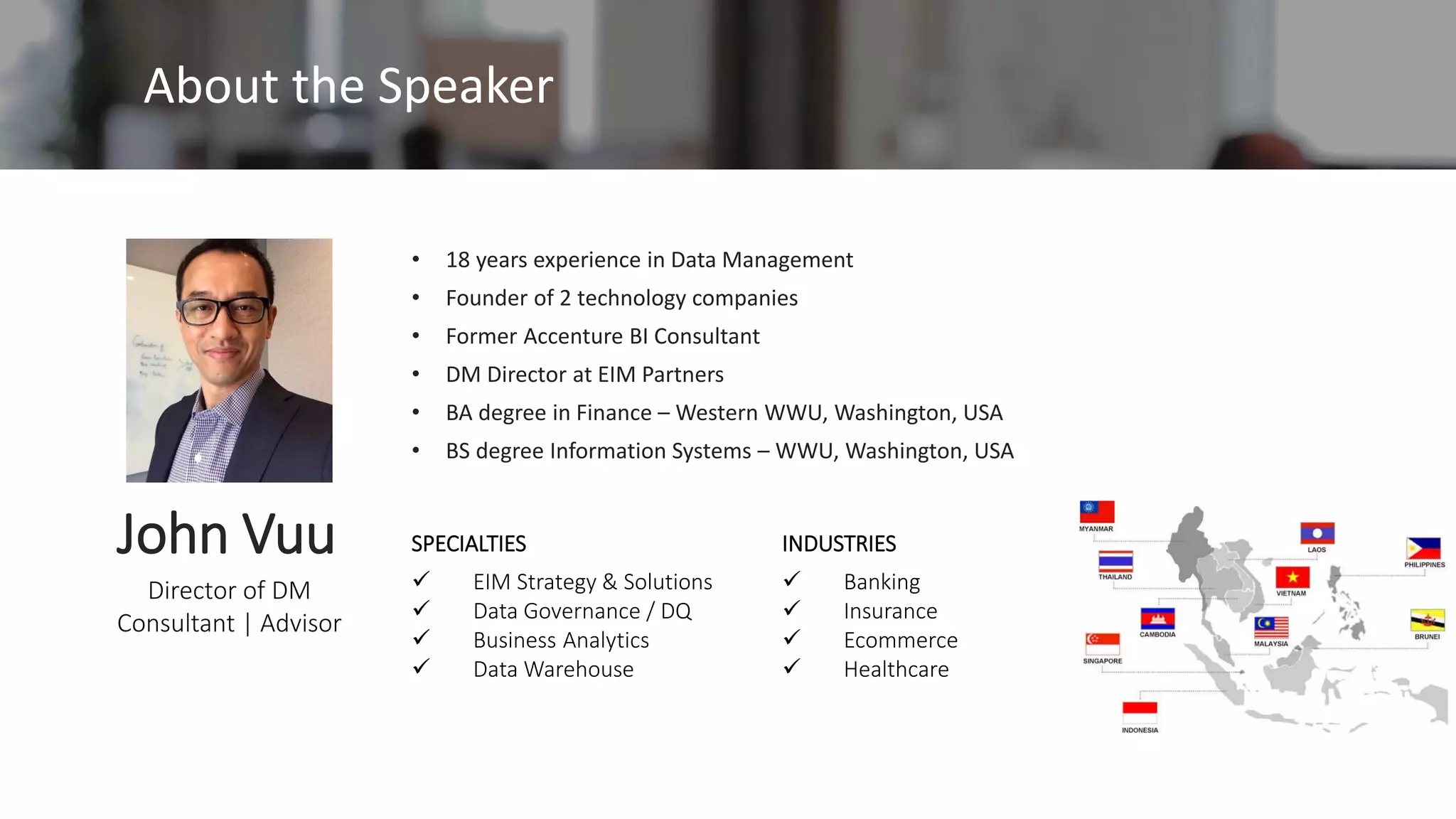
• 18 years experience in Data Management
• Founder of 2 technology companies
• Former Accenture BI Consultant
• DM Director at EIM Partners
• BA degree in Finance – Western WWU, Washington, USA
• BS degree Information Systems – WWU, Washington, USA
About the Speaker
3.
• IM FoundationalDisciplines
• Cross-functional Workflow Exchange
• Key Objectives of the Data Governance Framework
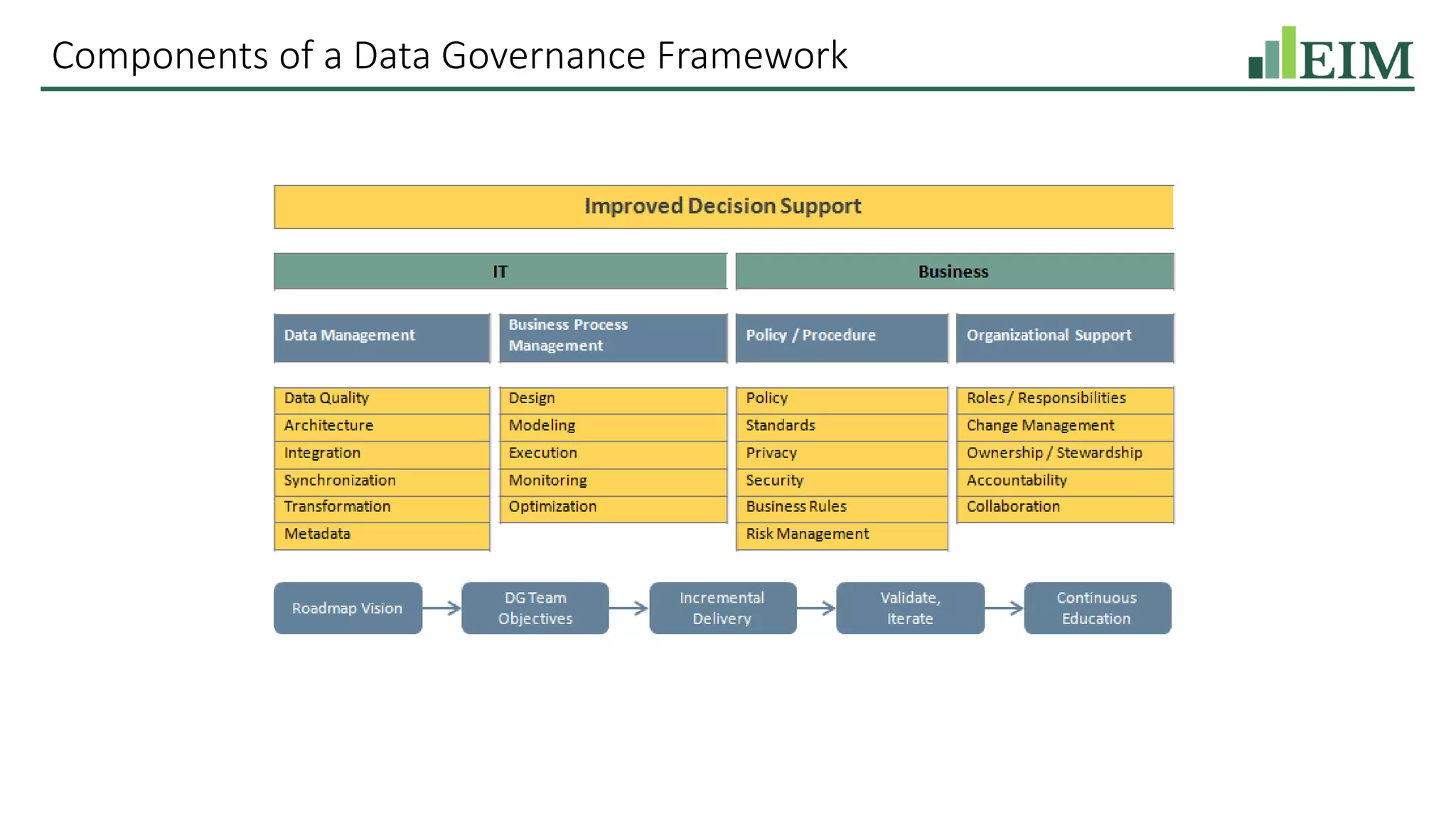
• Components of a Data Governance Framework
• Key Roles in Data Governance
• Data Governance Committee (DGC)
• 4 Data Governance Policy Areas
• 3 Challenges to Implementing Data Governance
• Data Governance Success Factors
Presentation Outline
4.
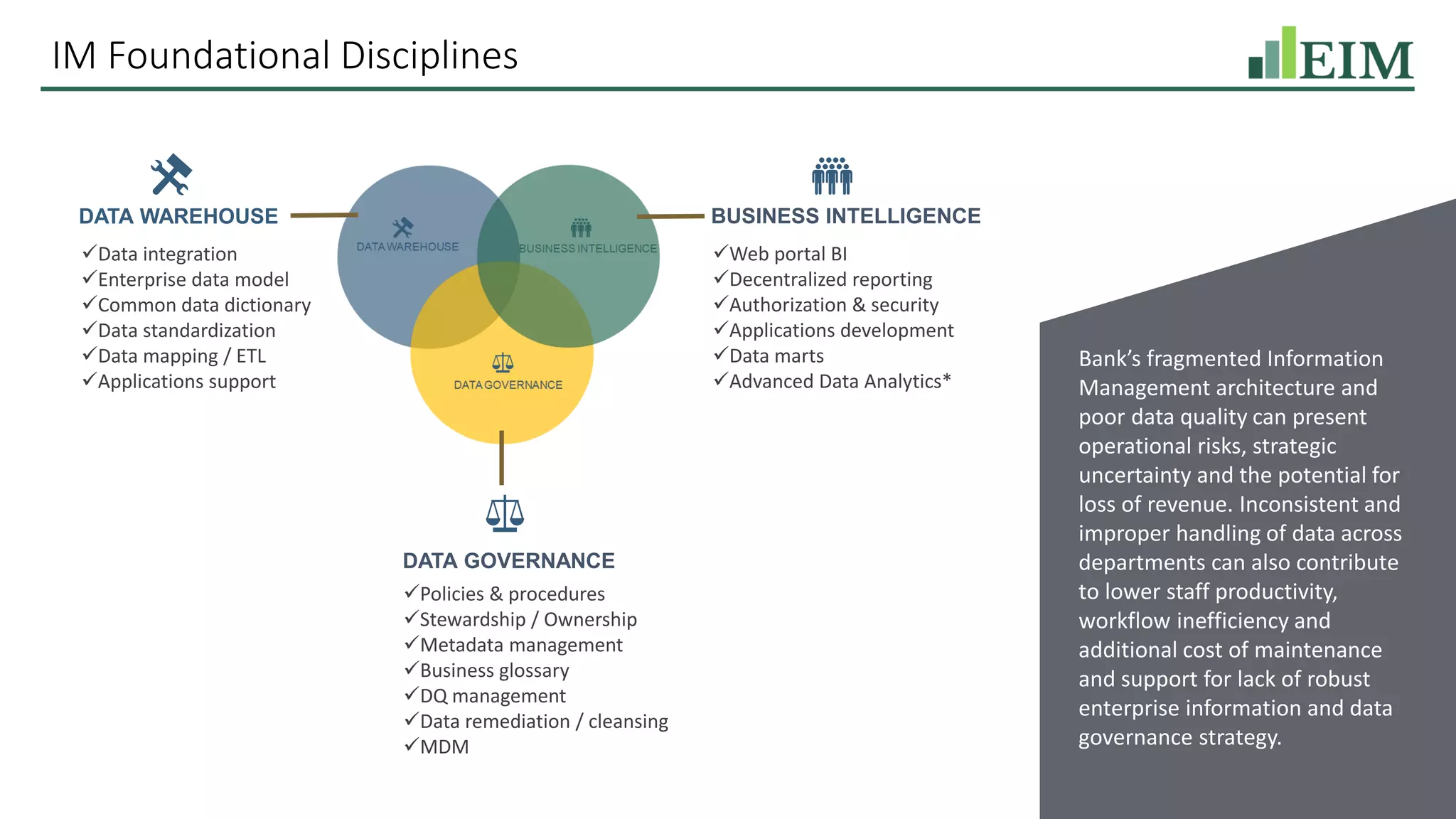
IM Foundational Disciplines
DATAWAREHOUSE
✓Data integration
✓Enterprise data model
✓Common data dictionary
✓Data standardization
✓Data mapping / ETL
✓Applications support
BUSINESS INTELLIGENCE
✓Web portal BI
✓Decentralized reporting
✓Authorization & security
✓Applications development
✓Data marts
✓Advanced Data Analytics*
DATA GOVERNANCE
✓Policies & procedures
✓Stewardship / Ownership
✓Metadata management
✓Business glossary
✓DQ management
✓Data remediation / cleansing
✓MDM
Bank’s fragmented Information
Management architecture and
poor data quality can present
operational risks, strategic
uncertainty and the potential for
loss of revenue. Inconsistent and
improper handling of data across
departments can also contribute
to lower staff productivity,
workflow inefficiency and
additional cost of maintenance
and support for lack of robust
enterprise information and data
governance strategy.
5.
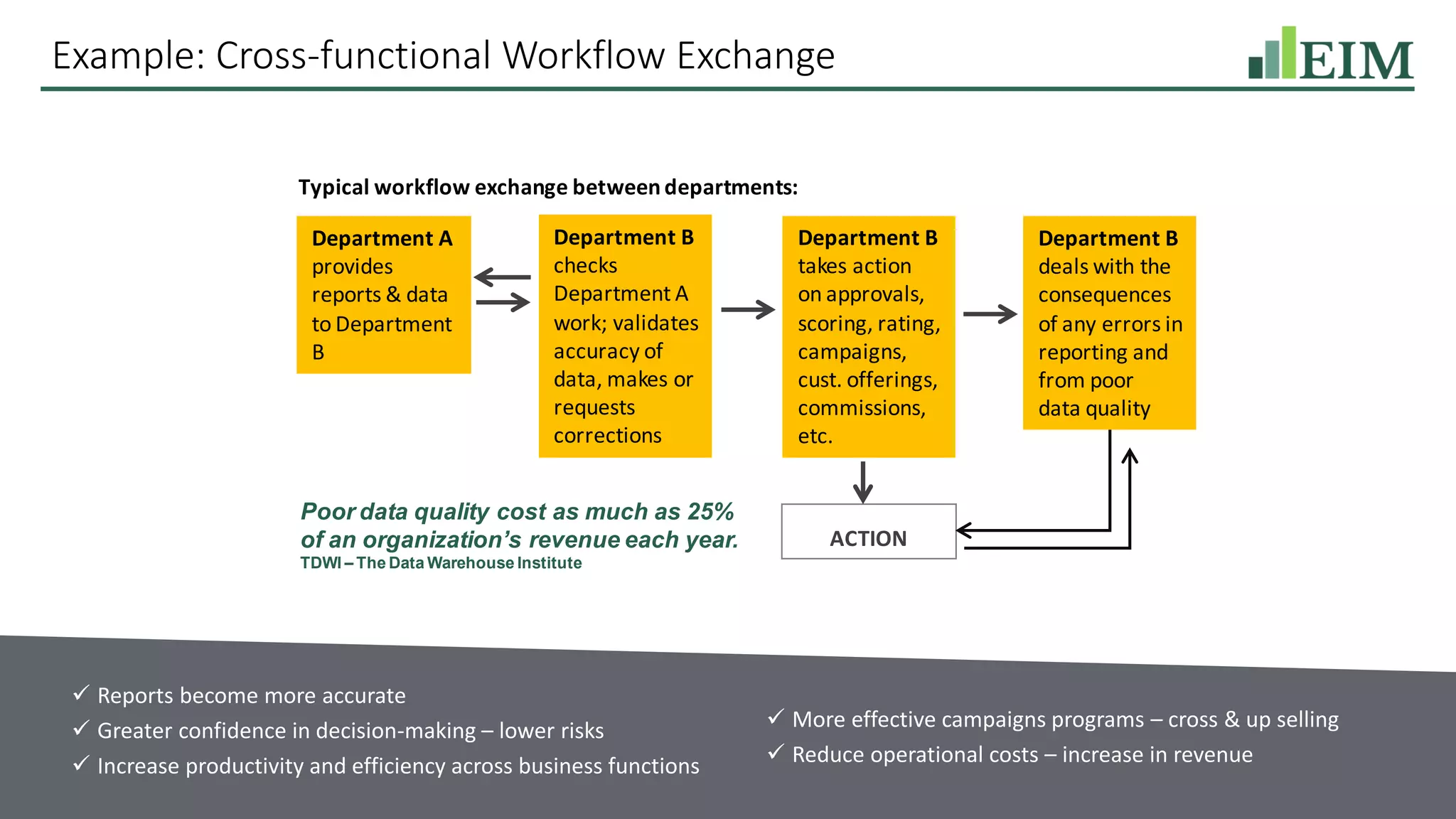
Example: Cross-functional WorkflowExchange
Department A
provides
reports & data
to Department
B
Department B
checks
Department A
work; validates
accuracy of
data, makes or
requests
corrections
Department B
takes action
on approvals,
scoring, rating,
campaigns,
cust. offerings,
commissions,
etc.
Department B
deals with the
consequences
of any errors in
reporting and
from poor
data quality
ACTION
Poor data quality cost as much as 25%
of an organization’s revenue each year.
TDWI – The Data Warehouse Institute
Typical workflow exchange between departments:
✓ Reports become more accurate
✓ Greater confidence in decision-making – lower risks
✓ Increase productivity and efficiency across business functions
✓ More effective campaigns programs – cross & up selling
✓ Reduce operational costs – increase in revenue
6.
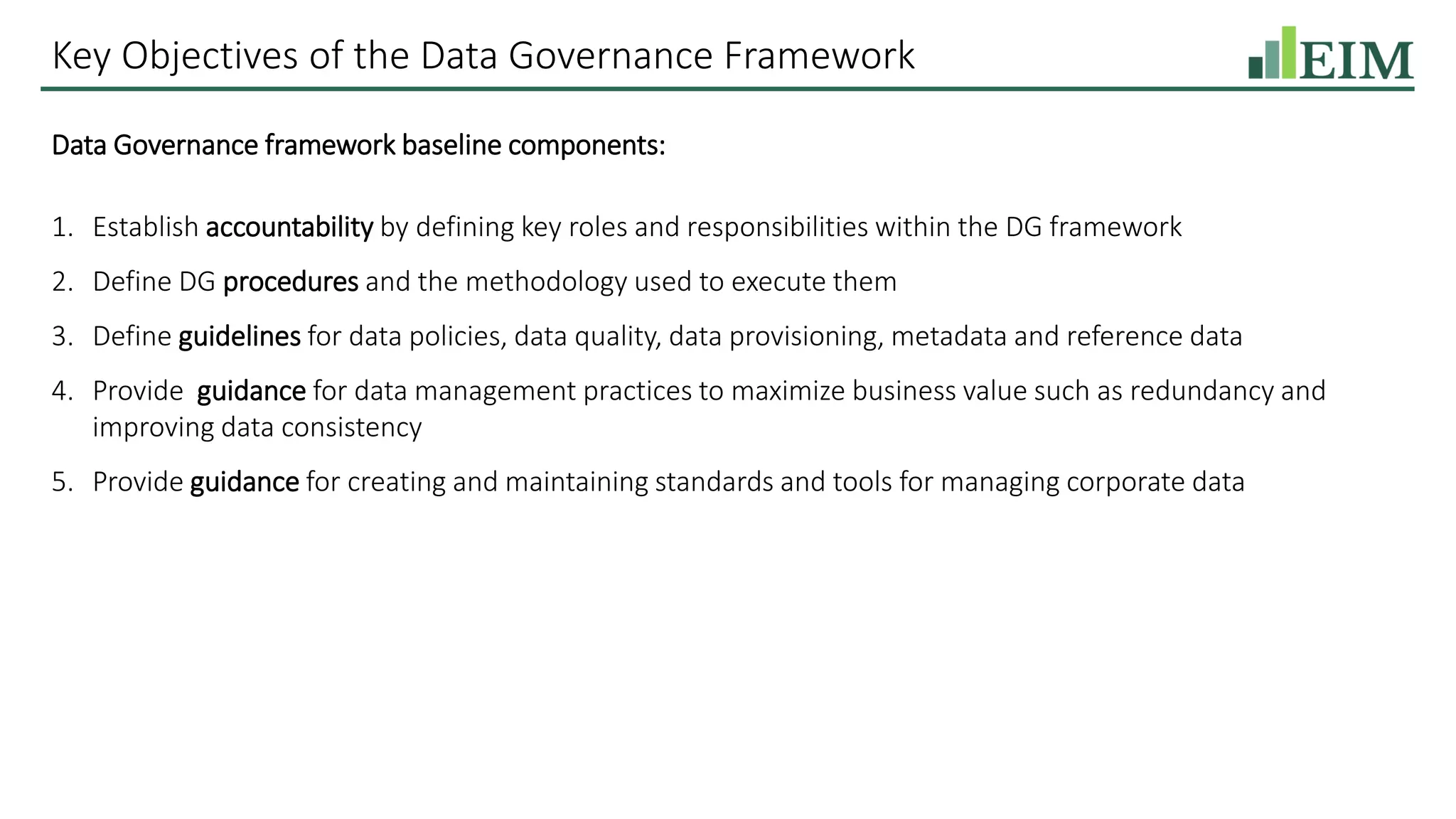
Key Objectives ofthe Data Governance Framework
Data Governance framework baseline components:
1. Establish accountability by defining key roles and responsibilities within the DG framework
2. Define DG procedures and the methodology used to execute them
3. Define guidelines for data policies, data quality, data provisioning, metadata and reference data
4. Provide guidance for data management practices to maximize business value such as redundancy and
improving data consistency
5. Provide guidance for creating and maintaining standards and tools for managing corporate data
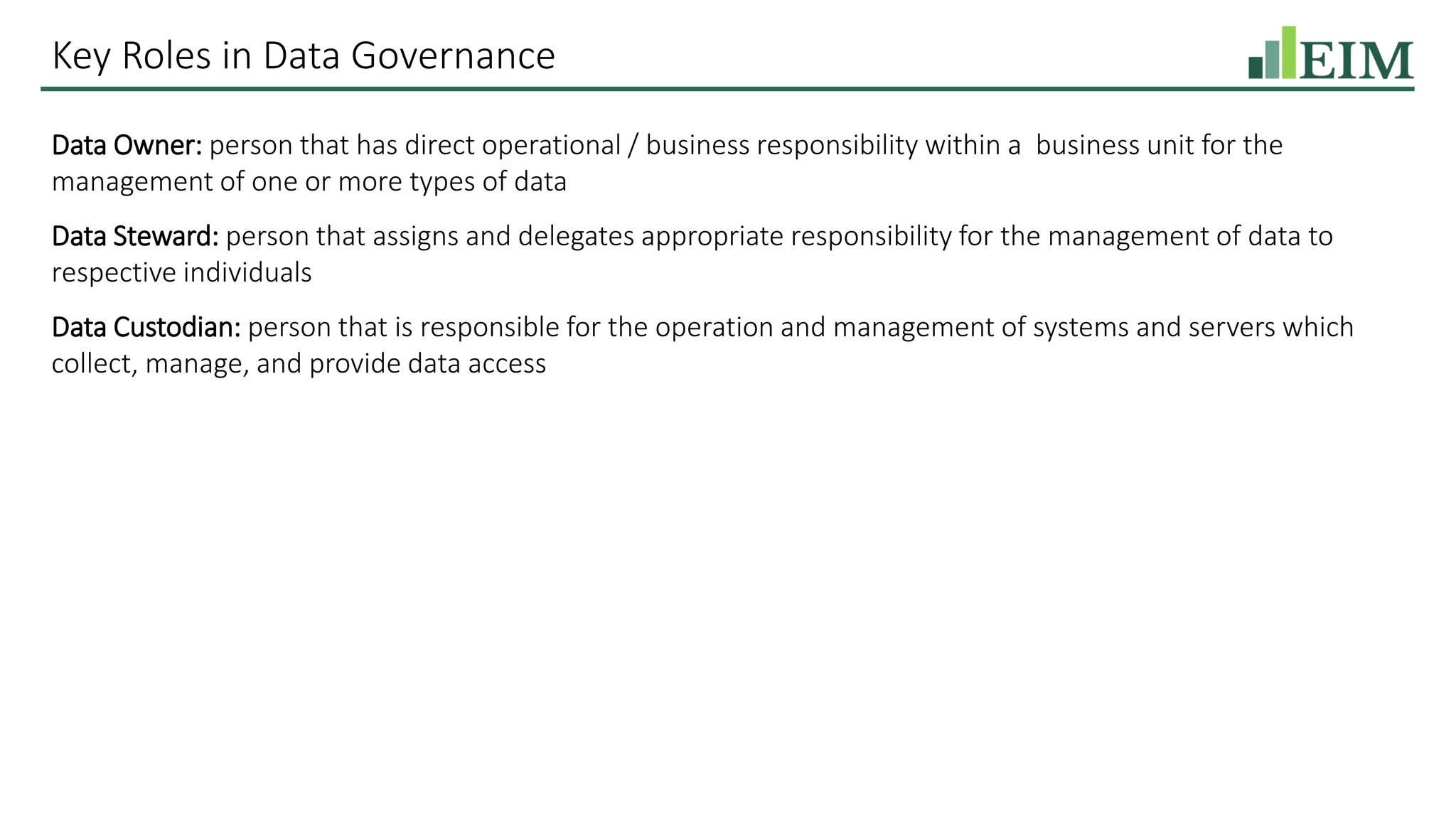
Key Roles inData Governance
Data Owner: person that has direct operational / business responsibility within a business unit for the
management of one or more types of data
Data Steward: person that assigns and delegates appropriate responsibility for the management of data to
respective individuals
Data Custodian: person that is responsible for the operation and management of systems and servers which
collect, manage, and provide data access
9.
Data Governance Committee(DGC)
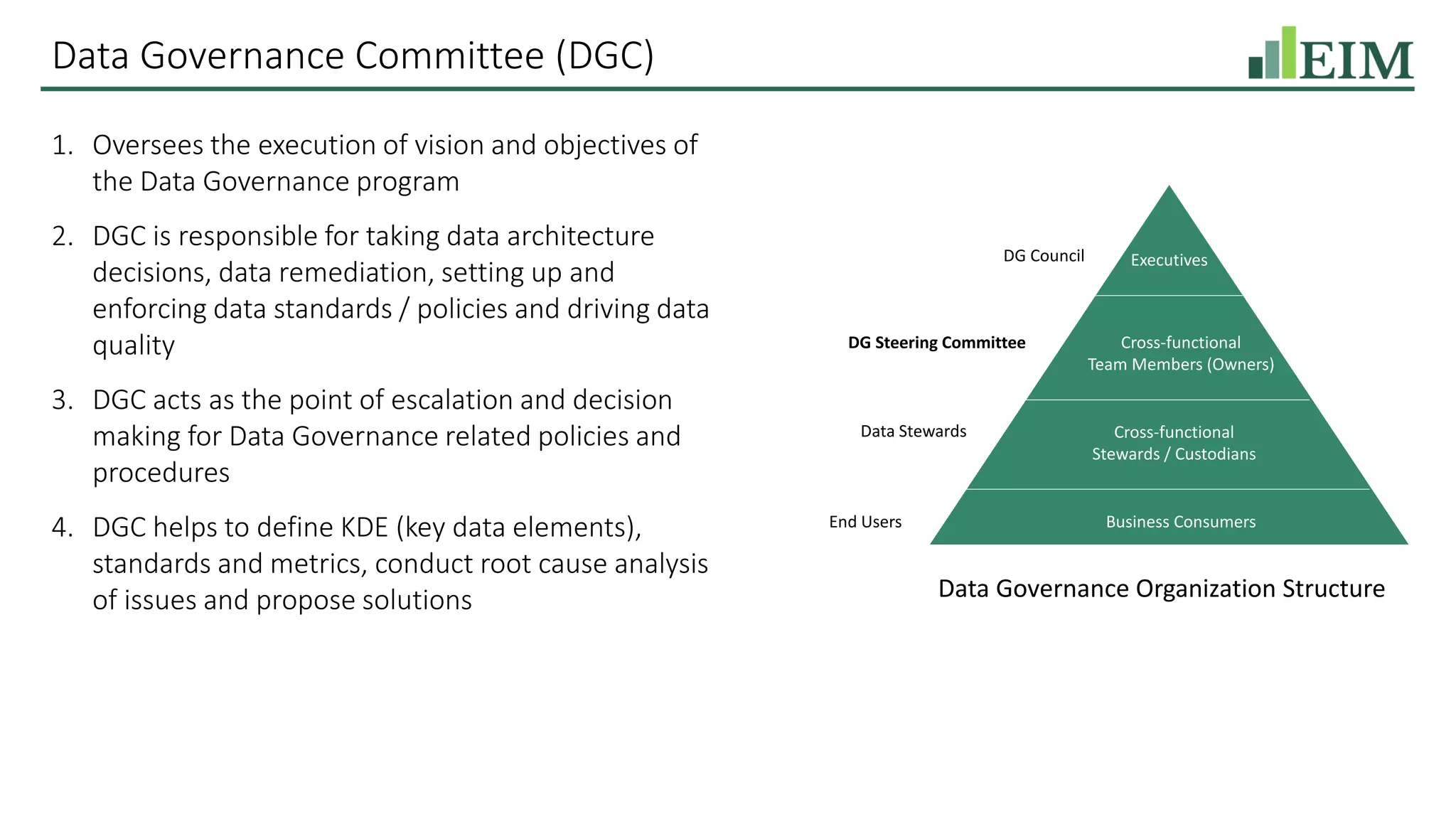
1. Oversees the execution of vision and objectives of
the Data Governance program
2. DGC is responsible for taking data architecture
decisions, data remediation, setting up and
enforcing data standards / policies and driving data
quality
3. DGC acts as the point of escalation and decision
making for Data Governance related policies and
procedures
4. DGC helps to define KDE (key data elements),
standards and metrics, conduct root cause analysis
of issues and propose solutions
Executives
Cross-functional
Team Members (Owners)
Cross-functional
Stewards / Custodians
Business Consumers
DG Council
DG Steering Committee
Data Stewards
End Users
Data Governance Organization Structure
10.
4 Data GovernancePolicy Areas
DG policies are principles or rules that guide data-related
decisions.
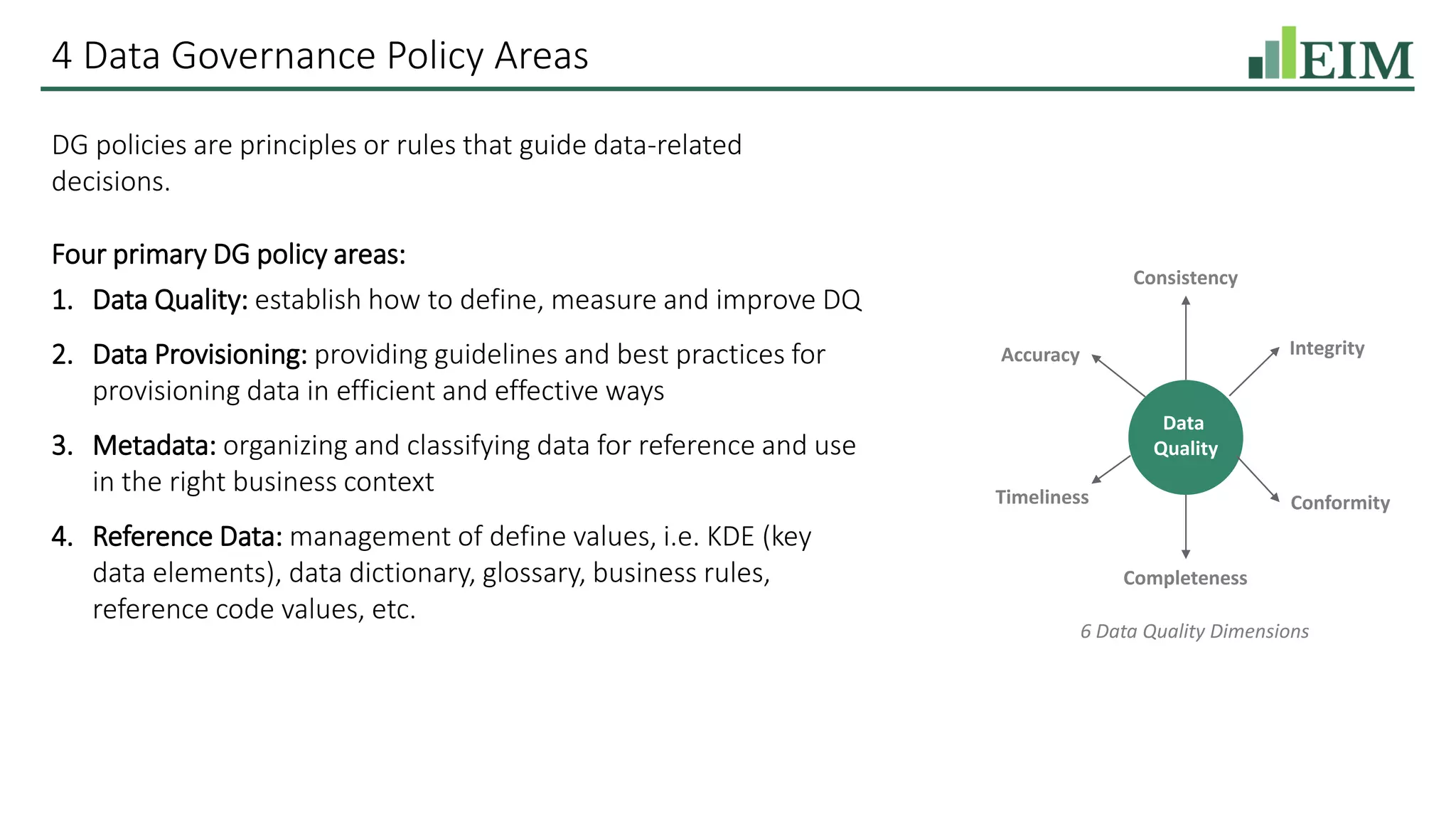
Four primary DG policy areas:
1. Data Quality: establish how to define, measure and improve DQ
2. Data Provisioning: providing guidelines and best practices for
provisioning data in efficient and effective ways
3. Metadata: organizing and classifying data for reference and use
in the right business context
4. Reference Data: management of define values, i.e. KDE (key
data elements), data dictionary, glossary, business rules,
reference code values, etc.
Data
Quality
Completeness
Consistency
Conformity
Accuracy Integrity
Timeliness
6 Data Quality Dimensions
11.
3 Challenges toImplementing Data Governance
Organization Fit – the strategy and approach are not clearly defined and do not take into
account resource involvement and their level of understanding
Ignored Efforts – lack of stakeholder buy-in and cross-functional collaboration leading to
independent workarounds by departments looking for quick solutions to their problems
Lack of Perceived Value – the value of data governance is often not as explicit as in other
projects. Internal bureaucracies and seemingly intrusive efforts of the DG program can
impede progress and muddy value
12.
Data Governance SuccessFactors
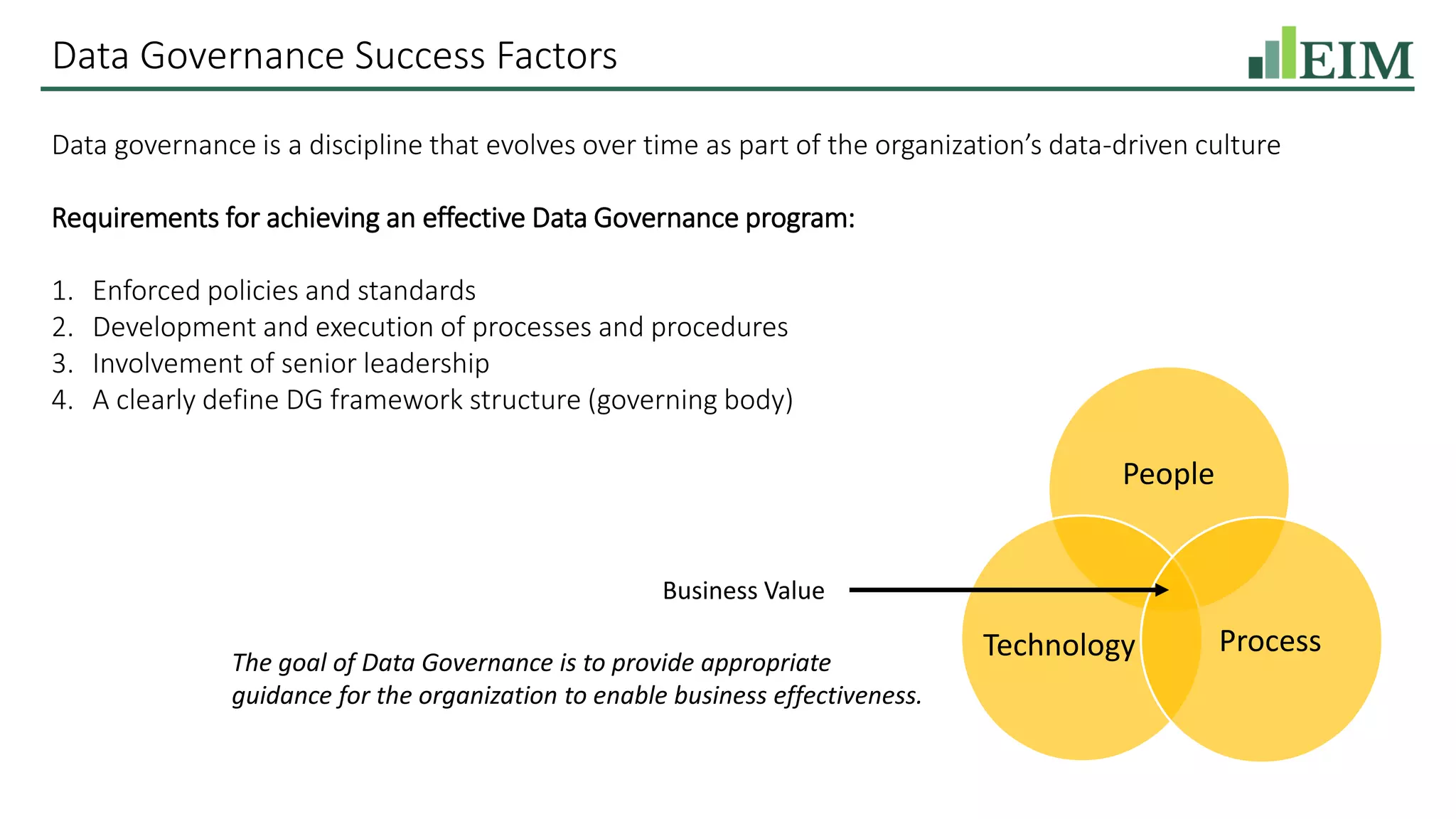
Data governance is a discipline that evolves over time as part of the organization’s data-driven culture
Requirements for achieving an effective Data Governance program:
1. Enforced policies and standards
2. Development and execution of processes and procedures
3. Involvement of senior leadership
4. A clearly define DG framework structure (governing body)
Business Value
The goal of Data Governance is to provide appropriate
guidance for the organization to enable business effectiveness.
People
ProcessTechnology



![[DSC Europe 25] Vid Stimac - Policy Parsimony: Between Oversimplifying and Ov...](https://cdn.slidesharecdn.com/ss_thumbnails/eqlepagzqp2rhg3gbluh-dsc-stimac-251120-251205090438-059e7f54-thumbnail.jpg?width=640&height=640&fit=bounds)
![[DSC Europe 25] Vladimir Jelic - The AI-Driven Security Shift From Reactive D...](https://cdn.slidesharecdn.com/ss_thumbnails/6g5gj25mtjwayniqem1t-6-251209104645-7a5a5fc6-thumbnail.jpg?width=640&height=640&fit=bounds)
![[DSC Europe 25] Dragan Vucic - Building the Learning Organization - How AI Tr...](https://cdn.slidesharecdn.com/ss_thumbnails/8brigo2sbu6qur6gxrra-7-251205085715-6ae07d24-thumbnail.jpg?width=640&height=640&fit=bounds)
![[DSC Europe 25] Katherine Forrest - AI NOW: Understanding the Velocity of Cha...](https://cdn.slidesharecdn.com/ss_thumbnails/wvvbruqfrci0sfq9xwgb-4-251212104007-e5ad1987-thumbnail.jpg?width=640&height=640&fit=bounds)
![[DSC Europe 25] Jovan Bogicevic - Legacy to AI-Driven Defense: Transforming D...](https://cdn.slidesharecdn.com/ss_thumbnails/rsarluadt563hntyfc8q-3-251211083849-3e7bc4c0-thumbnail.jpg?width=640&height=640&fit=bounds)
![[DSC Europe 25] Bassam Maharmeh - Artificial Intelligence: Opportunities and ...](https://cdn.slidesharecdn.com/ss_thumbnails/thhfmr2fqpawzj7hsjpg-5-251211083048-2c23204f-thumbnail.jpg?width=640&height=640&fit=bounds)


![[DSC Europe 25] Branko Dzakula - From Defense to Attack: How AI Redefines Cyb...](https://cdn.slidesharecdn.com/ss_thumbnails/80bdzdxpr3ky2g0qvyk9-8-251211083048-ce5fc1ee-thumbnail.jpg?width=640&height=640&fit=bounds)
![[DSC Europe 25] Dusan Nesic - Securing Tomorrow’s Infrastructure: Why Cyber-P...](https://cdn.slidesharecdn.com/ss_thumbnails/qikbszfftyowjm2q6duw-1-251211083848-8f2ead6b-thumbnail.jpg?width=640&height=640&fit=bounds)

![[DSC Europe 25] Milan Zdravkovic - The road less traveled in District Heating...](https://cdn.slidesharecdn.com/ss_thumbnails/nfaboniqwsz4ucyctnmy-2-milan-zdravkovic-dsc2025-the-road-less-traveled-in-district-heating-operation-251208151905-f56388a5-thumbnail.jpg?width=640&height=640&fit=bounds)

![[DSC Europe 25] Goran Obradovic - The Rise of Sovereign AI: Building the Regi...](https://cdn.slidesharecdn.com/ss_thumbnails/7nw2xxixrxqdxvrb5wca-6-251205085714-ab09a2ac-thumbnail.jpg?width=640&height=640&fit=bounds)
![[DSC Europe 25] Sara Polak - The Ancient Operating System: What Archaeology T...](https://cdn.slidesharecdn.com/ss_thumbnails/3vch2p6tttdnwhsgazoz-3-sara-polak-smart-cities-251208152532-64404202-thumbnail.jpg?width=640&height=640&fit=bounds)

![[DSC Europe 25] Max Talanov - Non digital NNs.pptx](https://cdn.slidesharecdn.com/ss_thumbnails/wif8tr3gtua74qvtopke-non-digital-nns-251205090438-26b0eea6-thumbnail.jpg?width=640&height=640&fit=bounds)