DATA VIRTUALIZATION PACKED LUNCH
WEBINAR SERIES
Sessions Covering Key Data Integration Challenges
Solved with Data Virtualization
Data Virtualization: An Introduction
Michael Dickson
Senior Sales Engineer, Denodo
Paul Moxon
VP Data Architectures & Chief Evangelist, Denodo
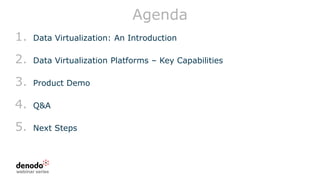
Agenda
1. Data Virtualization: An Introduction
2. Data Virtualization Platforms – Key Capabilities
3. Product Demo
4. Q&A
5. Next Steps
Data Virtualization: An Introduction
4
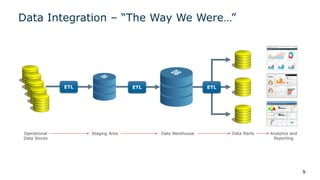
Data Integration – “The Way We Were…”
5
Operational
Data Stores
Staging Area Data Warehouse Data Marts Analytics and
Reporting
ETLETLETL
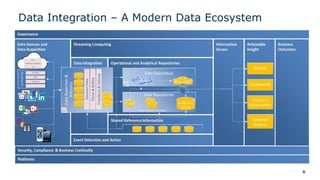
Data Integration – A Modern Data Ecosystem
6
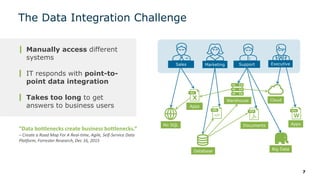
The Data Integration Challenge
7
Manually access different
systems
IT responds with point-to-
point data integration
Takes too long to get
answers to business users
MarketingSales ExecutiveSupport
Database
Apps
Warehouse Cloud
Big Data
Documents AppsNo SQL
“Data bottlenecks create business bottlenecks.”
– Create a Road Map For A Real-time, Agile, Self-Service Data
Platform, Forrester Research, Dec 16, 2015
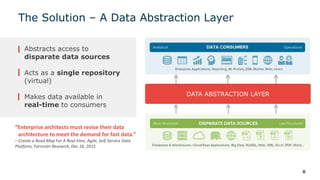
The Solution – A Data Abstraction Layer
8
Abstracts access to
disparate data sources
Acts as a single repository
(virtual)
Makes data available in
real-time to consumers
DATA ABSTRACTION LAYER
“Enterprise architects must revise their data
architecture to meet the demand for fast data.”
– Create a Road Map For A Real-time, Agile, Self-Service Data
Platform, Forrester Research, Dec 16, 2015
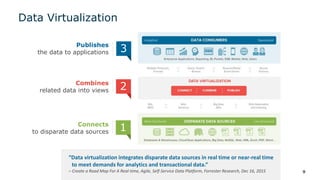
Data Virtualization
9
“Data virtualization integrates disparate data sources in real time or near-real time
to meet demands for analytics and transactional data.”
– Create a Road Map For A Real-time, Agile, Self-Service Data Platform, Forrester Research, Dec 16, 2015
Publishes
the data to applications
Combines
related data into views
Connects
to disparate data sources
2
3
1
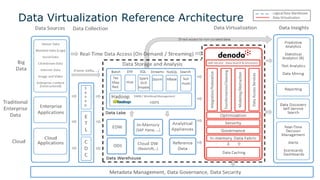
Data Virtualization Reference Architecture
10
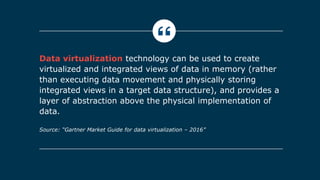
Source: “Gartner Market Guide for data virtualization – 2016”
Data virtualization technology can be used to create
virtualized and integrated views of data in memory (rather
than executing data movement and physically storing
integrated views in a target data structure), and provides a
layer of abstraction above the physical implementation of
data.
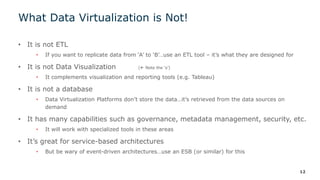
What Data Virtualization is Not!
• It is not ETL
• If you want to replicate data from ‘A’ to ‘B’…use an ETL tool – it’s what they are designed for
• It is not Data Visualization ( Note the ‘s’)
• It complements visualization and reporting tools (e.g. Tableau)
• It is not a database
• Data Virtualization Platforms don’t store the data…it’s retrieved from the data sources on
demand
• It has many capabilities such as governance, metadata management, security, etc.
• It will work with specialized tools in these areas
• It’s great for service-based architectures
• But be wary of event-driven architectures…use an ESB (or similar) for this
12
13
Data Virtualization Platforms –
Key Capabilities
14
15
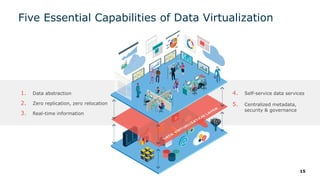
Five Essential Capabilities of Data Virtualization
4. Self-service data services
5. Centralized metadata,
security & governance
1. Data abstraction
2. Zero replication, zero relocation
3. Real-time information
16
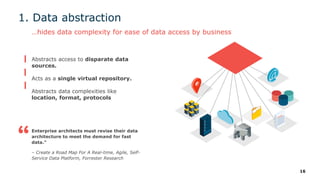
1. Data abstraction
Abstracts access to disparate data
sources.
Acts as a single virtual repository.
Abstracts data complexities like
location, format, protocols
…hides data complexity for ease of data access by business
Enterprise architects must revise their data
architecture to meet the demand for fast
data.”
– Create a Road Map For A Real-time, Agile, Self-
Service Data Platform, Forrester Research
17
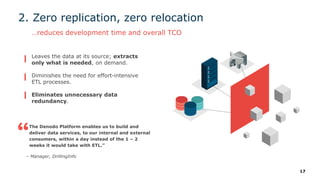
2. Zero replication, zero relocation
…reduces development time and overall TCO
The Denodo Platform enables us to build and
deliver data services, to our internal and external
consumers, within a day instead of the 1 – 2
weeks it would take with ETL.”
– Manager, DrillingInfo
Leaves the data at its source; extracts
only what is needed, on demand.
Diminishes the need for effort-intensive
ETL processes.
Eliminates unnecessary data
redundancy.
18
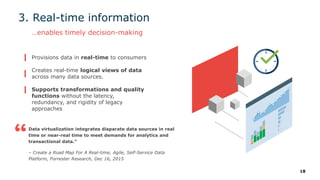
3. Real-time information
Provisions data in real-time to consumers
Creates real-time logical views of data
across many data sources.
Supports transformations and quality
functions without the latency,
redundancy, and rigidity of legacy
approaches
…enables timely decision-making
Data virtualization integrates disparate data sources in real
time or near-real time to meet demands for analytics and
transactional data.”
– Create a Road Map For A Real-time, Agile, Self-Service Data
Platform, Forrester Research, Dec 16, 2015
19
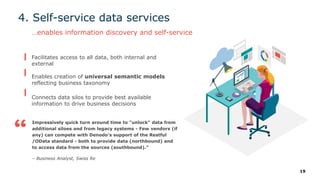
4. Self-service data services
Facilitates access to all data, both internal and
external
Enables creation of universal semantic models
reflecting business taxonomy
Connects data silos to provide best available
information to drive business decisions
…enables information discovery and self-service
Impressively quick turn around time to "unlock“ data from
additional siloes and from legacy systems - Few vendors (if
any) can compete with Denodo's support of the Restful
/OData standard - both to provide data (northbound) and
to access data from the sources (southbound).”
– Business Analyst, Swiss Re
20
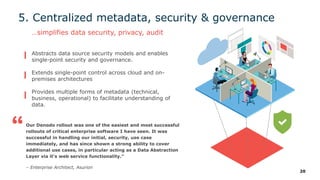
5. Centralized metadata, security & governance
Abstracts data source security models and enables
single-point security and governance.
Extends single-point control across cloud and on-
premises architectures
Provides multiple forms of metadata (technical,
business, operational) to facilitate understanding of
data.
…simplifies data security, privacy, audit
Our Denodo rollout was one of the easiest and most successful
rollouts of critical enterprise software I have seen. It was
successful in handling our initial, security, use case
immediately, and has since shown a strong ability to cover
additional use cases, in particular acting as a Data Abstraction
Layer via it's web service functionality.”
– Enterprise Architect, Asurion
21
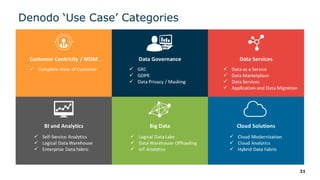
Denodo ‘Use Case’ Categories
Product Demonstration
Data Virtualization – An Introduction
22
Sales Engineer, Denodo
Ed Robbins
23
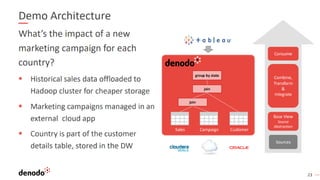
Client Address Client
Type
Company Invoicing Service
Usage
Product Logs Web
Incidents
Invoice Product Service Usage
Demo
24
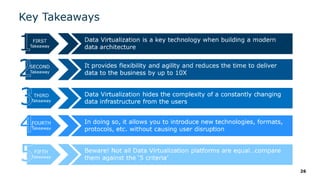
Key Takeaways
25
26
Q&A
28
Next Steps
Access Denodo Platform in the Cloud!
Take a Test Drive today!
https://bit.ly/2AouQLQ
GET STARTED TODAY
Thank you!
© Copyright Denodo Technologies. All rights reserved
Unless otherwise specified, no part of this PDF file may be reproduced or utilized in any for or by any means, electronic or mechanical, including photocopying and
microfilm, without prior the written authorization from Denodo Technologies.

Data virtualization an introduction

  • 1.
    DATA VIRTUALIZATION PACKEDLUNCH WEBINAR SERIES Sessions Covering Key Data Integration Challenges Solved with Data Virtualization
  • 2.
    Data Virtualization: AnIntroduction Michael Dickson Senior Sales Engineer, Denodo Paul Moxon VP Data Architectures & Chief Evangelist, Denodo
  • 3.
    Agenda 1. Data Virtualization:An Introduction 2. Data Virtualization Platforms – Key Capabilities 3. Product Demo 4. Q&A 5. Next Steps
  • 4.
  • 5.
    Data Integration –“The Way We Were…” 5 Operational Data Stores Staging Area Data Warehouse Data Marts Analytics and Reporting ETLETLETL
  • 6.
    Data Integration –A Modern Data Ecosystem 6
  • 7.
    The Data IntegrationChallenge 7 Manually access different systems IT responds with point-to- point data integration Takes too long to get answers to business users MarketingSales ExecutiveSupport Database Apps Warehouse Cloud Big Data Documents AppsNo SQL “Data bottlenecks create business bottlenecks.” – Create a Road Map For A Real-time, Agile, Self-Service Data Platform, Forrester Research, Dec 16, 2015
  • 8.
    The Solution –A Data Abstraction Layer 8 Abstracts access to disparate data sources Acts as a single repository (virtual) Makes data available in real-time to consumers DATA ABSTRACTION LAYER “Enterprise architects must revise their data architecture to meet the demand for fast data.” – Create a Road Map For A Real-time, Agile, Self-Service Data Platform, Forrester Research, Dec 16, 2015
  • 9.
    Data Virtualization 9 “Data virtualizationintegrates disparate data sources in real time or near-real time to meet demands for analytics and transactional data.” – Create a Road Map For A Real-time, Agile, Self-Service Data Platform, Forrester Research, Dec 16, 2015 Publishes the data to applications Combines related data into views Connects to disparate data sources 2 3 1
  • 10.
  • 11.
    Source: “Gartner MarketGuide for data virtualization – 2016” Data virtualization technology can be used to create virtualized and integrated views of data in memory (rather than executing data movement and physically storing integrated views in a target data structure), and provides a layer of abstraction above the physical implementation of data.
  • 12.
    What Data Virtualizationis Not! • It is not ETL • If you want to replicate data from ‘A’ to ‘B’…use an ETL tool – it’s what they are designed for • It is not Data Visualization ( Note the ‘s’) • It complements visualization and reporting tools (e.g. Tableau) • It is not a database • Data Virtualization Platforms don’t store the data…it’s retrieved from the data sources on demand • It has many capabilities such as governance, metadata management, security, etc. • It will work with specialized tools in these areas • It’s great for service-based architectures • But be wary of event-driven architectures…use an ESB (or similar) for this 12
  • 13.
  • 14.
    Data Virtualization Platforms– Key Capabilities 14
  • 15.
    15 Five Essential Capabilitiesof Data Virtualization 4. Self-service data services 5. Centralized metadata, security & governance 1. Data abstraction 2. Zero replication, zero relocation 3. Real-time information
  • 16.
    16 1. Data abstraction Abstractsaccess to disparate data sources. Acts as a single virtual repository. Abstracts data complexities like location, format, protocols …hides data complexity for ease of data access by business Enterprise architects must revise their data architecture to meet the demand for fast data.” – Create a Road Map For A Real-time, Agile, Self- Service Data Platform, Forrester Research
  • 17.
    17 2. Zero replication,zero relocation …reduces development time and overall TCO The Denodo Platform enables us to build and deliver data services, to our internal and external consumers, within a day instead of the 1 – 2 weeks it would take with ETL.” – Manager, DrillingInfo Leaves the data at its source; extracts only what is needed, on demand. Diminishes the need for effort-intensive ETL processes. Eliminates unnecessary data redundancy.
  • 18.
    18 3. Real-time information Provisionsdata in real-time to consumers Creates real-time logical views of data across many data sources. Supports transformations and quality functions without the latency, redundancy, and rigidity of legacy approaches …enables timely decision-making Data virtualization integrates disparate data sources in real time or near-real time to meet demands for analytics and transactional data.” – Create a Road Map For A Real-time, Agile, Self-Service Data Platform, Forrester Research, Dec 16, 2015
  • 19.
    19 4. Self-service dataservices Facilitates access to all data, both internal and external Enables creation of universal semantic models reflecting business taxonomy Connects data silos to provide best available information to drive business decisions …enables information discovery and self-service Impressively quick turn around time to "unlock“ data from additional siloes and from legacy systems - Few vendors (if any) can compete with Denodo's support of the Restful /OData standard - both to provide data (northbound) and to access data from the sources (southbound).” – Business Analyst, Swiss Re
  • 20.
    20 5. Centralized metadata,security & governance Abstracts data source security models and enables single-point security and governance. Extends single-point control across cloud and on- premises architectures Provides multiple forms of metadata (technical, business, operational) to facilitate understanding of data. …simplifies data security, privacy, audit Our Denodo rollout was one of the easiest and most successful rollouts of critical enterprise software I have seen. It was successful in handling our initial, security, use case immediately, and has since shown a strong ability to cover additional use cases, in particular acting as a Data Abstraction Layer via it's web service functionality.” – Enterprise Architect, Asurion
  • 21.
  • 22.
    Product Demonstration Data Virtualization– An Introduction 22 Sales Engineer, Denodo Ed Robbins
  • 23.
    23 Client Address Client Type CompanyInvoicing Service Usage Product Logs Web Incidents Invoice Product Service Usage
  • 24.
  • 25.
  • 26.
  • 27.
  • 28.
    28 Next Steps Access DenodoPlatform in the Cloud! Take a Test Drive today! https://bit.ly/2AouQLQ GET STARTED TODAY
  • 29.
    Thank you! © CopyrightDenodo Technologies. All rights reserved Unless otherwise specified, no part of this PDF file may be reproduced or utilized in any for or by any means, electronic or mechanical, including photocopying and microfilm, without prior the written authorization from Denodo Technologies.