Introduction to Mode S
Secondary Surveillance Radar System
CHEN Yang (Isaac)
CAAC ATMB
isaac21@qq.com
2
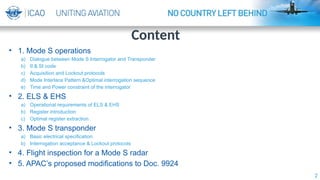
• 1. Mode S operations
a) Dialogue between Mode S Interrogator and Transponder
b) II & SI code
c) Acquisition and Lockout protocols
d) Mode Interlace Pattern &Optimal interrogation sequence
e) Time and Power constraint of the interrogator
• 2. ELS & EHS
a) Operational requirements of ELS & EHS
b) Register introduction
c) Optimal register extraction
• 3. Mode S transponder
a) Basic electrical specification
b) Interrogation acceptance & Lockout protocols
• 4. Flight inspection for a Mode S radar
• 5. APAC’s proposed modifications to Doc. 9924
Content
Mode S operations
4
Mode S operations-- Dialogue between Mode S Interrogator and Transponder
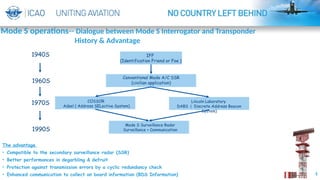
History & Advantage
The advantage
• Compatible to the secondary surveillance radar (SSR)
• Better performances in degarbling & defruit
• Protection against transmission errors by a cyclic redundancy check
• Enhanced communication to collect on board information (BDS Information)
IFF
(Identification Friend or Foe )
Conventional Mode A/C SSR
(civilian application)
COSSOR
Adsel ( Address SELective System)
Lincoln Laboratory
DABS ( Discrete Address Beacon
System)
Mode S Surveillance Radar
Surveillance + Communication
1940S
1960S
1970S
1990S
5
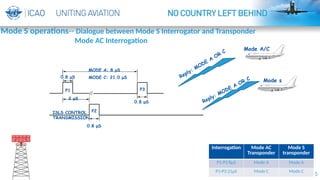
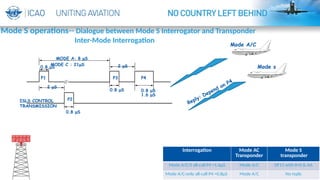
P2
P1 P3
2 μS
MODE A: 8 μS
MODE C: 21.0 μS
0.8 μS
0.8 μS
0.8 μS
ISLS CONTROL
TRANSMISSION
Mode s
Reply: MODE A
OR C
Reply: MODE
A
OR
C
Mode A/C
Interrogation Mode AC
Transponder
Mode S
transponder
P1-P3 8μS Mode A Mode A
P1-P3 21μS Mode C Mode C
Mode S operations-- Dialogue between Mode S Interrogator and Transponder
Mode AC Interrogation
6
Mode s
Reply: Depend on P4
Mode A/C
0.8 μS
P2
0.8 μS
0.8 μS
P1 P3 P4
0.8 μS
1.6 μS
2 μS
2 μS
MODE A: 8 μS
MODE C : 21μS
ISLS CONTROL
TRANSMISSION
Interrogation Mode AC
Transponder
Mode S
transponder
Mode A/C/S all-call P4 =1.6μS Mode A/C DF11 with II=0 & AA
Mode A/C-only all-call P4 =0.8μS Mode A/C No reply
Mode S operations-- Dialogue between Mode S Interrogator and Transponder
Inter-Mode Interrogation
7
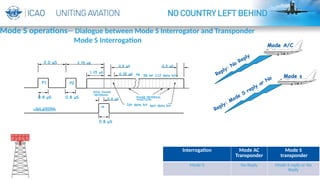
Mode s
Reply: Mode S
reply or No
Reply: No Reply
Mode A/C
Interrogation Mode AC
Transponder
Mode S
transponder
Mode S No Reply Mode S reply or No
Reply
0.4 μS
0.8 μS
P5
SLS CONTROL
TRANSMISSION
0.8 μS 0.8 μS
56 or 112 data bits
2.0 μS 2.75 μS
0.5 μS
P6
1.25 μS
0.5 μS
0.25 μS
1St data bit last data bit
P2
P1
SYNC PHASE
REVERSAL
PHASE REVERSAL
POSITION
Mode S operations-- Dialogue between Mode S Interrogator and Transponder
Mode S Interrogation
8
0.4 μS
0.8 μS
P5
SLS CONTROL
TRANSMISSION
0.8 μS 0.8 μS
56 or 112 data bits
2.0 μS 2.75 μS
0.5 μS
P6
1.25 μS
0.5 μS
0.25 μS
1
St data bit last data bit
P2
P1
SYNC PHASE
REVERSAL
PHASE REVERSAL
POSITION
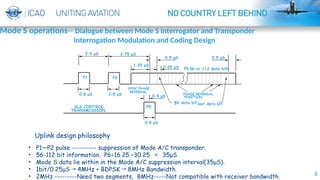
• P1—P2 pulse ---------- suppression of Mode A/C transponder.
• 56-112 bit information. P6=16.25 –30.25 < 35μS
• Mode S data lie within in the Mode A/C suppression interval(35μS).
• 1bit/0.25μS 4MHz + BDPSK 8MHz Bandwidth.
→ →
• 2MHz ---------Need two segments, 8MHz-----Not compatible with receiver bandwidth.
Uplink design philosophy
Mode S operations-- Dialogue between Mode S Interrogator and Transponder
Interrogation Modulation and Coding Design
9
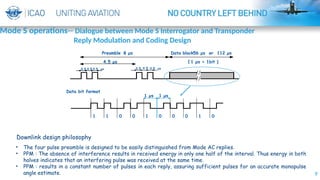
Preamble 8 µs Data block56 µs or 112 µs
4.5 µs ( 1 µs = 1bit )
Data bit format
1 1 0 0 1 0 0 0 1 0
0.5 0.5 0.5 µs 0.5 0.5 0.5 µs
1 µs 1 µs
• The four pulse preamble is designed to be easily distinguished from Mode AC replies.
• PPM : The absence of interference results in received energy in only one half of the interval. Thus energy in both
halves indicates that an interfering pulse was received at the same time.
• PPM : results in a constant number of pulses in each reply, assuring sufficient pulses for an accurate monopulse
angle estimate.
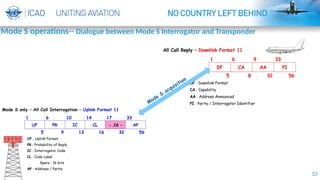
Downlink design philosophy
Mode S operations-- Dialogue between Mode S Interrogator and Transponder
Reply Modulation and Coding Design
10
Mode
S
acquisition
Mode S operations-- Dialogue between Mode S Interrogator and Transponder
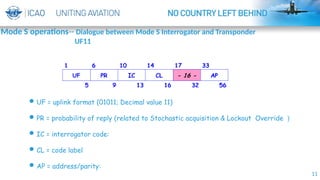
11
UF = uplink format (01011; Decimal value 11)
PR = probability of reply (related to Stochastic acquisition & Lockout Override )
IC = interrogator code:
CL = code label
AP = address/parity:
Mode S operations-- Dialogue between Mode S Interrogator and Transponder
UF11
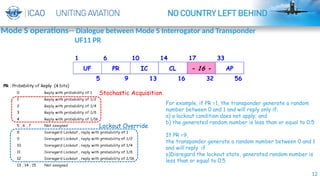
12
For example, if PR =1, the transponder generate a random
number between 0 and 1 and will reply only if:
a) a lockout condition does not apply; and
b) the generated random number is less than or equal to 0.5
If PR =9,
the transponder generate a random number between 0 and 1
and will reply if
a)Disregard the lockout state, generated random number is
less than or equal to 0.5
Stochastic Acquisition
Lockout Override
Mode S operations-- Dialogue between Mode S Interrogator and Transponder
UF11 PR
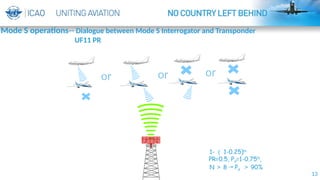
13
1- ( 1-0.25)N
PR=0.5, Pd=1-0.75N
,
N > 8 P
→ d > 90%
or or or
Mode S operations-- Dialogue between Mode S Interrogator and Transponder
UF11 PR
14
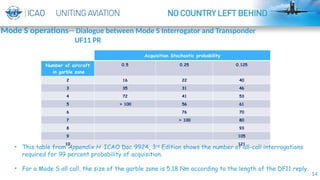
Acquisition Stochastic probability
Number of aircraft
in garble zone
0.5 0.25 0.125
2 16 22 40
3 35 31 46
4 72 41 53
5 > 100 56 61
6 76 70
7 > 100 80
8 93
9 105
10 121
• This table from Appendix H ICAO Doc 9924, 3rd
Edition shows the number of all-call interrogations
required for 99 percent probability of acquisition.
• For a Mode S all call, the size of the garble zone is 5.18 Nm according to the length of the DF11 reply.
Mode S operations-- Dialogue between Mode S Interrogator and Transponder
UF11 PR
15
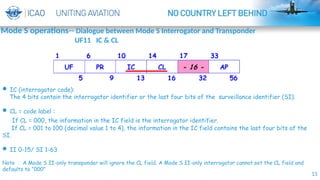
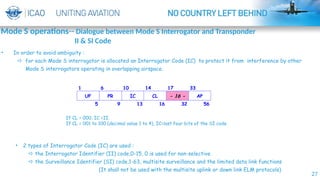
 IC (interrogator code):
The 4 bits contain the interrogator identifier or the last four bits of the surveillance identifier (SI).
 CL = code label :
If CL = 000, the information in the IC field is the interrogator identifier.
If CL = 001 to 100 (decimal value 1 to 4), the information in the IC field contains the last four bits of the
SI.
 II 0-15/ SI 1-63
Note : A Mode S II-only transponder will ignore the CL field. A Mode S II-only interrogator cannot set the CL field and
defaults to “000”
Mode S operations-- Dialogue between Mode S Interrogator and Transponder
UF11 IC & CL
16
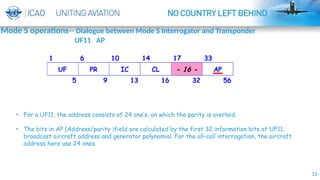
• For a UF11, the address consists of 24 one’s, on which the parity is overlaid.
• The bits in AP (Address/parity )field are calculated by the first 32 information bits of UF11,
broadcast aircraft address and generator polynomial. For the all-call interrogation, the aircraft
address here use 24 ones.
Mode S operations-- Dialogue between Mode S Interrogator and Transponder
UF11 AP
17
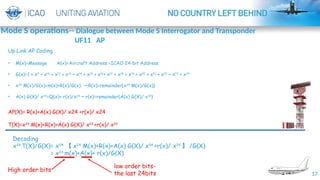
Decoding
x24
T(X)/G(X)= x24
【 x24
M(x)+R(x)+A(x) G(X)/ x24
+r(x)/ x24
】 /G(X)
= x24
m(x)+A(x)+ r(x)/G(X)
High order bits
low order bits-
the last 24bits
Up Link AP Coding
• M(x)=Message A(x)=Aircraft Address =ICAO 24-bit Address
• G(x)=1 + x3
+ x10
+ x12
+ x13
+ x14
+ x15
+ x16
+ x17
+ x18
+ x19
+ x20
+ x21
+ x22
+ x23
+ x24
• x24
M(x)/G(x)=m(x)+R(x)/G(x) R(x)=remainder{x
→ 24
M(x)/G(x)}
• A(x) G(X)/ x24
=Q(x)+ r(x)/x24
r(x)=remainder{
→ A(x) G(X)/ x24
}
AP(X)= R(x)+A(x) G(X)/ x24 +r(x)/ x24
T(X)=x24
M(x)+R(x)+A(x) G(X)/ x24
+r(x)/ x24
Mode S operations-- Dialogue between Mode S Interrogator and Transponder
UF11 AP
18
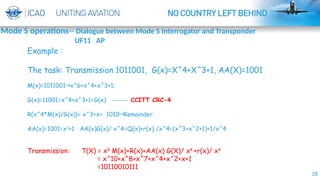
Example :
The task: Transmission 1011001, G(x)=X^4+X^3+1, AA(X)=1001
M(x)=1011001 x^6+x^4+x^3+1;
→
G(x)=11001=x^4+x^3+1=G(x) ------- CCITT CRC-4
R{x^4*M(x)/G(x)}= x^3+x= 1010 Remainder
→
AA(x)=1001=x3
+1 AA(x)G(x)/ x^4=Q(x)+r(x) /x^4=(x^3+x^2+1)+1/x^4
Transmission: T(X) = x4
M(x)+R(x)+AA(x) G(X)/ x4
+r(x)/ x4
= x^10+x^8+x^7+x^4+x^2+x+1
=10110010111
Mode S operations-- Dialogue between Mode S Interrogator and Transponder
UF11 AP
19
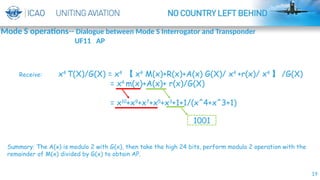
Receive: x4
T(X)/G(X) = x4
【 x4
M(x)+R(x)+A(x) G(X)/ x4
+r(x)/ x4
】 /G(X)
= x4
m(x)+A(x)+ r(x)/G(X)
= x10
+x9
+x7
+x5
+x3
+1+1/(x^4+x^3+1)
1001
Summary: The A(x) is modulo 2 with G(x), then take the high 24 bits, perform modulo 2 operation with the
remainder of M(x) divided by G(x) to obtain AP.
Mode S operations-- Dialogue between Mode S Interrogator and Transponder
UF11 AP
20
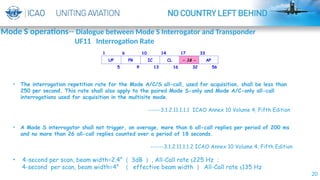
• The interrogation repetition rate for the Mode A/C/S all-call, used for acquisition, shall be less than
250 per second. This rate shall also apply to the paired Mode S-only and Mode A/C-only all-call
interrogations used for acquisition in the multisite mode.
------3.1.2.11.1.1.1 ICAO Annex 10 Volume 4, Fifth Edition
• A Mode S interrogator shall not trigger, on average, more than 6 all-call replies per period of 200 ms
and no more than 26 all-call replies counted over a period of 18 seconds.
------3.1.2.11.1.1.2 ICAO Annex 10 Volume 4, Fifth Edition
• 4-second per scan, beam width=2.4° ( 3dB ) , All-Call rate ≤225 Hz ;
4-second per scan, beam width=4° ( effective beam width ) All-Call rate ≤135 Hz
Mode S operations-- Dialogue between Mode S Interrogator and Transponder
UF11 Interrogation Rate
21
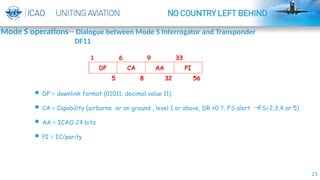
 DF = downlink format (01011; decimal value 11)
 CA = Capability (airborne or on ground , level 1 or above, DR ≠0 ?, FS alert FS=2,3,4 or 5)
→
 AA = ICAO 24 bits
 PI = IC/parity
Mode S operations-- Dialogue between Mode S Interrogator and Transponder
DF11
22
 PI =17 zero + CL (3 bits ) + IC ( 4 bits ) =PI ( x )
Transponder --- Transmission: T(x)=x^24 M(x) + R(x)+ PI(x)
Radar---Reception : [x^24 M(x) + R(x)+ PI(x)]/G(x) = Q(x) + 0+ [PI(x)/G(x)]
The remainder = PI(x)
Mode S operations-- Dialogue between Mode S Interrogator and Transponder
DF11
23
R
R
=
0
-
1
5
R
R
=
1
6
-
3
1
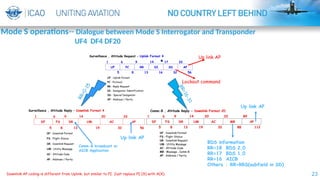
Lockout command
BDS information
RR=18 BDS 2,0
RR=17 BDS 1,0
RR=16 AICB
Others : RR+RRS(subfield in SD)
Downlink AP coding is different from Uplink, but similar to PI. Just replace PI (X) with A(X).
Up link AP
Up link AP
Up link AP
Comm-B broadcast or
AICB Application
Mode S operations-- Dialogue between Mode S Interrogator and Transponder
UF4 DF4 DF20
24
Mode S operations-- Dialogue between Mode S Interrogator and Transponder
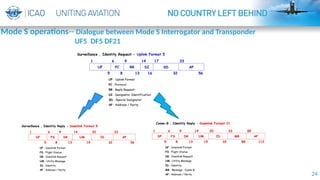
UF5 DF5 DF21
25
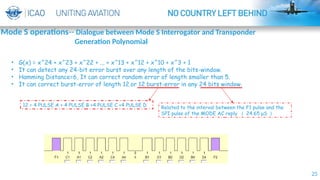
• G(x) = x^24 + x^23 + x^22 + ... + x^13 + x^12 + x^10 + x^3 + 1
• It can detect any 24-bit error burst over any length of the bits-window.
• Hamming Distance=6, It can correct random error of length smaller than 5.
• It can correct burst-error of length 12.or 12 burst-error in any 24 bits window.
Related to the interval between the F1 pulse and the
SPI pulse of the MODE AC reply ( 24.65 μS )
12 = 4 PULSE A + 4 PULSE B +4 PULSE C +4 PULSE D
Mode S operations-- Dialogue between Mode S Interrogator and Transponder
Generation Polynomial
26
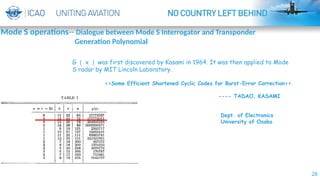
G ( x ) was first discovered by Kasami in 1964. It was then applied to Mode
S radar by MIT Lincoln Laboratory.
<<Some Efficient Shortened Cyclic Codes for Burst-Error Correction>>
---- TADAO. KASAMI
Dept. of Electronics
University of Osaka
Mode S operations-- Dialogue between Mode S Interrogator and Transponder
Generation Polynomial
27
If CL = 000, IC =II.
If CL = 001 to 100 (decimal value 1 to 4), IC=last four bits of the SI code
• 2 types of Interrogator Code (IC) are used :
 the Interrogator Identifier (II) code,0-15, 0 is used for non-selective
 the Surveillance Identifier (SI) code,1-63, multisite surveillance and the limited data link functions
(It shall not be used with the multisite uplink or down link ELM protocols)
• In order to avoid ambiguity :
 for each Mode S interrogator is allocated an Interrogator Code (IC) to protect it from interference by other
Mode S interrogators operating in overlapping airspace.
Mode S operations-- Dialogue between Mode S Interrogator and Transponder
II & SI Code
28
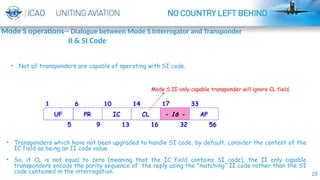
• Not all transponders are capable of operating with SI code.
• Transponders which have not been upgraded to handle SI code, by default, consider the content of the
IC field as being an II code value.
• So, if CL is not equal to zero (meaning that the IC field contains SI code), the II only capable
transponders encode the parity sequence of the reply using the "matching“ II code rather than the SI
code contained in the interrogation.
Mode S II-only capable transponder will ignore CL field.
Mode S operations-- Dialogue between Mode S Interrogator and Transponder
II & SI Code
29
 The interrogator operation with SI code, which will receive Mode S-only all-call replies encoded with the “matching” II code
will normally reject these replies. The consequence is that Mode S II-only transponders which have not been upgraded to
handle SI codes will not be detected by the interrogator operating with an SI code.
 The Mode S II/SI capable interrogator that supports the use of II/SI code operation, if operating with an II code, must be
configurable by the user to either:
a) not lockout Mode S transponders that do not report the SI capability in Register 10 or cannot report Register 10
b) use intermittent lockout for transponders that do not report the SI capability in Register 10 or cannot report Register 10
 The Mode II/SI capable interrogator that supports the use of II/SI code operation, if operating with an SI code, must be
configurable by the user to either:
a) acquisition the transponder on “matching” II code ;
b) not lockout non-SI capable transponders on the "matching" II code; or
c)use intermittent lockout for this "matching" II code.
Mode S operations-- II & SI Code
30
Allocation principle
The IC has to be unique :
 It cannot be used in a coverage overlapping with other (non-connected) interrogators using that same II or SI code.
 The II only interrogator can not have overlapping coverage with the interrogator with it’s matching SI code.
Mode S operations-- II & SI Code
31
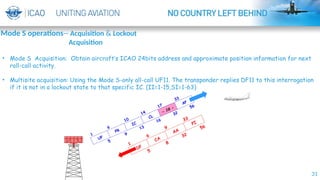
• Mode S Acquisition: Obtain aircraft’s ICAO 24bits address and approximate position information for next
roll-call activity.
• Multisite acquisition: Using the Mode S-only all-call UF11. The transponder replies DF11 to this interrogation
if it is not in a lockout state to that specific IC. (II=1-15,SI=1-63)
Mode S operations-- Acquisition & Lockout
Acquisition
32
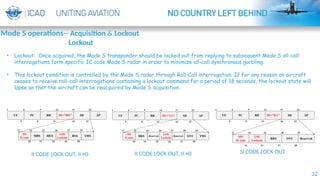
• Lockout: Once acquired, the Mode S transponder should be locked out from replying to subsequent Mode S all-call
interrogations form specific IC code Mode S radar in order to minimize all-call synchronous garbling.
• This lockout condition is controlled by the Mode S radar through Roll-Call interrogation. If for any reason an aircraft
ceases to receive roll-call interrogations containing a lockout command for a period of 18 seconds, the lockout state will
lapse so that the aircraft can be reacquired by Mode S acquisition.
UF PC RR DI="001" SD AP
1 6 9 14 17 33
5 8 13 16 32
IIS
II code
MBS MES
LOS
Lockout
RSS TMS
17 21 23 26 27 29
20 22 25 26 28
UF PC RR DI="111" SD AP
1 6 9 14 17 33
5 8 13 16 32
IIS
II code
RRS Reserved
LOS
Lockout
Reserved OVC TMS
17 21 25 26 27 28 29
20 24 25 26 27 28
UF PC RR DI="011" SD AP
1 6 9 14 17 33
5 8 13 16 32
SIS
SI code
LSS
Lockout
RRS OVC Reserved
17 23 24 28 29
22 23 27 28
II CODE LOCK OUT, II ≠0 II CODE LOCK OUT, II ≠0 SI CODE LOCK OUT
Mode S operations-- Acquisition & Lockout
Lockout
33
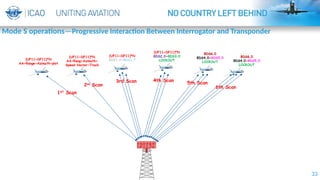
Mode S operations—Progressive Interaction Between Interrogator and Transponder
(UF11+DF11)*N
AA+Range+Azimuth=plot
(UF11+DF11)*N
AA+Rang+Azimuth+
Speed Vector=Track
(UF11+DF11)*N
BDS1,0+BDS1,7
(UF11+DF11)*N
BDS2,0+BDS3,0
LOCKOUT
BDS6,0
BDS4,0+BDS5,0
LOCKOUT
BDS6,0
BDS4,0+BDS5,0
LOCKOUT
By-ISAAC
1ST
Scan
2nd
Scan
3rd Scan 4th Scan
5th Scan
6th Scan
34
P1P2 Phase reversal
M
ode S All Cal l
4. 75μ S
128μ S
Staggeri ng
M
ode AC O
nl y Al l Call
Up to 256N
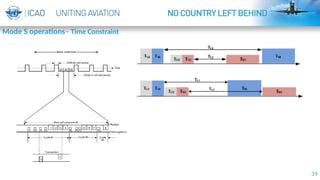
m= 3161 μ S
P1 P3 P4
Al l -Cal l
Peri od
Al l -Cal l
Peri od
Rol l - Cal l Peri od Rol l - Cal l Peri od
Al l - Cal l
Peri od
Ti m
e
Up to 256N
m
RC1 RC2 RC3 RC4
Repl y to RC4
M
ode S Rol l Cal l Li steni ng W
i ndow
Sel ecti ve Interrogation Repl y to RC2 Repl y to RC1
Repl y to RC3
M
ode S Al l Cal l Li steni ng W
i ndow
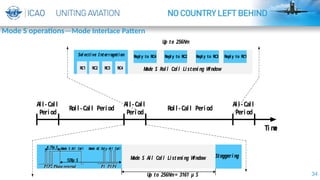
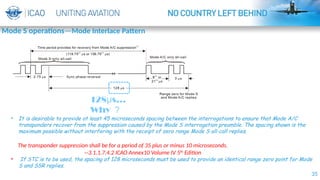
Mode S operations—Mode Interlace Pattern
35
128 s…
μ
Why ?
• It is desirable to provide at least 45 microseconds spacing between the interrogations to ensure that Mode A/C
transponders recover from the suppression caused by the Mode S interrogation preamble. The spacing shown is the
maximum possible without interfering with the receipt of zero range Mode S all-call replies.
The transponder suppression shall be for a period of 35 plus or minus 10 microseconds.
--3.1.1.7.4.2 ICAO Annex10 Volume IV 5th
Edition
• If STC is to be used, the spacing of 128 microseconds must be used to provide an identical range zero point for Mode
S and SSR replies.
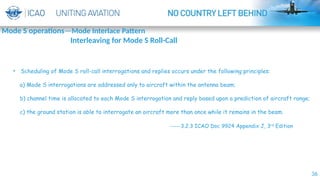
Mode S operations—Mode Interlace Pattern
36
• Scheduling of Mode S roll-call interrogations and replies occurs under the following principles:
a) Mode S interrogations are addressed only to aircraft within the antenna beam;
b) channel time is allocated to each Mode S interrogation and reply based upon a prediction of aircraft range;
c) the ground station is able to interrogate an aircraft more than once while it remains in the beam.
-----3.2.3 ICAO Doc 9924 Appendix J, 3rd
Edition
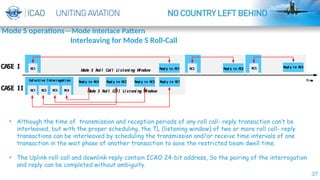
Mode S operations—Mode Interlace Pattern
Interleaving for Mode S Roll-Call
37
• Although the time of transmission and reception periods of any roll call- reply transaction can’t be
interleaved, but with the proper scheduling, the TL (listening window) of two or more roll call- reply
transactions can be interleaved by scheduling the transmission and/or receive time intervals of one
transaction in the wait phase of another transaction to save the restricted beam dwell time.
• The Uplink roll-call and downlink reply contain ICAO 24-bit address, So the pairing of the interrogation
and reply can be completed without ambiguity.
RC1 RC2 RC3 RC4
Repl y to RC4
M
ode S Rol l Cal l Li steni ng W
i ndow
Sel ecti ve Interrogati on Repl y to RC2 Repl y to RC1
Repl y to RC3
RC2 Repl y to RC2 RC3 Repl y to RC3
RC1 Repl y to RC1
M
ode S Rol l Cal l Li steni ng W
i ndow
Ti m
e
CASE I
CASE II
Mode S operations—Mode Interlace Pattern
Interleaving for Mode S Roll-Call
38
• Method for optimizing the management of radar time for secondary radars
operating in Mode S
---------Philippe Billaud
Thales patent
•A Method of Mode-S Radar Roll-Call Scheduling Management
-----IP/07 ICAO APAC DAPs
WG/3
• Task Scheduling Algorithm for an Air and Missile Defense Radar
------Hasan S. Mir and John D. Wilkinson
MIT Lincoln
Laboratory
Mode S operations-- Mode Interlace Pattern
Interleaving for Mode S Roll-Call
39
Mode S operations– Time Constraint
40
Mode S operations-- Time constraint
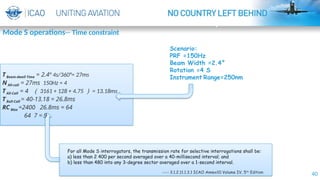
By-ISAAC
Scenario:
PRF =150Hz
Beam Width =2.4°
Rotation =4 S
Instrument Range=250nm
For all Mode S interrogators, the transmission rate for selective interrogations shall be:
a) less than 2 400 per second averaged over a 40-millisecond interval; and
b) less than 480 into any 3-degree sector averaged over a 1-second interval.
---- 3.1.2.11.1.3.1 ICAO Annex10 Volume IV, 5th
Edition
T Beam-dwell Time = 2.4° 4s/360°= 27ms
NAll-call = 27ms 150Hz ≈ 4
T All-Call = 4 ( 3161 + 128 + 4.75 ) = 13.18ms
T Roll-Call = 40-13.18 = 26.8ms
RC Max =2400 26.8ms = 64
64 7 = 9
41
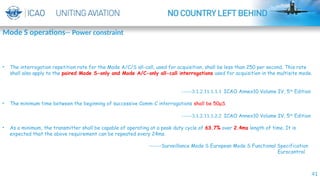
• The interrogation repetition rate for the Mode A/C/S all-call, used for acquisition, shall be less than 250 per second. This rate
shall also apply to the paired Mode S-only and Mode A/C-only all-call interrogations used for acquisition in the multisite mode.
-----3.1.2.11.1.1.1 ICAO Annex10 Volume IV, 5th
Edition
• The minimum time between the beginning of successive Comm-C interrogations shall be 50μS.
-----3.1.2.11.1.2.2 ICAO Annex10 Volume IV, 5th
Edition
• As a minimum, the transmitter shall be capable of operating at a peak duty cycle of 63.7% over 2.4ms length of time. It is
expected that the above requirement can be repeated every 24ms.
------Surveillance Mode S European Mode S Functional Specification
Eurocontrol
Mode S operations-- Power constraint
42
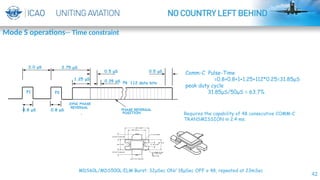
0.8 μS 0.8 μS
112 data bits
2.0 μS 2.75 μS
0.5 μS
P6
1.25 μS
0.5 μS
0.25 μS
P2
P1
SYNC PHASE
REVERSAL
PHASE REVERSAL
POSITION
Comm-C Pulse-Time
=0.8+0.8+1+1.25+112*0.25=31.85μS
peak duty cycle
31.85μS/50μS = 63.7%
Requires the capability of 48 consecutive COMM-C
TRANSMISSION in 2.4 ms.
MDS60L/MDS500L:ELM Burst: 32µSec ON/ 18µSec OFF x 48, repeated at 23mSec
Mode S operations-- Time constraint
ELS and EHS
44
ELS & EHS-- Operational requirements
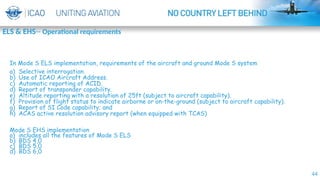
In Mode S ELS implementation, requirements of the aircraft and ground Mode S system
a) Selective interrogation.
b) Use of ICAO Aircraft Address.
c) Automatic reporting of ACID.
d) Report of transponder capability.
e) Altitude reporting with a resolution of 25ft (subject to aircraft capability).
f) Provision of flight status to indicate airborne or on-the-ground (subject to aircraft capability).
g) Report of SI Code capability; and
h) ACAS active resolution advisory report (when equipped with TCAS)
Mode S EHS implementation
a) includes all the features of Mode S ELS
b) BDS 4,0
c) BDS 5,0
d) BDS 6,0
45
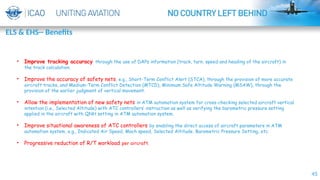
ELS & EHS-- Benefits
• Improve tracking accuracy through the use of DAPs information (track, turn, speed and heading of the aircraft) in
the track calculation.
• Improve the accuracy of safety nets, e.g., Short-Term Conflict Alert (STCA), through the provision of more accurate
aircraft tracks, and Medium-Term Conflict Detection (MTCD), Minimum Safe Altitude Warning (MSAW), through the
provision of the earlier judgment of vertical movement.
• Allow the implementation of new safety nets in ATM automation system for cross-checking selected aircraft vertical
intention (i.e., Selected Altitude) with ATC controllers’ instruction as well as verifying the barometric pressure setting
applied in the aircraft with QNH setting in ATM automation system.
• Improve situational awareness of ATC controllers by enabling the direct access of aircraft parameters in ATM
automation system, e.g., Indicated Air Speed, Mach speed, Selected Altitude, Barometric Pressure Setting, etc.
• Progressive reduction of R/T workload per aircraft.
46
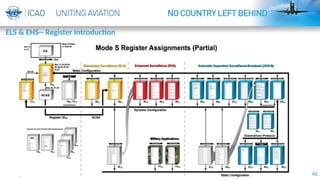
ELS & EHS-- Register Introduction
47
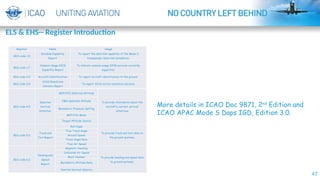
Register Name/Downlink Aircraft Parameters Usage
BDS code 4,0
Selected
Vertical
Intention
MCP/FCU Selected Altitude
To provide information about the
aircraft’s current vertical
intentions
FMS Selected Altitude
Barometric Pressure Setting
MCP/FCU Mode
Target Altitude Source
BDS code 5,0
Track and
Turn Report
Roll Angle
To provide track and turn data to
the ground systems.
True Track Angle
Ground Speed
Track Angle Rate
True Air Speed
BDS code 6,0
Heading and
Speed
Report
Magnetic Heading
To provide heading and speed data
to ground systems.
Indicated Air Speed
Mach Number
Barometric Altitude Rate
Inertial Vertical Velocity
Register Name Usage
BDS code 1,0
Datalink Capability
Report
To report the data link capability of the Mode S
transponder/data link installation.
BDS code 1,7
Common Usage GICB
Capability Report
To indicate common usage GICB services currently
supported.
BDS code 2,0 Aircraft Identification To report aircraft identification to the ground.
BDS code 3,0
ACAS Resolution
Advisory Report
To report ACAS active resolution advisory
More details in ICAO Doc 9871, 2nd
Edition and
ICAO APAC Mode S Daps IGD, Edition 3.0.
ELS & EHS-- Register Introduction
48
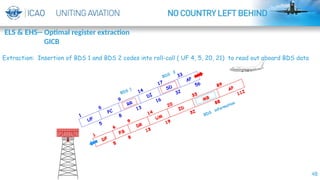
ELS & EHS-- Optimal register extraction
GICB
Extraction: Insertion of BDS 1 and BDS 2 codes into roll-call ( UF 4, 5, 20, 21) to read out aboard BDS data
BDS
information
BDS 1
BDS
2
49
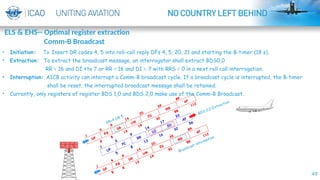
• Initiation: To Insert DR codes 4, 5 into roll-call reply DFs 4, 5, 20, 21 and starting the B-timer (18 s).
• Extraction: To extract the broadcast message, an interrogator shall extract BDS0,0
RR = 16 and DI ≠to 7 or RR = 16 and DI = 7 with RRS = 0 in a next roll call interrogation.
• Interruption: AICB activity can interrupt a Comm-B broadcast cycle. If a broadcast cycle is interrupted, the B-timer
shall be reset, the interrupted broadcast message shall be retained.
• Currently, only registers of register BDS 1,0 and BDS 2,0 make use of the Comm-B Broadcast.
DR=4 OR 5
BDS 0,0 Extraction
Broadcast information
ELS & EHS-- Optimal register extraction
Comm-B Broadcast
50
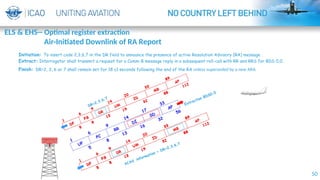
Initiation: To insert code 2,3,6,7 in the DR field to announce the presence of active Resolution Advisory (RA) message .
Extract: Interrogator shall transmit a request for a Comm-B message reply in a subsequent roll-call with RR and RRS for BDS 0,0.
Finish: DR=2, 3, 6 or 7 shall remain set for 18 ±1 seconds following the end of the RA unless superseded by a new ARA.
DR=2,3,6,7
ACAS
information + DR=2,3,6,7
Extraction BDS0,0
ELS & EHS-- Optimal register extraction
Air-Initiated Downlink of RA Report
51
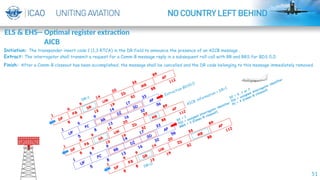
Initiation: The transponder insert code 1 (1,3 RTCA) in the DR field to announce the presence of an AICB message .
Extract: The interrogator shall transmit a request for a Comm-B message reply in a subsequent roll-call with RR and RRS for BDS 0,0.
Finish: After a Comm-B closeout has been accomplished, the message shall be cancelled and the DR code belonging to this message immediately removed.
DR=1
AICB information + DR=1
Extraction BDS0,0
DI = 1
IIS = assigned interrogator identifier
MBS = 2 (Comm-B closeout)
DI = 0, 1 or 7
IIS = assigned interrogator identifier
PC = 4 (Comm-B closeout)
DR=0
ELS & EHS-- Optimal register extraction
AICB
52
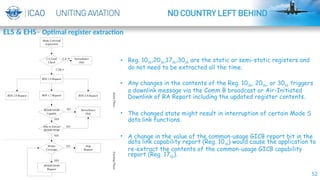
ELS & EHS– Optimal register extraction
Mode S aircraft
Acquisition
CA Field
Check
Surveillance
Only
BDS 1,0 Request
BDS 3,0 Request
BDS 2,0 Request BDS 1,7 Request
BDS40/50/60
Capable
Surveillance
Only
Able to Extract
BDS40/50/60
Within
Coverage
Stop
Request
BDS40/50/60
Request
Initial
Phase
Tracking
Phase
CA=0
CA≥ 4
NO
YES
NO
YES
YES
NO
• Reg. 1016,2016,1716,3016 are the static or semi-static registers and
do not need to be extracted all the time.
• Any changes in the contents of the Reg. 1016, 2016, or 3016 triggers
a downlink message via the Comm B broadcast or Air-Initiated
Downlink of RA Report including the updated register contents.
• The changed state might result in interruption of certain Mode S
data link functions.
• A change in the value of the common-usage GICB report bit in the
data link capability report (Reg. 1016) would cause the application to
re-extract the contents of the common-usage GICB capability
report (Reg. 1716).
Mode S Transponder
54
Mode S transponder-- Basic electrical specification
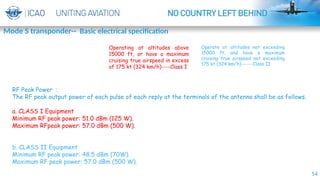
RF Peak Power :
The RF peak output power of each pulse of each reply at the terminals of the antenna shall be as follows.
a. CLASS I Equipment
Minimum RF peak power: 51.0 dBm (125 W).
Maximum RFpeak power: 57.0 dBm (500 W).
b. CLASS II Equipment
Minimum RF peak power: 48.5 dBm (70W).
Maximum RF peak power: 57.0 dBm (500 W).
Operate at altitudes not exceeding
15000 ft, and have a maximum
cruising true airspeed not exceeding
175 kt (324 km/h)------Class II
Operating at altitudes above
15000 ft, or have a maximum
cruising true airspeed in excess
of 175 kt (324 km/h)----Class I
55
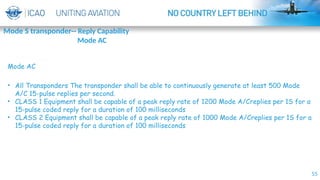
Mode S transponder-- Reply Capability
Mode AC
Mode AC
• All Transponders The transponder shall be able to continuously generate at least 500 Mode
A/C 15-pulse replies per second.
• CLASS 1 Equipment shall be capable of a peak reply rate of 1200 Mode A/Creplies per 1S for a
15-pulse coded reply for a duration of 100 milliseconds
• CLASS 2 Equipment shall be capable of a peak reply rate of 1000 Mode A/Creplies per 1S for a
15-pulse coded reply for a duration of 100 milliseconds
56
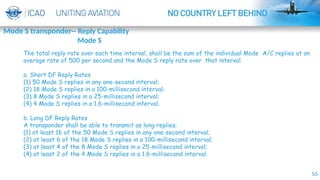
The total reply rate over each time interval, shall be the sum of the individual Mode A/C replies at an
average rate of 500 per second and the Mode S reply rate over that interval.
a. Short DF Reply Rates
(1) 50 Mode S replies in any one-second interval;
(2) 18 Mode S replies in a 100-millisecond interval;
(3) 8 Mode S replies in a 25-millisecond interval;
(4) 4 Mode S replies in a 1.6-millisecond interval.
b. Long DF Reply Rates
A transponder shall be able to transmit as long replies;
(1) at least 16 of the 50 Mode S replies in any one-second interval;
(2) at least 6 of the 18 Mode S replies in a 100-millisecond interval;
(3) at least 4 of the 8 Mode S replies in a 25-millisecond interval;
(4) at least 2 of the 4 Mode S replies in a 1.6-millisecond interval.
Mode S transponder-- Reply Capability
Mode S
57
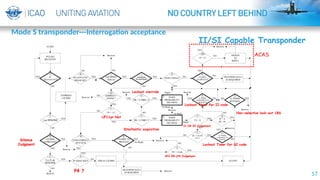
Mode S transponder---Interrogation acceptance
By-ISAAC
Silence
Judgment
Non-selective lock-out 18S
UF11or Not
Stochastic acquisition
Lockout override
II OR SI Judgement
SP4 OR LP4 Judgement
ACAS
P4 ?
II/SI Capable Transponder
Lockout Timer for SI code
Lockout Timer for II code
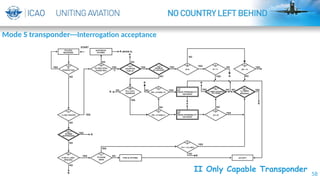
58
By-ISAAC
II Only Capable Transponder
Mode S transponder---Interrogation acceptance
59
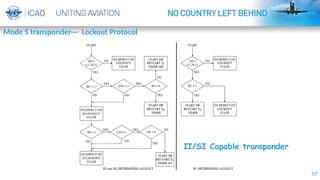
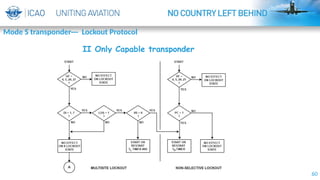
Mode S transponder--- Lockout Protocol
By-ISAAC
II/SI Capable transponder
60
Mode S transponder--- Lockout Protocol
By-ISAAC
II Only Capable transponder
Flight Inspection for a
Mode S Radar
62
Flight inspection for a Mode S radar
By-ISAAC
At present, many ANSPs require GICB, COMM-B broad-related capabilities in the technical specifications
when purchasing Mode S radars. Flight Inspection is recommended for the following capabilities which have
not been mentioned in ICAO Doc 8071 2nd
Edition:
Prior to commissioning,
• It is recommended for a verification of the GICB, COMM-B broadcast protocols in the flight inspection.
• It is recommended to perform stochastic acquisition and lockout override tests in the flight inspection.
• It is recommended to perform II and SI operation in the flight inspection.
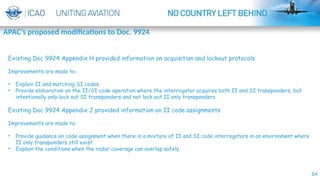
APAC’s proposed modifications to
Doc. 9924
64
APAC’s proposed modifications to Doc. 9924
By-ISAAC
Existing Doc 9924 Appendix H provided information on acquisition and lockout protocols
Improvements are made to:
• Explain II and matching SI codes.
• Provide elaboration on the II/SI code operation where the interrogator acquires both II and SI transponders, but
intentionally only lock out SI transponders and not lock out II only transponders.
Existing Doc 9924 Appendix J provided information on II code assignments
Improvements are made to:
• Provide guidance on code assignment when there is a mixture of II and SI code interrogators in an environment where
II only transponders still exist.
• Explain the conditions when the radar coverage can overlap safely.
65

Introduction to Mode S Radar System - Presented Version.pptx

  • 1.
    Introduction to ModeS Secondary Surveillance Radar System CHEN Yang (Isaac) CAAC ATMB isaac21@qq.com
  • 2.
    2 • 1. ModeS operations a) Dialogue between Mode S Interrogator and Transponder b) II & SI code c) Acquisition and Lockout protocols d) Mode Interlace Pattern &Optimal interrogation sequence e) Time and Power constraint of the interrogator • 2. ELS & EHS a) Operational requirements of ELS & EHS b) Register introduction c) Optimal register extraction • 3. Mode S transponder a) Basic electrical specification b) Interrogation acceptance & Lockout protocols • 4. Flight inspection for a Mode S radar • 5. APAC’s proposed modifications to Doc. 9924 Content
  • 3.
  • 4.
    4 Mode S operations--Dialogue between Mode S Interrogator and Transponder History & Advantage The advantage • Compatible to the secondary surveillance radar (SSR) • Better performances in degarbling & defruit • Protection against transmission errors by a cyclic redundancy check • Enhanced communication to collect on board information (BDS Information) IFF (Identification Friend or Foe ) Conventional Mode A/C SSR (civilian application) COSSOR Adsel ( Address SELective System) Lincoln Laboratory DABS ( Discrete Address Beacon System) Mode S Surveillance Radar Surveillance + Communication 1940S 1960S 1970S 1990S
  • 5.
    5 P2 P1 P3 2 μS MODEA: 8 μS MODE C: 21.0 μS 0.8 μS 0.8 μS 0.8 μS ISLS CONTROL TRANSMISSION Mode s Reply: MODE A OR C Reply: MODE A OR C Mode A/C Interrogation Mode AC Transponder Mode S transponder P1-P3 8μS Mode A Mode A P1-P3 21μS Mode C Mode C Mode S operations-- Dialogue between Mode S Interrogator and Transponder Mode AC Interrogation
  • 6.
    6 Mode s Reply: Dependon P4 Mode A/C 0.8 μS P2 0.8 μS 0.8 μS P1 P3 P4 0.8 μS 1.6 μS 2 μS 2 μS MODE A: 8 μS MODE C : 21μS ISLS CONTROL TRANSMISSION Interrogation Mode AC Transponder Mode S transponder Mode A/C/S all-call P4 =1.6μS Mode A/C DF11 with II=0 & AA Mode A/C-only all-call P4 =0.8μS Mode A/C No reply Mode S operations-- Dialogue between Mode S Interrogator and Transponder Inter-Mode Interrogation
  • 7.
    7 Mode s Reply: ModeS reply or No Reply: No Reply Mode A/C Interrogation Mode AC Transponder Mode S transponder Mode S No Reply Mode S reply or No Reply 0.4 μS 0.8 μS P5 SLS CONTROL TRANSMISSION 0.8 μS 0.8 μS 56 or 112 data bits 2.0 μS 2.75 μS 0.5 μS P6 1.25 μS 0.5 μS 0.25 μS 1St data bit last data bit P2 P1 SYNC PHASE REVERSAL PHASE REVERSAL POSITION Mode S operations-- Dialogue between Mode S Interrogator and Transponder Mode S Interrogation
  • 8.
    8 0.4 μS 0.8 μS P5 SLSCONTROL TRANSMISSION 0.8 μS 0.8 μS 56 or 112 data bits 2.0 μS 2.75 μS 0.5 μS P6 1.25 μS 0.5 μS 0.25 μS 1 St data bit last data bit P2 P1 SYNC PHASE REVERSAL PHASE REVERSAL POSITION • P1—P2 pulse ---------- suppression of Mode A/C transponder. • 56-112 bit information. P6=16.25 –30.25 < 35μS • Mode S data lie within in the Mode A/C suppression interval(35μS). • 1bit/0.25μS 4MHz + BDPSK 8MHz Bandwidth. → → • 2MHz ---------Need two segments, 8MHz-----Not compatible with receiver bandwidth. Uplink design philosophy Mode S operations-- Dialogue between Mode S Interrogator and Transponder Interrogation Modulation and Coding Design
  • 9.
    9 Preamble 8 µsData block56 µs or 112 µs 4.5 µs ( 1 µs = 1bit ) Data bit format 1 1 0 0 1 0 0 0 1 0 0.5 0.5 0.5 µs 0.5 0.5 0.5 µs 1 µs 1 µs • The four pulse preamble is designed to be easily distinguished from Mode AC replies. • PPM : The absence of interference results in received energy in only one half of the interval. Thus energy in both halves indicates that an interfering pulse was received at the same time. • PPM : results in a constant number of pulses in each reply, assuring sufficient pulses for an accurate monopulse angle estimate. Downlink design philosophy Mode S operations-- Dialogue between Mode S Interrogator and Transponder Reply Modulation and Coding Design
  • 10.
    10 Mode S acquisition Mode S operations--Dialogue between Mode S Interrogator and Transponder
  • 11.
    11 UF = uplinkformat (01011; Decimal value 11) PR = probability of reply (related to Stochastic acquisition & Lockout Override ) IC = interrogator code: CL = code label AP = address/parity: Mode S operations-- Dialogue between Mode S Interrogator and Transponder UF11
  • 12.
    12 For example, ifPR =1, the transponder generate a random number between 0 and 1 and will reply only if: a) a lockout condition does not apply; and b) the generated random number is less than or equal to 0.5 If PR =9, the transponder generate a random number between 0 and 1 and will reply if a)Disregard the lockout state, generated random number is less than or equal to 0.5 Stochastic Acquisition Lockout Override Mode S operations-- Dialogue between Mode S Interrogator and Transponder UF11 PR
  • 13.
    13 1- ( 1-0.25)N PR=0.5,Pd=1-0.75N , N > 8 P → d > 90% or or or Mode S operations-- Dialogue between Mode S Interrogator and Transponder UF11 PR
  • 14.
    14 Acquisition Stochastic probability Numberof aircraft in garble zone 0.5 0.25 0.125 2 16 22 40 3 35 31 46 4 72 41 53 5 > 100 56 61 6 76 70 7 > 100 80 8 93 9 105 10 121 • This table from Appendix H ICAO Doc 9924, 3rd Edition shows the number of all-call interrogations required for 99 percent probability of acquisition. • For a Mode S all call, the size of the garble zone is 5.18 Nm according to the length of the DF11 reply. Mode S operations-- Dialogue between Mode S Interrogator and Transponder UF11 PR
  • 15.
    15  IC (interrogatorcode): The 4 bits contain the interrogator identifier or the last four bits of the surveillance identifier (SI).  CL = code label : If CL = 000, the information in the IC field is the interrogator identifier. If CL = 001 to 100 (decimal value 1 to 4), the information in the IC field contains the last four bits of the SI.  II 0-15/ SI 1-63 Note : A Mode S II-only transponder will ignore the CL field. A Mode S II-only interrogator cannot set the CL field and defaults to “000” Mode S operations-- Dialogue between Mode S Interrogator and Transponder UF11 IC & CL
  • 16.
    16 • For aUF11, the address consists of 24 one’s, on which the parity is overlaid. • The bits in AP (Address/parity )field are calculated by the first 32 information bits of UF11, broadcast aircraft address and generator polynomial. For the all-call interrogation, the aircraft address here use 24 ones. Mode S operations-- Dialogue between Mode S Interrogator and Transponder UF11 AP
  • 17.
    17 Decoding x24 T(X)/G(X)= x24 【 x24 M(x)+R(x)+A(x)G(X)/ x24 +r(x)/ x24 】 /G(X) = x24 m(x)+A(x)+ r(x)/G(X) High order bits low order bits- the last 24bits Up Link AP Coding • M(x)=Message A(x)=Aircraft Address =ICAO 24-bit Address • G(x)=1 + x3 + x10 + x12 + x13 + x14 + x15 + x16 + x17 + x18 + x19 + x20 + x21 + x22 + x23 + x24 • x24 M(x)/G(x)=m(x)+R(x)/G(x) R(x)=remainder{x → 24 M(x)/G(x)} • A(x) G(X)/ x24 =Q(x)+ r(x)/x24 r(x)=remainder{ → A(x) G(X)/ x24 } AP(X)= R(x)+A(x) G(X)/ x24 +r(x)/ x24 T(X)=x24 M(x)+R(x)+A(x) G(X)/ x24 +r(x)/ x24 Mode S operations-- Dialogue between Mode S Interrogator and Transponder UF11 AP
  • 18.
    18 Example : The task:Transmission 1011001, G(x)=X^4+X^3+1, AA(X)=1001 M(x)=1011001 x^6+x^4+x^3+1; → G(x)=11001=x^4+x^3+1=G(x) ------- CCITT CRC-4 R{x^4*M(x)/G(x)}= x^3+x= 1010 Remainder → AA(x)=1001=x3 +1 AA(x)G(x)/ x^4=Q(x)+r(x) /x^4=(x^3+x^2+1)+1/x^4 Transmission: T(X) = x4 M(x)+R(x)+AA(x) G(X)/ x4 +r(x)/ x4 = x^10+x^8+x^7+x^4+x^2+x+1 =10110010111 Mode S operations-- Dialogue between Mode S Interrogator and Transponder UF11 AP
  • 19.
    19 Receive: x4 T(X)/G(X) =x4 【 x4 M(x)+R(x)+A(x) G(X)/ x4 +r(x)/ x4 】 /G(X) = x4 m(x)+A(x)+ r(x)/G(X) = x10 +x9 +x7 +x5 +x3 +1+1/(x^4+x^3+1) 1001 Summary: The A(x) is modulo 2 with G(x), then take the high 24 bits, perform modulo 2 operation with the remainder of M(x) divided by G(x) to obtain AP. Mode S operations-- Dialogue between Mode S Interrogator and Transponder UF11 AP
  • 20.
    20 • The interrogationrepetition rate for the Mode A/C/S all-call, used for acquisition, shall be less than 250 per second. This rate shall also apply to the paired Mode S-only and Mode A/C-only all-call interrogations used for acquisition in the multisite mode. ------3.1.2.11.1.1.1 ICAO Annex 10 Volume 4, Fifth Edition • A Mode S interrogator shall not trigger, on average, more than 6 all-call replies per period of 200 ms and no more than 26 all-call replies counted over a period of 18 seconds. ------3.1.2.11.1.1.2 ICAO Annex 10 Volume 4, Fifth Edition • 4-second per scan, beam width=2.4° ( 3dB ) , All-Call rate ≤225 Hz ; 4-second per scan, beam width=4° ( effective beam width ) All-Call rate ≤135 Hz Mode S operations-- Dialogue between Mode S Interrogator and Transponder UF11 Interrogation Rate
  • 21.
    21  DF =downlink format (01011; decimal value 11)  CA = Capability (airborne or on ground , level 1 or above, DR ≠0 ?, FS alert FS=2,3,4 or 5) →  AA = ICAO 24 bits  PI = IC/parity Mode S operations-- Dialogue between Mode S Interrogator and Transponder DF11
  • 22.
    22  PI =17zero + CL (3 bits ) + IC ( 4 bits ) =PI ( x ) Transponder --- Transmission: T(x)=x^24 M(x) + R(x)+ PI(x) Radar---Reception : [x^24 M(x) + R(x)+ PI(x)]/G(x) = Q(x) + 0+ [PI(x)/G(x)] The remainder = PI(x) Mode S operations-- Dialogue between Mode S Interrogator and Transponder DF11
  • 23.
    23 R R = 0 - 1 5 R R = 1 6 - 3 1 Lockout command BDS information RR=18BDS 2,0 RR=17 BDS 1,0 RR=16 AICB Others : RR+RRS(subfield in SD) Downlink AP coding is different from Uplink, but similar to PI. Just replace PI (X) with A(X). Up link AP Up link AP Up link AP Comm-B broadcast or AICB Application Mode S operations-- Dialogue between Mode S Interrogator and Transponder UF4 DF4 DF20
  • 24.
    24 Mode S operations--Dialogue between Mode S Interrogator and Transponder UF5 DF5 DF21
  • 25.
    25 • G(x) =x^24 + x^23 + x^22 + ... + x^13 + x^12 + x^10 + x^3 + 1 • It can detect any 24-bit error burst over any length of the bits-window. • Hamming Distance=6, It can correct random error of length smaller than 5. • It can correct burst-error of length 12.or 12 burst-error in any 24 bits window. Related to the interval between the F1 pulse and the SPI pulse of the MODE AC reply ( 24.65 μS ) 12 = 4 PULSE A + 4 PULSE B +4 PULSE C +4 PULSE D Mode S operations-- Dialogue between Mode S Interrogator and Transponder Generation Polynomial
  • 26.
    26 G ( x) was first discovered by Kasami in 1964. It was then applied to Mode S radar by MIT Lincoln Laboratory. <<Some Efficient Shortened Cyclic Codes for Burst-Error Correction>> ---- TADAO. KASAMI Dept. of Electronics University of Osaka Mode S operations-- Dialogue between Mode S Interrogator and Transponder Generation Polynomial
  • 27.
    27 If CL =000, IC =II. If CL = 001 to 100 (decimal value 1 to 4), IC=last four bits of the SI code • 2 types of Interrogator Code (IC) are used :  the Interrogator Identifier (II) code,0-15, 0 is used for non-selective  the Surveillance Identifier (SI) code,1-63, multisite surveillance and the limited data link functions (It shall not be used with the multisite uplink or down link ELM protocols) • In order to avoid ambiguity :  for each Mode S interrogator is allocated an Interrogator Code (IC) to protect it from interference by other Mode S interrogators operating in overlapping airspace. Mode S operations-- Dialogue between Mode S Interrogator and Transponder II & SI Code
  • 28.
    28 • Not alltransponders are capable of operating with SI code. • Transponders which have not been upgraded to handle SI code, by default, consider the content of the IC field as being an II code value. • So, if CL is not equal to zero (meaning that the IC field contains SI code), the II only capable transponders encode the parity sequence of the reply using the "matching“ II code rather than the SI code contained in the interrogation. Mode S II-only capable transponder will ignore CL field. Mode S operations-- Dialogue between Mode S Interrogator and Transponder II & SI Code
  • 29.
    29  The interrogatoroperation with SI code, which will receive Mode S-only all-call replies encoded with the “matching” II code will normally reject these replies. The consequence is that Mode S II-only transponders which have not been upgraded to handle SI codes will not be detected by the interrogator operating with an SI code.  The Mode S II/SI capable interrogator that supports the use of II/SI code operation, if operating with an II code, must be configurable by the user to either: a) not lockout Mode S transponders that do not report the SI capability in Register 10 or cannot report Register 10 b) use intermittent lockout for transponders that do not report the SI capability in Register 10 or cannot report Register 10  The Mode II/SI capable interrogator that supports the use of II/SI code operation, if operating with an SI code, must be configurable by the user to either: a) acquisition the transponder on “matching” II code ; b) not lockout non-SI capable transponders on the "matching" II code; or c)use intermittent lockout for this "matching" II code. Mode S operations-- II & SI Code
  • 30.
    30 Allocation principle The IChas to be unique :  It cannot be used in a coverage overlapping with other (non-connected) interrogators using that same II or SI code.  The II only interrogator can not have overlapping coverage with the interrogator with it’s matching SI code. Mode S operations-- II & SI Code
  • 31.
    31 • Mode SAcquisition: Obtain aircraft’s ICAO 24bits address and approximate position information for next roll-call activity. • Multisite acquisition: Using the Mode S-only all-call UF11. The transponder replies DF11 to this interrogation if it is not in a lockout state to that specific IC. (II=1-15,SI=1-63) Mode S operations-- Acquisition & Lockout Acquisition
  • 32.
    32 • Lockout: Onceacquired, the Mode S transponder should be locked out from replying to subsequent Mode S all-call interrogations form specific IC code Mode S radar in order to minimize all-call synchronous garbling. • This lockout condition is controlled by the Mode S radar through Roll-Call interrogation. If for any reason an aircraft ceases to receive roll-call interrogations containing a lockout command for a period of 18 seconds, the lockout state will lapse so that the aircraft can be reacquired by Mode S acquisition. UF PC RR DI="001" SD AP 1 6 9 14 17 33 5 8 13 16 32 IIS II code MBS MES LOS Lockout RSS TMS 17 21 23 26 27 29 20 22 25 26 28 UF PC RR DI="111" SD AP 1 6 9 14 17 33 5 8 13 16 32 IIS II code RRS Reserved LOS Lockout Reserved OVC TMS 17 21 25 26 27 28 29 20 24 25 26 27 28 UF PC RR DI="011" SD AP 1 6 9 14 17 33 5 8 13 16 32 SIS SI code LSS Lockout RRS OVC Reserved 17 23 24 28 29 22 23 27 28 II CODE LOCK OUT, II ≠0 II CODE LOCK OUT, II ≠0 SI CODE LOCK OUT Mode S operations-- Acquisition & Lockout Lockout
  • 33.
    33 Mode S operations—ProgressiveInteraction Between Interrogator and Transponder (UF11+DF11)*N AA+Range+Azimuth=plot (UF11+DF11)*N AA+Rang+Azimuth+ Speed Vector=Track (UF11+DF11)*N BDS1,0+BDS1,7 (UF11+DF11)*N BDS2,0+BDS3,0 LOCKOUT BDS6,0 BDS4,0+BDS5,0 LOCKOUT BDS6,0 BDS4,0+BDS5,0 LOCKOUT By-ISAAC 1ST Scan 2nd Scan 3rd Scan 4th Scan 5th Scan 6th Scan
  • 34.
    34 P1P2 Phase reversal M odeS All Cal l 4. 75μ S 128μ S Staggeri ng M ode AC O nl y Al l Call Up to 256N m= 3161 μ S P1 P3 P4 Al l -Cal l Peri od Al l -Cal l Peri od Rol l - Cal l Peri od Rol l - Cal l Peri od Al l - Cal l Peri od Ti m e Up to 256N m RC1 RC2 RC3 RC4 Repl y to RC4 M ode S Rol l Cal l Li steni ng W i ndow Sel ecti ve Interrogation Repl y to RC2 Repl y to RC1 Repl y to RC3 M ode S Al l Cal l Li steni ng W i ndow Mode S operations—Mode Interlace Pattern
  • 35.
    35 128 s… μ Why ? •It is desirable to provide at least 45 microseconds spacing between the interrogations to ensure that Mode A/C transponders recover from the suppression caused by the Mode S interrogation preamble. The spacing shown is the maximum possible without interfering with the receipt of zero range Mode S all-call replies. The transponder suppression shall be for a period of 35 plus or minus 10 microseconds. --3.1.1.7.4.2 ICAO Annex10 Volume IV 5th Edition • If STC is to be used, the spacing of 128 microseconds must be used to provide an identical range zero point for Mode S and SSR replies. Mode S operations—Mode Interlace Pattern
  • 36.
    36 • Scheduling ofMode S roll-call interrogations and replies occurs under the following principles: a) Mode S interrogations are addressed only to aircraft within the antenna beam; b) channel time is allocated to each Mode S interrogation and reply based upon a prediction of aircraft range; c) the ground station is able to interrogate an aircraft more than once while it remains in the beam. -----3.2.3 ICAO Doc 9924 Appendix J, 3rd Edition Mode S operations—Mode Interlace Pattern Interleaving for Mode S Roll-Call
  • 37.
    37 • Although thetime of transmission and reception periods of any roll call- reply transaction can’t be interleaved, but with the proper scheduling, the TL (listening window) of two or more roll call- reply transactions can be interleaved by scheduling the transmission and/or receive time intervals of one transaction in the wait phase of another transaction to save the restricted beam dwell time. • The Uplink roll-call and downlink reply contain ICAO 24-bit address, So the pairing of the interrogation and reply can be completed without ambiguity. RC1 RC2 RC3 RC4 Repl y to RC4 M ode S Rol l Cal l Li steni ng W i ndow Sel ecti ve Interrogati on Repl y to RC2 Repl y to RC1 Repl y to RC3 RC2 Repl y to RC2 RC3 Repl y to RC3 RC1 Repl y to RC1 M ode S Rol l Cal l Li steni ng W i ndow Ti m e CASE I CASE II Mode S operations—Mode Interlace Pattern Interleaving for Mode S Roll-Call
  • 38.
    38 • Method foroptimizing the management of radar time for secondary radars operating in Mode S ---------Philippe Billaud Thales patent •A Method of Mode-S Radar Roll-Call Scheduling Management -----IP/07 ICAO APAC DAPs WG/3 • Task Scheduling Algorithm for an Air and Missile Defense Radar ------Hasan S. Mir and John D. Wilkinson MIT Lincoln Laboratory Mode S operations-- Mode Interlace Pattern Interleaving for Mode S Roll-Call
  • 39.
    39 Mode S operations–Time Constraint
  • 40.
    40 Mode S operations--Time constraint By-ISAAC Scenario: PRF =150Hz Beam Width =2.4° Rotation =4 S Instrument Range=250nm For all Mode S interrogators, the transmission rate for selective interrogations shall be: a) less than 2 400 per second averaged over a 40-millisecond interval; and b) less than 480 into any 3-degree sector averaged over a 1-second interval. ---- 3.1.2.11.1.3.1 ICAO Annex10 Volume IV, 5th Edition T Beam-dwell Time = 2.4° 4s/360°= 27ms NAll-call = 27ms 150Hz ≈ 4 T All-Call = 4 ( 3161 + 128 + 4.75 ) = 13.18ms T Roll-Call = 40-13.18 = 26.8ms RC Max =2400 26.8ms = 64 64 7 = 9
  • 41.
    41 • The interrogationrepetition rate for the Mode A/C/S all-call, used for acquisition, shall be less than 250 per second. This rate shall also apply to the paired Mode S-only and Mode A/C-only all-call interrogations used for acquisition in the multisite mode. -----3.1.2.11.1.1.1 ICAO Annex10 Volume IV, 5th Edition • The minimum time between the beginning of successive Comm-C interrogations shall be 50μS. -----3.1.2.11.1.2.2 ICAO Annex10 Volume IV, 5th Edition • As a minimum, the transmitter shall be capable of operating at a peak duty cycle of 63.7% over 2.4ms length of time. It is expected that the above requirement can be repeated every 24ms. ------Surveillance Mode S European Mode S Functional Specification Eurocontrol Mode S operations-- Power constraint
  • 42.
    42 0.8 μS 0.8μS 112 data bits 2.0 μS 2.75 μS 0.5 μS P6 1.25 μS 0.5 μS 0.25 μS P2 P1 SYNC PHASE REVERSAL PHASE REVERSAL POSITION Comm-C Pulse-Time =0.8+0.8+1+1.25+112*0.25=31.85μS peak duty cycle 31.85μS/50μS = 63.7% Requires the capability of 48 consecutive COMM-C TRANSMISSION in 2.4 ms. MDS60L/MDS500L:ELM Burst: 32µSec ON/ 18µSec OFF x 48, repeated at 23mSec Mode S operations-- Time constraint
  • 43.
  • 44.
    44 ELS & EHS--Operational requirements In Mode S ELS implementation, requirements of the aircraft and ground Mode S system a) Selective interrogation. b) Use of ICAO Aircraft Address. c) Automatic reporting of ACID. d) Report of transponder capability. e) Altitude reporting with a resolution of 25ft (subject to aircraft capability). f) Provision of flight status to indicate airborne or on-the-ground (subject to aircraft capability). g) Report of SI Code capability; and h) ACAS active resolution advisory report (when equipped with TCAS) Mode S EHS implementation a) includes all the features of Mode S ELS b) BDS 4,0 c) BDS 5,0 d) BDS 6,0
  • 45.
    45 ELS & EHS--Benefits • Improve tracking accuracy through the use of DAPs information (track, turn, speed and heading of the aircraft) in the track calculation. • Improve the accuracy of safety nets, e.g., Short-Term Conflict Alert (STCA), through the provision of more accurate aircraft tracks, and Medium-Term Conflict Detection (MTCD), Minimum Safe Altitude Warning (MSAW), through the provision of the earlier judgment of vertical movement. • Allow the implementation of new safety nets in ATM automation system for cross-checking selected aircraft vertical intention (i.e., Selected Altitude) with ATC controllers’ instruction as well as verifying the barometric pressure setting applied in the aircraft with QNH setting in ATM automation system. • Improve situational awareness of ATC controllers by enabling the direct access of aircraft parameters in ATM automation system, e.g., Indicated Air Speed, Mach speed, Selected Altitude, Barometric Pressure Setting, etc. • Progressive reduction of R/T workload per aircraft.
  • 46.
    46 ELS & EHS--Register Introduction
  • 47.
    47 Register Name/Downlink AircraftParameters Usage BDS code 4,0 Selected Vertical Intention MCP/FCU Selected Altitude To provide information about the aircraft’s current vertical intentions FMS Selected Altitude Barometric Pressure Setting MCP/FCU Mode Target Altitude Source BDS code 5,0 Track and Turn Report Roll Angle To provide track and turn data to the ground systems. True Track Angle Ground Speed Track Angle Rate True Air Speed BDS code 6,0 Heading and Speed Report Magnetic Heading To provide heading and speed data to ground systems. Indicated Air Speed Mach Number Barometric Altitude Rate Inertial Vertical Velocity Register Name Usage BDS code 1,0 Datalink Capability Report To report the data link capability of the Mode S transponder/data link installation. BDS code 1,7 Common Usage GICB Capability Report To indicate common usage GICB services currently supported. BDS code 2,0 Aircraft Identification To report aircraft identification to the ground. BDS code 3,0 ACAS Resolution Advisory Report To report ACAS active resolution advisory More details in ICAO Doc 9871, 2nd Edition and ICAO APAC Mode S Daps IGD, Edition 3.0. ELS & EHS-- Register Introduction
  • 48.
    48 ELS & EHS--Optimal register extraction GICB Extraction: Insertion of BDS 1 and BDS 2 codes into roll-call ( UF 4, 5, 20, 21) to read out aboard BDS data BDS information BDS 1 BDS 2
  • 49.
    49 • Initiation: ToInsert DR codes 4, 5 into roll-call reply DFs 4, 5, 20, 21 and starting the B-timer (18 s). • Extraction: To extract the broadcast message, an interrogator shall extract BDS0,0 RR = 16 and DI ≠to 7 or RR = 16 and DI = 7 with RRS = 0 in a next roll call interrogation. • Interruption: AICB activity can interrupt a Comm-B broadcast cycle. If a broadcast cycle is interrupted, the B-timer shall be reset, the interrupted broadcast message shall be retained. • Currently, only registers of register BDS 1,0 and BDS 2,0 make use of the Comm-B Broadcast. DR=4 OR 5 BDS 0,0 Extraction Broadcast information ELS & EHS-- Optimal register extraction Comm-B Broadcast
  • 50.
    50 Initiation: To insertcode 2,3,6,7 in the DR field to announce the presence of active Resolution Advisory (RA) message . Extract: Interrogator shall transmit a request for a Comm-B message reply in a subsequent roll-call with RR and RRS for BDS 0,0. Finish: DR=2, 3, 6 or 7 shall remain set for 18 ±1 seconds following the end of the RA unless superseded by a new ARA. DR=2,3,6,7 ACAS information + DR=2,3,6,7 Extraction BDS0,0 ELS & EHS-- Optimal register extraction Air-Initiated Downlink of RA Report
  • 51.
    51 Initiation: The transponderinsert code 1 (1,3 RTCA) in the DR field to announce the presence of an AICB message . Extract: The interrogator shall transmit a request for a Comm-B message reply in a subsequent roll-call with RR and RRS for BDS 0,0. Finish: After a Comm-B closeout has been accomplished, the message shall be cancelled and the DR code belonging to this message immediately removed. DR=1 AICB information + DR=1 Extraction BDS0,0 DI = 1 IIS = assigned interrogator identifier MBS = 2 (Comm-B closeout) DI = 0, 1 or 7 IIS = assigned interrogator identifier PC = 4 (Comm-B closeout) DR=0 ELS & EHS-- Optimal register extraction AICB
  • 52.
    52 ELS & EHS–Optimal register extraction Mode S aircraft Acquisition CA Field Check Surveillance Only BDS 1,0 Request BDS 3,0 Request BDS 2,0 Request BDS 1,7 Request BDS40/50/60 Capable Surveillance Only Able to Extract BDS40/50/60 Within Coverage Stop Request BDS40/50/60 Request Initial Phase Tracking Phase CA=0 CA≥ 4 NO YES NO YES YES NO • Reg. 1016,2016,1716,3016 are the static or semi-static registers and do not need to be extracted all the time. • Any changes in the contents of the Reg. 1016, 2016, or 3016 triggers a downlink message via the Comm B broadcast or Air-Initiated Downlink of RA Report including the updated register contents. • The changed state might result in interruption of certain Mode S data link functions. • A change in the value of the common-usage GICB report bit in the data link capability report (Reg. 1016) would cause the application to re-extract the contents of the common-usage GICB capability report (Reg. 1716).
  • 53.
  • 54.
    54 Mode S transponder--Basic electrical specification RF Peak Power : The RF peak output power of each pulse of each reply at the terminals of the antenna shall be as follows. a. CLASS I Equipment Minimum RF peak power: 51.0 dBm (125 W). Maximum RFpeak power: 57.0 dBm (500 W). b. CLASS II Equipment Minimum RF peak power: 48.5 dBm (70W). Maximum RF peak power: 57.0 dBm (500 W). Operate at altitudes not exceeding 15000 ft, and have a maximum cruising true airspeed not exceeding 175 kt (324 km/h)------Class II Operating at altitudes above 15000 ft, or have a maximum cruising true airspeed in excess of 175 kt (324 km/h)----Class I
  • 55.
    55 Mode S transponder--Reply Capability Mode AC Mode AC • All Transponders The transponder shall be able to continuously generate at least 500 Mode A/C 15-pulse replies per second. • CLASS 1 Equipment shall be capable of a peak reply rate of 1200 Mode A/Creplies per 1S for a 15-pulse coded reply for a duration of 100 milliseconds • CLASS 2 Equipment shall be capable of a peak reply rate of 1000 Mode A/Creplies per 1S for a 15-pulse coded reply for a duration of 100 milliseconds
  • 56.
    56 The total replyrate over each time interval, shall be the sum of the individual Mode A/C replies at an average rate of 500 per second and the Mode S reply rate over that interval. a. Short DF Reply Rates (1) 50 Mode S replies in any one-second interval; (2) 18 Mode S replies in a 100-millisecond interval; (3) 8 Mode S replies in a 25-millisecond interval; (4) 4 Mode S replies in a 1.6-millisecond interval. b. Long DF Reply Rates A transponder shall be able to transmit as long replies; (1) at least 16 of the 50 Mode S replies in any one-second interval; (2) at least 6 of the 18 Mode S replies in a 100-millisecond interval; (3) at least 4 of the 8 Mode S replies in a 25-millisecond interval; (4) at least 2 of the 4 Mode S replies in a 1.6-millisecond interval. Mode S transponder-- Reply Capability Mode S
  • 57.
    57 Mode S transponder---Interrogationacceptance By-ISAAC Silence Judgment Non-selective lock-out 18S UF11or Not Stochastic acquisition Lockout override II OR SI Judgement SP4 OR LP4 Judgement ACAS P4 ? II/SI Capable Transponder Lockout Timer for SI code Lockout Timer for II code
  • 58.
    58 By-ISAAC II Only CapableTransponder Mode S transponder---Interrogation acceptance
  • 59.
    59 Mode S transponder---Lockout Protocol By-ISAAC II/SI Capable transponder
  • 60.
    60 Mode S transponder---Lockout Protocol By-ISAAC II Only Capable transponder
  • 61.
    Flight Inspection fora Mode S Radar
  • 62.
    62 Flight inspection fora Mode S radar By-ISAAC At present, many ANSPs require GICB, COMM-B broad-related capabilities in the technical specifications when purchasing Mode S radars. Flight Inspection is recommended for the following capabilities which have not been mentioned in ICAO Doc 8071 2nd Edition: Prior to commissioning, • It is recommended for a verification of the GICB, COMM-B broadcast protocols in the flight inspection. • It is recommended to perform stochastic acquisition and lockout override tests in the flight inspection. • It is recommended to perform II and SI operation in the flight inspection.
  • 63.
  • 64.
    64 APAC’s proposed modificationsto Doc. 9924 By-ISAAC Existing Doc 9924 Appendix H provided information on acquisition and lockout protocols Improvements are made to: • Explain II and matching SI codes. • Provide elaboration on the II/SI code operation where the interrogator acquires both II and SI transponders, but intentionally only lock out SI transponders and not lock out II only transponders. Existing Doc 9924 Appendix J provided information on II code assignments Improvements are made to: • Provide guidance on code assignment when there is a mixture of II and SI code interrogators in an environment where II only transponders still exist. • Explain the conditions when the radar coverage can overlap safely.
  • 65.

Editor's Notes

  • #4 Secondary radar is based on the communication between radar and the transponder. It appeared during the world war two to recognize the friendly planes, IFF (Identification Friend or Foe).This system was improved and applied to civilian application since the 60s (radar SSR + transponder)
  • #12 Stochastic acquisition : For example, if the PR code specifies a reply probability of 1/2 (PR=1), the transponder will generate a random number between zero and ten and will reply only if: a) a lockout condition does not apply; and b) the generated random number is less than or equal to 5 Lockout override For example, if the PR = 9 the transponder will generate a random number between zero and ten and will reply only if: a) the generated random number is less than or equal to 5, regardless of whether it is locked to the II or SI code.
  • #35  2. If gain time control is to be used, the spacing of 128 microseconds must be used to provide an identical range zero point for Mode S and SSR replies.
  • #49 On receipt of the above DR codes, interrogators may extract the broadcast message by transmitting RR=16 with DI≠3 or 7, or with DI=3 or 7 and RRS=0 in subsequent roll-call. When the B-timer runs out after 18 ±1 seconds, the transponder will reset the DR codes as required, will discard the previous broadcast.
  • #50 On receipt of the above DR codes, interrogators may extract the broadcast message by transmitting RR=16 with DI≠3 or 7, or with DI=3 or 7 and RRS=0 in subsequent roll-call. When the B-timer runs out after 18 ±1 seconds, the transponder will reset the DR codes as required, will discard the previous broadcast.
  • #51 On receipt of the above DR codes, interrogators may extract the broadcast message by transmitting RR=16 with DI≠3 or 7, or with DI=3 or 7 and RRS=0 in subsequent roll-call. When the B-timer runs out after 18 ±1 seconds, the transponder will reset the DR codes as required, will discard the previous broadcast.
  • #54 On receipt of the above DR codes, interrogators may extract the broadcast message by transmitting RR=16 with DI≠3 or 7, or with DI=3 or 7 and RRS=0 in subsequent roll-call. When the B-timer runs out after 18 ±1 seconds, the transponder will reset the DR codes as required, will discard the previous broadcast.
  • #55 On receipt of the above DR codes, interrogators may extract the broadcast message by transmitting RR=16 with DI≠3 or 7, or with DI=3 or 7 and RRS=0 in subsequent roll-call. When the B-timer runs out after 18 ±1 seconds, the transponder will reset the DR codes as required, will discard the previous broadcast.
  • #56 On receipt of the above DR codes, interrogators may extract the broadcast message by transmitting RR=16 with DI≠3 or 7, or with DI=3 or 7 and RRS=0 in subsequent roll-call. When the B-timer runs out after 18 ±1 seconds, the transponder will reset the DR codes as required, will discard the previous broadcast.
  • #57 On receipt of the above DR codes, interrogators may extract the broadcast message by transmitting RR=16 with DI≠3 or 7, or with DI=3 or 7 and RRS=0 in subsequent roll-call. When the B-timer runs out after 18 ±1 seconds, the transponder will reset the DR codes as required, will discard the previous broadcast.
  • #58 On receipt of the above DR codes, interrogators may extract the broadcast message by transmitting RR=16 with DI≠3 or 7, or with DI=3 or 7 and RRS=0 in subsequent roll-call. When the B-timer runs out after 18 ±1 seconds, the transponder will reset the DR codes as required, will discard the previous broadcast.
  • #59 On receipt of the above DR codes, interrogators may extract the broadcast message by transmitting RR=16 with DI≠3 or 7, or with DI=3 or 7 and RRS=0 in subsequent roll-call. When the B-timer runs out after 18 ±1 seconds, the transponder will reset the DR codes as required, will discard the previous broadcast.
  • #60 On receipt of the above DR codes, interrogators may extract the broadcast message by transmitting RR=16 with DI≠3 or 7, or with DI=3 or 7 and RRS=0 in subsequent roll-call. When the B-timer runs out after 18 ±1 seconds, the transponder will reset the DR codes as required, will discard the previous broadcast.
  • #62 On receipt of the above DR codes, interrogators may extract the broadcast message by transmitting RR=16 with DI≠3 or 7, or with DI=3 or 7 and RRS=0 in subsequent roll-call. When the B-timer runs out after 18 ±1 seconds, the transponder will reset the DR codes as required, will discard the previous broadcast.
  • #64 On receipt of the above DR codes, interrogators may extract the broadcast message by transmitting RR=16 with DI≠3 or 7, or with DI=3 or 7 and RRS=0 in subsequent roll-call. When the B-timer runs out after 18 ±1 seconds, the transponder will reset the DR codes as required, will discard the previous broadcast.