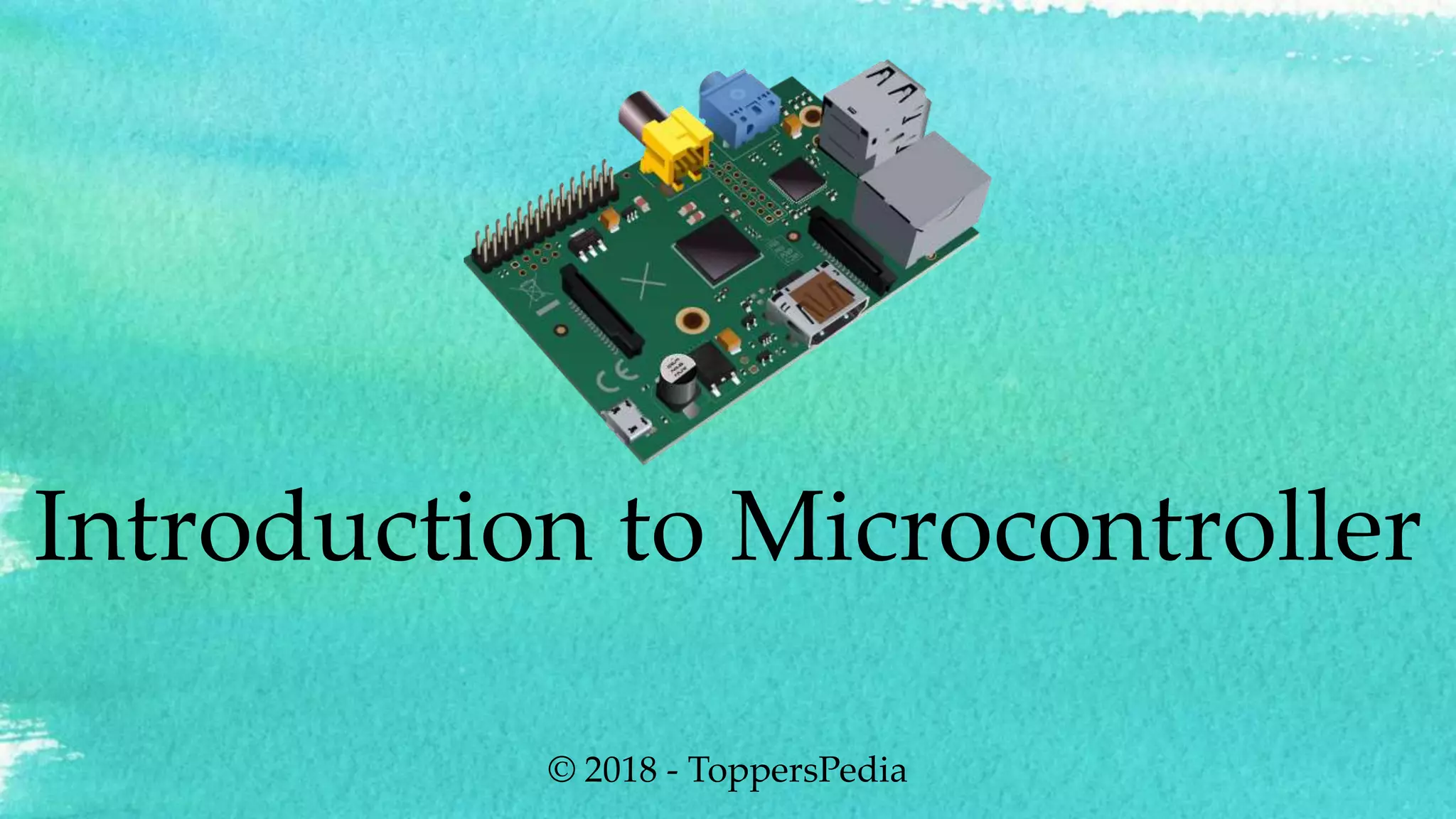
Introduction to Microcontroller
© 2018 - ToppersPedia
What is microcontroller?
• A microcontroller is a systematic microprocessor set, it consists of
microprocessor, limited amount of ROM or EPROM, RAM and I/O ports, built on
a single integrated chip.
• A microcontroller can be regarded as a microcomputer but since it performs some
specific controller functions it is called as a microcontroller.
• A microprocessor must include: full implementation of a standard
microprocessor, ROM or EPROM, RAM, parallel I/O ports, timer, a clock, serial
ports.
• A microcontroller is complicated than a microprocessor due to the presence of
several I/O components.
• For eg: Intel’s 8048, 8051.
© 2018 - ToppersPedia - www.topperspedia.com
Advantages of microcontroller over microprocessor
based system:
• A microcontroller has more I/O components than a micro-processor based
system.
• Microprocessor-based systems are expensive while microcontroller is cheap.
• Microcontrollers have varied uses in essential products such as in PC keyboards.
Microprocessor based systems can’t be used in such products.
• Other low cost products such as electronic toys, electric drills use
microcontrollers over microprocessor-based systems.
• Daily need products such as microwave ovens, DVDs are based on
microcontrollers.
© 2018 - ToppersPedia - www.topperspedia.com
Intel’s 8051
• It has 8-bit ALU.
• It has 4K byte ROM or EPROM.
• It has 128 byte RAM.
• It has 32 I/O lines for four 8-bit I/O
ports.
• It can address 64 kB of program
memory and data memory.
• It has two external interrupts.
• It has a full featured serial port.
© 2018 - ToppersPedia - www.topperspedia.com
Intel’s 8051
• It has dual 16-bit timer event counter.
• It has powerful instruction set,
consisting of 111 instructions.
• It has a clock upto 12-MHz
frequency.
• It also has 8-bit registers (one 16-bit
register with special move
instructions), 8-bit data bus and 2×16-
bit address bus, program counter,
data pointer, and related 8/11/16-bit
operations; hence it is mainly an 8-bit
microcontroller.
© 2018 - ToppersPedia - www.topperspedia.com
Architectural Block
Diagram of 8051
• It has 32 pins for four 8-bit
bidirectional ports.
• 8 pins are provided to connect
clock crystal, timing, control
signals and power supply.
• The standard functions which
make up microcontroller are in
the mid of the diagram, it
includes ALU, accumulator,
registers, etc.
• All of the blocks are connected
to 8051 internal 8-bit data bus.
Registers hold data for I/O
transfer and control the I/O
ports.
• The diagram also includes
ROM and RAM
© 2018 - ToppersPedia - www.topperspedia.com
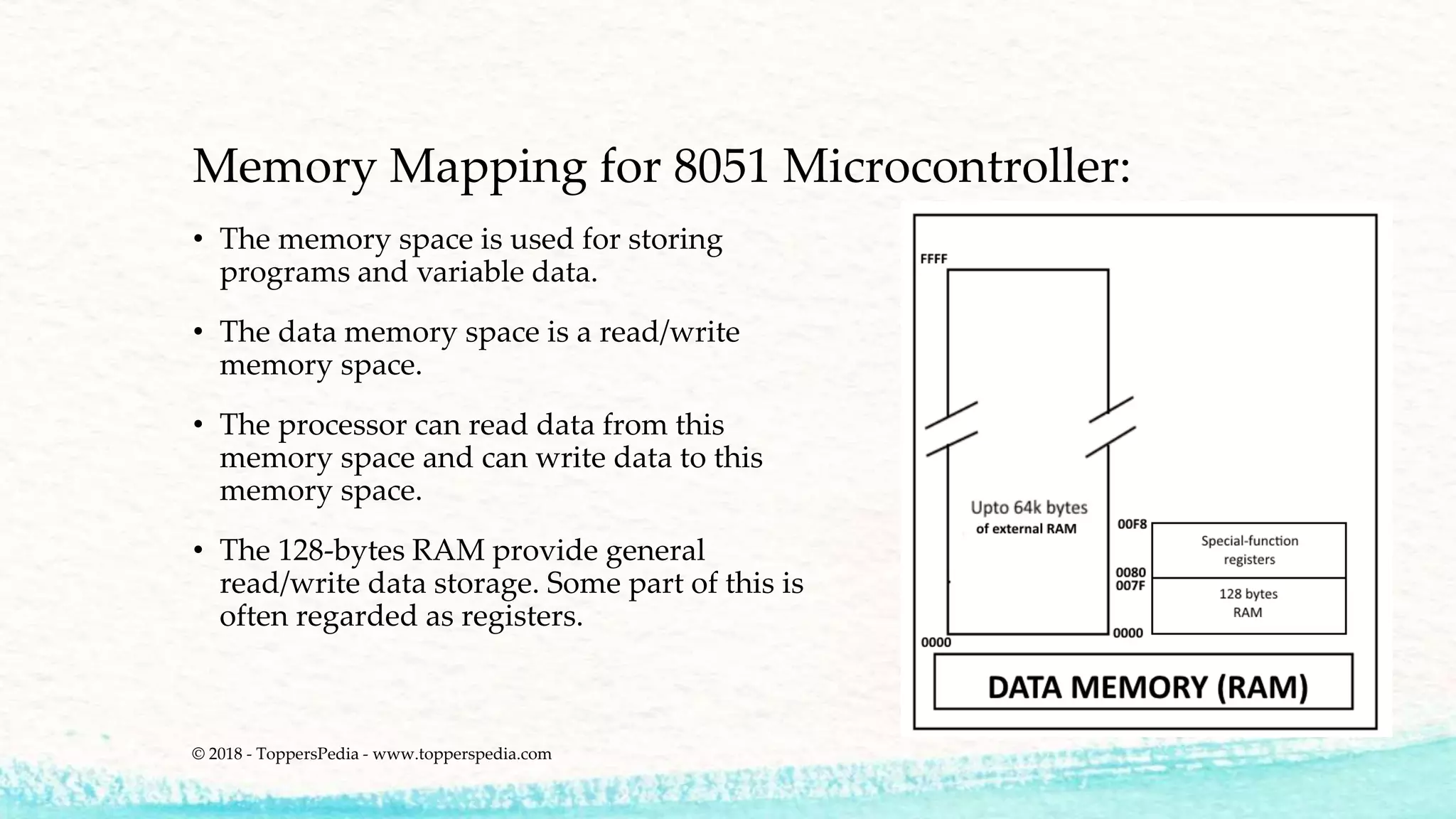
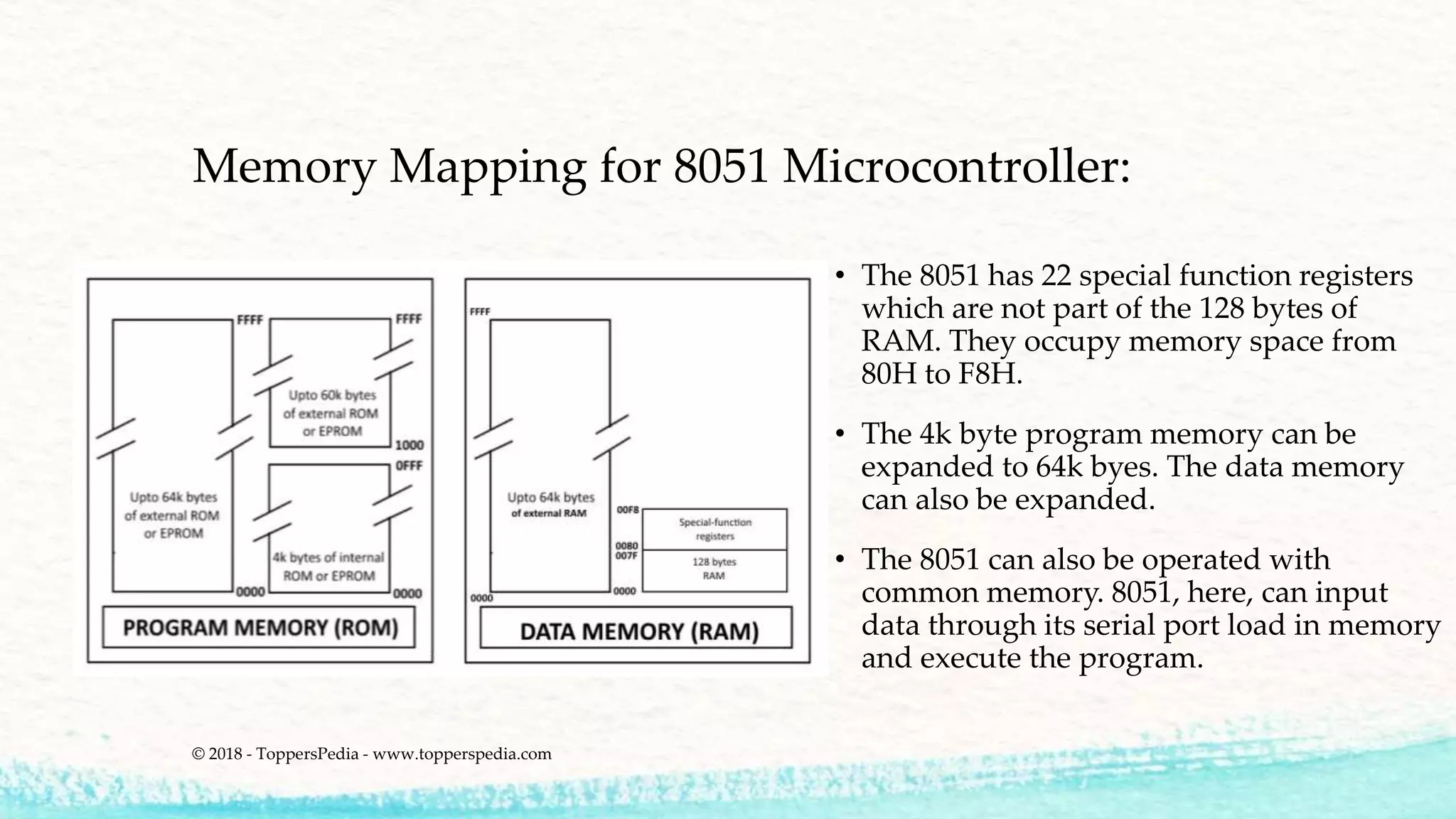
Memory Mapping for 8051 Microcontroller:
• It can be also regarded as addressing of
microcontroller over two separate memory
spaces.
• The 8051 addresses has two separate
memory spaces:
– Program Memory Space
– Data Memory Space
• The program memory space is read-only
memory (ROM) space.
• All instruction fetches are taken from
program memory space.
© 2018 - ToppersPedia - www.topperspedia.com
Memory Mapping for 8051 Microcontroller:
• The memory space is used for storing
programs and variable data.
• The data memory space is a read/write
memory space.
• The processor can read data from this
memory space and can write data to this
memory space.
• The 128-bytes RAM provide general
read/write data storage. Some part of this is
often regarded as registers.
© 2018 - ToppersPedia - www.topperspedia.com
Memory Mapping for 8051 Microcontroller:
© 2018 - ToppersPedia - www.topperspedia.com
• The 8051 has 22 special function registers
which are not part of the 128 bytes of
RAM. They occupy memory space from
80H to F8H.
• The 4k byte program memory can be
expanded to 64k byes. The data memory
can also be expanded.
• The 8051 can also be operated with
common memory. 8051, here, can input
data through its serial port load in memory
and execute the program.
8048 Microcontroller:
• 8048 has clock having frequency
2MHz to 4MHz.
• It has 27 I/O lines.
• It has 64 bytes RAM.
• It has one 8-bit time event counter.
• It has 1kbyte ROM or EPROM.
• It has a address capacity of 4KB.
© 2018 - ToppersPedia - www.topperspedia.com
8051 Family
8048, 8049, 8050, 8052, 8031, 8032
© 2018 - ToppersPedia - www.topperspedia.com
8048, 8049, 8050 Microcontrollers:
• 8048 was Intel’s first microcontroller.
8048-8049-8050 have almost same
architectures (differ in memory).
• 8048 supports 1K byte, 8049 supports
2K bytes of internal memory and
8050 supports 4K bytes of internal
memory.
• 8048 has 64 bytes internal RAM (w/
32 bytes of register/memory
location), 8049 has 128 bytes and 8050
has 256 bytes of RAM.
• They are very low cost, thus popular.
© 2018 - ToppersPedia - www.topperspedia.com
8052 Microcontroller
• An expansion of 8051.
• The 8052 has all the standard features
of the 8051 as well as an extra 128
bytes of RAM
• An extra timer.
• 8052 has 256 bytes of RAM and 3
timers.
• It has 8K bytes of on-chip program
ROM instead of 4K bytes.
© 2018 - ToppersPedia - www.topperspedia.com
Comparison between 8051 and 8052.
Microcontroller 8051
• It has 4k bytes of ROM.
• It has 128 bytes of RAM.
• It has a dual 16-bit timer event counter.
• Low cost.
• Point of similarity: Used in high volume
Applications and both allow us to write
large programs.
Microcontroller 8052
© 2018 - ToppersPedia - www.topperspedia.com
• It has 8k bytes of ROM.
• It has 256 bytes of RAM.
• It has an extra 16-bit timer event
counter.
• Comparatively more cost.
Applications of microcontroller:
• They are independent controllers in
machines or as slaves in distributed
processing.
• They are used as machine tools,
chemical processors, medical
instrumentation and sophisticated
guidance control.
• Keyboards use microcontrollers.
Even electronic toys and home
security system.
• It replaces scanning, debounce,
matrix decoding and serial
transmission circuits.
© 2018 - ToppersPedia - www.topperspedia.com

Introduction to Micro-Controller.

  • 1.
  • 2.
    What is microcontroller? •A microcontroller is a systematic microprocessor set, it consists of microprocessor, limited amount of ROM or EPROM, RAM and I/O ports, built on a single integrated chip. • A microcontroller can be regarded as a microcomputer but since it performs some specific controller functions it is called as a microcontroller. • A microprocessor must include: full implementation of a standard microprocessor, ROM or EPROM, RAM, parallel I/O ports, timer, a clock, serial ports. • A microcontroller is complicated than a microprocessor due to the presence of several I/O components. • For eg: Intel’s 8048, 8051. © 2018 - ToppersPedia - www.topperspedia.com
  • 3.
    Advantages of microcontrollerover microprocessor based system: • A microcontroller has more I/O components than a micro-processor based system. • Microprocessor-based systems are expensive while microcontroller is cheap. • Microcontrollers have varied uses in essential products such as in PC keyboards. Microprocessor based systems can’t be used in such products. • Other low cost products such as electronic toys, electric drills use microcontrollers over microprocessor-based systems. • Daily need products such as microwave ovens, DVDs are based on microcontrollers. © 2018 - ToppersPedia - www.topperspedia.com
  • 4.
    Intel’s 8051 • Ithas 8-bit ALU. • It has 4K byte ROM or EPROM. • It has 128 byte RAM. • It has 32 I/O lines for four 8-bit I/O ports. • It can address 64 kB of program memory and data memory. • It has two external interrupts. • It has a full featured serial port. © 2018 - ToppersPedia - www.topperspedia.com
  • 5.
    Intel’s 8051 • Ithas dual 16-bit timer event counter. • It has powerful instruction set, consisting of 111 instructions. • It has a clock upto 12-MHz frequency. • It also has 8-bit registers (one 16-bit register with special move instructions), 8-bit data bus and 2×16- bit address bus, program counter, data pointer, and related 8/11/16-bit operations; hence it is mainly an 8-bit microcontroller. © 2018 - ToppersPedia - www.topperspedia.com
  • 6.
    Architectural Block Diagram of8051 • It has 32 pins for four 8-bit bidirectional ports. • 8 pins are provided to connect clock crystal, timing, control signals and power supply. • The standard functions which make up microcontroller are in the mid of the diagram, it includes ALU, accumulator, registers, etc. • All of the blocks are connected to 8051 internal 8-bit data bus. Registers hold data for I/O transfer and control the I/O ports. • The diagram also includes ROM and RAM © 2018 - ToppersPedia - www.topperspedia.com
  • 7.
    Memory Mapping for8051 Microcontroller: • It can be also regarded as addressing of microcontroller over two separate memory spaces. • The 8051 addresses has two separate memory spaces: – Program Memory Space – Data Memory Space • The program memory space is read-only memory (ROM) space. • All instruction fetches are taken from program memory space. © 2018 - ToppersPedia - www.topperspedia.com
  • 8.
    Memory Mapping for8051 Microcontroller: • The memory space is used for storing programs and variable data. • The data memory space is a read/write memory space. • The processor can read data from this memory space and can write data to this memory space. • The 128-bytes RAM provide general read/write data storage. Some part of this is often regarded as registers. © 2018 - ToppersPedia - www.topperspedia.com
  • 9.
    Memory Mapping for8051 Microcontroller: © 2018 - ToppersPedia - www.topperspedia.com • The 8051 has 22 special function registers which are not part of the 128 bytes of RAM. They occupy memory space from 80H to F8H. • The 4k byte program memory can be expanded to 64k byes. The data memory can also be expanded. • The 8051 can also be operated with common memory. 8051, here, can input data through its serial port load in memory and execute the program.
  • 10.
    8048 Microcontroller: • 8048has clock having frequency 2MHz to 4MHz. • It has 27 I/O lines. • It has 64 bytes RAM. • It has one 8-bit time event counter. • It has 1kbyte ROM or EPROM. • It has a address capacity of 4KB. © 2018 - ToppersPedia - www.topperspedia.com
  • 11.
    8051 Family 8048, 8049,8050, 8052, 8031, 8032 © 2018 - ToppersPedia - www.topperspedia.com
  • 12.
    8048, 8049, 8050Microcontrollers: • 8048 was Intel’s first microcontroller. 8048-8049-8050 have almost same architectures (differ in memory). • 8048 supports 1K byte, 8049 supports 2K bytes of internal memory and 8050 supports 4K bytes of internal memory. • 8048 has 64 bytes internal RAM (w/ 32 bytes of register/memory location), 8049 has 128 bytes and 8050 has 256 bytes of RAM. • They are very low cost, thus popular. © 2018 - ToppersPedia - www.topperspedia.com
  • 13.
    8052 Microcontroller • Anexpansion of 8051. • The 8052 has all the standard features of the 8051 as well as an extra 128 bytes of RAM • An extra timer. • 8052 has 256 bytes of RAM and 3 timers. • It has 8K bytes of on-chip program ROM instead of 4K bytes. © 2018 - ToppersPedia - www.topperspedia.com
  • 14.
    Comparison between 8051and 8052. Microcontroller 8051 • It has 4k bytes of ROM. • It has 128 bytes of RAM. • It has a dual 16-bit timer event counter. • Low cost. • Point of similarity: Used in high volume Applications and both allow us to write large programs. Microcontroller 8052 © 2018 - ToppersPedia - www.topperspedia.com • It has 8k bytes of ROM. • It has 256 bytes of RAM. • It has an extra 16-bit timer event counter. • Comparatively more cost.
  • 15.
    Applications of microcontroller: •They are independent controllers in machines or as slaves in distributed processing. • They are used as machine tools, chemical processors, medical instrumentation and sophisticated guidance control. • Keyboards use microcontrollers. Even electronic toys and home security system. • It replaces scanning, debounce, matrix decoding and serial transmission circuits. © 2018 - ToppersPedia - www.topperspedia.com