INTRODUCTION TO
MENTAL HEALTH
STUDY UNIT 14
By C. Settley
Learning Outcomes
• Explain the term Mental Health
• Discuss the characteristics of a Mentally
Health Person
• Explore the criteria of mental health for a
person in relationship with:
• - self
• - others
• - environment
Explain the term ‘Mental Health’
• Mental health is a state of well-being in
which a person understands his or her
own abilities:
• - can cope with the normal stresses of life
• - can work productively and fruitfully
• - is able to make a contribution to his or
her community.
Explain the term ‘Mental Health’
• Both physical and mental health are the
result of a complex interplay between
many individual and environmental
factors, including:
• family history of illness and disease/genetics
• lifestyle and health behaviours (e.g., smoking, exercise, substance use)
• levels of personal stress
• workplace stress
• exposure to toxins
• exposure to trauma
• personal life circumstances and history
• access to support structures (e.g., timely healthcare, social supports)
• coping skills
Explain the term ‘Mental Health’
• When the demands placed on someone exceed their resources
and coping abilities, their mental health will be negatively affected.
• Two examples of common demands are:
• i) working long hours under difficult circumstances, and
• ii) caring for a chronically ill relative.
• Economic hardship, unemployment, underemployment and poverty
also have the potential to harm mental health.
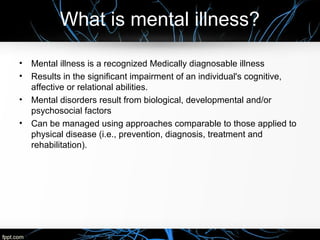
What is mental illness?
• Mental illness is a recognized Medically diagnosable illness
• Results in the significant impairment of an individual's cognitive,
affective or relational abilities.
• Mental disorders result from biological, developmental and/or
psychosocial factors
• Can be managed using approaches comparable to those applied to
physical disease (i.e., prevention, diagnosis, treatment and
rehabilitation).
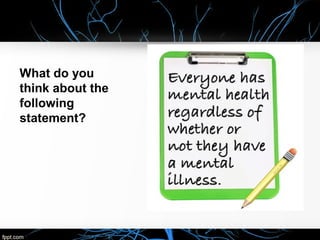
What do you
think about the
following
statement?
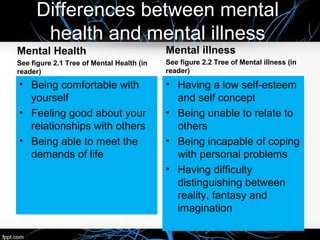
Differences between mental
health and mental illness
Mental Health
See figure 2.1 Tree of Mental Health (in
reader)
• Being comfortable with
yourself
• Feeling good about your
relationships with others
• Being able to meet the
demands of life
Mental illness
See figure 2.2 Tree of Mental illness (in
reader)
• Having a low self-esteem
and self concept
• Being unable to relate to
others
• Being incapable of coping
with personal problems
• Having difficulty
distinguishing between
reality, fantasy and
imagination
Video:
Mental Health- The Basics
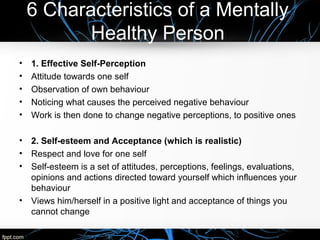
6 Characteristics of a Mentally
Healthy Person
• 1. Effective Self-Perception
• Attitude towards one self
• Observation of own behaviour
• Noticing what causes the perceived negative behaviour
• Work is then done to change negative perceptions, to positive ones
• 2. Self-esteem and Acceptance (which is realistic)
• Respect and love for one self
• Self-esteem is a set of attitudes, perceptions, feelings, evaluations,
opinions and actions directed toward yourself which influences your
behaviour
• Views him/herself in a positive light and acceptance of things you
cannot change
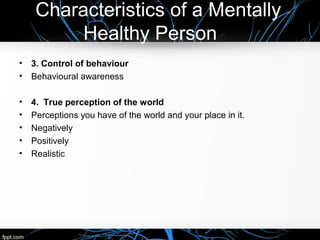
6 Characteristics of a Mentally
Healthy Person
• 3. Control of behaviour
• Behavioural awareness
• 4. True perception of the world
• Perceptions you have of the world and your place in it.
• Negatively
• Positively
• Realistic
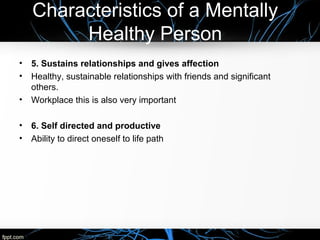
Characteristics of a Mentally
Healthy Person
• 5. Sustains relationships and gives affection
• Healthy, sustainable relationships with friends and significant
others.
• Workplace this is also very important
• 6. Self directed and productive
• Ability to direct oneself to life path
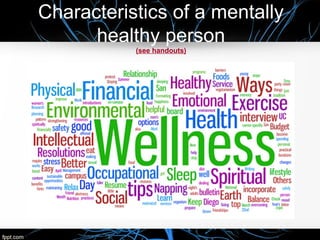
Characteristics of a mentally
healthy person
(see handouts)
Video: Mental Health & Mental
illness
Well- being
• Positive outcome
• Meaningful
• Good life
• How people perceive their lives
• Good living conditions, employment,
housing
• Relationships, emotions, realisation of
potential, life satisfaction
Why is well- being useful for public
health?
• Integration of mental health (mind) and physical health
(body)
• Results in holistic approaches to nursing care
• Disease prevention
• Health promotion
• Valid population outcome- morbidity, mortality, economic
status. Research: self perceived health, longevity,
behaviour, mental and physical heath, social
connectedness, productivity
• Meaningful to public
NON PHARMACOLOGICAL TREATMENT
OF MENTAL ILLNESSES
• Psychoanalysis, Psychotherapy andPsychoanalysis, Psychotherapy and
Behavioral therapyBehavioral therapy
• Approaches to addressing mental health issues usingApproaches to addressing mental health issues using
methods other than pharmacological treatmentmethods other than pharmacological treatment
• Nurses working in mental health settings and withNurses working in mental health settings and with
patients with diverse medical backgrounds shouldpatients with diverse medical backgrounds should
familiarise themselves with these practices as thefamiliarise themselves with these practices as the
nursing process engages with individuals with differentnursing process engages with individuals with different
and unique mental healthand unique mental health
NON PHARMACOLOGICAL TREATMENT OF
MENTAL ILLNESSES
• DIVIDE INTO 3 GROUPS. Each group willDIVIDE INTO 3 GROUPS. Each group will
be responsible for presenting the followingbe responsible for presenting the following
three methods of non pharmacologicalthree methods of non pharmacological
treatment:treatment:
• GROUP 1: PsychoanalysisGROUP 1: Psychoanalysis
• GROUP 2: PsychotherapyGROUP 2: Psychotherapy
• GROUP 3: Behavioral therapyGROUP 3: Behavioral therapy
• Definition, uses in medical field, examples
• Presentation; role play, group discussions,
case studies, refer to assignments done,
PowerPoint presentation
• Be creative
• Groups will assess one another
• Assessment: Each group member will be
evaluated by rest of the group
References
• Kreigh, H.Z. AND Perko, J.E., (1998). Psychiatric Health
Nursing. Pg 8. United States of America. Prentice Hall
International
• Clarke, M. (2012). Executive Coaching, Goal Setting and
tagged coaching, Executive Coaching, Jahoda, mental
health, wellbeing. Available at:
http://motivcoach.wordpress.com/2011/08/22/6-
characteristics-of-the-mentally-healthy-person/

Introduction to mental health study unit 14

  • 1.
  • 2.
    Learning Outcomes • Explainthe term Mental Health • Discuss the characteristics of a Mentally Health Person • Explore the criteria of mental health for a person in relationship with: • - self • - others • - environment
  • 3.
    Explain the term‘Mental Health’ • Mental health is a state of well-being in which a person understands his or her own abilities: • - can cope with the normal stresses of life • - can work productively and fruitfully • - is able to make a contribution to his or her community.
  • 4.
    Explain the term‘Mental Health’ • Both physical and mental health are the result of a complex interplay between many individual and environmental factors, including: • family history of illness and disease/genetics • lifestyle and health behaviours (e.g., smoking, exercise, substance use) • levels of personal stress • workplace stress • exposure to toxins • exposure to trauma • personal life circumstances and history • access to support structures (e.g., timely healthcare, social supports) • coping skills
  • 5.
    Explain the term‘Mental Health’ • When the demands placed on someone exceed their resources and coping abilities, their mental health will be negatively affected. • Two examples of common demands are: • i) working long hours under difficult circumstances, and • ii) caring for a chronically ill relative. • Economic hardship, unemployment, underemployment and poverty also have the potential to harm mental health.
  • 6.
    What is mentalillness? • Mental illness is a recognized Medically diagnosable illness • Results in the significant impairment of an individual's cognitive, affective or relational abilities. • Mental disorders result from biological, developmental and/or psychosocial factors • Can be managed using approaches comparable to those applied to physical disease (i.e., prevention, diagnosis, treatment and rehabilitation).
  • 7.
    What do you thinkabout the following statement?
  • 8.
    Differences between mental healthand mental illness Mental Health See figure 2.1 Tree of Mental Health (in reader) • Being comfortable with yourself • Feeling good about your relationships with others • Being able to meet the demands of life Mental illness See figure 2.2 Tree of Mental illness (in reader) • Having a low self-esteem and self concept • Being unable to relate to others • Being incapable of coping with personal problems • Having difficulty distinguishing between reality, fantasy and imagination
  • 9.
  • 10.
    6 Characteristics ofa Mentally Healthy Person • 1. Effective Self-Perception • Attitude towards one self • Observation of own behaviour • Noticing what causes the perceived negative behaviour • Work is then done to change negative perceptions, to positive ones • 2. Self-esteem and Acceptance (which is realistic) • Respect and love for one self • Self-esteem is a set of attitudes, perceptions, feelings, evaluations, opinions and actions directed toward yourself which influences your behaviour • Views him/herself in a positive light and acceptance of things you cannot change
  • 11.
    6 Characteristics ofa Mentally Healthy Person • 3. Control of behaviour • Behavioural awareness • 4. True perception of the world • Perceptions you have of the world and your place in it. • Negatively • Positively • Realistic
  • 12.
    Characteristics of aMentally Healthy Person • 5. Sustains relationships and gives affection • Healthy, sustainable relationships with friends and significant others. • Workplace this is also very important • 6. Self directed and productive • Ability to direct oneself to life path
  • 13.
    Characteristics of amentally healthy person (see handouts)
  • 14.
    Video: Mental Health& Mental illness
  • 15.
    Well- being • Positiveoutcome • Meaningful • Good life • How people perceive their lives • Good living conditions, employment, housing • Relationships, emotions, realisation of potential, life satisfaction
  • 16.
    Why is well-being useful for public health? • Integration of mental health (mind) and physical health (body) • Results in holistic approaches to nursing care • Disease prevention • Health promotion • Valid population outcome- morbidity, mortality, economic status. Research: self perceived health, longevity, behaviour, mental and physical heath, social connectedness, productivity • Meaningful to public
  • 17.
    NON PHARMACOLOGICAL TREATMENT OFMENTAL ILLNESSES • Psychoanalysis, Psychotherapy andPsychoanalysis, Psychotherapy and Behavioral therapyBehavioral therapy • Approaches to addressing mental health issues usingApproaches to addressing mental health issues using methods other than pharmacological treatmentmethods other than pharmacological treatment • Nurses working in mental health settings and withNurses working in mental health settings and with patients with diverse medical backgrounds shouldpatients with diverse medical backgrounds should familiarise themselves with these practices as thefamiliarise themselves with these practices as the nursing process engages with individuals with differentnursing process engages with individuals with different and unique mental healthand unique mental health
  • 18.
    NON PHARMACOLOGICAL TREATMENTOF MENTAL ILLNESSES • DIVIDE INTO 3 GROUPS. Each group willDIVIDE INTO 3 GROUPS. Each group will be responsible for presenting the followingbe responsible for presenting the following three methods of non pharmacologicalthree methods of non pharmacological treatment:treatment: • GROUP 1: PsychoanalysisGROUP 1: Psychoanalysis • GROUP 2: PsychotherapyGROUP 2: Psychotherapy • GROUP 3: Behavioral therapyGROUP 3: Behavioral therapy
  • 19.
    • Definition, usesin medical field, examples • Presentation; role play, group discussions, case studies, refer to assignments done, PowerPoint presentation • Be creative • Groups will assess one another • Assessment: Each group member will be evaluated by rest of the group
  • 21.
    References • Kreigh, H.Z.AND Perko, J.E., (1998). Psychiatric Health Nursing. Pg 8. United States of America. Prentice Hall International • Clarke, M. (2012). Executive Coaching, Goal Setting and tagged coaching, Executive Coaching, Jahoda, mental health, wellbeing. Available at: http://motivcoach.wordpress.com/2011/08/22/6- characteristics-of-the-mentally-healthy-person/