Introduction to Mental
Health / Illness
Health / Illness
Hammad
Lecturer INS
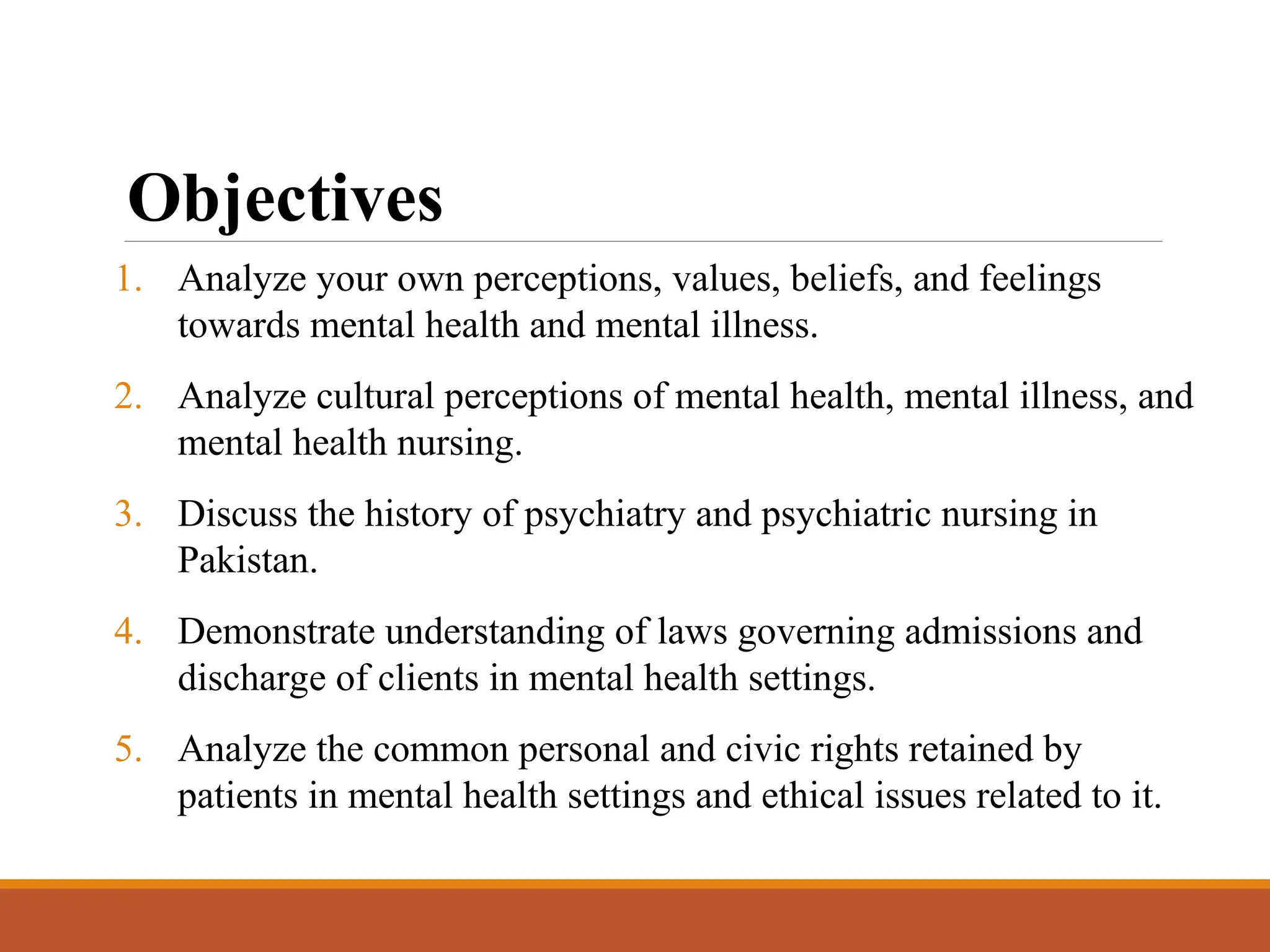
Objectives
1. Analyze your own perceptions, values, beliefs, and feelings
towards mental health and mental illness.
2. Analyze cultural perceptions of mental health, mental illness, and
mental health nursing.
3. Discuss the history of psychiatry and psychiatric nursing in
Pakistan.
4. Demonstrate understanding of laws governing admissions and
discharge of clients in mental health settings.
5. Analyze the common personal and civic rights retained by
patients in mental health settings and ethical issues related to it.
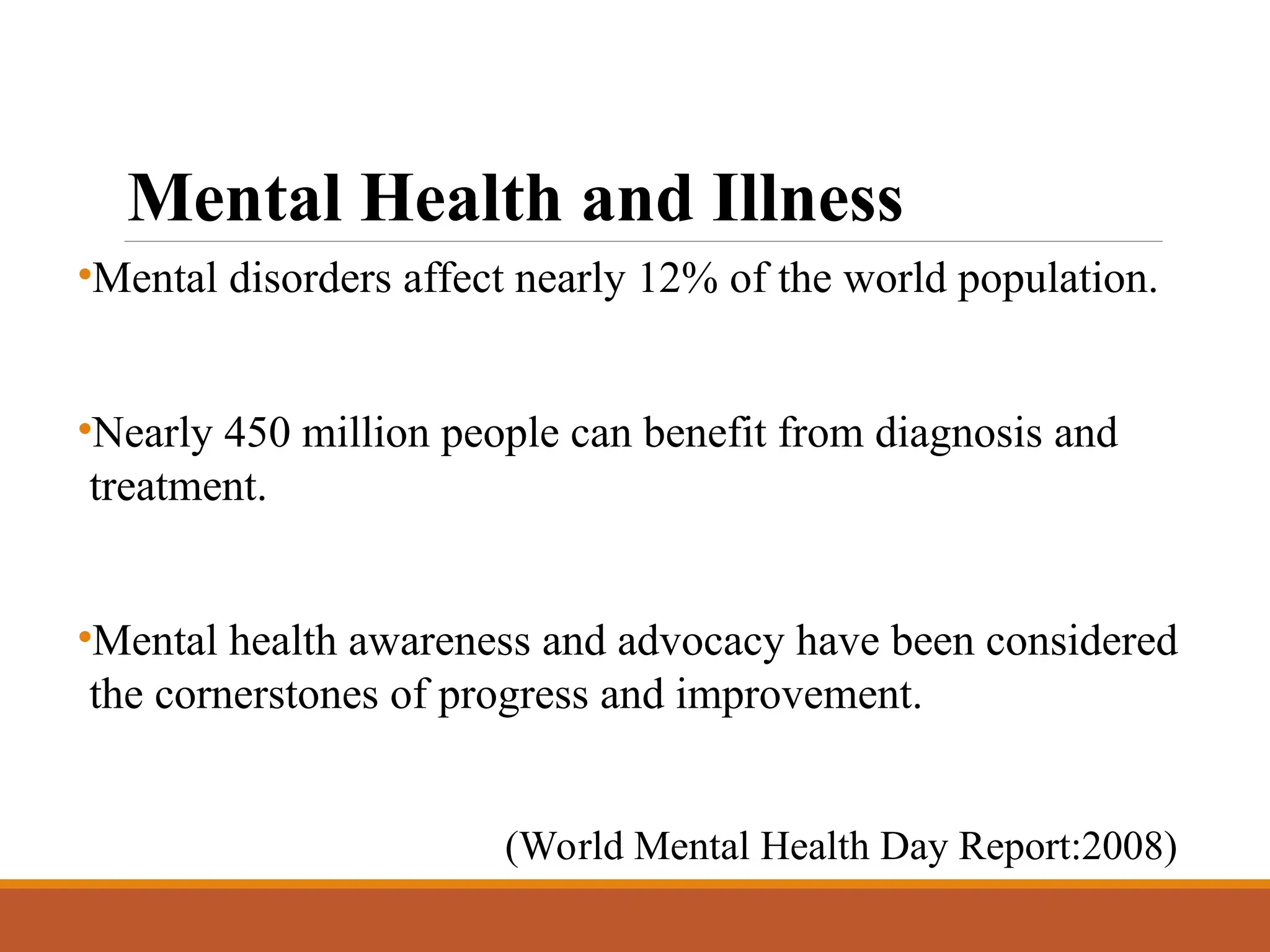
Mental Health and Illness
•Mental disorders affect nearly 12% of the world population.
•Nearly 450 million people can benefit from diagnosis and
treatment.
•Mental health awareness and advocacy have been considered
the cornerstones of progress and improvement.
(World Mental Health Day Report:2008)
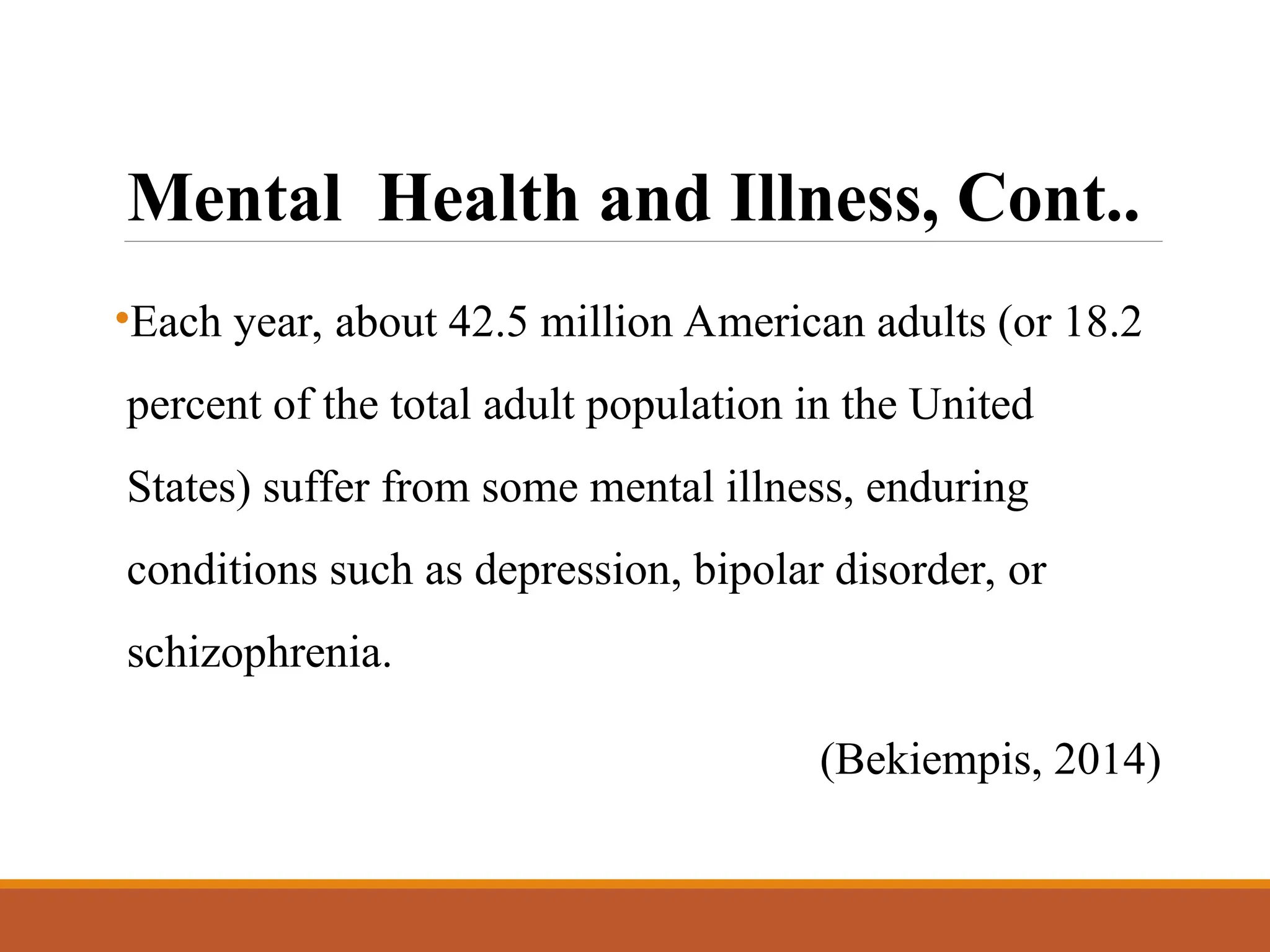
Mental Health and Illness, Cont..
•Each year, about 42.5 million American adults (or 18.2
percent of the total adult population in the United
States) suffer from some mental illness, enduring
conditions such as depression, bipolar disorder, or
schizophrenia.
(Bekiempis, 2014)
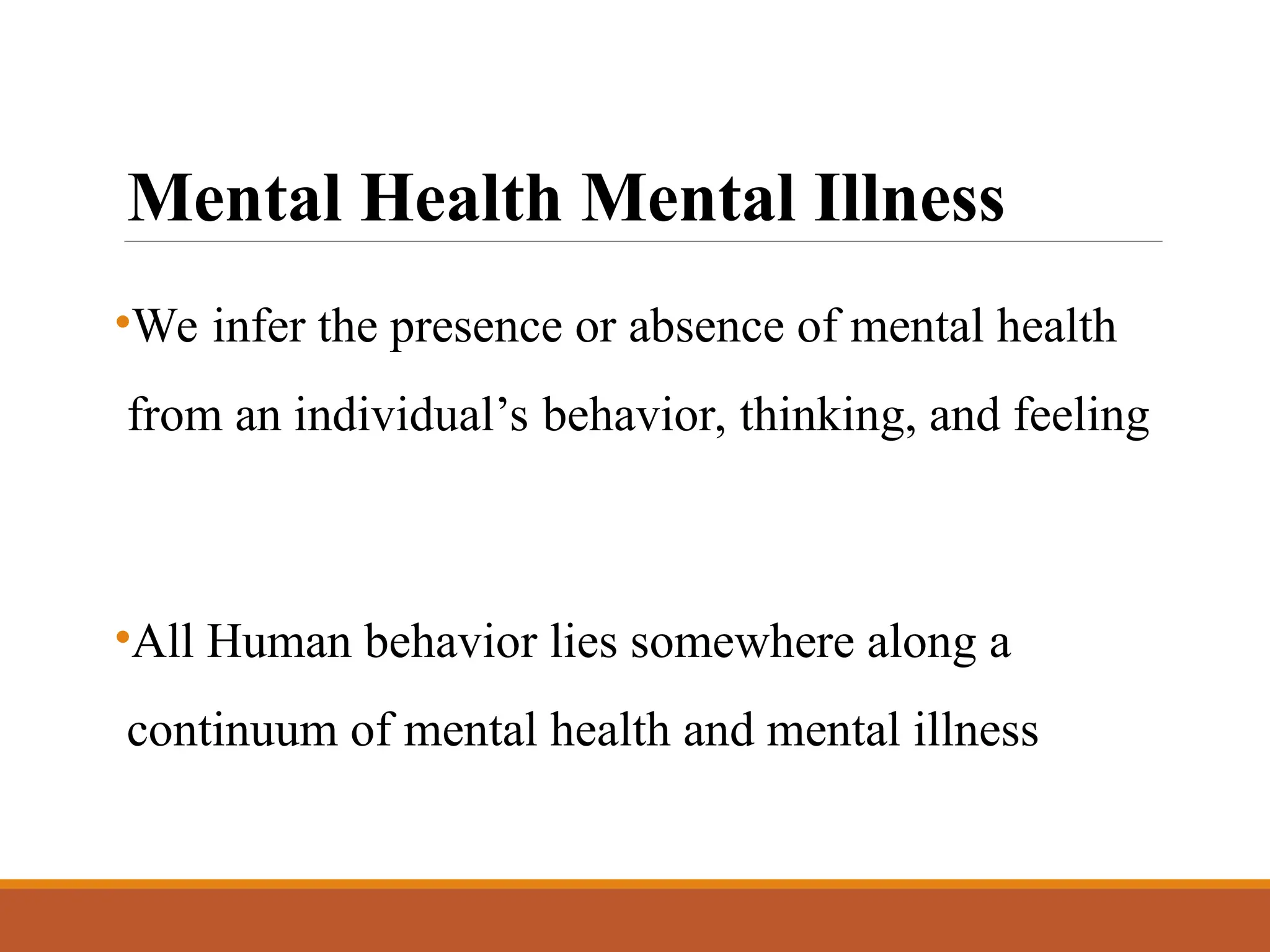
Mental Health Mental Illness
•We infer the presence or absence of mental health
from an individual’s behavior, thinking, and feeling
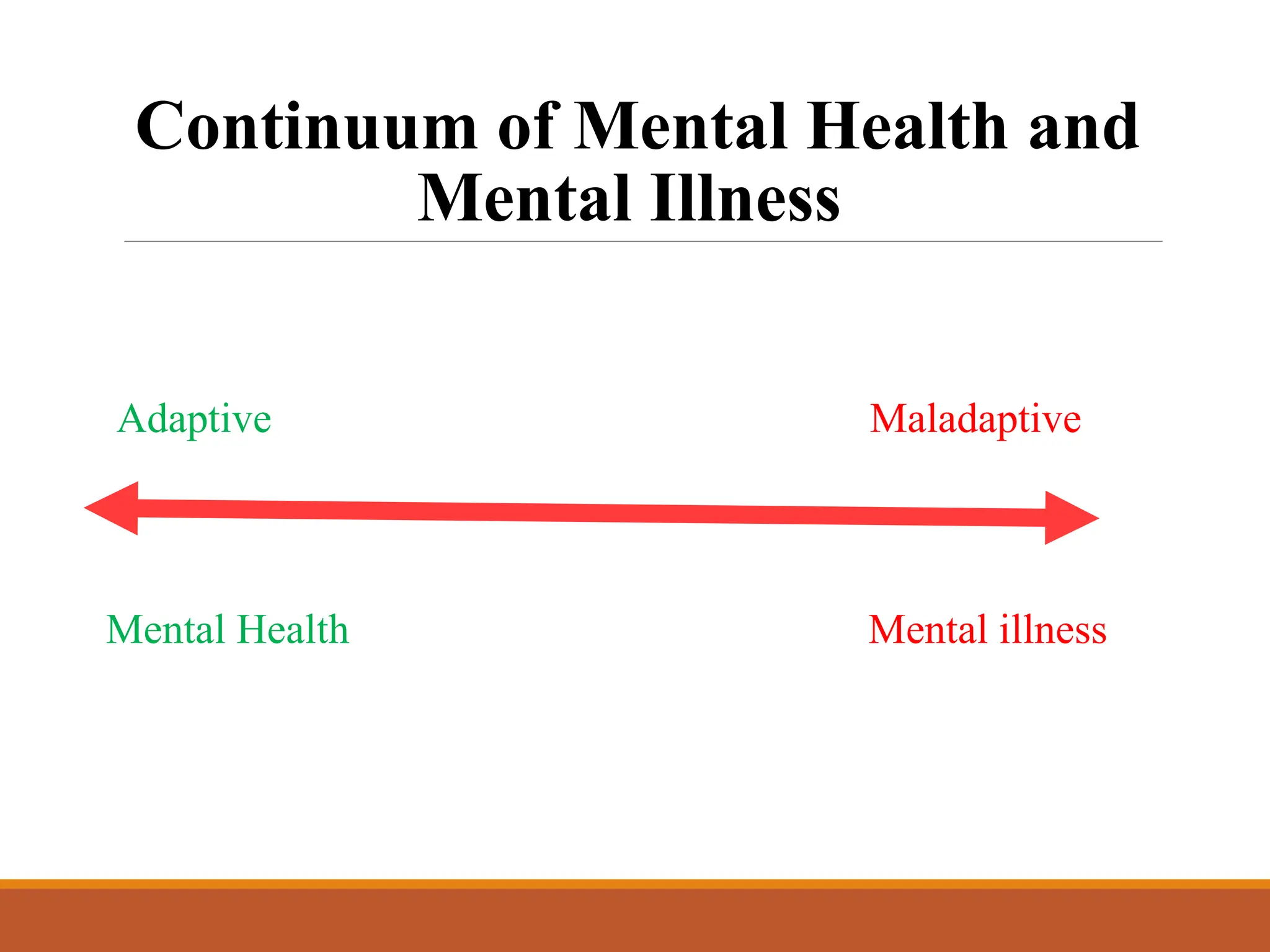
•All Human behavior lies somewhere along a
continuum of mental health and mental illness
Continuum of Mental Health and
Mental Illness
Adaptive Maladaptive
Mental Health Mental illness
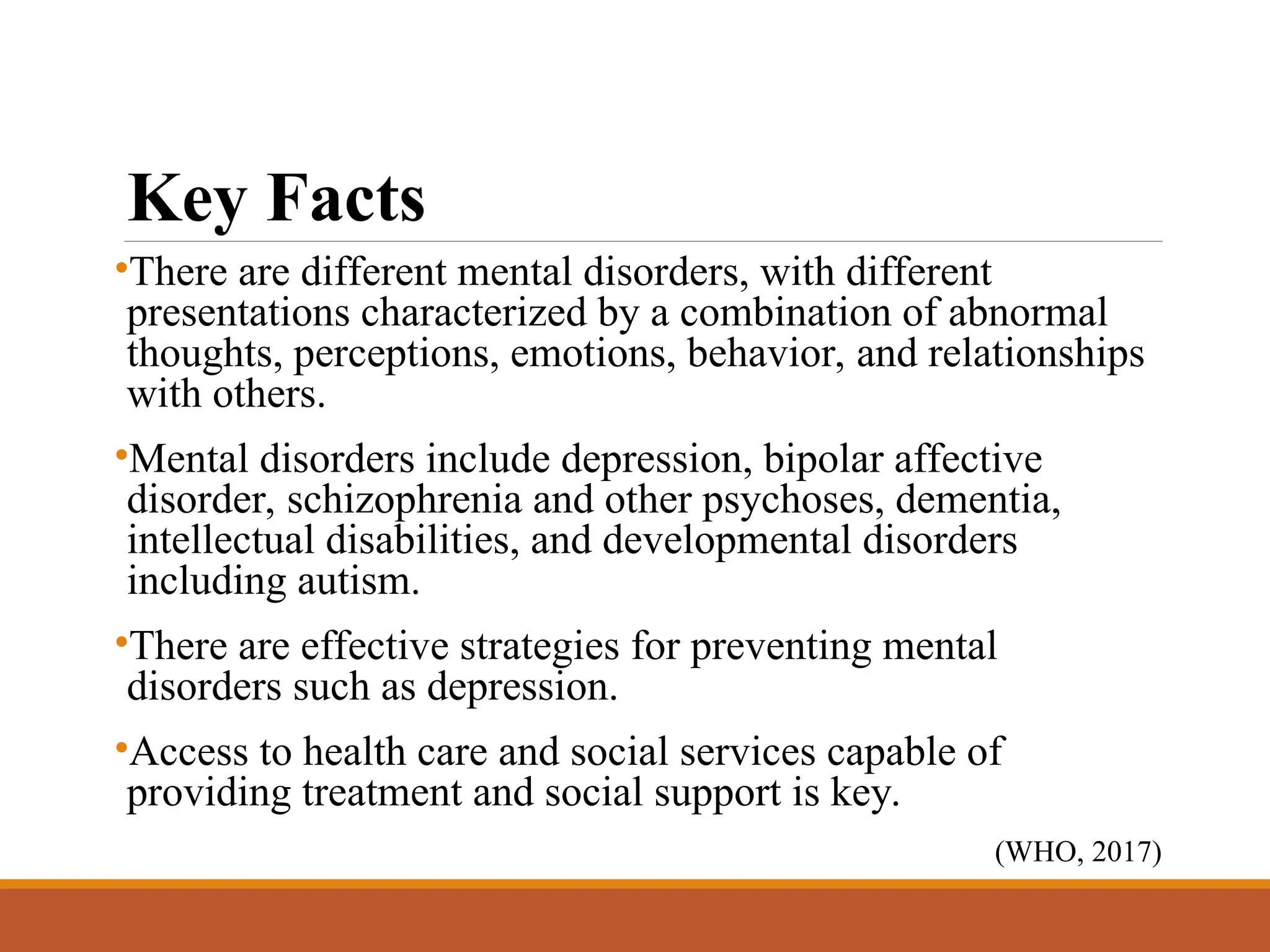
Key Facts
•There are different mental disorders, with different
presentations characterized by a combination of abnormal
thoughts, perceptions, emotions, behavior, and relationships
with others.
•Mental disorders include depression, bipolar affective
disorder, schizophrenia and other psychoses, dementia,
intellectual disabilities, and developmental disorders
including autism.
•There are effective strategies for preventing mental
disorders such as depression.
•Access to health care and social services capable of
providing treatment and social support is key.
(WHO, 2017)
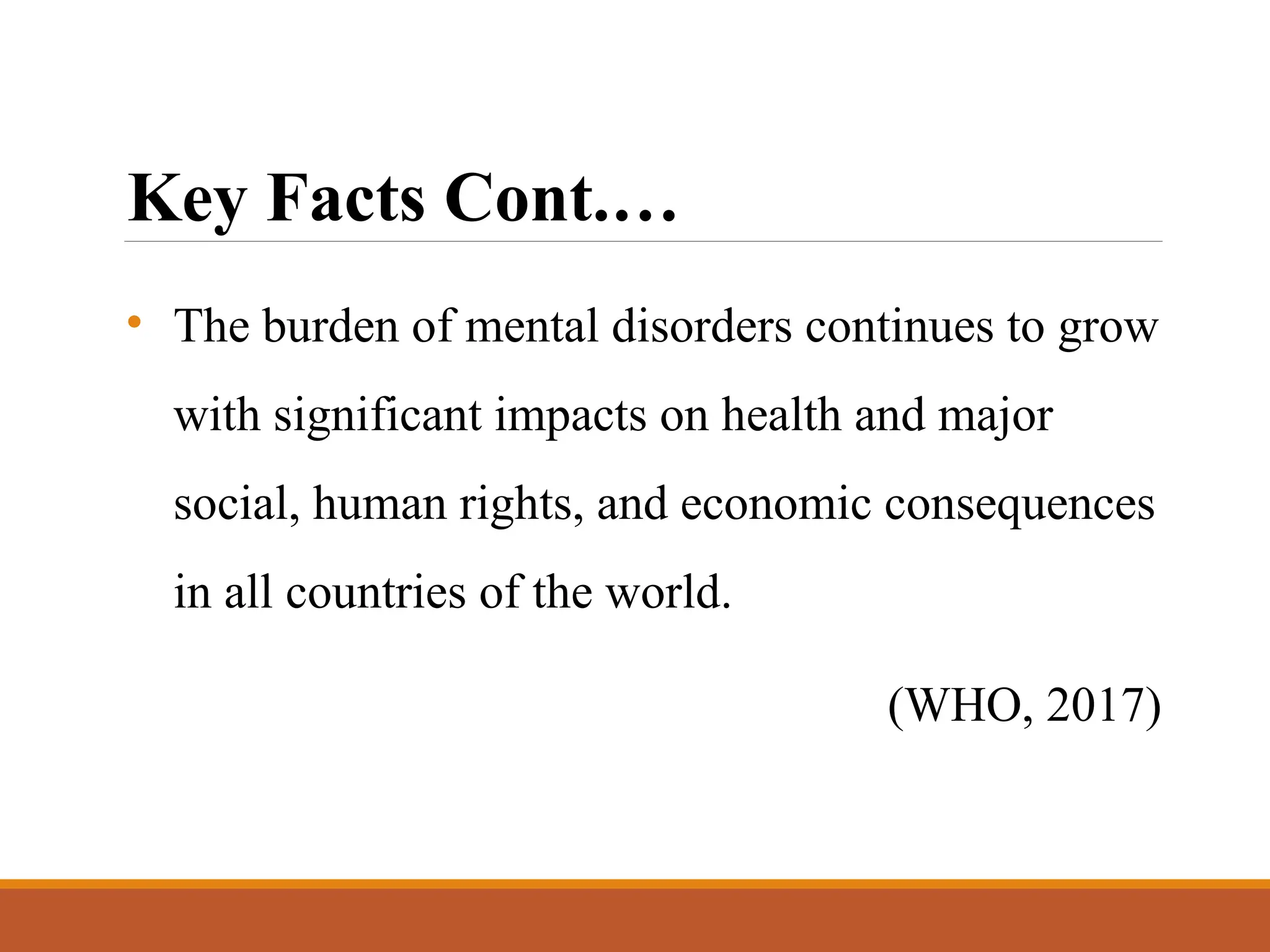
Key Facts Cont.…
• The burden of mental disorders continues to grow
with significant impacts on health and major
social, human rights, and economic consequences
in all countries of the world.
(WHO, 2017)
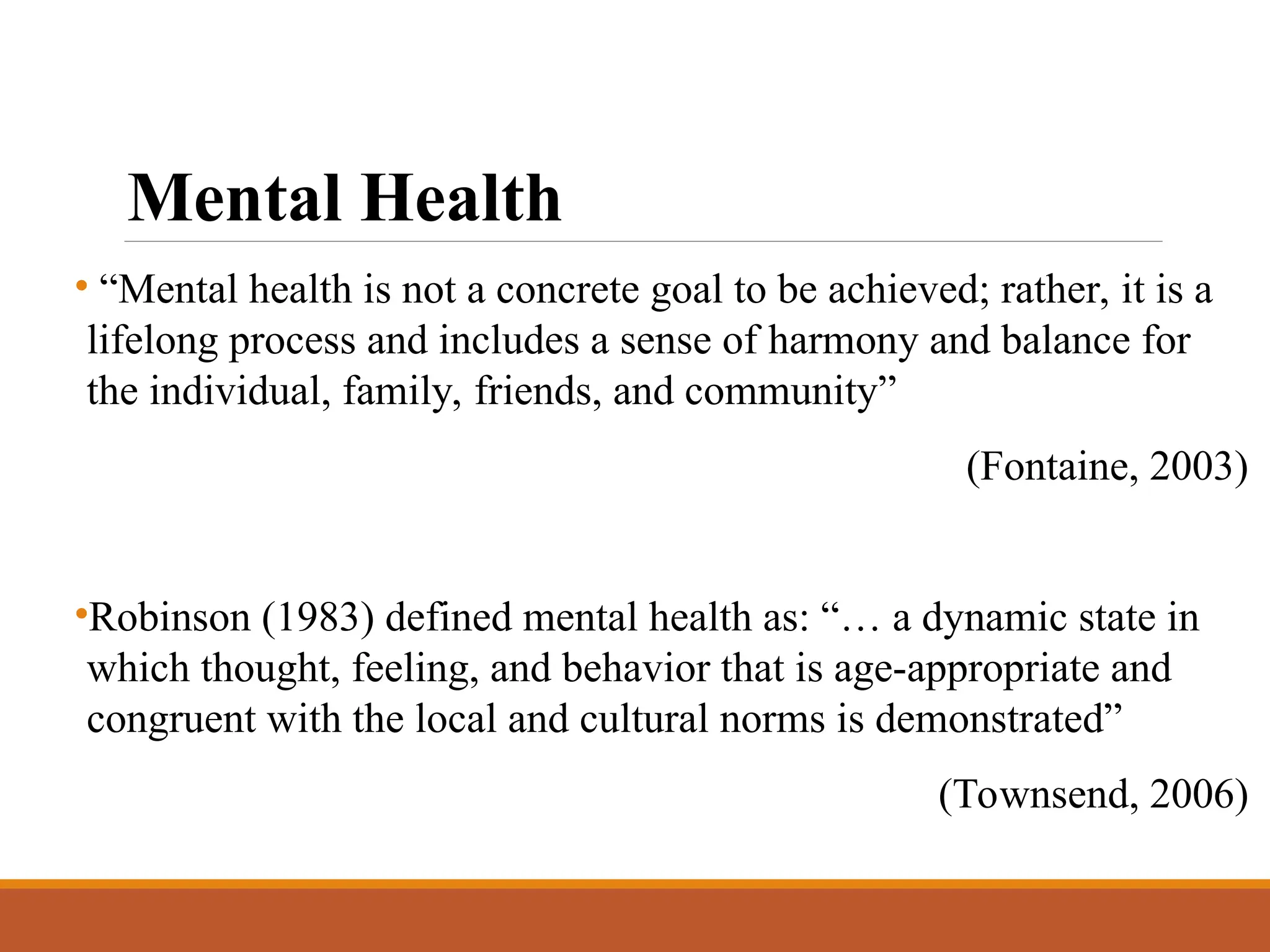
Mental Health
• “Mental health is not a concrete goal to be achieved; rather, it is a
lifelong process and includes a sense of harmony and balance for
the individual, family, friends, and community”
(Fontaine, 2003)
•Robinson (1983) defined mental health as: “… a dynamic state in
which thought, feeling, and behavior that is age-appropriate and
congruent with the local and cultural norms is demonstrated”
(Townsend, 2006)
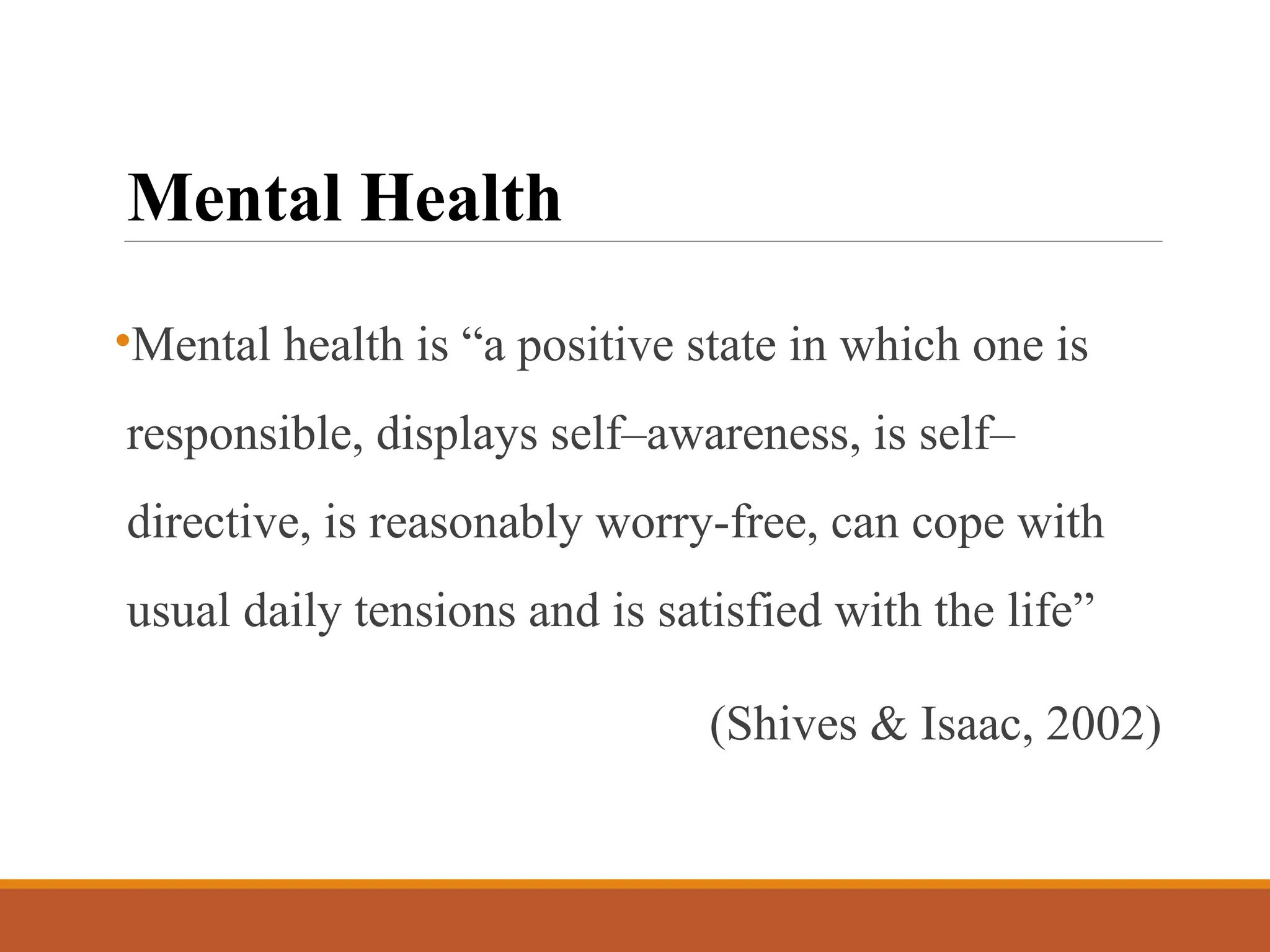
Mental Health
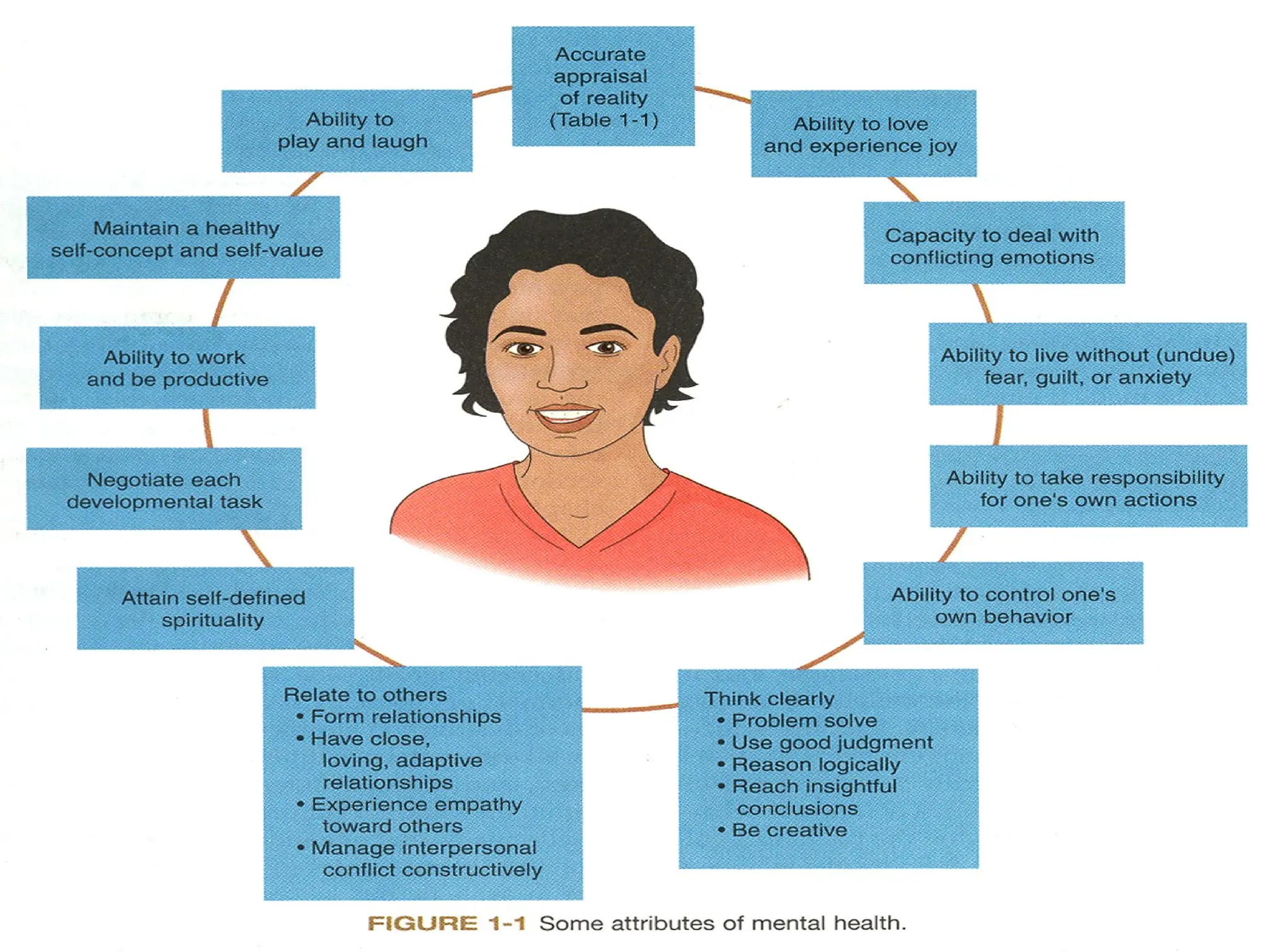
•Mental health is “a positive state in which one is
responsible, displays self–awareness, is self–
directive, is reasonably worry-free, can cope with
usual daily tensions and is satisfied with the life”
(Shives & Isaac, 2002)
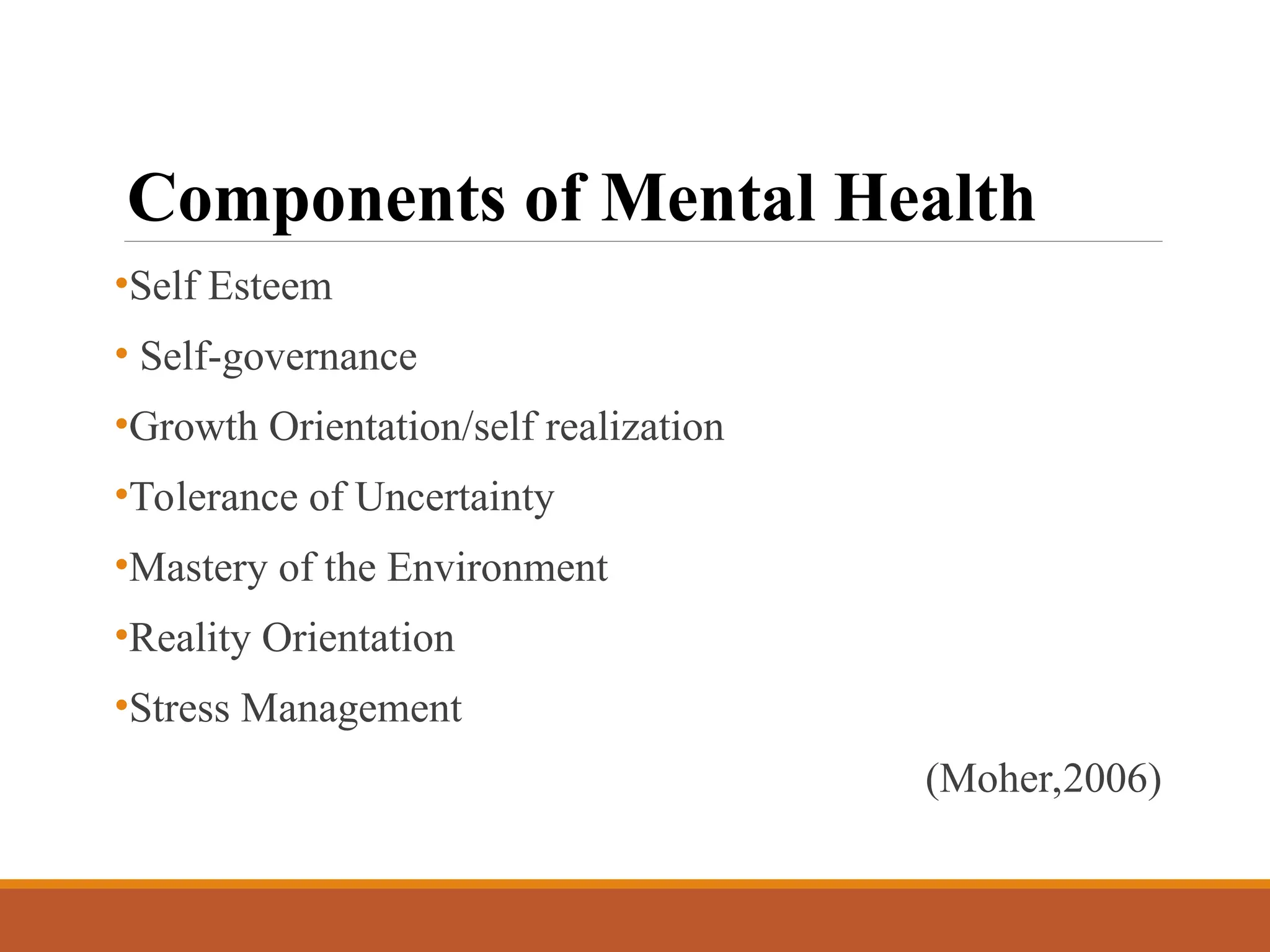
Components of Mental Health
•Self Esteem
• Self-governance
•Growth Orientation/self realization
•Tolerance of Uncertainty
•Mastery of the Environment
•Reality Orientation
•Stress Management
(Moher,2006)
Mental Illness
•Mental disorder is defined as “ a clinically significant
behavioral or psychological syndrome or pattern that
occurs in an individual and that is associated with
present distress (e.g., a painful symptom) or disability
(e.g., impairment in one or more important areas of
functioning).
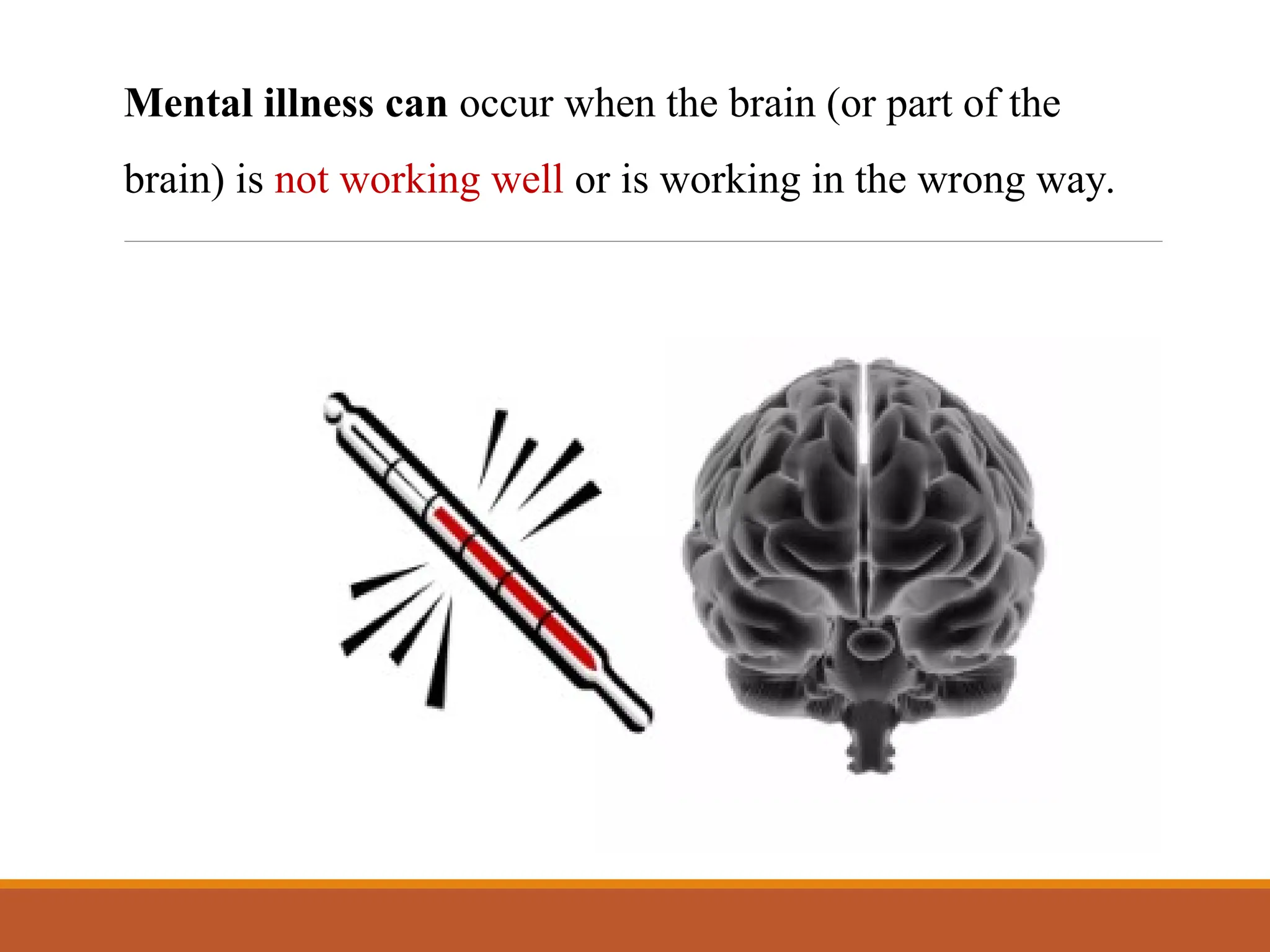
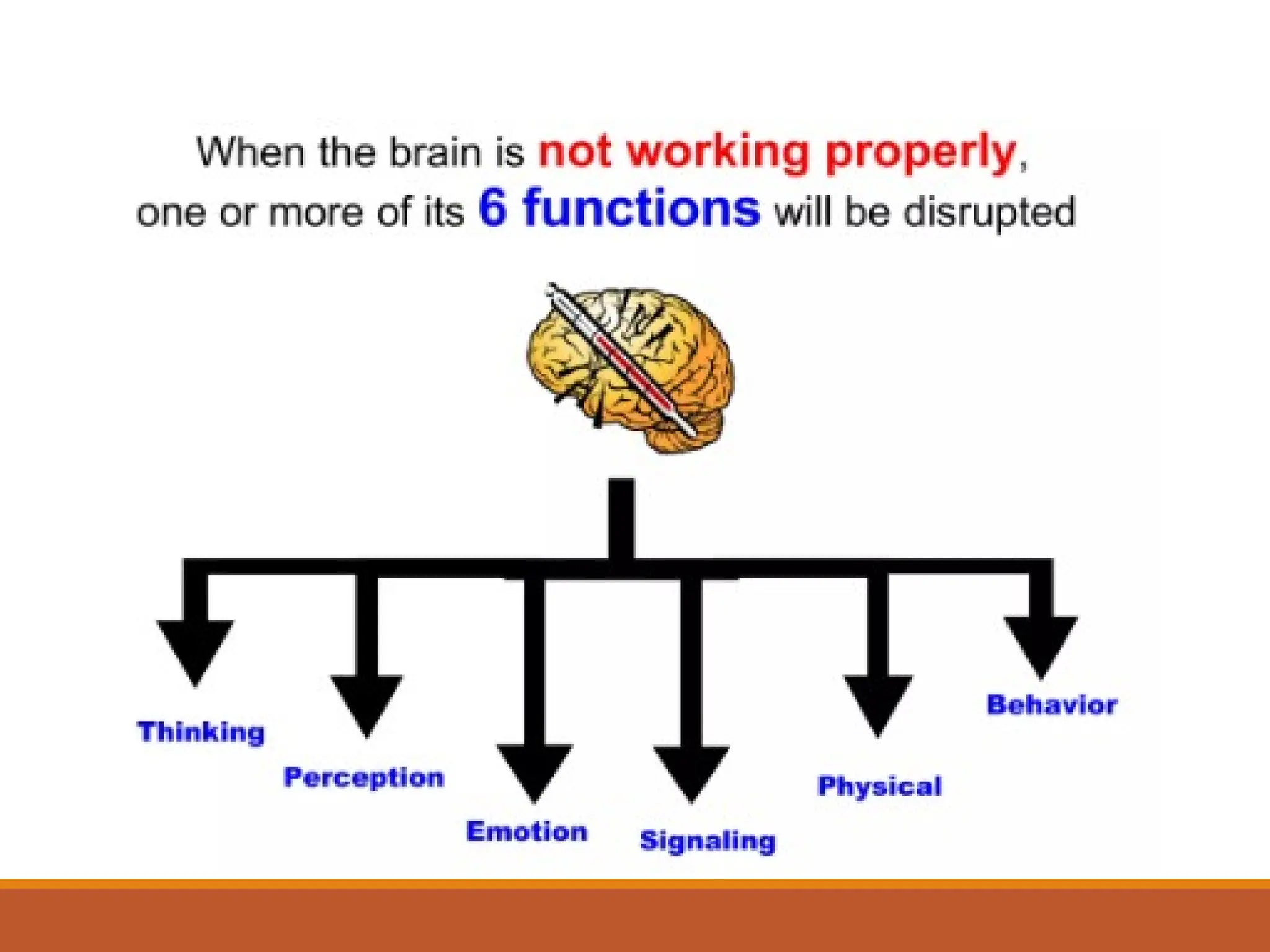
Mental illness can occur when the brain (or part of the
brain) is not working well or is working in the wrong way.
Guiding Principles for Mental
Health Nursing Practice
•Every person is worthy of dignity and respect
•Every person has the potential to change and grow
•All people share basic human needs
•All behavior is meaningful and can be understood from
the person’s perspective
•People have the right to participate in decisions
affecting their health and treatment
•Through the therapeutic use of self, via a therapeutic
relationship and communication nurses help people
adapt, change and grow.
(Mohr,2006)
Conclusion
•Mental health is like a violin with strings of interactions,
behaviors, affect, and intellect.
•All these together may produce a pleasant or stimulating
melody or they may be discordant and irritating. The tune
continually changes.
•No one is entirely mentally unhealthy, and no one is always
fully healthy
(Ebersole and Hess cited by Sheves 2002)
Bibliography
•Boyd, M. A. (2005). Psychiatric nursing contemporary practice. New York: Lippincott.
•Fortinash, K. M., & Worret, P. A. H. (2004). Psychiatric mental health nursing. (3rd ed.).
St. Louis: Mosby.
•Mohr, W. K.(2006).Psychiatric-mental health nursing (6th ed.). Philadelphia: Lippincott.
•Putman ,S (2008).Mental illness: Diagnostic Title or derogatory term? (Attitudes towards mental
illness.) Developing a learning resource for use within a clinical call centre. .A systematic
literature review on attitudes towards mental illness: The Journal of Psychiatric and Mental
Health Nursing 15,684-693
•Shives, L. R. (2002). Basic concepts of psychiatric mental health nursing (5th ed.). Philadelphia:
F.A Davis.
•World Mental Health theme Report, 2008
•WHO. (2017)
Any Question?
Any Question?
“Being able to be your
true self is one of the
strongest components
of good mental health”
THANKS
THANKS

Unit-1; Introduction to Mental Health Nursing.ppt

  • 1.
    Introduction to Mental Introductionto Mental Health / Illness Health / Illness Hammad Lecturer INS
  • 2.
    Objectives 1. Analyze yourown perceptions, values, beliefs, and feelings towards mental health and mental illness. 2. Analyze cultural perceptions of mental health, mental illness, and mental health nursing. 3. Discuss the history of psychiatry and psychiatric nursing in Pakistan. 4. Demonstrate understanding of laws governing admissions and discharge of clients in mental health settings. 5. Analyze the common personal and civic rights retained by patients in mental health settings and ethical issues related to it.
  • 6.
    Mental Health andIllness •Mental disorders affect nearly 12% of the world population. •Nearly 450 million people can benefit from diagnosis and treatment. •Mental health awareness and advocacy have been considered the cornerstones of progress and improvement. (World Mental Health Day Report:2008)
  • 7.
    Mental Health andIllness, Cont.. •Each year, about 42.5 million American adults (or 18.2 percent of the total adult population in the United States) suffer from some mental illness, enduring conditions such as depression, bipolar disorder, or schizophrenia. (Bekiempis, 2014)
  • 8.
    Mental Health MentalIllness •We infer the presence or absence of mental health from an individual’s behavior, thinking, and feeling •All Human behavior lies somewhere along a continuum of mental health and mental illness
  • 9.
    Continuum of MentalHealth and Mental Illness Adaptive Maladaptive Mental Health Mental illness
  • 10.
    Key Facts •There aredifferent mental disorders, with different presentations characterized by a combination of abnormal thoughts, perceptions, emotions, behavior, and relationships with others. •Mental disorders include depression, bipolar affective disorder, schizophrenia and other psychoses, dementia, intellectual disabilities, and developmental disorders including autism. •There are effective strategies for preventing mental disorders such as depression. •Access to health care and social services capable of providing treatment and social support is key. (WHO, 2017)
  • 11.
    Key Facts Cont.… •The burden of mental disorders continues to grow with significant impacts on health and major social, human rights, and economic consequences in all countries of the world. (WHO, 2017)
  • 12.
    Mental Health • “Mentalhealth is not a concrete goal to be achieved; rather, it is a lifelong process and includes a sense of harmony and balance for the individual, family, friends, and community” (Fontaine, 2003) •Robinson (1983) defined mental health as: “… a dynamic state in which thought, feeling, and behavior that is age-appropriate and congruent with the local and cultural norms is demonstrated” (Townsend, 2006)
  • 13.
    Mental Health •Mental healthis “a positive state in which one is responsible, displays self–awareness, is self– directive, is reasonably worry-free, can cope with usual daily tensions and is satisfied with the life” (Shives & Isaac, 2002)
  • 15.
    Components of MentalHealth •Self Esteem • Self-governance •Growth Orientation/self realization •Tolerance of Uncertainty •Mastery of the Environment •Reality Orientation •Stress Management (Moher,2006)
  • 16.
    Mental Illness •Mental disorderis defined as “ a clinically significant behavioral or psychological syndrome or pattern that occurs in an individual and that is associated with present distress (e.g., a painful symptom) or disability (e.g., impairment in one or more important areas of functioning).
  • 17.
    Mental illness canoccur when the brain (or part of the brain) is not working well or is working in the wrong way.
  • 19.
    Guiding Principles forMental Health Nursing Practice •Every person is worthy of dignity and respect •Every person has the potential to change and grow •All people share basic human needs •All behavior is meaningful and can be understood from the person’s perspective •People have the right to participate in decisions affecting their health and treatment •Through the therapeutic use of self, via a therapeutic relationship and communication nurses help people adapt, change and grow. (Mohr,2006)
  • 20.
    Conclusion •Mental health islike a violin with strings of interactions, behaviors, affect, and intellect. •All these together may produce a pleasant or stimulating melody or they may be discordant and irritating. The tune continually changes. •No one is entirely mentally unhealthy, and no one is always fully healthy (Ebersole and Hess cited by Sheves 2002)
  • 23.
    Bibliography •Boyd, M. A.(2005). Psychiatric nursing contemporary practice. New York: Lippincott. •Fortinash, K. M., & Worret, P. A. H. (2004). Psychiatric mental health nursing. (3rd ed.). St. Louis: Mosby. •Mohr, W. K.(2006).Psychiatric-mental health nursing (6th ed.). Philadelphia: Lippincott. •Putman ,S (2008).Mental illness: Diagnostic Title or derogatory term? (Attitudes towards mental illness.) Developing a learning resource for use within a clinical call centre. .A systematic literature review on attitudes towards mental illness: The Journal of Psychiatric and Mental Health Nursing 15,684-693 •Shives, L. R. (2002). Basic concepts of psychiatric mental health nursing (5th ed.). Philadelphia: F.A Davis. •World Mental Health theme Report, 2008 •WHO. (2017)
  • 24.
  • 25.
    “Being able tobe your true self is one of the strongest components of good mental health”
  • 26.