ninth edition
STEPHEN P. ROBBINS
PowerPoint Presentation by Charlie Cook
The University of West Alabama
MARY COULTER
© 2007 Prentice Hall, Inc.
All rights reserved.
Introduction to
Management and
Organizations
Chapter
1
© 2007 Prentice Hall, Inc. All rights reserved. 1–2
L E A R N I N G O U T L I N E
Follow this Learning Outline as you read and study this chapter.
Who Are Managers?
• Explain how managers differ from non-managerial
employees.
• Describe how to classify managers in organizations.
What Is Management?
• Define management.
• Explain why efficiency and effectiveness are important to
management.
© 2007 Prentice Hall, Inc. All rights reserved. 1–3
L E A R N I N G O U T L I N E (cont’d)
Follow this Learning Outline as you read and study this chapter.
What Do Managers Do?
• Describe the four functions of management.
• Explain Mintzberg’s managerial roles.
• Describe Katz’s three essential managerial skills and how
the importance of these skills changes depending on
managerial level.
• Discuss the changes that are impacting managers’ jobs.
• Explain why customer service and innovation are
important to the manager’s job.
© 2007 Prentice Hall, Inc. All rights reserved. 1–4
L E A R N I N G O U T L I N E (cont’d)
Follow this Learning Outline as you read and study this chapter.
What Is An Organization?
• Describe the characteristics of an organization.
• Explain how the concept of an organization is changing.
Why Study Management?
• Explain the universality of management concept.
• Discuss why an understanding of management is
important.
• Describe the rewards and challenges of being a manager.
© 2007 Prentice Hall, Inc. All rights reserved. 1–5
Who Are Managers?
• Manager
Someone who coordinates and oversees the work of
other people so that organizational goals can be
accomplished.
Managers do matter
What to do & how to do
© 2007 Prentice Hall, Inc. All rights reserved. 1–6
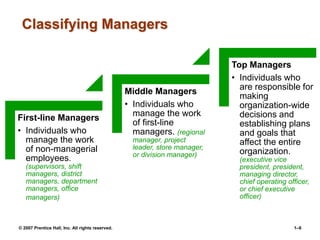
Classifying Managers
First-line Managers
• Individuals who
manage the work
of non-managerial
employees.
(supervisors, shift
managers, district
managers, department
managers, office
managers)
Middle Managers
• Individuals who
manage the work
of first-line
managers. (regional
manager, project
leader, store manager,
or division manager)
Top Managers
• Individuals who
are responsible for
making
organization-wide
decisions and
establishing plans
and goals that
affect the entire
organization.
(executive vice
president, president,
managing director,
chief operating officer,
or chief executive
officer)
© 2007 Prentice Hall, Inc. All rights reserved. 1–7
Exhibit 1–1 Managerial Levels
© 2007 Prentice Hall, Inc. All rights reserved. 1–8
What Is Management?
• Managerial Concerns
Efficiency
 “Doing things right”
– Getting the most output
for the least inputs
Effectiveness
 “Doing the right things”
– Attaining organizational
goals
© 2007 Prentice Hall, Inc. All rights reserved. 1–10
Exhibit 1–2 Effectiveness and Efficiency in Management
© 2007 Prentice Hall, Inc. All rights reserved. 1–11
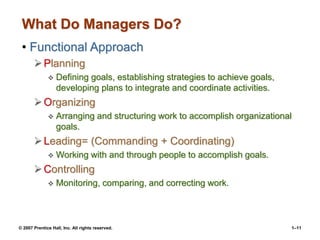
What Do Managers Do?
• Functional Approach
Planning
 Defining goals, establishing strategies to achieve goals,
developing plans to integrate and coordinate activities.
Organizing
 Arranging and structuring work to accomplish organizational
goals.
Leading= (Commanding + Coordinating)
 Working with and through people to accomplish goals.
Controlling
 Monitoring, comparing, and correcting work.
© 2007 Prentice Hall, Inc. All rights reserved. 1–12
Exhibit 1–3 Management Functions
© 2007 Prentice Hall, Inc. All rights reserved. 1–13
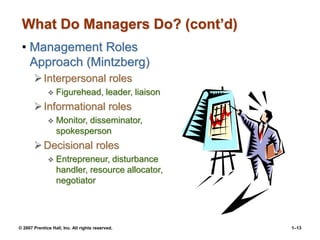
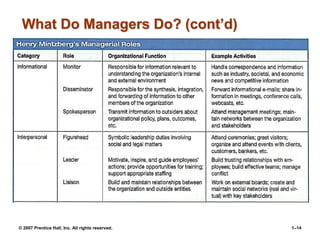
What Do Managers Do? (cont’d)
• Management Roles
Approach (Mintzberg)
Interpersonal roles
 Figurehead, leader, liaison
Informational roles
 Monitor, disseminator,
spokesperson
Decisional roles
 Entrepreneur, disturbance
handler, resource allocator,
negotiator
© 2007 Prentice Hall, Inc. All rights reserved. 1–14
What Do Managers Do? (cont’d)
© 2007 Prentice Hall, Inc. All rights reserved. 1–15
What Do Managers Do? (cont’d)
© 2007 Prentice Hall, Inc. All rights reserved. 1–16
What Managers Actually Do (Mintzberg)
• Interaction
with others
with the organization
with the external context
(environment) of the
organization
• Reflection
thoughtful thinking
• Action
practical doing
© 2007 Prentice Hall, Inc. All rights reserved. 1–17
What Do Managers Do? (cont’d)
• Skills Approach
Technical skills
 Knowledge and proficiency in a specific field
Human skills
 The ability to work well with other people
Conceptual skills
 The ability to think and conceptualize about complex
situations concerning the organization
© 2007 Prentice Hall, Inc. All rights reserved. 1–18
Exhibit 1–5 Skills Needed at Different Management Levels
© 2007 Prentice Hall, Inc. All rights reserved. 1–19
Exhibit 1–6 Conceptual Skills
• Using information to solve business problems
• Identifying of opportunities for innovation
• Recognizing problem areas and implementing
solutions
• Selecting critical information from masses of
data
• Understanding of business uses of technology
• Understanding of organization’s business model
 A business model is an organization’s plan for making a profit.
It identifies the products or services the business will sell, the
target market it has identified, and the expenses it anticipates.
© 2007 Prentice Hall, Inc. All rights reserved. 1–20
Exhibit 1–6 Communication Skills
• Ability to transform ideas into words and actions
• Credibility among colleagues, peers, and
subordinates
• Listening and asking questions
• Presentation skills; spoken format
• Presentation skills; written and/or graphic
formats
Source: Based on American Management Association Survey of Managerial Skills and
Competencies, March/April 2000, found on AMA Web site (www.ama.org), October 30, 2002.
© 2007 Prentice Hall, Inc. All rights reserved. 1–21
Exhibit 1–6 Effectiveness Skills
• Contributing to corporate mission/departmental
objectives
• Customer focus
• Multitasking: working at multiple tasks in parallel
• Negotiating skills
• Project management
• Reviewing operations and implementing
improvements
Source: Based on American Management Association Survey of Managerial Skills and
Competencies, March/April 2000, found on AMA Web site (www.ama.org), October 30, 2002.
© 2007 Prentice Hall, Inc. All rights reserved. 1–22
Exhibit 1–6 Effectiveness Skills (cont’d)
Source: Based on American Management Association Survey of Managerial Skills and
Competencies, March/April 2000, found on AMA Web site (www.ama.org), October 30, 2002.
• Setting and maintaining performance standards
internally and externally
• Setting priorities for attention and activity
• Time management
© 2007 Prentice Hall, Inc. All rights reserved. 1–23
Exhibit 1–6 Interpersonal Skills
Source: Based on American Management Association Survey of Managerial Skills and
Competencies, March/April 2000, found on AMA Web site (www.ama.org), October 30, 2002.
• Coaching and mentoring skills
• Diversity skills: working with diverse people and
cultures
• Networking within the organization
• Networking outside the organization
• Working in teams; cooperation and commitment
© 2007 Prentice Hall, Inc. All rights reserved. 1–24
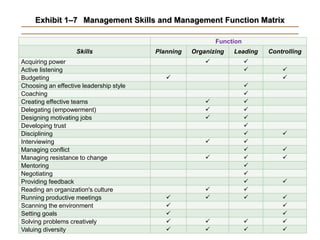
Exhibit 1–7 Management Skills and Management Function Matrix
Function
Skills Planning Organizing Leading Controlling
Acquiring power
Active listening
Budgeting
Choosing an effective leadership style
Coaching
Creating effective teams
Delegating (empowerment)
Designing motivating jobs
Developing trust
Disciplining
Interviewing
Managing conflict
Managing resistance to change
Mentoring
Negotiating
Providing feedback
Reading an organization's culture
Running productive meetings
Scanning the environment
Setting goals
Solving problems creatively
Valuing diversity
© 2007 Prentice Hall, Inc. All rights reserved. 1–25
Exhibit 1–7 Management Skills and Management Function Matrix
Function
Skills Planning Organizing Leading Controlling
Acquiring power  
Active listening  
Budgeting  
Choosing an effective leadership style 
Coaching 
Creating effective teams  
Delegating (empowerment)  
Designing motivating jobs  
Developing trust 
Disciplining  
Interviewing  
Managing conflict  
Managing resistance to change   
Mentoring 
Negotiating 
Providing feedback  
Reading an organization's culture  
Running productive meetings    
Scanning the environment  
Setting goals  
Solving problems creatively    
Valuing diversity    
© 2007 Prentice Hall, Inc. All rights reserved. 1–26
How The Manager’s Job Is Changing
• The Increasing Importance of Customers
Customers: the reason that organizations exist
 Managing customer relationships is the responsibility of all
managers and employees.
 Consistent high quality customer service is essential for
survival.
• Innovation
Doing things differently, exploring new territory, and
taking risks
 Managers should encourage employees to be aware of and
act on opportunities for innovation.
© 2007 Prentice Hall, Inc. All rights reserved. 1–27
Exhibit 1–8
Changes Impacting
the Manager’s Job
© 2007 Prentice Hall, Inc. All rights reserved. 1–28
What Is An Organization?
• An Organization
A deliberate arrangement of people to accomplish
some specific purpose (that individuals independently
could not accomplish alone).
• Common Characteristics of Organizations
Have a distinct purpose (goal)
Composed of people
Have a deliberate structure
© 2007 Prentice Hall, Inc. All rights reserved. 1–29
Exhibit 1–9 Characteristics of Organizations
© 2007 Prentice Hall, Inc. All rights reserved. 1–30
Exhibit 1–10 The Changing Organization
© 2007 Prentice Hall, Inc. All rights reserved. 1–31
Why Study Management?
• The Value of Studying Management
The universality of management
 Good management is needed in all organizations.
The reality of work
 Employees either manage or are managed.
Rewards and challenges of being a manager
 Management offers challenging, exciting and creative
opportunities for meaningful and fulfilling work.
 Successful managers receive significant monetary rewards
for their efforts.
© 2007 Prentice Hall, Inc. All rights reserved. 1–32
Exhibit 1–11 Universal Need for Management
© 2007 Prentice Hall, Inc. All rights reserved. 1–33
Exhibit 1–12 Rewards and Challenges of Being A Manager
© 2007 Prentice Hall, Inc. All rights reserved. 1–34
Terms to Know
• manager
• first-line managers
• middle managers
• top managers
• management
• efficiency
• effectiveness
• planning
• organizing
• leading
• controlling
• management roles
• interpersonal roles
• informational roles
• decisional roles
• technical skills
• human skills
• conceptual skills
• organization
• universality of
management
© 2007 Prentice Hall, Inc. All rights reserved. 1–35
© 2007 Prentice Hall, Inc. All rights reserved. 1–36

Introduction to managers and organization

  • 1.
    ninth edition STEPHEN P.ROBBINS PowerPoint Presentation by Charlie Cook The University of West Alabama MARY COULTER © 2007 Prentice Hall, Inc. All rights reserved. Introduction to Management and Organizations Chapter 1
  • 2.
    © 2007 PrenticeHall, Inc. All rights reserved. 1–2 L E A R N I N G O U T L I N E Follow this Learning Outline as you read and study this chapter. Who Are Managers? • Explain how managers differ from non-managerial employees. • Describe how to classify managers in organizations. What Is Management? • Define management. • Explain why efficiency and effectiveness are important to management.
  • 3.
    © 2007 PrenticeHall, Inc. All rights reserved. 1–3 L E A R N I N G O U T L I N E (cont’d) Follow this Learning Outline as you read and study this chapter. What Do Managers Do? • Describe the four functions of management. • Explain Mintzberg’s managerial roles. • Describe Katz’s three essential managerial skills and how the importance of these skills changes depending on managerial level. • Discuss the changes that are impacting managers’ jobs. • Explain why customer service and innovation are important to the manager’s job.
  • 4.
    © 2007 PrenticeHall, Inc. All rights reserved. 1–4 L E A R N I N G O U T L I N E (cont’d) Follow this Learning Outline as you read and study this chapter. What Is An Organization? • Describe the characteristics of an organization. • Explain how the concept of an organization is changing. Why Study Management? • Explain the universality of management concept. • Discuss why an understanding of management is important. • Describe the rewards and challenges of being a manager.
  • 5.
    © 2007 PrenticeHall, Inc. All rights reserved. 1–5 Who Are Managers? • Manager Someone who coordinates and oversees the work of other people so that organizational goals can be accomplished. Managers do matter What to do & how to do
  • 6.
    © 2007 PrenticeHall, Inc. All rights reserved. 1–6 Classifying Managers First-line Managers • Individuals who manage the work of non-managerial employees. (supervisors, shift managers, district managers, department managers, office managers) Middle Managers • Individuals who manage the work of first-line managers. (regional manager, project leader, store manager, or division manager) Top Managers • Individuals who are responsible for making organization-wide decisions and establishing plans and goals that affect the entire organization. (executive vice president, president, managing director, chief operating officer, or chief executive officer)
  • 7.
    © 2007 PrenticeHall, Inc. All rights reserved. 1–7 Exhibit 1–1 Managerial Levels
  • 8.
    © 2007 PrenticeHall, Inc. All rights reserved. 1–8 What Is Management? • Managerial Concerns Efficiency  “Doing things right” – Getting the most output for the least inputs Effectiveness  “Doing the right things” – Attaining organizational goals
  • 9.
    © 2007 PrenticeHall, Inc. All rights reserved. 1–10 Exhibit 1–2 Effectiveness and Efficiency in Management
  • 10.
    © 2007 PrenticeHall, Inc. All rights reserved. 1–11 What Do Managers Do? • Functional Approach Planning  Defining goals, establishing strategies to achieve goals, developing plans to integrate and coordinate activities. Organizing  Arranging and structuring work to accomplish organizational goals. Leading= (Commanding + Coordinating)  Working with and through people to accomplish goals. Controlling  Monitoring, comparing, and correcting work.
  • 11.
    © 2007 PrenticeHall, Inc. All rights reserved. 1–12 Exhibit 1–3 Management Functions
  • 12.
    © 2007 PrenticeHall, Inc. All rights reserved. 1–13 What Do Managers Do? (cont’d) • Management Roles Approach (Mintzberg) Interpersonal roles  Figurehead, leader, liaison Informational roles  Monitor, disseminator, spokesperson Decisional roles  Entrepreneur, disturbance handler, resource allocator, negotiator
  • 13.
    © 2007 PrenticeHall, Inc. All rights reserved. 1–14 What Do Managers Do? (cont’d)
  • 14.
    © 2007 PrenticeHall, Inc. All rights reserved. 1–15 What Do Managers Do? (cont’d)
  • 15.
    © 2007 PrenticeHall, Inc. All rights reserved. 1–16 What Managers Actually Do (Mintzberg) • Interaction with others with the organization with the external context (environment) of the organization • Reflection thoughtful thinking • Action practical doing
  • 16.
    © 2007 PrenticeHall, Inc. All rights reserved. 1–17 What Do Managers Do? (cont’d) • Skills Approach Technical skills  Knowledge and proficiency in a specific field Human skills  The ability to work well with other people Conceptual skills  The ability to think and conceptualize about complex situations concerning the organization
  • 17.
    © 2007 PrenticeHall, Inc. All rights reserved. 1–18 Exhibit 1–5 Skills Needed at Different Management Levels
  • 18.
    © 2007 PrenticeHall, Inc. All rights reserved. 1–19 Exhibit 1–6 Conceptual Skills • Using information to solve business problems • Identifying of opportunities for innovation • Recognizing problem areas and implementing solutions • Selecting critical information from masses of data • Understanding of business uses of technology • Understanding of organization’s business model  A business model is an organization’s plan for making a profit. It identifies the products or services the business will sell, the target market it has identified, and the expenses it anticipates.
  • 19.
    © 2007 PrenticeHall, Inc. All rights reserved. 1–20 Exhibit 1–6 Communication Skills • Ability to transform ideas into words and actions • Credibility among colleagues, peers, and subordinates • Listening and asking questions • Presentation skills; spoken format • Presentation skills; written and/or graphic formats Source: Based on American Management Association Survey of Managerial Skills and Competencies, March/April 2000, found on AMA Web site (www.ama.org), October 30, 2002.
  • 20.
    © 2007 PrenticeHall, Inc. All rights reserved. 1–21 Exhibit 1–6 Effectiveness Skills • Contributing to corporate mission/departmental objectives • Customer focus • Multitasking: working at multiple tasks in parallel • Negotiating skills • Project management • Reviewing operations and implementing improvements Source: Based on American Management Association Survey of Managerial Skills and Competencies, March/April 2000, found on AMA Web site (www.ama.org), October 30, 2002.
  • 21.
    © 2007 PrenticeHall, Inc. All rights reserved. 1–22 Exhibit 1–6 Effectiveness Skills (cont’d) Source: Based on American Management Association Survey of Managerial Skills and Competencies, March/April 2000, found on AMA Web site (www.ama.org), October 30, 2002. • Setting and maintaining performance standards internally and externally • Setting priorities for attention and activity • Time management
  • 22.
    © 2007 PrenticeHall, Inc. All rights reserved. 1–23 Exhibit 1–6 Interpersonal Skills Source: Based on American Management Association Survey of Managerial Skills and Competencies, March/April 2000, found on AMA Web site (www.ama.org), October 30, 2002. • Coaching and mentoring skills • Diversity skills: working with diverse people and cultures • Networking within the organization • Networking outside the organization • Working in teams; cooperation and commitment
  • 23.
    © 2007 PrenticeHall, Inc. All rights reserved. 1–24 Exhibit 1–7 Management Skills and Management Function Matrix Function Skills Planning Organizing Leading Controlling Acquiring power Active listening Budgeting Choosing an effective leadership style Coaching Creating effective teams Delegating (empowerment) Designing motivating jobs Developing trust Disciplining Interviewing Managing conflict Managing resistance to change Mentoring Negotiating Providing feedback Reading an organization's culture Running productive meetings Scanning the environment Setting goals Solving problems creatively Valuing diversity
  • 24.
    © 2007 PrenticeHall, Inc. All rights reserved. 1–25 Exhibit 1–7 Management Skills and Management Function Matrix Function Skills Planning Organizing Leading Controlling Acquiring power   Active listening   Budgeting   Choosing an effective leadership style  Coaching  Creating effective teams   Delegating (empowerment)   Designing motivating jobs   Developing trust  Disciplining   Interviewing   Managing conflict   Managing resistance to change    Mentoring  Negotiating  Providing feedback   Reading an organization's culture   Running productive meetings     Scanning the environment   Setting goals   Solving problems creatively     Valuing diversity    
  • 25.
    © 2007 PrenticeHall, Inc. All rights reserved. 1–26 How The Manager’s Job Is Changing • The Increasing Importance of Customers Customers: the reason that organizations exist  Managing customer relationships is the responsibility of all managers and employees.  Consistent high quality customer service is essential for survival. • Innovation Doing things differently, exploring new territory, and taking risks  Managers should encourage employees to be aware of and act on opportunities for innovation.
  • 26.
    © 2007 PrenticeHall, Inc. All rights reserved. 1–27 Exhibit 1–8 Changes Impacting the Manager’s Job
  • 27.
    © 2007 PrenticeHall, Inc. All rights reserved. 1–28 What Is An Organization? • An Organization A deliberate arrangement of people to accomplish some specific purpose (that individuals independently could not accomplish alone). • Common Characteristics of Organizations Have a distinct purpose (goal) Composed of people Have a deliberate structure
  • 28.
    © 2007 PrenticeHall, Inc. All rights reserved. 1–29 Exhibit 1–9 Characteristics of Organizations
  • 29.
    © 2007 PrenticeHall, Inc. All rights reserved. 1–30 Exhibit 1–10 The Changing Organization
  • 30.
    © 2007 PrenticeHall, Inc. All rights reserved. 1–31 Why Study Management? • The Value of Studying Management The universality of management  Good management is needed in all organizations. The reality of work  Employees either manage or are managed. Rewards and challenges of being a manager  Management offers challenging, exciting and creative opportunities for meaningful and fulfilling work.  Successful managers receive significant monetary rewards for their efforts.
  • 31.
    © 2007 PrenticeHall, Inc. All rights reserved. 1–32 Exhibit 1–11 Universal Need for Management
  • 32.
    © 2007 PrenticeHall, Inc. All rights reserved. 1–33 Exhibit 1–12 Rewards and Challenges of Being A Manager
  • 33.
    © 2007 PrenticeHall, Inc. All rights reserved. 1–34 Terms to Know • manager • first-line managers • middle managers • top managers • management • efficiency • effectiveness • planning • organizing • leading • controlling • management roles • interpersonal roles • informational roles • decisional roles • technical skills • human skills • conceptual skills • organization • universality of management
  • 34.
    © 2007 PrenticeHall, Inc. All rights reserved. 1–35
  • 35.
    © 2007 PrenticeHall, Inc. All rights reserved. 1–36