ninth edition
STEPHEN P. ROBBINS
PowerPoint Presentation by Charlie Cook
The University of West Alabama
MARY COULTER
© 2007 Prentice Hall, Inc.
All rights reserved.
Introduction to
Introduction to
Management and
Management and
Organizations
Organizations
Chapter
Chapter
1
1
© 2007 Prentice Hall, Inc. All rights reserved. 1–2
L E A R N I N G O U T L I N E
Follow this Learning Outline as you read and study this chapter.
Who Are Managers?
Who Are Managers?
• Explain how managers differ from non-managerial
Explain how managers differ from non-managerial
employees.
employees.
• Describe how to classify managers in organizations.
Describe how to classify managers in organizations.
What Is Management?
What Is Management?
• Define management.
Define management.
• Explain why efficiency and effectiveness are important to
Explain why efficiency and effectiveness are important to
management.
management.
© 2007 Prentice Hall, Inc. All rights reserved. 1–3
L E A R N I N G O U T L I N E (cont’d)
Follow this Learning Outline as you read and study this chapter.
What Do Managers Do?
• Describe the four functions of management.
Describe the four functions of management.
• Explain Mintzberg’s managerial roles.
Explain Mintzberg’s managerial roles.
• Describe Katz’s three essential managerial skills and how
Describe Katz’s three essential managerial skills and how
the importance of these skills changes depending on
managerial level.
managerial level.
• Discuss the changes that are impacting managers’ jobs.
Discuss the changes that are impacting managers’ jobs.
• Explain why customer service and innovation are
Explain why customer service and innovation are
important to the manager’s job.
© 2007 Prentice Hall, Inc. All rights reserved. 1–4
L E A R N I N G O U T L I N E (cont’d)
Follow this Learning Outline as you read and study this chapter.
What Is An Organization?
• Describe the characteristics of an organization.
Describe the characteristics of an organization.
• Explain how the concept of an organization is changing.
Explain how the concept of an organization is changing.
Why Study Management?
• Explain the universality of management concept.
Explain the universality of management concept.
• Discuss why an understanding of management is
Discuss why an understanding of management is
important.
important.
• Describe the rewards and challenges of being a manager.
Describe the rewards and challenges of being a manager.
© 2007 Prentice Hall, Inc. All rights reserved. 1–5
Who Are Managers?
Who Are Managers?
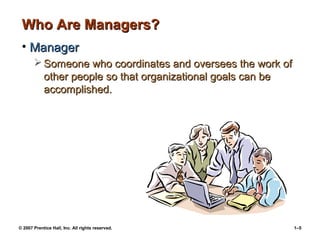
• Manager
Manager
 Someone who coordinates and oversees the work of
Someone who coordinates and oversees the work of
other people so that organizational goals can be
accomplished.
accomplished.
© 2007 Prentice Hall, Inc. All rights reserved. 1–6
Classifying Managers
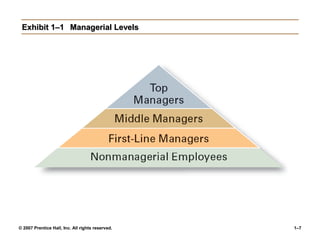
• First-line Managers
First-line Managers
 Individuals who manage the work of non-managerial
Individuals who manage the work of non-managerial
employees.
employees.
• Middle Managers
Middle Managers
 Individuals who manage the work of first-line
Individuals who manage the work of first-line
managers.
managers.
• Top Managers
Top Managers
 Individuals who are responsible for making
Individuals who are responsible for making
organization-wide decisions and establishing plans
and goals that affect the entire organization.
© 2007 Prentice Hall, Inc. All rights reserved. 1–7
Exhibit 1–1
Exhibit 1–1 Managerial Levels
Managerial Levels
© 2007 Prentice Hall, Inc. All rights reserved. 1–8
What Is Management?
What Is Management?
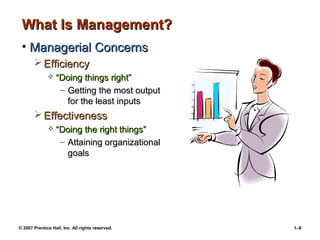
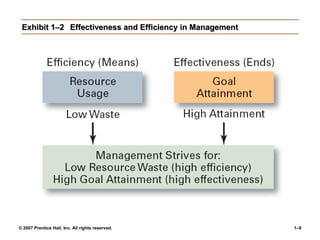
• Managerial Concerns
Managerial Concerns
 Efficiency
Efficiency
 “
“Doing things right”
Doing things right”
– Getting the most output
Getting the most output
for the least inputs
 Effectiveness
Effectiveness
 “
“Doing the right things”
Doing the right things”
– Attaining organizational
Attaining organizational
goals
goals
© 2007 Prentice Hall, Inc. All rights reserved. 1–9
Exhibit 1–2
Exhibit 1–2 Effectiveness and Efficiency in Management
Effectiveness and Efficiency in Management
© 2007 Prentice Hall, Inc. All rights reserved. 1–10
What Do Managers Do?
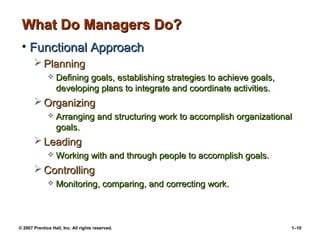
• Functional Approach
Functional Approach
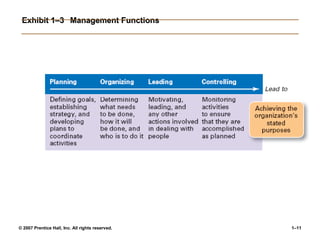
 Planning
Planning
 Defining goals, establishing strategies to achieve goals,
Defining goals, establishing strategies to achieve goals,
developing plans to integrate and coordinate activities.
 Organizing
Organizing
 Arranging and structuring work to accomplish organizational
Arranging and structuring work to accomplish organizational
goals.
goals.
 Leading
Leading
 Working with and through people to accomplish goals.
Working with and through people to accomplish goals.
 Controlling
Controlling
 Monitoring, comparing, and correcting work.
Monitoring, comparing, and correcting work.
© 2007 Prentice Hall, Inc. All rights reserved. 1–11
Exhibit 1–3
Exhibit 1–3 Management Functions
Management Functions
© 2007 Prentice Hall, Inc. All rights reserved. 1–12
What Do Managers Do? (cont’d)
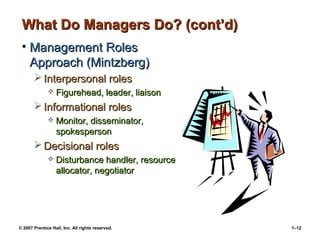
• Management Roles
Management Roles
Approach (Mintzberg)
 Interpersonal roles
Interpersonal roles
 Figurehead, leader, liaison
Figurehead, leader, liaison
 Informational roles
Informational roles
 Monitor, disseminator,
Monitor, disseminator,
spokesperson
spokesperson
 Decisional roles
Decisional roles
 Disturbance handler, resource
Disturbance handler, resource
allocator, negotiator
© 2007 Prentice Hall, Inc. All rights reserved. 1–13
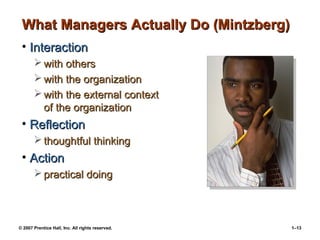
What Managers Actually Do (Mintzberg)
• Interaction
Interaction
 with others
with others
 with the organization
with the organization
 with the external context
with the external context
of the organization
of the organization
• Reflection
Reflection
 thoughtful thinking
thoughtful thinking
• Action
Action
 practical doing
practical doing
© 2007 Prentice Hall, Inc. All rights reserved. 1–14
What Do Managers Do? (cont’d)
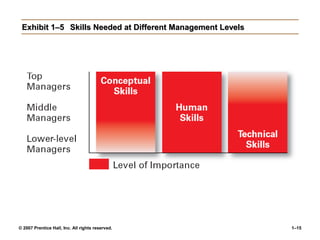
• Skills Approach
Skills Approach
 Technical skills
Technical skills
 Knowledge and proficiency in a specific field
Knowledge and proficiency in a specific field
 Human skills
Human skills
 The ability to work well with other people
The ability to work well with other people
 Conceptual skills
Conceptual skills
 The ability to think and conceptualize about abstract and
The ability to think and conceptualize about abstract and
complex situations concerning the organization
© 2007 Prentice Hall, Inc. All rights reserved. 1–15
Exhibit 1–5
Exhibit 1–5 Skills Needed at Different Management Levels
Skills Needed at Different Management Levels
© 2007 Prentice Hall, Inc. All rights reserved. 1–16
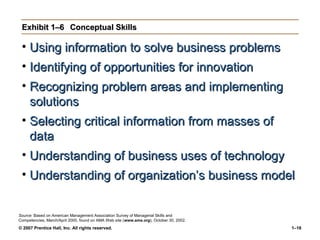
Exhibit 1–6
Exhibit 1–6 Conceptual Skills
Conceptual Skills
• Using information to solve business problems
Using information to solve business problems
• Identifying of opportunities for innovation
Identifying of opportunities for innovation
• Recognizing problem areas and implementing
Recognizing problem areas and implementing
solutions
solutions
• Selecting critical information from masses of
Selecting critical information from masses of
data
data
• Understanding of business uses of technology
Understanding of business uses of technology
• Understanding of organization’s business model
Understanding of organization’s business model
Source: Based on American Management Association Survey of Managerial Skills and
Competencies, March/April 2000, found on AMA Web site (www.ama.org), October 30, 2002.
© 2007 Prentice Hall, Inc. All rights reserved. 1–17
Exhibit 1–6
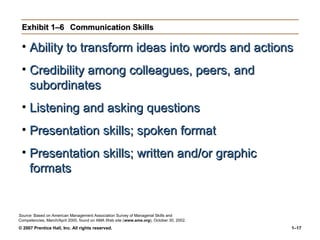
Exhibit 1–6 Communication Skills
Communication Skills
• Ability to transform ideas into words and actions
Ability to transform ideas into words and actions
• Credibility among colleagues, peers, and
Credibility among colleagues, peers, and
subordinates
subordinates
• Listening and asking questions
Listening and asking questions
• Presentation skills; spoken format
Presentation skills; spoken format
• Presentation skills; written and/or graphic
Presentation skills; written and/or graphic
formats
formats
Source: Based on American Management Association Survey of Managerial Skills and
Competencies, March/April 2000, found on AMA Web site (www.ama.org), October 30, 2002.
© 2007 Prentice Hall, Inc. All rights reserved. 1–18
Exhibit 1–6
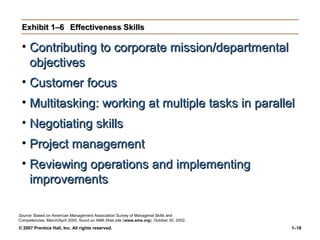
Exhibit 1–6 Effectiveness Skills
Effectiveness Skills
• Contributing to corporate mission/departmental
Contributing to corporate mission/departmental
objectives
objectives
• Customer focus
Customer focus
• Multitasking: working at multiple tasks in parallel
Multitasking: working at multiple tasks in parallel
• Negotiating skills
Negotiating skills
• Project management
Project management
• Reviewing operations and implementing
Reviewing operations and implementing
improvements
improvements
Source: Based on American Management Association Survey of Managerial Skills and
Competencies, March/April 2000, found on AMA Web site (www.ama.org), October 30, 2002.
© 2007 Prentice Hall, Inc. All rights reserved. 1–19
Exhibit 1–6
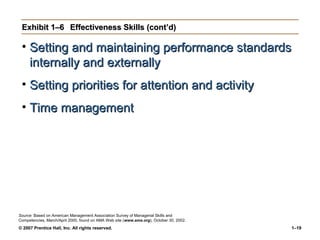
Exhibit 1–6 Effectiveness Skills (cont’d)
Effectiveness Skills (cont’d)
Source: Based on American Management Association Survey of Managerial Skills and
Competencies, March/April 2000, found on AMA Web site (www.ama.org), October 30, 2002.
• Setting and maintaining performance standards
Setting and maintaining performance standards
internally and externally
• Setting priorities for attention and activity
Setting priorities for attention and activity
• Time management
Time management
© 2007 Prentice Hall, Inc. All rights reserved. 1–20
Exhibit 1–6
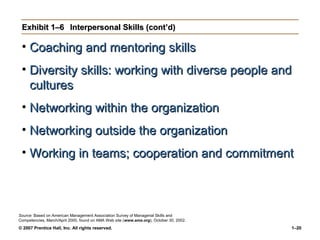
Exhibit 1–6 Interpersonal Skills (cont’d)
Interpersonal Skills (cont’d)
Source: Based on American Management Association Survey of Managerial Skills and
Competencies, March/April 2000, found on AMA Web site (www.ama.org), October 30, 2002.
• Coaching and mentoring skills
Coaching and mentoring skills
• Diversity skills: working with diverse people and
Diversity skills: working with diverse people and
cultures
cultures
• Networking within the organization
Networking within the organization
• Networking outside the organization
Networking outside the organization
• Working in teams; cooperation and commitment
Working in teams; cooperation and commitment
© 2007 Prentice Hall, Inc. All rights reserved. 1–21
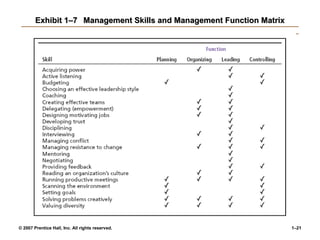
Exhibit 1–7
Exhibit 1–7 Management Skills and Management Function Matrix
Management Skills and Management Function Matrix
© 2007 Prentice Hall, Inc. All rights reserved. 1–22
How The Manager’s Job Is Changing
• The Increasing Importance of Customers
The Increasing Importance of Customers
 Customers: the reason that organizations exist
Customers: the reason that organizations exist
 Managing customer relationships is the responsibility of all
Managing customer relationships is the responsibility of all
managers and employees.
 Consistent high quality customer service is essential for
Consistent high quality customer service is essential for
survival.
survival.
• Innovation
Innovation
 Doing things differently, exploring new territory, and
Doing things differently, exploring new territory, and
taking risks
taking risks
 Managers should encourage employees to be aware of and
Managers should encourage employees to be aware of and
act on opportunities for innovation.
© 2007 Prentice Hall, Inc. All rights reserved. 1–23
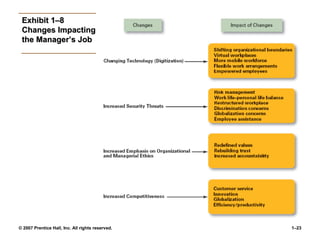
Exhibit 1–8
Exhibit 1–8
Changes Impacting
Changes Impacting
the Manager’s Job
the Manager’s Job
© 2007 Prentice Hall, Inc. All rights reserved. 1–24
What Is An Organization?
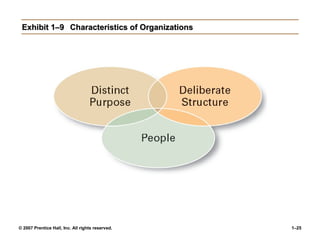
• An Organization Defined
An Organization Defined
 A deliberate arrangement of people to accomplish
A deliberate arrangement of people to accomplish
some specific purpose (that individuals independently
could not accomplish alone).
• Common Characteristics of Organizations
Common Characteristics of Organizations
 Have a distinct purpose (goal)
Have a distinct purpose (goal)
 Composed of people
Composed of people
 Have a deliberate structure
Have a deliberate structure
© 2007 Prentice Hall, Inc. All rights reserved. 1–25
Exhibit 1–9
Exhibit 1–9 Characteristics of Organizations
Characteristics of Organizations
© 2007 Prentice Hall, Inc. All rights reserved. 1–26
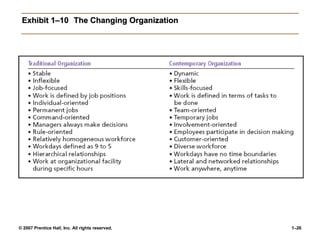
Exhibit 1–10
Exhibit 1–10 The Changing Organization
The Changing Organization
© 2007 Prentice Hall, Inc. All rights reserved. 1–27
Why Study Management?
• The Value of Studying Management
The Value of Studying Management
 The universality of management
The universality of management
 Good management is needed in all organizations.
Good management is needed in all organizations.
 The reality of work
The reality of work
 Employees either manage or are managed.
Employees either manage or are managed.
 Rewards and challenges of being a manager
Rewards and challenges of being a manager
 Management offers challenging, exciting and creative
Management offers challenging, exciting and creative
opportunities for meaningful and fulfilling work.
 Successful managers receive significant monetary rewards
Successful managers receive significant monetary rewards
for their efforts.
for their efforts.
© 2007 Prentice Hall, Inc. All rights reserved. 1–28
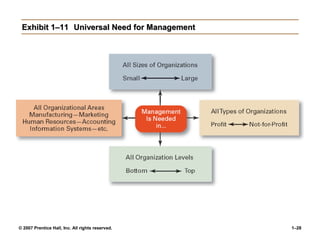
Exhibit 1–11
Exhibit 1–11 Universal Need for Management
Universal Need for Management
© 2007 Prentice Hall, Inc. All rights reserved. 1–29
Exhibit 1–12
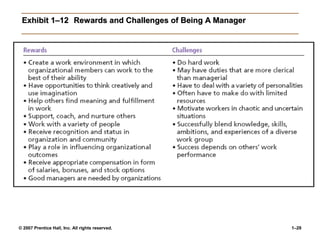
Exhibit 1–12 Rewards and Challenges of Being A Manager
Rewards and Challenges of Being A Manager
© 2007 Prentice Hall, Inc. All rights reserved. 1–30
Terms to Know
Terms to Know
• manager
manager
• first-line managers
first-line managers
• middle managers
middle managers
• top managers
top managers
• management
management
• efficiency
efficiency
• effectiveness
effectiveness
• planning
planning
• organizing
organizing
• leading
leading
• controlling
controlling
• management roles
management roles
• interpersonal roles
interpersonal roles
• informational roles
informational roles
• decisional roles
decisional roles
• technical skills
technical skills
• human skills
human skills
• conceptual skills
conceptual skills
• organization
organization
• universality of
universality of
management
management
ninth edition
STEPHEN P. ROBBINS
PowerPoint Presentation by Charlie Cook
The University of West Alabama
MARY COULTER
© 2007 Prentice Hall, Inc.
All rights reserved.
Management
Management
Yesterday and Today
Yesterday and Today
Chapter
Chapter
2
2
© 2007 Prentice Hall, Inc. All rights reserved. 2–32
L E A R N I N G O U T L I N E
Follow this Learning Outline as you read and study this chapter.
•Historical Background of Management
Historical Background of Management
• Explain why studying management history is important.
Explain why studying management history is important.
• Describe some early evidences of management practice.
Describe some early evidences of management practice.
•Scientific Management
Scientific Management
• Describe the important contributions made by Fredrick
Describe the important contributions made by Fredrick
W. Taylor and Frank and Lillian Gilbreth.
• Explain how today’s managers use scientific
Explain how today’s managers use scientific
management.
management.
© 2007 Prentice Hall, Inc. All rights reserved. 2–33
L E A R N I N G O U T L I N E (cont’d)
Follow this Learning Outline as you read and study this chapter.
•General Administrative Theory
General Administrative Theory
• Discuss Fayol’s contributions to management theory.
Discuss Fayol’s contributions to management theory.
• Describe Max Weber’s contribution to management
Describe Max Weber’s contribution to management
theory.
theory.
• Explain how today’s managers use general administrative
Explain how today’s managers use general administrative
theory.
theory.
•Quantitative Approach
Quantitative Approach
• Explain what the quantitative approach has contributed
Explain what the quantitative approach has contributed
to the field of management.
• Discuss how today’s managers use the quantitative
Discuss how today’s managers use the quantitative
approach.
approach.
© 2007 Prentice Hall, Inc. All rights reserved. 2–34
L E A R N I N G O U T L I N E (cont’d)
Follow this Learning Outline as you read and study this chapter.
•Toward Understanding Organizational Behavior
Toward Understanding Organizational Behavior
• Describe the contributions of the early advocates of OB.
Describe the contributions of the early advocates of OB.
• Explain the contributions of the Hawthorne Studies to the
Explain the contributions of the Hawthorne Studies to the
field of management.
• Discuss how today’s managers use the behavioral
Discuss how today’s managers use the behavioral
approach.
approach.
•The Systems Approach
The Systems Approach
• Describe an organization using the systems approach.
Describe an organization using the systems approach.
• Discuss how the systems approach helps us
Discuss how the systems approach helps us
management.
management.
© 2007 Prentice Hall, Inc. All rights reserved. 2–35
L E A R N I N G O U T L I N E (cont’d)
Follow this Learning Outline as you read and study this chapter.
•The Contingency Approach
The Contingency Approach
• Explain how the contingency approach differs from the
Explain how the contingency approach differs from the
early theories of management.
• Discuss how the contingency approach helps us
Discuss how the contingency approach helps us
understand management.
•Current Issues and Trends
Current Issues and Trends
• Explain why we need to look at the current trends and
Explain why we need to look at the current trends and
issues facing managers.
• Describe the current trends and issues facing managers.
Describe the current trends and issues facing managers.
© 2007 Prentice Hall, Inc. All rights reserved. 2–36
Historical Background of Management
• Ancient Management
Ancient Management
 Egypt (pyramids) and China (Great Wall)
Egypt (pyramids) and China (Great Wall)
 Venetians (floating warship assembly lines)
Venetians (floating warship assembly lines)
• Adam Smith
Adam Smith
 Published
Published “The Wealth of Nations”
“The Wealth of Nations” in 1776
in 1776
 Advocated the division of labor (job specialization) to
Advocated the division of labor (job specialization) to
increase the productivity of workers
• Industrial Revolution
Industrial Revolution
 Substituted machine power for human labor
Substituted machine power for human labor
 Created large organizations in need of management
Created large organizations in need of management
© 2007 Prentice Hall, Inc. All rights reserved. 2–37
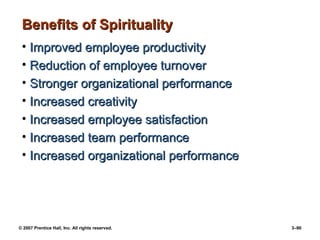
Exhibit 2–1
Exhibit 2–1 Development of Major Management Theories
Development of Major Management Theories
© 2007 Prentice Hall, Inc. All rights reserved. 2–38
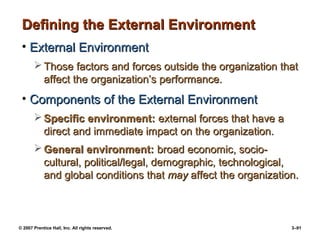
Major Approaches to Management
• Scientific Management
Scientific Management
• General Administrative Theory
General Administrative Theory
• Quantitative Management
Quantitative Management
• Organizational Behavior
Organizational Behavior
• Systems Approach
Systems Approach
• Contingency Approach
Contingency Approach
© 2007 Prentice Hall, Inc. All rights reserved. 2–39
Scientific Management
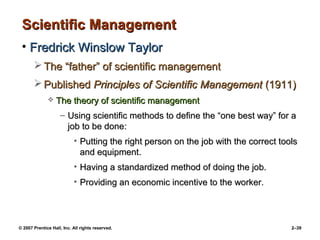
• Fredrick Winslow Taylor
Fredrick Winslow Taylor
 The “father” of scientific management
The “father” of scientific management
 Published
Published Principles of Scientific Management
Principles of Scientific Management (1911)
(1911)
 The theory of scientific management
The theory of scientific management
– Using scientific methods to define the “one best way” for a
Using scientific methods to define the “one best way” for a
job to be done:
job to be done:
• Putting the right person on the job with the correct tools
Putting the right person on the job with the correct tools
and equipment.
and equipment.
• Having a standardized method of doing the job.
Having a standardized method of doing the job.
• Providing an economic incentive to the worker.
Providing an economic incentive to the worker.
© 2007 Prentice Hall, Inc. All rights reserved. 2–40
Exhibit 2–2
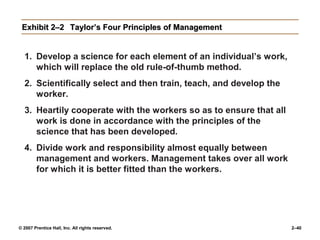
Exhibit 2–2 Taylor’s Four Principles of Management
Taylor’s Four Principles of Management
1. Develop a science for each element of an individual’s work,
which will replace the old rule-of-thumb method.
2. Scientifically select and then train, teach, and develop the
worker.
3. Heartily cooperate with the workers so as to ensure that all
work is done in accordance with the principles of the
science that has been developed.
4. Divide work and responsibility almost equally between
management and workers. Management takes over all work
for which it is better fitted than the workers.
© 2007 Prentice Hall, Inc. All rights reserved. 2–41
Scientific Management (cont’d)
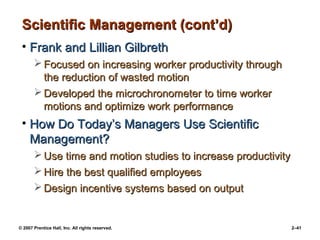
• Frank and Lillian Gilbreth
Frank and Lillian Gilbreth
 Focused on increasing worker productivity through
Focused on increasing worker productivity through
the reduction of wasted motion
 Developed the microchronometer to time worker
Developed the microchronometer to time worker
motions and optimize work performance
• How Do Today’s Managers Use Scientific
How Do Today’s Managers Use Scientific
Management?
Management?
 Use time and motion studies to increase productivity
Use time and motion studies to increase productivity
 Hire the best qualified employees
Hire the best qualified employees
 Design incentive systems based on output
Design incentive systems based on output
© 2007 Prentice Hall, Inc. All rights reserved. 2–42
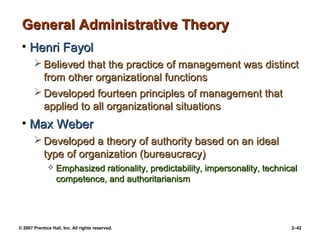
General Administrative Theory
• Henri Fayol
Henri Fayol
 Believed that the practice of management was distinct
Believed that the practice of management was distinct
from other organizational functions
 Developed fourteen principles of management that
Developed fourteen principles of management that
applied to all organizational situations
• Max Weber
Max Weber
 Developed a theory of authority based on an ideal
Developed a theory of authority based on an ideal
type of organization (bureaucracy)
 Emphasized rationality, predictability, impersonality, technical
Emphasized rationality, predictability, impersonality, technical
competence, and authoritarianism
© 2007 Prentice Hall, Inc. All rights reserved. 2–43
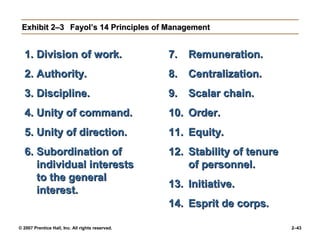
Exhibit 2–3
Exhibit 2–3 Fayol’s 14 Principles of Management
Fayol’s 14 Principles of Management
1.
1. Division of work.
Division of work.
2.
2. Authority.
Authority.
3.
3. Discipline.
Discipline.
4.
4. Unity of command.
Unity of command.
5.
5. Unity of direction.
Unity of direction.
6.
6. Subordination of
Subordination of
individual interests
to the general
to the general
interest.
interest.
7.
7. Remuneration.
Remuneration.
8.
8. Centralization.
Centralization.
9.
9. Scalar chain.
Scalar chain.
10.
10. Order.
Order.
11.
11. Equity.
Equity.
12.
12. Stability of tenure
Stability of tenure
of personnel.
of personnel.
13.
13. Initiative.
Initiative.
14.
14. Esprit de corps.
Esprit de corps.
© 2007 Prentice Hall, Inc. All rights reserved. 2–44
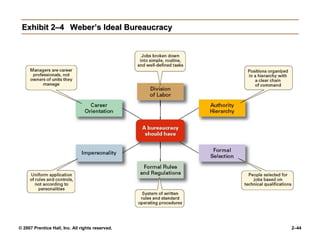
Exhibit 2–4
Exhibit 2–4 Weber’s Ideal Bureaucracy
Weber’s Ideal Bureaucracy
© 2007 Prentice Hall, Inc. All rights reserved. 2–45
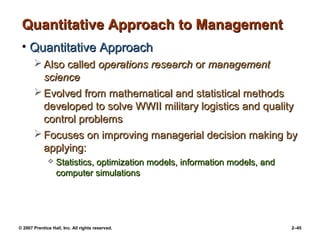
Quantitative Approach to Management
• Quantitative Approach
Quantitative Approach
 Also called
Also called operations research
operations research or
or management
management
science
science
 Evolved from mathematical and statistical methods
Evolved from mathematical and statistical methods
developed to solve WWII military logistics and quality
control problems
control problems
 Focuses on improving managerial decision making by
Focuses on improving managerial decision making by
applying:
applying:
 Statistics, optimization models, information models, and
Statistics, optimization models, information models, and
computer simulations
© 2007 Prentice Hall, Inc. All rights reserved. 2–46
Understanding Organizational Behavior
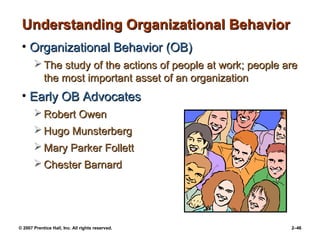
• Organizational Behavior (OB)
Organizational Behavior (OB)
 The study of the actions of people at work; people are
The study of the actions of people at work; people are
the most important asset of an organization
• Early OB Advocates
Early OB Advocates
 Robert Owen
Robert Owen
 Hugo Munsterberg
Hugo Munsterberg
 Mary Parker Follett
Mary Parker Follett
 Chester Barnard
Chester Barnard
© 2007 Prentice Hall, Inc. All rights reserved. 2–47
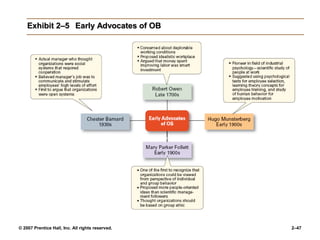
Exhibit 2–5
Exhibit 2–5 Early Advocates of OB
Early Advocates of OB
© 2007 Prentice Hall, Inc. All rights reserved. 2–48
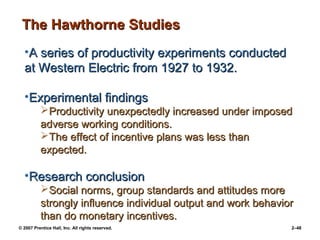
•A series of productivity experiments conducted
A series of productivity experiments conducted
at Western Electric from 1927 to 1932.
•Experimental findings
Experimental findings
Productivity unexpectedly increased under imposed
Productivity unexpectedly increased under imposed
adverse working conditions.
The effect of incentive plans was less than
The effect of incentive plans was less than
expected.
expected.
•Research conclusion
Research conclusion
Social norms, group standards and attitudes more
Social norms, group standards and attitudes more
strongly influence individual output and work behavior
than do monetary incentives.
The Hawthorne Studies
© 2007 Prentice Hall, Inc. All rights reserved. 2–49
The Systems Approach
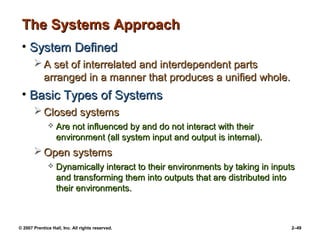
• System Defined
System Defined
 A set of interrelated and interdependent parts
A set of interrelated and interdependent parts
arranged in a manner that produces a unified whole.
• Basic Types of Systems
Basic Types of Systems
 Closed systems
Closed systems
 Are not influenced by and do not interact with their
Are not influenced by and do not interact with their
environment (all system input and output is internal).
 Open systems
Open systems
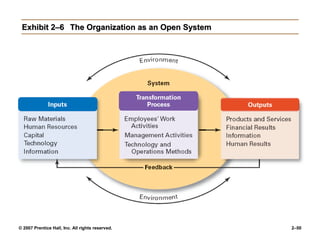
 Dynamically interact to their environments by taking in inputs
Dynamically interact to their environments by taking in inputs
and transforming them into outputs that are distributed into
their environments.
their environments.
© 2007 Prentice Hall, Inc. All rights reserved. 2–50
Exhibit 2–6
Exhibit 2–6 The Organization as an Open System
The Organization as an Open System
© 2007 Prentice Hall, Inc. All rights reserved. 2–51
Implications of the Systems Approach
• Coordination of the organization’s parts is
Coordination of the organization’s parts is
essential for proper functioning of the entire
organization.
organization.
• Decisions and actions taken in one area of the
Decisions and actions taken in one area of the
organization will have an effect in other areas of
the organization.
the organization.
• Organizations are not self-contained and,
Organizations are not self-contained and,
therefore, must adapt to changes in their
external environment.
© 2007 Prentice Hall, Inc. All rights reserved. 2–52
The Contingency Approach
• Contingency Approach Defined
Contingency Approach Defined
 Also sometimes called the
Also sometimes called the situational approach.
situational approach.
 There is no one universally applicable set of
There is no one universally applicable set of
management principles (rules) by which to manage
organizations.
organizations.
 Organizations are individually different, face different
Organizations are individually different, face different
situations (contingency variables), and require
different ways of managing.
© 2007 Prentice Hall, Inc. All rights reserved. 2–53
Exhibit 2–7
Exhibit 2–7 Popular Contingency Variables
Popular Contingency Variables
• Organization size
• As size increases, so do the problems of coordination.
• Routineness of task technology
• Routine technologies require organizational structures,
leadership styles, and control systems that differ from
those required by customized or nonroutine technologies.
• Environmental uncertainty
• What works best in a stable and predictable environment
may be totally inappropriate in a rapidly changing and
unpredictable environment.
• Individual differences
• Individuals differ in terms of their desire for growth,
autonomy, tolerance of ambiguity, and expectations.
© 2007 Prentice Hall, Inc. All rights reserved. 2–54
Current Trends and Issues
• Globalization
Globalization
• Ethics
Ethics
• Workforce Diversity
Workforce Diversity
• Entrepreneurship
Entrepreneurship
• E-business
E-business
• Knowledge Management
Knowledge Management
• Learning Organizations
Learning Organizations
• Quality Management
Quality Management
© 2007 Prentice Hall, Inc. All rights reserved. 2–55
Current Trends and Issues (cont’d)
• Globalization
Globalization
 Management in international organizations
Management in international organizations
 Political and cultural challenges of operating in a
Political and cultural challenges of operating in a
global market
global market
 Working with people from different cultures
Working with people from different cultures
 Coping with anticapitalist backlash
Coping with anticapitalist backlash
 Movement of jobs to countries with low-cost labor
Movement of jobs to countries with low-cost labor
• Ethics
Ethics
 Increased emphasis on ethics education in college
Increased emphasis on ethics education in college
curriculums
curriculums
 Increased creation and use of codes of ethics by
Increased creation and use of codes of ethics by
businesses
businesses
© 2007 Prentice Hall, Inc. All rights reserved. 2–56
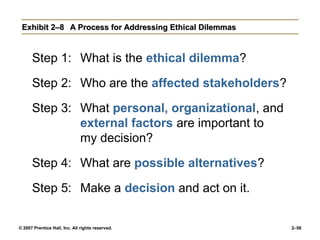
Exhibit 2–8
Exhibit 2–8 A Process for Addressing Ethical Dilemmas
A Process for Addressing Ethical Dilemmas
Step 1: What is the ethical dilemma?
Step 2: Who are the affected stakeholders?
Step 3: What personal, organizational, and
external factors are important to
my decision?
Step 4: What are possible alternatives?
Step 5: Make a decision and act on it.
© 2007 Prentice Hall, Inc. All rights reserved. 2–57
Current Trends and Issues (cont’d)
• Workforce Diversity
Workforce Diversity
 Increasing heterogeneity in the workforce
Increasing heterogeneity in the workforce
 More gender, minority, ethnic, and other forms of diversity in
More gender, minority, ethnic, and other forms of diversity in
employees
employees
 Aging workforce
Aging workforce
 Older employees who work longer and do not retire
Older employees who work longer and do not retire
 The increased costs of public and private benefits for older
The increased costs of public and private benefits for older
workers
workers
 An increasing demand for products and services related to
An increasing demand for products and services related to
aging.
aging.
© 2007 Prentice Hall, Inc. All rights reserved. 2–58
Current Trends and Issues (cont’d)
• Entrepreneurship Defined
Entrepreneurship Defined
 The process of starting new businesses, generally in
The process of starting new businesses, generally in
response to opportunities.
• Entrepreneurship process
Entrepreneurship process
 Pursuit of opportunities
Pursuit of opportunities
 Innovation in products, services, or business methods
Innovation in products, services, or business methods
 Desire for continual growth of the organization
Desire for continual growth of the organization
© 2007 Prentice Hall, Inc. All rights reserved. 2–59
Current Trends and Issues (cont’d)
• E-Business (Electronic Business)
E-Business (Electronic Business)
 The work preformed by an organization using
The work preformed by an organization using
electronic linkages to its key constituencies
 E-commerce: the sales and marketing aspect of an e-
E-commerce: the sales and marketing aspect of an e-
business
business
• Categories of E-Businesses
Categories of E-Businesses
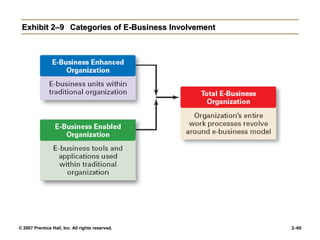
 E-business enhanced organization
E-business enhanced organization
 E-business enabled organization
E-business enabled organization
 Total e-business organization
Total e-business organization
© 2007 Prentice Hall, Inc. All rights reserved. 2–60
Exhibit 2–9
Exhibit 2–9 Categories of E-Business Involvement
Categories of E-Business Involvement
© 2007 Prentice Hall, Inc. All rights reserved. 2–61
Current Trends and Issues (cont’d)
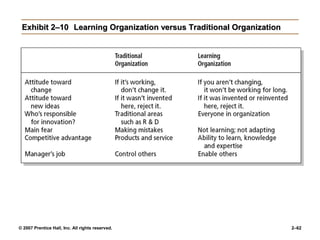
• Learning Organization
Learning Organization
 An organization that has developed the capacity to
An organization that has developed the capacity to
continuously learn, adapt, and change.
• Knowledge Management
Knowledge Management
 The cultivation of a learning culture where
The cultivation of a learning culture where
organizational members systematically gather and
share knowledge with others in order to achieve
better performance.
better performance.
© 2007 Prentice Hall, Inc. All rights reserved. 2–62
Exhibit 2–10
Exhibit 2–10 Learning Organization versus Traditional Organization
Learning Organization versus Traditional Organization
© 2007 Prentice Hall, Inc. All rights reserved. 2–63
Current Trends and Issues (cont’d)
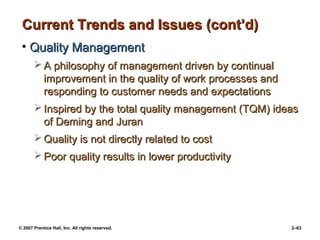
• Quality Management
Quality Management
 A philosophy of management driven by continual
A philosophy of management driven by continual
improvement in the quality of work processes and
responding to customer needs and expectations
 Inspired by the total quality management (TQM) ideas
Inspired by the total quality management (TQM) ideas
of Deming and Juran
of Deming and Juran
 Quality is not directly related to cost
Quality is not directly related to cost
 Poor quality results in lower productivity
Poor quality results in lower productivity
© 2007 Prentice Hall, Inc. All rights reserved. 2–64
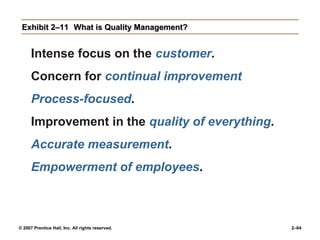
Exhibit 2–11
Exhibit 2–11 What is Quality Management?
What is Quality Management?
Intense focus on the customer.
Concern for continual improvement
Process-focused.
Improvement in the quality of everything.
Accurate measurement.
Empowerment of employees.
© 2007 Prentice Hall, Inc. All rights reserved. 2–65
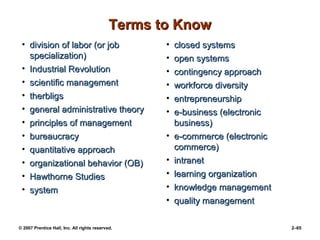
Terms to Know
Terms to Know
• division of labor (or job
division of labor (or job
specialization)
specialization)
• Industrial Revolution
Industrial Revolution
• scientific management
scientific management
• therbligs
therbligs
• general administrative theory
general administrative theory
• principles of management
principles of management
• bureaucracy
bureaucracy
• quantitative approach
quantitative approach
• organizational behavior (OB)
organizational behavior (OB)
• Hawthorne Studies
Hawthorne Studies
• system
system
• closed systems
closed systems
• open systems
open systems
• contingency approach
contingency approach
• workforce diversity
workforce diversity
• entrepreneurship
entrepreneurship
• e-business (electronic
e-business (electronic
business)
business)
• e-commerce (electronic
e-commerce (electronic
commerce)
commerce)
• intranet
intranet
• learning organization
learning organization
• knowledge management
knowledge management
• quality management
quality management
ninth edition
STEPHEN P. ROBBINS
PowerPoint Presentation by Charlie Cook
The University of West Alabama
MARY COULTER
© 2007 Prentice Hall, Inc.
All rights reserved.
Organizational Culture
and Environment:
and Environment:
The Constraints
The Constraints
Chapter
Chapter
3
3
© 2007 Prentice Hall, Inc. All rights reserved. 3–67
L E A R N I N G O U T L I N E
Follow this Learning Outline as you read and study this chapter.
•The Manager: Omnipotent or Symbolic
The Manager: Omnipotent or Symbolic
• Contrast the action of manager according to the
Contrast the action of manager according to the
omnipotent and symbolic views.
• Explain the parameters of managerial discretion.
Explain the parameters of managerial discretion.
•The Organization’s Culture
The Organization’s Culture
• Describe the seven dimensions of organizational culture.
Describe the seven dimensions of organizational culture.
• Discuss the impact of a strong culture on organizations
Discuss the impact of a strong culture on organizations
and managers.
and managers.
• Explain the source of an organization’s culture.
Explain the source of an organization’s culture.
• Describe how culture is transmitted to employees.
Describe how culture is transmitted to employees.
• Describe how culture affects managers.
Describe how culture affects managers.
© 2007 Prentice Hall, Inc. All rights reserved. 3–68
L E A R N I N G O U T L I N E (cont’d)
Follow this Learning Outline as you read and study this chapter.
•Current Organizational Cultural Issues Facing
Current Organizational Cultural Issues Facing
Managers
Managers
• Describe the characteristics of an ethical culture, an
Describe the characteristics of an ethical culture, an
innovative culture, and a customer-responsive culture.
• Discuss why workplace spirituality seems to be an
Discuss why workplace spirituality seems to be an
important concern.
important concern.
• Describe the characteristics of a spiritual organization.
Describe the characteristics of a spiritual organization.
© 2007 Prentice Hall, Inc. All rights reserved. 3–69
L E A R N I N G O U T L I N E (cont’d)
Follow this Learning Outline as you read and study this chapter.
•The Environment (cont’d)
The Environment (cont’d)
• Describe the components of the specific and general
Describe the components of the specific and general
environments.
environments.
• Discuss the two dimensions of environmental
Discuss the two dimensions of environmental
uncertainty.
uncertainty.
• Identify the most common organizational stakeholders.
Identify the most common organizational stakeholders.
• Explain the four steps in managing external stakeholder
Explain the four steps in managing external stakeholder
relationships.
relationships.
© 2007 Prentice Hall, Inc. All rights reserved. 3–70
The Manager: Omnipotent or Symbolic?
• Omnipotent View of Management
Omnipotent View of Management
 Managers are directly responsible for an
Managers are directly responsible for an
organization’s success or failure.
 The quality of the organization is determined by the
The quality of the organization is determined by the
quality of its managers.
 Managers are held accountable
Managers are held accountable
for an organization’s performance
yet it is difficult to attribute
good or poor performance
directly to their influence
on the organization.
© 2007 Prentice Hall, Inc. All rights reserved. 3–71
The Manager: Omnipotent or Symbolic?
• Symbolic View of Management
Symbolic View of Management
 Much of an organization’s success or failure is due to
Much of an organization’s success or failure is due to
external forces outside of managers’ control.
 The ability of managers to affect outcomes is
The ability of managers to affect outcomes is
influenced and constrained by external factors.
 The economy, customers, governmental policies,
The economy, customers, governmental policies,
competitors, industry conditions,
technology, and the actions of
previous managers
previous managers
 Managers symbolize control and
Managers symbolize control and
influence through their action.
© 2007 Prentice Hall, Inc. All rights reserved. 3–72
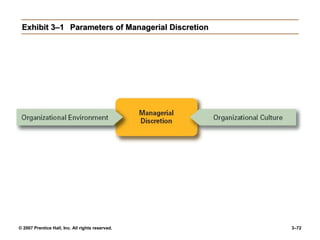
Exhibit 3–1
Exhibit 3–1 Parameters of Managerial Discretion
Parameters of Managerial Discretion
© 2007 Prentice Hall, Inc. All rights reserved. 3–73
The Organization’s Culture
• Organizational Culture
Organizational Culture
 A system of shared meanings and common beliefs
A system of shared meanings and common beliefs
held by organizational members that determines, in a
large degree, how they act towards each other.
 “
“The way we do things around here.”
The way we do things around here.”
 Values, symbols, rituals, myths, and practices
Values, symbols, rituals, myths, and practices
 Implications:
Implications:
 Culture is a perception.
Culture is a perception.
 Culture is shared.
Culture is shared.
 Culture is descriptive.
Culture is descriptive.
© 2007 Prentice Hall, Inc. All rights reserved. 3–74
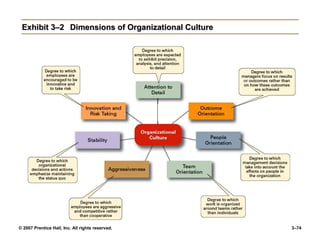
Exhibit 3–2
Exhibit 3–2 Dimensions of Organizational Culture
Dimensions of Organizational Culture
© 2007 Prentice Hall, Inc. All rights reserved. 3–75
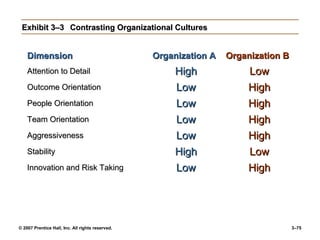
Exhibit 3–3
Exhibit 3–3 Contrasting Organizational Cultures
Contrasting Organizational Cultures
Dimension
Dimension Organization A
Organization A Organization B
Organization B
Attention to Detail
Attention to Detail High
High Low
Low
Outcome Orientation
Outcome Orientation Low
Low High
High
People Orientation
People Orientation Low
Low High
High
Team Orientation
Team Orientation Low
Low High
High
Aggressiveness
Aggressiveness Low
Low High
High
Stability
Stability High
High Low
Low
Innovation and Risk Taking
Innovation and Risk Taking Low
Low High
High
© 2007 Prentice Hall, Inc. All rights reserved. 3–76
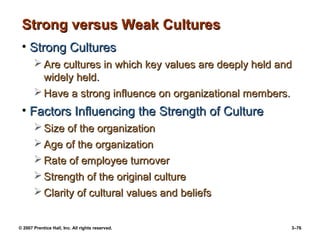
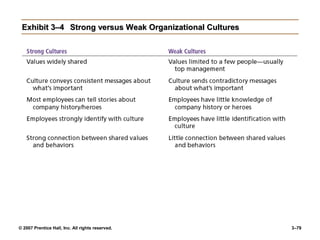
Strong versus Weak Cultures
• Strong Cultures
Strong Cultures
 Are cultures in which key values are deeply held and
Are cultures in which key values are deeply held and
widely held.
widely held.
 Have a strong influence on organizational members.
Have a strong influence on organizational members.
• Factors Influencing the Strength of Culture
Factors Influencing the Strength of Culture
 Size of the organization
Size of the organization
 Age of the organization
Age of the organization
 Rate of employee turnover
Rate of employee turnover
 Strength of the original culture
Strength of the original culture
 Clarity of cultural values and beliefs
Clarity of cultural values and beliefs
© 2007 Prentice Hall, Inc. All rights reserved. 3–77
Benefits of a Strong Culture
• Creates a stronger employee commitment to the
Creates a stronger employee commitment to the
organization.
organization.
• Aids in the recruitment and socialization of new
Aids in the recruitment and socialization of new
employees.
employees.
• Fosters higher organizational
Fosters higher organizational
performance by instilling and
promoting employee initiative.
© 2007 Prentice Hall, Inc. All rights reserved. 3–78
Organizational Culture
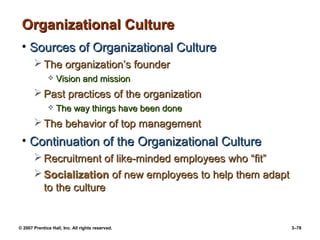
• Sources of Organizational Culture
Sources of Organizational Culture
 The organization’s founder
The organization’s founder
 Vision and mission
Vision and mission
 Past practices of the organization
Past practices of the organization
 The way things have been done
The way things have been done
 The behavior of top management
The behavior of top management
• Continuation of the Organizational Culture
Continuation of the Organizational Culture
 Recruitment of like-minded employees who “fit”
Recruitment of like-minded employees who “fit”
 Socialization
Socialization of new employees to help them adapt
of new employees to help them adapt
to the culture
to the culture
© 2007 Prentice Hall, Inc. All rights reserved. 3–79
Exhibit 3–4
Exhibit 3–4 Strong versus Weak Organizational Cultures
Strong versus Weak Organizational Cultures
© 2007 Prentice Hall, Inc. All rights reserved. 3–80
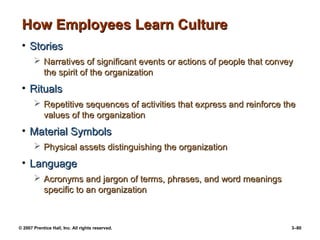
How Employees Learn Culture
• Stories
Stories
 Narratives of significant events or actions of people that convey
Narratives of significant events or actions of people that convey
the spirit of the organization
• Rituals
Rituals
 Repetitive sequences of activities that express and reinforce the
Repetitive sequences of activities that express and reinforce the
values of the organization
• Material Symbols
Material Symbols
 Physical assets distinguishing the organization
Physical assets distinguishing the organization
• Language
Language
 Acronyms and jargon of terms, phrases, and word meanings
Acronyms and jargon of terms, phrases, and word meanings
specific to an organization
© 2007 Prentice Hall, Inc. All rights reserved. 3–81
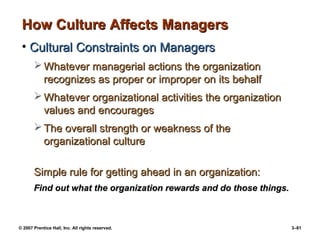
How Culture Affects Managers
• Cultural Constraints on Managers
Cultural Constraints on Managers
 Whatever managerial actions the organization
Whatever managerial actions the organization
recognizes as proper or improper on its behalf
 Whatever organizational activities the organization
Whatever organizational activities the organization
values and encourages
 The overall strength or weakness of the
The overall strength or weakness of the
organizational culture
Simple rule for getting ahead in an organization:
Find out what the organization rewards and do those things.
© 2007 Prentice Hall, Inc. All rights reserved. 3–82
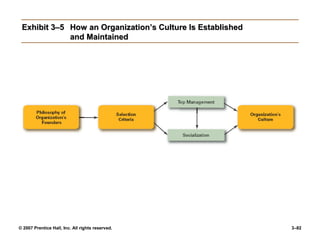
Exhibit 3–5
Exhibit 3–5 How an Organization’s Culture Is Established
How an Organization’s Culture Is Established
and Maintained
and Maintained
© 2007 Prentice Hall, Inc. All rights reserved. 3–83
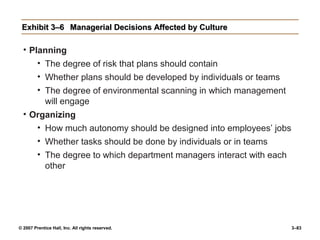
Exhibit 3–6
Exhibit 3–6 Managerial Decisions Affected by Culture
Managerial Decisions Affected by Culture
• Planning
• The degree of risk that plans should contain
• Whether plans should be developed by individuals or teams
• The degree of environmental scanning in which management
will engage
• Organizing
• How much autonomy should be designed into employees’ jobs
• Whether tasks should be done by individuals or in teams
• The degree to which department managers interact with each
other
© 2007 Prentice Hall, Inc. All rights reserved. 3–84
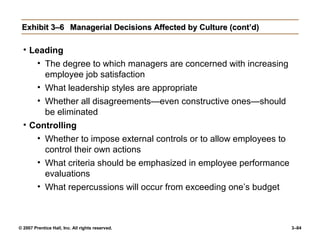
Exhibit 3–6
Exhibit 3–6 Managerial Decisions Affected by Culture (cont’d)
Managerial Decisions Affected by Culture (cont’d)
• Leading
• The degree to which managers are concerned with increasing
employee job satisfaction
• What leadership styles are appropriate
• Whether all disagreements—even constructive ones—should
be eliminated
• Controlling
• Whether to impose external controls or to allow employees to
control their own actions
• What criteria should be emphasized in employee performance
evaluations
• What repercussions will occur from exceeding one’s budget
© 2007 Prentice Hall, Inc. All rights reserved. 3–85
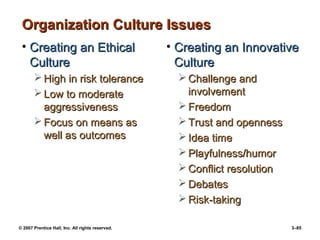
Organization Culture Issues
• Creating an Ethical
Creating an Ethical
Culture
Culture
 High in risk tolerance
High in risk tolerance
 Low to moderate
Low to moderate
aggressiveness
aggressiveness
 Focus on means as
Focus on means as
well as outcomes
well as outcomes
• Creating an Innovative
Creating an Innovative
Culture
Culture
 Challenge and
Challenge and
involvement
involvement
 Freedom
Freedom
 Trust and openness
Trust and openness
 Idea time
Idea time
 Playfulness/humor
Playfulness/humor
 Conflict resolution
Conflict resolution
 Debates
Debates
 Risk-taking
Risk-taking
© 2007 Prentice Hall, Inc. All rights reserved. 3–86
Exhibit 3–7
Exhibit 3–7 Suggestions for Managers: Creating a More Ethical Culture
Suggestions for Managers: Creating a More Ethical Culture
• Be a visible role model.
• Communicate ethical expectations.
• Provide ethics training.
• Visibly reward ethical acts and punish unethical
ones.
• Provide protective mechanisms so employees can
discuss ethical dilemmas and report unethical
behavior without fear.
© 2007 Prentice Hall, Inc. All rights reserved. 3–87
Organization Culture Issues (cont’d)
• Creating a Customer-Responsive Culture
Creating a Customer-Responsive Culture
 Hiring the right type of employees (ones with a strong
Hiring the right type of employees (ones with a strong
interest in serving customers)
 Having few rigid rules, procedures, and regulations
Having few rigid rules, procedures, and regulations
 Using widespread empowerment of employees
Using widespread empowerment of employees
 Having good listening skills in relating to customers’
Having good listening skills in relating to customers’
messages
messages
 Providing role clarity to employees to reduce
Providing role clarity to employees to reduce
ambiguity and conflict and increase job satisfaction
 Having conscientious, caring employees willing to
Having conscientious, caring employees willing to
take initiative
take initiative
© 2007 Prentice Hall, Inc. All rights reserved. 3–88
Exhibit 3–8
Exhibit 3–8 Suggestions for Managers: Creating a More Customer-
Suggestions for Managers: Creating a More Customer-
Responsive Culture
Responsive Culture
• Hire service-contact people with the personality and attitudes
consistent with customer service—friendliness, enthusiasm,
attentiveness, patience, concern about others, and listening skills.
• Train customer service people continuously by focusing on
improving product knowledge, active listening, showing patience,
and displaying emotions.
• Socialize new service-contact people to the organization’s goals and
values.
• Design customer-service jobs so that employees have as much
control as necessary to satisfy customers.
• Empower service-contact employees with the discretion to make
day-to-day decisions on job-related activities.
• As the leader, convey a customer-focused vision and demonstrate
through decisions and actions the commitment to customers.
© 2007 Prentice Hall, Inc. All rights reserved. 3–89
Spirituality and Organizational Culture
•Workplace Spirituality
Workplace Spirituality
 The recognition that people have an inner life that
The recognition that people have an inner life that
nourishes and is nourished by meaningful work that
takes place in the context of community.
•Characteristics of a Spiritual Organization
Characteristics of a Spiritual Organization
 Strong sense of purpose
Strong sense of purpose
 Focus on individual development
Focus on individual development
 Trust and openness
Trust and openness
 Employee empowerment
Employee empowerment
 Toleration of employees’ expression
Toleration of employees’ expression
© 2007 Prentice Hall, Inc. All rights reserved. 3–90
Benefits of Spirituality
• Improved employee productivity
Improved employee productivity
• Reduction of employee turnover
Reduction of employee turnover
• Stronger organizational performance
Stronger organizational performance
• Increased creativity
Increased creativity
• Increased employee satisfaction
Increased employee satisfaction
• Increased team performance
Increased team performance
• Increased organizational performance
Increased organizational performance
© 2007 Prentice Hall, Inc. All rights reserved. 3–91
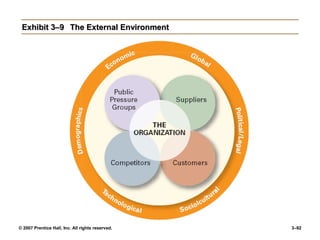
Defining the External Environment
• External Environment
External Environment
 Those factors and forces outside the organization that
Those factors and forces outside the organization that
affect the organization’s performance.
• Components of the External Environment
Components of the External Environment
 Specific environment:
Specific environment: external forces that have a
external forces that have a
direct and immediate impact on the organization.
 General environment:
General environment: broad economic, socio-
broad economic, socio-
cultural, political/legal, demographic, technological,
and global conditions that
and global conditions that may
may affect the organization.
affect the organization.
© 2007 Prentice Hall, Inc. All rights reserved. 3–92
Exhibit 3–9
Exhibit 3–9 The External Environment
The External Environment
© 2007 Prentice Hall, Inc. All rights reserved. 3–93
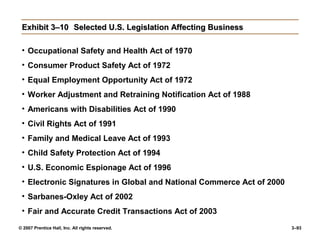
Exhibit 3–10
Exhibit 3–10 Selected U.S. Legislation Affecting Business
Selected U.S. Legislation Affecting Business
• Occupational Safety and Health Act of 1970
• Consumer Product Safety Act of 1972
• Equal Employment Opportunity Act of 1972
• Worker Adjustment and Retraining Notification Act of 1988
• Americans with Disabilities Act of 1990
• Civil Rights Act of 1991
• Family and Medical Leave Act of 1993
• Child Safety Protection Act of 1994
• U.S. Economic Espionage Act of 1996
• Electronic Signatures in Global and National Commerce Act of 2000
• Sarbanes-Oxley Act of 2002
• Fair and Accurate Credit Transactions Act of 2003
© 2007 Prentice Hall, Inc. All rights reserved. 3–94
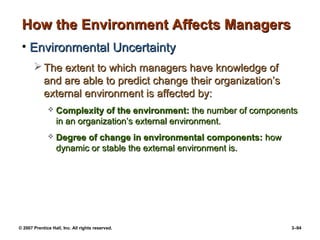
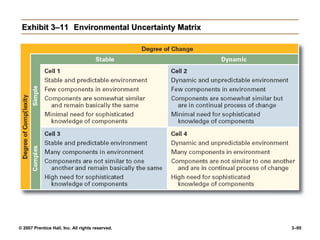
How the Environment Affects Managers
• Environmental Uncertainty
Environmental Uncertainty
 The extent to which managers have knowledge of
The extent to which managers have knowledge of
and are able to predict change their organization’s
external environment is affected by:
 Complexity of the environment:
Complexity of the environment: the number of components
the number of components
in an organization’s external environment.
 Degree of change in environmental components:
Degree of change in environmental components: how
how
dynamic or stable the external environment is.
© 2007 Prentice Hall, Inc. All rights reserved. 3–95
Exhibit 3–11
Exhibit 3–11 Environmental Uncertainty Matrix
Environmental Uncertainty Matrix
© 2007 Prentice Hall, Inc. All rights reserved. 3–96
Stakeholder Relationships
• Stakeholders
Stakeholders
 Any constituencies in the organization’s environment
Any constituencies in the organization’s environment
that are affected by the organization’s decisions and
actions
actions
• Why Manage Stakeholder Relationships?
Why Manage Stakeholder Relationships?
 It can lead to improved organizational performance.
It can lead to improved organizational performance.
 It’s the “right” thing to do given the interdependence
It’s the “right” thing to do given the interdependence
of the organization and its external stakeholders.
© 2007 Prentice Hall, Inc. All rights reserved. 3–97
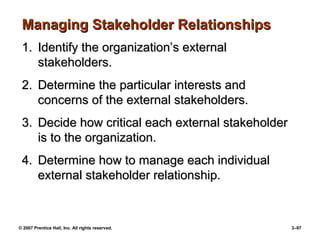
Managing Stakeholder Relationships
1.
1. Identify the organization’s external
Identify the organization’s external
stakeholders.
stakeholders.
2.
2. Determine the particular interests and
Determine the particular interests and
concerns of the external stakeholders.
3.
3. Decide how critical each external stakeholder
Decide how critical each external stakeholder
is to the organization.
4.
4. Determine how to manage each individual
Determine how to manage each individual
external stakeholder relationship.
© 2007 Prentice Hall, Inc. All rights reserved. 3–98
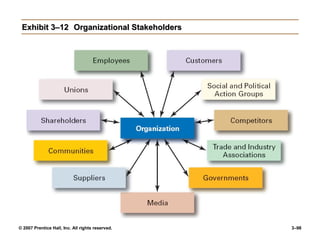
Exhibit 3–12
Exhibit 3–12 Organizational Stakeholders
Organizational Stakeholders
© 2007 Prentice Hall, Inc. All rights reserved. 3–99
Terms to Know
Terms to Know
• omnipotent view of
omnipotent view of
management
management
• symbolic view of
symbolic view of
management
management
• organizational culture
organizational culture
• strong cultures
strong cultures
• socialization
socialization
• workplace spirituality
workplace spirituality
• external environment
external environment
• specific environment
specific environment
• general environment
general environment
• environmental uncertainty
environmental uncertainty
• environmental complexity
environmental complexity
• stakeholders
stakeholders
ninth edition
STEPHEN P. ROBBINS
PowerPoint Presentation by Charlie Cook
The University of West Alabama
MARY COULTER
© 2007 Prentice Hall, Inc.
All rights reserved.
Managing in a Global
Environment
Environment
Chapter
Chapter
4
4
© 2007 Prentice Hall, Inc. All rights reserved. 4–101
L E A R N I N G O U T L I N E
Follow this Learning Outline as you read and study this chapter.
What’s Your Global Perspective?
• Define parochialism.
Define parochialism.
• Contrast ethnocentric, polycentric, and geocentric
Contrast ethnocentric, polycentric, and geocentric
attitudes towards global business.
• Explain why it’s important for managers to be sensitive to
Explain why it’s important for managers to be sensitive to
global differences
global differences
Understanding the Global Environment
• Describe the current status of the European Union.
Describe the current status of the European Union.
• Discuss the North American Free Trade Agreement and
Discuss the North American Free Trade Agreement and
other regional trade alliances in Latin America.
• Tell about the Association of Southeast Asian Nations.
Tell about the Association of Southeast Asian Nations.
© 2007 Prentice Hall, Inc. All rights reserved. 4–102
L E A R N I N G O U T L I N E (cont’d)
Follow this Learning Outline as you read and study this chapter.
Understanding the Global Environment
• Explain the interdependence that globalization involves.
Explain the interdependence that globalization involves.
• Discuss the role of the WTO.
Discuss the role of the WTO.
Doing Business Globally
• Contrast multinational, multidomestic, global,
Contrast multinational, multidomestic, global,
transnational, and born global organizations.
• Describe the different ways organizations can go
Describe the different ways organizations can go
international.
international.
• Define global sourcing, exporting, importing, licensing,
Define global sourcing, exporting, importing, licensing,
and franchising.
and franchising.
• Describe global strategic alliances, joint ventures, and
Describe global strategic alliances, joint ventures, and
foreign subsidiaries.
© 2007 Prentice Hall, Inc. All rights reserved. 4–103
L E A R N I N G O U T L I N E (cont’d)
Follow this Learning Outline as you read and study this chapter.
Managing in a Global Environment (cont’d)
• Explain how the global legal-political and economic
Explain how the global legal-political and economic
environments affect managers.
• Discuss Hofstede’s five dimensions for assessing
Discuss Hofstede’s five dimensions for assessing
cultures.
cultures.
• Explain the nine GLOBE dimensions for assessing
Explain the nine GLOBE dimensions for assessing
cultures.
cultures.
• Discuss the challenges of doing business globally in
Discuss the challenges of doing business globally in
today’s world.
today’s world.
© 2007 Prentice Hall, Inc. All rights reserved. 4–104
The Global Marketplace
• Opportunities and Challenges
Opportunities and Challenges
 Coping with the sudden appearance of new
Coping with the sudden appearance of new
competitors
competitors
 Acknowledging cultural, political, and economic
Acknowledging cultural, political, and economic
differences
differences
 Dealing with increased uncertainty, fear, and anxiety
Dealing with increased uncertainty, fear, and anxiety
 Adapting to changes in the global environment
Adapting to changes in the global environment
 Avoiding parochialism
Avoiding parochialism
© 2007 Prentice Hall, Inc. All rights reserved. 4–105
What’s Your Global Perspective?
• Parochialism
Parochialism
 Is viewing the world solely through its own eyes and
Is viewing the world solely through its own eyes and
perspectives.
perspectives.
 Is not recognizing that others have different ways of
Is not recognizing that others have different ways of
living and working.
living and working.
 Is a significant obstacle for managers working in a
Is a significant obstacle for managers working in a
global business world.
 Is falling into the trap of ignoring others’ values and
Is falling into the trap of ignoring others’ values and
customs and rigidly applying an attitude of “ours is
better than theirs” to foreign cultures.
© 2007 Prentice Hall, Inc. All rights reserved. 4–106
Exhibit 4–1
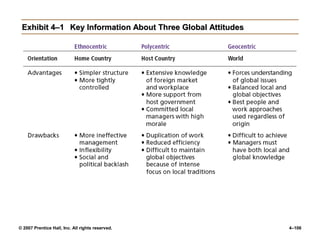
Exhibit 4–1 Key Information About Three Global Attitudes
Key Information About Three Global Attitudes
© 2007 Prentice Hall, Inc. All rights reserved. 4–107
Adopting a Global Perspective
• Ethnocentric Attitude
Ethnocentric Attitude
 The parochialistic belief that the best work
The parochialistic belief that the best work
approaches and practices are those of the
approaches and practices are those of the home
home
country.
country.
• Polycentric Attitude
Polycentric Attitude
 The view that the managers in the
The view that the managers in the host
host country know
country know
the best work approaches and practices for running
their business.
their business.
• Geocentric Attitude
Geocentric Attitude
 A
A world-oriented
world-oriented view that focuses on using the best
view that focuses on using the best
approaches and people from around the globe.
© 2007 Prentice Hall, Inc. All rights reserved. 4–108
Regional Trading Agreements
• The European Union (EU)
The European Union (EU)
 A unified economic and trade entity
A unified economic and trade entity
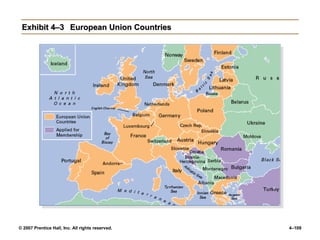
 Belgium, Denmark, France, Greece, Ireland, Italy,
Belgium, Denmark, France, Greece, Ireland, Italy,
Luxembourg, the Netherlands, Portugal, Spain, the United
Kingdom, Germany, Austria, Finland, and Sweden
 Economic and monetary union (Euro)
Economic and monetary union (Euro)
• North American Free Trade Agreement (NAFTA)
North American Free Trade Agreement (NAFTA)
 Eliminated barriers to free trade (tariffs, import
Eliminated barriers to free trade (tariffs, import
licensing requirements, and customs user fees)
 United States, Canada, and Mexico
United States, Canada, and Mexico
© 2007 Prentice Hall, Inc. All rights reserved. 4–109
Exhibit 4–3
Exhibit 4–3 European Union Countries
European Union Countries
© 2007 Prentice Hall, Inc. All rights reserved. 4–110
Regional Trading Agreements (cont’d)
• U.S.-Central America Free Trade Agreement
U.S.-Central America Free Trade Agreement
(CAFTA)
(CAFTA)
• Free Trade Area of the Americas
Free Trade Area of the Americas
• Southern Cone Common Market (Mercosur)
Southern Cone Common Market (Mercosur)
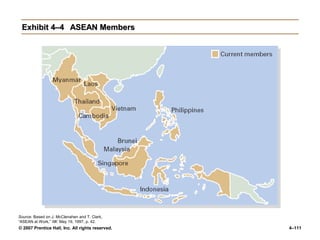
• Association of Southeast Asian Nations
Association of Southeast Asian Nations
(ASEAN)
(ASEAN)
 Trading alliance of 10 Southeast Asian nations
Trading alliance of 10 Southeast Asian nations
• African Union
African Union
• South Asian Association for Regional
South Asian Association for Regional
Cooperation (SARRC)
Cooperation (SARRC)
© 2007 Prentice Hall, Inc. All rights reserved. 4–111
Exhibit 4–4
Exhibit 4–4 ASEAN Members
ASEAN Members
Source: Based on J. McClenahen and T. Clark,
“ASEAN at Work,” IW. May 19, 1997, p. 42.
© 2007 Prentice Hall, Inc. All rights reserved. 4–112
The World Trade Organization (WTO)
• Evolved from the General Agreement on Tariffs
Evolved from the General Agreement on Tariffs
and Trade (GATT) in 1995.
• Functions as the only global organization
Functions as the only global organization
dealing with the rules of trade among nations.
• Has 149 member nations and 32 observer
Has 149 member nations and 32 observer
governments.
governments.
• Monitors and promotes world trade.
Monitors and promotes world trade.
© 2007 Prentice Hall, Inc. All rights reserved. 4–113
Different Types of International
Organizations
Organizations
• Multinational Corporation (MNC)
Multinational Corporation (MNC)
 Maintains operations in multiple countries.
Maintains operations in multiple countries.
• Multidomestic Corporation
Multidomestic Corporation
 Is an MNC that decentralizes management and other
Is an MNC that decentralizes management and other
decisions to the local country.
• Global Company
Global Company
 Is an MNC that centralizes its management and other
Is an MNC that centralizes its management and other
decisions in the home country.
© 2007 Prentice Hall, Inc. All rights reserved. 4–114
Different Types of International
Organizations (cont’d)
• Transnational Corporation (Borderless
Transnational Corporation (Borderless
Organization)
Organization)
 Is an MNC that has eliminated structural divisions that
Is an MNC that has eliminated structural divisions that
impose artificial geographic barriers and is organized
along business lines that reflect a geocentric attitude.
• Born Globals/International New Ventures (INVs)
Born Globals/International New Ventures (INVs)
 Commit resources upfront (material, people,
Commit resources upfront (material, people,
financing) to doing business in more than one
country.
country.
© 2007 Prentice Hall, Inc. All rights reserved. 4–115
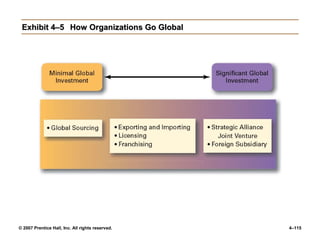
Exhibit 4–5
Exhibit 4–5 How Organizations Go Global
How Organizations Go Global
© 2007 Prentice Hall, Inc. All rights reserved. 4–116
Other Forms of Globalization
• Strategic Alliances
Strategic Alliances
 Partnerships between and organization and a foreign
Partnerships between and organization and a foreign
company in which both share resources and
knowledge in developing new products or building
new production facilities.
• Joint Venture
Joint Venture
 A specific type of strategic alliance in which the
A specific type of strategic alliance in which the
partners agree to form a separate, independent
organization for some business purpose.
• Foreign Subsidiary
Foreign Subsidiary
 Directly investing in a foreign country by setting up a
Directly investing in a foreign country by setting up a
separate and independent production facility or office.
© 2007 Prentice Hall, Inc. All rights reserved. 4–117
Managing in A Global Environment
• The Legal Environment
The Legal Environment
 Stability or instability of legal and political systems
Stability or instability of legal and political systems
 Legal procedures are established and followed
Legal procedures are established and followed
 Fair and honest elections held on a regular basis
Fair and honest elections held on a regular basis
 Differences in the laws of various nations
Differences in the laws of various nations
 Effects on business activities
Effects on business activities
 Effects on delivery of products and services
Effects on delivery of products and services
© 2007 Prentice Hall, Inc. All rights reserved. 4–118
The Economic Environment
• Economic Systems
Economic Systems
 Market economy
Market economy
 An economy in which resources are primarily owned and
An economy in which resources are primarily owned and
controlled by the private sector.
 Command economy
Command economy
 An economy in which all economic decisions are planned by
An economy in which all economic decisions are planned by
a central government.
• Monetary and Financial Factors
Monetary and Financial Factors
 Currency exchange rates
Currency exchange rates
 Inflation rates
Inflation rates
 Diverse tax policies
Diverse tax policies
© 2007 Prentice Hall, Inc. All rights reserved. 4–119
The Cultural Environment
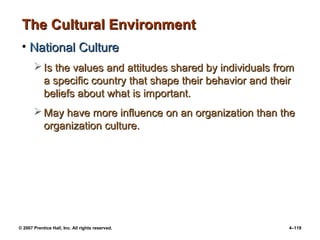
• National Culture
National Culture
 Is the values and attitudes shared by individuals from
Is the values and attitudes shared by individuals from
a specific country that shape their behavior and their
beliefs about what is important.
 May have more influence on an organization than the
May have more influence on an organization than the
organization culture.
© 2007 Prentice Hall, Inc. All rights reserved. 4–120
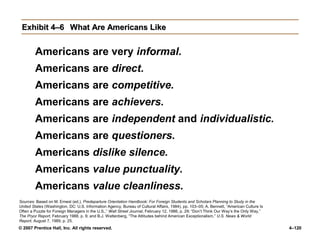
Exhibit 4–6
Exhibit 4–6 What Are Americans Like
What Are Americans Like
Americans are very informal.
Americans are direct.
Americans are competitive.
Americans are achievers.
Americans are independent and individualistic.
Americans are questioners.
Americans dislike silence.
Americans value punctuality.
Americans value cleanliness.
Sources: Based on M. Ernest (ed.), Predeparture Orientation Handbook: For Foreign Students and Scholars Planning to Study in the
United States (Washington, DC: U.S. Information Agency, Bureau of Cultural Affairs, 1984), pp. 103–05; A. Bennett, “American Culture Is
Often a Puzzle for Foreign Managers in the U.S.,” Wall Street Journal, February 12, 1986, p. 29; “Don’t Think Our Way’s the Only Way,”
The Pryor Report, February 1988, p. 9; and B.J. Wattenberg, “The Attitudes behind American Exceptionalism,” U.S. News & World
Report, August 7, 1989, p. 25.
© 2007 Prentice Hall, Inc. All rights reserved. 4–121
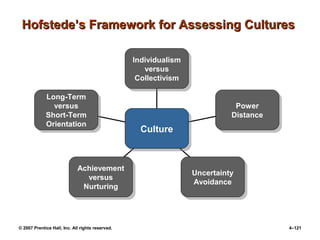
Hofstede’s Framework for Assessing Cultures
Individualism
versus
Collectivism
Individualism
versus
Collectivism
Power
Distance
Power
Distance
Uncertainty
Avoidance
Uncertainty
Avoidance
Achievement
versus
Nurturing
Achievement
versus
Nurturing
Long-Term
versus
Short-Term
Orientation
Long-Term
versus
Short-Term
Orientation
Culture
Culture
© 2007 Prentice Hall, Inc. All rights reserved. 4–122
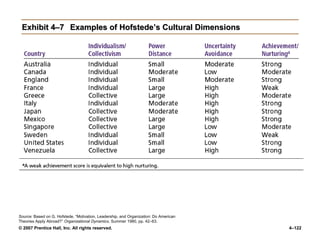
Exhibit 4–7
Exhibit 4–7 Examples of Hofstede’s Cultural Dimensions
Examples of Hofstede’s Cultural Dimensions
Source: Based on G. Hofstede, “Motivation, Leadership, and Organization: Do American
Theories Apply Abroad?” Organizational Dynamics, Summer 1980, pp. 42–63.
© 2007 Prentice Hall, Inc. All rights reserved. 4–123
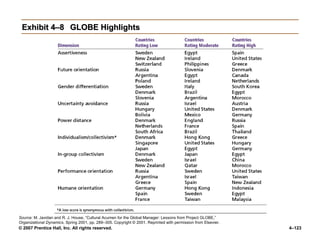
Exhibit 4–8
Exhibit 4–8 GLOBE Highlights
GLOBE Highlights
Source: M. Javidan and R. J. House, “Cultural Acumen for the Global Manager: Lessons from Project GLOBE,”
Organizational Dynamics, Spring 2001, pp. 289–305. Copyright © 2001. Reprinted with permission from Elsevier.
© 2007 Prentice Hall, Inc. All rights reserved. 4–124
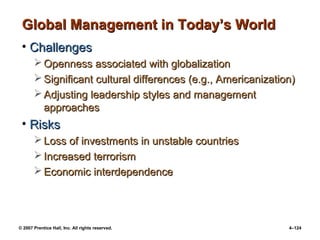
Global Management in Today’s World
• Challenges
Challenges
 Openness associated with globalization
Openness associated with globalization
 Significant cultural differences (e.g., Americanization)
Significant cultural differences (e.g., Americanization)
 Adjusting leadership styles and management
Adjusting leadership styles and management
approaches
approaches
• Risks
Risks
 Loss of investments in unstable countries
Loss of investments in unstable countries
 Increased terrorism
Increased terrorism
 Economic interdependence
Economic interdependence
© 2007 Prentice Hall, Inc. All rights reserved. 4–125
Terms to Know
Terms to Know
• parochialism
parochialism
• ethnocentric attitude
ethnocentric attitude
• polycentric attitude
polycentric attitude
• geocentric attitude
geocentric attitude
• European Union (EU)
European Union (EU)
• Euro
Euro
• North American Free Trade
North American Free Trade
Agreement (NAFTA)
Agreement (NAFTA)
• Association of Southeast Asian
Association of Southeast Asian
Nations (ASEAN)
Nations (ASEAN)
• World Trade Organization (WTO)
World Trade Organization (WTO)
• multinational corporations (MNCs)
multinational corporations (MNCs)
• multidomestic corporation
multidomestic corporation
• global company
global company
• transnational or borderless
transnational or borderless
organization
organization
• born globals
born globals
• global sourcing
global sourcing
• exporting
exporting
• importing
importing
• licensing
licensing
• franchising
franchising
• strategic alliances
strategic alliances
• joint venture
joint venture
• foreign subsidiary
foreign subsidiary
• market economy
market economy
• command economy
command economy
• national culture
national culture
• GLOBE
GLOBE
• wikis
wikis
• blogs
blogs
ninth edition
STEPHEN P. ROBBINS
PowerPoint Presentation by Charlie Cook
The University of West Alabama
MARY COULTER
© 2007 Prentice Hall, Inc.
All rights reserved.
Social Responsibility
and Managerial Ethics
Chapter
Chapter
5
5
© 2007 Prentice Hall, Inc. All rights reserved. 5–127
L E A R N I N G O U T L I N E
Follow this Learning Outline as you read and study this chapter
Follow this Learning Outline as you read and study this chapter.
.
What is Social Responsibility?
• Contrast the classical and socioeconomic views of social
Contrast the classical and socioeconomic views of social
responsibility.
responsibility.
• Discuss the role that stakeholders play in the four stages
Discuss the role that stakeholders play in the four stages
of social responsibility.
• Differentiate between social obligation, social
Differentiate between social obligation, social
responsiveness, and social responsibility.
© 2007 Prentice Hall, Inc. All rights reserved. 5–128
L E A R N I N G O U T L I N E
Follow this Learning Outline as you read and study this chapter
Follow this Learning Outline as you read and study this chapter.
.
Social Responsibility and Economic Performance
• Explain what research studies have shown about the
Explain what research studies have shown about the
relationship between an organization’s social involvement
and its economic performance.
• Define social screening.
Define social screening.
• Explain what conclusion can be reached regarding social
Explain what conclusion can be reached regarding social
responsibility and economic performance.
© 2007 Prentice Hall, Inc. All rights reserved. 5–129
L E A R N I N G O U T L I N E (cont’d)
Follow this Learning Outline as you read and study this chapter.
The Greening of Management
• Describe how organizations can go green.
Describe how organizations can go green.
• Relate the approaches to being green to the concepts of
Relate the approaches to being green to the concepts of
social obligation, social responsiveness, and social
responsibility.
responsibility.
Values-Based Management
• Discuss what purposes shared values serve.
Discuss what purposes shared values serve.
• Describe the relationship of values-based management to
Describe the relationship of values-based management to
ethics.
ethics.
© 2007 Prentice Hall, Inc. All rights reserved. 5–130
L E A R N I N G O U T L I N E (cont’d)
Follow this Learning Outline as you read and study this chapter.
Managerial Ethics
Managerial Ethics
• Discuss the factors that affect ethical and unethical
Discuss the factors that affect ethical and unethical
behavior.
behavior.
• Describe the important roles managers play in
Describe the important roles managers play in
encouraging ethical behavior.
© 2007 Prentice Hall, Inc. All rights reserved. 5–131
L E A R N I N G O U T L I N E (cont’d)
Follow this Learning Outline as you read and study this chapter.
Social Responsibility and Ethics in Today’s World
• Explain why ethical leadership is important.
Explain why ethical leadership is important.
• Discuss how managers and organizations can protect
Discuss how managers and organizations can protect
employees who raise ethical issues or concerns.
• Explain what role social entrepreneurs play.
Explain what role social entrepreneurs play.
• Describe social impact management.
Describe social impact management.
© 2007 Prentice Hall, Inc. All rights reserved. 5–132
What Is Social Responsibility?
• The Classical View
The Classical View
 Management’s only social responsibility is to
Management’s only social responsibility is to
maximize profits (create a financial return) by
operating the business in the best interests of the
stockholders (owners of the corporation).
 Expending the firm’s resources on doing “social good”
Expending the firm’s resources on doing “social good”
unjustifiably increases costs that lower profits to the
owners and raises prices to consumers.
© 2007 Prentice Hall, Inc. All rights reserved. 5–133
What Is Social Responsibility? (cont’d)
• The Socioeconomic View
The Socioeconomic View
 Management’s social responsibility goes beyond
Management’s social responsibility goes beyond
making profits to include protecting and improving
society’s welfare.
society’s welfare.
 Corporations are not independent entities responsible
Corporations are not independent entities responsible
only to stockholders.
 Firms have a moral responsibility to larger society to
Firms have a moral responsibility to larger society to
become involved in social, legal, and political issues.
 “
“To do the right thing”
To do the right thing”
© 2007 Prentice Hall, Inc. All rights reserved. 5–134
Exhibit 5–1
Exhibit 5–1 To Whom is Management Responsible?
To Whom is Management Responsible?
© 2007 Prentice Hall, Inc. All rights reserved. 5–135
Exhibit 5–2
Exhibit 5–2 Arguments For and Against Social Responsibility
Arguments For and Against Social Responsibility
• For
For
 Public expectations
Public expectations
 Long-run profits
Long-run profits
 Ethical obligation
Ethical obligation
 Public image
Public image
 Better environment
Better environment
 Discouragement of further
Discouragement of further
governmental regulation
 Balance of responsibility
Balance of responsibility
and power
and power
 Stockholder interests
Stockholder interests
 Possession of resources
Possession of resources
 Superiority of prevention
Superiority of prevention
over cure
over cure
• Against
Against
 Violation of profit
Violation of profit
maximization
maximization
 Dilution of purpose
Dilution of purpose
 Costs
Costs
 Too much power
Too much power
 Lack of skills
Lack of skills
 Lack of accountability
Lack of accountability
© 2007 Prentice Hall, Inc. All rights reserved. 5–136
From Obligation to Responsiveness to
Responsibility
Responsibility
• Social Obligation
Social Obligation
 The obligation of a business to meet its economic and
The obligation of a business to meet its economic and
legal responsibilities and nothing more.
• Social Responsiveness
Social Responsiveness
 When a firm engages in social actions in response to
When a firm engages in social actions in response to
some popular social need.
• Social Responsibility
Social Responsibility
 A business’s intention, beyond its legal and economic
A business’s intention, beyond its legal and economic
obligations, to do the right things and act in ways that
are good for society.
© 2007 Prentice Hall, Inc. All rights reserved. 5–137
Exhibit 5–3
Exhibit 5–3 Social Responsibility versus Social Responsiveness
Social Responsibility versus Social Responsiveness
Social Responsibility Social Responsiveness
Major consideration Ethical Pragmatic
Focus Ends Means
Emphasis Obligation Responses
Decision framework Long term Medium and short term
Source: Adapted from S.L. Wartick and P.L. Cochran, “The Evolution of the Corporate
Social Performance Model,” Academy of Management Review, October 1985, p. 766.
© 2007 Prentice Hall, Inc. All rights reserved. 5–138
Does Social Responsibility Pay?
• Studies appear to show a positive relationship
Studies appear to show a positive relationship
between social involvement and the economic
performance of firms.
 Difficulties in defining and measuring “social
Difficulties in defining and measuring “social
responsibility” and “economic performance raise
issues of validity and causation in the studies.
 Mutual funds using social screening in investment
Mutual funds using social screening in investment
decisions slightly outperformed other mutual funds.
• A general conclusion is that a firm’s social
A general conclusion is that a firm’s social
actions do not harm its long-term performance.
© 2007 Prentice Hall, Inc. All rights reserved. 5–139
Exhibit 5–4
Exhibit 5–4 Social Investing
Social Investing
Source: Social Investment Forum Foundation.
© 2007 Prentice Hall, Inc. All rights reserved. 5–140
The Greening of Management
• The recognition of the close link between an
The recognition of the close link between an
organization’s decision and activities and its
impact on the natural environment.
 Global environmental problems facing managers:
Global environmental problems facing managers:
 Air, water, and soil pollution from toxic wastes
Air, water, and soil pollution from toxic wastes
 Global warming from greenhouse gas emissions
Global warming from greenhouse gas emissions
 Natural resource depletion
Natural resource depletion
© 2007 Prentice Hall, Inc. All rights reserved. 5–141
How Organizations Go Green
• Legal (or Light Green) Approach
Legal (or Light Green) Approach
 Firms simply do what is legally required by obeying laws, rules,
Firms simply do what is legally required by obeying laws, rules,
and regulations willingly and without legal challenge.
• Market Approach
Market Approach
 Firms respond to the preferences of their customers for
Firms respond to the preferences of their customers for
environmentally friendly products.
• Stakeholder Approach
Stakeholder Approach
 Firms work to meet the environmental demands of multiple
Firms work to meet the environmental demands of multiple
stakeholders
stakeholders—
—employees, suppliers, and the community.
employees, suppliers, and the community.
• Activist Approach
Activist Approach
 Firms look for ways to respect and preserve environment and be
Firms look for ways to respect and preserve environment and be
actively socially responsible.
© 2007 Prentice Hall, Inc. All rights reserved. 5–142
Exhibit 5–5
Exhibit 5–5 Approaches to Being Green
Approaches to Being Green
Source: Based on R.E. Freeman. J. Pierce, and R. Dodd. Shades of Green:
Business Ethics and the Environment (New York: Oxford University Press, 1995).
© 2007 Prentice Hall, Inc. All rights reserved. 5–143
Evaluating the Greening of Management
• Organizations become “greener” by
Organizations become “greener” by
 Using the Sustainability Reporting Guidelines to
Using the Sustainability Reporting Guidelines to
document “green” actions.
 Adopting ISO 14001 standards for environmental
Adopting ISO 14001 standards for environmental
management
management
 Being named as one of the 100 Most Sustainable
Being named as one of the 100 Most Sustainable
Corporations in the World.
© 2007 Prentice Hall, Inc. All rights reserved. 5–144
Values-Based Management
• Values-Based Management
Values-Based Management
 An approach to managing in which managers
An approach to managing in which managers
establish and uphold an organization’s shared values.
• The Purposes of Shared Values
The Purposes of Shared Values
 Guiding managerial decisions
Guiding managerial decisions
 Shaping employee behavior
Shaping employee behavior
 Influencing the direction of marketing efforts
Influencing the direction of marketing efforts
 Building team spirit
Building team spirit
• The Bottom Line on Shared Corporate Values
The Bottom Line on Shared Corporate Values
 An organization’s values are reflected in the decisions
An organization’s values are reflected in the decisions
and actions of its employees.
© 2007 Prentice Hall, Inc. All rights reserved. 5–145
Exhibit 5–6
Exhibit 5–6 Purposes of Shared Values
Purposes of Shared Values
© 2007 Prentice Hall, Inc. All rights reserved. 5–146
Exhibit 5–7
Exhibit 5–7 Survey of Stated
Survey of Stated
Values of
Values of
Organizations
Organizations
Percentage of
Core Value Respondents
Customer satisfaction 77%
Ethics/integrity 76%
Accountability 61%
Respect for others 59%
Open communication 51%
Profitability 49%
Teamwork 47%
Innovation/change 47%
Continuous learning 43%
Positive work environment 42%
Diversity 41%
Community service 38%
Trust 37%
Social responsibility 33%
Security/safety 33%
Empowerment 32%
Employee job satisfaction 31%
Have fun 24%
Source: “AMA Corporate Values Survey,” (www.amanet.org), October 30, 2002.
© 2007 Prentice Hall, Inc. All rights reserved. 5–147
Managerial Ethics
Managerial Ethics
• Ethics Defined
Ethics Defined
 Principles, values, and beliefs that define what is right
Principles, values, and beliefs that define what is right
and wrong behavior.
and wrong behavior.
© 2007 Prentice Hall, Inc. All rights reserved. 5–148
Exhibit 5–8
Exhibit 5–8 Factors That Affect Ethical and Unethical Behavior
Factors That Affect Ethical and Unethical Behavior
© 2007 Prentice Hall, Inc. All rights reserved. 5–149
Factors That Affect Employee Ethics
• Moral Development
Moral Development
 A measure of independence from outside influences
A measure of independence from outside influences
 Levels of Individual Moral Development
Levels of Individual Moral Development
– Preconventional level
Preconventional level
– Conventional level
Conventional level
– Principled level
Principled level
 Stage of moral development interacts with:
Stage of moral development interacts with:
 Individual characteristics
Individual characteristics
 The organization’s structural design
The organization’s structural design
 The organization’s culture
The organization’s culture
 The intensity of the ethical issue
The intensity of the ethical issue
© 2007 Prentice Hall, Inc. All rights reserved. 5–150
Exhibit 5–9
Exhibit 5–9 Stages of Moral Development
Stages of Moral Development
Source: Based on L. Kohlberg, “Moral Stages and Moralization: The Cognitive-
Development Approach,” in T. Lickona (ed.). Moral Development and Behavior: Theory,
Research, and Social Issues (New York: Holt, Rinehart & Winston, 1976), pp. 34–35.
© 2007 Prentice Hall, Inc. All rights reserved. 5–151
Factors That Affect Employee Ethics
(cont’d)
(cont’d)
• Moral Development
Moral Development
 Research Conclusions:
Research Conclusions:
 People proceed through the stages of moral development
People proceed through the stages of moral development
sequentially.
sequentially.
 There is no guarantee of continued moral development.
There is no guarantee of continued moral development.
 Most adults are in Stage 4 (“good corporate citizen”).
Most adults are in Stage 4 (“good corporate citizen”).
© 2007 Prentice Hall, Inc. All rights reserved. 5–152
Individual Characteristics Affecting
Ethical Behaviors
Ethical Behaviors
• Values
Values
 Basic convictions about what is right or wrong on a
Basic convictions about what is right or wrong on a
broad range of issues
© 2007 Prentice Hall, Inc. All rights reserved. 5–153
Individual Characteristics
• Personality Variables
Personality Variables
 Ego strength
Ego strength
 A personality measure of the strength of a person’s
A personality measure of the strength of a person’s
convictions
convictions
 Locus of Control
Locus of Control
 A personality attribute that measures the degree to which
A personality attribute that measures the degree to which
people believe they control their own life.
 Internal locus:
Internal locus: the belief that you control your destiny.
the belief that you control your destiny.
 External locus:
External locus: the belief that what happens to you is due to
the belief that what happens to you is due to
luck or chance.
luck or chance.
© 2007 Prentice Hall, Inc. All rights reserved. 5–154
Other Variables
Other Variables
• Structural Variables
Structural Variables
 Organizational characteristics and mechanisms that
Organizational characteristics and mechanisms that
guide and influence individual ethics:
 Performance appraisal systems
Performance appraisal systems
 Reward allocation systems
Reward allocation systems
 Behaviors (ethical) of managers
Behaviors (ethical) of managers
• An Organization’s Culture
An Organization’s Culture
• Intensity of the Ethical Issue
Intensity of the Ethical Issue
© 2007 Prentice Hall, Inc. All rights reserved. 5–155
Exhibit 5–10
Exhibit 5–10 Determinants of Issue Intensity
Determinants of Issue Intensity
© 2007 Prentice Hall, Inc. All rights reserved. 5–156
Ethics in an International Context
• Ethical standards are not universal.
Ethical standards are not universal.
 Social and cultural differences determine acceptable
Social and cultural differences determine acceptable
behaviors.
behaviors.
• Foreign Corrupt Practices Act
Foreign Corrupt Practices Act
 Makes it illegal to corrupt a foreign official yet “token”
Makes it illegal to corrupt a foreign official yet “token”
payments to officials are permissible when doing so is
an accepted practice in that country.
• The Global Compact
The Global Compact
© 2007 Prentice Hall, Inc. All rights reserved. 5–157
Exhibit 5–11
Exhibit 5–11 The Global Compact
The Global Compact
Human Rights
Principle 1: Support and respect the protection of international human rights within their
sphere of influence.
Principle 2: Make sure business corporations are not complicit in human rights abuses.
Labor Standards
Principle 3: Freedom of association and the effective recognition of the right to collective
bargaining.
Principle 4: The elimination of all forms of forced and compulsory labor.
Principle 5: The effective abolition of child labor.
Principle 6: The elimination of discrimination in respect of employment and occupation.
Environment
Principle 7: Support a precautionary approach to environmental challenges.
Principle 8: Undertake initiatives to promote greater environmental responsibility.
Principle 9: Encourage the development and diffusion of environmentally friendly
technologies.
Source: Courtesy of Global Compact.
© 2007 Prentice Hall, Inc. All rights reserved. 5–158
How Managers Can Improve Ethical
Behavior in An Organization
1.
1. Hire individuals with high ethical standards.
Hire individuals with high ethical standards.
2.
2. Establish codes of ethics and decision rules.
Establish codes of ethics and decision rules.
3.
3. Lead by example.
Lead by example.
4.
4. Set realistic job goals and include ethics in
Set realistic job goals and include ethics in
performance appraisals.
5.
5. Provide ethics training.
Provide ethics training.
6.
6. Conduct independent social audits.
Conduct independent social audits.
7.
7. Provide support for individuals facing ethical
Provide support for individuals facing ethical
dilemmas.
dilemmas.
© 2007 Prentice Hall, Inc. All rights reserved. 5–159
The Value of Ethics Training
• Can make a difference in ethical behaviors.
Can make a difference in ethical behaviors.
• Increases employee awareness of ethical issues
Increases employee awareness of ethical issues
in business decisions.
• Clarifies and reinforces the organization’s
Clarifies and reinforces the organization’s
standards of conduct.
• Helps employees become more confident that
Helps employees become more confident that
they will have the organization’s support when
taking unpopular but ethically correct stances.
© 2007 Prentice Hall, Inc. All rights reserved. 5–160
Exhibit 5–12
Exhibit 5–12 Clusters of Variables Found in 83 Corporate
Clusters of Variables Found in 83 Corporate
Codes of Business Ethics
Cluster 1. Be a Dependable Organizational Citizen
1. Comply with safety, health, and security regulations.
2. Demonstrate courtesy, respect, honesty, and fairness.
3. Illegal drugs and alcohol at work are prohibited.
4. Manage personal finances well.
5. Exhibit good attendance and punctuality.
6. Follow directives of supervisors.
7. Do not use abusive language.
8. Dress in business attire.
9. Firearms at work are prohibited.
Cluster 2. Do Not Do Anything Unlawful or Improper That
Will Harm the Organization
1. Conduct business in compliance with all laws.
2. Payments for unlawful purposes are prohibited.
3. Bribes are prohibited.
4. Avoid outside activities that impair duties.
5. Maintain confidentiality of records.
6. Comply with all antitrust and trade regulations.
7. Comply with all accounting rules and controls.
8. Do not use company property for personal benefit.
9. Employees are personally accountable for company funds.
10. Do not propagate false or misleading information.
11. Make decisions without regard for personal gain.
Cluster 3. Be Good to Customers
1. Convey true claims in product advertisements.
2. Perform assigned duties to the best of your ability.
3. Provide products and services of the highest quality.
Source: F. R. David, “An Empirical Study of Codes of Business Ethics: A Strategic Perspective,” paper
presented at the 48th
Annual Academy of Management Conference, Anaheim, California, August 1988.
© 2007 Prentice Hall, Inc. All rights reserved. 5–161
Exhibit 5–13
Exhibit 5–13 Twelve Questions for Examining the Ethics
Twelve Questions for Examining the Ethics
of a Business Decision
1. Have you defined the problem accurately?
2. How would you define the problem if you stood on the other side of the fence?
3. How did this situation occur in the first place?
4. To whom and to what do you give your loyalty as a person and as a member of the
corporation?
5. What is your intention in making this decision?
6. How does this intention compare with the probable results?
7. Whom could your decision or action injure?
8. Can you discuss the problem with the affected parties before you make the decision?
9. Are you confident that your position will be as valid over a long period of time as it
seems now?
10. Could you disclose without qualm your decision or action to your boss, your chief
executive officer, the board of directors, your family, society as a whole?
11. What is the symbolic potential of your action if understood? If misunderstood?
12. Under what conditions would you allow exceptions to your stand?
Source: Reprinted by permission of Harvard Business Review. An exhibit from “Ethics Without the Sermon,” by L. L. Nash.
November–December 1981, p. 81. Copyright © 1981 by the President and Fellows of Harvard College. All rights reserved.
© 2007 Prentice Hall, Inc. All rights reserved. 5–162
Effective Use of a Code of Ethics
• Develop a code of ethics as a guide in handling
Develop a code of ethics as a guide in handling
ethical dilemmas in decision making.
• Communicate the code regularly to all
Communicate the code regularly to all
employees.
employees.
• Have all levels of management continually
Have all levels of management continually
reaffirm the importance of the ethics code and
the organization’s commitment to the code.
• Publicly reprimand and consistently discipline
Publicly reprimand and consistently discipline
those who break the code.
© 2007 Prentice Hall, Inc. All rights reserved. 5–163
Ethical Leadership
Ethical Leadership
• Managers must provide a
Managers must provide a good role model
good role model by:
by:
 Being ethical and honest at all times.
Being ethical and honest at all times.
 Telling the truth; don’t hide or manipulate information.
Telling the truth; don’t hide or manipulate information.
 Admitting failure and not trying to cover it up.
Admitting failure and not trying to cover it up.
 Communicating shared ethical values to employees
Communicating shared ethical values to employees
through symbols, stories, and slogans.
 Rewarding employees who behave ethically and
Rewarding employees who behave ethically and
punish those who do not.
 Protecting employees (
Protecting employees (whistleblowers
whistleblowers) who bring to
) who bring to
light unethical behaviors or raise ethical issues.
© 2007 Prentice Hall, Inc. All rights reserved. 5–164
Managing Ethical Lapses and Social
Irresponsibility
Irresponsibility
• Provide ethical leadership
Provide ethical leadership
• Protect employees who raise ethical issues
Protect employees who raise ethical issues
(whistle-blowers)
(whistle-blowers)
© 2007 Prentice Hall, Inc. All rights reserved. 5–165
Awareness of Social Issues
• Social Entrepreneurs
Social Entrepreneurs
 Are individuals or organizations who seek out
Are individuals or organizations who seek out
opportunities to improve society by using practical,
innovative, and sustainable approaches.
 Want to make the world a better place and have a
Want to make the world a better place and have a
driving passion to make that happen.
© 2007 Prentice Hall, Inc. All rights reserved. 5–166
Awareness of Social Issues (cont’d)
• Social Impact Management
Social Impact Management
 Is the field of inquiry at the intersection of business
Is the field of inquiry at the intersection of business
practice and wider societal concerns that reflects and
respects the complex interdependency of those two
realities.
realities.
 Seeks to answer the question of how to go about
Seeks to answer the question of how to go about
increasing managers’ awareness within their
decision-making processes of how society is
impacted by the conduct and activities of their firms.
© 2007 Prentice Hall, Inc. All rights reserved. 5–167
Terms to Know
Terms to Know
• classical view
classical view
• socioeconomic view
socioeconomic view
• social obligation
social obligation
• social responsiveness
social responsiveness
• social responsibility
social responsibility
• social screening
social screening
• greening of management
greening of management
• values-based
values-based
management
management
• ethics
ethics
• values
values
• ego strength
ego strength
• locus of control
locus of control
• code of ethics
code of ethics
• whistle-blower
whistle-blower
• social entrepreneur
social entrepreneur
• social impact
social impact
management
management
ninth edition
STEPHEN P. ROBBINS
PowerPoint Presentation by Charlie Cook
The University of West Alabama
MARY COULTER
© 2007 Prentice Hall, Inc.
All rights reserved.
Decision-Making:
Decision-Making:
The Essence of
The Essence of
the Manager’s Job
the Manager’s Job
Chapter
Chapter
6
6
© 2007 Prentice Hall, Inc. All rights reserved. 6–169
L E A R N I N G O U T L I N E
Follow this Learning Outline as you read and study this chapter.
The Decision-Making Process
• Define decision and decision-making process.
Define decision and decision-making process.
• Describe the eight steps in the decision-making process.
Describe the eight steps in the decision-making process.
The Manager as Decision Maker
• Discuss the assumptions of rational decision making.
Discuss the assumptions of rational decision making.
• Describe the concepts of bounded rationality, satisficing,
Describe the concepts of bounded rationality, satisficing,
and escalation of commitment.
• Explain intuitive decision making.
Explain intuitive decision making.
• Contrast programmed and nonprogrammed decisions.
Contrast programmed and nonprogrammed decisions.
© 2007 Prentice Hall, Inc. All rights reserved. 6–170
L E A R N I N G O U T L I N E (cont’d)
Follow this Learning Outline as you read and study this chapter.
The Manager as Decision Maker (cont’d)
• Contrast the three decision-making conditions.
Contrast the three decision-making conditions.
• Explain maximax, maximin, and minimax decision choice
Explain maximax, maximin, and minimax decision choice
approaches.
approaches.
• Describe the four decision making styles.
Describe the four decision making styles.
• Discuss the twelve decision-making biases managers
Discuss the twelve decision-making biases managers
may exhibit.
may exhibit.
• Describe how manager can deal with the negative effects
Describe how manager can deal with the negative effects
of decision errors and biases.
• Explain the managerial decision-making model.
Explain the managerial decision-making model.
© 2007 Prentice Hall, Inc. All rights reserved. 6–171
L E A R N I N G O U T L I N E (cont’d)
Follow this Learning Outline as you read and study this chapter.
Decision Making for Today’s World
• Explain how managers can make effective decisions in
Explain how managers can make effective decisions in
today’s world.
today’s world.
• List six characteristics of an effective decision-making
List six characteristics of an effective decision-making
process.
process.
• Describe the five habits of highly reliable organizations.
Describe the five habits of highly reliable organizations.
© 2007 Prentice Hall, Inc. All rights reserved. 6–172
Decision Making
Decision Making
• Decision
Decision
 Making a choice from two or more alternatives.
Making a choice from two or more alternatives.
• The Decision-Making Process
The Decision-Making Process
 Identifying a problem and decision criteria and
Identifying a problem and decision criteria and
allocating weights to the criteria.
 Developing, analyzing, and selecting an alternative
Developing, analyzing, and selecting an alternative
that can resolve the problem.
 Implementing the selected alternative.
Implementing the selected alternative.
 Evaluating the decision’s effectiveness.
Evaluating the decision’s effectiveness.
© 2007 Prentice Hall, Inc. All rights reserved. 6–173
Exhibit 6–1
Exhibit 6–1
The Decision-Making Process
© 2007 Prentice Hall, Inc. All rights reserved. 6–174
Step 1: Identifying the Problem
• Problem
Problem
 A discrepancy between an existing and desired state
A discrepancy between an existing and desired state
of affairs.
of affairs.
• Characteristics of Problems
Characteristics of Problems
 A problem becomes a problem when a manager
A problem becomes a problem when a manager
becomes aware of it.
 There is pressure to solve the problem.
There is pressure to solve the problem.
 The manager must have the authority, information, or
The manager must have the authority, information, or
resources needed to solve the problem.
© 2007 Prentice Hall, Inc. All rights reserved. 6–175
Step 2: Identifying Decision Criteria
• Decision criteria are factors that are important
Decision criteria are factors that are important
(relevant) to resolving the problem.
 Costs that will be incurred (investments required)
Costs that will be incurred (investments required)
 Risks likely to be encountered (chance of failure)
Risks likely to be encountered (chance of failure)
 Outcomes that are desired (growth of the firm)
Outcomes that are desired (growth of the firm)
Step 3: Allocating Weights to the Criteria
• Decision criteria are not of equal importance:
Decision criteria are not of equal importance:
 Assigning a weight to each item places the items in
Assigning a weight to each item places the items in
the correct priority order of their importance in the
decision making process.
© 2007 Prentice Hall, Inc. All rights reserved. 6–176
Exhibit 6–2
Exhibit 6–2 Criteria and Weights for Computer Replacement Decision
Criteria and Weights for Computer Replacement Decision
Criterion Weight
Memory and Storage 10
Battery life 8
Carrying Weight 6
Warranty 4
Display Quality 3
© 2007 Prentice Hall, Inc. All rights reserved. 6–177
Step 4: Developing Alternatives
• Identifying viable alternatives
Identifying viable alternatives
 Alternatives are listed (without evaluation) that can
Alternatives are listed (without evaluation) that can
resolve the problem.
Step 5: Analyzing Alternatives
• Appraising each alternative’s strengths and
Appraising each alternative’s strengths and
weaknesses
weaknesses
 An alternative’s appraisal is based on its ability to
An alternative’s appraisal is based on its ability to
resolve the issues identified in steps 2 and 3.
© 2007 Prentice Hall, Inc. All rights reserved. 6–178
Exhibit 6–3
Exhibit 6–3 Assessed Values of Laptop Computers
Assessed Values of Laptop Computers
Using Decision Criteria
© 2007 Prentice Hall, Inc. All rights reserved. 6–179
Step 6: Selecting an Alternative
• Choosing the best alternative
Choosing the best alternative
 The alternative with the highest total weight is
The alternative with the highest total weight is
chosen.
chosen.
Step 7: Implementing the Alternative
• Putting the chosen alternative into action.
Putting the chosen alternative into action.
 Conveying the decision to and gaining commitment
Conveying the decision to and gaining commitment
from those who will carry out the decision.
© 2007 Prentice Hall, Inc. All rights reserved. 6–180
Exhibit 6–4
Exhibit 6–4 Evaluation of Laptop Alternatives
Evaluation of Laptop Alternatives
Against Weighted Criteria
© 2007 Prentice Hall, Inc. All rights reserved. 6–181
Step 8: Evaluating the Decision’s
Effectiveness
Effectiveness
• The soundness of the decision is judged by its
The soundness of the decision is judged by its
outcomes.
outcomes.
 How effectively was the problem resolved by
How effectively was the problem resolved by
outcomes resulting from the chosen alternatives?
 If the problem was not resolved, what went wrong?
If the problem was not resolved, what went wrong?
© 2007 Prentice Hall, Inc. All rights reserved. 6–182
Exhibit 6–5
Exhibit 6–5 Decisions in the Management Functions
Decisions in the Management Functions
© 2007 Prentice Hall, Inc. All rights reserved. 6–183
Making Decisions
Making Decisions
• Rationality
Rationality
 Managers make consistent, value-maximizing choices
Managers make consistent, value-maximizing choices
with specified constraints.
 Assumptions are that decision makers:
Assumptions are that decision makers:
 Are perfectly rational, fully objective, and logical.
Are perfectly rational, fully objective, and logical.
 Have carefully defined the problem and identified all viable
Have carefully defined the problem and identified all viable
alternatives.
alternatives.
 Have a clear and specific goal
Have a clear and specific goal
 Will select the alternative that maximizes outcomes in the
Will select the alternative that maximizes outcomes in the
organization’s interests rather than in their personal interests.
© 2007 Prentice Hall, Inc. All rights reserved. 6–184
Exhibit 6–6
Exhibit 6–6 Assumptions of Rationality
Assumptions of Rationality
© 2007 Prentice Hall, Inc. All rights reserved. 6–185
Making Decisions (cont’d)
• Bounded Rationality
Bounded Rationality
 Managers make decisions rationally, but are limited
Managers make decisions rationally, but are limited
(bounded) by their ability to process information.
 Assumptions are that decision makers:
Assumptions are that decision makers:
 Will not seek out or have knowledge of all alternatives
Will not seek out or have knowledge of all alternatives
 Will
Will satisfice
satisfice—choose the first alternative encountered that
—choose the first alternative encountered that
satisfactorily solves the problem—
satisfactorily solves the problem—rather than maximize the
rather than maximize the
outcome of their decision by considering all alternatives and
choosing the best.
choosing the best.
 Influence on decision making
Influence on decision making
 Escalation of commitment: an increased commitment to a
Escalation of commitment: an increased commitment to a
previous decision despite evidence that it may have been
wrong.
wrong.
© 2007 Prentice Hall, Inc. All rights reserved. 6–186
The Role of Intuition
• Intuitive decision making
Intuitive decision making
 Making decisions on the basis of experience, feelings,
Making decisions on the basis of experience, feelings,
and accumulated judgment.
© 2007 Prentice Hall, Inc. All rights reserved. 6–187
Exhibit 6–7
Exhibit 6–7 What is Intuition?
What is Intuition?
Source: Based on L. A. Burke and M. K. Miller, “Taking the Mystery Out of Intuitive
Decision Making,” Academy of Management Executive, October 1999, pp. 91–99.
© 2007 Prentice Hall, Inc. All rights reserved. 6–188
Types of Problems and Decisions
• Structured Problems
Structured Problems
 Involve goals that clear.
Involve goals that clear.
 Are familiar (have occurred before).
Are familiar (have occurred before).
 Are easily and completely defined
Are easily and completely defined—infor
—information about
mation about
the problem is available and complete.
• Programmed Decision
Programmed Decision
 A repetitive decision that can be handled by a routine
A repetitive decision that can be handled by a routine
approach.
approach.
© 2007 Prentice Hall, Inc. All rights reserved. 6–189
Types of Programmed Decisions
• Policy
Policy
 A general guideline for making a decision about a
A general guideline for making a decision about a
structured problem.
structured problem.
• Procedure
Procedure
 A series of interrelated steps that a manager can use
A series of interrelated steps that a manager can use
to respond (applying a policy) to a structured problem.
• Rule
Rule
 An explicit statement that limits what a manager or
An explicit statement that limits what a manager or
employee can or cannot do.
© 2007 Prentice Hall, Inc. All rights reserved. 6–190
Policy, Procedure, and Rule Examples
• Policy
Policy
 Accept all customer-returned merchandise.
Accept all customer-returned merchandise.
• Procedure
Procedure
 Follow all steps for completing merchandise return
Follow all steps for completing merchandise return
documentation.
documentation.
• Rules
Rules
 Managers must approve all refunds over $50.00.
Managers must approve all refunds over $50.00.
 No credit purchases are refunded for cash.
No credit purchases are refunded for cash.
© 2007 Prentice Hall, Inc. All rights reserved. 6–191
Problems and Decisions (cont’d)
• Unstructured Problems
Unstructured Problems
 Problems that are new or unusual and for which
Problems that are new or unusual and for which
information is ambiguous or incomplete.
 Problems that will require custom-made solutions.
Problems that will require custom-made solutions.
• Nonprogrammed Decisions
Nonprogrammed Decisions
 Decisions that are unique and nonrecurring.
Decisions that are unique and nonrecurring.
 Decisions that generate unique responses.
Decisions that generate unique responses.
© 2007 Prentice Hall, Inc. All rights reserved. 6–192
Exhibit 6–8
Exhibit 6–8 Programmed versus Nonprogrammed Decisions
Programmed versus Nonprogrammed Decisions
© 2007 Prentice Hall, Inc. All rights reserved. 6–193
Decision-Making Conditions
• Certainty
Certainty
 A situation in which a manager can make an accurate
A situation in which a manager can make an accurate
decision because the outcome of every alternative
choice is known.
choice is known.
• Risk
Risk
 A situation in which the manager is able to estimate
A situation in which the manager is able to estimate
the likelihood (probability) of outcomes that result
from the choice of particular alternatives.
© 2007 Prentice Hall, Inc. All rights reserved. 6–194
Exhibit 6–9
Exhibit 6–9 Expected Value for Revenues from
Expected Value for Revenues from
the Addition of One Ski Lift
Expected
Expected × Probability = Value of Each
Event Revenues Alternative
Heavy snowfall $850,000 0.3 = $255,000
Normal snowfall 725,000 0.5 = 362,500
Light snowfall 350,000 0.2 = 70,000
$687,500
© 2007 Prentice Hall, Inc. All rights reserved. 6–195
Decision-Making Conditions
• Uncertainty
Uncertainty
 Limited information prevents estimation of outcome
Limited information prevents estimation of outcome
probabilities for alternatives associated with the
problem and may force managers to rely on intuition,
hunches, and “gut feelings”.
 Maximax:
Maximax: the optimistic manager’s choice to maximize the
the optimistic manager’s choice to maximize the
maximum payoff
maximum payoff
 Maximin:
Maximin: the pessimistic manager’s choice to maximize the
the pessimistic manager’s choice to maximize the
minimum payoff
minimum payoff
 Minimax:
Minimax: the manager’s choice to minimize maximum regret.
the manager’s choice to minimize maximum regret.
© 2007 Prentice Hall, Inc. All rights reserved. 6–196
Exhibit 6–10
Exhibit 6–10 Payoff Matrix
Payoff Matrix
© 2007 Prentice Hall, Inc. All rights reserved. 6–197
Exhibit 6–11
Exhibit 6–11 Regret Matrix
Regret Matrix
© 2007 Prentice Hall, Inc. All rights reserved. 6–198
Decision-Making Styles
• Dimensions of Decision-Making Styles
Dimensions of Decision-Making Styles
 Ways of thinking
Ways of thinking
 Rational, orderly, and consistent
Rational, orderly, and consistent
 Intuitive, creative, and unique
Intuitive, creative, and unique
 Tolerance for ambiguity
Tolerance for ambiguity
 Low tolerance: require consistency and order
Low tolerance: require consistency and order
 High tolerance: multiple thoughts simultaneously
High tolerance: multiple thoughts simultaneously
© 2007 Prentice Hall, Inc. All rights reserved. 6–199
Decision-Making Styles (cont’d)
• Types of Decision Makers
Types of Decision Makers
 Directive
Directive
 Use minimal information and consider few alternatives.
Use minimal information and consider few alternatives.
 Analytic
Analytic
 Make careful decisions in unique situations.
Make careful decisions in unique situations.
 Conceptual
Conceptual
 Maintain a broad outlook and consider many alternatives in
Maintain a broad outlook and consider many alternatives in
making decisions.
making decisions.
 Behavioral
Behavioral
 Avoid conflict by working well with others and being receptive
Avoid conflict by working well with others and being receptive
to suggestions.
to suggestions.
© 2007 Prentice Hall, Inc. All rights reserved. 6–200
Exhibit 6–12
Exhibit 6–12 Decision-Making Matrix
Decision-Making Matrix
© 2007 Prentice Hall, Inc. All rights reserved. 6–201
Exhibit 6–13
Exhibit 6–13 Common Decision-Making Errors and Biases
Common Decision-Making Errors and Biases
© 2007 Prentice Hall, Inc. All rights reserved. 6–202
Decision-Making Biases and Errors
• Heuristics
Heuristics
 Using “rules of thumb” to simplify decision making.
Using “rules of thumb” to simplify decision making.
• Overconfidence Bias
Overconfidence Bias
 Holding unrealistically positive views of one’s self and
Holding unrealistically positive views of one’s self and
one’s performance.
one’s performance.
• Immediate Gratification Bias
Immediate Gratification Bias
 Choosing alternatives that offer immediate rewards
Choosing alternatives that offer immediate rewards
and that to avoid immediate costs.
© 2007 Prentice Hall, Inc. All rights reserved. 6–203
Decision-Making Biases and Errors
(cont’d)
(cont’d)
• Anchoring Effect
Anchoring Effect
 Fixating on initial information and ignoring subsequent
Fixating on initial information and ignoring subsequent
information.
information.
• Selective Perception Bias
Selective Perception Bias
 Selecting organizing and interpreting events based on
Selecting organizing and interpreting events based on
the decision maker’s biased perceptions.
• Confirmation Bias
Confirmation Bias
 Seeking out information that reaffirms past choices
Seeking out information that reaffirms past choices
and discounting contradictory information.
© 2007 Prentice Hall, Inc. All rights reserved. 6–204
Decision-Making Biases and Errors
(cont’d)
(cont’d)
• Framing Bias
Framing Bias
 Selecting and highlighting certain aspects of a
Selecting and highlighting certain aspects of a
situation while ignoring other aspects.
• Availability Bias
Availability Bias
 Losing decision-making objectivity by focusing on the
Losing decision-making objectivity by focusing on the
most recent events.
most recent events.
• Representation Bias
Representation Bias
 Drawing analogies and seeing identical situations
Drawing analogies and seeing identical situations
when none exist.
when none exist.
• Randomness Bias
Randomness Bias
 Creating unfounded meaning out of random events.
Creating unfounded meaning out of random events.
© 2007 Prentice Hall, Inc. All rights reserved. 6–205
Decision-Making Biases and Errors
(cont’d)
(cont’d)
• Sunk Costs Errors
Sunk Costs Errors
 Forgetting that current actions cannot influence past
Forgetting that current actions cannot influence past
events and relate only to future consequences.
• Self-Serving Bias
Self-Serving Bias
 Taking quick credit for successes and blaming
Taking quick credit for successes and blaming
outside factors for failures.
• Hindsight Bias
Hindsight Bias
 Mistakenly believing that an event could have been
Mistakenly believing that an event could have been
predicted once the actual outcome is known (after-
the-fact).
the-fact).
© 2007 Prentice Hall, Inc. All rights reserved. 6–206
Exhibit 6–14
Exhibit 6–14 Overview of Managerial Decision Making
Overview of Managerial Decision Making
© 2007 Prentice Hall, Inc. All rights reserved. 6–207
Decision Making for Today’s World
• Guidelines for making effective decisions:
Guidelines for making effective decisions:
 Understand cultural differences.
Understand cultural differences.
 Know when it’s time to call it quits.
Know when it’s time to call it quits.
 Use an effective decision-making process.
Use an effective decision-making process.
• Habits of highly reliable organizations (HROs)
Habits of highly reliable organizations (HROs)
 Are not tricked by their success.
Are not tricked by their success.
 Defer to the experts on the front line.
Defer to the experts on the front line.
 Let unexpected circumstances provide the solution.
Let unexpected circumstances provide the solution.
 Embrace complexity.
Embrace complexity.
 Anticipate, but also anticipate their limits.
Anticipate, but also anticipate their limits.
© 2007 Prentice Hall, Inc. All rights reserved. 6–208
Characteristics of an Effective Decision-
Making Process
Making Process
• It focuses on what is important.
It focuses on what is important.
• It is logical and consistent.
It is logical and consistent.
• It acknowledges both subjective and objective thinking
It acknowledges both subjective and objective thinking
and blends analytical with intuitive thinking.
• It requires only as much information and analysis as is
It requires only as much information and analysis as is
necessary to resolve a particular dilemma.
• It encourages and guides the gathering of relevant
It encourages and guides the gathering of relevant
information and informed opinion.
• It is straightforward, reliable, easy to use, and flexible.
It is straightforward, reliable, easy to use, and flexible.
© 2007 Prentice Hall, Inc. All rights reserved. 6–209
Terms to Know
Terms to Know
• decision
decision
• decision-making process
decision-making process
• problem
problem
• decision criteria
decision criteria
• rational decision making
rational decision making
• bounded rationality
bounded rationality
• satisficing
satisficing
• escalation of commitment
escalation of commitment
• intuitive decision making
intuitive decision making
• structured problems
structured problems
• programmed decision
programmed decision
• procedure
procedure
• rule
rule
• policy
policy
• unstructured problems
unstructured problems
• nonprogrammed decisions
nonprogrammed decisions
• certainty
certainty
• risk
risk
• uncertainty
uncertainty
• directive style
directive style
• analytic style
analytic style
• conceptual style
conceptual style
• behavioral style
behavioral style
• heuristics
heuristics
• business performance
business performance
management (BPM) software
ninth edition
STEPHEN P. ROBBINS
PowerPoint Presentation by Charlie Cook
The University of West Alabama
MARY COULTER
© 2007 Prentice Hall, Inc.
All rights reserved.
Foundations
Foundations
of Planning
of Planning
Chapter
Chapter
7
7
© 2007 Prentice Hall, Inc. All rights reserved. 7–211
L E A R N I N G O U T L I N E
Follow this Learning Outline as you read and study this chapter.
What Is Planning?
What Is Planning?
• Define planning.
Define planning.
• Differentiate between formal and informal planning.
Differentiate between formal and informal planning.
• Describe the purposes of planning.
Describe the purposes of planning.
• Discuss the conclusions from studies of the relationship
Discuss the conclusions from studies of the relationship
between planning and performance.
How Do Managers Plan?
• Define goals and plans.
Define goals and plans.
• Describe the types of goals organizations might have.
Describe the types of goals organizations might have.
• Explain why it’s important to know an organization’s
Explain why it’s important to know an organization’s
stated and real goals.
• Describe each of the different types of plans.
Describe each of the different types of plans.
© 2007 Prentice Hall, Inc. All rights reserved. 7–212
L E A R N I N G O U T L I N E (cont’d)
Follow this Learning Outline as you read and study this chapter.
Establishing Goals and Developing Plans
• Discuss how traditional goal setting works.
Discuss how traditional goal setting works.
• Explain the concept of the means
Explain the concept of the means–
–end chain.
end chain.
• Describe the management by objective (MBO) approach.
Describe the management by objective (MBO) approach.
• Describe the characteristics of well-designed goals.
Describe the characteristics of well-designed goals.
• Explain the steps in setting goals.
Explain the steps in setting goals.
• Discuss the contingency factors that affect planning.
Discuss the contingency factors that affect planning.
• Describe the approaches to planning.
Describe the approaches to planning.
© 2007 Prentice Hall, Inc. All rights reserved. 7–213
L E A R N I N G O U T L I N E (cont’d)
Follow this Learning Outline as you read and study this chapter.
Contemporary Issues in Planning
• Explain the criticisms of planning and whether they’re
Explain the criticisms of planning and whether they’re
valid.
valid.
• Describe how managers can effectively plan in today’s
Describe how managers can effectively plan in today’s
dynamic environment.
© 2007 Prentice Hall, Inc. All rights reserved. 7–214
What Is Planning?
What Is Planning?
• Planning
Planning
 A primary managerial activity that involves:
A primary managerial activity that involves:
 Defining the organization’s goals
Defining the organization’s goals
 Establishing an overall strategy for achieving those goals
Establishing an overall strategy for achieving those goals
 Developing plans for organizational work activities.
Developing plans for organizational work activities.
 Types of planning
Types of planning
 Informal:
Informal: not written down, short-term focus; specific to an
not written down, short-term focus; specific to an
organizational unit.
 Formal:
Formal: written, specific, and long-term focus, involves
written, specific, and long-term focus, involves
shared goals for the organization.
© 2007 Prentice Hall, Inc. All rights reserved. 7–215
Why Do Managers Plan?
• Purposes of Planning
Purposes of Planning
 Provides direction
Provides direction
 Reduces uncertainty
Reduces uncertainty
 Minimizes waste and redundancy
Minimizes waste and redundancy
 Sets the standards for controlling
Sets the standards for controlling
© 2007 Prentice Hall, Inc. All rights reserved. 7–216
Planning and Performance
• The Relationship Between Planning And
The Relationship Between Planning And
Performance
Performance
 Formal planning is associated with:
Formal planning is associated with:
 Higher profits and returns on assets.
Higher profits and returns on assets.
 Positive financial results.
Positive financial results.
 The quality of planning and implementation affects
The quality of planning and implementation affects
performance more than the extent of planning.
 The external environment can reduce the impact of
The external environment can reduce the impact of
planning on performance,
 Formal planning must be used for several years
Formal planning must be used for several years
before planning begins to affect performance.
© 2007 Prentice Hall, Inc. All rights reserved. 7–217
How Do Managers Plan?
• Elements of Planning
Elements of Planning
 Goals (also Objectives)
Goals (also Objectives)
 Desired outcomes for individuals, groups, or entire
Desired outcomes for individuals, groups, or entire
organizations
organizations
 Provide direction and evaluation performance criteria
Provide direction and evaluation performance criteria
 Plans
Plans
 Documents that outline how goals are to be accomplished
Documents that outline how goals are to be accomplished
 Describe how resources are to be allocated and establish
Describe how resources are to be allocated and establish
activity schedules
activity schedules
© 2007 Prentice Hall, Inc. All rights reserved. 7–218
Types of Goals
Types of Goals
• Financial Goals
Financial Goals
 Are related to the expected internal financial
Are related to the expected internal financial
performance of the organization.
• Strategic Goals
Strategic Goals
 Are related to the performance of the firm relative to
Are related to the performance of the firm relative to
factors in its external environment (e.g., competitors).
• Stated Goals versus Real Goals
Stated Goals versus Real Goals
 Broadly-worded official statements of the organization
Broadly-worded official statements of the organization
(intended for public consumption) that may be
irrelevant to its real goals (what actually goes on in
the organization).
the organization).
© 2007 Prentice Hall, Inc. All rights reserved. 7–219
Exhibit 7–1
Exhibit 7–1 Stated Goals of Large Global Companies
Stated Goals of Large Global Companies
Execute strategic roadmap—“Plan to Win.”
Grow the business profitably.
Identify and develop diverse talent.
Promote balanced, active lifestyles.
(McDonald’s Corporation)
Continue to win market share globally.
Focus on higher-value products.
Reduce production costs.
Lower purchasing costs.
Integrate diversity.
Gain ISO 14001 certification for all factories.
(L’Oreal)
Respect the environment.
Respect and support family unity and national
traditions.
Promote community welfare.
Continue implementing quality systems.
Continue to be a strong cash generator.
(Grupo Bimbo)
Control inventory.
Maintain industry’s lowest inventory shrinkage rate.
Open 25–30 new locations in fiscal 2006.
Live by the code of ethics every day.
(Costco)
Expand selection of competitively priced products.
Manage inventory carefully.
Continue to improve store format every few years.
Operate 2,000 stores by the end of the decade.
Continue gaining market share.
(Target)
Roll out newly-designed environmentally friendly cup
in 2006.
Open approximately 1,800 new stores globally in
2006.
Attain net revenue growth of approximately 20
percent in 2006.
Attain annual EPS growth of between 20 percent to
25 percent for the next 3 to 5 years.
(Starbucks)
Source: Information from company’s Annual Reports, 2004–2005.
© 2007 Prentice Hall, Inc. All rights reserved. 7–220
Exhibit 7–2
Exhibit 7–2 Types of Plans
Types of Plans
© 2007 Prentice Hall, Inc. All rights reserved. 7–221
Types of Plans
Types of Plans
• Strategic Plans
Strategic Plans
 Apply to the entire organization.
Apply to the entire organization.
 Establish the organization’s overall goals.
Establish the organization’s overall goals.
 Seek to position the organization in terms of its
Seek to position the organization in terms of its
environment.
environment.
 Cover extended periods of time.
Cover extended periods of time.
• Operational Plans
Operational Plans
 Specify the details of how the overall goals are to be
Specify the details of how the overall goals are to be
achieved.
achieved.
 Cover short time period.
Cover short time period.
© 2007 Prentice Hall, Inc. All rights reserved. 7–222
Types of Plans (cont’d)
• Long-Term Plans
Long-Term Plans
 Plans with time frames extending beyond three years
Plans with time frames extending beyond three years
• Short-Term Plans
Short-Term Plans
 Plans with time frames on one year or less
Plans with time frames on one year or less
• Specific Plans
Specific Plans
 Plans that are clearly defined and leave no room for
Plans that are clearly defined and leave no room for
interpretation
interpretation
• Directional Plans
Directional Plans
 Flexible plans that set out general guidelines, provide
Flexible plans that set out general guidelines, provide
focus, yet allow discretion in implementation.
© 2007 Prentice Hall, Inc. All rights reserved. 7–223
Exhibit 7–3
Exhibit 7–3 Specific Versus Directional Plans
Specific Versus Directional Plans
© 2007 Prentice Hall, Inc. All rights reserved. 7–224
Types of Plans (cont’d)
• Single-Use Plan
Single-Use Plan
 A one-time plan specifically designed to meet the
A one-time plan specifically designed to meet the
need of a unique situation.
• Standing Plans
Standing Plans
 Ongoing plans that provide guidance for activities
Ongoing plans that provide guidance for activities
performed repeatedly.
© 2007 Prentice Hall, Inc. All rights reserved. 7–225
Establishing Goals and
Developing Plans
Developing Plans
• Traditional Goal Setting
Traditional Goal Setting
 Broad goals are set at the top of the organization.
Broad goals are set at the top of the organization.
 Goals are then broken into subgoals for each
Goals are then broken into subgoals for each
organizational level.
 Assumes that top management knows best because
Assumes that top management knows best because
they can see the “big picture.”
 Goals are intended to direct, guide, and constrain
Goals are intended to direct, guide, and constrain
from above.
from above.
 Goals lose clarity and focus as lower-level managers
Goals lose clarity and focus as lower-level managers
attempt to interpret and define the goals for their
areas of responsibility.
© 2007 Prentice Hall, Inc. All rights reserved. 7–226
Exhibit 7–4
Exhibit 7–4 The Downside of Traditional Goal Setting
The Downside of Traditional Goal Setting
© 2007 Prentice Hall, Inc. All rights reserved. 7–227
Establishing Goals and Developing
Plans (cont’d)
Plans (cont’d)
• Maintaining the Hierarchy of Goals
Maintaining the Hierarchy of Goals
 Means–Ends Chain
Means–Ends Chain
 The integrated network of goals that results from establishing
The integrated network of goals that results from establishing
a clearly-defined hierarchy of organizational goals.
 Achievement of lower-level goals is the means by which to
Achievement of lower-level goals is the means by which to
reach higher-level goals (ends).
© 2007 Prentice Hall, Inc. All rights reserved. 7–228
Establishing Goals and Developing
Plans (cont’d)
Plans (cont’d)
• Management By Objectives (MBO)
Management By Objectives (MBO)
 Specific performance goals are jointly determined by
Specific performance goals are jointly determined by
employees and managers.
 Progress toward accomplishing goals is periodically
Progress toward accomplishing goals is periodically
reviewed.
reviewed.
 Rewards are allocated on the basis of progress
Rewards are allocated on the basis of progress
towards the goals.
towards the goals.
 Key elements of MBO:
Key elements of MBO:
 Goal specificity, participative decision making, an explicit
Goal specificity, participative decision making, an explicit
performance/evaluation period, feedback
© 2007 Prentice Hall, Inc. All rights reserved. 7–229
Exhibit 7–5
Exhibit 7–5 Steps in a Typical MBO Program
Steps in a Typical MBO Program
1. The organization’s overall objectives and strategies are
formulated.
2. Major objectives are allocated among divisional and departmental
units.
3. Unit managers collaboratively set specific objectives for their
units with their managers.
4. Specific objectives are collaboratively set with all department
members.
5. Action plans, defining how objectives are to be achieved, are
specified and agreed upon by managers and employees.
6. The action plans are implemented.
7. Progress toward objectives is periodically reviewed, and
feedback is provided.
8. Successful achievement of objectives is reinforced by
performance-based rewards.
© 2007 Prentice Hall, Inc. All rights reserved. 7–230
Does MBO Work?
Does MBO Work?
• Reason for MBO Success
Reason for MBO Success
 Top management commitment and involvement
Top management commitment and involvement
• Potential Problems with MBO Programs
Potential Problems with MBO Programs
 Not as effective in dynamic environments that require
Not as effective in dynamic environments that require
constant resetting of goals.
 Overemphasis on individual accomplishment may
Overemphasis on individual accomplishment may
create problems with teamwork.
 Allowing the MBO program to become an annual
Allowing the MBO program to become an annual
paperwork shuffle.
paperwork shuffle.
© 2007 Prentice Hall, Inc. All rights reserved. 7–231
Exhibit 7–6
Exhibit 7–6 Characteristics of Well-Designed Goals
Characteristics of Well-Designed Goals
• Written in terms of
Written in terms of
outcomes, not actions
 Focuses on the ends, not
Focuses on the ends, not
the means.
the means.
• Measurable and
Measurable and
quantifiable
quantifiable
 Specifically defines how the
Specifically defines how the
outcome is to be measured
and how much is expected.
• Clear as to time frame
Clear as to time frame
 How long before measuring
How long before measuring
accomplishment.
accomplishment.
• Challenging yet attainable
Challenging yet attainable
 Low goals do not motivate.
Low goals do not motivate.
 High goals motivate if they
High goals motivate if they
can be achieved.
can be achieved.
• Written down
Written down
 Focuses, defines, and
Focuses, defines, and
makes goals visible.
• Communicated to all
Communicated to all
necessary organizational
members
members
 Puts everybody “on the
Puts everybody “on the
same page.”
same page.”
© 2007 Prentice Hall, Inc. All rights reserved. 7–232
Steps in Goal Setting
1.
1. Review the organization’s mission statement.
Review the organization’s mission statement.
Do goals reflect the mission?
1.
1. Evaluate available resources.
Evaluate available resources.
Are resources sufficient to accomplish the mission?
1.
1. Determine goals individually or with others.
Determine goals individually or with others.
Are goals specific, measurable, and timely?
1.
1. Write down the goals and communicate them.
Write down the goals and communicate them.
Is everybody on the same page?
1.
1. Review results and whether goals are being met.
Review results and whether goals are being met.
What changes are needed in mission, resources, or goals?
© 2007 Prentice Hall, Inc. All rights reserved. 7–233
Developing Plans
Developing Plans
• Contingency Factors in A Manager’s Planning
Contingency Factors in A Manager’s Planning
 Manager’s level in the organization
Manager’s level in the organization
 Strategic plans at higher levels
Strategic plans at higher levels
 Operational plans at lower levels
Operational plans at lower levels
 Degree of environmental uncertainty
Degree of environmental uncertainty
 Stable environment: specific plans
Stable environment: specific plans
 Dynamic environment: specific but flexible plans
Dynamic environment: specific but flexible plans
 Length of future commitments
Length of future commitments
 Commitment Concept:
Commitment Concept: current plans affecting future
current plans affecting future
commitments must be sufficiently long-term to meet those
commitments.
commitments.
© 2007 Prentice Hall, Inc. All rights reserved. 7–234
Exhibit 7–7
Exhibit 7–7 Planning in the Hierarchy of Organizations
Planning in the Hierarchy of Organizations
© 2007 Prentice Hall, Inc. All rights reserved. 7–235
Approaches to Planning
• Establishing a formal planning department
Establishing a formal planning department
 A group of planning specialists who
A group of planning specialists who help
help managers
managers
write organizational plans.
 Planning is a function of management; it should never
Planning is a function of management; it should never
become the sole responsibility of planners.
• Involving organizational members in the process
Involving organizational members in the process
 Plans are developed by members of organizational
Plans are developed by members of organizational
units at various levels and then coordinated with other
units across the organization.
© 2007 Prentice Hall, Inc. All rights reserved. 7–236
Contemporary Issues in Planning
• Criticisms of Planning
Criticisms of Planning
 Planning may create rigidity.
Planning may create rigidity.
 Plans cannot be developed for dynamic
Plans cannot be developed for dynamic
environments.
environments.
 Formal plans cannot replace intuition and creativity.
Formal plans cannot replace intuition and creativity.
 Planning focuses managers’ attention on today’s
Planning focuses managers’ attention on today’s
competition not tomorrow’s survival.
 Formal planning reinforces today’s success, which
Formal planning reinforces today’s success, which
may lead to tomorrow’s failure.
© 2007 Prentice Hall, Inc. All rights reserved. 7–237
Contemporary Issues in Planning
(cont’d)
(cont’d)
• Effective Planning in Dynamic Environments
Effective Planning in Dynamic Environments
 Develop plans that are specific but flexible.
Develop plans that are specific but flexible.
 Understand that planning is an ongoing process.
Understand that planning is an ongoing process.
 Change plans when conditions warrant.
Change plans when conditions warrant.
 Persistence in planning eventually pay off.
Persistence in planning eventually pay off.
 Flatten the organizational hierarchy to foster the
Flatten the organizational hierarchy to foster the
development of planning skills at all organizational
levels.
levels.
© 2007 Prentice Hall, Inc. All rights reserved. 7–238
Terms to Know
Terms to Know
• planning
planning
• goals
goals
• plans
plans
• stated goals
stated goals
• real goals
real goals
• framing
framing
• strategic plans
strategic plans
• operational plans
operational plans
• long-term plans
long-term plans
• short-term plans
short-term plans
• specific plans
specific plans
• directional plans
directional plans
• single-use plan
single-use plan
• standing plans
standing plans
• traditional goal setting
traditional goal setting
• means-ends chain
means-ends chain
• management by
management by
objectives (MBO)
objectives (MBO)
• mission
mission
• commitment concept
commitment concept
• formal planning
formal planning
department
department
ninth edition
STEPHEN P. ROBBINS
PowerPoint Presentation by Charlie Cook
The University of West Alabama
MARY COULTER
© 2007 Prentice Hall, Inc.
All rights reserved.
Strategic
Strategic
Management
Management
Chapter
Chapter
8
8
© 2007 Prentice Hall, Inc. All rights reserved. 8–240
L E A R N I N G O U T L I N E
Follow this Learning Outline as you read and study this chapter.
The Importance of Strategic Management
• Define strategic management, strategy, and business
Define strategic management, strategy, and business
model.
model.
• Explain why strategic management is important.
Explain why strategic management is important.
The Strategic Management Process
• List the six steps in the strategic management process.
List the six steps in the strategic management process.
• Describe what managers do during external and internal
Describe what managers do during external and internal
analyses.
analyses.
• Explain the role of resources, capabilities, and core
Explain the role of resources, capabilities, and core
competencies.
competencies.
• Define strengths, weaknesses, opportunities, and threats.
Define strengths, weaknesses, opportunities, and threats.
© 2007 Prentice Hall, Inc. All rights reserved. 8–241
L E A R N I N G O U T L I N E (cont’d)
Follow this Learning Outline as you read and study this chapter.
Types of Organizational Strategies
• Describe the three major types of corporate strategies.
Describe the three major types of corporate strategies.
• Discuss the BCG matrix and how it’s used.
Discuss the BCG matrix and how it’s used.
• Describe the role of competitive advantage in business-
Describe the role of competitive advantage in business-
level strategies.
level strategies.
• Explain Porter’s five forces model.
Explain Porter’s five forces model.
• Describe Porter’s three generic competitive strategies and
Describe Porter’s three generic competitive strategies and
the rule of three.
the rule of three.
© 2007 Prentice Hall, Inc. All rights reserved. 8–242
L E A R N I N G O U T L I N E (cont’d)
Follow this Learning Outline as you read and study this chapter.
Strategic Management in Today’s Environment
• Explain why strategic flexibility is important.
Explain why strategic flexibility is important.
• Describe strategies applying e-business techniques.
Describe strategies applying e-business techniques.
• Explain what strategies organizations might use to
Explain what strategies organizations might use to
become more customer oriented and to be more
innovative.
innovative.
© 2007 Prentice Hall, Inc. All rights reserved. 8–243
Strategic Management
• What managers do to develop the
What managers do to develop the
organization’s strategies.
Strategies
Strategies
• The decisions and actions that determine the
The decisions and actions that determine the
long-run performance of an organization.
© 2007 Prentice Hall, Inc. All rights reserved. 8–244
Strategic Management (cont’d)
• Business Model
Business Model
 Is a strategic design for how a company intends to
Is a strategic design for how a company intends to
profit from its strategies, work processes, and work
activities.
activities.
 Focuses on two things:
Focuses on two things:
 Whether customers will value what the company is providing.
Whether customers will value what the company is providing.
 Whether the company can make any money doing that.
Whether the company can make any money doing that.
© 2007 Prentice Hall, Inc. All rights reserved. 8–245
Why is Strategic Management Important
1.
1. It results in higher organizational performance.
It results in higher organizational performance.
2.
2. It requires that managers examine and adapt
It requires that managers examine and adapt
to business environment changes.
3.
3. It coordinates diverse organizational units,
It coordinates diverse organizational units,
helping them focus on organizational goals.
4.
4. It is very much involved in the managerial
It is very much involved in the managerial
decision-making process.
© 2007 Prentice Hall, Inc. All rights reserved. 8–246
Exhibit 8–1
Exhibit 8–1 The Strategic Management Process
The Strategic Management Process
© 2007 Prentice Hall, Inc. All rights reserved. 8–247
Strategic Management Process
• Step 1: Identifying the organization’s current
Step 1: Identifying the organization’s current
mission, goals, and strategies
 Mission:
Mission: the firm’s reason for being
the firm’s reason for being
 The scope of its products and services
The scope of its products and services
 Goals:
Goals: the foundation for further planning
the foundation for further planning
 Measurable performance targets
Measurable performance targets
• Step 2: Doing an external analysis
Step 2: Doing an external analysis
 The environmental scanning of specific and general
The environmental scanning of specific and general
environments
environments
 Focuses on identifying opportunities and threats
Focuses on identifying opportunities and threats
© 2007 Prentice Hall, Inc. All rights reserved. 8–248
Exhibit 8–2
Exhibit 8–2 Components of a Mission Statement
Components of a Mission Statement
Source: Based on F. David, Strategic Management, 11 ed. (Upper Saddle River, NJ: Prentice Hall, 2007), p.70.
© 2007 Prentice Hall, Inc. All rights reserved. 8–249
Strategic Management Process (cont’d)
• Step 3: Doing an internal analysis
Step 3: Doing an internal analysis
 Assessing organizational resources, capabilities, and activities:
Assessing organizational resources, capabilities, and activities:
 Strengths create value for the customer and strengthen the
Strengths create value for the customer and strengthen the
competitive position of the firm.
 Weaknesses can place the firm at a competitive disadvantage.
Weaknesses can place the firm at a competitive disadvantage.
 Analyzing financial and physical assets is fairly easy, but
Analyzing financial and physical assets is fairly easy, but
assessing intangible assets (employee’s skills, culture, corporate
reputation, and so forth) isn’t as easy.
• Steps 2 and 3 combined are called a SWOT analysis.
Steps 2 and 3 combined are called a SWOT analysis.
(Strengths, Weaknesses, Opportunities, and Threats)
© 2007 Prentice Hall, Inc. All rights reserved. 8–250
Exhibit 8–3
Exhibit 8–3 Corporate Rankings (partial lists)
Corporate Rankings (partial lists)
Sources: “America’s Most Admired Companies,” Fortune, February 22, 2006, p. 65; “The 100 Best Companies
to Work For,” Fortune, January 11, 2006, p. 89; R. Alsop, “Ranking Corporate Reputations,” Wall Street
Journal, December 6, 2005, p. B1; and “The 100 Top Brands,” BusinessWeek, August 1, 2005, p. 90.
Interbrand/BusinessWeek
100 Top Global Brands (2005)
1. Coca-Cola
2. Microsoft
3. IBM
4. General Electric
5. Intel
Harris Interactive/Wall Street Journal
National Corporate Reputation (2005)
1. Johnson & Johnson
2. Coca-Cola
3. Google
4. United Parcel Service
5. 3M Company
Hay Group/Fortune
America’s Most Admired Companies (2006)
Great Place to Work Institute/Fortune
100 Best Companies to Work For (2006)
1. General Electric
2. FedEx
3. Southwest Airlines
4. Procter & Gamble
5. Starbucks
1. Genentech
2. Wegman’s Food Markets
3. Valero Energy
4. Griffin Hospital
5. W. L. Gore & Associates
© 2007 Prentice Hall, Inc. All rights reserved. 8–251
Strategic Management Process (cont’d)
• Step 4: Formulating strategies
Step 4: Formulating strategies
 Develop and evaluate strategic alternatives
Develop and evaluate strategic alternatives
 Select appropriate strategies for all levels in the
Select appropriate strategies for all levels in the
organization that provide relative advantage over
competitors
competitors
 Match organizational strengths to environmental
Match organizational strengths to environmental
opportunities
opportunities
 Correct weaknesses and guard against threats
Correct weaknesses and guard against threats
© 2007 Prentice Hall, Inc. All rights reserved. 8–252
Strategic Management Process (cont’d)
• Step 5: Implementing strategies
Step 5: Implementing strategies
 Implementation:
Implementation: effectively fitting organizational
effectively fitting organizational
structure and activities to the environment.
 The environment dictates the chosen strategy;
The environment dictates the chosen strategy;
effective strategy implementation requires an
organizational structure matched to its requirements.
• Step 6: Evaluating results
Step 6: Evaluating results
 How effective have strategies been?
How effective have strategies been?
 What adjustments, if any, are necessary?
What adjustments, if any, are necessary?
© 2007 Prentice Hall, Inc. All rights reserved. 8–253
Types of Organizational Strategies
• Corporate Strategies
Corporate Strategies
 Top management’s overall plan for the entire
Top management’s overall plan for the entire
organization and its strategic business units
• Types of Corporate Strategies
Types of Corporate Strategies
 Growth: expansion into new products and markets
Growth: expansion into new products and markets
 Stability: maintenance of the status quo
Stability: maintenance of the status quo
 Renewal: redirection of the firm into new markets
Renewal: redirection of the firm into new markets
© 2007 Prentice Hall, Inc. All rights reserved. 8–254
Exhibit 8–4
Exhibit 8–4 Levels of Organizational Strategy
Levels of Organizational Strategy
© 2007 Prentice Hall, Inc. All rights reserved. 8–255
Corporate Strategies
• Growth Strategy
Growth Strategy
 Seeking to increase the organization’s business by
Seeking to increase the organization’s business by
expansion into new products and markets.
• Types of Growth Strategies
Types of Growth Strategies
 Concentration
Concentration
 Vertical integration
Vertical integration
 Horizontal integration
Horizontal integration
 Diversification
Diversification
© 2007 Prentice Hall, Inc. All rights reserved. 8–256
Growth Strategies
Growth Strategies
• Concentration
Concentration
 Focusing on a primary line of business and increasing
Focusing on a primary line of business and increasing
the number of products offered or markets served.
• Vertical Integration
Vertical Integration
 Backward vertical integration: attempting to gain
Backward vertical integration: attempting to gain
control of inputs (become a self-supplier).
 Forward vertical integration: attempting to gain control
Forward vertical integration: attempting to gain control
of output through control of the distribution channel or
provide customer service activities (eliminating
intermediaries).
intermediaries).
© 2007 Prentice Hall, Inc. All rights reserved. 8–257
Growth Strategies (cont’d)
• Horizontal Integration
Horizontal Integration
 Combining operations with another competitor in the
Combining operations with another competitor in the
same industry to increase competitive strengths and
lower competition among industry rivals.
• Related Diversification
Related Diversification
 Expanding by combining with firms in different, but
Expanding by combining with firms in different, but
related industries that are “strategic fits.”
• Unrelated Diversification
Unrelated Diversification
 Growing by combining with firms in unrelated
Growing by combining with firms in unrelated
industries where higher financial returns are possible.
© 2007 Prentice Hall, Inc. All rights reserved. 8–258
Growth Strategies (cont’d)
• Stability Strategy
Stability Strategy
 A strategy that seeks to maintain the status quo to
A strategy that seeks to maintain the status quo to
deal with the uncertainty of a dynamic environment,
when the industry is experiencing slow- or no-growth
conditions, or if the owners of the firm elect not to
grow for personal reasons.
© 2007 Prentice Hall, Inc. All rights reserved. 8–259
Growth Strategies (cont’d)
• Renewal Strategies
Renewal Strategies
 Developing strategies to counter organization
Developing strategies to counter organization
weaknesses that are leading to performance declines.
 Retrenchment:
Retrenchment: focusing of eliminating non-critical
focusing of eliminating non-critical
weaknesses and restoring strengths to overcome current
performance problems.
 Turnaround:
Turnaround: addressing critical long-term performance
addressing critical long-term performance
problems through the use of strong cost elimination
measures and large-scale organizational restructuring
solutions.
solutions.
© 2007 Prentice Hall, Inc. All rights reserved. 8–260
Corporate Portfolio Analysis
• Managers manage portfolio (or collection) of businesses
Managers manage portfolio (or collection) of businesses
using a corporate portfolio matrix such as the BCG
Matrix.
Matrix.
• BCG Matrix
BCG Matrix
 Developed by the Boston Consulting Group
Developed by the Boston Consulting Group
 Considers market share and industry growth rate
Considers market share and industry growth rate
 Classifies firms as:
Classifies firms as:
 Cash cows:
Cash cows: low growth rate, high market share
low growth rate, high market share
 Stars:
Stars: high growth rate, high market share
high growth rate, high market share
 Question marks:
Question marks: high growth rate, low market share
high growth rate, low market share
 Dogs:
Dogs: low growth rate, low market share
low growth rate, low market share
© 2007 Prentice Hall, Inc. All rights reserved. 8–261
Exhibit 8–5
Exhibit 8–5 The BCG Matrix
The BCG Matrix
© 2007 Prentice Hall, Inc. All rights reserved. 8–262
Business or Competitive Strategy
• Business (or Competitive) Strategy
Business (or Competitive) Strategy
 A strategy focused on how an organization should
A strategy focused on how an organization should
compete in each of its SBUs (strategic business
units).
units).
© 2007 Prentice Hall, Inc. All rights reserved. 8–263
The Role of Competitive Advantage
• Competitive Advantage
Competitive Advantage
 An organization’s distinctive competitive edge.
An organization’s distinctive competitive edge.
• Quality as a Competitive Advantage
Quality as a Competitive Advantage
 Differentiates the firm from its competitors.
Differentiates the firm from its competitors.
 Can create a sustainable competitive advantage.
Can create a sustainable competitive advantage.
 Represents the company’s focus on quality
Represents the company’s focus on quality
management to achieve continuous improvement and
meet customers’ demand for quality.
© 2007 Prentice Hall, Inc. All rights reserved. 8–264
The Role of Competitive Advantage
(cont’d)
(cont’d)
• Sustainable Competitive Advantage
Sustainable Competitive Advantage
 Continuing over time to effectively exploit resources
Continuing over time to effectively exploit resources
and develop core competencies that enable an
organization to keep its edge over its industry
competitors.
competitors.
© 2007 Prentice Hall, Inc. All rights reserved. 8–265
Five Competitive Forces
• Threat of New Entrants
Threat of New Entrants
 The ease or difficulty with which new competitors can
The ease or difficulty with which new competitors can
enter an industry.
enter an industry.
• Threat of Substitutes
Threat of Substitutes
 The extent to which switching costs and brand loyalty
The extent to which switching costs and brand loyalty
affect the likelihood of customers adopting substitutes
products and services.
• Bargaining Power of Buyers
Bargaining Power of Buyers
 The degree to which buyers have the market strength
The degree to which buyers have the market strength
to hold sway over and influence competitors in an
industry.
industry.
© 2007 Prentice Hall, Inc. All rights reserved. 8–266
Five Competitive Forces
• Bargaining Power of Suppliers
Bargaining Power of Suppliers
 The relative number of buyers to suppliers and
The relative number of buyers to suppliers and
threats from substitutes and new entrants affect the
buyer-supplier relationship.
• Current Rivalry
Current Rivalry
 Intensity among rivals increases when industry
Intensity among rivals increases when industry
growth rates slow, demand falls, and product prices
descend.
descend.
© 2007 Prentice Hall, Inc. All rights reserved. 8–267
Exhibit 8–6
Exhibit 8–6 Forces in the Industry Analysis
Forces in the Industry Analysis
Source: Based on M.E. Porter, Competitive Strategy: Techniques for
Analyzing Industries and Competitors (New York: The Free Press, 1980).
© 2007 Prentice Hall, Inc. All rights reserved. 8–268
Types of Competitive Strategies
• Cost Leadership Strategy
Cost Leadership Strategy
 Seeking to attain the lowest total overall costs relative
Seeking to attain the lowest total overall costs relative
to other industry competitors.
• Differentiation Strategy
Differentiation Strategy
 Attempting to create a unique and distinctive product
Attempting to create a unique and distinctive product
or service for which customers will pay a premium.
• Focus Strategy
Focus Strategy
 Using a cost or differentiation advantage to exploit a
Using a cost or differentiation advantage to exploit a
particular market segment rather a larger market.
© 2007 Prentice Hall, Inc. All rights reserved. 8–269
The Rule of Three
The Rule of Three
• Similar to Porter’s generic competitive strategies
Similar to Porter’s generic competitive strategies
 The competitive forces in an industry will create a
The competitive forces in an industry will create a
situation where three companies (full-line generalists)
will dominate a market.
 Some firms in the market become “super niche
Some firms in the market become “super niche
players” and while others end up as “ditch dwellers.”
 Firms unable to develop either a cost or differentiation
Firms unable to develop either a cost or differentiation
advantage become “stuck in the middle” and lack
prospects for long-term success.
 A few firms successfully pursue both differentiation
A few firms successfully pursue both differentiation
and cost advantages.
© 2007 Prentice Hall, Inc. All rights reserved. 8–270
Strategic Management Today
• Strategic Flexibility
Strategic Flexibility
• New Directions in Organizational Strategies
New Directions in Organizational Strategies
 e-business
e-business
 customer service
customer service
 innovation
innovation
© 2007 Prentice Hall, Inc. All rights reserved. 8–271
Exhibit 8–7
Exhibit 8–7 Creating Strategic Flexibility
Creating Strategic Flexibility
• Know what’s happening with strategies currently being
used by monitoring and measuring results.
• Encourage employees to be open about disclosing
and sharing negative information.
• Get new ideas and perspectives from outside the
organization.
• Have multiple alternatives when making strategic
decisions.
• Learn from mistakes.
Source: Based on K. Shimizu and M. A. Hitt, “Strategic Flexibility: Organizational Preparedness to Reverse
Ineffective Strategic Decisions,” Academy of Management Executive, November 2004, pp. 44–59.
© 2007 Prentice Hall, Inc. All rights reserved. 8–272
How the Internet Has Changed Business
• The Internet allows businesses to:
The Internet allows businesses to:
 Create knowledge bases that employees can tap into
Create knowledge bases that employees can tap into
anytime, anywhere.
anytime, anywhere.
 Turn customers into collaborative partners who help
Turn customers into collaborative partners who help
design, test, and launch new products.
 Become virtually paperless in specific tasks such as
Become virtually paperless in specific tasks such as
purchasing and filing expense reports.
 Manage logistics in real time
Manage logistics in real time
 Change the nature of work tasks throughout the
Change the nature of work tasks throughout the
organization.
organization.
© 2007 Prentice Hall, Inc. All rights reserved. 8–273
Strategies for Applying e-Business
Techniques
Techniques
• Cost Leadership
Cost Leadership
 On-line activities: bidding, order processing, inventory
On-line activities: bidding, order processing, inventory
control, recruitment and hiring
• Differentiation
Differentiation
 Internet-based knowledge systems, on-line ordering
Internet-based knowledge systems, on-line ordering
and customer support
• Focus
Focus
 Chat rooms and discussion boards, targeted web
Chat rooms and discussion boards, targeted web
sites
sites
© 2007 Prentice Hall, Inc. All rights reserved. 8–274
Customer Service Strategies
• Giving the customers what they want.
Giving the customers what they want.
• Communicating effectively with them.
Communicating effectively with them.
• Providing employees with customer service
Providing employees with customer service
training.
training.
© 2007 Prentice Hall, Inc. All rights reserved. 8–275
Innovation Strategies
• Possible Events
Possible Events
 Radical breakthroughs in products.
Radical breakthroughs in products.
 Application of existing technology to new uses.
Application of existing technology to new uses.
• Strategic Decisions about Innovation
Strategic Decisions about Innovation
 Basic research
Basic research
 Product development
Product development
 Process innovation
Process innovation
• First Mover
First Mover
 An organization that brings a product innovation to
An organization that brings a product innovation to
market or use a new process innovations
© 2007 Prentice Hall, Inc. All rights reserved. 8–276
Exhibit 8–8
Exhibit 8–8 First-Mover Advantages–Disadvantages
First-Mover Advantages–Disadvantages
• Advantages
Advantages
 Reputation for being
Reputation for being
innovative and industry
leader
leader
 Cost and learning benefits
Cost and learning benefits
 Control over scarce
Control over scarce
resources and keeping
competitors from having
access to them
access to them
 Opportunity to begin
Opportunity to begin
building customer
building customer
relationships and customer
loyalty
loyalty
• Disadvantages
Disadvantages
 Uncertainty over exact
Uncertainty over exact
direction technology and
market will go
market will go
 Risk of competitors
Risk of competitors
imitating innovations
 Financial and strategic risks
Financial and strategic risks
 High development costs
High development costs
© 2007 Prentice Hall, Inc. All rights reserved. 8–277
Terms to Know
Terms to Know
• strategic management
strategic management
• strategies
strategies
• business model
business model
• strategic management process
strategic management process
• mission
mission
• opportunities
opportunities
• threats
threats
• resources
resources
• capabilities
capabilities
• core competencies
core competencies
• strengths
strengths
• weaknesses
weaknesses
• SWOT analysis
SWOT analysis
• corporate strategy
corporate strategy
• growth strategy
growth strategy
• related diversification
related diversification
• unrelated diversification
unrelated diversification
• stability strategy
stability strategy
• renewal strategy
renewal strategy
• retrenchment strategy
retrenchment strategy
• turnaround strategy
turnaround strategy
• BCG matrix
BCG matrix
• business or competitive
business or competitive
strategy
strategy
• strategic business units
strategic business units
• competitive advantage
competitive advantage
© 2007 Prentice Hall, Inc. All rights reserved. 8–278
Terms to Know (cont’d)
• cost leadership strategy
cost leadership strategy
• differentiation strategy
differentiation strategy
• focus strategy
focus strategy
• stuck in the middle
stuck in the middle
• functional strategies
functional strategies
• strategic flexibility
strategic flexibility
• first mover
first mover
ninth edition
STEPHEN P. ROBBINS
PowerPoint Presentation by Charlie Cook
The University of West Alabama
MARY COULTER
© 2007 Prentice Hall, Inc.
All rights reserved.
Planning Tools
Planning Tools
and Techniques
and Techniques
Chapter
Chapter
9
9
© 2007 Prentice Hall, Inc. All rights reserved. 9–280
L E A R N I N G O U T L I N E
Follow this Learning Outline as you read and study this chapter.
Techniques for Assessing the Environment
• List the different approaches to assess the environment.
List the different approaches to assess the environment.
• Explain what competitor intelligence is and ways that
Explain what competitor intelligence is and ways that
managers can do it legally and ethically.
• Describe how managers can improve the effectiveness of
Describe how managers can improve the effectiveness of
forecasting.
forecasting.
• List the steps in the benchmarking process.
List the steps in the benchmarking process.
Techniques for Allocating Resources
• List the four techniques for allocating resources.
List the four techniques for allocating resources.
• Describe the different types of budgets.
Describe the different types of budgets.
• Explain what a Gantt chart and a load chart do.
Explain what a Gantt chart and a load chart do.
© 2007 Prentice Hall, Inc. All rights reserved. 9–281
L E A R N I N G O U T L I N E (cont’d)
Follow this Learning Outline as you read and study this chapter.
Techniques for Allocating Resources (cont’d)
• Describe how PERT network analysis works.
Describe how PERT network analysis works.
• Understand how to compute a breakeven point.
Understand how to compute a breakeven point.
• Describe how managers can use linear programming.
Describe how managers can use linear programming.
Contemporary Planning Techniques
• Explain why flexibility is so important to today’s planning
Explain why flexibility is so important to today’s planning
techniques.
techniques.
• Describe project management.
Describe project management.
• List the steps in the project planning process.
List the steps in the project planning process.
• Discuss why scenario planning is an important planning
Discuss why scenario planning is an important planning
tool.
tool.
© 2007 Prentice Hall, Inc. All rights reserved. 9–282
Assessing the Environment
• Environmental Scanning
Environmental Scanning
 The screening of large amounts of information to
The screening of large amounts of information to
anticipate and interpret change in the environment.
 Competitor Intelligence
Competitor Intelligence
 The process of gathering information about competitors
The process of gathering information about competitors—
—
w
who they are; what they are doing
ho they are; what they are doing
– Is not spying but rather careful attention to readily
Is not spying but rather careful attention to readily
accessible information from employees, customers,
suppliers, the Internet, and competitors themselves.
 May involve
May involve reverse engineering
reverse engineering of competing products to
of competing products to
discover technical innovations.
© 2007 Prentice Hall, Inc. All rights reserved. 9–283
Assessing the Environment (cont’d)
• Environmental Scanning (cont’d)
Environmental Scanning (cont’d)
 Global Scanning
Global Scanning
 Screening a broad scope of information on global forces that
Screening a broad scope of information on global forces that
might affect the organization.
 Has value to firms with significant global interests.
Has value to firms with significant global interests.
 Draws information from sources that provide global
Draws information from sources that provide global
perspectives on world-wide issues and opportunities.
© 2007 Prentice Hall, Inc. All rights reserved. 9–284
Assessing the Environment (cont’d)
• Forecasting
Forecasting
 The part of organizational planning that involves
The part of organizational planning that involves
creating predictions of outcomes based on
information gathered by environmental scanning.
 Facilitates managerial
Facilitates managerial
decision making.
decision making.
 Is most accurate in
Is most accurate in
stable environments.
© 2007 Prentice Hall, Inc. All rights reserved. 9–285
Assessing the Environment (cont’d)
• Forecasting Techniques
Forecasting Techniques
 Quantitative forecasting
Quantitative forecasting
 Applying a set of mathematical rules to a series of hard data
Applying a set of mathematical rules to a series of hard data
to predict outcomes (e.g., units to be produced).
 Qualitative forecasting
Qualitative forecasting
 Using expert judgments and opinions to predict less than
Using expert judgments and opinions to predict less than
precise outcomes (e.g., direction of the economy).
• Collaborative Planning, Forecasting, and
Collaborative Planning, Forecasting, and
Replenishment (CPFR) Software
 A standardized way for organizations
A standardized way for organizations
to use the Internet to exchange data.
© 2007 Prentice Hall, Inc. All rights reserved. 9–286
Exhibit 9–1
Exhibit 9–1 Forecasting Techniques
Forecasting Techniques
• Quantitative
• Time series analysis
• Regression models
• Econometric models
• Economic indicators
• Substitution effect
• Qualitative
• Jury of opinion
• Sales force composition
• Customer evaluation
© 2007 Prentice Hall, Inc. All rights reserved. 9–287
Making Forecasting More Effective
1.
1. Use simple forecasting methods.
Use simple forecasting methods.
2.
2. Compare each forecast with its corresponding
Compare each forecast with its corresponding
“no change” forecast.
3.
3. Don’t rely on a single forecasting method.
Don’t rely on a single forecasting method.
4.
4. Don’t assume that the turning points in a trend
Don’t assume that the turning points in a trend
can be accurately identified.
5.
5. Shorten the time period covered by a forecast.
Shorten the time period covered by a forecast.
6.
6. Remember that forecasting is a developed
Remember that forecasting is a developed
managerial skill that supports decision making.
© 2007 Prentice Hall, Inc. All rights reserved. 9–288
Benchmarking
Benchmarking
• The search for the best practices among
The search for the best practices among
competitors and noncompetitors that lead to
their superior performance.
• By analyzing and copying these practices, firms
By analyzing and copying these practices, firms
can improve their performance.
© 2007 Prentice Hall, Inc. All rights reserved. 9–289
Exhibit 9–2
Exhibit 9–2 Steps in Benchmarking
Steps in Benchmarking
Source: Based on Y.K. Shetty, “Aiming High: Competitive Benchmarking
for Superior Performance,” Long Range Planning. February 1993, p. 42.
© 2007 Prentice Hall, Inc. All rights reserved. 9–290
Allocating Resources
• Types of Resources
Types of Resources
 The assets of the organization
The assets of the organization
 Financial:
Financial: debt, equity, and retained earnings
debt, equity, and retained earnings
 Physical:
Physical: buildings, equipment, and raw materials
buildings, equipment, and raw materials
 Human:
Human: experiences, skills, knowledge, and competencies
experiences, skills, knowledge, and competencies
 Intangible:
Intangible: brand names, patents, reputation, trademarks,
brand names, patents, reputation, trademarks,
copyrights, and databases
© 2007 Prentice Hall, Inc. All rights reserved. 9–291
Allocating Resources: Budgeting
• Budgets
Budgets
 Are numerical plans for allocating resources (e.g.,
Are numerical plans for allocating resources (e.g.,
revenues, expenses, and capital expenditures).
 Are used to improve time, space, and use of material
Are used to improve time, space, and use of material
resources.
resources.
 Are the most commonly used
Are the most commonly used
and most widely applicable
planning technique for
organizations.
organizations.
© 2007 Prentice Hall, Inc. All rights reserved. 9–292
Exhibit 9–3
Exhibit 9–3 Types of Budgets
Types of Budgets
Source: Based on R.S. Russell and B.W. Taylor III. Production and Operations
Management (Upper Saddle River, NJ: Prentice Hall, 1995), p. 287.
© 2007 Prentice Hall, Inc. All rights reserved. 9–293
Exhibit 9–4
Exhibit 9–4 Suggestions for Improving Budgeting
Suggestions for Improving Budgeting
• Collaborate and communicate.
• Be flexible.
• Goals should drive budgets—budgets should not
determine goals.
• Coordinate budgeting throughout the organization.
• Use budgeting/planning software when
appropriate.
• Remember that budgets are tools.
• Remember that profits result from smart
management, not because you budgeted for them.
© 2007 Prentice Hall, Inc. All rights reserved. 9–294
Allocating Resources: Scheduling
• Schedules
Schedules
 Plans that allocate resources by detailing what
Plans that allocate resources by detailing what
activities have to be done, the order in which they are
to be completed, who is to do each, and when they
are to be completed.
 Represent the coordination of various activities.
Represent the coordination of various activities.
© 2007 Prentice Hall, Inc. All rights reserved. 9–295
Allocating Resources: Charting
• Gantt Chart
Gantt Chart
 A bar graph with time on the horizontal axis and
A bar graph with time on the horizontal axis and
activities to be accomplished on the vertical axis.
 Shows the expected and actual progress of various
Shows the expected and actual progress of various
tasks.
tasks.
• Load Chart
Load Chart
 A modified Gantt chart that lists entire departments or
A modified Gantt chart that lists entire departments or
specific resources on the vertical axis.
 Allows managers to plan and control capacity
Allows managers to plan and control capacity
utilization.
utilization.
© 2007 Prentice Hall, Inc. All rights reserved. 9–296
Exhibit 9–5
Exhibit 9–5 A Gantt Chart
A Gantt Chart
© 2007 Prentice Hall, Inc. All rights reserved. 9–297
Exhibit 9–6
Exhibit 9–6 A Load Chart
A Load Chart
© 2007 Prentice Hall, Inc. All rights reserved. 9–298
Allocating Resources: Analysis
• Program Evaluation and Review Technique (PERT)
Program Evaluation and Review Technique (PERT)
 A flow chart diagram that depicts the sequence of activities
A flow chart diagram that depicts the sequence of activities
needed to complete a project and the time or costs
associated with each activity.
 Events:
Events: endpoints for completion.
endpoints for completion.
 Activities:
Activities: time required for each activity.
time required for each activity.
 Slack time:
Slack time: the time that a completed activity waits for another
the time that a completed activity waits for another
activity to finish so that the next activity, which depends on the
completion of both activities, can start.
 Critical path:
Critical path: the path (ordering) of activities that allows all
the path (ordering) of activities that allows all
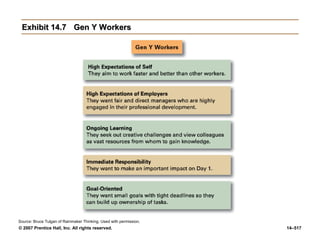
tasks to be completed with the least slack time.
© 2007 Prentice Hall, Inc. All rights reserved. 9–299
Exhibit 9–7
Exhibit 9–7 Steps in Developing a PERT Network
Steps in Developing a PERT Network
1. Identify every significant activity that must be achieved for
a project to be completed.
2. Determine the order in which these events must be
completed.
3. Diagram the flow of activities from start to finish,
identifying each activity and its relationship to all other
activities.
4. Compute a time estimate for completing each activity.
5. Using the network diagram that contains time estimates for
each activity, determine a schedule for the start and finish
dates of each activity and for the entire project.
© 2007 Prentice Hall, Inc. All rights reserved. 9–300
Exhibit 9–8
Exhibit 9–8 Events and Activities in Constructing an Office Building
Events and Activities in Constructing an Office Building
© 2007 Prentice Hall, Inc. All rights reserved. 9–301
Exhibit 9–9
Exhibit 9–9 A Visual PERT Network for Constructing an Office Building
A Visual PERT Network for Constructing an Office Building
Critical Path: A - B - C - D - G - H - J - K
© 2007 Prentice Hall, Inc. All rights reserved. 9–302
Allocating Resources: Analysis (cont’d)
• Breakeven Analysis
Breakeven Analysis
 Is used to determine the point at which all fixed costs
Is used to determine the point at which all fixed costs
have been recovered and profitability begins.
 Fixed cost (FC)
Fixed cost (FC)
 Variable costs (VC)
Variable costs (VC)
 Total Fixed Costs (TFC)
Total Fixed Costs (TFC)
 Price (P)
Price (P)
• The Break-even Formula:
The Break-even Formula:
Costs
Variable
Unit
-
Price
Unit
Costs
Fixed
Total
Breakeven:
© 2007 Prentice Hall, Inc. All rights reserved. 9–303
Exhibit 9–10
Exhibit 9–10 Breakeven Analysis
Breakeven Analysis
© 2007 Prentice Hall, Inc. All rights reserved. 9–304
Allocating Resources: Analysis (cont’d)
• Linear Programming
Linear Programming
 A technique that seeks to solve resource allocation
A technique that seeks to solve resource allocation
problems using the proportional relationships
between two variables.
© 2007 Prentice Hall, Inc. All rights reserved. 9–305
Exhibit 9–11
Exhibit 9–11 Production Data for Cinnamon-Scented Products
Production Data for Cinnamon-Scented Products
© 2007 Prentice Hall, Inc. All rights reserved. 9–306
Exhibit 9–12
Exhibit 9–12 Graphical Solution to Linear Programming Problem
Graphical Solution to Linear Programming Problem
Max. Assembly
Max. Manufacturing
Max. Manufacturing
Max. Assembly
Max. Profits
© 2007 Prentice Hall, Inc. All rights reserved. 9–307
Contemporary Planning Techniques
• Project
Project
 A one-time-only set of activities that has a definite
A one-time-only set of activities that has a definite
beginning and ending point time.
• Project Management
Project Management
 The task of getting a project’s activities done on time,
The task of getting a project’s activities done on time,
within budget, and according to specifications.
 Define project goals
Define project goals
 Identify all required activities, materials, and labor
Identify all required activities, materials, and labor
 Determine the sequence of completion
Determine the sequence of completion
© 2007 Prentice Hall, Inc. All rights reserved. 9–308
Exhibit 9–13
Exhibit 9–13 Project Planning Process
Project Planning Process
Source: Based on R.S. Russell and B.W. Taylor III, Production and Operations
Management (Upper Saddle River, NJ: Prentice Hall, 1995), p. 287.
© 2007 Prentice Hall, Inc. All rights reserved. 9–309
Contemporary Planning Techniques
(cont’d)
(cont’d)
• Scenario
Scenario
 A consistent view of what the future is likely to be.
A consistent view of what the future is likely to be.
• Scenario Planning
Scenario Planning
 An attempt not try to predict the future but to reduce
An attempt not try to predict the future but to reduce
uncertainty by playing out potential situations under
different specified conditions.
• Contingency Planning
Contingency Planning
 Developing scenarios that allow managers determine
Developing scenarios that allow managers determine
in advance what their actions should be should a
considered event actually occur.
© 2007 Prentice Hall, Inc. All rights reserved. 9–310
Exhibit 9–14
Exhibit 9–14 Preparing for Unexpected Events
Preparing for Unexpected Events
• Identify potential unexpected events.
• Determine if any of these events would have
early indicators.
• Set up an information gathering system to
identify early indicators.
• Have appropriate responses (plans) in place if
these unexpected events occur.
Source: S. Caudron, “Frontview Mirror,” Business Finance, December 1999, pp. 24–30.
© 2007 Prentice Hall, Inc. All rights reserved. 9–311
Terms to Know
Terms to Know
• environmental scanning
environmental scanning
• competitor intelligence
competitor intelligence
• forecasts
forecasts
• quantitative forecasting
quantitative forecasting
• qualitative forecasting
qualitative forecasting
• benchmarking
benchmarking
• resources
resources
• budget
budget
• scheduling
scheduling
• Gantt chart
Gantt chart
• load chart
load chart
• PERT network
PERT network
• events
events
• activities
activities
• slack time
slack time
• critical path
critical path
• breakeven analysis
breakeven analysis
• linear programming
linear programming
• project
project
• project management
project management
• scenario
scenario
ninth edition
STEPHEN P. ROBBINS
PowerPoint Presentation by Charlie Cook
The University of West Alabama
MARY COULTER
© 2007 Prentice Hall, Inc.
All rights reserved.
Organizational
Organizational
Structure and Design
Chapter
Chapter
10
10
© 2007 Prentice Hall, Inc. All rights reserved. 10–313
L E A R N I N G O U T L I N E
Follow this Learning Outline as you read and study this chapter.
Defining Organizational Structure
• Discuss the traditional and contemporary views of work
Discuss the traditional and contemporary views of work
specialization, chain of command, and span of control.
• Describe each of the five forms of departmentalization.
Describe each of the five forms of departmentalization.
• Explain cross-functional teams.
Explain cross-functional teams.
• Differentiate, authority, responsibility, and unity of
Differentiate, authority, responsibility, and unity of
command.
command.
• Tell what factors influence the amount of centralization
Tell what factors influence the amount of centralization
and decentralization.
• Explain how formalization is used in organizational
Explain how formalization is used in organizational
design.
design.
© 2007 Prentice Hall, Inc. All rights reserved. 10–314
L E A R N I N G O U T L I N E (cont’d)
Follow this Learning Outline as you read and study this chapter.
Organizational Design Decisions
• Contrast mechanistic and organic organizations.
Contrast mechanistic and organic organizations.
• Explain the relationship between strategy and structure.
Explain the relationship between strategy and structure.
• Tell how organizational size affects organizational design.
Tell how organizational size affects organizational design.
• Discuss Woodward’s findings on the relationship of
Discuss Woodward’s findings on the relationship of
technology and structure.
• Explain how environmental uncertainty affects
Explain how environmental uncertainty affects
organizational design.
© 2007 Prentice Hall, Inc. All rights reserved. 10–315
L E A R N I N G O U T L I N E (cont’d)
Follow this Learning Outline as you read and study this chapter.
Common Organizational Designs
• Contrast the three traditional organizational designs.
Contrast the three traditional organizational designs.
• Explain team, matrix, and project structures.
Explain team, matrix, and project structures.
• Describe the design of virtual and network organizations.
Describe the design of virtual and network organizations.
• Discuss the organizational design challenges facing
Discuss the organizational design challenges facing
managers today.
managers today.
© 2007 Prentice Hall, Inc. All rights reserved. 10–316
Defining Organizational Structure
• Organizational Structure
Organizational Structure
 The formal arrangement of jobs within an organization.
The formal arrangement of jobs within an organization.
• Organizational Design
Organizational Design
 A process involving decisions about six key elements:
A process involving decisions about six key elements:
 Work specialization
Work specialization
 Departmentalization
Departmentalization
 Chain of command
Chain of command
 Span of control
Span of control
 Centralization and decentralization
Centralization and decentralization
 Formalization
Formalization
© 2007 Prentice Hall, Inc. All rights reserved. 10–317
Exhibit 10–1
Exhibit 10–1 Purposes of Organizing
Purposes of Organizing
• Divides work to be done into specific jobs and
departments.
• Assigns tasks and responsibilities associated with
individual jobs.
• Coordinates diverse organizational tasks.
• Clusters jobs into units.
• Establishes relationships among individuals,
groups, and departments.
• Establishes formal lines of authority.
• Allocates and deploys organizational resources.
© 2007 Prentice Hall, Inc. All rights reserved. 10–318
Organizational Structure
• Work Specialization
Work Specialization
 The degree to which tasks in the organization are
The degree to which tasks in the organization are
divided into separate jobs with each step completed
by a different person.
 Overspecialization can result in human diseconomies
Overspecialization can result in human diseconomies
from boredom, fatigue, stress, poor quality, increased
absenteeism, and higher turnover.
© 2007 Prentice Hall, Inc. All rights reserved. 10–319
Departmentalization by Type
• Functional
Functional
 Grouping jobs by
Grouping jobs by
functions performed
functions performed
• Product
Product
 Grouping jobs by product
Grouping jobs by product
line
line
• Geographical
Geographical
 Grouping jobs on the
Grouping jobs on the
basis of territory or
geography
geography
• Process
Process
 Grouping jobs on the
Grouping jobs on the
basis of product or
basis of product or
customer flow
customer flow
• Customer
Customer
 Grouping jobs by type of
Grouping jobs by type of
customer and needs
customer and needs
© 2007 Prentice Hall, Inc. All rights reserved. 10–320
Exhibit 10–2
Exhibit 10–2 Functional Departmentalization
Functional Departmentalization
• Advantages
• Efficiencies from putting together similar specialties and
people with common skills, knowledge, and orientations
• Coordination within functional area
• In-depth specialization
• Disadvantages
• Poor communication across functional areas
• Limited view of organizational goals
© 2007 Prentice Hall, Inc. All rights reserved. 10–321
Exhibit 10–2 (cont’d)
Exhibit 10–2 (cont’d) Geographical Departmentalization
Geographical Departmentalization
• Advantages
• More effective and efficient handling of specific
regional issues that arise
• Serve needs of unique geographic markets better
• Disadvantages
• Duplication of functions
• Can feel isolated from other organizational areas
© 2007 Prentice Hall, Inc. All rights reserved. 10–322
Exhibit 10–2 (cont’d)
Exhibit 10–2 (cont’d) Product Departmentalization
Product Departmentalization
+ Allows specialization in particular products and services
+ Managers can become experts in their industry
+ Closer to customers
– Duplication of functions
– Limited view of organizational goals
© 2007 Prentice Hall, Inc. All rights reserved. 10–323
Exhibit 10–2 (cont’d)
Exhibit 10–2 (cont’d) Process Departmentalization
Process Departmentalization
+ More efficient flow of work activities
– Can only be used with certain types of products
© 2007 Prentice Hall, Inc. All rights reserved. 10–324
Exhibit 10–2 (cont’d)
Exhibit 10–2 (cont’d) Customer Departmentalization
Customer Departmentalization
+ Customers’ needs and problems can be met by specialists
- Duplication of functions
- Limited view of organizational goals
© 2007 Prentice Hall, Inc. All rights reserved. 10–325
Organization Structure (cont’d)
• Chain of Command
Chain of Command
 The continuous line of authority that extends from
The continuous line of authority that extends from
upper levels of an organization to the lowest levels of
the organization and clarifies who reports to who.
© 2007 Prentice Hall, Inc. All rights reserved. 10–326
Organization Structure (cont’d)
• Authority
Authority
 The rights inherent in a managerial position to tell
The rights inherent in a managerial position to tell
people what to do and to expect them to do it.
• Responsibility
Responsibility
 The obligation or expectation to perform.
The obligation or expectation to perform.
• Unity of Command
Unity of Command
 The concept that a person should have one boss and
The concept that a person should have one boss and
should report only to that person.
© 2007 Prentice Hall, Inc. All rights reserved. 10–327
Organization Structure (cont’d)
• Span of Control
Span of Control
 The number of employees who can be effectively and
The number of employees who can be effectively and
efficiently supervised by a manager.
 Width of span is affected by:
Width of span is affected by:
 Skills and abilities of the manager
Skills and abilities of the manager
 Employee characteristics
Employee characteristics
 Characteristics of the work being done
Characteristics of the work being done
 Similarity of tasks
Similarity of tasks
 Complexity of tasks
Complexity of tasks
 Physical proximity of subordinates
Physical proximity of subordinates
 Standardization of tasks
Standardization of tasks
© 2007 Prentice Hall, Inc. All rights reserved. 10–328
Exhibit 10–3
Exhibit 10–3 Contrasting Spans of Control
Contrasting Spans of Control
© 2007 Prentice Hall, Inc. All rights reserved. 10–329
Organization Structure (cont’d)
• Centralization
Centralization
 The degree to which decision-making is concentrated
The degree to which decision-making is concentrated
at a single point in the organizations.
 Organizations in which top managers make all the decisions
Organizations in which top managers make all the decisions
and lower-level employees simply carry out those orders.
• Decentralization
Decentralization
 Organizations in which decision-making is pushed
Organizations in which decision-making is pushed
down to the managers who are closest to the action.
• Employee Empowerment
Employee Empowerment
 Increasing the decision-making authority (power) of
Increasing the decision-making authority (power) of
employees.
employees.
© 2007 Prentice Hall, Inc. All rights reserved. 10–330
Exhibit 10–4
Exhibit 10–4 Factors that Influence the Amount of Centralization
Factors that Influence the Amount of Centralization
• More Centralization
More Centralization
 Environment is stable.
Environment is stable.
 Lower-level managers are not as capable or experienced at
Lower-level managers are not as capable or experienced at
making decisions as upper-level managers.
 Lower-level managers do not want to have a say in decisions.
Lower-level managers do not want to have a say in decisions.
 Decisions are relatively minor.
Decisions are relatively minor.
 Organization is facing a crisis or the risk of company failure.
Organization is facing a crisis or the risk of company failure.
 Company is large.
Company is large.
 Effective implementation of company strategies depends on
Effective implementation of company strategies depends on
managers retaining say over what happens.
© 2007 Prentice Hall, Inc. All rights reserved. 10–331
Exhibit 10–4 (cont’d)
Exhibit 10–4 (cont’d) Factors that Influence the Amount of Centralization
Factors that Influence the Amount of Centralization
• More Decentralization
More Decentralization
 Environment is complex, uncertain.
Environment is complex, uncertain.
 Lower-level managers are capable and experienced at making
Lower-level managers are capable and experienced at making
decisions.
decisions.
 Lower-level managers want a voice in decisions.
Lower-level managers want a voice in decisions.
 Decisions are significant.
Decisions are significant.
 Corporate culture is open to allowing managers to have a say in
Corporate culture is open to allowing managers to have a say in
what happens.
what happens.
 Company is geographically dispersed.
Company is geographically dispersed.
 Effective implementation of company strategies depends on
Effective implementation of company strategies depends on
managers having involvement and flexibility to make decisions.
© 2007 Prentice Hall, Inc. All rights reserved. 10–332
Organization Structure (cont’d)
• Formalization
Formalization
 The degree to which jobs within the organization are
The degree to which jobs within the organization are
standardized and the extent to which employee
behavior is guided by rules and procedures.
 Highly formalized jobs offer little discretion over what is to be
Highly formalized jobs offer little discretion over what is to be
done.
done.
 Low formalization means fewer constraints on how
Low formalization means fewer constraints on how
employees do their work.
© 2007 Prentice Hall, Inc. All rights reserved. 10–333
Organizational Design Decisions
• Mechanistic Organization
Mechanistic Organization
 A rigid and tightly controlled
A rigid and tightly controlled
structure
structure
 High specialization
High specialization
 Rigid departmentalization
Rigid departmentalization
 Narrow spans of control
Narrow spans of control
 High formalization
High formalization
 Limited information network
Limited information network
(downward)
(downward)
 Low decision participation
Low decision participation
• Organic Organization
Organic Organization
 Highly flexible and
Highly flexible and
adaptable structure
adaptable structure
 Non-standardized jobs
Non-standardized jobs
 Fluid team-based structure
Fluid team-based structure
 Little direct supervision
Little direct supervision
 Minimal formal rules
Minimal formal rules
 Open communication
Open communication
network
network
 Empowered employees
Empowered employees
© 2007 Prentice Hall, Inc. All rights reserved. 10–334
Exhibit 10–5
Exhibit 10–5 Mechanistic versus Organic Organization
Mechanistic versus Organic Organization
• High specialization
• Rigid departmentalization
• Clear chain of command
• Narrow spans of control
• Centralization
• High formalization
• Cross-functional teams
• Cross-hierarchical teams
• Free flow of information
• Wide spans of control
• Decentralization
• Low formalization
© 2007 Prentice Hall, Inc. All rights reserved. 10–335
Contingency Factors
Contingency Factors
• Structural decisions are influenced by:
Structural decisions are influenced by:
 Overall strategy of the organization
Overall strategy of the organization
 Organizational structure follows strategy.
Organizational structure follows strategy.
 Size of the organization
Size of the organization
 Firms change from organic to mechanistic organizations as
Firms change from organic to mechanistic organizations as
they grow in size.
they grow in size.
 Technology use by the organization
Technology use by the organization
 Firms adapt their structure to the technology they use.
Firms adapt their structure to the technology they use.
 Degree of environmental uncertainty
Degree of environmental uncertainty
 Dynamic environments require organic structures;
Dynamic environments require organic structures;
mechanistic structures need stable environments.
© 2007 Prentice Hall, Inc. All rights reserved. 10–336
Contingency Factors (cont’d)
• Strategy Frameworks:
Strategy Frameworks:
 Innovation
Innovation
 Pursuing competitive advantage through meaningful and
Pursuing competitive advantage through meaningful and
unique innovations favors an organic structuring.
 Cost minimization
Cost minimization
 Focusing on tightly controlling costs requires a mechanistic
Focusing on tightly controlling costs requires a mechanistic
structure for the organization.
 Imitation
Imitation
 Minimizing risks and maximizing profitability by copying
Minimizing risks and maximizing profitability by copying
market leaders requires both organic and mechanistic
elements in the organization’s structure.
© 2007 Prentice Hall, Inc. All rights reserved. 10–337
Contingency Factors (cont’d)
• Strategy and Structure
Strategy and Structure
 Achievement of strategic goals is facilitated by
Achievement of strategic goals is facilitated by
changes in organizational structure that
accommodate and support change.
• Size and Structure
Size and Structure
 As an organization grows larger, its structure tends to
As an organization grows larger, its structure tends to
change from organic to mechanistic with increased
specialization, departmentalization, centralization,
and rules and regulations.
© 2007 Prentice Hall, Inc. All rights reserved. 10–338
Contingency Factors (cont’d)
• Technology and Structure
Technology and Structure
 Organizations adapt their structures to their
Organizations adapt their structures to their
technology.
technology.
 Woodward’s classification of firms based on the
Woodward’s classification of firms based on the
complexity of the technology employed:
 Unit production
Unit production of single units or small batches
of single units or small batches
 Mass production
Mass production of large batches of output
of large batches of output
 Process production
Process production in continuous process of outputs
in continuous process of outputs
 Routine technology = mechanistic organizations
Routine technology = mechanistic organizations
 Non-routine technology = organic organizations
Non-routine technology = organic organizations
© 2007 Prentice Hall, Inc. All rights reserved. 10–339
Exhibit 10–6
Exhibit 10–6 Woodward’s Findings on Technology, Structure,
Woodward’s Findings on Technology, Structure,
and Effectiveness
and Effectiveness
© 2007 Prentice Hall, Inc. All rights reserved. 10–340
Contingency Factors (cont’d)
• Environmental Uncertainty and Structure
Environmental Uncertainty and Structure
 Mechanistic organizational structures tend to be most
Mechanistic organizational structures tend to be most
effective in stable and simple environments.
 The flexibility of organic organizational structures is
The flexibility of organic organizational structures is
better suited for dynamic and complex environments.
© 2007 Prentice Hall, Inc. All rights reserved. 10–341
Common Organizational Designs
• Traditional Designs
Traditional Designs
 Simple structure
Simple structure
 Low departmentalization, wide spans of control, centralized
Low departmentalization, wide spans of control, centralized
authority, little formalization
 Functional structure
Functional structure
 Departmentalization by function
Departmentalization by function
– Operations, finance, human resources, and product
Operations, finance, human resources, and product
research and development
 Divisional structure
Divisional structure
 Composed of separate business units or divisions with limited
Composed of separate business units or divisions with limited
autonomy under the coordination and control the parent
corporation.
corporation.
© 2007 Prentice Hall, Inc. All rights reserved. 10–342
Exhibit 10–7
Exhibit 10–7 Strengths and Weaknesses of Traditional
Strengths and Weaknesses of Traditional
Organizational Designs
© 2007 Prentice Hall, Inc. All rights reserved. 10–343
Exhibit 10–8
Exhibit 10–8 Contemporary Organizational Designs
Contemporary Organizational Designs
Team Structure
Team Structure
•
• What it is:
What it is: A structure in which the entire organization is made up of
A structure in which the entire organization is made up of
work groups or teams.
•
• Advantages:
Advantages: Employees are more involved and empowered. Reduced
Employees are more involved and empowered. Reduced
barriers among functional areas.
•
• Disadvantages:
Disadvantages: No clear chain of command. Pressure on teams to perform.
No clear chain of command. Pressure on teams to perform.
Matrix-Project Structure
What it is:
What it is: A structure that assigns specialists from different functional
A structure that assigns specialists from different functional
areas to work on projects but who return to their areas when
the project is completed. Project is a structure in which
employees continuously work on projects. As one project is
completed, employees move on to the next project.
•
• Advantages:
Advantages: Fluid and flexible design that can respond to environmental
Fluid and flexible design that can respond to environmental
changes. Faster decision making.
•
• Disadvantages:
Disadvantages: Complexity of assigning people to projects. Task and
Complexity of assigning people to projects. Task and
personality conflicts.
© 2007 Prentice Hall, Inc. All rights reserved. 10–344
Exhibit 10–8 (cont’d)
Exhibit 10–8 (cont’d) Contemporary Organizational Designs
Contemporary Organizational Designs
Boundaryless Structure
What it is:
What it is: A structure that is not defined by or limited to artificial
A structure that is not defined by or limited to artificial
horizontal, vertical, or external boundaries; includes virtual
and network types of organizations.
•
• Advantages:
Advantages: Highly flexible and responsive. Draws on talent wherever it’s
Highly flexible and responsive. Draws on talent wherever it’s
found..
found..
•
• Disadvantages:
Disadvantages: Lack of control. Communication difficulties..
Lack of control. Communication difficulties..
© 2007 Prentice Hall, Inc. All rights reserved. 10–345
Organizational Designs (cont’d)
• Contemporary Organizational Designs
Contemporary Organizational Designs
 Team structures
Team structures
 The entire organization is made up of work groups or self-
The entire organization is made up of work groups or self-
managed teams of empowered employees.
 Matrix and project structures
Matrix and project structures
 Specialists from different functional departments are
Specialists from different functional departments are
assigned to work on projects led by project managers.
 Matrix and project participants have two managers.
Matrix and project participants have two managers.
 In project structures, employees work continuously on
In project structures, employees work continuously on
projects; moving on to another project as each project is
completed.
completed.
© 2007 Prentice Hall, Inc. All rights reserved. 10–346
Exhibit 10–9
Exhibit 10–9 An Example of a Matrix Organization
An Example of a Matrix Organization
© 2007 Prentice Hall, Inc. All rights reserved. 10–347
Organizational Designs (cont’d)
• Contemporary Organizational Designs (cont’d)
Contemporary Organizational Designs (cont’d)
 Boundaryless Organization
Boundaryless Organization
 An flexible and unstructured organizational design that is
An flexible and unstructured organizational design that is
intended to break down external barriers between the
organization and its customers and suppliers.
 Removes internal (horizontal) boundaries:
Removes internal (horizontal) boundaries:
– Eliminates the chain of command
Eliminates the chain of command
– Has limitless spans of control
Has limitless spans of control
– Uses empowered teams rather than departments
Uses empowered teams rather than departments
 Eliminates external boundaries:
Eliminates external boundaries:
– Uses virtual, network, and modular organizational
Uses virtual, network, and modular organizational
structures to get closer to stakeholders.
© 2007 Prentice Hall, Inc. All rights reserved. 10–348
Removing External Boundaries
• Virtual Organization
Virtual Organization
 An organization that consists of a small core of full-time
An organization that consists of a small core of full-time
employees and that temporarily hires specialists to work on
opportunities that arise.
• Network Organization
Network Organization
 A small core organization that outsources its major
A small core organization that outsources its major
business functions (e.g., manufacturing) in order to
concentrate what it does best.
• Modular Organization
Modular Organization
 A manufacturing organization that uses outside suppliers to
A manufacturing organization that uses outside suppliers to
provide product components for its final assembly
operations.
operations.
© 2007 Prentice Hall, Inc. All rights reserved. 10–349
Today’s Organizational Design
Challenges
Challenges
• Keeping Employees Connected
Keeping Employees Connected
 Widely dispersed and mobile employees
Widely dispersed and mobile employees
• Building a Learning Organization
Building a Learning Organization
• Managing Global Structural Issues
Managing Global Structural Issues
 Cultural implications of design elements
Cultural implications of design elements
© 2007 Prentice Hall, Inc. All rights reserved. 10–350
Organizational Designs (cont’d)
• The Learning Organization
The Learning Organization
 An organization that has developed the capacity to
An organization that has developed the capacity to
continuously learn, adapt, and change through the
practice of knowledge management by employees.
 Characteristics of a learning organization:
Characteristics of a learning organization:
 An open team-based organization design that empowers
An open team-based organization design that empowers
employees
employees
 Extensive and open information sharing
Extensive and open information sharing
 Leadership that provides a shared vision of the organization’s
Leadership that provides a shared vision of the organization’s
future, support and encouragement
 A strong culture of shared values, trust, openness, and a
A strong culture of shared values, trust, openness, and a
sense of community.
sense of community.
© 2007 Prentice Hall, Inc. All rights reserved. 10–351
Terms to Know
Terms to Know
• organizing
organizing
• organizational structure
organizational structure
• organizational design
organizational design
• work specialization
work specialization
• departmentalization
departmentalization
• functional departmentalization
functional departmentalization
• product departmentalization
product departmentalization
• geographical
geographical
departmentalization
departmentalization
• process departmentalization
process departmentalization
• customer departmentalization
customer departmentalization
• cross-functional teams
cross-functional teams
• chain of command
chain of command
• authority
authority
• responsibility
responsibility
• unity of command
unity of command
• span of control
span of control
• centralization
centralization
• decentralization
decentralization
• employee empowerment
employee empowerment
• formalization
formalization
• mechanistic organization
mechanistic organization
• organic organization
organic organization
• unit production
unit production
• mass production
mass production
• process production
process production
• simple structure
simple structure
• functional structure
functional structure
© 2007 Prentice Hall, Inc. All rights reserved. 10–352
Terms to Know
Terms to Know
• divisional structure
divisional structure
• team structure
team structure
• matrix structure
matrix structure
• project structure
project structure
• boundaryless organization
boundaryless organization
• virtual organization
virtual organization
• network organization
network organization
• learning organization
learning organization
• organizational chart
organizational chart
ninth edition
STEPHEN P. ROBBINS
PowerPoint Presentation by Charlie Cook
The University of West Alabama
MARY COULTER
© 2007 Prentice Hall, Inc.
All rights reserved.
Communication
Communication
and Information
and Information
Technology
Technology
Chapter
Chapter
11
11
© 2007 Prentice Hall, Inc. All rights reserved. 11–354
L E A R N I N G O U T L I N E
Follow this Learning Outline as you read and study this chapter.
Understanding Communications
• Differentiate between interpersonal and organizational
Differentiate between interpersonal and organizational
communication.
communication.
• Discuss the functions of communication.
Discuss the functions of communication.
The Process of Interpersonal Communications
• Explain all the components of the communication process.
Explain all the components of the communication process.
• List the communication methods managers might use.
List the communication methods managers might use.
• Describe nonverbal communication and how it takes
Describe nonverbal communication and how it takes
place.
place.
• Explain the barriers to effective interpersonal
Explain the barriers to effective interpersonal
communication and how to overcome them.
© 2007 Prentice Hall, Inc. All rights reserved. 11–355
L E A R N I N G O U T L I N E (cont’d)
Follow this Learning Outline as you read and study this chapter.
Organizational Communication
• Explain how communication can flow in an organization.
Explain how communication can flow in an organization.
• Describe the three common communication networks.
Describe the three common communication networks.
• Discuss how managers should handle the grapevine.
Discuss how managers should handle the grapevine.
Understanding Information Technology
• Describe how technology affects managerial
Describe how technology affects managerial
communication.
communication.
• Define e-mail, instant messaging, blogs and wikis, voice-
Define e-mail, instant messaging, blogs and wikis, voice-
mail, fax, EDI, teleconferencing, videoconferencing, web
conferencing, intranet, and extranet.
• Explain how information technology affects
Explain how information technology affects
organizations.
organizations.
© 2007 Prentice Hall, Inc. All rights reserved. 11–356
L E A R N I N G O U T L I N E (cont’d)
Follow this Learning Outline as you read and study this chapter.
Communication Issues in Today’s Organization
• Discuss the challenges of managing communication in an
Discuss the challenges of managing communication in an
Internet world.
Internet world.
• Explain how organizations can manage knowledge.
Explain how organizations can manage knowledge.
• Explain why communicating with customers is an
Explain why communicating with customers is an
important managerial issue.
• Explain how political correctness is affecting
Explain how political correctness is affecting
communication.
communication.
© 2007 Prentice Hall, Inc. All rights reserved. 11–357
What Is Communication?
• Communication
Communication
 The transfer and understanding of meaning.
The transfer and understanding of meaning.
 Transfer means the message was received in a form that can
Transfer means the message was received in a form that can
be interpreted by the receiver.
 Understanding the message is not the same as the receiver
Understanding the message is not the same as the receiver
agreeing with the message.
 Interpersonal Communication
Interpersonal Communication
 Communication between two or more people
Communication between two or more people
 Organizational Communication
Organizational Communication
 All the patterns, network, and systems of communications
All the patterns, network, and systems of communications
within an organization
© 2007 Prentice Hall, Inc. All rights reserved. 11–358
Four Functions of Communication
Functions of
Functions of
Communication
Communication
Functions of
Functions of
Communication
Communication
Control
Control
Control
Control Motivation
Motivation
Motivation
Motivation
Emotional
Emotional
Expression
Expression
Emotional
Emotional
Expression
Expression
Information
Information
Information
Information
© 2007 Prentice Hall, Inc. All rights reserved. 11–359
Functions of Communication
• Control
Control
 Formal and informal communications act to control
Formal and informal communications act to control
individuals’ behaviors in organizations.
• Motivation
Motivation
 Communications clarify for employees what is to
Communications clarify for employees what is to
done, how well they have done it, and what can be
done to improve performance.
© 2007 Prentice Hall, Inc. All rights reserved. 11–360
Functions of Communication (cont’d)
• Emotional Expression
Emotional Expression
 Social interaction in the form of work group
Social interaction in the form of work group
communications provides a way for employees to
express themselves.
express themselves.
• Information
Information
 Individuals and work groups need information to
Individuals and work groups need information to
make decisions or to do their work.
© 2007 Prentice Hall, Inc. All rights reserved. 11–361
Interpersonal Communication
• Message
Message
 Source: sender’s intended meaning
Source: sender’s intended meaning
• Encoding
Encoding
 The message converted to symbolic form
The message converted to symbolic form
• Channel
Channel
 The medium through which the message travels
The medium through which the message travels
• Decoding
Decoding
 The receiver’s retranslation of the message
The receiver’s retranslation of the message
• Noise
Noise
 Disturbances that interfere with communications
Disturbances that interfere with communications
© 2007 Prentice Hall, Inc. All rights reserved. 11–362
Exhibit 11–1
Exhibit 11–1 The Interpersonal Communication Process
The Interpersonal Communication Process
© 2007 Prentice Hall, Inc. All rights reserved. 11–363
Distortions in Communications
• Message Encoding
Message Encoding
 The effect of the skills, attitudes, and knowledge of
The effect of the skills, attitudes, and knowledge of
the sender on the process of encoding the message
 The social-cultural system of the sender
The social-cultural system of the sender
• The Message
The Message
 Symbols used to convey the message’s meaning
Symbols used to convey the message’s meaning
 The content of the message itself
The content of the message itself
 The choice of message format
The choice of message format
 Noise interfering with the message
Noise interfering with the message
© 2007 Prentice Hall, Inc. All rights reserved. 11–364
Distortions in Communications (cont’d)
• The Channel
The Channel
 The sender’s choice of the appropriate channel or
The sender’s choice of the appropriate channel or
multiple channels for conveying the message
• Receiver
Receiver
 The effect of skills, attitudes, and knowledge of the
The effect of skills, attitudes, and knowledge of the
receiver on the process of decoding the message
 The social-cultural system of the receiver
The social-cultural system of the receiver
• Feedback Loop
Feedback Loop
 Communication channel distortions affecting the
Communication channel distortions affecting the
return message from receiver to sender
© 2007 Prentice Hall, Inc. All rights reserved. 11–365
Interpersonal Communication Methods
• Face-to-face
Face-to-face
• Telephone
Telephone
• Group meetings
Group meetings
• Formal presentations
Formal presentations
• Memos
Memos
• Traditional Mail
Traditional Mail
• Fax machines
Fax machines
• Employee publications
Employee publications
• Bulletin boards
Bulletin boards
• Audio- and videotapes
Audio- and videotapes
• Hotlines
Hotlines
• E-mail
E-mail
• Computer conferencing
Computer conferencing
• Voice mail
Voice mail
• Teleconferences
Teleconferences
• Videoconferences
Videoconferences
© 2007 Prentice Hall, Inc. All rights reserved. 11–366
Evaluating Communication Methods
• Feedback
Feedback
• Complexity capacity
Complexity capacity
• Breadth potential
Breadth potential
• Confidentiality
Confidentiality
• Encoding ease
Encoding ease
• Decoding ease
Decoding ease
• Time-space constraint
Time-space constraint
• Cost
Cost
• Interpersonal warmth
Interpersonal warmth
• Formality
Formality
• Scanability
Scanability
• Time consumption
Time consumption
© 2007 Prentice Hall, Inc. All rights reserved. 11–367
Exhibit 11–2
Exhibit 11–2 Comparison of Communication Methods
Comparison of Communication Methods
Note: Ratings are on a 1–5 scale where 1 = high and 5 = low. Consumption time refers to who
controls the reception of communication. S/R means the sender and receiver share control.
Source: P. G. Clampitt, Communicating for Managerial Effectiveness (Newbury Park, CA: Sage Publications, 1991), p. 136.
© 2007 Prentice Hall, Inc. All rights reserved. 11–368
Interpersonal Communication (cont’d)
• Nonverbal Communication
Nonverbal Communication
 Communication that is transmitted without words.
Communication that is transmitted without words.
 Sounds
Sounds with specific meanings or warnings
with specific meanings or warnings
 Images
Images that control or encourage behaviors
that control or encourage behaviors
 Situational behaviors
Situational behaviors that convey meanings
that convey meanings
 Clothing and physical surroundings
Clothing and physical surroundings that imply status
that imply status
 Body language:
Body language: gestures, facial expressions, and
gestures, facial expressions, and
other body movements that convey meaning.
 Verbal intonation:
Verbal intonation: emphasis that a speaker gives to
emphasis that a speaker gives to
certain words or phrases that conveys meaning.
© 2007 Prentice Hall, Inc. All rights reserved. 11–369
Interpersonal Communication Barriers
Defensiveness
Defensiveness
National
National
Culture
Culture Emotions
Emotions
Information
Information
Overload
Overload
Interpersonal
Interpersonal
Communication
Communication
Language
Language
Filtering
Filtering
© 2007 Prentice Hall, Inc. All rights reserved. 11–370
Barriers to Effective Interpersonal
Communication
Communication
• Filtering
Filtering
 The deliberate manipulation of information to make it
The deliberate manipulation of information to make it
appear more favorable to the receiver.
• Emotions
Emotions
 Disregarding rational and objective thinking
Disregarding rational and objective thinking
processes and substituting emotional judgments
when interpreting messages.
• Information Overload
Information Overload
 Being confronted with a quantity of information that
Being confronted with a quantity of information that
exceeds an individual’s capacity to process it.
© 2007 Prentice Hall, Inc. All rights reserved. 11–371
Barriers to Effective Interpersonal
Communication (cont’d)
• Defensiveness
Defensiveness
 When threatened, reacting in a way that reduces the
When threatened, reacting in a way that reduces the
ability to achieve mutual understanding.
• Language
Language
 The different meanings of and specialized ways
The different meanings of and specialized ways
(jargon) in which senders use words can cause
receivers to misinterpret their messages.
• National Culture
National Culture
 Culture influences the form, formality, openness,
Culture influences the form, formality, openness,
patterns and use of information in communications.
© 2007 Prentice Hall, Inc. All rights reserved. 11–372
Overcoming the Barriers to Effective
Interpersonal Communications
• Use Feedback
Use Feedback
• Simplify Language
Simplify Language
• Listen Actively
Listen Actively
• Constrain Emotions
Constrain Emotions
• Watch Nonverbal Cues
Watch Nonverbal Cues
© 2007 Prentice Hall, Inc. All rights reserved. 11–373
Exhibit 11–3
Exhibit 11–3 Active Listening Behaviors
Active Listening Behaviors
Source: Based on P.L. Hunsaker, Training in Management
Skills (Upper Saddle River, NJ: Prentice Hall, 2001).
© 2007 Prentice Hall, Inc. All rights reserved. 11–374
Types of Organizational Communication
• Formal Communication
Formal Communication
 Communication that follows the official chain of
Communication that follows the official chain of
command or is part of the communication required to
do one’s job.
do one’s job.
• Informal Communication
Informal Communication
 Communication that is not defined by the
Communication that is not defined by the
organization’s hierarchy.
 Permits employees to satisfy their need for social interaction.
Permits employees to satisfy their need for social interaction.
 Can improve an organization’s performance by creating
Can improve an organization’s performance by creating
faster and more effective channels of communication.
© 2007 Prentice Hall, Inc. All rights reserved. 11–375
Communication Flows
Communication Flows
Lateral
Lateral
D
i
a
g
o
n
a
l
D
i
a
g
o
n
a
l
D
D
o
o
w
w
n
n
w
w
a
a
r
r
d
d
U
U
p
p
w
w
a
a
r
r
d
d
© 2007 Prentice Hall, Inc. All rights reserved. 11–376
Direction of Communication Flow
• Downward
Downward
 Communications that flow from managers to
Communications that flow from managers to
employees to inform, direct, coordinate, and evaluate
employees.
employees.
• Upward
Upward
 Communications that flow from employees up to
Communications that flow from employees up to
managers to keep them aware of employee needs
and how things can be improved to create a climate
of trust and respect.
© 2007 Prentice Hall, Inc. All rights reserved. 11–377
Direction of Communication Flow
(cont’d)
(cont’d)
• Lateral (Horizontal) Communication
Lateral (Horizontal) Communication
 Communication that takes place among employees
Communication that takes place among employees
on the same level in the organization to save time and
facilitate coordination.
• Diagonal Communication
Diagonal Communication
 Communication that cuts across both work areas and
Communication that cuts across both work areas and
organizational levels in the interest of efficiency and
speed.
speed.
© 2007 Prentice Hall, Inc. All rights reserved. 11–378
Types of Communication Networks
• Chain Network
Chain Network
 Communication flows according to the formal chain of
Communication flows according to the formal chain of
command, both upward and downward.
• Wheel Network
Wheel Network
 All communication flows in and out through the group
All communication flows in and out through the group
leader (hub) to others in the group.
• All-Channel Network
All-Channel Network
 Communications flow freely among all members of
Communications flow freely among all members of
the work team.
the work team.
© 2007 Prentice Hall, Inc. All rights reserved. 11–379
Exhibit 11–4
Exhibit 11–4 Three Common Organizational Communication Networks
Three Common Organizational Communication Networks
and How They Rate on Effectiveness Criteria
© 2007 Prentice Hall, Inc. All rights reserved. 11–380
The Grapevine
The Grapevine
• An informal organizational communication
An informal organizational communication
network that is active in almost every
organization.
organization.
 Provides a channel for issues not suitable for formal
Provides a channel for issues not suitable for formal
communication channels.
 The impact of information passed along the grapevine
The impact of information passed along the grapevine
can be countered by open and honest communication
with employees.
with employees.
© 2007 Prentice Hall, Inc. All rights reserved. 11–381
Understanding Information Technology
• Benefits of Information Technology (IT)
Benefits of Information Technology (IT)
 Increased ability to monitor individual and team
Increased ability to monitor individual and team
performance
performance
 Better decision making based on more complete
Better decision making based on more complete
information
information
 More collaboration and
More collaboration and
sharing of information
 Greater accessibility
Greater accessibility
to coworkers
to coworkers
© 2007 Prentice Hall, Inc. All rights reserved. 11–382
Information Technology (cont’d)
• Networked Computer
Networked Computer
Systems
Systems
 Linking individual
Linking individual
computers to create an
organizational network for
communication and
communication and
information sharing.
• E-mail
E-mail
• Instant messaging (IM)
Instant messaging (IM)
• Blogs
Blogs
• Wikis
Wikis
• Voice-mail
Voice-mail
• Fax machines
Fax machines
• Electronic Data Exchange
Electronic Data Exchange
(EDI)
(EDI)
• Teleconferencing
Teleconferencing
• Videoconferencing
Videoconferencing
• Web conferencing
Web conferencing
© 2007 Prentice Hall, Inc. All rights reserved. 11–383
Information Technology (cont’d)
• Types of Network Systems
Types of Network Systems
 Intranet
Intranet
 An internal network that uses Internet
An internal network that uses Internet
technology and is accessible only to
employees.
employees.
 Extranet
Extranet
 An internal network that uses Internet
An internal network that uses Internet
technology and allows authorized users
inside the organization to communicate
with certain outsiders such as customers
and vendors.
and vendors.
 Wireless (WIFI) capabilities
Wireless (WIFI) capabilities
© 2007 Prentice Hall, Inc. All rights reserved. 11–384
How IT Affects Organization
• Removes the constraints of time and distance
Removes the constraints of time and distance
 Allows widely dispersed employees to work together.
Allows widely dispersed employees to work together.
• Provides for the sharing of information
Provides for the sharing of information
 Increases effectiveness and efficiency.
Increases effectiveness and efficiency.
• Integrates decision making and work
Integrates decision making and work
 Provides more complete information and participation
Provides more complete information and participation
for better decisions.
• Creates problems of constant accessibility to
Creates problems of constant accessibility to
employees
employees
 Blurs the line between work and personal lives.
Blurs the line between work and personal lives.
© 2007 Prentice Hall, Inc. All rights reserved. 11–385
Current Communication Issues
• Managing Communication in an Internet World
Managing Communication in an Internet World
 Legal and security issues
Legal and security issues
 Inappropriate use of company e-mail and instant messaging
Inappropriate use of company e-mail and instant messaging
 Loss of confidential and proprietary information due to
Loss of confidential and proprietary information due to
inadvertent or deliberate dissemination or to hackers.
 Lack of personal interaction
Lack of personal interaction
 Being connected is not the same as face-to-face contact.
Being connected is not the same as face-to-face contact.
 Difficulties occur in achieving understanding and
Difficulties occur in achieving understanding and
collaboration in virtual environements.
© 2007 Prentice Hall, Inc. All rights reserved. 11–386
Current Communication Issues
• Being connected versus being concerned
Being connected versus being concerned
 Managing Internet gripe sites as a valuable resource
Managing Internet gripe sites as a valuable resource
for unique insights into the organization.
 Employee complaints (“hot-button” issues)
Employee complaints (“hot-button” issues)
 Customer complaints
Customer complaints
 Responding to Internet gripe sites
Responding to Internet gripe sites
 Recognized them as a valuable source of information.
Recognized them as a valuable source of information.
 Post messages that clarify misinformation.
Post messages that clarify misinformation.
 Take action to correct problems noted on the site.
Take action to correct problems noted on the site.
 Set up an internal gripe site.
Set up an internal gripe site.
 Continue to monitor the public gripe site.
Continue to monitor the public gripe site.
© 2007 Prentice Hall, Inc. All rights reserved. 11–387
Current Communication Issues (cont’d)
• Managing the Organization’s Knowledge
Managing the Organization’s Knowledge
Resources
Resources
 Build online information databases that employees
Build online information databases that employees
can access.
can access.
 Create “communities of practice” for groups of people
Create “communities of practice” for groups of people
who share a concern, share expertise, and interact
with each other.
with each other.
© 2007 Prentice Hall, Inc. All rights reserved. 11–388
Communication and Customer Service
• Communicating Effectively with Customers
Communicating Effectively with Customers
 Recognize the three components of the customer
Recognize the three components of the customer
service delivery process:
 The customer
The customer
 The service organization
The service organization
 The service provider
The service provider
 Develop a strong service culture focused on the
Develop a strong service culture focused on the
personalization of service to each customer.
 Listen and respond to the customer.
Listen and respond to the customer.
 Provide access to needed service information.
Provide access to needed service information.
© 2007 Prentice Hall, Inc. All rights reserved. 11–389
“
“Politically Correct” Communication
Politically Correct” Communication
• Do not use words or phrases that stereotype,
Do not use words or phrases that stereotype,
intimidate, or offend individuals based on their
differences.
differences.
• However, choose words carefully to maintain as
However, choose words carefully to maintain as
much clarity as possible in communications.
© 2007 Prentice Hall, Inc. All rights reserved. 11–390
Terms to Know
Terms to Know
• communication
communication
• interpersonal
interpersonal
communication
communication
• organizational
organizational
communication
communication
• message
message
• encoding
encoding
• channel
channel
• decoding
decoding
• communication process
communication process
• noise
noise
• nonverbal communication
nonverbal communication
• body language
body language
• verbal intonation
verbal intonation
• filtering
filtering
• selective perception
selective perception
• information overload
information overload
• jargon
jargon
• active listening
active listening
• formal communication
formal communication
• informal communication
informal communication
• downward communication
downward communication
• upward communication
upward communication
© 2007 Prentice Hall, Inc. All rights reserved. 11–391
Terms to Know (cont’d)
• lateral communication
lateral communication
• diagonal communication
diagonal communication
• communication networks
communication networks
• grapevine
grapevine
• e-mail
e-mail
• instant messaging (IM)
instant messaging (IM)
• blog
blog
• wiki
wiki
• voice mail
voice mail
• fax
fax
• electronic data
electronic data
interchange (EDI)
interchange (EDI)
• teleconferencing
teleconferencing
• videoconferencing
videoconferencing
• web conferencing
web conferencing
• intranet
intranet
• extranet
extranet
• communities of practice
communities of practice
ninth edition
STEPHEN P. ROBBINS
PowerPoint Presentation by Charlie Cook
The University of West Alabama
MARY COULTER
© 2007 Prentice Hall, Inc.
All rights reserved.
Human Resource
Human Resource
Management
Management
Chapter
Chapter
12
12
© 2007 Prentice Hall, Inc. All rights reserved. 12–393
L E A R N I N G O U T L I N E
Follow this Learning Outline as you read and study this chapter.
Why Human Resources Is Important:
The HRM Process
The HRM Process
• Explain how an organization’s human resources can be a
Explain how an organization’s human resources can be a
significant source of competitive advantage.
• List eight activities necessary for staffing the organization
List eight activities necessary for staffing the organization
and sustaining high employee performance.
• Discuss the environmental factors that most directly affect
Discuss the environmental factors that most directly affect
the HRM process.
the HRM process.
© 2007 Prentice Hall, Inc. All rights reserved. 12–394
L E A R N I N G O U T L I N E (cont’d)
Follow this Learning Outline as you read and study this chapter.
Human Resource Planning; Recruitment/
Decruitment; Selection; Orientation; Training
• Contrast job analysis, job description, and job
Contrast job analysis, job description, and job
specification.
specification.
• Discuss the major sources of potential job candidates.
Discuss the major sources of potential job candidates.
• Describe the different selection devices and which work
Describe the different selection devices and which work
best for different jobs.
• Tell what a realistic job preview is and why it’s important.
Tell what a realistic job preview is and why it’s important.
• Explain why orientation is so important.
Explain why orientation is so important.
• Describe the different types of training and how that
Describe the different types of training and how that
training can be provided.
© 2007 Prentice Hall, Inc. All rights reserved. 12–395
L E A R N I N G O U T L I N E (cont’d)
Follow this Learning Outline as you read and study this chapter.
Employee Performance Management;
Compensation/Benefits; Career Development
• Describe the different performance appraisal methods.
Describe the different performance appraisal methods.
• Discuss the factors that influence employee
Discuss the factors that influence employee
compensation and benefits.
• Describe skill-based and variable pay systems.
Describe skill-based and variable pay systems.
• Describe career development for today’s employees.
Describe career development for today’s employees.
Current Issues in Human Resource Management
• Explain how managers can manage downsizing.
Explain how managers can manage downsizing.
• Discuss how managers can manage workforce diversity.
Discuss how managers can manage workforce diversity.
© 2007 Prentice Hall, Inc. All rights reserved. 12–396
L E A R N I N G O U T L I N E (cont’d)
Follow this Learning Outline as you read and study this chapter.
Current Issues in Human Resource Management
(cont’d)
(cont’d)
• Explain what sexual harassment is and what managers
Explain what sexual harassment is and what managers
need to know about it.
• Describe how organizations are dealing with work-life
Describe how organizations are dealing with work-life
balances.
balances.
© 2007 Prentice Hall, Inc. All rights reserved. 12–397
The Importance of Human Resource
Management (HRM)
Management (HRM)
• As a necessary part of the organizing function of
As a necessary part of the organizing function of
management
management
 Selecting, training, and evaluating the work force
Selecting, training, and evaluating the work force
• As an important strategic tool
As an important strategic tool
 HRM helps establish an organization’s sustainable
HRM helps establish an organization’s sustainable
competitive advantage.
• Adds value to the firm
Adds value to the firm
 High performance work practices lead to both high
High performance work practices lead to both high
individual and high organizational performance.
© 2007 Prentice Hall, Inc. All rights reserved. 12–398
Exhibit 12–1
Exhibit 12–1 Examples of High-Performance Work Practices
Examples of High-Performance Work Practices
• Self-managed teams
Self-managed teams
• Decentralized decision making
Decentralized decision making
• Training programs to develop knowledge, skills,
Training programs to develop knowledge, skills,
and abilities
and abilities
• Flexible job assignments
Flexible job assignments
• Open communication
Open communication
• Performance-based compensation
Performance-based compensation
• Staffing based on person–job and person–
Staffing based on person–job and person–
organization fit
organization fit
Source: Based on W. R. Evans and W. D. Davis, “High-Performance Work
Systems and Organizational Performance: The Mediating Role of Internal
Social Structure,” Journal of Management, October 2005, p. 760.
© 2007 Prentice Hall, Inc. All rights reserved. 12–399
The HRM Process
The HRM Process
• Functions of the HRM Process
Functions of the HRM Process
 Ensuring that competent employees are identified and
Ensuring that competent employees are identified and
selected.
selected.
 Providing employees with up-to-date knowledge and
Providing employees with up-to-date knowledge and
skills to do their jobs.
 Ensuring that the organization retains competent and
Ensuring that the organization retains competent and
high-performing employees who are capable of high
performance.
performance.
© 2007 Prentice Hall, Inc. All rights reserved. 12–400
Exhibit 12–2
Exhibit 12–2 Human Resource Management Process
Human Resource Management Process
© 2007 Prentice Hall, Inc. All rights reserved. 12–401
Environmental Factors Affecting HRM
• Employee Labor Unions
Employee Labor Unions
 Organizations that represent workers and seek to
Organizations that represent workers and seek to
protect their interests through collective bargaining.
 Collective bargaining agreement
Collective bargaining agreement
– A contractual agreement between a firm and a union
A contractual agreement between a firm and a union
elected to represent a bargaining unit of employees of the
firm in bargaining for wage, hours, and working conditions.
• Governmental Laws and Regulations
Governmental Laws and Regulations
 Limit managerial discretion in hiring, promoting, and
Limit managerial discretion in hiring, promoting, and
discharging employees.
 Affirmative Action: the requirement that organizations take
Affirmative Action: the requirement that organizations take
proactive steps to ensure the full participation of protected
groups in its workforce.
© 2007 Prentice Hall, Inc. All rights reserved. 12–402
Exhibit 12–3
Exhibit 12–3 Major U.S. Federal Laws and Regulations Related to HRM
Major U.S. Federal Laws and Regulations Related to HRM
1963
1963 Equal Pay Act
Equal Pay Act
1964
1964 Civil Rights Act, Title VII (amended in 1972)
Civil Rights Act, Title VII (amended in 1972)
1967
1967 Age Discrimination in Employment Act
Age Discrimination in Employment Act
1973
1973 Vocational Rehabilitation Act
Vocational Rehabilitation Act
1974
1974 Privacy Act
Privacy Act
1978
1978 Mandatory Retirement Act
Mandatory Retirement Act
1986
1986 Immigration Reform and Control Act
Immigration Reform and Control Act
1988
1988 Worker Adjustment and Retraining Notification Act
Worker Adjustment and Retraining Notification Act
1990
1990 Americans with Disabilities Act
Americans with Disabilities Act
1991
1991 Civil Rights Act of 1991
Civil Rights Act of 1991
1993
1993 Family and Medical Leave Act of 1993
Family and Medical Leave Act of 1993
1996
1996 Health Insurance Portability and Accountability Act of 1996
Health Insurance Portability and Accountability Act of 1996
2003
2003 Fair and Accurate Credit Transactions Act
Fair and Accurate Credit Transactions Act
2004
2004 FairPay Overtime Initiative
FairPay Overtime Initiative
© 2007 Prentice Hall, Inc. All rights reserved. 12–403
Managing Human Resources
• Human Resource (HR) Planning
Human Resource (HR) Planning
 The process by which managers ensure that they
The process by which managers ensure that they
have the right number and kinds of people in the right
places, and at the right times, who are capable of
effectively and efficiently performing their tasks.
 Helps avoid sudden talent shortages and surpluses.
Helps avoid sudden talent shortages and surpluses.
 Steps in HR planning:
Steps in HR planning:
 Assessing current human resources
Assessing current human resources
 Assessing future needs for human resources
Assessing future needs for human resources
 Developing a program to meet those future needs
Developing a program to meet those future needs
© 2007 Prentice Hall, Inc. All rights reserved. 12–404
Current Assessment
Current Assessment
• Human Resource Inventory
Human Resource Inventory
 A review of the current make-up of the organization’s
A review of the current make-up of the organization’s
current resource status
 Job Analysis
Job Analysis
 An assessment that defines a job and the behaviors
An assessment that defines a job and the behaviors
necessary to perform the job
– Knowledge, skills, and abilities (KSAs)
Knowledge, skills, and abilities (KSAs)
 Requires conducting interviews, engaging in direct
Requires conducting interviews, engaging in direct
observation, and collecting the self-reports of employees and
their managers.
their managers.
© 2007 Prentice Hall, Inc. All rights reserved. 12–405
Current Assessment (cont’d)
• Job Description
Job Description
 A written statement of what the job holder does, how
A written statement of what the job holder does, how
it is done, and why it is done.
• Job Specification
Job Specification
 A written statement of the minimum qualifications that
A written statement of the minimum qualifications that
a person must possess to perform a given job
successfully.
successfully.
© 2007 Prentice Hall, Inc. All rights reserved. 12–406
Meeting Future Human Resource Needs
Supply of Employees Demand for Employees
Factors Affecting Staffing
Strategic Goals
Forecast demand for products and services
Availability of knowledge, skills, and abilities
© 2007 Prentice Hall, Inc. All rights reserved. 12–407
Recruitment and Decruitment
• Recruitment
Recruitment
 The process of locating, identifying, and attracting
The process of locating, identifying, and attracting
capable applicants to an organization
• Decruitment
Decruitment
 The process of reducing a surplus of employees in
The process of reducing a surplus of employees in
the workforce of an organization
• E-recruiting
E-recruiting
 Recruitment of employees through the Internet
Recruitment of employees through the Internet
 Organizational web sites
Organizational web sites
 Online recruiters
Online recruiters
© 2007 Prentice Hall, Inc. All rights reserved. 12–408
Exhibit 12–4
Exhibit 12–4 Major Sources of Potential Job Candidates
Major Sources of Potential Job Candidates
© 2007 Prentice Hall, Inc. All rights reserved. 12–409
Exhibit 12–5
Exhibit 12–5 Decruitment Options
Decruitment Options
© 2007 Prentice Hall, Inc. All rights reserved. 12–410
Selection
Selection
• Selection Process
Selection Process
 The process of screening job applicants to ensure
The process of screening job applicants to ensure
that the most appropriate candidates are hired.
• What is Selection?
What is Selection?
 An exercise in predicting which applicants, if hired,
An exercise in predicting which applicants, if hired,
will be (or will not be) successful in performing well on
the criteria the organization uses to evaluate
performance.
performance.
 Selection errors:
Selection errors:
 Reject errors for potentially successful applicants
Reject errors for potentially successful applicants
 Accept errors for ultimately poor performers
Accept errors for ultimately poor performers
© 2007 Prentice Hall, Inc. All rights reserved. 12–411
Exhibit 12–6
Exhibit 12–6 Selection Decision Outcomes
Selection Decision Outcomes
© 2007 Prentice Hall, Inc. All rights reserved. 12–412
Validity and Reliability
• Validity (of Prediction)
Validity (of Prediction)
 A proven relationship between the selection device
A proven relationship between the selection device
used and some relevant criterion for successful
performance in an organization.
 High tests scores equate to high job performance; low scores
High tests scores equate to high job performance; low scores
to poor performance.
• Reliability (of Prediction)
Reliability (of Prediction)
 The degree of consistency with which a selection
The degree of consistency with which a selection
device measures the same thing.
 Individual test scores obtained with a selection device are
Individual test scores obtained with a selection device are
consistent over multiple testing instances.
© 2007 Prentice Hall, Inc. All rights reserved. 12–413
Exhibit 12–7
Exhibit 12–7 Selection Devices
Selection Devices
• Application Forms
Application Forms
• Written Tests
Written Tests
• Performance Simulations
Performance Simulations
• Interviews
Interviews
• Background Investigations
Background Investigations
• Physical examinations
Physical examinations
© 2007 Prentice Hall, Inc. All rights reserved. 12–414
Written Tests
Written Tests
• Types of Tests
Types of Tests
 Intelligence: how smart are you?
Intelligence: how smart are you?
 Aptitude: can you learn to do it?
Aptitude: can you learn to do it?
 Attitude: how do you feel about it?
Attitude: how do you feel about it?
 Ability: can you do it now?
Ability: can you do it now?
 Interest: do you want to do it?
Interest: do you want to do it?
• Legal Challenges to Tests
Legal Challenges to Tests
 Lack of job-relatedness of test items or interview
Lack of job-relatedness of test items or interview
questions to job requirements
 Discrimination in equal employment opportunity
Discrimination in equal employment opportunity
against members of protected classes
© 2007 Prentice Hall, Inc. All rights reserved. 12–415
Performance Simulation Tests
• Testing an applicant’s ability to perform actual
Testing an applicant’s ability to perform actual
job behaviors, use required skills, and
demonstrate specific knowledge of the job.
 Work sampling
Work sampling
 Requiring applicants to actually perform a task or set of tasks
Requiring applicants to actually perform a task or set of tasks
that are central to successful job performance.
 Assessment centers
Assessment centers
 Dedicated facilities in which job candidates undergo a series
Dedicated facilities in which job candidates undergo a series
of performance simulation tests to evaluate their managerial
potential.
potential.
© 2007 Prentice Hall, Inc. All rights reserved. 12–416
Other Selection Approaches
• Interviews
Interviews
 Although used almost universally, managers need to
Although used almost universally, managers need to
approach interviews carefully.
• Background Investigations
Background Investigations
 Verification of application data
Verification of application data
 Reference checks:
Reference checks:
 Lack validity because self-selection of references ensures
Lack validity because self-selection of references ensures
only positive outcomes.
• Physical Examinations
Physical Examinations
 Useful for physical requirements and for insurance
Useful for physical requirements and for insurance
purposes related to pre-existing conditions.
© 2007 Prentice Hall, Inc. All rights reserved. 12–417
Exhibit 12–8
Exhibit 12–8 Suggestions for Interviewing
Suggestions for Interviewing
1.
1. Structure a
Structure a fixed set of questions
fixed set of questions for all applicants.
for all applicants.
2.
2. Have
Have detailed information
detailed information about the job
about the job for which applicants
for which applicants
are interviewing.
are interviewing.
3.
3. Minimize any prior knowledge
Minimize any prior knowledge of applicants’ background,
of applicants’ background,
experience, interests, test scores, or other characteristics.
4.
4. Ask behavioral questions
Ask behavioral questions that require applicants to give
that require applicants to give
detailed accounts of actual job behaviors.
5.
5. Use a
Use a standardized evaluation form
standardized evaluation form.
.
6.
6. Take notes
Take notes during the interview.
during the interview.
7.
7. Avoid short interviews
Avoid short interviews that encourage premature decision
that encourage premature decision
making.
making.
Source: Based on D.A. DeCenzo and S.P. Robbins, Human
Resource Management, 7th ed. (New York Wiley: 2002, p. 200)
© 2007 Prentice Hall, Inc. All rights reserved. 12–418
Exhibit 12–9
Exhibit 12–9 Examples of “Can’t Ask and Can Ask” Interview Questions
Examples of “Can’t Ask and Can Ask” Interview Questions
for Managers*
for Managers*
Can’t Ask
Can’t Ask
• What’s your birth date?
What’s your birth date?
or How old are you?
or How old are you?
• What’s your marital
What’s your marital
status? or Do you plan
to have a family?
to have a family?
• What’s your native
What’s your native
language?
language?
• Have you ever been
Have you ever been
arrested?
arrested?
Can Ask
Can Ask
• Are you over 18?
Are you over 18?
• Would you relocate?
Would you relocate?
• Are you authorized to
Are you authorized to
work in the United
work in the United
States?
States?
• Have you ever been
Have you ever been
convicted of [fill in the
blank]?—The crime must
be reasonably related to
the performance of the
job.
job.
* Note: Managers should be aware that there are numerous
other “can and can’t ask” questions. Be sure to always
check with your HR department for specific guidance.
© 2007 Prentice Hall, Inc. All rights reserved. 12–419
Exhibit 12–10
Exhibit 12–10 Quality of Selection Devices as Predictors
Quality of Selection Devices as Predictors
© 2007 Prentice Hall, Inc. All rights reserved. 12–420
Other Selection Approaches (cont’d)
• Realistic Job Preview (RJP)
Realistic Job Preview (RJP)
 The process of relating to an applicant both the
The process of relating to an applicant both the
positive and the negative aspects of the job.
 Encourages mismatched applicants to withdraw.
Encourages mismatched applicants to withdraw.
 Aligns successful applicants’ expectations with actual job
Aligns successful applicants’ expectations with actual job
conditions; reducing turnover.
© 2007 Prentice Hall, Inc. All rights reserved. 12–421
Orientation
Orientation
• Transitioning a new employee into the
Transitioning a new employee into the
organization.
organization.
 Work-unit orientation
Work-unit orientation
 Familiarizes new employee with work-unit goals
Familiarizes new employee with work-unit goals
 Clarifies how his or her job contributes to unit goals
Clarifies how his or her job contributes to unit goals
 Introduces he or she to his or her coworkers
Introduces he or she to his or her coworkers
 Organization orientation
Organization orientation
 Informs new employee about the organization’s objectives,
Informs new employee about the organization’s objectives,
history, philosophy, procedures, and rules.
 Includes a tour of the entire facility
Includes a tour of the entire facility
© 2007 Prentice Hall, Inc. All rights reserved. 12–422
Exhibit 12–11
Exhibit 12–11 Types of Training
Types of Training
Type
Type Includes
Includes
General
General Communication skills, computer systems application
Communication skills, computer systems application
and programming, customer service, executive
development, management skills and development,
personal growth, sales, supervisory skills, and
technological skills and knowledge
Specific
Specific Basic life/work skills, creativity, customer education,
Basic life/work skills, creativity, customer education,
diversity/cultural awareness, remedial writing, managing
change, leadership, product knowledge, public
speaking/presentation skills, safety, ethics, sexual
harassment, team building, wellness, and others
Source: Based on “2005 Industry Report—Types of Training,” Training, December 2005, p. 22.
© 2007 Prentice Hall, Inc. All rights reserved. 12–423
Exhibit 12–12
Exhibit 12–12 Employee Training Methods
Employee Training Methods
• Traditional
Traditional
Training Methods
Training Methods
 On-the-job
On-the-job
 Job rotation
Job rotation
 Mentoring and coaching
Mentoring and coaching
 Experiential exercises
Experiential exercises
 Workbooks/manuals
Workbooks/manuals
 Classroom lectures
Classroom lectures
• Technology-Based
Technology-Based
Training Methods
Training Methods
 CD-ROM/DVD/videotapes/
CD-ROM/DVD/videotapes/
audiotapes
audiotapes
 Videoconferencing/
Videoconferencing/
teleconferencing/
teleconferencing/
satellite TV
satellite TV
 E-learning
E-learning
© 2007 Prentice Hall, Inc. All rights reserved. 12–424
Employee Performance Management
• Performance Management System
Performance Management System
 A process of establishing performance standards and
A process of establishing performance standards and
appraising employee performance in order to arrive at
objective HR decisions and to provide documentation
in support of those decisions.
© 2007 Prentice Hall, Inc. All rights reserved. 12–425
Exhibit 12–13 Advantages and Disadvantages of Performance Appraisal Methods
Method
Method Advantage
Advantage Disadvantage
Disadvantage
Written
Written
essays
essays
Simple to use
Simple to use More a measure of evaluator’s writing
More a measure of evaluator’s writing
ability than of employee’s actual
performance
performance
Critical
Critical
incidents
incidents
Rich examples; behaviorally
based
based
Time-consuming; lack quantification
Graphic
Graphic
rating scales
rating scales
Provide quantitative data;
less time-consuming than
others
others
Do not provide depth of job behavior
assessed
assessed
BARS
BARS Focus on specific and
Focus on specific and
measurable job behaviors
Time-consuming; difficult to develop
Multiperson
Multiperson
comparisons
comparisons
Compares employees with
one another
one another
Unwieldy with large number of
employees; legal concerns
MBO
MBO Focuses on end goals;
Focuses on end goals;
results oriented
results oriented
Time-consuming
Time-consuming
360-degree
360-degree
appraisals
appraisals
Thorough
Thorough Time-consuming
Time-consuming
© 2007 Prentice Hall, Inc. All rights reserved. 12–426
Compensation and Benefits
• Benefits of a Fair, Effective, and Appropriate
Benefits of a Fair, Effective, and Appropriate
Compensation System
Compensation System
 Helps attract and retain high-performance employees
Helps attract and retain high-performance employees
 Impacts on the strategic performance of the firm
Impacts on the strategic performance of the firm
• Types of Compensation
Types of Compensation
 Base wage or salary
Base wage or salary
 Wage and salary add-ons
Wage and salary add-ons
 Incentive payments
Incentive payments
 Skill-based pay
Skill-based pay
 Variable pay
Variable pay
© 2007 Prentice Hall, Inc. All rights reserved. 12–427
Exhibit 12–14
Exhibit 12–14 Factors That Influence Compensation and Benefits
Factors That Influence Compensation and Benefits
Sources: Based on R.I. Henderson, Compensation Management, 6th
ed. (Upper Saddle River, NJ: Prentice Hall,
1994), pp. 3–24; and A. Murray, “Mom, Apple Pie, and Small Business,” Wall Street Journal, August 15, 1994, p. A1
© 2007 Prentice Hall, Inc. All rights reserved. 12–428
Career Development
Career Development
• Career Defined
Career Defined
 The sequence of positions held by a person during
The sequence of positions held by a person during
his or her lifetime.
 The Way It Was
The Way It Was
 Career Development
Career Development
– Provided for information, assessment, and training
Provided for information, assessment, and training
– Helped attract and retain highly talented people
Helped attract and retain highly talented people
 Now
Now
– Individuals—not the organization—are responsible for
Individuals—not the organization—are responsible for
designing, guiding, and developing their own careers.
 Boundaryless Career
Boundaryless Career
 A career in which individuals, not organizations, define career
A career in which individuals, not organizations, define career
progression and organizational loyalty
© 2007 Prentice Hall, Inc. All rights reserved. 12–429
Exhibit 12–15
Exhibit 12–15 What College Graduates Want From Jobs
What College Graduates Want From Jobs
Top Factors for U.S.
Students
Students
 Work–life balance
Work–life balance
 Annual base salary
Annual base salary
 Job stability and security
Job stability and security
 Recognition for a job done
Recognition for a job done
well
well
 Increasingly challenging
Increasingly challenging
tasks
tasks
 Rotational programs
Rotational programs
Top Factors for U.K.
Students
Students
 International career
International career
opportunities
opportunities
 Flexible working hours
Flexible working hours
 Variety of assignments
Variety of assignments
 Paid overtime
Paid overtime
Sources: Based on S. Shellenbarger, “Avoiding the Next Enron: Today’s Crop of Soon-to-Be Grads Seeks Job Security,”
Wall Street Journal Online, February 16, 2006; “MBAs Eye Financial Services and Management Consulting,”
HRMarketer.com, June 7, 2005; and J. Boone, “Students Set Tighter Terms for Work,” FinancialTimes.com, May 21, 2005.
© 2007 Prentice Hall, Inc. All rights reserved. 12–430
Exhibit 12–16
Exhibit 12–16
Some Suggestions
Some Suggestions
for a Successful
for a Successful
Management Career
Management Career
© 2007 Prentice Hall, Inc. All rights reserved. 12–431
Current Issues in HRM
• Managing Downsizing
Managing Downsizing
 The planned elimination of jobs in an organization
The planned elimination of jobs in an organization
 Provide open and honest communication.
Provide open and honest communication.
 Provide assistance to employees being downsized.
Provide assistance to employees being downsized.
 Reassure and counseling to surviving employees.
Reassure and counseling to surviving employees.
• Managing Work Force Diversity
Managing Work Force Diversity
 Widen the recruitment net for diversity
Widen the recruitment net for diversity
 Ensure selection without discrimination
Ensure selection without discrimination
 Provide orientation and training that is effective
Provide orientation and training that is effective
© 2007 Prentice Hall, Inc. All rights reserved. 12–432
Current Issues in HRM (cont’d)
• Sexual Harassment
Sexual Harassment
 An unwanted activity of a sexual nature that affects
An unwanted activity of a sexual nature that affects
an individual’s employment.
 Unwanted sexual advances, requests for sexual favors, and
Unwanted sexual advances, requests for sexual favors, and
other verbal or physical conduct of a sexual nature when
submission or rejection of this conduct explicitly or implicitly
affects an individual’s employment.
 An offensive or hostile environment
An offensive or hostile environment
 An environment in which a person is affected by elements of
An environment in which a person is affected by elements of
a sexual nature.
a sexual nature.
• Workplace Romances
Workplace Romances
 Potential liability for harassment
Potential liability for harassment
© 2007 Prentice Hall, Inc. All rights reserved. 12–433
Current Issues in HRM (cont’d)
• Work-Life Balance
Work-Life Balance
 Employees have personal lives that they don’t leave
Employees have personal lives that they don’t leave
behind when they come to work.
 Organizations have become more attuned to their
Organizations have become more attuned to their
employees by offering
employees by offering family-friendly benefits
family-friendly benefits:
:
 On-site child care
On-site child care
 Summer day camps
Summer day camps
 Flextime
Flextime
 Job sharing
Job sharing
 Leave for personal matters
Leave for personal matters
 Flexible job hours
Flexible job hours
© 2007 Prentice Hall, Inc. All rights reserved. 12–434
Current Issues in HRM (cont’d)
• Controlling HR Costs
Controlling HR Costs
 Employee health-care
Employee health-care
 Encouraging healthy lifestyles
Encouraging healthy lifestyles
– Financial incentives
Financial incentives
– Wellness programs
Wellness programs
– Charging employees with poor health habits more for
Charging employees with poor health habits more for
benefits
benefits
 Employee pension plans
Employee pension plans
 Reducing pension benefits
Reducing pension benefits
 No longer providing pension plans
No longer providing pension plans
© 2007 Prentice Hall, Inc. All rights reserved. 12–435
Terms to Know
Terms to Know
• high-performance work
high-performance work
practices
practices
• human resource
human resource
management process
management process
• labor union
labor union
• affirmative action
affirmative action
• human resource planning
human resource planning
• job analysis
job analysis
• job description
job description
• job specification
job specification
• recruitment
recruitment
• decruitment
decruitment
• selection
selection
• validity
validity
• reliability
reliability
• work sampling
work sampling
• assessment centers
assessment centers
• realistic job preview (RJP)
realistic job preview (RJP)
• orientation
orientation
• performance
performance
management system
management system
• written essay
written essay
• critical incidents
critical incidents
• graphic rating scales
graphic rating scales
© 2007 Prentice Hall, Inc. All rights reserved. 12–436
Terms to Know (cont’d)
• behaviorally anchored
behaviorally anchored
rating scales (BARS)
• multiperson comparisons
multiperson comparisons
• 360 degree feedback
360 degree feedback
• skill-based pay
skill-based pay
• variable pay
variable pay
• career
career
• downsizing
downsizing
• sexual harassment
sexual harassment
• family-friendly benefits
family-friendly benefits
ninth edition
STEPHEN P. ROBBINS
PowerPoint Presentation by Charlie Cook
The University of West Alabama
MARY COULTER
© 2007 Prentice Hall, Inc.
All rights reserved.
Managing Change
Managing Change
and Innovation
and Innovation
Chapter
Chapter
13
13
© 2007 Prentice Hall, Inc. All rights reserved. 13–438
L E A R N I N G O U T L I N E
Follow this Learning Outline as you read and study this chapter
Follow this Learning Outline as you read and study this chapter.
.
Forces for Change: Two Views of the Change
Process
Process
• Discuss the external and internal forces for change.
Discuss the external and internal forces for change.
• Contrast the calm waters and white-water rapids
Contrast the calm waters and white-water rapids
metaphors of change.
• Explain Lewin’s three-step model of the change process.
Explain Lewin’s three-step model of the change process.
Managing Organizational Change
• Define organizational change.
Define organizational change.
• Contrast internal and external change agents.
Contrast internal and external change agents.
• Explain how managers might change structure,
Explain how managers might change structure,
technology, and people.
© 2007 Prentice Hall, Inc. All rights reserved. 13–439
L E A R N I N G O U T L I N E (cont’d)
Follow this Learning Outline as you read and study this chapter.
Managing Change
Managing Change
• Explain why people resist change and how resistance
Explain why people resist change and how resistance
might be managed.
might be managed.
Contemporary Issues in Managing Change
• Explain why changing organizational culture is so difficult
Explain why changing organizational culture is so difficult
and how managers can do it.
• Describe employee stress and how managers can help
Describe employee stress and how managers can help
employees deal with stress.
• Discuss what it takes to make change happen
Discuss what it takes to make change happen
successfully.
successfully.
© 2007 Prentice Hall, Inc. All rights reserved. 13–440
L E A R N I N G O U T L I N E (cont’d)
Follow this Learning Outline as you read and study this chapter.
Stimulating Innovation
• Explain why innovation isn’t just creativity.
Explain why innovation isn’t just creativity.
• Explain the systems view of innovation.
Explain the systems view of innovation.
• Describe the structural, cultural, and human resource
Describe the structural, cultural, and human resource
variables that are necessary for innovation.
• Explain what idea champions are and why they’re
Explain what idea champions are and why they’re
important to innovation.
© 2007 Prentice Hall, Inc. All rights reserved. 13–441
What Is Change?
What Is Change?
• Organizational Change
Organizational Change
 Any alterations in the people, structure, or technology
Any alterations in the people, structure, or technology
of an organization
of an organization
• Characteristics of Change
Characteristics of Change
 Is constant yet varies in degree and direction
Is constant yet varies in degree and direction
 Produces uncertainty yet is not completely
Produces uncertainty yet is not completely
unpredictable
unpredictable
 Creates both threats and opportunities
Creates both threats and opportunities
• Managing change is an integral part
Managing change is an integral part
of every manager’s job.
© 2007 Prentice Hall, Inc. All rights reserved. 13–442
Forces for Change
Forces for Change
• External Forces
External Forces
 Marketplace
Marketplace
 Governmental laws
Governmental laws
and regulations
and regulations
 Technology
Technology
 Labor market
Labor market
 Economic changes
Economic changes
• Internal Forces
Internal Forces
 Changes in
Changes in
organizational
organizational
strategy
strategy
 Workforce changes
Workforce changes
 New equipment
New equipment
 Employee attitudes
Employee attitudes
© 2007 Prentice Hall, Inc. All rights reserved. 13–443
Change Process Viewpoints
• The Calm Waters Metaphor
The Calm Waters Metaphor
 Lewin’s description of the change process as a break
Lewin’s description of the change process as a break
in the organization’s equilibrium state
 Unfreezing
Unfreezing the status quo
the status quo
 Changing
Changing to a new state
to a new state
 Refreezing
Refreezing to make the change permanent
to make the change permanent
• White-Water Rapids Metaphor
White-Water Rapids Metaphor
 The lack of environmental stability and predictability
The lack of environmental stability and predictability
requires that managers and organizations continually
adapt (manage change actively) to survive.
© 2007 Prentice Hall, Inc. All rights reserved. 13–444
Exhibit 13–1
Exhibit 13–1 The Change Process
The Change Process
© 2007 Prentice Hall, Inc. All rights reserved. 13–445
Change Agents
Change Agents
• Change Agents
Change Agents
 Persons who act as catalysts and assume the
Persons who act as catalysts and assume the
responsibility for managing the change process.
• Types of Change Agents
Types of Change Agents
 Managers: internal entrepreneurs
Managers: internal entrepreneurs
 Nonmanagers: change specialists
Nonmanagers: change specialists
 Outside consultants: change implementation experts
Outside consultants: change implementation experts
© 2007 Prentice Hall, Inc. All rights reserved. 13–446
Exhibit 13–2
Exhibit 13–2 Three Categories of Change
Three Categories of Change
© 2007 Prentice Hall, Inc. All rights reserved. 13–447
Types of Change
Types of Change
• Structural
Structural
 Changing an organization’s
Changing an organization’s
structural components or its
structural design
structural design
• Technological
Technological
 Adopting new equipment,
Adopting new equipment,
tools, or operating methods
that displace old skills and
require new ones
require new ones
 Automation: replacing
Automation: replacing
certain tasks done by
people with machines
 Computerization
Computerization
• People
People
 Changing attitudes,
Changing attitudes,
expectations, perceptions,
and behaviors of the
workforce
workforce
• Organizational
Organizational
development (OD)
development (OD)
 Techniques or programs to
Techniques or programs to
change people and the
nature and quality of
interpersonal work
interpersonal work
relationships.
relationships.
© 2007 Prentice Hall, Inc. All rights reserved. 13–448
Organizational Development
• Organizational Development (OD)
Organizational Development (OD)
 Techniques or programs to change people and the
Techniques or programs to change people and the
nature and quality of interpersonal work relationships.
• Global OD
Global OD
 OD techniques that work for U.S. organizations may
OD techniques that work for U.S. organizations may
be inappropriate in other countries and cultures.
© 2007 Prentice Hall, Inc. All rights reserved. 13–449
Exhibit 13–3
Exhibit 13–3 Organizational Development Techniques
Organizational Development Techniques
© 2007 Prentice Hall, Inc. All rights reserved. 13–450
Managing Resistance to Change
• Why People Resist Change?
Why People Resist Change?
 The ambiguity and uncertainty that change introduces
The ambiguity and uncertainty that change introduces
 The comfort of old habits
The comfort of old habits
 A concern over personal loss of status, money,
A concern over personal loss of status, money,
authority, friendships, and personal convenience
 The perception that change is incompatible with the
The perception that change is incompatible with the
goals and interest of the organization
© 2007 Prentice Hall, Inc. All rights reserved. 13–451
Exhibit 13–4
Exhibit 13–4 Managerial Actions to Reduce Resistance to Change
Managerial Actions to Reduce Resistance to Change
• Education and communication
Education and communication
• Participation
Participation
• Facilitation and support
Facilitation and support
• Negotiation
Negotiation
• Manipulation and co-optation
Manipulation and co-optation
• Selecting people who accept change
Selecting people who accept change
• Coercion
Coercion
© 2007 Prentice Hall, Inc. All rights reserved. 13–452
Issues in Managing Change (cont’d)
• Changing Organizational Cultures
Changing Organizational Cultures
 Cultures are naturally resistant to change.
Cultures are naturally resistant to change.
 Conditions that facilitate cultural change:
Conditions that facilitate cultural change:
 The occurrence of a dramatic crisis
The occurrence of a dramatic crisis
 Leadership changing hands
Leadership changing hands
 A young, flexible, and small organization
A young, flexible, and small organization
 A weak organizational culture
A weak organizational culture
© 2007 Prentice Hall, Inc. All rights reserved. 13–453
Exhibit 13–5
Exhibit 13–5 Strategies for Managing Cultural Change
Strategies for Managing Cultural Change
• Set the tone through management behavior; top managers,
Set the tone through management behavior; top managers,
particularly, need to be positive role models.
• Create new stories, symbols, and rituals to replace those
Create new stories, symbols, and rituals to replace those
currently in use.
currently in use.
• Select, promote, and support employees who adopt the new
Select, promote, and support employees who adopt the new
values.
values.
• Redesign socialization processes to align with the new values.
Redesign socialization processes to align with the new values.
• To encourage acceptance of the new values, change the
To encourage acceptance of the new values, change the
reward system.
reward system.
• Replace unwritten norms with clearly specified expectations.
Replace unwritten norms with clearly specified expectations.
• Shake up current subcultures through job transfers, job
Shake up current subcultures through job transfers, job
rotation, and/or terminations.
• Work to get consensus through employee participation and
Work to get consensus through employee participation and
creating a climate with a high level of trust.
© 2007 Prentice Hall, Inc. All rights reserved. 13–454
Issues in Managing Change (cont’d)
• Handling Employee Stress
Handling Employee Stress
 Stress
Stress
 The adverse reaction people have to excessive pressure
The adverse reaction people have to excessive pressure
placed on them from extraordinary demands, constraints, or
opportunities.
opportunities.
 Functional Stress
Functional Stress
– Stress that has a positive effect on performance.
Stress that has a positive effect on performance.
 How Potential Stress Becomes Actual Stress
How Potential Stress Becomes Actual Stress
 When there is uncertainty over the outcome.
When there is uncertainty over the outcome.
 When the outcome is important.
When the outcome is important.
© 2007 Prentice Hall, Inc. All rights reserved. 13–455
Exhibit 13–6
Exhibit 13–6 Causes of Stress
Causes of Stress
© 2007 Prentice Hall, Inc. All rights reserved. 13–456
Exhibit 13–7
Exhibit 13–7 Symptoms of Stress
Symptoms of Stress
© 2007 Prentice Hall, Inc. All rights reserved. 13–457
Issues in Managing Change (cont’d)
• Reducing Stress
Reducing Stress
 Engage in proper employee selection
Engage in proper employee selection
 Match employees’ KSA’s to jobs’ Tasks, Duties, and
Match employees’ KSA’s to jobs’ Tasks, Duties, and
Responsibilities (TDR’s)
 Use realistic job interviews for reduce ambiguity
Use realistic job interviews for reduce ambiguity
 Improve organizational communications
Improve organizational communications
 Develop a performance planning program
Develop a performance planning program
 Use job redesign
Use job redesign
 Provide a counseling program
Provide a counseling program
 Offer time planning management assistance
Offer time planning management assistance
 Sponsor wellness programs
Sponsor wellness programs
© 2007 Prentice Hall, Inc. All rights reserved. 13–458
Issues in Managing Change (cont’d)
• Making Change Happen Successfully
Making Change Happen Successfully
 Embrace change
Embrace change—become a change-capable
—become a change-capable
organization.
organization.
 Create a simple, compelling message explaining why
Create a simple, compelling message explaining why
change is necessary.
 Communicate constantly and honestly.
Communicate constantly and honestly.
 Foster as much employee participation as possible—
Foster as much employee participation as possible—
get all employees committed.
 Encourage employees to be flexible.
Encourage employees to be flexible.
 Remove those who resist and cannot be changed.
Remove those who resist and cannot be changed.
© 2007 Prentice Hall, Inc. All rights reserved. 13–459
Exhibit 13–8
Exhibit 13–8 Characteristics of Change-Capable Organizations
Characteristics of Change-Capable Organizations
• Link the present and
Link the present and
the future.
the future.
• Make learning a way
Make learning a way
of life.
of life.
• Actively support and
Actively support and
encourage day-to-day
improvements and
improvements and
changes.
changes.
• Ensure diverse teams.
Ensure diverse teams.
• Encourage mavericks.
Encourage mavericks.
• Shelter breakthroughs
Shelter breakthroughs
• Integrate technology.
Integrate technology.
• Build and deepen trust.
Build and deepen trust.
© 2007 Prentice Hall, Inc. All rights reserved. 13–460
Stimulating Innovation
• Creativity
Creativity
 The ability to combine ideas in a unique way or to
The ability to combine ideas in a unique way or to
make an unusual association.
• Innovation
Innovation
 Turning the outcomes of the creative process into
Turning the outcomes of the creative process into
useful products, services, or work methods.
• Idea Champion
Idea Champion
 Dynamic self-confident leaders who actively and
Dynamic self-confident leaders who actively and
enthusiastically inspire support for new ideas, build
support, overcome resistance, and ensure that
innovations are implemented.
© 2007 Prentice Hall, Inc. All rights reserved. 13–461
Exhibit 13–9
Exhibit 13–9 Innovative Companies Around the World
Innovative Companies Around the World
Data: Boston Consulting Group * We broke ties by comparing 10-year annualized total shareholder
returns. In ties between a public and a private company, the public company was favored.
Source: “A Global Pulse of Innovation,” BusinessWeek, April 24, 2006, p. 74.
© 2007 Prentice Hall, Inc. All rights reserved. 13–462
Exhibit 13–10
Exhibit 13–10 Systems View of Innovation
Systems View of Innovation
Source: Adapted from R.W. Woodman, J.E. Sawyer, and R.W. Griffin, “Toward a Theory
of Organizational Creativity,” Academy of Management Review, April 1993, p. 309.
© 2007 Prentice Hall, Inc. All rights reserved. 13–463
Exhibit 13–11
Exhibit 13–11
Innovation
Innovation
Variables
Variables
© 2007 Prentice Hall, Inc. All rights reserved. 13–464
Creating the “Right” Environment for
Innovation
Innovation
• Structural Variables
Structural Variables
 Adopt an organic structure
Adopt an organic structure
 Make available plentiful resources
Make available plentiful resources
 Engage in frequent interunit communication
Engage in frequent interunit communication
 Minimize extreme time pressures on creative
Minimize extreme time pressures on creative
activities
activities
 Provide explicit support for creativity
Provide explicit support for creativity
© 2007 Prentice Hall, Inc. All rights reserved. 13–465
Creating the “Right” Environment for
Innovation (cont’d)
Innovation (cont’d)
• Cultural Variables
Cultural Variables
 Accept ambiguity
Accept ambiguity
 Tolerate the impractical
Tolerate the impractical
 Have low external controls
Have low external controls
 Tolerate risk taking
Tolerate risk taking
 Tolerate conflict
Tolerate conflict
 Focus on ends rather than means
Focus on ends rather than means
 Develop an open-system focus
Develop an open-system focus
 Provide positive feedback
Provide positive feedback
© 2007 Prentice Hall, Inc. All rights reserved. 13–466
Creating the “Right” Environment for
Innovation (cont’d)
Innovation (cont’d)
• Human Resource Variables
Human Resource Variables
 Actively promote training and development to keep
Actively promote training and development to keep
employees’ skills current.
 Offer high job security to encourage risk taking.
Offer high job security to encourage risk taking.
 Encourage individual to be “champions” of change.
Encourage individual to be “champions” of change.
© 2007 Prentice Hall, Inc. All rights reserved. 13–467
Terms to Know
Terms to Know
• organizational change
organizational change
• change agent
change agent
• organizational
organizational
development (OD)
development (OD)
• stress
stress
• creativity
creativity
• innovation
innovation
• idea champion
idea champion
ninth edition
STEPHEN P. ROBBINS
PowerPoint Presentation by Charlie Cook
The University of West Alabama
MARY COULTER
© 2007 Prentice Hall, Inc.
All rights reserved.
Foundations
Foundations
of Behavior
of Behavior
Chapter
Chapter
14
14
© 2007 Prentice Hall, Inc. All rights reserved. 14–469
L E A R N I N G O U T L I N E
Follow this Learning Outline as you read and study this chapter.
Why Look at Individual Behavior?
• Explain why the concept of an organization as an iceberg
Explain why the concept of an organization as an iceberg
is important to understanding organizational behavior.
• Describe the focus and the goals of organizational
Describe the focus and the goals of organizational
behavior.
behavior.
• Define the six important employee behaviors that
Define the six important employee behaviors that
managers want to explain, predict, and influence.
Attitudes
Attitudes
• Describe the three components of an attitude.
Describe the three components of an attitude.
• Discuss three job-related attitudes.
Discuss three job-related attitudes.
• Describe the impact job satisfaction has on employee
Describe the impact job satisfaction has on employee
behavior.
behavior.
© 2007 Prentice Hall, Inc. All rights reserved. 14–470
L E A R N I N G O U T L I N E (cont’d)
Follow this Learning Outline as you read and study this chapter.
Attitudes (cont’d)
Attitudes (cont’d)
• Explain how individuals reconcile inconsistencies
Explain how individuals reconcile inconsistencies
between attitudes and behavior.
•Personality
Personality
• Contrast the MBTI and the big-five model of personality.
Contrast the MBTI and the big-five model of personality.
• Describe the five personality traits that have proved to be
Describe the five personality traits that have proved to be
most powerful in explaining individual behavior in
organizations.
organizations.
• Explain how emotions and emotional intelligence impact
Explain how emotions and emotional intelligence impact
behavior.
behavior.
© 2007 Prentice Hall, Inc. All rights reserved. 14–471
L E A R N I N G O U T L I N E (cont’d)
Follow this Learning Outline as you read and study this chapter.
Perception
Perception
• Explain how an understanding of perception can help
Explain how an understanding of perception can help
managers.
managers.
• Describe the key elements of attribution theory.
Describe the key elements of attribution theory.
• Discuss how the fundamental attribution error and self-
Discuss how the fundamental attribution error and self-
serving bias can distort attributions.
• Name three shortcuts used in judging others.
Name three shortcuts used in judging others.
Learning
Learning
• Explain how operant conditioning helps managers
Explain how operant conditioning helps managers
understand, predict, and influence behavior.
• Describe the implications of social learning theory for
Describe the implications of social learning theory for
managing people at work.
© 2007 Prentice Hall, Inc. All rights reserved. 14–472
L E A R N I N G O U T L I N E (cont’d)
Follow this Learning Outline as you read and study this chapter.
Learning (cont’d)
Learning (cont’d)
• Discuss how managers can shape behavior.
Discuss how managers can shape behavior.
Contemporary OB Issues
• Describe the challenges managers face in managing Gen
Describe the challenges managers face in managing Gen
Y workers.
Y workers.
• Explain what managers can do to deal with workplace
Explain what managers can do to deal with workplace
misbehavior.
misbehavior.
© 2007 Prentice Hall, Inc. All rights reserved. 14–473
Why Look at Individual Behavior?
• Organizational Behavior (OB)
Organizational Behavior (OB)
 The actions of people at work
The actions of people at work
• Focus of Organizational Behavior
Focus of Organizational Behavior
 Individual behavior
Individual behavior
 Attitudes, personality, perception, learning, and motivation
Attitudes, personality, perception, learning, and motivation
 Group behavior
Group behavior
 Norms, roles, team building, leadership, and conflict
Norms, roles, team building, leadership, and conflict
• Goals of Organizational Behavior
Goals of Organizational Behavior
 To explain, predict and influence behavior.
To explain, predict and influence behavior.
© 2007 Prentice Hall, Inc. All rights reserved. 14–474
Exhibit 14.1
Exhibit 14.1 The Organization as an Iceberg
The Organization as an Iceberg
© 2007 Prentice Hall, Inc. All rights reserved. 14–475
Important Employee Behaviors
• Employee Productivity
Employee Productivity
 A performance measure of both efficiency and
A performance measure of both efficiency and
effectiveness
effectiveness
• Absenteeism
Absenteeism
 The failure to report to work when expected
The failure to report to work when expected
• Turnover
Turnover
 The voluntary and involuntary
The voluntary and involuntary
permanent withdrawal from
an organization
an organization
© 2007 Prentice Hall, Inc. All rights reserved. 14–476
Important Employee Behaviors (cont’d)
• Organizational Citizenship Behavior (OCB)
Organizational Citizenship Behavior (OCB)
 Discretionary behavior that is not a part of an
Discretionary behavior that is not a part of an
employee’s formal job requirements, but which
promotes the effective functioning of the organization.
• Job Satisfaction
Job Satisfaction
 The individual’s general attitude
The individual’s general attitude
toward his or her job
© 2007 Prentice Hall, Inc. All rights reserved. 14–477
Important Employee Behaviors (cont’d)
• Workplace Misbehavior
Workplace Misbehavior
 Any intentional employee behavior that has negative
Any intentional employee behavior that has negative
consequences for the organization or individuals
within the organization.
 Types of Misbehavior
Types of Misbehavior
 Deviance
Deviance
 Aggression
Aggression
 Antisocial behavior
Antisocial behavior
 Violence
Violence
© 2007 Prentice Hall, Inc. All rights reserved. 14–478
Psychological Factors Affecting
Employee Behavior
Employee Behavior
• Attitudes
Attitudes
• Personality
Personality
• Perception
Perception
• Learning
Learning
• Attitudes
Attitudes
• Personality
Personality
• Perception
Perception
• Learning
Learning
• Employee
Employee
Productivity
Productivity
• Absenteeism
Absenteeism
• Turnover
Turnover
• Organizational
Organizational
Citizenship
Citizenship
• Job Satisfaction
Job Satisfaction
• Workplace
Workplace
Misbehavior
Misbehavior
• Employee
Employee
Productivity
Productivity
• Absenteeism
Absenteeism
• Turnover
Turnover
• Organizational
Organizational
Citizenship
Citizenship
• Job Satisfaction
Job Satisfaction
• Workplace
Workplace
Misbehavior
Misbehavior
© 2007 Prentice Hall, Inc. All rights reserved. 14–479
Psychological Factors
• Attitudes
Attitudes
 Evaluative statements
Evaluative statements—either favorable or
—either favorable or
unfavorable—concerning objects, people, or events.
• Components Of An Attitude
Components Of An Attitude
 Cognitive component:
Cognitive component: the beliefs, opinions,
the beliefs, opinions,
knowledge, or information held by a person.
 Affective component:
Affective component: the emotional or feeling part
the emotional or feeling part
of an attitude.
of an attitude.
 Behavioral component:
Behavioral component: the intention to behave in a
the intention to behave in a
certain way.
certain way.
© 2007 Prentice Hall, Inc. All rights reserved. 14–480
Psychological Factors (cont’d)
• Job Satisfaction
Job Satisfaction
 Job satisfaction is affected by level of income earned
Job satisfaction is affected by level of income earned
and by the type of job a worker does.
• Job Satisfaction and Productivity
Job Satisfaction and Productivity
 For individuals, productivity appears to lead to job
For individuals, productivity appears to lead to job
satisfaction.
satisfaction.
 For organizations, those with more satisfied
For organizations, those with more satisfied
employees are more effective than those with less
satisfied employees.
© 2007 Prentice Hall, Inc. All rights reserved. 14–481
Psychological Factors (cont’d)
• Job Satisfaction and Absenteeism
Job Satisfaction and Absenteeism
 Satisfied employees tend to have lower levels of
Satisfied employees tend to have lower levels of
absenteeism.
absenteeism.
• Job Satisfaction and Turnover
Job Satisfaction and Turnover
 Satisfied employees have lower levels of turnover;
Satisfied employees have lower levels of turnover;
dissatisfied employees have higher levels of turnover.
 Turnover is affected by the level of employee
Turnover is affected by the level of employee
performance.
performance.
 The preferential treatment afforded superior employees
The preferential treatment afforded superior employees
makes satisfaction less important in predicting their turnover
decisions.
decisions.
© 2007 Prentice Hall, Inc. All rights reserved. 14–482
Psychological Factors (cont’d)
• Job Satisfaction and Customer Satisfaction
Job Satisfaction and Customer Satisfaction
 The level of job satisfaction for frontline employees is
The level of job satisfaction for frontline employees is
related to increased customer satisfaction and loyalty.
 Interaction with dissatisfied customers can increase
Interaction with dissatisfied customers can increase
an employee’s job dissatisfaction.
 Actions to increase job satisfaction for customer
Actions to increase job satisfaction for customer
service workers:
service workers:
 Hire upbeat and friendly employees.
Hire upbeat and friendly employees.
 Reward superior customer service.
Reward superior customer service.
 Provide a positive work climate.
Provide a positive work climate.
 Use attitude surveys to track employee satisfaction.
Use attitude surveys to track employee satisfaction.
© 2007 Prentice Hall, Inc. All rights reserved. 14–483
Psychological Factors (cont’d)
• Job Satisfaction and Workplace Misbehavior
Job Satisfaction and Workplace Misbehavior
 Dissatisfied employees will respond somehow
Dissatisfied employees will respond somehow
 Not easy to predict exactly how they’ll respond
Not easy to predict exactly how they’ll respond
© 2007 Prentice Hall, Inc. All rights reserved. 14–484
Psychological Factors (cont’d)
• Job Involvement
Job Involvement
 The degree to which an employee identifies with his
The degree to which an employee identifies with his
or her job, actively participates in it, and considers his
or her performance to be important to his or her self-
worth.
worth.
 High levels of commitment are related to fewer absences and
High levels of commitment are related to fewer absences and
lower resignation rates.
© 2007 Prentice Hall, Inc. All rights reserved. 14–485
Psychological Factors (cont’d)
• Organizational Commitment
Organizational Commitment
 Is the degree to which an employee identifies with a
Is the degree to which an employee identifies with a
particular organization and its goals and wishes to
maintain membership in the organization.
 Leads to lower levels of both absenteeism and
Leads to lower levels of both absenteeism and
turnover.
turnover.
 Could be becoming an outmoded measure as the
Could be becoming an outmoded measure as the
number of workers who change employers increases.
© 2007 Prentice Hall, Inc. All rights reserved. 14–486
Psychological Factors (cont’d)
• Perceived Organizational Support
Perceived Organizational Support
 Is the general belief of employees that their
Is the general belief of employees that their
organization values their contribution and cares about
their well-being.
their well-being.
 Represents the commitment of the organization to the
Represents the commitment of the organization to the
employee.
employee.
 Providing high levels of support increases job
Providing high levels of support increases job
satisfaction and lower turnover.
© 2007 Prentice Hall, Inc. All rights reserved. 14–487
Attitudes and Consistency
• People seek consistency in two ways:
People seek consistency in two ways:
 Consistency among their attitudes.
Consistency among their attitudes.
 Consistency between their attitudes and behaviors.
Consistency between their attitudes and behaviors.
• If an inconsistency arises, individuals:
If an inconsistency arises, individuals:
 Alter their attitudes
Alter their attitudes
or
or
 Alter their behavior
Alter their behavior
or
or
 Develop a rationalization for the inconsistency
Develop a rationalization for the inconsistency
© 2007 Prentice Hall, Inc. All rights reserved. 14–488
Cognitive Dissonance Theory
• Cognitive Dissonance
Cognitive Dissonance
 Any incompatibility or inconsistency between attitudes
Any incompatibility or inconsistency between attitudes
or between behavior and attitudes.
 Any form of inconsistency is uncomfortable and individuals
Any form of inconsistency is uncomfortable and individuals
will try to reduce the dissonance.
 The intensity of the desire to reduce the dissonance is
The intensity of the desire to reduce the dissonance is
influenced by:
influenced by:
 The importance of the factors creating the dissonance.
The importance of the factors creating the dissonance.
 The degree to which an individual believes that the factors
The degree to which an individual believes that the factors
causing the dissonance are controllable.
 Rewards available to compensate for the dissonance.
Rewards available to compensate for the dissonance.
© 2007 Prentice Hall, Inc. All rights reserved. 14–489
Attitude Surveys
Attitude Surveys
• Attitude Surveys
Attitude Surveys
 A instrument/document that presents employees with
A instrument/document that presents employees with
a set of statements or questions eliciting how they
feel about their jobs, work groups, supervisors, or
their organization.
their organization.
 Provide management with feedback on employee
Provide management with feedback on employee
perceptions of the organization and their jobs.
© 2007 Prentice Hall, Inc. All rights reserved. 14–490
Exhibit 14.2
Exhibit 14.2 Sample Attitude Survey
Sample Attitude Survey
Source: Based on T. Lammers, “The Essential Employee Survey,” Inc., December 1992, pp. 159–161.
© 2007 Prentice Hall, Inc. All rights reserved. 14–491
The Importance of Attitudes
• Implication for Managers
Implication for Managers
 Attitudes warn of potential behavioral problems:
Attitudes warn of potential behavioral problems:
 Managers should do things that generate the positive
Managers should do things that generate the positive
attitudes that reduce absenteeism and turnover.
 Attitudes influence behaviors of employees:
Attitudes influence behaviors of employees:
 Managers should focus on helping employees become more
Managers should focus on helping employees become more
productive to increase job satisfaction.
 Employees will try to reduce dissonance unless:
Employees will try to reduce dissonance unless:
 Managers identify the external sources of dissonance.
Managers identify the external sources of dissonance.
 Managers provide rewards compensating for the dissonance.
Managers provide rewards compensating for the dissonance.
© 2007 Prentice Hall, Inc. All rights reserved. 14–492
Personality
Personality
• Personality
Personality
 The unique combination of psychological
The unique combination of psychological
characteristics (measurable traits) that affect how a
person reacts and interacts with others.
© 2007 Prentice Hall, Inc. All rights reserved. 14–493
Classifying Personality Traits
• Myers Briggs Type Indicator (MBTI
Myers Briggs Type Indicator (MBTI®
®
)
)
 A general personality assessment tool that
A general personality assessment tool that
measures the personality of an individual using four
categories:
categories:
 Social interaction: Extrovert or Introvert (E or I)
Social interaction: Extrovert or Introvert (E or I)
 Preference for gathering data: Sensing or Intuitive (S or N)
Preference for gathering data: Sensing or Intuitive (S or N)
 Preference for decision making: Feeling or Thinking (F or T)
Preference for decision making: Feeling or Thinking (F or T)
 Style of decision making: Perceptive or Judgmental (P or J)
Style of decision making: Perceptive or Judgmental (P or J)
© 2007 Prentice Hall, Inc. All rights reserved. 14–494
Exhibit 14.3
Exhibit 14.3 Examples of MBTI
Examples of MBTI®
®
Types
Types
Type
Type Description
Description
INFJ (introvert, intuitive,
feeling, judgmental)
Quietly forceful, conscientious, and concerned for others. Such
people succeed by perseverance, originality, and the desire to
do whatever is needed or wanted. They are often highly
respected for their uncompromising principles.
ESTP (extrovert,
ESTP (extrovert,
sensing, thinking,
sensing, thinking,
perceptive)
perceptive)
Blunt and sometimes insensitive. Such people are matter-of-fact
and do not
and do not
worry or hurry. They enjoy whatever comes along. They work
best with real things that can be assembled or disassembled.
ISFP (introvert, sensing,
feeling, perceptive)
Sensitive, kind, modest, shy, and quietly friendly. Such people
strongly dislike
strongly dislike
disagreements and will avoid them. They are loyal followers and
quite often are relaxed about getting things done.
ENTJ (extrovert,
ENTJ (extrovert,
intuitive, thinking,
judgmental)
judgmental)
Warm, friendly, candid, and decisive; also usually skilled in
anything that requires reasoning and intelligent talk, but may
sometimes overestimate what they are capable of doing.
Source: Based on I. Briggs-Myers, Introduction to Type (Palo Alto, CA: Consulting Psychologists Press, 1980), pp. 7–8.
© 2007 Prentice Hall, Inc. All rights reserved. 14–495
The Big-Five Model
The Big-Five Model
• Extraversion
Extraversion
 Sociable, talkative, and
Sociable, talkative, and
assertive
assertive
• Agreeableness
Agreeableness
 Good-natured,
Good-natured,
cooperative, and trusting
• Conscientiousness
Conscientiousness
 Responsible, dependable,
Responsible, dependable,
persistent, and
persistent, and
achievement oriented
• Emotional Stability
Emotional Stability
 Calm, enthusiastic, and
Calm, enthusiastic, and
secure or tense, nervous,
and insecure
and insecure
• Openness to Experience
Openness to Experience
 Imaginative, artistically
Imaginative, artistically
sensitive, and intellectual
© 2007 Prentice Hall, Inc. All rights reserved. 14–496
Other Personality Insights
• Locus of Control
Locus of Control
 Internal locus:
Internal locus: persons who believe that they control
persons who believe that they control
their own destiny.
their own destiny.
 External locus:
External locus: persons who believe that what
persons who believe that what
happens to them is due to luck or chance (the
uncontrollable effects of outside forces) .
• Machiavellianism (Mach)
Machiavellianism (Mach)
 The degree to which an individual is pragmatic,
The degree to which an individual is pragmatic,
maintains emotional distance, and seeks to gain and
manipulate power
manipulate power—ends can justify means.
—ends can justify means.
© 2007 Prentice Hall, Inc. All rights reserved. 14–497
Other Personality Insights (cont’d)
• Self-Esteem (SE)
Self-Esteem (SE)
 The degree to which people like or dislike themselves
The degree to which people like or dislike themselves
 High SEs
High SEs
 Believe in themselves and expect success.
Believe in themselves and expect success.
 Take more risks and use unconventional approaches.
Take more risks and use unconventional approaches.
 Are more satisfied with their jobs than Low SEs.
Are more satisfied with their jobs than Low SEs.
 Low SEs
Low SEs
 Are more susceptible to external influences.
Are more susceptible to external influences.
 Depend on positive evaluations from others.
Depend on positive evaluations from others.
 Are more prone to conform than high SEs.
Are more prone to conform than high SEs.
© 2007 Prentice Hall, Inc. All rights reserved. 14–498
Other Personality Insights (cont’d)
• Self-Monitoring
Self-Monitoring
 An individual’s ability to adjust his or her behavior to
An individual’s ability to adjust his or her behavior to
external, situational factors.
 High self-monitors:
High self-monitors:
 Are sensitive to external cues and behave differently in
Are sensitive to external cues and behave differently in
different situations.
 Can present contradictory public persona and private selves
Can present contradictory public persona and private selves
—impression management.
 Low self-monitors
Low self-monitors
 Do not adjust their behavior to the situation.
Do not adjust their behavior to the situation.
 Are behaviorally consistent in public and private.
Are behaviorally consistent in public and private.
© 2007 Prentice Hall, Inc. All rights reserved. 14–499
Other Personality Insights (cont’d)
• Risk-Taking
Risk-Taking
 The propensity (or willingness) to take risks.
The propensity (or willingness) to take risks.
 High risk-takers take less time and require less information
High risk-takers take less time and require less information
than low risk-takers when making a decision.
 Organizational effectiveness is maximized when the
Organizational effectiveness is maximized when the
risk-taking propensity of a manager is aligned with
the specific demands of the job assigned to the
manager.
manager.
© 2007 Prentice Hall, Inc. All rights reserved. 14–500
Emotions
Emotions
• Emotions
Emotions
 Intense feelings (reactions) that are directed at
Intense feelings (reactions) that are directed at
specific objects (someone or something)
 Universal emotions:
Universal emotions:
 Anger
Anger
 Fear
Fear
 Sadness
Sadness
 Happiness
Happiness
 Disgust
Disgust
 Surprise
Surprise
© 2007 Prentice Hall, Inc. All rights reserved. 14–501
Emotional Intelligence
• Emotional Intelligence (EI)
Emotional Intelligence (EI)
 An assortment of noncognitive skills, capabilities, and
An assortment of noncognitive skills, capabilities, and
competencies that influence a person’s ability to
succeed in coping with environmental demands and
pressures.
pressures.
 Dimensions of EI:
Dimensions of EI:
 Self-awareness: knowing what you’re feeling
Self-awareness: knowing what you’re feeling
 Self-management: managing emotions and impulses
Self-management: managing emotions and impulses
 Self-motivation: persisting despite setbacks and failures
Self-motivation: persisting despite setbacks and failures
 Empathy: sensing how others are feeling
Empathy: sensing how others are feeling
 Social skills: handling the emotions of others
Social skills: handling the emotions of others
© 2007 Prentice Hall, Inc. All rights reserved. 14–502
Implications for Managers
• Employee selection
Employee selection
• Helps in understanding employee behavior(s)
Helps in understanding employee behavior(s)
• By understanding others’ behavior(s), can work
By understanding others’ behavior(s), can work
better with them
better with them
© 2007 Prentice Hall, Inc. All rights reserved. 14–503
Understanding Personality Differences
• Personality-Job Fit Theory (Holland)
Personality-Job Fit Theory (Holland)
 An employee’s job satisfaction and likelihood of
An employee’s job satisfaction and likelihood of
turnover depends on the compatibility of the
employee’s personality and occupation.
 Key points of the theory:
Key points of the theory:
 There are differences in personalities.
There are differences in personalities.
 There are different types of jobs.
There are different types of jobs.
 Job satisfaction and turnover are related to the match
Job satisfaction and turnover are related to the match
between personality and job for an individual.
© 2007 Prentice Hall, Inc. All rights reserved. 14–504
Exhibit 14.4
Exhibit 14.4 Holland’s Typology of Personality and Sample Occupations
Holland’s Typology of Personality and Sample Occupations
Source: Based on J. L. Holland, Making Vocational Choices: A Theory of Vocational Personalities
and Work Environments (Odessa, FL: Psychological Assessment Resources, 1997).
© 2007 Prentice Hall, Inc. All rights reserved. 14–505
Perception
Perception
• Perception
Perception
 A process by which individuals give meaning (reality)
A process by which individuals give meaning (reality)
to their environment by organizing and interpreting
their sensory impressions.
• Factors influencing perception:
Factors influencing perception:
 The perceiver’s personal characteristics
The perceiver’s personal characteristics—interests,
—interests,
biases and expectations
 The target’s characteristics
The target’s characteristics—
—distinctiveness, contrast,
distinctiveness, contrast,
and similarity)
and similarity)
 The situation (context) factors
The situation (context) factors—
—place, time, location
place, time, location
—
—draw attention or distract from the target
draw attention or distract from the target
© 2007 Prentice Hall, Inc. All rights reserved. 14–506
Exhibit 14.5
Exhibit 14.5 Perception Challenges: What Do You See?
Perception Challenges: What Do You See?
© 2007 Prentice Hall, Inc. All rights reserved. 14–507
How We Perceive People
• Attribution Theory
Attribution Theory
 How the actions of individuals are perceived by others
How the actions of individuals are perceived by others
depends on what meaning (causation) we attribute to
a given behavior.
a given behavior.
 Internally caused behavior: under the individual’s control
Internally caused behavior: under the individual’s control
 Externally caused behavior: due to outside factors
Externally caused behavior: due to outside factors
 Determining the source of behaviors:
Determining the source of behaviors:
 Distinctiveness: different behaviors in different situations
Distinctiveness: different behaviors in different situations
 Consensus: behaviors similar to others in same situation
Consensus: behaviors similar to others in same situation
 Consistency: regularity of the same behavior over time
Consistency: regularity of the same behavior over time
© 2007 Prentice Hall, Inc. All rights reserved. 14–508
Exhibit 14.6
Exhibit 14.6 Attribution Theory
Attribution Theory
© 2007 Prentice Hall, Inc. All rights reserved. 14–509
How We Perceive People (cont’d)
• Attribution Theory – errors and biases (cont’d)
Attribution Theory – errors and biases (cont’d)
 Fundamental attribution error
Fundamental attribution error
 The tendency to underestimate the influence of external
The tendency to underestimate the influence of external
factors and to overestimate the influence of internal or
personal factors.
personal factors.
 Self-serving bias
Self-serving bias
 The tendency of individuals to attribute their successes to
The tendency of individuals to attribute their successes to
internal factors while blaming personal failures on external
factors.
factors.
© 2007 Prentice Hall, Inc. All rights reserved. 14–510
Shortcuts Used in Judging Others
• Assumed Similarity
Assumed Similarity
 Assuming that others are more like us than they
Assuming that others are more like us than they
actually are.
actually are.
• Stereotyping
Stereotyping
 Judging someone on the basis of our perception of a
Judging someone on the basis of our perception of a
group he or she is a part of.
• Halo Effect
Halo Effect
 Forming a general impression of a person on the
Forming a general impression of a person on the
basis of a single characteristic of that person
© 2007 Prentice Hall, Inc. All rights reserved. 14–511
Implications for Managers
• Employees react to perceptions
Employees react to perceptions
• Pay close attention to how employees perceive
Pay close attention to how employees perceive
their jobs and management actions
© 2007 Prentice Hall, Inc. All rights reserved. 14–512
Learning
Learning
• Learning
Learning
 Any relatively permanent change in behavior that
Any relatively permanent change in behavior that
occurs as a result of experience.
 Almost all complex behavior is learned.
Almost all complex behavior is learned.
 Learning is a continuous, life-long process.
Learning is a continuous, life-long process.
 The principles of learning can be used to shape behavior
The principles of learning can be used to shape behavior
• Theories of learning:
Theories of learning:
 Operant conditioning
Operant conditioning
 Social learning
Social learning
© 2007 Prentice Hall, Inc. All rights reserved. 14–513
Learning (cont’d)
Learning (cont’d)
• Operant Conditioning (B.F. Skinner)
Operant Conditioning (B.F. Skinner)
 The theory that behavior is a function of its
The theory that behavior is a function of its
consequences and is learned through experience.
 Operant behavior: voluntary or learned behaviors
Operant behavior: voluntary or learned behaviors
 Behaviors are learned by making rewards contingent to
Behaviors are learned by making rewards contingent to
behaviors.
behaviors.
 Behavior that is rewarded (positively reinforced) is likely to be
Behavior that is rewarded (positively reinforced) is likely to be
repeated.
repeated.
 Behavior that is punished or ignored is less likely to be
Behavior that is punished or ignored is less likely to be
repeated.
repeated.
© 2007 Prentice Hall, Inc. All rights reserved. 14–514
Learning (cont’d)
Learning (cont’d)
• Social Learning
Social Learning
 The theory that individuals learn through their
The theory that individuals learn through their
observations of others and through their direct
experiences.
experiences.
 Attributes of models that influence learning:
Attributes of models that influence learning:
 Attentional:
Attentional: the attractiveness or similarity of the model
the attractiveness or similarity of the model
 Retention:
Retention: how well the model can be recalled
how well the model can be recalled
 Motor reproduction:
Motor reproduction: the reproducibility of the model’s
the reproducibility of the model’s
actions
actions
 Reinforcement:
Reinforcement: the rewards associated with learning the
the rewards associated with learning the
model behavior
model behavior
© 2007 Prentice Hall, Inc. All rights reserved. 14–515
Shaping: A Managerial Tool
• Shaping Behavior
Shaping Behavior
 Attempting to “mold” individuals by guiding their
Attempting to “mold” individuals by guiding their
learning in graduated steps such that they learn to
behave in ways that most benefit the organization.
 Shaping methods:
Shaping methods:
 Positive reinforcement:
Positive reinforcement: rewarding desired behaviors.
rewarding desired behaviors.
 Negative reinforcement:
Negative reinforcement: removing an unpleasant
removing an unpleasant
consequence once the desired behavior is exhibited.
 Punishment:
Punishment: penalizing an undesired behavior.
penalizing an undesired behavior.
 Extinction:
Extinction: eliminating a reinforcement for an undesired
eliminating a reinforcement for an undesired
behavior.
behavior.
© 2007 Prentice Hall, Inc. All rights reserved. 14–516
Contemporary Issues in OB
• Managing Generational Differences in the
Managing Generational Differences in the
Workplace
Workplace
 Gen Y: individuals born after 1978
Gen Y: individuals born after 1978
 Bring new attitudes to the workplace that reflect wide arrays
Bring new attitudes to the workplace that reflect wide arrays
of experiences and opportunities
 Want to work, but don’t want work to be their life
Want to work, but don’t want work to be their life
 Challenge the status quo
Challenge the status quo
 Have grown up with technology
Have grown up with technology
© 2007 Prentice Hall, Inc. All rights reserved. 14–517
Exhibit 14.7
Exhibit 14.7 Gen Y Workers
Gen Y Workers
Source: Bruce Tulgan of Rainmaker Thinking. Used with permission.
© 2007 Prentice Hall, Inc. All rights reserved. 14–518
Contemporary Issues in OB
• Managing Negative Behavior in the Workplace
Managing Negative Behavior in the Workplace
 Tolerating negative behavior sends the wrong
Tolerating negative behavior sends the wrong
message to other employees
 Both preventive and responsive actions to negative
Both preventive and responsive actions to negative
behaviors are needed:
 Screening potential employees
Screening potential employees
 Responding immediately and decisively to unacceptable
Responding immediately and decisively to unacceptable
behavior
behavior
 Paying attention to employee attitudes
Paying attention to employee attitudes
© 2007 Prentice Hall, Inc. All rights reserved. 14–519
Terms to Know
Terms to Know
• behavior
behavior
• organizational behavior
organizational behavior
• employee productivity
employee productivity
• absenteeism
absenteeism
• turnover
turnover
• organizational citizenship
organizational citizenship
behavior
behavior
• job satisfaction
job satisfaction
• workplace misbehavior
workplace misbehavior
• attitudes
attitudes
• cognitive component
cognitive component
• affective component
affective component
• behavioral component
behavioral component
• job involvement
job involvement
• organizational
organizational
commitment
commitment
• perceived organizational
perceived organizational
support
support
• cognitive dissonance
cognitive dissonance
• attitude surveys
attitude surveys
• personality
personality
• big-five model
big-five model
• locus of control
locus of control
• Machiavellianism
Machiavellianism
© 2007 Prentice Hall, Inc. All rights reserved. 14–520
Terms to Know (cont’d)
• self-esteem
self-esteem
• self-monitoring
self-monitoring
• impression management
impression management
• emotions
emotions
• emotional intelligence (EI)
emotional intelligence (EI)
• perception
perception
• attribution theory
attribution theory
• fundamental attribution
fundamental attribution
error
error
• self-serving bias
self-serving bias
• assumed similarity
assumed similarity
• stereotyping
stereotyping
• halo effect
halo effect
• learning
learning
• operant conditioning
operant conditioning
• social learning theory
social learning theory
• shaping behavior
shaping behavior
ninth edition
STEPHEN P. ROBBINS
PowerPoint Presentation by Charlie Cook
The University of West Alabama
MARY COULTER
© 2007 Prentice Hall, Inc.
All rights reserved.
Understanding
Understanding
Groups and Teams
Groups and Teams
Chapter
Chapter
15
15
© 2007 Prentice Hall, Inc. All rights reserved. 15–522
L E A R N I N G O U T L I N E
Follow this Learning Outline as you read and study this chapter.
Understanding Groups
• Define the different types of groups.
Define the different types of groups.
• Describe the five stages of group development.
Describe the five stages of group development.
Explaining Work Group Behavior
• Explain the major components that determine group
Explain the major components that determine group
performance and satisfaction.
• Discuss how roles, norms, conformity, status systems,
Discuss how roles, norms, conformity, status systems,
group size, and group cohesiveness influence group
behavior.
behavior.
• Explain how group norms can both help and hurt an
Explain how group norms can both help and hurt an
organization.
organization.
• Define groupthink and social loafing.
Define groupthink and social loafing.
© 2007 Prentice Hall, Inc. All rights reserved. 15–523
L E A R N I N G O U T L I N E (cont’d)
Follow this Learning Outline as you read and study this chapter.
Explaining Work Group Behavior (cont’d)
• Describe the relationships between group cohesiveness
Describe the relationships between group cohesiveness
and productivity.
and productivity.
• Discuss how conflict management influences group
Discuss how conflict management influences group
behavior.
behavior.
• Tell the advantages and disadvantages of group decision
Tell the advantages and disadvantages of group decision
making.
making.
Creating Effective Teams
• Compare groups and teams.
Compare groups and teams.
• Explain why teams have become so popular in
Explain why teams have become so popular in
organizations.
organizations.
• Describe the four most common types of teams.
Describe the four most common types of teams.
© 2007 Prentice Hall, Inc. All rights reserved. 15–524
L E A R N I N G O U T L I N E (cont’d)
Follow this Learning Outline as you read and study this chapter.
Creating Effective Teams (cont’d)
• List the characteristics of effective teams.
List the characteristics of effective teams.
Current Challenges in Managing Teams
• Discuss the challenges of managing global teams
Discuss the challenges of managing global teams
• Explain the role of informal (social) networks in managing
Explain the role of informal (social) networks in managing
teams.
teams.
© 2007 Prentice Hall, Inc. All rights reserved. 15–525
Understanding Groups
• Group
Group
 Two or more interacting and interdependent
Two or more interacting and interdependent
individuals who come together to achieve specific
goals.
goals.
 Formal groups
Formal groups
 Work groups defined by the organization’s structure that have
Work groups defined by the organization’s structure that have
designated work assignments and tasks.
– Appropriate behaviors are defined by and directed toward
Appropriate behaviors are defined by and directed toward
organizational goals.
 Informal groups
Informal groups
 Groups that are independently formed to meet the social
Groups that are independently formed to meet the social
needs of their members.
© 2007 Prentice Hall, Inc. All rights reserved. 15–526
Exhibit 15–1
Exhibit 15–1 Examples of Formal Groups
Examples of Formal Groups
• Command Groups
Command Groups
 Groups that are determined by the organization chart
Groups that are determined by the organization chart
and composed of individuals who report directly to a
given manager.
given manager.
• Task Groups
Task Groups
 Groups composed of individuals brought together to
Groups composed of individuals brought together to
complete a specific job task; their existence is often
temporary because once the task is completed, the
group disbands.
group disbands.
© 2007 Prentice Hall, Inc. All rights reserved. 15–527
Exhibit 15–1
Exhibit 15–1 Examples of Formal Groups (cont’d)
Examples of Formal Groups (cont’d)
• Cross-Functional Teams
Cross-Functional Teams
 Groups that bring together the knowledge and skills of
Groups that bring together the knowledge and skills of
individuals from various work areas or groups whose
members have been trained to do each others’ jobs.
• Self-Managed Teams
Self-Managed Teams
 Groups that are essentially independent and in
Groups that are essentially independent and in
addition to their own tasks, take on traditional
responsibilities such as hiring, planning and
scheduling, and performance evaluations.
© 2007 Prentice Hall, Inc. All rights reserved. 15–528
Stages in Group Development
• Forming
Forming
 Members join and begin the
Members join and begin the
process of defining the
group’s purpose, structure,
and leadership.
and leadership.
• Storming
Storming
 Intragroup conflict occurs as
Intragroup conflict occurs as
individuals resist control by
the group and disagree over
leadership.
leadership.
• Norming
Norming
 Close relationships develop
Close relationships develop
as the group becomes
cohesive and establishes its
norms for acceptable
behavior.
behavior.
• Performing
Performing
 A fully functional group
A fully functional group
structure allows the group to
focus on performing the task
at hand.
at hand.
• Adjourning
Adjourning
 The group prepares to
The group prepares to
disband and is no longer
concerned with high levels
of performance.
of performance.
© 2007 Prentice Hall, Inc. All rights reserved. 15–529
Exhibit 15–2
Exhibit 15–2 Stages of Group Development
Stages of Group Development
© 2007 Prentice Hall, Inc. All rights reserved. 15–530
Exhibit 15–3
Exhibit 15–3 Group Behavior Model
Group Behavior Model
© 2007 Prentice Hall, Inc. All rights reserved. 15–531
Work Group Behavior
Work Group Behavior
• Internal Variables Affecting Group Behavior
Internal Variables Affecting Group Behavior
 The individual abilities of the group’s members
The individual abilities of the group’s members
 The size of the group
The size of the group
 The level of conflict
The level of conflict
 The internal pressures on members to conform to the
The internal pressures on members to conform to the
group’s norms
group’s norms
© 2007 Prentice Hall, Inc. All rights reserved. 15–532
Conditions Affecting Group Behavior
• External (Organizational)
External (Organizational)
Conditions
Conditions
 Overall strategy
Overall strategy
 Authority structures
Authority structures
 Formal regulations
Formal regulations
 Available organizational
Available organizational
resources
resources
 Employee selection criteria
Employee selection criteria
 Performance management
Performance management
(appraisal) system
(appraisal) system
 Organizational culture
Organizational culture
 General physical layout
General physical layout
• Internal Group
Internal Group
Variables
Variables
 Individual competencies
Individual competencies
and traits of members
 Group structure
Group structure
 Size of the group
Size of the group
 Cohesiveness and the level
Cohesiveness and the level
of intragroup conflict
 Internal pressures on
Internal pressures on
members to conform o the
group’s norms
group’s norms
© 2007 Prentice Hall, Inc. All rights reserved. 15–533
Group Structure
Group Structure
• Role
Role
 The set of expected behavior patterns attributed to
The set of expected behavior patterns attributed to
someone who occupies a given position in a social
unit that assist the group in task accomplishment or
maintaining group member satisfaction.
 Role conflict: experiencing differing role expectations
Role conflict: experiencing differing role expectations
 Role ambiguity: uncertainty about role expectations
Role ambiguity: uncertainty about role expectations
© 2007 Prentice Hall, Inc. All rights reserved. 15–534
Group Structure (cont’d)
• Norms
Norms
 Acceptable standards or expectations that are shared
Acceptable standards or expectations that are shared
by the group’s members.
• Common types of norms
Common types of norms
 Effort and performance
Effort and performance
 Output levels, absenteeism, promptness, socializing
Output levels, absenteeism, promptness, socializing
 Dress
Dress
 Loyalty
Loyalty
© 2007 Prentice Hall, Inc. All rights reserved. 15–535
Group Structure (cont’d)
• Conformity
Conformity
 Individuals conform in order to be accepted by
Individuals conform in order to be accepted by
groups.
groups.
 Group pressures can have an effect on an individual
Group pressures can have an effect on an individual
member’s judgment and attitudes.
 The effect of conformity is not as strong as it once
The effect of conformity is not as strong as it once
was, although still a powerful force.
 Groupthink
Groupthink
 The extensive pressure of others in a strongly cohesive or
The extensive pressure of others in a strongly cohesive or
threatened group that causes individual members to change
their opinions to conform to that of the group.
© 2007 Prentice Hall, Inc. All rights reserved. 15–536
Exhibit 15–4
Exhibit 15–4 Examples of Cards Used in the Asch Study
Examples of Cards Used in the Asch Study
© 2007 Prentice Hall, Inc. All rights reserved. 15–537
Group Structure (cont’d)
• Status System
Status System
 The formal or informal prestige grading, position, or
The formal or informal prestige grading, position, or
ranking system for members of a group that serves
as recognition for individual contributions to the
group and as a behavioral motivator.
 Formal status systems are effective when the perceived
Formal status systems are effective when the perceived
ranking of an individual and the status symbols accorded that
individual are congruent.
© 2007 Prentice Hall, Inc. All rights reserved. 15–538
Group Structure: Group Size
• Small groups
Small groups
 Complete tasks faster
Complete tasks faster
than larger groups.
than larger groups.
 Make more effective use
Make more effective use
of facts.
of facts.
• Large groups
Large groups
 Solve problems better
Solve problems better
than small groups.
than small groups.
 Are good for getting
Are good for getting
diverse input.
diverse input.
 Are more effective in fact-
Are more effective in fact-
finding.
finding.
• Social Loafing
Social Loafing
 The tendency for
The tendency for
individuals to expend less
effort when working
effort when working
collectively than when
work individually.
work individually.
© 2007 Prentice Hall, Inc. All rights reserved. 15–539
Group Structure (cont’d)
• Group Cohesiveness
Group Cohesiveness
 The degree to which members are attracted to a
The degree to which members are attracted to a
group and share the group’s goals.
 Highly cohesive groups are more effective and productive
Highly cohesive groups are more effective and productive
than less cohesive groups when their goals aligned with
organizational goals.
© 2007 Prentice Hall, Inc. All rights reserved. 15–540
Exhibit 15–5
Exhibit 15–5 The Relationship Between Cohesiveness and Productivity
The Relationship Between Cohesiveness and Productivity
© 2007 Prentice Hall, Inc. All rights reserved. 15–541
Group Processes: Group Decision Making
• Advantages
Advantages
 Generates more complete
Generates more complete
information and
information and
knowledge.
knowledge.
 Generates more diverse
Generates more diverse
alternatives.
alternatives.
 Increases acceptance of a
Increases acceptance of a
solution.
solution.
 Increases legitimacy of
Increases legitimacy of
decision.
decision.
• Disadvantages
Disadvantages
 Time consuming
Time consuming
 Minority domination
Minority domination
 Pressures to conform
Pressures to conform
 Ambiguous responsibility
Ambiguous responsibility
© 2007 Prentice Hall, Inc. All rights reserved. 15–542
Exhibit 15–6
Exhibit 15–6 Group versus Individual Decision Making
Group versus Individual Decision Making
Criteria of Effectiveness Groups Individuals
Accuracy 
Speed 
Creativity 
Degree of acceptance 
Efficiency 
© 2007 Prentice Hall, Inc. All rights reserved. 15–543
Exhibit 15–7
Exhibit 15–7 Techniques for Making More Creative Group Decisions
Techniques for Making More Creative Group Decisions
© 2007 Prentice Hall, Inc. All rights reserved. 15–544
Group Processes: Conflict Management
• Conflict
Conflict
 The perceived incompatible differences in a group
The perceived incompatible differences in a group
resulting in some form of interference with or
opposition to its assigned tasks.
 Traditional view:
Traditional view: conflict must be avoided.
conflict must be avoided.
 Human relations view:
Human relations view: conflict is a natural and inevitable
conflict is a natural and inevitable
outcome in any group.
 Interactionist view:
Interactionist view: conflict can be a positive force and is
conflict can be a positive force and is
absolutely necessary for effective group performance.
© 2007 Prentice Hall, Inc. All rights reserved. 15–545
Group Processes: Conflict Management
(cont’d)
(cont’d)
• Categories of Conflict
Categories of Conflict
 Functional conflicts are constructive.
Functional conflicts are constructive.
 Dysfunctional conflicts are destructive.
Dysfunctional conflicts are destructive.
• Types of Conflict
Types of Conflict
 Task conflict: content and goals of the work
Task conflict: content and goals of the work
 Relationship conflict: interpersonal relationships
Relationship conflict: interpersonal relationships
 Process conflict: how the work gets done
Process conflict: how the work gets done
© 2007 Prentice Hall, Inc. All rights reserved. 15–546
Exhibit 15–8
Exhibit 15–8 Conflict and Group Performance
Conflict and Group Performance
© 2007 Prentice Hall, Inc. All rights reserved. 15–547
Group Processes: Conflict Management
(cont’d)
(cont’d)
• Techniques to Reduce Conflict:
Techniques to Reduce Conflict:
 Avoidance
Avoidance
 Accommodation
Accommodation
 Forcing
Forcing
 Compromise
Compromise
 Collaboration
Collaboration
© 2007 Prentice Hall, Inc. All rights reserved. 15–548
Exhibit 15–9
Exhibit 15–9 Conflict-Management Techniques
Conflict-Management Techniques
Source: Adapted from K.W. Thomas,
“Conflict and Negotiation Processes in
Organizations,” in M.D. Dunnette and L.M.
Hough (eds.) Handbook of Industrial and
Organizational Psychology, vol. 3, 2d ed.
(Palo Alto, CA: Consulting Psychologists
Press, 1992), p. 668. With permission
© 2007 Prentice Hall, Inc. All rights reserved. 15–549
Group Tasks and Group Effectiveness
• Highly complex and interdependent tasks
Highly complex and interdependent tasks
require:
require:
 Effective communications: discussion among group
Effective communications: discussion among group
members.
members.
 Controlled conflict: More interaction among group
Controlled conflict: More interaction among group
members.
members.
© 2007 Prentice Hall, Inc. All rights reserved. 15–550
What Is a Team?
What Is a Team?
• Work Team
Work Team
 A group whose members work intensely on a specific
A group whose members work intensely on a specific
common goal using their positive synergy, individual
and mutual accountability, and complementary skills.
• Types of Teams
Types of Teams
 Problem-solving teams
Problem-solving teams
 Self-managed work teams
Self-managed work teams
 Cross-functional teams
Cross-functional teams
 Virtual teams
Virtual teams
© 2007 Prentice Hall, Inc. All rights reserved. 15–551
Exhibit 15–10
Exhibit 15–10 Groups versus Teams
Groups versus Teams
© 2007 Prentice Hall, Inc. All rights reserved. 15–552
Types of Teams
Types of Teams
• Problem-solving Teams
Problem-solving Teams
 Employees from the same department and functional
Employees from the same department and functional
area who are involved in efforts to improve work
activities or to solve specific problems.
• Self-managed Work Teams
Self-managed Work Teams
 A formal group of employees who operate without a
A formal group of employees who operate without a
manager and responsible for a complete work
process or segment.
process or segment.
© 2007 Prentice Hall, Inc. All rights reserved. 15–553
Types of Teams (cont’d)
• Cross-functional Teams
Cross-functional Teams
 A hybrid grouping of individuals who are experts in
A hybrid grouping of individuals who are experts in
various specialties and who work together on various
tasks.
tasks.
• Virtual Teams
Virtual Teams
 Teams that use computer technology to link
Teams that use computer technology to link
physically dispersed members in order to achieve a
common goal.
common goal.
© 2007 Prentice Hall, Inc. All rights reserved. 15–554
Advantages of Using Teams
• Teams outperform individuals.
Teams outperform individuals.
• Teams provide a way to better use employee
Teams provide a way to better use employee
talents.
talents.
• Teams are more flexible and responsive.
Teams are more flexible and responsive.
• Teams can be quickly
Teams can be quickly
assembled, deployed,
refocused, and disbanded.
© 2007 Prentice Hall, Inc. All rights reserved. 15–555
Exhibit 15–11
Exhibit 15–11 Characteristics of Effective Teams
Characteristics of Effective Teams
© 2007 Prentice Hall, Inc. All rights reserved. 15–556
Characteristics of Effective Teams
• Have a clear
Have a clear
understanding of their
goals.
goals.
• Have competent
Have competent
members with relevant
technical and
technical and
interpersonal skills.
• Exhibit high mutual trust
Exhibit high mutual trust
in the character and
integrity of their
integrity of their
members.
members.
• Are unified in their
Are unified in their
commitment to team goals.
• Have good communication
Have good communication
systems.
systems.
• Possess effective
Possess effective
negotiating skills
negotiating skills
• Have appropriate
Have appropriate
leadership
leadership
• Have both internally and
Have both internally and
externally supportive
environments
environments
© 2007 Prentice Hall, Inc. All rights reserved. 15–557
Current Challenges in Managing Teams
• Getting employees to:
Getting employees to:
 Cooperate with others
Cooperate with others
 Share information
Share information
 Confront differences
Confront differences
 Sublimate personal
Sublimate personal
interest for the greater
good of the team
good of the team
© 2007 Prentice Hall, Inc. All rights reserved. 15–558
Managing Global Teams
• Group Member Resources
Group Member Resources
 Unique cultural characteristics of team members
Unique cultural characteristics of team members
 Avoiding stereotyping
Avoiding stereotyping
• Group Structure
Group Structure
 Conformity
Conformity—less groupthink
—less groupthink
 Status
Status—varies in importance among cultures
—varies in importance among cultures
 Social loafing
Social loafing—predominately a Western bias
—predominately a Western bias
 Cohesiveness
Cohesiveness—more difficult to achieve
—more difficult to achieve
• Group processes—capitalize on diverse ideas
Group processes—capitalize on diverse ideas
• Manager’s role—a communicator sensitive to the type of
Manager’s role—a communicator sensitive to the type of
globe team to use.
globe team to use.
© 2007 Prentice Hall, Inc. All rights reserved. 15–559
Exhibit 15–12
Exhibit 15–12 Drawbacks and Benefits of Global Teams
Drawbacks and Benefits of Global Teams
© 2007 Prentice Hall, Inc. All rights reserved. 15–560
Understanding Social Networks
• Social Network
Social Network
 The patterns of informal connections among
The patterns of informal connections among
individuals within groups
• The Importance of Social Networks
The Importance of Social Networks
 Relationships can help or hinder team effectiveness
Relationships can help or hinder team effectiveness
 Relationships improve team goal attainment and
Relationships improve team goal attainment and
increase member commitment to the team.
© 2007 Prentice Hall, Inc. All rights reserved. 15–561
Terms to Know
Terms to Know
• group
group
• forming
forming
• storming
storming
• norming
norming
• performing
performing
• adjourning
adjourning
• role
role
• norms
norms
• groupthink
groupthink
• status
status
• social loafing
social loafing
• group cohesiveness
group cohesiveness
• conflict
conflict
• traditional view of conflict
traditional view of conflict
• human relations view of
human relations view of
conflict
conflict
• interactionist view of
interactionist view of
conflict
conflict
• functional conflicts
functional conflicts
• dysfunctional conflicts
dysfunctional conflicts
• task conflict
task conflict
• relationship conflict
relationship conflict
• process conflict
process conflict
• work teams
work teams
© 2007 Prentice Hall, Inc. All rights reserved. 15–562
Terms to Know
Terms to Know
• problem-solving team
problem-solving team
• self-managed work team
self-managed work team
• cross-functional team
cross-functional team
• virtual team
virtual team
• social network structure
social network structure
ninth edition
STEPHEN P. ROBBINS
PowerPoint Presentation by Charlie Cook
The University of West Alabama
MARY COULTER
© 2007 Prentice Hall, Inc.
All rights reserved.
Leadership
Leadership
Chapter
Chapter
17
17
© 2007 Prentice Hall, Inc. All rights reserved. 17–564
L E A R N I N G O U T L I N E
Follow this Learning Outline as you read and study this chapter.
Who Are Leaders and What Is Leadership
• Define leaders and leadership.
Define leaders and leadership.
• Explain why managers should be leaders.
Explain why managers should be leaders.
Early Leadership Theories
• Discuss what research has shown about leadership traits.
Discuss what research has shown about leadership traits.
• Contrast the findings of the four behavioral leadership
Contrast the findings of the four behavioral leadership
theories.
theories.
• Explain the dual nature of a leader’s behavior.
Explain the dual nature of a leader’s behavior.
© 2007 Prentice Hall, Inc. All rights reserved. 17–565
L E A R N I N G O U T L I N E (cont’d)
Follow this Learning Outline as you read and study this chapter.
Contingency Theories of Leadership
• Explain how Fiedler’s theory of leadership is a
Explain how Fiedler’s theory of leadership is a
contingency model.
contingency model.
• Contrast situational leadership theory and the leader
Contrast situational leadership theory and the leader
participation model.
• Discuss how path-goal theory explains leadership.
Discuss how path-goal theory explains leadership.
Contemporary Views on Leadership
• Differentiate between transactional and transformational
Differentiate between transactional and transformational
leaders.
leaders.
• Describe charismatic and visionary leadership.
Describe charismatic and visionary leadership.
• Discuss what team leadership involves.
Discuss what team leadership involves.
© 2007 Prentice Hall, Inc. All rights reserved. 17–566
L E A R N I N G O U T L I N E (cont’d)
Follow this Learning Outline as you read and study this chapter.
Leadership Issues in the Twenty-First Century
• Tell the five sources of a leader’s power.
Tell the five sources of a leader’s power.
• Discuss the issues today’s leaders face.
Discuss the issues today’s leaders face.
• Explain why leadership is sometimes irrelevant.
Explain why leadership is sometimes irrelevant.
© 2007 Prentice Hall, Inc. All rights reserved. 17–567
Leaders and Leadership
• Leader – Someone who can influence others and who has
Leader – Someone who can influence others and who has
managerial authority
• Leadership – What leaders do; the process of influencing a
Leadership – What leaders do; the process of influencing a
group to achieve goals
• Ideally, all managers
Ideally, all managers should be
should be leaders
leaders
• Although groups may have informal leaders who emerge,
Although groups may have informal leaders who emerge,
those are not the leaders we’re studying
Leadership research has tried to answer:
Leadership research has tried to answer: What is an effective
What is an effective
leader?
leader?
© 2007 Prentice Hall, Inc. All rights reserved. 17–568
Early Leadership Theories
• Trait Theories (1920s-30s)
Trait Theories (1920s-30s)
 Research focused on identifying personal
Research focused on identifying personal
characteristics that differentiated leaders from
nonleaders was unsuccessful.
 Later research on the leadership process identified
Later research on the leadership process identified
seven traits associated with successful leadership:
 Drive, the desire to lead, honesty and integrity, self-
Drive, the desire to lead, honesty and integrity, self-
confidence, intelligence, job-relevant knowledge, and
extraversion.
extraversion.
© 2007 Prentice Hall, Inc. All rights reserved. 17–569
Exhibit 17–1
Exhibit 17–1 Seven Traits Associated with Leadership
Seven Traits Associated with Leadership
Source: S. A. Kirkpatrick and E. A. Locke, “Leadership: Do Traits Really Matter?” Academy of Management
Executive, May 1991, pp. 48–60; T. A. Judge, J. E. Bono, R. llies, and M. W. Gerhardt, “Personality and
Leadership: A Qualitative and Quantitative Review,” Journal of Applied Psychology, August 2002, pp. 765–780.
© 2007 Prentice Hall, Inc. All rights reserved. 17–570
Exhibit 17–2
Exhibit 17–2 Behavioral Theories of Leadership
Behavioral Theories of Leadership
© 2007 Prentice Hall, Inc. All rights reserved. 17–571
Exhibit 17–2 (cont’d)
Exhibit 17–2 (cont’d) Behavioral Theories of Leadership
Behavioral Theories of Leadership
© 2007 Prentice Hall, Inc. All rights reserved. 17–572
Early Leadership Theories (cont’d)
• Behavioral Theories
Behavioral Theories
 University of Iowa Studies (Kurt Lewin)
University of Iowa Studies (Kurt Lewin)
 Identified three leadership styles:
Identified three leadership styles:
– Autocratic style:
Autocratic style: centralized authority, low participation
centralized authority, low participation
– Democratic style:
Democratic style: involvement, high participation,
involvement, high participation,
feedback
feedback
– Laissez faire style:
Laissez faire style: hands-off management
hands-off management
 Research findings: mixed results
Research findings: mixed results
– No specific style was consistently better for producing
No specific style was consistently better for producing
better performance
better performance
– Employees were more satisfied under a democratic leader
Employees were more satisfied under a democratic leader
than an autocratic leader.
© 2007 Prentice Hall, Inc. All rights reserved. 17–573
Early Leadership Theories (cont’d)
• Behavioral Theories (cont’d)
Behavioral Theories (cont’d)
 Ohio State Studies
Ohio State Studies
 Identified two dimensions of leader behavior
Identified two dimensions of leader behavior
– Initiating structure:
Initiating structure: the role of the leader in defining his
the role of the leader in defining his
or her role and the roles of group members
– Consideration:
Consideration: the leader’s mutual trust and respect for
the leader’s mutual trust and respect for
group members’ ideas and feelings.
 Research findings: mixed results
Research findings: mixed results
– High-high leaders generally, but not always, achieved high
High-high leaders generally, but not always, achieved high
group task performance and satisfaction.
– Evidence indicated that situational factors appeared to
Evidence indicated that situational factors appeared to
strongly influence leadership effectiveness.
© 2007 Prentice Hall, Inc. All rights reserved. 17–574
Early Leadership Theories (cont’d)
• Behavioral Theories (cont’d)
Behavioral Theories (cont’d)
 University of Michigan Studies
University of Michigan Studies
 Identified two dimensions of leader behavior
Identified two dimensions of leader behavior
– Employee oriented:
Employee oriented: emphasizing personal relationships
emphasizing personal relationships
– Production oriented:
Production oriented: emphasizing task accomplishment
emphasizing task accomplishment
 Research findings:
Research findings:
– Leaders who are employee oriented are strongly
Leaders who are employee oriented are strongly
associated with high group productivity and high job
satisfaction.
satisfaction.
© 2007 Prentice Hall, Inc. All rights reserved. 17–575
The Managerial Grid
The Managerial Grid
• Managerial Grid
Managerial Grid
 Appraises leadership styles using two dimensions:
Appraises leadership styles using two dimensions:
 Concern for people
Concern for people
 Concern for production
Concern for production
 Places managerial styles in five categories:
Places managerial styles in five categories:
 Impoverished management
Impoverished management
 Task management
Task management
 Middle-of-the-road management
Middle-of-the-road management
 Country club management
Country club management
 Team management
Team management
© 2007 Prentice Hall, Inc. All rights reserved. 17–576
Exhibit 17–3
Exhibit 17–3
The
The
Managerial
Managerial
Grid
Grid
Source: Reprinted by permission of Harvard Business Review. An exhibit from “Breakthrough in Organization Development” by Robert R. Blake, Jane S. Mouton,
Louis B. Barnes, and Larry E. Greiner, November–December 1964, p. 136. Copyright © 1964 by the President and Fellows of Harvard College. All rights reserved.
© 2007 Prentice Hall, Inc. All rights reserved. 17–577
Contingency Theories of Leadership
• The Fiedler Model (cont’d)
The Fiedler Model (cont’d)
 Proposes that effective group performance depends
Proposes that effective group performance depends
upon the proper match between the leader’s style of
interacting with followers and the degree to which the
situation allows the leader to control and influence.
 Assumptions:
Assumptions:
 A certain leadership style should be most effective in different
A certain leadership style should be most effective in different
types of situations.
 Leaders do not readily change leadership styles.
Leaders do not readily change leadership styles.
– Matching the leader to the situation or changing the
Matching the leader to the situation or changing the
situation to make it favorable to the leader is required.
© 2007 Prentice Hall, Inc. All rights reserved. 17–578
Contingency Theories… (cont’d)
• The Fiedler Model (cont’d)
The Fiedler Model (cont’d)
 Least-preferred co-worker (LPC) questionnaire
Least-preferred co-worker (LPC) questionnaire
 Determines leadership style by measuring responses to 18
Determines leadership style by measuring responses to 18
pairs of contrasting adjectives.
– High score: a relationship-oriented leadership
High score: a relationship-oriented leadership
style
style
– Low score: a task-oriented leadership style
Low score: a task-oriented leadership style
 Situational factors in matching leader to the situation:
Situational factors in matching leader to the situation:
 Leader-member relations
Leader-member relations
 Task structure
Task structure
 Position power
Position power
© 2007 Prentice Hall, Inc. All rights reserved. 17–579
Exhibit 17–4
Exhibit 17–4 Findings of the Fiedler Model
Findings of the Fiedler Model
© 2007 Prentice Hall, Inc. All rights reserved. 17–580
Contingency Theories… (cont’d)
• Hersey and Blanchard’s Situational Leadership
Hersey and Blanchard’s Situational Leadership
Theory (SLT)
Theory (SLT)
 Argues that successful leadership is achieved by
Argues that successful leadership is achieved by
selecting the right leadership style which is contingent
on the level of the followers’ readiness.
 Acceptance:
Acceptance: leadership effectiveness depends on whether
leadership effectiveness depends on whether
followers accept or reject a leader.
 Readiness:
Readiness: the extent to which followers have the ability and
the extent to which followers have the ability and
willingness to accomplish a specific task.
 Leaders must relinquish control over and contact with
Leaders must relinquish control over and contact with
followers as they become more competent.
© 2007 Prentice Hall, Inc. All rights reserved. 17–581
Contingency Theories… (cont’d)
• Hersey and Blanchard’s Situational Leadership
Hersey and Blanchard’s Situational Leadership
Theory (SLT)
Theory (SLT)
 Creates four specific leadership styles incorporating
Creates four specific leadership styles incorporating
Fiedler’s two leadership dimensions:
 Telling:
Telling: high task-low relationship leadership
high task-low relationship leadership
 Selling:
Selling: high task-high relationship leadership
high task-high relationship leadership
 Participating:
Participating: low task-high relationship leadership
low task-high relationship leadership
 Delegating:
Delegating: low task-low relationship leadership
low task-low relationship leadership
© 2007 Prentice Hall, Inc. All rights reserved. 17–582
Contingency Theories… (cont’d)
• Hersey and Blanchard’s Situational Leadership
Hersey and Blanchard’s Situational Leadership
Theory (SLT)
Theory (SLT)
 Posits four stages follower readiness:
Posits four stages follower readiness:
 R1:
R1: followers are unable and unwilling
followers are unable and unwilling
 R2:
R2: followers are unable but willing
followers are unable but willing
 R3:
R3: followers are able but unwilling
followers are able but unwilling
 R4:
R4: followers are able and willing
followers are able and willing
© 2007 Prentice Hall, Inc. All rights reserved. 17–583
Contingency Theories… (cont’d)
• Leader Participation Model (Vroom and Yetton)
Leader Participation Model (Vroom and Yetton)
 Posits that leader behavior must be adjusted to reflect
Posits that leader behavior must be adjusted to reflect
the task structure
the task structure—whether it is routine, nonroutine,
—whether it is routine, nonroutine,
or in between—based on a sequential set of rules
(contingencies) for determining the form and amount
of follower participation in decision making in a given
situation.
situation.
© 2007 Prentice Hall, Inc. All rights reserved. 17–584
Contingency Theories… (cont’d)
• Leader Participation Model
Leader Participation Model Contingencies:
Contingencies:
 Decision significance
Decision significance
 Importance of commitment
Importance of commitment
 Leader expertise
Leader expertise
 Likelihood of commitment
Likelihood of commitment
 Group support
Group support
 Group expertise
Group expertise
 Team competence
Team competence
© 2007 Prentice Hall, Inc. All rights reserved. 17–585
Exhibit 17–5
Exhibit 17–5 Leadership Styles in the Vroom Leader Participation Model
Leadership Styles in the Vroom Leader Participation Model
• Decide:
Decide: Leader makes the decision alone and either announces or
Leader makes the decision alone and either announces or
sells it to group.
sells it to group.
• Consult Individually:
Consult Individually: Leader presents the problem to group
Leader presents the problem to group
members individually, gets their suggestions, and then makes the
decision.
decision.
• Consult Group:
Consult Group: Leader presents the problem to group members in
Leader presents the problem to group members in
a meeting, gets their suggestions, and then makes the decision.
• Facilitate:
Facilitate: Leader presents the problem to the group in a meeting
Leader presents the problem to the group in a meeting
and, acting as facilitator, defines the problem and the boundaries
within which a decision must be made.
• Delegate:
Delegate: Leader permits the group to make the decision within
Leader permits the group to make the decision within
prescribed limits.
prescribed limits.
Source: Based on V. Vroom, “Leadership and the Decision-Making
Process,” Organizational Dynamics, vol. 28, no. 4 (2000), p. 84.
© 2007 Prentice Hall, Inc. All rights reserved. 17–586
Exhibit 17–6
Exhibit 17–6
Time-Driven
Time-Driven
Model
Model
Source: Adapted from V. Vroom, “Leadership and
the Decision-Making Process,” Organizational
Dynamics, vol. 28, no. 4 (2000), p. 87.
© 2007 Prentice Hall, Inc. All rights reserved. 17–587
Contingency Theories… (cont’d)
• Path-Goal Model
Path-Goal Model
 States that the leader’s job is to assist his or her
States that the leader’s job is to assist his or her
followers in attaining their goals and to provide
direction or support to ensure their goals are
compatible with organizational goals.
 Leaders assume different leadership styles at
Leaders assume different leadership styles at
different times depending on the situation:
 Directive leader
Directive leader
 Supportive leader
Supportive leader
 Participative leader
Participative leader
 Achievement oriented leader
Achievement oriented leader
© 2007 Prentice Hall, Inc. All rights reserved. 17–588
Exhibit 17–7
Exhibit 17–7 Path-Goal Theory
Path-Goal Theory
© 2007 Prentice Hall, Inc. All rights reserved. 17–589
Contemporary Views on Leadership
• Transactional Leadership
Transactional Leadership
 Leaders who guide or motivate their followers in the
Leaders who guide or motivate their followers in the
direction of established goals by clarifying role and
task requirements.
task requirements.
• Transformational Leadership
Transformational Leadership
 Leaders who inspire followers to transcend their own
Leaders who inspire followers to transcend their own
self-interests for the good of the organization by
clarifying role and task requirements.
 Leaders who also are capable of having a profound
Leaders who also are capable of having a profound
and extraordinary effect on their followers.
© 2007 Prentice Hall, Inc. All rights reserved. 17–590
Contemporary Views…(cont’d)
• Charismatic Leadership
Charismatic Leadership
 An enthusiastic, self-confident leader whose
An enthusiastic, self-confident leader whose
personality and actions influence people to behave in
certain ways.
certain ways.
 Characteristics of charismatic leaders:
Characteristics of charismatic leaders:
 Have a vision.
Have a vision.
 Are able to articulate the vision.
Are able to articulate the vision.
 Are willing to take risks to achieve the vision.
Are willing to take risks to achieve the vision.
 Are sensitive to the environment and follower needs.
Are sensitive to the environment and follower needs.
 Exhibit behaviors that are out of the ordinary.
Exhibit behaviors that are out of the ordinary.
© 2007 Prentice Hall, Inc. All rights reserved. 17–591
Contemporary Views…(cont’d)
• Visionary Leadership
Visionary Leadership
 A leader who creates and articulates a realistic,
A leader who creates and articulates a realistic,
credible, and attractive vision of the future that
improves upon the present situation.
• Visionary leaders have the ability to:
Visionary leaders have the ability to:
 Explain the vision to others.
Explain the vision to others.
 Express the vision not just verbally but through
Express the vision not just verbally but through
behavior.
behavior.
 Extend or apply the vision to different leadership
Extend or apply the vision to different leadership
contexts.
contexts.
© 2007 Prentice Hall, Inc. All rights reserved. 17–592
Contemporary Views…(cont’d)
• Team Leadership Characteristics
Team Leadership Characteristics
 Having patience to share information
Having patience to share information
 Being able to trust others and to give up authority
Being able to trust others and to give up authority
 Understanding when to intervene
Understanding when to intervene
• Team Leader’s Job
Team Leader’s Job
 Managing the team’s external boundary
Managing the team’s external boundary
 Facilitating the team process
Facilitating the team process
 Coaching, facilitating, handling disciplinary problems,
Coaching, facilitating, handling disciplinary problems,
reviewing team and individual performance, training, and
communication
communication
© 2007 Prentice Hall, Inc. All rights reserved. 17–593
Exhibit 17–8
Exhibit 17–8 Specific Team Leadership Roles
Specific Team Leadership Roles
© 2007 Prentice Hall, Inc. All rights reserved. 17–594
Leadership Issues in the 21
Leadership Issues in the 21st
st
Century
Century
• Managing Power
Managing Power
 Legitimate power
Legitimate power
 The power a leader
The power a leader
has as a result of his
or her position.
or her position.
 Coercive power
Coercive power
 The power a leader
The power a leader
has to punish or
has to punish or
control.
control.
 Reward power
Reward power
 The power to give
The power to give
positive benefits or
rewards.
rewards.
 Expert power
Expert power
 The influence a leader
The influence a leader
can exert as a result of
his or her expertise,
skills, or knowledge.
 Referent power
Referent power
 The power of a leader
The power of a leader
that arise because of a
person’s desirable
person’s desirable
resources or admired
personal traits.
personal traits.
© 2007 Prentice Hall, Inc. All rights reserved. 17–595
Developing Credibility and Trust
• Credibility (of a Leader)
Credibility (of a Leader)
 The assessment of a leader’s honesty, competence,
The assessment of a leader’s honesty, competence,
and ability to inspire by his or her followers
• Trust
Trust
 Is the belief of followers and others in the integrity,
Is the belief of followers and others in the integrity,
character, and ability of a leader.
 Dimensions of trust:
Dimensions of trust: integrity, competence, consistency,
integrity, competence, consistency,
loyalty, and openness.
 Is related to increases in job performance,
Is related to increases in job performance,
organizational citizenship behaviors, job satisfaction,
and organization commitment.
© 2007 Prentice Hall, Inc. All rights reserved. 17–596
Exhibit 17–9
Exhibit 17–9 Suggestions for Building Trust
Suggestions for Building Trust
Practice openness.
Practice openness.
Be fair.
Be fair.
Speak your feelings.
Tell the truth.
Tell the truth.
Show consistency.
Show consistency.
Fulfill your promises.
Maintain confidences.
Demonstrate competence.
© 2007 Prentice Hall, Inc. All rights reserved. 17–597
Providing Ethical Leadership
• Ethics are part of leadership when leaders
Ethics are part of leadership when leaders
attempt to:
attempt to:
 Foster moral virtue through changes in attitudes and
Foster moral virtue through changes in attitudes and
behaviors.
behaviors.
 Use their charisma in socially constructive ways.
Use their charisma in socially constructive ways.
 Promote ethical behavior by exhibiting their personal
Promote ethical behavior by exhibiting their personal
traits of honesty and integrity.
• Moral Leadership
Moral Leadership
 Involves addressing the means that a leader uses to
Involves addressing the means that a leader uses to
achieve goals as well as the moral content of those
goals.
goals.
© 2007 Prentice Hall, Inc. All rights reserved. 17–598
Empowering Employees
• Empowerment
Empowerment
 Involves increasing the decision-making discretion of
Involves increasing the decision-making discretion of
workers such that teams can make key operating
decisions in develop budgets, scheduling workloads,
controlling inventories, and solving quality problems.
 Why empower employees?
Why empower employees?
 Quicker responses problems and faster decisions.
Quicker responses problems and faster decisions.
 Addresses the problem of increased spans of control in
Addresses the problem of increased spans of control in
relieving managers to work on other problems.
© 2007 Prentice Hall, Inc. All rights reserved. 17–599
Cross-Cultural Leadership
• Universal Elements of
Universal Elements of
Effective Leadership
 Vision
Vision
 Foresight
Foresight
 Providing encouragement
Providing encouragement
 Trustworthiness
Trustworthiness
 Dynamism
Dynamism
 Positiveness
Positiveness
 Proactiveness
Proactiveness
© 2007 Prentice Hall, Inc. All rights reserved. 17–600
Exhibit 17–10
Exhibit 17–10 Selected Cross-Cultural Leadership Findings
Selected Cross-Cultural Leadership Findings
• Korean leaders are expected to be paternalistic toward employees.
• Arab leaders who show kindness or generosity without being
asked to do so are seen by other Arabs as weak.
• Japanese leaders are expected to be humble and speak frequently.
• Scandinavian and Dutch leaders who single out individuals with
public praise are likely to embarrass, not energize, those
individuals.
• Effective leaders in Malaysia are expected to show compassion
while using more of an autocratic than a participative style.
• Effective German leaders are characterized by high performance
orientation, low compassion, low self-protection, low team
orientation, high autonomy, and high participation.
Source: Based on J. C. Kennedy, “Leadership in Malaysia: Traditional Values, International Outlook,” Academy of Management Executive, August
2002, pp. 15–17; F.C. Brodbeck, M. Frese, and M. Javidan, “Leadership Made in Germany: Low on Compassion, High on Performance,” Academy
of Management Executive, February 2002, pp. 16–29; M. F. Peterson and J. G. Hunt, “International Perspectives on International Leadership,”
Leadership Quarterly, Fall 1997, pp. 203–31; R. J. House and R. N. Aditya, “The Social Scientific Study of Leadership: Quo Vadis?” Journal of
Management, vol. 23, no. 3, (1997), p. 463; and R. J. House, “Leadership in the Twenty-First Century,” in A. Howard (ed.), The Changing Nature
of Work (San Francisco: Jossey-Bass, 1995), p. 442.
© 2007 Prentice Hall, Inc. All rights reserved. 17–601
Gender Differences and Leadership
• Research Findings
Research Findings
 Males and females use different styles:
Males and females use different styles:
 Women tend to adopt a more democratic or participative style
Women tend to adopt a more democratic or participative style
unless in a male-dominated job.
 Women tend to use transformational leadership.
Women tend to use transformational leadership.
 Men tend to use transactional leadership.
Men tend to use transactional leadership.
© 2007 Prentice Hall, Inc. All rights reserved. 17–602
Exhibit 17–11
Exhibit 17–11 Where Female Managers Do Better: A Scorecard
Where Female Managers Do Better: A Scorecard
Source: R. Sharpe, “As Leaders, Women Rule,” BusinessWeek, November 20. 2000, p. 75.
© 2007 Prentice Hall, Inc. All rights reserved. 17–603
Basics of Leadership
• Give people a reason to come to work.
Give people a reason to come to work.
• Be loyal to the organization’s people
Be loyal to the organization’s people
• Spend time with people who do the real work of
Spend time with people who do the real work of
the organization.
the organization.
• Be more open and more candid about what
Be more open and more candid about what
business practices are acceptable and proper
and how the unacceptable ones should be fixed.
© 2007 Prentice Hall, Inc. All rights reserved. 17–604
Leadership Can Be Irrelevant!
• Substitutes for Leadership
Substitutes for Leadership
 Follower characteristics
Follower characteristics
 Experience, training, professional orientation, or the need for
Experience, training, professional orientation, or the need for
independence
independence
 Job characteristics
Job characteristics
 Routine, unambiguous, and satisfying jobs
Routine, unambiguous, and satisfying jobs
 Organization characteristics
Organization characteristics
 Explicit formalized goals, rigid rules and procedures, or
Explicit formalized goals, rigid rules and procedures, or
cohesive work groups
© 2007 Prentice Hall, Inc. All rights reserved. 17–605
Terms to Know
Terms to Know
• leader
leader
• leadership
leadership
• behavioral theories
behavioral theories
• autocratic style
autocratic style
• democratic style
democratic style
• laissez-faire style
laissez-faire style
• initiating structure
initiating structure
• consideration
consideration
• high-high leader
high-high leader
• managerial grid
managerial grid
• Fiedler contingency
Fiedler contingency
model
model
• least-preferred co-worker
least-preferred co-worker
(LPC) questionnaire
(LPC) questionnaire
• leader-member relations
leader-member relations
• task structure
task structure
• position power
position power
• situational leadership theory
situational leadership theory
(SLT)
(SLT)
• readiness
readiness
• leader participation model
leader participation model
• path-goal theory
path-goal theory
• transactional leaders
transactional leaders
© 2007 Prentice Hall, Inc. All rights reserved. 17–606
Terms to Know (cont’d)
• transformational leaders
transformational leaders
• charismatic leader
charismatic leader
• visionary leadership
visionary leadership
• legitimate power
legitimate power
• coercive power
coercive power
• reward power
reward power
• expert power
expert power
• referent power
referent power
• credibility
credibility
• trust
trust
• empowerment
empowerment
ninth edition
STEPHEN P. ROBBINS
PowerPoint Presentation by Charlie Cook
The University of West Alabama
MARY COULTER
© 2007 Prentice Hall, Inc.
All rights reserved.
Foundations
Foundations
of Control
of Control
Chapter
Chapter
18
18
© 2007 Prentice Hall, Inc. All rights reserved. 18–608
L E A R N I N G O U T L I N E
Follow this Learning Outline as you read and study this chapter.
What Is Control and Why Is It Important?
• Define control.
Define control.
• Contrast the three approaches to designing control
Contrast the three approaches to designing control
systems.
systems.
• Discuss the reasons why control is important.
Discuss the reasons why control is important.
• Explain the planning-controlling link.
Explain the planning-controlling link.
The Control Process
The Control Process
• Describe the three steps in the control process.
Describe the three steps in the control process.
• Explain why what is measured is more critical than how
Explain why what is measured is more critical than how
it’s measured.
it’s measured.
• Explain the three courses of action managers can take in
Explain the three courses of action managers can take in
controlling.
controlling.
© 2007 Prentice Hall, Inc. All rights reserved. 18–609
L E A R N I N G O U T L I N E (cont’d)
Follow this Learning Outline as you read and study this chapter.
Controlling Organizational Performance
• Define organizational performance.
Define organizational performance.
• Describe the most frequently used measures of
Describe the most frequently used measures of
organizational performance.
Tools for Organizational Performance
• Contrast feedforward, concurrent, and feedback controls.
Contrast feedforward, concurrent, and feedback controls.
• Explain the types of financial and information controls
Explain the types of financial and information controls
managers can use.
managers can use.
• Describe how balanced scorecards and benchmarking are
Describe how balanced scorecards and benchmarking are
used in controlling.
© 2007 Prentice Hall, Inc. All rights reserved. 18–610
L E A R N I N G O U T L I N E (cont’d)
Follow this Learning Outline as you read and study this chapter.
Contemporary Issues in Control
• Describe how managers may have to adjust controls for
Describe how managers may have to adjust controls for
cross-cultural differences.
• Discuss the types of workplace concerns managers face
Discuss the types of workplace concerns managers face
and how they can address those concerns.
• Explain why control is important to customer interactions.
Explain why control is important to customer interactions.
• Discuss what corporate governance is and how it’s
Discuss what corporate governance is and how it’s
changing.
changing.
© 2007 Prentice Hall, Inc. All rights reserved. 18–611
What Is Control?
What Is Control?
• Controlling
Controlling
 The process of monitoring activities to ensure that
The process of monitoring activities to ensure that
they are being accomplished as planned and of
correcting any significant deviations.
• The Purpose of Control
The Purpose of Control
 To ensure that activities are completed in ways that
To ensure that activities are completed in ways that
lead to accomplishment of organizational goals.
© 2007 Prentice Hall, Inc. All rights reserved. 18–612
Designing Control Systems
• Market Control
Market Control
 Emphasizes the use of external market mechanisms
Emphasizes the use of external market mechanisms
to establish the standards used in the control system.
 External measures:
External measures: price competition and relative market
price competition and relative market
share
share
• Bureaucratic Control
Bureaucratic Control
 Emphasizes organizational authority and relies on
Emphasizes organizational authority and relies on
rules, regulations, procedures, and policies.
• Clan Control
Clan Control
 Regulates behavior by shared values, norms,
Regulates behavior by shared values, norms,
traditions, rituals, and beliefs of the firm’s culture.
© 2007 Prentice Hall, Inc. All rights reserved. 18–613
Exhibit 18–1
Exhibit 18–1 Characteristics of Three Approaches to Control Systems
Characteristics of Three Approaches to Control Systems
Type of Control
Type of Control Characteristics
Characteristics
Market
Market Uses external market mechanisms, such as price competition
Uses external market mechanisms, such as price competition
and relative market share, to establish standards used in
system. Typically used by organizations whose products or
services are clearly specified and distinct and that face
considerable marketplace competition.
Bureaucratic
Bureaucratic Emphasizes organizational authority. Relies on administrative
Emphasizes organizational authority. Relies on administrative
and hierarchical mechanisms, such as rules, regulations,
procedures, policies, standardization of activities, well-
defined job descriptions, and budgets to ensure that
employees exhibit appropriate behaviors and meet
performance standards.
Clan
Clan Regulates employee behavior by the shared values, norms,
Regulates employee behavior by the shared values, norms,
traditions, rituals, beliefs, and other aspects of the
organization’s culture. Often used by organizations in which
teams are common and technology is changing rapidly.
© 2007 Prentice Hall, Inc. All rights reserved. 18–614
Why Is Control Important?
• As the final link in management functions:
As the final link in management functions:
 Planning
Planning
 Controls let managers know whether their goals and plans
Controls let managers know whether their goals and plans
are on target and what future actions to take.
 Empowering employees
Empowering employees
 Control systems provide managers with information and
Control systems provide managers with information and
feedback on employee performance.
 Protecting the workplace
Protecting the workplace
 Controls enhance physical security and help minimize
Controls enhance physical security and help minimize
workplace disruptions.
© 2007 Prentice Hall, Inc. All rights reserved. 18–615
Exhibit 18–2
Exhibit 18–2 The Planning–Controlling Link
The Planning–Controlling Link
© 2007 Prentice Hall, Inc. All rights reserved. 18–616
The Control Process
The Control Process
• The Process of Control
The Process of Control
1.
1. Measuring actual
Measuring actual
performance.
performance.
2.
2. Comparing actual
Comparing actual
performance against a
standard.
standard.
3.
3. Taking action to correct
Taking action to correct
deviations or inadequate
standards.
standards.
© 2007 Prentice Hall, Inc. All rights reserved. 18–617
Exhibit 18–3
Exhibit 18–3 The Control Process
The Control Process
© 2007 Prentice Hall, Inc. All rights reserved. 18–618
Measuring: How and What We Measure
• Sources of
Sources of
Information (How)
Information (How)
 Personal observation
Personal observation
 Statistical reports
Statistical reports
 Oral reports
Oral reports
 Written reports
Written reports
• Control Criteria
Control Criteria
(What)
(What)
 Employees
Employees
 Satisfaction
Satisfaction
 Turnover
Turnover
 Absenteeism
Absenteeism
 Budgets
Budgets
 Costs
Costs
 Output
Output
 Sales
Sales
© 2007 Prentice Hall, Inc. All rights reserved. 18–619
Exhibit 18–4
Exhibit 18–4 Common Sources of Information
Common Sources of Information
for Measuring Performance
© 2007 Prentice Hall, Inc. All rights reserved. 18–620
Comparing
Comparing
• Determining the degree of variation between
Determining the degree of variation between
actual performance and the standard.
 Significance of variation is determined by:
Significance of variation is determined by:
 The acceptable range of variation from the standard (forecast
The acceptable range of variation from the standard (forecast
or budget).
or budget).
 The size (large or small) and direction (over or under) of the
The size (large or small) and direction (over or under) of the
variation from the standard (forecast or budget).
© 2007 Prentice Hall, Inc. All rights reserved. 18–621
Exhibit 18–5
Exhibit 18–5 Defining the Acceptable Range of Variation
Defining the Acceptable Range of Variation
© 2007 Prentice Hall, Inc. All rights reserved. 18–622
Exhibit 18–6
Exhibit 18–6 Sales Performance Figures for July,
Sales Performance Figures for July,
Eastern States Distributors
© 2007 Prentice Hall, Inc. All rights reserved. 18–623
Taking Managerial Action
• Courses of Action
Courses of Action
 “
“Doing nothing”
Doing nothing”
 Only if deviation is judged to be insignificant.
Only if deviation is judged to be insignificant.
 Correcting actual (current) performance
Correcting actual (current) performance
 Immediate corrective action to correct the problem at once.
Immediate corrective action to correct the problem at once.
 Basic corrective action to locate and to correct the source of
Basic corrective action to locate and to correct the source of
the deviation.
the deviation.
 Corrective Actions
Corrective Actions
– Change strategy, structure, compensation scheme, or
Change strategy, structure, compensation scheme, or
training programs; redesign jobs; or fire employees
© 2007 Prentice Hall, Inc. All rights reserved. 18–624
Taking Managerial Action (cont’d)
• Courses of Action (cont’d)
Courses of Action (cont’d)
 Revising the standard
Revising the standard
 Examining the standard to ascertain whether or not the
Examining the standard to ascertain whether or not the
standard is realistic, fair, and achievable.
– Upholding the validity of the standard.
Upholding the validity of the standard.
– Resetting goals that were initially set too low or too high.
Resetting goals that were initially set too low or too high.
© 2007 Prentice Hall, Inc. All rights reserved. 18–625
Exhibit 18–7
Exhibit 18–7 Managerial Decisions in the Control Process
Managerial Decisions in the Control Process
© 2007 Prentice Hall, Inc. All rights reserved. 18–626
Controlling for Organizational
Performance
Performance
• What Is Performance?
What Is Performance?
 The end result of an activity
The end result of an activity
• What Is Organizational
What Is Organizational
Performance?
Performance?
 The accumulated end results of all of the
The accumulated end results of all of the
organization’s work processes and activities
 Designing strategies, work processes, and work activities.
Designing strategies, work processes, and work activities.
 Coordinating the work of employees.
Coordinating the work of employees.
© 2007 Prentice Hall, Inc. All rights reserved. 18–627
Organizational Performance Measures
• Organizational Productivity
Organizational Productivity
 Productivity:
Productivity: the overall output of goods and/or
the overall output of goods and/or
services divided by the inputs needed to generate
that output.
that output.
 Output: sales revenues
Output: sales revenues
 Inputs: costs of resources (materials, labor expense, and
Inputs: costs of resources (materials, labor expense, and
facilities)
facilities)
 Ultimately, productivity is a measure of how efficiently
Ultimately, productivity is a measure of how efficiently
employees do their work.
© 2007 Prentice Hall, Inc. All rights reserved. 18–628
Organizational Performance Measures
• Organizational Effectiveness
Organizational Effectiveness
 Measuring how appropriate organizational goals are
Measuring how appropriate organizational goals are
and how well the organization is achieving its goals.
 Systems resource model
Systems resource model
– The ability of the organization to exploit its environment in
The ability of the organization to exploit its environment in
acquiring scarce and valued resources.
 The process model
The process model
– The efficiency of an organization’s transformation process
The efficiency of an organization’s transformation process
in converting inputs to outputs.
 The multiple constituencies model
The multiple constituencies model
– The effectiveness of the organization in meeting each
The effectiveness of the organization in meeting each
constituencies’ needs.
© 2007 Prentice Hall, Inc. All rights reserved. 18–629
Industry and Company Rankings
• Industry rankings on:
Industry rankings on:
 Profits
Profits
 Return on revenue
Return on revenue
 Return on shareholders’
Return on shareholders’
equity
equity
 Growth in profits
Growth in profits
 Revenues per employee
Revenues per employee
 Revenues per dollar of
Revenues per dollar of
assets
assets
 Revenues per dollar of
Revenues per dollar of
equity
equity
• Corporate Culture
Corporate Culture
Audits
Audits
• Compensation and
Compensation and
benefits surveys
benefits surveys
• Customer satisfaction
Customer satisfaction
surveys
surveys
© 2007 Prentice Hall, Inc. All rights reserved. 18–630
Exhibit 18–8
Exhibit 18–8 Popular Industry and Company Rankings
Popular Industry and Company Rankings
© 2007 Prentice Hall, Inc. All rights reserved. 18–631
Tools for Controlling Organizational
Performance
Performance
• Feedforward Control
Feedforward Control
 A control that prevents anticipated problems
A control that prevents anticipated problems before
before
actual occurrences of the problem.
 Building in quality through design.
Building in quality through design.
 Requiring suppliers conform to ISO 9002.
Requiring suppliers conform to ISO 9002.
• Concurrent Control
Concurrent Control
 A control that takes place while the monitored activity
A control that takes place while the monitored activity
is in progress.
is in progress.
 Direct supervision
Direct supervision: management by walking around.
: management by walking around.
© 2007 Prentice Hall, Inc. All rights reserved. 18–632
Exhibit 18–9
Exhibit 18–9 Types of Control
Types of Control
© 2007 Prentice Hall, Inc. All rights reserved. 18–633
Tools for Controlling Organizational
Performance (cont’d)
• Feedback Control
Feedback Control
 A control that takes place after an activity is done.
A control that takes place after an activity is done.
 Corrective action is after-the-fact, when the problem has
Corrective action is after-the-fact, when the problem has
already occurred.
already occurred.
 Advantages of feedback controls:
Advantages of feedback controls:
 Provide managers with information on the effectiveness of
Provide managers with information on the effectiveness of
their planning efforts.
 Enhance employee motivation by providing them with
Enhance employee motivation by providing them with
information on how well they are doing.
© 2007 Prentice Hall, Inc. All rights reserved. 18–634
Tools for Controlling Organizational
Performance: Financial Controls
• Traditional Controls
Traditional Controls
 Ratio analysis
Ratio analysis
 Liquidity
Liquidity
 Leverage
Leverage
 Activity
Activity
 Profitability
Profitability
 Budget Analysis
Budget Analysis
 Quantitative standards
Quantitative standards
 Deviations
Deviations
• Other Measures
Other Measures
 Economic Value Added
Economic Value Added
(EVA)
(EVA)
 Market Value Added
Market Value Added
(MVA)
(MVA)
© 2007 Prentice Hall, Inc. All rights reserved. 18–635
Exhibit 18–10
Exhibit 18–10 Popular Financial Ratios
Popular Financial Ratios
© 2007 Prentice Hall, Inc. All rights reserved. 18–636
Exhibit 18–10
Exhibit 18–10 Popular Financial Ratios (cont’d)
Popular Financial Ratios (cont’d)
© 2007 Prentice Hall, Inc. All rights reserved. 18–637
Tools for Controlling Organizational
Performance: Financial Controls
(cont’d)
(cont’d)
• Other Measures
Other Measures
 Economic Value Added (EVA)
Economic Value Added (EVA)
 How much value is created by what a company does with its
How much value is created by what a company does with its
assets, less any capital investments in those assets:
assets, less any capital investments in those assets: the rate
the rate
of return earned over and above the cost of capital.
– The choice is to use less capital or invest in high-return
The choice is to use less capital or invest in high-return
projects.
projects.
© 2007 Prentice Hall, Inc. All rights reserved. 18–638
Tools for Controlling Organizational
Performance: Financial Controls
(cont’d)
(cont’d)
• Other Measures (cont’d)
Other Measures (cont’d)
 Market Value Added (MVA)
Market Value Added (MVA)
 The value that the stock market places on a firm’s past and
The value that the stock market places on a firm’s past and
expected capital investment projects
 If the firm’s market value (its stock and debt) exceeds the
If the firm’s market value (its stock and debt) exceeds the
value of its invest capital (its equity and retained earnings),
then managers have created wealth.
• The Practice of Managing Earnings
The Practice of Managing Earnings
© 2007 Prentice Hall, Inc. All rights reserved. 18–639
Controlling Organizational Performance
• Balanced Scorecard
Balanced Scorecard
 Is a measurement tool that uses goals set by
Is a measurement tool that uses goals set by
managers in four areas to measure a company’s
performance:
performance:
 Financial
Financial
 Customer
Customer
 Internal processes
Internal processes
 People/innovation/growth assets
People/innovation/growth assets
 Is intended to emphasize that all of these areas are
Is intended to emphasize that all of these areas are
important to an organization’s success and that there
should be a balance among them.
© 2007 Prentice Hall, Inc. All rights reserved. 18–640
Information Controls
• Purposes of Information Controls
Purposes of Information Controls
 As a tool to help managers control other
As a tool to help managers control other
organizational activities.
 Managers need the right information at the right time and in
Managers need the right information at the right time and in
the right amount.
the right amount.
 As an organizational area that managers need to
As an organizational area that managers need to
control.
control.
 Managers must have comprehensive and secure controls in
Managers must have comprehensive and secure controls in
place to protect the organization’s important information.
© 2007 Prentice Hall, Inc. All rights reserved. 18–641
Information Controls
• Management Information Systems (MIS)
Management Information Systems (MIS)
 A system used to provide management with needed
A system used to provide management with needed
information on a regular basis.
 Data:
Data: an unorganized collection of raw, unanalyzed facts
an unorganized collection of raw, unanalyzed facts
(e.g., unsorted list of customer names).
 Information:
Information: data that has been analyzed and organized
data that has been analyzed and organized
such that it has value and relevance to managers.
© 2007 Prentice Hall, Inc. All rights reserved. 18–642
Benchmarking of Best Practices
• Benchmark
Benchmark
 The standard of excellence against which to measure
The standard of excellence against which to measure
and compare.
and compare.
• Benchmarking
Benchmarking
 Is the search for the best practices among
Is the search for the best practices among
competitors or noncompetitors that lead to their
superior performance.
 Is a control tool for identifying and measuring specific
Is a control tool for identifying and measuring specific
performance gaps and areas for improvement.
© 2007 Prentice Hall, Inc. All rights reserved. 18–643
Exhibit 18–11
Exhibit 18–11 Steps to Successfully Implement an Internal
Steps to Successfully Implement an Internal
Benchmarking Best Practices Program
1.
1. Connect best practices to strategies and goals.
Connect best practices to strategies and goals.
2.
2. Identify best practices throughout the organization.
Identify best practices throughout the organization.
3.
3. Develop best practices reward and recognition
Develop best practices reward and recognition
systems.
systems.
4.
4. Communicate best practices throughout the
Communicate best practices throughout the
organization.
organization.
5.
5. Create a best practices knowledge-sharing system.
Create a best practices knowledge-sharing system.
6.
6. Nurture best practices on an ongoing basis.
Nurture best practices on an ongoing basis.
© 2007 Prentice Hall, Inc. All rights reserved. 18–644
Contemporary Issues in Control
• Cross-Cultural Issues
Cross-Cultural Issues
 The use of technology to increase direct corporate
The use of technology to increase direct corporate
control of local operations
 Legal constraints on corrective actions in foreign
Legal constraints on corrective actions in foreign
countries
countries
 Difficulty with the comparability of data collected from
Difficulty with the comparability of data collected from
operations in different countries
© 2007 Prentice Hall, Inc. All rights reserved. 18–645
Contemporary Issues in Control (cont’d)
• Workplace Concerns
Workplace Concerns
 Workplace privacy versus workplace monitoring:
Workplace privacy versus workplace monitoring:
 E-mail, telephone, computer, and Internet usage
E-mail, telephone, computer, and Internet usage
 Productivity, harassment, security, confidentiality, intellectual
Productivity, harassment, security, confidentiality, intellectual
property protection
property protection
 Employee theft
Employee theft
 The unauthorized taking of company property by employees
The unauthorized taking of company property by employees
for their personal use.
 Workplace violence
Workplace violence
 Anger, rage, and violence in the workplace is affecting
Anger, rage, and violence in the workplace is affecting
employee productivity.
© 2007 Prentice Hall, Inc. All rights reserved. 18–646
Exhibit 18–12
Exhibit 18–12
Types of Workplace
Types of Workplace
Monitoring by
Monitoring by
Employers
Employers
Source: American Management
Association/ePolicy Institute Research, “2005
Electronic Monitoring & Surveillance Survey,”
American Management Association.
© 2007 Prentice Hall, Inc. All rights reserved. 18–647
Exhibit 18–13
Exhibit 18–13 Control Measures for Employee Theft or Fraud
Control Measures for Employee Theft or Fraud
Sources: Based on A.H. Bell and D.M. Smith. “Protecting the
Company Against Theft and Fraud,” Workforce Online
(www.workforce.com) December 3, 2000; J.D. Hansen. “To Catch
a Thief,” Journal of Accountancy, March 2000, pp. 43–46; and J.
Greenberg, “The Cognitive Geometry of Employee Theft,” in
Dysfunctional Behavior in Organizations: Nonviolent and Deviant
Behavior, eds. S.B. Bacharach, A. O’Leary-Kelly, J.M. Collins, and
R.W. Griffin (Stamford, CT: JAI Press, 1998), pp. 147–93.
© 2007 Prentice Hall, Inc. All rights reserved. 18–648
Exhibit 18–14
Exhibit 18–14 Workplace Violence
Workplace Violence
Witnessed yelling or other verbal abuse 42%
Yelled at co-workers themselves 29%
Cried over work-related issues 23%
Seen someone purposely damage
machines or furniture 14%
Seen physical violence in the workplace 10%
Struck a co-worker 2%
Source: Integra Realty Resources, October-November Survey of Adults
18 and Over, in “Desk Rage.” BusinessWeek, November 20, 2000, p. 12.
© 2007 Prentice Hall, Inc. All rights reserved. 18–649
Exhibit 18–15
Exhibit 18–15 Control Measures for Deterring or Reducing
Control Measures for Deterring or Reducing
Workplace Violence
Workplace Violence
Sources: Based on M. Gorkin, “Five Strategies and Structures for Reducing
Workplace Violence,” Workforce Online (www.workforce.com). December
3, 2000; “Investigating Workplace Violence: Where Do You Start?”
Workforce Online (www.forceforce.com), December 3, 2000; “Ten Tips
on Recognizing and Minimizing Violence,” Workforce Online
(www.workforce.com), December 3, 2000; and “Points to Cover in a
Workplace Violence Policy,” Workforce Online (www.workforce.com),
December 3, 2000.
© 2007 Prentice Hall, Inc. All rights reserved. 18–650
Contemporary Issues in Control (cont’d)
• Customer Interactions
Customer Interactions
 Service profit chain
Service profit chain
 Is the service sequence from employees to customers to
Is the service sequence from employees to customers to
profit.
profit.
 Service capability affects service value which impacts
Service capability affects service value which impacts
on customer satisfaction that, in turn, leads to
customer loyalty in the form of repeat business
(profit).
(profit).
© 2007 Prentice Hall, Inc. All rights reserved. 18–651
Exhibit 18–16
Exhibit 18–16 The Service Profit Chain
The Service Profit Chain
Source: Adapted and reprinted by permission of Harvard Business Review. An exhibit from “Putting the Service Profit Chain to Work,” by J. L. Heskett,
T. O. Jones, G. W. Loveman, W. E. Sasser, Jr., and L. A. Schlesinger. March–April 1994: 166. Copyright (c) by the President and Fellows of Harvard
College. All rights reserved. See also J. L. Heskett, W. E. Sasser, and L. A. Schlesinger, The Service Profit Chain (New York: Free Press, 1997).
© 2007 Prentice Hall, Inc. All rights reserved. 18–652
Contemporary Issues in Control (cont’d)
• Corporate Governance
Corporate Governance
 The system used to govern a corporation so that the
The system used to govern a corporation so that the
interests of the corporate owners are protected.
 Changes in the role of boards of directors
Changes in the role of boards of directors
 Increased scrutiny of financial reporting (Sarbanes-Oxley Act
Increased scrutiny of financial reporting (Sarbanes-Oxley Act
of 2002)
of 2002)
– More disclosure and transparency of corporate financial
More disclosure and transparency of corporate financial
information
information
– Certification of financial results by senior management
Certification of financial results by senior management
© 2007 Prentice Hall, Inc. All rights reserved. 18–653
Terms to Know
Terms to Know
• controlling
controlling
• market control
market control
• bureaucratic control
bureaucratic control
• clan control
clan control
• control process
control process
• range of variation
range of variation
• immediate corrective
immediate corrective
action
action
• basic corrective action
basic corrective action
• performance
performance
• organizational
organizational
performance
performance
• productivity
productivity
• organizational
organizational
effectiveness
effectiveness
• feedforward control
feedforward control
• concurrent control
concurrent control
• management by walking
management by walking
around
around
• feedback control
feedback control
• economic value added
economic value added
(EVA)
(EVA)
• market value added
market value added
(MVA)
(MVA)
© 2007 Prentice Hall, Inc. All rights reserved. 18–654
Terms to Know (cont’d)
• management information
management information
system (MIS)
system (MIS)
• data
data
• information
information
• balanced scorecard
balanced scorecard
• benchmarking
benchmarking
• employee theft
employee theft
• service profit chain
service profit chain
• corporate governance
corporate governance

management9eppt-151209043053-lva1-app6892.pdf

  • 1.
    ninth edition STEPHEN P.ROBBINS PowerPoint Presentation by Charlie Cook PowerPoint Presentation by Charlie Cook The University of West Alabama The University of West Alabama MARY COULTER © 2007 Prentice Hall, Inc. © 2007 Prentice Hall, Inc. All rights reserved. All rights reserved. Introduction to Introduction to Management and Management and Organizations Organizations Chapter Chapter 1 1
  • 2.
    © 2007 PrenticeHall, Inc. All rights reserved. 1–2 L E A R N I N G O U T L I N E L E A R N I N G O U T L I N E Follow this Learning Outline as you read and study this chapter. Follow this Learning Outline as you read and study this chapter. Who Are Managers? Who Are Managers? • Explain how managers differ from non-managerial Explain how managers differ from non-managerial employees. employees. • Describe how to classify managers in organizations. Describe how to classify managers in organizations. What Is Management? What Is Management? • Define management. Define management. • Explain why efficiency and effectiveness are important to Explain why efficiency and effectiveness are important to management. management.
  • 3.
    © 2007 PrenticeHall, Inc. All rights reserved. 1–3 L E A R N I N G O U T L I N E (cont’d) L E A R N I N G O U T L I N E (cont’d) Follow this Learning Outline as you read and study this chapter. Follow this Learning Outline as you read and study this chapter. What Do Managers Do? What Do Managers Do? • Describe the four functions of management. Describe the four functions of management. • Explain Mintzberg’s managerial roles. Explain Mintzberg’s managerial roles. • Describe Katz’s three essential managerial skills and how Describe Katz’s three essential managerial skills and how the importance of these skills changes depending on the importance of these skills changes depending on managerial level. managerial level. • Discuss the changes that are impacting managers’ jobs. Discuss the changes that are impacting managers’ jobs. • Explain why customer service and innovation are Explain why customer service and innovation are important to the manager’s job. important to the manager’s job.
  • 4.
    © 2007 PrenticeHall, Inc. All rights reserved. 1–4 L E A R N I N G O U T L I N E (cont’d) L E A R N I N G O U T L I N E (cont’d) Follow this Learning Outline as you read and study this chapter. Follow this Learning Outline as you read and study this chapter. What Is An Organization? What Is An Organization? • Describe the characteristics of an organization. Describe the characteristics of an organization. • Explain how the concept of an organization is changing. Explain how the concept of an organization is changing. Why Study Management? Why Study Management? • Explain the universality of management concept. Explain the universality of management concept. • Discuss why an understanding of management is Discuss why an understanding of management is important. important. • Describe the rewards and challenges of being a manager. Describe the rewards and challenges of being a manager.
  • 5.
    © 2007 PrenticeHall, Inc. All rights reserved. 1–5 Who Are Managers? Who Are Managers? • Manager Manager  Someone who coordinates and oversees the work of Someone who coordinates and oversees the work of other people so that organizational goals can be other people so that organizational goals can be accomplished. accomplished.
  • 6.
    © 2007 PrenticeHall, Inc. All rights reserved. 1–6 Classifying Managers Classifying Managers • First-line Managers First-line Managers  Individuals who manage the work of non-managerial Individuals who manage the work of non-managerial employees. employees. • Middle Managers Middle Managers  Individuals who manage the work of first-line Individuals who manage the work of first-line managers. managers. • Top Managers Top Managers  Individuals who are responsible for making Individuals who are responsible for making organization-wide decisions and establishing plans organization-wide decisions and establishing plans and goals that affect the entire organization. and goals that affect the entire organization.
  • 7.
    © 2007 PrenticeHall, Inc. All rights reserved. 1–7 Exhibit 1–1 Exhibit 1–1 Managerial Levels Managerial Levels
  • 8.
    © 2007 PrenticeHall, Inc. All rights reserved. 1–8 What Is Management? What Is Management? • Managerial Concerns Managerial Concerns  Efficiency Efficiency  “ “Doing things right” Doing things right” – Getting the most output Getting the most output for the least inputs for the least inputs  Effectiveness Effectiveness  “ “Doing the right things” Doing the right things” – Attaining organizational Attaining organizational goals goals
  • 9.
    © 2007 PrenticeHall, Inc. All rights reserved. 1–9 Exhibit 1–2 Exhibit 1–2 Effectiveness and Efficiency in Management Effectiveness and Efficiency in Management
  • 10.
    © 2007 PrenticeHall, Inc. All rights reserved. 1–10 What Do Managers Do? What Do Managers Do? • Functional Approach Functional Approach  Planning Planning  Defining goals, establishing strategies to achieve goals, Defining goals, establishing strategies to achieve goals, developing plans to integrate and coordinate activities. developing plans to integrate and coordinate activities.  Organizing Organizing  Arranging and structuring work to accomplish organizational Arranging and structuring work to accomplish organizational goals. goals.  Leading Leading  Working with and through people to accomplish goals. Working with and through people to accomplish goals.  Controlling Controlling  Monitoring, comparing, and correcting work. Monitoring, comparing, and correcting work.
  • 11.
    © 2007 PrenticeHall, Inc. All rights reserved. 1–11 Exhibit 1–3 Exhibit 1–3 Management Functions Management Functions
  • 12.
    © 2007 PrenticeHall, Inc. All rights reserved. 1–12 What Do Managers Do? (cont’d) What Do Managers Do? (cont’d) • Management Roles Management Roles Approach (Mintzberg) Approach (Mintzberg)  Interpersonal roles Interpersonal roles  Figurehead, leader, liaison Figurehead, leader, liaison  Informational roles Informational roles  Monitor, disseminator, Monitor, disseminator, spokesperson spokesperson  Decisional roles Decisional roles  Disturbance handler, resource Disturbance handler, resource allocator, negotiator allocator, negotiator
  • 13.
    © 2007 PrenticeHall, Inc. All rights reserved. 1–13 What Managers Actually Do (Mintzberg) What Managers Actually Do (Mintzberg) • Interaction Interaction  with others with others  with the organization with the organization  with the external context with the external context of the organization of the organization • Reflection Reflection  thoughtful thinking thoughtful thinking • Action Action  practical doing practical doing
  • 14.
    © 2007 PrenticeHall, Inc. All rights reserved. 1–14 What Do Managers Do? (cont’d) What Do Managers Do? (cont’d) • Skills Approach Skills Approach  Technical skills Technical skills  Knowledge and proficiency in a specific field Knowledge and proficiency in a specific field  Human skills Human skills  The ability to work well with other people The ability to work well with other people  Conceptual skills Conceptual skills  The ability to think and conceptualize about abstract and The ability to think and conceptualize about abstract and complex situations concerning the organization complex situations concerning the organization
  • 15.
    © 2007 PrenticeHall, Inc. All rights reserved. 1–15 Exhibit 1–5 Exhibit 1–5 Skills Needed at Different Management Levels Skills Needed at Different Management Levels
  • 16.
    © 2007 PrenticeHall, Inc. All rights reserved. 1–16 Exhibit 1–6 Exhibit 1–6 Conceptual Skills Conceptual Skills • Using information to solve business problems Using information to solve business problems • Identifying of opportunities for innovation Identifying of opportunities for innovation • Recognizing problem areas and implementing Recognizing problem areas and implementing solutions solutions • Selecting critical information from masses of Selecting critical information from masses of data data • Understanding of business uses of technology Understanding of business uses of technology • Understanding of organization’s business model Understanding of organization’s business model Source: Based on American Management Association Survey of Managerial Skills and Competencies, March/April 2000, found on AMA Web site (www.ama.org), October 30, 2002.
  • 17.
    © 2007 PrenticeHall, Inc. All rights reserved. 1–17 Exhibit 1–6 Exhibit 1–6 Communication Skills Communication Skills • Ability to transform ideas into words and actions Ability to transform ideas into words and actions • Credibility among colleagues, peers, and Credibility among colleagues, peers, and subordinates subordinates • Listening and asking questions Listening and asking questions • Presentation skills; spoken format Presentation skills; spoken format • Presentation skills; written and/or graphic Presentation skills; written and/or graphic formats formats Source: Based on American Management Association Survey of Managerial Skills and Competencies, March/April 2000, found on AMA Web site (www.ama.org), October 30, 2002.
  • 18.
    © 2007 PrenticeHall, Inc. All rights reserved. 1–18 Exhibit 1–6 Exhibit 1–6 Effectiveness Skills Effectiveness Skills • Contributing to corporate mission/departmental Contributing to corporate mission/departmental objectives objectives • Customer focus Customer focus • Multitasking: working at multiple tasks in parallel Multitasking: working at multiple tasks in parallel • Negotiating skills Negotiating skills • Project management Project management • Reviewing operations and implementing Reviewing operations and implementing improvements improvements Source: Based on American Management Association Survey of Managerial Skills and Competencies, March/April 2000, found on AMA Web site (www.ama.org), October 30, 2002.
  • 19.
    © 2007 PrenticeHall, Inc. All rights reserved. 1–19 Exhibit 1–6 Exhibit 1–6 Effectiveness Skills (cont’d) Effectiveness Skills (cont’d) Source: Based on American Management Association Survey of Managerial Skills and Competencies, March/April 2000, found on AMA Web site (www.ama.org), October 30, 2002. • Setting and maintaining performance standards Setting and maintaining performance standards internally and externally internally and externally • Setting priorities for attention and activity Setting priorities for attention and activity • Time management Time management
  • 20.
    © 2007 PrenticeHall, Inc. All rights reserved. 1–20 Exhibit 1–6 Exhibit 1–6 Interpersonal Skills (cont’d) Interpersonal Skills (cont’d) Source: Based on American Management Association Survey of Managerial Skills and Competencies, March/April 2000, found on AMA Web site (www.ama.org), October 30, 2002. • Coaching and mentoring skills Coaching and mentoring skills • Diversity skills: working with diverse people and Diversity skills: working with diverse people and cultures cultures • Networking within the organization Networking within the organization • Networking outside the organization Networking outside the organization • Working in teams; cooperation and commitment Working in teams; cooperation and commitment
  • 21.
    © 2007 PrenticeHall, Inc. All rights reserved. 1–21 Exhibit 1–7 Exhibit 1–7 Management Skills and Management Function Matrix Management Skills and Management Function Matrix
  • 22.
    © 2007 PrenticeHall, Inc. All rights reserved. 1–22 How The Manager’s Job Is Changing How The Manager’s Job Is Changing • The Increasing Importance of Customers The Increasing Importance of Customers  Customers: the reason that organizations exist Customers: the reason that organizations exist  Managing customer relationships is the responsibility of all Managing customer relationships is the responsibility of all managers and employees. managers and employees.  Consistent high quality customer service is essential for Consistent high quality customer service is essential for survival. survival. • Innovation Innovation  Doing things differently, exploring new territory, and Doing things differently, exploring new territory, and taking risks taking risks  Managers should encourage employees to be aware of and Managers should encourage employees to be aware of and act on opportunities for innovation. act on opportunities for innovation.
  • 23.
    © 2007 PrenticeHall, Inc. All rights reserved. 1–23 Exhibit 1–8 Exhibit 1–8 Changes Impacting Changes Impacting the Manager’s Job the Manager’s Job
  • 24.
    © 2007 PrenticeHall, Inc. All rights reserved. 1–24 What Is An Organization? What Is An Organization? • An Organization Defined An Organization Defined  A deliberate arrangement of people to accomplish A deliberate arrangement of people to accomplish some specific purpose (that individuals independently some specific purpose (that individuals independently could not accomplish alone). could not accomplish alone). • Common Characteristics of Organizations Common Characteristics of Organizations  Have a distinct purpose (goal) Have a distinct purpose (goal)  Composed of people Composed of people  Have a deliberate structure Have a deliberate structure
  • 25.
    © 2007 PrenticeHall, Inc. All rights reserved. 1–25 Exhibit 1–9 Exhibit 1–9 Characteristics of Organizations Characteristics of Organizations
  • 26.
    © 2007 PrenticeHall, Inc. All rights reserved. 1–26 Exhibit 1–10 Exhibit 1–10 The Changing Organization The Changing Organization
  • 27.
    © 2007 PrenticeHall, Inc. All rights reserved. 1–27 Why Study Management? Why Study Management? • The Value of Studying Management The Value of Studying Management  The universality of management The universality of management  Good management is needed in all organizations. Good management is needed in all organizations.  The reality of work The reality of work  Employees either manage or are managed. Employees either manage or are managed.  Rewards and challenges of being a manager Rewards and challenges of being a manager  Management offers challenging, exciting and creative Management offers challenging, exciting and creative opportunities for meaningful and fulfilling work. opportunities for meaningful and fulfilling work.  Successful managers receive significant monetary rewards Successful managers receive significant monetary rewards for their efforts. for their efforts.
  • 28.
    © 2007 PrenticeHall, Inc. All rights reserved. 1–28 Exhibit 1–11 Exhibit 1–11 Universal Need for Management Universal Need for Management
  • 29.
    © 2007 PrenticeHall, Inc. All rights reserved. 1–29 Exhibit 1–12 Exhibit 1–12 Rewards and Challenges of Being A Manager Rewards and Challenges of Being A Manager
  • 30.
    © 2007 PrenticeHall, Inc. All rights reserved. 1–30 Terms to Know Terms to Know • manager manager • first-line managers first-line managers • middle managers middle managers • top managers top managers • management management • efficiency efficiency • effectiveness effectiveness • planning planning • organizing organizing • leading leading • controlling controlling • management roles management roles • interpersonal roles interpersonal roles • informational roles informational roles • decisional roles decisional roles • technical skills technical skills • human skills human skills • conceptual skills conceptual skills • organization organization • universality of universality of management management
  • 31.
    ninth edition STEPHEN P.ROBBINS PowerPoint Presentation by Charlie Cook PowerPoint Presentation by Charlie Cook The University of West Alabama The University of West Alabama MARY COULTER © 2007 Prentice Hall, Inc. © 2007 Prentice Hall, Inc. All rights reserved. All rights reserved. Management Management Yesterday and Today Yesterday and Today Chapter Chapter 2 2
  • 32.
    © 2007 PrenticeHall, Inc. All rights reserved. 2–32 L E A R N I N G O U T L I N E L E A R N I N G O U T L I N E Follow this Learning Outline as you read and study this chapter. Follow this Learning Outline as you read and study this chapter. •Historical Background of Management Historical Background of Management • Explain why studying management history is important. Explain why studying management history is important. • Describe some early evidences of management practice. Describe some early evidences of management practice. •Scientific Management Scientific Management • Describe the important contributions made by Fredrick Describe the important contributions made by Fredrick W. Taylor and Frank and Lillian Gilbreth. W. Taylor and Frank and Lillian Gilbreth. • Explain how today’s managers use scientific Explain how today’s managers use scientific management. management.
  • 33.
    © 2007 PrenticeHall, Inc. All rights reserved. 2–33 L E A R N I N G O U T L I N E (cont’d) L E A R N I N G O U T L I N E (cont’d) Follow this Learning Outline as you read and study this chapter. Follow this Learning Outline as you read and study this chapter. •General Administrative Theory General Administrative Theory • Discuss Fayol’s contributions to management theory. Discuss Fayol’s contributions to management theory. • Describe Max Weber’s contribution to management Describe Max Weber’s contribution to management theory. theory. • Explain how today’s managers use general administrative Explain how today’s managers use general administrative theory. theory. •Quantitative Approach Quantitative Approach • Explain what the quantitative approach has contributed Explain what the quantitative approach has contributed to the field of management. to the field of management. • Discuss how today’s managers use the quantitative Discuss how today’s managers use the quantitative approach. approach.
  • 34.
    © 2007 PrenticeHall, Inc. All rights reserved. 2–34 L E A R N I N G O U T L I N E (cont’d) L E A R N I N G O U T L I N E (cont’d) Follow this Learning Outline as you read and study this chapter. Follow this Learning Outline as you read and study this chapter. •Toward Understanding Organizational Behavior Toward Understanding Organizational Behavior • Describe the contributions of the early advocates of OB. Describe the contributions of the early advocates of OB. • Explain the contributions of the Hawthorne Studies to the Explain the contributions of the Hawthorne Studies to the field of management. field of management. • Discuss how today’s managers use the behavioral Discuss how today’s managers use the behavioral approach. approach. •The Systems Approach The Systems Approach • Describe an organization using the systems approach. Describe an organization using the systems approach. • Discuss how the systems approach helps us Discuss how the systems approach helps us management. management.
  • 35.
    © 2007 PrenticeHall, Inc. All rights reserved. 2–35 L E A R N I N G O U T L I N E (cont’d) L E A R N I N G O U T L I N E (cont’d) Follow this Learning Outline as you read and study this chapter. Follow this Learning Outline as you read and study this chapter. •The Contingency Approach The Contingency Approach • Explain how the contingency approach differs from the Explain how the contingency approach differs from the early theories of management. early theories of management. • Discuss how the contingency approach helps us Discuss how the contingency approach helps us understand management. understand management. •Current Issues and Trends Current Issues and Trends • Explain why we need to look at the current trends and Explain why we need to look at the current trends and issues facing managers. issues facing managers. • Describe the current trends and issues facing managers. Describe the current trends and issues facing managers.
  • 36.
    © 2007 PrenticeHall, Inc. All rights reserved. 2–36 Historical Background of Management Historical Background of Management • Ancient Management Ancient Management  Egypt (pyramids) and China (Great Wall) Egypt (pyramids) and China (Great Wall)  Venetians (floating warship assembly lines) Venetians (floating warship assembly lines) • Adam Smith Adam Smith  Published Published “The Wealth of Nations” “The Wealth of Nations” in 1776 in 1776  Advocated the division of labor (job specialization) to Advocated the division of labor (job specialization) to increase the productivity of workers increase the productivity of workers • Industrial Revolution Industrial Revolution  Substituted machine power for human labor Substituted machine power for human labor  Created large organizations in need of management Created large organizations in need of management
  • 37.
    © 2007 PrenticeHall, Inc. All rights reserved. 2–37 Exhibit 2–1 Exhibit 2–1 Development of Major Management Theories Development of Major Management Theories
  • 38.
    © 2007 PrenticeHall, Inc. All rights reserved. 2–38 Major Approaches to Management Major Approaches to Management • Scientific Management Scientific Management • General Administrative Theory General Administrative Theory • Quantitative Management Quantitative Management • Organizational Behavior Organizational Behavior • Systems Approach Systems Approach • Contingency Approach Contingency Approach
  • 39.
    © 2007 PrenticeHall, Inc. All rights reserved. 2–39 Scientific Management Scientific Management • Fredrick Winslow Taylor Fredrick Winslow Taylor  The “father” of scientific management The “father” of scientific management  Published Published Principles of Scientific Management Principles of Scientific Management (1911) (1911)  The theory of scientific management The theory of scientific management – Using scientific methods to define the “one best way” for a Using scientific methods to define the “one best way” for a job to be done: job to be done: • Putting the right person on the job with the correct tools Putting the right person on the job with the correct tools and equipment. and equipment. • Having a standardized method of doing the job. Having a standardized method of doing the job. • Providing an economic incentive to the worker. Providing an economic incentive to the worker.
  • 40.
    © 2007 PrenticeHall, Inc. All rights reserved. 2–40 Exhibit 2–2 Exhibit 2–2 Taylor’s Four Principles of Management Taylor’s Four Principles of Management 1. Develop a science for each element of an individual’s work, which will replace the old rule-of-thumb method. 2. Scientifically select and then train, teach, and develop the worker. 3. Heartily cooperate with the workers so as to ensure that all work is done in accordance with the principles of the science that has been developed. 4. Divide work and responsibility almost equally between management and workers. Management takes over all work for which it is better fitted than the workers.
  • 41.
    © 2007 PrenticeHall, Inc. All rights reserved. 2–41 Scientific Management (cont’d) Scientific Management (cont’d) • Frank and Lillian Gilbreth Frank and Lillian Gilbreth  Focused on increasing worker productivity through Focused on increasing worker productivity through the reduction of wasted motion the reduction of wasted motion  Developed the microchronometer to time worker Developed the microchronometer to time worker motions and optimize work performance motions and optimize work performance • How Do Today’s Managers Use Scientific How Do Today’s Managers Use Scientific Management? Management?  Use time and motion studies to increase productivity Use time and motion studies to increase productivity  Hire the best qualified employees Hire the best qualified employees  Design incentive systems based on output Design incentive systems based on output
  • 42.
    © 2007 PrenticeHall, Inc. All rights reserved. 2–42 General Administrative Theory General Administrative Theory • Henri Fayol Henri Fayol  Believed that the practice of management was distinct Believed that the practice of management was distinct from other organizational functions from other organizational functions  Developed fourteen principles of management that Developed fourteen principles of management that applied to all organizational situations applied to all organizational situations • Max Weber Max Weber  Developed a theory of authority based on an ideal Developed a theory of authority based on an ideal type of organization (bureaucracy) type of organization (bureaucracy)  Emphasized rationality, predictability, impersonality, technical Emphasized rationality, predictability, impersonality, technical competence, and authoritarianism competence, and authoritarianism
  • 43.
    © 2007 PrenticeHall, Inc. All rights reserved. 2–43 Exhibit 2–3 Exhibit 2–3 Fayol’s 14 Principles of Management Fayol’s 14 Principles of Management 1. 1. Division of work. Division of work. 2. 2. Authority. Authority. 3. 3. Discipline. Discipline. 4. 4. Unity of command. Unity of command. 5. 5. Unity of direction. Unity of direction. 6. 6. Subordination of Subordination of individual interests individual interests to the general to the general interest. interest. 7. 7. Remuneration. Remuneration. 8. 8. Centralization. Centralization. 9. 9. Scalar chain. Scalar chain. 10. 10. Order. Order. 11. 11. Equity. Equity. 12. 12. Stability of tenure Stability of tenure of personnel. of personnel. 13. 13. Initiative. Initiative. 14. 14. Esprit de corps. Esprit de corps.
  • 44.
    © 2007 PrenticeHall, Inc. All rights reserved. 2–44 Exhibit 2–4 Exhibit 2–4 Weber’s Ideal Bureaucracy Weber’s Ideal Bureaucracy
  • 45.
    © 2007 PrenticeHall, Inc. All rights reserved. 2–45 Quantitative Approach to Management Quantitative Approach to Management • Quantitative Approach Quantitative Approach  Also called Also called operations research operations research or or management management science science  Evolved from mathematical and statistical methods Evolved from mathematical and statistical methods developed to solve WWII military logistics and quality developed to solve WWII military logistics and quality control problems control problems  Focuses on improving managerial decision making by Focuses on improving managerial decision making by applying: applying:  Statistics, optimization models, information models, and Statistics, optimization models, information models, and computer simulations computer simulations
  • 46.
    © 2007 PrenticeHall, Inc. All rights reserved. 2–46 Understanding Organizational Behavior Understanding Organizational Behavior • Organizational Behavior (OB) Organizational Behavior (OB)  The study of the actions of people at work; people are The study of the actions of people at work; people are the most important asset of an organization the most important asset of an organization • Early OB Advocates Early OB Advocates  Robert Owen Robert Owen  Hugo Munsterberg Hugo Munsterberg  Mary Parker Follett Mary Parker Follett  Chester Barnard Chester Barnard
  • 47.
    © 2007 PrenticeHall, Inc. All rights reserved. 2–47 Exhibit 2–5 Exhibit 2–5 Early Advocates of OB Early Advocates of OB
  • 48.
    © 2007 PrenticeHall, Inc. All rights reserved. 2–48 •A series of productivity experiments conducted A series of productivity experiments conducted at Western Electric from 1927 to 1932. at Western Electric from 1927 to 1932. •Experimental findings Experimental findings Productivity unexpectedly increased under imposed Productivity unexpectedly increased under imposed adverse working conditions. adverse working conditions. The effect of incentive plans was less than The effect of incentive plans was less than expected. expected. •Research conclusion Research conclusion Social norms, group standards and attitudes more Social norms, group standards and attitudes more strongly influence individual output and work behavior strongly influence individual output and work behavior than do monetary incentives. than do monetary incentives. The Hawthorne Studies The Hawthorne Studies
  • 49.
    © 2007 PrenticeHall, Inc. All rights reserved. 2–49 The Systems Approach The Systems Approach • System Defined System Defined  A set of interrelated and interdependent parts A set of interrelated and interdependent parts arranged in a manner that produces a unified whole. arranged in a manner that produces a unified whole. • Basic Types of Systems Basic Types of Systems  Closed systems Closed systems  Are not influenced by and do not interact with their Are not influenced by and do not interact with their environment (all system input and output is internal). environment (all system input and output is internal).  Open systems Open systems  Dynamically interact to their environments by taking in inputs Dynamically interact to their environments by taking in inputs and transforming them into outputs that are distributed into and transforming them into outputs that are distributed into their environments. their environments.
  • 50.
    © 2007 PrenticeHall, Inc. All rights reserved. 2–50 Exhibit 2–6 Exhibit 2–6 The Organization as an Open System The Organization as an Open System
  • 51.
    © 2007 PrenticeHall, Inc. All rights reserved. 2–51 Implications of the Systems Approach Implications of the Systems Approach • Coordination of the organization’s parts is Coordination of the organization’s parts is essential for proper functioning of the entire essential for proper functioning of the entire organization. organization. • Decisions and actions taken in one area of the Decisions and actions taken in one area of the organization will have an effect in other areas of organization will have an effect in other areas of the organization. the organization. • Organizations are not self-contained and, Organizations are not self-contained and, therefore, must adapt to changes in their therefore, must adapt to changes in their external environment. external environment.
  • 52.
    © 2007 PrenticeHall, Inc. All rights reserved. 2–52 The Contingency Approach The Contingency Approach • Contingency Approach Defined Contingency Approach Defined  Also sometimes called the Also sometimes called the situational approach. situational approach.  There is no one universally applicable set of There is no one universally applicable set of management principles (rules) by which to manage management principles (rules) by which to manage organizations. organizations.  Organizations are individually different, face different Organizations are individually different, face different situations (contingency variables), and require situations (contingency variables), and require different ways of managing. different ways of managing.
  • 53.
    © 2007 PrenticeHall, Inc. All rights reserved. 2–53 Exhibit 2–7 Exhibit 2–7 Popular Contingency Variables Popular Contingency Variables • Organization size • As size increases, so do the problems of coordination. • Routineness of task technology • Routine technologies require organizational structures, leadership styles, and control systems that differ from those required by customized or nonroutine technologies. • Environmental uncertainty • What works best in a stable and predictable environment may be totally inappropriate in a rapidly changing and unpredictable environment. • Individual differences • Individuals differ in terms of their desire for growth, autonomy, tolerance of ambiguity, and expectations.
  • 54.
    © 2007 PrenticeHall, Inc. All rights reserved. 2–54 Current Trends and Issues Current Trends and Issues • Globalization Globalization • Ethics Ethics • Workforce Diversity Workforce Diversity • Entrepreneurship Entrepreneurship • E-business E-business • Knowledge Management Knowledge Management • Learning Organizations Learning Organizations • Quality Management Quality Management
  • 55.
    © 2007 PrenticeHall, Inc. All rights reserved. 2–55 Current Trends and Issues (cont’d) Current Trends and Issues (cont’d) • Globalization Globalization  Management in international organizations Management in international organizations  Political and cultural challenges of operating in a Political and cultural challenges of operating in a global market global market  Working with people from different cultures Working with people from different cultures  Coping with anticapitalist backlash Coping with anticapitalist backlash  Movement of jobs to countries with low-cost labor Movement of jobs to countries with low-cost labor • Ethics Ethics  Increased emphasis on ethics education in college Increased emphasis on ethics education in college curriculums curriculums  Increased creation and use of codes of ethics by Increased creation and use of codes of ethics by businesses businesses
  • 56.
    © 2007 PrenticeHall, Inc. All rights reserved. 2–56 Exhibit 2–8 Exhibit 2–8 A Process for Addressing Ethical Dilemmas A Process for Addressing Ethical Dilemmas Step 1: What is the ethical dilemma? Step 2: Who are the affected stakeholders? Step 3: What personal, organizational, and external factors are important to my decision? Step 4: What are possible alternatives? Step 5: Make a decision and act on it.
  • 57.
    © 2007 PrenticeHall, Inc. All rights reserved. 2–57 Current Trends and Issues (cont’d) Current Trends and Issues (cont’d) • Workforce Diversity Workforce Diversity  Increasing heterogeneity in the workforce Increasing heterogeneity in the workforce  More gender, minority, ethnic, and other forms of diversity in More gender, minority, ethnic, and other forms of diversity in employees employees  Aging workforce Aging workforce  Older employees who work longer and do not retire Older employees who work longer and do not retire  The increased costs of public and private benefits for older The increased costs of public and private benefits for older workers workers  An increasing demand for products and services related to An increasing demand for products and services related to aging. aging.
  • 58.
    © 2007 PrenticeHall, Inc. All rights reserved. 2–58 Current Trends and Issues (cont’d) Current Trends and Issues (cont’d) • Entrepreneurship Defined Entrepreneurship Defined  The process of starting new businesses, generally in The process of starting new businesses, generally in response to opportunities. response to opportunities. • Entrepreneurship process Entrepreneurship process  Pursuit of opportunities Pursuit of opportunities  Innovation in products, services, or business methods Innovation in products, services, or business methods  Desire for continual growth of the organization Desire for continual growth of the organization
  • 59.
    © 2007 PrenticeHall, Inc. All rights reserved. 2–59 Current Trends and Issues (cont’d) Current Trends and Issues (cont’d) • E-Business (Electronic Business) E-Business (Electronic Business)  The work preformed by an organization using The work preformed by an organization using electronic linkages to its key constituencies electronic linkages to its key constituencies  E-commerce: the sales and marketing aspect of an e- E-commerce: the sales and marketing aspect of an e- business business • Categories of E-Businesses Categories of E-Businesses  E-business enhanced organization E-business enhanced organization  E-business enabled organization E-business enabled organization  Total e-business organization Total e-business organization
  • 60.
    © 2007 PrenticeHall, Inc. All rights reserved. 2–60 Exhibit 2–9 Exhibit 2–9 Categories of E-Business Involvement Categories of E-Business Involvement
  • 61.
    © 2007 PrenticeHall, Inc. All rights reserved. 2–61 Current Trends and Issues (cont’d) Current Trends and Issues (cont’d) • Learning Organization Learning Organization  An organization that has developed the capacity to An organization that has developed the capacity to continuously learn, adapt, and change. continuously learn, adapt, and change. • Knowledge Management Knowledge Management  The cultivation of a learning culture where The cultivation of a learning culture where organizational members systematically gather and organizational members systematically gather and share knowledge with others in order to achieve share knowledge with others in order to achieve better performance. better performance.
  • 62.
    © 2007 PrenticeHall, Inc. All rights reserved. 2–62 Exhibit 2–10 Exhibit 2–10 Learning Organization versus Traditional Organization Learning Organization versus Traditional Organization
  • 63.
    © 2007 PrenticeHall, Inc. All rights reserved. 2–63 Current Trends and Issues (cont’d) Current Trends and Issues (cont’d) • Quality Management Quality Management  A philosophy of management driven by continual A philosophy of management driven by continual improvement in the quality of work processes and improvement in the quality of work processes and responding to customer needs and expectations responding to customer needs and expectations  Inspired by the total quality management (TQM) ideas Inspired by the total quality management (TQM) ideas of Deming and Juran of Deming and Juran  Quality is not directly related to cost Quality is not directly related to cost  Poor quality results in lower productivity Poor quality results in lower productivity
  • 64.
    © 2007 PrenticeHall, Inc. All rights reserved. 2–64 Exhibit 2–11 Exhibit 2–11 What is Quality Management? What is Quality Management? Intense focus on the customer. Concern for continual improvement Process-focused. Improvement in the quality of everything. Accurate measurement. Empowerment of employees.
  • 65.
    © 2007 PrenticeHall, Inc. All rights reserved. 2–65 Terms to Know Terms to Know • division of labor (or job division of labor (or job specialization) specialization) • Industrial Revolution Industrial Revolution • scientific management scientific management • therbligs therbligs • general administrative theory general administrative theory • principles of management principles of management • bureaucracy bureaucracy • quantitative approach quantitative approach • organizational behavior (OB) organizational behavior (OB) • Hawthorne Studies Hawthorne Studies • system system • closed systems closed systems • open systems open systems • contingency approach contingency approach • workforce diversity workforce diversity • entrepreneurship entrepreneurship • e-business (electronic e-business (electronic business) business) • e-commerce (electronic e-commerce (electronic commerce) commerce) • intranet intranet • learning organization learning organization • knowledge management knowledge management • quality management quality management
  • 66.
    ninth edition STEPHEN P.ROBBINS PowerPoint Presentation by Charlie Cook PowerPoint Presentation by Charlie Cook The University of West Alabama The University of West Alabama MARY COULTER © 2007 Prentice Hall, Inc. © 2007 Prentice Hall, Inc. All rights reserved. All rights reserved. Organizational Culture Organizational Culture and Environment: and Environment: The Constraints The Constraints Chapter Chapter 3 3
  • 67.
    © 2007 PrenticeHall, Inc. All rights reserved. 3–67 L E A R N I N G O U T L I N E L E A R N I N G O U T L I N E Follow this Learning Outline as you read and study this chapter. Follow this Learning Outline as you read and study this chapter. •The Manager: Omnipotent or Symbolic The Manager: Omnipotent or Symbolic • Contrast the action of manager according to the Contrast the action of manager according to the omnipotent and symbolic views. omnipotent and symbolic views. • Explain the parameters of managerial discretion. Explain the parameters of managerial discretion. •The Organization’s Culture The Organization’s Culture • Describe the seven dimensions of organizational culture. Describe the seven dimensions of organizational culture. • Discuss the impact of a strong culture on organizations Discuss the impact of a strong culture on organizations and managers. and managers. • Explain the source of an organization’s culture. Explain the source of an organization’s culture. • Describe how culture is transmitted to employees. Describe how culture is transmitted to employees. • Describe how culture affects managers. Describe how culture affects managers.
  • 68.
    © 2007 PrenticeHall, Inc. All rights reserved. 3–68 L E A R N I N G O U T L I N E (cont’d) L E A R N I N G O U T L I N E (cont’d) Follow this Learning Outline as you read and study this chapter. Follow this Learning Outline as you read and study this chapter. •Current Organizational Cultural Issues Facing Current Organizational Cultural Issues Facing Managers Managers • Describe the characteristics of an ethical culture, an Describe the characteristics of an ethical culture, an innovative culture, and a customer-responsive culture. innovative culture, and a customer-responsive culture. • Discuss why workplace spirituality seems to be an Discuss why workplace spirituality seems to be an important concern. important concern. • Describe the characteristics of a spiritual organization. Describe the characteristics of a spiritual organization.
  • 69.
    © 2007 PrenticeHall, Inc. All rights reserved. 3–69 L E A R N I N G O U T L I N E (cont’d) L E A R N I N G O U T L I N E (cont’d) Follow this Learning Outline as you read and study this chapter. Follow this Learning Outline as you read and study this chapter. •The Environment (cont’d) The Environment (cont’d) • Describe the components of the specific and general Describe the components of the specific and general environments. environments. • Discuss the two dimensions of environmental Discuss the two dimensions of environmental uncertainty. uncertainty. • Identify the most common organizational stakeholders. Identify the most common organizational stakeholders. • Explain the four steps in managing external stakeholder Explain the four steps in managing external stakeholder relationships. relationships.
  • 70.
    © 2007 PrenticeHall, Inc. All rights reserved. 3–70 The Manager: Omnipotent or Symbolic? The Manager: Omnipotent or Symbolic? • Omnipotent View of Management Omnipotent View of Management  Managers are directly responsible for an Managers are directly responsible for an organization’s success or failure. organization’s success or failure.  The quality of the organization is determined by the The quality of the organization is determined by the quality of its managers. quality of its managers.  Managers are held accountable Managers are held accountable for an organization’s performance for an organization’s performance yet it is difficult to attribute yet it is difficult to attribute good or poor performance good or poor performance directly to their influence directly to their influence on the organization. on the organization.
  • 71.
    © 2007 PrenticeHall, Inc. All rights reserved. 3–71 The Manager: Omnipotent or Symbolic? The Manager: Omnipotent or Symbolic? • Symbolic View of Management Symbolic View of Management  Much of an organization’s success or failure is due to Much of an organization’s success or failure is due to external forces outside of managers’ control. external forces outside of managers’ control.  The ability of managers to affect outcomes is The ability of managers to affect outcomes is influenced and constrained by external factors. influenced and constrained by external factors.  The economy, customers, governmental policies, The economy, customers, governmental policies, competitors, industry conditions, competitors, industry conditions, technology, and the actions of technology, and the actions of previous managers previous managers  Managers symbolize control and Managers symbolize control and influence through their action. influence through their action.
  • 72.
    © 2007 PrenticeHall, Inc. All rights reserved. 3–72 Exhibit 3–1 Exhibit 3–1 Parameters of Managerial Discretion Parameters of Managerial Discretion
  • 73.
    © 2007 PrenticeHall, Inc. All rights reserved. 3–73 The Organization’s Culture The Organization’s Culture • Organizational Culture Organizational Culture  A system of shared meanings and common beliefs A system of shared meanings and common beliefs held by organizational members that determines, in a held by organizational members that determines, in a large degree, how they act towards each other. large degree, how they act towards each other.  “ “The way we do things around here.” The way we do things around here.”  Values, symbols, rituals, myths, and practices Values, symbols, rituals, myths, and practices  Implications: Implications:  Culture is a perception. Culture is a perception.  Culture is shared. Culture is shared.  Culture is descriptive. Culture is descriptive.
  • 74.
    © 2007 PrenticeHall, Inc. All rights reserved. 3–74 Exhibit 3–2 Exhibit 3–2 Dimensions of Organizational Culture Dimensions of Organizational Culture
  • 75.
    © 2007 PrenticeHall, Inc. All rights reserved. 3–75 Exhibit 3–3 Exhibit 3–3 Contrasting Organizational Cultures Contrasting Organizational Cultures Dimension Dimension Organization A Organization A Organization B Organization B Attention to Detail Attention to Detail High High Low Low Outcome Orientation Outcome Orientation Low Low High High People Orientation People Orientation Low Low High High Team Orientation Team Orientation Low Low High High Aggressiveness Aggressiveness Low Low High High Stability Stability High High Low Low Innovation and Risk Taking Innovation and Risk Taking Low Low High High
  • 76.
    © 2007 PrenticeHall, Inc. All rights reserved. 3–76 Strong versus Weak Cultures Strong versus Weak Cultures • Strong Cultures Strong Cultures  Are cultures in which key values are deeply held and Are cultures in which key values are deeply held and widely held. widely held.  Have a strong influence on organizational members. Have a strong influence on organizational members. • Factors Influencing the Strength of Culture Factors Influencing the Strength of Culture  Size of the organization Size of the organization  Age of the organization Age of the organization  Rate of employee turnover Rate of employee turnover  Strength of the original culture Strength of the original culture  Clarity of cultural values and beliefs Clarity of cultural values and beliefs
  • 77.
    © 2007 PrenticeHall, Inc. All rights reserved. 3–77 Benefits of a Strong Culture Benefits of a Strong Culture • Creates a stronger employee commitment to the Creates a stronger employee commitment to the organization. organization. • Aids in the recruitment and socialization of new Aids in the recruitment and socialization of new employees. employees. • Fosters higher organizational Fosters higher organizational performance by instilling and performance by instilling and promoting employee initiative. promoting employee initiative.
  • 78.
    © 2007 PrenticeHall, Inc. All rights reserved. 3–78 Organizational Culture Organizational Culture • Sources of Organizational Culture Sources of Organizational Culture  The organization’s founder The organization’s founder  Vision and mission Vision and mission  Past practices of the organization Past practices of the organization  The way things have been done The way things have been done  The behavior of top management The behavior of top management • Continuation of the Organizational Culture Continuation of the Organizational Culture  Recruitment of like-minded employees who “fit” Recruitment of like-minded employees who “fit”  Socialization Socialization of new employees to help them adapt of new employees to help them adapt to the culture to the culture
  • 79.
    © 2007 PrenticeHall, Inc. All rights reserved. 3–79 Exhibit 3–4 Exhibit 3–4 Strong versus Weak Organizational Cultures Strong versus Weak Organizational Cultures
  • 80.
    © 2007 PrenticeHall, Inc. All rights reserved. 3–80 How Employees Learn Culture How Employees Learn Culture • Stories Stories  Narratives of significant events or actions of people that convey Narratives of significant events or actions of people that convey the spirit of the organization the spirit of the organization • Rituals Rituals  Repetitive sequences of activities that express and reinforce the Repetitive sequences of activities that express and reinforce the values of the organization values of the organization • Material Symbols Material Symbols  Physical assets distinguishing the organization Physical assets distinguishing the organization • Language Language  Acronyms and jargon of terms, phrases, and word meanings Acronyms and jargon of terms, phrases, and word meanings specific to an organization specific to an organization
  • 81.
    © 2007 PrenticeHall, Inc. All rights reserved. 3–81 How Culture Affects Managers How Culture Affects Managers • Cultural Constraints on Managers Cultural Constraints on Managers  Whatever managerial actions the organization Whatever managerial actions the organization recognizes as proper or improper on its behalf recognizes as proper or improper on its behalf  Whatever organizational activities the organization Whatever organizational activities the organization values and encourages values and encourages  The overall strength or weakness of the The overall strength or weakness of the organizational culture organizational culture Simple rule for getting ahead in an organization: Simple rule for getting ahead in an organization: Find out what the organization rewards and do those things. Find out what the organization rewards and do those things.
  • 82.
    © 2007 PrenticeHall, Inc. All rights reserved. 3–82 Exhibit 3–5 Exhibit 3–5 How an Organization’s Culture Is Established How an Organization’s Culture Is Established and Maintained and Maintained
  • 83.
    © 2007 PrenticeHall, Inc. All rights reserved. 3–83 Exhibit 3–6 Exhibit 3–6 Managerial Decisions Affected by Culture Managerial Decisions Affected by Culture • Planning • The degree of risk that plans should contain • Whether plans should be developed by individuals or teams • The degree of environmental scanning in which management will engage • Organizing • How much autonomy should be designed into employees’ jobs • Whether tasks should be done by individuals or in teams • The degree to which department managers interact with each other
  • 84.
    © 2007 PrenticeHall, Inc. All rights reserved. 3–84 Exhibit 3–6 Exhibit 3–6 Managerial Decisions Affected by Culture (cont’d) Managerial Decisions Affected by Culture (cont’d) • Leading • The degree to which managers are concerned with increasing employee job satisfaction • What leadership styles are appropriate • Whether all disagreements—even constructive ones—should be eliminated • Controlling • Whether to impose external controls or to allow employees to control their own actions • What criteria should be emphasized in employee performance evaluations • What repercussions will occur from exceeding one’s budget
  • 85.
    © 2007 PrenticeHall, Inc. All rights reserved. 3–85 Organization Culture Issues Organization Culture Issues • Creating an Ethical Creating an Ethical Culture Culture  High in risk tolerance High in risk tolerance  Low to moderate Low to moderate aggressiveness aggressiveness  Focus on means as Focus on means as well as outcomes well as outcomes • Creating an Innovative Creating an Innovative Culture Culture  Challenge and Challenge and involvement involvement  Freedom Freedom  Trust and openness Trust and openness  Idea time Idea time  Playfulness/humor Playfulness/humor  Conflict resolution Conflict resolution  Debates Debates  Risk-taking Risk-taking
  • 86.
    © 2007 PrenticeHall, Inc. All rights reserved. 3–86 Exhibit 3–7 Exhibit 3–7 Suggestions for Managers: Creating a More Ethical Culture Suggestions for Managers: Creating a More Ethical Culture • Be a visible role model. • Communicate ethical expectations. • Provide ethics training. • Visibly reward ethical acts and punish unethical ones. • Provide protective mechanisms so employees can discuss ethical dilemmas and report unethical behavior without fear.
  • 87.
    © 2007 PrenticeHall, Inc. All rights reserved. 3–87 Organization Culture Issues (cont’d) Organization Culture Issues (cont’d) • Creating a Customer-Responsive Culture Creating a Customer-Responsive Culture  Hiring the right type of employees (ones with a strong Hiring the right type of employees (ones with a strong interest in serving customers) interest in serving customers)  Having few rigid rules, procedures, and regulations Having few rigid rules, procedures, and regulations  Using widespread empowerment of employees Using widespread empowerment of employees  Having good listening skills in relating to customers’ Having good listening skills in relating to customers’ messages messages  Providing role clarity to employees to reduce Providing role clarity to employees to reduce ambiguity and conflict and increase job satisfaction ambiguity and conflict and increase job satisfaction  Having conscientious, caring employees willing to Having conscientious, caring employees willing to take initiative take initiative
  • 88.
    © 2007 PrenticeHall, Inc. All rights reserved. 3–88 Exhibit 3–8 Exhibit 3–8 Suggestions for Managers: Creating a More Customer- Suggestions for Managers: Creating a More Customer- Responsive Culture Responsive Culture • Hire service-contact people with the personality and attitudes consistent with customer service—friendliness, enthusiasm, attentiveness, patience, concern about others, and listening skills. • Train customer service people continuously by focusing on improving product knowledge, active listening, showing patience, and displaying emotions. • Socialize new service-contact people to the organization’s goals and values. • Design customer-service jobs so that employees have as much control as necessary to satisfy customers. • Empower service-contact employees with the discretion to make day-to-day decisions on job-related activities. • As the leader, convey a customer-focused vision and demonstrate through decisions and actions the commitment to customers.
  • 89.
    © 2007 PrenticeHall, Inc. All rights reserved. 3–89 Spirituality and Organizational Culture Spirituality and Organizational Culture •Workplace Spirituality Workplace Spirituality  The recognition that people have an inner life that The recognition that people have an inner life that nourishes and is nourished by meaningful work that nourishes and is nourished by meaningful work that takes place in the context of community. takes place in the context of community. •Characteristics of a Spiritual Organization Characteristics of a Spiritual Organization  Strong sense of purpose Strong sense of purpose  Focus on individual development Focus on individual development  Trust and openness Trust and openness  Employee empowerment Employee empowerment  Toleration of employees’ expression Toleration of employees’ expression
  • 90.
    © 2007 PrenticeHall, Inc. All rights reserved. 3–90 Benefits of Spirituality Benefits of Spirituality • Improved employee productivity Improved employee productivity • Reduction of employee turnover Reduction of employee turnover • Stronger organizational performance Stronger organizational performance • Increased creativity Increased creativity • Increased employee satisfaction Increased employee satisfaction • Increased team performance Increased team performance • Increased organizational performance Increased organizational performance
  • 91.
    © 2007 PrenticeHall, Inc. All rights reserved. 3–91 Defining the External Environment Defining the External Environment • External Environment External Environment  Those factors and forces outside the organization that Those factors and forces outside the organization that affect the organization’s performance. affect the organization’s performance. • Components of the External Environment Components of the External Environment  Specific environment: Specific environment: external forces that have a external forces that have a direct and immediate impact on the organization. direct and immediate impact on the organization.  General environment: General environment: broad economic, socio- broad economic, socio- cultural, political/legal, demographic, technological, cultural, political/legal, demographic, technological, and global conditions that and global conditions that may may affect the organization. affect the organization.
  • 92.
    © 2007 PrenticeHall, Inc. All rights reserved. 3–92 Exhibit 3–9 Exhibit 3–9 The External Environment The External Environment
  • 93.
    © 2007 PrenticeHall, Inc. All rights reserved. 3–93 Exhibit 3–10 Exhibit 3–10 Selected U.S. Legislation Affecting Business Selected U.S. Legislation Affecting Business • Occupational Safety and Health Act of 1970 • Consumer Product Safety Act of 1972 • Equal Employment Opportunity Act of 1972 • Worker Adjustment and Retraining Notification Act of 1988 • Americans with Disabilities Act of 1990 • Civil Rights Act of 1991 • Family and Medical Leave Act of 1993 • Child Safety Protection Act of 1994 • U.S. Economic Espionage Act of 1996 • Electronic Signatures in Global and National Commerce Act of 2000 • Sarbanes-Oxley Act of 2002 • Fair and Accurate Credit Transactions Act of 2003
  • 94.
    © 2007 PrenticeHall, Inc. All rights reserved. 3–94 How the Environment Affects Managers How the Environment Affects Managers • Environmental Uncertainty Environmental Uncertainty  The extent to which managers have knowledge of The extent to which managers have knowledge of and are able to predict change their organization’s and are able to predict change their organization’s external environment is affected by: external environment is affected by:  Complexity of the environment: Complexity of the environment: the number of components the number of components in an organization’s external environment. in an organization’s external environment.  Degree of change in environmental components: Degree of change in environmental components: how how dynamic or stable the external environment is. dynamic or stable the external environment is.
  • 95.
    © 2007 PrenticeHall, Inc. All rights reserved. 3–95 Exhibit 3–11 Exhibit 3–11 Environmental Uncertainty Matrix Environmental Uncertainty Matrix
  • 96.
    © 2007 PrenticeHall, Inc. All rights reserved. 3–96 Stakeholder Relationships Stakeholder Relationships • Stakeholders Stakeholders  Any constituencies in the organization’s environment Any constituencies in the organization’s environment that are affected by the organization’s decisions and that are affected by the organization’s decisions and actions actions • Why Manage Stakeholder Relationships? Why Manage Stakeholder Relationships?  It can lead to improved organizational performance. It can lead to improved organizational performance.  It’s the “right” thing to do given the interdependence It’s the “right” thing to do given the interdependence of the organization and its external stakeholders. of the organization and its external stakeholders.
  • 97.
    © 2007 PrenticeHall, Inc. All rights reserved. 3–97 Managing Stakeholder Relationships Managing Stakeholder Relationships 1. 1. Identify the organization’s external Identify the organization’s external stakeholders. stakeholders. 2. 2. Determine the particular interests and Determine the particular interests and concerns of the external stakeholders. concerns of the external stakeholders. 3. 3. Decide how critical each external stakeholder Decide how critical each external stakeholder is to the organization. is to the organization. 4. 4. Determine how to manage each individual Determine how to manage each individual external stakeholder relationship. external stakeholder relationship.
  • 98.
    © 2007 PrenticeHall, Inc. All rights reserved. 3–98 Exhibit 3–12 Exhibit 3–12 Organizational Stakeholders Organizational Stakeholders
  • 99.
    © 2007 PrenticeHall, Inc. All rights reserved. 3–99 Terms to Know Terms to Know • omnipotent view of omnipotent view of management management • symbolic view of symbolic view of management management • organizational culture organizational culture • strong cultures strong cultures • socialization socialization • workplace spirituality workplace spirituality • external environment external environment • specific environment specific environment • general environment general environment • environmental uncertainty environmental uncertainty • environmental complexity environmental complexity • stakeholders stakeholders
  • 100.
    ninth edition STEPHEN P.ROBBINS PowerPoint Presentation by Charlie Cook PowerPoint Presentation by Charlie Cook The University of West Alabama The University of West Alabama MARY COULTER © 2007 Prentice Hall, Inc. © 2007 Prentice Hall, Inc. All rights reserved. All rights reserved. Managing in a Global Managing in a Global Environment Environment Chapter Chapter 4 4
  • 101.
    © 2007 PrenticeHall, Inc. All rights reserved. 4–101 L E A R N I N G O U T L I N E L E A R N I N G O U T L I N E Follow this Learning Outline as you read and study this chapter. Follow this Learning Outline as you read and study this chapter. What’s Your Global Perspective? What’s Your Global Perspective? • Define parochialism. Define parochialism. • Contrast ethnocentric, polycentric, and geocentric Contrast ethnocentric, polycentric, and geocentric attitudes towards global business. attitudes towards global business. • Explain why it’s important for managers to be sensitive to Explain why it’s important for managers to be sensitive to global differences global differences Understanding the Global Environment Understanding the Global Environment • Describe the current status of the European Union. Describe the current status of the European Union. • Discuss the North American Free Trade Agreement and Discuss the North American Free Trade Agreement and other regional trade alliances in Latin America. other regional trade alliances in Latin America. • Tell about the Association of Southeast Asian Nations. Tell about the Association of Southeast Asian Nations.
  • 102.
    © 2007 PrenticeHall, Inc. All rights reserved. 4–102 L E A R N I N G O U T L I N E (cont’d) L E A R N I N G O U T L I N E (cont’d) Follow this Learning Outline as you read and study this chapter. Follow this Learning Outline as you read and study this chapter. Understanding the Global Environment Understanding the Global Environment • Explain the interdependence that globalization involves. Explain the interdependence that globalization involves. • Discuss the role of the WTO. Discuss the role of the WTO. Doing Business Globally Doing Business Globally • Contrast multinational, multidomestic, global, Contrast multinational, multidomestic, global, transnational, and born global organizations. transnational, and born global organizations. • Describe the different ways organizations can go Describe the different ways organizations can go international. international. • Define global sourcing, exporting, importing, licensing, Define global sourcing, exporting, importing, licensing, and franchising. and franchising. • Describe global strategic alliances, joint ventures, and Describe global strategic alliances, joint ventures, and foreign subsidiaries. foreign subsidiaries.
  • 103.
    © 2007 PrenticeHall, Inc. All rights reserved. 4–103 L E A R N I N G O U T L I N E (cont’d) L E A R N I N G O U T L I N E (cont’d) Follow this Learning Outline as you read and study this chapter. Follow this Learning Outline as you read and study this chapter. Managing in a Global Environment (cont’d) Managing in a Global Environment (cont’d) • Explain how the global legal-political and economic Explain how the global legal-political and economic environments affect managers. environments affect managers. • Discuss Hofstede’s five dimensions for assessing Discuss Hofstede’s five dimensions for assessing cultures. cultures. • Explain the nine GLOBE dimensions for assessing Explain the nine GLOBE dimensions for assessing cultures. cultures. • Discuss the challenges of doing business globally in Discuss the challenges of doing business globally in today’s world. today’s world.
  • 104.
    © 2007 PrenticeHall, Inc. All rights reserved. 4–104 The Global Marketplace The Global Marketplace • Opportunities and Challenges Opportunities and Challenges  Coping with the sudden appearance of new Coping with the sudden appearance of new competitors competitors  Acknowledging cultural, political, and economic Acknowledging cultural, political, and economic differences differences  Dealing with increased uncertainty, fear, and anxiety Dealing with increased uncertainty, fear, and anxiety  Adapting to changes in the global environment Adapting to changes in the global environment  Avoiding parochialism Avoiding parochialism
  • 105.
    © 2007 PrenticeHall, Inc. All rights reserved. 4–105 What’s Your Global Perspective? What’s Your Global Perspective? • Parochialism Parochialism  Is viewing the world solely through its own eyes and Is viewing the world solely through its own eyes and perspectives. perspectives.  Is not recognizing that others have different ways of Is not recognizing that others have different ways of living and working. living and working.  Is a significant obstacle for managers working in a Is a significant obstacle for managers working in a global business world. global business world.  Is falling into the trap of ignoring others’ values and Is falling into the trap of ignoring others’ values and customs and rigidly applying an attitude of “ours is customs and rigidly applying an attitude of “ours is better than theirs” to foreign cultures. better than theirs” to foreign cultures.
  • 106.
    © 2007 PrenticeHall, Inc. All rights reserved. 4–106 Exhibit 4–1 Exhibit 4–1 Key Information About Three Global Attitudes Key Information About Three Global Attitudes
  • 107.
    © 2007 PrenticeHall, Inc. All rights reserved. 4–107 Adopting a Global Perspective Adopting a Global Perspective • Ethnocentric Attitude Ethnocentric Attitude  The parochialistic belief that the best work The parochialistic belief that the best work approaches and practices are those of the approaches and practices are those of the home home country. country. • Polycentric Attitude Polycentric Attitude  The view that the managers in the The view that the managers in the host host country know country know the best work approaches and practices for running the best work approaches and practices for running their business. their business. • Geocentric Attitude Geocentric Attitude  A A world-oriented world-oriented view that focuses on using the best view that focuses on using the best approaches and people from around the globe. approaches and people from around the globe.
  • 108.
    © 2007 PrenticeHall, Inc. All rights reserved. 4–108 Regional Trading Agreements Regional Trading Agreements • The European Union (EU) The European Union (EU)  A unified economic and trade entity A unified economic and trade entity  Belgium, Denmark, France, Greece, Ireland, Italy, Belgium, Denmark, France, Greece, Ireland, Italy, Luxembourg, the Netherlands, Portugal, Spain, the United Luxembourg, the Netherlands, Portugal, Spain, the United Kingdom, Germany, Austria, Finland, and Sweden Kingdom, Germany, Austria, Finland, and Sweden  Economic and monetary union (Euro) Economic and monetary union (Euro) • North American Free Trade Agreement (NAFTA) North American Free Trade Agreement (NAFTA)  Eliminated barriers to free trade (tariffs, import Eliminated barriers to free trade (tariffs, import licensing requirements, and customs user fees) licensing requirements, and customs user fees)  United States, Canada, and Mexico United States, Canada, and Mexico
  • 109.
    © 2007 PrenticeHall, Inc. All rights reserved. 4–109 Exhibit 4–3 Exhibit 4–3 European Union Countries European Union Countries
  • 110.
    © 2007 PrenticeHall, Inc. All rights reserved. 4–110 Regional Trading Agreements (cont’d) Regional Trading Agreements (cont’d) • U.S.-Central America Free Trade Agreement U.S.-Central America Free Trade Agreement (CAFTA) (CAFTA) • Free Trade Area of the Americas Free Trade Area of the Americas • Southern Cone Common Market (Mercosur) Southern Cone Common Market (Mercosur) • Association of Southeast Asian Nations Association of Southeast Asian Nations (ASEAN) (ASEAN)  Trading alliance of 10 Southeast Asian nations Trading alliance of 10 Southeast Asian nations • African Union African Union • South Asian Association for Regional South Asian Association for Regional Cooperation (SARRC) Cooperation (SARRC)
  • 111.
    © 2007 PrenticeHall, Inc. All rights reserved. 4–111 Exhibit 4–4 Exhibit 4–4 ASEAN Members ASEAN Members Source: Based on J. McClenahen and T. Clark, “ASEAN at Work,” IW. May 19, 1997, p. 42.
  • 112.
    © 2007 PrenticeHall, Inc. All rights reserved. 4–112 The World Trade Organization (WTO) The World Trade Organization (WTO) • Evolved from the General Agreement on Tariffs Evolved from the General Agreement on Tariffs and Trade (GATT) in 1995. and Trade (GATT) in 1995. • Functions as the only global organization Functions as the only global organization dealing with the rules of trade among nations. dealing with the rules of trade among nations. • Has 149 member nations and 32 observer Has 149 member nations and 32 observer governments. governments. • Monitors and promotes world trade. Monitors and promotes world trade.
  • 113.
    © 2007 PrenticeHall, Inc. All rights reserved. 4–113 Different Types of International Different Types of International Organizations Organizations • Multinational Corporation (MNC) Multinational Corporation (MNC)  Maintains operations in multiple countries. Maintains operations in multiple countries. • Multidomestic Corporation Multidomestic Corporation  Is an MNC that decentralizes management and other Is an MNC that decentralizes management and other decisions to the local country. decisions to the local country. • Global Company Global Company  Is an MNC that centralizes its management and other Is an MNC that centralizes its management and other decisions in the home country. decisions in the home country.
  • 114.
    © 2007 PrenticeHall, Inc. All rights reserved. 4–114 Different Types of International Different Types of International Organizations (cont’d) Organizations (cont’d) • Transnational Corporation (Borderless Transnational Corporation (Borderless Organization) Organization)  Is an MNC that has eliminated structural divisions that Is an MNC that has eliminated structural divisions that impose artificial geographic barriers and is organized impose artificial geographic barriers and is organized along business lines that reflect a geocentric attitude. along business lines that reflect a geocentric attitude. • Born Globals/International New Ventures (INVs) Born Globals/International New Ventures (INVs)  Commit resources upfront (material, people, Commit resources upfront (material, people, financing) to doing business in more than one financing) to doing business in more than one country. country.
  • 115.
    © 2007 PrenticeHall, Inc. All rights reserved. 4–115 Exhibit 4–5 Exhibit 4–5 How Organizations Go Global How Organizations Go Global
  • 116.
    © 2007 PrenticeHall, Inc. All rights reserved. 4–116 Other Forms of Globalization Other Forms of Globalization • Strategic Alliances Strategic Alliances  Partnerships between and organization and a foreign Partnerships between and organization and a foreign company in which both share resources and company in which both share resources and knowledge in developing new products or building knowledge in developing new products or building new production facilities. new production facilities. • Joint Venture Joint Venture  A specific type of strategic alliance in which the A specific type of strategic alliance in which the partners agree to form a separate, independent partners agree to form a separate, independent organization for some business purpose. organization for some business purpose. • Foreign Subsidiary Foreign Subsidiary  Directly investing in a foreign country by setting up a Directly investing in a foreign country by setting up a separate and independent production facility or office. separate and independent production facility or office.
  • 117.
    © 2007 PrenticeHall, Inc. All rights reserved. 4–117 Managing in A Global Environment Managing in A Global Environment • The Legal Environment The Legal Environment  Stability or instability of legal and political systems Stability or instability of legal and political systems  Legal procedures are established and followed Legal procedures are established and followed  Fair and honest elections held on a regular basis Fair and honest elections held on a regular basis  Differences in the laws of various nations Differences in the laws of various nations  Effects on business activities Effects on business activities  Effects on delivery of products and services Effects on delivery of products and services
  • 118.
    © 2007 PrenticeHall, Inc. All rights reserved. 4–118 The Economic Environment The Economic Environment • Economic Systems Economic Systems  Market economy Market economy  An economy in which resources are primarily owned and An economy in which resources are primarily owned and controlled by the private sector. controlled by the private sector.  Command economy Command economy  An economy in which all economic decisions are planned by An economy in which all economic decisions are planned by a central government. a central government. • Monetary and Financial Factors Monetary and Financial Factors  Currency exchange rates Currency exchange rates  Inflation rates Inflation rates  Diverse tax policies Diverse tax policies
  • 119.
    © 2007 PrenticeHall, Inc. All rights reserved. 4–119 The Cultural Environment The Cultural Environment • National Culture National Culture  Is the values and attitudes shared by individuals from Is the values and attitudes shared by individuals from a specific country that shape their behavior and their a specific country that shape their behavior and their beliefs about what is important. beliefs about what is important.  May have more influence on an organization than the May have more influence on an organization than the organization culture. organization culture.
  • 120.
    © 2007 PrenticeHall, Inc. All rights reserved. 4–120 Exhibit 4–6 Exhibit 4–6 What Are Americans Like What Are Americans Like Americans are very informal. Americans are direct. Americans are competitive. Americans are achievers. Americans are independent and individualistic. Americans are questioners. Americans dislike silence. Americans value punctuality. Americans value cleanliness. Sources: Based on M. Ernest (ed.), Predeparture Orientation Handbook: For Foreign Students and Scholars Planning to Study in the United States (Washington, DC: U.S. Information Agency, Bureau of Cultural Affairs, 1984), pp. 103–05; A. Bennett, “American Culture Is Often a Puzzle for Foreign Managers in the U.S.,” Wall Street Journal, February 12, 1986, p. 29; “Don’t Think Our Way’s the Only Way,” The Pryor Report, February 1988, p. 9; and B.J. Wattenberg, “The Attitudes behind American Exceptionalism,” U.S. News & World Report, August 7, 1989, p. 25.
  • 121.
    © 2007 PrenticeHall, Inc. All rights reserved. 4–121 Hofstede’s Framework for Assessing Cultures Hofstede’s Framework for Assessing Cultures Individualism versus Collectivism Individualism versus Collectivism Power Distance Power Distance Uncertainty Avoidance Uncertainty Avoidance Achievement versus Nurturing Achievement versus Nurturing Long-Term versus Short-Term Orientation Long-Term versus Short-Term Orientation Culture Culture
  • 122.
    © 2007 PrenticeHall, Inc. All rights reserved. 4–122 Exhibit 4–7 Exhibit 4–7 Examples of Hofstede’s Cultural Dimensions Examples of Hofstede’s Cultural Dimensions Source: Based on G. Hofstede, “Motivation, Leadership, and Organization: Do American Theories Apply Abroad?” Organizational Dynamics, Summer 1980, pp. 42–63.
  • 123.
    © 2007 PrenticeHall, Inc. All rights reserved. 4–123 Exhibit 4–8 Exhibit 4–8 GLOBE Highlights GLOBE Highlights Source: M. Javidan and R. J. House, “Cultural Acumen for the Global Manager: Lessons from Project GLOBE,” Organizational Dynamics, Spring 2001, pp. 289–305. Copyright © 2001. Reprinted with permission from Elsevier.
  • 124.
    © 2007 PrenticeHall, Inc. All rights reserved. 4–124 Global Management in Today’s World Global Management in Today’s World • Challenges Challenges  Openness associated with globalization Openness associated with globalization  Significant cultural differences (e.g., Americanization) Significant cultural differences (e.g., Americanization)  Adjusting leadership styles and management Adjusting leadership styles and management approaches approaches • Risks Risks  Loss of investments in unstable countries Loss of investments in unstable countries  Increased terrorism Increased terrorism  Economic interdependence Economic interdependence
  • 125.
    © 2007 PrenticeHall, Inc. All rights reserved. 4–125 Terms to Know Terms to Know • parochialism parochialism • ethnocentric attitude ethnocentric attitude • polycentric attitude polycentric attitude • geocentric attitude geocentric attitude • European Union (EU) European Union (EU) • Euro Euro • North American Free Trade North American Free Trade Agreement (NAFTA) Agreement (NAFTA) • Association of Southeast Asian Association of Southeast Asian Nations (ASEAN) Nations (ASEAN) • World Trade Organization (WTO) World Trade Organization (WTO) • multinational corporations (MNCs) multinational corporations (MNCs) • multidomestic corporation multidomestic corporation • global company global company • transnational or borderless transnational or borderless organization organization • born globals born globals • global sourcing global sourcing • exporting exporting • importing importing • licensing licensing • franchising franchising • strategic alliances strategic alliances • joint venture joint venture • foreign subsidiary foreign subsidiary • market economy market economy • command economy command economy • national culture national culture • GLOBE GLOBE • wikis wikis • blogs blogs
  • 126.
    ninth edition STEPHEN P.ROBBINS PowerPoint Presentation by Charlie Cook PowerPoint Presentation by Charlie Cook The University of West Alabama The University of West Alabama MARY COULTER © 2007 Prentice Hall, Inc. © 2007 Prentice Hall, Inc. All rights reserved. All rights reserved. Social Responsibility Social Responsibility and Managerial Ethics and Managerial Ethics Chapter Chapter 5 5
  • 127.
    © 2007 PrenticeHall, Inc. All rights reserved. 5–127 L E A R N I N G O U T L I N E L E A R N I N G O U T L I N E Follow this Learning Outline as you read and study this chapter Follow this Learning Outline as you read and study this chapter. . What is Social Responsibility? What is Social Responsibility? • Contrast the classical and socioeconomic views of social Contrast the classical and socioeconomic views of social responsibility. responsibility. • Discuss the role that stakeholders play in the four stages Discuss the role that stakeholders play in the four stages of social responsibility. of social responsibility. • Differentiate between social obligation, social Differentiate between social obligation, social responsiveness, and social responsibility. responsiveness, and social responsibility.
  • 128.
    © 2007 PrenticeHall, Inc. All rights reserved. 5–128 L E A R N I N G O U T L I N E L E A R N I N G O U T L I N E Follow this Learning Outline as you read and study this chapter Follow this Learning Outline as you read and study this chapter. . Social Responsibility and Economic Performance Social Responsibility and Economic Performance • Explain what research studies have shown about the Explain what research studies have shown about the relationship between an organization’s social involvement relationship between an organization’s social involvement and its economic performance. and its economic performance. • Define social screening. Define social screening. • Explain what conclusion can be reached regarding social Explain what conclusion can be reached regarding social responsibility and economic performance. responsibility and economic performance.
  • 129.
    © 2007 PrenticeHall, Inc. All rights reserved. 5–129 L E A R N I N G O U T L I N E (cont’d) L E A R N I N G O U T L I N E (cont’d) Follow this Learning Outline as you read and study this chapter. Follow this Learning Outline as you read and study this chapter. The Greening of Management The Greening of Management • Describe how organizations can go green. Describe how organizations can go green. • Relate the approaches to being green to the concepts of Relate the approaches to being green to the concepts of social obligation, social responsiveness, and social social obligation, social responsiveness, and social responsibility. responsibility. Values-Based Management Values-Based Management • Discuss what purposes shared values serve. Discuss what purposes shared values serve. • Describe the relationship of values-based management to Describe the relationship of values-based management to ethics. ethics.
  • 130.
    © 2007 PrenticeHall, Inc. All rights reserved. 5–130 L E A R N I N G O U T L I N E (cont’d) L E A R N I N G O U T L I N E (cont’d) Follow this Learning Outline as you read and study this chapter. Follow this Learning Outline as you read and study this chapter. Managerial Ethics Managerial Ethics • Discuss the factors that affect ethical and unethical Discuss the factors that affect ethical and unethical behavior. behavior. • Describe the important roles managers play in Describe the important roles managers play in encouraging ethical behavior. encouraging ethical behavior.
  • 131.
    © 2007 PrenticeHall, Inc. All rights reserved. 5–131 L E A R N I N G O U T L I N E (cont’d) L E A R N I N G O U T L I N E (cont’d) Follow this Learning Outline as you read and study this chapter. Follow this Learning Outline as you read and study this chapter. Social Responsibility and Ethics in Today’s World Social Responsibility and Ethics in Today’s World • Explain why ethical leadership is important. Explain why ethical leadership is important. • Discuss how managers and organizations can protect Discuss how managers and organizations can protect employees who raise ethical issues or concerns. employees who raise ethical issues or concerns. • Explain what role social entrepreneurs play. Explain what role social entrepreneurs play. • Describe social impact management. Describe social impact management.
  • 132.
    © 2007 PrenticeHall, Inc. All rights reserved. 5–132 What Is Social Responsibility? What Is Social Responsibility? • The Classical View The Classical View  Management’s only social responsibility is to Management’s only social responsibility is to maximize profits (create a financial return) by maximize profits (create a financial return) by operating the business in the best interests of the operating the business in the best interests of the stockholders (owners of the corporation). stockholders (owners of the corporation).  Expending the firm’s resources on doing “social good” Expending the firm’s resources on doing “social good” unjustifiably increases costs that lower profits to the unjustifiably increases costs that lower profits to the owners and raises prices to consumers. owners and raises prices to consumers.
  • 133.
    © 2007 PrenticeHall, Inc. All rights reserved. 5–133 What Is Social Responsibility? (cont’d) What Is Social Responsibility? (cont’d) • The Socioeconomic View The Socioeconomic View  Management’s social responsibility goes beyond Management’s social responsibility goes beyond making profits to include protecting and improving making profits to include protecting and improving society’s welfare. society’s welfare.  Corporations are not independent entities responsible Corporations are not independent entities responsible only to stockholders. only to stockholders.  Firms have a moral responsibility to larger society to Firms have a moral responsibility to larger society to become involved in social, legal, and political issues. become involved in social, legal, and political issues.  “ “To do the right thing” To do the right thing”
  • 134.
    © 2007 PrenticeHall, Inc. All rights reserved. 5–134 Exhibit 5–1 Exhibit 5–1 To Whom is Management Responsible? To Whom is Management Responsible?
  • 135.
    © 2007 PrenticeHall, Inc. All rights reserved. 5–135 Exhibit 5–2 Exhibit 5–2 Arguments For and Against Social Responsibility Arguments For and Against Social Responsibility • For For  Public expectations Public expectations  Long-run profits Long-run profits  Ethical obligation Ethical obligation  Public image Public image  Better environment Better environment  Discouragement of further Discouragement of further governmental regulation governmental regulation  Balance of responsibility Balance of responsibility and power and power  Stockholder interests Stockholder interests  Possession of resources Possession of resources  Superiority of prevention Superiority of prevention over cure over cure • Against Against  Violation of profit Violation of profit maximization maximization  Dilution of purpose Dilution of purpose  Costs Costs  Too much power Too much power  Lack of skills Lack of skills  Lack of accountability Lack of accountability
  • 136.
    © 2007 PrenticeHall, Inc. All rights reserved. 5–136 From Obligation to Responsiveness to From Obligation to Responsiveness to Responsibility Responsibility • Social Obligation Social Obligation  The obligation of a business to meet its economic and The obligation of a business to meet its economic and legal responsibilities and nothing more. legal responsibilities and nothing more. • Social Responsiveness Social Responsiveness  When a firm engages in social actions in response to When a firm engages in social actions in response to some popular social need. some popular social need. • Social Responsibility Social Responsibility  A business’s intention, beyond its legal and economic A business’s intention, beyond its legal and economic obligations, to do the right things and act in ways that obligations, to do the right things and act in ways that are good for society. are good for society.
  • 137.
    © 2007 PrenticeHall, Inc. All rights reserved. 5–137 Exhibit 5–3 Exhibit 5–3 Social Responsibility versus Social Responsiveness Social Responsibility versus Social Responsiveness Social Responsibility Social Responsiveness Major consideration Ethical Pragmatic Focus Ends Means Emphasis Obligation Responses Decision framework Long term Medium and short term Source: Adapted from S.L. Wartick and P.L. Cochran, “The Evolution of the Corporate Social Performance Model,” Academy of Management Review, October 1985, p. 766.
  • 138.
    © 2007 PrenticeHall, Inc. All rights reserved. 5–138 Does Social Responsibility Pay? Does Social Responsibility Pay? • Studies appear to show a positive relationship Studies appear to show a positive relationship between social involvement and the economic between social involvement and the economic performance of firms. performance of firms.  Difficulties in defining and measuring “social Difficulties in defining and measuring “social responsibility” and “economic performance raise responsibility” and “economic performance raise issues of validity and causation in the studies. issues of validity and causation in the studies.  Mutual funds using social screening in investment Mutual funds using social screening in investment decisions slightly outperformed other mutual funds. decisions slightly outperformed other mutual funds. • A general conclusion is that a firm’s social A general conclusion is that a firm’s social actions do not harm its long-term performance. actions do not harm its long-term performance.
  • 139.
    © 2007 PrenticeHall, Inc. All rights reserved. 5–139 Exhibit 5–4 Exhibit 5–4 Social Investing Social Investing Source: Social Investment Forum Foundation.
  • 140.
    © 2007 PrenticeHall, Inc. All rights reserved. 5–140 The Greening of Management The Greening of Management • The recognition of the close link between an The recognition of the close link between an organization’s decision and activities and its organization’s decision and activities and its impact on the natural environment. impact on the natural environment.  Global environmental problems facing managers: Global environmental problems facing managers:  Air, water, and soil pollution from toxic wastes Air, water, and soil pollution from toxic wastes  Global warming from greenhouse gas emissions Global warming from greenhouse gas emissions  Natural resource depletion Natural resource depletion
  • 141.
    © 2007 PrenticeHall, Inc. All rights reserved. 5–141 How Organizations Go Green How Organizations Go Green • Legal (or Light Green) Approach Legal (or Light Green) Approach  Firms simply do what is legally required by obeying laws, rules, Firms simply do what is legally required by obeying laws, rules, and regulations willingly and without legal challenge. and regulations willingly and without legal challenge. • Market Approach Market Approach  Firms respond to the preferences of their customers for Firms respond to the preferences of their customers for environmentally friendly products. environmentally friendly products. • Stakeholder Approach Stakeholder Approach  Firms work to meet the environmental demands of multiple Firms work to meet the environmental demands of multiple stakeholders stakeholders— —employees, suppliers, and the community. employees, suppliers, and the community. • Activist Approach Activist Approach  Firms look for ways to respect and preserve environment and be Firms look for ways to respect and preserve environment and be actively socially responsible. actively socially responsible.
  • 142.
    © 2007 PrenticeHall, Inc. All rights reserved. 5–142 Exhibit 5–5 Exhibit 5–5 Approaches to Being Green Approaches to Being Green Source: Based on R.E. Freeman. J. Pierce, and R. Dodd. Shades of Green: Business Ethics and the Environment (New York: Oxford University Press, 1995).
  • 143.
    © 2007 PrenticeHall, Inc. All rights reserved. 5–143 Evaluating the Greening of Management Evaluating the Greening of Management • Organizations become “greener” by Organizations become “greener” by  Using the Sustainability Reporting Guidelines to Using the Sustainability Reporting Guidelines to document “green” actions. document “green” actions.  Adopting ISO 14001 standards for environmental Adopting ISO 14001 standards for environmental management management  Being named as one of the 100 Most Sustainable Being named as one of the 100 Most Sustainable Corporations in the World. Corporations in the World.
  • 144.
    © 2007 PrenticeHall, Inc. All rights reserved. 5–144 Values-Based Management Values-Based Management • Values-Based Management Values-Based Management  An approach to managing in which managers An approach to managing in which managers establish and uphold an organization’s shared values. establish and uphold an organization’s shared values. • The Purposes of Shared Values The Purposes of Shared Values  Guiding managerial decisions Guiding managerial decisions  Shaping employee behavior Shaping employee behavior  Influencing the direction of marketing efforts Influencing the direction of marketing efforts  Building team spirit Building team spirit • The Bottom Line on Shared Corporate Values The Bottom Line on Shared Corporate Values  An organization’s values are reflected in the decisions An organization’s values are reflected in the decisions and actions of its employees. and actions of its employees.
  • 145.
    © 2007 PrenticeHall, Inc. All rights reserved. 5–145 Exhibit 5–6 Exhibit 5–6 Purposes of Shared Values Purposes of Shared Values
  • 146.
    © 2007 PrenticeHall, Inc. All rights reserved. 5–146 Exhibit 5–7 Exhibit 5–7 Survey of Stated Survey of Stated Values of Values of Organizations Organizations Percentage of Core Value Respondents Customer satisfaction 77% Ethics/integrity 76% Accountability 61% Respect for others 59% Open communication 51% Profitability 49% Teamwork 47% Innovation/change 47% Continuous learning 43% Positive work environment 42% Diversity 41% Community service 38% Trust 37% Social responsibility 33% Security/safety 33% Empowerment 32% Employee job satisfaction 31% Have fun 24% Source: “AMA Corporate Values Survey,” (www.amanet.org), October 30, 2002.
  • 147.
    © 2007 PrenticeHall, Inc. All rights reserved. 5–147 Managerial Ethics Managerial Ethics • Ethics Defined Ethics Defined  Principles, values, and beliefs that define what is right Principles, values, and beliefs that define what is right and wrong behavior. and wrong behavior.
  • 148.
    © 2007 PrenticeHall, Inc. All rights reserved. 5–148 Exhibit 5–8 Exhibit 5–8 Factors That Affect Ethical and Unethical Behavior Factors That Affect Ethical and Unethical Behavior
  • 149.
    © 2007 PrenticeHall, Inc. All rights reserved. 5–149 Factors That Affect Employee Ethics Factors That Affect Employee Ethics • Moral Development Moral Development  A measure of independence from outside influences A measure of independence from outside influences  Levels of Individual Moral Development Levels of Individual Moral Development – Preconventional level Preconventional level – Conventional level Conventional level – Principled level Principled level  Stage of moral development interacts with: Stage of moral development interacts with:  Individual characteristics Individual characteristics  The organization’s structural design The organization’s structural design  The organization’s culture The organization’s culture  The intensity of the ethical issue The intensity of the ethical issue
  • 150.
    © 2007 PrenticeHall, Inc. All rights reserved. 5–150 Exhibit 5–9 Exhibit 5–9 Stages of Moral Development Stages of Moral Development Source: Based on L. Kohlberg, “Moral Stages and Moralization: The Cognitive- Development Approach,” in T. Lickona (ed.). Moral Development and Behavior: Theory, Research, and Social Issues (New York: Holt, Rinehart & Winston, 1976), pp. 34–35.
  • 151.
    © 2007 PrenticeHall, Inc. All rights reserved. 5–151 Factors That Affect Employee Ethics Factors That Affect Employee Ethics (cont’d) (cont’d) • Moral Development Moral Development  Research Conclusions: Research Conclusions:  People proceed through the stages of moral development People proceed through the stages of moral development sequentially. sequentially.  There is no guarantee of continued moral development. There is no guarantee of continued moral development.  Most adults are in Stage 4 (“good corporate citizen”). Most adults are in Stage 4 (“good corporate citizen”).
  • 152.
    © 2007 PrenticeHall, Inc. All rights reserved. 5–152 Individual Characteristics Affecting Individual Characteristics Affecting Ethical Behaviors Ethical Behaviors • Values Values  Basic convictions about what is right or wrong on a Basic convictions about what is right or wrong on a broad range of issues broad range of issues
  • 153.
    © 2007 PrenticeHall, Inc. All rights reserved. 5–153 Individual Characteristics Individual Characteristics • Personality Variables Personality Variables  Ego strength Ego strength  A personality measure of the strength of a person’s A personality measure of the strength of a person’s convictions convictions  Locus of Control Locus of Control  A personality attribute that measures the degree to which A personality attribute that measures the degree to which people believe they control their own life. people believe they control their own life.  Internal locus: Internal locus: the belief that you control your destiny. the belief that you control your destiny.  External locus: External locus: the belief that what happens to you is due to the belief that what happens to you is due to luck or chance. luck or chance.
  • 154.
    © 2007 PrenticeHall, Inc. All rights reserved. 5–154 Other Variables Other Variables • Structural Variables Structural Variables  Organizational characteristics and mechanisms that Organizational characteristics and mechanisms that guide and influence individual ethics: guide and influence individual ethics:  Performance appraisal systems Performance appraisal systems  Reward allocation systems Reward allocation systems  Behaviors (ethical) of managers Behaviors (ethical) of managers • An Organization’s Culture An Organization’s Culture • Intensity of the Ethical Issue Intensity of the Ethical Issue
  • 155.
    © 2007 PrenticeHall, Inc. All rights reserved. 5–155 Exhibit 5–10 Exhibit 5–10 Determinants of Issue Intensity Determinants of Issue Intensity
  • 156.
    © 2007 PrenticeHall, Inc. All rights reserved. 5–156 Ethics in an International Context Ethics in an International Context • Ethical standards are not universal. Ethical standards are not universal.  Social and cultural differences determine acceptable Social and cultural differences determine acceptable behaviors. behaviors. • Foreign Corrupt Practices Act Foreign Corrupt Practices Act  Makes it illegal to corrupt a foreign official yet “token” Makes it illegal to corrupt a foreign official yet “token” payments to officials are permissible when doing so is payments to officials are permissible when doing so is an accepted practice in that country. an accepted practice in that country. • The Global Compact The Global Compact
  • 157.
    © 2007 PrenticeHall, Inc. All rights reserved. 5–157 Exhibit 5–11 Exhibit 5–11 The Global Compact The Global Compact Human Rights Principle 1: Support and respect the protection of international human rights within their sphere of influence. Principle 2: Make sure business corporations are not complicit in human rights abuses. Labor Standards Principle 3: Freedom of association and the effective recognition of the right to collective bargaining. Principle 4: The elimination of all forms of forced and compulsory labor. Principle 5: The effective abolition of child labor. Principle 6: The elimination of discrimination in respect of employment and occupation. Environment Principle 7: Support a precautionary approach to environmental challenges. Principle 8: Undertake initiatives to promote greater environmental responsibility. Principle 9: Encourage the development and diffusion of environmentally friendly technologies. Source: Courtesy of Global Compact.
  • 158.
    © 2007 PrenticeHall, Inc. All rights reserved. 5–158 How Managers Can Improve Ethical How Managers Can Improve Ethical Behavior in An Organization Behavior in An Organization 1. 1. Hire individuals with high ethical standards. Hire individuals with high ethical standards. 2. 2. Establish codes of ethics and decision rules. Establish codes of ethics and decision rules. 3. 3. Lead by example. Lead by example. 4. 4. Set realistic job goals and include ethics in Set realistic job goals and include ethics in performance appraisals. performance appraisals. 5. 5. Provide ethics training. Provide ethics training. 6. 6. Conduct independent social audits. Conduct independent social audits. 7. 7. Provide support for individuals facing ethical Provide support for individuals facing ethical dilemmas. dilemmas.
  • 159.
    © 2007 PrenticeHall, Inc. All rights reserved. 5–159 The Value of Ethics Training The Value of Ethics Training • Can make a difference in ethical behaviors. Can make a difference in ethical behaviors. • Increases employee awareness of ethical issues Increases employee awareness of ethical issues in business decisions. in business decisions. • Clarifies and reinforces the organization’s Clarifies and reinforces the organization’s standards of conduct. standards of conduct. • Helps employees become more confident that Helps employees become more confident that they will have the organization’s support when they will have the organization’s support when taking unpopular but ethically correct stances. taking unpopular but ethically correct stances.
  • 160.
    © 2007 PrenticeHall, Inc. All rights reserved. 5–160 Exhibit 5–12 Exhibit 5–12 Clusters of Variables Found in 83 Corporate Clusters of Variables Found in 83 Corporate Codes of Business Ethics Codes of Business Ethics Cluster 1. Be a Dependable Organizational Citizen 1. Comply with safety, health, and security regulations. 2. Demonstrate courtesy, respect, honesty, and fairness. 3. Illegal drugs and alcohol at work are prohibited. 4. Manage personal finances well. 5. Exhibit good attendance and punctuality. 6. Follow directives of supervisors. 7. Do not use abusive language. 8. Dress in business attire. 9. Firearms at work are prohibited. Cluster 2. Do Not Do Anything Unlawful or Improper That Will Harm the Organization 1. Conduct business in compliance with all laws. 2. Payments for unlawful purposes are prohibited. 3. Bribes are prohibited. 4. Avoid outside activities that impair duties. 5. Maintain confidentiality of records. 6. Comply with all antitrust and trade regulations. 7. Comply with all accounting rules and controls. 8. Do not use company property for personal benefit. 9. Employees are personally accountable for company funds. 10. Do not propagate false or misleading information. 11. Make decisions without regard for personal gain. Cluster 3. Be Good to Customers 1. Convey true claims in product advertisements. 2. Perform assigned duties to the best of your ability. 3. Provide products and services of the highest quality. Source: F. R. David, “An Empirical Study of Codes of Business Ethics: A Strategic Perspective,” paper presented at the 48th Annual Academy of Management Conference, Anaheim, California, August 1988.
  • 161.
    © 2007 PrenticeHall, Inc. All rights reserved. 5–161 Exhibit 5–13 Exhibit 5–13 Twelve Questions for Examining the Ethics Twelve Questions for Examining the Ethics of a Business Decision of a Business Decision 1. Have you defined the problem accurately? 2. How would you define the problem if you stood on the other side of the fence? 3. How did this situation occur in the first place? 4. To whom and to what do you give your loyalty as a person and as a member of the corporation? 5. What is your intention in making this decision? 6. How does this intention compare with the probable results? 7. Whom could your decision or action injure? 8. Can you discuss the problem with the affected parties before you make the decision? 9. Are you confident that your position will be as valid over a long period of time as it seems now? 10. Could you disclose without qualm your decision or action to your boss, your chief executive officer, the board of directors, your family, society as a whole? 11. What is the symbolic potential of your action if understood? If misunderstood? 12. Under what conditions would you allow exceptions to your stand? Source: Reprinted by permission of Harvard Business Review. An exhibit from “Ethics Without the Sermon,” by L. L. Nash. November–December 1981, p. 81. Copyright © 1981 by the President and Fellows of Harvard College. All rights reserved.
  • 162.
    © 2007 PrenticeHall, Inc. All rights reserved. 5–162 Effective Use of a Code of Ethics Effective Use of a Code of Ethics • Develop a code of ethics as a guide in handling Develop a code of ethics as a guide in handling ethical dilemmas in decision making. ethical dilemmas in decision making. • Communicate the code regularly to all Communicate the code regularly to all employees. employees. • Have all levels of management continually Have all levels of management continually reaffirm the importance of the ethics code and reaffirm the importance of the ethics code and the organization’s commitment to the code. the organization’s commitment to the code. • Publicly reprimand and consistently discipline Publicly reprimand and consistently discipline those who break the code. those who break the code.
  • 163.
    © 2007 PrenticeHall, Inc. All rights reserved. 5–163 Ethical Leadership Ethical Leadership • Managers must provide a Managers must provide a good role model good role model by: by:  Being ethical and honest at all times. Being ethical and honest at all times.  Telling the truth; don’t hide or manipulate information. Telling the truth; don’t hide or manipulate information.  Admitting failure and not trying to cover it up. Admitting failure and not trying to cover it up.  Communicating shared ethical values to employees Communicating shared ethical values to employees through symbols, stories, and slogans. through symbols, stories, and slogans.  Rewarding employees who behave ethically and Rewarding employees who behave ethically and punish those who do not. punish those who do not.  Protecting employees ( Protecting employees (whistleblowers whistleblowers) who bring to ) who bring to light unethical behaviors or raise ethical issues. light unethical behaviors or raise ethical issues.
  • 164.
    © 2007 PrenticeHall, Inc. All rights reserved. 5–164 Managing Ethical Lapses and Social Managing Ethical Lapses and Social Irresponsibility Irresponsibility • Provide ethical leadership Provide ethical leadership • Protect employees who raise ethical issues Protect employees who raise ethical issues (whistle-blowers) (whistle-blowers)
  • 165.
    © 2007 PrenticeHall, Inc. All rights reserved. 5–165 Awareness of Social Issues Awareness of Social Issues • Social Entrepreneurs Social Entrepreneurs  Are individuals or organizations who seek out Are individuals or organizations who seek out opportunities to improve society by using practical, opportunities to improve society by using practical, innovative, and sustainable approaches. innovative, and sustainable approaches.  Want to make the world a better place and have a Want to make the world a better place and have a driving passion to make that happen. driving passion to make that happen.
  • 166.
    © 2007 PrenticeHall, Inc. All rights reserved. 5–166 Awareness of Social Issues (cont’d) Awareness of Social Issues (cont’d) • Social Impact Management Social Impact Management  Is the field of inquiry at the intersection of business Is the field of inquiry at the intersection of business practice and wider societal concerns that reflects and practice and wider societal concerns that reflects and respects the complex interdependency of those two respects the complex interdependency of those two realities. realities.  Seeks to answer the question of how to go about Seeks to answer the question of how to go about increasing managers’ awareness within their increasing managers’ awareness within their decision-making processes of how society is decision-making processes of how society is impacted by the conduct and activities of their firms. impacted by the conduct and activities of their firms.
  • 167.
    © 2007 PrenticeHall, Inc. All rights reserved. 5–167 Terms to Know Terms to Know • classical view classical view • socioeconomic view socioeconomic view • social obligation social obligation • social responsiveness social responsiveness • social responsibility social responsibility • social screening social screening • greening of management greening of management • values-based values-based management management • ethics ethics • values values • ego strength ego strength • locus of control locus of control • code of ethics code of ethics • whistle-blower whistle-blower • social entrepreneur social entrepreneur • social impact social impact management management
  • 168.
    ninth edition STEPHEN P.ROBBINS PowerPoint Presentation by Charlie Cook PowerPoint Presentation by Charlie Cook The University of West Alabama The University of West Alabama MARY COULTER © 2007 Prentice Hall, Inc. © 2007 Prentice Hall, Inc. All rights reserved. All rights reserved. Decision-Making: Decision-Making: The Essence of The Essence of the Manager’s Job the Manager’s Job Chapter Chapter 6 6
  • 169.
    © 2007 PrenticeHall, Inc. All rights reserved. 6–169 L E A R N I N G O U T L I N E L E A R N I N G O U T L I N E Follow this Learning Outline as you read and study this chapter. Follow this Learning Outline as you read and study this chapter. The Decision-Making Process The Decision-Making Process • Define decision and decision-making process. Define decision and decision-making process. • Describe the eight steps in the decision-making process. Describe the eight steps in the decision-making process. The Manager as Decision Maker The Manager as Decision Maker • Discuss the assumptions of rational decision making. Discuss the assumptions of rational decision making. • Describe the concepts of bounded rationality, satisficing, Describe the concepts of bounded rationality, satisficing, and escalation of commitment. and escalation of commitment. • Explain intuitive decision making. Explain intuitive decision making. • Contrast programmed and nonprogrammed decisions. Contrast programmed and nonprogrammed decisions.
  • 170.
    © 2007 PrenticeHall, Inc. All rights reserved. 6–170 L E A R N I N G O U T L I N E (cont’d) L E A R N I N G O U T L I N E (cont’d) Follow this Learning Outline as you read and study this chapter. Follow this Learning Outline as you read and study this chapter. The Manager as Decision Maker (cont’d) The Manager as Decision Maker (cont’d) • Contrast the three decision-making conditions. Contrast the three decision-making conditions. • Explain maximax, maximin, and minimax decision choice Explain maximax, maximin, and minimax decision choice approaches. approaches. • Describe the four decision making styles. Describe the four decision making styles. • Discuss the twelve decision-making biases managers Discuss the twelve decision-making biases managers may exhibit. may exhibit. • Describe how manager can deal with the negative effects Describe how manager can deal with the negative effects of decision errors and biases. of decision errors and biases. • Explain the managerial decision-making model. Explain the managerial decision-making model.
  • 171.
    © 2007 PrenticeHall, Inc. All rights reserved. 6–171 L E A R N I N G O U T L I N E (cont’d) L E A R N I N G O U T L I N E (cont’d) Follow this Learning Outline as you read and study this chapter. Follow this Learning Outline as you read and study this chapter. Decision Making for Today’s World Decision Making for Today’s World • Explain how managers can make effective decisions in Explain how managers can make effective decisions in today’s world. today’s world. • List six characteristics of an effective decision-making List six characteristics of an effective decision-making process. process. • Describe the five habits of highly reliable organizations. Describe the five habits of highly reliable organizations.
  • 172.
    © 2007 PrenticeHall, Inc. All rights reserved. 6–172 Decision Making Decision Making • Decision Decision  Making a choice from two or more alternatives. Making a choice from two or more alternatives. • The Decision-Making Process The Decision-Making Process  Identifying a problem and decision criteria and Identifying a problem and decision criteria and allocating weights to the criteria. allocating weights to the criteria.  Developing, analyzing, and selecting an alternative Developing, analyzing, and selecting an alternative that can resolve the problem. that can resolve the problem.  Implementing the selected alternative. Implementing the selected alternative.  Evaluating the decision’s effectiveness. Evaluating the decision’s effectiveness.
  • 173.
    © 2007 PrenticeHall, Inc. All rights reserved. 6–173 Exhibit 6–1 Exhibit 6–1 The Decision-Making Process The Decision-Making Process
  • 174.
    © 2007 PrenticeHall, Inc. All rights reserved. 6–174 Step 1: Identifying the Problem Step 1: Identifying the Problem • Problem Problem  A discrepancy between an existing and desired state A discrepancy between an existing and desired state of affairs. of affairs. • Characteristics of Problems Characteristics of Problems  A problem becomes a problem when a manager A problem becomes a problem when a manager becomes aware of it. becomes aware of it.  There is pressure to solve the problem. There is pressure to solve the problem.  The manager must have the authority, information, or The manager must have the authority, information, or resources needed to solve the problem. resources needed to solve the problem.
  • 175.
    © 2007 PrenticeHall, Inc. All rights reserved. 6–175 Step 2: Identifying Decision Criteria Step 2: Identifying Decision Criteria • Decision criteria are factors that are important Decision criteria are factors that are important (relevant) to resolving the problem. (relevant) to resolving the problem.  Costs that will be incurred (investments required) Costs that will be incurred (investments required)  Risks likely to be encountered (chance of failure) Risks likely to be encountered (chance of failure)  Outcomes that are desired (growth of the firm) Outcomes that are desired (growth of the firm) Step 3: Allocating Weights to the Criteria Step 3: Allocating Weights to the Criteria • Decision criteria are not of equal importance: Decision criteria are not of equal importance:  Assigning a weight to each item places the items in Assigning a weight to each item places the items in the correct priority order of their importance in the the correct priority order of their importance in the decision making process. decision making process.
  • 176.
    © 2007 PrenticeHall, Inc. All rights reserved. 6–176 Exhibit 6–2 Exhibit 6–2 Criteria and Weights for Computer Replacement Decision Criteria and Weights for Computer Replacement Decision Criterion Weight Memory and Storage 10 Battery life 8 Carrying Weight 6 Warranty 4 Display Quality 3
  • 177.
    © 2007 PrenticeHall, Inc. All rights reserved. 6–177 Step 4: Developing Alternatives Step 4: Developing Alternatives • Identifying viable alternatives Identifying viable alternatives  Alternatives are listed (without evaluation) that can Alternatives are listed (without evaluation) that can resolve the problem. resolve the problem. Step 5: Analyzing Alternatives Step 5: Analyzing Alternatives • Appraising each alternative’s strengths and Appraising each alternative’s strengths and weaknesses weaknesses  An alternative’s appraisal is based on its ability to An alternative’s appraisal is based on its ability to resolve the issues identified in steps 2 and 3. resolve the issues identified in steps 2 and 3.
  • 178.
    © 2007 PrenticeHall, Inc. All rights reserved. 6–178 Exhibit 6–3 Exhibit 6–3 Assessed Values of Laptop Computers Assessed Values of Laptop Computers Using Decision Criteria Using Decision Criteria
  • 179.
    © 2007 PrenticeHall, Inc. All rights reserved. 6–179 Step 6: Selecting an Alternative Step 6: Selecting an Alternative • Choosing the best alternative Choosing the best alternative  The alternative with the highest total weight is The alternative with the highest total weight is chosen. chosen. Step 7: Implementing the Alternative Step 7: Implementing the Alternative • Putting the chosen alternative into action. Putting the chosen alternative into action.  Conveying the decision to and gaining commitment Conveying the decision to and gaining commitment from those who will carry out the decision. from those who will carry out the decision.
  • 180.
    © 2007 PrenticeHall, Inc. All rights reserved. 6–180 Exhibit 6–4 Exhibit 6–4 Evaluation of Laptop Alternatives Evaluation of Laptop Alternatives Against Weighted Criteria Against Weighted Criteria
  • 181.
    © 2007 PrenticeHall, Inc. All rights reserved. 6–181 Step 8: Evaluating the Decision’s Step 8: Evaluating the Decision’s Effectiveness Effectiveness • The soundness of the decision is judged by its The soundness of the decision is judged by its outcomes. outcomes.  How effectively was the problem resolved by How effectively was the problem resolved by outcomes resulting from the chosen alternatives? outcomes resulting from the chosen alternatives?  If the problem was not resolved, what went wrong? If the problem was not resolved, what went wrong?
  • 182.
    © 2007 PrenticeHall, Inc. All rights reserved. 6–182 Exhibit 6–5 Exhibit 6–5 Decisions in the Management Functions Decisions in the Management Functions
  • 183.
    © 2007 PrenticeHall, Inc. All rights reserved. 6–183 Making Decisions Making Decisions • Rationality Rationality  Managers make consistent, value-maximizing choices Managers make consistent, value-maximizing choices with specified constraints. with specified constraints.  Assumptions are that decision makers: Assumptions are that decision makers:  Are perfectly rational, fully objective, and logical. Are perfectly rational, fully objective, and logical.  Have carefully defined the problem and identified all viable Have carefully defined the problem and identified all viable alternatives. alternatives.  Have a clear and specific goal Have a clear and specific goal  Will select the alternative that maximizes outcomes in the Will select the alternative that maximizes outcomes in the organization’s interests rather than in their personal interests. organization’s interests rather than in their personal interests.
  • 184.
    © 2007 PrenticeHall, Inc. All rights reserved. 6–184 Exhibit 6–6 Exhibit 6–6 Assumptions of Rationality Assumptions of Rationality
  • 185.
    © 2007 PrenticeHall, Inc. All rights reserved. 6–185 Making Decisions (cont’d) Making Decisions (cont’d) • Bounded Rationality Bounded Rationality  Managers make decisions rationally, but are limited Managers make decisions rationally, but are limited (bounded) by their ability to process information. (bounded) by their ability to process information.  Assumptions are that decision makers: Assumptions are that decision makers:  Will not seek out or have knowledge of all alternatives Will not seek out or have knowledge of all alternatives  Will Will satisfice satisfice—choose the first alternative encountered that —choose the first alternative encountered that satisfactorily solves the problem— satisfactorily solves the problem—rather than maximize the rather than maximize the outcome of their decision by considering all alternatives and outcome of their decision by considering all alternatives and choosing the best. choosing the best.  Influence on decision making Influence on decision making  Escalation of commitment: an increased commitment to a Escalation of commitment: an increased commitment to a previous decision despite evidence that it may have been previous decision despite evidence that it may have been wrong. wrong.
  • 186.
    © 2007 PrenticeHall, Inc. All rights reserved. 6–186 The Role of Intuition The Role of Intuition • Intuitive decision making Intuitive decision making  Making decisions on the basis of experience, feelings, Making decisions on the basis of experience, feelings, and accumulated judgment. and accumulated judgment.
  • 187.
    © 2007 PrenticeHall, Inc. All rights reserved. 6–187 Exhibit 6–7 Exhibit 6–7 What is Intuition? What is Intuition? Source: Based on L. A. Burke and M. K. Miller, “Taking the Mystery Out of Intuitive Decision Making,” Academy of Management Executive, October 1999, pp. 91–99.
  • 188.
    © 2007 PrenticeHall, Inc. All rights reserved. 6–188 Types of Problems and Decisions Types of Problems and Decisions • Structured Problems Structured Problems  Involve goals that clear. Involve goals that clear.  Are familiar (have occurred before). Are familiar (have occurred before).  Are easily and completely defined Are easily and completely defined—infor —information about mation about the problem is available and complete. the problem is available and complete. • Programmed Decision Programmed Decision  A repetitive decision that can be handled by a routine A repetitive decision that can be handled by a routine approach. approach.
  • 189.
    © 2007 PrenticeHall, Inc. All rights reserved. 6–189 Types of Programmed Decisions Types of Programmed Decisions • Policy Policy  A general guideline for making a decision about a A general guideline for making a decision about a structured problem. structured problem. • Procedure Procedure  A series of interrelated steps that a manager can use A series of interrelated steps that a manager can use to respond (applying a policy) to a structured problem. to respond (applying a policy) to a structured problem. • Rule Rule  An explicit statement that limits what a manager or An explicit statement that limits what a manager or employee can or cannot do. employee can or cannot do.
  • 190.
    © 2007 PrenticeHall, Inc. All rights reserved. 6–190 Policy, Procedure, and Rule Examples Policy, Procedure, and Rule Examples • Policy Policy  Accept all customer-returned merchandise. Accept all customer-returned merchandise. • Procedure Procedure  Follow all steps for completing merchandise return Follow all steps for completing merchandise return documentation. documentation. • Rules Rules  Managers must approve all refunds over $50.00. Managers must approve all refunds over $50.00.  No credit purchases are refunded for cash. No credit purchases are refunded for cash.
  • 191.
    © 2007 PrenticeHall, Inc. All rights reserved. 6–191 Problems and Decisions (cont’d) Problems and Decisions (cont’d) • Unstructured Problems Unstructured Problems  Problems that are new or unusual and for which Problems that are new or unusual and for which information is ambiguous or incomplete. information is ambiguous or incomplete.  Problems that will require custom-made solutions. Problems that will require custom-made solutions. • Nonprogrammed Decisions Nonprogrammed Decisions  Decisions that are unique and nonrecurring. Decisions that are unique and nonrecurring.  Decisions that generate unique responses. Decisions that generate unique responses.
  • 192.
    © 2007 PrenticeHall, Inc. All rights reserved. 6–192 Exhibit 6–8 Exhibit 6–8 Programmed versus Nonprogrammed Decisions Programmed versus Nonprogrammed Decisions
  • 193.
    © 2007 PrenticeHall, Inc. All rights reserved. 6–193 Decision-Making Conditions Decision-Making Conditions • Certainty Certainty  A situation in which a manager can make an accurate A situation in which a manager can make an accurate decision because the outcome of every alternative decision because the outcome of every alternative choice is known. choice is known. • Risk Risk  A situation in which the manager is able to estimate A situation in which the manager is able to estimate the likelihood (probability) of outcomes that result the likelihood (probability) of outcomes that result from the choice of particular alternatives. from the choice of particular alternatives.
  • 194.
    © 2007 PrenticeHall, Inc. All rights reserved. 6–194 Exhibit 6–9 Exhibit 6–9 Expected Value for Revenues from Expected Value for Revenues from the Addition of One Ski Lift the Addition of One Ski Lift Expected Expected × Probability = Value of Each Event Revenues Alternative Heavy snowfall $850,000 0.3 = $255,000 Normal snowfall 725,000 0.5 = 362,500 Light snowfall 350,000 0.2 = 70,000 $687,500
  • 195.
    © 2007 PrenticeHall, Inc. All rights reserved. 6–195 Decision-Making Conditions Decision-Making Conditions • Uncertainty Uncertainty  Limited information prevents estimation of outcome Limited information prevents estimation of outcome probabilities for alternatives associated with the probabilities for alternatives associated with the problem and may force managers to rely on intuition, problem and may force managers to rely on intuition, hunches, and “gut feelings”. hunches, and “gut feelings”.  Maximax: Maximax: the optimistic manager’s choice to maximize the the optimistic manager’s choice to maximize the maximum payoff maximum payoff  Maximin: Maximin: the pessimistic manager’s choice to maximize the the pessimistic manager’s choice to maximize the minimum payoff minimum payoff  Minimax: Minimax: the manager’s choice to minimize maximum regret. the manager’s choice to minimize maximum regret.
  • 196.
    © 2007 PrenticeHall, Inc. All rights reserved. 6–196 Exhibit 6–10 Exhibit 6–10 Payoff Matrix Payoff Matrix
  • 197.
    © 2007 PrenticeHall, Inc. All rights reserved. 6–197 Exhibit 6–11 Exhibit 6–11 Regret Matrix Regret Matrix
  • 198.
    © 2007 PrenticeHall, Inc. All rights reserved. 6–198 Decision-Making Styles Decision-Making Styles • Dimensions of Decision-Making Styles Dimensions of Decision-Making Styles  Ways of thinking Ways of thinking  Rational, orderly, and consistent Rational, orderly, and consistent  Intuitive, creative, and unique Intuitive, creative, and unique  Tolerance for ambiguity Tolerance for ambiguity  Low tolerance: require consistency and order Low tolerance: require consistency and order  High tolerance: multiple thoughts simultaneously High tolerance: multiple thoughts simultaneously
  • 199.
    © 2007 PrenticeHall, Inc. All rights reserved. 6–199 Decision-Making Styles (cont’d) Decision-Making Styles (cont’d) • Types of Decision Makers Types of Decision Makers  Directive Directive  Use minimal information and consider few alternatives. Use minimal information and consider few alternatives.  Analytic Analytic  Make careful decisions in unique situations. Make careful decisions in unique situations.  Conceptual Conceptual  Maintain a broad outlook and consider many alternatives in Maintain a broad outlook and consider many alternatives in making decisions. making decisions.  Behavioral Behavioral  Avoid conflict by working well with others and being receptive Avoid conflict by working well with others and being receptive to suggestions. to suggestions.
  • 200.
    © 2007 PrenticeHall, Inc. All rights reserved. 6–200 Exhibit 6–12 Exhibit 6–12 Decision-Making Matrix Decision-Making Matrix
  • 201.
    © 2007 PrenticeHall, Inc. All rights reserved. 6–201 Exhibit 6–13 Exhibit 6–13 Common Decision-Making Errors and Biases Common Decision-Making Errors and Biases
  • 202.
    © 2007 PrenticeHall, Inc. All rights reserved. 6–202 Decision-Making Biases and Errors Decision-Making Biases and Errors • Heuristics Heuristics  Using “rules of thumb” to simplify decision making. Using “rules of thumb” to simplify decision making. • Overconfidence Bias Overconfidence Bias  Holding unrealistically positive views of one’s self and Holding unrealistically positive views of one’s self and one’s performance. one’s performance. • Immediate Gratification Bias Immediate Gratification Bias  Choosing alternatives that offer immediate rewards Choosing alternatives that offer immediate rewards and that to avoid immediate costs. and that to avoid immediate costs.
  • 203.
    © 2007 PrenticeHall, Inc. All rights reserved. 6–203 Decision-Making Biases and Errors Decision-Making Biases and Errors (cont’d) (cont’d) • Anchoring Effect Anchoring Effect  Fixating on initial information and ignoring subsequent Fixating on initial information and ignoring subsequent information. information. • Selective Perception Bias Selective Perception Bias  Selecting organizing and interpreting events based on Selecting organizing and interpreting events based on the decision maker’s biased perceptions. the decision maker’s biased perceptions. • Confirmation Bias Confirmation Bias  Seeking out information that reaffirms past choices Seeking out information that reaffirms past choices and discounting contradictory information. and discounting contradictory information.
  • 204.
    © 2007 PrenticeHall, Inc. All rights reserved. 6–204 Decision-Making Biases and Errors Decision-Making Biases and Errors (cont’d) (cont’d) • Framing Bias Framing Bias  Selecting and highlighting certain aspects of a Selecting and highlighting certain aspects of a situation while ignoring other aspects. situation while ignoring other aspects. • Availability Bias Availability Bias  Losing decision-making objectivity by focusing on the Losing decision-making objectivity by focusing on the most recent events. most recent events. • Representation Bias Representation Bias  Drawing analogies and seeing identical situations Drawing analogies and seeing identical situations when none exist. when none exist. • Randomness Bias Randomness Bias  Creating unfounded meaning out of random events. Creating unfounded meaning out of random events.
  • 205.
    © 2007 PrenticeHall, Inc. All rights reserved. 6–205 Decision-Making Biases and Errors Decision-Making Biases and Errors (cont’d) (cont’d) • Sunk Costs Errors Sunk Costs Errors  Forgetting that current actions cannot influence past Forgetting that current actions cannot influence past events and relate only to future consequences. events and relate only to future consequences. • Self-Serving Bias Self-Serving Bias  Taking quick credit for successes and blaming Taking quick credit for successes and blaming outside factors for failures. outside factors for failures. • Hindsight Bias Hindsight Bias  Mistakenly believing that an event could have been Mistakenly believing that an event could have been predicted once the actual outcome is known (after- predicted once the actual outcome is known (after- the-fact). the-fact).
  • 206.
    © 2007 PrenticeHall, Inc. All rights reserved. 6–206 Exhibit 6–14 Exhibit 6–14 Overview of Managerial Decision Making Overview of Managerial Decision Making
  • 207.
    © 2007 PrenticeHall, Inc. All rights reserved. 6–207 Decision Making for Today’s World Decision Making for Today’s World • Guidelines for making effective decisions: Guidelines for making effective decisions:  Understand cultural differences. Understand cultural differences.  Know when it’s time to call it quits. Know when it’s time to call it quits.  Use an effective decision-making process. Use an effective decision-making process. • Habits of highly reliable organizations (HROs) Habits of highly reliable organizations (HROs)  Are not tricked by their success. Are not tricked by their success.  Defer to the experts on the front line. Defer to the experts on the front line.  Let unexpected circumstances provide the solution. Let unexpected circumstances provide the solution.  Embrace complexity. Embrace complexity.  Anticipate, but also anticipate their limits. Anticipate, but also anticipate their limits.
  • 208.
    © 2007 PrenticeHall, Inc. All rights reserved. 6–208 Characteristics of an Effective Decision- Characteristics of an Effective Decision- Making Process Making Process • It focuses on what is important. It focuses on what is important. • It is logical and consistent. It is logical and consistent. • It acknowledges both subjective and objective thinking It acknowledges both subjective and objective thinking and blends analytical with intuitive thinking. and blends analytical with intuitive thinking. • It requires only as much information and analysis as is It requires only as much information and analysis as is necessary to resolve a particular dilemma. necessary to resolve a particular dilemma. • It encourages and guides the gathering of relevant It encourages and guides the gathering of relevant information and informed opinion. information and informed opinion. • It is straightforward, reliable, easy to use, and flexible. It is straightforward, reliable, easy to use, and flexible.
  • 209.
    © 2007 PrenticeHall, Inc. All rights reserved. 6–209 Terms to Know Terms to Know • decision decision • decision-making process decision-making process • problem problem • decision criteria decision criteria • rational decision making rational decision making • bounded rationality bounded rationality • satisficing satisficing • escalation of commitment escalation of commitment • intuitive decision making intuitive decision making • structured problems structured problems • programmed decision programmed decision • procedure procedure • rule rule • policy policy • unstructured problems unstructured problems • nonprogrammed decisions nonprogrammed decisions • certainty certainty • risk risk • uncertainty uncertainty • directive style directive style • analytic style analytic style • conceptual style conceptual style • behavioral style behavioral style • heuristics heuristics • business performance business performance management (BPM) software management (BPM) software
  • 210.
    ninth edition STEPHEN P.ROBBINS PowerPoint Presentation by Charlie Cook PowerPoint Presentation by Charlie Cook The University of West Alabama The University of West Alabama MARY COULTER © 2007 Prentice Hall, Inc. © 2007 Prentice Hall, Inc. All rights reserved. All rights reserved. Foundations Foundations of Planning of Planning Chapter Chapter 7 7
  • 211.
    © 2007 PrenticeHall, Inc. All rights reserved. 7–211 L E A R N I N G O U T L I N E L E A R N I N G O U T L I N E Follow this Learning Outline as you read and study this chapter. Follow this Learning Outline as you read and study this chapter. What Is Planning? What Is Planning? • Define planning. Define planning. • Differentiate between formal and informal planning. Differentiate between formal and informal planning. • Describe the purposes of planning. Describe the purposes of planning. • Discuss the conclusions from studies of the relationship Discuss the conclusions from studies of the relationship between planning and performance. between planning and performance. How Do Managers Plan? How Do Managers Plan? • Define goals and plans. Define goals and plans. • Describe the types of goals organizations might have. Describe the types of goals organizations might have. • Explain why it’s important to know an organization’s Explain why it’s important to know an organization’s stated and real goals. stated and real goals. • Describe each of the different types of plans. Describe each of the different types of plans.
  • 212.
    © 2007 PrenticeHall, Inc. All rights reserved. 7–212 L E A R N I N G O U T L I N E (cont’d) L E A R N I N G O U T L I N E (cont’d) Follow this Learning Outline as you read and study this chapter. Follow this Learning Outline as you read and study this chapter. Establishing Goals and Developing Plans Establishing Goals and Developing Plans • Discuss how traditional goal setting works. Discuss how traditional goal setting works. • Explain the concept of the means Explain the concept of the means– –end chain. end chain. • Describe the management by objective (MBO) approach. Describe the management by objective (MBO) approach. • Describe the characteristics of well-designed goals. Describe the characteristics of well-designed goals. • Explain the steps in setting goals. Explain the steps in setting goals. • Discuss the contingency factors that affect planning. Discuss the contingency factors that affect planning. • Describe the approaches to planning. Describe the approaches to planning.
  • 213.
    © 2007 PrenticeHall, Inc. All rights reserved. 7–213 L E A R N I N G O U T L I N E (cont’d) L E A R N I N G O U T L I N E (cont’d) Follow this Learning Outline as you read and study this chapter. Follow this Learning Outline as you read and study this chapter. Contemporary Issues in Planning Contemporary Issues in Planning • Explain the criticisms of planning and whether they’re Explain the criticisms of planning and whether they’re valid. valid. • Describe how managers can effectively plan in today’s Describe how managers can effectively plan in today’s dynamic environment. dynamic environment.
  • 214.
    © 2007 PrenticeHall, Inc. All rights reserved. 7–214 What Is Planning? What Is Planning? • Planning Planning  A primary managerial activity that involves: A primary managerial activity that involves:  Defining the organization’s goals Defining the organization’s goals  Establishing an overall strategy for achieving those goals Establishing an overall strategy for achieving those goals  Developing plans for organizational work activities. Developing plans for organizational work activities.  Types of planning Types of planning  Informal: Informal: not written down, short-term focus; specific to an not written down, short-term focus; specific to an organizational unit. organizational unit.  Formal: Formal: written, specific, and long-term focus, involves written, specific, and long-term focus, involves shared goals for the organization. shared goals for the organization.
  • 215.
    © 2007 PrenticeHall, Inc. All rights reserved. 7–215 Why Do Managers Plan? Why Do Managers Plan? • Purposes of Planning Purposes of Planning  Provides direction Provides direction  Reduces uncertainty Reduces uncertainty  Minimizes waste and redundancy Minimizes waste and redundancy  Sets the standards for controlling Sets the standards for controlling
  • 216.
    © 2007 PrenticeHall, Inc. All rights reserved. 7–216 Planning and Performance Planning and Performance • The Relationship Between Planning And The Relationship Between Planning And Performance Performance  Formal planning is associated with: Formal planning is associated with:  Higher profits and returns on assets. Higher profits and returns on assets.  Positive financial results. Positive financial results.  The quality of planning and implementation affects The quality of planning and implementation affects performance more than the extent of planning. performance more than the extent of planning.  The external environment can reduce the impact of The external environment can reduce the impact of planning on performance, planning on performance,  Formal planning must be used for several years Formal planning must be used for several years before planning begins to affect performance. before planning begins to affect performance.
  • 217.
    © 2007 PrenticeHall, Inc. All rights reserved. 7–217 How Do Managers Plan? How Do Managers Plan? • Elements of Planning Elements of Planning  Goals (also Objectives) Goals (also Objectives)  Desired outcomes for individuals, groups, or entire Desired outcomes for individuals, groups, or entire organizations organizations  Provide direction and evaluation performance criteria Provide direction and evaluation performance criteria  Plans Plans  Documents that outline how goals are to be accomplished Documents that outline how goals are to be accomplished  Describe how resources are to be allocated and establish Describe how resources are to be allocated and establish activity schedules activity schedules
  • 218.
    © 2007 PrenticeHall, Inc. All rights reserved. 7–218 Types of Goals Types of Goals • Financial Goals Financial Goals  Are related to the expected internal financial Are related to the expected internal financial performance of the organization. performance of the organization. • Strategic Goals Strategic Goals  Are related to the performance of the firm relative to Are related to the performance of the firm relative to factors in its external environment (e.g., competitors). factors in its external environment (e.g., competitors). • Stated Goals versus Real Goals Stated Goals versus Real Goals  Broadly-worded official statements of the organization Broadly-worded official statements of the organization (intended for public consumption) that may be (intended for public consumption) that may be irrelevant to its real goals (what actually goes on in irrelevant to its real goals (what actually goes on in the organization). the organization).
  • 219.
    © 2007 PrenticeHall, Inc. All rights reserved. 7–219 Exhibit 7–1 Exhibit 7–1 Stated Goals of Large Global Companies Stated Goals of Large Global Companies Execute strategic roadmap—“Plan to Win.” Grow the business profitably. Identify and develop diverse talent. Promote balanced, active lifestyles. (McDonald’s Corporation) Continue to win market share globally. Focus on higher-value products. Reduce production costs. Lower purchasing costs. Integrate diversity. Gain ISO 14001 certification for all factories. (L’Oreal) Respect the environment. Respect and support family unity and national traditions. Promote community welfare. Continue implementing quality systems. Continue to be a strong cash generator. (Grupo Bimbo) Control inventory. Maintain industry’s lowest inventory shrinkage rate. Open 25–30 new locations in fiscal 2006. Live by the code of ethics every day. (Costco) Expand selection of competitively priced products. Manage inventory carefully. Continue to improve store format every few years. Operate 2,000 stores by the end of the decade. Continue gaining market share. (Target) Roll out newly-designed environmentally friendly cup in 2006. Open approximately 1,800 new stores globally in 2006. Attain net revenue growth of approximately 20 percent in 2006. Attain annual EPS growth of between 20 percent to 25 percent for the next 3 to 5 years. (Starbucks) Source: Information from company’s Annual Reports, 2004–2005.
  • 220.
    © 2007 PrenticeHall, Inc. All rights reserved. 7–220 Exhibit 7–2 Exhibit 7–2 Types of Plans Types of Plans
  • 221.
    © 2007 PrenticeHall, Inc. All rights reserved. 7–221 Types of Plans Types of Plans • Strategic Plans Strategic Plans  Apply to the entire organization. Apply to the entire organization.  Establish the organization’s overall goals. Establish the organization’s overall goals.  Seek to position the organization in terms of its Seek to position the organization in terms of its environment. environment.  Cover extended periods of time. Cover extended periods of time. • Operational Plans Operational Plans  Specify the details of how the overall goals are to be Specify the details of how the overall goals are to be achieved. achieved.  Cover short time period. Cover short time period.
  • 222.
    © 2007 PrenticeHall, Inc. All rights reserved. 7–222 Types of Plans (cont’d) Types of Plans (cont’d) • Long-Term Plans Long-Term Plans  Plans with time frames extending beyond three years Plans with time frames extending beyond three years • Short-Term Plans Short-Term Plans  Plans with time frames on one year or less Plans with time frames on one year or less • Specific Plans Specific Plans  Plans that are clearly defined and leave no room for Plans that are clearly defined and leave no room for interpretation interpretation • Directional Plans Directional Plans  Flexible plans that set out general guidelines, provide Flexible plans that set out general guidelines, provide focus, yet allow discretion in implementation. focus, yet allow discretion in implementation.
  • 223.
    © 2007 PrenticeHall, Inc. All rights reserved. 7–223 Exhibit 7–3 Exhibit 7–3 Specific Versus Directional Plans Specific Versus Directional Plans
  • 224.
    © 2007 PrenticeHall, Inc. All rights reserved. 7–224 Types of Plans (cont’d) Types of Plans (cont’d) • Single-Use Plan Single-Use Plan  A one-time plan specifically designed to meet the A one-time plan specifically designed to meet the need of a unique situation. need of a unique situation. • Standing Plans Standing Plans  Ongoing plans that provide guidance for activities Ongoing plans that provide guidance for activities performed repeatedly. performed repeatedly.
  • 225.
    © 2007 PrenticeHall, Inc. All rights reserved. 7–225 Establishing Goals and Establishing Goals and Developing Plans Developing Plans • Traditional Goal Setting Traditional Goal Setting  Broad goals are set at the top of the organization. Broad goals are set at the top of the organization.  Goals are then broken into subgoals for each Goals are then broken into subgoals for each organizational level. organizational level.  Assumes that top management knows best because Assumes that top management knows best because they can see the “big picture.” they can see the “big picture.”  Goals are intended to direct, guide, and constrain Goals are intended to direct, guide, and constrain from above. from above.  Goals lose clarity and focus as lower-level managers Goals lose clarity and focus as lower-level managers attempt to interpret and define the goals for their attempt to interpret and define the goals for their areas of responsibility. areas of responsibility.
  • 226.
    © 2007 PrenticeHall, Inc. All rights reserved. 7–226 Exhibit 7–4 Exhibit 7–4 The Downside of Traditional Goal Setting The Downside of Traditional Goal Setting
  • 227.
    © 2007 PrenticeHall, Inc. All rights reserved. 7–227 Establishing Goals and Developing Establishing Goals and Developing Plans (cont’d) Plans (cont’d) • Maintaining the Hierarchy of Goals Maintaining the Hierarchy of Goals  Means–Ends Chain Means–Ends Chain  The integrated network of goals that results from establishing The integrated network of goals that results from establishing a clearly-defined hierarchy of organizational goals. a clearly-defined hierarchy of organizational goals.  Achievement of lower-level goals is the means by which to Achievement of lower-level goals is the means by which to reach higher-level goals (ends). reach higher-level goals (ends).
  • 228.
    © 2007 PrenticeHall, Inc. All rights reserved. 7–228 Establishing Goals and Developing Establishing Goals and Developing Plans (cont’d) Plans (cont’d) • Management By Objectives (MBO) Management By Objectives (MBO)  Specific performance goals are jointly determined by Specific performance goals are jointly determined by employees and managers. employees and managers.  Progress toward accomplishing goals is periodically Progress toward accomplishing goals is periodically reviewed. reviewed.  Rewards are allocated on the basis of progress Rewards are allocated on the basis of progress towards the goals. towards the goals.  Key elements of MBO: Key elements of MBO:  Goal specificity, participative decision making, an explicit Goal specificity, participative decision making, an explicit performance/evaluation period, feedback performance/evaluation period, feedback
  • 229.
    © 2007 PrenticeHall, Inc. All rights reserved. 7–229 Exhibit 7–5 Exhibit 7–5 Steps in a Typical MBO Program Steps in a Typical MBO Program 1. The organization’s overall objectives and strategies are formulated. 2. Major objectives are allocated among divisional and departmental units. 3. Unit managers collaboratively set specific objectives for their units with their managers. 4. Specific objectives are collaboratively set with all department members. 5. Action plans, defining how objectives are to be achieved, are specified and agreed upon by managers and employees. 6. The action plans are implemented. 7. Progress toward objectives is periodically reviewed, and feedback is provided. 8. Successful achievement of objectives is reinforced by performance-based rewards.
  • 230.
    © 2007 PrenticeHall, Inc. All rights reserved. 7–230 Does MBO Work? Does MBO Work? • Reason for MBO Success Reason for MBO Success  Top management commitment and involvement Top management commitment and involvement • Potential Problems with MBO Programs Potential Problems with MBO Programs  Not as effective in dynamic environments that require Not as effective in dynamic environments that require constant resetting of goals. constant resetting of goals.  Overemphasis on individual accomplishment may Overemphasis on individual accomplishment may create problems with teamwork. create problems with teamwork.  Allowing the MBO program to become an annual Allowing the MBO program to become an annual paperwork shuffle. paperwork shuffle.
  • 231.
    © 2007 PrenticeHall, Inc. All rights reserved. 7–231 Exhibit 7–6 Exhibit 7–6 Characteristics of Well-Designed Goals Characteristics of Well-Designed Goals • Written in terms of Written in terms of outcomes, not actions outcomes, not actions  Focuses on the ends, not Focuses on the ends, not the means. the means. • Measurable and Measurable and quantifiable quantifiable  Specifically defines how the Specifically defines how the outcome is to be measured outcome is to be measured and how much is expected. and how much is expected. • Clear as to time frame Clear as to time frame  How long before measuring How long before measuring accomplishment. accomplishment. • Challenging yet attainable Challenging yet attainable  Low goals do not motivate. Low goals do not motivate.  High goals motivate if they High goals motivate if they can be achieved. can be achieved. • Written down Written down  Focuses, defines, and Focuses, defines, and makes goals visible. makes goals visible. • Communicated to all Communicated to all necessary organizational necessary organizational members members  Puts everybody “on the Puts everybody “on the same page.” same page.”
  • 232.
    © 2007 PrenticeHall, Inc. All rights reserved. 7–232 Steps in Goal Setting Steps in Goal Setting 1. 1. Review the organization’s mission statement. Review the organization’s mission statement. Do goals reflect the mission? Do goals reflect the mission? 1. 1. Evaluate available resources. Evaluate available resources. Are resources sufficient to accomplish the mission? Are resources sufficient to accomplish the mission? 1. 1. Determine goals individually or with others. Determine goals individually or with others. Are goals specific, measurable, and timely? Are goals specific, measurable, and timely? 1. 1. Write down the goals and communicate them. Write down the goals and communicate them. Is everybody on the same page? Is everybody on the same page? 1. 1. Review results and whether goals are being met. Review results and whether goals are being met. What changes are needed in mission, resources, or goals? What changes are needed in mission, resources, or goals?
  • 233.
    © 2007 PrenticeHall, Inc. All rights reserved. 7–233 Developing Plans Developing Plans • Contingency Factors in A Manager’s Planning Contingency Factors in A Manager’s Planning  Manager’s level in the organization Manager’s level in the organization  Strategic plans at higher levels Strategic plans at higher levels  Operational plans at lower levels Operational plans at lower levels  Degree of environmental uncertainty Degree of environmental uncertainty  Stable environment: specific plans Stable environment: specific plans  Dynamic environment: specific but flexible plans Dynamic environment: specific but flexible plans  Length of future commitments Length of future commitments  Commitment Concept: Commitment Concept: current plans affecting future current plans affecting future commitments must be sufficiently long-term to meet those commitments must be sufficiently long-term to meet those commitments. commitments.
  • 234.
    © 2007 PrenticeHall, Inc. All rights reserved. 7–234 Exhibit 7–7 Exhibit 7–7 Planning in the Hierarchy of Organizations Planning in the Hierarchy of Organizations
  • 235.
    © 2007 PrenticeHall, Inc. All rights reserved. 7–235 Approaches to Planning Approaches to Planning • Establishing a formal planning department Establishing a formal planning department  A group of planning specialists who A group of planning specialists who help help managers managers write organizational plans. write organizational plans.  Planning is a function of management; it should never Planning is a function of management; it should never become the sole responsibility of planners. become the sole responsibility of planners. • Involving organizational members in the process Involving organizational members in the process  Plans are developed by members of organizational Plans are developed by members of organizational units at various levels and then coordinated with other units at various levels and then coordinated with other units across the organization. units across the organization.
  • 236.
    © 2007 PrenticeHall, Inc. All rights reserved. 7–236 Contemporary Issues in Planning Contemporary Issues in Planning • Criticisms of Planning Criticisms of Planning  Planning may create rigidity. Planning may create rigidity.  Plans cannot be developed for dynamic Plans cannot be developed for dynamic environments. environments.  Formal plans cannot replace intuition and creativity. Formal plans cannot replace intuition and creativity.  Planning focuses managers’ attention on today’s Planning focuses managers’ attention on today’s competition not tomorrow’s survival. competition not tomorrow’s survival.  Formal planning reinforces today’s success, which Formal planning reinforces today’s success, which may lead to tomorrow’s failure. may lead to tomorrow’s failure.
  • 237.
    © 2007 PrenticeHall, Inc. All rights reserved. 7–237 Contemporary Issues in Planning Contemporary Issues in Planning (cont’d) (cont’d) • Effective Planning in Dynamic Environments Effective Planning in Dynamic Environments  Develop plans that are specific but flexible. Develop plans that are specific but flexible.  Understand that planning is an ongoing process. Understand that planning is an ongoing process.  Change plans when conditions warrant. Change plans when conditions warrant.  Persistence in planning eventually pay off. Persistence in planning eventually pay off.  Flatten the organizational hierarchy to foster the Flatten the organizational hierarchy to foster the development of planning skills at all organizational development of planning skills at all organizational levels. levels.
  • 238.
    © 2007 PrenticeHall, Inc. All rights reserved. 7–238 Terms to Know Terms to Know • planning planning • goals goals • plans plans • stated goals stated goals • real goals real goals • framing framing • strategic plans strategic plans • operational plans operational plans • long-term plans long-term plans • short-term plans short-term plans • specific plans specific plans • directional plans directional plans • single-use plan single-use plan • standing plans standing plans • traditional goal setting traditional goal setting • means-ends chain means-ends chain • management by management by objectives (MBO) objectives (MBO) • mission mission • commitment concept commitment concept • formal planning formal planning department department
  • 239.
    ninth edition STEPHEN P.ROBBINS PowerPoint Presentation by Charlie Cook PowerPoint Presentation by Charlie Cook The University of West Alabama The University of West Alabama MARY COULTER © 2007 Prentice Hall, Inc. © 2007 Prentice Hall, Inc. All rights reserved. All rights reserved. Strategic Strategic Management Management Chapter Chapter 8 8
  • 240.
    © 2007 PrenticeHall, Inc. All rights reserved. 8–240 L E A R N I N G O U T L I N E L E A R N I N G O U T L I N E Follow this Learning Outline as you read and study this chapter. Follow this Learning Outline as you read and study this chapter. The Importance of Strategic Management The Importance of Strategic Management • Define strategic management, strategy, and business Define strategic management, strategy, and business model. model. • Explain why strategic management is important. Explain why strategic management is important. The Strategic Management Process The Strategic Management Process • List the six steps in the strategic management process. List the six steps in the strategic management process. • Describe what managers do during external and internal Describe what managers do during external and internal analyses. analyses. • Explain the role of resources, capabilities, and core Explain the role of resources, capabilities, and core competencies. competencies. • Define strengths, weaknesses, opportunities, and threats. Define strengths, weaknesses, opportunities, and threats.
  • 241.
    © 2007 PrenticeHall, Inc. All rights reserved. 8–241 L E A R N I N G O U T L I N E (cont’d) L E A R N I N G O U T L I N E (cont’d) Follow this Learning Outline as you read and study this chapter. Follow this Learning Outline as you read and study this chapter. Types of Organizational Strategies Types of Organizational Strategies • Describe the three major types of corporate strategies. Describe the three major types of corporate strategies. • Discuss the BCG matrix and how it’s used. Discuss the BCG matrix and how it’s used. • Describe the role of competitive advantage in business- Describe the role of competitive advantage in business- level strategies. level strategies. • Explain Porter’s five forces model. Explain Porter’s five forces model. • Describe Porter’s three generic competitive strategies and Describe Porter’s three generic competitive strategies and the rule of three. the rule of three.
  • 242.
    © 2007 PrenticeHall, Inc. All rights reserved. 8–242 L E A R N I N G O U T L I N E (cont’d) L E A R N I N G O U T L I N E (cont’d) Follow this Learning Outline as you read and study this chapter. Follow this Learning Outline as you read and study this chapter. Strategic Management in Today’s Environment Strategic Management in Today’s Environment • Explain why strategic flexibility is important. Explain why strategic flexibility is important. • Describe strategies applying e-business techniques. Describe strategies applying e-business techniques. • Explain what strategies organizations might use to Explain what strategies organizations might use to become more customer oriented and to be more become more customer oriented and to be more innovative. innovative.
  • 243.
    © 2007 PrenticeHall, Inc. All rights reserved. 8–243 Strategic Management Strategic Management • What managers do to develop the What managers do to develop the organization’s strategies. organization’s strategies. Strategies Strategies • The decisions and actions that determine the The decisions and actions that determine the long-run performance of an organization. long-run performance of an organization.
  • 244.
    © 2007 PrenticeHall, Inc. All rights reserved. 8–244 Strategic Management (cont’d) Strategic Management (cont’d) • Business Model Business Model  Is a strategic design for how a company intends to Is a strategic design for how a company intends to profit from its strategies, work processes, and work profit from its strategies, work processes, and work activities. activities.  Focuses on two things: Focuses on two things:  Whether customers will value what the company is providing. Whether customers will value what the company is providing.  Whether the company can make any money doing that. Whether the company can make any money doing that.
  • 245.
    © 2007 PrenticeHall, Inc. All rights reserved. 8–245 Why is Strategic Management Important Why is Strategic Management Important 1. 1. It results in higher organizational performance. It results in higher organizational performance. 2. 2. It requires that managers examine and adapt It requires that managers examine and adapt to business environment changes. to business environment changes. 3. 3. It coordinates diverse organizational units, It coordinates diverse organizational units, helping them focus on organizational goals. helping them focus on organizational goals. 4. 4. It is very much involved in the managerial It is very much involved in the managerial decision-making process. decision-making process.
  • 246.
    © 2007 PrenticeHall, Inc. All rights reserved. 8–246 Exhibit 8–1 Exhibit 8–1 The Strategic Management Process The Strategic Management Process
  • 247.
    © 2007 PrenticeHall, Inc. All rights reserved. 8–247 Strategic Management Process Strategic Management Process • Step 1: Identifying the organization’s current Step 1: Identifying the organization’s current mission, goals, and strategies mission, goals, and strategies  Mission: Mission: the firm’s reason for being the firm’s reason for being  The scope of its products and services The scope of its products and services  Goals: Goals: the foundation for further planning the foundation for further planning  Measurable performance targets Measurable performance targets • Step 2: Doing an external analysis Step 2: Doing an external analysis  The environmental scanning of specific and general The environmental scanning of specific and general environments environments  Focuses on identifying opportunities and threats Focuses on identifying opportunities and threats
  • 248.
    © 2007 PrenticeHall, Inc. All rights reserved. 8–248 Exhibit 8–2 Exhibit 8–2 Components of a Mission Statement Components of a Mission Statement Source: Based on F. David, Strategic Management, 11 ed. (Upper Saddle River, NJ: Prentice Hall, 2007), p.70.
  • 249.
    © 2007 PrenticeHall, Inc. All rights reserved. 8–249 Strategic Management Process (cont’d) Strategic Management Process (cont’d) • Step 3: Doing an internal analysis Step 3: Doing an internal analysis  Assessing organizational resources, capabilities, and activities: Assessing organizational resources, capabilities, and activities:  Strengths create value for the customer and strengthen the Strengths create value for the customer and strengthen the competitive position of the firm. competitive position of the firm.  Weaknesses can place the firm at a competitive disadvantage. Weaknesses can place the firm at a competitive disadvantage.  Analyzing financial and physical assets is fairly easy, but Analyzing financial and physical assets is fairly easy, but assessing intangible assets (employee’s skills, culture, corporate assessing intangible assets (employee’s skills, culture, corporate reputation, and so forth) isn’t as easy. reputation, and so forth) isn’t as easy. • Steps 2 and 3 combined are called a SWOT analysis. Steps 2 and 3 combined are called a SWOT analysis. (Strengths, Weaknesses, Opportunities, and Threats) (Strengths, Weaknesses, Opportunities, and Threats)
  • 250.
    © 2007 PrenticeHall, Inc. All rights reserved. 8–250 Exhibit 8–3 Exhibit 8–3 Corporate Rankings (partial lists) Corporate Rankings (partial lists) Sources: “America’s Most Admired Companies,” Fortune, February 22, 2006, p. 65; “The 100 Best Companies to Work For,” Fortune, January 11, 2006, p. 89; R. Alsop, “Ranking Corporate Reputations,” Wall Street Journal, December 6, 2005, p. B1; and “The 100 Top Brands,” BusinessWeek, August 1, 2005, p. 90. Interbrand/BusinessWeek 100 Top Global Brands (2005) 1. Coca-Cola 2. Microsoft 3. IBM 4. General Electric 5. Intel Harris Interactive/Wall Street Journal National Corporate Reputation (2005) 1. Johnson & Johnson 2. Coca-Cola 3. Google 4. United Parcel Service 5. 3M Company Hay Group/Fortune America’s Most Admired Companies (2006) Great Place to Work Institute/Fortune 100 Best Companies to Work For (2006) 1. General Electric 2. FedEx 3. Southwest Airlines 4. Procter & Gamble 5. Starbucks 1. Genentech 2. Wegman’s Food Markets 3. Valero Energy 4. Griffin Hospital 5. W. L. Gore & Associates
  • 251.
    © 2007 PrenticeHall, Inc. All rights reserved. 8–251 Strategic Management Process (cont’d) Strategic Management Process (cont’d) • Step 4: Formulating strategies Step 4: Formulating strategies  Develop and evaluate strategic alternatives Develop and evaluate strategic alternatives  Select appropriate strategies for all levels in the Select appropriate strategies for all levels in the organization that provide relative advantage over organization that provide relative advantage over competitors competitors  Match organizational strengths to environmental Match organizational strengths to environmental opportunities opportunities  Correct weaknesses and guard against threats Correct weaknesses and guard against threats
  • 252.
    © 2007 PrenticeHall, Inc. All rights reserved. 8–252 Strategic Management Process (cont’d) Strategic Management Process (cont’d) • Step 5: Implementing strategies Step 5: Implementing strategies  Implementation: Implementation: effectively fitting organizational effectively fitting organizational structure and activities to the environment. structure and activities to the environment.  The environment dictates the chosen strategy; The environment dictates the chosen strategy; effective strategy implementation requires an effective strategy implementation requires an organizational structure matched to its requirements. organizational structure matched to its requirements. • Step 6: Evaluating results Step 6: Evaluating results  How effective have strategies been? How effective have strategies been?  What adjustments, if any, are necessary? What adjustments, if any, are necessary?
  • 253.
    © 2007 PrenticeHall, Inc. All rights reserved. 8–253 Types of Organizational Strategies Types of Organizational Strategies • Corporate Strategies Corporate Strategies  Top management’s overall plan for the entire Top management’s overall plan for the entire organization and its strategic business units organization and its strategic business units • Types of Corporate Strategies Types of Corporate Strategies  Growth: expansion into new products and markets Growth: expansion into new products and markets  Stability: maintenance of the status quo Stability: maintenance of the status quo  Renewal: redirection of the firm into new markets Renewal: redirection of the firm into new markets
  • 254.
    © 2007 PrenticeHall, Inc. All rights reserved. 8–254 Exhibit 8–4 Exhibit 8–4 Levels of Organizational Strategy Levels of Organizational Strategy
  • 255.
    © 2007 PrenticeHall, Inc. All rights reserved. 8–255 Corporate Strategies Corporate Strategies • Growth Strategy Growth Strategy  Seeking to increase the organization’s business by Seeking to increase the organization’s business by expansion into new products and markets. expansion into new products and markets. • Types of Growth Strategies Types of Growth Strategies  Concentration Concentration  Vertical integration Vertical integration  Horizontal integration Horizontal integration  Diversification Diversification
  • 256.
    © 2007 PrenticeHall, Inc. All rights reserved. 8–256 Growth Strategies Growth Strategies • Concentration Concentration  Focusing on a primary line of business and increasing Focusing on a primary line of business and increasing the number of products offered or markets served. the number of products offered or markets served. • Vertical Integration Vertical Integration  Backward vertical integration: attempting to gain Backward vertical integration: attempting to gain control of inputs (become a self-supplier). control of inputs (become a self-supplier).  Forward vertical integration: attempting to gain control Forward vertical integration: attempting to gain control of output through control of the distribution channel or of output through control of the distribution channel or provide customer service activities (eliminating provide customer service activities (eliminating intermediaries). intermediaries).
  • 257.
    © 2007 PrenticeHall, Inc. All rights reserved. 8–257 Growth Strategies (cont’d) Growth Strategies (cont’d) • Horizontal Integration Horizontal Integration  Combining operations with another competitor in the Combining operations with another competitor in the same industry to increase competitive strengths and same industry to increase competitive strengths and lower competition among industry rivals. lower competition among industry rivals. • Related Diversification Related Diversification  Expanding by combining with firms in different, but Expanding by combining with firms in different, but related industries that are “strategic fits.” related industries that are “strategic fits.” • Unrelated Diversification Unrelated Diversification  Growing by combining with firms in unrelated Growing by combining with firms in unrelated industries where higher financial returns are possible. industries where higher financial returns are possible.
  • 258.
    © 2007 PrenticeHall, Inc. All rights reserved. 8–258 Growth Strategies (cont’d) Growth Strategies (cont’d) • Stability Strategy Stability Strategy  A strategy that seeks to maintain the status quo to A strategy that seeks to maintain the status quo to deal with the uncertainty of a dynamic environment, deal with the uncertainty of a dynamic environment, when the industry is experiencing slow- or no-growth when the industry is experiencing slow- or no-growth conditions, or if the owners of the firm elect not to conditions, or if the owners of the firm elect not to grow for personal reasons. grow for personal reasons.
  • 259.
    © 2007 PrenticeHall, Inc. All rights reserved. 8–259 Growth Strategies (cont’d) Growth Strategies (cont’d) • Renewal Strategies Renewal Strategies  Developing strategies to counter organization Developing strategies to counter organization weaknesses that are leading to performance declines. weaknesses that are leading to performance declines.  Retrenchment: Retrenchment: focusing of eliminating non-critical focusing of eliminating non-critical weaknesses and restoring strengths to overcome current weaknesses and restoring strengths to overcome current performance problems. performance problems.  Turnaround: Turnaround: addressing critical long-term performance addressing critical long-term performance problems through the use of strong cost elimination problems through the use of strong cost elimination measures and large-scale organizational restructuring measures and large-scale organizational restructuring solutions. solutions.
  • 260.
    © 2007 PrenticeHall, Inc. All rights reserved. 8–260 Corporate Portfolio Analysis Corporate Portfolio Analysis • Managers manage portfolio (or collection) of businesses Managers manage portfolio (or collection) of businesses using a corporate portfolio matrix such as the BCG using a corporate portfolio matrix such as the BCG Matrix. Matrix. • BCG Matrix BCG Matrix  Developed by the Boston Consulting Group Developed by the Boston Consulting Group  Considers market share and industry growth rate Considers market share and industry growth rate  Classifies firms as: Classifies firms as:  Cash cows: Cash cows: low growth rate, high market share low growth rate, high market share  Stars: Stars: high growth rate, high market share high growth rate, high market share  Question marks: Question marks: high growth rate, low market share high growth rate, low market share  Dogs: Dogs: low growth rate, low market share low growth rate, low market share
  • 261.
    © 2007 PrenticeHall, Inc. All rights reserved. 8–261 Exhibit 8–5 Exhibit 8–5 The BCG Matrix The BCG Matrix
  • 262.
    © 2007 PrenticeHall, Inc. All rights reserved. 8–262 Business or Competitive Strategy Business or Competitive Strategy • Business (or Competitive) Strategy Business (or Competitive) Strategy  A strategy focused on how an organization should A strategy focused on how an organization should compete in each of its SBUs (strategic business compete in each of its SBUs (strategic business units). units).
  • 263.
    © 2007 PrenticeHall, Inc. All rights reserved. 8–263 The Role of Competitive Advantage The Role of Competitive Advantage • Competitive Advantage Competitive Advantage  An organization’s distinctive competitive edge. An organization’s distinctive competitive edge. • Quality as a Competitive Advantage Quality as a Competitive Advantage  Differentiates the firm from its competitors. Differentiates the firm from its competitors.  Can create a sustainable competitive advantage. Can create a sustainable competitive advantage.  Represents the company’s focus on quality Represents the company’s focus on quality management to achieve continuous improvement and management to achieve continuous improvement and meet customers’ demand for quality. meet customers’ demand for quality.
  • 264.
    © 2007 PrenticeHall, Inc. All rights reserved. 8–264 The Role of Competitive Advantage The Role of Competitive Advantage (cont’d) (cont’d) • Sustainable Competitive Advantage Sustainable Competitive Advantage  Continuing over time to effectively exploit resources Continuing over time to effectively exploit resources and develop core competencies that enable an and develop core competencies that enable an organization to keep its edge over its industry organization to keep its edge over its industry competitors. competitors.
  • 265.
    © 2007 PrenticeHall, Inc. All rights reserved. 8–265 Five Competitive Forces Five Competitive Forces • Threat of New Entrants Threat of New Entrants  The ease or difficulty with which new competitors can The ease or difficulty with which new competitors can enter an industry. enter an industry. • Threat of Substitutes Threat of Substitutes  The extent to which switching costs and brand loyalty The extent to which switching costs and brand loyalty affect the likelihood of customers adopting substitutes affect the likelihood of customers adopting substitutes products and services. products and services. • Bargaining Power of Buyers Bargaining Power of Buyers  The degree to which buyers have the market strength The degree to which buyers have the market strength to hold sway over and influence competitors in an to hold sway over and influence competitors in an industry. industry.
  • 266.
    © 2007 PrenticeHall, Inc. All rights reserved. 8–266 Five Competitive Forces Five Competitive Forces • Bargaining Power of Suppliers Bargaining Power of Suppliers  The relative number of buyers to suppliers and The relative number of buyers to suppliers and threats from substitutes and new entrants affect the threats from substitutes and new entrants affect the buyer-supplier relationship. buyer-supplier relationship. • Current Rivalry Current Rivalry  Intensity among rivals increases when industry Intensity among rivals increases when industry growth rates slow, demand falls, and product prices growth rates slow, demand falls, and product prices descend. descend.
  • 267.
    © 2007 PrenticeHall, Inc. All rights reserved. 8–267 Exhibit 8–6 Exhibit 8–6 Forces in the Industry Analysis Forces in the Industry Analysis Source: Based on M.E. Porter, Competitive Strategy: Techniques for Analyzing Industries and Competitors (New York: The Free Press, 1980).
  • 268.
    © 2007 PrenticeHall, Inc. All rights reserved. 8–268 Types of Competitive Strategies Types of Competitive Strategies • Cost Leadership Strategy Cost Leadership Strategy  Seeking to attain the lowest total overall costs relative Seeking to attain the lowest total overall costs relative to other industry competitors. to other industry competitors. • Differentiation Strategy Differentiation Strategy  Attempting to create a unique and distinctive product Attempting to create a unique and distinctive product or service for which customers will pay a premium. or service for which customers will pay a premium. • Focus Strategy Focus Strategy  Using a cost or differentiation advantage to exploit a Using a cost or differentiation advantage to exploit a particular market segment rather a larger market. particular market segment rather a larger market.
  • 269.
    © 2007 PrenticeHall, Inc. All rights reserved. 8–269 The Rule of Three The Rule of Three • Similar to Porter’s generic competitive strategies Similar to Porter’s generic competitive strategies  The competitive forces in an industry will create a The competitive forces in an industry will create a situation where three companies (full-line generalists) situation where three companies (full-line generalists) will dominate a market. will dominate a market.  Some firms in the market become “super niche Some firms in the market become “super niche players” and while others end up as “ditch dwellers.” players” and while others end up as “ditch dwellers.”  Firms unable to develop either a cost or differentiation Firms unable to develop either a cost or differentiation advantage become “stuck in the middle” and lack advantage become “stuck in the middle” and lack prospects for long-term success. prospects for long-term success.  A few firms successfully pursue both differentiation A few firms successfully pursue both differentiation and cost advantages. and cost advantages.
  • 270.
    © 2007 PrenticeHall, Inc. All rights reserved. 8–270 Strategic Management Today Strategic Management Today • Strategic Flexibility Strategic Flexibility • New Directions in Organizational Strategies New Directions in Organizational Strategies  e-business e-business  customer service customer service  innovation innovation
  • 271.
    © 2007 PrenticeHall, Inc. All rights reserved. 8–271 Exhibit 8–7 Exhibit 8–7 Creating Strategic Flexibility Creating Strategic Flexibility • Know what’s happening with strategies currently being used by monitoring and measuring results. • Encourage employees to be open about disclosing and sharing negative information. • Get new ideas and perspectives from outside the organization. • Have multiple alternatives when making strategic decisions. • Learn from mistakes. Source: Based on K. Shimizu and M. A. Hitt, “Strategic Flexibility: Organizational Preparedness to Reverse Ineffective Strategic Decisions,” Academy of Management Executive, November 2004, pp. 44–59.
  • 272.
    © 2007 PrenticeHall, Inc. All rights reserved. 8–272 How the Internet Has Changed Business How the Internet Has Changed Business • The Internet allows businesses to: The Internet allows businesses to:  Create knowledge bases that employees can tap into Create knowledge bases that employees can tap into anytime, anywhere. anytime, anywhere.  Turn customers into collaborative partners who help Turn customers into collaborative partners who help design, test, and launch new products. design, test, and launch new products.  Become virtually paperless in specific tasks such as Become virtually paperless in specific tasks such as purchasing and filing expense reports. purchasing and filing expense reports.  Manage logistics in real time Manage logistics in real time  Change the nature of work tasks throughout the Change the nature of work tasks throughout the organization. organization.
  • 273.
    © 2007 PrenticeHall, Inc. All rights reserved. 8–273 Strategies for Applying e-Business Strategies for Applying e-Business Techniques Techniques • Cost Leadership Cost Leadership  On-line activities: bidding, order processing, inventory On-line activities: bidding, order processing, inventory control, recruitment and hiring control, recruitment and hiring • Differentiation Differentiation  Internet-based knowledge systems, on-line ordering Internet-based knowledge systems, on-line ordering and customer support and customer support • Focus Focus  Chat rooms and discussion boards, targeted web Chat rooms and discussion boards, targeted web sites sites
  • 274.
    © 2007 PrenticeHall, Inc. All rights reserved. 8–274 Customer Service Strategies Customer Service Strategies • Giving the customers what they want. Giving the customers what they want. • Communicating effectively with them. Communicating effectively with them. • Providing employees with customer service Providing employees with customer service training. training.
  • 275.
    © 2007 PrenticeHall, Inc. All rights reserved. 8–275 Innovation Strategies Innovation Strategies • Possible Events Possible Events  Radical breakthroughs in products. Radical breakthroughs in products.  Application of existing technology to new uses. Application of existing technology to new uses. • Strategic Decisions about Innovation Strategic Decisions about Innovation  Basic research Basic research  Product development Product development  Process innovation Process innovation • First Mover First Mover  An organization that brings a product innovation to An organization that brings a product innovation to market or use a new process innovations market or use a new process innovations
  • 276.
    © 2007 PrenticeHall, Inc. All rights reserved. 8–276 Exhibit 8–8 Exhibit 8–8 First-Mover Advantages–Disadvantages First-Mover Advantages–Disadvantages • Advantages Advantages  Reputation for being Reputation for being innovative and industry innovative and industry leader leader  Cost and learning benefits Cost and learning benefits  Control over scarce Control over scarce resources and keeping resources and keeping competitors from having competitors from having access to them access to them  Opportunity to begin Opportunity to begin building customer building customer relationships and customer relationships and customer loyalty loyalty • Disadvantages Disadvantages  Uncertainty over exact Uncertainty over exact direction technology and direction technology and market will go market will go  Risk of competitors Risk of competitors imitating innovations imitating innovations  Financial and strategic risks Financial and strategic risks  High development costs High development costs
  • 277.
    © 2007 PrenticeHall, Inc. All rights reserved. 8–277 Terms to Know Terms to Know • strategic management strategic management • strategies strategies • business model business model • strategic management process strategic management process • mission mission • opportunities opportunities • threats threats • resources resources • capabilities capabilities • core competencies core competencies • strengths strengths • weaknesses weaknesses • SWOT analysis SWOT analysis • corporate strategy corporate strategy • growth strategy growth strategy • related diversification related diversification • unrelated diversification unrelated diversification • stability strategy stability strategy • renewal strategy renewal strategy • retrenchment strategy retrenchment strategy • turnaround strategy turnaround strategy • BCG matrix BCG matrix • business or competitive business or competitive strategy strategy • strategic business units strategic business units • competitive advantage competitive advantage
  • 278.
    © 2007 PrenticeHall, Inc. All rights reserved. 8–278 Terms to Know (cont’d) Terms to Know (cont’d) • cost leadership strategy cost leadership strategy • differentiation strategy differentiation strategy • focus strategy focus strategy • stuck in the middle stuck in the middle • functional strategies functional strategies • strategic flexibility strategic flexibility • first mover first mover
  • 279.
    ninth edition STEPHEN P.ROBBINS PowerPoint Presentation by Charlie Cook PowerPoint Presentation by Charlie Cook The University of West Alabama The University of West Alabama MARY COULTER © 2007 Prentice Hall, Inc. © 2007 Prentice Hall, Inc. All rights reserved. All rights reserved. Planning Tools Planning Tools and Techniques and Techniques Chapter Chapter 9 9
  • 280.
    © 2007 PrenticeHall, Inc. All rights reserved. 9–280 L E A R N I N G O U T L I N E L E A R N I N G O U T L I N E Follow this Learning Outline as you read and study this chapter. Follow this Learning Outline as you read and study this chapter. Techniques for Assessing the Environment Techniques for Assessing the Environment • List the different approaches to assess the environment. List the different approaches to assess the environment. • Explain what competitor intelligence is and ways that Explain what competitor intelligence is and ways that managers can do it legally and ethically. managers can do it legally and ethically. • Describe how managers can improve the effectiveness of Describe how managers can improve the effectiveness of forecasting. forecasting. • List the steps in the benchmarking process. List the steps in the benchmarking process. Techniques for Allocating Resources Techniques for Allocating Resources • List the four techniques for allocating resources. List the four techniques for allocating resources. • Describe the different types of budgets. Describe the different types of budgets. • Explain what a Gantt chart and a load chart do. Explain what a Gantt chart and a load chart do.
  • 281.
    © 2007 PrenticeHall, Inc. All rights reserved. 9–281 L E A R N I N G O U T L I N E (cont’d) L E A R N I N G O U T L I N E (cont’d) Follow this Learning Outline as you read and study this chapter. Follow this Learning Outline as you read and study this chapter. Techniques for Allocating Resources (cont’d) Techniques for Allocating Resources (cont’d) • Describe how PERT network analysis works. Describe how PERT network analysis works. • Understand how to compute a breakeven point. Understand how to compute a breakeven point. • Describe how managers can use linear programming. Describe how managers can use linear programming. Contemporary Planning Techniques Contemporary Planning Techniques • Explain why flexibility is so important to today’s planning Explain why flexibility is so important to today’s planning techniques. techniques. • Describe project management. Describe project management. • List the steps in the project planning process. List the steps in the project planning process. • Discuss why scenario planning is an important planning Discuss why scenario planning is an important planning tool. tool.
  • 282.
    © 2007 PrenticeHall, Inc. All rights reserved. 9–282 Assessing the Environment Assessing the Environment • Environmental Scanning Environmental Scanning  The screening of large amounts of information to The screening of large amounts of information to anticipate and interpret change in the environment. anticipate and interpret change in the environment.  Competitor Intelligence Competitor Intelligence  The process of gathering information about competitors The process of gathering information about competitors— — w who they are; what they are doing ho they are; what they are doing – Is not spying but rather careful attention to readily Is not spying but rather careful attention to readily accessible information from employees, customers, accessible information from employees, customers, suppliers, the Internet, and competitors themselves. suppliers, the Internet, and competitors themselves.  May involve May involve reverse engineering reverse engineering of competing products to of competing products to discover technical innovations. discover technical innovations.
  • 283.
    © 2007 PrenticeHall, Inc. All rights reserved. 9–283 Assessing the Environment (cont’d) Assessing the Environment (cont’d) • Environmental Scanning (cont’d) Environmental Scanning (cont’d)  Global Scanning Global Scanning  Screening a broad scope of information on global forces that Screening a broad scope of information on global forces that might affect the organization. might affect the organization.  Has value to firms with significant global interests. Has value to firms with significant global interests.  Draws information from sources that provide global Draws information from sources that provide global perspectives on world-wide issues and opportunities. perspectives on world-wide issues and opportunities.
  • 284.
    © 2007 PrenticeHall, Inc. All rights reserved. 9–284 Assessing the Environment (cont’d) Assessing the Environment (cont’d) • Forecasting Forecasting  The part of organizational planning that involves The part of organizational planning that involves creating predictions of outcomes based on creating predictions of outcomes based on information gathered by environmental scanning. information gathered by environmental scanning.  Facilitates managerial Facilitates managerial decision making. decision making.  Is most accurate in Is most accurate in stable environments. stable environments.
  • 285.
    © 2007 PrenticeHall, Inc. All rights reserved. 9–285 Assessing the Environment (cont’d) Assessing the Environment (cont’d) • Forecasting Techniques Forecasting Techniques  Quantitative forecasting Quantitative forecasting  Applying a set of mathematical rules to a series of hard data Applying a set of mathematical rules to a series of hard data to predict outcomes (e.g., units to be produced). to predict outcomes (e.g., units to be produced).  Qualitative forecasting Qualitative forecasting  Using expert judgments and opinions to predict less than Using expert judgments and opinions to predict less than precise outcomes (e.g., direction of the economy). precise outcomes (e.g., direction of the economy). • Collaborative Planning, Forecasting, and Collaborative Planning, Forecasting, and Replenishment (CPFR) Software Replenishment (CPFR) Software  A standardized way for organizations A standardized way for organizations to use the Internet to exchange data. to use the Internet to exchange data.
  • 286.
    © 2007 PrenticeHall, Inc. All rights reserved. 9–286 Exhibit 9–1 Exhibit 9–1 Forecasting Techniques Forecasting Techniques • Quantitative • Time series analysis • Regression models • Econometric models • Economic indicators • Substitution effect • Qualitative • Jury of opinion • Sales force composition • Customer evaluation
  • 287.
    © 2007 PrenticeHall, Inc. All rights reserved. 9–287 Making Forecasting More Effective Making Forecasting More Effective 1. 1. Use simple forecasting methods. Use simple forecasting methods. 2. 2. Compare each forecast with its corresponding Compare each forecast with its corresponding “no change” forecast. “no change” forecast. 3. 3. Don’t rely on a single forecasting method. Don’t rely on a single forecasting method. 4. 4. Don’t assume that the turning points in a trend Don’t assume that the turning points in a trend can be accurately identified. can be accurately identified. 5. 5. Shorten the time period covered by a forecast. Shorten the time period covered by a forecast. 6. 6. Remember that forecasting is a developed Remember that forecasting is a developed managerial skill that supports decision making. managerial skill that supports decision making.
  • 288.
    © 2007 PrenticeHall, Inc. All rights reserved. 9–288 Benchmarking Benchmarking • The search for the best practices among The search for the best practices among competitors and noncompetitors that lead to competitors and noncompetitors that lead to their superior performance. their superior performance. • By analyzing and copying these practices, firms By analyzing and copying these practices, firms can improve their performance. can improve their performance.
  • 289.
    © 2007 PrenticeHall, Inc. All rights reserved. 9–289 Exhibit 9–2 Exhibit 9–2 Steps in Benchmarking Steps in Benchmarking Source: Based on Y.K. Shetty, “Aiming High: Competitive Benchmarking for Superior Performance,” Long Range Planning. February 1993, p. 42.
  • 290.
    © 2007 PrenticeHall, Inc. All rights reserved. 9–290 Allocating Resources Allocating Resources • Types of Resources Types of Resources  The assets of the organization The assets of the organization  Financial: Financial: debt, equity, and retained earnings debt, equity, and retained earnings  Physical: Physical: buildings, equipment, and raw materials buildings, equipment, and raw materials  Human: Human: experiences, skills, knowledge, and competencies experiences, skills, knowledge, and competencies  Intangible: Intangible: brand names, patents, reputation, trademarks, brand names, patents, reputation, trademarks, copyrights, and databases copyrights, and databases
  • 291.
    © 2007 PrenticeHall, Inc. All rights reserved. 9–291 Allocating Resources: Budgeting Allocating Resources: Budgeting • Budgets Budgets  Are numerical plans for allocating resources (e.g., Are numerical plans for allocating resources (e.g., revenues, expenses, and capital expenditures). revenues, expenses, and capital expenditures).  Are used to improve time, space, and use of material Are used to improve time, space, and use of material resources. resources.  Are the most commonly used Are the most commonly used and most widely applicable and most widely applicable planning technique for planning technique for organizations. organizations.
  • 292.
    © 2007 PrenticeHall, Inc. All rights reserved. 9–292 Exhibit 9–3 Exhibit 9–3 Types of Budgets Types of Budgets Source: Based on R.S. Russell and B.W. Taylor III. Production and Operations Management (Upper Saddle River, NJ: Prentice Hall, 1995), p. 287.
  • 293.
    © 2007 PrenticeHall, Inc. All rights reserved. 9–293 Exhibit 9–4 Exhibit 9–4 Suggestions for Improving Budgeting Suggestions for Improving Budgeting • Collaborate and communicate. • Be flexible. • Goals should drive budgets—budgets should not determine goals. • Coordinate budgeting throughout the organization. • Use budgeting/planning software when appropriate. • Remember that budgets are tools. • Remember that profits result from smart management, not because you budgeted for them.
  • 294.
    © 2007 PrenticeHall, Inc. All rights reserved. 9–294 Allocating Resources: Scheduling Allocating Resources: Scheduling • Schedules Schedules  Plans that allocate resources by detailing what Plans that allocate resources by detailing what activities have to be done, the order in which they are activities have to be done, the order in which they are to be completed, who is to do each, and when they to be completed, who is to do each, and when they are to be completed. are to be completed.  Represent the coordination of various activities. Represent the coordination of various activities.
  • 295.
    © 2007 PrenticeHall, Inc. All rights reserved. 9–295 Allocating Resources: Charting Allocating Resources: Charting • Gantt Chart Gantt Chart  A bar graph with time on the horizontal axis and A bar graph with time on the horizontal axis and activities to be accomplished on the vertical axis. activities to be accomplished on the vertical axis.  Shows the expected and actual progress of various Shows the expected and actual progress of various tasks. tasks. • Load Chart Load Chart  A modified Gantt chart that lists entire departments or A modified Gantt chart that lists entire departments or specific resources on the vertical axis. specific resources on the vertical axis.  Allows managers to plan and control capacity Allows managers to plan and control capacity utilization. utilization.
  • 296.
    © 2007 PrenticeHall, Inc. All rights reserved. 9–296 Exhibit 9–5 Exhibit 9–5 A Gantt Chart A Gantt Chart
  • 297.
    © 2007 PrenticeHall, Inc. All rights reserved. 9–297 Exhibit 9–6 Exhibit 9–6 A Load Chart A Load Chart
  • 298.
    © 2007 PrenticeHall, Inc. All rights reserved. 9–298 Allocating Resources: Analysis Allocating Resources: Analysis • Program Evaluation and Review Technique (PERT) Program Evaluation and Review Technique (PERT)  A flow chart diagram that depicts the sequence of activities A flow chart diagram that depicts the sequence of activities needed to complete a project and the time or costs needed to complete a project and the time or costs associated with each activity. associated with each activity.  Events: Events: endpoints for completion. endpoints for completion.  Activities: Activities: time required for each activity. time required for each activity.  Slack time: Slack time: the time that a completed activity waits for another the time that a completed activity waits for another activity to finish so that the next activity, which depends on the activity to finish so that the next activity, which depends on the completion of both activities, can start. completion of both activities, can start.  Critical path: Critical path: the path (ordering) of activities that allows all the path (ordering) of activities that allows all tasks to be completed with the least slack time. tasks to be completed with the least slack time.
  • 299.
    © 2007 PrenticeHall, Inc. All rights reserved. 9–299 Exhibit 9–7 Exhibit 9–7 Steps in Developing a PERT Network Steps in Developing a PERT Network 1. Identify every significant activity that must be achieved for a project to be completed. 2. Determine the order in which these events must be completed. 3. Diagram the flow of activities from start to finish, identifying each activity and its relationship to all other activities. 4. Compute a time estimate for completing each activity. 5. Using the network diagram that contains time estimates for each activity, determine a schedule for the start and finish dates of each activity and for the entire project.
  • 300.
    © 2007 PrenticeHall, Inc. All rights reserved. 9–300 Exhibit 9–8 Exhibit 9–8 Events and Activities in Constructing an Office Building Events and Activities in Constructing an Office Building
  • 301.
    © 2007 PrenticeHall, Inc. All rights reserved. 9–301 Exhibit 9–9 Exhibit 9–9 A Visual PERT Network for Constructing an Office Building A Visual PERT Network for Constructing an Office Building Critical Path: A - B - C - D - G - H - J - K
  • 302.
    © 2007 PrenticeHall, Inc. All rights reserved. 9–302 Allocating Resources: Analysis (cont’d) Allocating Resources: Analysis (cont’d) • Breakeven Analysis Breakeven Analysis  Is used to determine the point at which all fixed costs Is used to determine the point at which all fixed costs have been recovered and profitability begins. have been recovered and profitability begins.  Fixed cost (FC) Fixed cost (FC)  Variable costs (VC) Variable costs (VC)  Total Fixed Costs (TFC) Total Fixed Costs (TFC)  Price (P) Price (P) • The Break-even Formula: The Break-even Formula: Costs Variable Unit - Price Unit Costs Fixed Total Breakeven:
  • 303.
    © 2007 PrenticeHall, Inc. All rights reserved. 9–303 Exhibit 9–10 Exhibit 9–10 Breakeven Analysis Breakeven Analysis
  • 304.
    © 2007 PrenticeHall, Inc. All rights reserved. 9–304 Allocating Resources: Analysis (cont’d) Allocating Resources: Analysis (cont’d) • Linear Programming Linear Programming  A technique that seeks to solve resource allocation A technique that seeks to solve resource allocation problems using the proportional relationships problems using the proportional relationships between two variables. between two variables.
  • 305.
    © 2007 PrenticeHall, Inc. All rights reserved. 9–305 Exhibit 9–11 Exhibit 9–11 Production Data for Cinnamon-Scented Products Production Data for Cinnamon-Scented Products
  • 306.
    © 2007 PrenticeHall, Inc. All rights reserved. 9–306 Exhibit 9–12 Exhibit 9–12 Graphical Solution to Linear Programming Problem Graphical Solution to Linear Programming Problem Max. Assembly Max. Manufacturing Max. Manufacturing Max. Assembly Max. Profits
  • 307.
    © 2007 PrenticeHall, Inc. All rights reserved. 9–307 Contemporary Planning Techniques Contemporary Planning Techniques • Project Project  A one-time-only set of activities that has a definite A one-time-only set of activities that has a definite beginning and ending point time. beginning and ending point time. • Project Management Project Management  The task of getting a project’s activities done on time, The task of getting a project’s activities done on time, within budget, and according to specifications. within budget, and according to specifications.  Define project goals Define project goals  Identify all required activities, materials, and labor Identify all required activities, materials, and labor  Determine the sequence of completion Determine the sequence of completion
  • 308.
    © 2007 PrenticeHall, Inc. All rights reserved. 9–308 Exhibit 9–13 Exhibit 9–13 Project Planning Process Project Planning Process Source: Based on R.S. Russell and B.W. Taylor III, Production and Operations Management (Upper Saddle River, NJ: Prentice Hall, 1995), p. 287.
  • 309.
    © 2007 PrenticeHall, Inc. All rights reserved. 9–309 Contemporary Planning Techniques Contemporary Planning Techniques (cont’d) (cont’d) • Scenario Scenario  A consistent view of what the future is likely to be. A consistent view of what the future is likely to be. • Scenario Planning Scenario Planning  An attempt not try to predict the future but to reduce An attempt not try to predict the future but to reduce uncertainty by playing out potential situations under uncertainty by playing out potential situations under different specified conditions. different specified conditions. • Contingency Planning Contingency Planning  Developing scenarios that allow managers determine Developing scenarios that allow managers determine in advance what their actions should be should a in advance what their actions should be should a considered event actually occur. considered event actually occur.
  • 310.
    © 2007 PrenticeHall, Inc. All rights reserved. 9–310 Exhibit 9–14 Exhibit 9–14 Preparing for Unexpected Events Preparing for Unexpected Events • Identify potential unexpected events. • Determine if any of these events would have early indicators. • Set up an information gathering system to identify early indicators. • Have appropriate responses (plans) in place if these unexpected events occur. Source: S. Caudron, “Frontview Mirror,” Business Finance, December 1999, pp. 24–30.
  • 311.
    © 2007 PrenticeHall, Inc. All rights reserved. 9–311 Terms to Know Terms to Know • environmental scanning environmental scanning • competitor intelligence competitor intelligence • forecasts forecasts • quantitative forecasting quantitative forecasting • qualitative forecasting qualitative forecasting • benchmarking benchmarking • resources resources • budget budget • scheduling scheduling • Gantt chart Gantt chart • load chart load chart • PERT network PERT network • events events • activities activities • slack time slack time • critical path critical path • breakeven analysis breakeven analysis • linear programming linear programming • project project • project management project management • scenario scenario
  • 312.
    ninth edition STEPHEN P.ROBBINS PowerPoint Presentation by Charlie Cook PowerPoint Presentation by Charlie Cook The University of West Alabama The University of West Alabama MARY COULTER © 2007 Prentice Hall, Inc. © 2007 Prentice Hall, Inc. All rights reserved. All rights reserved. Organizational Organizational Structure and Design Structure and Design Chapter Chapter 10 10
  • 313.
    © 2007 PrenticeHall, Inc. All rights reserved. 10–313 L E A R N I N G O U T L I N E L E A R N I N G O U T L I N E Follow this Learning Outline as you read and study this chapter. Follow this Learning Outline as you read and study this chapter. Defining Organizational Structure Defining Organizational Structure • Discuss the traditional and contemporary views of work Discuss the traditional and contemporary views of work specialization, chain of command, and span of control. specialization, chain of command, and span of control. • Describe each of the five forms of departmentalization. Describe each of the five forms of departmentalization. • Explain cross-functional teams. Explain cross-functional teams. • Differentiate, authority, responsibility, and unity of Differentiate, authority, responsibility, and unity of command. command. • Tell what factors influence the amount of centralization Tell what factors influence the amount of centralization and decentralization. and decentralization. • Explain how formalization is used in organizational Explain how formalization is used in organizational design. design.
  • 314.
    © 2007 PrenticeHall, Inc. All rights reserved. 10–314 L E A R N I N G O U T L I N E (cont’d) L E A R N I N G O U T L I N E (cont’d) Follow this Learning Outline as you read and study this chapter. Follow this Learning Outline as you read and study this chapter. Organizational Design Decisions Organizational Design Decisions • Contrast mechanistic and organic organizations. Contrast mechanistic and organic organizations. • Explain the relationship between strategy and structure. Explain the relationship between strategy and structure. • Tell how organizational size affects organizational design. Tell how organizational size affects organizational design. • Discuss Woodward’s findings on the relationship of Discuss Woodward’s findings on the relationship of technology and structure. technology and structure. • Explain how environmental uncertainty affects Explain how environmental uncertainty affects organizational design. organizational design.
  • 315.
    © 2007 PrenticeHall, Inc. All rights reserved. 10–315 L E A R N I N G O U T L I N E (cont’d) L E A R N I N G O U T L I N E (cont’d) Follow this Learning Outline as you read and study this chapter. Follow this Learning Outline as you read and study this chapter. Common Organizational Designs Common Organizational Designs • Contrast the three traditional organizational designs. Contrast the three traditional organizational designs. • Explain team, matrix, and project structures. Explain team, matrix, and project structures. • Describe the design of virtual and network organizations. Describe the design of virtual and network organizations. • Discuss the organizational design challenges facing Discuss the organizational design challenges facing managers today. managers today.
  • 316.
    © 2007 PrenticeHall, Inc. All rights reserved. 10–316 Defining Organizational Structure Defining Organizational Structure • Organizational Structure Organizational Structure  The formal arrangement of jobs within an organization. The formal arrangement of jobs within an organization. • Organizational Design Organizational Design  A process involving decisions about six key elements: A process involving decisions about six key elements:  Work specialization Work specialization  Departmentalization Departmentalization  Chain of command Chain of command  Span of control Span of control  Centralization and decentralization Centralization and decentralization  Formalization Formalization
  • 317.
    © 2007 PrenticeHall, Inc. All rights reserved. 10–317 Exhibit 10–1 Exhibit 10–1 Purposes of Organizing Purposes of Organizing • Divides work to be done into specific jobs and departments. • Assigns tasks and responsibilities associated with individual jobs. • Coordinates diverse organizational tasks. • Clusters jobs into units. • Establishes relationships among individuals, groups, and departments. • Establishes formal lines of authority. • Allocates and deploys organizational resources.
  • 318.
    © 2007 PrenticeHall, Inc. All rights reserved. 10–318 Organizational Structure Organizational Structure • Work Specialization Work Specialization  The degree to which tasks in the organization are The degree to which tasks in the organization are divided into separate jobs with each step completed divided into separate jobs with each step completed by a different person. by a different person.  Overspecialization can result in human diseconomies Overspecialization can result in human diseconomies from boredom, fatigue, stress, poor quality, increased from boredom, fatigue, stress, poor quality, increased absenteeism, and higher turnover. absenteeism, and higher turnover.
  • 319.
    © 2007 PrenticeHall, Inc. All rights reserved. 10–319 Departmentalization by Type Departmentalization by Type • Functional Functional  Grouping jobs by Grouping jobs by functions performed functions performed • Product Product  Grouping jobs by product Grouping jobs by product line line • Geographical Geographical  Grouping jobs on the Grouping jobs on the basis of territory or basis of territory or geography geography • Process Process  Grouping jobs on the Grouping jobs on the basis of product or basis of product or customer flow customer flow • Customer Customer  Grouping jobs by type of Grouping jobs by type of customer and needs customer and needs
  • 320.
    © 2007 PrenticeHall, Inc. All rights reserved. 10–320 Exhibit 10–2 Exhibit 10–2 Functional Departmentalization Functional Departmentalization • Advantages • Efficiencies from putting together similar specialties and people with common skills, knowledge, and orientations • Coordination within functional area • In-depth specialization • Disadvantages • Poor communication across functional areas • Limited view of organizational goals
  • 321.
    © 2007 PrenticeHall, Inc. All rights reserved. 10–321 Exhibit 10–2 (cont’d) Exhibit 10–2 (cont’d) Geographical Departmentalization Geographical Departmentalization • Advantages • More effective and efficient handling of specific regional issues that arise • Serve needs of unique geographic markets better • Disadvantages • Duplication of functions • Can feel isolated from other organizational areas
  • 322.
    © 2007 PrenticeHall, Inc. All rights reserved. 10–322 Exhibit 10–2 (cont’d) Exhibit 10–2 (cont’d) Product Departmentalization Product Departmentalization + Allows specialization in particular products and services + Managers can become experts in their industry + Closer to customers – Duplication of functions – Limited view of organizational goals
  • 323.
    © 2007 PrenticeHall, Inc. All rights reserved. 10–323 Exhibit 10–2 (cont’d) Exhibit 10–2 (cont’d) Process Departmentalization Process Departmentalization + More efficient flow of work activities – Can only be used with certain types of products
  • 324.
    © 2007 PrenticeHall, Inc. All rights reserved. 10–324 Exhibit 10–2 (cont’d) Exhibit 10–2 (cont’d) Customer Departmentalization Customer Departmentalization + Customers’ needs and problems can be met by specialists - Duplication of functions - Limited view of organizational goals
  • 325.
    © 2007 PrenticeHall, Inc. All rights reserved. 10–325 Organization Structure (cont’d) Organization Structure (cont’d) • Chain of Command Chain of Command  The continuous line of authority that extends from The continuous line of authority that extends from upper levels of an organization to the lowest levels of upper levels of an organization to the lowest levels of the organization and clarifies who reports to who. the organization and clarifies who reports to who.
  • 326.
    © 2007 PrenticeHall, Inc. All rights reserved. 10–326 Organization Structure (cont’d) Organization Structure (cont’d) • Authority Authority  The rights inherent in a managerial position to tell The rights inherent in a managerial position to tell people what to do and to expect them to do it. people what to do and to expect them to do it. • Responsibility Responsibility  The obligation or expectation to perform. The obligation or expectation to perform. • Unity of Command Unity of Command  The concept that a person should have one boss and The concept that a person should have one boss and should report only to that person. should report only to that person.
  • 327.
    © 2007 PrenticeHall, Inc. All rights reserved. 10–327 Organization Structure (cont’d) Organization Structure (cont’d) • Span of Control Span of Control  The number of employees who can be effectively and The number of employees who can be effectively and efficiently supervised by a manager. efficiently supervised by a manager.  Width of span is affected by: Width of span is affected by:  Skills and abilities of the manager Skills and abilities of the manager  Employee characteristics Employee characteristics  Characteristics of the work being done Characteristics of the work being done  Similarity of tasks Similarity of tasks  Complexity of tasks Complexity of tasks  Physical proximity of subordinates Physical proximity of subordinates  Standardization of tasks Standardization of tasks
  • 328.
    © 2007 PrenticeHall, Inc. All rights reserved. 10–328 Exhibit 10–3 Exhibit 10–3 Contrasting Spans of Control Contrasting Spans of Control
  • 329.
    © 2007 PrenticeHall, Inc. All rights reserved. 10–329 Organization Structure (cont’d) Organization Structure (cont’d) • Centralization Centralization  The degree to which decision-making is concentrated The degree to which decision-making is concentrated at a single point in the organizations. at a single point in the organizations.  Organizations in which top managers make all the decisions Organizations in which top managers make all the decisions and lower-level employees simply carry out those orders. and lower-level employees simply carry out those orders. • Decentralization Decentralization  Organizations in which decision-making is pushed Organizations in which decision-making is pushed down to the managers who are closest to the action. down to the managers who are closest to the action. • Employee Empowerment Employee Empowerment  Increasing the decision-making authority (power) of Increasing the decision-making authority (power) of employees. employees.
  • 330.
    © 2007 PrenticeHall, Inc. All rights reserved. 10–330 Exhibit 10–4 Exhibit 10–4 Factors that Influence the Amount of Centralization Factors that Influence the Amount of Centralization • More Centralization More Centralization  Environment is stable. Environment is stable.  Lower-level managers are not as capable or experienced at Lower-level managers are not as capable or experienced at making decisions as upper-level managers. making decisions as upper-level managers.  Lower-level managers do not want to have a say in decisions. Lower-level managers do not want to have a say in decisions.  Decisions are relatively minor. Decisions are relatively minor.  Organization is facing a crisis or the risk of company failure. Organization is facing a crisis or the risk of company failure.  Company is large. Company is large.  Effective implementation of company strategies depends on Effective implementation of company strategies depends on managers retaining say over what happens. managers retaining say over what happens.
  • 331.
    © 2007 PrenticeHall, Inc. All rights reserved. 10–331 Exhibit 10–4 (cont’d) Exhibit 10–4 (cont’d) Factors that Influence the Amount of Centralization Factors that Influence the Amount of Centralization • More Decentralization More Decentralization  Environment is complex, uncertain. Environment is complex, uncertain.  Lower-level managers are capable and experienced at making Lower-level managers are capable and experienced at making decisions. decisions.  Lower-level managers want a voice in decisions. Lower-level managers want a voice in decisions.  Decisions are significant. Decisions are significant.  Corporate culture is open to allowing managers to have a say in Corporate culture is open to allowing managers to have a say in what happens. what happens.  Company is geographically dispersed. Company is geographically dispersed.  Effective implementation of company strategies depends on Effective implementation of company strategies depends on managers having involvement and flexibility to make decisions. managers having involvement and flexibility to make decisions.
  • 332.
    © 2007 PrenticeHall, Inc. All rights reserved. 10–332 Organization Structure (cont’d) Organization Structure (cont’d) • Formalization Formalization  The degree to which jobs within the organization are The degree to which jobs within the organization are standardized and the extent to which employee standardized and the extent to which employee behavior is guided by rules and procedures. behavior is guided by rules and procedures.  Highly formalized jobs offer little discretion over what is to be Highly formalized jobs offer little discretion over what is to be done. done.  Low formalization means fewer constraints on how Low formalization means fewer constraints on how employees do their work. employees do their work.
  • 333.
    © 2007 PrenticeHall, Inc. All rights reserved. 10–333 Organizational Design Decisions Organizational Design Decisions • Mechanistic Organization Mechanistic Organization  A rigid and tightly controlled A rigid and tightly controlled structure structure  High specialization High specialization  Rigid departmentalization Rigid departmentalization  Narrow spans of control Narrow spans of control  High formalization High formalization  Limited information network Limited information network (downward) (downward)  Low decision participation Low decision participation • Organic Organization Organic Organization  Highly flexible and Highly flexible and adaptable structure adaptable structure  Non-standardized jobs Non-standardized jobs  Fluid team-based structure Fluid team-based structure  Little direct supervision Little direct supervision  Minimal formal rules Minimal formal rules  Open communication Open communication network network  Empowered employees Empowered employees
  • 334.
    © 2007 PrenticeHall, Inc. All rights reserved. 10–334 Exhibit 10–5 Exhibit 10–5 Mechanistic versus Organic Organization Mechanistic versus Organic Organization • High specialization • Rigid departmentalization • Clear chain of command • Narrow spans of control • Centralization • High formalization • Cross-functional teams • Cross-hierarchical teams • Free flow of information • Wide spans of control • Decentralization • Low formalization
  • 335.
    © 2007 PrenticeHall, Inc. All rights reserved. 10–335 Contingency Factors Contingency Factors • Structural decisions are influenced by: Structural decisions are influenced by:  Overall strategy of the organization Overall strategy of the organization  Organizational structure follows strategy. Organizational structure follows strategy.  Size of the organization Size of the organization  Firms change from organic to mechanistic organizations as Firms change from organic to mechanistic organizations as they grow in size. they grow in size.  Technology use by the organization Technology use by the organization  Firms adapt their structure to the technology they use. Firms adapt their structure to the technology they use.  Degree of environmental uncertainty Degree of environmental uncertainty  Dynamic environments require organic structures; Dynamic environments require organic structures; mechanistic structures need stable environments. mechanistic structures need stable environments.
  • 336.
    © 2007 PrenticeHall, Inc. All rights reserved. 10–336 Contingency Factors (cont’d) Contingency Factors (cont’d) • Strategy Frameworks: Strategy Frameworks:  Innovation Innovation  Pursuing competitive advantage through meaningful and Pursuing competitive advantage through meaningful and unique innovations favors an organic structuring. unique innovations favors an organic structuring.  Cost minimization Cost minimization  Focusing on tightly controlling costs requires a mechanistic Focusing on tightly controlling costs requires a mechanistic structure for the organization. structure for the organization.  Imitation Imitation  Minimizing risks and maximizing profitability by copying Minimizing risks and maximizing profitability by copying market leaders requires both organic and mechanistic market leaders requires both organic and mechanistic elements in the organization’s structure. elements in the organization’s structure.
  • 337.
    © 2007 PrenticeHall, Inc. All rights reserved. 10–337 Contingency Factors (cont’d) Contingency Factors (cont’d) • Strategy and Structure Strategy and Structure  Achievement of strategic goals is facilitated by Achievement of strategic goals is facilitated by changes in organizational structure that changes in organizational structure that accommodate and support change. accommodate and support change. • Size and Structure Size and Structure  As an organization grows larger, its structure tends to As an organization grows larger, its structure tends to change from organic to mechanistic with increased change from organic to mechanistic with increased specialization, departmentalization, centralization, specialization, departmentalization, centralization, and rules and regulations. and rules and regulations.
  • 338.
    © 2007 PrenticeHall, Inc. All rights reserved. 10–338 Contingency Factors (cont’d) Contingency Factors (cont’d) • Technology and Structure Technology and Structure  Organizations adapt their structures to their Organizations adapt their structures to their technology. technology.  Woodward’s classification of firms based on the Woodward’s classification of firms based on the complexity of the technology employed: complexity of the technology employed:  Unit production Unit production of single units or small batches of single units or small batches  Mass production Mass production of large batches of output of large batches of output  Process production Process production in continuous process of outputs in continuous process of outputs  Routine technology = mechanistic organizations Routine technology = mechanistic organizations  Non-routine technology = organic organizations Non-routine technology = organic organizations
  • 339.
    © 2007 PrenticeHall, Inc. All rights reserved. 10–339 Exhibit 10–6 Exhibit 10–6 Woodward’s Findings on Technology, Structure, Woodward’s Findings on Technology, Structure, and Effectiveness and Effectiveness
  • 340.
    © 2007 PrenticeHall, Inc. All rights reserved. 10–340 Contingency Factors (cont’d) Contingency Factors (cont’d) • Environmental Uncertainty and Structure Environmental Uncertainty and Structure  Mechanistic organizational structures tend to be most Mechanistic organizational structures tend to be most effective in stable and simple environments. effective in stable and simple environments.  The flexibility of organic organizational structures is The flexibility of organic organizational structures is better suited for dynamic and complex environments. better suited for dynamic and complex environments.
  • 341.
    © 2007 PrenticeHall, Inc. All rights reserved. 10–341 Common Organizational Designs Common Organizational Designs • Traditional Designs Traditional Designs  Simple structure Simple structure  Low departmentalization, wide spans of control, centralized Low departmentalization, wide spans of control, centralized authority, little formalization authority, little formalization  Functional structure Functional structure  Departmentalization by function Departmentalization by function – Operations, finance, human resources, and product Operations, finance, human resources, and product research and development research and development  Divisional structure Divisional structure  Composed of separate business units or divisions with limited Composed of separate business units or divisions with limited autonomy under the coordination and control the parent autonomy under the coordination and control the parent corporation. corporation.
  • 342.
    © 2007 PrenticeHall, Inc. All rights reserved. 10–342 Exhibit 10–7 Exhibit 10–7 Strengths and Weaknesses of Traditional Strengths and Weaknesses of Traditional Organizational Designs Organizational Designs
  • 343.
    © 2007 PrenticeHall, Inc. All rights reserved. 10–343 Exhibit 10–8 Exhibit 10–8 Contemporary Organizational Designs Contemporary Organizational Designs Team Structure Team Structure • • What it is: What it is: A structure in which the entire organization is made up of A structure in which the entire organization is made up of work groups or teams. work groups or teams. • • Advantages: Advantages: Employees are more involved and empowered. Reduced Employees are more involved and empowered. Reduced barriers among functional areas. barriers among functional areas. • • Disadvantages: Disadvantages: No clear chain of command. Pressure on teams to perform. No clear chain of command. Pressure on teams to perform. Matrix-Project Structure Matrix-Project Structure What it is: What it is: A structure that assigns specialists from different functional A structure that assigns specialists from different functional areas to work on projects but who return to their areas when areas to work on projects but who return to their areas when the project is completed. Project is a structure in which the project is completed. Project is a structure in which employees continuously work on projects. As one project is employees continuously work on projects. As one project is completed, employees move on to the next project. completed, employees move on to the next project. • • Advantages: Advantages: Fluid and flexible design that can respond to environmental Fluid and flexible design that can respond to environmental changes. Faster decision making. changes. Faster decision making. • • Disadvantages: Disadvantages: Complexity of assigning people to projects. Task and Complexity of assigning people to projects. Task and personality conflicts. personality conflicts.
  • 344.
    © 2007 PrenticeHall, Inc. All rights reserved. 10–344 Exhibit 10–8 (cont’d) Exhibit 10–8 (cont’d) Contemporary Organizational Designs Contemporary Organizational Designs Boundaryless Structure Boundaryless Structure What it is: What it is: A structure that is not defined by or limited to artificial A structure that is not defined by or limited to artificial horizontal, vertical, or external boundaries; includes virtual horizontal, vertical, or external boundaries; includes virtual and network types of organizations. and network types of organizations. • • Advantages: Advantages: Highly flexible and responsive. Draws on talent wherever it’s Highly flexible and responsive. Draws on talent wherever it’s found.. found.. • • Disadvantages: Disadvantages: Lack of control. Communication difficulties.. Lack of control. Communication difficulties..
  • 345.
    © 2007 PrenticeHall, Inc. All rights reserved. 10–345 Organizational Designs (cont’d) Organizational Designs (cont’d) • Contemporary Organizational Designs Contemporary Organizational Designs  Team structures Team structures  The entire organization is made up of work groups or self- The entire organization is made up of work groups or self- managed teams of empowered employees. managed teams of empowered employees.  Matrix and project structures Matrix and project structures  Specialists from different functional departments are Specialists from different functional departments are assigned to work on projects led by project managers. assigned to work on projects led by project managers.  Matrix and project participants have two managers. Matrix and project participants have two managers.  In project structures, employees work continuously on In project structures, employees work continuously on projects; moving on to another project as each project is projects; moving on to another project as each project is completed. completed.
  • 346.
    © 2007 PrenticeHall, Inc. All rights reserved. 10–346 Exhibit 10–9 Exhibit 10–9 An Example of a Matrix Organization An Example of a Matrix Organization
  • 347.
    © 2007 PrenticeHall, Inc. All rights reserved. 10–347 Organizational Designs (cont’d) Organizational Designs (cont’d) • Contemporary Organizational Designs (cont’d) Contemporary Organizational Designs (cont’d)  Boundaryless Organization Boundaryless Organization  An flexible and unstructured organizational design that is An flexible and unstructured organizational design that is intended to break down external barriers between the intended to break down external barriers between the organization and its customers and suppliers. organization and its customers and suppliers.  Removes internal (horizontal) boundaries: Removes internal (horizontal) boundaries: – Eliminates the chain of command Eliminates the chain of command – Has limitless spans of control Has limitless spans of control – Uses empowered teams rather than departments Uses empowered teams rather than departments  Eliminates external boundaries: Eliminates external boundaries: – Uses virtual, network, and modular organizational Uses virtual, network, and modular organizational structures to get closer to stakeholders. structures to get closer to stakeholders.
  • 348.
    © 2007 PrenticeHall, Inc. All rights reserved. 10–348 Removing External Boundaries Removing External Boundaries • Virtual Organization Virtual Organization  An organization that consists of a small core of full-time An organization that consists of a small core of full-time employees and that temporarily hires specialists to work on employees and that temporarily hires specialists to work on opportunities that arise. opportunities that arise. • Network Organization Network Organization  A small core organization that outsources its major A small core organization that outsources its major business functions (e.g., manufacturing) in order to business functions (e.g., manufacturing) in order to concentrate what it does best. concentrate what it does best. • Modular Organization Modular Organization  A manufacturing organization that uses outside suppliers to A manufacturing organization that uses outside suppliers to provide product components for its final assembly provide product components for its final assembly operations. operations.
  • 349.
    © 2007 PrenticeHall, Inc. All rights reserved. 10–349 Today’s Organizational Design Today’s Organizational Design Challenges Challenges • Keeping Employees Connected Keeping Employees Connected  Widely dispersed and mobile employees Widely dispersed and mobile employees • Building a Learning Organization Building a Learning Organization • Managing Global Structural Issues Managing Global Structural Issues  Cultural implications of design elements Cultural implications of design elements
  • 350.
    © 2007 PrenticeHall, Inc. All rights reserved. 10–350 Organizational Designs (cont’d) Organizational Designs (cont’d) • The Learning Organization The Learning Organization  An organization that has developed the capacity to An organization that has developed the capacity to continuously learn, adapt, and change through the continuously learn, adapt, and change through the practice of knowledge management by employees. practice of knowledge management by employees.  Characteristics of a learning organization: Characteristics of a learning organization:  An open team-based organization design that empowers An open team-based organization design that empowers employees employees  Extensive and open information sharing Extensive and open information sharing  Leadership that provides a shared vision of the organization’s Leadership that provides a shared vision of the organization’s future, support and encouragement future, support and encouragement  A strong culture of shared values, trust, openness, and a A strong culture of shared values, trust, openness, and a sense of community. sense of community.
  • 351.
    © 2007 PrenticeHall, Inc. All rights reserved. 10–351 Terms to Know Terms to Know • organizing organizing • organizational structure organizational structure • organizational design organizational design • work specialization work specialization • departmentalization departmentalization • functional departmentalization functional departmentalization • product departmentalization product departmentalization • geographical geographical departmentalization departmentalization • process departmentalization process departmentalization • customer departmentalization customer departmentalization • cross-functional teams cross-functional teams • chain of command chain of command • authority authority • responsibility responsibility • unity of command unity of command • span of control span of control • centralization centralization • decentralization decentralization • employee empowerment employee empowerment • formalization formalization • mechanistic organization mechanistic organization • organic organization organic organization • unit production unit production • mass production mass production • process production process production • simple structure simple structure • functional structure functional structure
  • 352.
    © 2007 PrenticeHall, Inc. All rights reserved. 10–352 Terms to Know Terms to Know • divisional structure divisional structure • team structure team structure • matrix structure matrix structure • project structure project structure • boundaryless organization boundaryless organization • virtual organization virtual organization • network organization network organization • learning organization learning organization • organizational chart organizational chart
  • 353.
    ninth edition STEPHEN P.ROBBINS PowerPoint Presentation by Charlie Cook PowerPoint Presentation by Charlie Cook The University of West Alabama The University of West Alabama MARY COULTER © 2007 Prentice Hall, Inc. © 2007 Prentice Hall, Inc. All rights reserved. All rights reserved. Communication Communication and Information and Information Technology Technology Chapter Chapter 11 11
  • 354.
    © 2007 PrenticeHall, Inc. All rights reserved. 11–354 L E A R N I N G O U T L I N E L E A R N I N G O U T L I N E Follow this Learning Outline as you read and study this chapter. Follow this Learning Outline as you read and study this chapter. Understanding Communications Understanding Communications • Differentiate between interpersonal and organizational Differentiate between interpersonal and organizational communication. communication. • Discuss the functions of communication. Discuss the functions of communication. The Process of Interpersonal Communications The Process of Interpersonal Communications • Explain all the components of the communication process. Explain all the components of the communication process. • List the communication methods managers might use. List the communication methods managers might use. • Describe nonverbal communication and how it takes Describe nonverbal communication and how it takes place. place. • Explain the barriers to effective interpersonal Explain the barriers to effective interpersonal communication and how to overcome them. communication and how to overcome them.
  • 355.
    © 2007 PrenticeHall, Inc. All rights reserved. 11–355 L E A R N I N G O U T L I N E (cont’d) L E A R N I N G O U T L I N E (cont’d) Follow this Learning Outline as you read and study this chapter. Follow this Learning Outline as you read and study this chapter. Organizational Communication Organizational Communication • Explain how communication can flow in an organization. Explain how communication can flow in an organization. • Describe the three common communication networks. Describe the three common communication networks. • Discuss how managers should handle the grapevine. Discuss how managers should handle the grapevine. Understanding Information Technology Understanding Information Technology • Describe how technology affects managerial Describe how technology affects managerial communication. communication. • Define e-mail, instant messaging, blogs and wikis, voice- Define e-mail, instant messaging, blogs and wikis, voice- mail, fax, EDI, teleconferencing, videoconferencing, web mail, fax, EDI, teleconferencing, videoconferencing, web conferencing, intranet, and extranet. conferencing, intranet, and extranet. • Explain how information technology affects Explain how information technology affects organizations. organizations.
  • 356.
    © 2007 PrenticeHall, Inc. All rights reserved. 11–356 L E A R N I N G O U T L I N E (cont’d) L E A R N I N G O U T L I N E (cont’d) Follow this Learning Outline as you read and study this chapter. Follow this Learning Outline as you read and study this chapter. Communication Issues in Today’s Organization Communication Issues in Today’s Organization • Discuss the challenges of managing communication in an Discuss the challenges of managing communication in an Internet world. Internet world. • Explain how organizations can manage knowledge. Explain how organizations can manage knowledge. • Explain why communicating with customers is an Explain why communicating with customers is an important managerial issue. important managerial issue. • Explain how political correctness is affecting Explain how political correctness is affecting communication. communication.
  • 357.
    © 2007 PrenticeHall, Inc. All rights reserved. 11–357 What Is Communication? What Is Communication? • Communication Communication  The transfer and understanding of meaning. The transfer and understanding of meaning.  Transfer means the message was received in a form that can Transfer means the message was received in a form that can be interpreted by the receiver. be interpreted by the receiver.  Understanding the message is not the same as the receiver Understanding the message is not the same as the receiver agreeing with the message. agreeing with the message.  Interpersonal Communication Interpersonal Communication  Communication between two or more people Communication between two or more people  Organizational Communication Organizational Communication  All the patterns, network, and systems of communications All the patterns, network, and systems of communications within an organization within an organization
  • 358.
    © 2007 PrenticeHall, Inc. All rights reserved. 11–358 Four Functions of Communication Four Functions of Communication Functions of Functions of Communication Communication Functions of Functions of Communication Communication Control Control Control Control Motivation Motivation Motivation Motivation Emotional Emotional Expression Expression Emotional Emotional Expression Expression Information Information Information Information
  • 359.
    © 2007 PrenticeHall, Inc. All rights reserved. 11–359 Functions of Communication Functions of Communication • Control Control  Formal and informal communications act to control Formal and informal communications act to control individuals’ behaviors in organizations. individuals’ behaviors in organizations. • Motivation Motivation  Communications clarify for employees what is to Communications clarify for employees what is to done, how well they have done it, and what can be done, how well they have done it, and what can be done to improve performance. done to improve performance.
  • 360.
    © 2007 PrenticeHall, Inc. All rights reserved. 11–360 Functions of Communication (cont’d) Functions of Communication (cont’d) • Emotional Expression Emotional Expression  Social interaction in the form of work group Social interaction in the form of work group communications provides a way for employees to communications provides a way for employees to express themselves. express themselves. • Information Information  Individuals and work groups need information to Individuals and work groups need information to make decisions or to do their work. make decisions or to do their work.
  • 361.
    © 2007 PrenticeHall, Inc. All rights reserved. 11–361 Interpersonal Communication Interpersonal Communication • Message Message  Source: sender’s intended meaning Source: sender’s intended meaning • Encoding Encoding  The message converted to symbolic form The message converted to symbolic form • Channel Channel  The medium through which the message travels The medium through which the message travels • Decoding Decoding  The receiver’s retranslation of the message The receiver’s retranslation of the message • Noise Noise  Disturbances that interfere with communications Disturbances that interfere with communications
  • 362.
    © 2007 PrenticeHall, Inc. All rights reserved. 11–362 Exhibit 11–1 Exhibit 11–1 The Interpersonal Communication Process The Interpersonal Communication Process
  • 363.
    © 2007 PrenticeHall, Inc. All rights reserved. 11–363 Distortions in Communications Distortions in Communications • Message Encoding Message Encoding  The effect of the skills, attitudes, and knowledge of The effect of the skills, attitudes, and knowledge of the sender on the process of encoding the message the sender on the process of encoding the message  The social-cultural system of the sender The social-cultural system of the sender • The Message The Message  Symbols used to convey the message’s meaning Symbols used to convey the message’s meaning  The content of the message itself The content of the message itself  The choice of message format The choice of message format  Noise interfering with the message Noise interfering with the message
  • 364.
    © 2007 PrenticeHall, Inc. All rights reserved. 11–364 Distortions in Communications (cont’d) Distortions in Communications (cont’d) • The Channel The Channel  The sender’s choice of the appropriate channel or The sender’s choice of the appropriate channel or multiple channels for conveying the message multiple channels for conveying the message • Receiver Receiver  The effect of skills, attitudes, and knowledge of the The effect of skills, attitudes, and knowledge of the receiver on the process of decoding the message receiver on the process of decoding the message  The social-cultural system of the receiver The social-cultural system of the receiver • Feedback Loop Feedback Loop  Communication channel distortions affecting the Communication channel distortions affecting the return message from receiver to sender return message from receiver to sender
  • 365.
    © 2007 PrenticeHall, Inc. All rights reserved. 11–365 Interpersonal Communication Methods Interpersonal Communication Methods • Face-to-face Face-to-face • Telephone Telephone • Group meetings Group meetings • Formal presentations Formal presentations • Memos Memos • Traditional Mail Traditional Mail • Fax machines Fax machines • Employee publications Employee publications • Bulletin boards Bulletin boards • Audio- and videotapes Audio- and videotapes • Hotlines Hotlines • E-mail E-mail • Computer conferencing Computer conferencing • Voice mail Voice mail • Teleconferences Teleconferences • Videoconferences Videoconferences
  • 366.
    © 2007 PrenticeHall, Inc. All rights reserved. 11–366 Evaluating Communication Methods Evaluating Communication Methods • Feedback Feedback • Complexity capacity Complexity capacity • Breadth potential Breadth potential • Confidentiality Confidentiality • Encoding ease Encoding ease • Decoding ease Decoding ease • Time-space constraint Time-space constraint • Cost Cost • Interpersonal warmth Interpersonal warmth • Formality Formality • Scanability Scanability • Time consumption Time consumption
  • 367.
    © 2007 PrenticeHall, Inc. All rights reserved. 11–367 Exhibit 11–2 Exhibit 11–2 Comparison of Communication Methods Comparison of Communication Methods Note: Ratings are on a 1–5 scale where 1 = high and 5 = low. Consumption time refers to who controls the reception of communication. S/R means the sender and receiver share control. Source: P. G. Clampitt, Communicating for Managerial Effectiveness (Newbury Park, CA: Sage Publications, 1991), p. 136.
  • 368.
    © 2007 PrenticeHall, Inc. All rights reserved. 11–368 Interpersonal Communication (cont’d) Interpersonal Communication (cont’d) • Nonverbal Communication Nonverbal Communication  Communication that is transmitted without words. Communication that is transmitted without words.  Sounds Sounds with specific meanings or warnings with specific meanings or warnings  Images Images that control or encourage behaviors that control or encourage behaviors  Situational behaviors Situational behaviors that convey meanings that convey meanings  Clothing and physical surroundings Clothing and physical surroundings that imply status that imply status  Body language: Body language: gestures, facial expressions, and gestures, facial expressions, and other body movements that convey meaning. other body movements that convey meaning.  Verbal intonation: Verbal intonation: emphasis that a speaker gives to emphasis that a speaker gives to certain words or phrases that conveys meaning. certain words or phrases that conveys meaning.
  • 369.
    © 2007 PrenticeHall, Inc. All rights reserved. 11–369 Interpersonal Communication Barriers Interpersonal Communication Barriers Defensiveness Defensiveness National National Culture Culture Emotions Emotions Information Information Overload Overload Interpersonal Interpersonal Communication Communication Language Language Filtering Filtering
  • 370.
    © 2007 PrenticeHall, Inc. All rights reserved. 11–370 Barriers to Effective Interpersonal Barriers to Effective Interpersonal Communication Communication • Filtering Filtering  The deliberate manipulation of information to make it The deliberate manipulation of information to make it appear more favorable to the receiver. appear more favorable to the receiver. • Emotions Emotions  Disregarding rational and objective thinking Disregarding rational and objective thinking processes and substituting emotional judgments processes and substituting emotional judgments when interpreting messages. when interpreting messages. • Information Overload Information Overload  Being confronted with a quantity of information that Being confronted with a quantity of information that exceeds an individual’s capacity to process it. exceeds an individual’s capacity to process it.
  • 371.
    © 2007 PrenticeHall, Inc. All rights reserved. 11–371 Barriers to Effective Interpersonal Barriers to Effective Interpersonal Communication (cont’d) Communication (cont’d) • Defensiveness Defensiveness  When threatened, reacting in a way that reduces the When threatened, reacting in a way that reduces the ability to achieve mutual understanding. ability to achieve mutual understanding. • Language Language  The different meanings of and specialized ways The different meanings of and specialized ways (jargon) in which senders use words can cause (jargon) in which senders use words can cause receivers to misinterpret their messages. receivers to misinterpret their messages. • National Culture National Culture  Culture influences the form, formality, openness, Culture influences the form, formality, openness, patterns and use of information in communications. patterns and use of information in communications.
  • 372.
    © 2007 PrenticeHall, Inc. All rights reserved. 11–372 Overcoming the Barriers to Effective Overcoming the Barriers to Effective Interpersonal Communications Interpersonal Communications • Use Feedback Use Feedback • Simplify Language Simplify Language • Listen Actively Listen Actively • Constrain Emotions Constrain Emotions • Watch Nonverbal Cues Watch Nonverbal Cues
  • 373.
    © 2007 PrenticeHall, Inc. All rights reserved. 11–373 Exhibit 11–3 Exhibit 11–3 Active Listening Behaviors Active Listening Behaviors Source: Based on P.L. Hunsaker, Training in Management Skills (Upper Saddle River, NJ: Prentice Hall, 2001).
  • 374.
    © 2007 PrenticeHall, Inc. All rights reserved. 11–374 Types of Organizational Communication Types of Organizational Communication • Formal Communication Formal Communication  Communication that follows the official chain of Communication that follows the official chain of command or is part of the communication required to command or is part of the communication required to do one’s job. do one’s job. • Informal Communication Informal Communication  Communication that is not defined by the Communication that is not defined by the organization’s hierarchy. organization’s hierarchy.  Permits employees to satisfy their need for social interaction. Permits employees to satisfy their need for social interaction.  Can improve an organization’s performance by creating Can improve an organization’s performance by creating faster and more effective channels of communication. faster and more effective channels of communication.
  • 375.
    © 2007 PrenticeHall, Inc. All rights reserved. 11–375 Communication Flows Communication Flows Lateral Lateral D i a g o n a l D i a g o n a l D D o o w w n n w w a a r r d d U U p p w w a a r r d d
  • 376.
    © 2007 PrenticeHall, Inc. All rights reserved. 11–376 Direction of Communication Flow Direction of Communication Flow • Downward Downward  Communications that flow from managers to Communications that flow from managers to employees to inform, direct, coordinate, and evaluate employees to inform, direct, coordinate, and evaluate employees. employees. • Upward Upward  Communications that flow from employees up to Communications that flow from employees up to managers to keep them aware of employee needs managers to keep them aware of employee needs and how things can be improved to create a climate and how things can be improved to create a climate of trust and respect. of trust and respect.
  • 377.
    © 2007 PrenticeHall, Inc. All rights reserved. 11–377 Direction of Communication Flow Direction of Communication Flow (cont’d) (cont’d) • Lateral (Horizontal) Communication Lateral (Horizontal) Communication  Communication that takes place among employees Communication that takes place among employees on the same level in the organization to save time and on the same level in the organization to save time and facilitate coordination. facilitate coordination. • Diagonal Communication Diagonal Communication  Communication that cuts across both work areas and Communication that cuts across both work areas and organizational levels in the interest of efficiency and organizational levels in the interest of efficiency and speed. speed.
  • 378.
    © 2007 PrenticeHall, Inc. All rights reserved. 11–378 Types of Communication Networks Types of Communication Networks • Chain Network Chain Network  Communication flows according to the formal chain of Communication flows according to the formal chain of command, both upward and downward. command, both upward and downward. • Wheel Network Wheel Network  All communication flows in and out through the group All communication flows in and out through the group leader (hub) to others in the group. leader (hub) to others in the group. • All-Channel Network All-Channel Network  Communications flow freely among all members of Communications flow freely among all members of the work team. the work team.
  • 379.
    © 2007 PrenticeHall, Inc. All rights reserved. 11–379 Exhibit 11–4 Exhibit 11–4 Three Common Organizational Communication Networks Three Common Organizational Communication Networks and How They Rate on Effectiveness Criteria and How They Rate on Effectiveness Criteria
  • 380.
    © 2007 PrenticeHall, Inc. All rights reserved. 11–380 The Grapevine The Grapevine • An informal organizational communication An informal organizational communication network that is active in almost every network that is active in almost every organization. organization.  Provides a channel for issues not suitable for formal Provides a channel for issues not suitable for formal communication channels. communication channels.  The impact of information passed along the grapevine The impact of information passed along the grapevine can be countered by open and honest communication can be countered by open and honest communication with employees. with employees.
  • 381.
    © 2007 PrenticeHall, Inc. All rights reserved. 11–381 Understanding Information Technology Understanding Information Technology • Benefits of Information Technology (IT) Benefits of Information Technology (IT)  Increased ability to monitor individual and team Increased ability to monitor individual and team performance performance  Better decision making based on more complete Better decision making based on more complete information information  More collaboration and More collaboration and sharing of information sharing of information  Greater accessibility Greater accessibility to coworkers to coworkers
  • 382.
    © 2007 PrenticeHall, Inc. All rights reserved. 11–382 Information Technology (cont’d) Information Technology (cont’d) • Networked Computer Networked Computer Systems Systems  Linking individual Linking individual computers to create an computers to create an organizational network for organizational network for communication and communication and information sharing. information sharing. • E-mail E-mail • Instant messaging (IM) Instant messaging (IM) • Blogs Blogs • Wikis Wikis • Voice-mail Voice-mail • Fax machines Fax machines • Electronic Data Exchange Electronic Data Exchange (EDI) (EDI) • Teleconferencing Teleconferencing • Videoconferencing Videoconferencing • Web conferencing Web conferencing
  • 383.
    © 2007 PrenticeHall, Inc. All rights reserved. 11–383 Information Technology (cont’d) Information Technology (cont’d) • Types of Network Systems Types of Network Systems  Intranet Intranet  An internal network that uses Internet An internal network that uses Internet technology and is accessible only to technology and is accessible only to employees. employees.  Extranet Extranet  An internal network that uses Internet An internal network that uses Internet technology and allows authorized users technology and allows authorized users inside the organization to communicate inside the organization to communicate with certain outsiders such as customers with certain outsiders such as customers and vendors. and vendors.  Wireless (WIFI) capabilities Wireless (WIFI) capabilities
  • 384.
    © 2007 PrenticeHall, Inc. All rights reserved. 11–384 How IT Affects Organization How IT Affects Organization • Removes the constraints of time and distance Removes the constraints of time and distance  Allows widely dispersed employees to work together. Allows widely dispersed employees to work together. • Provides for the sharing of information Provides for the sharing of information  Increases effectiveness and efficiency. Increases effectiveness and efficiency. • Integrates decision making and work Integrates decision making and work  Provides more complete information and participation Provides more complete information and participation for better decisions. for better decisions. • Creates problems of constant accessibility to Creates problems of constant accessibility to employees employees  Blurs the line between work and personal lives. Blurs the line between work and personal lives.
  • 385.
    © 2007 PrenticeHall, Inc. All rights reserved. 11–385 Current Communication Issues Current Communication Issues • Managing Communication in an Internet World Managing Communication in an Internet World  Legal and security issues Legal and security issues  Inappropriate use of company e-mail and instant messaging Inappropriate use of company e-mail and instant messaging  Loss of confidential and proprietary information due to Loss of confidential and proprietary information due to inadvertent or deliberate dissemination or to hackers. inadvertent or deliberate dissemination or to hackers.  Lack of personal interaction Lack of personal interaction  Being connected is not the same as face-to-face contact. Being connected is not the same as face-to-face contact.  Difficulties occur in achieving understanding and Difficulties occur in achieving understanding and collaboration in virtual environements. collaboration in virtual environements.
  • 386.
    © 2007 PrenticeHall, Inc. All rights reserved. 11–386 Current Communication Issues Current Communication Issues • Being connected versus being concerned Being connected versus being concerned  Managing Internet gripe sites as a valuable resource Managing Internet gripe sites as a valuable resource for unique insights into the organization. for unique insights into the organization.  Employee complaints (“hot-button” issues) Employee complaints (“hot-button” issues)  Customer complaints Customer complaints  Responding to Internet gripe sites Responding to Internet gripe sites  Recognized them as a valuable source of information. Recognized them as a valuable source of information.  Post messages that clarify misinformation. Post messages that clarify misinformation.  Take action to correct problems noted on the site. Take action to correct problems noted on the site.  Set up an internal gripe site. Set up an internal gripe site.  Continue to monitor the public gripe site. Continue to monitor the public gripe site.
  • 387.
    © 2007 PrenticeHall, Inc. All rights reserved. 11–387 Current Communication Issues (cont’d) Current Communication Issues (cont’d) • Managing the Organization’s Knowledge Managing the Organization’s Knowledge Resources Resources  Build online information databases that employees Build online information databases that employees can access. can access.  Create “communities of practice” for groups of people Create “communities of practice” for groups of people who share a concern, share expertise, and interact who share a concern, share expertise, and interact with each other. with each other.
  • 388.
    © 2007 PrenticeHall, Inc. All rights reserved. 11–388 Communication and Customer Service Communication and Customer Service • Communicating Effectively with Customers Communicating Effectively with Customers  Recognize the three components of the customer Recognize the three components of the customer service delivery process: service delivery process:  The customer The customer  The service organization The service organization  The service provider The service provider  Develop a strong service culture focused on the Develop a strong service culture focused on the personalization of service to each customer. personalization of service to each customer.  Listen and respond to the customer. Listen and respond to the customer.  Provide access to needed service information. Provide access to needed service information.
  • 389.
    © 2007 PrenticeHall, Inc. All rights reserved. 11–389 “ “Politically Correct” Communication Politically Correct” Communication • Do not use words or phrases that stereotype, Do not use words or phrases that stereotype, intimidate, or offend individuals based on their intimidate, or offend individuals based on their differences. differences. • However, choose words carefully to maintain as However, choose words carefully to maintain as much clarity as possible in communications. much clarity as possible in communications.
  • 390.
    © 2007 PrenticeHall, Inc. All rights reserved. 11–390 Terms to Know Terms to Know • communication communication • interpersonal interpersonal communication communication • organizational organizational communication communication • message message • encoding encoding • channel channel • decoding decoding • communication process communication process • noise noise • nonverbal communication nonverbal communication • body language body language • verbal intonation verbal intonation • filtering filtering • selective perception selective perception • information overload information overload • jargon jargon • active listening active listening • formal communication formal communication • informal communication informal communication • downward communication downward communication • upward communication upward communication
  • 391.
    © 2007 PrenticeHall, Inc. All rights reserved. 11–391 Terms to Know (cont’d) Terms to Know (cont’d) • lateral communication lateral communication • diagonal communication diagonal communication • communication networks communication networks • grapevine grapevine • e-mail e-mail • instant messaging (IM) instant messaging (IM) • blog blog • wiki wiki • voice mail voice mail • fax fax • electronic data electronic data interchange (EDI) interchange (EDI) • teleconferencing teleconferencing • videoconferencing videoconferencing • web conferencing web conferencing • intranet intranet • extranet extranet • communities of practice communities of practice
  • 392.
    ninth edition STEPHEN P.ROBBINS PowerPoint Presentation by Charlie Cook PowerPoint Presentation by Charlie Cook The University of West Alabama The University of West Alabama MARY COULTER © 2007 Prentice Hall, Inc. © 2007 Prentice Hall, Inc. All rights reserved. All rights reserved. Human Resource Human Resource Management Management Chapter Chapter 12 12
  • 393.
    © 2007 PrenticeHall, Inc. All rights reserved. 12–393 L E A R N I N G O U T L I N E L E A R N I N G O U T L I N E Follow this Learning Outline as you read and study this chapter. Follow this Learning Outline as you read and study this chapter. Why Human Resources Is Important: Why Human Resources Is Important: The HRM Process The HRM Process • Explain how an organization’s human resources can be a Explain how an organization’s human resources can be a significant source of competitive advantage. significant source of competitive advantage. • List eight activities necessary for staffing the organization List eight activities necessary for staffing the organization and sustaining high employee performance. and sustaining high employee performance. • Discuss the environmental factors that most directly affect Discuss the environmental factors that most directly affect the HRM process. the HRM process.
  • 394.
    © 2007 PrenticeHall, Inc. All rights reserved. 12–394 L E A R N I N G O U T L I N E (cont’d) L E A R N I N G O U T L I N E (cont’d) Follow this Learning Outline as you read and study this chapter. Follow this Learning Outline as you read and study this chapter. Human Resource Planning; Recruitment/ Human Resource Planning; Recruitment/ Decruitment; Selection; Orientation; Training Decruitment; Selection; Orientation; Training • Contrast job analysis, job description, and job Contrast job analysis, job description, and job specification. specification. • Discuss the major sources of potential job candidates. Discuss the major sources of potential job candidates. • Describe the different selection devices and which work Describe the different selection devices and which work best for different jobs. best for different jobs. • Tell what a realistic job preview is and why it’s important. Tell what a realistic job preview is and why it’s important. • Explain why orientation is so important. Explain why orientation is so important. • Describe the different types of training and how that Describe the different types of training and how that training can be provided. training can be provided.
  • 395.
    © 2007 PrenticeHall, Inc. All rights reserved. 12–395 L E A R N I N G O U T L I N E (cont’d) L E A R N I N G O U T L I N E (cont’d) Follow this Learning Outline as you read and study this chapter. Follow this Learning Outline as you read and study this chapter. Employee Performance Management; Employee Performance Management; Compensation/Benefits; Career Development Compensation/Benefits; Career Development • Describe the different performance appraisal methods. Describe the different performance appraisal methods. • Discuss the factors that influence employee Discuss the factors that influence employee compensation and benefits. compensation and benefits. • Describe skill-based and variable pay systems. Describe skill-based and variable pay systems. • Describe career development for today’s employees. Describe career development for today’s employees. Current Issues in Human Resource Management Current Issues in Human Resource Management • Explain how managers can manage downsizing. Explain how managers can manage downsizing. • Discuss how managers can manage workforce diversity. Discuss how managers can manage workforce diversity.
  • 396.
    © 2007 PrenticeHall, Inc. All rights reserved. 12–396 L E A R N I N G O U T L I N E (cont’d) L E A R N I N G O U T L I N E (cont’d) Follow this Learning Outline as you read and study this chapter. Follow this Learning Outline as you read and study this chapter. Current Issues in Human Resource Management Current Issues in Human Resource Management (cont’d) (cont’d) • Explain what sexual harassment is and what managers Explain what sexual harassment is and what managers need to know about it. need to know about it. • Describe how organizations are dealing with work-life Describe how organizations are dealing with work-life balances. balances.
  • 397.
    © 2007 PrenticeHall, Inc. All rights reserved. 12–397 The Importance of Human Resource The Importance of Human Resource Management (HRM) Management (HRM) • As a necessary part of the organizing function of As a necessary part of the organizing function of management management  Selecting, training, and evaluating the work force Selecting, training, and evaluating the work force • As an important strategic tool As an important strategic tool  HRM helps establish an organization’s sustainable HRM helps establish an organization’s sustainable competitive advantage. competitive advantage. • Adds value to the firm Adds value to the firm  High performance work practices lead to both high High performance work practices lead to both high individual and high organizational performance. individual and high organizational performance.
  • 398.
    © 2007 PrenticeHall, Inc. All rights reserved. 12–398 Exhibit 12–1 Exhibit 12–1 Examples of High-Performance Work Practices Examples of High-Performance Work Practices • Self-managed teams Self-managed teams • Decentralized decision making Decentralized decision making • Training programs to develop knowledge, skills, Training programs to develop knowledge, skills, and abilities and abilities • Flexible job assignments Flexible job assignments • Open communication Open communication • Performance-based compensation Performance-based compensation • Staffing based on person–job and person– Staffing based on person–job and person– organization fit organization fit Source: Based on W. R. Evans and W. D. Davis, “High-Performance Work Systems and Organizational Performance: The Mediating Role of Internal Social Structure,” Journal of Management, October 2005, p. 760.
  • 399.
    © 2007 PrenticeHall, Inc. All rights reserved. 12–399 The HRM Process The HRM Process • Functions of the HRM Process Functions of the HRM Process  Ensuring that competent employees are identified and Ensuring that competent employees are identified and selected. selected.  Providing employees with up-to-date knowledge and Providing employees with up-to-date knowledge and skills to do their jobs. skills to do their jobs.  Ensuring that the organization retains competent and Ensuring that the organization retains competent and high-performing employees who are capable of high high-performing employees who are capable of high performance. performance.
  • 400.
    © 2007 PrenticeHall, Inc. All rights reserved. 12–400 Exhibit 12–2 Exhibit 12–2 Human Resource Management Process Human Resource Management Process
  • 401.
    © 2007 PrenticeHall, Inc. All rights reserved. 12–401 Environmental Factors Affecting HRM Environmental Factors Affecting HRM • Employee Labor Unions Employee Labor Unions  Organizations that represent workers and seek to Organizations that represent workers and seek to protect their interests through collective bargaining. protect their interests through collective bargaining.  Collective bargaining agreement Collective bargaining agreement – A contractual agreement between a firm and a union A contractual agreement between a firm and a union elected to represent a bargaining unit of employees of the elected to represent a bargaining unit of employees of the firm in bargaining for wage, hours, and working conditions. firm in bargaining for wage, hours, and working conditions. • Governmental Laws and Regulations Governmental Laws and Regulations  Limit managerial discretion in hiring, promoting, and Limit managerial discretion in hiring, promoting, and discharging employees. discharging employees.  Affirmative Action: the requirement that organizations take Affirmative Action: the requirement that organizations take proactive steps to ensure the full participation of protected proactive steps to ensure the full participation of protected groups in its workforce. groups in its workforce.
  • 402.
    © 2007 PrenticeHall, Inc. All rights reserved. 12–402 Exhibit 12–3 Exhibit 12–3 Major U.S. Federal Laws and Regulations Related to HRM Major U.S. Federal Laws and Regulations Related to HRM 1963 1963 Equal Pay Act Equal Pay Act 1964 1964 Civil Rights Act, Title VII (amended in 1972) Civil Rights Act, Title VII (amended in 1972) 1967 1967 Age Discrimination in Employment Act Age Discrimination in Employment Act 1973 1973 Vocational Rehabilitation Act Vocational Rehabilitation Act 1974 1974 Privacy Act Privacy Act 1978 1978 Mandatory Retirement Act Mandatory Retirement Act 1986 1986 Immigration Reform and Control Act Immigration Reform and Control Act 1988 1988 Worker Adjustment and Retraining Notification Act Worker Adjustment and Retraining Notification Act 1990 1990 Americans with Disabilities Act Americans with Disabilities Act 1991 1991 Civil Rights Act of 1991 Civil Rights Act of 1991 1993 1993 Family and Medical Leave Act of 1993 Family and Medical Leave Act of 1993 1996 1996 Health Insurance Portability and Accountability Act of 1996 Health Insurance Portability and Accountability Act of 1996 2003 2003 Fair and Accurate Credit Transactions Act Fair and Accurate Credit Transactions Act 2004 2004 FairPay Overtime Initiative FairPay Overtime Initiative
  • 403.
    © 2007 PrenticeHall, Inc. All rights reserved. 12–403 Managing Human Resources Managing Human Resources • Human Resource (HR) Planning Human Resource (HR) Planning  The process by which managers ensure that they The process by which managers ensure that they have the right number and kinds of people in the right have the right number and kinds of people in the right places, and at the right times, who are capable of places, and at the right times, who are capable of effectively and efficiently performing their tasks. effectively and efficiently performing their tasks.  Helps avoid sudden talent shortages and surpluses. Helps avoid sudden talent shortages and surpluses.  Steps in HR planning: Steps in HR planning:  Assessing current human resources Assessing current human resources  Assessing future needs for human resources Assessing future needs for human resources  Developing a program to meet those future needs Developing a program to meet those future needs
  • 404.
    © 2007 PrenticeHall, Inc. All rights reserved. 12–404 Current Assessment Current Assessment • Human Resource Inventory Human Resource Inventory  A review of the current make-up of the organization’s A review of the current make-up of the organization’s current resource status current resource status  Job Analysis Job Analysis  An assessment that defines a job and the behaviors An assessment that defines a job and the behaviors necessary to perform the job necessary to perform the job – Knowledge, skills, and abilities (KSAs) Knowledge, skills, and abilities (KSAs)  Requires conducting interviews, engaging in direct Requires conducting interviews, engaging in direct observation, and collecting the self-reports of employees and observation, and collecting the self-reports of employees and their managers. their managers.
  • 405.
    © 2007 PrenticeHall, Inc. All rights reserved. 12–405 Current Assessment (cont’d) Current Assessment (cont’d) • Job Description Job Description  A written statement of what the job holder does, how A written statement of what the job holder does, how it is done, and why it is done. it is done, and why it is done. • Job Specification Job Specification  A written statement of the minimum qualifications that A written statement of the minimum qualifications that a person must possess to perform a given job a person must possess to perform a given job successfully. successfully.
  • 406.
    © 2007 PrenticeHall, Inc. All rights reserved. 12–406 Meeting Future Human Resource Needs Meeting Future Human Resource Needs Supply of Employees Demand for Employees Factors Affecting Staffing Strategic Goals Forecast demand for products and services Availability of knowledge, skills, and abilities
  • 407.
    © 2007 PrenticeHall, Inc. All rights reserved. 12–407 Recruitment and Decruitment Recruitment and Decruitment • Recruitment Recruitment  The process of locating, identifying, and attracting The process of locating, identifying, and attracting capable applicants to an organization capable applicants to an organization • Decruitment Decruitment  The process of reducing a surplus of employees in The process of reducing a surplus of employees in the workforce of an organization the workforce of an organization • E-recruiting E-recruiting  Recruitment of employees through the Internet Recruitment of employees through the Internet  Organizational web sites Organizational web sites  Online recruiters Online recruiters
  • 408.
    © 2007 PrenticeHall, Inc. All rights reserved. 12–408 Exhibit 12–4 Exhibit 12–4 Major Sources of Potential Job Candidates Major Sources of Potential Job Candidates
  • 409.
    © 2007 PrenticeHall, Inc. All rights reserved. 12–409 Exhibit 12–5 Exhibit 12–5 Decruitment Options Decruitment Options
  • 410.
    © 2007 PrenticeHall, Inc. All rights reserved. 12–410 Selection Selection • Selection Process Selection Process  The process of screening job applicants to ensure The process of screening job applicants to ensure that the most appropriate candidates are hired. that the most appropriate candidates are hired. • What is Selection? What is Selection?  An exercise in predicting which applicants, if hired, An exercise in predicting which applicants, if hired, will be (or will not be) successful in performing well on will be (or will not be) successful in performing well on the criteria the organization uses to evaluate the criteria the organization uses to evaluate performance. performance.  Selection errors: Selection errors:  Reject errors for potentially successful applicants Reject errors for potentially successful applicants  Accept errors for ultimately poor performers Accept errors for ultimately poor performers
  • 411.
    © 2007 PrenticeHall, Inc. All rights reserved. 12–411 Exhibit 12–6 Exhibit 12–6 Selection Decision Outcomes Selection Decision Outcomes
  • 412.
    © 2007 PrenticeHall, Inc. All rights reserved. 12–412 Validity and Reliability Validity and Reliability • Validity (of Prediction) Validity (of Prediction)  A proven relationship between the selection device A proven relationship between the selection device used and some relevant criterion for successful used and some relevant criterion for successful performance in an organization. performance in an organization.  High tests scores equate to high job performance; low scores High tests scores equate to high job performance; low scores to poor performance. to poor performance. • Reliability (of Prediction) Reliability (of Prediction)  The degree of consistency with which a selection The degree of consistency with which a selection device measures the same thing. device measures the same thing.  Individual test scores obtained with a selection device are Individual test scores obtained with a selection device are consistent over multiple testing instances. consistent over multiple testing instances.
  • 413.
    © 2007 PrenticeHall, Inc. All rights reserved. 12–413 Exhibit 12–7 Exhibit 12–7 Selection Devices Selection Devices • Application Forms Application Forms • Written Tests Written Tests • Performance Simulations Performance Simulations • Interviews Interviews • Background Investigations Background Investigations • Physical examinations Physical examinations
  • 414.
    © 2007 PrenticeHall, Inc. All rights reserved. 12–414 Written Tests Written Tests • Types of Tests Types of Tests  Intelligence: how smart are you? Intelligence: how smart are you?  Aptitude: can you learn to do it? Aptitude: can you learn to do it?  Attitude: how do you feel about it? Attitude: how do you feel about it?  Ability: can you do it now? Ability: can you do it now?  Interest: do you want to do it? Interest: do you want to do it? • Legal Challenges to Tests Legal Challenges to Tests  Lack of job-relatedness of test items or interview Lack of job-relatedness of test items or interview questions to job requirements questions to job requirements  Discrimination in equal employment opportunity Discrimination in equal employment opportunity against members of protected classes against members of protected classes
  • 415.
    © 2007 PrenticeHall, Inc. All rights reserved. 12–415 Performance Simulation Tests Performance Simulation Tests • Testing an applicant’s ability to perform actual Testing an applicant’s ability to perform actual job behaviors, use required skills, and job behaviors, use required skills, and demonstrate specific knowledge of the job. demonstrate specific knowledge of the job.  Work sampling Work sampling  Requiring applicants to actually perform a task or set of tasks Requiring applicants to actually perform a task or set of tasks that are central to successful job performance. that are central to successful job performance.  Assessment centers Assessment centers  Dedicated facilities in which job candidates undergo a series Dedicated facilities in which job candidates undergo a series of performance simulation tests to evaluate their managerial of performance simulation tests to evaluate their managerial potential. potential.
  • 416.
    © 2007 PrenticeHall, Inc. All rights reserved. 12–416 Other Selection Approaches Other Selection Approaches • Interviews Interviews  Although used almost universally, managers need to Although used almost universally, managers need to approach interviews carefully. approach interviews carefully. • Background Investigations Background Investigations  Verification of application data Verification of application data  Reference checks: Reference checks:  Lack validity because self-selection of references ensures Lack validity because self-selection of references ensures only positive outcomes. only positive outcomes. • Physical Examinations Physical Examinations  Useful for physical requirements and for insurance Useful for physical requirements and for insurance purposes related to pre-existing conditions. purposes related to pre-existing conditions.
  • 417.
    © 2007 PrenticeHall, Inc. All rights reserved. 12–417 Exhibit 12–8 Exhibit 12–8 Suggestions for Interviewing Suggestions for Interviewing 1. 1. Structure a Structure a fixed set of questions fixed set of questions for all applicants. for all applicants. 2. 2. Have Have detailed information detailed information about the job about the job for which applicants for which applicants are interviewing. are interviewing. 3. 3. Minimize any prior knowledge Minimize any prior knowledge of applicants’ background, of applicants’ background, experience, interests, test scores, or other characteristics. experience, interests, test scores, or other characteristics. 4. 4. Ask behavioral questions Ask behavioral questions that require applicants to give that require applicants to give detailed accounts of actual job behaviors. detailed accounts of actual job behaviors. 5. 5. Use a Use a standardized evaluation form standardized evaluation form. . 6. 6. Take notes Take notes during the interview. during the interview. 7. 7. Avoid short interviews Avoid short interviews that encourage premature decision that encourage premature decision making. making. Source: Based on D.A. DeCenzo and S.P. Robbins, Human Resource Management, 7th ed. (New York Wiley: 2002, p. 200)
  • 418.
    © 2007 PrenticeHall, Inc. All rights reserved. 12–418 Exhibit 12–9 Exhibit 12–9 Examples of “Can’t Ask and Can Ask” Interview Questions Examples of “Can’t Ask and Can Ask” Interview Questions for Managers* for Managers* Can’t Ask Can’t Ask • What’s your birth date? What’s your birth date? or How old are you? or How old are you? • What’s your marital What’s your marital status? or Do you plan status? or Do you plan to have a family? to have a family? • What’s your native What’s your native language? language? • Have you ever been Have you ever been arrested? arrested? Can Ask Can Ask • Are you over 18? Are you over 18? • Would you relocate? Would you relocate? • Are you authorized to Are you authorized to work in the United work in the United States? States? • Have you ever been Have you ever been convicted of [fill in the convicted of [fill in the blank]?—The crime must blank]?—The crime must be reasonably related to be reasonably related to the performance of the the performance of the job. job. * Note: Managers should be aware that there are numerous other “can and can’t ask” questions. Be sure to always check with your HR department for specific guidance.
  • 419.
    © 2007 PrenticeHall, Inc. All rights reserved. 12–419 Exhibit 12–10 Exhibit 12–10 Quality of Selection Devices as Predictors Quality of Selection Devices as Predictors
  • 420.
    © 2007 PrenticeHall, Inc. All rights reserved. 12–420 Other Selection Approaches (cont’d) Other Selection Approaches (cont’d) • Realistic Job Preview (RJP) Realistic Job Preview (RJP)  The process of relating to an applicant both the The process of relating to an applicant both the positive and the negative aspects of the job. positive and the negative aspects of the job.  Encourages mismatched applicants to withdraw. Encourages mismatched applicants to withdraw.  Aligns successful applicants’ expectations with actual job Aligns successful applicants’ expectations with actual job conditions; reducing turnover. conditions; reducing turnover.
  • 421.
    © 2007 PrenticeHall, Inc. All rights reserved. 12–421 Orientation Orientation • Transitioning a new employee into the Transitioning a new employee into the organization. organization.  Work-unit orientation Work-unit orientation  Familiarizes new employee with work-unit goals Familiarizes new employee with work-unit goals  Clarifies how his or her job contributes to unit goals Clarifies how his or her job contributes to unit goals  Introduces he or she to his or her coworkers Introduces he or she to his or her coworkers  Organization orientation Organization orientation  Informs new employee about the organization’s objectives, Informs new employee about the organization’s objectives, history, philosophy, procedures, and rules. history, philosophy, procedures, and rules.  Includes a tour of the entire facility Includes a tour of the entire facility
  • 422.
    © 2007 PrenticeHall, Inc. All rights reserved. 12–422 Exhibit 12–11 Exhibit 12–11 Types of Training Types of Training Type Type Includes Includes General General Communication skills, computer systems application Communication skills, computer systems application and programming, customer service, executive and programming, customer service, executive development, management skills and development, development, management skills and development, personal growth, sales, supervisory skills, and personal growth, sales, supervisory skills, and technological skills and knowledge technological skills and knowledge Specific Specific Basic life/work skills, creativity, customer education, Basic life/work skills, creativity, customer education, diversity/cultural awareness, remedial writing, managing diversity/cultural awareness, remedial writing, managing change, leadership, product knowledge, public change, leadership, product knowledge, public speaking/presentation skills, safety, ethics, sexual speaking/presentation skills, safety, ethics, sexual harassment, team building, wellness, and others harassment, team building, wellness, and others Source: Based on “2005 Industry Report—Types of Training,” Training, December 2005, p. 22.
  • 423.
    © 2007 PrenticeHall, Inc. All rights reserved. 12–423 Exhibit 12–12 Exhibit 12–12 Employee Training Methods Employee Training Methods • Traditional Traditional Training Methods Training Methods  On-the-job On-the-job  Job rotation Job rotation  Mentoring and coaching Mentoring and coaching  Experiential exercises Experiential exercises  Workbooks/manuals Workbooks/manuals  Classroom lectures Classroom lectures • Technology-Based Technology-Based Training Methods Training Methods  CD-ROM/DVD/videotapes/ CD-ROM/DVD/videotapes/ audiotapes audiotapes  Videoconferencing/ Videoconferencing/ teleconferencing/ teleconferencing/ satellite TV satellite TV  E-learning E-learning
  • 424.
    © 2007 PrenticeHall, Inc. All rights reserved. 12–424 Employee Performance Management Employee Performance Management • Performance Management System Performance Management System  A process of establishing performance standards and A process of establishing performance standards and appraising employee performance in order to arrive at appraising employee performance in order to arrive at objective HR decisions and to provide documentation objective HR decisions and to provide documentation in support of those decisions. in support of those decisions.
  • 425.
    © 2007 PrenticeHall, Inc. All rights reserved. 12–425 Exhibit 12–13 Advantages and Disadvantages of Performance Appraisal Methods Exhibit 12–13 Advantages and Disadvantages of Performance Appraisal Methods Method Method Advantage Advantage Disadvantage Disadvantage Written Written essays essays Simple to use Simple to use More a measure of evaluator’s writing More a measure of evaluator’s writing ability than of employee’s actual ability than of employee’s actual performance performance Critical Critical incidents incidents Rich examples; behaviorally Rich examples; behaviorally based based Time-consuming; lack quantification Time-consuming; lack quantification Graphic Graphic rating scales rating scales Provide quantitative data; Provide quantitative data; less time-consuming than less time-consuming than others others Do not provide depth of job behavior Do not provide depth of job behavior assessed assessed BARS BARS Focus on specific and Focus on specific and measurable job behaviors measurable job behaviors Time-consuming; difficult to develop Time-consuming; difficult to develop Multiperson Multiperson comparisons comparisons Compares employees with Compares employees with one another one another Unwieldy with large number of Unwieldy with large number of employees; legal concerns employees; legal concerns MBO MBO Focuses on end goals; Focuses on end goals; results oriented results oriented Time-consuming Time-consuming 360-degree 360-degree appraisals appraisals Thorough Thorough Time-consuming Time-consuming
  • 426.
    © 2007 PrenticeHall, Inc. All rights reserved. 12–426 Compensation and Benefits Compensation and Benefits • Benefits of a Fair, Effective, and Appropriate Benefits of a Fair, Effective, and Appropriate Compensation System Compensation System  Helps attract and retain high-performance employees Helps attract and retain high-performance employees  Impacts on the strategic performance of the firm Impacts on the strategic performance of the firm • Types of Compensation Types of Compensation  Base wage or salary Base wage or salary  Wage and salary add-ons Wage and salary add-ons  Incentive payments Incentive payments  Skill-based pay Skill-based pay  Variable pay Variable pay
  • 427.
    © 2007 PrenticeHall, Inc. All rights reserved. 12–427 Exhibit 12–14 Exhibit 12–14 Factors That Influence Compensation and Benefits Factors That Influence Compensation and Benefits Sources: Based on R.I. Henderson, Compensation Management, 6th ed. (Upper Saddle River, NJ: Prentice Hall, 1994), pp. 3–24; and A. Murray, “Mom, Apple Pie, and Small Business,” Wall Street Journal, August 15, 1994, p. A1
  • 428.
    © 2007 PrenticeHall, Inc. All rights reserved. 12–428 Career Development Career Development • Career Defined Career Defined  The sequence of positions held by a person during The sequence of positions held by a person during his or her lifetime. his or her lifetime.  The Way It Was The Way It Was  Career Development Career Development – Provided for information, assessment, and training Provided for information, assessment, and training – Helped attract and retain highly talented people Helped attract and retain highly talented people  Now Now – Individuals—not the organization—are responsible for Individuals—not the organization—are responsible for designing, guiding, and developing their own careers. designing, guiding, and developing their own careers.  Boundaryless Career Boundaryless Career  A career in which individuals, not organizations, define career A career in which individuals, not organizations, define career progression and organizational loyalty progression and organizational loyalty
  • 429.
    © 2007 PrenticeHall, Inc. All rights reserved. 12–429 Exhibit 12–15 Exhibit 12–15 What College Graduates Want From Jobs What College Graduates Want From Jobs Top Factors for U.S. Top Factors for U.S. Students Students  Work–life balance Work–life balance  Annual base salary Annual base salary  Job stability and security Job stability and security  Recognition for a job done Recognition for a job done well well  Increasingly challenging Increasingly challenging tasks tasks  Rotational programs Rotational programs Top Factors for U.K. Top Factors for U.K. Students Students  International career International career opportunities opportunities  Flexible working hours Flexible working hours  Variety of assignments Variety of assignments  Paid overtime Paid overtime Sources: Based on S. Shellenbarger, “Avoiding the Next Enron: Today’s Crop of Soon-to-Be Grads Seeks Job Security,” Wall Street Journal Online, February 16, 2006; “MBAs Eye Financial Services and Management Consulting,” HRMarketer.com, June 7, 2005; and J. Boone, “Students Set Tighter Terms for Work,” FinancialTimes.com, May 21, 2005.
  • 430.
    © 2007 PrenticeHall, Inc. All rights reserved. 12–430 Exhibit 12–16 Exhibit 12–16 Some Suggestions Some Suggestions for a Successful for a Successful Management Career Management Career
  • 431.
    © 2007 PrenticeHall, Inc. All rights reserved. 12–431 Current Issues in HRM Current Issues in HRM • Managing Downsizing Managing Downsizing  The planned elimination of jobs in an organization The planned elimination of jobs in an organization  Provide open and honest communication. Provide open and honest communication.  Provide assistance to employees being downsized. Provide assistance to employees being downsized.  Reassure and counseling to surviving employees. Reassure and counseling to surviving employees. • Managing Work Force Diversity Managing Work Force Diversity  Widen the recruitment net for diversity Widen the recruitment net for diversity  Ensure selection without discrimination Ensure selection without discrimination  Provide orientation and training that is effective Provide orientation and training that is effective
  • 432.
    © 2007 PrenticeHall, Inc. All rights reserved. 12–432 Current Issues in HRM (cont’d) Current Issues in HRM (cont’d) • Sexual Harassment Sexual Harassment  An unwanted activity of a sexual nature that affects An unwanted activity of a sexual nature that affects an individual’s employment. an individual’s employment.  Unwanted sexual advances, requests for sexual favors, and Unwanted sexual advances, requests for sexual favors, and other verbal or physical conduct of a sexual nature when other verbal or physical conduct of a sexual nature when submission or rejection of this conduct explicitly or implicitly submission or rejection of this conduct explicitly or implicitly affects an individual’s employment. affects an individual’s employment.  An offensive or hostile environment An offensive or hostile environment  An environment in which a person is affected by elements of An environment in which a person is affected by elements of a sexual nature. a sexual nature. • Workplace Romances Workplace Romances  Potential liability for harassment Potential liability for harassment
  • 433.
    © 2007 PrenticeHall, Inc. All rights reserved. 12–433 Current Issues in HRM (cont’d) Current Issues in HRM (cont’d) • Work-Life Balance Work-Life Balance  Employees have personal lives that they don’t leave Employees have personal lives that they don’t leave behind when they come to work. behind when they come to work.  Organizations have become more attuned to their Organizations have become more attuned to their employees by offering employees by offering family-friendly benefits family-friendly benefits: :  On-site child care On-site child care  Summer day camps Summer day camps  Flextime Flextime  Job sharing Job sharing  Leave for personal matters Leave for personal matters  Flexible job hours Flexible job hours
  • 434.
    © 2007 PrenticeHall, Inc. All rights reserved. 12–434 Current Issues in HRM (cont’d) Current Issues in HRM (cont’d) • Controlling HR Costs Controlling HR Costs  Employee health-care Employee health-care  Encouraging healthy lifestyles Encouraging healthy lifestyles – Financial incentives Financial incentives – Wellness programs Wellness programs – Charging employees with poor health habits more for Charging employees with poor health habits more for benefits benefits  Employee pension plans Employee pension plans  Reducing pension benefits Reducing pension benefits  No longer providing pension plans No longer providing pension plans
  • 435.
    © 2007 PrenticeHall, Inc. All rights reserved. 12–435 Terms to Know Terms to Know • high-performance work high-performance work practices practices • human resource human resource management process management process • labor union labor union • affirmative action affirmative action • human resource planning human resource planning • job analysis job analysis • job description job description • job specification job specification • recruitment recruitment • decruitment decruitment • selection selection • validity validity • reliability reliability • work sampling work sampling • assessment centers assessment centers • realistic job preview (RJP) realistic job preview (RJP) • orientation orientation • performance performance management system management system • written essay written essay • critical incidents critical incidents • graphic rating scales graphic rating scales
  • 436.
    © 2007 PrenticeHall, Inc. All rights reserved. 12–436 Terms to Know (cont’d) Terms to Know (cont’d) • behaviorally anchored behaviorally anchored rating scales (BARS) rating scales (BARS) • multiperson comparisons multiperson comparisons • 360 degree feedback 360 degree feedback • skill-based pay skill-based pay • variable pay variable pay • career career • downsizing downsizing • sexual harassment sexual harassment • family-friendly benefits family-friendly benefits
  • 437.
    ninth edition STEPHEN P.ROBBINS PowerPoint Presentation by Charlie Cook PowerPoint Presentation by Charlie Cook The University of West Alabama The University of West Alabama MARY COULTER © 2007 Prentice Hall, Inc. © 2007 Prentice Hall, Inc. All rights reserved. All rights reserved. Managing Change Managing Change and Innovation and Innovation Chapter Chapter 13 13
  • 438.
    © 2007 PrenticeHall, Inc. All rights reserved. 13–438 L E A R N I N G O U T L I N E L E A R N I N G O U T L I N E Follow this Learning Outline as you read and study this chapter Follow this Learning Outline as you read and study this chapter. . Forces for Change: Two Views of the Change Forces for Change: Two Views of the Change Process Process • Discuss the external and internal forces for change. Discuss the external and internal forces for change. • Contrast the calm waters and white-water rapids Contrast the calm waters and white-water rapids metaphors of change. metaphors of change. • Explain Lewin’s three-step model of the change process. Explain Lewin’s three-step model of the change process. Managing Organizational Change Managing Organizational Change • Define organizational change. Define organizational change. • Contrast internal and external change agents. Contrast internal and external change agents. • Explain how managers might change structure, Explain how managers might change structure, technology, and people. technology, and people.
  • 439.
    © 2007 PrenticeHall, Inc. All rights reserved. 13–439 L E A R N I N G O U T L I N E (cont’d) L E A R N I N G O U T L I N E (cont’d) Follow this Learning Outline as you read and study this chapter. Follow this Learning Outline as you read and study this chapter. Managing Change Managing Change • Explain why people resist change and how resistance Explain why people resist change and how resistance might be managed. might be managed. Contemporary Issues in Managing Change Contemporary Issues in Managing Change • Explain why changing organizational culture is so difficult Explain why changing organizational culture is so difficult and how managers can do it. and how managers can do it. • Describe employee stress and how managers can help Describe employee stress and how managers can help employees deal with stress. employees deal with stress. • Discuss what it takes to make change happen Discuss what it takes to make change happen successfully. successfully.
  • 440.
    © 2007 PrenticeHall, Inc. All rights reserved. 13–440 L E A R N I N G O U T L I N E (cont’d) L E A R N I N G O U T L I N E (cont’d) Follow this Learning Outline as you read and study this chapter. Follow this Learning Outline as you read and study this chapter. Stimulating Innovation Stimulating Innovation • Explain why innovation isn’t just creativity. Explain why innovation isn’t just creativity. • Explain the systems view of innovation. Explain the systems view of innovation. • Describe the structural, cultural, and human resource Describe the structural, cultural, and human resource variables that are necessary for innovation. variables that are necessary for innovation. • Explain what idea champions are and why they’re Explain what idea champions are and why they’re important to innovation. important to innovation.
  • 441.
    © 2007 PrenticeHall, Inc. All rights reserved. 13–441 What Is Change? What Is Change? • Organizational Change Organizational Change  Any alterations in the people, structure, or technology Any alterations in the people, structure, or technology of an organization of an organization • Characteristics of Change Characteristics of Change  Is constant yet varies in degree and direction Is constant yet varies in degree and direction  Produces uncertainty yet is not completely Produces uncertainty yet is not completely unpredictable unpredictable  Creates both threats and opportunities Creates both threats and opportunities • Managing change is an integral part Managing change is an integral part of every manager’s job. of every manager’s job.
  • 442.
    © 2007 PrenticeHall, Inc. All rights reserved. 13–442 Forces for Change Forces for Change • External Forces External Forces  Marketplace Marketplace  Governmental laws Governmental laws and regulations and regulations  Technology Technology  Labor market Labor market  Economic changes Economic changes • Internal Forces Internal Forces  Changes in Changes in organizational organizational strategy strategy  Workforce changes Workforce changes  New equipment New equipment  Employee attitudes Employee attitudes
  • 443.
    © 2007 PrenticeHall, Inc. All rights reserved. 13–443 Change Process Viewpoints Change Process Viewpoints • The Calm Waters Metaphor The Calm Waters Metaphor  Lewin’s description of the change process as a break Lewin’s description of the change process as a break in the organization’s equilibrium state in the organization’s equilibrium state  Unfreezing Unfreezing the status quo the status quo  Changing Changing to a new state to a new state  Refreezing Refreezing to make the change permanent to make the change permanent • White-Water Rapids Metaphor White-Water Rapids Metaphor  The lack of environmental stability and predictability The lack of environmental stability and predictability requires that managers and organizations continually requires that managers and organizations continually adapt (manage change actively) to survive. adapt (manage change actively) to survive.
  • 444.
    © 2007 PrenticeHall, Inc. All rights reserved. 13–444 Exhibit 13–1 Exhibit 13–1 The Change Process The Change Process
  • 445.
    © 2007 PrenticeHall, Inc. All rights reserved. 13–445 Change Agents Change Agents • Change Agents Change Agents  Persons who act as catalysts and assume the Persons who act as catalysts and assume the responsibility for managing the change process. responsibility for managing the change process. • Types of Change Agents Types of Change Agents  Managers: internal entrepreneurs Managers: internal entrepreneurs  Nonmanagers: change specialists Nonmanagers: change specialists  Outside consultants: change implementation experts Outside consultants: change implementation experts
  • 446.
    © 2007 PrenticeHall, Inc. All rights reserved. 13–446 Exhibit 13–2 Exhibit 13–2 Three Categories of Change Three Categories of Change
  • 447.
    © 2007 PrenticeHall, Inc. All rights reserved. 13–447 Types of Change Types of Change • Structural Structural  Changing an organization’s Changing an organization’s structural components or its structural components or its structural design structural design • Technological Technological  Adopting new equipment, Adopting new equipment, tools, or operating methods tools, or operating methods that displace old skills and that displace old skills and require new ones require new ones  Automation: replacing Automation: replacing certain tasks done by certain tasks done by people with machines people with machines  Computerization Computerization • People People  Changing attitudes, Changing attitudes, expectations, perceptions, expectations, perceptions, and behaviors of the and behaviors of the workforce workforce • Organizational Organizational development (OD) development (OD)  Techniques or programs to Techniques or programs to change people and the change people and the nature and quality of nature and quality of interpersonal work interpersonal work relationships. relationships.
  • 448.
    © 2007 PrenticeHall, Inc. All rights reserved. 13–448 Organizational Development Organizational Development • Organizational Development (OD) Organizational Development (OD)  Techniques or programs to change people and the Techniques or programs to change people and the nature and quality of interpersonal work relationships. nature and quality of interpersonal work relationships. • Global OD Global OD  OD techniques that work for U.S. organizations may OD techniques that work for U.S. organizations may be inappropriate in other countries and cultures. be inappropriate in other countries and cultures.
  • 449.
    © 2007 PrenticeHall, Inc. All rights reserved. 13–449 Exhibit 13–3 Exhibit 13–3 Organizational Development Techniques Organizational Development Techniques
  • 450.
    © 2007 PrenticeHall, Inc. All rights reserved. 13–450 Managing Resistance to Change Managing Resistance to Change • Why People Resist Change? Why People Resist Change?  The ambiguity and uncertainty that change introduces The ambiguity and uncertainty that change introduces  The comfort of old habits The comfort of old habits  A concern over personal loss of status, money, A concern over personal loss of status, money, authority, friendships, and personal convenience authority, friendships, and personal convenience  The perception that change is incompatible with the The perception that change is incompatible with the goals and interest of the organization goals and interest of the organization
  • 451.
    © 2007 PrenticeHall, Inc. All rights reserved. 13–451 Exhibit 13–4 Exhibit 13–4 Managerial Actions to Reduce Resistance to Change Managerial Actions to Reduce Resistance to Change • Education and communication Education and communication • Participation Participation • Facilitation and support Facilitation and support • Negotiation Negotiation • Manipulation and co-optation Manipulation and co-optation • Selecting people who accept change Selecting people who accept change • Coercion Coercion
  • 452.
    © 2007 PrenticeHall, Inc. All rights reserved. 13–452 Issues in Managing Change (cont’d) Issues in Managing Change (cont’d) • Changing Organizational Cultures Changing Organizational Cultures  Cultures are naturally resistant to change. Cultures are naturally resistant to change.  Conditions that facilitate cultural change: Conditions that facilitate cultural change:  The occurrence of a dramatic crisis The occurrence of a dramatic crisis  Leadership changing hands Leadership changing hands  A young, flexible, and small organization A young, flexible, and small organization  A weak organizational culture A weak organizational culture
  • 453.
    © 2007 PrenticeHall, Inc. All rights reserved. 13–453 Exhibit 13–5 Exhibit 13–5 Strategies for Managing Cultural Change Strategies for Managing Cultural Change • Set the tone through management behavior; top managers, Set the tone through management behavior; top managers, particularly, need to be positive role models. particularly, need to be positive role models. • Create new stories, symbols, and rituals to replace those Create new stories, symbols, and rituals to replace those currently in use. currently in use. • Select, promote, and support employees who adopt the new Select, promote, and support employees who adopt the new values. values. • Redesign socialization processes to align with the new values. Redesign socialization processes to align with the new values. • To encourage acceptance of the new values, change the To encourage acceptance of the new values, change the reward system. reward system. • Replace unwritten norms with clearly specified expectations. Replace unwritten norms with clearly specified expectations. • Shake up current subcultures through job transfers, job Shake up current subcultures through job transfers, job rotation, and/or terminations. rotation, and/or terminations. • Work to get consensus through employee participation and Work to get consensus through employee participation and creating a climate with a high level of trust. creating a climate with a high level of trust.
  • 454.
    © 2007 PrenticeHall, Inc. All rights reserved. 13–454 Issues in Managing Change (cont’d) Issues in Managing Change (cont’d) • Handling Employee Stress Handling Employee Stress  Stress Stress  The adverse reaction people have to excessive pressure The adverse reaction people have to excessive pressure placed on them from extraordinary demands, constraints, or placed on them from extraordinary demands, constraints, or opportunities. opportunities.  Functional Stress Functional Stress – Stress that has a positive effect on performance. Stress that has a positive effect on performance.  How Potential Stress Becomes Actual Stress How Potential Stress Becomes Actual Stress  When there is uncertainty over the outcome. When there is uncertainty over the outcome.  When the outcome is important. When the outcome is important.
  • 455.
    © 2007 PrenticeHall, Inc. All rights reserved. 13–455 Exhibit 13–6 Exhibit 13–6 Causes of Stress Causes of Stress
  • 456.
    © 2007 PrenticeHall, Inc. All rights reserved. 13–456 Exhibit 13–7 Exhibit 13–7 Symptoms of Stress Symptoms of Stress
  • 457.
    © 2007 PrenticeHall, Inc. All rights reserved. 13–457 Issues in Managing Change (cont’d) Issues in Managing Change (cont’d) • Reducing Stress Reducing Stress  Engage in proper employee selection Engage in proper employee selection  Match employees’ KSA’s to jobs’ Tasks, Duties, and Match employees’ KSA’s to jobs’ Tasks, Duties, and Responsibilities (TDR’s) Responsibilities (TDR’s)  Use realistic job interviews for reduce ambiguity Use realistic job interviews for reduce ambiguity  Improve organizational communications Improve organizational communications  Develop a performance planning program Develop a performance planning program  Use job redesign Use job redesign  Provide a counseling program Provide a counseling program  Offer time planning management assistance Offer time planning management assistance  Sponsor wellness programs Sponsor wellness programs
  • 458.
    © 2007 PrenticeHall, Inc. All rights reserved. 13–458 Issues in Managing Change (cont’d) Issues in Managing Change (cont’d) • Making Change Happen Successfully Making Change Happen Successfully  Embrace change Embrace change—become a change-capable —become a change-capable organization. organization.  Create a simple, compelling message explaining why Create a simple, compelling message explaining why change is necessary. change is necessary.  Communicate constantly and honestly. Communicate constantly and honestly.  Foster as much employee participation as possible— Foster as much employee participation as possible— get all employees committed. get all employees committed.  Encourage employees to be flexible. Encourage employees to be flexible.  Remove those who resist and cannot be changed. Remove those who resist and cannot be changed.
  • 459.
    © 2007 PrenticeHall, Inc. All rights reserved. 13–459 Exhibit 13–8 Exhibit 13–8 Characteristics of Change-Capable Organizations Characteristics of Change-Capable Organizations • Link the present and Link the present and the future. the future. • Make learning a way Make learning a way of life. of life. • Actively support and Actively support and encourage day-to-day encourage day-to-day improvements and improvements and changes. changes. • Ensure diverse teams. Ensure diverse teams. • Encourage mavericks. Encourage mavericks. • Shelter breakthroughs Shelter breakthroughs • Integrate technology. Integrate technology. • Build and deepen trust. Build and deepen trust.
  • 460.
    © 2007 PrenticeHall, Inc. All rights reserved. 13–460 Stimulating Innovation Stimulating Innovation • Creativity Creativity  The ability to combine ideas in a unique way or to The ability to combine ideas in a unique way or to make an unusual association. make an unusual association. • Innovation Innovation  Turning the outcomes of the creative process into Turning the outcomes of the creative process into useful products, services, or work methods. useful products, services, or work methods. • Idea Champion Idea Champion  Dynamic self-confident leaders who actively and Dynamic self-confident leaders who actively and enthusiastically inspire support for new ideas, build enthusiastically inspire support for new ideas, build support, overcome resistance, and ensure that support, overcome resistance, and ensure that innovations are implemented. innovations are implemented.
  • 461.
    © 2007 PrenticeHall, Inc. All rights reserved. 13–461 Exhibit 13–9 Exhibit 13–9 Innovative Companies Around the World Innovative Companies Around the World Data: Boston Consulting Group * We broke ties by comparing 10-year annualized total shareholder returns. In ties between a public and a private company, the public company was favored. Source: “A Global Pulse of Innovation,” BusinessWeek, April 24, 2006, p. 74.
  • 462.
    © 2007 PrenticeHall, Inc. All rights reserved. 13–462 Exhibit 13–10 Exhibit 13–10 Systems View of Innovation Systems View of Innovation Source: Adapted from R.W. Woodman, J.E. Sawyer, and R.W. Griffin, “Toward a Theory of Organizational Creativity,” Academy of Management Review, April 1993, p. 309.
  • 463.
    © 2007 PrenticeHall, Inc. All rights reserved. 13–463 Exhibit 13–11 Exhibit 13–11 Innovation Innovation Variables Variables
  • 464.
    © 2007 PrenticeHall, Inc. All rights reserved. 13–464 Creating the “Right” Environment for Creating the “Right” Environment for Innovation Innovation • Structural Variables Structural Variables  Adopt an organic structure Adopt an organic structure  Make available plentiful resources Make available plentiful resources  Engage in frequent interunit communication Engage in frequent interunit communication  Minimize extreme time pressures on creative Minimize extreme time pressures on creative activities activities  Provide explicit support for creativity Provide explicit support for creativity
  • 465.
    © 2007 PrenticeHall, Inc. All rights reserved. 13–465 Creating the “Right” Environment for Creating the “Right” Environment for Innovation (cont’d) Innovation (cont’d) • Cultural Variables Cultural Variables  Accept ambiguity Accept ambiguity  Tolerate the impractical Tolerate the impractical  Have low external controls Have low external controls  Tolerate risk taking Tolerate risk taking  Tolerate conflict Tolerate conflict  Focus on ends rather than means Focus on ends rather than means  Develop an open-system focus Develop an open-system focus  Provide positive feedback Provide positive feedback
  • 466.
    © 2007 PrenticeHall, Inc. All rights reserved. 13–466 Creating the “Right” Environment for Creating the “Right” Environment for Innovation (cont’d) Innovation (cont’d) • Human Resource Variables Human Resource Variables  Actively promote training and development to keep Actively promote training and development to keep employees’ skills current. employees’ skills current.  Offer high job security to encourage risk taking. Offer high job security to encourage risk taking.  Encourage individual to be “champions” of change. Encourage individual to be “champions” of change.
  • 467.
    © 2007 PrenticeHall, Inc. All rights reserved. 13–467 Terms to Know Terms to Know • organizational change organizational change • change agent change agent • organizational organizational development (OD) development (OD) • stress stress • creativity creativity • innovation innovation • idea champion idea champion
  • 468.
    ninth edition STEPHEN P.ROBBINS PowerPoint Presentation by Charlie Cook PowerPoint Presentation by Charlie Cook The University of West Alabama The University of West Alabama MARY COULTER © 2007 Prentice Hall, Inc. © 2007 Prentice Hall, Inc. All rights reserved. All rights reserved. Foundations Foundations of Behavior of Behavior Chapter Chapter 14 14
  • 469.
    © 2007 PrenticeHall, Inc. All rights reserved. 14–469 L E A R N I N G O U T L I N E L E A R N I N G O U T L I N E Follow this Learning Outline as you read and study this chapter. Follow this Learning Outline as you read and study this chapter. Why Look at Individual Behavior? Why Look at Individual Behavior? • Explain why the concept of an organization as an iceberg Explain why the concept of an organization as an iceberg is important to understanding organizational behavior. is important to understanding organizational behavior. • Describe the focus and the goals of organizational Describe the focus and the goals of organizational behavior. behavior. • Define the six important employee behaviors that Define the six important employee behaviors that managers want to explain, predict, and influence. managers want to explain, predict, and influence. Attitudes Attitudes • Describe the three components of an attitude. Describe the three components of an attitude. • Discuss three job-related attitudes. Discuss three job-related attitudes. • Describe the impact job satisfaction has on employee Describe the impact job satisfaction has on employee behavior. behavior.
  • 470.
    © 2007 PrenticeHall, Inc. All rights reserved. 14–470 L E A R N I N G O U T L I N E (cont’d) L E A R N I N G O U T L I N E (cont’d) Follow this Learning Outline as you read and study this chapter. Follow this Learning Outline as you read and study this chapter. Attitudes (cont’d) Attitudes (cont’d) • Explain how individuals reconcile inconsistencies Explain how individuals reconcile inconsistencies between attitudes and behavior. between attitudes and behavior. •Personality Personality • Contrast the MBTI and the big-five model of personality. Contrast the MBTI and the big-five model of personality. • Describe the five personality traits that have proved to be Describe the five personality traits that have proved to be most powerful in explaining individual behavior in most powerful in explaining individual behavior in organizations. organizations. • Explain how emotions and emotional intelligence impact Explain how emotions and emotional intelligence impact behavior. behavior.
  • 471.
    © 2007 PrenticeHall, Inc. All rights reserved. 14–471 L E A R N I N G O U T L I N E (cont’d) L E A R N I N G O U T L I N E (cont’d) Follow this Learning Outline as you read and study this chapter. Follow this Learning Outline as you read and study this chapter. Perception Perception • Explain how an understanding of perception can help Explain how an understanding of perception can help managers. managers. • Describe the key elements of attribution theory. Describe the key elements of attribution theory. • Discuss how the fundamental attribution error and self- Discuss how the fundamental attribution error and self- serving bias can distort attributions. serving bias can distort attributions. • Name three shortcuts used in judging others. Name three shortcuts used in judging others. Learning Learning • Explain how operant conditioning helps managers Explain how operant conditioning helps managers understand, predict, and influence behavior. understand, predict, and influence behavior. • Describe the implications of social learning theory for Describe the implications of social learning theory for managing people at work. managing people at work.
  • 472.
    © 2007 PrenticeHall, Inc. All rights reserved. 14–472 L E A R N I N G O U T L I N E (cont’d) L E A R N I N G O U T L I N E (cont’d) Follow this Learning Outline as you read and study this chapter. Follow this Learning Outline as you read and study this chapter. Learning (cont’d) Learning (cont’d) • Discuss how managers can shape behavior. Discuss how managers can shape behavior. Contemporary OB Issues Contemporary OB Issues • Describe the challenges managers face in managing Gen Describe the challenges managers face in managing Gen Y workers. Y workers. • Explain what managers can do to deal with workplace Explain what managers can do to deal with workplace misbehavior. misbehavior.
  • 473.
    © 2007 PrenticeHall, Inc. All rights reserved. 14–473 Why Look at Individual Behavior? Why Look at Individual Behavior? • Organizational Behavior (OB) Organizational Behavior (OB)  The actions of people at work The actions of people at work • Focus of Organizational Behavior Focus of Organizational Behavior  Individual behavior Individual behavior  Attitudes, personality, perception, learning, and motivation Attitudes, personality, perception, learning, and motivation  Group behavior Group behavior  Norms, roles, team building, leadership, and conflict Norms, roles, team building, leadership, and conflict • Goals of Organizational Behavior Goals of Organizational Behavior  To explain, predict and influence behavior. To explain, predict and influence behavior.
  • 474.
    © 2007 PrenticeHall, Inc. All rights reserved. 14–474 Exhibit 14.1 Exhibit 14.1 The Organization as an Iceberg The Organization as an Iceberg
  • 475.
    © 2007 PrenticeHall, Inc. All rights reserved. 14–475 Important Employee Behaviors Important Employee Behaviors • Employee Productivity Employee Productivity  A performance measure of both efficiency and A performance measure of both efficiency and effectiveness effectiveness • Absenteeism Absenteeism  The failure to report to work when expected The failure to report to work when expected • Turnover Turnover  The voluntary and involuntary The voluntary and involuntary permanent withdrawal from permanent withdrawal from an organization an organization
  • 476.
    © 2007 PrenticeHall, Inc. All rights reserved. 14–476 Important Employee Behaviors (cont’d) Important Employee Behaviors (cont’d) • Organizational Citizenship Behavior (OCB) Organizational Citizenship Behavior (OCB)  Discretionary behavior that is not a part of an Discretionary behavior that is not a part of an employee’s formal job requirements, but which employee’s formal job requirements, but which promotes the effective functioning of the organization. promotes the effective functioning of the organization. • Job Satisfaction Job Satisfaction  The individual’s general attitude The individual’s general attitude toward his or her job toward his or her job
  • 477.
    © 2007 PrenticeHall, Inc. All rights reserved. 14–477 Important Employee Behaviors (cont’d) Important Employee Behaviors (cont’d) • Workplace Misbehavior Workplace Misbehavior  Any intentional employee behavior that has negative Any intentional employee behavior that has negative consequences for the organization or individuals consequences for the organization or individuals within the organization. within the organization.  Types of Misbehavior Types of Misbehavior  Deviance Deviance  Aggression Aggression  Antisocial behavior Antisocial behavior  Violence Violence
  • 478.
    © 2007 PrenticeHall, Inc. All rights reserved. 14–478 Psychological Factors Affecting Psychological Factors Affecting Employee Behavior Employee Behavior • Attitudes Attitudes • Personality Personality • Perception Perception • Learning Learning • Attitudes Attitudes • Personality Personality • Perception Perception • Learning Learning • Employee Employee Productivity Productivity • Absenteeism Absenteeism • Turnover Turnover • Organizational Organizational Citizenship Citizenship • Job Satisfaction Job Satisfaction • Workplace Workplace Misbehavior Misbehavior • Employee Employee Productivity Productivity • Absenteeism Absenteeism • Turnover Turnover • Organizational Organizational Citizenship Citizenship • Job Satisfaction Job Satisfaction • Workplace Workplace Misbehavior Misbehavior
  • 479.
    © 2007 PrenticeHall, Inc. All rights reserved. 14–479 Psychological Factors Psychological Factors • Attitudes Attitudes  Evaluative statements Evaluative statements—either favorable or —either favorable or unfavorable—concerning objects, people, or events. unfavorable—concerning objects, people, or events. • Components Of An Attitude Components Of An Attitude  Cognitive component: Cognitive component: the beliefs, opinions, the beliefs, opinions, knowledge, or information held by a person. knowledge, or information held by a person.  Affective component: Affective component: the emotional or feeling part the emotional or feeling part of an attitude. of an attitude.  Behavioral component: Behavioral component: the intention to behave in a the intention to behave in a certain way. certain way.
  • 480.
    © 2007 PrenticeHall, Inc. All rights reserved. 14–480 Psychological Factors (cont’d) Psychological Factors (cont’d) • Job Satisfaction Job Satisfaction  Job satisfaction is affected by level of income earned Job satisfaction is affected by level of income earned and by the type of job a worker does. and by the type of job a worker does. • Job Satisfaction and Productivity Job Satisfaction and Productivity  For individuals, productivity appears to lead to job For individuals, productivity appears to lead to job satisfaction. satisfaction.  For organizations, those with more satisfied For organizations, those with more satisfied employees are more effective than those with less employees are more effective than those with less satisfied employees. satisfied employees.
  • 481.
    © 2007 PrenticeHall, Inc. All rights reserved. 14–481 Psychological Factors (cont’d) Psychological Factors (cont’d) • Job Satisfaction and Absenteeism Job Satisfaction and Absenteeism  Satisfied employees tend to have lower levels of Satisfied employees tend to have lower levels of absenteeism. absenteeism. • Job Satisfaction and Turnover Job Satisfaction and Turnover  Satisfied employees have lower levels of turnover; Satisfied employees have lower levels of turnover; dissatisfied employees have higher levels of turnover. dissatisfied employees have higher levels of turnover.  Turnover is affected by the level of employee Turnover is affected by the level of employee performance. performance.  The preferential treatment afforded superior employees The preferential treatment afforded superior employees makes satisfaction less important in predicting their turnover makes satisfaction less important in predicting their turnover decisions. decisions.
  • 482.
    © 2007 PrenticeHall, Inc. All rights reserved. 14–482 Psychological Factors (cont’d) Psychological Factors (cont’d) • Job Satisfaction and Customer Satisfaction Job Satisfaction and Customer Satisfaction  The level of job satisfaction for frontline employees is The level of job satisfaction for frontline employees is related to increased customer satisfaction and loyalty. related to increased customer satisfaction and loyalty.  Interaction with dissatisfied customers can increase Interaction with dissatisfied customers can increase an employee’s job dissatisfaction. an employee’s job dissatisfaction.  Actions to increase job satisfaction for customer Actions to increase job satisfaction for customer service workers: service workers:  Hire upbeat and friendly employees. Hire upbeat and friendly employees.  Reward superior customer service. Reward superior customer service.  Provide a positive work climate. Provide a positive work climate.  Use attitude surveys to track employee satisfaction. Use attitude surveys to track employee satisfaction.
  • 483.
    © 2007 PrenticeHall, Inc. All rights reserved. 14–483 Psychological Factors (cont’d) Psychological Factors (cont’d) • Job Satisfaction and Workplace Misbehavior Job Satisfaction and Workplace Misbehavior  Dissatisfied employees will respond somehow Dissatisfied employees will respond somehow  Not easy to predict exactly how they’ll respond Not easy to predict exactly how they’ll respond
  • 484.
    © 2007 PrenticeHall, Inc. All rights reserved. 14–484 Psychological Factors (cont’d) Psychological Factors (cont’d) • Job Involvement Job Involvement  The degree to which an employee identifies with his The degree to which an employee identifies with his or her job, actively participates in it, and considers his or her job, actively participates in it, and considers his or her performance to be important to his or her self- or her performance to be important to his or her self- worth. worth.  High levels of commitment are related to fewer absences and High levels of commitment are related to fewer absences and lower resignation rates. lower resignation rates.
  • 485.
    © 2007 PrenticeHall, Inc. All rights reserved. 14–485 Psychological Factors (cont’d) Psychological Factors (cont’d) • Organizational Commitment Organizational Commitment  Is the degree to which an employee identifies with a Is the degree to which an employee identifies with a particular organization and its goals and wishes to particular organization and its goals and wishes to maintain membership in the organization. maintain membership in the organization.  Leads to lower levels of both absenteeism and Leads to lower levels of both absenteeism and turnover. turnover.  Could be becoming an outmoded measure as the Could be becoming an outmoded measure as the number of workers who change employers increases. number of workers who change employers increases.
  • 486.
    © 2007 PrenticeHall, Inc. All rights reserved. 14–486 Psychological Factors (cont’d) Psychological Factors (cont’d) • Perceived Organizational Support Perceived Organizational Support  Is the general belief of employees that their Is the general belief of employees that their organization values their contribution and cares about organization values their contribution and cares about their well-being. their well-being.  Represents the commitment of the organization to the Represents the commitment of the organization to the employee. employee.  Providing high levels of support increases job Providing high levels of support increases job satisfaction and lower turnover. satisfaction and lower turnover.
  • 487.
    © 2007 PrenticeHall, Inc. All rights reserved. 14–487 Attitudes and Consistency Attitudes and Consistency • People seek consistency in two ways: People seek consistency in two ways:  Consistency among their attitudes. Consistency among their attitudes.  Consistency between their attitudes and behaviors. Consistency between their attitudes and behaviors. • If an inconsistency arises, individuals: If an inconsistency arises, individuals:  Alter their attitudes Alter their attitudes or or  Alter their behavior Alter their behavior or or  Develop a rationalization for the inconsistency Develop a rationalization for the inconsistency
  • 488.
    © 2007 PrenticeHall, Inc. All rights reserved. 14–488 Cognitive Dissonance Theory Cognitive Dissonance Theory • Cognitive Dissonance Cognitive Dissonance  Any incompatibility or inconsistency between attitudes Any incompatibility or inconsistency between attitudes or between behavior and attitudes. or between behavior and attitudes.  Any form of inconsistency is uncomfortable and individuals Any form of inconsistency is uncomfortable and individuals will try to reduce the dissonance. will try to reduce the dissonance.  The intensity of the desire to reduce the dissonance is The intensity of the desire to reduce the dissonance is influenced by: influenced by:  The importance of the factors creating the dissonance. The importance of the factors creating the dissonance.  The degree to which an individual believes that the factors The degree to which an individual believes that the factors causing the dissonance are controllable. causing the dissonance are controllable.  Rewards available to compensate for the dissonance. Rewards available to compensate for the dissonance.
  • 489.
    © 2007 PrenticeHall, Inc. All rights reserved. 14–489 Attitude Surveys Attitude Surveys • Attitude Surveys Attitude Surveys  A instrument/document that presents employees with A instrument/document that presents employees with a set of statements or questions eliciting how they a set of statements or questions eliciting how they feel about their jobs, work groups, supervisors, or feel about their jobs, work groups, supervisors, or their organization. their organization.  Provide management with feedback on employee Provide management with feedback on employee perceptions of the organization and their jobs. perceptions of the organization and their jobs.
  • 490.
    © 2007 PrenticeHall, Inc. All rights reserved. 14–490 Exhibit 14.2 Exhibit 14.2 Sample Attitude Survey Sample Attitude Survey Source: Based on T. Lammers, “The Essential Employee Survey,” Inc., December 1992, pp. 159–161.
  • 491.
    © 2007 PrenticeHall, Inc. All rights reserved. 14–491 The Importance of Attitudes The Importance of Attitudes • Implication for Managers Implication for Managers  Attitudes warn of potential behavioral problems: Attitudes warn of potential behavioral problems:  Managers should do things that generate the positive Managers should do things that generate the positive attitudes that reduce absenteeism and turnover. attitudes that reduce absenteeism and turnover.  Attitudes influence behaviors of employees: Attitudes influence behaviors of employees:  Managers should focus on helping employees become more Managers should focus on helping employees become more productive to increase job satisfaction. productive to increase job satisfaction.  Employees will try to reduce dissonance unless: Employees will try to reduce dissonance unless:  Managers identify the external sources of dissonance. Managers identify the external sources of dissonance.  Managers provide rewards compensating for the dissonance. Managers provide rewards compensating for the dissonance.
  • 492.
    © 2007 PrenticeHall, Inc. All rights reserved. 14–492 Personality Personality • Personality Personality  The unique combination of psychological The unique combination of psychological characteristics (measurable traits) that affect how a characteristics (measurable traits) that affect how a person reacts and interacts with others. person reacts and interacts with others.
  • 493.
    © 2007 PrenticeHall, Inc. All rights reserved. 14–493 Classifying Personality Traits Classifying Personality Traits • Myers Briggs Type Indicator (MBTI Myers Briggs Type Indicator (MBTI® ® ) )  A general personality assessment tool that A general personality assessment tool that measures the personality of an individual using four measures the personality of an individual using four categories: categories:  Social interaction: Extrovert or Introvert (E or I) Social interaction: Extrovert or Introvert (E or I)  Preference for gathering data: Sensing or Intuitive (S or N) Preference for gathering data: Sensing or Intuitive (S or N)  Preference for decision making: Feeling or Thinking (F or T) Preference for decision making: Feeling or Thinking (F or T)  Style of decision making: Perceptive or Judgmental (P or J) Style of decision making: Perceptive or Judgmental (P or J)
  • 494.
    © 2007 PrenticeHall, Inc. All rights reserved. 14–494 Exhibit 14.3 Exhibit 14.3 Examples of MBTI Examples of MBTI® ® Types Types Type Type Description Description INFJ (introvert, intuitive, INFJ (introvert, intuitive, feeling, judgmental) feeling, judgmental) Quietly forceful, conscientious, and concerned for others. Such Quietly forceful, conscientious, and concerned for others. Such people succeed by perseverance, originality, and the desire to people succeed by perseverance, originality, and the desire to do whatever is needed or wanted. They are often highly do whatever is needed or wanted. They are often highly respected for their uncompromising principles. respected for their uncompromising principles. ESTP (extrovert, ESTP (extrovert, sensing, thinking, sensing, thinking, perceptive) perceptive) Blunt and sometimes insensitive. Such people are matter-of-fact Blunt and sometimes insensitive. Such people are matter-of-fact and do not and do not worry or hurry. They enjoy whatever comes along. They work worry or hurry. They enjoy whatever comes along. They work best with real things that can be assembled or disassembled. best with real things that can be assembled or disassembled. ISFP (introvert, sensing, ISFP (introvert, sensing, feeling, perceptive) feeling, perceptive) Sensitive, kind, modest, shy, and quietly friendly. Such people Sensitive, kind, modest, shy, and quietly friendly. Such people strongly dislike strongly dislike disagreements and will avoid them. They are loyal followers and disagreements and will avoid them. They are loyal followers and quite often are relaxed about getting things done. quite often are relaxed about getting things done. ENTJ (extrovert, ENTJ (extrovert, intuitive, thinking, intuitive, thinking, judgmental) judgmental) Warm, friendly, candid, and decisive; also usually skilled in Warm, friendly, candid, and decisive; also usually skilled in anything that requires reasoning and intelligent talk, but may anything that requires reasoning and intelligent talk, but may sometimes overestimate what they are capable of doing. sometimes overestimate what they are capable of doing. Source: Based on I. Briggs-Myers, Introduction to Type (Palo Alto, CA: Consulting Psychologists Press, 1980), pp. 7–8.
  • 495.
    © 2007 PrenticeHall, Inc. All rights reserved. 14–495 The Big-Five Model The Big-Five Model • Extraversion Extraversion  Sociable, talkative, and Sociable, talkative, and assertive assertive • Agreeableness Agreeableness  Good-natured, Good-natured, cooperative, and trusting cooperative, and trusting • Conscientiousness Conscientiousness  Responsible, dependable, Responsible, dependable, persistent, and persistent, and achievement oriented achievement oriented • Emotional Stability Emotional Stability  Calm, enthusiastic, and Calm, enthusiastic, and secure or tense, nervous, secure or tense, nervous, and insecure and insecure • Openness to Experience Openness to Experience  Imaginative, artistically Imaginative, artistically sensitive, and intellectual sensitive, and intellectual
  • 496.
    © 2007 PrenticeHall, Inc. All rights reserved. 14–496 Other Personality Insights Other Personality Insights • Locus of Control Locus of Control  Internal locus: Internal locus: persons who believe that they control persons who believe that they control their own destiny. their own destiny.  External locus: External locus: persons who believe that what persons who believe that what happens to them is due to luck or chance (the happens to them is due to luck or chance (the uncontrollable effects of outside forces) . uncontrollable effects of outside forces) . • Machiavellianism (Mach) Machiavellianism (Mach)  The degree to which an individual is pragmatic, The degree to which an individual is pragmatic, maintains emotional distance, and seeks to gain and maintains emotional distance, and seeks to gain and manipulate power manipulate power—ends can justify means. —ends can justify means.
  • 497.
    © 2007 PrenticeHall, Inc. All rights reserved. 14–497 Other Personality Insights (cont’d) Other Personality Insights (cont’d) • Self-Esteem (SE) Self-Esteem (SE)  The degree to which people like or dislike themselves The degree to which people like or dislike themselves  High SEs High SEs  Believe in themselves and expect success. Believe in themselves and expect success.  Take more risks and use unconventional approaches. Take more risks and use unconventional approaches.  Are more satisfied with their jobs than Low SEs. Are more satisfied with their jobs than Low SEs.  Low SEs Low SEs  Are more susceptible to external influences. Are more susceptible to external influences.  Depend on positive evaluations from others. Depend on positive evaluations from others.  Are more prone to conform than high SEs. Are more prone to conform than high SEs.
  • 498.
    © 2007 PrenticeHall, Inc. All rights reserved. 14–498 Other Personality Insights (cont’d) Other Personality Insights (cont’d) • Self-Monitoring Self-Monitoring  An individual’s ability to adjust his or her behavior to An individual’s ability to adjust his or her behavior to external, situational factors. external, situational factors.  High self-monitors: High self-monitors:  Are sensitive to external cues and behave differently in Are sensitive to external cues and behave differently in different situations. different situations.  Can present contradictory public persona and private selves Can present contradictory public persona and private selves —impression management. —impression management.  Low self-monitors Low self-monitors  Do not adjust their behavior to the situation. Do not adjust their behavior to the situation.  Are behaviorally consistent in public and private. Are behaviorally consistent in public and private.
  • 499.
    © 2007 PrenticeHall, Inc. All rights reserved. 14–499 Other Personality Insights (cont’d) Other Personality Insights (cont’d) • Risk-Taking Risk-Taking  The propensity (or willingness) to take risks. The propensity (or willingness) to take risks.  High risk-takers take less time and require less information High risk-takers take less time and require less information than low risk-takers when making a decision. than low risk-takers when making a decision.  Organizational effectiveness is maximized when the Organizational effectiveness is maximized when the risk-taking propensity of a manager is aligned with risk-taking propensity of a manager is aligned with the specific demands of the job assigned to the the specific demands of the job assigned to the manager. manager.
  • 500.
    © 2007 PrenticeHall, Inc. All rights reserved. 14–500 Emotions Emotions • Emotions Emotions  Intense feelings (reactions) that are directed at Intense feelings (reactions) that are directed at specific objects (someone or something) specific objects (someone or something)  Universal emotions: Universal emotions:  Anger Anger  Fear Fear  Sadness Sadness  Happiness Happiness  Disgust Disgust  Surprise Surprise
  • 501.
    © 2007 PrenticeHall, Inc. All rights reserved. 14–501 Emotional Intelligence Emotional Intelligence • Emotional Intelligence (EI) Emotional Intelligence (EI)  An assortment of noncognitive skills, capabilities, and An assortment of noncognitive skills, capabilities, and competencies that influence a person’s ability to competencies that influence a person’s ability to succeed in coping with environmental demands and succeed in coping with environmental demands and pressures. pressures.  Dimensions of EI: Dimensions of EI:  Self-awareness: knowing what you’re feeling Self-awareness: knowing what you’re feeling  Self-management: managing emotions and impulses Self-management: managing emotions and impulses  Self-motivation: persisting despite setbacks and failures Self-motivation: persisting despite setbacks and failures  Empathy: sensing how others are feeling Empathy: sensing how others are feeling  Social skills: handling the emotions of others Social skills: handling the emotions of others
  • 502.
    © 2007 PrenticeHall, Inc. All rights reserved. 14–502 Implications for Managers Implications for Managers • Employee selection Employee selection • Helps in understanding employee behavior(s) Helps in understanding employee behavior(s) • By understanding others’ behavior(s), can work By understanding others’ behavior(s), can work better with them better with them
  • 503.
    © 2007 PrenticeHall, Inc. All rights reserved. 14–503 Understanding Personality Differences Understanding Personality Differences • Personality-Job Fit Theory (Holland) Personality-Job Fit Theory (Holland)  An employee’s job satisfaction and likelihood of An employee’s job satisfaction and likelihood of turnover depends on the compatibility of the turnover depends on the compatibility of the employee’s personality and occupation. employee’s personality and occupation.  Key points of the theory: Key points of the theory:  There are differences in personalities. There are differences in personalities.  There are different types of jobs. There are different types of jobs.  Job satisfaction and turnover are related to the match Job satisfaction and turnover are related to the match between personality and job for an individual. between personality and job for an individual.
  • 504.
    © 2007 PrenticeHall, Inc. All rights reserved. 14–504 Exhibit 14.4 Exhibit 14.4 Holland’s Typology of Personality and Sample Occupations Holland’s Typology of Personality and Sample Occupations Source: Based on J. L. Holland, Making Vocational Choices: A Theory of Vocational Personalities and Work Environments (Odessa, FL: Psychological Assessment Resources, 1997).
  • 505.
    © 2007 PrenticeHall, Inc. All rights reserved. 14–505 Perception Perception • Perception Perception  A process by which individuals give meaning (reality) A process by which individuals give meaning (reality) to their environment by organizing and interpreting to their environment by organizing and interpreting their sensory impressions. their sensory impressions. • Factors influencing perception: Factors influencing perception:  The perceiver’s personal characteristics The perceiver’s personal characteristics—interests, —interests, biases and expectations biases and expectations  The target’s characteristics The target’s characteristics— —distinctiveness, contrast, distinctiveness, contrast, and similarity) and similarity)  The situation (context) factors The situation (context) factors— —place, time, location place, time, location — —draw attention or distract from the target draw attention or distract from the target
  • 506.
    © 2007 PrenticeHall, Inc. All rights reserved. 14–506 Exhibit 14.5 Exhibit 14.5 Perception Challenges: What Do You See? Perception Challenges: What Do You See?
  • 507.
    © 2007 PrenticeHall, Inc. All rights reserved. 14–507 How We Perceive People How We Perceive People • Attribution Theory Attribution Theory  How the actions of individuals are perceived by others How the actions of individuals are perceived by others depends on what meaning (causation) we attribute to depends on what meaning (causation) we attribute to a given behavior. a given behavior.  Internally caused behavior: under the individual’s control Internally caused behavior: under the individual’s control  Externally caused behavior: due to outside factors Externally caused behavior: due to outside factors  Determining the source of behaviors: Determining the source of behaviors:  Distinctiveness: different behaviors in different situations Distinctiveness: different behaviors in different situations  Consensus: behaviors similar to others in same situation Consensus: behaviors similar to others in same situation  Consistency: regularity of the same behavior over time Consistency: regularity of the same behavior over time
  • 508.
    © 2007 PrenticeHall, Inc. All rights reserved. 14–508 Exhibit 14.6 Exhibit 14.6 Attribution Theory Attribution Theory
  • 509.
    © 2007 PrenticeHall, Inc. All rights reserved. 14–509 How We Perceive People (cont’d) How We Perceive People (cont’d) • Attribution Theory – errors and biases (cont’d) Attribution Theory – errors and biases (cont’d)  Fundamental attribution error Fundamental attribution error  The tendency to underestimate the influence of external The tendency to underestimate the influence of external factors and to overestimate the influence of internal or factors and to overestimate the influence of internal or personal factors. personal factors.  Self-serving bias Self-serving bias  The tendency of individuals to attribute their successes to The tendency of individuals to attribute their successes to internal factors while blaming personal failures on external internal factors while blaming personal failures on external factors. factors.
  • 510.
    © 2007 PrenticeHall, Inc. All rights reserved. 14–510 Shortcuts Used in Judging Others Shortcuts Used in Judging Others • Assumed Similarity Assumed Similarity  Assuming that others are more like us than they Assuming that others are more like us than they actually are. actually are. • Stereotyping Stereotyping  Judging someone on the basis of our perception of a Judging someone on the basis of our perception of a group he or she is a part of. group he or she is a part of. • Halo Effect Halo Effect  Forming a general impression of a person on the Forming a general impression of a person on the basis of a single characteristic of that person basis of a single characteristic of that person
  • 511.
    © 2007 PrenticeHall, Inc. All rights reserved. 14–511 Implications for Managers Implications for Managers • Employees react to perceptions Employees react to perceptions • Pay close attention to how employees perceive Pay close attention to how employees perceive their jobs and management actions their jobs and management actions
  • 512.
    © 2007 PrenticeHall, Inc. All rights reserved. 14–512 Learning Learning • Learning Learning  Any relatively permanent change in behavior that Any relatively permanent change in behavior that occurs as a result of experience. occurs as a result of experience.  Almost all complex behavior is learned. Almost all complex behavior is learned.  Learning is a continuous, life-long process. Learning is a continuous, life-long process.  The principles of learning can be used to shape behavior The principles of learning can be used to shape behavior • Theories of learning: Theories of learning:  Operant conditioning Operant conditioning  Social learning Social learning
  • 513.
    © 2007 PrenticeHall, Inc. All rights reserved. 14–513 Learning (cont’d) Learning (cont’d) • Operant Conditioning (B.F. Skinner) Operant Conditioning (B.F. Skinner)  The theory that behavior is a function of its The theory that behavior is a function of its consequences and is learned through experience. consequences and is learned through experience.  Operant behavior: voluntary or learned behaviors Operant behavior: voluntary or learned behaviors  Behaviors are learned by making rewards contingent to Behaviors are learned by making rewards contingent to behaviors. behaviors.  Behavior that is rewarded (positively reinforced) is likely to be Behavior that is rewarded (positively reinforced) is likely to be repeated. repeated.  Behavior that is punished or ignored is less likely to be Behavior that is punished or ignored is less likely to be repeated. repeated.
  • 514.
    © 2007 PrenticeHall, Inc. All rights reserved. 14–514 Learning (cont’d) Learning (cont’d) • Social Learning Social Learning  The theory that individuals learn through their The theory that individuals learn through their observations of others and through their direct observations of others and through their direct experiences. experiences.  Attributes of models that influence learning: Attributes of models that influence learning:  Attentional: Attentional: the attractiveness or similarity of the model the attractiveness or similarity of the model  Retention: Retention: how well the model can be recalled how well the model can be recalled  Motor reproduction: Motor reproduction: the reproducibility of the model’s the reproducibility of the model’s actions actions  Reinforcement: Reinforcement: the rewards associated with learning the the rewards associated with learning the model behavior model behavior
  • 515.
    © 2007 PrenticeHall, Inc. All rights reserved. 14–515 Shaping: A Managerial Tool Shaping: A Managerial Tool • Shaping Behavior Shaping Behavior  Attempting to “mold” individuals by guiding their Attempting to “mold” individuals by guiding their learning in graduated steps such that they learn to learning in graduated steps such that they learn to behave in ways that most benefit the organization. behave in ways that most benefit the organization.  Shaping methods: Shaping methods:  Positive reinforcement: Positive reinforcement: rewarding desired behaviors. rewarding desired behaviors.  Negative reinforcement: Negative reinforcement: removing an unpleasant removing an unpleasant consequence once the desired behavior is exhibited. consequence once the desired behavior is exhibited.  Punishment: Punishment: penalizing an undesired behavior. penalizing an undesired behavior.  Extinction: Extinction: eliminating a reinforcement for an undesired eliminating a reinforcement for an undesired behavior. behavior.
  • 516.
    © 2007 PrenticeHall, Inc. All rights reserved. 14–516 Contemporary Issues in OB Contemporary Issues in OB • Managing Generational Differences in the Managing Generational Differences in the Workplace Workplace  Gen Y: individuals born after 1978 Gen Y: individuals born after 1978  Bring new attitudes to the workplace that reflect wide arrays Bring new attitudes to the workplace that reflect wide arrays of experiences and opportunities of experiences and opportunities  Want to work, but don’t want work to be their life Want to work, but don’t want work to be their life  Challenge the status quo Challenge the status quo  Have grown up with technology Have grown up with technology
  • 517.
    © 2007 PrenticeHall, Inc. All rights reserved. 14–517 Exhibit 14.7 Exhibit 14.7 Gen Y Workers Gen Y Workers Source: Bruce Tulgan of Rainmaker Thinking. Used with permission.
  • 518.
    © 2007 PrenticeHall, Inc. All rights reserved. 14–518 Contemporary Issues in OB Contemporary Issues in OB • Managing Negative Behavior in the Workplace Managing Negative Behavior in the Workplace  Tolerating negative behavior sends the wrong Tolerating negative behavior sends the wrong message to other employees message to other employees  Both preventive and responsive actions to negative Both preventive and responsive actions to negative behaviors are needed: behaviors are needed:  Screening potential employees Screening potential employees  Responding immediately and decisively to unacceptable Responding immediately and decisively to unacceptable behavior behavior  Paying attention to employee attitudes Paying attention to employee attitudes
  • 519.
    © 2007 PrenticeHall, Inc. All rights reserved. 14–519 Terms to Know Terms to Know • behavior behavior • organizational behavior organizational behavior • employee productivity employee productivity • absenteeism absenteeism • turnover turnover • organizational citizenship organizational citizenship behavior behavior • job satisfaction job satisfaction • workplace misbehavior workplace misbehavior • attitudes attitudes • cognitive component cognitive component • affective component affective component • behavioral component behavioral component • job involvement job involvement • organizational organizational commitment commitment • perceived organizational perceived organizational support support • cognitive dissonance cognitive dissonance • attitude surveys attitude surveys • personality personality • big-five model big-five model • locus of control locus of control • Machiavellianism Machiavellianism
  • 520.
    © 2007 PrenticeHall, Inc. All rights reserved. 14–520 Terms to Know (cont’d) Terms to Know (cont’d) • self-esteem self-esteem • self-monitoring self-monitoring • impression management impression management • emotions emotions • emotional intelligence (EI) emotional intelligence (EI) • perception perception • attribution theory attribution theory • fundamental attribution fundamental attribution error error • self-serving bias self-serving bias • assumed similarity assumed similarity • stereotyping stereotyping • halo effect halo effect • learning learning • operant conditioning operant conditioning • social learning theory social learning theory • shaping behavior shaping behavior
  • 521.
    ninth edition STEPHEN P.ROBBINS PowerPoint Presentation by Charlie Cook PowerPoint Presentation by Charlie Cook The University of West Alabama The University of West Alabama MARY COULTER © 2007 Prentice Hall, Inc. © 2007 Prentice Hall, Inc. All rights reserved. All rights reserved. Understanding Understanding Groups and Teams Groups and Teams Chapter Chapter 15 15
  • 522.
    © 2007 PrenticeHall, Inc. All rights reserved. 15–522 L E A R N I N G O U T L I N E L E A R N I N G O U T L I N E Follow this Learning Outline as you read and study this chapter. Follow this Learning Outline as you read and study this chapter. Understanding Groups Understanding Groups • Define the different types of groups. Define the different types of groups. • Describe the five stages of group development. Describe the five stages of group development. Explaining Work Group Behavior Explaining Work Group Behavior • Explain the major components that determine group Explain the major components that determine group performance and satisfaction. performance and satisfaction. • Discuss how roles, norms, conformity, status systems, Discuss how roles, norms, conformity, status systems, group size, and group cohesiveness influence group group size, and group cohesiveness influence group behavior. behavior. • Explain how group norms can both help and hurt an Explain how group norms can both help and hurt an organization. organization. • Define groupthink and social loafing. Define groupthink and social loafing.
  • 523.
    © 2007 PrenticeHall, Inc. All rights reserved. 15–523 L E A R N I N G O U T L I N E (cont’d) L E A R N I N G O U T L I N E (cont’d) Follow this Learning Outline as you read and study this chapter. Follow this Learning Outline as you read and study this chapter. Explaining Work Group Behavior (cont’d) Explaining Work Group Behavior (cont’d) • Describe the relationships between group cohesiveness Describe the relationships between group cohesiveness and productivity. and productivity. • Discuss how conflict management influences group Discuss how conflict management influences group behavior. behavior. • Tell the advantages and disadvantages of group decision Tell the advantages and disadvantages of group decision making. making. Creating Effective Teams Creating Effective Teams • Compare groups and teams. Compare groups and teams. • Explain why teams have become so popular in Explain why teams have become so popular in organizations. organizations. • Describe the four most common types of teams. Describe the four most common types of teams.
  • 524.
    © 2007 PrenticeHall, Inc. All rights reserved. 15–524 L E A R N I N G O U T L I N E (cont’d) L E A R N I N G O U T L I N E (cont’d) Follow this Learning Outline as you read and study this chapter. Follow this Learning Outline as you read and study this chapter. Creating Effective Teams (cont’d) Creating Effective Teams (cont’d) • List the characteristics of effective teams. List the characteristics of effective teams. Current Challenges in Managing Teams Current Challenges in Managing Teams • Discuss the challenges of managing global teams Discuss the challenges of managing global teams • Explain the role of informal (social) networks in managing Explain the role of informal (social) networks in managing teams. teams.
  • 525.
    © 2007 PrenticeHall, Inc. All rights reserved. 15–525 Understanding Groups Understanding Groups • Group Group  Two or more interacting and interdependent Two or more interacting and interdependent individuals who come together to achieve specific individuals who come together to achieve specific goals. goals.  Formal groups Formal groups  Work groups defined by the organization’s structure that have Work groups defined by the organization’s structure that have designated work assignments and tasks. designated work assignments and tasks. – Appropriate behaviors are defined by and directed toward Appropriate behaviors are defined by and directed toward organizational goals. organizational goals.  Informal groups Informal groups  Groups that are independently formed to meet the social Groups that are independently formed to meet the social needs of their members. needs of their members.
  • 526.
    © 2007 PrenticeHall, Inc. All rights reserved. 15–526 Exhibit 15–1 Exhibit 15–1 Examples of Formal Groups Examples of Formal Groups • Command Groups Command Groups  Groups that are determined by the organization chart Groups that are determined by the organization chart and composed of individuals who report directly to a and composed of individuals who report directly to a given manager. given manager. • Task Groups Task Groups  Groups composed of individuals brought together to Groups composed of individuals brought together to complete a specific job task; their existence is often complete a specific job task; their existence is often temporary because once the task is completed, the temporary because once the task is completed, the group disbands. group disbands.
  • 527.
    © 2007 PrenticeHall, Inc. All rights reserved. 15–527 Exhibit 15–1 Exhibit 15–1 Examples of Formal Groups (cont’d) Examples of Formal Groups (cont’d) • Cross-Functional Teams Cross-Functional Teams  Groups that bring together the knowledge and skills of Groups that bring together the knowledge and skills of individuals from various work areas or groups whose individuals from various work areas or groups whose members have been trained to do each others’ jobs. members have been trained to do each others’ jobs. • Self-Managed Teams Self-Managed Teams  Groups that are essentially independent and in Groups that are essentially independent and in addition to their own tasks, take on traditional addition to their own tasks, take on traditional responsibilities such as hiring, planning and responsibilities such as hiring, planning and scheduling, and performance evaluations. scheduling, and performance evaluations.
  • 528.
    © 2007 PrenticeHall, Inc. All rights reserved. 15–528 Stages in Group Development Stages in Group Development • Forming Forming  Members join and begin the Members join and begin the process of defining the process of defining the group’s purpose, structure, group’s purpose, structure, and leadership. and leadership. • Storming Storming  Intragroup conflict occurs as Intragroup conflict occurs as individuals resist control by individuals resist control by the group and disagree over the group and disagree over leadership. leadership. • Norming Norming  Close relationships develop Close relationships develop as the group becomes as the group becomes cohesive and establishes its cohesive and establishes its norms for acceptable norms for acceptable behavior. behavior. • Performing Performing  A fully functional group A fully functional group structure allows the group to structure allows the group to focus on performing the task focus on performing the task at hand. at hand. • Adjourning Adjourning  The group prepares to The group prepares to disband and is no longer disband and is no longer concerned with high levels concerned with high levels of performance. of performance.
  • 529.
    © 2007 PrenticeHall, Inc. All rights reserved. 15–529 Exhibit 15–2 Exhibit 15–2 Stages of Group Development Stages of Group Development
  • 530.
    © 2007 PrenticeHall, Inc. All rights reserved. 15–530 Exhibit 15–3 Exhibit 15–3 Group Behavior Model Group Behavior Model
  • 531.
    © 2007 PrenticeHall, Inc. All rights reserved. 15–531 Work Group Behavior Work Group Behavior • Internal Variables Affecting Group Behavior Internal Variables Affecting Group Behavior  The individual abilities of the group’s members The individual abilities of the group’s members  The size of the group The size of the group  The level of conflict The level of conflict  The internal pressures on members to conform to the The internal pressures on members to conform to the group’s norms group’s norms
  • 532.
    © 2007 PrenticeHall, Inc. All rights reserved. 15–532 Conditions Affecting Group Behavior Conditions Affecting Group Behavior • External (Organizational) External (Organizational) Conditions Conditions  Overall strategy Overall strategy  Authority structures Authority structures  Formal regulations Formal regulations  Available organizational Available organizational resources resources  Employee selection criteria Employee selection criteria  Performance management Performance management (appraisal) system (appraisal) system  Organizational culture Organizational culture  General physical layout General physical layout • Internal Group Internal Group Variables Variables  Individual competencies Individual competencies and traits of members and traits of members  Group structure Group structure  Size of the group Size of the group  Cohesiveness and the level Cohesiveness and the level of intragroup conflict of intragroup conflict  Internal pressures on Internal pressures on members to conform o the members to conform o the group’s norms group’s norms
  • 533.
    © 2007 PrenticeHall, Inc. All rights reserved. 15–533 Group Structure Group Structure • Role Role  The set of expected behavior patterns attributed to The set of expected behavior patterns attributed to someone who occupies a given position in a social someone who occupies a given position in a social unit that assist the group in task accomplishment or unit that assist the group in task accomplishment or maintaining group member satisfaction. maintaining group member satisfaction.  Role conflict: experiencing differing role expectations Role conflict: experiencing differing role expectations  Role ambiguity: uncertainty about role expectations Role ambiguity: uncertainty about role expectations
  • 534.
    © 2007 PrenticeHall, Inc. All rights reserved. 15–534 Group Structure (cont’d) Group Structure (cont’d) • Norms Norms  Acceptable standards or expectations that are shared Acceptable standards or expectations that are shared by the group’s members. by the group’s members. • Common types of norms Common types of norms  Effort and performance Effort and performance  Output levels, absenteeism, promptness, socializing Output levels, absenteeism, promptness, socializing  Dress Dress  Loyalty Loyalty
  • 535.
    © 2007 PrenticeHall, Inc. All rights reserved. 15–535 Group Structure (cont’d) Group Structure (cont’d) • Conformity Conformity  Individuals conform in order to be accepted by Individuals conform in order to be accepted by groups. groups.  Group pressures can have an effect on an individual Group pressures can have an effect on an individual member’s judgment and attitudes. member’s judgment and attitudes.  The effect of conformity is not as strong as it once The effect of conformity is not as strong as it once was, although still a powerful force. was, although still a powerful force.  Groupthink Groupthink  The extensive pressure of others in a strongly cohesive or The extensive pressure of others in a strongly cohesive or threatened group that causes individual members to change threatened group that causes individual members to change their opinions to conform to that of the group. their opinions to conform to that of the group.
  • 536.
    © 2007 PrenticeHall, Inc. All rights reserved. 15–536 Exhibit 15–4 Exhibit 15–4 Examples of Cards Used in the Asch Study Examples of Cards Used in the Asch Study
  • 537.
    © 2007 PrenticeHall, Inc. All rights reserved. 15–537 Group Structure (cont’d) Group Structure (cont’d) • Status System Status System  The formal or informal prestige grading, position, or The formal or informal prestige grading, position, or ranking system for members of a group that serves ranking system for members of a group that serves as recognition for individual contributions to the as recognition for individual contributions to the group and as a behavioral motivator. group and as a behavioral motivator.  Formal status systems are effective when the perceived Formal status systems are effective when the perceived ranking of an individual and the status symbols accorded that ranking of an individual and the status symbols accorded that individual are congruent. individual are congruent.
  • 538.
    © 2007 PrenticeHall, Inc. All rights reserved. 15–538 Group Structure: Group Size Group Structure: Group Size • Small groups Small groups  Complete tasks faster Complete tasks faster than larger groups. than larger groups.  Make more effective use Make more effective use of facts. of facts. • Large groups Large groups  Solve problems better Solve problems better than small groups. than small groups.  Are good for getting Are good for getting diverse input. diverse input.  Are more effective in fact- Are more effective in fact- finding. finding. • Social Loafing Social Loafing  The tendency for The tendency for individuals to expend less individuals to expend less effort when working effort when working collectively than when collectively than when work individually. work individually.
  • 539.
    © 2007 PrenticeHall, Inc. All rights reserved. 15–539 Group Structure (cont’d) Group Structure (cont’d) • Group Cohesiveness Group Cohesiveness  The degree to which members are attracted to a The degree to which members are attracted to a group and share the group’s goals. group and share the group’s goals.  Highly cohesive groups are more effective and productive Highly cohesive groups are more effective and productive than less cohesive groups when their goals aligned with than less cohesive groups when their goals aligned with organizational goals. organizational goals.
  • 540.
    © 2007 PrenticeHall, Inc. All rights reserved. 15–540 Exhibit 15–5 Exhibit 15–5 The Relationship Between Cohesiveness and Productivity The Relationship Between Cohesiveness and Productivity
  • 541.
    © 2007 PrenticeHall, Inc. All rights reserved. 15–541 Group Processes: Group Decision Making Group Processes: Group Decision Making • Advantages Advantages  Generates more complete Generates more complete information and information and knowledge. knowledge.  Generates more diverse Generates more diverse alternatives. alternatives.  Increases acceptance of a Increases acceptance of a solution. solution.  Increases legitimacy of Increases legitimacy of decision. decision. • Disadvantages Disadvantages  Time consuming Time consuming  Minority domination Minority domination  Pressures to conform Pressures to conform  Ambiguous responsibility Ambiguous responsibility
  • 542.
    © 2007 PrenticeHall, Inc. All rights reserved. 15–542 Exhibit 15–6 Exhibit 15–6 Group versus Individual Decision Making Group versus Individual Decision Making Criteria of Effectiveness Groups Individuals Accuracy  Speed  Creativity  Degree of acceptance  Efficiency 
  • 543.
    © 2007 PrenticeHall, Inc. All rights reserved. 15–543 Exhibit 15–7 Exhibit 15–7 Techniques for Making More Creative Group Decisions Techniques for Making More Creative Group Decisions
  • 544.
    © 2007 PrenticeHall, Inc. All rights reserved. 15–544 Group Processes: Conflict Management Group Processes: Conflict Management • Conflict Conflict  The perceived incompatible differences in a group The perceived incompatible differences in a group resulting in some form of interference with or resulting in some form of interference with or opposition to its assigned tasks. opposition to its assigned tasks.  Traditional view: Traditional view: conflict must be avoided. conflict must be avoided.  Human relations view: Human relations view: conflict is a natural and inevitable conflict is a natural and inevitable outcome in any group. outcome in any group.  Interactionist view: Interactionist view: conflict can be a positive force and is conflict can be a positive force and is absolutely necessary for effective group performance. absolutely necessary for effective group performance.
  • 545.
    © 2007 PrenticeHall, Inc. All rights reserved. 15–545 Group Processes: Conflict Management Group Processes: Conflict Management (cont’d) (cont’d) • Categories of Conflict Categories of Conflict  Functional conflicts are constructive. Functional conflicts are constructive.  Dysfunctional conflicts are destructive. Dysfunctional conflicts are destructive. • Types of Conflict Types of Conflict  Task conflict: content and goals of the work Task conflict: content and goals of the work  Relationship conflict: interpersonal relationships Relationship conflict: interpersonal relationships  Process conflict: how the work gets done Process conflict: how the work gets done
  • 546.
    © 2007 PrenticeHall, Inc. All rights reserved. 15–546 Exhibit 15–8 Exhibit 15–8 Conflict and Group Performance Conflict and Group Performance
  • 547.
    © 2007 PrenticeHall, Inc. All rights reserved. 15–547 Group Processes: Conflict Management Group Processes: Conflict Management (cont’d) (cont’d) • Techniques to Reduce Conflict: Techniques to Reduce Conflict:  Avoidance Avoidance  Accommodation Accommodation  Forcing Forcing  Compromise Compromise  Collaboration Collaboration
  • 548.
    © 2007 PrenticeHall, Inc. All rights reserved. 15–548 Exhibit 15–9 Exhibit 15–9 Conflict-Management Techniques Conflict-Management Techniques Source: Adapted from K.W. Thomas, “Conflict and Negotiation Processes in Organizations,” in M.D. Dunnette and L.M. Hough (eds.) Handbook of Industrial and Organizational Psychology, vol. 3, 2d ed. (Palo Alto, CA: Consulting Psychologists Press, 1992), p. 668. With permission
  • 549.
    © 2007 PrenticeHall, Inc. All rights reserved. 15–549 Group Tasks and Group Effectiveness Group Tasks and Group Effectiveness • Highly complex and interdependent tasks Highly complex and interdependent tasks require: require:  Effective communications: discussion among group Effective communications: discussion among group members. members.  Controlled conflict: More interaction among group Controlled conflict: More interaction among group members. members.
  • 550.
    © 2007 PrenticeHall, Inc. All rights reserved. 15–550 What Is a Team? What Is a Team? • Work Team Work Team  A group whose members work intensely on a specific A group whose members work intensely on a specific common goal using their positive synergy, individual common goal using their positive synergy, individual and mutual accountability, and complementary skills. and mutual accountability, and complementary skills. • Types of Teams Types of Teams  Problem-solving teams Problem-solving teams  Self-managed work teams Self-managed work teams  Cross-functional teams Cross-functional teams  Virtual teams Virtual teams
  • 551.
    © 2007 PrenticeHall, Inc. All rights reserved. 15–551 Exhibit 15–10 Exhibit 15–10 Groups versus Teams Groups versus Teams
  • 552.
    © 2007 PrenticeHall, Inc. All rights reserved. 15–552 Types of Teams Types of Teams • Problem-solving Teams Problem-solving Teams  Employees from the same department and functional Employees from the same department and functional area who are involved in efforts to improve work area who are involved in efforts to improve work activities or to solve specific problems. activities or to solve specific problems. • Self-managed Work Teams Self-managed Work Teams  A formal group of employees who operate without a A formal group of employees who operate without a manager and responsible for a complete work manager and responsible for a complete work process or segment. process or segment.
  • 553.
    © 2007 PrenticeHall, Inc. All rights reserved. 15–553 Types of Teams (cont’d) Types of Teams (cont’d) • Cross-functional Teams Cross-functional Teams  A hybrid grouping of individuals who are experts in A hybrid grouping of individuals who are experts in various specialties and who work together on various various specialties and who work together on various tasks. tasks. • Virtual Teams Virtual Teams  Teams that use computer technology to link Teams that use computer technology to link physically dispersed members in order to achieve a physically dispersed members in order to achieve a common goal. common goal.
  • 554.
    © 2007 PrenticeHall, Inc. All rights reserved. 15–554 Advantages of Using Teams Advantages of Using Teams • Teams outperform individuals. Teams outperform individuals. • Teams provide a way to better use employee Teams provide a way to better use employee talents. talents. • Teams are more flexible and responsive. Teams are more flexible and responsive. • Teams can be quickly Teams can be quickly assembled, deployed, assembled, deployed, refocused, and disbanded. refocused, and disbanded.
  • 555.
    © 2007 PrenticeHall, Inc. All rights reserved. 15–555 Exhibit 15–11 Exhibit 15–11 Characteristics of Effective Teams Characteristics of Effective Teams
  • 556.
    © 2007 PrenticeHall, Inc. All rights reserved. 15–556 Characteristics of Effective Teams Characteristics of Effective Teams • Have a clear Have a clear understanding of their understanding of their goals. goals. • Have competent Have competent members with relevant members with relevant technical and technical and interpersonal skills. interpersonal skills. • Exhibit high mutual trust Exhibit high mutual trust in the character and in the character and integrity of their integrity of their members. members. • Are unified in their Are unified in their commitment to team goals. commitment to team goals. • Have good communication Have good communication systems. systems. • Possess effective Possess effective negotiating skills negotiating skills • Have appropriate Have appropriate leadership leadership • Have both internally and Have both internally and externally supportive externally supportive environments environments
  • 557.
    © 2007 PrenticeHall, Inc. All rights reserved. 15–557 Current Challenges in Managing Teams Current Challenges in Managing Teams • Getting employees to: Getting employees to:  Cooperate with others Cooperate with others  Share information Share information  Confront differences Confront differences  Sublimate personal Sublimate personal interest for the greater interest for the greater good of the team good of the team
  • 558.
    © 2007 PrenticeHall, Inc. All rights reserved. 15–558 Managing Global Teams Managing Global Teams • Group Member Resources Group Member Resources  Unique cultural characteristics of team members Unique cultural characteristics of team members  Avoiding stereotyping Avoiding stereotyping • Group Structure Group Structure  Conformity Conformity—less groupthink —less groupthink  Status Status—varies in importance among cultures —varies in importance among cultures  Social loafing Social loafing—predominately a Western bias —predominately a Western bias  Cohesiveness Cohesiveness—more difficult to achieve —more difficult to achieve • Group processes—capitalize on diverse ideas Group processes—capitalize on diverse ideas • Manager’s role—a communicator sensitive to the type of Manager’s role—a communicator sensitive to the type of globe team to use. globe team to use.
  • 559.
    © 2007 PrenticeHall, Inc. All rights reserved. 15–559 Exhibit 15–12 Exhibit 15–12 Drawbacks and Benefits of Global Teams Drawbacks and Benefits of Global Teams
  • 560.
    © 2007 PrenticeHall, Inc. All rights reserved. 15–560 Understanding Social Networks Understanding Social Networks • Social Network Social Network  The patterns of informal connections among The patterns of informal connections among individuals within groups individuals within groups • The Importance of Social Networks The Importance of Social Networks  Relationships can help or hinder team effectiveness Relationships can help or hinder team effectiveness  Relationships improve team goal attainment and Relationships improve team goal attainment and increase member commitment to the team. increase member commitment to the team.
  • 561.
    © 2007 PrenticeHall, Inc. All rights reserved. 15–561 Terms to Know Terms to Know • group group • forming forming • storming storming • norming norming • performing performing • adjourning adjourning • role role • norms norms • groupthink groupthink • status status • social loafing social loafing • group cohesiveness group cohesiveness • conflict conflict • traditional view of conflict traditional view of conflict • human relations view of human relations view of conflict conflict • interactionist view of interactionist view of conflict conflict • functional conflicts functional conflicts • dysfunctional conflicts dysfunctional conflicts • task conflict task conflict • relationship conflict relationship conflict • process conflict process conflict • work teams work teams
  • 562.
    © 2007 PrenticeHall, Inc. All rights reserved. 15–562 Terms to Know Terms to Know • problem-solving team problem-solving team • self-managed work team self-managed work team • cross-functional team cross-functional team • virtual team virtual team • social network structure social network structure
  • 563.
    ninth edition STEPHEN P.ROBBINS PowerPoint Presentation by Charlie Cook PowerPoint Presentation by Charlie Cook The University of West Alabama The University of West Alabama MARY COULTER © 2007 Prentice Hall, Inc. © 2007 Prentice Hall, Inc. All rights reserved. All rights reserved. Leadership Leadership Chapter Chapter 17 17
  • 564.
    © 2007 PrenticeHall, Inc. All rights reserved. 17–564 L E A R N I N G O U T L I N E L E A R N I N G O U T L I N E Follow this Learning Outline as you read and study this chapter. Follow this Learning Outline as you read and study this chapter. Who Are Leaders and What Is Leadership Who Are Leaders and What Is Leadership • Define leaders and leadership. Define leaders and leadership. • Explain why managers should be leaders. Explain why managers should be leaders. Early Leadership Theories Early Leadership Theories • Discuss what research has shown about leadership traits. Discuss what research has shown about leadership traits. • Contrast the findings of the four behavioral leadership Contrast the findings of the four behavioral leadership theories. theories. • Explain the dual nature of a leader’s behavior. Explain the dual nature of a leader’s behavior.
  • 565.
    © 2007 PrenticeHall, Inc. All rights reserved. 17–565 L E A R N I N G O U T L I N E (cont’d) L E A R N I N G O U T L I N E (cont’d) Follow this Learning Outline as you read and study this chapter. Follow this Learning Outline as you read and study this chapter. Contingency Theories of Leadership Contingency Theories of Leadership • Explain how Fiedler’s theory of leadership is a Explain how Fiedler’s theory of leadership is a contingency model. contingency model. • Contrast situational leadership theory and the leader Contrast situational leadership theory and the leader participation model. participation model. • Discuss how path-goal theory explains leadership. Discuss how path-goal theory explains leadership. Contemporary Views on Leadership Contemporary Views on Leadership • Differentiate between transactional and transformational Differentiate between transactional and transformational leaders. leaders. • Describe charismatic and visionary leadership. Describe charismatic and visionary leadership. • Discuss what team leadership involves. Discuss what team leadership involves.
  • 566.
    © 2007 PrenticeHall, Inc. All rights reserved. 17–566 L E A R N I N G O U T L I N E (cont’d) L E A R N I N G O U T L I N E (cont’d) Follow this Learning Outline as you read and study this chapter. Follow this Learning Outline as you read and study this chapter. Leadership Issues in the Twenty-First Century Leadership Issues in the Twenty-First Century • Tell the five sources of a leader’s power. Tell the five sources of a leader’s power. • Discuss the issues today’s leaders face. Discuss the issues today’s leaders face. • Explain why leadership is sometimes irrelevant. Explain why leadership is sometimes irrelevant.
  • 567.
    © 2007 PrenticeHall, Inc. All rights reserved. 17–567 Leaders and Leadership Leaders and Leadership • Leader – Someone who can influence others and who has Leader – Someone who can influence others and who has managerial authority managerial authority • Leadership – What leaders do; the process of influencing a Leadership – What leaders do; the process of influencing a group to achieve goals group to achieve goals • Ideally, all managers Ideally, all managers should be should be leaders leaders • Although groups may have informal leaders who emerge, Although groups may have informal leaders who emerge, those are not the leaders we’re studying those are not the leaders we’re studying Leadership research has tried to answer: Leadership research has tried to answer: What is an effective What is an effective leader? leader?
  • 568.
    © 2007 PrenticeHall, Inc. All rights reserved. 17–568 Early Leadership Theories Early Leadership Theories • Trait Theories (1920s-30s) Trait Theories (1920s-30s)  Research focused on identifying personal Research focused on identifying personal characteristics that differentiated leaders from characteristics that differentiated leaders from nonleaders was unsuccessful. nonleaders was unsuccessful.  Later research on the leadership process identified Later research on the leadership process identified seven traits associated with successful leadership: seven traits associated with successful leadership:  Drive, the desire to lead, honesty and integrity, self- Drive, the desire to lead, honesty and integrity, self- confidence, intelligence, job-relevant knowledge, and confidence, intelligence, job-relevant knowledge, and extraversion. extraversion.
  • 569.
    © 2007 PrenticeHall, Inc. All rights reserved. 17–569 Exhibit 17–1 Exhibit 17–1 Seven Traits Associated with Leadership Seven Traits Associated with Leadership Source: S. A. Kirkpatrick and E. A. Locke, “Leadership: Do Traits Really Matter?” Academy of Management Executive, May 1991, pp. 48–60; T. A. Judge, J. E. Bono, R. llies, and M. W. Gerhardt, “Personality and Leadership: A Qualitative and Quantitative Review,” Journal of Applied Psychology, August 2002, pp. 765–780.
  • 570.
    © 2007 PrenticeHall, Inc. All rights reserved. 17–570 Exhibit 17–2 Exhibit 17–2 Behavioral Theories of Leadership Behavioral Theories of Leadership
  • 571.
    © 2007 PrenticeHall, Inc. All rights reserved. 17–571 Exhibit 17–2 (cont’d) Exhibit 17–2 (cont’d) Behavioral Theories of Leadership Behavioral Theories of Leadership
  • 572.
    © 2007 PrenticeHall, Inc. All rights reserved. 17–572 Early Leadership Theories (cont’d) Early Leadership Theories (cont’d) • Behavioral Theories Behavioral Theories  University of Iowa Studies (Kurt Lewin) University of Iowa Studies (Kurt Lewin)  Identified three leadership styles: Identified three leadership styles: – Autocratic style: Autocratic style: centralized authority, low participation centralized authority, low participation – Democratic style: Democratic style: involvement, high participation, involvement, high participation, feedback feedback – Laissez faire style: Laissez faire style: hands-off management hands-off management  Research findings: mixed results Research findings: mixed results – No specific style was consistently better for producing No specific style was consistently better for producing better performance better performance – Employees were more satisfied under a democratic leader Employees were more satisfied under a democratic leader than an autocratic leader. than an autocratic leader.
  • 573.
    © 2007 PrenticeHall, Inc. All rights reserved. 17–573 Early Leadership Theories (cont’d) Early Leadership Theories (cont’d) • Behavioral Theories (cont’d) Behavioral Theories (cont’d)  Ohio State Studies Ohio State Studies  Identified two dimensions of leader behavior Identified two dimensions of leader behavior – Initiating structure: Initiating structure: the role of the leader in defining his the role of the leader in defining his or her role and the roles of group members or her role and the roles of group members – Consideration: Consideration: the leader’s mutual trust and respect for the leader’s mutual trust and respect for group members’ ideas and feelings. group members’ ideas and feelings.  Research findings: mixed results Research findings: mixed results – High-high leaders generally, but not always, achieved high High-high leaders generally, but not always, achieved high group task performance and satisfaction. group task performance and satisfaction. – Evidence indicated that situational factors appeared to Evidence indicated that situational factors appeared to strongly influence leadership effectiveness. strongly influence leadership effectiveness.
  • 574.
    © 2007 PrenticeHall, Inc. All rights reserved. 17–574 Early Leadership Theories (cont’d) Early Leadership Theories (cont’d) • Behavioral Theories (cont’d) Behavioral Theories (cont’d)  University of Michigan Studies University of Michigan Studies  Identified two dimensions of leader behavior Identified two dimensions of leader behavior – Employee oriented: Employee oriented: emphasizing personal relationships emphasizing personal relationships – Production oriented: Production oriented: emphasizing task accomplishment emphasizing task accomplishment  Research findings: Research findings: – Leaders who are employee oriented are strongly Leaders who are employee oriented are strongly associated with high group productivity and high job associated with high group productivity and high job satisfaction. satisfaction.
  • 575.
    © 2007 PrenticeHall, Inc. All rights reserved. 17–575 The Managerial Grid The Managerial Grid • Managerial Grid Managerial Grid  Appraises leadership styles using two dimensions: Appraises leadership styles using two dimensions:  Concern for people Concern for people  Concern for production Concern for production  Places managerial styles in five categories: Places managerial styles in five categories:  Impoverished management Impoverished management  Task management Task management  Middle-of-the-road management Middle-of-the-road management  Country club management Country club management  Team management Team management
  • 576.
    © 2007 PrenticeHall, Inc. All rights reserved. 17–576 Exhibit 17–3 Exhibit 17–3 The The Managerial Managerial Grid Grid Source: Reprinted by permission of Harvard Business Review. An exhibit from “Breakthrough in Organization Development” by Robert R. Blake, Jane S. Mouton, Louis B. Barnes, and Larry E. Greiner, November–December 1964, p. 136. Copyright © 1964 by the President and Fellows of Harvard College. All rights reserved.
  • 577.
    © 2007 PrenticeHall, Inc. All rights reserved. 17–577 Contingency Theories of Leadership Contingency Theories of Leadership • The Fiedler Model (cont’d) The Fiedler Model (cont’d)  Proposes that effective group performance depends Proposes that effective group performance depends upon the proper match between the leader’s style of upon the proper match between the leader’s style of interacting with followers and the degree to which the interacting with followers and the degree to which the situation allows the leader to control and influence. situation allows the leader to control and influence.  Assumptions: Assumptions:  A certain leadership style should be most effective in different A certain leadership style should be most effective in different types of situations. types of situations.  Leaders do not readily change leadership styles. Leaders do not readily change leadership styles. – Matching the leader to the situation or changing the Matching the leader to the situation or changing the situation to make it favorable to the leader is required. situation to make it favorable to the leader is required.
  • 578.
    © 2007 PrenticeHall, Inc. All rights reserved. 17–578 Contingency Theories… (cont’d) Contingency Theories… (cont’d) • The Fiedler Model (cont’d) The Fiedler Model (cont’d)  Least-preferred co-worker (LPC) questionnaire Least-preferred co-worker (LPC) questionnaire  Determines leadership style by measuring responses to 18 Determines leadership style by measuring responses to 18 pairs of contrasting adjectives. pairs of contrasting adjectives. – High score: a relationship-oriented leadership High score: a relationship-oriented leadership style style – Low score: a task-oriented leadership style Low score: a task-oriented leadership style  Situational factors in matching leader to the situation: Situational factors in matching leader to the situation:  Leader-member relations Leader-member relations  Task structure Task structure  Position power Position power
  • 579.
    © 2007 PrenticeHall, Inc. All rights reserved. 17–579 Exhibit 17–4 Exhibit 17–4 Findings of the Fiedler Model Findings of the Fiedler Model
  • 580.
    © 2007 PrenticeHall, Inc. All rights reserved. 17–580 Contingency Theories… (cont’d) Contingency Theories… (cont’d) • Hersey and Blanchard’s Situational Leadership Hersey and Blanchard’s Situational Leadership Theory (SLT) Theory (SLT)  Argues that successful leadership is achieved by Argues that successful leadership is achieved by selecting the right leadership style which is contingent selecting the right leadership style which is contingent on the level of the followers’ readiness. on the level of the followers’ readiness.  Acceptance: Acceptance: leadership effectiveness depends on whether leadership effectiveness depends on whether followers accept or reject a leader. followers accept or reject a leader.  Readiness: Readiness: the extent to which followers have the ability and the extent to which followers have the ability and willingness to accomplish a specific task. willingness to accomplish a specific task.  Leaders must relinquish control over and contact with Leaders must relinquish control over and contact with followers as they become more competent. followers as they become more competent.
  • 581.
    © 2007 PrenticeHall, Inc. All rights reserved. 17–581 Contingency Theories… (cont’d) Contingency Theories… (cont’d) • Hersey and Blanchard’s Situational Leadership Hersey and Blanchard’s Situational Leadership Theory (SLT) Theory (SLT)  Creates four specific leadership styles incorporating Creates four specific leadership styles incorporating Fiedler’s two leadership dimensions: Fiedler’s two leadership dimensions:  Telling: Telling: high task-low relationship leadership high task-low relationship leadership  Selling: Selling: high task-high relationship leadership high task-high relationship leadership  Participating: Participating: low task-high relationship leadership low task-high relationship leadership  Delegating: Delegating: low task-low relationship leadership low task-low relationship leadership
  • 582.
    © 2007 PrenticeHall, Inc. All rights reserved. 17–582 Contingency Theories… (cont’d) Contingency Theories… (cont’d) • Hersey and Blanchard’s Situational Leadership Hersey and Blanchard’s Situational Leadership Theory (SLT) Theory (SLT)  Posits four stages follower readiness: Posits four stages follower readiness:  R1: R1: followers are unable and unwilling followers are unable and unwilling  R2: R2: followers are unable but willing followers are unable but willing  R3: R3: followers are able but unwilling followers are able but unwilling  R4: R4: followers are able and willing followers are able and willing
  • 583.
    © 2007 PrenticeHall, Inc. All rights reserved. 17–583 Contingency Theories… (cont’d) Contingency Theories… (cont’d) • Leader Participation Model (Vroom and Yetton) Leader Participation Model (Vroom and Yetton)  Posits that leader behavior must be adjusted to reflect Posits that leader behavior must be adjusted to reflect the task structure the task structure—whether it is routine, nonroutine, —whether it is routine, nonroutine, or in between—based on a sequential set of rules or in between—based on a sequential set of rules (contingencies) for determining the form and amount (contingencies) for determining the form and amount of follower participation in decision making in a given of follower participation in decision making in a given situation. situation.
  • 584.
    © 2007 PrenticeHall, Inc. All rights reserved. 17–584 Contingency Theories… (cont’d) Contingency Theories… (cont’d) • Leader Participation Model Leader Participation Model Contingencies: Contingencies:  Decision significance Decision significance  Importance of commitment Importance of commitment  Leader expertise Leader expertise  Likelihood of commitment Likelihood of commitment  Group support Group support  Group expertise Group expertise  Team competence Team competence
  • 585.
    © 2007 PrenticeHall, Inc. All rights reserved. 17–585 Exhibit 17–5 Exhibit 17–5 Leadership Styles in the Vroom Leader Participation Model Leadership Styles in the Vroom Leader Participation Model • Decide: Decide: Leader makes the decision alone and either announces or Leader makes the decision alone and either announces or sells it to group. sells it to group. • Consult Individually: Consult Individually: Leader presents the problem to group Leader presents the problem to group members individually, gets their suggestions, and then makes the members individually, gets their suggestions, and then makes the decision. decision. • Consult Group: Consult Group: Leader presents the problem to group members in Leader presents the problem to group members in a meeting, gets their suggestions, and then makes the decision. a meeting, gets their suggestions, and then makes the decision. • Facilitate: Facilitate: Leader presents the problem to the group in a meeting Leader presents the problem to the group in a meeting and, acting as facilitator, defines the problem and the boundaries and, acting as facilitator, defines the problem and the boundaries within which a decision must be made. within which a decision must be made. • Delegate: Delegate: Leader permits the group to make the decision within Leader permits the group to make the decision within prescribed limits. prescribed limits. Source: Based on V. Vroom, “Leadership and the Decision-Making Process,” Organizational Dynamics, vol. 28, no. 4 (2000), p. 84.
  • 586.
    © 2007 PrenticeHall, Inc. All rights reserved. 17–586 Exhibit 17–6 Exhibit 17–6 Time-Driven Time-Driven Model Model Source: Adapted from V. Vroom, “Leadership and the Decision-Making Process,” Organizational Dynamics, vol. 28, no. 4 (2000), p. 87.
  • 587.
    © 2007 PrenticeHall, Inc. All rights reserved. 17–587 Contingency Theories… (cont’d) Contingency Theories… (cont’d) • Path-Goal Model Path-Goal Model  States that the leader’s job is to assist his or her States that the leader’s job is to assist his or her followers in attaining their goals and to provide followers in attaining their goals and to provide direction or support to ensure their goals are direction or support to ensure their goals are compatible with organizational goals. compatible with organizational goals.  Leaders assume different leadership styles at Leaders assume different leadership styles at different times depending on the situation: different times depending on the situation:  Directive leader Directive leader  Supportive leader Supportive leader  Participative leader Participative leader  Achievement oriented leader Achievement oriented leader
  • 588.
    © 2007 PrenticeHall, Inc. All rights reserved. 17–588 Exhibit 17–7 Exhibit 17–7 Path-Goal Theory Path-Goal Theory
  • 589.
    © 2007 PrenticeHall, Inc. All rights reserved. 17–589 Contemporary Views on Leadership Contemporary Views on Leadership • Transactional Leadership Transactional Leadership  Leaders who guide or motivate their followers in the Leaders who guide or motivate their followers in the direction of established goals by clarifying role and direction of established goals by clarifying role and task requirements. task requirements. • Transformational Leadership Transformational Leadership  Leaders who inspire followers to transcend their own Leaders who inspire followers to transcend their own self-interests for the good of the organization by self-interests for the good of the organization by clarifying role and task requirements. clarifying role and task requirements.  Leaders who also are capable of having a profound Leaders who also are capable of having a profound and extraordinary effect on their followers. and extraordinary effect on their followers.
  • 590.
    © 2007 PrenticeHall, Inc. All rights reserved. 17–590 Contemporary Views…(cont’d) Contemporary Views…(cont’d) • Charismatic Leadership Charismatic Leadership  An enthusiastic, self-confident leader whose An enthusiastic, self-confident leader whose personality and actions influence people to behave in personality and actions influence people to behave in certain ways. certain ways.  Characteristics of charismatic leaders: Characteristics of charismatic leaders:  Have a vision. Have a vision.  Are able to articulate the vision. Are able to articulate the vision.  Are willing to take risks to achieve the vision. Are willing to take risks to achieve the vision.  Are sensitive to the environment and follower needs. Are sensitive to the environment and follower needs.  Exhibit behaviors that are out of the ordinary. Exhibit behaviors that are out of the ordinary.
  • 591.
    © 2007 PrenticeHall, Inc. All rights reserved. 17–591 Contemporary Views…(cont’d) Contemporary Views…(cont’d) • Visionary Leadership Visionary Leadership  A leader who creates and articulates a realistic, A leader who creates and articulates a realistic, credible, and attractive vision of the future that credible, and attractive vision of the future that improves upon the present situation. improves upon the present situation. • Visionary leaders have the ability to: Visionary leaders have the ability to:  Explain the vision to others. Explain the vision to others.  Express the vision not just verbally but through Express the vision not just verbally but through behavior. behavior.  Extend or apply the vision to different leadership Extend or apply the vision to different leadership contexts. contexts.
  • 592.
    © 2007 PrenticeHall, Inc. All rights reserved. 17–592 Contemporary Views…(cont’d) Contemporary Views…(cont’d) • Team Leadership Characteristics Team Leadership Characteristics  Having patience to share information Having patience to share information  Being able to trust others and to give up authority Being able to trust others and to give up authority  Understanding when to intervene Understanding when to intervene • Team Leader’s Job Team Leader’s Job  Managing the team’s external boundary Managing the team’s external boundary  Facilitating the team process Facilitating the team process  Coaching, facilitating, handling disciplinary problems, Coaching, facilitating, handling disciplinary problems, reviewing team and individual performance, training, and reviewing team and individual performance, training, and communication communication
  • 593.
    © 2007 PrenticeHall, Inc. All rights reserved. 17–593 Exhibit 17–8 Exhibit 17–8 Specific Team Leadership Roles Specific Team Leadership Roles
  • 594.
    © 2007 PrenticeHall, Inc. All rights reserved. 17–594 Leadership Issues in the 21 Leadership Issues in the 21st st Century Century • Managing Power Managing Power  Legitimate power Legitimate power  The power a leader The power a leader has as a result of his has as a result of his or her position. or her position.  Coercive power Coercive power  The power a leader The power a leader has to punish or has to punish or control. control.  Reward power Reward power  The power to give The power to give positive benefits or positive benefits or rewards. rewards.  Expert power Expert power  The influence a leader The influence a leader can exert as a result of can exert as a result of his or her expertise, his or her expertise, skills, or knowledge. skills, or knowledge.  Referent power Referent power  The power of a leader The power of a leader that arise because of a that arise because of a person’s desirable person’s desirable resources or admired resources or admired personal traits. personal traits.
  • 595.
    © 2007 PrenticeHall, Inc. All rights reserved. 17–595 Developing Credibility and Trust Developing Credibility and Trust • Credibility (of a Leader) Credibility (of a Leader)  The assessment of a leader’s honesty, competence, The assessment of a leader’s honesty, competence, and ability to inspire by his or her followers and ability to inspire by his or her followers • Trust Trust  Is the belief of followers and others in the integrity, Is the belief of followers and others in the integrity, character, and ability of a leader. character, and ability of a leader.  Dimensions of trust: Dimensions of trust: integrity, competence, consistency, integrity, competence, consistency, loyalty, and openness. loyalty, and openness.  Is related to increases in job performance, Is related to increases in job performance, organizational citizenship behaviors, job satisfaction, organizational citizenship behaviors, job satisfaction, and organization commitment. and organization commitment.
  • 596.
    © 2007 PrenticeHall, Inc. All rights reserved. 17–596 Exhibit 17–9 Exhibit 17–9 Suggestions for Building Trust Suggestions for Building Trust Practice openness. Practice openness. Be fair. Be fair. Speak your feelings. Speak your feelings. Tell the truth. Tell the truth. Show consistency. Show consistency. Fulfill your promises. Fulfill your promises. Maintain confidences. Maintain confidences. Demonstrate competence. Demonstrate competence.
  • 597.
    © 2007 PrenticeHall, Inc. All rights reserved. 17–597 Providing Ethical Leadership Providing Ethical Leadership • Ethics are part of leadership when leaders Ethics are part of leadership when leaders attempt to: attempt to:  Foster moral virtue through changes in attitudes and Foster moral virtue through changes in attitudes and behaviors. behaviors.  Use their charisma in socially constructive ways. Use their charisma in socially constructive ways.  Promote ethical behavior by exhibiting their personal Promote ethical behavior by exhibiting their personal traits of honesty and integrity. traits of honesty and integrity. • Moral Leadership Moral Leadership  Involves addressing the means that a leader uses to Involves addressing the means that a leader uses to achieve goals as well as the moral content of those achieve goals as well as the moral content of those goals. goals.
  • 598.
    © 2007 PrenticeHall, Inc. All rights reserved. 17–598 Empowering Employees Empowering Employees • Empowerment Empowerment  Involves increasing the decision-making discretion of Involves increasing the decision-making discretion of workers such that teams can make key operating workers such that teams can make key operating decisions in develop budgets, scheduling workloads, decisions in develop budgets, scheduling workloads, controlling inventories, and solving quality problems. controlling inventories, and solving quality problems.  Why empower employees? Why empower employees?  Quicker responses problems and faster decisions. Quicker responses problems and faster decisions.  Addresses the problem of increased spans of control in Addresses the problem of increased spans of control in relieving managers to work on other problems. relieving managers to work on other problems.
  • 599.
    © 2007 PrenticeHall, Inc. All rights reserved. 17–599 Cross-Cultural Leadership Cross-Cultural Leadership • Universal Elements of Universal Elements of Effective Leadership Effective Leadership  Vision Vision  Foresight Foresight  Providing encouragement Providing encouragement  Trustworthiness Trustworthiness  Dynamism Dynamism  Positiveness Positiveness  Proactiveness Proactiveness
  • 600.
    © 2007 PrenticeHall, Inc. All rights reserved. 17–600 Exhibit 17–10 Exhibit 17–10 Selected Cross-Cultural Leadership Findings Selected Cross-Cultural Leadership Findings • Korean leaders are expected to be paternalistic toward employees. • Arab leaders who show kindness or generosity without being asked to do so are seen by other Arabs as weak. • Japanese leaders are expected to be humble and speak frequently. • Scandinavian and Dutch leaders who single out individuals with public praise are likely to embarrass, not energize, those individuals. • Effective leaders in Malaysia are expected to show compassion while using more of an autocratic than a participative style. • Effective German leaders are characterized by high performance orientation, low compassion, low self-protection, low team orientation, high autonomy, and high participation. Source: Based on J. C. Kennedy, “Leadership in Malaysia: Traditional Values, International Outlook,” Academy of Management Executive, August 2002, pp. 15–17; F.C. Brodbeck, M. Frese, and M. Javidan, “Leadership Made in Germany: Low on Compassion, High on Performance,” Academy of Management Executive, February 2002, pp. 16–29; M. F. Peterson and J. G. Hunt, “International Perspectives on International Leadership,” Leadership Quarterly, Fall 1997, pp. 203–31; R. J. House and R. N. Aditya, “The Social Scientific Study of Leadership: Quo Vadis?” Journal of Management, vol. 23, no. 3, (1997), p. 463; and R. J. House, “Leadership in the Twenty-First Century,” in A. Howard (ed.), The Changing Nature of Work (San Francisco: Jossey-Bass, 1995), p. 442.
  • 601.
    © 2007 PrenticeHall, Inc. All rights reserved. 17–601 Gender Differences and Leadership Gender Differences and Leadership • Research Findings Research Findings  Males and females use different styles: Males and females use different styles:  Women tend to adopt a more democratic or participative style Women tend to adopt a more democratic or participative style unless in a male-dominated job. unless in a male-dominated job.  Women tend to use transformational leadership. Women tend to use transformational leadership.  Men tend to use transactional leadership. Men tend to use transactional leadership.
  • 602.
    © 2007 PrenticeHall, Inc. All rights reserved. 17–602 Exhibit 17–11 Exhibit 17–11 Where Female Managers Do Better: A Scorecard Where Female Managers Do Better: A Scorecard Source: R. Sharpe, “As Leaders, Women Rule,” BusinessWeek, November 20. 2000, p. 75.
  • 603.
    © 2007 PrenticeHall, Inc. All rights reserved. 17–603 Basics of Leadership Basics of Leadership • Give people a reason to come to work. Give people a reason to come to work. • Be loyal to the organization’s people Be loyal to the organization’s people • Spend time with people who do the real work of Spend time with people who do the real work of the organization. the organization. • Be more open and more candid about what Be more open and more candid about what business practices are acceptable and proper business practices are acceptable and proper and how the unacceptable ones should be fixed. and how the unacceptable ones should be fixed.
  • 604.
    © 2007 PrenticeHall, Inc. All rights reserved. 17–604 Leadership Can Be Irrelevant! Leadership Can Be Irrelevant! • Substitutes for Leadership Substitutes for Leadership  Follower characteristics Follower characteristics  Experience, training, professional orientation, or the need for Experience, training, professional orientation, or the need for independence independence  Job characteristics Job characteristics  Routine, unambiguous, and satisfying jobs Routine, unambiguous, and satisfying jobs  Organization characteristics Organization characteristics  Explicit formalized goals, rigid rules and procedures, or Explicit formalized goals, rigid rules and procedures, or cohesive work groups cohesive work groups
  • 605.
    © 2007 PrenticeHall, Inc. All rights reserved. 17–605 Terms to Know Terms to Know • leader leader • leadership leadership • behavioral theories behavioral theories • autocratic style autocratic style • democratic style democratic style • laissez-faire style laissez-faire style • initiating structure initiating structure • consideration consideration • high-high leader high-high leader • managerial grid managerial grid • Fiedler contingency Fiedler contingency model model • least-preferred co-worker least-preferred co-worker (LPC) questionnaire (LPC) questionnaire • leader-member relations leader-member relations • task structure task structure • position power position power • situational leadership theory situational leadership theory (SLT) (SLT) • readiness readiness • leader participation model leader participation model • path-goal theory path-goal theory • transactional leaders transactional leaders
  • 606.
    © 2007 PrenticeHall, Inc. All rights reserved. 17–606 Terms to Know (cont’d) Terms to Know (cont’d) • transformational leaders transformational leaders • charismatic leader charismatic leader • visionary leadership visionary leadership • legitimate power legitimate power • coercive power coercive power • reward power reward power • expert power expert power • referent power referent power • credibility credibility • trust trust • empowerment empowerment
  • 607.
    ninth edition STEPHEN P.ROBBINS PowerPoint Presentation by Charlie Cook PowerPoint Presentation by Charlie Cook The University of West Alabama The University of West Alabama MARY COULTER © 2007 Prentice Hall, Inc. © 2007 Prentice Hall, Inc. All rights reserved. All rights reserved. Foundations Foundations of Control of Control Chapter Chapter 18 18
  • 608.
    © 2007 PrenticeHall, Inc. All rights reserved. 18–608 L E A R N I N G O U T L I N E L E A R N I N G O U T L I N E Follow this Learning Outline as you read and study this chapter. Follow this Learning Outline as you read and study this chapter. What Is Control and Why Is It Important? What Is Control and Why Is It Important? • Define control. Define control. • Contrast the three approaches to designing control Contrast the three approaches to designing control systems. systems. • Discuss the reasons why control is important. Discuss the reasons why control is important. • Explain the planning-controlling link. Explain the planning-controlling link. The Control Process The Control Process • Describe the three steps in the control process. Describe the three steps in the control process. • Explain why what is measured is more critical than how Explain why what is measured is more critical than how it’s measured. it’s measured. • Explain the three courses of action managers can take in Explain the three courses of action managers can take in controlling. controlling.
  • 609.
    © 2007 PrenticeHall, Inc. All rights reserved. 18–609 L E A R N I N G O U T L I N E (cont’d) L E A R N I N G O U T L I N E (cont’d) Follow this Learning Outline as you read and study this chapter. Follow this Learning Outline as you read and study this chapter. Controlling Organizational Performance Controlling Organizational Performance • Define organizational performance. Define organizational performance. • Describe the most frequently used measures of Describe the most frequently used measures of organizational performance. organizational performance. Tools for Organizational Performance Tools for Organizational Performance • Contrast feedforward, concurrent, and feedback controls. Contrast feedforward, concurrent, and feedback controls. • Explain the types of financial and information controls Explain the types of financial and information controls managers can use. managers can use. • Describe how balanced scorecards and benchmarking are Describe how balanced scorecards and benchmarking are used in controlling. used in controlling.
  • 610.
    © 2007 PrenticeHall, Inc. All rights reserved. 18–610 L E A R N I N G O U T L I N E (cont’d) L E A R N I N G O U T L I N E (cont’d) Follow this Learning Outline as you read and study this chapter. Follow this Learning Outline as you read and study this chapter. Contemporary Issues in Control Contemporary Issues in Control • Describe how managers may have to adjust controls for Describe how managers may have to adjust controls for cross-cultural differences. cross-cultural differences. • Discuss the types of workplace concerns managers face Discuss the types of workplace concerns managers face and how they can address those concerns. and how they can address those concerns. • Explain why control is important to customer interactions. Explain why control is important to customer interactions. • Discuss what corporate governance is and how it’s Discuss what corporate governance is and how it’s changing. changing.
  • 611.
    © 2007 PrenticeHall, Inc. All rights reserved. 18–611 What Is Control? What Is Control? • Controlling Controlling  The process of monitoring activities to ensure that The process of monitoring activities to ensure that they are being accomplished as planned and of they are being accomplished as planned and of correcting any significant deviations. correcting any significant deviations. • The Purpose of Control The Purpose of Control  To ensure that activities are completed in ways that To ensure that activities are completed in ways that lead to accomplishment of organizational goals. lead to accomplishment of organizational goals.
  • 612.
    © 2007 PrenticeHall, Inc. All rights reserved. 18–612 Designing Control Systems Designing Control Systems • Market Control Market Control  Emphasizes the use of external market mechanisms Emphasizes the use of external market mechanisms to establish the standards used in the control system. to establish the standards used in the control system.  External measures: External measures: price competition and relative market price competition and relative market share share • Bureaucratic Control Bureaucratic Control  Emphasizes organizational authority and relies on Emphasizes organizational authority and relies on rules, regulations, procedures, and policies. rules, regulations, procedures, and policies. • Clan Control Clan Control  Regulates behavior by shared values, norms, Regulates behavior by shared values, norms, traditions, rituals, and beliefs of the firm’s culture. traditions, rituals, and beliefs of the firm’s culture.
  • 613.
    © 2007 PrenticeHall, Inc. All rights reserved. 18–613 Exhibit 18–1 Exhibit 18–1 Characteristics of Three Approaches to Control Systems Characteristics of Three Approaches to Control Systems Type of Control Type of Control Characteristics Characteristics Market Market Uses external market mechanisms, such as price competition Uses external market mechanisms, such as price competition and relative market share, to establish standards used in and relative market share, to establish standards used in system. Typically used by organizations whose products or system. Typically used by organizations whose products or services are clearly specified and distinct and that face services are clearly specified and distinct and that face considerable marketplace competition. considerable marketplace competition. Bureaucratic Bureaucratic Emphasizes organizational authority. Relies on administrative Emphasizes organizational authority. Relies on administrative and hierarchical mechanisms, such as rules, regulations, and hierarchical mechanisms, such as rules, regulations, procedures, policies, standardization of activities, well- procedures, policies, standardization of activities, well- defined job descriptions, and budgets to ensure that defined job descriptions, and budgets to ensure that employees exhibit appropriate behaviors and meet employees exhibit appropriate behaviors and meet performance standards. performance standards. Clan Clan Regulates employee behavior by the shared values, norms, Regulates employee behavior by the shared values, norms, traditions, rituals, beliefs, and other aspects of the traditions, rituals, beliefs, and other aspects of the organization’s culture. Often used by organizations in which organization’s culture. Often used by organizations in which teams are common and technology is changing rapidly. teams are common and technology is changing rapidly.
  • 614.
    © 2007 PrenticeHall, Inc. All rights reserved. 18–614 Why Is Control Important? Why Is Control Important? • As the final link in management functions: As the final link in management functions:  Planning Planning  Controls let managers know whether their goals and plans Controls let managers know whether their goals and plans are on target and what future actions to take. are on target and what future actions to take.  Empowering employees Empowering employees  Control systems provide managers with information and Control systems provide managers with information and feedback on employee performance. feedback on employee performance.  Protecting the workplace Protecting the workplace  Controls enhance physical security and help minimize Controls enhance physical security and help minimize workplace disruptions. workplace disruptions.
  • 615.
    © 2007 PrenticeHall, Inc. All rights reserved. 18–615 Exhibit 18–2 Exhibit 18–2 The Planning–Controlling Link The Planning–Controlling Link
  • 616.
    © 2007 PrenticeHall, Inc. All rights reserved. 18–616 The Control Process The Control Process • The Process of Control The Process of Control 1. 1. Measuring actual Measuring actual performance. performance. 2. 2. Comparing actual Comparing actual performance against a performance against a standard. standard. 3. 3. Taking action to correct Taking action to correct deviations or inadequate deviations or inadequate standards. standards.
  • 617.
    © 2007 PrenticeHall, Inc. All rights reserved. 18–617 Exhibit 18–3 Exhibit 18–3 The Control Process The Control Process
  • 618.
    © 2007 PrenticeHall, Inc. All rights reserved. 18–618 Measuring: How and What We Measure Measuring: How and What We Measure • Sources of Sources of Information (How) Information (How)  Personal observation Personal observation  Statistical reports Statistical reports  Oral reports Oral reports  Written reports Written reports • Control Criteria Control Criteria (What) (What)  Employees Employees  Satisfaction Satisfaction  Turnover Turnover  Absenteeism Absenteeism  Budgets Budgets  Costs Costs  Output Output  Sales Sales
  • 619.
    © 2007 PrenticeHall, Inc. All rights reserved. 18–619 Exhibit 18–4 Exhibit 18–4 Common Sources of Information Common Sources of Information for Measuring Performance for Measuring Performance
  • 620.
    © 2007 PrenticeHall, Inc. All rights reserved. 18–620 Comparing Comparing • Determining the degree of variation between Determining the degree of variation between actual performance and the standard. actual performance and the standard.  Significance of variation is determined by: Significance of variation is determined by:  The acceptable range of variation from the standard (forecast The acceptable range of variation from the standard (forecast or budget). or budget).  The size (large or small) and direction (over or under) of the The size (large or small) and direction (over or under) of the variation from the standard (forecast or budget). variation from the standard (forecast or budget).
  • 621.
    © 2007 PrenticeHall, Inc. All rights reserved. 18–621 Exhibit 18–5 Exhibit 18–5 Defining the Acceptable Range of Variation Defining the Acceptable Range of Variation
  • 622.
    © 2007 PrenticeHall, Inc. All rights reserved. 18–622 Exhibit 18–6 Exhibit 18–6 Sales Performance Figures for July, Sales Performance Figures for July, Eastern States Distributors Eastern States Distributors
  • 623.
    © 2007 PrenticeHall, Inc. All rights reserved. 18–623 Taking Managerial Action Taking Managerial Action • Courses of Action Courses of Action  “ “Doing nothing” Doing nothing”  Only if deviation is judged to be insignificant. Only if deviation is judged to be insignificant.  Correcting actual (current) performance Correcting actual (current) performance  Immediate corrective action to correct the problem at once. Immediate corrective action to correct the problem at once.  Basic corrective action to locate and to correct the source of Basic corrective action to locate and to correct the source of the deviation. the deviation.  Corrective Actions Corrective Actions – Change strategy, structure, compensation scheme, or Change strategy, structure, compensation scheme, or training programs; redesign jobs; or fire employees training programs; redesign jobs; or fire employees
  • 624.
    © 2007 PrenticeHall, Inc. All rights reserved. 18–624 Taking Managerial Action (cont’d) Taking Managerial Action (cont’d) • Courses of Action (cont’d) Courses of Action (cont’d)  Revising the standard Revising the standard  Examining the standard to ascertain whether or not the Examining the standard to ascertain whether or not the standard is realistic, fair, and achievable. standard is realistic, fair, and achievable. – Upholding the validity of the standard. Upholding the validity of the standard. – Resetting goals that were initially set too low or too high. Resetting goals that were initially set too low or too high.
  • 625.
    © 2007 PrenticeHall, Inc. All rights reserved. 18–625 Exhibit 18–7 Exhibit 18–7 Managerial Decisions in the Control Process Managerial Decisions in the Control Process
  • 626.
    © 2007 PrenticeHall, Inc. All rights reserved. 18–626 Controlling for Organizational Controlling for Organizational Performance Performance • What Is Performance? What Is Performance?  The end result of an activity The end result of an activity • What Is Organizational What Is Organizational Performance? Performance?  The accumulated end results of all of the The accumulated end results of all of the organization’s work processes and activities organization’s work processes and activities  Designing strategies, work processes, and work activities. Designing strategies, work processes, and work activities.  Coordinating the work of employees. Coordinating the work of employees.
  • 627.
    © 2007 PrenticeHall, Inc. All rights reserved. 18–627 Organizational Performance Measures Organizational Performance Measures • Organizational Productivity Organizational Productivity  Productivity: Productivity: the overall output of goods and/or the overall output of goods and/or services divided by the inputs needed to generate services divided by the inputs needed to generate that output. that output.  Output: sales revenues Output: sales revenues  Inputs: costs of resources (materials, labor expense, and Inputs: costs of resources (materials, labor expense, and facilities) facilities)  Ultimately, productivity is a measure of how efficiently Ultimately, productivity is a measure of how efficiently employees do their work. employees do their work.
  • 628.
    © 2007 PrenticeHall, Inc. All rights reserved. 18–628 Organizational Performance Measures Organizational Performance Measures • Organizational Effectiveness Organizational Effectiveness  Measuring how appropriate organizational goals are Measuring how appropriate organizational goals are and how well the organization is achieving its goals. and how well the organization is achieving its goals.  Systems resource model Systems resource model – The ability of the organization to exploit its environment in The ability of the organization to exploit its environment in acquiring scarce and valued resources. acquiring scarce and valued resources.  The process model The process model – The efficiency of an organization’s transformation process The efficiency of an organization’s transformation process in converting inputs to outputs. in converting inputs to outputs.  The multiple constituencies model The multiple constituencies model – The effectiveness of the organization in meeting each The effectiveness of the organization in meeting each constituencies’ needs. constituencies’ needs.
  • 629.
    © 2007 PrenticeHall, Inc. All rights reserved. 18–629 Industry and Company Rankings Industry and Company Rankings • Industry rankings on: Industry rankings on:  Profits Profits  Return on revenue Return on revenue  Return on shareholders’ Return on shareholders’ equity equity  Growth in profits Growth in profits  Revenues per employee Revenues per employee  Revenues per dollar of Revenues per dollar of assets assets  Revenues per dollar of Revenues per dollar of equity equity • Corporate Culture Corporate Culture Audits Audits • Compensation and Compensation and benefits surveys benefits surveys • Customer satisfaction Customer satisfaction surveys surveys
  • 630.
    © 2007 PrenticeHall, Inc. All rights reserved. 18–630 Exhibit 18–8 Exhibit 18–8 Popular Industry and Company Rankings Popular Industry and Company Rankings
  • 631.
    © 2007 PrenticeHall, Inc. All rights reserved. 18–631 Tools for Controlling Organizational Tools for Controlling Organizational Performance Performance • Feedforward Control Feedforward Control  A control that prevents anticipated problems A control that prevents anticipated problems before before actual occurrences of the problem. actual occurrences of the problem.  Building in quality through design. Building in quality through design.  Requiring suppliers conform to ISO 9002. Requiring suppliers conform to ISO 9002. • Concurrent Control Concurrent Control  A control that takes place while the monitored activity A control that takes place while the monitored activity is in progress. is in progress.  Direct supervision Direct supervision: management by walking around. : management by walking around.
  • 632.
    © 2007 PrenticeHall, Inc. All rights reserved. 18–632 Exhibit 18–9 Exhibit 18–9 Types of Control Types of Control
  • 633.
    © 2007 PrenticeHall, Inc. All rights reserved. 18–633 Tools for Controlling Organizational Tools for Controlling Organizational Performance (cont’d) Performance (cont’d) • Feedback Control Feedback Control  A control that takes place after an activity is done. A control that takes place after an activity is done.  Corrective action is after-the-fact, when the problem has Corrective action is after-the-fact, when the problem has already occurred. already occurred.  Advantages of feedback controls: Advantages of feedback controls:  Provide managers with information on the effectiveness of Provide managers with information on the effectiveness of their planning efforts. their planning efforts.  Enhance employee motivation by providing them with Enhance employee motivation by providing them with information on how well they are doing. information on how well they are doing.
  • 634.
    © 2007 PrenticeHall, Inc. All rights reserved. 18–634 Tools for Controlling Organizational Tools for Controlling Organizational Performance: Financial Controls Performance: Financial Controls • Traditional Controls Traditional Controls  Ratio analysis Ratio analysis  Liquidity Liquidity  Leverage Leverage  Activity Activity  Profitability Profitability  Budget Analysis Budget Analysis  Quantitative standards Quantitative standards  Deviations Deviations • Other Measures Other Measures  Economic Value Added Economic Value Added (EVA) (EVA)  Market Value Added Market Value Added (MVA) (MVA)
  • 635.
    © 2007 PrenticeHall, Inc. All rights reserved. 18–635 Exhibit 18–10 Exhibit 18–10 Popular Financial Ratios Popular Financial Ratios
  • 636.
    © 2007 PrenticeHall, Inc. All rights reserved. 18–636 Exhibit 18–10 Exhibit 18–10 Popular Financial Ratios (cont’d) Popular Financial Ratios (cont’d)
  • 637.
    © 2007 PrenticeHall, Inc. All rights reserved. 18–637 Tools for Controlling Organizational Tools for Controlling Organizational Performance: Financial Controls Performance: Financial Controls (cont’d) (cont’d) • Other Measures Other Measures  Economic Value Added (EVA) Economic Value Added (EVA)  How much value is created by what a company does with its How much value is created by what a company does with its assets, less any capital investments in those assets: assets, less any capital investments in those assets: the rate the rate of return earned over and above the cost of capital. of return earned over and above the cost of capital. – The choice is to use less capital or invest in high-return The choice is to use less capital or invest in high-return projects. projects.
  • 638.
    © 2007 PrenticeHall, Inc. All rights reserved. 18–638 Tools for Controlling Organizational Tools for Controlling Organizational Performance: Financial Controls Performance: Financial Controls (cont’d) (cont’d) • Other Measures (cont’d) Other Measures (cont’d)  Market Value Added (MVA) Market Value Added (MVA)  The value that the stock market places on a firm’s past and The value that the stock market places on a firm’s past and expected capital investment projects expected capital investment projects  If the firm’s market value (its stock and debt) exceeds the If the firm’s market value (its stock and debt) exceeds the value of its invest capital (its equity and retained earnings), value of its invest capital (its equity and retained earnings), then managers have created wealth. then managers have created wealth. • The Practice of Managing Earnings The Practice of Managing Earnings
  • 639.
    © 2007 PrenticeHall, Inc. All rights reserved. 18–639 Controlling Organizational Performance Controlling Organizational Performance • Balanced Scorecard Balanced Scorecard  Is a measurement tool that uses goals set by Is a measurement tool that uses goals set by managers in four areas to measure a company’s managers in four areas to measure a company’s performance: performance:  Financial Financial  Customer Customer  Internal processes Internal processes  People/innovation/growth assets People/innovation/growth assets  Is intended to emphasize that all of these areas are Is intended to emphasize that all of these areas are important to an organization’s success and that there important to an organization’s success and that there should be a balance among them. should be a balance among them.
  • 640.
    © 2007 PrenticeHall, Inc. All rights reserved. 18–640 Information Controls Information Controls • Purposes of Information Controls Purposes of Information Controls  As a tool to help managers control other As a tool to help managers control other organizational activities. organizational activities.  Managers need the right information at the right time and in Managers need the right information at the right time and in the right amount. the right amount.  As an organizational area that managers need to As an organizational area that managers need to control. control.  Managers must have comprehensive and secure controls in Managers must have comprehensive and secure controls in place to protect the organization’s important information. place to protect the organization’s important information.
  • 641.
    © 2007 PrenticeHall, Inc. All rights reserved. 18–641 Information Controls Information Controls • Management Information Systems (MIS) Management Information Systems (MIS)  A system used to provide management with needed A system used to provide management with needed information on a regular basis. information on a regular basis.  Data: Data: an unorganized collection of raw, unanalyzed facts an unorganized collection of raw, unanalyzed facts (e.g., unsorted list of customer names). (e.g., unsorted list of customer names).  Information: Information: data that has been analyzed and organized data that has been analyzed and organized such that it has value and relevance to managers. such that it has value and relevance to managers.
  • 642.
    © 2007 PrenticeHall, Inc. All rights reserved. 18–642 Benchmarking of Best Practices Benchmarking of Best Practices • Benchmark Benchmark  The standard of excellence against which to measure The standard of excellence against which to measure and compare. and compare. • Benchmarking Benchmarking  Is the search for the best practices among Is the search for the best practices among competitors or noncompetitors that lead to their competitors or noncompetitors that lead to their superior performance. superior performance.  Is a control tool for identifying and measuring specific Is a control tool for identifying and measuring specific performance gaps and areas for improvement. performance gaps and areas for improvement.
  • 643.
    © 2007 PrenticeHall, Inc. All rights reserved. 18–643 Exhibit 18–11 Exhibit 18–11 Steps to Successfully Implement an Internal Steps to Successfully Implement an Internal Benchmarking Best Practices Program Benchmarking Best Practices Program 1. 1. Connect best practices to strategies and goals. Connect best practices to strategies and goals. 2. 2. Identify best practices throughout the organization. Identify best practices throughout the organization. 3. 3. Develop best practices reward and recognition Develop best practices reward and recognition systems. systems. 4. 4. Communicate best practices throughout the Communicate best practices throughout the organization. organization. 5. 5. Create a best practices knowledge-sharing system. Create a best practices knowledge-sharing system. 6. 6. Nurture best practices on an ongoing basis. Nurture best practices on an ongoing basis.
  • 644.
    © 2007 PrenticeHall, Inc. All rights reserved. 18–644 Contemporary Issues in Control Contemporary Issues in Control • Cross-Cultural Issues Cross-Cultural Issues  The use of technology to increase direct corporate The use of technology to increase direct corporate control of local operations control of local operations  Legal constraints on corrective actions in foreign Legal constraints on corrective actions in foreign countries countries  Difficulty with the comparability of data collected from Difficulty with the comparability of data collected from operations in different countries operations in different countries
  • 645.
    © 2007 PrenticeHall, Inc. All rights reserved. 18–645 Contemporary Issues in Control (cont’d) Contemporary Issues in Control (cont’d) • Workplace Concerns Workplace Concerns  Workplace privacy versus workplace monitoring: Workplace privacy versus workplace monitoring:  E-mail, telephone, computer, and Internet usage E-mail, telephone, computer, and Internet usage  Productivity, harassment, security, confidentiality, intellectual Productivity, harassment, security, confidentiality, intellectual property protection property protection  Employee theft Employee theft  The unauthorized taking of company property by employees The unauthorized taking of company property by employees for their personal use. for their personal use.  Workplace violence Workplace violence  Anger, rage, and violence in the workplace is affecting Anger, rage, and violence in the workplace is affecting employee productivity. employee productivity.
  • 646.
    © 2007 PrenticeHall, Inc. All rights reserved. 18–646 Exhibit 18–12 Exhibit 18–12 Types of Workplace Types of Workplace Monitoring by Monitoring by Employers Employers Source: American Management Association/ePolicy Institute Research, “2005 Electronic Monitoring & Surveillance Survey,” American Management Association.
  • 647.
    © 2007 PrenticeHall, Inc. All rights reserved. 18–647 Exhibit 18–13 Exhibit 18–13 Control Measures for Employee Theft or Fraud Control Measures for Employee Theft or Fraud Sources: Based on A.H. Bell and D.M. Smith. “Protecting the Company Against Theft and Fraud,” Workforce Online (www.workforce.com) December 3, 2000; J.D. Hansen. “To Catch a Thief,” Journal of Accountancy, March 2000, pp. 43–46; and J. Greenberg, “The Cognitive Geometry of Employee Theft,” in Dysfunctional Behavior in Organizations: Nonviolent and Deviant Behavior, eds. S.B. Bacharach, A. O’Leary-Kelly, J.M. Collins, and R.W. Griffin (Stamford, CT: JAI Press, 1998), pp. 147–93.
  • 648.
    © 2007 PrenticeHall, Inc. All rights reserved. 18–648 Exhibit 18–14 Exhibit 18–14 Workplace Violence Workplace Violence Witnessed yelling or other verbal abuse 42% Yelled at co-workers themselves 29% Cried over work-related issues 23% Seen someone purposely damage machines or furniture 14% Seen physical violence in the workplace 10% Struck a co-worker 2% Source: Integra Realty Resources, October-November Survey of Adults 18 and Over, in “Desk Rage.” BusinessWeek, November 20, 2000, p. 12.
  • 649.
    © 2007 PrenticeHall, Inc. All rights reserved. 18–649 Exhibit 18–15 Exhibit 18–15 Control Measures for Deterring or Reducing Control Measures for Deterring or Reducing Workplace Violence Workplace Violence Sources: Based on M. Gorkin, “Five Strategies and Structures for Reducing Workplace Violence,” Workforce Online (www.workforce.com). December 3, 2000; “Investigating Workplace Violence: Where Do You Start?” Workforce Online (www.forceforce.com), December 3, 2000; “Ten Tips on Recognizing and Minimizing Violence,” Workforce Online (www.workforce.com), December 3, 2000; and “Points to Cover in a Workplace Violence Policy,” Workforce Online (www.workforce.com), December 3, 2000.
  • 650.
    © 2007 PrenticeHall, Inc. All rights reserved. 18–650 Contemporary Issues in Control (cont’d) Contemporary Issues in Control (cont’d) • Customer Interactions Customer Interactions  Service profit chain Service profit chain  Is the service sequence from employees to customers to Is the service sequence from employees to customers to profit. profit.  Service capability affects service value which impacts Service capability affects service value which impacts on customer satisfaction that, in turn, leads to on customer satisfaction that, in turn, leads to customer loyalty in the form of repeat business customer loyalty in the form of repeat business (profit). (profit).
  • 651.
    © 2007 PrenticeHall, Inc. All rights reserved. 18–651 Exhibit 18–16 Exhibit 18–16 The Service Profit Chain The Service Profit Chain Source: Adapted and reprinted by permission of Harvard Business Review. An exhibit from “Putting the Service Profit Chain to Work,” by J. L. Heskett, T. O. Jones, G. W. Loveman, W. E. Sasser, Jr., and L. A. Schlesinger. March–April 1994: 166. Copyright (c) by the President and Fellows of Harvard College. All rights reserved. See also J. L. Heskett, W. E. Sasser, and L. A. Schlesinger, The Service Profit Chain (New York: Free Press, 1997).
  • 652.
    © 2007 PrenticeHall, Inc. All rights reserved. 18–652 Contemporary Issues in Control (cont’d) Contemporary Issues in Control (cont’d) • Corporate Governance Corporate Governance  The system used to govern a corporation so that the The system used to govern a corporation so that the interests of the corporate owners are protected. interests of the corporate owners are protected.  Changes in the role of boards of directors Changes in the role of boards of directors  Increased scrutiny of financial reporting (Sarbanes-Oxley Act Increased scrutiny of financial reporting (Sarbanes-Oxley Act of 2002) of 2002) – More disclosure and transparency of corporate financial More disclosure and transparency of corporate financial information information – Certification of financial results by senior management Certification of financial results by senior management
  • 653.
    © 2007 PrenticeHall, Inc. All rights reserved. 18–653 Terms to Know Terms to Know • controlling controlling • market control market control • bureaucratic control bureaucratic control • clan control clan control • control process control process • range of variation range of variation • immediate corrective immediate corrective action action • basic corrective action basic corrective action • performance performance • organizational organizational performance performance • productivity productivity • organizational organizational effectiveness effectiveness • feedforward control feedforward control • concurrent control concurrent control • management by walking management by walking around around • feedback control feedback control • economic value added economic value added (EVA) (EVA) • market value added market value added (MVA) (MVA)
  • 654.
    © 2007 PrenticeHall, Inc. All rights reserved. 18–654 Terms to Know (cont’d) Terms to Know (cont’d) • management information management information system (MIS) system (MIS) • data data • information information • balanced scorecard balanced scorecard • benchmarking benchmarking • employee theft employee theft • service profit chain service profit chain • corporate governance corporate governance