Lecture 1
Machine Learning
3/31/2020 shivani saluja 1
Introduction
• Machine learning (ML) is the scientific study of algorithms and statistical models that computer
systems use to perform a specific task without using explicit instructions, relying on patterns and
inference instead.
• It is seen as a subset of artificial intelligence.
• Machine learning algorithms build a mathematical model based on sample data, known as "training
data", in order to make predictions or decisions without being explicitly programmed to perform
the task .
• Machine learning is the way to make programming scalable.
• Machine Learning is the field of study that gives computers the capability to learn without being
explicitly programmed
• Machine learning is closely related to computational statistics, which focuses on making
predictions using computers.
3/31/2020 Shivani Saluja 2
Traditional vs ML
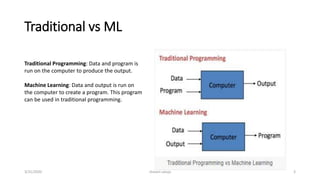
Traditional Programming: Data and program is
run on the computer to produce the output.
Machine Learning: Data and output is run on
the computer to create a program. This program
can be used in traditional programming.
3/31/2020 shivani saluja 3
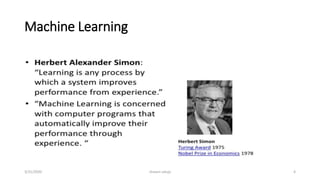
Machine Learning
3/31/2020 shivani saluja 4
Why Machine Learning?
3/31/2020 shivani saluja 5
Applications of Machine Learning
• Web search: ranking page based on what you are most likely to click on.
• Computational biology: rational design drugs in the computer based on past experiments.
• Finance: decide who to send what credit card offers to. Evaluation of risk on credit offers. How to decide
where to invest money.
• E-commerce: Predicting customer churn. Whether or not a transaction is fraudulent.
• Space exploration: space probes and radio astronomy.
• Robotics: how to handle uncertainty in new environments. Autonomous. Self-driving car.
• Information extraction: Ask questions over databases across the web.
• Social networks: Data on relationships and preferences. Machine learning to extract value from data.
• Debugging: Use in computer science problems like debugging. Labor intensive process. Could suggest where
the bug could be.
3/31/2020 shivani saluja 6
Applications
3/31/2020 shivani saluja 7
Key Elements of Machine Learning
• Representation: how to represent knowledge. Examples include decision trees, sets of
rules, instances, graphical models, neural networks, support vector machines
• Evaluation: the way to evaluate candidate programs (hypotheses). Examples include
accuracy, prediction and recall, squared error, likelihood, posterior probability, cost,
margin
• Optimization: the way candidate programs are generated known as the search process.
For example combinatorial optimization, convex optimization, constrained optimization.
3/31/2020 shivani saluja 8
Types of Learning
There are four types of machine learning:
• Supervised learning: (also called inductive learning) Training data includes
desired outputs. This is spam this is not, learning is supervised.
• Unsupervised learning: Training data does not include desired outputs. Example
is clustering. It is hard to tell what is good learning and what is not.
• Semi-supervised learning: Training data includes a few desired outputs.
• Reinforcement learning: Rewards from a sequence of actions. AI types like it, it
is the most ambitious type of learning.
3/31/2020 shivani saluja 9
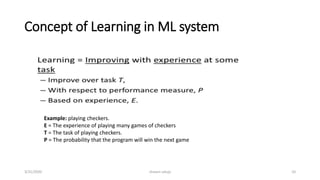
Concept of Learning in ML system
3/31/2020 shivani saluja 10
Example: playing checkers.
E = The experience of playing many games of checkers
T = The task of playing checkers.
P = The probability that the program will win the next game
Spam Filtering
3/31/2020 shivani saluja 11
Data in Machine learning
• DATA : It can be any unprocessed fact, value, text, sound or picture that is not being interpreted
and analyzed. Data is the most important part of all Data Analytics, Machine Learning, Artificial
Intelligence. Without data, we can’t train any model and all modern research and automation will
go vain. Big Enterprises are spending loads of money just to gather as much certain data as
possible.
Example: Why did Facebook acquire WhatsApp by paying a huge price of $19 billion?
The answer is very simple and logical – it is to have access to the users’ information that Facebook
may not have but WhatsApp will have. This information of their users is of paramount importance
to Facebook as it will facilitate the task of improvement in their services.
• INFORMATION : Data that has been interpreted and manipulated and has now some meaningful
inference for the users.
• KNOWLEDGE : Combination of inferred information, experiences, learning and insights. Results
in awareness or concept building for an individual or organization.
3/31/2020 shivani saluja 12
3/31/2020 shivani saluja 13
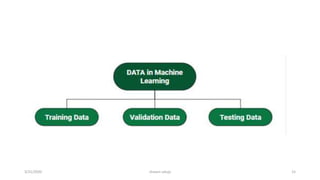
Types of data in machine learning
• Training Data: The part of data we use to train our model. This is the data which your
model actually sees(both input and output) and learn from.
• Validation Data: The part of data which is used to do a frequent evaluation of model, fit
on training dataset along with improving involved hyperparameters (initially set
parameters before the model begins learning). This data plays it’s part when the model is
actually training.
• Testing Data: Once our model is completely trained, testing data provides the unbiased
evaluation. When we feed in the inputs of Testing data, our model will predict some
values(without seeing actual output). After prediction, we evaluate our model by
comparing it with actual output present in the testing data. This is how we evaluate and
see how much our model has learned from the experiences feed in as training data, set at
the time of training.
3/31/2020 shivani saluja 14
3/31/2020 shivani saluja 15
Properties of Data
3/31/2020 shivani saluja 16
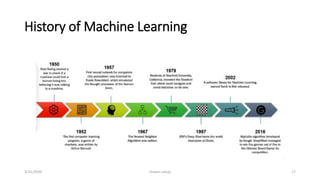
History of Machine Learning
3/31/2020 shivani saluja 17
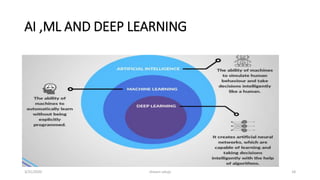
AI ,ML AND DEEP LEARNING
3/31/2020 shivani saluja 18

Introduction to Machine Learning

  • 1.
  • 2.
    Introduction • Machine learning(ML) is the scientific study of algorithms and statistical models that computer systems use to perform a specific task without using explicit instructions, relying on patterns and inference instead. • It is seen as a subset of artificial intelligence. • Machine learning algorithms build a mathematical model based on sample data, known as "training data", in order to make predictions or decisions without being explicitly programmed to perform the task . • Machine learning is the way to make programming scalable. • Machine Learning is the field of study that gives computers the capability to learn without being explicitly programmed • Machine learning is closely related to computational statistics, which focuses on making predictions using computers. 3/31/2020 Shivani Saluja 2
  • 3.
    Traditional vs ML TraditionalProgramming: Data and program is run on the computer to produce the output. Machine Learning: Data and output is run on the computer to create a program. This program can be used in traditional programming. 3/31/2020 shivani saluja 3
  • 4.
  • 5.
  • 6.
    Applications of MachineLearning • Web search: ranking page based on what you are most likely to click on. • Computational biology: rational design drugs in the computer based on past experiments. • Finance: decide who to send what credit card offers to. Evaluation of risk on credit offers. How to decide where to invest money. • E-commerce: Predicting customer churn. Whether or not a transaction is fraudulent. • Space exploration: space probes and radio astronomy. • Robotics: how to handle uncertainty in new environments. Autonomous. Self-driving car. • Information extraction: Ask questions over databases across the web. • Social networks: Data on relationships and preferences. Machine learning to extract value from data. • Debugging: Use in computer science problems like debugging. Labor intensive process. Could suggest where the bug could be. 3/31/2020 shivani saluja 6
  • 7.
  • 8.
    Key Elements ofMachine Learning • Representation: how to represent knowledge. Examples include decision trees, sets of rules, instances, graphical models, neural networks, support vector machines • Evaluation: the way to evaluate candidate programs (hypotheses). Examples include accuracy, prediction and recall, squared error, likelihood, posterior probability, cost, margin • Optimization: the way candidate programs are generated known as the search process. For example combinatorial optimization, convex optimization, constrained optimization. 3/31/2020 shivani saluja 8
  • 9.
    Types of Learning Thereare four types of machine learning: • Supervised learning: (also called inductive learning) Training data includes desired outputs. This is spam this is not, learning is supervised. • Unsupervised learning: Training data does not include desired outputs. Example is clustering. It is hard to tell what is good learning and what is not. • Semi-supervised learning: Training data includes a few desired outputs. • Reinforcement learning: Rewards from a sequence of actions. AI types like it, it is the most ambitious type of learning. 3/31/2020 shivani saluja 9
  • 10.
    Concept of Learningin ML system 3/31/2020 shivani saluja 10 Example: playing checkers. E = The experience of playing many games of checkers T = The task of playing checkers. P = The probability that the program will win the next game
  • 11.
  • 12.
    Data in Machinelearning • DATA : It can be any unprocessed fact, value, text, sound or picture that is not being interpreted and analyzed. Data is the most important part of all Data Analytics, Machine Learning, Artificial Intelligence. Without data, we can’t train any model and all modern research and automation will go vain. Big Enterprises are spending loads of money just to gather as much certain data as possible. Example: Why did Facebook acquire WhatsApp by paying a huge price of $19 billion? The answer is very simple and logical – it is to have access to the users’ information that Facebook may not have but WhatsApp will have. This information of their users is of paramount importance to Facebook as it will facilitate the task of improvement in their services. • INFORMATION : Data that has been interpreted and manipulated and has now some meaningful inference for the users. • KNOWLEDGE : Combination of inferred information, experiences, learning and insights. Results in awareness or concept building for an individual or organization. 3/31/2020 shivani saluja 12
  • 13.
  • 14.
    Types of datain machine learning • Training Data: The part of data we use to train our model. This is the data which your model actually sees(both input and output) and learn from. • Validation Data: The part of data which is used to do a frequent evaluation of model, fit on training dataset along with improving involved hyperparameters (initially set parameters before the model begins learning). This data plays it’s part when the model is actually training. • Testing Data: Once our model is completely trained, testing data provides the unbiased evaluation. When we feed in the inputs of Testing data, our model will predict some values(without seeing actual output). After prediction, we evaluate our model by comparing it with actual output present in the testing data. This is how we evaluate and see how much our model has learned from the experiences feed in as training data, set at the time of training. 3/31/2020 shivani saluja 14
  • 15.
  • 16.
  • 17.
    History of MachineLearning 3/31/2020 shivani saluja 17
  • 18.
    AI ,ML ANDDEEP LEARNING 3/31/2020 shivani saluja 18