Introduction
Of
Machine
Learning
Contents
 Introduction
 Components
 Classifications
 Applications
Introduction
By Aiman Ashfaq 1807
History of Machine
Learning
o In 1950, Alan Turing give the concept of thinking process
in computer.
o In 1952, Arthur Samual IBM made a self learning game.
o In 1958,Frank Rosenblatt introduce a perceptron.
o In 1979,Stanford University made Stanford Cart.
o In 1985,Terry Sejnow Ski invent NETTALK program.
Machine Learning
 Machine learning is an application of artificial intelligence that
involves algorithms and data that automatically analyses and make
decision by itself without human intervention.
 It describes how computer perform tasks on their own by previous
experiences.
 For example, medical diagnosis, image processing, prediction,
classification, learning association, regression etc.
Concepts of Machine
Learning
The concept of learning in ML is:
 Learning 〓 Improving with experiences with respect to
some tasks
 Improve our task T
 With respect to performances measure P
 Based on experiences E
Artificial Intelligences VS
Machine Leaning
Artificial intelligences the technology using which we can
create an intelligent systems that can simulate human
intelligences.ML is the subset of AI that used for automating
tasks through past experiences. AI use for solve the complex
program on the other hand ML perform working through
learning form past data.
Importance of
Machine Learning
Machine learning is important because it gives
enterprises a view of trends in customer behavior and
business operational patterns, as well as supports the
development of new products. Many of today’s leading
companies, such as Facebook, Google and Uber, make
machine learning a central part of their operations.
Components
Bakhtawar 1968
Components Of
Machine Learning
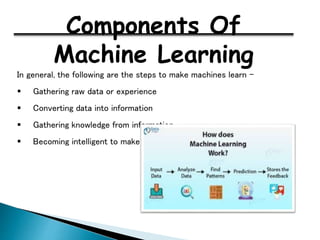
In general, the following are the steps to make machines learn -
 Gathering raw data or experience
 Converting data into information
 Gathering knowledge from information
 Becoming intelligent to make decision
Gathering Raw Data
We’re generating data at unprecedented rate. These data
can be numeric, categorical and free data. Data collection
is the process of gathering and measuring information from
countless different sources. In order to use the data we
collect to develop practical machine learning solutions, it
must be collected and stored.
Converting Data
Data transformation is the process of changing the format,
structure, or values of data. For data analytics projects, data
may be transformed at two stages of the data pipeline.
Process such as data integration, data migration, data
warehousing, and data wrangling all may involve data transfers.
Data transformation may be constructive, destruction,
aesthetic, or structural.
Gathering Knowledge
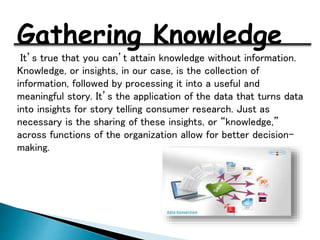
It’s true that you can’t attain knowledge without information.
Knowledge, or insights, in our case, is the collection of
information, followed by processing it into a useful and
meaningful story. It’s the application of the data that turns data
into insights for story telling consumer research. Just as
necessary is the sharing of these insights, or “knowledge,”
across functions of the organization allow for better decision-
making.
Decision Makings
Machine learning algorithms in cognitive computing for decision
making can help out how to achieve significant solutions by
generalizing a learned model from environmental pattern
instances. This technique is frequently practicable and
economical where manual rigid rule based abstract programming
is not suitable. As more training input patterns are obtainable,
better-determined tasks can be attempted. As a result, machine
learning is extensively used in machine learning big data.
Classification
Maria Bibi 1692
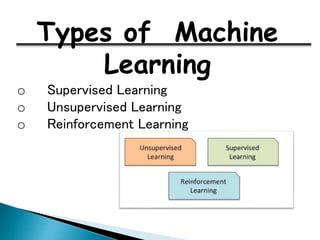
Types of Machine
Learning
o Supervised Learning
o Unsupervised Learning
o Reinforcement Learning
Supervised Machine
Learning
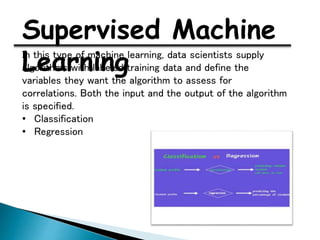
In this type of machine learning, data scientists supply
algorithms with labeled training data and define the
variables they want the algorithm to assess for
correlations. Both the input and the output of the algorithm
is specified.
• Classification
• Regression
Unsupervised Machine
Learning
This type of machine learning involves algorithms that train on unlabeled
data. The algorithm scans through data sets looking for any meaningful
connection. The data that algorithms train on as well as the predictions or
recommendations they output are predetermined.
 Clustering
 Association
Reinforcement
Machine Learning
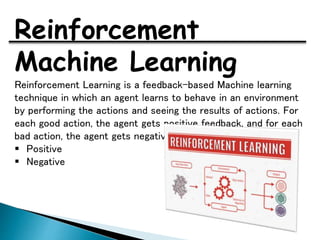
Reinforcement Learning is a feedback-based Machine learning
technique in which an agent learns to behave in an environment
by performing the actions and seeing the results of actions. For
each good action, the agent gets positive feedback, and for each
bad action, the agent gets negative feedback or penalty.
 Positive
 Negative
Applications
Sana Rahmat Khan 1560
Applications of
Machine Learning
 Traffic Predictions
 Speech & Image recognition
 Virtual Assistants
 Bioinformatics
 Medical Diagnosis
 Extractions
 Spam Detections
It predicts the traffic conditions such as whether traffic is
cleared, slow-moving, or heavily congested with the help of
two ways i.e. Real Time location of the vehicle form Google
Map app and sensors
Average time has taken on past days at the same time.
Traffic prediction
Image Recognition
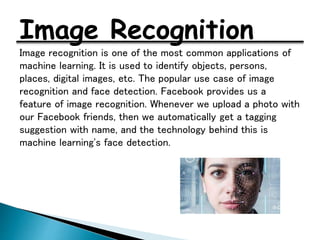
Image recognition is one of the most common applications of
machine learning. It is used to identify objects, persons,
places, digital images, etc. The popular use case of image
recognition and face detection. Facebook provides us a
feature of image recognition. Whenever we upload a photo with
our Facebook friends, then we automatically get a tagging
suggestion with name, and the technology behind this is
machine learning's face detection.
Speech Recognition
It's a popular application of machine learning. Speech
recognition is a process of converting voice instructions into
text, and it is also known as "Speech to text", or "Computer
speech recognition." Google assistant, Siri, Cortana, and Alexa
are using speech recognition technology to follow the voice
instructions.
Medical Diagnosis
In medical science, machine learning is used for diseases
diagnoses. With this, medical technology is growing very fast
and able to build 3D models that can predict the exact
position of lesions in the brain. It helps in finding brain tumors
and other brain-related diseases easily.
Whenever we receive a new email, it is filtered automatically
as important, normal, and spam. We always receive an
important mail in our inbox with the important symbol and
spam emails in our spam box, and the technology behind this
is Machine learning.
Email Spam and
Malware Filtering
Advantages of
Machine Learning
• Fast, Accurate, Efficient.
• Automation of most applications.
• Wide range of real life applications.
• Enhanced cyber security and spam detection.
• No human Intervention is needed.
• Handling multi-dimensional data

Machine learning

  • 1.
  • 2.
    Contents  Introduction  Components Classifications  Applications
  • 3.
  • 4.
    History of Machine Learning oIn 1950, Alan Turing give the concept of thinking process in computer. o In 1952, Arthur Samual IBM made a self learning game. o In 1958,Frank Rosenblatt introduce a perceptron. o In 1979,Stanford University made Stanford Cart. o In 1985,Terry Sejnow Ski invent NETTALK program.
  • 5.
    Machine Learning  Machinelearning is an application of artificial intelligence that involves algorithms and data that automatically analyses and make decision by itself without human intervention.  It describes how computer perform tasks on their own by previous experiences.  For example, medical diagnosis, image processing, prediction, classification, learning association, regression etc.
  • 6.
    Concepts of Machine Learning Theconcept of learning in ML is:  Learning 〓 Improving with experiences with respect to some tasks  Improve our task T  With respect to performances measure P  Based on experiences E
  • 7.
    Artificial Intelligences VS MachineLeaning Artificial intelligences the technology using which we can create an intelligent systems that can simulate human intelligences.ML is the subset of AI that used for automating tasks through past experiences. AI use for solve the complex program on the other hand ML perform working through learning form past data.
  • 8.
    Importance of Machine Learning Machinelearning is important because it gives enterprises a view of trends in customer behavior and business operational patterns, as well as supports the development of new products. Many of today’s leading companies, such as Facebook, Google and Uber, make machine learning a central part of their operations.
  • 9.
  • 10.
    Components Of Machine Learning Ingeneral, the following are the steps to make machines learn -  Gathering raw data or experience  Converting data into information  Gathering knowledge from information  Becoming intelligent to make decision
  • 11.
    Gathering Raw Data We’regenerating data at unprecedented rate. These data can be numeric, categorical and free data. Data collection is the process of gathering and measuring information from countless different sources. In order to use the data we collect to develop practical machine learning solutions, it must be collected and stored.
  • 12.
    Converting Data Data transformationis the process of changing the format, structure, or values of data. For data analytics projects, data may be transformed at two stages of the data pipeline. Process such as data integration, data migration, data warehousing, and data wrangling all may involve data transfers. Data transformation may be constructive, destruction, aesthetic, or structural.
  • 13.
    Gathering Knowledge It’s truethat you can’t attain knowledge without information. Knowledge, or insights, in our case, is the collection of information, followed by processing it into a useful and meaningful story. It’s the application of the data that turns data into insights for story telling consumer research. Just as necessary is the sharing of these insights, or “knowledge,” across functions of the organization allow for better decision- making.
  • 14.
    Decision Makings Machine learningalgorithms in cognitive computing for decision making can help out how to achieve significant solutions by generalizing a learned model from environmental pattern instances. This technique is frequently practicable and economical where manual rigid rule based abstract programming is not suitable. As more training input patterns are obtainable, better-determined tasks can be attempted. As a result, machine learning is extensively used in machine learning big data.
  • 15.
  • 16.
    Types of Machine Learning oSupervised Learning o Unsupervised Learning o Reinforcement Learning
  • 17.
    Supervised Machine Learning In thistype of machine learning, data scientists supply algorithms with labeled training data and define the variables they want the algorithm to assess for correlations. Both the input and the output of the algorithm is specified. • Classification • Regression
  • 18.
    Unsupervised Machine Learning This typeof machine learning involves algorithms that train on unlabeled data. The algorithm scans through data sets looking for any meaningful connection. The data that algorithms train on as well as the predictions or recommendations they output are predetermined.  Clustering  Association
  • 19.
    Reinforcement Machine Learning Reinforcement Learningis a feedback-based Machine learning technique in which an agent learns to behave in an environment by performing the actions and seeing the results of actions. For each good action, the agent gets positive feedback, and for each bad action, the agent gets negative feedback or penalty.  Positive  Negative
  • 20.
  • 21.
    Applications of Machine Learning Traffic Predictions  Speech & Image recognition  Virtual Assistants  Bioinformatics  Medical Diagnosis  Extractions  Spam Detections
  • 22.
    It predicts thetraffic conditions such as whether traffic is cleared, slow-moving, or heavily congested with the help of two ways i.e. Real Time location of the vehicle form Google Map app and sensors Average time has taken on past days at the same time. Traffic prediction
  • 23.
    Image Recognition Image recognitionis one of the most common applications of machine learning. It is used to identify objects, persons, places, digital images, etc. The popular use case of image recognition and face detection. Facebook provides us a feature of image recognition. Whenever we upload a photo with our Facebook friends, then we automatically get a tagging suggestion with name, and the technology behind this is machine learning's face detection.
  • 24.
    Speech Recognition It's apopular application of machine learning. Speech recognition is a process of converting voice instructions into text, and it is also known as "Speech to text", or "Computer speech recognition." Google assistant, Siri, Cortana, and Alexa are using speech recognition technology to follow the voice instructions.
  • 25.
    Medical Diagnosis In medicalscience, machine learning is used for diseases diagnoses. With this, medical technology is growing very fast and able to build 3D models that can predict the exact position of lesions in the brain. It helps in finding brain tumors and other brain-related diseases easily.
  • 26.
    Whenever we receivea new email, it is filtered automatically as important, normal, and spam. We always receive an important mail in our inbox with the important symbol and spam emails in our spam box, and the technology behind this is Machine learning. Email Spam and Malware Filtering
  • 27.
    Advantages of Machine Learning •Fast, Accurate, Efficient. • Automation of most applications. • Wide range of real life applications. • Enhanced cyber security and spam detection. • No human Intervention is needed. • Handling multi-dimensional data