Shivani Saluja
Assistant Professor
IMSEC GHAZIABAD
Introduction
 SWI_PROLOG
 Fundamentals of PROLOG
 Applications
 References

Open source software is software that
can be freely used, changed, and
shared (in modified or unmodified
form) by anyone.





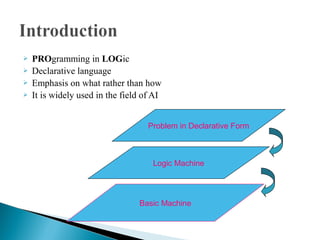
PROgramming in LOGic
Declarative language
Emphasis on what rather than how
It is widely used in the field of AI
Problem in Declarative Form

Logic Machine

Basic Machine
SWI-Prolog offers a comprehensive FREE SOFTWARE
Prolog environment.
 Link for downloading:
http://www.swi-prolog.org/download/stable
 A Self-installing executable for MS-Windows: swipl-win.exe
 Works on Windows XP
 LINUX versions are also available.

Facts
 Rules
 Query
 Unification
 Resolution
 Backtracing
 Cuts and negations








Facts are statements about what is true about a problem,
instead of instructions how to accomplish the solution.
The Prolog system uses the facts to work out how to
accomplish the solution by searching through the space of
possible solutions.
It is defined by an identifier followed by an n-tuple of
constants.
A relation identifier is referred to as a predicate
When a tuple of values is in a relation we say the tuple
satisfies the predicate.





Names of relationship and objects must begin with a lowercase letter.
Relationship is written first (typically the predicate of the
sentence).
Objects are written separated by commas and are enclosed
by a pair of round brackets.
The full stop character ‘.’ must come at the end of a fact.
Examples
facts

Predicate

Interpretation

valuable(gold)

Gold is valuable.

owns(john,gold)

John owns gold.

father(john,mary)

John is the father of
Mary
John gives the book to
Mary

gives (john,book,mary)


Specifies under what conditions a tuple of values satisfies a
predicate.



The basic building block of a rule is called an atom

Atom :- Atom1, ..., Atomn
If each of Atom1,...,Atomn is true, then Atom is also true.

Rules specify:
 If-then conditions

I use an umbrella if there is a rain

use(i, umbrella) :- occur(rain).
 Generalizations

All men are mortal

mortal(X) :- man(X).
 Definitions
 An animal is a bird if it has feathers
 bird(X) :- animal(X), has_feather(X).
Syntax of rule
 <head> :- <body>
 Read ‘:-’ as ‘if’.
 likes(john,X) :- likes(X,cricket).
“John likes X if X likes cricket”.
i.e., “John likes anyone who likes cricket”.

 Rules always end with ‘.’
There are two types of queries:
 Ground Query
 edge(a,b)
 This query is called a ground query because it consists only
of value identifiers as parameters to the predicate.
 a ground query is posed we expect a yes/no answer.
 Non Ground Query
 They have variables as parameters
 tedge(a,X)


Always begin with a capital letter





?- likes (john,X).
?- likes (john, Something).

But not


?- likes (john,something)




Facts: ()
◦ likes(john,mary).
◦ likes(john,X). % Variables begin with capital
Queries
◦ ?- likes(X,Y).
◦ X=john, Y=Mary. % hit “;” for more
◦ ?- likes(X,X).
◦ X=john.




Rules
◦ likes(john,X) :- likes(X,wine). % :- = if
◦ likes(john,X):- female(X), likes(X,john).
Query: ? - likes(john,Y).
◦ Y = bill ;
◦ no
Predicate
Procedure for elephant
Facts

Clauses
Rule

elephant(george).
elephant(forge).
elephant(X) :- grey(X), mammal(X), hasTrunk(X).
?- elephant(george).
Queries

yes
?- elephant(jane).
Replies

no




Conjunction of predicates is represented as a sequence of
structures, separated by commas”,”.
It is referred as “AND”
sister_of (X,Y):- female (X), parents (X, M, F),





Disjunction of predicates is represented as a sequence of
structures, separated by semicolon”;”.
It is referred as “OR”
friend(ram,shyam):friend(shyam,sita);friend(shyam,mohan).









Questions based on facts are answered by matching
Unification is the name given to the way Prolog does its
matching.
Two facts match if their predicates are same (spelt the
same way) and the arguments each are same.
If matched, prolog answers yes, else no.
No does not mean falsity
This means not provable from the given facts.
Question Answering in presence of
rules
Facts
 male (ram).
 male (shyam).
 female (sita).
 female (gita).
 parents (shyam, gita, ram).
 parents (sita, gita, ram).
Rule:sister_of (X,Y):- female (X), parents (X, M, F),parents (Y, M, F).
X is a sister of Y is X is a female and X and Y have same parents
Backtracking
?- sister_of (sita, shyam)

female(sita)

parents(sita,M,F)

parents(shyam,M,F)

parents(shyam,gita,ram)
parents(sita,gita,ram)
success
Question Answering: wh-type: whose
sister is sita?
?- ?- sister_of (sita, X)

female(sita)

parents(sita,M,F)

parents(Y,M,F)

parents(Y,gita,ram)
parents(sita,gita,ram)
parents(shyam,gita,ram)
Success
Y=shyam








Prolog provides a number of basic arithmetic tools.
Arithmetic examples
Prolog Notation
6+2=8
8 is 6+2.
6 ∗ 2 = 12
12 is 6*2.
Answers to arithmetic questions by using ariables. For
example:
?- X is 6+2.
X=8
Prolog’s computation
 Depth First Search
 Pursues a goal till the end
 Conditional AND; falsity of any goal prevents satisfaction of
further clauses.
 Conditional OR; satisfaction of any goal prevents further clauses
being evaluated.
Control flow (top level)
Given
g:- a, b, c.

(1)

g:- d, e, f; g. (2)
If prolog cannot satisfy (1), control will automatically fall through to
(2).
Control Flow within a rule
Taking (1),
g:- a, b, c.
If a succeeds, prolog will try to satisfy b, succeding which c will be
tried.
For ANDed clauses, control flows forward till the ‘.’, iff the current
clause is true.
For ORed clauses, control flows forward till the ‘.’, iff the current
clause evaluates to false.
On Failure
REDO the immediately preceding goal.

Always place the more general rule AFTER a specific rule











Automatic backtracking is one of the most characteristic
features of Prolog.
Backtracking can lead to inefficiency.
Prolog can waste time exploring possibilities that lead
nowhere.
Cut is a goal that always succeeds
Commits Prolog to the choices that were made since the
parent goal was called
CUTS are used control over this aspect of its behaviour
p(X):- b(X), c(X), !, d(X), e(X).








consider the following piece of cut-free code:
p(X):- a(X).
p(X):- b(X), c(X), d(X), e(X).
p(X):- f(X).
a(1). b(1).
c(1).
d(2). e(2). f(3).
b(2).
c(2).
For query p(X) we will get the following responses:
X = 1 ;
X = 2 ;
X = 3 ;
no
Here is the search tree that explains how Prolog finds these three
solutions. Note that it has to backtrack once, namely when it enters the
second clause for p/1 and decides to unify the first goal
with b(1) instead of b(2) .





Consider the following code:
enjoys(vincent,X) :- big_kahuna_burger(X),!,fail.
enjoys(vincent,X) :- burger(X).
burger(X) :- big_mac(X).
burger(X) :- big_kahuna_burger(X).
burger(X) :- whopper(X).
big_mac(a).
big_kahuna_burger(b).
big_mac(c).
whopper(d).
Using Negation

   enjoys(vincent,X) :- burger(X), neg(big_kahuna_burger(X)).
Predicate Calculus
 Introduction through an example (Zohar Manna, 1974):
 Problem: A, B and C belong to the Himalayan club. Every
member in the club is either a mountain climber or a skier or
both. A likes whatever B dislikes and dislikes whatever B likes.
A likes rain and snow. No mountain climber likes rain. Every
skier likes snow. Is there a member who is a mountain climber
and not a skier?
 Given knowledge has:
 Facts
 Rules








Compute_length ([],0).
Compute_length ([Head|Tail], Length):Compute_length (Tail,Tail_length),
Length is Tail_length+1.
High level explanation:
The length of a list is 1 plus the length of the tail of the list,
obtained by removing the first element of the list.
This is a declarative description of the computation.
◦ Expert Systems
Inferencing)

(Knowledge

Representation

◦ Natural Language Processing
◦ Definite Clause Grammar
◦ http://www.learnprolognow.org/lpnpage.php?
pagetype=html&pageid=lpn-htmlch8

and
www.swi-prolog.org/
 http://www.learnprolognow.org/

THANKYOU

Prolog basics

  • 1.
  • 2.
    Introduction  SWI_PROLOG  Fundamentalsof PROLOG  Applications  References 
  • 3.
    Open source softwareis software that can be freely used, changed, and shared (in modified or unmodified form) by anyone.
  • 4.
        PROgramming in LOGic Declarativelanguage Emphasis on what rather than how It is widely used in the field of AI Problem in Declarative Form Logic Machine Basic Machine
  • 5.
    SWI-Prolog offers acomprehensive FREE SOFTWARE Prolog environment.  Link for downloading: http://www.swi-prolog.org/download/stable  A Self-installing executable for MS-Windows: swipl-win.exe  Works on Windows XP  LINUX versions are also available. 
  • 6.
    Facts  Rules  Query Unification  Resolution  Backtracing  Cuts and negations 
  • 7.
         Facts are statementsabout what is true about a problem, instead of instructions how to accomplish the solution. The Prolog system uses the facts to work out how to accomplish the solution by searching through the space of possible solutions. It is defined by an identifier followed by an n-tuple of constants. A relation identifier is referred to as a predicate When a tuple of values is in a relation we say the tuple satisfies the predicate.
  • 8.
        Names of relationshipand objects must begin with a lowercase letter. Relationship is written first (typically the predicate of the sentence). Objects are written separated by commas and are enclosed by a pair of round brackets. The full stop character ‘.’ must come at the end of a fact.
  • 9.
    Examples facts Predicate Interpretation valuable(gold) Gold is valuable. owns(john,gold) Johnowns gold. father(john,mary) John is the father of Mary John gives the book to Mary gives (john,book,mary)
  • 10.
     Specifies under whatconditions a tuple of values satisfies a predicate.  The basic building block of a rule is called an atom Atom :- Atom1, ..., Atomn If each of Atom1,...,Atomn is true, then Atom is also true. 
  • 11.
    Rules specify:  If-thenconditions  I use an umbrella if there is a rain  use(i, umbrella) :- occur(rain).  Generalizations  All men are mortal  mortal(X) :- man(X).  Definitions  An animal is a bird if it has feathers  bird(X) :- animal(X), has_feather(X).
  • 12.
    Syntax of rule <head> :- <body>  Read ‘:-’ as ‘if’.  likes(john,X) :- likes(X,cricket). “John likes X if X likes cricket”. i.e., “John likes anyone who likes cricket”.  Rules always end with ‘.’
  • 13.
    There are twotypes of queries:  Ground Query  edge(a,b)  This query is called a ground query because it consists only of value identifiers as parameters to the predicate.  a ground query is posed we expect a yes/no answer.  Non Ground Query  They have variables as parameters  tedge(a,X)
  • 14.
     Always begin witha capital letter    ?- likes (john,X). ?- likes (john, Something). But not  ?- likes (john,something)
  • 15.
      Facts: () ◦ likes(john,mary). ◦likes(john,X). % Variables begin with capital Queries ◦ ?- likes(X,Y). ◦ X=john, Y=Mary. % hit “;” for more ◦ ?- likes(X,X). ◦ X=john.
  • 16.
      Rules ◦ likes(john,X) :-likes(X,wine). % :- = if ◦ likes(john,X):- female(X), likes(X,john). Query: ? - likes(john,Y). ◦ Y = bill ; ◦ no
  • 17.
  • 18.
  • 19.
      Conjunction of predicatesis represented as a sequence of structures, separated by commas”,”. It is referred as “AND” sister_of (X,Y):- female (X), parents (X, M, F),   Disjunction of predicates is represented as a sequence of structures, separated by semicolon”;”. It is referred as “OR” friend(ram,shyam):friend(shyam,sita);friend(shyam,mohan).
  • 20.
          Questions based onfacts are answered by matching Unification is the name given to the way Prolog does its matching. Two facts match if their predicates are same (spelt the same way) and the arguments each are same. If matched, prolog answers yes, else no. No does not mean falsity This means not provable from the given facts.
  • 21.
    Question Answering inpresence of rules Facts  male (ram).  male (shyam).  female (sita).  female (gita).  parents (shyam, gita, ram).  parents (sita, gita, ram). Rule:sister_of (X,Y):- female (X), parents (X, M, F),parents (Y, M, F). X is a sister of Y is X is a female and X and Y have same parents
  • 22.
    Backtracking ?- sister_of (sita,shyam) female(sita) parents(sita,M,F) parents(shyam,M,F) parents(shyam,gita,ram) parents(sita,gita,ram) success
  • 23.
    Question Answering: wh-type:whose sister is sita? ?- ?- sister_of (sita, X) female(sita) parents(sita,M,F) parents(Y,M,F) parents(Y,gita,ram) parents(sita,gita,ram) parents(shyam,gita,ram) Success Y=shyam
  • 24.
          Prolog provides anumber of basic arithmetic tools. Arithmetic examples Prolog Notation 6+2=8 8 is 6+2. 6 ∗ 2 = 12 12 is 6*2. Answers to arithmetic questions by using ariables. For example: ?- X is 6+2. X=8
  • 25.
    Prolog’s computation  DepthFirst Search  Pursues a goal till the end  Conditional AND; falsity of any goal prevents satisfaction of further clauses.  Conditional OR; satisfaction of any goal prevents further clauses being evaluated.
  • 26.
    Control flow (toplevel) Given g:- a, b, c. (1) g:- d, e, f; g. (2) If prolog cannot satisfy (1), control will automatically fall through to (2).
  • 27.
    Control Flow withina rule Taking (1), g:- a, b, c. If a succeeds, prolog will try to satisfy b, succeding which c will be tried. For ANDed clauses, control flows forward till the ‘.’, iff the current clause is true. For ORed clauses, control flows forward till the ‘.’, iff the current clause evaluates to false. On Failure REDO the immediately preceding goal. Always place the more general rule AFTER a specific rule
  • 28.
           Automatic backtracking isone of the most characteristic features of Prolog. Backtracking can lead to inefficiency. Prolog can waste time exploring possibilities that lead nowhere. Cut is a goal that always succeeds Commits Prolog to the choices that were made since the parent goal was called CUTS are used control over this aspect of its behaviour p(X):- b(X), c(X), !, d(X), e(X).
  • 29.
         consider the followingpiece of cut-free code: p(X):- a(X). p(X):- b(X), c(X), d(X), e(X). p(X):- f(X). a(1). b(1). c(1). d(2). e(2). f(3). b(2). c(2). For query p(X) we will get the following responses: X = 1 ; X = 2 ; X = 3 ; no Here is the search tree that explains how Prolog finds these three solutions. Note that it has to backtrack once, namely when it enters the second clause for p/1 and decides to unify the first goal with b(1) instead of b(2) .
  • 33.
       Consider the followingcode: enjoys(vincent,X) :- big_kahuna_burger(X),!,fail. enjoys(vincent,X) :- burger(X). burger(X) :- big_mac(X). burger(X) :- big_kahuna_burger(X). burger(X) :- whopper(X). big_mac(a). big_kahuna_burger(b). big_mac(c). whopper(d). Using Negation    enjoys(vincent,X) :- burger(X), neg(big_kahuna_burger(X)).
  • 34.
    Predicate Calculus  Introductionthrough an example (Zohar Manna, 1974):  Problem: A, B and C belong to the Himalayan club. Every member in the club is either a mountain climber or a skier or both. A likes whatever B dislikes and dislikes whatever B likes. A likes rain and snow. No mountain climber likes rain. Every skier likes snow. Is there a member who is a mountain climber and not a skier?  Given knowledge has:  Facts  Rules
  • 35.
           Compute_length ([],0). Compute_length ([Head|Tail],Length):Compute_length (Tail,Tail_length), Length is Tail_length+1. High level explanation: The length of a list is 1 plus the length of the tail of the list, obtained by removing the first element of the list. This is a declarative description of the computation.
  • 36.
    ◦ Expert Systems Inferencing) (Knowledge Representation ◦Natural Language Processing ◦ Definite Clause Grammar ◦ http://www.learnprolognow.org/lpnpage.php? pagetype=html&pageid=lpn-htmlch8 and
  • 37.
  • 38.