Introduction to
Generative AI
Generative AI refers to algorithms used in artificial intelligence
that create new data similar to input data. It involves techniques
like GANs, VAEs, and RNNs to generate content like images, text,
and music.
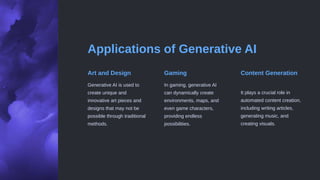
Applications of Generative AI
Art and Design
Generative AI is used to
create unique and
innovative art pieces and
designs that may not be
possible through traditional
methods.
Gaming
In gaming, generative AI
can dynamically create
environments, maps, and
even game characters,
providing endless
possibilities.
Content Generation
It plays a crucial role in
automated content creation,
including writing articles,
generating music, and
creating visuals.
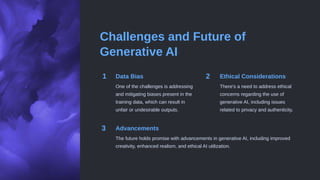
Challenges and Future of
Generative AI
Data Bias
One of the challenges is addressing
and mitigating biases present in the
training data, which can result in
unfair or undesirable outputs.
2 Ethical Considerations
There's a need to address ethical
concerns regarding the use of
generative AI, including issues
related to privacy and authenticity.
3 Advancements
The future holds promise with advancements in generative AI, including improved
creativity, enhanced realism, and ethical AI utilization.
1
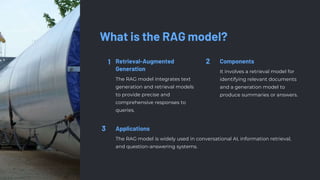
What is the RAG model?
Retrieval-Augmented
Generation
The RAG model integrates text
generation and retrieval models
to provide precise and
comprehensive responses to
queries.
2 Components
It involves a retrieval model for
identifying relevant documents
and a generation model to
produce summaries or answers.
3 Applications
The RAG model is widely used in conversational AI, information retrieval,
and question-answering systems.
1
Pros of using the RAG model
Improved
Accuracy
The model provides accurate and
contextually relevant responses due to its
retrieval-based approach.
Enhanced User
Experience
Users receive more precise and coherent
answers, leading to a better conversational
experience.
Efficient Information
Retrieval
RAG efficiently retrieves pertinent
information, making it valuable for
knowledge-intensive applications.
Versatility
It can generate responses across a wide
range of topics and domains, adding to its
versatility.
Cons of using the RAG model
Complexity
Setting up and fine-
tuning the retrieval and
generation models can
be intricate and time-
consuming.
2 High Computational
Cost
RAG often requires
substantial
computational
resources, especially for
large-scale retrieval
operations.
3 Quality
Assurance
Ensuring the accuracy
of retrieved documents
and the relevance of
generated responses
demands ongoing
monitoring.
1
Key components of the RAG pipeline
Retrieval Model Identifies relevant information from large
datasets.
Generation Model Composes contextually appropriate
responses.
Ranking Algorithm Determines the relevance of retrieved
documents.
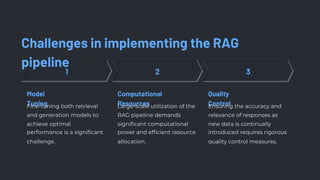
Challenges in implementing the RAG
pipeline
Model
Tuning
Computational
Resources
Quality
Control
Fine-tuning both retrieval
and generation models to
achieve optimal
performance is a significant
challenge.
Large-scale utilization of the
RAG pipeline demands
significant computational
power and efficient resource
allocation.
Ensuring the accuracy and
relevance of responses as
new data is continually
introduced requires rigorous
quality control measures.
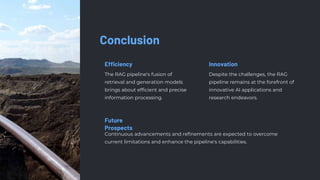
Conclusion
Efficiency
The RAG pipeline's fusion of
retrieval and generation models
brings about efficient and precise
information processing.
Innovation
Despite the challenges, the RAG
pipeline remains at the forefront of
innovative AI applications and
research endeavors.
Future
Prospects
Continuous advancements and refinements are expected to overcome
current limitations and enhance the pipeline's capabilities.

Introduction-to-Generative-AI.pptx

  • 1.
    Introduction to Generative AI GenerativeAI refers to algorithms used in artificial intelligence that create new data similar to input data. It involves techniques like GANs, VAEs, and RNNs to generate content like images, text, and music.
  • 2.
    Applications of GenerativeAI Art and Design Generative AI is used to create unique and innovative art pieces and designs that may not be possible through traditional methods. Gaming In gaming, generative AI can dynamically create environments, maps, and even game characters, providing endless possibilities. Content Generation It plays a crucial role in automated content creation, including writing articles, generating music, and creating visuals.
  • 3.
    Challenges and Futureof Generative AI Data Bias One of the challenges is addressing and mitigating biases present in the training data, which can result in unfair or undesirable outputs. 2 Ethical Considerations There's a need to address ethical concerns regarding the use of generative AI, including issues related to privacy and authenticity. 3 Advancements The future holds promise with advancements in generative AI, including improved creativity, enhanced realism, and ethical AI utilization. 1
  • 4.
    What is theRAG model? Retrieval-Augmented Generation The RAG model integrates text generation and retrieval models to provide precise and comprehensive responses to queries. 2 Components It involves a retrieval model for identifying relevant documents and a generation model to produce summaries or answers. 3 Applications The RAG model is widely used in conversational AI, information retrieval, and question-answering systems. 1
  • 5.
    Pros of usingthe RAG model Improved Accuracy The model provides accurate and contextually relevant responses due to its retrieval-based approach. Enhanced User Experience Users receive more precise and coherent answers, leading to a better conversational experience. Efficient Information Retrieval RAG efficiently retrieves pertinent information, making it valuable for knowledge-intensive applications. Versatility It can generate responses across a wide range of topics and domains, adding to its versatility.
  • 6.
    Cons of usingthe RAG model Complexity Setting up and fine- tuning the retrieval and generation models can be intricate and time- consuming. 2 High Computational Cost RAG often requires substantial computational resources, especially for large-scale retrieval operations. 3 Quality Assurance Ensuring the accuracy of retrieved documents and the relevance of generated responses demands ongoing monitoring. 1
  • 7.
    Key components ofthe RAG pipeline Retrieval Model Identifies relevant information from large datasets. Generation Model Composes contextually appropriate responses. Ranking Algorithm Determines the relevance of retrieved documents.
  • 8.
    Challenges in implementingthe RAG pipeline Model Tuning Computational Resources Quality Control Fine-tuning both retrieval and generation models to achieve optimal performance is a significant challenge. Large-scale utilization of the RAG pipeline demands significant computational power and efficient resource allocation. Ensuring the accuracy and relevance of responses as new data is continually introduced requires rigorous quality control measures.
  • 9.
    Conclusion Efficiency The RAG pipeline'sfusion of retrieval and generation models brings about efficient and precise information processing. Innovation Despite the challenges, the RAG pipeline remains at the forefront of innovative AI applications and research endeavors. Future Prospects Continuous advancements and refinements are expected to overcome current limitations and enhance the pipeline's capabilities.

Editor's Notes