Assignment
On
5th
class note
Course title : Data communication
Course code : CSE 313
Submitted to
Pranab bandhu nath
Senior Lecturer
Department of CSE
City University
Submitted by
Md.Ismail
Id: 1834902082
Batch : 49th
(B)
Department of CSE
City University
Submission date : 31.08.2021
Base band
Baseband Transmission is a signaling technology that sends digital signals over a single
frequency as discrete electrical pulses.
Baseband technology uses digital signal in data transmission.It sends binary values directly as
pulses of different voltage levels.
To support bidirectional communication thios technology uses two separate electric circuits
together ,one for sending and another for reciving.
Broad band
Broadband refers to various high-capacity transmission technologies that are used to transmit
data, voice, and video across long distances and at high speeds.
Broadband is typically used in an environment that transmits audio, video, and data
simultaneously. For example, Cable TV Networks, Radio stations, and Telephone companies.
Broadband transmissions are divided into multiple bands or channels by multiplexers using a
multiplexing scheme such as frequency-division multiplexing (FDM). Each channel has a carrier
frequency that is modulated to carry the signal from a given source.
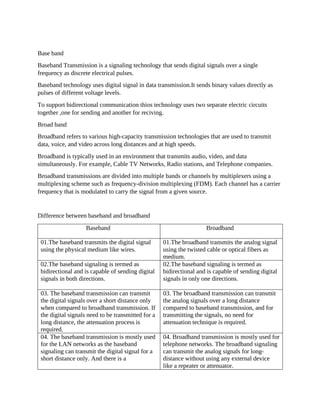
Difference between baseband and broadband
Baseband Broadband
01.The baseband transmits the digital signal
using the physical medium like wires.
01.The broadband transmits the analog signal
using the twisted cable or optical fibers as
medium.
02.The baseband signaling is termed as
bidirectional and is capable of sending digital
signals in both directions.
02.The baseband signaling is termed as
bidirectional and is capable of sending digital
signals in only one directions.
03. The baseband transmission can transmit
the digital signals over a short distance only
when compared to broadband transmission. If
the digital signals need to be transmitted for a
long distance, the attenuation process is
required.
03. The broadband transmission can transmit
the analog signals over a long distance
compared to baseband transmission, and for
transmitting the signals, no need for
attenuation technique is required.
04. The baseband transmission is mostly used
for the LAN networks as the baseband
signaling can transmit the digital signal for a
short distance only. And there is a
04. Broadband transmission is mostly used for
telephone networks. The broadband signaling
can transmit the analog signals for long-
distance without using any external device
like a repeater or attenuator.
requirement of repeaters for transmitting the
signals.
Twisted pair cable:
A twisted pair cable is a type of cable made by putting two separate insulated wires together in a
twisted pattern and running them parallel to each other.
shielded cable
A shielded cable or screened cable is an electrical cable of one or more insulated conductors enclosed by
a common conductive layer.
Unshielded Cables
This cable is usually referred to as unshielded twisted pair cable (UTP) where individual wire pairs are
simply wrapped in a foil, without any additional layer of protection. Unshielded cables are ideal for
office environments, which experience less traffic.
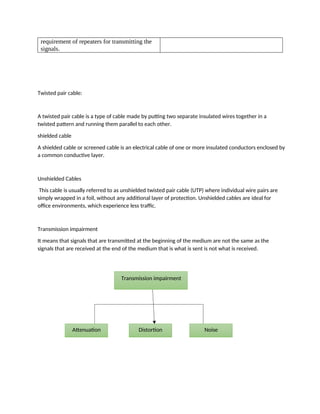
Transmission impairment
It means that signals that are transmitted at the beginning of the medium are not the same as the
signals that are received at the end of the medium that is what is sent is not what is received.
Attenuation Distortion Noise
Transmission impairment
Attenuation means a loss of energy. When a signal or composite,travels through a medium ,it loses
some of its energy in overcoming the resistance of the medium.That is why a wire carrying electronic
signals gets warm .
To compensate for this loss,amplifier are used to amplify the signal .
To show that a signal has lost or gained strength,engineers use the unit of the decibel.
The decibel measures the relative strengths of two signal or one signal at two different points .
The decibel is negative if a signal is attenuated and positive if a signal is amplifie..
Noise
Noise is another cause of impairment.
Several types of Noise,such as thermal Noise,induced Noise,cross talk and impulse Noise may corrupt
the signal
Reference : https://www.computernetworkingnotes.com/networking-tutorials/differences-between-baseband-and-bro
Reference : https://www.includehelp.com/computer-networks/transmission-impairment.aspx

Assignment05

  • 1.
    Assignment On 5th class note Course title: Data communication Course code : CSE 313 Submitted to Pranab bandhu nath Senior Lecturer Department of CSE City University Submitted by Md.Ismail Id: 1834902082 Batch : 49th (B) Department of CSE City University Submission date : 31.08.2021
  • 2.
    Base band Baseband Transmissionis a signaling technology that sends digital signals over a single frequency as discrete electrical pulses. Baseband technology uses digital signal in data transmission.It sends binary values directly as pulses of different voltage levels. To support bidirectional communication thios technology uses two separate electric circuits together ,one for sending and another for reciving. Broad band Broadband refers to various high-capacity transmission technologies that are used to transmit data, voice, and video across long distances and at high speeds. Broadband is typically used in an environment that transmits audio, video, and data simultaneously. For example, Cable TV Networks, Radio stations, and Telephone companies. Broadband transmissions are divided into multiple bands or channels by multiplexers using a multiplexing scheme such as frequency-division multiplexing (FDM). Each channel has a carrier frequency that is modulated to carry the signal from a given source. Difference between baseband and broadband Baseband Broadband 01.The baseband transmits the digital signal using the physical medium like wires. 01.The broadband transmits the analog signal using the twisted cable or optical fibers as medium. 02.The baseband signaling is termed as bidirectional and is capable of sending digital signals in both directions. 02.The baseband signaling is termed as bidirectional and is capable of sending digital signals in only one directions. 03. The baseband transmission can transmit the digital signals over a short distance only when compared to broadband transmission. If the digital signals need to be transmitted for a long distance, the attenuation process is required. 03. The broadband transmission can transmit the analog signals over a long distance compared to baseband transmission, and for transmitting the signals, no need for attenuation technique is required. 04. The baseband transmission is mostly used for the LAN networks as the baseband signaling can transmit the digital signal for a short distance only. And there is a 04. Broadband transmission is mostly used for telephone networks. The broadband signaling can transmit the analog signals for long- distance without using any external device like a repeater or attenuator.
  • 3.
    requirement of repeatersfor transmitting the signals. Twisted pair cable: A twisted pair cable is a type of cable made by putting two separate insulated wires together in a twisted pattern and running them parallel to each other. shielded cable A shielded cable or screened cable is an electrical cable of one or more insulated conductors enclosed by a common conductive layer. Unshielded Cables This cable is usually referred to as unshielded twisted pair cable (UTP) where individual wire pairs are simply wrapped in a foil, without any additional layer of protection. Unshielded cables are ideal for office environments, which experience less traffic. Transmission impairment It means that signals that are transmitted at the beginning of the medium are not the same as the signals that are received at the end of the medium that is what is sent is not what is received. Attenuation Distortion Noise Transmission impairment
  • 4.
    Attenuation means aloss of energy. When a signal or composite,travels through a medium ,it loses some of its energy in overcoming the resistance of the medium.That is why a wire carrying electronic signals gets warm . To compensate for this loss,amplifier are used to amplify the signal . To show that a signal has lost or gained strength,engineers use the unit of the decibel. The decibel measures the relative strengths of two signal or one signal at two different points . The decibel is negative if a signal is attenuated and positive if a signal is amplifie.. Noise Noise is another cause of impairment. Several types of Noise,such as thermal Noise,induced Noise,cross talk and impulse Noise may corrupt the signal Reference : https://www.computernetworkingnotes.com/networking-tutorials/differences-between-baseband-and-bro Reference : https://www.includehelp.com/computer-networks/transmission-impairment.aspx