The basic concept of housekeeping has started from keeping a
domestic house clean and has gradually come to maintaining
high standards of cleanliness and maintenance at commercial
levels. Besides this , housekeeping should also contribute to
the saving in costs of labour, cleaning material and equipment,
furnishings and the like in every type of establishment.
 means maintaining a house on a daily or
long term
basis or looking after its cleanliness,
tidiness, upkeep and smooth running.
 None of the objects are broken or
chipped and fabrics are not torn.
 All the fixtures like taps, geysers
are not leaking, electric wiring is
proper and there is no danger of
fire due to short circuiting and so
on.
Is a process of keeping a place
clean, beautiful and well
maintained so that it looks
and feels pleasant and inviting
to all, either, living, visiting or
working there.
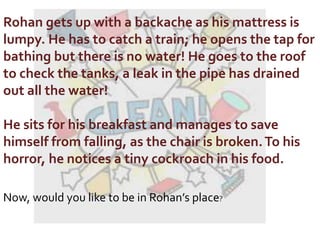
Rohan gets up with a backache as his mattress is
lumpy. He has to catch a train; he opens the tap for
bathing but there is no water! He goes to the roof
to check the tanks, a leak in the pipe has drained
out all the water!
He sits for his breakfast and manages to save
himself from falling, as the chair is broken.To his
horror, he notices a tiny cockroach in his food.
Now, would you like to be in Rohan’s place?
 A good Housekeeping would have
ensured smooth functioning of all
gadgets, no leaks, a comfortable
environment in which you would
have enjoyed a hassle free living.
 Thus housekeeping means
attending to small tasks in time.
In commercial establishments, the
housekeeping services are done by
a team of specialized people
according to different areas.
 Taps, sinks, water closet, geysers, water
supply, electrical sockets and switches,
supply of towels, toilet paper, toiletries(
shampoo, soap, etc.)
 Ceiling and wall paint, wall paper, fans, air-
conditioners, electrical switches and sockets,
wiring, windows, doors, glass panes, bed,
bed-making, carpets, locks, keys, etc.
 Linen ( table napkin, tablecloth), towels, bed
sheets, bed covers, blankets, garments of
guest, staff uniforms, etc.
 Furniture, curtains, table lamps, tube lights,
chandeliers, bulbs, sofas, dining tables and
chairs, etc.
Plants, pots, lawn (grass),
flowers, trees, bushes,
hedges, etc.
 Stair case, corridors, lobby,
conference/seminar room, waiting
halls, recreation room, parking
area, clubs, swimming pool,
offices, common toilets, etc.
She or he is responsible
for upkeep and
maintenance of the
premises.
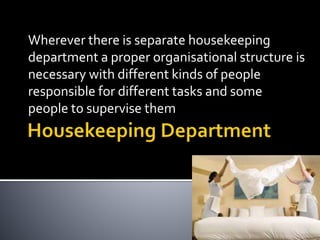
Wherever there is separate housekeeping
department a proper organisational structure is
necessary with different kinds of people
responsible for different tasks and some
people to supervise them
 The housekeeper is the overall in-charge of
the housekeeping department. He or she
directly controls all the personnel as well as
all aspects of housekeeping.
 She/ he is responsible for the cleanliness,
beautification and maintenance of the
premises.
 He or she is responsible for all the
aspects similar to that of the
housekeeper.
 In case the organization works
round-the-clock, there maybe more
than one assistant housekeeper to
work in different shifts.
 This person communicates with the staff
and coordinates with various departments
of the organization.
 He or she becomes the centre point of all
messages, complaints etc. And also keeps
records of what work has been assigned to
whom and maintains the general follow-up
of the same.
 He/she is responsible for the
storage, issue, cleanliness and
maintenance of linen. ( napkin,
table cloths, bed sheets, bed
covers, pillow covers, blankets,
curtains and uniforms)
 For multistoried buildings, each floor is
attended by a floor supervisor.
 He/she is responsible for cleanliness and
maintenance of the assigned floor which
includes rooms, corridors, rest rooms,
stair case, etc., for jobs like changing or
repairing light, switches, etc.
 He/she is responsible for
cleanliness and maintenance of
waiting halls, lobby,
conference/seminar rooms,
recreation rooms, parking area,
clubs, offices, etc.
He or she is responsible
for the maintenace and
service of common
toilets.
 It responsible for all the floral and
plant decoration as well as the
upkeep of gardens in the premises

Introduction to housekeeping

  • 1.
    The basic conceptof housekeeping has started from keeping a domestic house clean and has gradually come to maintaining high standards of cleanliness and maintenance at commercial levels. Besides this , housekeeping should also contribute to the saving in costs of labour, cleaning material and equipment, furnishings and the like in every type of establishment.
  • 2.
     means maintaininga house on a daily or long term basis or looking after its cleanliness, tidiness, upkeep and smooth running.
  • 4.
     None ofthe objects are broken or chipped and fabrics are not torn.  All the fixtures like taps, geysers are not leaking, electric wiring is proper and there is no danger of fire due to short circuiting and so on.
  • 5.
    Is a processof keeping a place clean, beautiful and well maintained so that it looks and feels pleasant and inviting to all, either, living, visiting or working there.
  • 7.
    Rohan gets upwith a backache as his mattress is lumpy. He has to catch a train; he opens the tap for bathing but there is no water! He goes to the roof to check the tanks, a leak in the pipe has drained out all the water! He sits for his breakfast and manages to save himself from falling, as the chair is broken.To his horror, he notices a tiny cockroach in his food. Now, would you like to be in Rohan’s place?
  • 8.
     A goodHousekeeping would have ensured smooth functioning of all gadgets, no leaks, a comfortable environment in which you would have enjoyed a hassle free living.  Thus housekeeping means attending to small tasks in time.
  • 10.
    In commercial establishments,the housekeeping services are done by a team of specialized people according to different areas.
  • 11.
     Taps, sinks,water closet, geysers, water supply, electrical sockets and switches, supply of towels, toilet paper, toiletries( shampoo, soap, etc.)
  • 12.
     Ceiling andwall paint, wall paper, fans, air- conditioners, electrical switches and sockets, wiring, windows, doors, glass panes, bed, bed-making, carpets, locks, keys, etc.
  • 13.
     Linen (table napkin, tablecloth), towels, bed sheets, bed covers, blankets, garments of guest, staff uniforms, etc.
  • 14.
     Furniture, curtains,table lamps, tube lights, chandeliers, bulbs, sofas, dining tables and chairs, etc.
  • 15.
    Plants, pots, lawn(grass), flowers, trees, bushes, hedges, etc.
  • 16.
     Stair case,corridors, lobby, conference/seminar room, waiting halls, recreation room, parking area, clubs, swimming pool, offices, common toilets, etc.
  • 18.
    She or heis responsible for upkeep and maintenance of the premises.
  • 19.
    Wherever there isseparate housekeeping department a proper organisational structure is necessary with different kinds of people responsible for different tasks and some people to supervise them
  • 20.
     The housekeeperis the overall in-charge of the housekeeping department. He or she directly controls all the personnel as well as all aspects of housekeeping.  She/ he is responsible for the cleanliness, beautification and maintenance of the premises.
  • 21.
     He orshe is responsible for all the aspects similar to that of the housekeeper.  In case the organization works round-the-clock, there maybe more than one assistant housekeeper to work in different shifts.
  • 22.
     This personcommunicates with the staff and coordinates with various departments of the organization.  He or she becomes the centre point of all messages, complaints etc. And also keeps records of what work has been assigned to whom and maintains the general follow-up of the same.
  • 23.
     He/she isresponsible for the storage, issue, cleanliness and maintenance of linen. ( napkin, table cloths, bed sheets, bed covers, pillow covers, blankets, curtains and uniforms)
  • 24.
     For multistoriedbuildings, each floor is attended by a floor supervisor.  He/she is responsible for cleanliness and maintenance of the assigned floor which includes rooms, corridors, rest rooms, stair case, etc., for jobs like changing or repairing light, switches, etc.
  • 25.
     He/she isresponsible for cleanliness and maintenance of waiting halls, lobby, conference/seminar rooms, recreation rooms, parking area, clubs, offices, etc.
  • 26.
    He or sheis responsible for the maintenace and service of common toilets.
  • 27.
     It responsiblefor all the floral and plant decoration as well as the upkeep of gardens in the premises