Principles and Technical Issues
Expert System
Contents
Subjects to be discussed
Introduction
Architecture
Applications
Applications in Energy Management
Resources
02
18
Introduction
04
18
Introduction
What is Expert System?
Systems which mimic the procedure of thought, reasoning, decision
making and executing the solution Just like humankind.
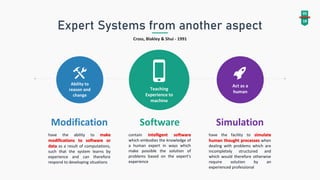
Expert Systems from another aspect
Cross, Blakley & Shui - 1991
have the ability to make
modifications to software or
data as a result of computations,
such that the system learns by
experience and can therefore
respond to developing situations
Modification
contain intelligent software
which embodies the knowledge of
a human expert in ways which
make possible the solution of
problems based on the expert's
experience
Software
have the facility to simulate
human thought processes when
dealing with problems which are
incompletely structured and
which would therefore otherwise
require solution by an
experienced professional
Simulation
Ability to
reason and
change
Teaching
Experience to
machine
Act as a
human
05
18
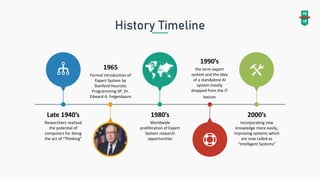
History Timeline
Late 1940’s
Researchers realized
the potential of
computers for doing
the act of “Thinking”
2000’s
incorporating new
knowledge more easily,
improving systems which
are now called as
“Intelligent Systems”
1980’s
Worldwide
proliferation of Expert
System research
opportunities
1990’s
the term expert
system and the idea
of a standalone AI
system mostly
dropped from the IT
lexicon
1965
Formal introduction of
Expert System by
Stanford Heuristic
Programming SP, Dr.
Edward A. Feigenbaum
06
18
Architecture
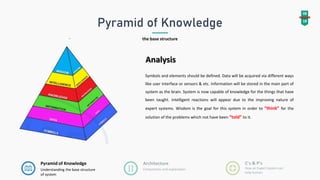
Pyramid of Knowledge
the base structure
Symbols and elements should be defined. Data will be acquired via different ways
like user interface or sensors & etc. Information will be stored in the main part of
system as the brain. System is now capable of knowledge for the things that have
been taught. Intelligent reactions will appear due to the improving nature of
expert systems. Wisdom is the goal for this system in order to “think” for the
solution of the problems which not have been “told” to it.
Analysis
08
18
Pyramid of Knowledge
Understanding the base structure
of system
Architecture
Components and explanation
C’s & P’s
How an Expert System can
help human
Architecture
Components of system
Knowledge
Acquisition
Facility
Knowledge Base Explanation
Facility
User Interface
Each and every of the expert systems have a complicated structure beyond
their simple interface. But the main parts of an Expert System are the sections
mentioned in photo and below.
Knowledge base may be the vital part of any Expert System because all the data that will be used in future, are stored in there. Then there is Explanation
Facility which models each of the problems for the main brain of the system. The Inference Engine is an automated reasoning system that evaluates the current
state of the knowledge-base, applies relevant rules, and then asserts new knowledge into the knowledge base. Using the Data Acquisition Facility to teach any
information crucial for the performance of the system, this system will be capable to choose and act like an expert technician. External Interface gets its data
from all of the measurement devices. And at last the only thing standing between a User and the Expert System is the User Interface to simplify the
communication of human with machine.
Pyramid of Knowledge
Understanding the base structure
of system
Architecture
Components and explanation
C’s & P’s
How an Expert System can
help human
External Interface
09
18
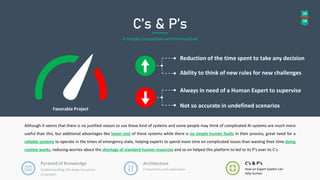
C’s & P’s
A Simple Comparison with Humankind
Ability to think of new rules for new challenges
Not so accurate in undefined scenarios
Always in need of a Human Expert to supervise
Reduction of the time spent to take any decision
Although it seems that there is no justified reason to use these kind of systems and some people may think of complicated AI systems are much more
useful than this, but additional advantages like lower cost of these systems while there is no simple human faults in their process, great need for a
reliable systems to operate in the times of emergency state, helping experts to spend more time on complicated issues than wasting their time doing
routine works, reducing worries about the shortage of standard human resources and so on helped this platform to led to its P’s over its C’s.
Favorable Project
Pyramid of Knowledge
Understanding the base structure
of system
Architecture
Components and explanation
C’s & P’s
How an Expert System can
help human
10
18
Applications
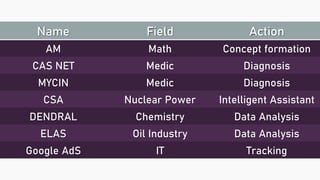
Approximately in each and every of the subjects that we could think about, there is a research to build an Expert
System for it. Medical diagnosis, mathematical issues, economical conflicts, scientific challenges and etc. are just a
part of vast field of use for expert systems. A chart will show some examples for these fields.
Applications
Fields of use based on subjects
12
18
Medic Mathematics Oil Industry Chemistry Nuclear Power & …
Name Field Action
AM Math Concept formation
CAS NET Medic Diagnosis
MYCIN Medic Diagnosis
CSA Nuclear Power Intelligent Assistant
DENDRAL Chemistry Data Analysis
ELAS Oil Industry Data Analysis
Google AdS IT Tracking
Applications
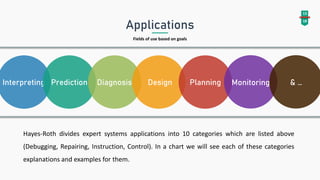
Fields of use based on goals
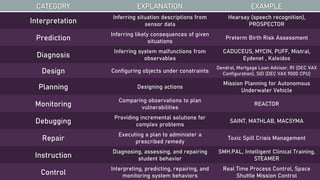
Hayes-Roth divides expert systems applications into 10 categories which are listed above
(Debugging, Repairing, Instruction, Control). In a chart we will see each of these categories
explanations and examples for them.
13
18
Interpreting Prediction Diagnosis Design Planning Monitoring & …
CATEGORY EXPLANATION EXAMPLE
Interpretation
Inferring situation descriptions from
sensor data
Hearsay (speech recognition),
PROSPECTOR
Prediction
Inferring likely consequences of given
situations
Preterm Birth Risk Assessment
Diagnosis
Inferring system malfunctions from
observables
CADUCEUS, MYCIN, PUFF, Mistral,
Eydenet , Kaleidos
Design Configuring objects under constraints
Dendral, Mortgage Loan Advisor, R1 (DEC VAX
Configuration), SID (DEC VAX 9000 CPU)
Planning Designing actions
Mission Planning for Autonomous
Underwater Vehicle
Monitoring
Comparing observations to plan
vulnerabilities
REACTOR
Debugging
Providing incremental solutions for
complex problems
SAINT, MATHLAB, MACSYMA
Repair
Executing a plan to administer a
prescribed remedy
Toxic Spill Crisis Management
Instruction
Diagnosing, assessing, and repairing
student behavior
SMH.PAL, Intelligent Clinical Training,
STEAMER
Control
Interpreting, predicting, repairing, and
monitoring system behaviors
Real Time Process Control, Space
Shuttle Mission Control
Applications
inElectrical Engineering
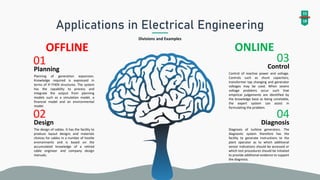
Applications in Electrical Engineering
Divisions and Examples
Planning
01
Planning of generation expansion.
Knowledge required is expressed in
terms of IF-THEN structures. The system
has the capability to process and
integrate the output from planning
models such as a simulation model, a
financial model and an environmental
model.
Design
02
The design of cables. It has the facility to
produce layout designs and materials
choices for cables in a number of hostile
environments and is based on the
accumulated knowledge of a retired
cable engineer and company design
manuals.
Control
03
Control of reactive power and voltage.
Controls such as shunt capacitors,
transformer tap changing and generator
voltages may be used. When severe
voltage problems occur such that
empirical judgements are identified by
the knowledge base as being unreliable,
the expert system can assist in
formulating the problem.
Diagnosis
04
Diagnosis of turbine generators. The
diagnostic system therefore has the
facility to generate instructions to the
plant operator as to which additional
sensor indications should be accessed or
which test procedures should be initiated
to provide additional evidence to support
the diagnosis.
15
18
OFFLINE ONLINE
References
17
18
1 AI and Cognitive Science ’90
Michael F. McTear & Norman Creaney – Workshops in Computing (1990)- Springer Verlag London Ltd. – ISBN 9783540196532
2 Building Expert Systems
Hayes-Roth, Frederick & Waterman, Donald& Lenat, Douglas (1983) - Addison-Wesley - ISBN 9780201106862
3
EXPERT SYSTEMS APPLICATION TO POWER SYSTEMS
-STATE-OF -THE-ART AND FUTURE TRENDS
G. Bretthauer - E. Handschin - and W. Hoffmannu – IFAC 1992 Munich-Germany
4
Applications of artificial intelligence and expert systems
in power engineering
KIT PO WONG - The Knowledge Engineering Review, Vol. 5: 2, 199
5 https://www.dbioscharts.com/expert_system_architecture.html
6 https://www.dbioscharts.com/expert_system_architecture.html
Introduction to Expert systems

Introduction to Expert systems

  • 1.
    Principles and TechnicalIssues Expert System
  • 2.
    Contents Subjects to bediscussed Introduction Architecture Applications Applications in Energy Management Resources 02 18
  • 3.
  • 4.
    04 18 Introduction What is ExpertSystem? Systems which mimic the procedure of thought, reasoning, decision making and executing the solution Just like humankind.
  • 5.
    Expert Systems fromanother aspect Cross, Blakley & Shui - 1991 have the ability to make modifications to software or data as a result of computations, such that the system learns by experience and can therefore respond to developing situations Modification contain intelligent software which embodies the knowledge of a human expert in ways which make possible the solution of problems based on the expert's experience Software have the facility to simulate human thought processes when dealing with problems which are incompletely structured and which would therefore otherwise require solution by an experienced professional Simulation Ability to reason and change Teaching Experience to machine Act as a human 05 18
  • 6.
    History Timeline Late 1940’s Researchersrealized the potential of computers for doing the act of “Thinking” 2000’s incorporating new knowledge more easily, improving systems which are now called as “Intelligent Systems” 1980’s Worldwide proliferation of Expert System research opportunities 1990’s the term expert system and the idea of a standalone AI system mostly dropped from the IT lexicon 1965 Formal introduction of Expert System by Stanford Heuristic Programming SP, Dr. Edward A. Feigenbaum 06 18
  • 7.
  • 8.
    Pyramid of Knowledge thebase structure Symbols and elements should be defined. Data will be acquired via different ways like user interface or sensors & etc. Information will be stored in the main part of system as the brain. System is now capable of knowledge for the things that have been taught. Intelligent reactions will appear due to the improving nature of expert systems. Wisdom is the goal for this system in order to “think” for the solution of the problems which not have been “told” to it. Analysis 08 18 Pyramid of Knowledge Understanding the base structure of system Architecture Components and explanation C’s & P’s How an Expert System can help human
  • 9.
    Architecture Components of system Knowledge Acquisition Facility KnowledgeBase Explanation Facility User Interface Each and every of the expert systems have a complicated structure beyond their simple interface. But the main parts of an Expert System are the sections mentioned in photo and below. Knowledge base may be the vital part of any Expert System because all the data that will be used in future, are stored in there. Then there is Explanation Facility which models each of the problems for the main brain of the system. The Inference Engine is an automated reasoning system that evaluates the current state of the knowledge-base, applies relevant rules, and then asserts new knowledge into the knowledge base. Using the Data Acquisition Facility to teach any information crucial for the performance of the system, this system will be capable to choose and act like an expert technician. External Interface gets its data from all of the measurement devices. And at last the only thing standing between a User and the Expert System is the User Interface to simplify the communication of human with machine. Pyramid of Knowledge Understanding the base structure of system Architecture Components and explanation C’s & P’s How an Expert System can help human External Interface 09 18
  • 10.
    C’s & P’s ASimple Comparison with Humankind Ability to think of new rules for new challenges Not so accurate in undefined scenarios Always in need of a Human Expert to supervise Reduction of the time spent to take any decision Although it seems that there is no justified reason to use these kind of systems and some people may think of complicated AI systems are much more useful than this, but additional advantages like lower cost of these systems while there is no simple human faults in their process, great need for a reliable systems to operate in the times of emergency state, helping experts to spend more time on complicated issues than wasting their time doing routine works, reducing worries about the shortage of standard human resources and so on helped this platform to led to its P’s over its C’s. Favorable Project Pyramid of Knowledge Understanding the base structure of system Architecture Components and explanation C’s & P’s How an Expert System can help human 10 18
  • 11.
  • 12.
    Approximately in eachand every of the subjects that we could think about, there is a research to build an Expert System for it. Medical diagnosis, mathematical issues, economical conflicts, scientific challenges and etc. are just a part of vast field of use for expert systems. A chart will show some examples for these fields. Applications Fields of use based on subjects 12 18 Medic Mathematics Oil Industry Chemistry Nuclear Power & …
  • 13.
    Name Field Action AMMath Concept formation CAS NET Medic Diagnosis MYCIN Medic Diagnosis CSA Nuclear Power Intelligent Assistant DENDRAL Chemistry Data Analysis ELAS Oil Industry Data Analysis Google AdS IT Tracking
  • 14.
    Applications Fields of usebased on goals Hayes-Roth divides expert systems applications into 10 categories which are listed above (Debugging, Repairing, Instruction, Control). In a chart we will see each of these categories explanations and examples for them. 13 18 Interpreting Prediction Diagnosis Design Planning Monitoring & …
  • 15.
    CATEGORY EXPLANATION EXAMPLE Interpretation Inferringsituation descriptions from sensor data Hearsay (speech recognition), PROSPECTOR Prediction Inferring likely consequences of given situations Preterm Birth Risk Assessment Diagnosis Inferring system malfunctions from observables CADUCEUS, MYCIN, PUFF, Mistral, Eydenet , Kaleidos Design Configuring objects under constraints Dendral, Mortgage Loan Advisor, R1 (DEC VAX Configuration), SID (DEC VAX 9000 CPU) Planning Designing actions Mission Planning for Autonomous Underwater Vehicle Monitoring Comparing observations to plan vulnerabilities REACTOR Debugging Providing incremental solutions for complex problems SAINT, MATHLAB, MACSYMA Repair Executing a plan to administer a prescribed remedy Toxic Spill Crisis Management Instruction Diagnosing, assessing, and repairing student behavior SMH.PAL, Intelligent Clinical Training, STEAMER Control Interpreting, predicting, repairing, and monitoring system behaviors Real Time Process Control, Space Shuttle Mission Control
  • 16.
  • 17.
    Applications in ElectricalEngineering Divisions and Examples Planning 01 Planning of generation expansion. Knowledge required is expressed in terms of IF-THEN structures. The system has the capability to process and integrate the output from planning models such as a simulation model, a financial model and an environmental model. Design 02 The design of cables. It has the facility to produce layout designs and materials choices for cables in a number of hostile environments and is based on the accumulated knowledge of a retired cable engineer and company design manuals. Control 03 Control of reactive power and voltage. Controls such as shunt capacitors, transformer tap changing and generator voltages may be used. When severe voltage problems occur such that empirical judgements are identified by the knowledge base as being unreliable, the expert system can assist in formulating the problem. Diagnosis 04 Diagnosis of turbine generators. The diagnostic system therefore has the facility to generate instructions to the plant operator as to which additional sensor indications should be accessed or which test procedures should be initiated to provide additional evidence to support the diagnosis. 15 18 OFFLINE ONLINE
  • 18.
  • 19.
    17 18 1 AI andCognitive Science ’90 Michael F. McTear & Norman Creaney – Workshops in Computing (1990)- Springer Verlag London Ltd. – ISBN 9783540196532 2 Building Expert Systems Hayes-Roth, Frederick & Waterman, Donald& Lenat, Douglas (1983) - Addison-Wesley - ISBN 9780201106862 3 EXPERT SYSTEMS APPLICATION TO POWER SYSTEMS -STATE-OF -THE-ART AND FUTURE TRENDS G. Bretthauer - E. Handschin - and W. Hoffmannu – IFAC 1992 Munich-Germany 4 Applications of artificial intelligence and expert systems in power engineering KIT PO WONG - The Knowledge Engineering Review, Vol. 5: 2, 199 5 https://www.dbioscharts.com/expert_system_architecture.html 6 https://www.dbioscharts.com/expert_system_architecture.html