www.advisian.com
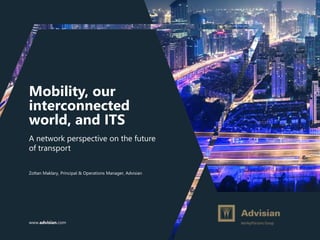
Mobility, our
interconnected
world, and ITS
A network perspective on the future
of transport
Zoltan Maklary, Principal & Operations Manager, Advisian
We’ve created a remarkable, complex
and highly interdependent world.
We’re more reliant on each other globally
than at any other time in the history
of mankind.
We’re free to travel to 95% of the world in around 24
hours or less. Mobility is at the heart of our lives and
economies, and it’s changing with technology -
Intelligent Transport Systems is a key enabler.
The evolution of mobility
The world’s population in cities today
500 cities have 1 million people or more.
This growth started 250 years ago, triggered by the industrial
revolution (steam power).
3%
1800 2016
+50%
A transport hierarchy has formed, comprising:
Cars that provide
point-to-point travel
at an individual level.
Rail that provides
mass transit between
key destinations.
Light rail and buses
that service the
journeys in between.
Currently coal and oil drives mobility
When we think of transport challenges,
we generally think in terms of modes
instead of journeys (e.g. very fast rail,
light rail, bus rapid transit etc.)
We need to move from thinking about vehicles
and modes, to end-to-end journeys for people
and business.
The future of mobility
The mobility challenge
is big and it’s growing
3.5 billion people currently live in cities,
and will increase to 7 billion people by 2050.
1.2 million people are moving into cities
each week.
The number of cars on the road will double
by 2050, even accounting for new technologies.
By 2050 there will be 600% more people on the
move every day.
Where transport innovation was
once driven by engines run on
steam, coal and oil, it will now be
driven by communications, data,
and a deeper understanding of
people’s needs.
Change has come to transport –
how will we respond…?
Intelligent Transport Systems
(ITS)
What is ITS?
Vehicles
Components
of integrated
ITS
User
related
Co-operative Road and
road-side
Back office Industry
and freight
Payment
i
ITS is moving from stand-alone systems to being integrated and connected; from
technology to an enabler. ITS is mode agnostic, and all about moving people and
goods. ITS covers a broad spectrum, from traffic lights to smart motorways to
Cooperative ITS, Autonomous Vehicles, Payment Systems and the Internet of Things.
Improving network planning
How does ITS impact the way we perceive
and plan transport networks?
Infrastructure
First and foremost, new technologies will run
on old infrastructure – arterial roads,
motorways, and railways will still be required.
The challenge will be to increase operating
capacity and efficiency without building more
infrastructure.
We must also consider how to future proof
new infrastructure to accommodate things
like Cooperative ITS, Autonomous Vehicles
and mode agnostic (intelligent) mobility.
Perspective
We need to understand how the network is
used and change our perspective from
vehicles to people.
Data will provide us an increasingly detailed
understanding of origins and destinations,
allowing us to consider how trips, people
and business needs can be efficiently
serviced.
Outcome
Mobility will become more dense, with a
wider range of transport options and a
blurring of the lines between public and
private.
We can see this through emerging
technologies such as Bridj and Simply
Connect. They’re painting a picture of how
future public transport/mobility networks
may be responsive and adaptive, optimising
services to suit customers at any given point
in time.
Improving network performance
How can ITS help improve the way we use networks
to realise more capacity and better respond to
a people’s and business’ needs?
Responsive management
New and adaptive versions of traffic signal
management systems are already being
implemented to be responsive to public
transport scheduling and emergency vehicle
access.
In the future, with connected cars, traffic will
also be able to be re-routed in response to
emergencies.
New data
Companies like Waze are using crowdsourcing
to build a dynamic picture of network
performance.
This concept was picked up by the City of
Boston, who launched a mobile phone app
called ‘StreetBump’ to monitor car travel and
automatically report pot holes.
Demand-based pricing
Surge pricing from companies like Uber is familiar,
and its application is widening. San Francisco
Municipal Transportation Agency, through SFPark,
is trialling an equivalent concept to manage the
city’s on-street parking, adjusting price in
response to demand.
The bike-share system, ‘BIKETOWN’, in Portland
will do the same for managing bike stock,
negating the need to truck bikes from less
popular to popular locations. Ultimately, it will be
a way to send price signals to road users to better
manage peak congestion - something Oregon,
London, Virginia and many other places are doing
through distance and congestion based tolling.
Improving network experience
How can the transport network be more flexible,
adaptive, and easy to use?
Merging public and private data
Integrated journey planners that tailor
transport options across all sectors based on
time, cost, and environmental preferences are
now available.
Qixxit, developed by a subsidiary of rail
operator Deutsche Bahn AG, is one of the
most compelling. It merges car rentals, car
pooling, taxis, public transport, and airlines
into a single (and integrated) service in which
users can plan and pay for their trips. The
concept is ‘one ticket for everything’.
Smart Cities
The US Department of Transportation
launched the Smart Cities initiative, offering
$50 million for the city that put forward the
most compelling proposal to “fully integrate
innovative technologies into their
transportation network”.
Similar to Qixxit, cities such as Portland,
Kansas, and San Francisco have proposed
visions where the best of the private sector’s
innovations are embedded into the public
transport network.
Mobility as a Service
The ultimate goal is to fully break down
the barriers between types of mobility.
Gothenburg in Sweden created an experiment
dubbed UbiGo for ‘subscription mobility’,
managing all transport services through a
single app and payment.
There are a number of start ups now trying
to take this idea worldwide.
The key questions that emerge from these considerations and examples are:
Where does government’s role in the future of transport start and
stop? As a service provider or marketplace regulator? Is it up to the
private sector to innovate, or the government to address market
failures?
How to manage liability when the sharing economy is merged with
the traditional transport economy?
How can accumulated data be integrated across government
and packaged for public release?
How to balance privacy with a user-centred experience?
How to send the right price signals while addressing equity
of access?
Mobility challenges and barriers
1.
2.
3.
4.
5.
Ultimately, we cannot say what the
future will look like so it’s up to all of
us to keep an open mind.
Visit our website:
http://www.advisian.com/our-sectors/transport
Contact:
Zoltan Maklary
Principal & Operations Manager
E: zoltan.maklary@advisian.com
Find out more
DISCLAIMER
This presentation has been prepared by a representative of Advisian.
The presentation contains the professional and personal opinions of the presenter, which are given in good faith. As such, opinions presented
herein may not always necessarily reflect the position of Advisian as a whole, its officers or executive.
Any forward-looking statements included in this presentation will involve subjective judgment and analysis and are subject to uncertainties, risks and
contingencies—many of which are outside the control of, and may be unknown to, Advisian.
Advisian and all associated entities and representatives make no representation or warranty as to the accuracy, reliability or completeness of
information in this document and do not take responsibility for updating any information or correcting any error or omission that may become
apparent after this document has been issued.
To the extent permitted by law, Advisian and its officers, employees, related bodies and agents disclaim all liability—direct, indirect or consequential
(and whether or not arising out of the negligence, default or lack of care of Advisian and/or any of its agents)—for any loss or damage suffered by a
recipient or other persons arising out of, or in connection with, any use or reliance on this presentation or information.

Mobility, our interconnected world, and ITS

  • 1.
    www.advisian.com Mobility, our interconnected world, andITS A network perspective on the future of transport Zoltan Maklary, Principal & Operations Manager, Advisian
  • 2.
    We’ve created aremarkable, complex and highly interdependent world. We’re more reliant on each other globally than at any other time in the history of mankind.
  • 3.
    We’re free totravel to 95% of the world in around 24 hours or less. Mobility is at the heart of our lives and economies, and it’s changing with technology - Intelligent Transport Systems is a key enabler.
  • 4.
  • 5.
    The world’s populationin cities today 500 cities have 1 million people or more. This growth started 250 years ago, triggered by the industrial revolution (steam power). 3% 1800 2016 +50%
  • 6.
    A transport hierarchyhas formed, comprising: Cars that provide point-to-point travel at an individual level. Rail that provides mass transit between key destinations. Light rail and buses that service the journeys in between. Currently coal and oil drives mobility
  • 7.
    When we thinkof transport challenges, we generally think in terms of modes instead of journeys (e.g. very fast rail, light rail, bus rapid transit etc.)
  • 8.
    We need tomove from thinking about vehicles and modes, to end-to-end journeys for people and business.
  • 9.
    The future ofmobility
  • 10.
    The mobility challenge isbig and it’s growing
  • 11.
    3.5 billion peoplecurrently live in cities, and will increase to 7 billion people by 2050. 1.2 million people are moving into cities each week. The number of cars on the road will double by 2050, even accounting for new technologies. By 2050 there will be 600% more people on the move every day.
  • 12.
    Where transport innovationwas once driven by engines run on steam, coal and oil, it will now be driven by communications, data, and a deeper understanding of people’s needs.
  • 13.
    Change has cometo transport – how will we respond…?
  • 14.
  • 15.
    What is ITS? Vehicles Components ofintegrated ITS User related Co-operative Road and road-side Back office Industry and freight Payment i ITS is moving from stand-alone systems to being integrated and connected; from technology to an enabler. ITS is mode agnostic, and all about moving people and goods. ITS covers a broad spectrum, from traffic lights to smart motorways to Cooperative ITS, Autonomous Vehicles, Payment Systems and the Internet of Things.
  • 16.
    Improving network planning Howdoes ITS impact the way we perceive and plan transport networks?
  • 17.
    Infrastructure First and foremost,new technologies will run on old infrastructure – arterial roads, motorways, and railways will still be required. The challenge will be to increase operating capacity and efficiency without building more infrastructure. We must also consider how to future proof new infrastructure to accommodate things like Cooperative ITS, Autonomous Vehicles and mode agnostic (intelligent) mobility.
  • 18.
    Perspective We need tounderstand how the network is used and change our perspective from vehicles to people. Data will provide us an increasingly detailed understanding of origins and destinations, allowing us to consider how trips, people and business needs can be efficiently serviced.
  • 19.
    Outcome Mobility will becomemore dense, with a wider range of transport options and a blurring of the lines between public and private. We can see this through emerging technologies such as Bridj and Simply Connect. They’re painting a picture of how future public transport/mobility networks may be responsive and adaptive, optimising services to suit customers at any given point in time.
  • 20.
    Improving network performance Howcan ITS help improve the way we use networks to realise more capacity and better respond to a people’s and business’ needs?
  • 21.
    Responsive management New andadaptive versions of traffic signal management systems are already being implemented to be responsive to public transport scheduling and emergency vehicle access. In the future, with connected cars, traffic will also be able to be re-routed in response to emergencies.
  • 22.
    New data Companies likeWaze are using crowdsourcing to build a dynamic picture of network performance. This concept was picked up by the City of Boston, who launched a mobile phone app called ‘StreetBump’ to monitor car travel and automatically report pot holes.
  • 23.
    Demand-based pricing Surge pricingfrom companies like Uber is familiar, and its application is widening. San Francisco Municipal Transportation Agency, through SFPark, is trialling an equivalent concept to manage the city’s on-street parking, adjusting price in response to demand. The bike-share system, ‘BIKETOWN’, in Portland will do the same for managing bike stock, negating the need to truck bikes from less popular to popular locations. Ultimately, it will be a way to send price signals to road users to better manage peak congestion - something Oregon, London, Virginia and many other places are doing through distance and congestion based tolling.
  • 24.
    Improving network experience Howcan the transport network be more flexible, adaptive, and easy to use?
  • 25.
    Merging public andprivate data Integrated journey planners that tailor transport options across all sectors based on time, cost, and environmental preferences are now available. Qixxit, developed by a subsidiary of rail operator Deutsche Bahn AG, is one of the most compelling. It merges car rentals, car pooling, taxis, public transport, and airlines into a single (and integrated) service in which users can plan and pay for their trips. The concept is ‘one ticket for everything’.
  • 26.
    Smart Cities The USDepartment of Transportation launched the Smart Cities initiative, offering $50 million for the city that put forward the most compelling proposal to “fully integrate innovative technologies into their transportation network”. Similar to Qixxit, cities such as Portland, Kansas, and San Francisco have proposed visions where the best of the private sector’s innovations are embedded into the public transport network.
  • 27.
    Mobility as aService The ultimate goal is to fully break down the barriers between types of mobility. Gothenburg in Sweden created an experiment dubbed UbiGo for ‘subscription mobility’, managing all transport services through a single app and payment. There are a number of start ups now trying to take this idea worldwide.
  • 28.
    The key questionsthat emerge from these considerations and examples are: Where does government’s role in the future of transport start and stop? As a service provider or marketplace regulator? Is it up to the private sector to innovate, or the government to address market failures? How to manage liability when the sharing economy is merged with the traditional transport economy? How can accumulated data be integrated across government and packaged for public release? How to balance privacy with a user-centred experience? How to send the right price signals while addressing equity of access? Mobility challenges and barriers 1. 2. 3. 4. 5.
  • 29.
    Ultimately, we cannotsay what the future will look like so it’s up to all of us to keep an open mind.
  • 30.
    Visit our website: http://www.advisian.com/our-sectors/transport Contact: ZoltanMaklary Principal & Operations Manager E: zoltan.maklary@advisian.com Find out more
  • 32.
    DISCLAIMER This presentation hasbeen prepared by a representative of Advisian. The presentation contains the professional and personal opinions of the presenter, which are given in good faith. As such, opinions presented herein may not always necessarily reflect the position of Advisian as a whole, its officers or executive. Any forward-looking statements included in this presentation will involve subjective judgment and analysis and are subject to uncertainties, risks and contingencies—many of which are outside the control of, and may be unknown to, Advisian. Advisian and all associated entities and representatives make no representation or warranty as to the accuracy, reliability or completeness of information in this document and do not take responsibility for updating any information or correcting any error or omission that may become apparent after this document has been issued. To the extent permitted by law, Advisian and its officers, employees, related bodies and agents disclaim all liability—direct, indirect or consequential (and whether or not arising out of the negligence, default or lack of care of Advisian and/or any of its agents)—for any loss or damage suffered by a recipient or other persons arising out of, or in connection with, any use or reliance on this presentation or information.

Editor's Notes

  • #30 CHALLENGES AND BARRIERS I leave you with this thought!