1 
BY KEVIN 
CHAKRE
1. Hack Value: It is the notion among Hackers that something doing is interesting or 
worthwhile. 
2. Exploit: A piece of software that takes advantage of a bug, glitch or vulnerability 
that leads to unauthorized access, privilege escalation or denial of service on 
computer systems and networks. 
3. Vulnerability: Existence of software flaws, logic design, implementation errors 
executing bad or damaging instructions to the system. 
2
4. Target of Evaluation: It is the system, product or network that is the subject of 
security analysis or attacks. 
5. Zero Day attacks: A computer threats that tries to exploit computer application 
vulnerabilities that are undisclosed to others or undisclosed to the software 
developer. 
6. Daisy chaining: Hackers who get away with database thefts usually complete their 
task and then backtrack to cover their tracks by destroying logs etc. 
3
7. Attack: An action or an event that might compromise security. 
8. Threat: An environment or a situation that might lead to potential breach of 
security. 
9. Vulnerability Research: It is the process of discovering vulnerabilities and design 
weakness that lead an operating systems or its application to attacks or misuse. 
10. Penetration Testing: It is the method of actively evaluating the security of a system 
by simulating an attack from malicious source. 
4
 Security is a state of well being of information and infrastructure in which the 
possibility of theft, tampering of disruption of services is kept low or tolerable. 
 It relies on the five major elements of security: 
1. Confidentiality: It is the assurance that the information is easily accessible to 
only those who are authorized to have access. Confidentiality breaches may occur 
due to improper data handling or hacking attempt. 
2. Integrity: It is the trustworthiness of data and resources in terms of preventing 
improper and unauthorized changes, the assurance that the information can be 
relied upon to be sufficiently accurate for its purposes 
5
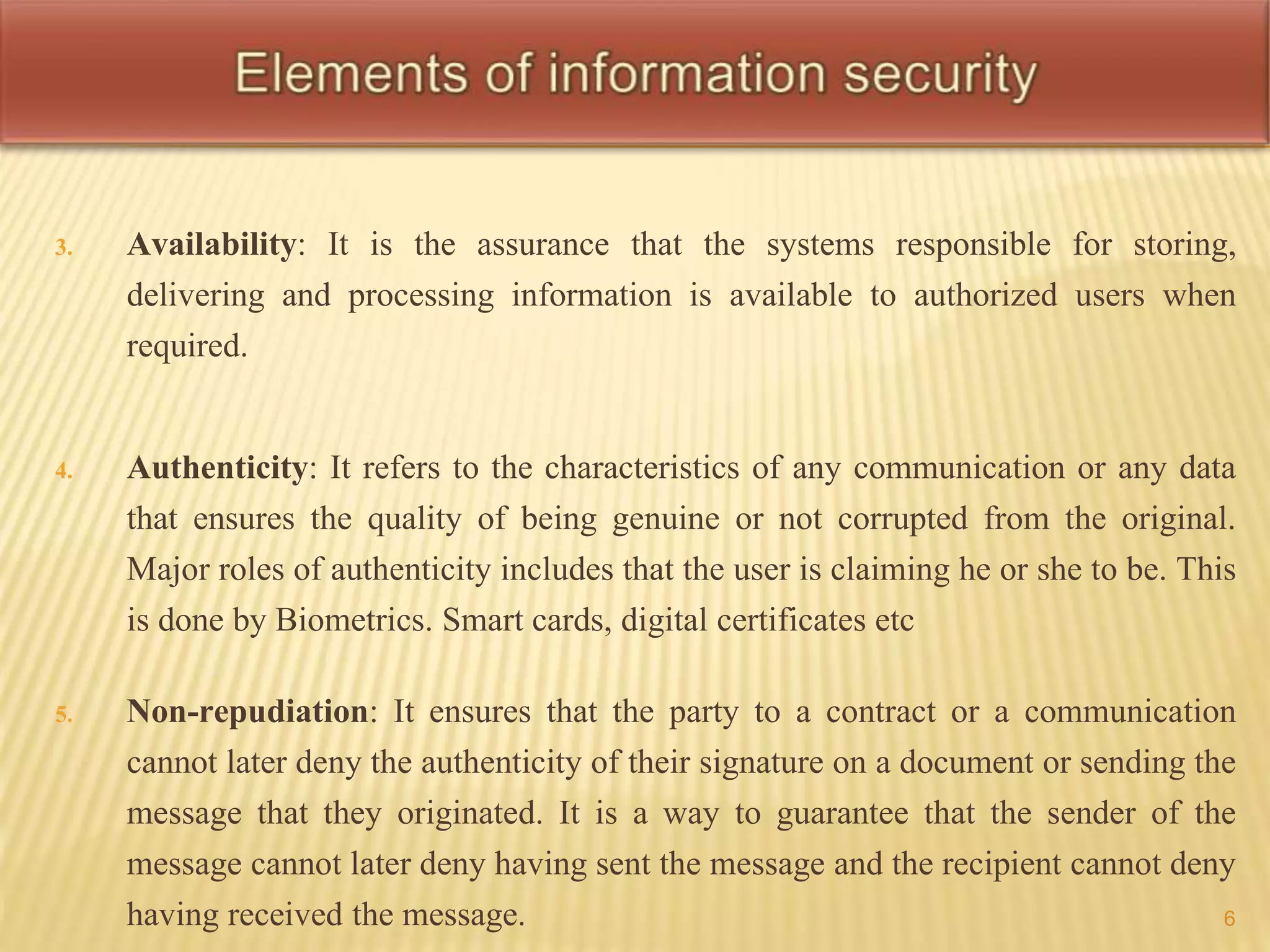
3. Availability: It is the assurance that the systems responsible for storing, 
delivering and processing information is available to authorized users when 
required. 
4. Authenticity: It refers to the characteristics of any communication or any data 
that ensures the quality of being genuine or not corrupted from the original. 
Major roles of authenticity includes that the user is claiming he or she to be. This 
is done by Biometrics. Smart cards, digital certificates etc 
5. Non-repudiation: It ensures that the party to a contract or a communication 
cannot later deny the authenticity of their signature on a document or sending the 
message that they originated. It is a way to guarantee that the sender of the 
message cannot later deny having sent the message and the recipient cannot deny 
having received the message. 6
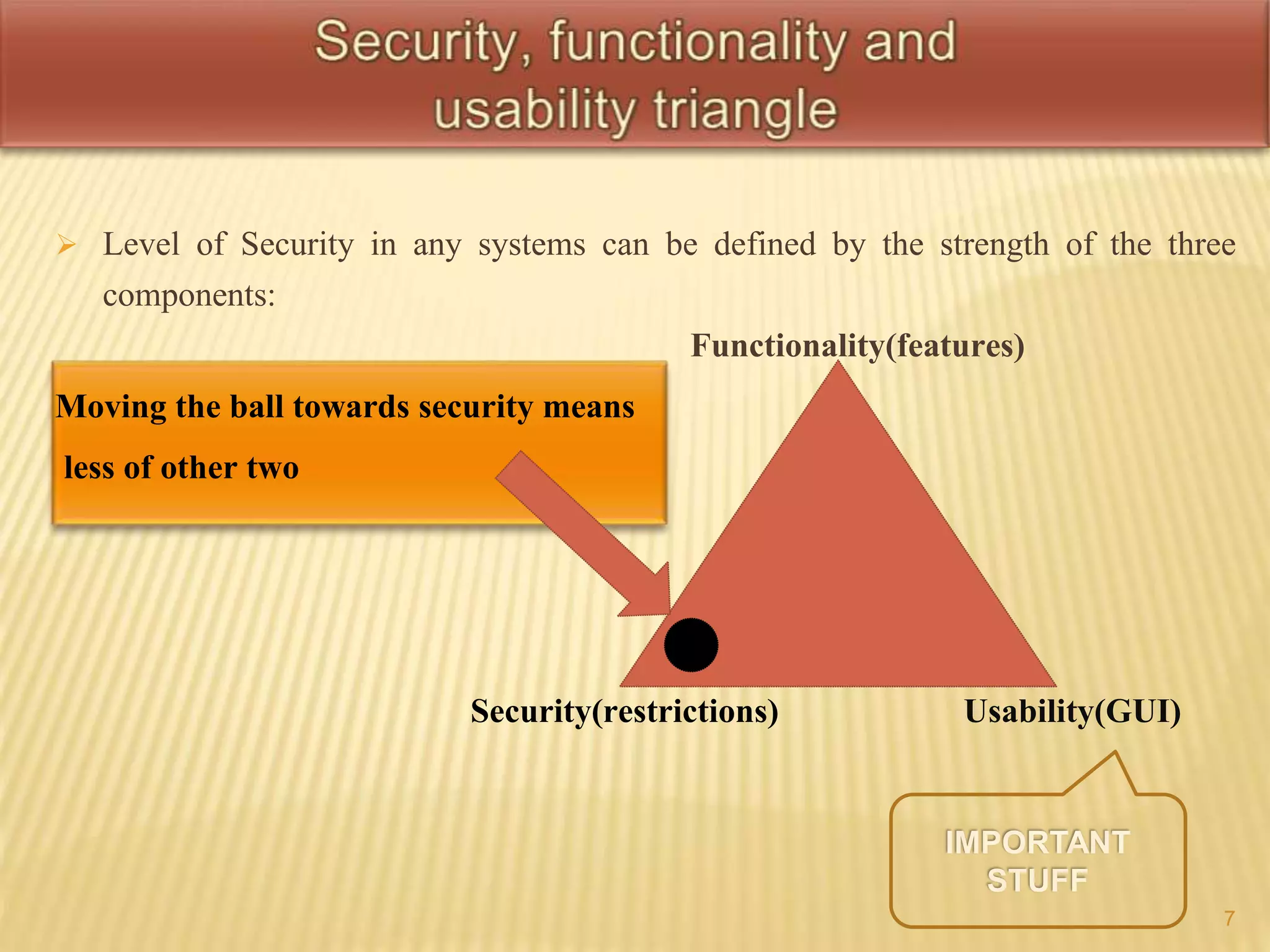
 Level of Security in any systems can be defined by the strength of the three 
components: 
Functionality(features) 
Moving the ball towards security means 
less of other two 
Security(restrictions) Usability(GUI) 
7
 An attack vector is a path or means by which an attacker can gain access to an 
information system to perform malicious attack. 
 This attack vector can enable an attacker to take advantage of the vulnerabilities 
present in the information system to carry out a particular attack. 
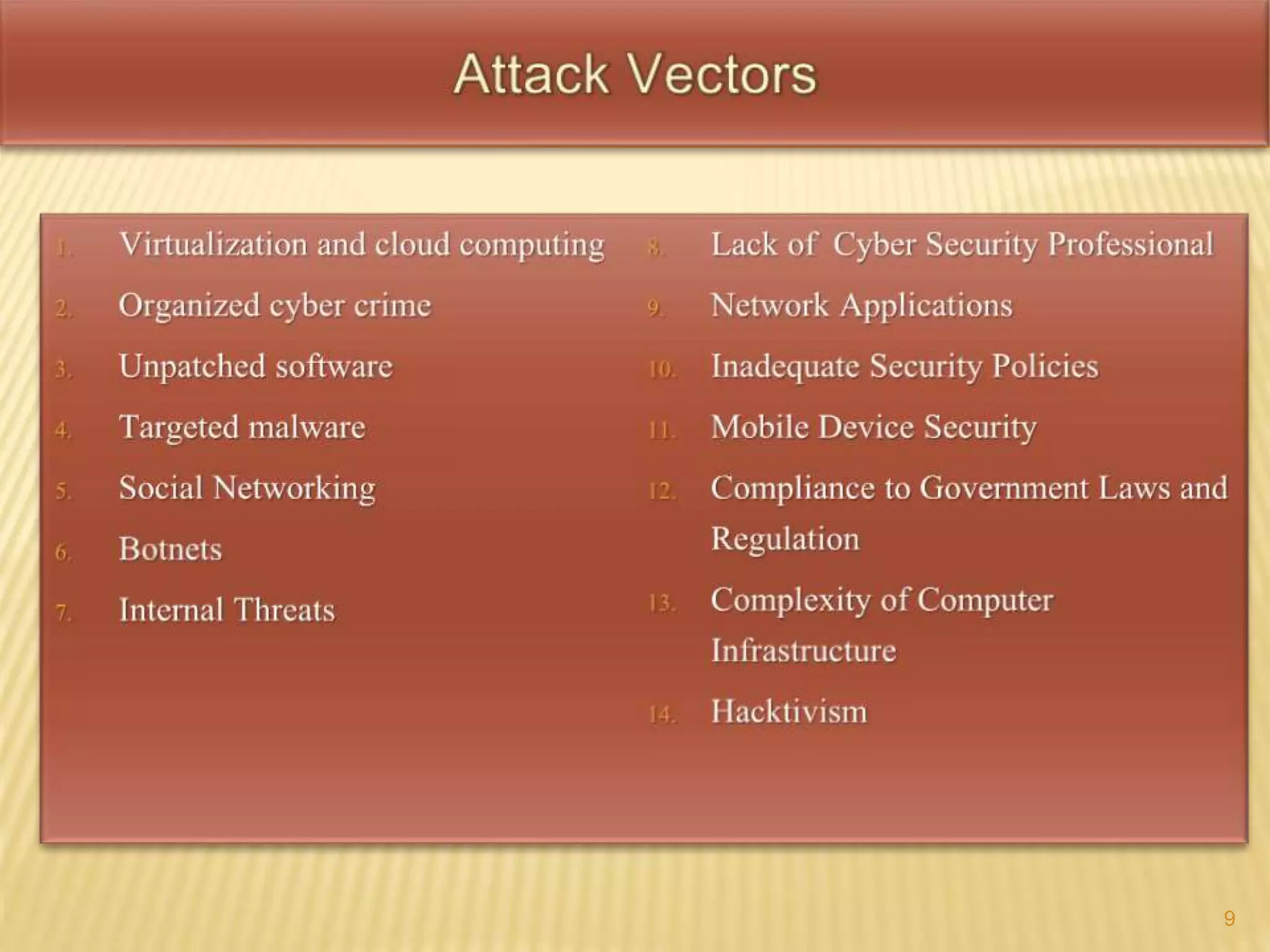
 The following are the possible attack vectors by which an attacker can attack on 
information system: 
8
9
 Information Security Threats are classified into three categories: 
1. Natural Threats: such as natural disasters such as flood, earthquakes . 
2. Physical Security Threats: such as errors, misconfiguration, sabotage . 
3. Human Threats: such as internal threats-disgruntled employees and external 
threats-malicious hackers 
10
 Human Threats are classified into three categories: 
1. Network Threats: such as Sniffing, MITM attacks, Information Gathering, 
Spoofing, ARP Poisoning. 
2. Host Threats: such as Unauthorized access, Password Attacks, Privilege 
Escalations. 
3. Application Threats: Cross Site Scripting, Buffer Overflows, SQL Injections. 
11
 The Term Information Warfare or Info-War refers to the use of information and 
communicative technology to take competitive advantage over an opponent. 
1. Defensive Information Warfare: refers to all the strategies and actions to 
defend against attacks on ICT assets. 
2. Offensive Information Warfare: refers to the Information warfare that involves 
attacks against ICT assets of an opponent. 
12
 Most people do not understand between hacking and Ethical hacking. 
 These two terms can be differentiated on the basis of the intentions of the people 
who are performing hacking activity. 
 However, understanding the true intentions of hackers can be quite difficult. 
 Hacking: refers to exploitation and exploration of the computer software and 
hardware to gain unauthorized access to perform malicious attacks. 
 Ethical Hacking: refers to exploitation and exploration of the computer software 
and hardware to make it more secure and ease of use. 
13
 A hacker is a person who illegally breaks into computer system or network 
without any authorization to steal or destroy data or perform malicious activities. 
 Hackers may be motivated by a multitude of reasons: 
1. Intelligent individuals with excellent computer skills with the ability to create and 
explore into computer software and hardware. 
2. For some hackers, hacking is a hobby to see how many systems or network they 
can compromise. 
3. Their intention can either be to gain knowledge or to poke around to do illegal 
things. 
4. Some hack with malicious intent such as stealing business data, credit card 
information and social security no. 
14
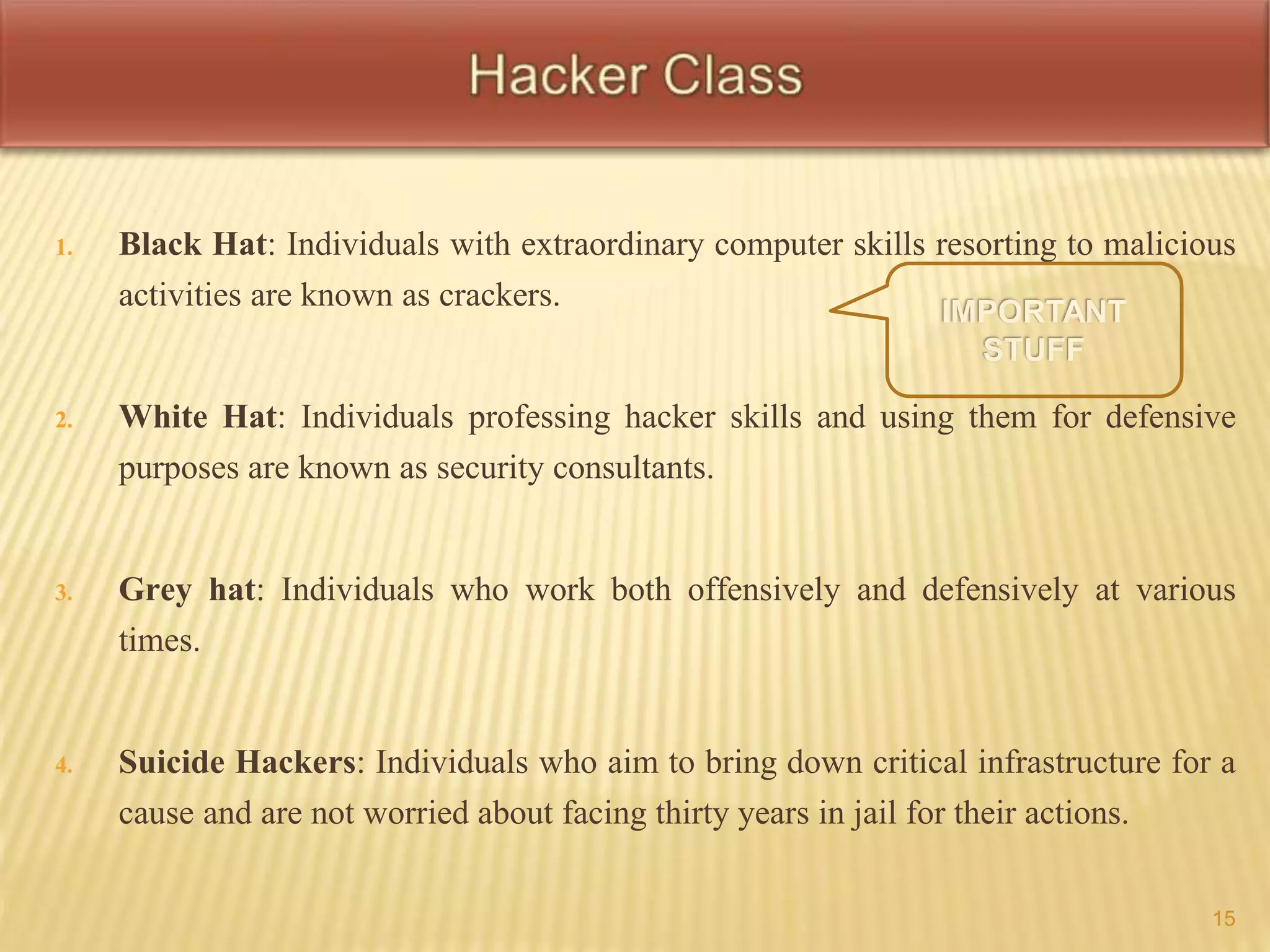
1. Black Hat: Individuals with extraordinary computer skills resorting to malicious 
activities are known as crackers. 
2. White Hat: Individuals professing hacker skills and using them for defensive 
purposes are known as security consultants. 
3. Grey hat: Individuals who work both offensively and defensively at various 
times. 
4. Suicide Hackers: Individuals who aim to bring down critical infrastructure for a 
cause and are not worried about facing thirty years in jail for their actions. 
15
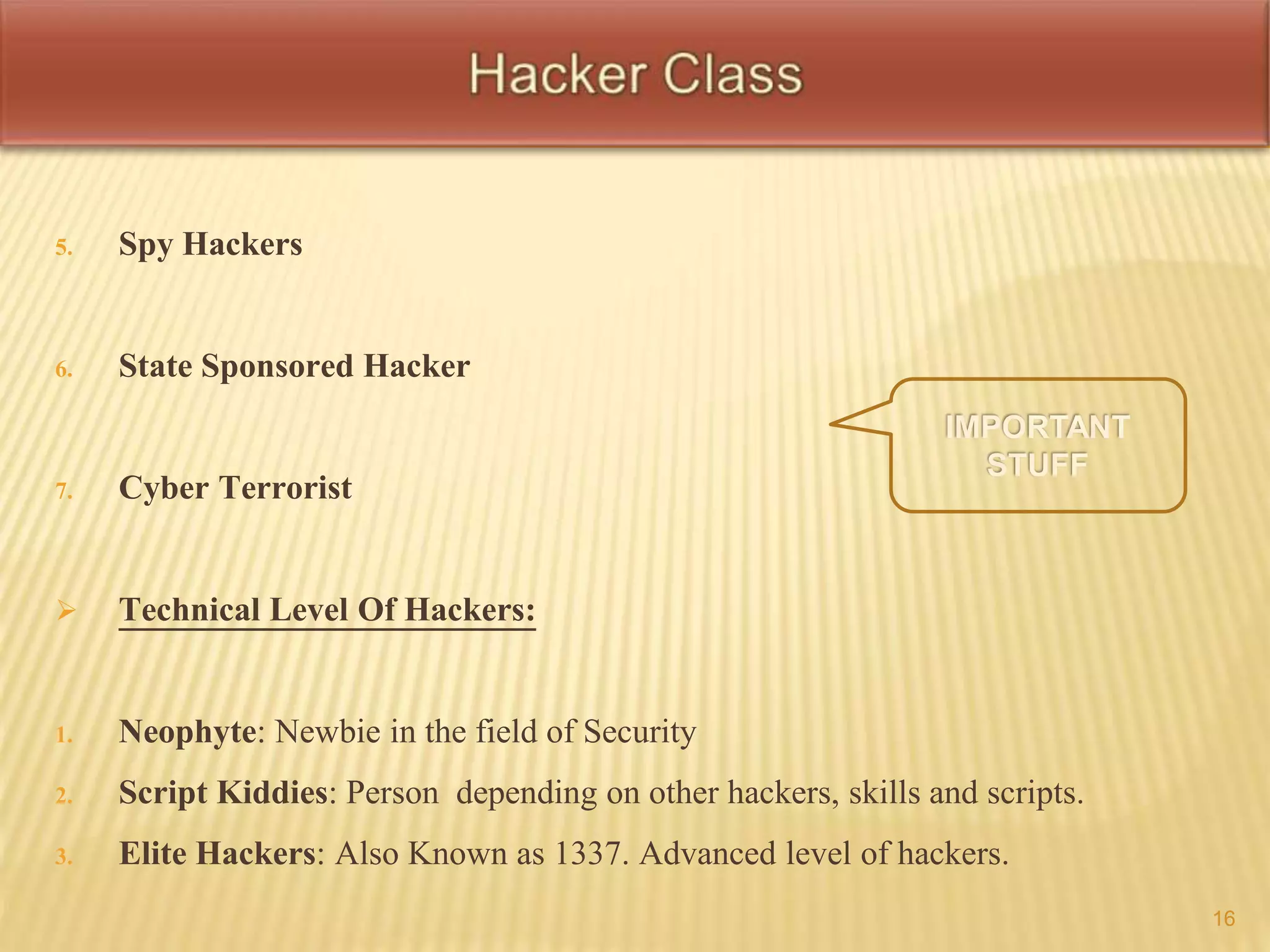
5. Spy Hackers 
6. State Sponsored Hacker 
7. Cyber Terrorist 
 Technical Level Of Hackers: 
1. Neophyte: Newbie in the field of Security 
2. Script Kiddies: Person depending on other hackers, skills and scripts. 
3. Elite Hackers: Also Known as 1337. Advanced level of hackers. 
16
1. Hacktivism is an act of promoting political agenda especially by defacing or 
disabling websites. 
2. It thrives in the environment where information is easily accessible. 
3. Aims at sending message through their hacking activities and gaining visibility 
for a cause. 
4. Common targets include governments, multinational corporations or any other 
entity as perceived as bad or wrong by these groups of individuals. E.g. 
Anonymous and Lulzsec 
17
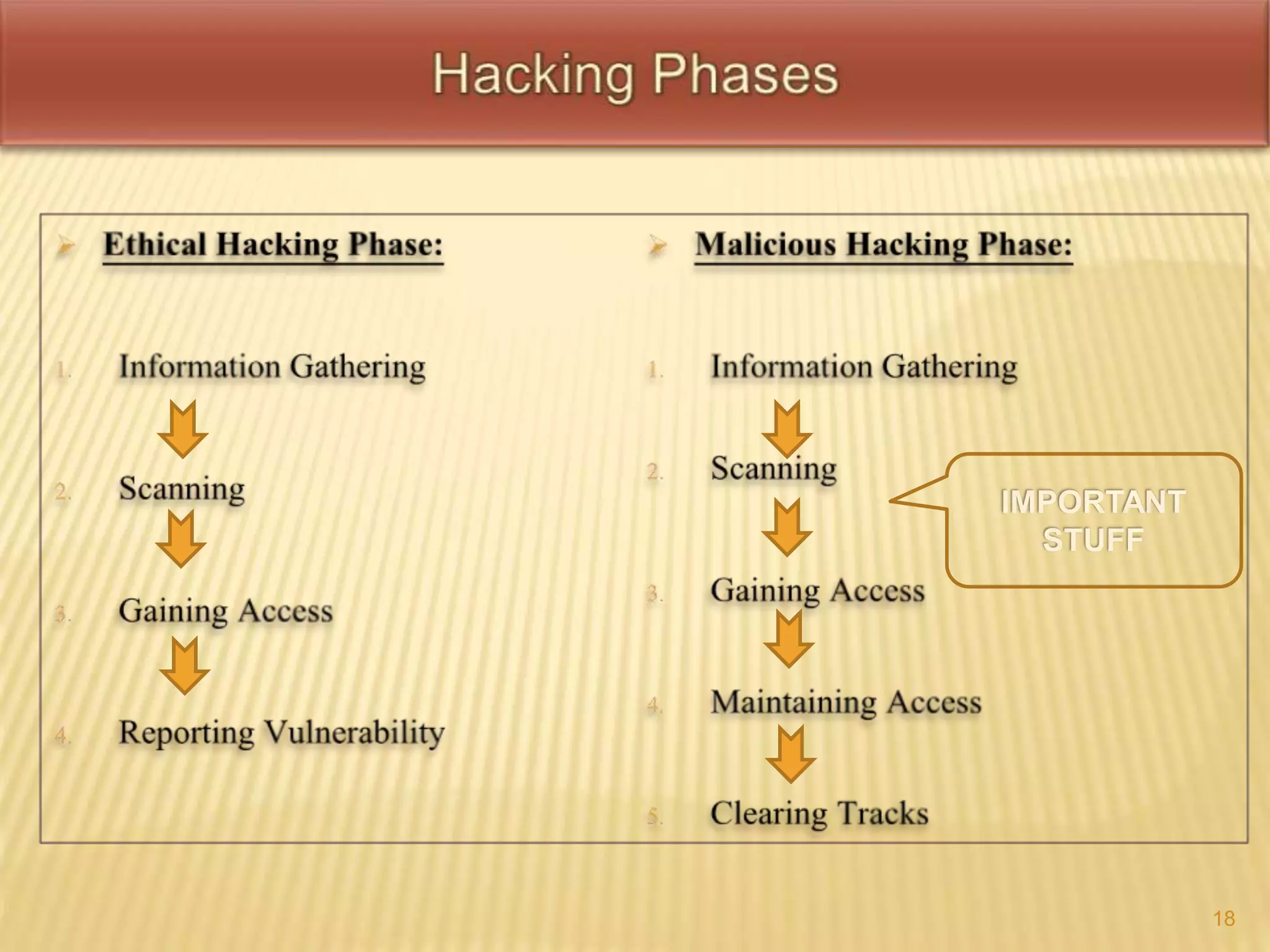
18
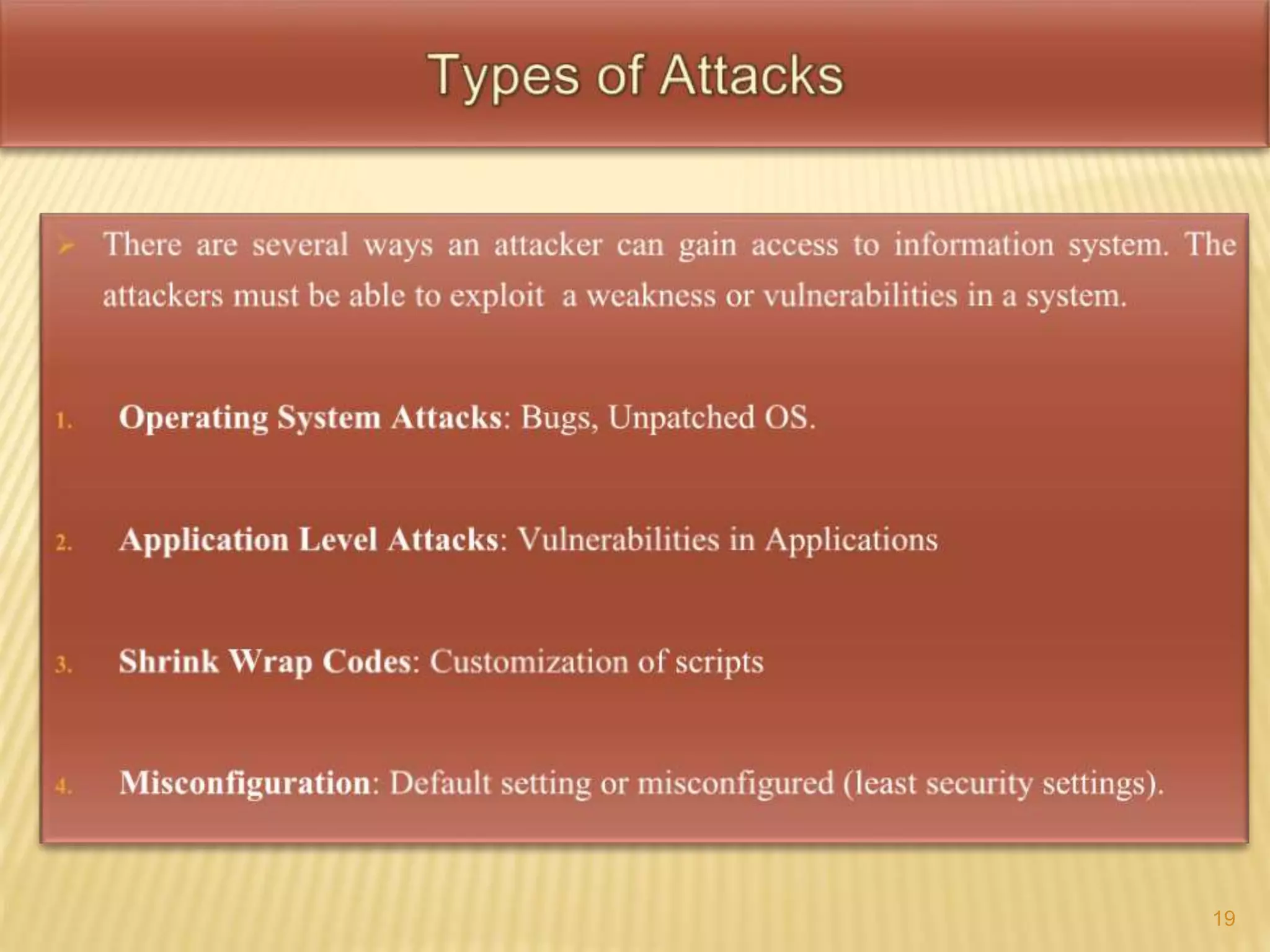
19
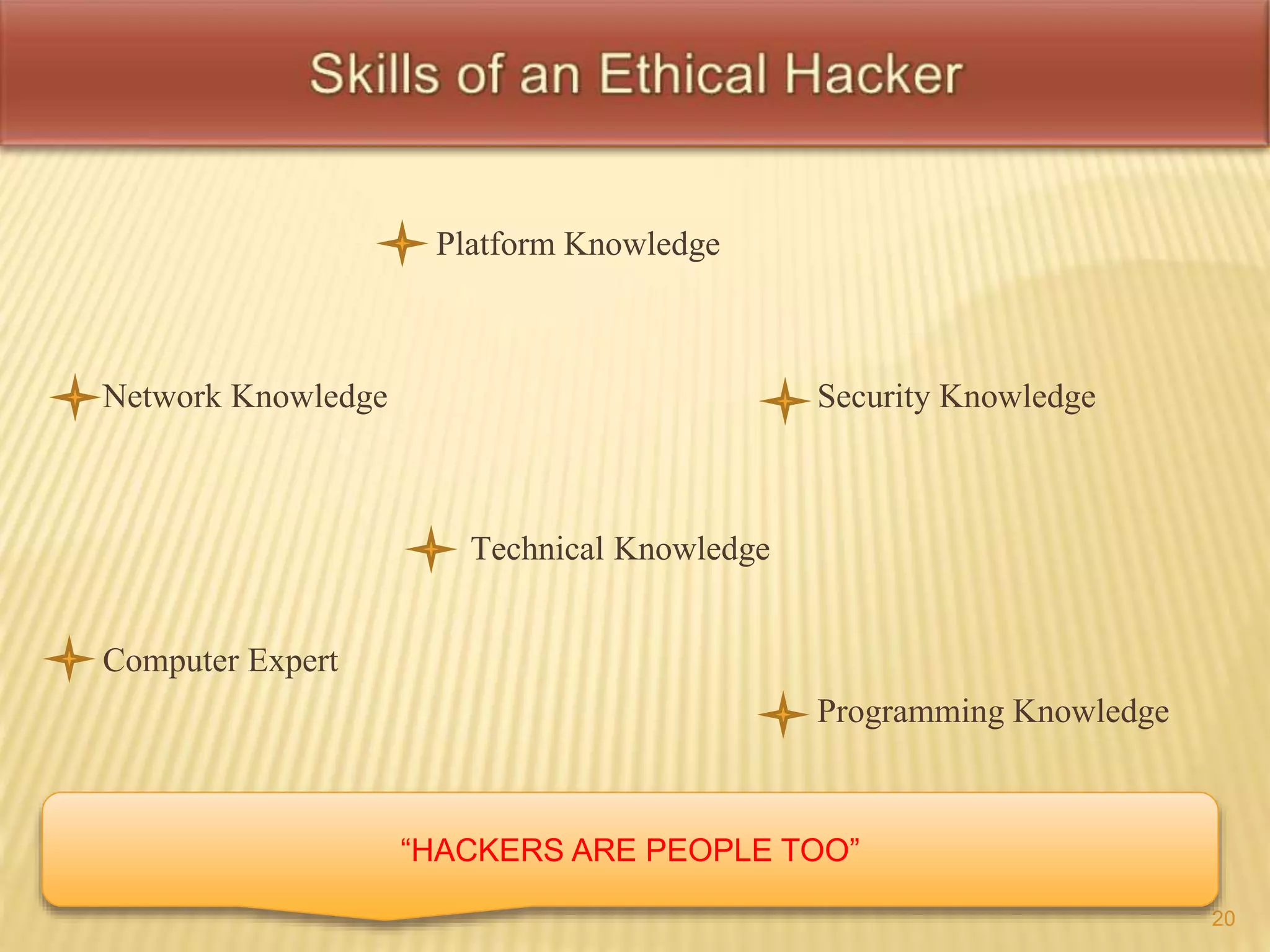
Platform Knowledge 
Network Knowledge Security Knowledge 
Technical Knowledge 
Computer Expert 
Programming Knowledge 
20 
“HACKERS ARE PEOPLE TOO”

Introduction to Ethical Hacking

  • 1.
    1 BY KEVIN CHAKRE
  • 2.
    1. Hack Value:It is the notion among Hackers that something doing is interesting or worthwhile. 2. Exploit: A piece of software that takes advantage of a bug, glitch or vulnerability that leads to unauthorized access, privilege escalation or denial of service on computer systems and networks. 3. Vulnerability: Existence of software flaws, logic design, implementation errors executing bad or damaging instructions to the system. 2
  • 3.
    4. Target ofEvaluation: It is the system, product or network that is the subject of security analysis or attacks. 5. Zero Day attacks: A computer threats that tries to exploit computer application vulnerabilities that are undisclosed to others or undisclosed to the software developer. 6. Daisy chaining: Hackers who get away with database thefts usually complete their task and then backtrack to cover their tracks by destroying logs etc. 3
  • 4.
    7. Attack: Anaction or an event that might compromise security. 8. Threat: An environment or a situation that might lead to potential breach of security. 9. Vulnerability Research: It is the process of discovering vulnerabilities and design weakness that lead an operating systems or its application to attacks or misuse. 10. Penetration Testing: It is the method of actively evaluating the security of a system by simulating an attack from malicious source. 4
  • 5.
     Security isa state of well being of information and infrastructure in which the possibility of theft, tampering of disruption of services is kept low or tolerable.  It relies on the five major elements of security: 1. Confidentiality: It is the assurance that the information is easily accessible to only those who are authorized to have access. Confidentiality breaches may occur due to improper data handling or hacking attempt. 2. Integrity: It is the trustworthiness of data and resources in terms of preventing improper and unauthorized changes, the assurance that the information can be relied upon to be sufficiently accurate for its purposes 5
  • 6.
    3. Availability: Itis the assurance that the systems responsible for storing, delivering and processing information is available to authorized users when required. 4. Authenticity: It refers to the characteristics of any communication or any data that ensures the quality of being genuine or not corrupted from the original. Major roles of authenticity includes that the user is claiming he or she to be. This is done by Biometrics. Smart cards, digital certificates etc 5. Non-repudiation: It ensures that the party to a contract or a communication cannot later deny the authenticity of their signature on a document or sending the message that they originated. It is a way to guarantee that the sender of the message cannot later deny having sent the message and the recipient cannot deny having received the message. 6
  • 7.
     Level ofSecurity in any systems can be defined by the strength of the three components: Functionality(features) Moving the ball towards security means less of other two Security(restrictions) Usability(GUI) 7
  • 8.
     An attackvector is a path or means by which an attacker can gain access to an information system to perform malicious attack.  This attack vector can enable an attacker to take advantage of the vulnerabilities present in the information system to carry out a particular attack.  The following are the possible attack vectors by which an attacker can attack on information system: 8
  • 9.
  • 10.
     Information SecurityThreats are classified into three categories: 1. Natural Threats: such as natural disasters such as flood, earthquakes . 2. Physical Security Threats: such as errors, misconfiguration, sabotage . 3. Human Threats: such as internal threats-disgruntled employees and external threats-malicious hackers 10
  • 11.
     Human Threatsare classified into three categories: 1. Network Threats: such as Sniffing, MITM attacks, Information Gathering, Spoofing, ARP Poisoning. 2. Host Threats: such as Unauthorized access, Password Attacks, Privilege Escalations. 3. Application Threats: Cross Site Scripting, Buffer Overflows, SQL Injections. 11
  • 12.
     The TermInformation Warfare or Info-War refers to the use of information and communicative technology to take competitive advantage over an opponent. 1. Defensive Information Warfare: refers to all the strategies and actions to defend against attacks on ICT assets. 2. Offensive Information Warfare: refers to the Information warfare that involves attacks against ICT assets of an opponent. 12
  • 13.
     Most peopledo not understand between hacking and Ethical hacking.  These two terms can be differentiated on the basis of the intentions of the people who are performing hacking activity.  However, understanding the true intentions of hackers can be quite difficult.  Hacking: refers to exploitation and exploration of the computer software and hardware to gain unauthorized access to perform malicious attacks.  Ethical Hacking: refers to exploitation and exploration of the computer software and hardware to make it more secure and ease of use. 13
  • 14.
     A hackeris a person who illegally breaks into computer system or network without any authorization to steal or destroy data or perform malicious activities.  Hackers may be motivated by a multitude of reasons: 1. Intelligent individuals with excellent computer skills with the ability to create and explore into computer software and hardware. 2. For some hackers, hacking is a hobby to see how many systems or network they can compromise. 3. Their intention can either be to gain knowledge or to poke around to do illegal things. 4. Some hack with malicious intent such as stealing business data, credit card information and social security no. 14
  • 15.
    1. Black Hat:Individuals with extraordinary computer skills resorting to malicious activities are known as crackers. 2. White Hat: Individuals professing hacker skills and using them for defensive purposes are known as security consultants. 3. Grey hat: Individuals who work both offensively and defensively at various times. 4. Suicide Hackers: Individuals who aim to bring down critical infrastructure for a cause and are not worried about facing thirty years in jail for their actions. 15
  • 16.
    5. Spy Hackers 6. State Sponsored Hacker 7. Cyber Terrorist  Technical Level Of Hackers: 1. Neophyte: Newbie in the field of Security 2. Script Kiddies: Person depending on other hackers, skills and scripts. 3. Elite Hackers: Also Known as 1337. Advanced level of hackers. 16
  • 17.
    1. Hacktivism isan act of promoting political agenda especially by defacing or disabling websites. 2. It thrives in the environment where information is easily accessible. 3. Aims at sending message through their hacking activities and gaining visibility for a cause. 4. Common targets include governments, multinational corporations or any other entity as perceived as bad or wrong by these groups of individuals. E.g. Anonymous and Lulzsec 17
  • 18.
  • 19.
  • 20.
    Platform Knowledge NetworkKnowledge Security Knowledge Technical Knowledge Computer Expert Programming Knowledge 20 “HACKERS ARE PEOPLE TOO”