Name - Priya
Class – 9-C
Roll No.-27
FIT Project
CYBER CRIME
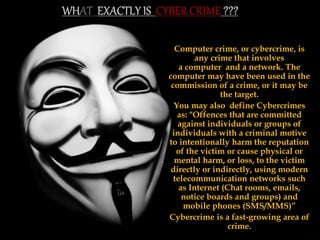
Computer crime, or cybercrime, is
any crime that involves
a computer and a network. The
computer may have been used in the
commission of a crime, or it may be
the target.
You may also define Cybercrimes
as: "Offences that are committed
against individuals or groups of
individuals with a criminal motive
to intentionally harm the reputation
of the victim or cause physical or
mental harm, or loss, to the victim
directly or indirectly, using modern
telecommunication networks such
as Internet (Chat rooms, emails,
notice boards and groups) and
mobile phones (SMS/MMS)”
Cybercrime is a fast-growing area of
crime.
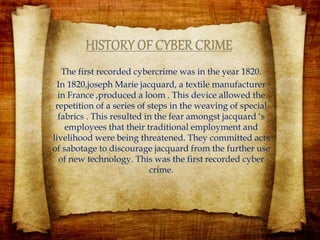
The first recorded cybercrime was in the year 1820.
In 1820,joseph Marie jacquard, a textile manufacturer
in France ,produced a loom . This device allowed the
repetition of a series of steps in the weaving of special
fabrics . This resulted in the fear amongst jacquard ‘s
employees that their traditional employment and
livelihood were being threatened. They committed acts
of sabotage to discourage jacquard from the further use
of new technology. This was the first recorded cyber
crime.
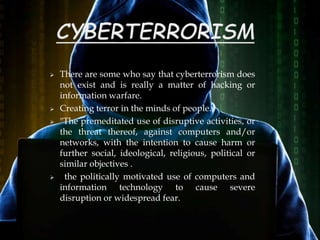
 There are some who say that cyberterrorism does
not exist and is really a matter of hacking or
information warfare.
 Creating terror in the minds of people.
 "The premeditated use of disruptive activities, or
the threat thereof, against computers and/or
networks, with the intention to cause harm or
further social, ideological, religious, political or
similar objectives .
 the politically motivated use of computers and
information technology to cause severe
disruption or widespread fear.
Computer fraud is any dishonest misrepresentation of
fact intended to let another to do or refrain from doing
something which causes loss.
THE FRAUD CAN BE BENIFITTED BY:
 Altering in an unauthorized way.
 Altering, destroying, suppressing, or stealing output,
usually to conceal unauthorized transactions. This is
difficult to detect
 Altering or deleting stored data;
Other forms of fraud may be facilitated using computer
systems, including bank fraud, carding, identity theft,
extortion, and theft of classified information.
 Cyber extortion occurs when a website, e-mail server,
or computer system is subjected to or threatened with
repeated denial of service or other attacks by malicious
hackers.
 They demand money to stop all these.
 Cyberextortionists are increasingly attacking corporate
websites and networks, crippling their ability to
operate and demanding payments to restore their
service.
 More than 20 cases are reported each month to the FBI
and many go unreported in order to keep the victim's
name out of the public domain.
 An example of cyber extortion was the attack on Sony
Pictures of 2014.
 Cyberwarfare is Internet-based conflict involving
politically motivated attacks on information and
information systems. Cyberwarfare attacks can
disable official websites and networks, disrupt or
disable essential services, steal or alter classified
data, and cripple financial systems - among many
other possibilities.
 According to Jeffrey Carr, author of "Inside Cyber
Warfare," any country can wage cyberwar on any
other country, irrespective of resources, because
most military forces are network-centric and
connected to the Internet, which is not secure.
 In 1998, the United States hacked into Serbia's air
defence system to compromise air traffic control
and facilitate the bombing of Serbian targets.
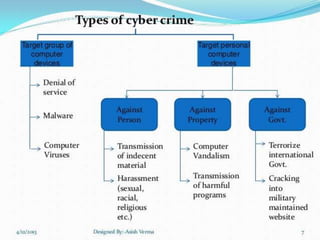
 When the individual is the main target of cybercrime, the
computer can be considered as the tool .
 Human weaknesses are generally exploited. The damage
dealt is largely psychological and intangible, making legal
action against the variants more difficult. These are the
crimes which have existed for centuries in the offline world.
Crimes that use computer networks or devices to advance other
ends include:
 Fraud and Identity
 Information warfare
 Phishing spams
 Spam
 Propagation of illegal obscene or offensive content, including
harassment and threats
 These crimes are committed by a selected group of
criminals. Unlike crimes using the computer as a tool,
these crimes require the technical knowledge of the
perpetrators.
 These crimes are relatively new, having been in
existence for only as long as computers have - which
explains how unprepared society and the world in
general is towards combating these crimes. There are
numerous crimes of this nature committed daily on the
internet:
Crimes that primarily target computer networks or
devices include:
 Computer viruses
 Denial-of-service attacks
 Malware (malicious code)
In today’s world, the reality is that all
individuals and organisations connected to the
internet are vulnerable to cyber attack. The
number, type and sophistication of attacks
continues to grow.
It isn’t only large organisations that are under
threat. Even individuals or organisations that
don’t believe they have much to offer hackers
can be targeted. So even if you think you’re a
small target, you might still be at risk.
Hackers are becoming more focused on spear-phishing attacks, which
are tailored to individual people, and any bit of information about you
can be of help.
Key to the hacker is the issue of trust. The information gathered is
used to build a profile of the target with the aim to have enough data
that allows the hacker to appear trustworthy to you.
In most cases, the hacker will attempt to impersonate an entity that is
trusted by you. The more information the hacker has on you, the more
likely they will be able to maintain the illusion long enough to achieve
their aims.
For most of us, identity theft is likely to cause the most damage
because it badly impacts on our ability to go about our normal daily
life. for example: To make matters worse, the process of addressing
the damage of an attack can be costly, time consuming and
emotionally exhausting.
In other cases, the damage could be in the form of confidential
information, such as medical history records, ending up in the hands
of malicious parties, and thus make the you susceptible to different
kinds of blackmail.
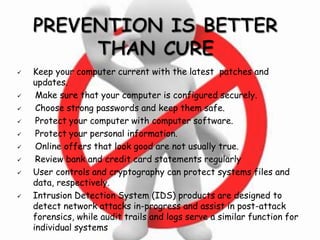
 Keep your computer current with the latest patches and
updates.
 Make sure that your computer is configured securely.
 Choose strong passwords and keep them safe.
 Protect your computer with computer software.
 Protect your personal information.
 Online offers that look good are not usually true.
 Review bank and credit card statements regularly
 User controls and cryptography can protect systems files and
data, respectively.
 Intrusion Detection System (IDS) products are designed to
detect network attacks in-progress and assist in post-attack
forensics, while audit trails and logs serve a similar function for
individual systems
The attitude of individuals and organisations needs
to change in order to prevent cyber attacks. There has
to be a fundamental understanding that, when
online, everyone is a target and that none of us are
too small or unimportant.
It is also critical to change the attitude to incident
detection and handling. We can only get better at the
defence part if we learn from previous experience,
painful and costly as that may be. The reason we
know about some of the attacks mentioned above is
because they were detected and investigated.
There has to be a concerted effort to treat cyber
security seriously rather than an expensive auditing
exercise. The vast majority of organisations are
looking at cyber security as a compliance task and
thus do the minimum possible to achieve that.
cyber crime

cyber crime

  • 1.
    Name - Priya Class– 9-C Roll No.-27 FIT Project CYBER CRIME
  • 2.
    Computer crime, orcybercrime, is any crime that involves a computer and a network. The computer may have been used in the commission of a crime, or it may be the target. You may also define Cybercrimes as: "Offences that are committed against individuals or groups of individuals with a criminal motive to intentionally harm the reputation of the victim or cause physical or mental harm, or loss, to the victim directly or indirectly, using modern telecommunication networks such as Internet (Chat rooms, emails, notice boards and groups) and mobile phones (SMS/MMS)” Cybercrime is a fast-growing area of crime.
  • 3.
    The first recordedcybercrime was in the year 1820. In 1820,joseph Marie jacquard, a textile manufacturer in France ,produced a loom . This device allowed the repetition of a series of steps in the weaving of special fabrics . This resulted in the fear amongst jacquard ‘s employees that their traditional employment and livelihood were being threatened. They committed acts of sabotage to discourage jacquard from the further use of new technology. This was the first recorded cyber crime.
  • 5.
     There aresome who say that cyberterrorism does not exist and is really a matter of hacking or information warfare.  Creating terror in the minds of people.  "The premeditated use of disruptive activities, or the threat thereof, against computers and/or networks, with the intention to cause harm or further social, ideological, religious, political or similar objectives .  the politically motivated use of computers and information technology to cause severe disruption or widespread fear.
  • 6.
    Computer fraud isany dishonest misrepresentation of fact intended to let another to do or refrain from doing something which causes loss. THE FRAUD CAN BE BENIFITTED BY:  Altering in an unauthorized way.  Altering, destroying, suppressing, or stealing output, usually to conceal unauthorized transactions. This is difficult to detect  Altering or deleting stored data; Other forms of fraud may be facilitated using computer systems, including bank fraud, carding, identity theft, extortion, and theft of classified information.
  • 7.
     Cyber extortionoccurs when a website, e-mail server, or computer system is subjected to or threatened with repeated denial of service or other attacks by malicious hackers.  They demand money to stop all these.  Cyberextortionists are increasingly attacking corporate websites and networks, crippling their ability to operate and demanding payments to restore their service.  More than 20 cases are reported each month to the FBI and many go unreported in order to keep the victim's name out of the public domain.  An example of cyber extortion was the attack on Sony Pictures of 2014.
  • 8.
     Cyberwarfare isInternet-based conflict involving politically motivated attacks on information and information systems. Cyberwarfare attacks can disable official websites and networks, disrupt or disable essential services, steal or alter classified data, and cripple financial systems - among many other possibilities.  According to Jeffrey Carr, author of "Inside Cyber Warfare," any country can wage cyberwar on any other country, irrespective of resources, because most military forces are network-centric and connected to the Internet, which is not secure.  In 1998, the United States hacked into Serbia's air defence system to compromise air traffic control and facilitate the bombing of Serbian targets.
  • 9.
     When theindividual is the main target of cybercrime, the computer can be considered as the tool .  Human weaknesses are generally exploited. The damage dealt is largely psychological and intangible, making legal action against the variants more difficult. These are the crimes which have existed for centuries in the offline world. Crimes that use computer networks or devices to advance other ends include:  Fraud and Identity  Information warfare  Phishing spams  Spam  Propagation of illegal obscene or offensive content, including harassment and threats
  • 10.
     These crimesare committed by a selected group of criminals. Unlike crimes using the computer as a tool, these crimes require the technical knowledge of the perpetrators.  These crimes are relatively new, having been in existence for only as long as computers have - which explains how unprepared society and the world in general is towards combating these crimes. There are numerous crimes of this nature committed daily on the internet: Crimes that primarily target computer networks or devices include:  Computer viruses  Denial-of-service attacks  Malware (malicious code)
  • 11.
    In today’s world,the reality is that all individuals and organisations connected to the internet are vulnerable to cyber attack. The number, type and sophistication of attacks continues to grow. It isn’t only large organisations that are under threat. Even individuals or organisations that don’t believe they have much to offer hackers can be targeted. So even if you think you’re a small target, you might still be at risk.
  • 12.
    Hackers are becomingmore focused on spear-phishing attacks, which are tailored to individual people, and any bit of information about you can be of help. Key to the hacker is the issue of trust. The information gathered is used to build a profile of the target with the aim to have enough data that allows the hacker to appear trustworthy to you. In most cases, the hacker will attempt to impersonate an entity that is trusted by you. The more information the hacker has on you, the more likely they will be able to maintain the illusion long enough to achieve their aims. For most of us, identity theft is likely to cause the most damage because it badly impacts on our ability to go about our normal daily life. for example: To make matters worse, the process of addressing the damage of an attack can be costly, time consuming and emotionally exhausting. In other cases, the damage could be in the form of confidential information, such as medical history records, ending up in the hands of malicious parties, and thus make the you susceptible to different kinds of blackmail.
  • 13.
     Keep yourcomputer current with the latest patches and updates.  Make sure that your computer is configured securely.  Choose strong passwords and keep them safe.  Protect your computer with computer software.  Protect your personal information.  Online offers that look good are not usually true.  Review bank and credit card statements regularly  User controls and cryptography can protect systems files and data, respectively.  Intrusion Detection System (IDS) products are designed to detect network attacks in-progress and assist in post-attack forensics, while audit trails and logs serve a similar function for individual systems
  • 14.
    The attitude ofindividuals and organisations needs to change in order to prevent cyber attacks. There has to be a fundamental understanding that, when online, everyone is a target and that none of us are too small or unimportant. It is also critical to change the attitude to incident detection and handling. We can only get better at the defence part if we learn from previous experience, painful and costly as that may be. The reason we know about some of the attacks mentioned above is because they were detected and investigated. There has to be a concerted effort to treat cyber security seriously rather than an expensive auditing exercise. The vast majority of organisations are looking at cyber security as a compliance task and thus do the minimum possible to achieve that.