Estate Planning  Taking Care of Your Family and Minimizing Taxes Speaker: Robert LeChevallier Attorney at Law
Why Most People  Fail To Plan Their Estate! Why? Fear of mortality Not sure who should handle estate/trust Not sure how to distribute Does not know the value of their assets Not aware of tax consequences of failure to plan Symptoms! Procrastination Failure to complete estate plan.
Four Ways Assets Are  Transferred On Death Contract  ex. (life insurance and retirement plans Operation of Law (ex jointly owned property with right of survivorship) Will  (subject to probate) Revocable Trusts Irrevocable Trusts
Contract Payable on Death Transfer on Death Life Insurance Retirement Plans
Operation of Law Joint Tenants with Right of Survivorship Tenants by the Entirety  (husband and wife) Community Property  (WA, CA, ID)
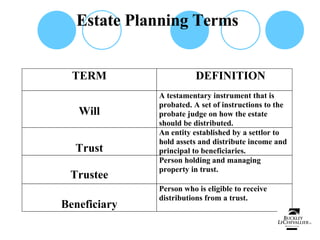
Estate Planning Terms
The Will If you do not have a will the State “writes” one for you Assets pass according to the “intestate” law of succession Advantages of a will: Simpler to  manage during lifetime than a trust Court supervision over estate administration Can waive bond requirement Disadvantage of a will is that it is subject to probate Public information Time and cost to probate estate
Probate Process Most states allow a small estate to avoid a full probate.  Oregon: 50k personal property; 150k real property (2009) Probate is to assure that the intent of the decedent is followed Attorney is hired by the personal representative Probate Court takes control of estate, appoints Personal Representative, supervises payment of debts and orders distribution of assets Legal notice to interested parties is required to be published in local paper Decedent’s assets must be inventoried by personal representative and appraised if necessary Four month creditor waiting period Notice to Estate Admin -Department of Human Services
Probate Advantage Court supervised process Provides notice and allows objection by heirs and/or creditors Time limit on claims Disadvantage Time Expense Lack of control by family
Trusts Revocable Created during the settlor’s lifetime Can be amended so long as the settlor has capacity Typically used to avoid probate Irrevocable Revocable trusts become irrevocable upon settlor’s death Lifetime irrevocable trust for advanced planning Testamentary trusts (trusts established in a decedent’s will) These are trusts that cannot be modified easily without consent of settlor, trustee and beneficiaries
Revocable Trust Person creating trust can be the settlor, trustee and beneficiary until their death, resignation and/or incapacity Any items not transferred to the Trust will be distributed according to the will No probate court jurisdiction, therefore no probate fees Avoids a conservatorship in the event of incapacity Trust Administration private and quicker than probate
Revocable Trusts Advantage Private Retain control Not subject to mandatory timelines like a probate Procedure available to limit claims Disadvantage No court supervision Beneficiary(ies) have right to enforce terms of trust Uniform Trust Code REVOCABLE TRUSTS
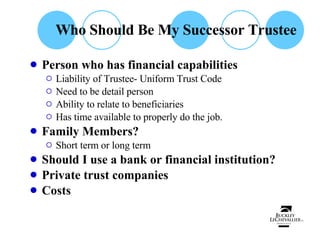
Who Should Be My Successor Trustee Person who has financial capabilities Liability of Trustee- Uniform Trust Code Need to be detail person Ability to relate to beneficiaries Has time available to properly do the job. Family Members? Short term or long term Should I use a bank or financial institution? Private trust companies Costs
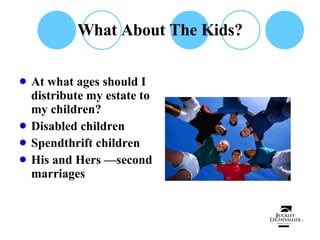
What About The Kids? At what ages should I distribute my estate to my children? Disabled children Spendthrift children His and Hers —second marriages
Additional Uses of Trusts Discretionary Trusts (income or principal) Incentive Trusts (i.e. if you graduate…) Education Trusts (for college) Grandchildren’s Trusts Protect children in event of  spouse’s subsequent marriage(s) Protect family assets in event of children’s divorce Spendthrift- protect children from creditors
Additional Estate Planning Documents Pour-over Will Durable Power of Attorney Advance Directive (Living Will)
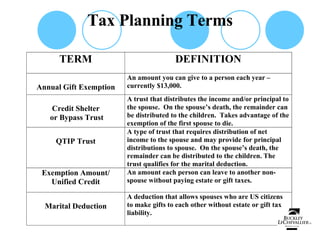
Tax Planning Terms
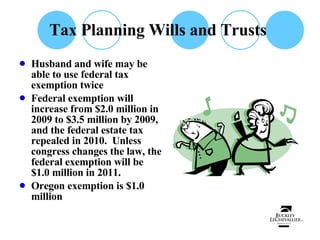
Tax Planning Wills and Trusts  Husband and wife may be able to use federal tax exemption twice Federal exemption will increase from $2.0 million in 2009 to $3.5 million by 2009, and the federal estate tax repealed in 2010.  Unless congress changes the law, the federal exemption will be $1.0 million in 2011. Oregon exemption is $1.0 million
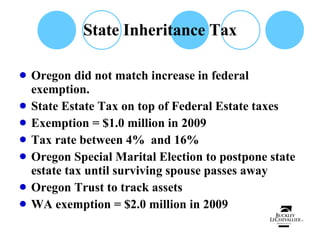
State Inheritance Tax Oregon did not match increase in federal exemption.  State Estate Tax on top of Federal Estate taxes Exemption = $1.0 million in 2009 Tax rate between 4%  and 16% Oregon Special Marital Election to postpone state estate tax until surviving spouse passes away Oregon Trust to track assets WA exemption = $2.0 million in 2009
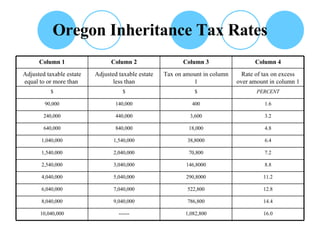
Oregon Inheritance Tax Rates 7.2 70,800 2,040,000 1,540,000 16.0 1,082,800 ------ 10,040,000 14.4 786,800 9,040,000 8,040,000 12.8 522,800 7,040,000 6,040,000 11.2 290,8000 5,040,000 4,040,000 8.8 146,8000 3,040,000 2,540,000 6.4 38,8000 1,540,000 1,040,000 4.8 18,000 840,000 640,000 3.2 3,600 440,000 240,000 1.6 400 140,000 90,000 PERCENT $ $ $ Rate of tax on excess over amount in column 1 Tax on amount in column 1 Adjusted taxable estate less than Adjusted taxable estate equal to or more than  Column 4 Column 3 Column 2 Column 1
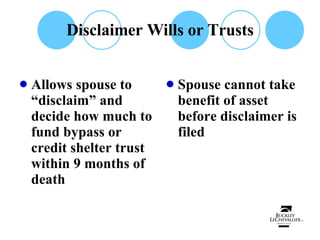
Disclaimer Wills or Trusts Allows spouse to “disclaim” and decide how much to fund bypass or credit shelter trust within 9 months of death Spouse cannot take benefit of asset before disclaimer is filed
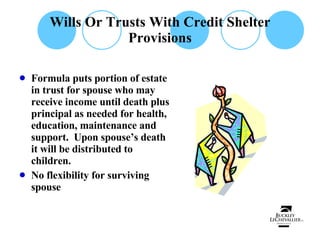
Wills Or Trusts With Credit Shelter Provisions Formula puts portion of estate in trust for spouse who may receive income until death plus principal as needed for health, education, maintenance and support.  Upon spouse’s death it will be distributed to children. No flexibility for surviving spouse
Charitable Deduction Gift to charities or charitable trust qualify for charitable deduction IRA’s  Gifts of life insurance Gifts of appreciated property (need appraisal) Gifts to Community Foundations (donor advised funds) Charitable remainder trusts Charitable lead trusts
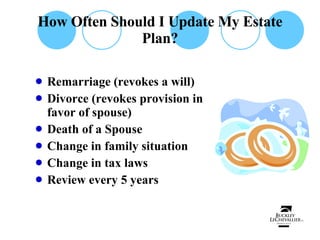
How Often Should I Update My Estate Plan? Remarriage (revokes a will) Divorce (revokes provision in favor of spouse) Death of a Spouse Change in family situation Change in tax laws Review every 5 years
NEXT  STEPS! Prepare a will, a durable power of attorney and advance directive Prepare a Revocable  Trust (if over age 55; high net worth or assets in multiple states) Do appropriate estate and income tax planning If you have a taxable estate start a gifting program to family Once family is taken care of, consider charitable gifts
QUESTIONS? For more information give us a call ( 503) 620-8900 3 Centerpointe Drive, Suite 250 Lake Oswego, OR 97035 www.buckley-law.com

2009 Estate Planning Program

  • 1.
    Estate Planning Taking Care of Your Family and Minimizing Taxes Speaker: Robert LeChevallier Attorney at Law
  • 2.
    Why Most People Fail To Plan Their Estate! Why? Fear of mortality Not sure who should handle estate/trust Not sure how to distribute Does not know the value of their assets Not aware of tax consequences of failure to plan Symptoms! Procrastination Failure to complete estate plan.
  • 3.
    Four Ways AssetsAre Transferred On Death Contract ex. (life insurance and retirement plans Operation of Law (ex jointly owned property with right of survivorship) Will (subject to probate) Revocable Trusts Irrevocable Trusts
  • 4.
    Contract Payable onDeath Transfer on Death Life Insurance Retirement Plans
  • 5.
    Operation of LawJoint Tenants with Right of Survivorship Tenants by the Entirety (husband and wife) Community Property (WA, CA, ID)
  • 6.
  • 7.
    The Will Ifyou do not have a will the State “writes” one for you Assets pass according to the “intestate” law of succession Advantages of a will: Simpler to manage during lifetime than a trust Court supervision over estate administration Can waive bond requirement Disadvantage of a will is that it is subject to probate Public information Time and cost to probate estate
  • 8.
    Probate Process Moststates allow a small estate to avoid a full probate. Oregon: 50k personal property; 150k real property (2009) Probate is to assure that the intent of the decedent is followed Attorney is hired by the personal representative Probate Court takes control of estate, appoints Personal Representative, supervises payment of debts and orders distribution of assets Legal notice to interested parties is required to be published in local paper Decedent’s assets must be inventoried by personal representative and appraised if necessary Four month creditor waiting period Notice to Estate Admin -Department of Human Services
  • 9.
    Probate Advantage Courtsupervised process Provides notice and allows objection by heirs and/or creditors Time limit on claims Disadvantage Time Expense Lack of control by family
  • 10.
    Trusts Revocable Createdduring the settlor’s lifetime Can be amended so long as the settlor has capacity Typically used to avoid probate Irrevocable Revocable trusts become irrevocable upon settlor’s death Lifetime irrevocable trust for advanced planning Testamentary trusts (trusts established in a decedent’s will) These are trusts that cannot be modified easily without consent of settlor, trustee and beneficiaries
  • 11.
    Revocable Trust Personcreating trust can be the settlor, trustee and beneficiary until their death, resignation and/or incapacity Any items not transferred to the Trust will be distributed according to the will No probate court jurisdiction, therefore no probate fees Avoids a conservatorship in the event of incapacity Trust Administration private and quicker than probate
  • 12.
    Revocable Trusts AdvantagePrivate Retain control Not subject to mandatory timelines like a probate Procedure available to limit claims Disadvantage No court supervision Beneficiary(ies) have right to enforce terms of trust Uniform Trust Code REVOCABLE TRUSTS
  • 13.
    Who Should BeMy Successor Trustee Person who has financial capabilities Liability of Trustee- Uniform Trust Code Need to be detail person Ability to relate to beneficiaries Has time available to properly do the job. Family Members? Short term or long term Should I use a bank or financial institution? Private trust companies Costs
  • 14.
    What About TheKids? At what ages should I distribute my estate to my children? Disabled children Spendthrift children His and Hers —second marriages
  • 15.
    Additional Uses ofTrusts Discretionary Trusts (income or principal) Incentive Trusts (i.e. if you graduate…) Education Trusts (for college) Grandchildren’s Trusts Protect children in event of spouse’s subsequent marriage(s) Protect family assets in event of children’s divorce Spendthrift- protect children from creditors
  • 16.
    Additional Estate PlanningDocuments Pour-over Will Durable Power of Attorney Advance Directive (Living Will)
  • 17.
  • 18.
    Tax Planning Willsand Trusts Husband and wife may be able to use federal tax exemption twice Federal exemption will increase from $2.0 million in 2009 to $3.5 million by 2009, and the federal estate tax repealed in 2010. Unless congress changes the law, the federal exemption will be $1.0 million in 2011. Oregon exemption is $1.0 million
  • 19.
    State Inheritance TaxOregon did not match increase in federal exemption. State Estate Tax on top of Federal Estate taxes Exemption = $1.0 million in 2009 Tax rate between 4% and 16% Oregon Special Marital Election to postpone state estate tax until surviving spouse passes away Oregon Trust to track assets WA exemption = $2.0 million in 2009
  • 20.
    Oregon Inheritance TaxRates 7.2 70,800 2,040,000 1,540,000 16.0 1,082,800 ------ 10,040,000 14.4 786,800 9,040,000 8,040,000 12.8 522,800 7,040,000 6,040,000 11.2 290,8000 5,040,000 4,040,000 8.8 146,8000 3,040,000 2,540,000 6.4 38,8000 1,540,000 1,040,000 4.8 18,000 840,000 640,000 3.2 3,600 440,000 240,000 1.6 400 140,000 90,000 PERCENT $ $ $ Rate of tax on excess over amount in column 1 Tax on amount in column 1 Adjusted taxable estate less than Adjusted taxable estate equal to or more than Column 4 Column 3 Column 2 Column 1
  • 21.
    Disclaimer Wills orTrusts Allows spouse to “disclaim” and decide how much to fund bypass or credit shelter trust within 9 months of death Spouse cannot take benefit of asset before disclaimer is filed
  • 22.
    Wills Or TrustsWith Credit Shelter Provisions Formula puts portion of estate in trust for spouse who may receive income until death plus principal as needed for health, education, maintenance and support. Upon spouse’s death it will be distributed to children. No flexibility for surviving spouse
  • 23.
    Charitable Deduction Giftto charities or charitable trust qualify for charitable deduction IRA’s Gifts of life insurance Gifts of appreciated property (need appraisal) Gifts to Community Foundations (donor advised funds) Charitable remainder trusts Charitable lead trusts
  • 24.
    How Often ShouldI Update My Estate Plan? Remarriage (revokes a will) Divorce (revokes provision in favor of spouse) Death of a Spouse Change in family situation Change in tax laws Review every 5 years
  • 25.
    NEXT STEPS!Prepare a will, a durable power of attorney and advance directive Prepare a Revocable Trust (if over age 55; high net worth or assets in multiple states) Do appropriate estate and income tax planning If you have a taxable estate start a gifting program to family Once family is taken care of, consider charitable gifts
  • 26.
    QUESTIONS? For moreinformation give us a call ( 503) 620-8900 3 Centerpointe Drive, Suite 250 Lake Oswego, OR 97035 www.buckley-law.com