BASIC ESTATE
PLANNING TOOLS
3 BASIC DOCUMENTS
• LAST WILL AND TESTAMENT (WILL)
• POWER OF ATTORNEY
• ADVANCED HEALTHCARE DIRECTIVE
(HEALTH CARE PROXY AND LIVING WILL)
LAST WILL & TESTAMENT
• Written legal document used to distribute
assets following your death
• Allows you to designate an Executor
(Personal Representative) who will ensure
that your instructions are carried out
• Allows you to nominate a guardian and
trustee for your minor or disabled children
WHO CAN MAKE A WILL?
• 18 YEARS OF AGE OR OLDER
• OF SOUND MIND
• FREE FROM IMPROPER INFLUENCES
• BEST TO BE OF GOOD HEALTH & FREE
FROM EMOTIONAL STRESS
HOW IS A WILL MADE?
• Written, not verbal
• Signed by maker of the will
• Witnessed as provided by law
WHY DO YOU NEED A
WILL?
• Final instructions
• Prevent arguments
• Provide for children
• You get to make the decision, not the
State
WHAT HAPPENS IF YOU DIE
WITHOUT A WILL?• Intestate – Person dies without a will
• Alabama laws of intestacy provide that if the decedent (dead
person) is survived by a spouse, the following rules apply:
(a) If the decedent didn’t leave parents or children, the spouse gets
everything.
(b) If the decedent was survived by parents but not by children, the
spouse gets $100,000 and half of the balance of the decedent’s
estate. The decedent’s parents get the remaining half.
(c) If the decedent had children who are also children of the
surviving spouse, the surviving spouse gets $50,000 and one half of
the balance of the decedent’s estate. The surviving children share
the other half of the balance.
(d) If the decedent had living children that are not the children of the
surviving spouse, the surviving spouse gets one half of the estate
and the decedent’s children get the remaining half.
INTESTACY, continued
• If the decedent is not survived by a spouse,
the estate passes to decedent’s heirs at law
in the following order of priority:
(a) Children and their descendants;
(b)Parents;
(c)Brothers and sisters, or, if all are
deceased, nieces and nephews;
(d)Grandparents, aunts, and uncles or, if all
are deceased, to their descendants; and then
(e)The State of Alabama.
OVERVIEW OF PROBATE
PROCESS• Seek guidance from a lawyer to determine if
it is necessary to probate the deceased
person’s estate.
• Petition is filed with court
• Notice is given as provided by law
• Hearing is held if required
• Executor/Personal Representative is
appointed
• 6 months claim period must run
• Final Settlement
MISC ITEMS
• Alabama does not recognize handwritten wills
not properly witnessed (holographic wills)
• Will must be probated within 5 years of death
• Discuss final arrangements with family members
• Keep important paperwork in safe, central
location
TRUSTS
• Contract between Settlor and Trustee
• Settlor is the person who creates the trust
• Trustee is the person who manages the trust
• A trust allows you to plan with more details and
more control
• Reduce estate and gift taxes
• Seek advice of lawyer
POWER OF ATTORNEY
• Written document that allows you to give
someone else legal right to act for you
• Specific or general
• Durable power of attorney
• Delegation of Parental Authority
ADVANCED HEALTHCARE
DIRECTIVE
• Healthcare proxy and living will
• Healthcare proxy – allows you to designate
someone to make healthcare decisions for you if
incapacitated
• Living Will – Health care directive that spells out
your life sustaining treatment choices
LIFE INSURANCE
• To protect your family and loved ones especially
if you are the primary source of income
• Cannot replace a person but can help provide
financially for those you leave behind
• Two major types: Term Life and Whole Life
TERM LIFE
• Simplest form of life insurance
• Coverage is for a defined period of time
• Guaranteed death benefit during defined period
of time
• No cash value
• Premium is fixed for the initial period
• Premium is initially lower than other types of life
insurance
WHOLE LIFE
• Sometimes referred to as “permanent life
insurance”
• More expensive premiums than term life
• Different types of whole life
• Part of your premium may go toward building
cash value
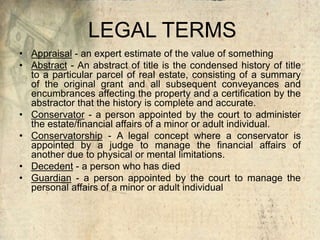
LEGAL TERMS
• Appraisal - an expert estimate of the value of something
• Abstract - An abstract of title is the condensed history of title
to a particular parcel of real estate, consisting of a summary
of the original grant and all subsequent conveyances and
encumbrances affecting the property and a certification by the
abstractor that the history is complete and accurate.
• Conservator - a person appointed by the court to administer
the estate/financial affairs of a minor or adult individual.
• Conservatorship - A legal concept where a conservator is
appointed by a judge to manage the financial affairs of
another due to physical or mental limitations.
• Decedent - a person who has died
• Guardian - a person appointed by the court to manage the
personal affairs of a minor or adult individual
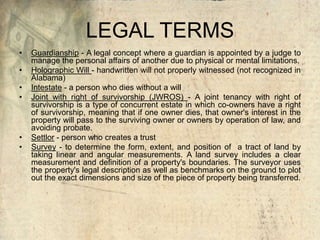
LEGAL TERMS
• Guardianship - A legal concept where a guardian is appointed by a judge to
manage the personal affairs of another due to physical or mental limitations.
• Holographic Will - handwritten will not properly witnessed (not recognized in
Alabama)
• Intestate - a person who dies without a will
• Joint with right of survivorship (JWROS) - A joint tenancy with right of
survivorship is a type of concurrent estate in which co-owners have a right
of survivorship, meaning that if one owner dies, that owner's interest in the
property will pass to the surviving owner or owners by operation of law, and
avoiding probate.
• Settlor - person who creates a trust
• Survey - to determine the form, extent, and position of a tract of land by
taking linear and angular measurements. A land survey includes a clear
measurement and definition of a property's boundaries. The surveyor uses
the property's legal description as well as benchmarks on the ground to plot
out the exact dimensions and size of the piece of property being transferred.
2 estate planning updated

2 estate planning updated

  • 2.
  • 3.
    3 BASIC DOCUMENTS •LAST WILL AND TESTAMENT (WILL) • POWER OF ATTORNEY • ADVANCED HEALTHCARE DIRECTIVE (HEALTH CARE PROXY AND LIVING WILL)
  • 4.
    LAST WILL &TESTAMENT • Written legal document used to distribute assets following your death • Allows you to designate an Executor (Personal Representative) who will ensure that your instructions are carried out • Allows you to nominate a guardian and trustee for your minor or disabled children
  • 5.
    WHO CAN MAKEA WILL? • 18 YEARS OF AGE OR OLDER • OF SOUND MIND • FREE FROM IMPROPER INFLUENCES • BEST TO BE OF GOOD HEALTH & FREE FROM EMOTIONAL STRESS
  • 6.
    HOW IS AWILL MADE? • Written, not verbal • Signed by maker of the will • Witnessed as provided by law
  • 7.
    WHY DO YOUNEED A WILL? • Final instructions • Prevent arguments • Provide for children • You get to make the decision, not the State
  • 8.
    WHAT HAPPENS IFYOU DIE WITHOUT A WILL?• Intestate – Person dies without a will • Alabama laws of intestacy provide that if the decedent (dead person) is survived by a spouse, the following rules apply: (a) If the decedent didn’t leave parents or children, the spouse gets everything. (b) If the decedent was survived by parents but not by children, the spouse gets $100,000 and half of the balance of the decedent’s estate. The decedent’s parents get the remaining half. (c) If the decedent had children who are also children of the surviving spouse, the surviving spouse gets $50,000 and one half of the balance of the decedent’s estate. The surviving children share the other half of the balance. (d) If the decedent had living children that are not the children of the surviving spouse, the surviving spouse gets one half of the estate and the decedent’s children get the remaining half.
  • 9.
    INTESTACY, continued • Ifthe decedent is not survived by a spouse, the estate passes to decedent’s heirs at law in the following order of priority: (a) Children and their descendants; (b)Parents; (c)Brothers and sisters, or, if all are deceased, nieces and nephews; (d)Grandparents, aunts, and uncles or, if all are deceased, to their descendants; and then (e)The State of Alabama.
  • 10.
    OVERVIEW OF PROBATE PROCESS•Seek guidance from a lawyer to determine if it is necessary to probate the deceased person’s estate. • Petition is filed with court • Notice is given as provided by law • Hearing is held if required • Executor/Personal Representative is appointed • 6 months claim period must run • Final Settlement
  • 11.
    MISC ITEMS • Alabamadoes not recognize handwritten wills not properly witnessed (holographic wills) • Will must be probated within 5 years of death • Discuss final arrangements with family members • Keep important paperwork in safe, central location
  • 12.
    TRUSTS • Contract betweenSettlor and Trustee • Settlor is the person who creates the trust • Trustee is the person who manages the trust • A trust allows you to plan with more details and more control • Reduce estate and gift taxes • Seek advice of lawyer
  • 13.
    POWER OF ATTORNEY •Written document that allows you to give someone else legal right to act for you • Specific or general • Durable power of attorney • Delegation of Parental Authority
  • 14.
    ADVANCED HEALTHCARE DIRECTIVE • Healthcareproxy and living will • Healthcare proxy – allows you to designate someone to make healthcare decisions for you if incapacitated • Living Will – Health care directive that spells out your life sustaining treatment choices
  • 15.
    LIFE INSURANCE • Toprotect your family and loved ones especially if you are the primary source of income • Cannot replace a person but can help provide financially for those you leave behind • Two major types: Term Life and Whole Life
  • 16.
    TERM LIFE • Simplestform of life insurance • Coverage is for a defined period of time • Guaranteed death benefit during defined period of time • No cash value • Premium is fixed for the initial period • Premium is initially lower than other types of life insurance
  • 17.
    WHOLE LIFE • Sometimesreferred to as “permanent life insurance” • More expensive premiums than term life • Different types of whole life • Part of your premium may go toward building cash value
  • 18.
    LEGAL TERMS • Appraisal- an expert estimate of the value of something • Abstract - An abstract of title is the condensed history of title to a particular parcel of real estate, consisting of a summary of the original grant and all subsequent conveyances and encumbrances affecting the property and a certification by the abstractor that the history is complete and accurate. • Conservator - a person appointed by the court to administer the estate/financial affairs of a minor or adult individual. • Conservatorship - A legal concept where a conservator is appointed by a judge to manage the financial affairs of another due to physical or mental limitations. • Decedent - a person who has died • Guardian - a person appointed by the court to manage the personal affairs of a minor or adult individual
  • 19.
    LEGAL TERMS • Guardianship- A legal concept where a guardian is appointed by a judge to manage the personal affairs of another due to physical or mental limitations. • Holographic Will - handwritten will not properly witnessed (not recognized in Alabama) • Intestate - a person who dies without a will • Joint with right of survivorship (JWROS) - A joint tenancy with right of survivorship is a type of concurrent estate in which co-owners have a right of survivorship, meaning that if one owner dies, that owner's interest in the property will pass to the surviving owner or owners by operation of law, and avoiding probate. • Settlor - person who creates a trust • Survey - to determine the form, extent, and position of a tract of land by taking linear and angular measurements. A land survey includes a clear measurement and definition of a property's boundaries. The surveyor uses the property's legal description as well as benchmarks on the ground to plot out the exact dimensions and size of the piece of property being transferred.