APEEJAY INSTITUTE OF DESIGN
NEW DELHI
-BY KHUSHBOO
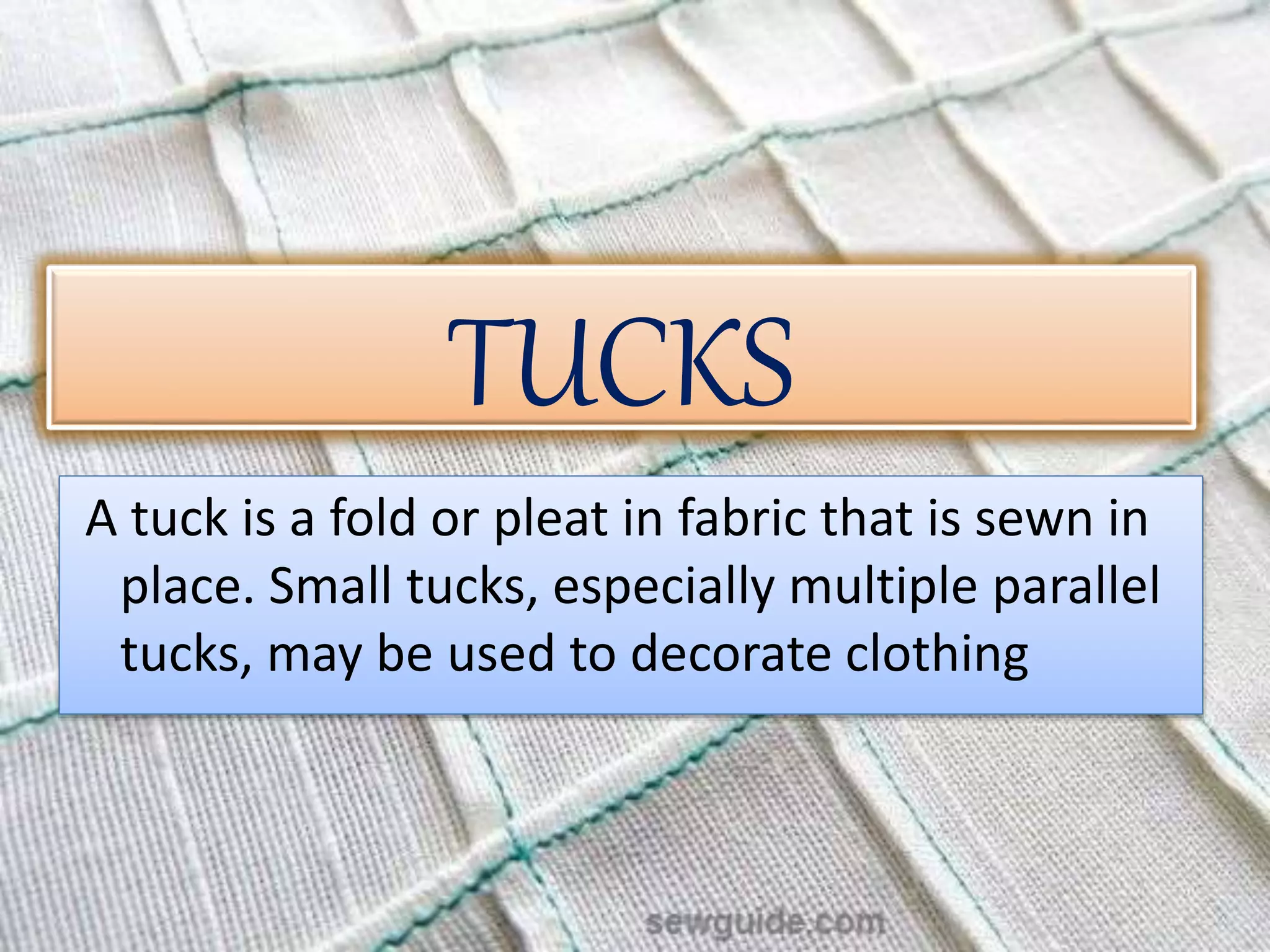
TUCKS
A tuck is a fold or pleat in fabric that is sewn in
place. Small tucks, especially multiple parallel
tucks, may be used to decorate clothing
Types of tucks
Pin tucks
Space tucks
Blind tucks
Shell tucks
Group tucks
Cross tucks
Released tucks
Pin tucks
Pin tucks are parallel rows of raised fabric
produced by stitching tight rows of stitches
on sewing machines to push up the fabric
between them. Pin tucks are common on
formalwear and make a nice pattern along the
front of a shirt or blouse.
space tucks
Space tucks Space tucks are pin tucks made wider than
standard pin tucks to be at least ¼-inch wide. They can be
pressed flat to create a different decorative look. Bubble
tucks are basically space tucks that are tacked together at
regular intervals so the fabric puffs and bubbles up.
These are commonly used on children’s clothing and
other fancier garments.
Group tucks
Group tucking is done on the fabric before the
garment is cut. Measured, mark and stitch the
tuck, placing them close together . Press to one
side . Mark the fabric at even intervals in the
opposite direction for the crosswise stitching.
Stitch across the tucks in the direction they were
pressed. Then stitch in the opposite direction in
which they were pressed. Continue stitching ,
alternating the direction of the tucks in each row.
Cross tucks
This type of tucking is done on the fabric piece before
the garment is cut. Measure , make and stitch all tucks
on the lengthwise grain of the fabric. Press all tucks to
the side in one direction. Measure , mark and stitch
tucks on the crosswise grain. Press all crosswise tucks in
one direction.
Released tucks
Often used to give shaping to a garment as well as for
decorative effect. Usually they are folded and pinned on
the marking lines with the right sides of the fabric
together. For reinforcement , pivot at the top of the
stitching and stitch straight out to the fold line . Back
stitch and clip thread.
shell tucks
Shell tucks Shell tucks is a variety of pin tucks made with
wider lengths of fabric between the lines of stitching. These
wider flaps of fabric are then cross-stitched, laying forward
and backward to create a twisted or wavy look on the fabric
and attractive on blouses, dresses, and other garments.
.
Blind tucks
Blind tucks Blind tucks are stitched same like space
tucks but it does not have any space between seams.
Each flap overlaps and hides the next seam.
Pleats
.
A pleat is folded excess fabric that creates fullness. Pleats are used both as a design
element and for functionality and ease of movement. They are created by doubling
over fabric on itself to produce a fold. Pleats come in a variety of forms, shapes, and
sizes. They can be pressed or un pressed, stitched or unstitched. They may also be
grouped evenly or not. Pleats can be found on a variety of garment..
Types of pleats
Knife pleat
Box pleat
Inverted box pleat
Inverted box pleat with top stitch
Inverted box pleat with separate underlay
Stitch down pleat
Edge stitch pleat
Knife pleats
Knife pleats have one fold line and one placement line ,
all the folds are turned in the same direction. Some
garments may have one cluster facing one way and
another facing the opposite way .
Box pleats
Box pleats have two fold lines and two
placements lines. The two folds of each pleat
are turned away from one another . The back
folds in box pleats are facing and may meet ,
but it is not necessary.
Inverted box pleat
Inverted pleat have two fold lines and a common
placement line. The two folds of each pleat are
turned toward each other and in this case they must
meet . The back folds face away from each other.
Inverted box pleats with top
stitch
Top stitch inverted pleats on both sides of the
matched fold lines. Pin mark each pleat where the
topstitching will begin . With garment right side up,
insert needle between fold lines at marked point.
Take two or three stitches across the pleat.
Inverted box pleats with
separate underlay
inverted pleat in appearance , but constructed with a
separate underlay that forms under side of pleat . In
place of usual two back folds , there are two seams.
Stitch down pleats
Stitching helps to produce a smooth flat fir over the
hipline in a pleated skirt. Pleats in position close to the
fold edge through all thickness of the skirt , keeping
under folds of pleat free.
Edge stitch pleats
A special finish used to remain a perfect crease. It adds
a trim look to tailored pleated skirt and holds the pleat
in position. It is particularly necessary is the pleating is
done on the bias grain of a flared skirt.
Gathers
Gathers are perhaps the most popular methods of controlling fullness in a garment .
gathering is one or two rows of stitching drawn up to form very tiny pleats in the
fabric.
Gathers by hands
you can make gathers by hand , if you prefer . To
gather , fasten the thread securely with several
tiny back stitches . Sew on the gathering line with
small evenly spaced running stitches pull up the
thread and distribute the fullness until the section
measures the desired length.
Gathers by machine
Gathering by machine is the easiest and
quickest method. Adjust the machine to the
longest stitch. Place a row of machine stitching
on the seam line for gathering with another line
close to it . Pull the top threads through to the
wrong side of the fabric and anchor the thread
at one end securely around pin.
Gathers by elastic
For this we will take ½ “ of elastic then we will
put elastic on fabric now we will stretch the
elastic and then sew the elastic on fabric this
will automatically create gathers on fabric
Gathers by cord
For this first we have to sew a flap of ½ “ on
back side of the fabric them we put cord under
that flap and stretch the cord this makes gathers
in fabric.
Shirring
Shirring is formed with multiple rows of gathering and is primarily a decorative way of
controlling fullness.
Shirring by machine
Shirring by machine is same as making
gathers by machine but in this case we
make multiple numbers of stitch parallel
to each other in whole fabric after that we
pull all threads from both the edges and
we make shirring .
Shirring by bobbin elastic
Machine shirring involves sewing rows of
stitching 1/2″ apart while using elastic thread
in the bobbin and all-purpose thread in the
needle. The elastic thread evenly gathers the
fabric between stitches, creating texture and
elasticity.
Ruffles
Ruffle is a strip of fabric cut or handled in such a way as to produce fullness. Through
primarily decorative , ruffles may also serve a practical purpose, such as lengthening a
garment.
Plain ruffles
A plain ruffle has one finished edge the other
edge is gathered to size and then sewn into a
seam or onto another unfinished edges.
Single head ruffles
Single head ruffle are made from one layer of
fabric.
Double head ruffle
A double head ruffle is gathered in the centre
halfway between the two finished edges . It is
then top stitched through the centre to the
garment section.
ruffles in a seam
Ruffles in a seam line is a common method of finishing
of ruffles , especially when ruffles does not continuous
the full length of the seam . Position the ruffle on the
seam , drawing it beyond
the seam allowance until the outer finished edge
crosses the seam lines where the ruffle will end.
Plackets
An opening or slit in a garment, covering fastenings or for access to a pocket, or the
flap of fabric under such an opening. The placket made in a seam is stronger and gives a
better finish when completed.
Two piece plackets
This is used in the left seam of skirts or
petticoats and back seam of dresses. The under
lap side of this placket is finished with a binding
and the overlap with a facing. For this two
separate strips of fabric are used, one of width
1' for the overlap and a wider one (2') for the
under lap.
Two piece lapped plackets
This placket is same as two piece placket but in this
placket both the plackets are finished with separate strip
and in this one placket is lapped on the other placket.
This placket is usually used in shirts.
Continuous plackets
These packets can be made on a seam or a
slash. It is usually used in children’s
garments undergarments like sari petticoat
and sleeve openings for a cuff or band.
These packets are nor suitable for bulky
fabrics or curved seams.
Kurta plackets
A kurta placket an attractive look to the
garment and also to enhance the strength .It is
very often used in the sleeve opening area of
men’s shirts, children’s garments where a neck
opening is needed. It may be utilized for
decorative purposes in children’s and ladies
dresses, where the colour of the placket may be
contrasting in order to enhance the aesthetic
value of the garment.
Fasteners
Fastener is a device that secures or closes garment. It can be used in garments for decorative as
well as for closing and opening purpose .
1) Button ,Button hole
2) Shank button
3) Snap fastener
5) Hook and bar
4) Hook and eye
1
2
3
4
5
LOOP BUTTON
VELCRO
A device consisting of two flexible strips of
metal or plastic with interlocking projections
closed or opened by pulling a slide along
them, used to fasten garments, bags, and
other items.
Conventional zipper-centred method
Conventional zippers have two strips of fabric
that are attached at the bottom by a stop. The
zipper teeth are visible when the zipper is facing
up. Unless a zipper is purposefully exposed as a
fashion
Conventional zipper – lapped
method
Conventional zippers have two strips of fabric
that are attached at the bottom by a stop. The
zipper teeth are visible when the zipper is
facing up. Unless a zipper is purposefully
exposed as a fashion conventional zippers are
often hidden in a garment by lapping a small layer
of fabric over the teeth.
Invisible zipper
An invisible zipper is a zipper that is hidden
within a seam. The only part of the zipper that is
seen is a slender zipper pull at the top. An
invisible zipper is not sewn in the same manner
that regular zippers are sewn. With an invisible
zipper, you do not need to bother with straight
topstitching on the finished zipper.
Open end zipper
Separating zippers are most often used when
making jackets and vests. It has stopper at the
end and we can apart them easily . Because
separating zippers are most often used for coats
and longer projects, they often come in longer
sizes. And because they are most often used with
heavier fabrics, the size of the zipper teeth tend to
be larger, and there appears to be a greater variety
of metallic choices.
Pockets
A pocket is a kind of small bag which forms part of a piece of clothing, and which is
used for carrying small things such as money or a handkerchief.
-Patch pockets
-Inseam pockets
-Slash pocket
Patch Pocket – round
A pocket made of a separate piece of cloth sewn on
to the outside of a garment.
Patch Pockets are created by attaching a pre-cut
pieces of material and sewing them, like a patch, to
the outside of a garment, instead of constructing
inset pockets. Often patch pockets have a flap at the
top and become a feature of the design — think the
patch pockets on Paddington Bear’s duffle coat.
Patch Pocket - square
They are same as round patch pocket but the
only difference is its shape. This pocket is cut in
square shape .it can be use for decorative
purpose or for functional purpose.
Patch Pocket with flap
Flap pockets which consist of an extra lined flap of
matching fabric to cover the top of the pocket. This
flap present over the pocket prevents the contents
inside the pocket from getting wet during rain. At
other times, the flap can be tucked into the pocket.
Front hip Pocket
Front hip pockets are one of the most common
types of pockets found in jeans, trousers, shorts.
In-seam pocket
A pocket in which the opening falls along a
seam line of the garment is known as an ‘in-
seam pocket’. This type of pocket can be found
in pants, skirts, trousers, shorts,
kids’ wear, kurtas and pyjamas.
Slash Pocket – bound
Slash pockets lie inside the garment and the
pocket opening is a slash of some type.
Decorative Pocket
It is a pocket which is for both functional and
decorative purpose . It can be of any type , any size
, any shape. To make this pocket we can use any
constructional detail or we can use multiple
numbers or details to make it look attractive and to
make garment look unique.
Necklines
Round neckline with piping
In this type of neckline , neckline is finished with a
bias strip it is used as piping . Strip is stretched
and then sew . Very thin line of that bias strip is
visible from front as piping . We use piping for
decorative purpose .
Round Neckline with
facing
A neckline cut in round shape but it is
finished with facing. This make the
neckline more finished and make the
neckline more stiffer.
Round neckline with shape facing
A round neckline finished with a bias strip of fabric
and hemming is done at the wrong side . In this bias
strip is sew without stretching it and it is not visible
from front.
V neckline
A neckline cut in v – shape and finished with the
help of shape facing . This neckline can be deep as
per the need of the customer.
square neckline
A neckline cut in a square shape and finished with the
help of shape facing.
Sweetheart
neckline
A neckline on a dress or blouse that is low at the
front and shaped like the top of a heart.

TUCKS.pptx

  • 1.
    APEEJAY INSTITUTE OFDESIGN NEW DELHI -BY KHUSHBOO
  • 2.
    TUCKS A tuck isa fold or pleat in fabric that is sewn in place. Small tucks, especially multiple parallel tucks, may be used to decorate clothing
  • 3.
    Types of tucks Pintucks Space tucks Blind tucks Shell tucks Group tucks Cross tucks Released tucks
  • 4.
    Pin tucks Pin tucksare parallel rows of raised fabric produced by stitching tight rows of stitches on sewing machines to push up the fabric between them. Pin tucks are common on formalwear and make a nice pattern along the front of a shirt or blouse.
  • 5.
    space tucks Space tucksSpace tucks are pin tucks made wider than standard pin tucks to be at least ¼-inch wide. They can be pressed flat to create a different decorative look. Bubble tucks are basically space tucks that are tacked together at regular intervals so the fabric puffs and bubbles up. These are commonly used on children’s clothing and other fancier garments.
  • 6.
    Group tucks Group tuckingis done on the fabric before the garment is cut. Measured, mark and stitch the tuck, placing them close together . Press to one side . Mark the fabric at even intervals in the opposite direction for the crosswise stitching. Stitch across the tucks in the direction they were pressed. Then stitch in the opposite direction in which they were pressed. Continue stitching , alternating the direction of the tucks in each row.
  • 7.
    Cross tucks This typeof tucking is done on the fabric piece before the garment is cut. Measure , make and stitch all tucks on the lengthwise grain of the fabric. Press all tucks to the side in one direction. Measure , mark and stitch tucks on the crosswise grain. Press all crosswise tucks in one direction.
  • 8.
    Released tucks Often usedto give shaping to a garment as well as for decorative effect. Usually they are folded and pinned on the marking lines with the right sides of the fabric together. For reinforcement , pivot at the top of the stitching and stitch straight out to the fold line . Back stitch and clip thread.
  • 9.
    shell tucks Shell tucksShell tucks is a variety of pin tucks made with wider lengths of fabric between the lines of stitching. These wider flaps of fabric are then cross-stitched, laying forward and backward to create a twisted or wavy look on the fabric and attractive on blouses, dresses, and other garments. .
  • 10.
    Blind tucks Blind tucksBlind tucks are stitched same like space tucks but it does not have any space between seams. Each flap overlaps and hides the next seam.
  • 11.
    Pleats . A pleat isfolded excess fabric that creates fullness. Pleats are used both as a design element and for functionality and ease of movement. They are created by doubling over fabric on itself to produce a fold. Pleats come in a variety of forms, shapes, and sizes. They can be pressed or un pressed, stitched or unstitched. They may also be grouped evenly or not. Pleats can be found on a variety of garment..
  • 12.
    Types of pleats Knifepleat Box pleat Inverted box pleat Inverted box pleat with top stitch Inverted box pleat with separate underlay Stitch down pleat Edge stitch pleat
  • 13.
    Knife pleats Knife pleatshave one fold line and one placement line , all the folds are turned in the same direction. Some garments may have one cluster facing one way and another facing the opposite way .
  • 14.
    Box pleats Box pleatshave two fold lines and two placements lines. The two folds of each pleat are turned away from one another . The back folds in box pleats are facing and may meet , but it is not necessary.
  • 15.
    Inverted box pleat Invertedpleat have two fold lines and a common placement line. The two folds of each pleat are turned toward each other and in this case they must meet . The back folds face away from each other.
  • 16.
    Inverted box pleatswith top stitch Top stitch inverted pleats on both sides of the matched fold lines. Pin mark each pleat where the topstitching will begin . With garment right side up, insert needle between fold lines at marked point. Take two or three stitches across the pleat.
  • 17.
    Inverted box pleatswith separate underlay inverted pleat in appearance , but constructed with a separate underlay that forms under side of pleat . In place of usual two back folds , there are two seams.
  • 18.
    Stitch down pleats Stitchinghelps to produce a smooth flat fir over the hipline in a pleated skirt. Pleats in position close to the fold edge through all thickness of the skirt , keeping under folds of pleat free.
  • 19.
    Edge stitch pleats Aspecial finish used to remain a perfect crease. It adds a trim look to tailored pleated skirt and holds the pleat in position. It is particularly necessary is the pleating is done on the bias grain of a flared skirt.
  • 20.
    Gathers Gathers are perhapsthe most popular methods of controlling fullness in a garment . gathering is one or two rows of stitching drawn up to form very tiny pleats in the fabric.
  • 21.
    Gathers by hands youcan make gathers by hand , if you prefer . To gather , fasten the thread securely with several tiny back stitches . Sew on the gathering line with small evenly spaced running stitches pull up the thread and distribute the fullness until the section measures the desired length.
  • 22.
    Gathers by machine Gatheringby machine is the easiest and quickest method. Adjust the machine to the longest stitch. Place a row of machine stitching on the seam line for gathering with another line close to it . Pull the top threads through to the wrong side of the fabric and anchor the thread at one end securely around pin.
  • 23.
    Gathers by elastic Forthis we will take ½ “ of elastic then we will put elastic on fabric now we will stretch the elastic and then sew the elastic on fabric this will automatically create gathers on fabric
  • 24.
    Gathers by cord Forthis first we have to sew a flap of ½ “ on back side of the fabric them we put cord under that flap and stretch the cord this makes gathers in fabric.
  • 25.
    Shirring Shirring is formedwith multiple rows of gathering and is primarily a decorative way of controlling fullness.
  • 26.
    Shirring by machine Shirringby machine is same as making gathers by machine but in this case we make multiple numbers of stitch parallel to each other in whole fabric after that we pull all threads from both the edges and we make shirring .
  • 27.
    Shirring by bobbinelastic Machine shirring involves sewing rows of stitching 1/2″ apart while using elastic thread in the bobbin and all-purpose thread in the needle. The elastic thread evenly gathers the fabric between stitches, creating texture and elasticity.
  • 28.
    Ruffles Ruffle is astrip of fabric cut or handled in such a way as to produce fullness. Through primarily decorative , ruffles may also serve a practical purpose, such as lengthening a garment.
  • 29.
    Plain ruffles A plainruffle has one finished edge the other edge is gathered to size and then sewn into a seam or onto another unfinished edges.
  • 30.
    Single head ruffles Singlehead ruffle are made from one layer of fabric.
  • 31.
    Double head ruffle Adouble head ruffle is gathered in the centre halfway between the two finished edges . It is then top stitched through the centre to the garment section.
  • 32.
    ruffles in aseam Ruffles in a seam line is a common method of finishing of ruffles , especially when ruffles does not continuous the full length of the seam . Position the ruffle on the seam , drawing it beyond the seam allowance until the outer finished edge crosses the seam lines where the ruffle will end.
  • 33.
    Plackets An opening orslit in a garment, covering fastenings or for access to a pocket, or the flap of fabric under such an opening. The placket made in a seam is stronger and gives a better finish when completed.
  • 34.
    Two piece plackets Thisis used in the left seam of skirts or petticoats and back seam of dresses. The under lap side of this placket is finished with a binding and the overlap with a facing. For this two separate strips of fabric are used, one of width 1' for the overlap and a wider one (2') for the under lap.
  • 35.
    Two piece lappedplackets This placket is same as two piece placket but in this placket both the plackets are finished with separate strip and in this one placket is lapped on the other placket. This placket is usually used in shirts.
  • 36.
    Continuous plackets These packetscan be made on a seam or a slash. It is usually used in children’s garments undergarments like sari petticoat and sleeve openings for a cuff or band. These packets are nor suitable for bulky fabrics or curved seams.
  • 37.
    Kurta plackets A kurtaplacket an attractive look to the garment and also to enhance the strength .It is very often used in the sleeve opening area of men’s shirts, children’s garments where a neck opening is needed. It may be utilized for decorative purposes in children’s and ladies dresses, where the colour of the placket may be contrasting in order to enhance the aesthetic value of the garment.
  • 38.
    Fasteners Fastener is adevice that secures or closes garment. It can be used in garments for decorative as well as for closing and opening purpose . 1) Button ,Button hole 2) Shank button 3) Snap fastener 5) Hook and bar 4) Hook and eye 1 2 3 4 5
  • 39.
  • 40.
  • 41.
    A device consistingof two flexible strips of metal or plastic with interlocking projections closed or opened by pulling a slide along them, used to fasten garments, bags, and other items.
  • 42.
    Conventional zipper-centred method Conventionalzippers have two strips of fabric that are attached at the bottom by a stop. The zipper teeth are visible when the zipper is facing up. Unless a zipper is purposefully exposed as a fashion
  • 43.
    Conventional zipper –lapped method Conventional zippers have two strips of fabric that are attached at the bottom by a stop. The zipper teeth are visible when the zipper is facing up. Unless a zipper is purposefully exposed as a fashion conventional zippers are often hidden in a garment by lapping a small layer of fabric over the teeth.
  • 44.
    Invisible zipper An invisiblezipper is a zipper that is hidden within a seam. The only part of the zipper that is seen is a slender zipper pull at the top. An invisible zipper is not sewn in the same manner that regular zippers are sewn. With an invisible zipper, you do not need to bother with straight topstitching on the finished zipper.
  • 45.
    Open end zipper Separatingzippers are most often used when making jackets and vests. It has stopper at the end and we can apart them easily . Because separating zippers are most often used for coats and longer projects, they often come in longer sizes. And because they are most often used with heavier fabrics, the size of the zipper teeth tend to be larger, and there appears to be a greater variety of metallic choices.
  • 46.
    Pockets A pocket isa kind of small bag which forms part of a piece of clothing, and which is used for carrying small things such as money or a handkerchief. -Patch pockets -Inseam pockets -Slash pocket
  • 47.
    Patch Pocket –round A pocket made of a separate piece of cloth sewn on to the outside of a garment. Patch Pockets are created by attaching a pre-cut pieces of material and sewing them, like a patch, to the outside of a garment, instead of constructing inset pockets. Often patch pockets have a flap at the top and become a feature of the design — think the patch pockets on Paddington Bear’s duffle coat.
  • 48.
    Patch Pocket -square They are same as round patch pocket but the only difference is its shape. This pocket is cut in square shape .it can be use for decorative purpose or for functional purpose.
  • 49.
    Patch Pocket withflap Flap pockets which consist of an extra lined flap of matching fabric to cover the top of the pocket. This flap present over the pocket prevents the contents inside the pocket from getting wet during rain. At other times, the flap can be tucked into the pocket.
  • 50.
    Front hip Pocket Fronthip pockets are one of the most common types of pockets found in jeans, trousers, shorts.
  • 51.
    In-seam pocket A pocketin which the opening falls along a seam line of the garment is known as an ‘in- seam pocket’. This type of pocket can be found in pants, skirts, trousers, shorts, kids’ wear, kurtas and pyjamas.
  • 52.
    Slash Pocket –bound Slash pockets lie inside the garment and the pocket opening is a slash of some type.
  • 53.
    Decorative Pocket It isa pocket which is for both functional and decorative purpose . It can be of any type , any size , any shape. To make this pocket we can use any constructional detail or we can use multiple numbers or details to make it look attractive and to make garment look unique.
  • 54.
  • 55.
    Round neckline withpiping In this type of neckline , neckline is finished with a bias strip it is used as piping . Strip is stretched and then sew . Very thin line of that bias strip is visible from front as piping . We use piping for decorative purpose .
  • 56.
    Round Neckline with facing Aneckline cut in round shape but it is finished with facing. This make the neckline more finished and make the neckline more stiffer.
  • 57.
    Round neckline withshape facing A round neckline finished with a bias strip of fabric and hemming is done at the wrong side . In this bias strip is sew without stretching it and it is not visible from front.
  • 58.
    V neckline A necklinecut in v – shape and finished with the help of shape facing . This neckline can be deep as per the need of the customer.
  • 59.
    square neckline A necklinecut in a square shape and finished with the help of shape facing.
  • 60.
    Sweetheart neckline A neckline ona dress or blouse that is low at the front and shaped like the top of a heart.