UNIT 3: Introduction to Drug of Abuse
Prof. Mayank David Raiborde
Asst. Professor
Dept. of Forensic Science
Kristu Jayanti College (Autonomous)
Bengaluru
• Drug: Any substance, other than that required for the maintenance
of normal health, which when administered to a living organism
modifies one or more of its functions.
• A drug is a substance that alters the normal functioning of the
human body, whether for medicinal, recreational, or other
purposes.
• Drug Use: Drug use refers to the consumption of a substance as
prescribed or intended, typically for legitimate medical or
recreational purposes, without adverse consequences or harmful
effects.
• When taken into body, changes the bodily functions either
physically or psychologically.
• Agent used for: Diagnosis, Treatment and Prevention.
• Drug Misuse: Drug misuse occurs when a substance is used in a
way that deviates from medical or social norms, potentially resulting
in negative health or social consequences. Misuse can involve
taking more than prescribed, using someone else's medication, or
Topic 1: Introduction to Drugs & Psychotropic Substances
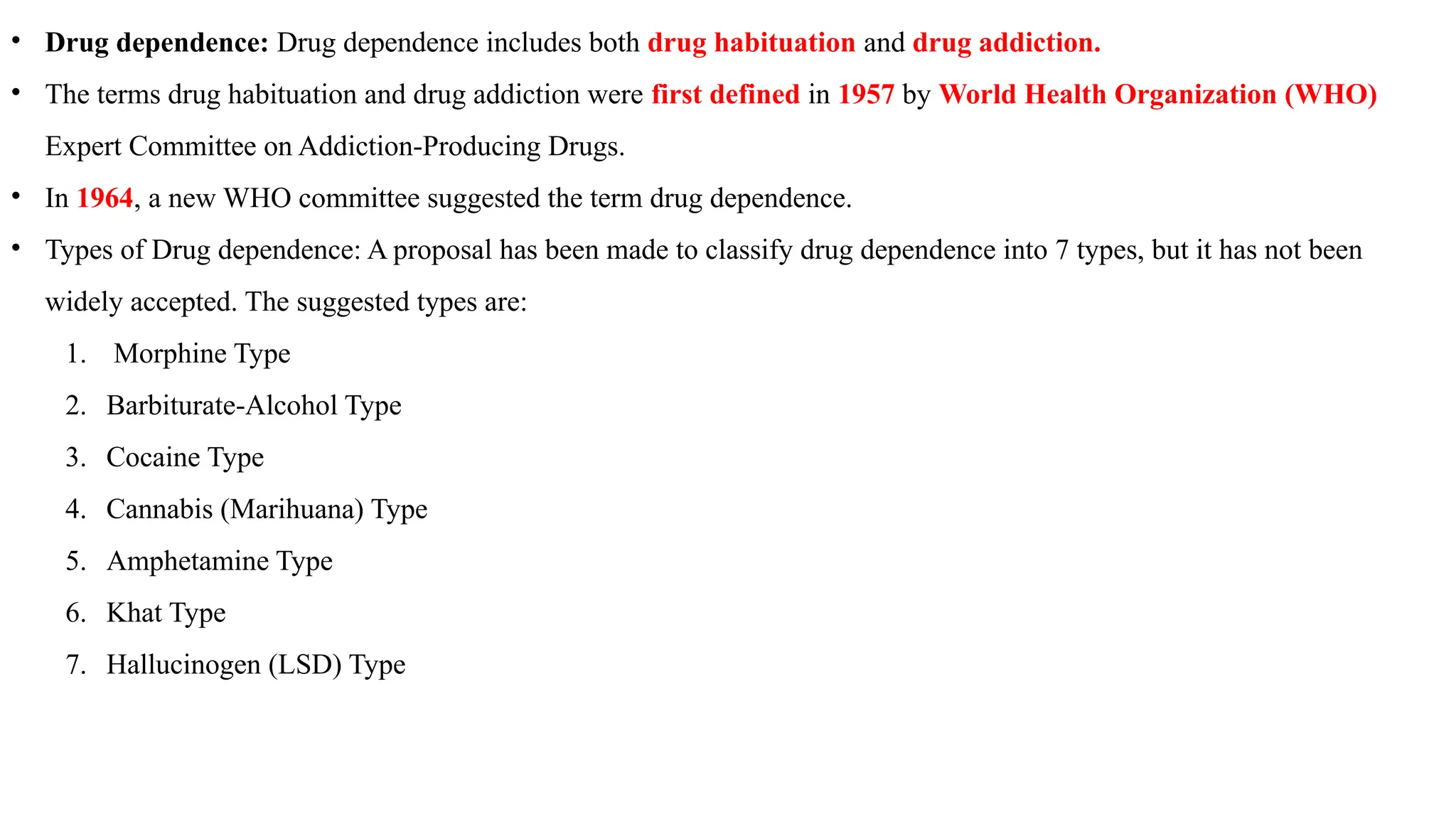
• Drug Habituation: Psychological and emotional dependency
resulting from repeated consumption of a drug (caffeine in tea
and coffee, nicotine in cigarettes).
• Drug Addiction: Physical, psychological and emotional
dependency resulting from repeated consumption of a drug
(opium, cocaine, cannabis).
• Compulsive use - There is compulsive use of drugs (craving)
resulting in physical, psychological and social harm. Use is
continued despite awareness of that harm.
• Drug Relapse - Relapse is the return to drug taking following
extended periods of abstinence.
• Drugs known to cause addiction - include illegal drugs as well
as prescription or over-the-counter [OTC] drugs [Prescription
drug abuse, Kiddie dope].
• Drug dependence: Drug dependence includes both drug habituation and drug addiction.
• The terms drug habituation and drug addiction were first defined in 1957 by World Health Organization (WHO)
Expert Committee on Addiction-Producing Drugs.
• In 1964, a new WHO committee suggested the term drug dependence.
• Types of Drug dependence: A proposal has been made to classify drug dependence into 7 types, but it has not been
widely accepted. The suggested types are:
1. Morphine Type
2. Barbiturate-Alcohol Type
3. Cocaine Type
4. Cannabis (Marihuana) Type
5. Amphetamine Type
6. Khat Type
7. Hallucinogen (LSD) Type
• Drug Abuse: The term “drug abuse” is not mentioned in DSM-IV-TR at all. However it loosely refers to the self
administration of any drug in a manner that deviates from the approved medical or social pattern within a given
culture.
• It is a tradition within some cultures to use psychoactive drugs [eg hallucinogenic mushrooms, Catha edulis,
Bhang on Holi and Kasoomba on cultural festivities in India]. Such use would not be called drug abuse.
• Drug abuse may not necessarily involve any dependency [physiological or psychological]. For example
occasional experimental use of LSD by a college student perhaps on his colleague’s insistence is drug abuse, but
not drug dependence.
• Physical dependency: Alteration in CNS which is manifested by tolerance and appearance of withdrawal
phenomena, when a chronically administered drug is discontinued or displaced from its receptor.
• Drug Tolerance: Need for greatly increased amounts of the substance to achieve intoxication (or the desired
effect) or a markedly diminished effect with continued use of the same amount of the substance.
• CNS DEPRESSANTS
• CNS STIMULANTS
• HALLUCINOGENS OR PSYCHEDELICS
• NARCOTICS
Common Classification of Drugs of Abuse
Depressants
• Depressants are substances used to slow down or depress the
functions of the central nervous system.
• Depressants calm irritability and anxiety and may induce
sleep.
• These include:
 Alcohol (ethanol or ethyl alcohol)
 Barbiturates
 Antipsychotics/antianxiety drugs (Ketamine)
 Various substances that can be sniffed, such as airplane glue,
model cement, or aerosol gas propellants such as freon.
• Alcohol (ethyl alcohol) enters the body’s bloodstream
and quickly travels to the brain, where it acts to suppress
the brain’s control of thought processes and muscle
coordination.
• Low dose: inhibits judgement, memory, concentration.
Confident personality.
• Moderate dose: reduced coordination, inhibits thought
process and speech patterns, slow reaction time. Impaired
walking/driving.
• High dose: irritable and emotional, anger/crying
• Extremely high dose: coma and death
• Barbiturates, or “downers,” are normally taken orally and
create a feeling of well-being, relax the body, and
produce sleep.
• Taken orally and enters the blood through the walls of
the intestine.
• Extensive and prolonged use will cause physical
dependence.
• Antipsychotic/Antianxiety drugs unlike
barbiturates, produce a relaxing tranquility without
impairment of high-thinking faculties or inducing
sleep.
 Common Antipsychotic drugs – reserpine and
chlorpromazine.
 Common Antianxiety drugs - Valium, Xanax.
• Can produce psychological and physical
dependency with repeated and high levels of
usage.
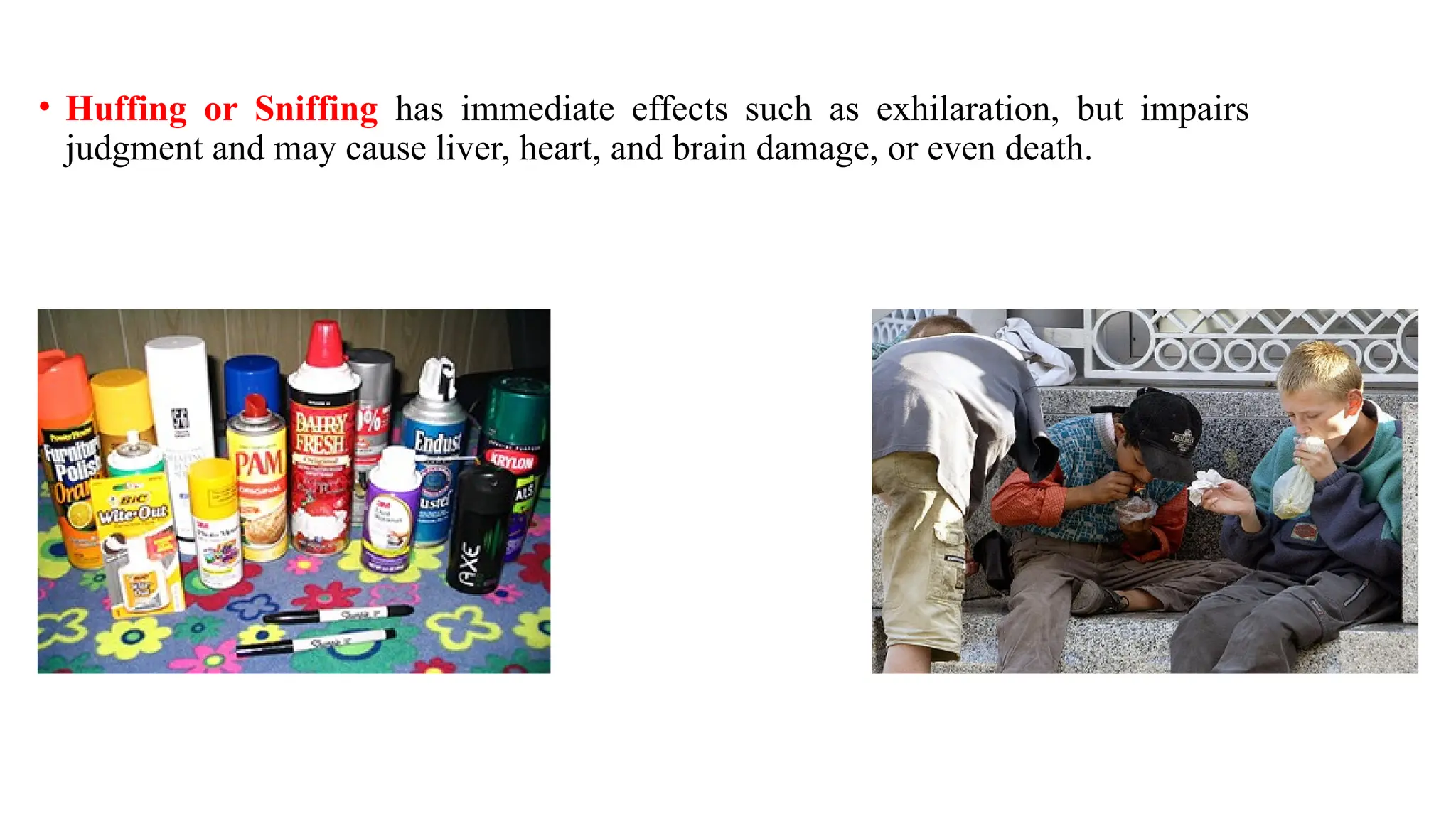
• Huffing or Sniffing has immediate effects such as exhilaration, but impairs
judgment and may cause liver, heart, and brain damage, or even death.
• Huffing or Sniffing - in the long term may
cause liver, heart, and brain damage, or even
death.
• Sniffing materials contains volatile solvents:
airplane glue, Freon, toluene, and gasoline.
• Immediate Effects: exhilaration and
euphoria, slurred speech, impaired
judgement, double vision, drowsiness,
stupor.

Introduction to Drug of Buse (Part 1) .pptx

  • 1.
    UNIT 3: Introductionto Drug of Abuse Prof. Mayank David Raiborde Asst. Professor Dept. of Forensic Science Kristu Jayanti College (Autonomous) Bengaluru
  • 2.
    • Drug: Anysubstance, other than that required for the maintenance of normal health, which when administered to a living organism modifies one or more of its functions. • A drug is a substance that alters the normal functioning of the human body, whether for medicinal, recreational, or other purposes. • Drug Use: Drug use refers to the consumption of a substance as prescribed or intended, typically for legitimate medical or recreational purposes, without adverse consequences or harmful effects. • When taken into body, changes the bodily functions either physically or psychologically. • Agent used for: Diagnosis, Treatment and Prevention. • Drug Misuse: Drug misuse occurs when a substance is used in a way that deviates from medical or social norms, potentially resulting in negative health or social consequences. Misuse can involve taking more than prescribed, using someone else's medication, or Topic 1: Introduction to Drugs & Psychotropic Substances
  • 3.
    • Drug Habituation:Psychological and emotional dependency resulting from repeated consumption of a drug (caffeine in tea and coffee, nicotine in cigarettes). • Drug Addiction: Physical, psychological and emotional dependency resulting from repeated consumption of a drug (opium, cocaine, cannabis). • Compulsive use - There is compulsive use of drugs (craving) resulting in physical, psychological and social harm. Use is continued despite awareness of that harm. • Drug Relapse - Relapse is the return to drug taking following extended periods of abstinence. • Drugs known to cause addiction - include illegal drugs as well as prescription or over-the-counter [OTC] drugs [Prescription drug abuse, Kiddie dope].
  • 5.
    • Drug dependence:Drug dependence includes both drug habituation and drug addiction. • The terms drug habituation and drug addiction were first defined in 1957 by World Health Organization (WHO) Expert Committee on Addiction-Producing Drugs. • In 1964, a new WHO committee suggested the term drug dependence. • Types of Drug dependence: A proposal has been made to classify drug dependence into 7 types, but it has not been widely accepted. The suggested types are: 1. Morphine Type 2. Barbiturate-Alcohol Type 3. Cocaine Type 4. Cannabis (Marihuana) Type 5. Amphetamine Type 6. Khat Type 7. Hallucinogen (LSD) Type
  • 6.
    • Drug Abuse:The term “drug abuse” is not mentioned in DSM-IV-TR at all. However it loosely refers to the self administration of any drug in a manner that deviates from the approved medical or social pattern within a given culture. • It is a tradition within some cultures to use psychoactive drugs [eg hallucinogenic mushrooms, Catha edulis, Bhang on Holi and Kasoomba on cultural festivities in India]. Such use would not be called drug abuse. • Drug abuse may not necessarily involve any dependency [physiological or psychological]. For example occasional experimental use of LSD by a college student perhaps on his colleague’s insistence is drug abuse, but not drug dependence. • Physical dependency: Alteration in CNS which is manifested by tolerance and appearance of withdrawal phenomena, when a chronically administered drug is discontinued or displaced from its receptor. • Drug Tolerance: Need for greatly increased amounts of the substance to achieve intoxication (or the desired effect) or a markedly diminished effect with continued use of the same amount of the substance.
  • 7.
    • CNS DEPRESSANTS •CNS STIMULANTS • HALLUCINOGENS OR PSYCHEDELICS • NARCOTICS Common Classification of Drugs of Abuse
  • 8.
    Depressants • Depressants aresubstances used to slow down or depress the functions of the central nervous system. • Depressants calm irritability and anxiety and may induce sleep. • These include:  Alcohol (ethanol or ethyl alcohol)  Barbiturates  Antipsychotics/antianxiety drugs (Ketamine)  Various substances that can be sniffed, such as airplane glue, model cement, or aerosol gas propellants such as freon.
  • 9.
    • Alcohol (ethylalcohol) enters the body’s bloodstream and quickly travels to the brain, where it acts to suppress the brain’s control of thought processes and muscle coordination. • Low dose: inhibits judgement, memory, concentration. Confident personality. • Moderate dose: reduced coordination, inhibits thought process and speech patterns, slow reaction time. Impaired walking/driving. • High dose: irritable and emotional, anger/crying • Extremely high dose: coma and death
  • 10.
    • Barbiturates, or“downers,” are normally taken orally and create a feeling of well-being, relax the body, and produce sleep. • Taken orally and enters the blood through the walls of the intestine. • Extensive and prolonged use will cause physical dependence.
  • 11.
    • Antipsychotic/Antianxiety drugsunlike barbiturates, produce a relaxing tranquility without impairment of high-thinking faculties or inducing sleep.  Common Antipsychotic drugs – reserpine and chlorpromazine.  Common Antianxiety drugs - Valium, Xanax. • Can produce psychological and physical dependency with repeated and high levels of usage.
  • 12.
    • Huffing orSniffing has immediate effects such as exhilaration, but impairs judgment and may cause liver, heart, and brain damage, or even death.
  • 13.
    • Huffing orSniffing - in the long term may cause liver, heart, and brain damage, or even death. • Sniffing materials contains volatile solvents: airplane glue, Freon, toluene, and gasoline. • Immediate Effects: exhilaration and euphoria, slurred speech, impaired judgement, double vision, drowsiness, stupor.

Editor's Notes

  • #5 DSM-IV-TR: Diagnostic and Statistical Manual of Mental Disorders is a compendium of mental disorders, a listing of the criteria used to diagnose them, and a detailed system for their definition, organization, and classification.