UNIT 01: Fundamentals of Nutrition
& Physical Fitness
Prepared By : Mr. Mayank David R..
Asst. Professor
Dept. of Forensic Science
Kristu Jayanti College (Autonomous), Bengaluru
• Any substance used for energy, physical growth,
development and repair or rebuilding in the body can be
termed as food.
• It means, any such substance which after consumption,
helps in producing heat or energy, formation of new
tissues, repair of tissues and carrying the
physiological processes, can be called food.
• Physical growth and development.
• Production of energy or power.
• Enhancement of tissues working capacity.
• Protection against diseases.
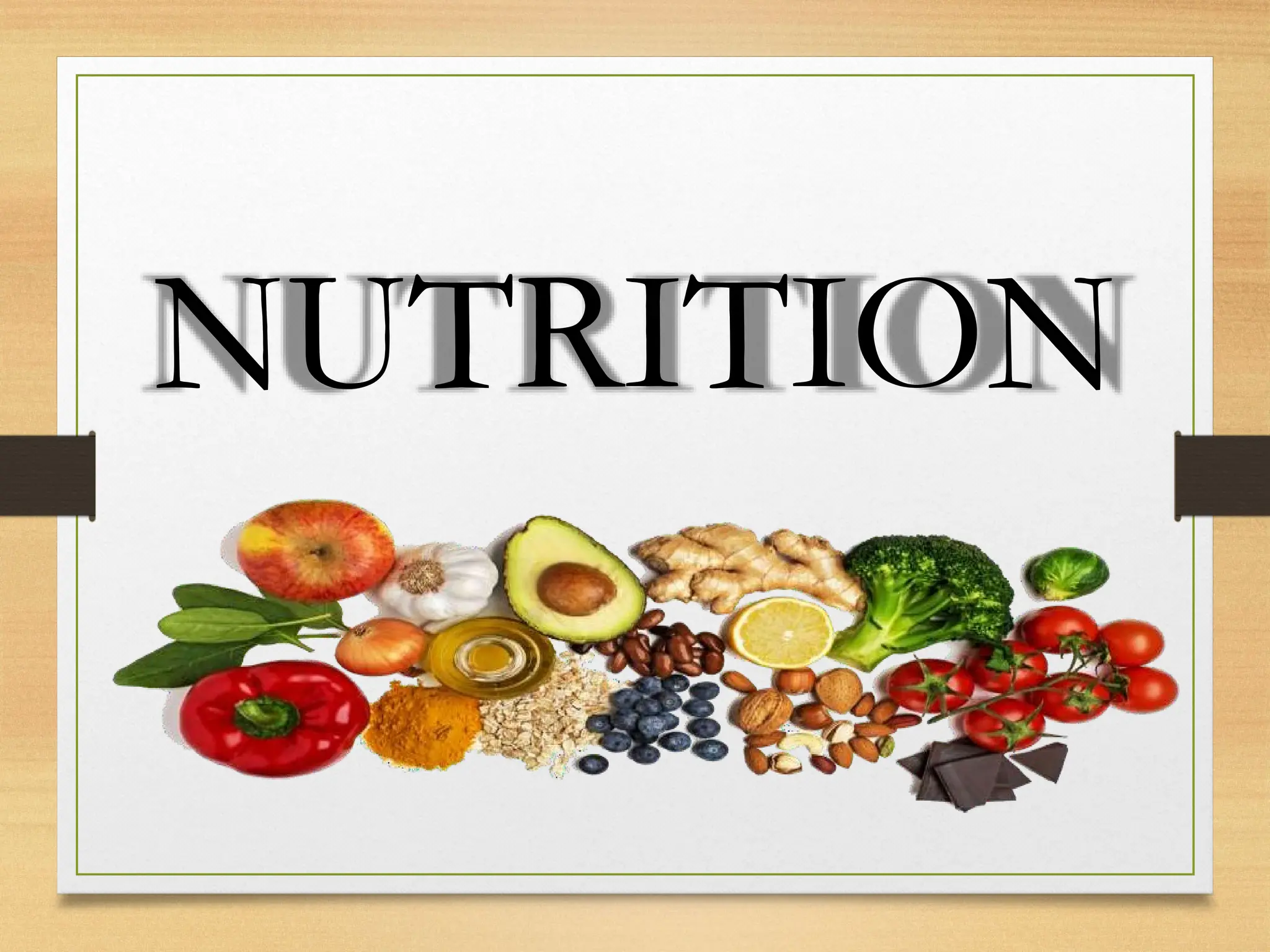
NUTRITION
INTRODUCTION
• The term “Nutrition” is derived from “Nourish” which
implies the food consumed by us and all the reactions through
which it is utilized for physical growth, energy and better
health.
• Nutrition plays an important role in healthy living and
prevention of diseases.
• Nutrition is most important indicator in determining the health
status of an individual, family and community and the nation.
“Nutrition is the study of food and nourishment.”
“The scientific study of food and nourishment,
including food composition, dietary guidelines
and the roles that various nutrients have in
maintaining health.”
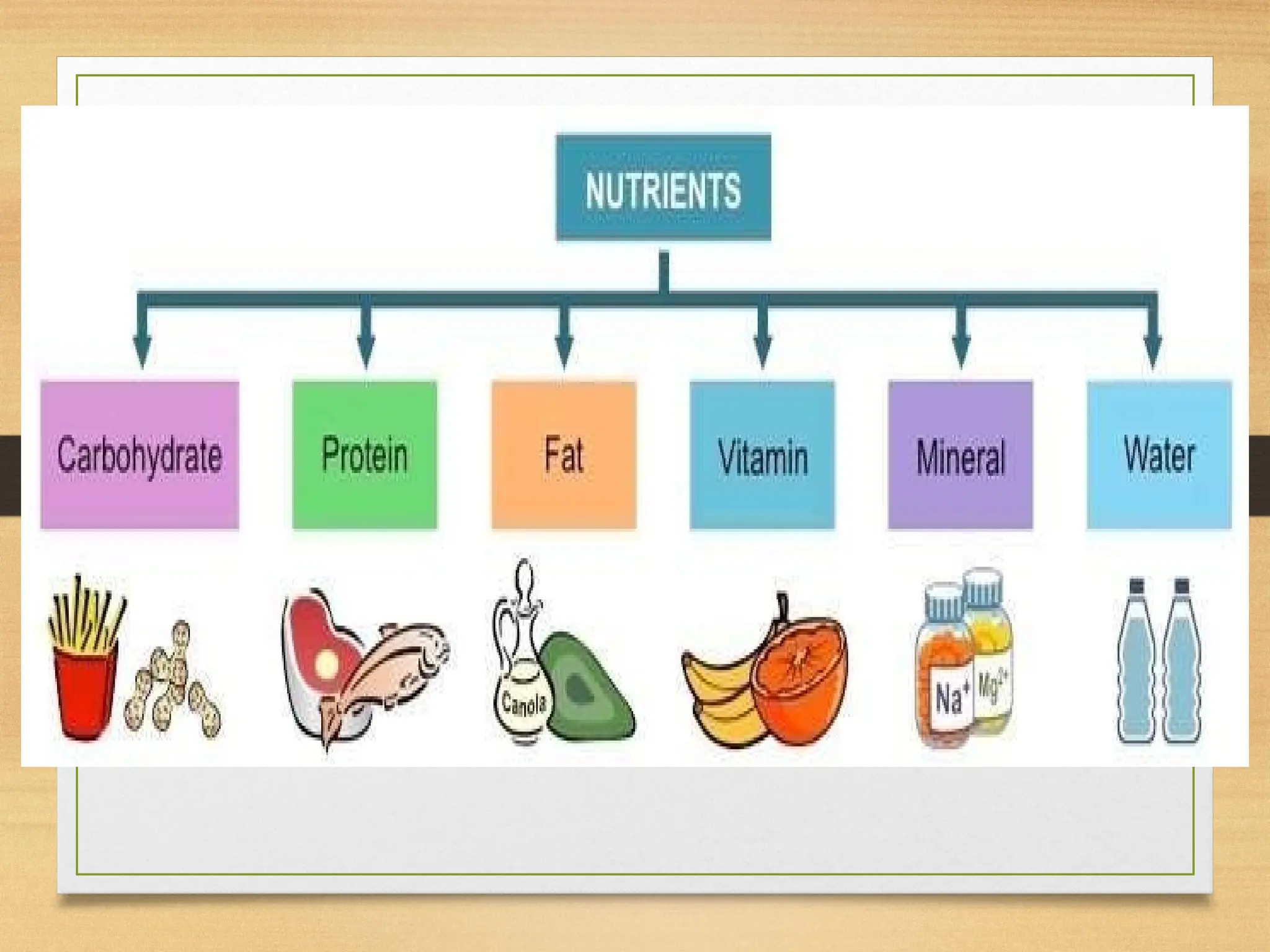
• Nutrients are organic and inorganic compounds found in
diet.
• Ordinarily, we get many nutrients in food but there is no
such food item which contains all the nutrients.
• Every food item contains more than one nutrient.
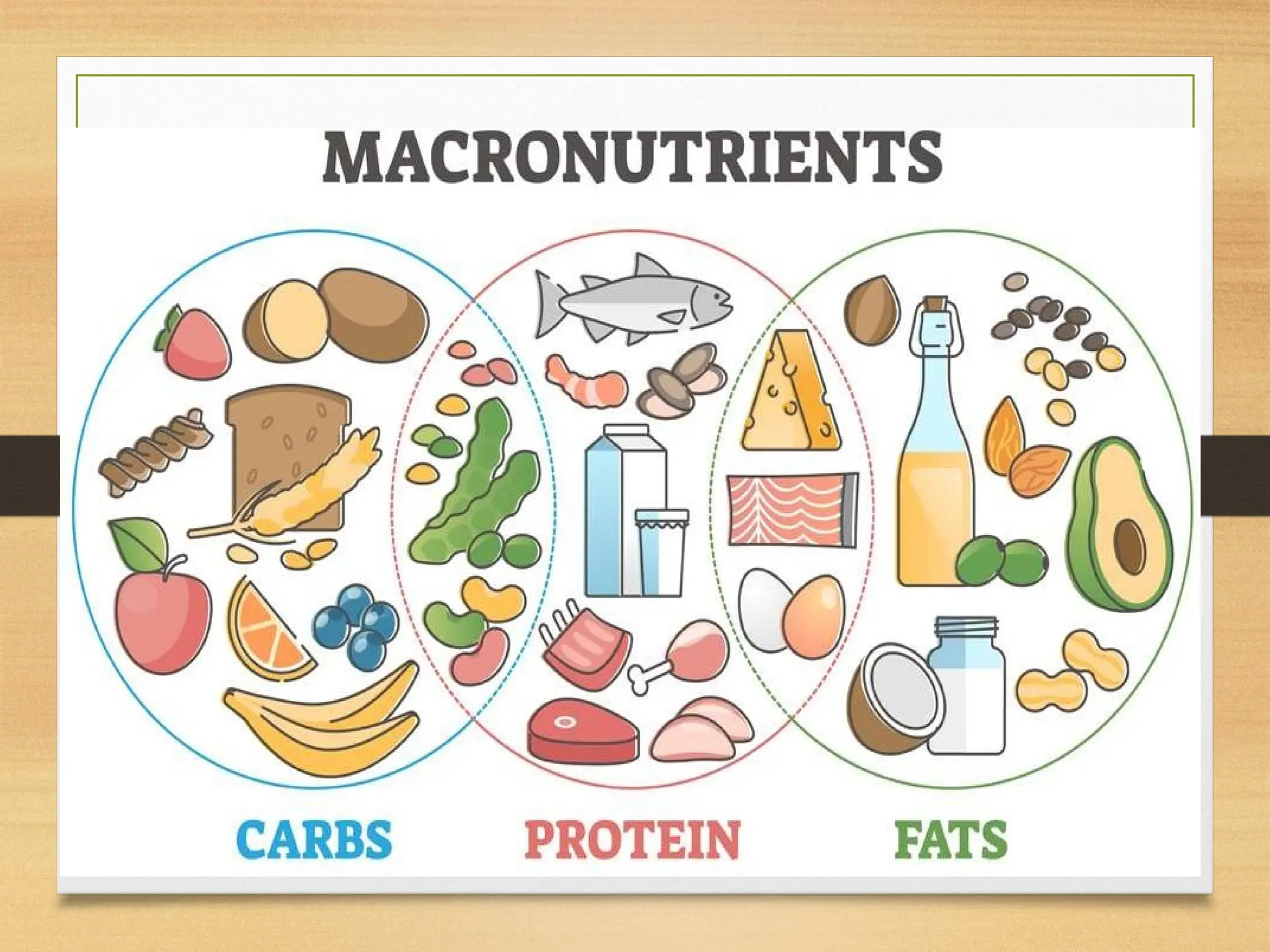
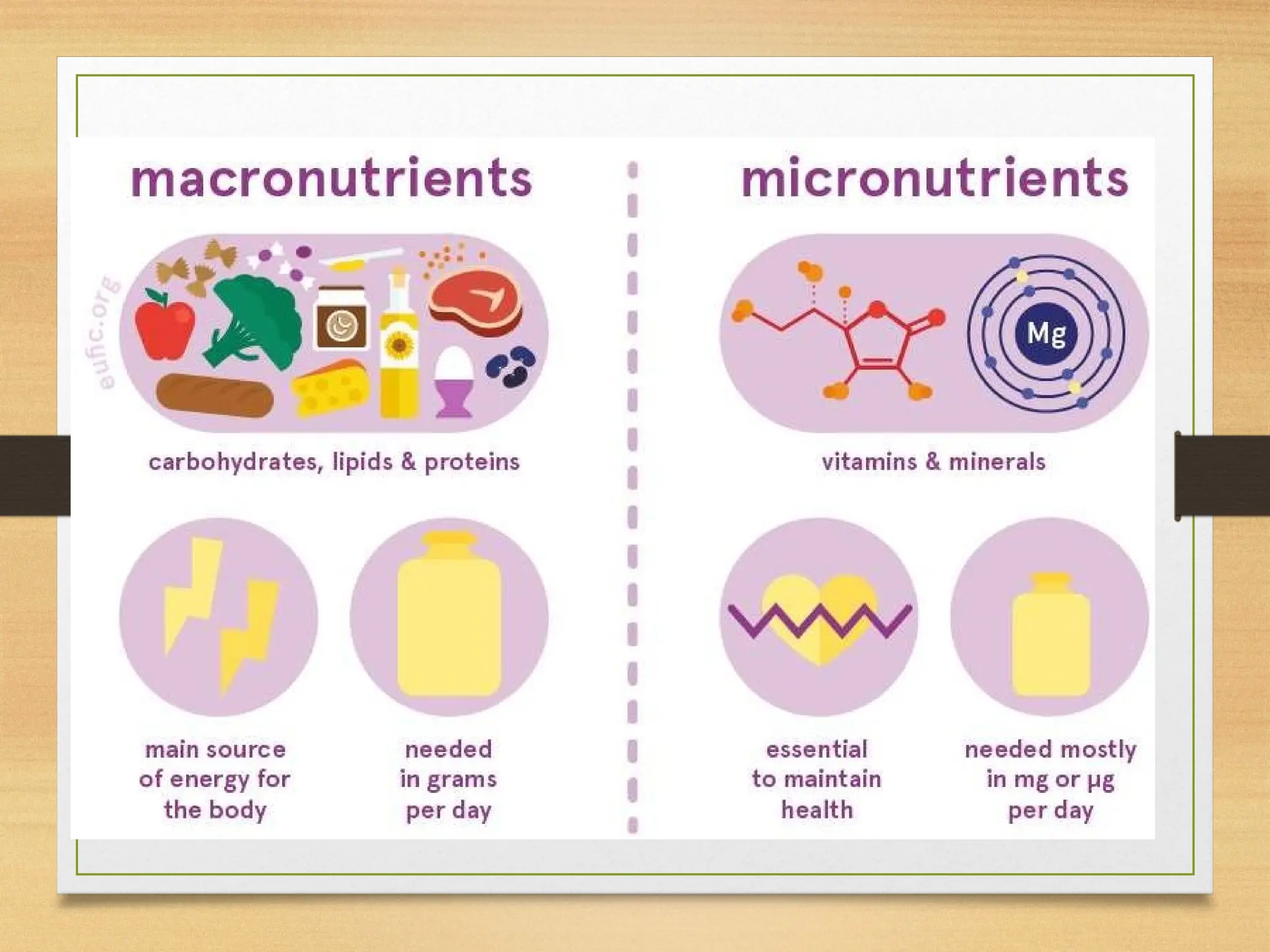
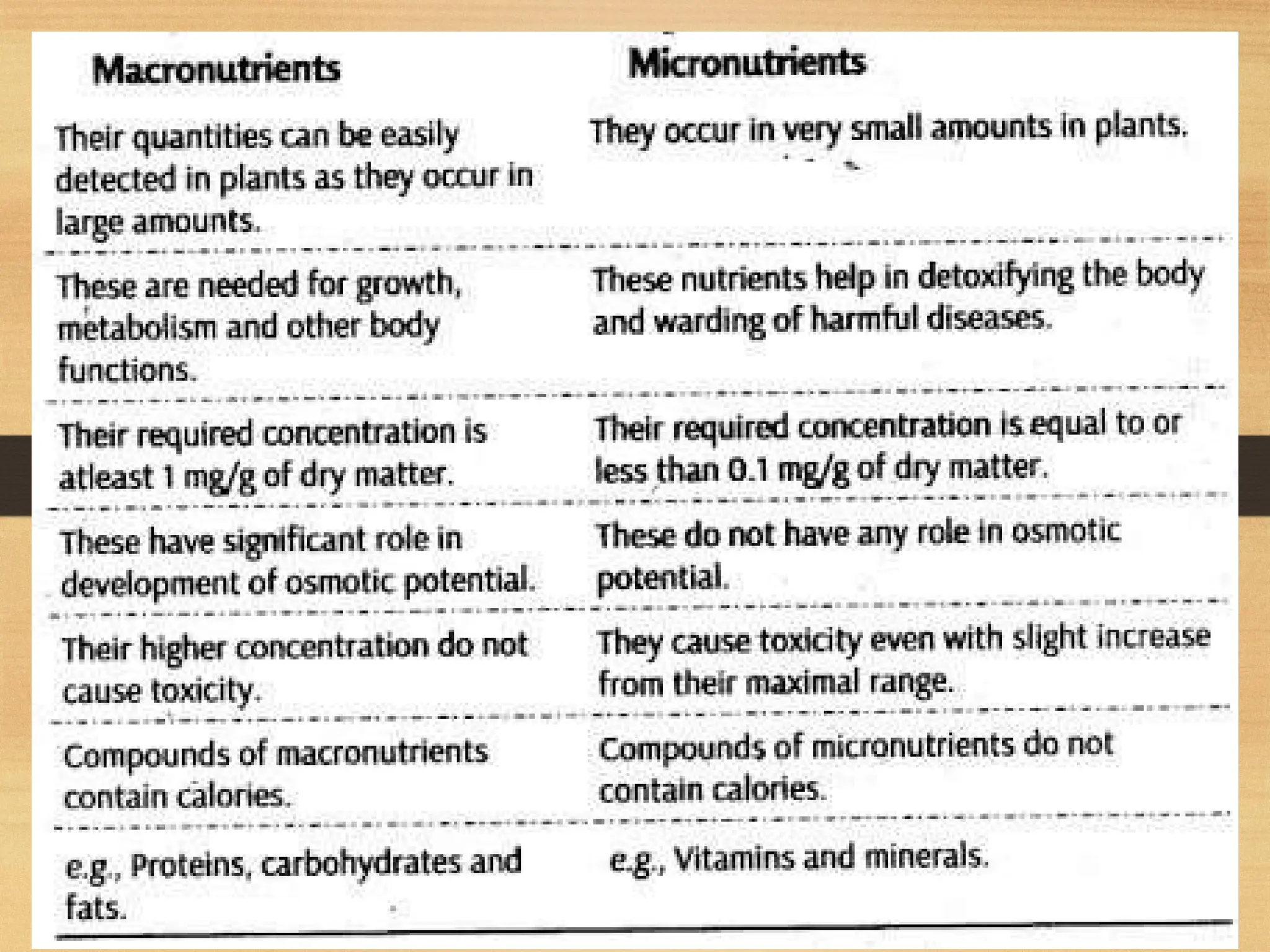
• Proteins, fats and carbohydrates are kept in this
category.
• These are the bulk of food and rare the main sources
of energy.
• a macronutrient breakdown of 20%-30% fat, 30%
protein and 40%-50% carbohydrates.
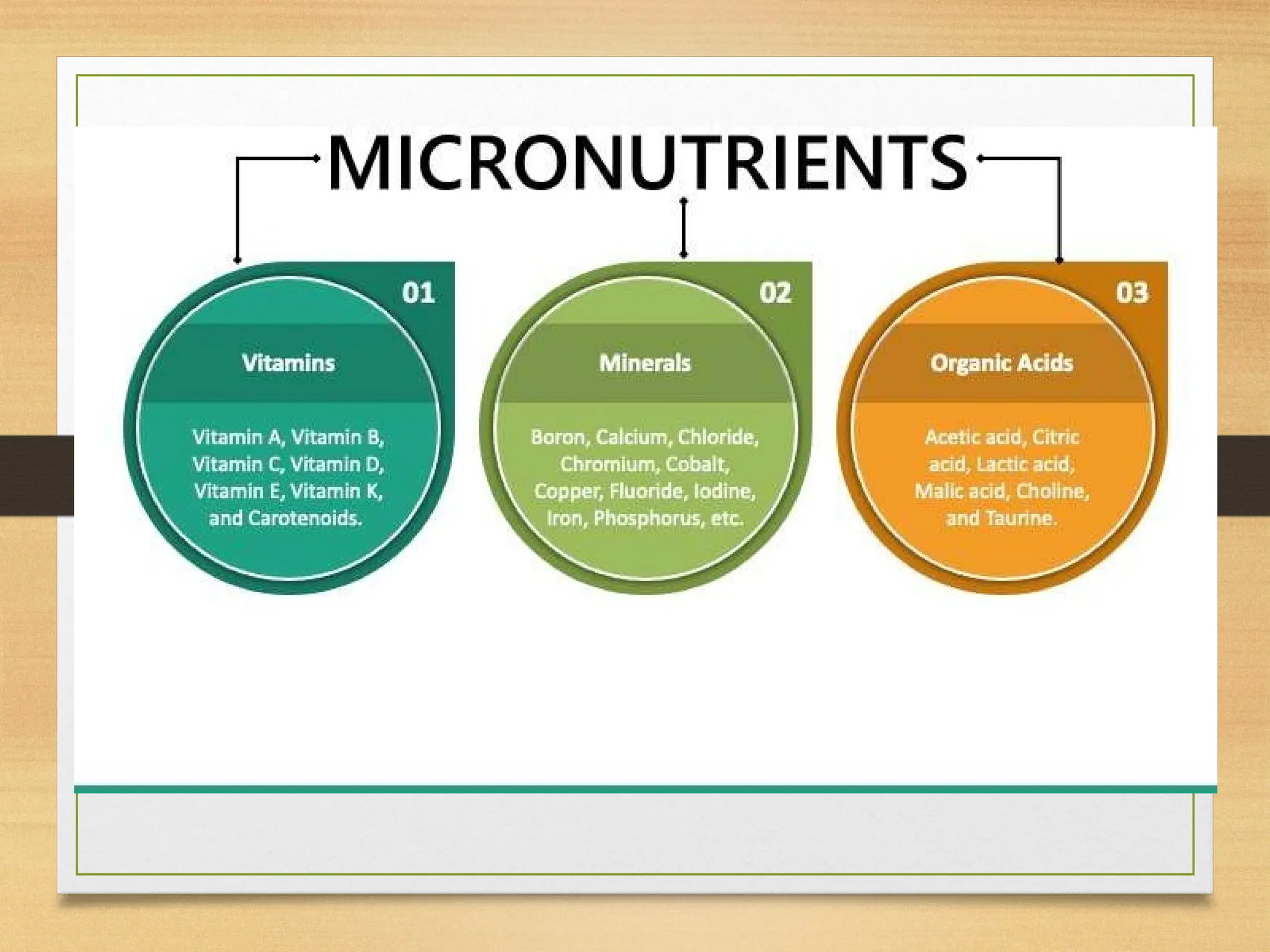
• This category includes minerals and vitamins.
• These are required in small quantities and hence,
called as micronutrients
CARBOHYDRATES
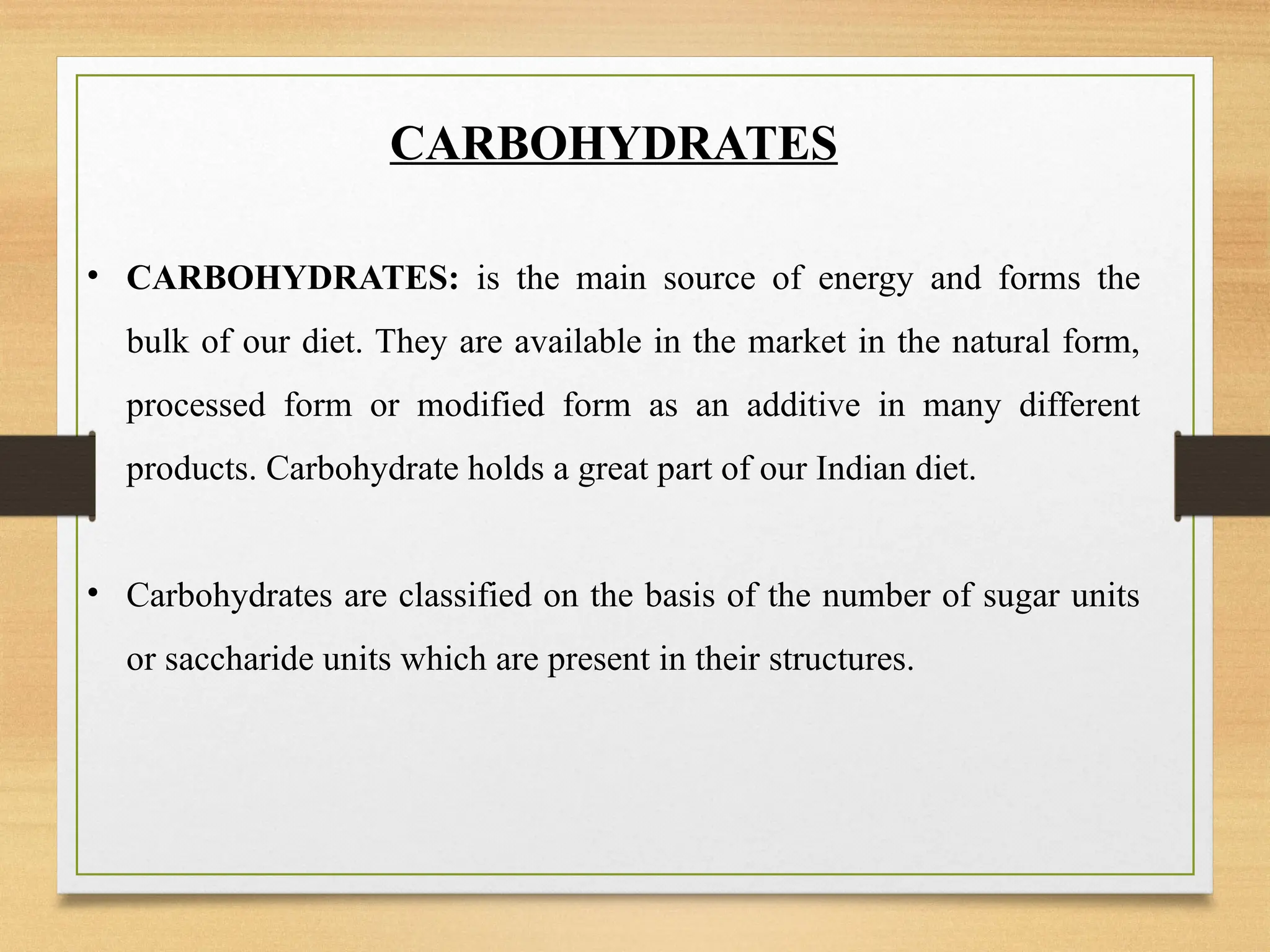
• CARBOHYDRATES: is the main source of energy and forms the
bulk of our diet. They are available in the market in the natural form,
processed form or modified form as an additive in many different
products. Carbohydrate holds a great part of our Indian diet.
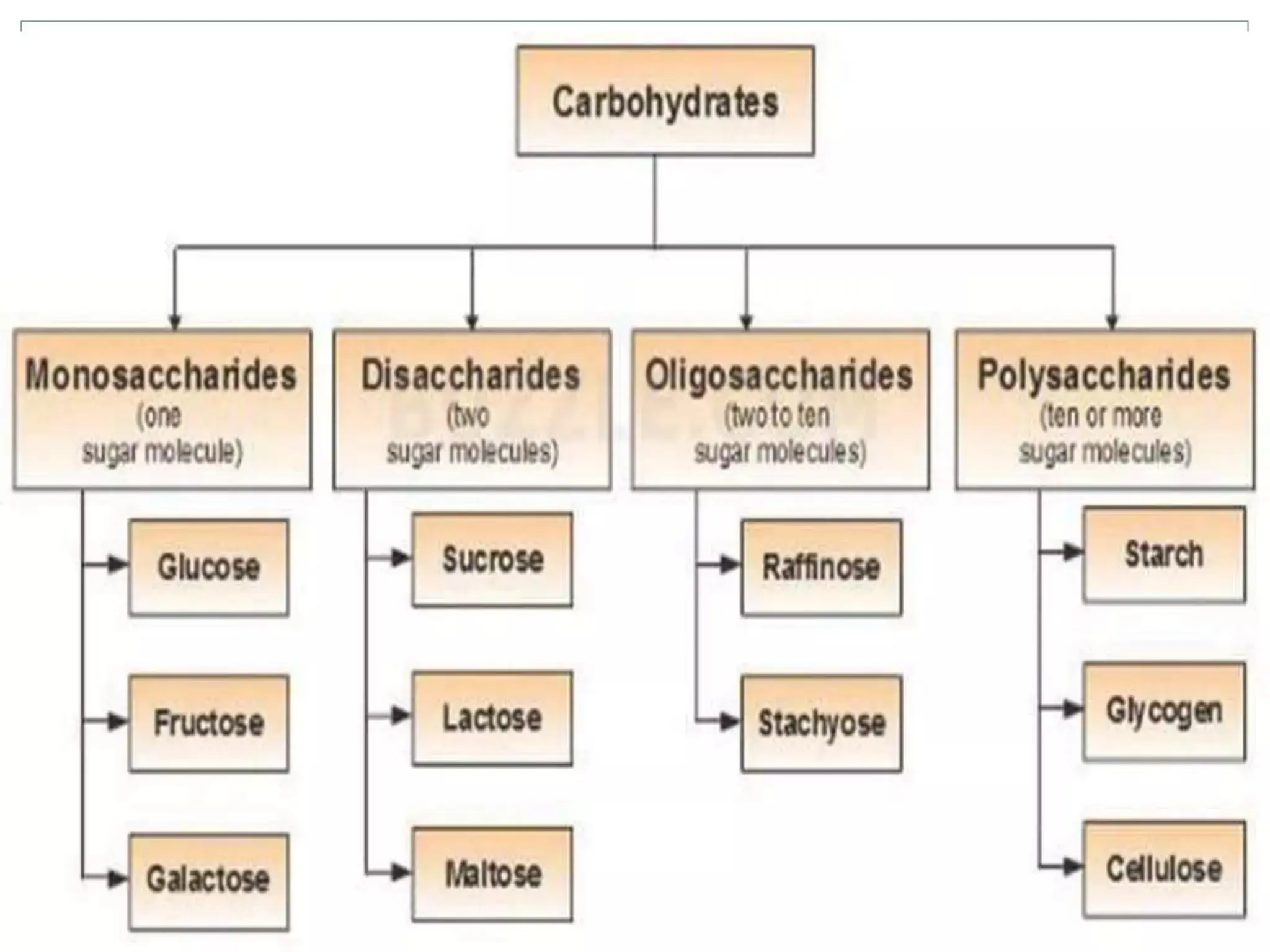
• Carbohydrates are classified on the basis of the number of sugar units
or saccharide units which are present in their structures.
1. MONOSACCHARIDES
• Monosaccharides also called simple sugar, are the
simplest form of sugar and the most basic units of
carbohydrate. They cannot be further hydrolyzed to
simpler chemical compounds. The general formula is
C6H12O6(Glucose).
• They are usually colorless, water-soluble, and crystalline
solids. Some monosaccharide's have a sweet taste.
• GLUCOSE: It is the most important of all the
monosaccharide's as it is the primary carbohydrate used
by the body. Glucose is the sugar which is absorbed into
the bloodstream after carbohydrates are digested in the
body.
• It is also known as dextrose and available in powder and
liquid form.
• FRUCTOSE: It is the sweetest of all sugars and is also
known as fruit sugar because it is found in fruits and
honey. In human body, it is converted to glucose and
oxidized as a source of energy. It is also called levulose.
• Galactose- It is found in combination with glucose in
milk. This sugar is converted to glucose in human body.It
is also known as dextrose and available in powder and
liquid form.
2. Disaccharides
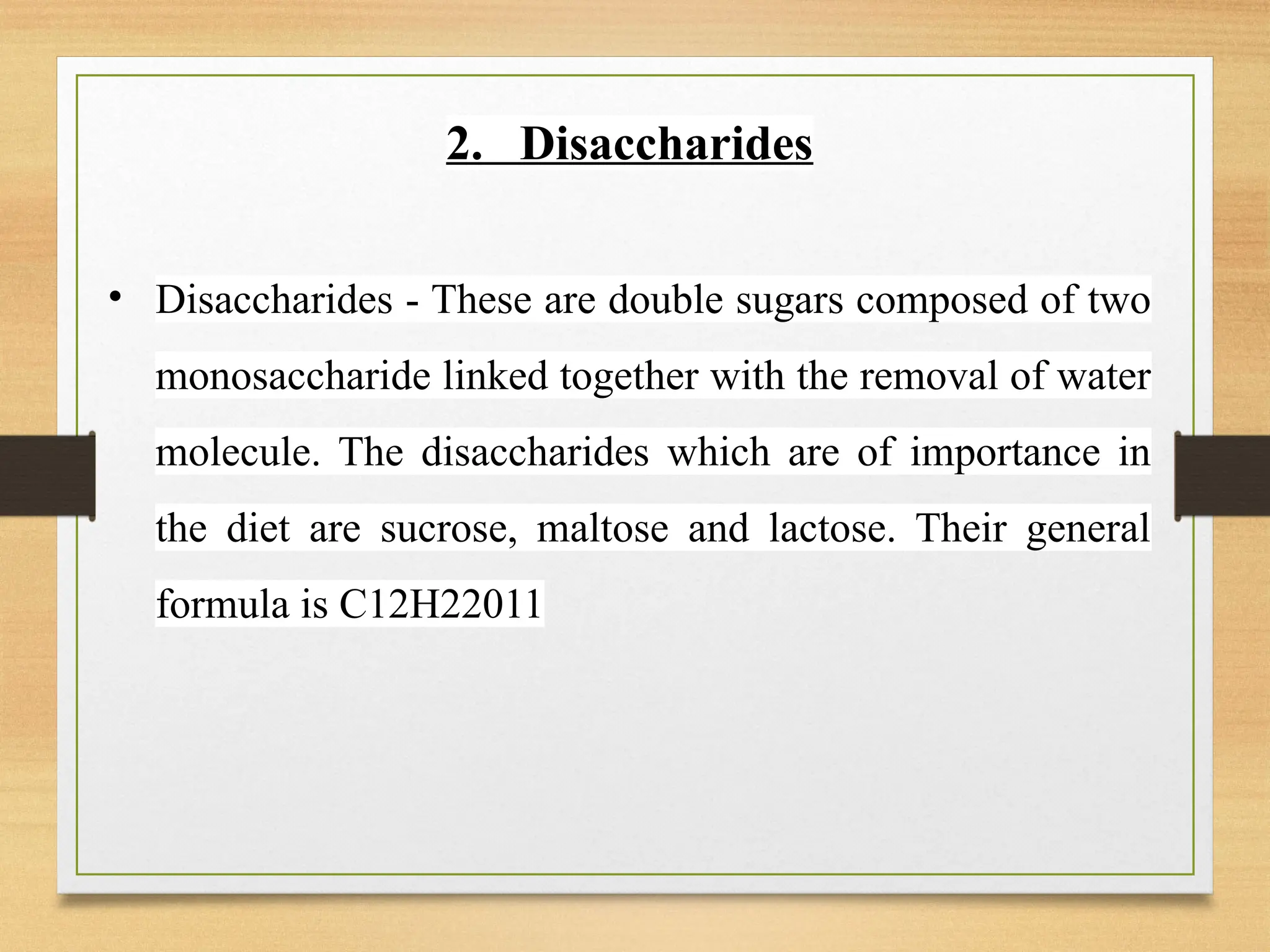
• Disaccharides - These are double sugars composed of two
monosaccharide linked together with the removal of water
molecule. The disaccharides which are of importance in
the diet are sucrose, maltose and lactose. Their general
formula is C12H22011
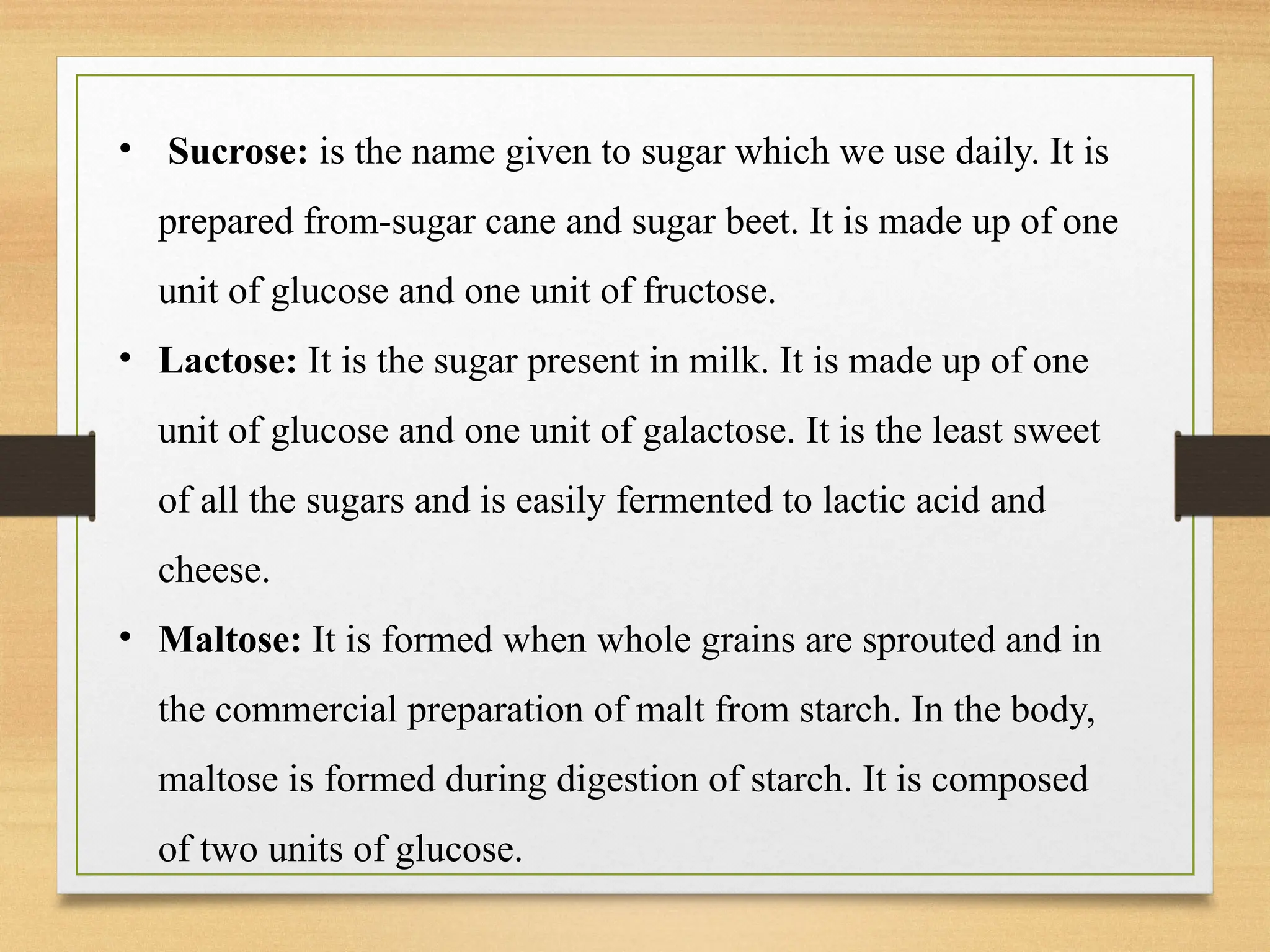
• Sucrose: is the name given to sugar which we use daily. It is
prepared from-sugar cane and sugar beet. It is made up of one
unit of glucose and one unit of fructose.
• Lactose: It is the sugar present in milk. It is made up of one
unit of glucose and one unit of galactose. It is the least sweet
of all the sugars and is easily fermented to lactic acid and
cheese.
• Maltose: It is formed when whole grains are sprouted and in
the commercial preparation of malt from starch. In the body,
maltose is formed during digestion of starch. It is composed
of two units of glucose.
3. Oligosaccharides
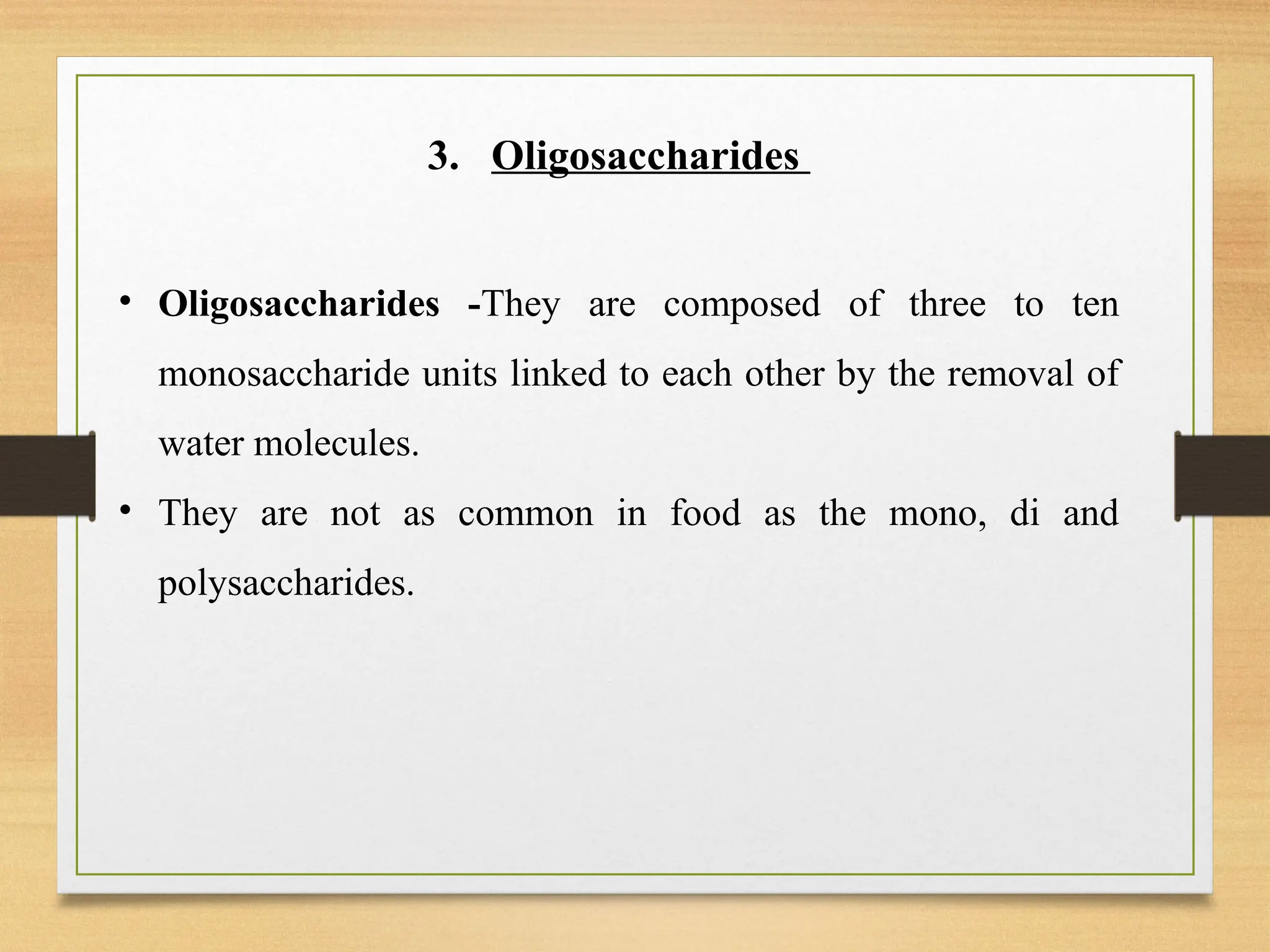
• Oligosaccharides -They are composed of three to ten
monosaccharide units linked to each other by the removal of
water molecules.
• They are not as common in food as the mono, di and
polysaccharides.
4. Polysaccharides
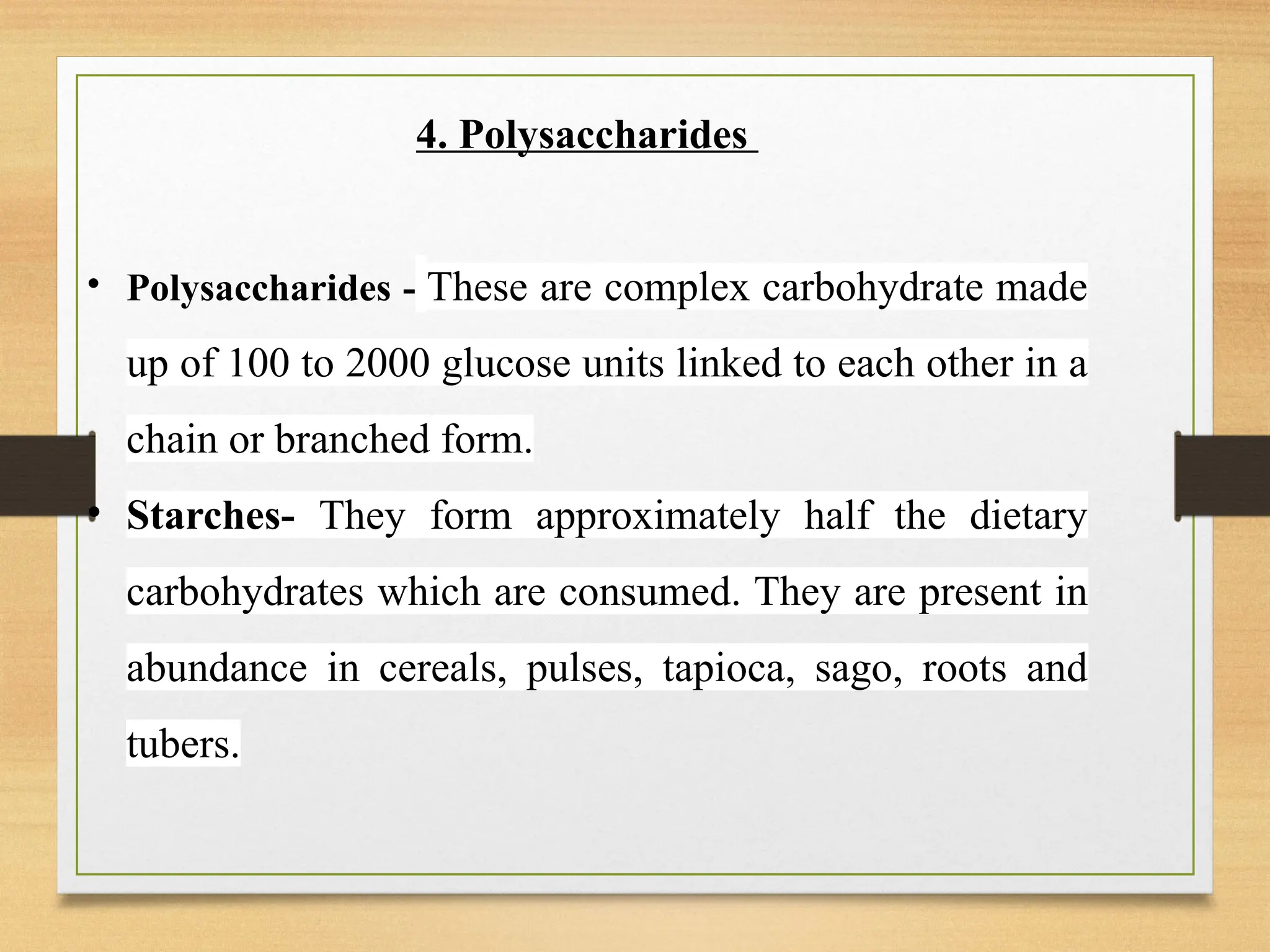
• Polysaccharides - These are complex carbohydrate made
up of 100 to 2000 glucose units linked to each other in a
chain or branched form.
• Starches- They form approximately half the dietary
carbohydrates which are consumed. They are present in
abundance in cereals, pulses, tapioca, sago, roots and
tubers.
• Glycogen -This is also called animal starch as it is the form in
which the animal body stores CARBOHYDRATES as a
reserve source of energy. One third of the glycogen is stored in
the liver and two- third is stored in muscles.
• Dextrin :This is formed in the first stage of starch breakdown
either by enzyme during digestion or by the action of dry heat
on starch during toasting a bread or browning flour.
Function of Carbohydrates
• The chief function of carbohydrate is to provide energy to the body so
that it can carry out day to day work and maintain body temperature.
• They are required for complete oxidation of fat.
• Carbohydrates spare proteins from being broken down for energy and are
used for body building and repair.
• Glucose in the only form of energy used by the CNS.
• The sugar lactose help in the absorption of the minerals calcium and
phosphorus.
• Lactose also helps certain bacteria to grow in the intestine.
• Dietary fibers help in preventing constipation.
DIETARY FIBRES
• Fibers: Fibers are also known as roughage or bulk
• They are sugars and starches ( polysaccharides) from plants.
Fruits, vegetables, whole grains and legumes, such as peas
and beans.
• Another way to get fiber is through natural supplements
such as psyllium, which is made from the seed of a shrub-
like herb.
DIETARY VS. FUNCTIONAL FIBRES
• Dietary fiber : consists of nondigestible carbohydrates and
lignin that are intrinsic and intact in plants.
• Functional fiber : consists of isolated, nondigestible
carbohydrates that have beneficial physiological effects in
humans.
DIETARY FIBRES CLASSIFICATION
• Fiber can be classified into two types:
• Soluble (dissolves in water and may form a gel)
• Soluble fiber can help to lower cholesterol and regulate
glucose levels as well as promote regularity.
• Examples of soluble fiber include:
• Oats; Fruits and vegetables; Beans; Barley; Psyllium.
Insoluble (does not dissolve in water)
• Insoluble fiber adds bulk to the stool and contributes to bowel regularity.
• Examples are :
• Whole-wheat flour
• Wheat bran
• Some vegetables
• Virtually all plant foods contain soluble and insoluble fiber
• Normalizes bowel movements. Dietary fiber increases the weight and size of
your stool and softens it. A bulky stool is easier to pass, decreasing your chance
of constipation. If you have loose, watery stools, fiber may help to solidify the
stool because it absorbs water and adds bulk to stool.
• Helps maintain bowel health. A high-fiber diet may lower your risk of
developing hemorrhoids and small pouches in your colon (diverticular disease).
Studies have also found that a high-fiber diet likely lowers the risk of colorectal
cancer. Some fiber is fermented in the colon. Researchers are looking at how this
may play a role in preventing diseases of the colon.
• Lowers cholesterol levels. Soluble fiber found in beans, oats, flaxseed and oat
bran may help lower total blood cholesterol levels by lowering low-density
lipoprotein, or "bad," cholesterol levels. Studies also have shown that high-fiber
foods may have other heart-health benefits, such as reducing blood pressure and
inflammation.
• Helps control blood sugar levels. In people with diabetes, fiber —
particularly soluble fiber — can slow the absorption of sugar and help
improve blood sugar levels. A healthy diet that includes insoluble fiber
may also reduce the risk of developing type 2 diabetes.
• Aids in achieving healthy weight. High-fiber foods tend to be more
filling than low-fiber foods, so you're likely to eat less and stay satisfied
longer. And high-fiber foods tend to take longer to eat and to be less
"energy dense," which means they have fewer calories for the same
volume of food.
• Helps you live longer. Studies suggest that increasing your dietary fiber
intake — especially cereal fiber — is associated with a reduced risk of
dying from cardiovascular disease and all cancers.
Introduction to nutrition and food:.pptx

Introduction to nutrition and food:.pptx

  • 1.
    UNIT 01: Fundamentalsof Nutrition & Physical Fitness Prepared By : Mr. Mayank David R.. Asst. Professor Dept. of Forensic Science Kristu Jayanti College (Autonomous), Bengaluru
  • 3.
    • Any substanceused for energy, physical growth, development and repair or rebuilding in the body can be termed as food. • It means, any such substance which after consumption, helps in producing heat or energy, formation of new tissues, repair of tissues and carrying the physiological processes, can be called food.
  • 5.
    • Physical growthand development. • Production of energy or power. • Enhancement of tissues working capacity. • Protection against diseases.
  • 6.
  • 7.
    INTRODUCTION • The term“Nutrition” is derived from “Nourish” which implies the food consumed by us and all the reactions through which it is utilized for physical growth, energy and better health. • Nutrition plays an important role in healthy living and prevention of diseases. • Nutrition is most important indicator in determining the health status of an individual, family and community and the nation.
  • 8.
    “Nutrition is thestudy of food and nourishment.” “The scientific study of food and nourishment, including food composition, dietary guidelines and the roles that various nutrients have in maintaining health.”
  • 9.
    • Nutrients areorganic and inorganic compounds found in diet. • Ordinarily, we get many nutrients in food but there is no such food item which contains all the nutrients. • Every food item contains more than one nutrient.
  • 11.
    • Proteins, fatsand carbohydrates are kept in this category. • These are the bulk of food and rare the main sources of energy. • a macronutrient breakdown of 20%-30% fat, 30% protein and 40%-50% carbohydrates.
  • 13.
    • This categoryincludes minerals and vitamins. • These are required in small quantities and hence, called as micronutrients
  • 17.
    CARBOHYDRATES • CARBOHYDRATES: isthe main source of energy and forms the bulk of our diet. They are available in the market in the natural form, processed form or modified form as an additive in many different products. Carbohydrate holds a great part of our Indian diet. • Carbohydrates are classified on the basis of the number of sugar units or saccharide units which are present in their structures.
  • 19.
    1. MONOSACCHARIDES • Monosaccharidesalso called simple sugar, are the simplest form of sugar and the most basic units of carbohydrate. They cannot be further hydrolyzed to simpler chemical compounds. The general formula is C6H12O6(Glucose). • They are usually colorless, water-soluble, and crystalline solids. Some monosaccharide's have a sweet taste.
  • 20.
    • GLUCOSE: Itis the most important of all the monosaccharide's as it is the primary carbohydrate used by the body. Glucose is the sugar which is absorbed into the bloodstream after carbohydrates are digested in the body. • It is also known as dextrose and available in powder and liquid form.
  • 21.
    • FRUCTOSE: Itis the sweetest of all sugars and is also known as fruit sugar because it is found in fruits and honey. In human body, it is converted to glucose and oxidized as a source of energy. It is also called levulose. • Galactose- It is found in combination with glucose in milk. This sugar is converted to glucose in human body.It is also known as dextrose and available in powder and liquid form.
  • 22.
    2. Disaccharides • Disaccharides- These are double sugars composed of two monosaccharide linked together with the removal of water molecule. The disaccharides which are of importance in the diet are sucrose, maltose and lactose. Their general formula is C12H22011
  • 23.
    • Sucrose: isthe name given to sugar which we use daily. It is prepared from-sugar cane and sugar beet. It is made up of one unit of glucose and one unit of fructose. • Lactose: It is the sugar present in milk. It is made up of one unit of glucose and one unit of galactose. It is the least sweet of all the sugars and is easily fermented to lactic acid and cheese. • Maltose: It is formed when whole grains are sprouted and in the commercial preparation of malt from starch. In the body, maltose is formed during digestion of starch. It is composed of two units of glucose.
  • 24.
    3. Oligosaccharides • Oligosaccharides-They are composed of three to ten monosaccharide units linked to each other by the removal of water molecules. • They are not as common in food as the mono, di and polysaccharides.
  • 25.
    4. Polysaccharides • Polysaccharides- These are complex carbohydrate made up of 100 to 2000 glucose units linked to each other in a chain or branched form. • Starches- They form approximately half the dietary carbohydrates which are consumed. They are present in abundance in cereals, pulses, tapioca, sago, roots and tubers.
  • 26.
    • Glycogen -Thisis also called animal starch as it is the form in which the animal body stores CARBOHYDRATES as a reserve source of energy. One third of the glycogen is stored in the liver and two- third is stored in muscles. • Dextrin :This is formed in the first stage of starch breakdown either by enzyme during digestion or by the action of dry heat on starch during toasting a bread or browning flour.
  • 27.
    Function of Carbohydrates •The chief function of carbohydrate is to provide energy to the body so that it can carry out day to day work and maintain body temperature. • They are required for complete oxidation of fat. • Carbohydrates spare proteins from being broken down for energy and are used for body building and repair. • Glucose in the only form of energy used by the CNS. • The sugar lactose help in the absorption of the minerals calcium and phosphorus. • Lactose also helps certain bacteria to grow in the intestine. • Dietary fibers help in preventing constipation.
  • 28.
    DIETARY FIBRES • Fibers:Fibers are also known as roughage or bulk • They are sugars and starches ( polysaccharides) from plants. Fruits, vegetables, whole grains and legumes, such as peas and beans. • Another way to get fiber is through natural supplements such as psyllium, which is made from the seed of a shrub- like herb.
  • 29.
    DIETARY VS. FUNCTIONALFIBRES • Dietary fiber : consists of nondigestible carbohydrates and lignin that are intrinsic and intact in plants. • Functional fiber : consists of isolated, nondigestible carbohydrates that have beneficial physiological effects in humans.
  • 30.
    DIETARY FIBRES CLASSIFICATION •Fiber can be classified into two types: • Soluble (dissolves in water and may form a gel) • Soluble fiber can help to lower cholesterol and regulate glucose levels as well as promote regularity. • Examples of soluble fiber include: • Oats; Fruits and vegetables; Beans; Barley; Psyllium.
  • 31.
    Insoluble (does notdissolve in water) • Insoluble fiber adds bulk to the stool and contributes to bowel regularity. • Examples are : • Whole-wheat flour • Wheat bran • Some vegetables • Virtually all plant foods contain soluble and insoluble fiber
  • 32.
    • Normalizes bowelmovements. Dietary fiber increases the weight and size of your stool and softens it. A bulky stool is easier to pass, decreasing your chance of constipation. If you have loose, watery stools, fiber may help to solidify the stool because it absorbs water and adds bulk to stool. • Helps maintain bowel health. A high-fiber diet may lower your risk of developing hemorrhoids and small pouches in your colon (diverticular disease). Studies have also found that a high-fiber diet likely lowers the risk of colorectal cancer. Some fiber is fermented in the colon. Researchers are looking at how this may play a role in preventing diseases of the colon. • Lowers cholesterol levels. Soluble fiber found in beans, oats, flaxseed and oat bran may help lower total blood cholesterol levels by lowering low-density lipoprotein, or "bad," cholesterol levels. Studies also have shown that high-fiber foods may have other heart-health benefits, such as reducing blood pressure and inflammation.
  • 33.
    • Helps controlblood sugar levels. In people with diabetes, fiber — particularly soluble fiber — can slow the absorption of sugar and help improve blood sugar levels. A healthy diet that includes insoluble fiber may also reduce the risk of developing type 2 diabetes. • Aids in achieving healthy weight. High-fiber foods tend to be more filling than low-fiber foods, so you're likely to eat less and stay satisfied longer. And high-fiber foods tend to take longer to eat and to be less "energy dense," which means they have fewer calories for the same volume of food. • Helps you live longer. Studies suggest that increasing your dietary fiber intake — especially cereal fiber — is associated with a reduced risk of dying from cardiovascular disease and all cancers.