Quick Review The metric unit for mass is? Which form of matter has particles that are free to move independently and collide frequently? Which variable is usually is represented by the x-axis in a data table? Give 2 unit labels for volume. Physical changes to matter  do not change  what?
Quick Review When CO 2(s)  changes state directly into a gas without becoming a liquid, we call this______________. Which form of matter has both crystalline and amorphous structures? Plant leaves lose water through evaporation –  physical  or  chemical ? Why? Proteins are made from amino acids –  physical  or  chemical ?  Why? Food is digested –  physical  or  chemical ? Which Law states that Mass can neither be created or destroyed?
Quick Review What method would you use to find the volume of a block of wood? What are 3 equivalent formulas for finding the volume of a cube? What are the 3 equivalent units of measurement for volume of an object? When will a substance float in water? What is the vocabulary word for finding the volume of an irregularly shaped object?
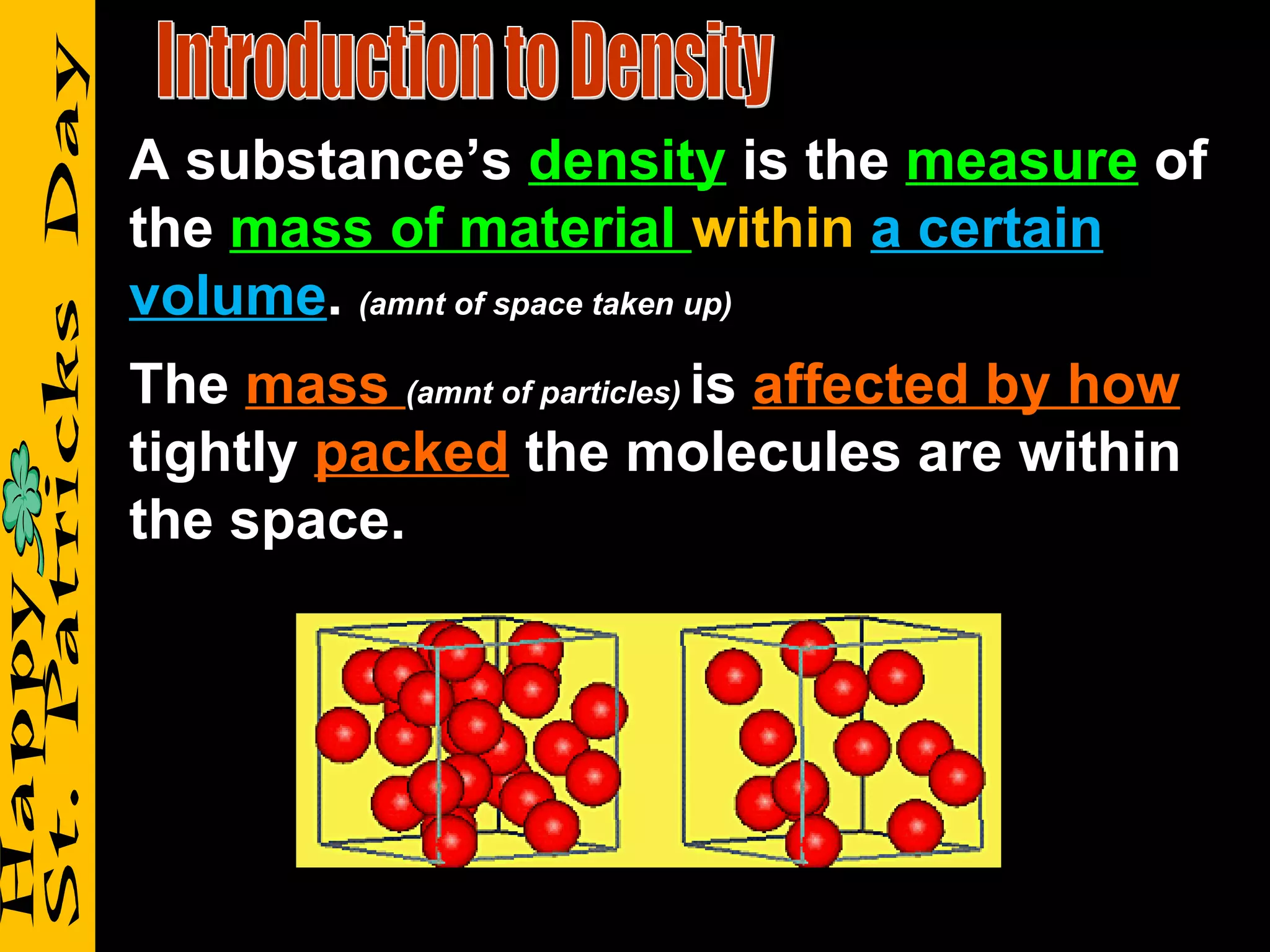
Introduction to Density A substance’s  density  is the  measure  of the  mass of material  within   a certain volume .  (amnt of space taken up) The  mass  (amnt of particles)  is  affected by how  tightly  packed  the molecules are within the space.
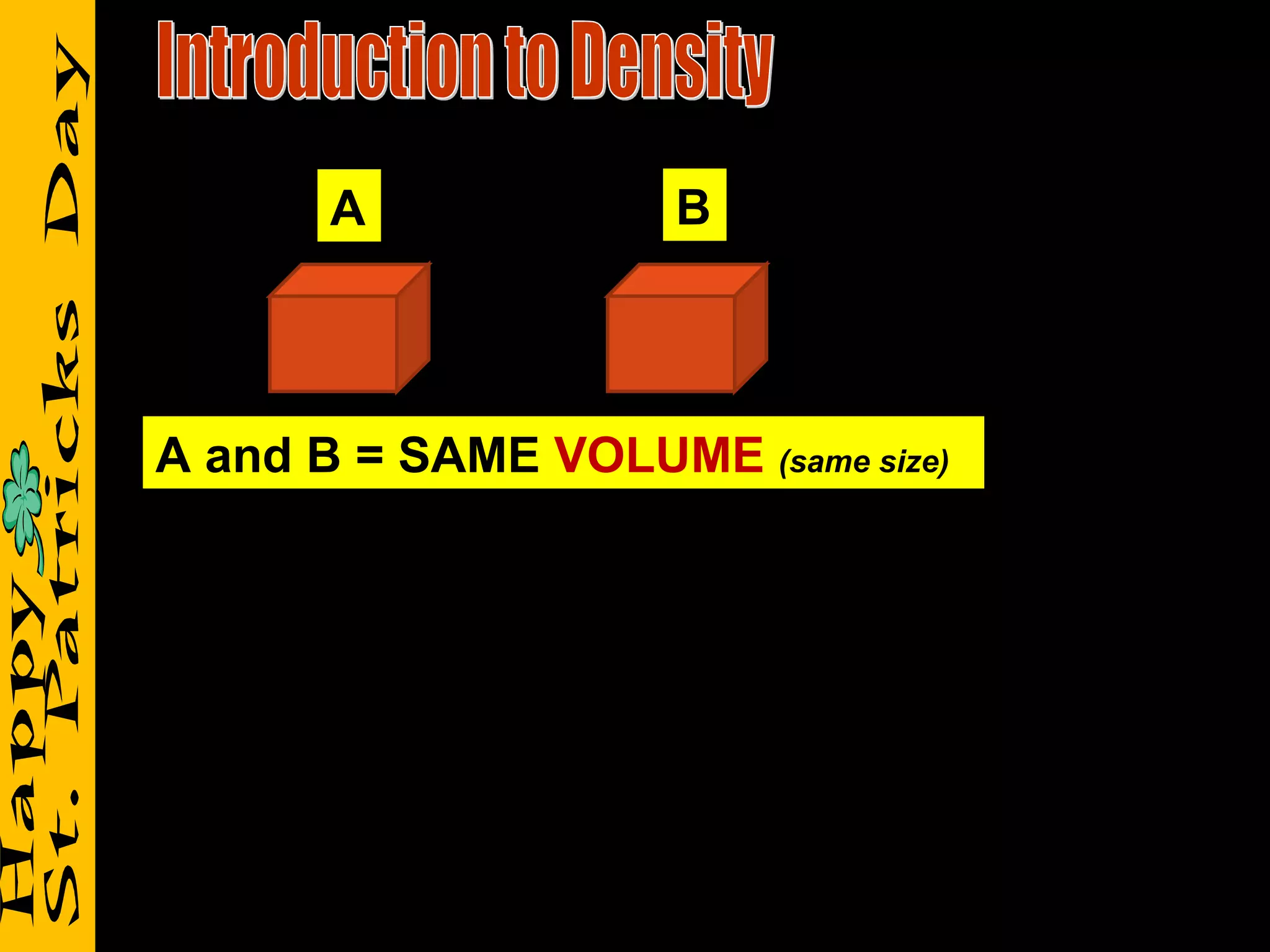
Introduction to Density A B A and B = SAME  VOLUME   (same size)
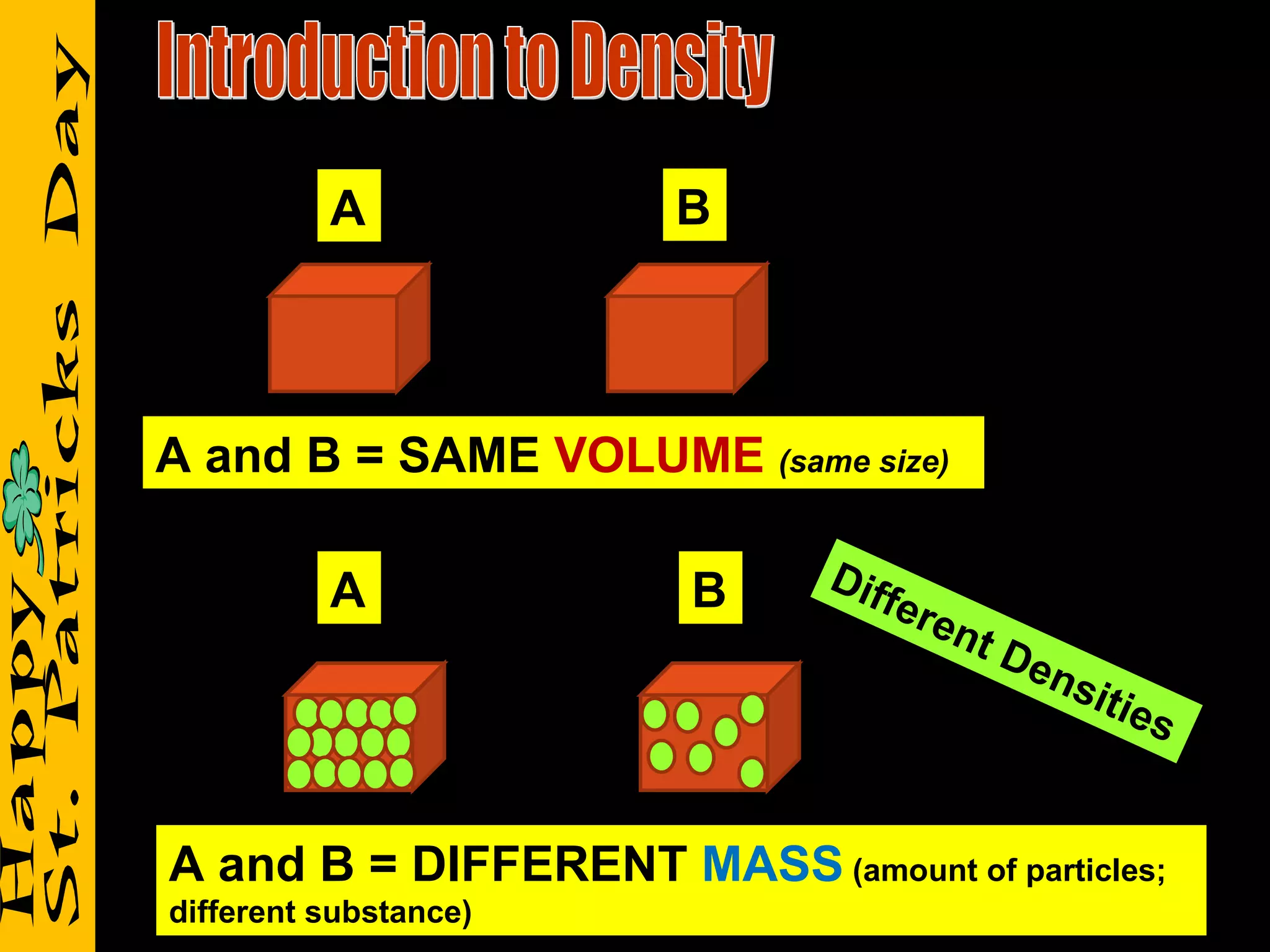
Introduction to Density A B A and B = SAME  VOLUME   (same size) A B A and B = DIFFERENT  MASS   (amount of particles; different substance) Different Densities
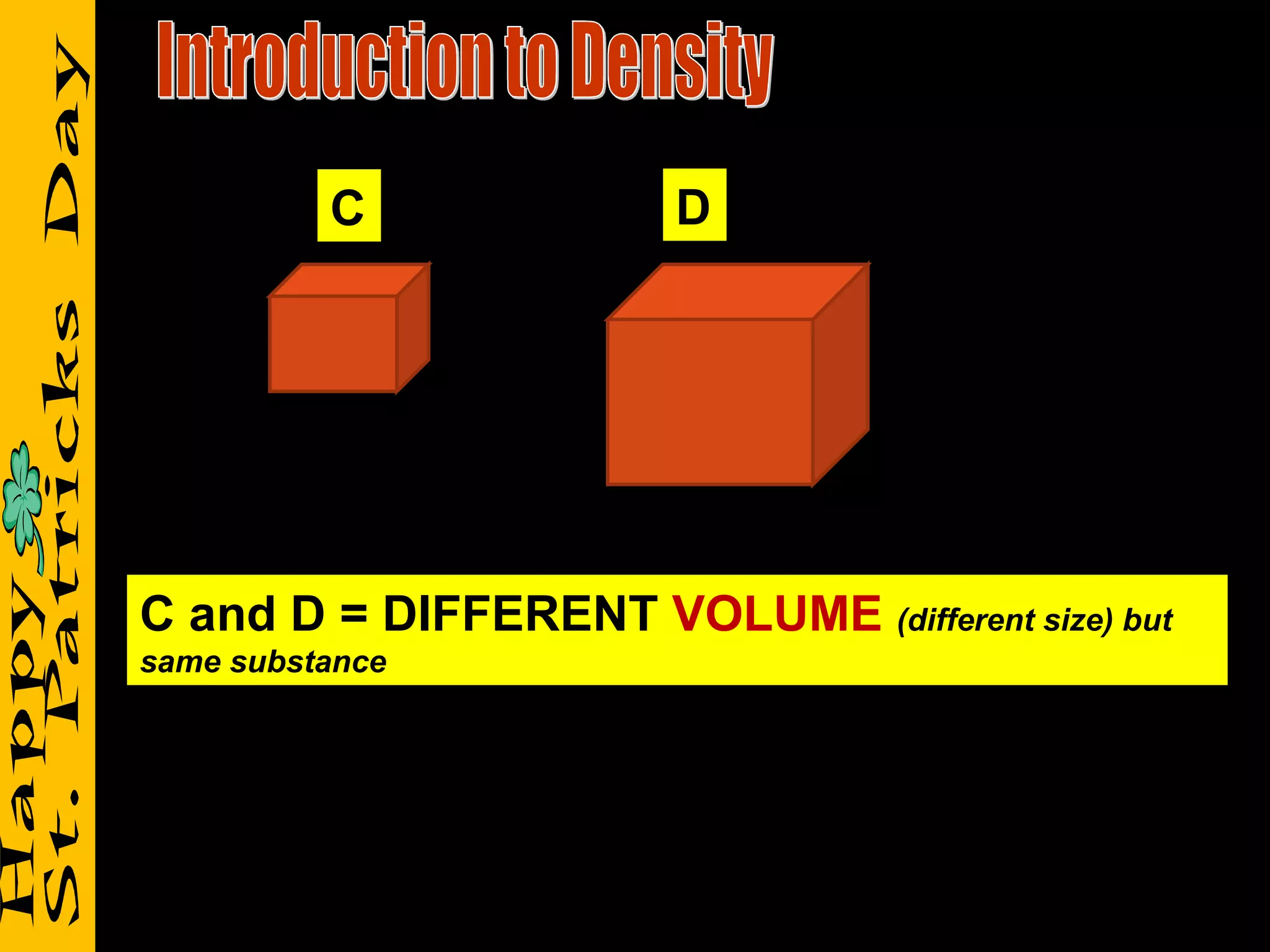
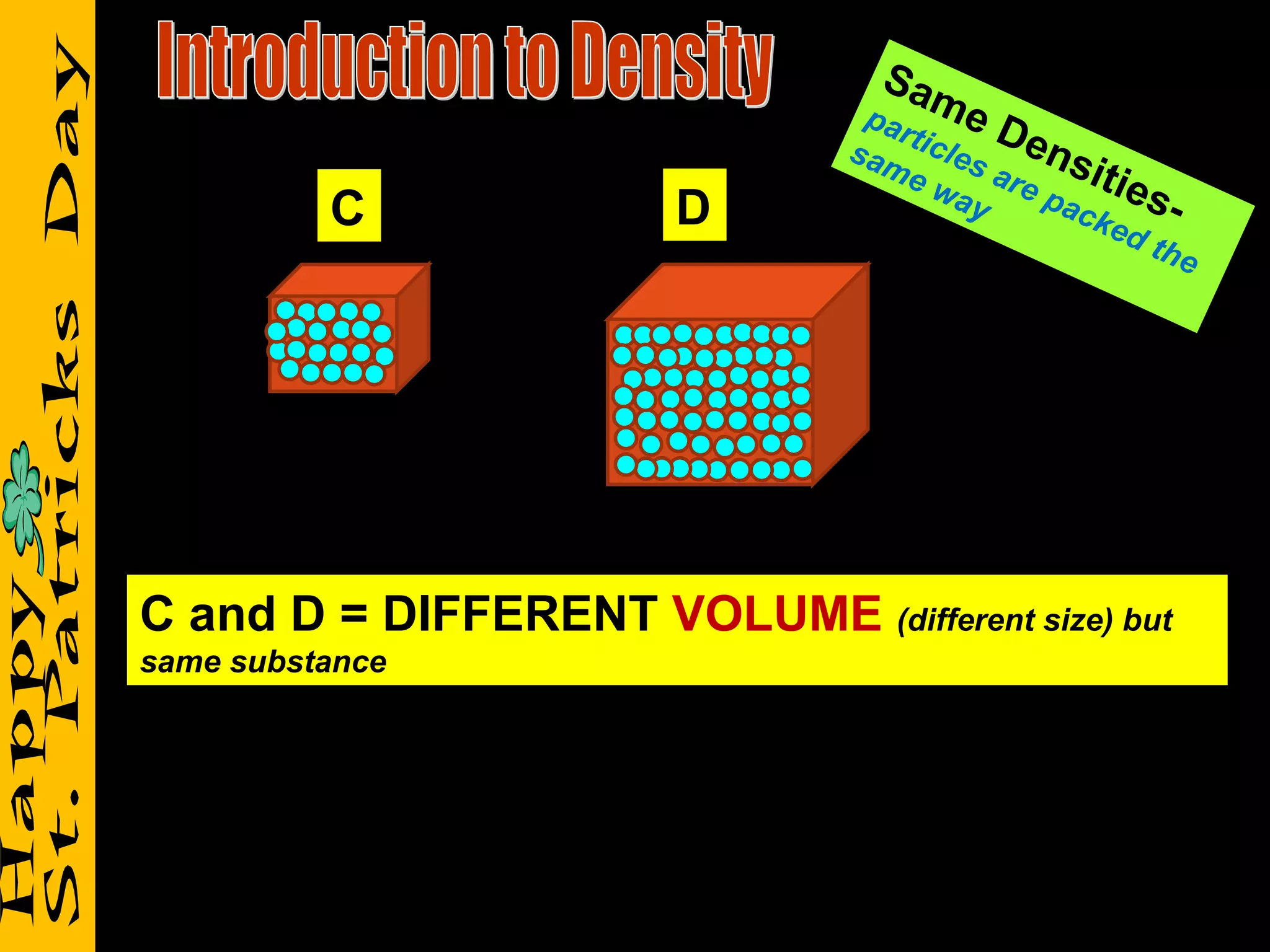
Introduction to Density C D C and D = DIFFERENT  VOLUME   (different size) but same substance
Introduction to Density C D C and D = DIFFERENT  VOLUME   (different size) but same substance Same Densities-  particles are packed the same way
Let’s Review Vocabulary Pictures Fold blank paper in half landscape style
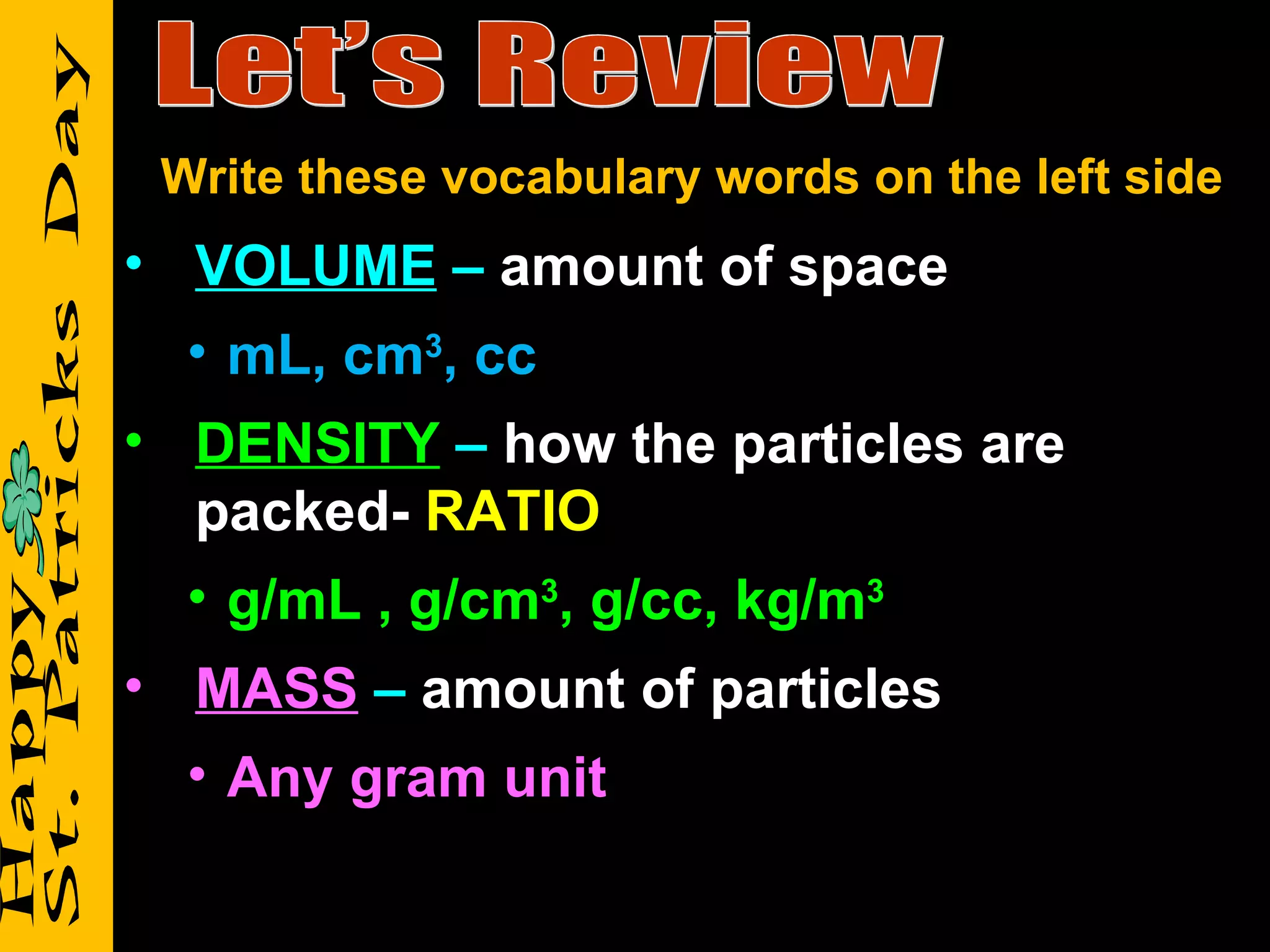
Let’s Review VOLUME  –  amount of space mL, cm 3 , cc DENSITY   –  how the particles are packed-  RATIO g/mL , g/cm 3 , g/cc, kg/m 3 MASS   –  amount of particles Any gram unit Write these vocabulary words on the left side
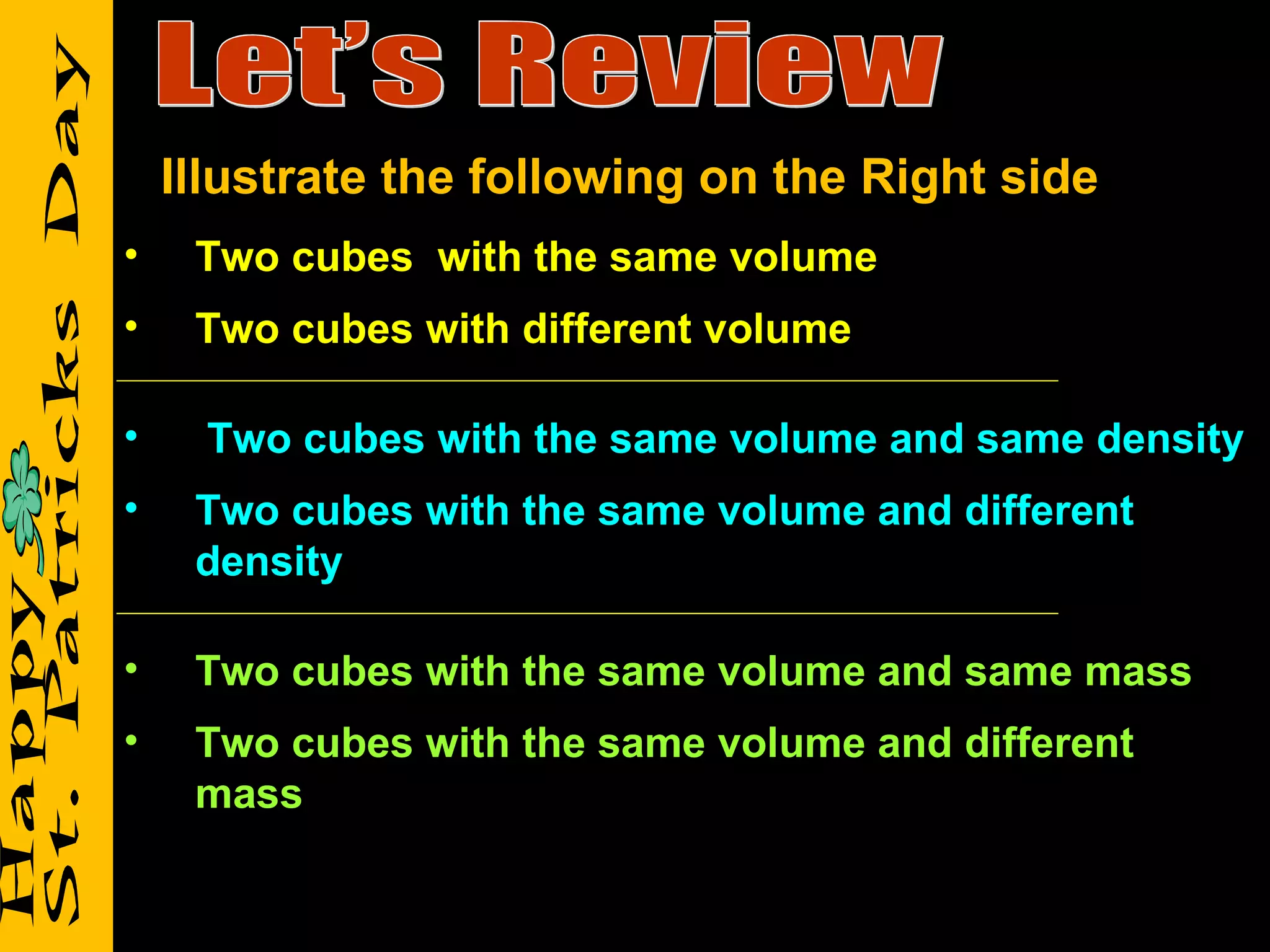
Let’s Review Two cubes  with the same volume Two cubes with different volume Two cubes with the same volume and same density Two cubes with the same volume and different density Two cubes with the same volume and same mass Two cubes with the same volume and different  mass Illustrate the following on the Right side
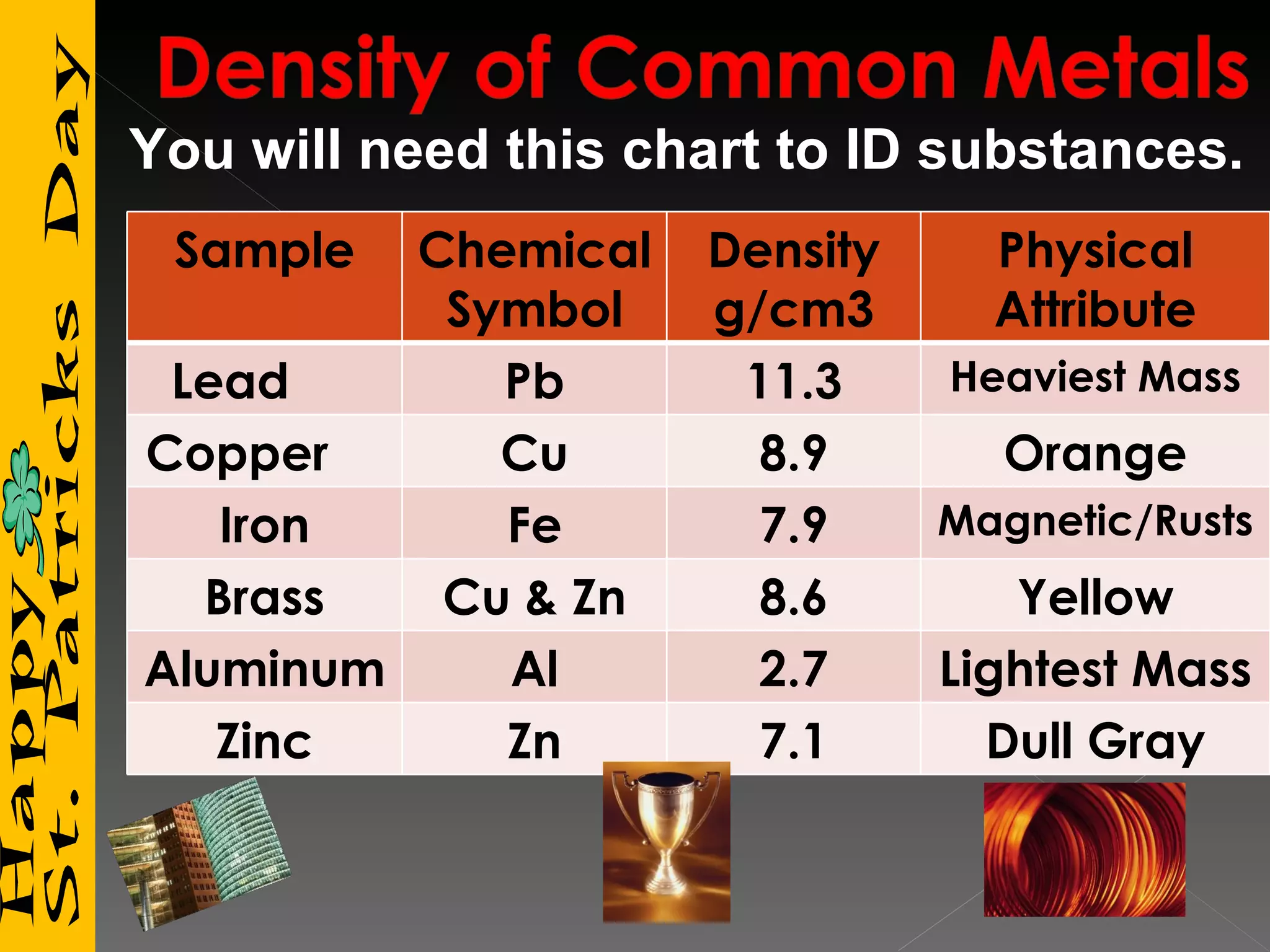
You will need this chart to ID substances. Sample Chemical Symbol Density g/cm3 Physical Attribute Lead  Pb 11.3 Heaviest Mass Copper  Cu 8.9 Orange Iron Fe 7.9 Magnetic/Rusts Brass Cu & Zn 8.6 Yellow Aluminum Al 2.7 Lightest Mass Zinc Zn 7.1 Dull Gray
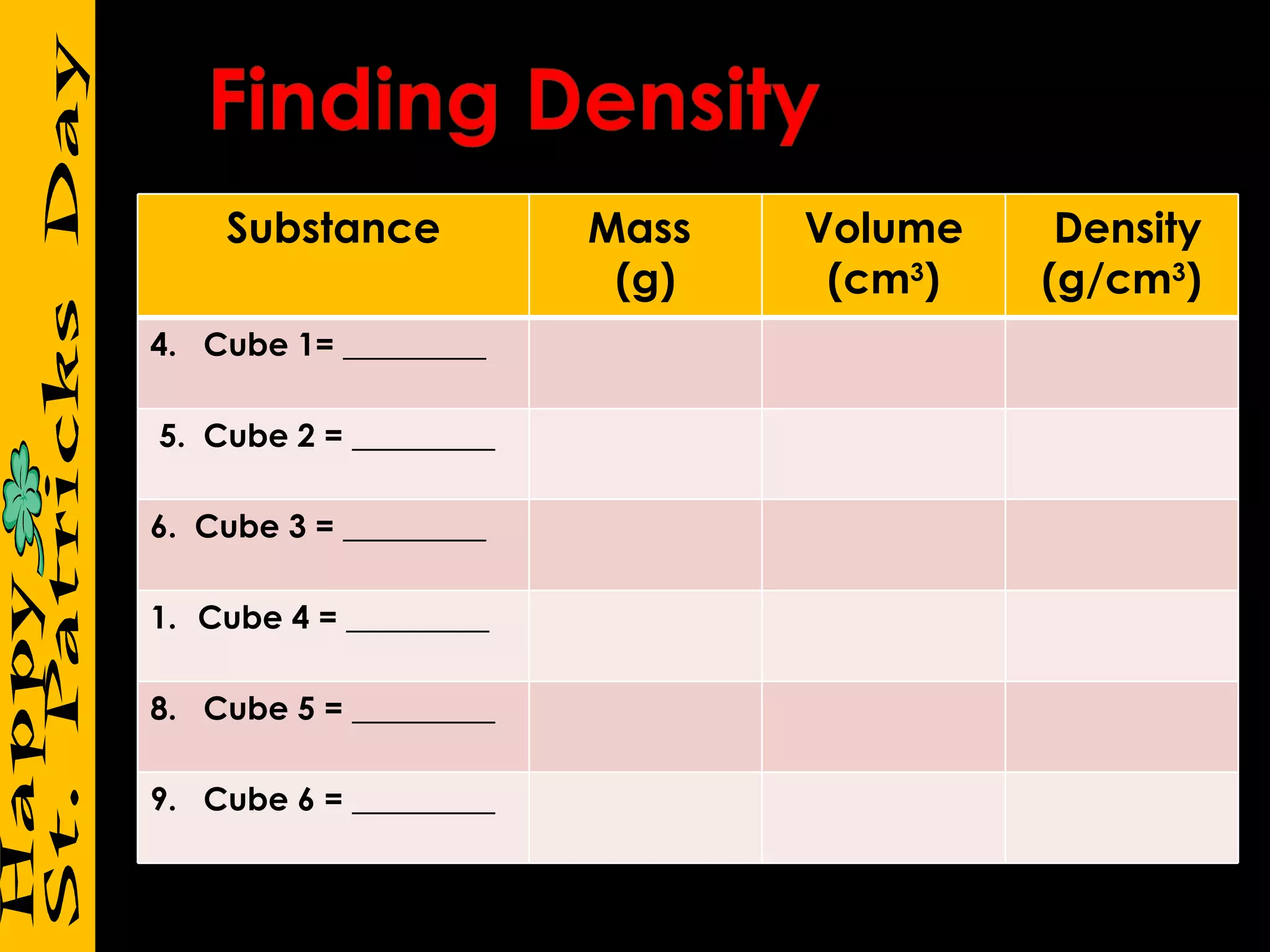
Substance Mass  (g) Volume (cm 3 ) Density (g/cm 3 ) 4.  Cube 1= _________ 5.  Cube 2 = _________ 6.  Cube 3 = _________ Cube 4 = _________ 8.  Cube 5 = _________ 9.  Cube 6 = _________
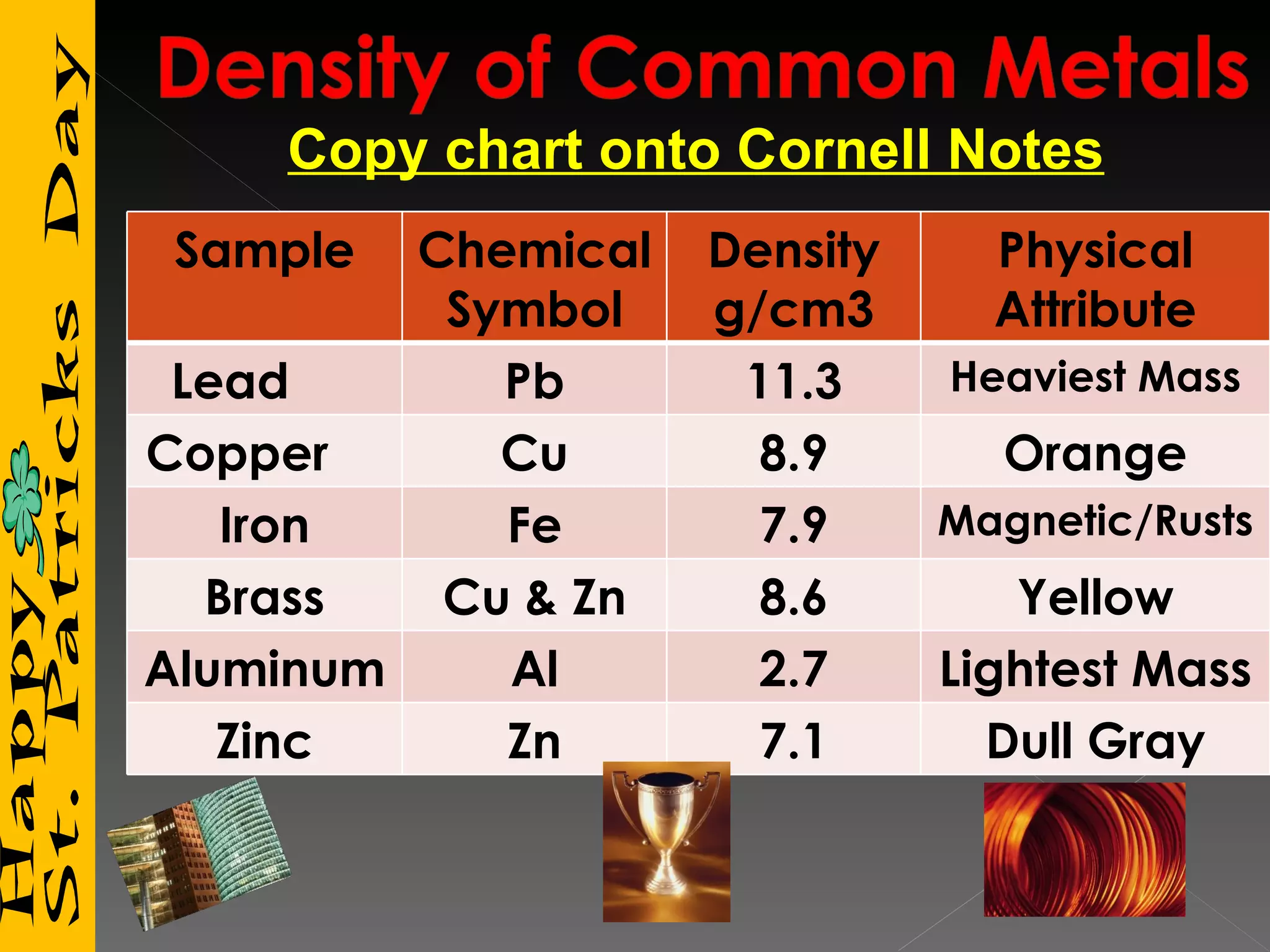
Copy chart onto Cornell Notes Sample Chemical Symbol Density g/cm3 Physical Attribute Lead  Pb 11.3 Heaviest Mass Copper  Cu 8.9 Orange Iron Fe 7.9 Magnetic/Rusts Brass Cu & Zn 8.6 Yellow Aluminum Al 2.7 Lightest Mass Zinc Zn 7.1 Dull Gray
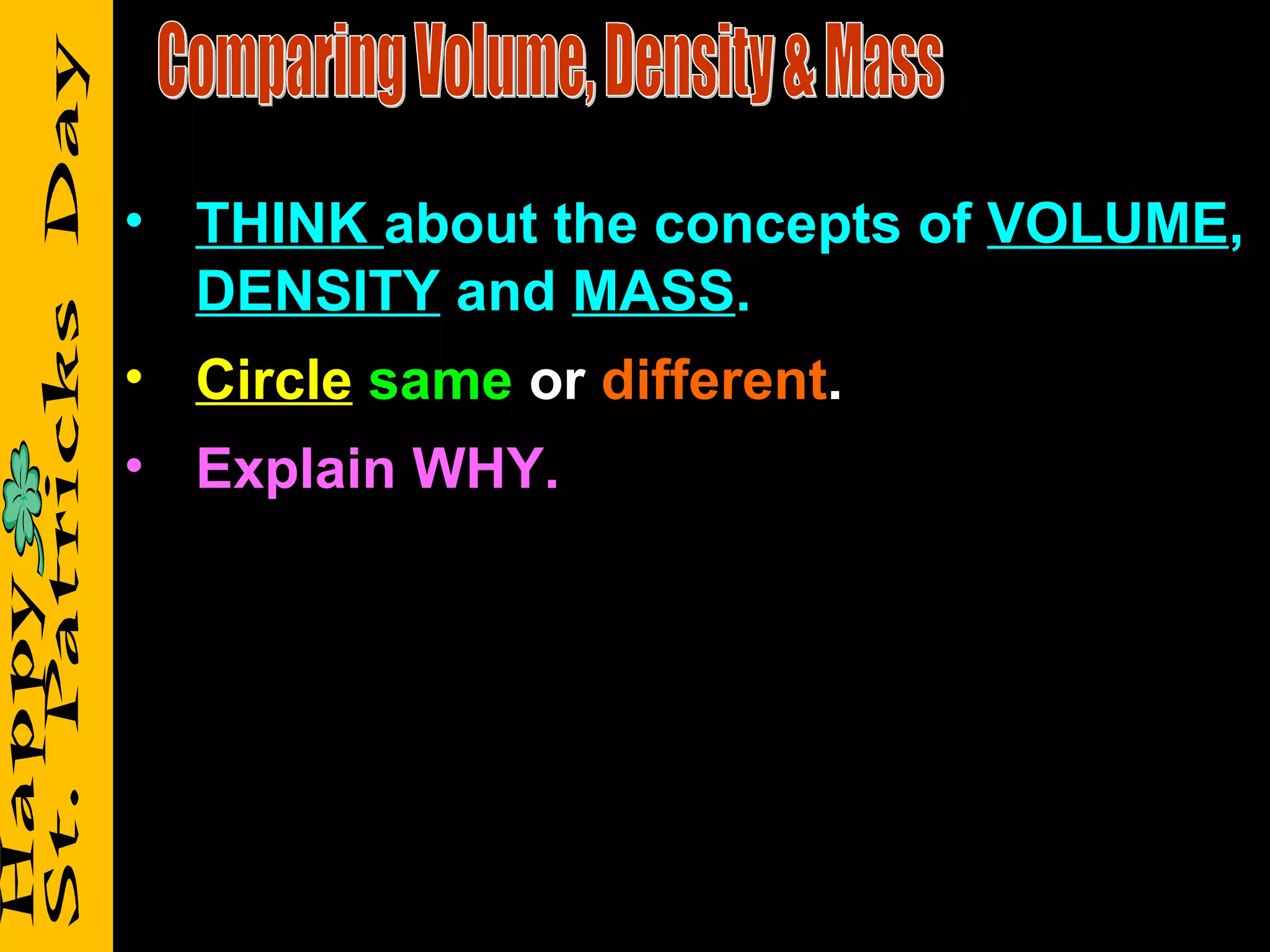
Comparing Volume, Density & Mass THINK  about the concepts of  VOLUME ,  DENSITY  and  MASS . Circle   same  or  different . Explain WHY.
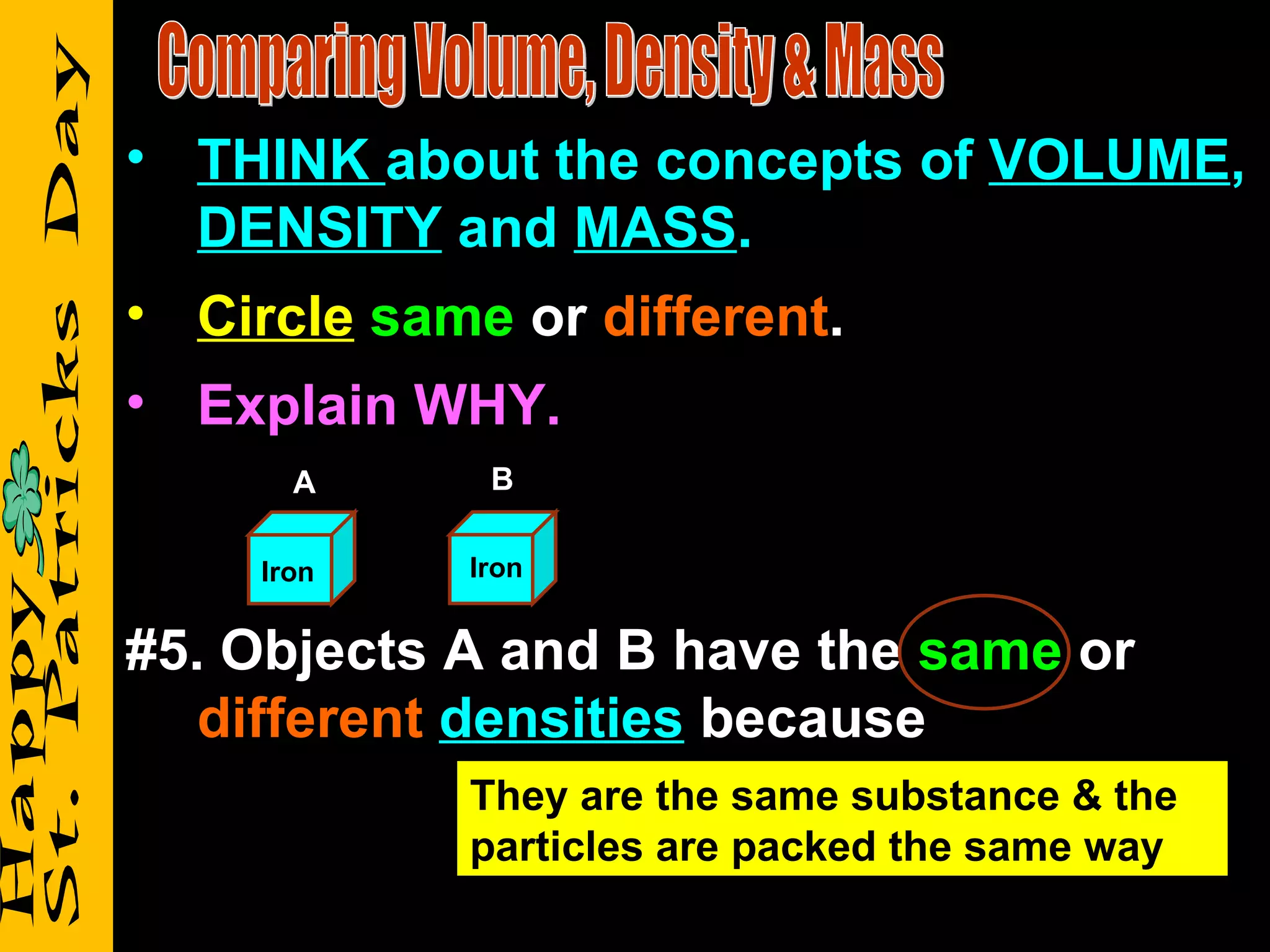
Comparing Volume, Density & Mass THINK  about the concepts of  VOLUME ,  DENSITY  and  MASS . Circle   same  or  different . Explain WHY. #5. Objects A and B have the  same  or  different   densities  because Iron Iron A B They are the same substance & the particles are packed the same way
Identifying Volume Lab –  Due Some Time Today Test #1 – Part 2 Corrected and Signed  – Due Today Introduction to Density  due Tomorrow.

Introduction to Density

  • 1.
  • 2.
  • 3.
    Quick Review Themetric unit for mass is? Which form of matter has particles that are free to move independently and collide frequently? Which variable is usually is represented by the x-axis in a data table? Give 2 unit labels for volume. Physical changes to matter do not change what?
  • 4.
    Quick Review WhenCO 2(s) changes state directly into a gas without becoming a liquid, we call this______________. Which form of matter has both crystalline and amorphous structures? Plant leaves lose water through evaporation – physical or chemical ? Why? Proteins are made from amino acids – physical or chemical ? Why? Food is digested – physical or chemical ? Which Law states that Mass can neither be created or destroyed?
  • 5.
    Quick Review Whatmethod would you use to find the volume of a block of wood? What are 3 equivalent formulas for finding the volume of a cube? What are the 3 equivalent units of measurement for volume of an object? When will a substance float in water? What is the vocabulary word for finding the volume of an irregularly shaped object?
  • 6.
    Introduction to DensityA substance’s density is the measure of the mass of material within a certain volume . (amnt of space taken up) The mass (amnt of particles) is affected by how tightly packed the molecules are within the space.
  • 7.
    Introduction to DensityA B A and B = SAME VOLUME (same size)
  • 8.
    Introduction to DensityA B A and B = SAME VOLUME (same size) A B A and B = DIFFERENT MASS (amount of particles; different substance) Different Densities
  • 9.
    Introduction to DensityC D C and D = DIFFERENT VOLUME (different size) but same substance
  • 10.
    Introduction to DensityC D C and D = DIFFERENT VOLUME (different size) but same substance Same Densities- particles are packed the same way
  • 11.
    Let’s Review VocabularyPictures Fold blank paper in half landscape style
  • 12.
    Let’s Review VOLUME – amount of space mL, cm 3 , cc DENSITY – how the particles are packed- RATIO g/mL , g/cm 3 , g/cc, kg/m 3 MASS – amount of particles Any gram unit Write these vocabulary words on the left side
  • 13.
    Let’s Review Twocubes with the same volume Two cubes with different volume Two cubes with the same volume and same density Two cubes with the same volume and different density Two cubes with the same volume and same mass Two cubes with the same volume and different mass Illustrate the following on the Right side
  • 14.
    You will needthis chart to ID substances. Sample Chemical Symbol Density g/cm3 Physical Attribute Lead Pb 11.3 Heaviest Mass Copper Cu 8.9 Orange Iron Fe 7.9 Magnetic/Rusts Brass Cu & Zn 8.6 Yellow Aluminum Al 2.7 Lightest Mass Zinc Zn 7.1 Dull Gray
  • 15.
    Substance Mass (g) Volume (cm 3 ) Density (g/cm 3 ) 4. Cube 1= _________ 5. Cube 2 = _________ 6. Cube 3 = _________ Cube 4 = _________ 8. Cube 5 = _________ 9. Cube 6 = _________
  • 16.
    Copy chart ontoCornell Notes Sample Chemical Symbol Density g/cm3 Physical Attribute Lead Pb 11.3 Heaviest Mass Copper Cu 8.9 Orange Iron Fe 7.9 Magnetic/Rusts Brass Cu & Zn 8.6 Yellow Aluminum Al 2.7 Lightest Mass Zinc Zn 7.1 Dull Gray
  • 17.
    Comparing Volume, Density& Mass THINK about the concepts of VOLUME , DENSITY and MASS . Circle same or different . Explain WHY.
  • 18.
    Comparing Volume, Density& Mass THINK about the concepts of VOLUME , DENSITY and MASS . Circle same or different . Explain WHY. #5. Objects A and B have the same or different densities because Iron Iron A B They are the same substance & the particles are packed the same way
  • 19.
    Identifying Volume Lab– Due Some Time Today Test #1 – Part 2 Corrected and Signed – Due Today Introduction to Density due Tomorrow.