What is
Database
IN HINDI
Computer Programming
S.Y.B.Com. : Semester-IV
What is Database.
Types of Database.
Advantages of Databases.
Unit-II
Principles of DBMS
OMega TechEd
Data
Data are raw facts or figures having no meaning.
Example:
• Data of the marks of students in a class.
• Data of Salaries of the employees.
OMega TechEd
Information
Processed data is called Information.
For Example , we find from the data of the marks of students in a class,
how many students are pass.
OMega TechEd
Database
A database is a collection of information that is organized so that it can
be easily accessed, managed and updated.
Example:
• A list of students enrolled for the Commerce stream.
• Addresses and telephone numbers in a telephone directory etc.
OMega TechEd
Types of
Databases
OMega TechEd
Types of Databases
Operational Database
External Databases
Data Warehouses
They contain the information about the various activities of the organization, that is
required to support its operations. An operational database is designed to run the
day-to-day operations or transactions of the business.
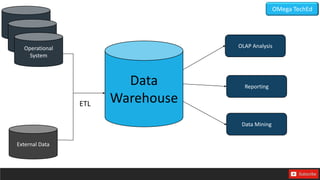
Data warehouses contain current as well as old historical data of the organization
obtained from the various sources. They are used mainly for creating reports that
are used by the management in decision making.
They contain all the information available from various sources on the internet, which
also contain access to different multimedia documents available as links on the web.
OMega TechEd
Data
Warehouse
External Data
External Data
External Data
Operational
System
OLAP Analysis
Data Mining
Reporting
OMega TechEd
ETL
Types of Databases
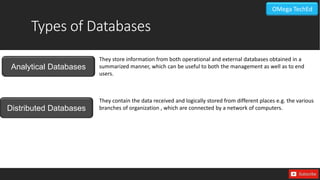
Analytical Databases
Distributed Databases
They store information from both operational and external databases obtained in a
summarized manner, which can be useful to both the management as well as to end
users.
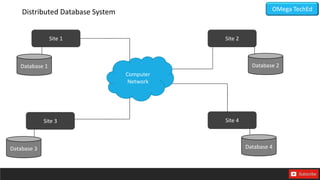
They contain the data received and logically stored from different places e.g. the various
branches of organization , which are connected by a network of computers.
OMega TechEd
Computer
Network
Site 1 Site 2
Site 4
Site 3
Database 1 Database 2
Database 3 Database 4
Distributed Database System OMega TechEd
Types of Databases
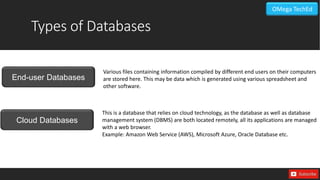
Cloud Databases
End-user Databases
Various files containing information compiled by different end users on their computers
are stored here. This may be data which is generated using various spreadsheet and
other software.
This is a database that relies on cloud technology, as the database as well as database
management system (DBMS) are both located remotely, all its applications are managed
with a web browser.
Example: Amazon Web Service (AWS), Microsoft Azure, Oracle Database etc.
OMega TechEd
Advantages of
Database
OMega TechEd
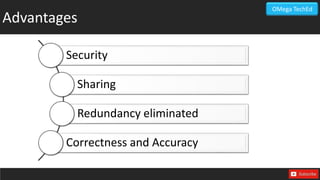
Security
Sharing
Redundancy eliminated
Correctness and Accuracy
Advantages
OMega TechEd
LIKE &
Share
Thank You
OMega TechEd
If you have a question, you can reach me via e-mail at omega.teched@gmail.com
Social Media Handles:
omega.teched
megha_with
megha-sharma24
OMega TechEd

Introduction to Databases

  • 1.
    What is Database IN HINDI ComputerProgramming S.Y.B.Com. : Semester-IV
  • 2.
    What is Database. Typesof Database. Advantages of Databases. Unit-II Principles of DBMS OMega TechEd
  • 3.
    Data Data are rawfacts or figures having no meaning. Example: • Data of the marks of students in a class. • Data of Salaries of the employees. OMega TechEd
  • 4.
    Information Processed data iscalled Information. For Example , we find from the data of the marks of students in a class, how many students are pass. OMega TechEd
  • 5.
    Database A database isa collection of information that is organized so that it can be easily accessed, managed and updated. Example: • A list of students enrolled for the Commerce stream. • Addresses and telephone numbers in a telephone directory etc. OMega TechEd
  • 6.
  • 7.
    Types of Databases OperationalDatabase External Databases Data Warehouses They contain the information about the various activities of the organization, that is required to support its operations. An operational database is designed to run the day-to-day operations or transactions of the business. Data warehouses contain current as well as old historical data of the organization obtained from the various sources. They are used mainly for creating reports that are used by the management in decision making. They contain all the information available from various sources on the internet, which also contain access to different multimedia documents available as links on the web. OMega TechEd
  • 8.
    Data Warehouse External Data External Data ExternalData Operational System OLAP Analysis Data Mining Reporting OMega TechEd ETL
  • 9.
    Types of Databases AnalyticalDatabases Distributed Databases They store information from both operational and external databases obtained in a summarized manner, which can be useful to both the management as well as to end users. They contain the data received and logically stored from different places e.g. the various branches of organization , which are connected by a network of computers. OMega TechEd
  • 10.
    Computer Network Site 1 Site2 Site 4 Site 3 Database 1 Database 2 Database 3 Database 4 Distributed Database System OMega TechEd
  • 11.
    Types of Databases CloudDatabases End-user Databases Various files containing information compiled by different end users on their computers are stored here. This may be data which is generated using various spreadsheet and other software. This is a database that relies on cloud technology, as the database as well as database management system (DBMS) are both located remotely, all its applications are managed with a web browser. Example: Amazon Web Service (AWS), Microsoft Azure, Oracle Database etc. OMega TechEd
  • 12.
  • 13.
  • 14.
  • 15.
    If you havea question, you can reach me via e-mail at omega.teched@gmail.com Social Media Handles: omega.teched megha_with megha-sharma24 OMega TechEd