Introduction to Data
Warehouse
duantv@antsprogrammatic.com
• What is Data Warehouse (DW)?
• Purpose and Definition
• DW Architecture
• Multidimensional Model
• Schema
Discussion
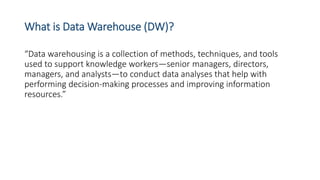
What is Data Warehouse (DW)?
“Data warehousing is a collection of methods, techniques, and tools
used to support knowledge workers—senior managers, directors,
managers, and analysts—to conduct data analyses that help with
performing decision-making processes and improving information
resources.”
Purpose and Definition
• DW is a store of information organized in a unified data model
• Data collected from a number of different sources
• Finance, billing, website logs, personnel, …
• Purpose of a data warehouse (DW): support decision making
• Easy to perform advanced analysis
• Ad-hoc analysis and reports
• Data mining: discovery of hidden patterns and trends
DW
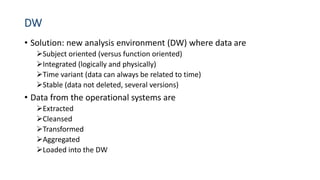
• Solution: new analysis environment (DW) where data are
Subject oriented (versus function oriented)
Integrated (logically and physically)
Time variant (data can always be related to time)
Stable (data not deleted, several versions)
• Data from the operational systems are
Extracted
Cleansed
Transformed
Aggregated
Loaded into the DW
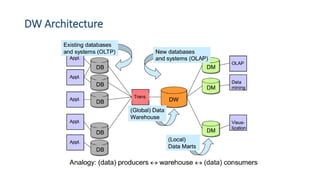
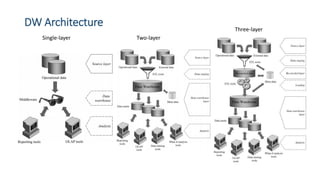
DW Architecture
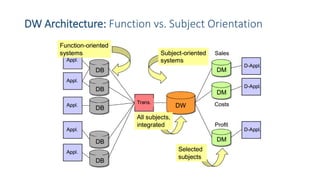
DW Architecture: Function vs. Subject Orientation
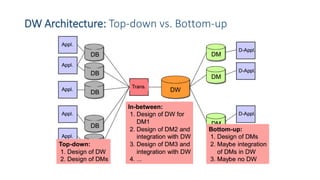
DW Architecture: Top-down vs. Bottom-up
DW Architecture
Single-layer Two-layer
Three-layer
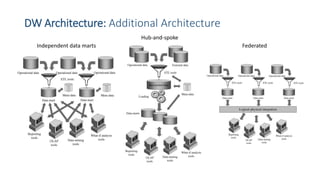
DW Architecture: Additional Architecture
Independent data marts
Hub-and-spoke
Federated
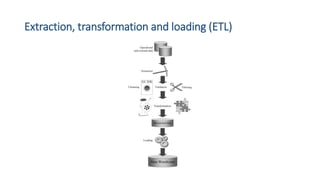
Extraction, transformation and loading (ETL)
Multidimensional Model
• The multidimensional model
• Its only purpose: data analysis
• It is not suitable for OLTP systems
• More built in “meaning”
• What is important
• What describes the important
• What we want to optimize
• Easy for query operations
• Data is divided into:
• Facts
• Dimensions
• Facts are the important entity: a sale
• Facts have measures that can be aggregated
• Dimensions describe facts
• A sale has the dimensions Product, Store and Time
• Facts “live” in a multidimensional cube
Cubes
• Dimensions are the core of multidimensional databases
• Dimensions are used for
• Selection of data
• Grouping of data at the right level of detail
• Dimensions consist of dimension values
• Dimension values may have an ordering
• Used for comparing cube data across values
• Especially used for Time dimension
• Dimensions have hierarchies with levels
• Typically 3-5 levels (of detail)
• Dimension values are organized in a tree structure
• Dimensions have a bottom level and a top level
• Dimensions should contain much information
Dimensions
Facts
• Facts represent the subject of the desired analysis
• The ”important” in the business that should be analyzed
• A fact is identified via its dimension values
• A fact is a non-empty cell
• The fact table stores facts
• One column for each measure
• One column for each dimension (foreign key to dimension table)
• Dimensions keys make up composite primary key
Measures
• Measures represent the fact property that the users want to study
and optimize
• A measure has two components
• Numerical value: (revenue)
• Aggregation formula (SUM): used for aggregating/combining a number of
measure values into one
• Measure value determined by dimension value combination
• Measure value is meaningful for all aggregation levels
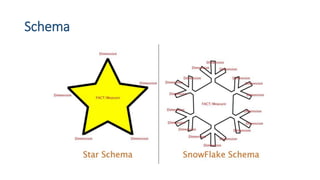
Schema
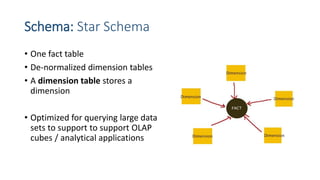
Schema: Star Schema
• One fact table
• De-normalized dimension tables
• A dimension table stores a
dimension
• Optimized for querying large data
sets to support to support OLAP
cubes / analytical applications
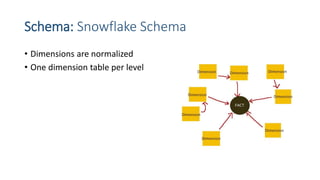
Schema: Snowflake Schema
• Dimensions are normalized
• One dimension table per level
Q&A

Introduction to Data Warehouse

  • 1.
  • 2.
    • What isData Warehouse (DW)? • Purpose and Definition • DW Architecture • Multidimensional Model • Schema Discussion
  • 3.
    What is DataWarehouse (DW)? “Data warehousing is a collection of methods, techniques, and tools used to support knowledge workers—senior managers, directors, managers, and analysts—to conduct data analyses that help with performing decision-making processes and improving information resources.”
  • 4.
    Purpose and Definition •DW is a store of information organized in a unified data model • Data collected from a number of different sources • Finance, billing, website logs, personnel, … • Purpose of a data warehouse (DW): support decision making • Easy to perform advanced analysis • Ad-hoc analysis and reports • Data mining: discovery of hidden patterns and trends
  • 5.
    DW • Solution: newanalysis environment (DW) where data are Subject oriented (versus function oriented) Integrated (logically and physically) Time variant (data can always be related to time) Stable (data not deleted, several versions) • Data from the operational systems are Extracted Cleansed Transformed Aggregated Loaded into the DW
  • 6.
  • 7.
    DW Architecture: Functionvs. Subject Orientation
  • 8.
  • 9.
  • 10.
    DW Architecture: AdditionalArchitecture Independent data marts Hub-and-spoke Federated
  • 11.
  • 12.
    Multidimensional Model • Themultidimensional model • Its only purpose: data analysis • It is not suitable for OLTP systems • More built in “meaning” • What is important • What describes the important • What we want to optimize • Easy for query operations • Data is divided into: • Facts • Dimensions • Facts are the important entity: a sale • Facts have measures that can be aggregated • Dimensions describe facts • A sale has the dimensions Product, Store and Time • Facts “live” in a multidimensional cube
  • 13.
  • 14.
    • Dimensions arethe core of multidimensional databases • Dimensions are used for • Selection of data • Grouping of data at the right level of detail • Dimensions consist of dimension values • Dimension values may have an ordering • Used for comparing cube data across values • Especially used for Time dimension • Dimensions have hierarchies with levels • Typically 3-5 levels (of detail) • Dimension values are organized in a tree structure • Dimensions have a bottom level and a top level • Dimensions should contain much information Dimensions
  • 15.
    Facts • Facts representthe subject of the desired analysis • The ”important” in the business that should be analyzed • A fact is identified via its dimension values • A fact is a non-empty cell • The fact table stores facts • One column for each measure • One column for each dimension (foreign key to dimension table) • Dimensions keys make up composite primary key
  • 16.
    Measures • Measures representthe fact property that the users want to study and optimize • A measure has two components • Numerical value: (revenue) • Aggregation formula (SUM): used for aggregating/combining a number of measure values into one • Measure value determined by dimension value combination • Measure value is meaningful for all aggregation levels
  • 17.
  • 18.
    Schema: Star Schema •One fact table • De-normalized dimension tables • A dimension table stores a dimension • Optimized for querying large data sets to support to support OLAP cubes / analytical applications
  • 19.
    Schema: Snowflake Schema •Dimensions are normalized • One dimension table per level
  • 20.