SAG – Indexing and Query
Optimization
Vaibhav Jain
vjain44@csc.com
Ext : 706224
Indexing – A Refresher
• Introducing Indexes
 What are Indexes?
 What are the types of Indexes?
 What do these terms inside SQL Server mean?
– Pages, Extents
– Heap
– Clustered Indexes
– Non-Clustered Indexes
Page, Extents
• The fundamental unit of data storage in SQL Server is the PAGE
(8k)
 This means SQL Server databases have 128 pages per megabyte
 Each page begins with a 96-byte header
 Maximum amount of data contained in a single row on a page is 8,060
bytes
• Extents are a collection of eight physically contiguous pages
HEAP
• A heap is a table without a clustered index
• The data rows are not stored in any particular order
• Data pages are not linked in a linked list
Clustered Index
• The data rows are stored in order based on the clustered index key
• The clustered index is implemented as a B-tree index structure
• Data pages in the leaf level, are linked in a doubly-linked list
• Clustered indexes have one row in sys.partitions, with index_id = 1
Clustered Index B - Tree
Non-Clustered Index
• Nonclustered indexes have a B-tree index structure
similar to the one in clustered indexes
• The difference is that nonclustered indexes do not
affect the order of the data rows.
• Each index row contains the nonclustered key value, a
row locator and any included, or nonkey, columns
Query Optimization
Simple flow chart Real pie chart
Query Processing and Optimization
Parsing
Optimization
Execution
Query Processing and Optimization
• Cost Based Optimizer
• Disk IO Cost
• CPU Cost
• Memory Cost – Very insignificant
• Indexes
• Selects optimal indexes to be used
• Query Algorithms
• Converts Logical operation into physical operations
Execution Plan Operators
• When
• Good
• Bad
• Action Item
80% - 20% Rule
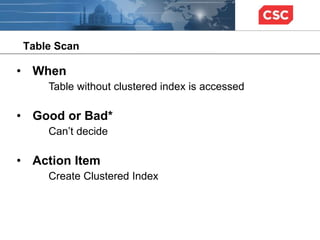
Table Scan
• When
Table without clustered index is accessed
• Good or Bad*
Can’t decide
• Action Item
Create Clustered Index
Clustered Index Scan
• When
Table with clustered index is accessed but query
doesn’t uses the clustered index key
• Good or Bad*
Bad unless large data with most columns and rows
retrieved
• Action Item
Evaluate Clustered Index Keys
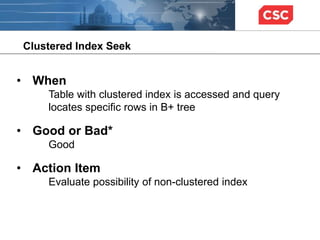
Clustered Index Seek
• When
Table with clustered index is accessed and query
locates specific rows in B+ tree
• Good or Bad*
Good
• Action Item
Evaluate possibility of non-clustered index
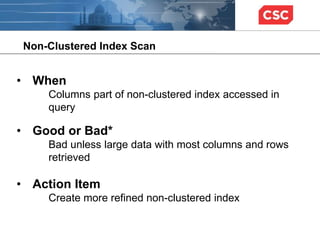
Non-Clustered Index Scan
• When
Columns part of non-clustered index accessed in
query
• Good or Bad*
Bad unless large data with most columns and rows
retrieved
• Action Item
Create more refined non-clustered index
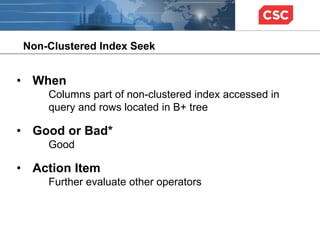
Non-Clustered Index Seek
• When
Columns part of non-clustered index accessed in
query and rows located in B+ tree
• Good or Bad*
Good
• Action Item
Further evaluate other operators
Lookups
• When
Query Optimizer uses non-clustered index to search
few column data and base table for other columns data
• Good or Bad*
Good
• Action Item
Included Index or Covered Index
Questions?
THANK YOU

SAG_Indexing and Query Optimization

  • 1.
    SAG – Indexingand Query Optimization Vaibhav Jain vjain44@csc.com Ext : 706224
  • 2.
    Indexing – ARefresher • Introducing Indexes  What are Indexes?  What are the types of Indexes?  What do these terms inside SQL Server mean? – Pages, Extents – Heap – Clustered Indexes – Non-Clustered Indexes
  • 3.
    Page, Extents • Thefundamental unit of data storage in SQL Server is the PAGE (8k)  This means SQL Server databases have 128 pages per megabyte  Each page begins with a 96-byte header  Maximum amount of data contained in a single row on a page is 8,060 bytes • Extents are a collection of eight physically contiguous pages
  • 4.
    HEAP • A heapis a table without a clustered index • The data rows are not stored in any particular order • Data pages are not linked in a linked list
  • 5.
    Clustered Index • Thedata rows are stored in order based on the clustered index key • The clustered index is implemented as a B-tree index structure • Data pages in the leaf level, are linked in a doubly-linked list • Clustered indexes have one row in sys.partitions, with index_id = 1
  • 6.
  • 7.
    Non-Clustered Index • Nonclusteredindexes have a B-tree index structure similar to the one in clustered indexes • The difference is that nonclustered indexes do not affect the order of the data rows. • Each index row contains the nonclustered key value, a row locator and any included, or nonkey, columns
  • 8.
    Query Optimization Simple flowchart Real pie chart
  • 9.
    Query Processing andOptimization Parsing Optimization Execution
  • 10.
    Query Processing andOptimization • Cost Based Optimizer • Disk IO Cost • CPU Cost • Memory Cost – Very insignificant • Indexes • Selects optimal indexes to be used • Query Algorithms • Converts Logical operation into physical operations
  • 11.
    Execution Plan Operators •When • Good • Bad • Action Item 80% - 20% Rule
  • 12.
    Table Scan • When Tablewithout clustered index is accessed • Good or Bad* Can’t decide • Action Item Create Clustered Index
  • 13.
    Clustered Index Scan •When Table with clustered index is accessed but query doesn’t uses the clustered index key • Good or Bad* Bad unless large data with most columns and rows retrieved • Action Item Evaluate Clustered Index Keys
  • 14.
    Clustered Index Seek •When Table with clustered index is accessed and query locates specific rows in B+ tree • Good or Bad* Good • Action Item Evaluate possibility of non-clustered index
  • 15.
    Non-Clustered Index Scan •When Columns part of non-clustered index accessed in query • Good or Bad* Bad unless large data with most columns and rows retrieved • Action Item Create more refined non-clustered index
  • 16.
    Non-Clustered Index Seek •When Columns part of non-clustered index accessed in query and rows located in B+ tree • Good or Bad* Good • Action Item Further evaluate other operators
  • 17.
    Lookups • When Query Optimizeruses non-clustered index to search few column data and base table for other columns data • Good or Bad* Good • Action Item Included Index or Covered Index
  • 18.