Module: 6 Mortarsand its applications
Introduction-Classification of Mortars-Properties-Lime
mortar-Cement mortar-Selection of mortar-Testing of
mortars-Applications.
2.
Mortar
Mortar is anintimate mixture of binding material, fine aggregate, and
water. When water is added into the dry mixture of binding material
and the inert material, binding material develops the property that
binds not only the inert material but also the surrounding bricks and
stones.
If the cement is the binding material, then the mortar is called
cement mortar. Other mortars commonly used are lime mortar and
mud mortar. The inert material used is sand.
Some of the important uses of mortars are as follows:
1. In brick and stone masonry it is used in the vertical joints and is
—
spread over each layer to give bed and a binding medium for successive
layers of masonry.
2. In plastering and pointing—to cover exposed walls and joints to
protect against weathering besides better appearance.
3. As matrix in concrete.
3.
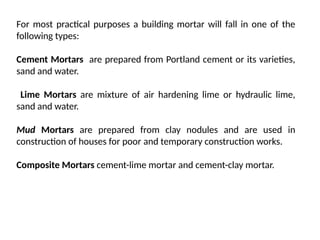
For most practicalpurposes a building mortar will fall in one of the
following types:
Cement Mortars are prepared from Portland cement or its varieties,
sand and water.
Lime Mortars are mixture of air hardening lime or hydraulic lime,
sand and water.
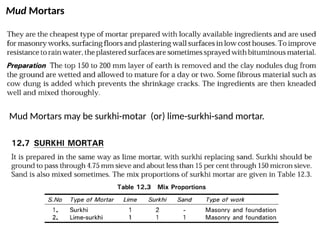
Mud Mortars are prepared from clay nodules and are used in
construction of houses for poor and temporary construction works.
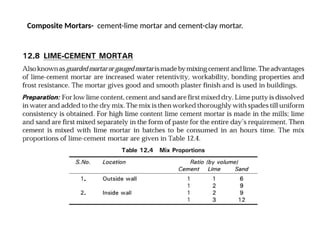
Composite Mortars cement-lime mortar and cement-clay mortar.
4.
Cement mortar
Cement mortarcan be prepared by mixing cement, sand and water
in desired proportions.
Portland cement and blast furnace slag cement form excellent
mortars for walls built with bricks, stones and large blocks. Puzzolana
Portland cement and sulphate-resisting cement form mortar which
are used for constructions exposed to aggressive and waste waters.
Cement mortars are used for plastering, rendering smooth finishes
and damp proof courses.
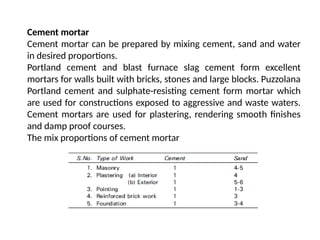
The mix proportions of cement mortar
5.
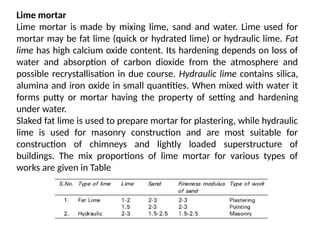
Lime mortar
Lime mortaris made by mixing lime, sand and water. Lime used for
mortar may be fat lime (quick or hydrated lime) or hydraulic lime. Fat
lime has high calcium oxide content. Its hardening depends on loss of
water and absorption of carbon dioxide from the atmosphere and
possible recrystallisation in due course. Hydraulic lime contains silica,
alumina and iron oxide in small quantities. When mixed with water it
forms putty or mortar having the property of setting and hardening
under water.
Slaked fat lime is used to prepare mortar for plastering, while hydraulic
lime is used for masonry construction and are most suitable for
construction of chimneys and lightly loaded superstructure of
buildings. The mix proportions of lime mortar for various types of
works are given in Table
Qualities of aGood Mortar
Strength
Mobility
Placeability
Water retention
1. Strength of Mortar
A mortar is said to be good in strength only after its hardening. But use
of good quality material in good proportions lead to good strength
mortar. When it comes to preparation of good strength mortar, the
sufficient cement content should be used. Well graded fine aggregate
should be used. Water content should not be more than required
amount.
9.
2. Mobility
The consistencyof a mortar is indicated by the term mobility. The
consistency is categorized into different types as stiff, dense, loose,
fluid etc. Mobility of mortar is dependent of composition of mortar
ingredients. Mortars of different consistencies are used for different
works.
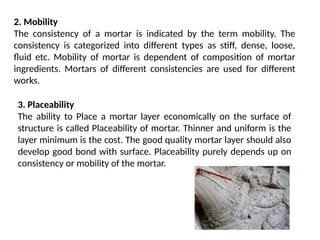
3. Placeability
The ability to Place a mortar layer economically on the surface of
structure is called Placeability of mortar. Thinner and uniform is the
layer minimum is the cost. The good quality mortar layer should also
develop good bond with surface. Placeability purely depends up on
consistency or mobility of the mortar.
10.
4. Water Retention
Agood quality mortar has strong water retention capacity. A mortar
should not lose its water content especially during transportation. If
the water gets separated from the mix, then it is difficult to get harden
and strength of mortar also reduced. The mortar cannot develop
strong bond with the surface without sufficient water in it. Several
types of plasticizers are available for enhancing water retention of
mortar.
11.
Properties of GoodMortar
When a mortar is said to be good mortar it should obey the following
properties:
The mortar should have sufficient adhesive property to develop strong
bond with masonry units.
The mortar should be water proof and it should not allow water
through it in external walls during rainy season.
The mortar should be long-lasting.
The mortar should be economical and easily placeable.
The mortar should be easily workable.
A good mortar should develop designed stresses after hardening.
The mortar should not allow cracks near the joints and it should
maintain good appearance for longer periods.
The mortar should take less time to set which results speedy
construction.
The properties of materials which comes into contact with mortar
should not be affected by it.
12.
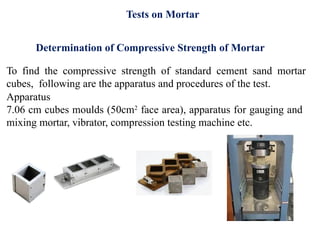
Determination of CompressiveStrength of Mortar
To find the compressive strength of standard cement sand mortar
cubes, following are the apparatus and procedures of the test.
Apparatus
7.06 cm cubes moulds (50cm2
face area), apparatus for gauging and
mixing mortar, vibrator, compression testing machine etc.
Tests on Mortar
13.
Procedure for CompressiveStrength of Mortar
1)Take 200gm of cement and 600gm of standard sand in the mix ratio
1:3 by weight) in a pan.
2)The sand grains shall be angular, the shape of grains approximating to the
spherical form, elongated and flattened grains being present only in very
small quantities.
3)Standard sand shall pass through 2 mm IS sieve and shall be
retained on 90 microns
5. Mix the cement and sand in dry condition with a trowel for 1minitues
and then add water.
6. The quantity of water shall be (p/4+3)% of combined weight of cement
and sand where, p is the % of water required to produce a paste of
standard consistency determined earlier.
7. Add water and mix it until the mixture is of uniform colour. The time
of mixing shall not be < 3 minutes & not > 4 minutes.
8. Immediately after mixing the mortar, place the mortar in the cube mould
and prod with the help of the rod.
14.
The mortar shallbe prodded 20 times in about 8 sec to ensure
elimination of entrained air.
If vibrator is used, the period of vibration shall be 2 minutes at the
specified speed of 12000±400 vibrations /minutes.
Then place the cube moulds in temperature of 27±2o
C and 90%
relative humidity for 24 hours.
After 24 hours remove the cubes from the mould and immediately
submerge in clean water till testing. Take out the cubes from water just
before testing.
Testing should be done on their sides without any packing. The rate of
loading should be 350 kg/cm2
/minute and uniform.
Test should be conducted for 3 cubes and report the average value as
the test result for both 7day and 28 day compressive strength.
15.
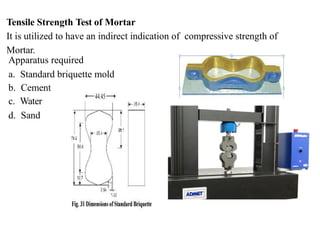
Tensile Strength Testof Mortar
It is utilized to have an indirect indication of compressive strength of
Mortar.
Apparatus required
a. Standard briquette mold
b. Cement
c. Water
d. Sand
16.
This test procedureas follows:
a.The tensile strength test is carried out by fracturing six
briquettes made of cement mortar in the ratio of 1:3 using
standard sand and test cement.
b.An average of six results is treated as the tensile strength of cement.
c.The percentage of water by weight of cement required to make the
cement mortar is given by the relation (P/5+2.5), where P is a percentage of
water required to make cement paste of normal consistency.
d.Cement mortar prepared in this way is filled in the standard briquette
mold and cured for 24 hours at a temperature of 25-29° C and relative
humidity of 90%.
e.The test is carried out for 3 days, 7 days, and 28 days. During the test,
the load is to be applied uniformly at the rate of 35 kg/cm² or 3.50
N/mm².
f.The tensile stress at the end of 3 days should not be below 20 kg/cm² or 2
N/mm² and that at the end of 7 days should not be below 25 kg/cm² or 2.50
N/mm², 28 days should not be below 45 kg/cm² or 4.50 N/mm².
17.
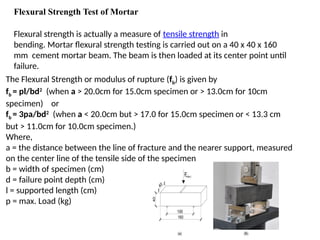
Flexural Strength Testof Mortar
Flexural strength is actually a measure of tensile strength in
bending. Mortar flexural strength testing is carried out on a 40 x 40 x 160
mm cement mortar beam. The beam is then loaded at its center point until
failure.
The Flexural Strength or modulus of rupture (fb) is given by
fb = pl/bd2
(when a > 20.0cm for 15.0cm specimen or > 13.0cm for 10cm
specimen) or
fb = 3pa/bd2
(when a < 20.0cm but > 17.0 for 15.0cm specimen or < 13.3 cm
but > 11.0cm for 10.0cm specimen.)
Where,
a = the distance between the line of fracture and the nearer support, measured
on the center line of the tensile side of the specimen
b = width of specimen (cm)
d = failure point depth (cm)
l = supported length (cm)
p = max. Load (kg)
19.
Water retention
The propertyspecification of ASTM C270 requires a minimum water
retention of 75% when tested in accordance with Standard Test Method
for Water Retention of Hydraulic Cement-Based Mortars and Plasters,
ASTM C1506 (ref. 15). This test was developed to measure the ability of a
mortar to retain its mix water under the suction of the adjacent masonry
unit. A certain amount of water absorption by the unit is beneficial, but
too much may be detrimental.
Water retention is determined in the laboratory by measuring the
mortar’s “initial flow,” and “flow after suction.” Initial flow is the percent
increase in diameter of a mortar sample when it is placed on a flow table
and dropped 25 times in 15 seconds. The same procedure is used to
determine flow after some of the mortar’s mix water has been removed
by an applied vacuum, which is meant to simulate the suction of
masonry units on mortar. Water retention is the ratio of flow after
suction to initial flow, expressed as a percentage.
22.
Air Content
The ASTMC270 property specification includes a limit on the mortar air
content. In general, greater air contents result in greater mortar durability
and workability, but reduced mortar bond strength.
Air content is determined in accordance with ASTM C91, with the
exception that the laboratory-prepared mortar is required to be of the
materials and proportions used in the construction. The air content of the
mortar is determined by calculation using the weight of a sample of
mortar and accounting for all of the materials used.
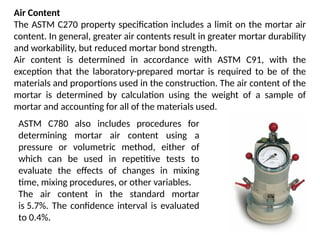
ASTM C780 also includes procedures for
determining mortar air content using a
pressure or volumetric method, either of
which can be used in repetitive tests to
evaluate the effects of changes in mixing
time, mixing procedures, or other variables.
The air content in the standard mortar
is 5.7%. The confidence interval is evaluated
to 0.4%.
23.
Permeability Test
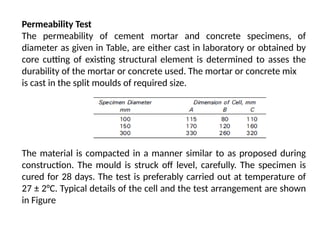
The permeabilityof cement mortar and concrete specimens, of
diameter as given in Table, are either cast in laboratory or obtained by
core cutting of existing structural element is determined to asses the
durability of the mortar or concrete used. The mortar or concrete mix
is cast in the split moulds of required size.
The material is compacted in a manner similar to as proposed during
construction. The mould is struck off level, carefully. The specimen is
cured for 28 days. The test is preferably carried out at temperature of
27 ± 2°C. Typical details of the cell and the test arrangement are shown
in Figure
25.
The specimen isthoroughly cleaned with a stiff wire brush to remove
all the laitance. The end surfaces are then sand blasted or lightly
chiselled. The system is completely filled with water
and the desired pressure is applied to the water reservoir and the
initial reading of the gaugeglass recorded.
The specimen is subjected to a standard test pressure of 1N/mm2
, but
may be reduced to 0.5N/mm2
for relatively more permeable
specimens and increased up to 1.5N/mm2
for relatively
less permeable specimen, from one side. At the same time a clean
collection bottle is weighed and placed in position to collect the
water percolating through the specimen. The quantity of percolate
and the gauge reading is recorded at periodic intervals.
26.
As the steadyflow is approached, the two rates tend to become
equal and the outflow become maximum and stabilizes. The test is
continued for 100 hours after the steady state of flow has been
reached and the out flow is considered as average of all the out flows
measured during this period of 100 hours.
The quantity of water percolating through it during a given interval of
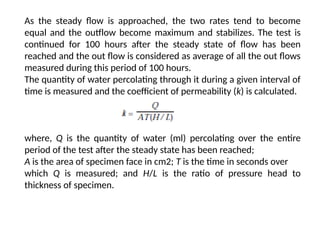
time is measured and the coefficient of permeability (k) is calculated.
where, Q is the quantity of water (ml) percolating over the entire
period of the test after the steady state has been reached;
A is the area of specimen face in cm2; T is the time in seconds over
which Q is measured; and H/L is the ratio of pressure head to
thickness of specimen.