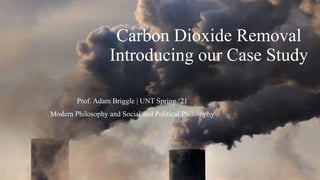
Carbon Dioxide Removal
Introducing our Case Study
Prof. Adam Briggle | UNT Spring ‘21
Modern Philosophy and Social and Political Philosophy





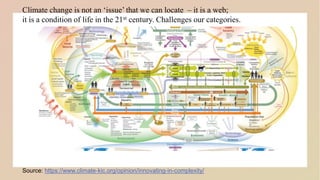
Source: https://www.climate-kic.org/opinion/innovating-in-complexity/
Climate change is not an ‘issue’ that we can locate – it is a web;
it is a condition of life in the 21st century. Challenges our categories.
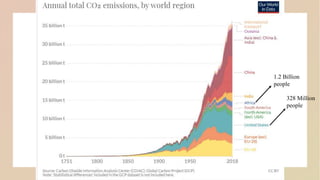
1.2 Billion
people
328 Million
people
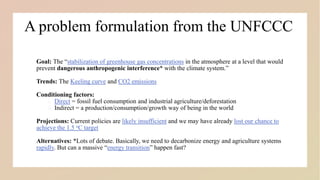
A problem formulation from the UNFCCC
Goal: The “stabilization of greenhouse gas concentrations in the atmosphere at a level that would
prevent dangerous anthropogenic interference* with the climate system.”
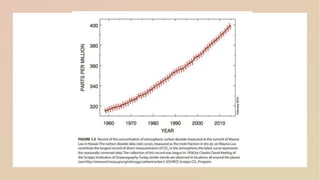
Trends: The Keeling curve and CO2 emissions
Conditioning factors:
i. Direct = fossil fuel consumption and industrial agriculture/deforestation
ii. Indirect = a production/consumption/growth way of being in the world
Projections: Current policies are likely insufficient and we may have already lost our chance to
achieve the 1.5 oC target
Alternatives: *Lots of debate. Basically, we need to decarbonize energy and agriculture systems
rapidly. But can a massive “energy transition” happen fast?
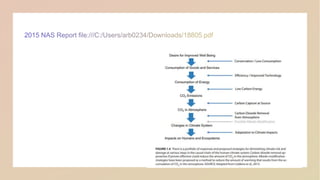
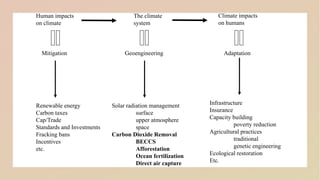
Human impacts
on climate
The climate
system
Climate impacts
on humans
Adaptation
Geoengineering
Mitigation
Renewable energy
Carbon taxes
Cap/Trade
Standards and Investments
Fracking bans
Incentives
etc.
Solar radiation management
surface
upper atmosphere
space
Carbon Dioxide Removal
BECCS
Afforestation
Ocean fertilization
Direct air capture
Infrastructure
Insurance
Capacity building
poverty reduction
Agricultural practices
traditional
genetic engineering
Ecological restoration
Etc.
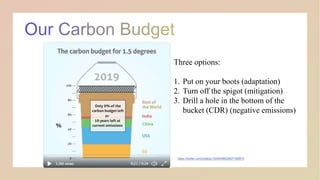
 https://twitter.com/i/status/1205449629527166976
Three options:
1. Put on your boots (adaptation)
2. Turn off the spigot (mitigation)
3. Drill a hole in the bottom of the
bucket (CDR) (negative emissions)
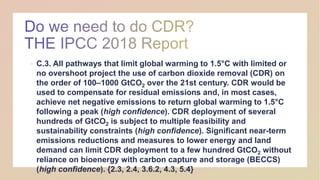
 C.3. All pathways that limit global warming to 1.5°C with limited or
no overshoot project the use of carbon dioxide removal (CDR) on
the order of 100–1000 GtCO2 over the 21st century. CDR would be
used to compensate for residual emissions and, in most cases,
achieve net negative emissions to return global warming to 1.5°C
following a peak (high confidence). CDR deployment of several
hundreds of GtCO2 is subject to multiple feasibility and
sustainability constraints (high confidence). Significant near-term
emissions reductions and measures to lower energy and land
demand can limit CDR deployment to a few hundred GtCO2 without
reliance on bioenergy with carbon capture and storage (BECCS)
(high confidence). {2.3, 2.4, 3.6.2, 4.3, 5.4}
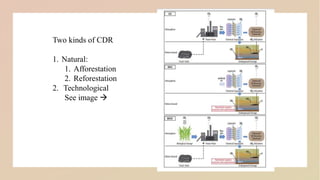
Two kinds of CDR
1. Natural:
1. Afforestation
2. Reforestation
2. Technological
See image 

Introduction to Carbon Dioxide Removal

  • 1.
    Carbon Dioxide Removal Introducingour Case Study Prof. Adam Briggle | UNT Spring ‘21 Modern Philosophy and Social and Political Philosophy
  • 2.
  • 9.
    Source: https://www.climate-kic.org/opinion/innovating-in-complexity/ Climate changeis not an ‘issue’ that we can locate – it is a web; it is a condition of life in the 21st century. Challenges our categories.
  • 10.
  • 12.
    A problem formulationfrom the UNFCCC Goal: The “stabilization of greenhouse gas concentrations in the atmosphere at a level that would prevent dangerous anthropogenic interference* with the climate system.” Trends: The Keeling curve and CO2 emissions Conditioning factors: i. Direct = fossil fuel consumption and industrial agriculture/deforestation ii. Indirect = a production/consumption/growth way of being in the world Projections: Current policies are likely insufficient and we may have already lost our chance to achieve the 1.5 oC target Alternatives: *Lots of debate. Basically, we need to decarbonize energy and agriculture systems rapidly. But can a massive “energy transition” happen fast?
  • 14.
    Human impacts on climate Theclimate system Climate impacts on humans Adaptation Geoengineering Mitigation Renewable energy Carbon taxes Cap/Trade Standards and Investments Fracking bans Incentives etc. Solar radiation management surface upper atmosphere space Carbon Dioxide Removal BECCS Afforestation Ocean fertilization Direct air capture Infrastructure Insurance Capacity building poverty reduction Agricultural practices traditional genetic engineering Ecological restoration Etc.
  • 15.
     https://twitter.com/i/status/1205449629527166976 Three options: 1.Put on your boots (adaptation) 2. Turn off the spigot (mitigation) 3. Drill a hole in the bottom of the bucket (CDR) (negative emissions)
  • 16.
     C.3. Allpathways that limit global warming to 1.5°C with limited or no overshoot project the use of carbon dioxide removal (CDR) on the order of 100–1000 GtCO2 over the 21st century. CDR would be used to compensate for residual emissions and, in most cases, achieve net negative emissions to return global warming to 1.5°C following a peak (high confidence). CDR deployment of several hundreds of GtCO2 is subject to multiple feasibility and sustainability constraints (high confidence). Significant near-term emissions reductions and measures to lower energy and land demand can limit CDR deployment to a few hundred GtCO2 without reliance on bioenergy with carbon capture and storage (BECCS) (high confidence). {2.3, 2.4, 3.6.2, 4.3, 5.4}
  • 17.
    Two kinds ofCDR 1. Natural: 1. Afforestation 2. Reforestation 2. Technological See image 