Climate Change: Basics 
Compiled by Dr. Anoob Razak 
[Check http://www.clearias.com for more!] 
1
What’s Inside? 
•Climate Change fundamentals 
•Green House Effect 
•Ozone Hole etc. 
2
CLIMATE CHANGE 
 Climate vs Weather 
 Framework Convention on Climate Change (UNFCCC) 
“a change of climate which is attributed directly or indirectly to human activity that alters the composition of the global atmosphere and which is in addition to natural climate variability observed over comparable time periods”
GLOBAL WARMING 
unprecedented warming over the last few decades 
~0.8oC since 1880 – 2012 
 increase in the average global temperature of Earth’s atmosphere, near the surface and in the troposphere 
UNFCCC 
◦restrict the rise to 2oC, from 1990 levels
Causes- human-induced 
Effects 
◦Temperature 
◦Pressure 
◦Winds 
◦Rainfall
Impacts 
◦Melting of ice caps & glaciers 
◦Rise in sea level 
◦Changes in rainfall pattern, drought 
◦Bleaching of coral reefs 
◦Loss of plankton due to warming of seas 
◦Extinction of species due to habitat loss 
◦Incresed likelihood of extreme events 
◦agriculture
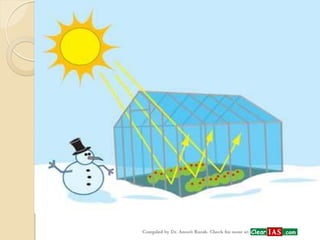
GREEN HOUSE (GLASS HOUSE) 
Cold climate areas 
Inside temperature higher than the low outside temperature 
Protects the plant from frost
GREEN HOUSE EFFECT 
Naturally occurring phenomenon that blankets the lower atmosphere & warms it, maintaining the temperature suitable for living things to survive 
Frozen & lifeless in the absence of Green House Effect, like moon 
Venus- thick atmosphere
Average temperature – 14oC 
In the absence of Green House Effect- -18oC 
Green House vs Green House Effect 
(Convective) (Radiative)
EARTH HEAT BUDGET (EARTHS ENERGY BUDGET)
Short Wave vs Long Wave 
Albedo 
◦Ratio of light reflected by a body to the light received by it 
◦0 - pitch black 
◦1 - perfect reflector 
Heat Budget- Zero 
◦Balanced 
Radiative Forcing/Climate Forcing
Green House Gas (GHG) 
Gas that can absorb & emit Infrared Radiation 
Trap heat in the atmosphere 
◦Water Vapour (H2O) 
◦Carbon Dioxide (CO2) 
◦Methane (CH4) 
◦Nitrous Oxide (N2O) 
◦Fluorinated Gases (HFCs, PFCs, SF6 etc) 
◦Nitrogen Fluoride (NF3)
factors that determine the degree to which any GHG will influence Global Warming 
1.abundance 
2.ability to absorb energy 
Global Warming Potential 
3.life (how long it stays in atmosphere)
Global Warming Potential (GWP) 
a measure of the total energy that a gas absorbs over a particular period of time (usually 100 years) compared to CO2 
Larger the GWP, more warming the gas causes 
◦CO2 - 1 
◦CH4 - 21 
◦N2O- 300 
◦F-Gases – high GWP gases
Sources of GHGs 
◦Burning of fossil fuels 
Energy Production 
Industry 
Transportation 
◦Agriculture 
◦Commercial & Residential 
◦Land Use & Forestry
Carbon Dioxide (CO2) 
 Fossil fuel burning 
energy production- Coal & Natural Gas 
transportation- Petrol & Diesel Industry 
Industry 
Production of chemicals, cement etc
Methane (CH4) 
Wetlands 
Coal Mining 
Agriculture 
Domestic Livestock 
Rice Fields 
Industry 
CH4- component of Natural Gas
Nitrous Oxide (N2O) 
Fossil Fuel Combustion 
In Industry & Transportation 
Synthetic Fertilizers in Agriculture 
Livestock manure & urine – 
Nitrogen complexes breakdown
Fluorinated Gases 
HFCs to replace CFCs 
PFCs in Semiconductor manufacturing 
SF6 in industrial processes
IPCC- 4th Assessment Report 2007 
◦GHG Emission by Gas
IPCC- 4th Assessment Report 2007 
◦GHG Emission by Source
IPCC – 5th Assessment Report 2013
IPCC – 5th Assessment Report 2013 
GHG Emission by Gas 
◦CO2 – 76 % 
◦CH4 – 16% 
◦N2O – 6% 
◦F-Gases – 2%
Black Carbon 
aerosol / soot / fine particulate matter 
almost pure carbon 
due to incomplete combustion 
◦almost all due to anthropogenic activity 
strongly absorbs light & converts the energy into heat
Effects 
◦Global Warming 
Tropospheric temperature 
Deposited on snow & ice- decreases albedo 
◦Public Health- morbidity 
Cancers, respiratory illneses 
Life time- days to weeks
 fossil fuel combustion 
◦Climate change 
◦Public health 
◦Economic development
Project Surya 
NGOs 
Funding from UNEP 
Solar (or biomass) stove & solar lights 
Indoor air pollution 
◦Respiratory illnesses, asthma 
◦cancers
Ozone Hole 
UltraViolet (UV) Radiation from Sun 
◦Adverse effect of human 
Skin cancer, cataracts 
◦Adverse effect on Biosphere 
Inhibiting plant growth & damaging ecosystems 
◦Adverse effect on physical infrastructure 
Degradation of materials
Ozone – blocks harmful UV Rays 
thickness measured Dobson Unit (DU) 
‘Ozone Hole’ 
◦Decrease in springtime thickness of Ozone in the stratosphere
Impact of Climate Change 
Fresh Water Resources 
◦water scarcity 
◦Major river floods 
◦Renewable surface water 
◦Groundwater availability 
Terrestrial & Freshwater Ecosystems 
◦Species face incresed extinction risk 
◦Abrupt irreversible change in structure, compositon & function of ecosystems
Coastal Systems & Low-lying areas 
◦Sea-level rise 
Submergence, coastal flooding, coastal erosion 
Marine Ecosystems 
◦Species loss & biodiversity reduction 
◦Decrease in fisheries productivity
Agriculture, Food Production & Food Security 
◦Individual location may benefit 
(CO2 Fertilization effect) 
◦Tropical vs cold climate 
◦Generalised decrease in productivity, 
especially in the context of increased demand 
◦Food access, utiulization & price stability - 
adversely affected
Urban Areas 
◦Maximum risk concentrated 
◦Heat stress, extremes of precipatation, smog, inland & coastal flooding, landslides, drought & water scarcity 
Rural Areas 
◦Water availabilty & supply 
◦Food security 
◦Agriculturalincomes 
◦Shift in production areas of crops
Key Economic Sectors & Services 
◦More dependence on technology 
◦Huge economic impact 
Livelihood & Poverty 
◦New poverty traps & hotspots of hunger 
(especially urban areas) 
◦Economic growth 
◦Food security
Human Health 
◦Increased morbidity & mortality 
◦Undernutrition 
◦Increased food & water borne diseases 
◦Increased vector borne diseases 
◦Increased chance of disasters
Human Security 
◦Increased displacement of people & migration, 
due to extreme events 
◦Indirectly increases risks of violent conflicts in the form of civil war & inter group violence 
◦Influence national security policies 
◦Territorial integrity, esp in coastal areas
Impact on Indian Agriculture 
◦Rainfed agriculture 
◦Overall Rainfall & distribution & timing 
◦Droughts 
Water Resources 
◦Rainfall decreases 
◦Water Scarcity 
◦Rivers 
◦Hydrologic cycle change 
◦Glacial Melt 
◦Groundwater resources 
Coastal Areas 
◦Goa, Orissa, Mumbai
MITIGATION STRATEGIES 
 “Mitigate” 
To make less severe or painful 
alleviate 
Mitigation 
◦Human intervention to reduce the sources or enhance the sinks of CO2/GHG
Carbon Sequestration 
Carbon Uptake 
Carbon Capture & Storage 
Taking up CO2 from the atmosphere and long term storage
Carbon Dioxide Removal (CDR) 
Set of techniques that aim to remove CO2 directly from atmosphere, by either 
◦1)increasing natural sinks for carbon, or 
◦2) using engineering techniques to remove CO2 with the intent of reducing CO2 concentration 
ocean – Iron fertilization 
land - large scale afforestation 
technical- direct capture of CO2 from atmosphere by chemical means
Iron Fertilization 
◦deliberate introduction of Iron to the upper ocean surface to enhance biological productivity which can sequester additional atmospheric CO2 in oceans 
◦added advantage- marine food chain+
Carbon Sink 
Reservoir that stores carbon containing material for an indefinite period 
natural & artificial 
Natural 
◦forests- tropical, mangroves (biosequestration) 
◦oceans 
◦wetlands
Artificial 
◦Geologic sequestration 
Landfills 
pumping CO2 directly in oil & gas wells 
◦Ocean sequestration 
Pumping CO2 deep into the ocean 
◦Artificial Trees
GeoEngineering / Climate Enginnering 
broad set of methods & technologies that aim to deliberately alter the climate system, in order to alleviate the impacts if climate change, 
by either 
◦1) reduce the amount of absorbed Solar Energy 
◦2) increase net carbon sinks at a sufficiently large scale to alter climate
Solar Radiation Management 
◦Intentional modification of Earth’s shortwave radiative budget with the aim to reduce climate change 
 artificial injection of stratospheric aerosols 
 cloud brightening 
CO2 removal techniques 
detonating a nuclear bomb on the lunar surface
Carbon Credit 
A tradable certificate/permit representing the right to emit one tonne of carbon or CO2 equivalent 
How to earn Carbon Credit 
◦Produce one tonne less of Carbon or CO2 equivalent than the standard level allowed for its activity
The credits can be traded in Exchanges 
‘International Emission Trading’ 
◦a Kyoto mechanism 
India – 1 billion $ 
Multi Commodity Exchange- Carbon Trading
Carbon Offsetting 
Credits for reduction in GHG emission made at another location, mostly from renewable energy projects
Carbon Tax 
direct tax 
based on amount of carbon in the fossil fuel 
~equivalent to an emission tax on CO2 emission
Civil Service Preliminary 1995 
 Q) Which one of the following fuels causes minimum environmental pollution? 
a)Diesel 
b)Coal 
c)Hydrogen 
d)Kerosene
Civil Service Preliminary 2003 
 Q) 
Assertion (A): Coal-based thermal power stations contribute to acid-rain 
Reason (R): Oxides of Carbon are emitted when coal burns 
a)Both A & R are true, and R is the correct explanation of A 
b)Both A & R are true, but R is bot the correct explanation of A 
c)A is true, R is false 
d)A is false, but R is true
Civil Service Preliminary 2003 
 Q) Which one of the following is produced during the formation of photochemical smog 
a)Hydrocarbons 
b)Nitrogen Oxide 
c)Ozone 
d)Methane
Civil Service Preliminary 2008 
 Q) Consider the following: 
1) Rice Fields 2) Coal mining 
3) Domestic animals 4) Wetlands 
Which of the above are sources of methane, a major greenhouse gas? 
a)1 & 4 only 
b)2 & 3 only 
c)1, 2 & 3 only 
d)1, 2, 3 & 4
Civil Service Preliminary 2010 
 Q) Due to their extensive rice cultivation, some regions may be contributing to global warming. To what possible extent is this attributable? 1) The anaerobic conditions associated with rice cultivation cause the emission of methane. 2) When nitrogen based fertilizers are used, Nitrous Oxide is emitted from the cultivated soil. 
Which of the above statements are correct? 
a)1 only b) 2 only 
c) Both 1 & 2 d) Neither 1 nor 2
Civil Service Preliminary 2010 
 Q) Consider the following: 
1) Oxides of Hydrogen 
2) Oxides of Nitrogen 
3) Oxides of Sulphur 
Which of the above cause acid rain? 
a)1 & 2 only 
b)3 only 
c)2 & 3 only 
d)1, 2 & 3
Civil Service Preliminary 2011 
 Q) Consider the following: 
1) Carbon Dioxide 
2) Oxides of Nitrogen 
3) Oxides of Sulphur 
Which of the are emissions from coal combustion at thermal power plants? 
a)1 only 
b)2 & 3 only 
c)1 & 3 only 
d)1, 2 & 3
Civil Service Preliminary 2011 
 Q) Human activities in the recent past have caused the increased concentration of carbon dioxide in the atmosphere, but a lot of it does not remain in the lower atmosphere because of 1. its escape into the outer atmosphere 2.the photosynthesis by phytoplankton 3. the trapping of air in the polar ice caps Which of the statements given are correct? 
a) 1 & 2 b) 2 only 
c) 2 & 3 d) 3 only
Civil Service Preliminary 2011 
 Q) The formation of Ozone Hole in the Antarctic Region has been a cause of concern. What could be the reason for the formation of this hole? 
a)Presence of prominent tropospheric turbulence; and inflow of chlorofluorocarbons 
b)Presence of prominent polar front & stratospheric clouds; and inflow of chlorofluorocarbons 
c)Absence of prominent polar front & stratospheric clouds; and inflow of methane & chlorofluorocarbons 
d)Increased temperature at polar region due to global warming
Civil Service Preliminary 2011 
 Q) The increasing amount of carbon dioxide in the air is slowly raising the temperature, because it absorbs? 
a)The water vapour of the air & retains its heat 
b)The Ultraviolet part of the solar radiation 
c)All the solar radiations 
d)The infrared part of the solar radiation
Civil Service Preliminary 2012 
 Q) What would happen if phytoplankton of an ocean is completely destroyed for some reason? 1. The ocean as a carbon sink would be completely destroyed 2. The food chains in the ocean would be adversely affected 3. The density of ocean water would drastically decrease Select the correct answer from the codes given below 
a) 1 & 2 only b) 2 only 
c) 3 only d) 1, 2 & 3
Civil Service Preliminary 2013 
 Q) Acid rain is caused by the pollution of environment by 
a)carbon dioxide & nitrogen 
b)carbon monoxide & carbon dioxide 
c)ozone & carbon dioxide 
d)nitrous oxide & sulphur dioxide
Civil Service Preliminary 2013 
 Q) Photochemical smog is a resultant of the reaction among 
a)NO2, O3 & peroxyacetyl nitrate in the presence of sunlight 
b)CO, O2 & peroxyacetyl nitrate in the presence of sunlight 
c)CO, CO2 & NO2 at low temperature 
d)High concentration of NO2, O3 & CO in the evening
Thank You! 
Check http://www.clearias.com for more! 
71

Climate Change : Basics - Byclearias.com

  • 1.
    Climate Change: Basics Compiled by Dr. Anoob Razak [Check http://www.clearias.com for more!] 1
  • 2.
    What’s Inside? •ClimateChange fundamentals •Green House Effect •Ozone Hole etc. 2
  • 3.
    CLIMATE CHANGE Climate vs Weather  Framework Convention on Climate Change (UNFCCC) “a change of climate which is attributed directly or indirectly to human activity that alters the composition of the global atmosphere and which is in addition to natural climate variability observed over comparable time periods”
  • 4.
    GLOBAL WARMING unprecedentedwarming over the last few decades ~0.8oC since 1880 – 2012  increase in the average global temperature of Earth’s atmosphere, near the surface and in the troposphere UNFCCC ◦restrict the rise to 2oC, from 1990 levels
  • 5.
    Causes- human-induced Effects ◦Temperature ◦Pressure ◦Winds ◦Rainfall
  • 6.
    Impacts ◦Melting ofice caps & glaciers ◦Rise in sea level ◦Changes in rainfall pattern, drought ◦Bleaching of coral reefs ◦Loss of plankton due to warming of seas ◦Extinction of species due to habitat loss ◦Incresed likelihood of extreme events ◦agriculture
  • 10.
    GREEN HOUSE (GLASSHOUSE) Cold climate areas Inside temperature higher than the low outside temperature Protects the plant from frost
  • 11.
    GREEN HOUSE EFFECT Naturally occurring phenomenon that blankets the lower atmosphere & warms it, maintaining the temperature suitable for living things to survive Frozen & lifeless in the absence of Green House Effect, like moon Venus- thick atmosphere
  • 12.
    Average temperature –14oC In the absence of Green House Effect- -18oC Green House vs Green House Effect (Convective) (Radiative)
  • 13.
    EARTH HEAT BUDGET(EARTHS ENERGY BUDGET)
  • 15.
    Short Wave vsLong Wave Albedo ◦Ratio of light reflected by a body to the light received by it ◦0 - pitch black ◦1 - perfect reflector Heat Budget- Zero ◦Balanced Radiative Forcing/Climate Forcing
  • 16.
    Green House Gas(GHG) Gas that can absorb & emit Infrared Radiation Trap heat in the atmosphere ◦Water Vapour (H2O) ◦Carbon Dioxide (CO2) ◦Methane (CH4) ◦Nitrous Oxide (N2O) ◦Fluorinated Gases (HFCs, PFCs, SF6 etc) ◦Nitrogen Fluoride (NF3)
  • 17.
    factors that determinethe degree to which any GHG will influence Global Warming 1.abundance 2.ability to absorb energy Global Warming Potential 3.life (how long it stays in atmosphere)
  • 18.
    Global Warming Potential(GWP) a measure of the total energy that a gas absorbs over a particular period of time (usually 100 years) compared to CO2 Larger the GWP, more warming the gas causes ◦CO2 - 1 ◦CH4 - 21 ◦N2O- 300 ◦F-Gases – high GWP gases
  • 19.
    Sources of GHGs ◦Burning of fossil fuels Energy Production Industry Transportation ◦Agriculture ◦Commercial & Residential ◦Land Use & Forestry
  • 20.
    Carbon Dioxide (CO2)  Fossil fuel burning energy production- Coal & Natural Gas transportation- Petrol & Diesel Industry Industry Production of chemicals, cement etc
  • 21.
    Methane (CH4) Wetlands Coal Mining Agriculture Domestic Livestock Rice Fields Industry CH4- component of Natural Gas
  • 22.
    Nitrous Oxide (N2O) Fossil Fuel Combustion In Industry & Transportation Synthetic Fertilizers in Agriculture Livestock manure & urine – Nitrogen complexes breakdown
  • 23.
    Fluorinated Gases HFCsto replace CFCs PFCs in Semiconductor manufacturing SF6 in industrial processes
  • 24.
    IPCC- 4th AssessmentReport 2007 ◦GHG Emission by Gas
  • 25.
    IPCC- 4th AssessmentReport 2007 ◦GHG Emission by Source
  • 26.
    IPCC – 5thAssessment Report 2013
  • 27.
    IPCC – 5thAssessment Report 2013 GHG Emission by Gas ◦CO2 – 76 % ◦CH4 – 16% ◦N2O – 6% ◦F-Gases – 2%
  • 28.
    Black Carbon aerosol/ soot / fine particulate matter almost pure carbon due to incomplete combustion ◦almost all due to anthropogenic activity strongly absorbs light & converts the energy into heat
  • 29.
    Effects ◦Global Warming Tropospheric temperature Deposited on snow & ice- decreases albedo ◦Public Health- morbidity Cancers, respiratory illneses Life time- days to weeks
  • 30.
     fossil fuelcombustion ◦Climate change ◦Public health ◦Economic development
  • 31.
    Project Surya NGOs Funding from UNEP Solar (or biomass) stove & solar lights Indoor air pollution ◦Respiratory illnesses, asthma ◦cancers
  • 32.
    Ozone Hole UltraViolet(UV) Radiation from Sun ◦Adverse effect of human Skin cancer, cataracts ◦Adverse effect on Biosphere Inhibiting plant growth & damaging ecosystems ◦Adverse effect on physical infrastructure Degradation of materials
  • 36.
    Ozone – blocksharmful UV Rays thickness measured Dobson Unit (DU) ‘Ozone Hole’ ◦Decrease in springtime thickness of Ozone in the stratosphere
  • 38.
    Impact of ClimateChange Fresh Water Resources ◦water scarcity ◦Major river floods ◦Renewable surface water ◦Groundwater availability Terrestrial & Freshwater Ecosystems ◦Species face incresed extinction risk ◦Abrupt irreversible change in structure, compositon & function of ecosystems
  • 39.
    Coastal Systems &Low-lying areas ◦Sea-level rise Submergence, coastal flooding, coastal erosion Marine Ecosystems ◦Species loss & biodiversity reduction ◦Decrease in fisheries productivity
  • 40.
    Agriculture, Food Production& Food Security ◦Individual location may benefit (CO2 Fertilization effect) ◦Tropical vs cold climate ◦Generalised decrease in productivity, especially in the context of increased demand ◦Food access, utiulization & price stability - adversely affected
  • 41.
    Urban Areas ◦Maximumrisk concentrated ◦Heat stress, extremes of precipatation, smog, inland & coastal flooding, landslides, drought & water scarcity Rural Areas ◦Water availabilty & supply ◦Food security ◦Agriculturalincomes ◦Shift in production areas of crops
  • 42.
    Key Economic Sectors& Services ◦More dependence on technology ◦Huge economic impact Livelihood & Poverty ◦New poverty traps & hotspots of hunger (especially urban areas) ◦Economic growth ◦Food security
  • 43.
    Human Health ◦Increasedmorbidity & mortality ◦Undernutrition ◦Increased food & water borne diseases ◦Increased vector borne diseases ◦Increased chance of disasters
  • 44.
    Human Security ◦Increaseddisplacement of people & migration, due to extreme events ◦Indirectly increases risks of violent conflicts in the form of civil war & inter group violence ◦Influence national security policies ◦Territorial integrity, esp in coastal areas
  • 45.
    Impact on IndianAgriculture ◦Rainfed agriculture ◦Overall Rainfall & distribution & timing ◦Droughts Water Resources ◦Rainfall decreases ◦Water Scarcity ◦Rivers ◦Hydrologic cycle change ◦Glacial Melt ◦Groundwater resources Coastal Areas ◦Goa, Orissa, Mumbai
  • 46.
    MITIGATION STRATEGIES “Mitigate” To make less severe or painful alleviate Mitigation ◦Human intervention to reduce the sources or enhance the sinks of CO2/GHG
  • 47.
    Carbon Sequestration CarbonUptake Carbon Capture & Storage Taking up CO2 from the atmosphere and long term storage
  • 48.
    Carbon Dioxide Removal(CDR) Set of techniques that aim to remove CO2 directly from atmosphere, by either ◦1)increasing natural sinks for carbon, or ◦2) using engineering techniques to remove CO2 with the intent of reducing CO2 concentration ocean – Iron fertilization land - large scale afforestation technical- direct capture of CO2 from atmosphere by chemical means
  • 49.
    Iron Fertilization ◦deliberateintroduction of Iron to the upper ocean surface to enhance biological productivity which can sequester additional atmospheric CO2 in oceans ◦added advantage- marine food chain+
  • 50.
    Carbon Sink Reservoirthat stores carbon containing material for an indefinite period natural & artificial Natural ◦forests- tropical, mangroves (biosequestration) ◦oceans ◦wetlands
  • 51.
    Artificial ◦Geologic sequestration Landfills pumping CO2 directly in oil & gas wells ◦Ocean sequestration Pumping CO2 deep into the ocean ◦Artificial Trees
  • 52.
    GeoEngineering / ClimateEnginnering broad set of methods & technologies that aim to deliberately alter the climate system, in order to alleviate the impacts if climate change, by either ◦1) reduce the amount of absorbed Solar Energy ◦2) increase net carbon sinks at a sufficiently large scale to alter climate
  • 53.
    Solar Radiation Management ◦Intentional modification of Earth’s shortwave radiative budget with the aim to reduce climate change  artificial injection of stratospheric aerosols  cloud brightening CO2 removal techniques detonating a nuclear bomb on the lunar surface
  • 54.
    Carbon Credit Atradable certificate/permit representing the right to emit one tonne of carbon or CO2 equivalent How to earn Carbon Credit ◦Produce one tonne less of Carbon or CO2 equivalent than the standard level allowed for its activity
  • 55.
    The credits canbe traded in Exchanges ‘International Emission Trading’ ◦a Kyoto mechanism India – 1 billion $ Multi Commodity Exchange- Carbon Trading
  • 56.
    Carbon Offsetting Creditsfor reduction in GHG emission made at another location, mostly from renewable energy projects
  • 57.
    Carbon Tax directtax based on amount of carbon in the fossil fuel ~equivalent to an emission tax on CO2 emission
  • 58.
    Civil Service Preliminary1995  Q) Which one of the following fuels causes minimum environmental pollution? a)Diesel b)Coal c)Hydrogen d)Kerosene
  • 59.
    Civil Service Preliminary2003  Q) Assertion (A): Coal-based thermal power stations contribute to acid-rain Reason (R): Oxides of Carbon are emitted when coal burns a)Both A & R are true, and R is the correct explanation of A b)Both A & R are true, but R is bot the correct explanation of A c)A is true, R is false d)A is false, but R is true
  • 60.
    Civil Service Preliminary2003  Q) Which one of the following is produced during the formation of photochemical smog a)Hydrocarbons b)Nitrogen Oxide c)Ozone d)Methane
  • 61.
    Civil Service Preliminary2008  Q) Consider the following: 1) Rice Fields 2) Coal mining 3) Domestic animals 4) Wetlands Which of the above are sources of methane, a major greenhouse gas? a)1 & 4 only b)2 & 3 only c)1, 2 & 3 only d)1, 2, 3 & 4
  • 62.
    Civil Service Preliminary2010  Q) Due to their extensive rice cultivation, some regions may be contributing to global warming. To what possible extent is this attributable? 1) The anaerobic conditions associated with rice cultivation cause the emission of methane. 2) When nitrogen based fertilizers are used, Nitrous Oxide is emitted from the cultivated soil. Which of the above statements are correct? a)1 only b) 2 only c) Both 1 & 2 d) Neither 1 nor 2
  • 63.
    Civil Service Preliminary2010  Q) Consider the following: 1) Oxides of Hydrogen 2) Oxides of Nitrogen 3) Oxides of Sulphur Which of the above cause acid rain? a)1 & 2 only b)3 only c)2 & 3 only d)1, 2 & 3
  • 64.
    Civil Service Preliminary2011  Q) Consider the following: 1) Carbon Dioxide 2) Oxides of Nitrogen 3) Oxides of Sulphur Which of the are emissions from coal combustion at thermal power plants? a)1 only b)2 & 3 only c)1 & 3 only d)1, 2 & 3
  • 65.
    Civil Service Preliminary2011  Q) Human activities in the recent past have caused the increased concentration of carbon dioxide in the atmosphere, but a lot of it does not remain in the lower atmosphere because of 1. its escape into the outer atmosphere 2.the photosynthesis by phytoplankton 3. the trapping of air in the polar ice caps Which of the statements given are correct? a) 1 & 2 b) 2 only c) 2 & 3 d) 3 only
  • 66.
    Civil Service Preliminary2011  Q) The formation of Ozone Hole in the Antarctic Region has been a cause of concern. What could be the reason for the formation of this hole? a)Presence of prominent tropospheric turbulence; and inflow of chlorofluorocarbons b)Presence of prominent polar front & stratospheric clouds; and inflow of chlorofluorocarbons c)Absence of prominent polar front & stratospheric clouds; and inflow of methane & chlorofluorocarbons d)Increased temperature at polar region due to global warming
  • 67.
    Civil Service Preliminary2011  Q) The increasing amount of carbon dioxide in the air is slowly raising the temperature, because it absorbs? a)The water vapour of the air & retains its heat b)The Ultraviolet part of the solar radiation c)All the solar radiations d)The infrared part of the solar radiation
  • 68.
    Civil Service Preliminary2012  Q) What would happen if phytoplankton of an ocean is completely destroyed for some reason? 1. The ocean as a carbon sink would be completely destroyed 2. The food chains in the ocean would be adversely affected 3. The density of ocean water would drastically decrease Select the correct answer from the codes given below a) 1 & 2 only b) 2 only c) 3 only d) 1, 2 & 3
  • 69.
    Civil Service Preliminary2013  Q) Acid rain is caused by the pollution of environment by a)carbon dioxide & nitrogen b)carbon monoxide & carbon dioxide c)ozone & carbon dioxide d)nitrous oxide & sulphur dioxide
  • 70.
    Civil Service Preliminary2013  Q) Photochemical smog is a resultant of the reaction among a)NO2, O3 & peroxyacetyl nitrate in the presence of sunlight b)CO, O2 & peroxyacetyl nitrate in the presence of sunlight c)CO, CO2 & NO2 at low temperature d)High concentration of NO2, O3 & CO in the evening
  • 71.
    Thank You! Checkhttp://www.clearias.com for more! 71