INTRODUCTION
TO
BIOCHEMISTRY
Dr. RAJESH.N
M.Sc., DLC., DCA., DCR., DMT., DMI., PGDHR., Ph.D., FASS., FBDS., FACS., FPAI
Asst . Professor
Department of Biochemistry/ Food Processing & Engineering
JSSCACS, Ooty Road, Mysore-570025
Karnataka, India.
In humans, at the most basic level, properly functioning balances of
chemical reactions within the body are responsible for health while
disfunctioning balances of chemical reactions are responsible for
diseases.
Biochemical reactions are responsible for everything from
metabolism to genetics.
The study of biochemistry is important for deepening our
understanding of how organisms function.
Understanding biochemistry plays a large role in understanding the
genetic basis for some diseases, the pharmacological effects of
medications, the intricacies of metabolism, and the most basic
differences between organisms.
Why BIOCHEMISTRY
WITHOUT FUNCTIONING BIOCHEMICAL REACTIONS, LIFE IN ANY
FORM WOULD NOT EXIST.
 The term BIOCHEMISTRY was first of all introduced by a
German chemist called Carl Neuberg in 1903.
 The word Biochemistry is derived from the Greek word Bios
meaning LIFE.
 Biochemistry means the chemistry of living organisms.Thus it
may be defind as
“science which describes s in language of chemistry, the structure
and functioning of living organisms”.
 It is also defined as the branch of science which deals with the
chemical processes that goes on in living matter, ranging from
Viruses and Bacteria to Plants and Animals.
Actually it is a study of
 CELL BIOLOGY
 MOLECULAR BIOLOGY
 ORGANIC CHEMISTRY
 MOLECULAR PHYSIOLOGY
 BIOCHEMICAL GENETICS
 INORGANIC CHEMISTRY
 PHYSICAL CHEMISTRY
 MICROBIOLOGY
 CLINICAL SCIENCE
 AGRICULTURE CHEMISTRY
 INDUSTRIAL CHEMISTRY
 HUMAN DISEASES
“The aim of biochemistry is to understand life in the
language of science. Because of the inherent complexity
of living matter”.
BRANCHES OF BIOCHEMISTRY
Biochemistry has two separate branches
DESCRIPTIVE BIOCHEMISTRY
DYNAMIC BIOCHEMISTRY
DESCRIPTIVE BIOCHEMISTRY
 It deals with the qualitative and quantitative characterization of the
various cell components. This branch is more concern to the organic
chemist.
DYANAMIC BIOCHEMISTRY
 It deals with the elucidation of the nature and the mechanism of the
reactions involving the cell components. This branch now becomes the
Language of modern Biochemistry
However, as the knowledge of biochemistry is growing rapidly newer
disciplines are emerging from the parent biochemistry, some of these disciplines
are
 ENZYMOLOGY: It is the Study of enzymes.
 ENDOCRINOLOGY: It is the Study of endocrine glands
(HORMONES).
 CLINICAL BIOCHEMISTRY:It I the study of living system in
abnormality condition in term’s of its function during.
 MOLECUALR BIOCHEMISTRY: It is the study of central
dogma of molecular structure and function of genes.
•PHARMACOLOGICAL BIOCHEMISTRY:
It is the branch of science which deals with the
study of useful drugs for health promotion.
•AGRICULTURAL BIOCHEMISTRY :
It is field in which using the knowledge of
biochemistry in agriculture in order to get more benefit
from minimum time and surceases.
HISTORICAL RESUME:-
In terms of history, biochemistry is a young
science.
Science of biochemistry began with writings of
Parcelsus (1493-1541)
1.Jan Baptist Van Helmont (1577-1644)
Amalgamated the science of chemistry with
medicine.
2.KARL WILHELM SCHEELE (1742-1786)
Discovered the chemical composition of various
drugs, plants and animals materials. Thus, he laid
foundation of descriptive biochemistry.
3.ANTOINE LAVOISIER (1743-1794)
Put dynamic biochemistry on firm stand footings. He is often
called as father of modern biochemistry.
4. FRIEDRICHWOHLER (1800-1882)
Synthesized Urea. This rendered the vitalistic theory of
organic materials
5. JUSTUSVON LIEBIG (1803-1873)
Often called as father of agricultural chemistry
6.MICHEL CHEVREUL (1786-1889)
Saponification of fats.
7. EMIL FISCHER (1852-1919)
Structural biochemistry
9. MAYER AND VON HELMHOLTZ XIX
CENTURY
Laws of Thermo chemistry
8. FRIEDRICH MIESCHER (1871-1921)
Discovery of Nucleic acid
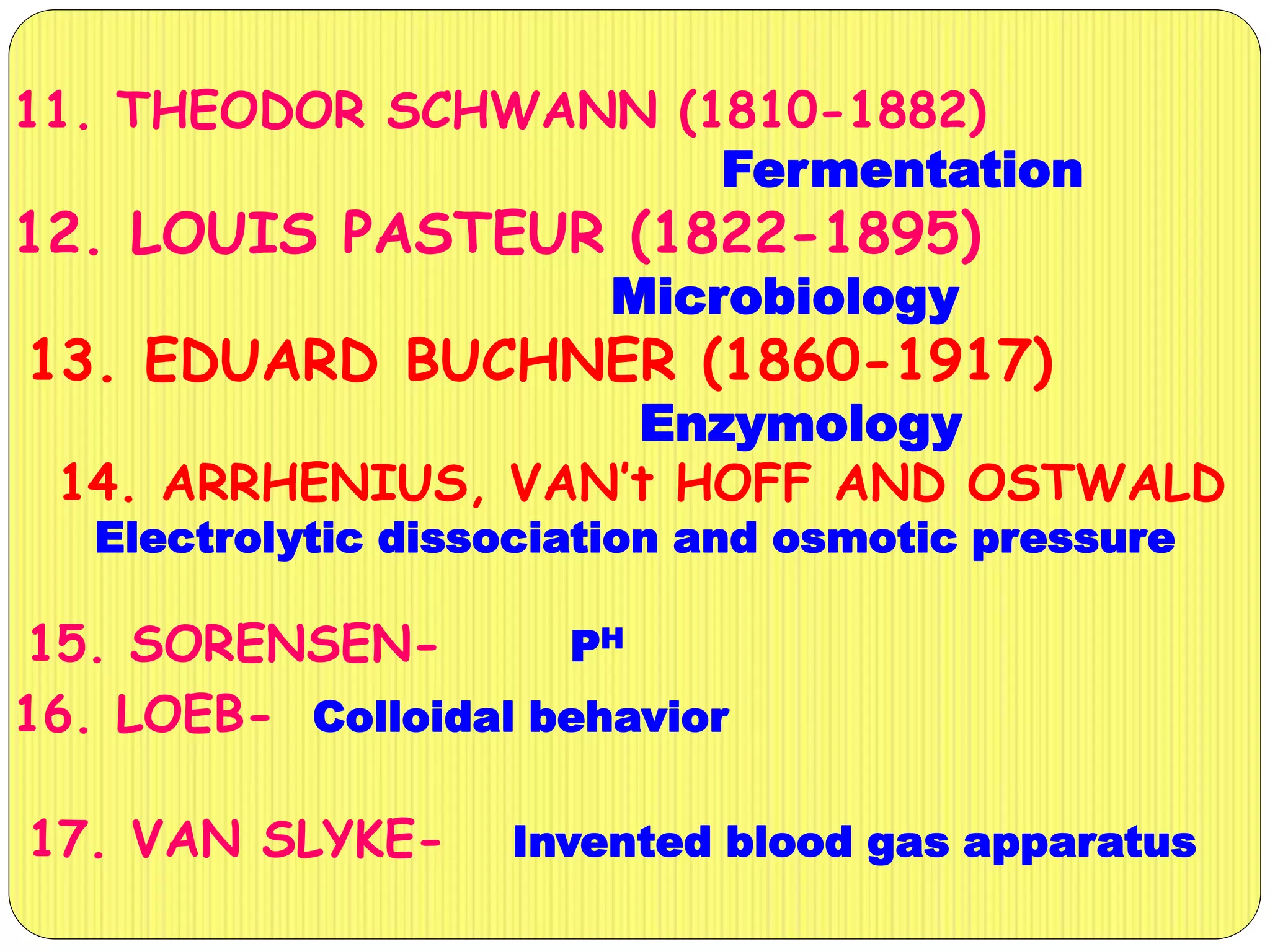
11. THEODOR SCHWANN (1810-1882)
Fermentation
12. LOUIS PASTEUR (1822-1895)
Microbiology
13. EDUARD BUCHNER (1860-1917)
Enzymology
14. ARRHENIUS, VAN’t HOFF AND OSTWALD
Electrolytic dissociation and osmotic pressure
15. SORENSEN- PH
16. LOEB- Colloidal behavior
17. VAN SLYKE- Invented blood gas apparatus
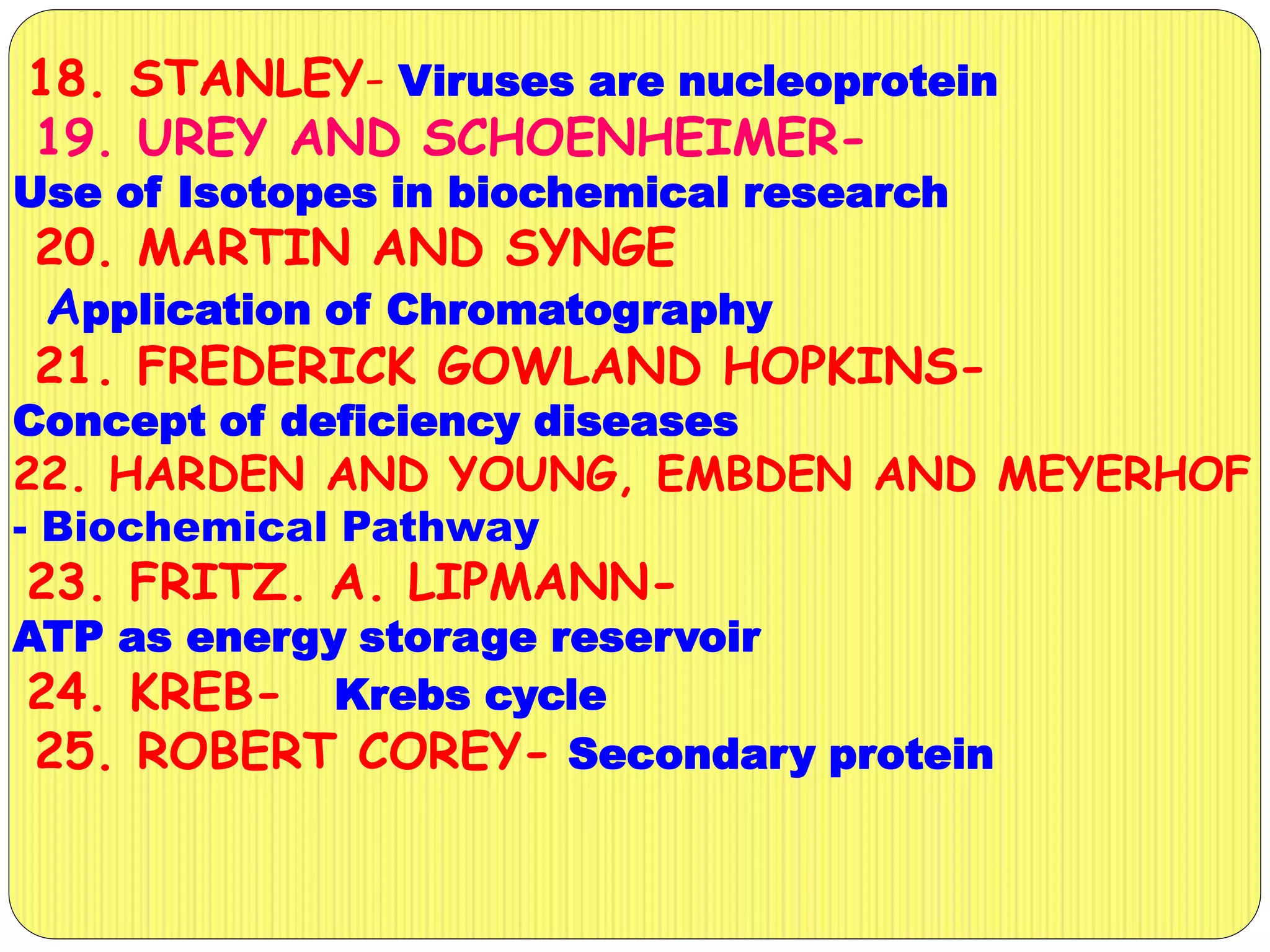
18. STANLEY- Viruses are nucleoprotein
19. UREY AND SCHOENHEIMER-
Use of Isotopes in biochemical research
20. MARTIN AND SYNGE
Application of Chromatography
21. FREDERICK GOWLAND HOPKINS-
Concept of deficiency diseases
22. HARDEN AND YOUNG, EMBDEN AND MEYERHOF
- Biochemical Pathway
23. FRITZ. A. LIPMANN-
ATP as energy storage reservoir
24. KREB- Krebs cycle
25. ROBERT COREY- Secondary protein
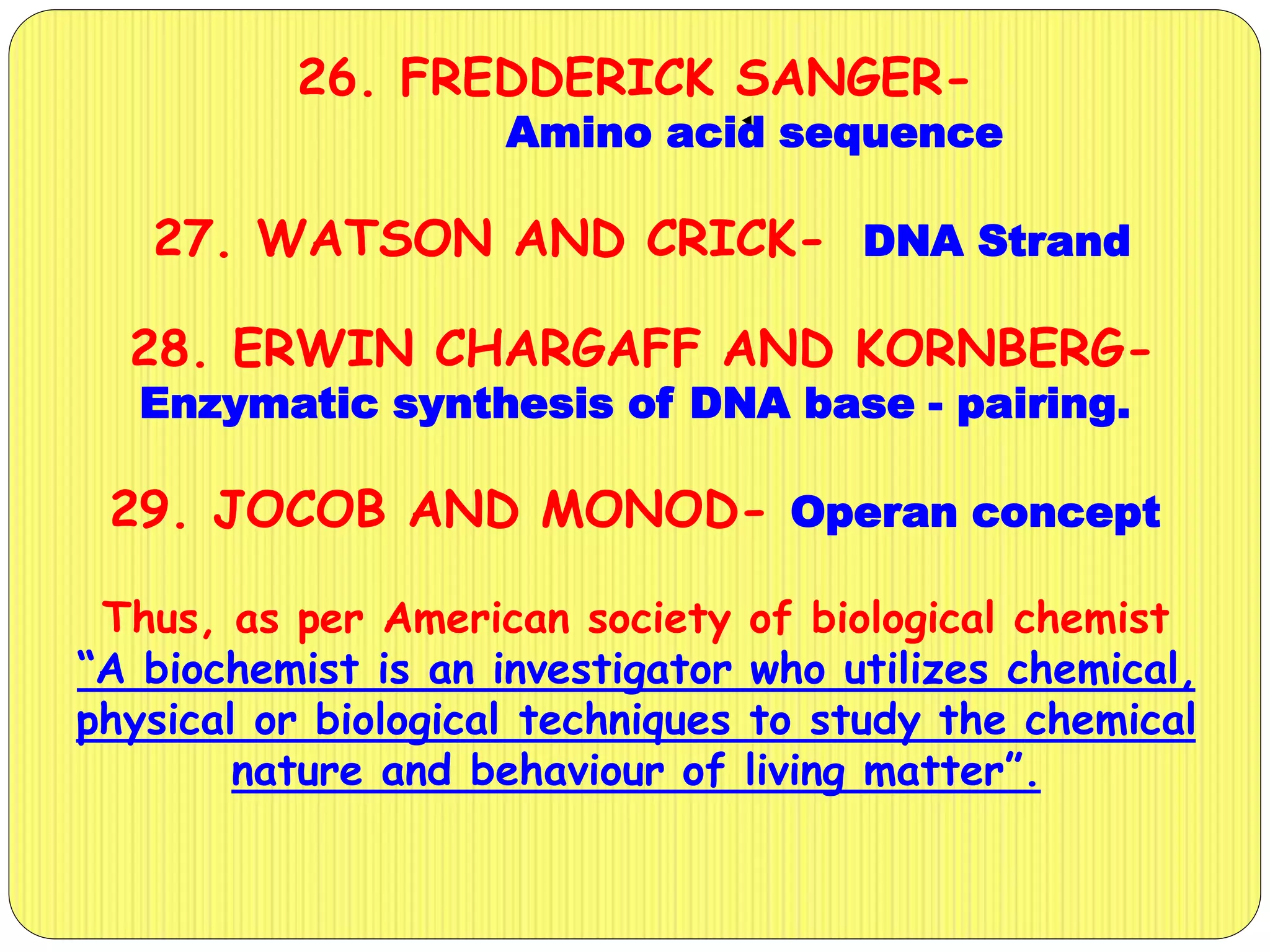
26. FREDDERICK SANGER-
Amino acid sequence
27. WATSON AND CRICK- DNA Strand
28. ERWIN CHARGAFF AND KORNBERG-
Enzymatic synthesis of DNA base - pairing.
29. JOCOB AND MONOD- Operan concept
Thus, as per American society of biological chemist
“A biochemist is an investigator who utilizes chemical,
physical or biological techniques to study the chemical
nature and behaviour of living matter”.
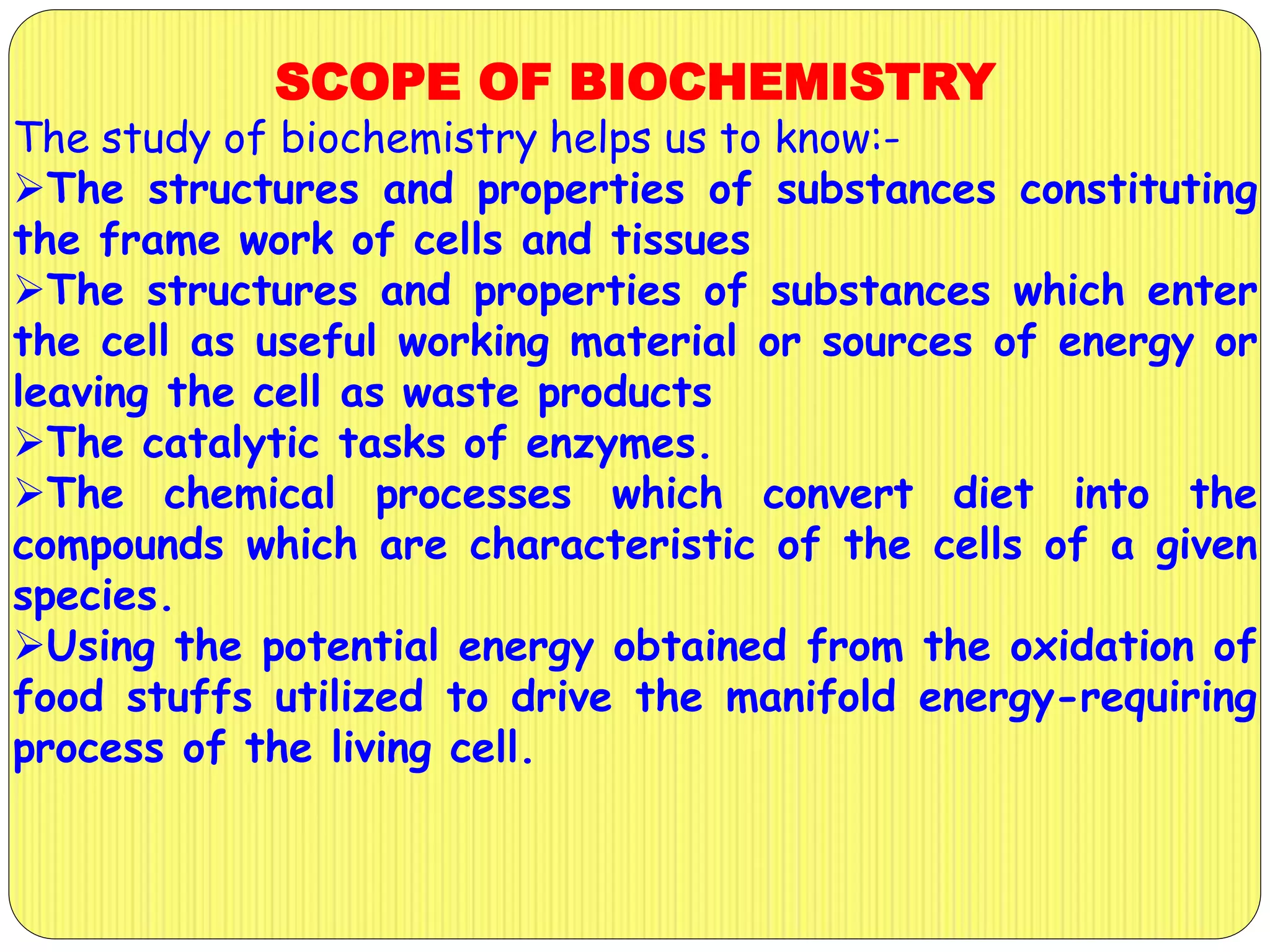
SCOPE OF BIOCHEMISTRY
The study of biochemistry helps us to know:-
The structures and properties of substances constituting
the frame work of cells and tissues
The structures and properties of substances which enter
the cell as useful working material or sources of energy or
leaving the cell as waste products
The catalytic tasks of enzymes.
The chemical processes which convert diet into the
compounds which are characteristic of the cells of a given
species.
Using the potential energy obtained from the oxidation of
food stuffs utilized to drive the manifold energy-requiring
process of the living cell.
Chemistry of inheritance.
The molecular basis of life
Clinical Diagnosis
Solving some fundamental problems in biology an
medicine.
Metabolism and biosynthesis
Relation with other branches of science
From the above it follows that the main objective of
biochemistry is to fill the wide gap between the highly
integrated functions of the living cells and the various
properties of its individual chemical constituents.
Thus, a biochemist is an investigator, who utilizes
chemical, physical or biological techniques to study the
chemical nature and behavior of living matter
(American society of Biological chemists 1965).
 A Biochemist therefore has to perform an important
arduous task of carrying the research work with utmost
sincerity. Patience and honesty. Prof. Hopkins (1931) has
rightly remarked- “He (biochemist) should be bold in
Experiment but cautious in his claims. He may not be the
last word in the description o life, but without his help
the last word will never be said”
 Over the last 40 years biochemistry has become so
successful at explaining living processes that now almost all
areas of the LIFE SCIENCES from BOTANY to MEDICINE are
engaged in biochemical research.Today the main focus of
pure biochemistry is in understanding how biological
molecules give rise to the processes that occur within
living cells, which in turn relates greatly to the study and
understanding of whole organisms.
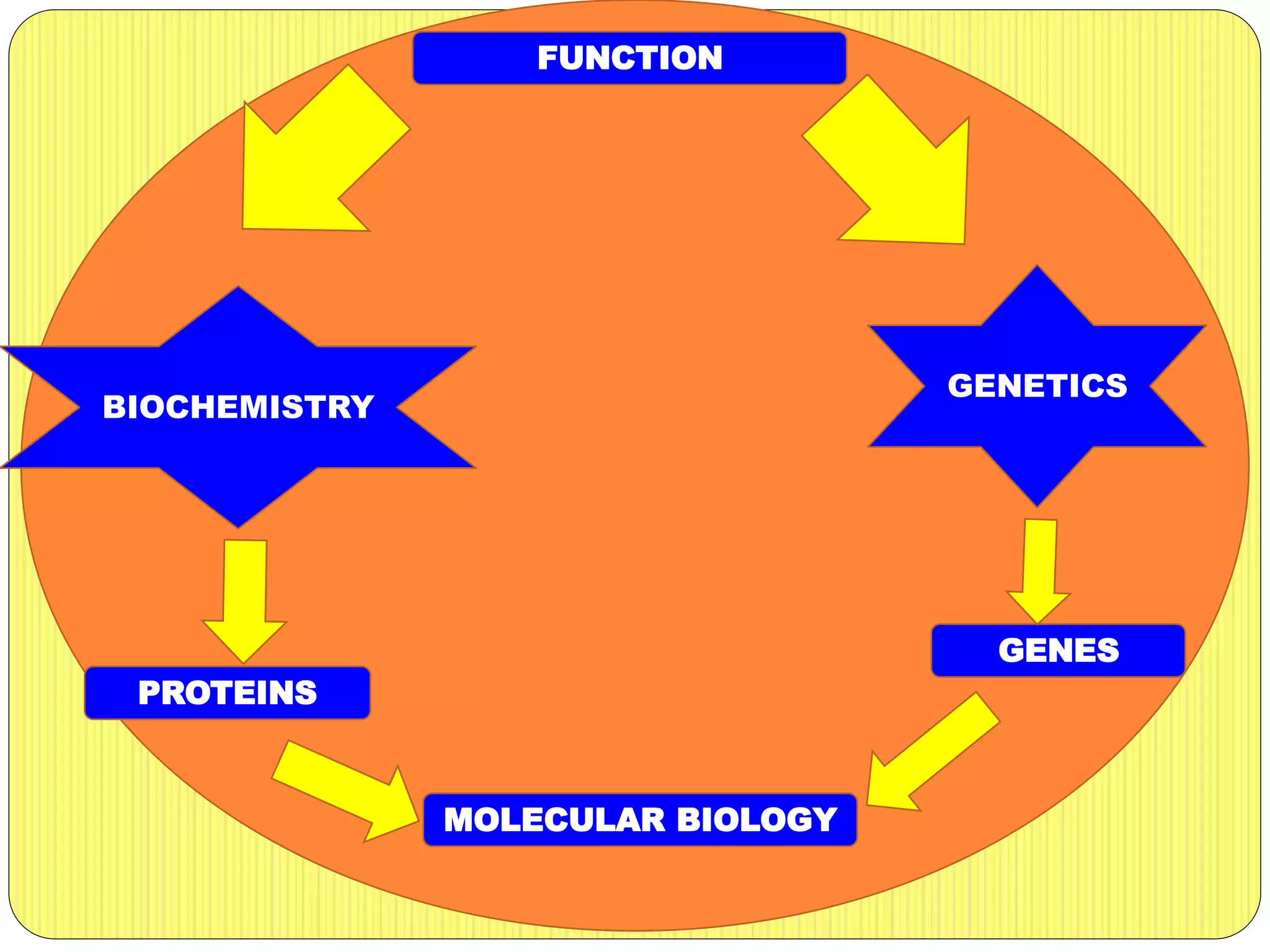
FUNCTION
BIOCHEMISTRY
GENETICS
MOLECULAR BIOLOGY
PROTEINS
GENES
THANK YOU
FOR YOUR
KIND ATTENTION

INTRODUCTION TO BIOCHEMISTY

  • 1.
    INTRODUCTION TO BIOCHEMISTRY Dr. RAJESH.N M.Sc., DLC.,DCA., DCR., DMT., DMI., PGDHR., Ph.D., FASS., FBDS., FACS., FPAI Asst . Professor Department of Biochemistry/ Food Processing & Engineering JSSCACS, Ooty Road, Mysore-570025 Karnataka, India.
  • 2.
    In humans, atthe most basic level, properly functioning balances of chemical reactions within the body are responsible for health while disfunctioning balances of chemical reactions are responsible for diseases. Biochemical reactions are responsible for everything from metabolism to genetics. The study of biochemistry is important for deepening our understanding of how organisms function. Understanding biochemistry plays a large role in understanding the genetic basis for some diseases, the pharmacological effects of medications, the intricacies of metabolism, and the most basic differences between organisms. Why BIOCHEMISTRY WITHOUT FUNCTIONING BIOCHEMICAL REACTIONS, LIFE IN ANY FORM WOULD NOT EXIST.
  • 3.
     The termBIOCHEMISTRY was first of all introduced by a German chemist called Carl Neuberg in 1903.  The word Biochemistry is derived from the Greek word Bios meaning LIFE.  Biochemistry means the chemistry of living organisms.Thus it may be defind as “science which describes s in language of chemistry, the structure and functioning of living organisms”.  It is also defined as the branch of science which deals with the chemical processes that goes on in living matter, ranging from Viruses and Bacteria to Plants and Animals.
  • 4.
    Actually it isa study of  CELL BIOLOGY  MOLECULAR BIOLOGY  ORGANIC CHEMISTRY  MOLECULAR PHYSIOLOGY  BIOCHEMICAL GENETICS  INORGANIC CHEMISTRY  PHYSICAL CHEMISTRY  MICROBIOLOGY  CLINICAL SCIENCE  AGRICULTURE CHEMISTRY  INDUSTRIAL CHEMISTRY  HUMAN DISEASES
  • 5.
    “The aim ofbiochemistry is to understand life in the language of science. Because of the inherent complexity of living matter”.
  • 6.
    BRANCHES OF BIOCHEMISTRY Biochemistryhas two separate branches DESCRIPTIVE BIOCHEMISTRY DYNAMIC BIOCHEMISTRY
  • 7.
    DESCRIPTIVE BIOCHEMISTRY  Itdeals with the qualitative and quantitative characterization of the various cell components. This branch is more concern to the organic chemist. DYANAMIC BIOCHEMISTRY  It deals with the elucidation of the nature and the mechanism of the reactions involving the cell components. This branch now becomes the Language of modern Biochemistry However, as the knowledge of biochemistry is growing rapidly newer disciplines are emerging from the parent biochemistry, some of these disciplines are
  • 8.
     ENZYMOLOGY: Itis the Study of enzymes.  ENDOCRINOLOGY: It is the Study of endocrine glands (HORMONES).  CLINICAL BIOCHEMISTRY:It I the study of living system in abnormality condition in term’s of its function during.  MOLECUALR BIOCHEMISTRY: It is the study of central dogma of molecular structure and function of genes.
  • 9.
    •PHARMACOLOGICAL BIOCHEMISTRY: It isthe branch of science which deals with the study of useful drugs for health promotion. •AGRICULTURAL BIOCHEMISTRY : It is field in which using the knowledge of biochemistry in agriculture in order to get more benefit from minimum time and surceases.
  • 10.
    HISTORICAL RESUME:- In termsof history, biochemistry is a young science. Science of biochemistry began with writings of Parcelsus (1493-1541) 1.Jan Baptist Van Helmont (1577-1644) Amalgamated the science of chemistry with medicine. 2.KARL WILHELM SCHEELE (1742-1786) Discovered the chemical composition of various drugs, plants and animals materials. Thus, he laid foundation of descriptive biochemistry.
  • 11.
    3.ANTOINE LAVOISIER (1743-1794) Putdynamic biochemistry on firm stand footings. He is often called as father of modern biochemistry. 4. FRIEDRICHWOHLER (1800-1882) Synthesized Urea. This rendered the vitalistic theory of organic materials 5. JUSTUSVON LIEBIG (1803-1873) Often called as father of agricultural chemistry
  • 12.
    6.MICHEL CHEVREUL (1786-1889) Saponificationof fats. 7. EMIL FISCHER (1852-1919) Structural biochemistry 9. MAYER AND VON HELMHOLTZ XIX CENTURY Laws of Thermo chemistry 8. FRIEDRICH MIESCHER (1871-1921) Discovery of Nucleic acid
  • 13.
    11. THEODOR SCHWANN(1810-1882) Fermentation 12. LOUIS PASTEUR (1822-1895) Microbiology 13. EDUARD BUCHNER (1860-1917) Enzymology 14. ARRHENIUS, VAN’t HOFF AND OSTWALD Electrolytic dissociation and osmotic pressure 15. SORENSEN- PH 16. LOEB- Colloidal behavior 17. VAN SLYKE- Invented blood gas apparatus
  • 14.
    18. STANLEY- Virusesare nucleoprotein 19. UREY AND SCHOENHEIMER- Use of Isotopes in biochemical research 20. MARTIN AND SYNGE Application of Chromatography 21. FREDERICK GOWLAND HOPKINS- Concept of deficiency diseases 22. HARDEN AND YOUNG, EMBDEN AND MEYERHOF - Biochemical Pathway 23. FRITZ. A. LIPMANN- ATP as energy storage reservoir 24. KREB- Krebs cycle 25. ROBERT COREY- Secondary protein
  • 15.
    26. FREDDERICK SANGER- Aminoacid sequence 27. WATSON AND CRICK- DNA Strand 28. ERWIN CHARGAFF AND KORNBERG- Enzymatic synthesis of DNA base - pairing. 29. JOCOB AND MONOD- Operan concept Thus, as per American society of biological chemist “A biochemist is an investigator who utilizes chemical, physical or biological techniques to study the chemical nature and behaviour of living matter”.
  • 16.
    SCOPE OF BIOCHEMISTRY Thestudy of biochemistry helps us to know:- The structures and properties of substances constituting the frame work of cells and tissues The structures and properties of substances which enter the cell as useful working material or sources of energy or leaving the cell as waste products The catalytic tasks of enzymes. The chemical processes which convert diet into the compounds which are characteristic of the cells of a given species. Using the potential energy obtained from the oxidation of food stuffs utilized to drive the manifold energy-requiring process of the living cell.
  • 17.
    Chemistry of inheritance. Themolecular basis of life Clinical Diagnosis Solving some fundamental problems in biology an medicine. Metabolism and biosynthesis Relation with other branches of science From the above it follows that the main objective of biochemistry is to fill the wide gap between the highly integrated functions of the living cells and the various properties of its individual chemical constituents. Thus, a biochemist is an investigator, who utilizes chemical, physical or biological techniques to study the chemical nature and behavior of living matter (American society of Biological chemists 1965).
  • 18.
     A Biochemisttherefore has to perform an important arduous task of carrying the research work with utmost sincerity. Patience and honesty. Prof. Hopkins (1931) has rightly remarked- “He (biochemist) should be bold in Experiment but cautious in his claims. He may not be the last word in the description o life, but without his help the last word will never be said”
  • 19.
     Over thelast 40 years biochemistry has become so successful at explaining living processes that now almost all areas of the LIFE SCIENCES from BOTANY to MEDICINE are engaged in biochemical research.Today the main focus of pure biochemistry is in understanding how biological molecules give rise to the processes that occur within living cells, which in turn relates greatly to the study and understanding of whole organisms.
  • 20.
  • 21.