INTRODUCTION
TO
BIOCHEMISTRY
What Is Biochemistry?
The word ‘BIOCHEMISTRY’-
means -Chemistry of Living
beings or Chemical Basis of
Life.
“Life” in Biochemistry point of
view is:
Hundreds of Biochemical
reactions and Biochemical
processes
Occurring in sub cellular
organelles of a cell in an
organized manner.
Biochemistry is a branch
of life science:
Which deals with the Study
of Biochemical Reactions
and Processes
Occurring in living cells of
organisms.
Branches of Biochemistry
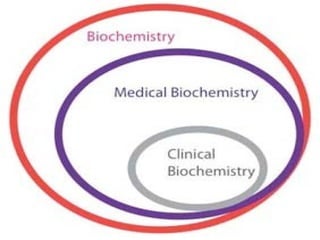
Medical Biochemistry-Deals with
chemical basis of human body.
Clinical Biochemistry-Deals with
clinical diseases/pathological
conditions of human body.
Clinical Biochemistry
supports:
Diagnosis, Therapy and
Research of Medical field.
Bacterial Biochemistry-Deals with Microbes.
Plant Biochemistry- Deals with Plants.
Animal Biochemistry-Deals with animals.
Industrial Biochemistry-Deals with
industrial products involved with
microorganisms.
Historical Developments
of
Biochemistry
Biochemistry emerged in the late 18th
and early 19th century.
The term Biochemistry was first
introduced by the German Chemist Carl
Neuberg in 1903.
In the 1940s Clinical Biochemistry
evolved, as an autonomous field.
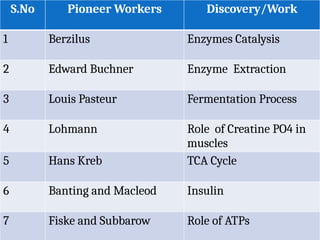
S.No Pioneer Workers Discovery/Work
1 Berzilus Enzymes Catalysis
2 Edward Buchner Enzyme Extraction
3 Louis Pasteur Fermentation Process
4 Lohmann Role of Creatine PO4 in
muscles
5 Hans Kreb TCA Cycle
6 Banting and Macleod Insulin
7 Fiske and Subbarow Role of ATPs
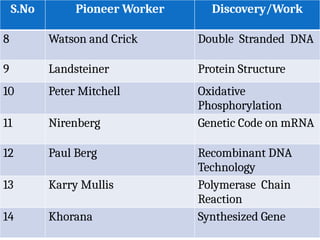
S.No Pioneer Worker Discovery/Work
8 Watson and Crick Double Stranded DNA
9 Landsteiner Protein Structure
10 Peter Mitchell Oxidative
Phosphorylation
11 Nirenberg Genetic Code on mRNA
12 Paul Berg Recombinant DNA
Technology
13 Karry Mullis Polymerase Chain
Reaction
14 Khorana Synthesized Gene
Aim And Objectives
To Study
Biochemistry
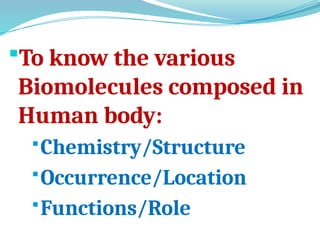
To know the various
Biomolecules composed in
Human body:
Chemistry/Structure
Occurrence/Location
Functions/Role
Determination of mode of
action of Biomolecules is
by:
Isolation and Structural
elucidation of Biomolecules.
Understand completely
all the organized
Biochemical processes
Occurring in living cells at
the molecular/sub
cellular level .
Identification of disease
mechanisms:
Study of Inborn Errors of
metabolism.
Study of Oncogenes in cancer cells.
Syllabus Of Biochemistry
Medical Biochemistry
Medical or Human Biochemistry is a
branch of Biochemistry which deals with:
Biochemical constituents of human
body
Their interactions in body cells
To maintain normal health, growth
and reproduction and related diseases.
Chemical Composition of Human body
Study of Biochemical
aspects of Cell and its sub
cellular organelles.
 Study of various Biochemical constituents of
cell:
(Chemistry, properties , functions, metabolism and
related disorders).
① Carbohydrates
② Lipids
③ Proteins
④ Vitamins
⑤ Minerals
⑥ Water
Nutrition and Metabolism of
Biomolecules
Study of Food and its
constituents
Dietary Nutrients
builds human body
and maintain health
Major prerequisite for the
maintenance of health is that
There should be optimal
dietary intake of constituents
with good quality and
appropriate quantity.
Biochemical research has
impact on Nutrition &
Preventive Medicine.
Metabolism of Biomolecules
Ingestion
Digestion
Absorption
Transport
Uptake and
Assimilation of food constituents in
human body.
Catabolic and Anabolic
pathways related to
Biomolecules for Human
vitality:
Energy rich biomolecules get
catabolized in body cells to liberate
chemical form of energy ATP used for
various body activities.
Various biomolecules are biosynthesized
to perform vital functions of human
body.
To maintain normal health of
a human body:
Biomolecules in human body
work
Cooperatively with good
coordination ,Regulation and
Interrelationship.
Roles Of Important Biomolecules
Carbohydrates serves as primary
source of energy.
Lipids serves as secondary source of
energy.
Proteins are structural and
functional units of human body
which are of prime importance and
survival of human beings.
Vitamins: Fat soluble and Water soluble
vitamins have specific functions which
serve as accessory growth factors.
Minerals: Inorganic elements major and
minor type has important role in
building and functioning of human
bodies.
Enzymes are biomolecules which are
Biocatalysts catalyzes specific biochemical
reactions of metabolic pathways and
considered as functional units of
metabolism.
Hormones the Endocrine substances,
chemical messengers of human body.
They bring good coordination and regulate
enzyme activities of metabolism.
Elements of Molecular Biology
Nucleic acids and Molecular
Genetics
DNA, RNA and Protein synthesis
Regulation of gene expression
Recombinant DNA technology
Biochemical Processes
of
Human Body
 Membrane transport mechanisms and signal
transduction
 Biochemical mechanisms of hormone action-Cellular
Homoeostasis
 Functions of Neurotransmitters
 Oxygen transport, Bioenergetics, Mitochondrial
Respiratory chain
 The Immune response
Interrelationships Of Biochemistry
Biochemistry Is A Fundamental Subject Of
Medicine
Biochemistry is
related to almost every
Subject of Medicine.
There is relationship of Biochemistry with
many subjects such as.
Physiology
Pathology
Pharmacology
Immunology - Microbiology
Toxicology
Medicine and Allied Subjects
Community Medicine-Nutrition
Importance Of Biochemistry Knowledge To
A Doctor
Clear understanding
concepts of Biochemistry
Is a prerequisite to become A
Good Doctor
A thorough understanding
knowledge, of Biochemistry
by a Doctor helps in:
Right Diagnosing and treating
a patient .
Biochemical Aspects
of
Health and Disease
Healthy body
Healthy body in biochemical point
of view is with-
Normal metabolic functions in
the body cells.
Balanced levels of all the
biochemical constituents
Unhealthy/Diseased body
Unhealthy/Diseased body in
biochemical point of view is
with:
Derangement in their
metabolic functions.
Imbalanced levels of
biochemical constituents
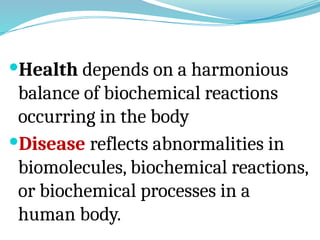
Health depends on a harmonious
balance of biochemical reactions
occurring in the body
Disease reflects abnormalities in
biomolecules, biochemical reactions,
or biochemical processes in a
human body.
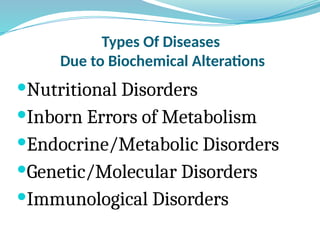
Types Of Diseases
Due to Biochemical Alterations
Nutritional Disorders
Inborn Errors of Metabolism
Endocrine/Metabolic Disorders
Genetic/Molecular Disorders
Immunological Disorders
List of Biochemical Disorders
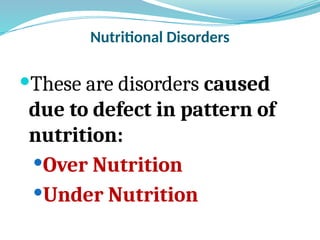
Nutritional Disorders
These are disorders caused
due to defect in pattern of
nutrition:
Over Nutrition
Under Nutrition
Thank You

Introduction TO BIOCHEMISTRY welcome.pptx