Lecture 1
Introduction to Biochemistry
Definition Of Biochemistry
• Definition: The chemistry of life
• The science concerned with the chemical basis of life.
• The science concerned with the various molecules that occur in living cells
and organisms and with their chemical reaction.
Biochemistry
1- chemistry of biomolecules 2- chemical reactions
( structures and functions) of biomolecules
Aims of biochemistry
1- is to describe and explain in
molecular terms all chemical
processes of living cell
• Structure-function
• Metabolism and Regulation
2- To understand how life is began
3- knowledge of biochemistry is
essential to all life sciences
Bio-medicine relationship
• All diseases have biochemical bases
• Most biochemical reactions have been discovered after following a
course of a disease
• Bio.techniques used for diagnosis of diseases
• Biochemistry is used for formulation of drugs
4
Biochemistry & pharmacology
•The action of a drug almost always involves some
change in the biochemical processes taking place in
the body. As such, pharmacologists must also be
aware with the biochemical aspects of the human
body.
•In pharmacy, biochemical testing provides
indispensable visions into a drug's: mode of action.
In order to study biochemistry a little
information should be known about
the cell
The cell smallest unit of live capable
of doing all living processes
Cell divided into :
1- eukaryotic cell
2- prokaryotic cell
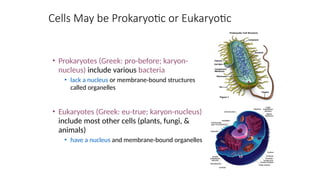
Cells May be Prokaryotic or Eukaryotic
• Prokaryotes (Greek: pro-before; karyon-
nucleus) include various bacteria
• lack a nucleus or membrane-bound structures
called organelles
• Eukaryotes (Greek: eu-true; karyon-nucleus)
include most other cells (plants, fungi, &
animals)
• have a nucleus and membrane-bound organelles
Eukaryotic cell
 Cell found usually in multi-
cellular organisms
 Consist of
1- outer plasma membrane
2- nucleus with nuclear membrane
3- cytosol enriched with organells
The organells are:
1- mitochondrion
2- endoplsmic reticulum
3- golgi apparatus
4- lysosomes
5- perioxisome
6- ribosome
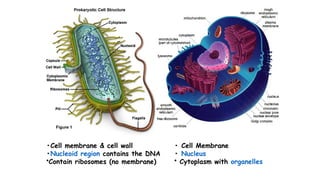
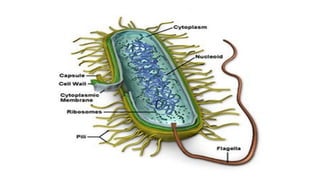
•Cell membrane & cell wall
•Nucleoid region contains the DNA
•Contain ribosomes (no membrane)
• Cell Membrane
• Nucleus
• Cytoplasm with organelles
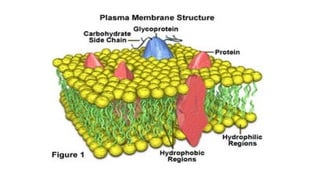
Plasma membrane
 Found in both prokaryote
and eukaryote cells
 It is phospholipids in nature
 It is selective permeable to
molecules
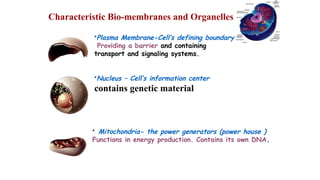
Characteristic Bio-membranes and Organelles
• Mitochondria- the power generators (power house )
Functions in energy production. Contains its own DNA.
•Plasma Membrane-Cell’s defining boundary
Providing a barrier and containing
transport and signaling systems.
•Nucleus – Cell’s information center
contains genetic material
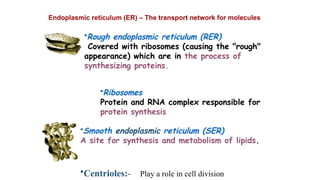
•Rough endoplasmic reticulum (RER)
Covered with ribosomes (causing the "rough"
appearance) which are in the process of
synthesizing proteins.
•Ribosomes
Protein and RNA complex responsible for
protein synthesis
•Smooth endoplasmic reticulum (SER)
A site for synthesis and metabolism of lipids.
•Centrioles:- Play a role in cell division
Endoplasmic reticulum (ER) – The transport network for molecules
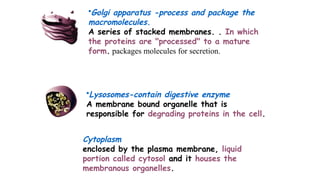
Cytoplasm
enclosed by the plasma membrane, liquid
portion called cytosol and it houses the
membranous organelles.
•Lysosomes-contain digestive enzyme
A membrane bound organelle that is
responsible for degrading proteins in the cell.
•Golgi apparatus -process and package the
macromolecules.
A series of stacked membranes. . In which
the proteins are "processed" to a mature
form. packages molecules for secretion.
Cell wall : - protects the cell and gives shape (A cell wall is
found in plants, algae, fungi, & most bacteria).
 Chloroplast :- conduct photosynthesis
 Vacuole :- storage, secretary, excretory
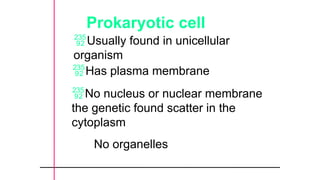
Prokaryotic cell
Has plasma membrane
No nucleus or nuclear membrane
the genetic found scatter in the
cytoplasm
No organelles
Usually found in unicellular
organism
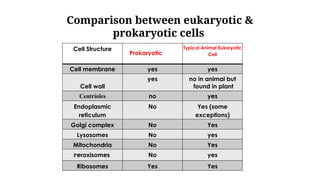
Cell Structure
Prokaryotic Cell
Typical Animal Eukaryotic
Cell
Cell membrane yes yes
Cell wall
yes no in animal but
found in plant
Centrioles no yes
Endoplasmic
reticulum
No Yes (some
exceptions)
Golgi complex No Yes
Lysosomes No yes
Mitochondria No Yes
Peroxisomes No yes
Ribosomes Yes Yes
Comparison between eukaryotic &
prokaryotic cells
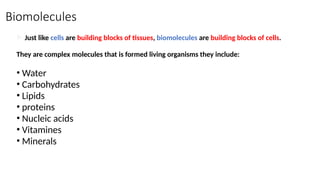
Biomolecules
 Just like cells are building blocks of tissues, biomolecules are building blocks of cells.
They are complex molecules that is formed living organisms they include:
• Water
• Carbohydrates
• Lipids
• proteins
• Nucleic acids
• Vitamines
• Minerals

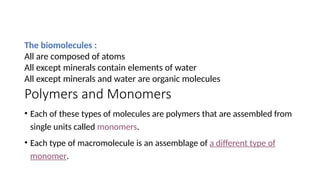
Polymers and Monomers
• Each of these types of molecules are polymers that are assembled from
single units called monomers.
• Each type of macromolecule is an assemblage of a different type of
monomer.
The biomolecules :
All are composed of atoms
All except minerals contain elements of water
All except minerals and water are organic molecules
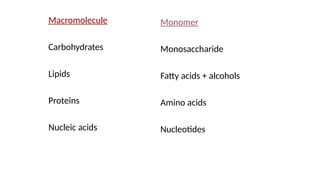
Macromolecule
Carbohydrates
Lipids
Proteins
Nucleic acids
Monomer
Monosaccharide
Fatty acids + alcohols
Amino acids
Nucleotides
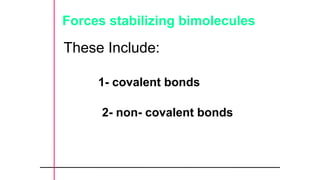
Forces stabilizing bimolecules
These Include:
1- covalent bonds
2- non- covalent bonds
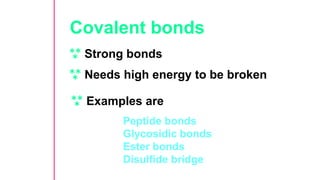
Covalent bonds
 Strong bonds
 Needs high energy to be broken
 Examples are
Peptide bonds
Glycosidic bonds
Ester bonds
Disulfide bridge
The non-covalent bonds
This include
1- hydrogen bond
2- hydrophobic interaction
3- Electrostatic bond
4- Van Der Waal forces
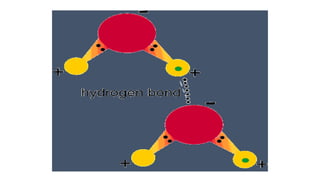
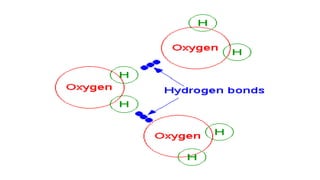
Hydrogen bond
 Non-covalent bond
 Occur between positive
hydrogen ion in a molecule ad
negative ion in another one
Is very week bond
The hydrophobic interaction
Is tendency of a molecule
for folding around it self to
hide the non-polar part from
water when put in solution
In this case the polar part
come to the out side to
contact water
Electrostatic interaction
(ionic bridge,salt bridge)
 Non-covalent bond
 Occur between a positive
ion in one molecule and most
negative ion in another
molecule
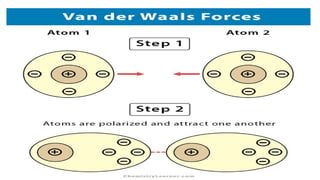
Van Der Waal forces
Is the attractive and
repulsive forces that
occur between two
adjacent atoms in a
molecule
Introduction to biochemistry majdolinbb.pptx

Introduction to biochemistry majdolinbb.pptx

  • 1.
  • 2.
    Definition Of Biochemistry •Definition: The chemistry of life • The science concerned with the chemical basis of life. • The science concerned with the various molecules that occur in living cells and organisms and with their chemical reaction. Biochemistry 1- chemistry of biomolecules 2- chemical reactions ( structures and functions) of biomolecules
  • 3.
    Aims of biochemistry 1-is to describe and explain in molecular terms all chemical processes of living cell • Structure-function • Metabolism and Regulation 2- To understand how life is began 3- knowledge of biochemistry is essential to all life sciences
  • 4.
    Bio-medicine relationship • Alldiseases have biochemical bases • Most biochemical reactions have been discovered after following a course of a disease • Bio.techniques used for diagnosis of diseases • Biochemistry is used for formulation of drugs 4
  • 5.
    Biochemistry & pharmacology •Theaction of a drug almost always involves some change in the biochemical processes taking place in the body. As such, pharmacologists must also be aware with the biochemical aspects of the human body. •In pharmacy, biochemical testing provides indispensable visions into a drug's: mode of action.
  • 6.
    In order tostudy biochemistry a little information should be known about the cell The cell smallest unit of live capable of doing all living processes Cell divided into : 1- eukaryotic cell 2- prokaryotic cell
  • 7.
    Cells May beProkaryotic or Eukaryotic • Prokaryotes (Greek: pro-before; karyon- nucleus) include various bacteria • lack a nucleus or membrane-bound structures called organelles • Eukaryotes (Greek: eu-true; karyon-nucleus) include most other cells (plants, fungi, & animals) • have a nucleus and membrane-bound organelles
  • 8.
    Eukaryotic cell  Cellfound usually in multi- cellular organisms  Consist of 1- outer plasma membrane 2- nucleus with nuclear membrane 3- cytosol enriched with organells
  • 9.
    The organells are: 1-mitochondrion 2- endoplsmic reticulum 3- golgi apparatus 4- lysosomes 5- perioxisome 6- ribosome
  • 10.
    •Cell membrane &cell wall •Nucleoid region contains the DNA •Contain ribosomes (no membrane) • Cell Membrane • Nucleus • Cytoplasm with organelles
  • 11.
    Plasma membrane  Foundin both prokaryote and eukaryote cells  It is phospholipids in nature  It is selective permeable to molecules
  • 13.
    Characteristic Bio-membranes andOrganelles • Mitochondria- the power generators (power house ) Functions in energy production. Contains its own DNA. •Plasma Membrane-Cell’s defining boundary Providing a barrier and containing transport and signaling systems. •Nucleus – Cell’s information center contains genetic material
  • 14.
    •Rough endoplasmic reticulum(RER) Covered with ribosomes (causing the "rough" appearance) which are in the process of synthesizing proteins. •Ribosomes Protein and RNA complex responsible for protein synthesis •Smooth endoplasmic reticulum (SER) A site for synthesis and metabolism of lipids. •Centrioles:- Play a role in cell division Endoplasmic reticulum (ER) – The transport network for molecules
  • 15.
    Cytoplasm enclosed by theplasma membrane, liquid portion called cytosol and it houses the membranous organelles. •Lysosomes-contain digestive enzyme A membrane bound organelle that is responsible for degrading proteins in the cell. •Golgi apparatus -process and package the macromolecules. A series of stacked membranes. . In which the proteins are "processed" to a mature form. packages molecules for secretion.
  • 16.
    Cell wall :- protects the cell and gives shape (A cell wall is found in plants, algae, fungi, & most bacteria).  Chloroplast :- conduct photosynthesis  Vacuole :- storage, secretary, excretory
  • 17.
    Prokaryotic cell Has plasmamembrane No nucleus or nuclear membrane the genetic found scatter in the cytoplasm No organelles Usually found in unicellular organism
  • 19.
    Cell Structure Prokaryotic Cell TypicalAnimal Eukaryotic Cell Cell membrane yes yes Cell wall yes no in animal but found in plant Centrioles no yes Endoplasmic reticulum No Yes (some exceptions) Golgi complex No Yes Lysosomes No yes Mitochondria No Yes Peroxisomes No yes Ribosomes Yes Yes Comparison between eukaryotic & prokaryotic cells
  • 20.
    Biomolecules  Just likecells are building blocks of tissues, biomolecules are building blocks of cells. They are complex molecules that is formed living organisms they include: • Water • Carbohydrates • Lipids • proteins • Nucleic acids • Vitamines • Minerals 
  • 21.
    Polymers and Monomers •Each of these types of molecules are polymers that are assembled from single units called monomers. • Each type of macromolecule is an assemblage of a different type of monomer. The biomolecules : All are composed of atoms All except minerals contain elements of water All except minerals and water are organic molecules
  • 22.
  • 23.
    Forces stabilizing bimolecules TheseInclude: 1- covalent bonds 2- non- covalent bonds
  • 24.
    Covalent bonds  Strongbonds  Needs high energy to be broken  Examples are Peptide bonds Glycosidic bonds Ester bonds Disulfide bridge
  • 25.
    The non-covalent bonds Thisinclude 1- hydrogen bond 2- hydrophobic interaction 3- Electrostatic bond 4- Van Der Waal forces
  • 26.
    Hydrogen bond  Non-covalentbond  Occur between positive hydrogen ion in a molecule ad negative ion in another one Is very week bond
  • 29.
    The hydrophobic interaction Istendency of a molecule for folding around it self to hide the non-polar part from water when put in solution In this case the polar part come to the out side to contact water
  • 30.
    Electrostatic interaction (ionic bridge,saltbridge)  Non-covalent bond  Occur between a positive ion in one molecule and most negative ion in another molecule
  • 32.
    Van Der Waalforces Is the attractive and repulsive forces that occur between two adjacent atoms in a molecule