Bio Chemistry
By Dr Saima Memon
Introduction
 Name
 City
 Best quality
 Area of improvement
Bio Chemistry
 Biochemistry is the branch of science that explores
the chemical processes within and related to living
organisms. It is a laboratory-based science that
combines principles of biology and chemistry to
understand the molecular mechanisms that govern
life. Biochemistry focuses on the structure, function,
and interactions of biological molecules such as
proteins, nucleic acids, lipids, carbohydrates, and
enzymes.
Lecture -1
Cell
Bio Chemistry
At The end of this session you should able to
understand
1. CELL
a) Describe the structure of cell and its bio chemical
composition
b) Differentiate between eukaryotic and prokaryotic cell
c) Describe various cell membrane proteins
d) Discuss cell receptors and different signaling
mechanism
What is Cell?
The cell is the functional basic unit of life. It
was discovered by Robert Hooke and is the
functional unit of all known living organisms.
Shape of cells
Generally, cells are round, spherical or
elongated some cells are long and pointed at
both ends. They exhibit a spindle shape. Cells
sometimes are quite long. Some are branched
like nerve cells or a neuron. Some are sphere
like RBC.
Unicellular and multicellular
Organisms, such as most bacteria, are
unicellular (consist of a single cell). Other
organisms, such as humans, are multi cellular.
Humans have about 100 trillion cells
Types of Cell
There are two types of cells:
1. Eukaryotic cell
2. Prokaryotic cell
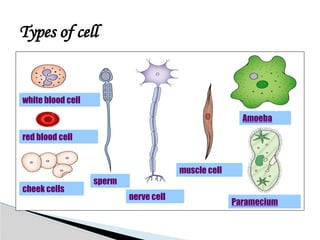
Types of cell
white blood cell
red blood cell
cheek cells
sperm
nerve cell
muscle cell
Amoeba
Paramecium
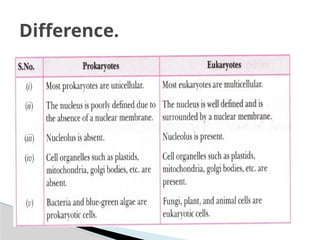
Difference.
 Cells are composed of several components:
 1. Cell Membrane: A phospholipid bilayer that
controls the entry and exit of substances.
 2. Cytoplasm: Gel-like substance containing
organelles and cytosolic molecules.
 3. Nucleus: Contains genetic material (DNA) in
eukaryotic cells.

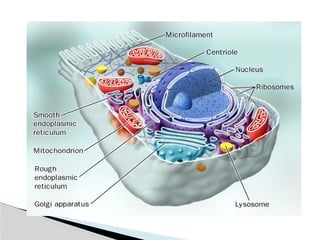
Structure of cell
 4. Organelles: Mitochondria: Powerhouse of
the cell, produces energy (ATP).
Ribosomes: Synthesize proteins.
Endoplasmic Reticulum: Rough (protein
synthesis) and Smooth (lipid synthesis).
Golgi Apparatus: Modifies, sorts, and packages
proteins.
Lysosomes: Contain enzymes for digestion.
Chloroplasts (in plants): Site of photosynthesis.
Structure of cell
Organelles of Cell
Very small size
Can only be observed under a microscope
Have specific functions
Found throughout cytoplasm
Endoplasmic reticulum (rough & smooth) ; Golgi
Bodies;Nucleolus; Lysosomes; Ribosomes
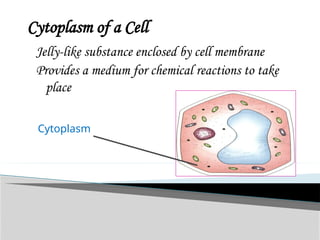
Cytoplasm of a Cell
Jelly-like substance enclosed by cell membrane
Provides a medium for chemical reactions to take
place
Cytoplasm
Cell nucleus
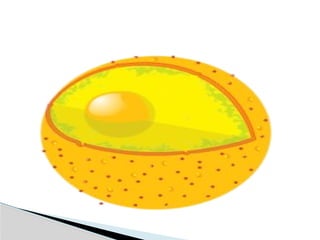
The cell nucleus is the most conspicuous
organelle found in a eukaryotic cell. It houses
the cell's chromosomes, and is the place where
almost all DNA replication and RNA
synthesis (transcription) occur. The nucleus is
spherical and separated from the cytoplasm by
a double membrane called the nuclear envelope.
 DNA replication and RNA transcription of DNA
occur in the nucleus.
 The nucleolus is non-membranous and
contains RNA polymerase, RNAase, ATPase
and other enzymes but no DNA polymerase.
 Nucleolus is also the major site where
ribosome subunits are assembled.
functions
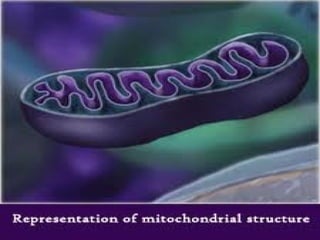
Mitochondria
Mitochondria are present in eukaryotes only.
Mitochondria are self-replicating organelles
that occur in various numbers, shapes, and
sizes in the cytoplasm of all eukaryotic cells.
Mitochondria play a critical role in
generating energy in the eukaryotic cell.
Endoplasmic reticulum
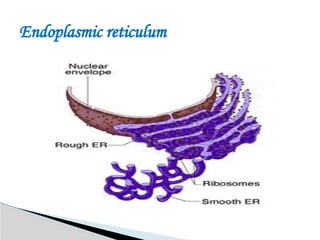
The ER has two forms: the rough ER, which
has ribosomes on its surface and secretes
proteins into the cytoplasm, and the smooth
ER, which lacks them. Smooth ER plays a role
in calcium sequestration and release.
There are two kinds of endoplasmic reticulum
(ER)
 i) Rough surfaced ER
 ii) Smooth surfaced ER
Function of rough ER: Rough ER synthesizes
membrane lipids, and secretory proteins.
These proteins are inserted through the ER
membrane into the lumen of the cisternae
where they are modified and transported
through the cell.
Types
 Function of smooth ER: Smooth endoplasmic
reticulum is involved:
(i) In lipid synthesis and
(ii) Modification and transport of proteins
synthesized in the rough ER.
Endoplasmic reticulum
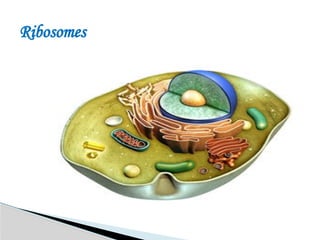
The ribosome
The ribosome is a large complex of RNA and
protein molecules. They each consist of two
subunits, and act as an assembly line where
RNA from the nucleus is used to synthesize
proteins from amino acids. Ribosomes can be
found
Ribosomes
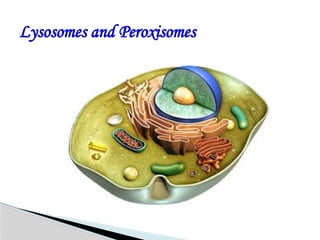
Lysosomes and Peroxisomes
Lysosomes and Peroxisomes are present in
eukaryotes only. Lysosomes contain
digestive enzymes (acid hydrolases). They digest
excess or worn-out organelles, food particles,
and engulfed viruses or bacteria. Peroxisomes
have enzymes that rid the cell of toxic
peroxides.
Lysosomes and Peroxisomes
 Cells are primarily composed of:
 1. Water (~70%): Acts as a solvent for
biochemical reactions.
 2. Proteins: Enzymes, structural components,
and signaling molecules.
 3. Lipids: Form the cell membrane and store
energy.
 4. Carbohydrates: Provide energy and
structural support.
Biochemical Composition of a Cell
 5. Nucleic Acids: DNA and RNA, carriers of
genetic information.
 6. Ions and Small Molecules: Calcium,
potassium, sodium, etc., for cellular processes.
Biochemical Composition of a Cell
It’s You!
Thank You

Bio Chemistry lec ...........................

  • 1.
  • 2.
    Introduction  Name  City Best quality  Area of improvement
  • 3.
    Bio Chemistry  Biochemistryis the branch of science that explores the chemical processes within and related to living organisms. It is a laboratory-based science that combines principles of biology and chemistry to understand the molecular mechanisms that govern life. Biochemistry focuses on the structure, function, and interactions of biological molecules such as proteins, nucleic acids, lipids, carbohydrates, and enzymes.
  • 4.
  • 5.
    Bio Chemistry At Theend of this session you should able to understand 1. CELL a) Describe the structure of cell and its bio chemical composition b) Differentiate between eukaryotic and prokaryotic cell c) Describe various cell membrane proteins d) Discuss cell receptors and different signaling mechanism
  • 6.
    What is Cell? Thecell is the functional basic unit of life. It was discovered by Robert Hooke and is the functional unit of all known living organisms.
  • 7.
    Shape of cells Generally,cells are round, spherical or elongated some cells are long and pointed at both ends. They exhibit a spindle shape. Cells sometimes are quite long. Some are branched like nerve cells or a neuron. Some are sphere like RBC.
  • 8.
    Unicellular and multicellular Organisms,such as most bacteria, are unicellular (consist of a single cell). Other organisms, such as humans, are multi cellular. Humans have about 100 trillion cells
  • 9.
    Types of Cell Thereare two types of cells: 1. Eukaryotic cell 2. Prokaryotic cell
  • 10.
    Types of cell whiteblood cell red blood cell cheek cells sperm nerve cell muscle cell Amoeba Paramecium
  • 11.
  • 12.
     Cells arecomposed of several components:  1. Cell Membrane: A phospholipid bilayer that controls the entry and exit of substances.  2. Cytoplasm: Gel-like substance containing organelles and cytosolic molecules.  3. Nucleus: Contains genetic material (DNA) in eukaryotic cells. Structure of cell
  • 13.
     4. Organelles:Mitochondria: Powerhouse of the cell, produces energy (ATP). Ribosomes: Synthesize proteins. Endoplasmic Reticulum: Rough (protein synthesis) and Smooth (lipid synthesis). Golgi Apparatus: Modifies, sorts, and packages proteins. Lysosomes: Contain enzymes for digestion. Chloroplasts (in plants): Site of photosynthesis. Structure of cell
  • 14.
    Organelles of Cell Verysmall size Can only be observed under a microscope Have specific functions Found throughout cytoplasm Endoplasmic reticulum (rough & smooth) ; Golgi Bodies;Nucleolus; Lysosomes; Ribosomes
  • 15.
    Cytoplasm of aCell Jelly-like substance enclosed by cell membrane Provides a medium for chemical reactions to take place Cytoplasm
  • 17.
    Cell nucleus The cellnucleus is the most conspicuous organelle found in a eukaryotic cell. It houses the cell's chromosomes, and is the place where almost all DNA replication and RNA synthesis (transcription) occur. The nucleus is spherical and separated from the cytoplasm by a double membrane called the nuclear envelope.
  • 18.
     DNA replicationand RNA transcription of DNA occur in the nucleus.  The nucleolus is non-membranous and contains RNA polymerase, RNAase, ATPase and other enzymes but no DNA polymerase.  Nucleolus is also the major site where ribosome subunits are assembled. functions
  • 20.
    Mitochondria Mitochondria are presentin eukaryotes only. Mitochondria are self-replicating organelles that occur in various numbers, shapes, and sizes in the cytoplasm of all eukaryotic cells. Mitochondria play a critical role in generating energy in the eukaryotic cell.
  • 22.
    Endoplasmic reticulum The ERhas two forms: the rough ER, which has ribosomes on its surface and secretes proteins into the cytoplasm, and the smooth ER, which lacks them. Smooth ER plays a role in calcium sequestration and release.
  • 23.
    There are twokinds of endoplasmic reticulum (ER)  i) Rough surfaced ER  ii) Smooth surfaced ER Function of rough ER: Rough ER synthesizes membrane lipids, and secretory proteins. These proteins are inserted through the ER membrane into the lumen of the cisternae where they are modified and transported through the cell. Types
  • 24.
     Function ofsmooth ER: Smooth endoplasmic reticulum is involved: (i) In lipid synthesis and (ii) Modification and transport of proteins synthesized in the rough ER.
  • 25.
  • 26.
    The ribosome The ribosomeis a large complex of RNA and protein molecules. They each consist of two subunits, and act as an assembly line where RNA from the nucleus is used to synthesize proteins from amino acids. Ribosomes can be found
  • 27.
  • 28.
    Lysosomes and Peroxisomes Lysosomesand Peroxisomes are present in eukaryotes only. Lysosomes contain digestive enzymes (acid hydrolases). They digest excess or worn-out organelles, food particles, and engulfed viruses or bacteria. Peroxisomes have enzymes that rid the cell of toxic peroxides.
  • 29.
  • 30.
     Cells areprimarily composed of:  1. Water (~70%): Acts as a solvent for biochemical reactions.  2. Proteins: Enzymes, structural components, and signaling molecules.  3. Lipids: Form the cell membrane and store energy.  4. Carbohydrates: Provide energy and structural support. Biochemical Composition of a Cell
  • 31.
     5. NucleicAcids: DNA and RNA, carriers of genetic information.  6. Ions and Small Molecules: Calcium, potassium, sodium, etc., for cellular processes. Biochemical Composition of a Cell
  • 32.