Prateek Garodia

INTRODUCTION TO AIRLINE
NETWORKS
Network Introduction

 This presentation is an introduction to and a
 comparison of the two of the most common
 networks in the airline industry
   Direct Network (aka Point-to-Point Network) and
   Hub & Spoke Network
 A network is required to manage all the
 routes that an airline has opened to service its
 customers


                                    1/5/2012         2
Direct Network

 A Direct Network is one where there is a
 direct service from one airport to another
 without a stop in a third airport
 It is optimally used under the following
 circumstances
   Distance between two cities is small
   Demand between two cities is high
   Total number of cities served by the airline is small


                                        1/5/2012           3
Direct Network Advantages

 Schedule reliability (aka on time
 performance) is high
   The direct flight does not have an
   interdependency on other flights
   This minimizes the “domino effect” where one
   delay can multiply into other delays elsewhere in
   the network
 Aircraft utilization is high
   Flights from one airport do not have to feed into
   downstream flights at the destination so schedule
   can be optimized for maximum aircraft utilization
                                      1/5/2012         4
Direct Network Disadvantages

 Schedule frequency (number of flights per
 day) is low
   Due to the actual flight times, there are only so
   many flights you can have in a day when going
   from A to B
   But when you schedule flights to stop at other
   cities before going to B from A, then you can have
   a lot more options
 Number of routes required to cover all cities
 as you introduce more cities in the network
                                      1/5/2012          5
Direct Network – Route
Addition
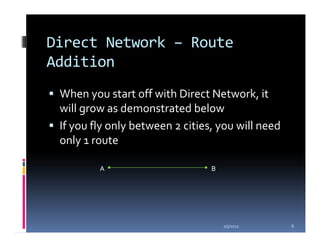
 When you start off with Direct Network, it
 will grow as demonstrated below
 If you fly only between 2 cities, you will need
 only 1 route

         A                       B


                                     1/5/2012      6
Direct Network – Route
Addition

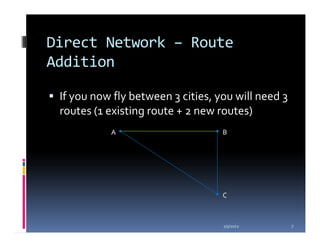
 If you now fly between 3 cities, you will need 3
 routes (1 existing route + 2 new routes)
           A                       B


                                   C


                                   1/5/2012         7
Direct Network – Route
Addition

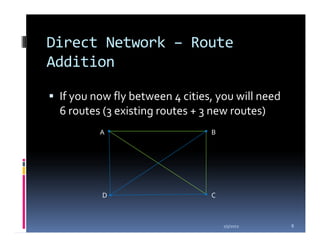
 If you now fly between 4 cities, you will need
 6 routes (3 existing routes + 3 new routes)
         A                      B


         D                      C


                                    1/5/2012      8
Direct Network – Route
Addition

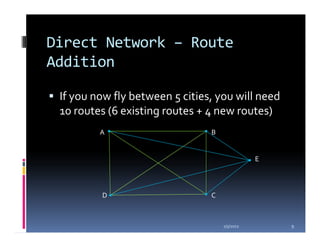
 If you now fly between 5 cities, you will need
 10 routes (6 existing routes + 4 new routes)
         A                      B


                                               E


         D                      C


                                    1/5/2012       9
Direct Network – Route
Addition

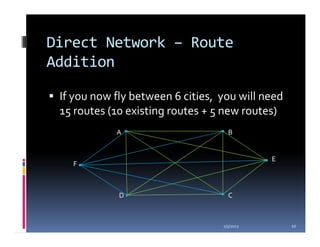
 If you now fly between 6 cities, you will need
 15 routes (10 existing routes + 5 new routes)
            A                       B


                                             E
   F


             D                      C


                                  1/5/2012        10
Direct Network Disadvantages

 As you can see the number of routes needed
 to cover all the cities in Direct Network
 increases very quickly
 In this network, if there are n cities, there will
 be ((n * (n-1)) / 2) routes
 This will get very hard to manage very quickly
 This will also be very expensive for the airline
 as it will need a lot of aircrafts and personnel
 to cover this
                                     1/5/2012         11
Hub & Spoke Network

 A hub is an airport that an airline uses as a
 transfer point to get passengers to their
 intended destination
 Spokes are airports that usually do not have
 major traffic for the airline
 A hub & spoke network is one where traffic
 from spoke cities are routed to their intended
 destination via the hubs

                                  1/5/2012        12
Hub & Spoke Network

 It is optimally used under the following
 circumstances
   Distance between two cities is large
   Demand between two cities is low
   Total number of cities served by the airline is large


                                        1/5/2012           13
Hub & Spoke Network
Advantages
 Schedule frequency (number of flights per
 day) is high
   By creating routes through hubs, there can be
   more flights scheduled for a route giving more
   options to passengers
 Due to the nature of how hub & spoke
 networks work, addition of a new city does
 not need too many routes for complete
 coverage

                                      1/5/2012      14
Hub & Spoke Network – Route
Addition

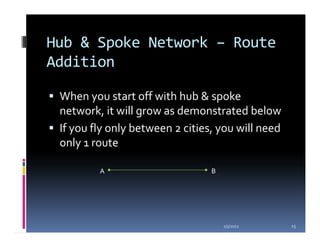
 When you start off with hub & spoke
 network, it will grow as demonstrated below
 If you fly only between 2 cities, you will need
 only 1 route

         A                       B


                                     1/5/2012      15
Hub & Spoke Network – Route
Addition

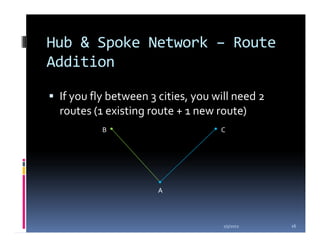
 If you fly between 3 cities, you will need 2
 routes (1 existing route + 1 new route)
          B                        C


                      A


                                    1/5/2012    16
Hub & Spoke Network – Route
Addition

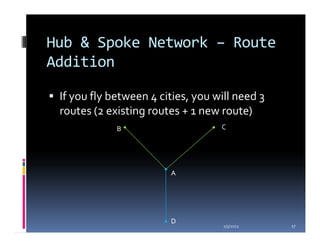
 If you fly between 4 cities, you will need 3
 routes (2 existing routes + 1 new route)
             B                     C


                        A


                        D
                                    1/5/2012    17
Hub & Spoke Network – Route
Addition

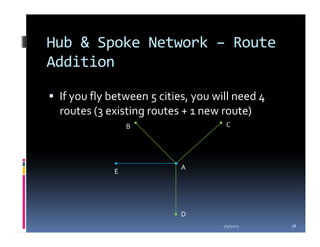
 If you fly between 5 cities, you will need 4
 routes (3 existing routes + 1 new route)
                B                    C


                           A
            E


                           D
                                    1/5/2012    18
Hub & Spoke Network – Route
Addition

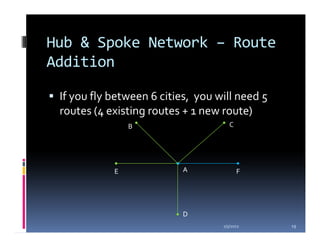
 If you fly between 6 cities, you will need 5
 routes (4 existing routes + 1 new route)
                B                     C


            E              A              F


                           D
                                   1/5/2012     19
Hub & Spoke Network
Advantages

 As you can see, the number of routes
 required with hub & spoke network are
 greatly reduced
 In this network, if there are n cities, there will
 be (n-1) routes
 This reduces costs for the airline as the
 number of aircrafts and personnel required
 are reduced
                                     1/5/2012         20
Hub & Spoke Network
Disadvantages

 Schedule reliability (aka on time
 performance) is low
   This type of a network suffers from
   interdependencies on other flights
   This leads to the “domino effect” where one delay
   can multiply into other delays elsewhere in the
   network


                                     1/5/2012          21
Hub & Spoke Network
Disadvantages

 Aircraft utilization is low
   Flights from one airport usually have to feed into
   downstream flights so schedules have to match so
   there are no missed connections
   This restriction leads to lower flight utilization
 Additional delays arise when the traffic at the
 hub city has exceeded its limits


                                      1/5/2012          22
Improving on Hub & Spoke
Network
 One way to deal with increased traffic is to try
 to reduce traffic by increasing the fare
 Another way is to start diagnosing the traffic
 patterns to see which spoke cities do the
 travelers go most to and from which spoke
 city
 It may be wise to create a direct route
 between these cities to ease the traffic at the
 hub city

                                   1/5/2012         23
Improving on Hub & Spoke
Network

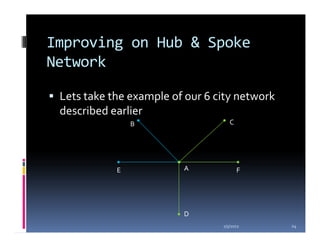
 Lets take the example of our 6 city network
 described earlier
                B                   C


            E            A              F


                         D
                                 1/5/2012      24
Improving on Hub & Spoke
Network

 As you can see, there is a significant amount
 of traffic going from E to B via A. In this case,
 it makes sense to create a separate route
 from E to B. This will ease the traffic on A.
 This does not mean that we close the existing
 routes of E to A and B to A. They are still
 required to go to A and other cities connected
 from A.
                                    1/5/2012         25
Improving on Hub & Spoke
Network

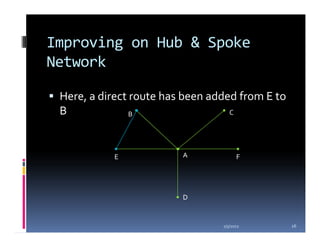
 Here, a direct route has been added from E to
 B              B                  C


           E             A             F


                         D


                                 1/5/2012        26
Improving on Hub & Spoke
Network
 Another way of dealing with congestion in
 the hub may be to create another hub
 This depends on a number of things
   Is the infrastructure at the potential new hub
   capable of handling the additional traffic?
   Are there enough spoke cities whose traffic can be
   diverted to this new hub without rendering the
   existing hub unproductive?
   How will the two hubs be connected?

                                      1/5/2012          27
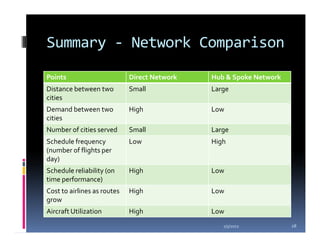
Summary - Network Comparison
Points                       Direct Network   Hub & Spoke Network
Distance between two         Small            Large
cities
Demand between two           High             Low
cities
Number of cities served      Small            Large
Schedule frequency           Low              High
(number of flights per
day)
Schedule reliability (on     High             Low
time performance)
Cost to airlines as routes   High             Low
grow
Aircraft Utilization         High             Low
                                                 1/5/2012           28
References

 Handbook of Airline Economics, Second
 Edition, Executive Editor - Darryl Jenkins,
 published by Aviation Week, ISBN 007-
 982394-7,
 http://www.amazon.com/Handbook-Airline-
 Economics-Darryl-
 Jenkins/dp/0079823947/ref=sr_1_1?s=books&
 ie=UTF8&qid=1325406665&sr=1-1
 http://en.wikipedia.org/wiki/Point-to-
 point_transit

                                1/5/2012       29
References

 Airline Network Design by Phillip J. Lederer &
 Ramakrishnan S. Nambimadom,
 http://www.simon.rochester.edu/fac/lederer/
 SimonFacultyWeb/LedererPapers/AirlineNet
 workDesign.pdf
 http://en.wikipedia.org/wiki/Spoke-
 hub_distribution_paradigm
 http://en.wikipedia.org/wiki/Airline_hub

                                  1/5/2012        30

Introduction to airline networks

  • 1.
  • 2.
    Network Introduction Thispresentation is an introduction to and a comparison of the two of the most common networks in the airline industry Direct Network (aka Point-to-Point Network) and Hub & Spoke Network A network is required to manage all the routes that an airline has opened to service its customers 1/5/2012 2
  • 3.
    Direct Network ADirect Network is one where there is a direct service from one airport to another without a stop in a third airport It is optimally used under the following circumstances Distance between two cities is small Demand between two cities is high Total number of cities served by the airline is small 1/5/2012 3
  • 4.
    Direct Network Advantages Schedule reliability (aka on time performance) is high The direct flight does not have an interdependency on other flights This minimizes the “domino effect” where one delay can multiply into other delays elsewhere in the network Aircraft utilization is high Flights from one airport do not have to feed into downstream flights at the destination so schedule can be optimized for maximum aircraft utilization 1/5/2012 4
  • 5.
    Direct Network Disadvantages Schedule frequency (number of flights per day) is low Due to the actual flight times, there are only so many flights you can have in a day when going from A to B But when you schedule flights to stop at other cities before going to B from A, then you can have a lot more options Number of routes required to cover all cities as you introduce more cities in the network 1/5/2012 5
  • 6.
    Direct Network –Route Addition When you start off with Direct Network, it will grow as demonstrated below If you fly only between 2 cities, you will need only 1 route A B 1/5/2012 6
  • 7.
    Direct Network –Route Addition If you now fly between 3 cities, you will need 3 routes (1 existing route + 2 new routes) A B C 1/5/2012 7
  • 8.
    Direct Network –Route Addition If you now fly between 4 cities, you will need 6 routes (3 existing routes + 3 new routes) A B D C 1/5/2012 8
  • 9.
    Direct Network –Route Addition If you now fly between 5 cities, you will need 10 routes (6 existing routes + 4 new routes) A B E D C 1/5/2012 9
  • 10.
    Direct Network –Route Addition If you now fly between 6 cities, you will need 15 routes (10 existing routes + 5 new routes) A B E F D C 1/5/2012 10
  • 11.
    Direct Network Disadvantages As you can see the number of routes needed to cover all the cities in Direct Network increases very quickly In this network, if there are n cities, there will be ((n * (n-1)) / 2) routes This will get very hard to manage very quickly This will also be very expensive for the airline as it will need a lot of aircrafts and personnel to cover this 1/5/2012 11
  • 12.
    Hub & SpokeNetwork A hub is an airport that an airline uses as a transfer point to get passengers to their intended destination Spokes are airports that usually do not have major traffic for the airline A hub & spoke network is one where traffic from spoke cities are routed to their intended destination via the hubs 1/5/2012 12
  • 13.
    Hub & SpokeNetwork It is optimally used under the following circumstances Distance between two cities is large Demand between two cities is low Total number of cities served by the airline is large 1/5/2012 13
  • 14.
    Hub & SpokeNetwork Advantages Schedule frequency (number of flights per day) is high By creating routes through hubs, there can be more flights scheduled for a route giving more options to passengers Due to the nature of how hub & spoke networks work, addition of a new city does not need too many routes for complete coverage 1/5/2012 14
  • 15.
    Hub & SpokeNetwork – Route Addition When you start off with hub & spoke network, it will grow as demonstrated below If you fly only between 2 cities, you will need only 1 route A B 1/5/2012 15
  • 16.
    Hub & SpokeNetwork – Route Addition If you fly between 3 cities, you will need 2 routes (1 existing route + 1 new route) B C A 1/5/2012 16
  • 17.
    Hub & SpokeNetwork – Route Addition If you fly between 4 cities, you will need 3 routes (2 existing routes + 1 new route) B C A D 1/5/2012 17
  • 18.
    Hub & SpokeNetwork – Route Addition If you fly between 5 cities, you will need 4 routes (3 existing routes + 1 new route) B C A E D 1/5/2012 18
  • 19.
    Hub & SpokeNetwork – Route Addition If you fly between 6 cities, you will need 5 routes (4 existing routes + 1 new route) B C E A F D 1/5/2012 19
  • 20.
    Hub & SpokeNetwork Advantages As you can see, the number of routes required with hub & spoke network are greatly reduced In this network, if there are n cities, there will be (n-1) routes This reduces costs for the airline as the number of aircrafts and personnel required are reduced 1/5/2012 20
  • 21.
    Hub & SpokeNetwork Disadvantages Schedule reliability (aka on time performance) is low This type of a network suffers from interdependencies on other flights This leads to the “domino effect” where one delay can multiply into other delays elsewhere in the network 1/5/2012 21
  • 22.
    Hub & SpokeNetwork Disadvantages Aircraft utilization is low Flights from one airport usually have to feed into downstream flights so schedules have to match so there are no missed connections This restriction leads to lower flight utilization Additional delays arise when the traffic at the hub city has exceeded its limits 1/5/2012 22
  • 23.
    Improving on Hub& Spoke Network One way to deal with increased traffic is to try to reduce traffic by increasing the fare Another way is to start diagnosing the traffic patterns to see which spoke cities do the travelers go most to and from which spoke city It may be wise to create a direct route between these cities to ease the traffic at the hub city 1/5/2012 23
  • 24.
    Improving on Hub& Spoke Network Lets take the example of our 6 city network described earlier B C E A F D 1/5/2012 24
  • 25.
    Improving on Hub& Spoke Network As you can see, there is a significant amount of traffic going from E to B via A. In this case, it makes sense to create a separate route from E to B. This will ease the traffic on A. This does not mean that we close the existing routes of E to A and B to A. They are still required to go to A and other cities connected from A. 1/5/2012 25
  • 26.
    Improving on Hub& Spoke Network Here, a direct route has been added from E to B B C E A F D 1/5/2012 26
  • 27.
    Improving on Hub& Spoke Network Another way of dealing with congestion in the hub may be to create another hub This depends on a number of things Is the infrastructure at the potential new hub capable of handling the additional traffic? Are there enough spoke cities whose traffic can be diverted to this new hub without rendering the existing hub unproductive? How will the two hubs be connected? 1/5/2012 27
  • 28.
    Summary - NetworkComparison Points Direct Network Hub & Spoke Network Distance between two Small Large cities Demand between two High Low cities Number of cities served Small Large Schedule frequency Low High (number of flights per day) Schedule reliability (on High Low time performance) Cost to airlines as routes High Low grow Aircraft Utilization High Low 1/5/2012 28
  • 29.
    References Handbook ofAirline Economics, Second Edition, Executive Editor - Darryl Jenkins, published by Aviation Week, ISBN 007- 982394-7, http://www.amazon.com/Handbook-Airline- Economics-Darryl- Jenkins/dp/0079823947/ref=sr_1_1?s=books& ie=UTF8&qid=1325406665&sr=1-1 http://en.wikipedia.org/wiki/Point-to- point_transit 1/5/2012 29
  • 30.
    References Airline NetworkDesign by Phillip J. Lederer & Ramakrishnan S. Nambimadom, http://www.simon.rochester.edu/fac/lederer/ SimonFacultyWeb/LedererPapers/AirlineNet workDesign.pdf http://en.wikipedia.org/wiki/Spoke- hub_distribution_paradigm http://en.wikipedia.org/wiki/Airline_hub 1/5/2012 30