Photograph by Alex Clapson ©
Action Learning Sets by Alex Clapson
Action Learning – The power of working
together to build teams & to solve problems
What will you gain from your participation?
• Learn a simple process which improves the effectiveness of teams &
organisations
• Develop Reflective Practice
• A raised awareness of the power of collaboration to solve problems
• Create tangible Action Plans
• A focus on specific listening skills that improve working relationships
There are several Action Learning Set models / processes available. The process
described here is one that (based upon feedback) works well with most groups in
most settings. This method works as well virtually / online as it does face-to-face.
If working face-to-face, it will help with the smooth running of your Action Learning
Set/s if you have a selection of 1, 5, & 10-minute sand timers. I find that the
presence of a sand timer, with the grains of sand running away is a powerful visual
reminder for the group to use the available time wisely.
Each group member will need a pen, or pencil & some notepaper. When meeting in-
person, try sitting in a circle so that all group members can hear each other.
The process is divided up into short blocks of time, followed by 5 minutes of
feedback & reflections on the conversation.
Action Learning Sets work well with at least 4 people & a maximum of 8 people – the
larger the group size; the less opportunities there are for everyone to contribute.
Working with less than 4 people can reduce the collaborative problem-solving power
of the model.
In advance of the Action Learning Set, the meeting host asks group members to
consider a current work-based challenge that they would like to bring to the group.
The process
• Agree a designated meeting host / facilitator – it is their task to ensure
that the group adhere to the process (in small groups, the host might
also be a participating group member)
• Agree a problem owner
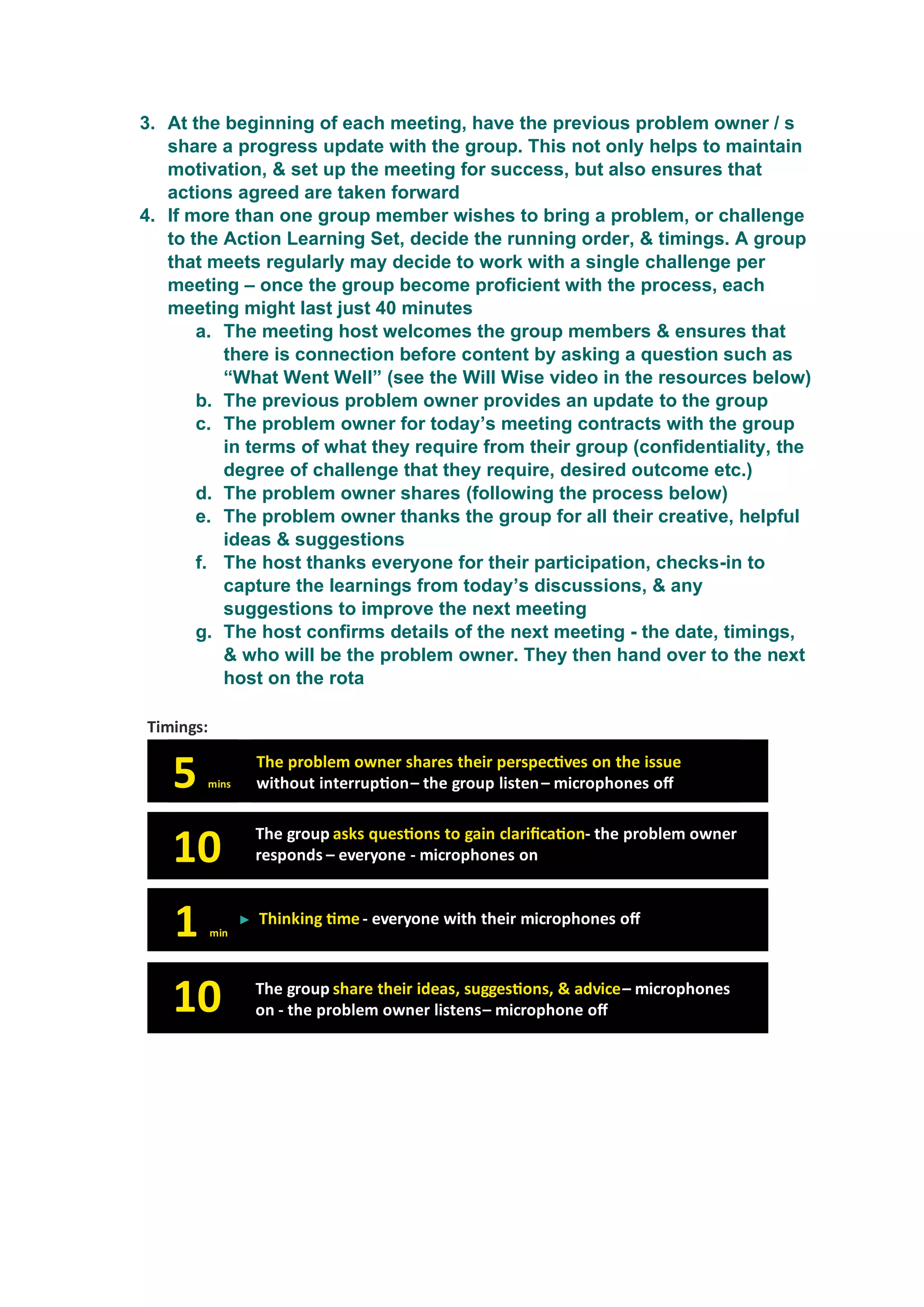
The first 5 minutes – The Problem Owner:
The Problem Owner presents a current work-based problem, or challenge that they
would like to discuss - they share what they have already tried in their attempt to
solve the issue. Only the Problem Owner can speak during this time (if online,
everyone else mutes their microphones). Group members are encouraged to take
notes, including writing down questions they wish to ask of the Problem Owner, &
any ideas that they would like to share – this encourages group members to capture
their thoughts, write them down, & continue to actively listen.
The next 10 minutes – The Group ask questions to gain clarity:
Group members now refer to their notes & ask the Problem Owner questions to gain
further understanding & clarification of the problem or challenge that they are facing.
The group Must Not get into problem solving, offer their ideas, or suggestions – they
are asking questions to gain clarity. The group may wish to ask questions about what
has already been attempted to solve the issue. The use of open questions is
recommended. The TED questioning model is a useful tool:
• Tell me more about…
• Explain how this has impacted on you & the team…
• Describe what you have tried so far to resolve this issue…
Gain as much information as possible in readiness for the next stage of the process.
One minute – Brain Thinking Time:
Everyone takes a minute to press the pause-button & reflect upon what has been
shared / reading over their notes – no-one speaks during this time.
The next 10 minutes – Group Problem-Solving:
The Problem Owner moves slightly out of the circle if in-person (no more than a
metre) / switches off their microphone if online, so that they can still hear what is
being said, but they are no longer contributing to the discussion. The Problem Owner
cannot speak / respond to questions for the next 10 minutes. They are encouraged
to make notes of the discussion.
Group members now discuss what they have heard, discuss any perceived
inconsistencies & begin problem solving. Example questions: “What if they tried this”,
“Have they thought about doing…” etc. The Problem Owner listens to the discussion
& makes notes of anything they hear which they find useful.
5 minutes of feedback – The Problem Owner:
The Problem Owner thanks the group for their contributions & shares with the group
what they found useful from the discussions, & any actions they plan to take.
Reflections:
The host facilitates a discussion about the process – what worked well & what might
be improved for the next time.
And repeat:
Each Action Learning Set takes around 35 to 40 minutes. Allow time between each
problem-solving discussion for group members to take a comfort break & then re-
convene for another group member to become the Problem Owner.
Once groups are familiar with the format, they can facilitate the discussions
themselves – many groups find it helpful to have a designated host / facilitator to
ensure that the format is followed, & to keep time.
Action Learning Sets – A step-by-step guide to self-sufficiency
Working with a group of peers, meeting regularly (for example: once a month)
1. Decide who will be hosting (organising / facilitating) each session – I
would suggest rotating the host throughout the year to spread the task
2. Decide in advance who will be bringing a current work-based challenge
to the problem-solving group (this will enable them to prepare in
advance) – this person is the problem owner
3. At the beginning of each meeting, have the previous problem owner / s
share a progress update with the group. This not only helps to maintain
motivation, & set up the meeting for success, but also ensures that
actions agreed are taken forward
4. If more than one group member wishes to bring a problem, or challenge
to the Action Learning Set, decide the running order, & timings. A group
that meets regularly may decide to work with a single challenge per
meeting – once the group become proficient with the process, each
meeting might last just 40 minutes
a. The meeting host welcomes the group members & ensures that
there is connection before content by asking a question such as
“What Went Well” (see the Will Wise video in the resources below)
b. The previous problem owner provides an update to the group
c. The problem owner for today’s meeting contracts with the group
in terms of what they require from their group (confidentiality, the
degree of challenge that they require, desired outcome etc.)
d. The problem owner shares (following the process below)
e. The problem owner thanks the group for all their creative, helpful
ideas & suggestions
f. The host thanks everyone for their participation, checks-in to
capture the learnings from today’s discussions, & any
suggestions to improve the next meeting
g. The host confirms details of the next meeting - the date, timings,
& who will be the problem owner. They then hand over to the next
host on the rota
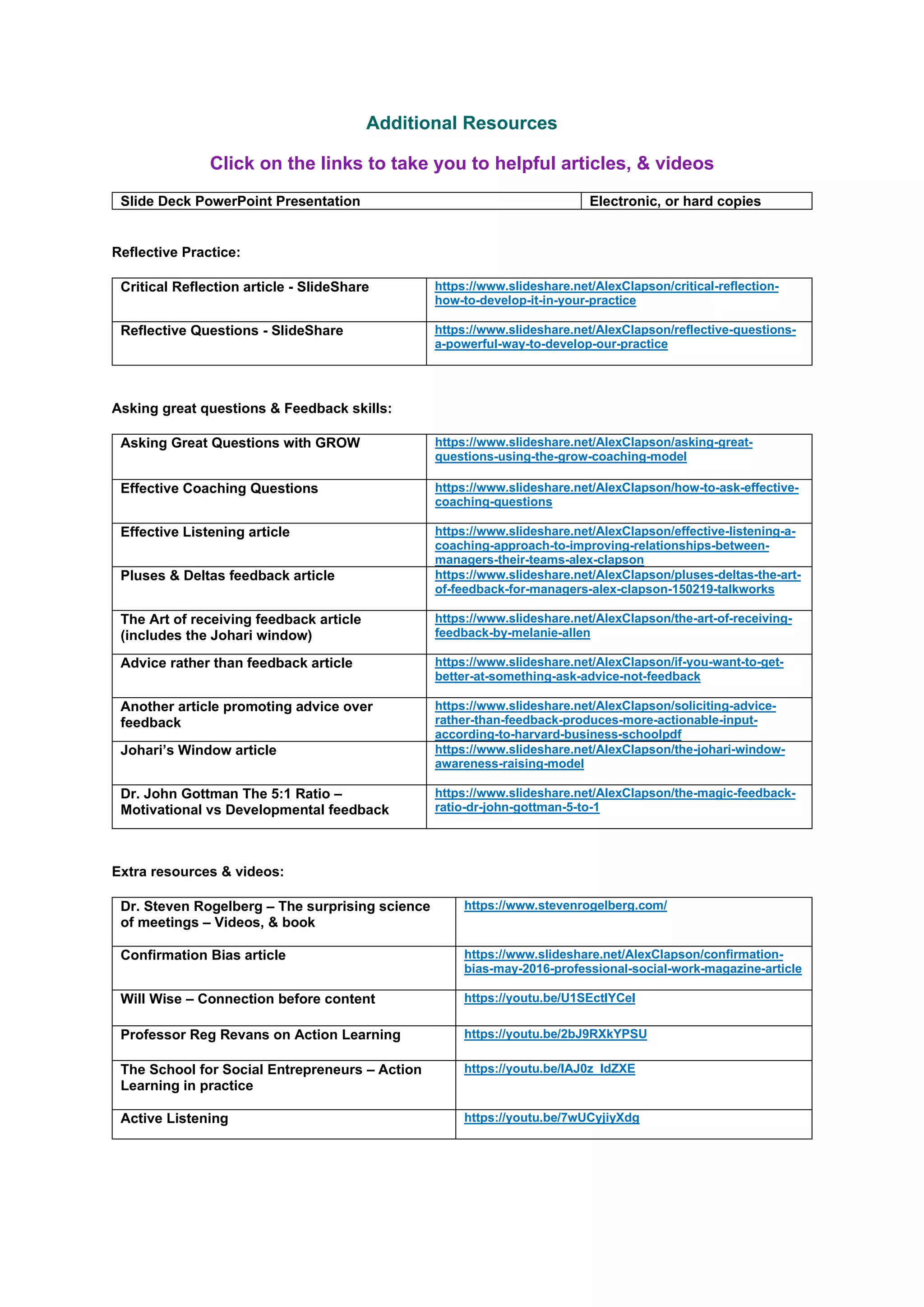
Additional Resources
Click on the links to take you to helpful articles, & videos
Slide Deck PowerPoint Presentation Electronic, or hard copies
Reflective Practice:
Critical Reflection article - SlideShare https://www.slideshare.net/AlexClapson/critical-reflection-
how-to-develop-it-in-your-practice
Reflective Questions - SlideShare https://www.slideshare.net/AlexClapson/reflective-questions-
a-powerful-way-to-develop-our-practice
Asking great questions & Feedback skills:
Asking Great Questions with GROW https://www.slideshare.net/AlexClapson/asking-great-
questions-using-the-grow-coaching-model
Effective Coaching Questions https://www.slideshare.net/AlexClapson/how-to-ask-effective-
coaching-questions
Effective Listening article https://www.slideshare.net/AlexClapson/effective-listening-a-
coaching-approach-to-improving-relationships-between-
managers-their-teams-alex-clapson
Pluses & Deltas feedback article https://www.slideshare.net/AlexClapson/pluses-deltas-the-art-
of-feedback-for-managers-alex-clapson-150219-talkworks
The Art of receiving feedback article
(includes the Johari window)
https://www.slideshare.net/AlexClapson/the-art-of-receiving-
feedback-by-melanie-allen
Advice rather than feedback article https://www.slideshare.net/AlexClapson/if-you-want-to-get-
better-at-something-ask-advice-not-feedback
Another article promoting advice over
feedback
https://www.slideshare.net/AlexClapson/soliciting-advice-
rather-than-feedback-produces-more-actionable-input-
according-to-harvard-business-schoolpdf
Johari’s Window article https://www.slideshare.net/AlexClapson/the-johari-window-
awareness-raising-model
Dr. John Gottman The 5:1 Ratio –
Motivational vs Developmental feedback
https://www.slideshare.net/AlexClapson/the-magic-feedback-
ratio-dr-john-gottman-5-to-1
Extra resources & videos:
Dr. Steven Rogelberg – The surprising science
of meetings – Videos, & book
https://www.stevenrogelberg.com/
Confirmation Bias article https://www.slideshare.net/AlexClapson/confirmation-
bias-may-2016-professional-social-work-magazine-article
Will Wise – Connection before content https://youtu.be/U1SEctIYCeI
Professor Reg Revans on Action Learning https://youtu.be/2bJ9RXkYPSU
The School for Social Entrepreneurs – Action
Learning in practice
https://youtu.be/IAJ0z_IdZXE
Active Listening https://youtu.be/7wUCyjiyXdg
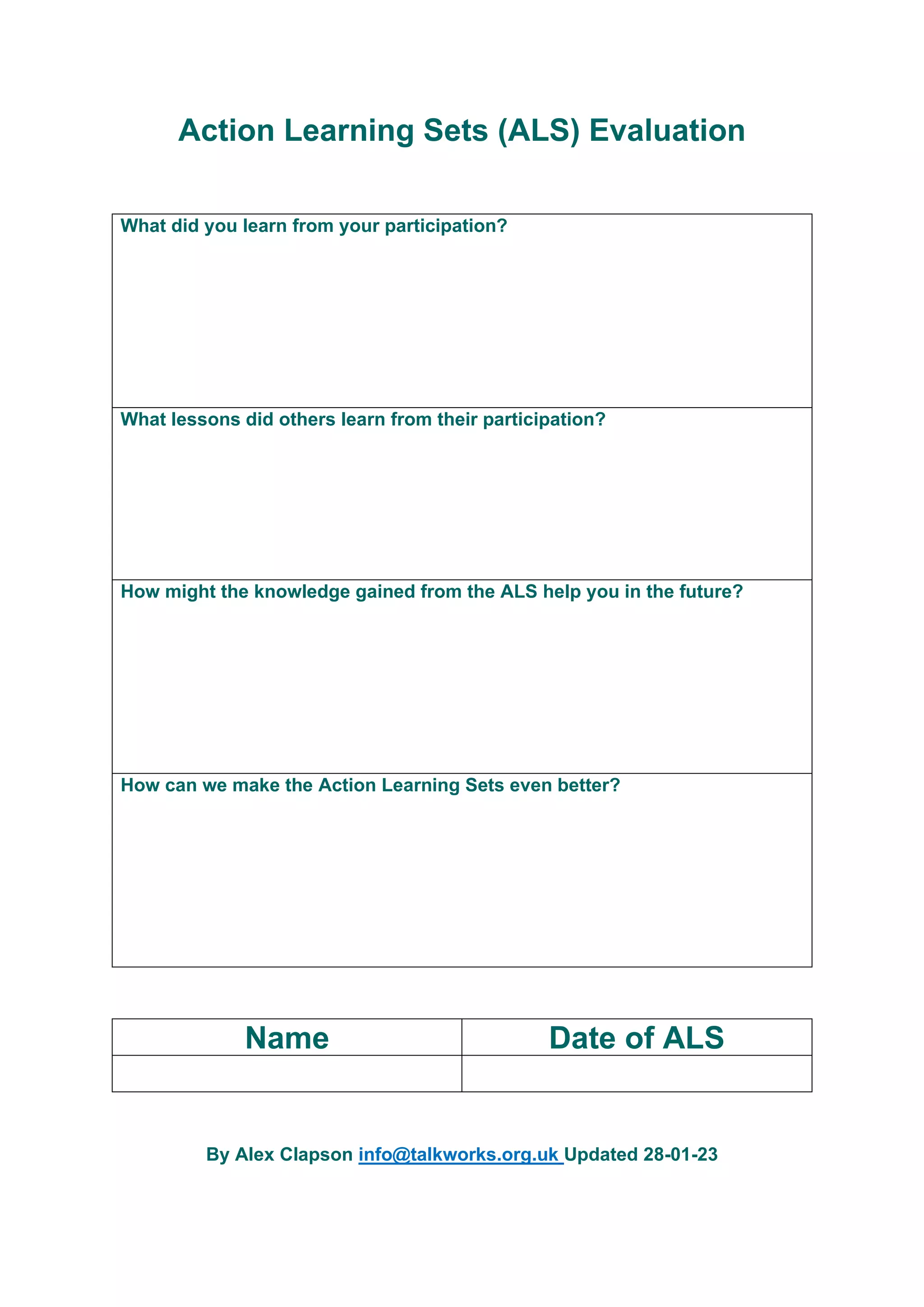
Action Learning Sets (ALS) Evaluation
What did you learn from your participation?
What lessons did others learn from their participation?
How might the knowledge gained from the ALS help you in the future?
How can we make the Action Learning Sets even better?
Name Date of ALS
By Alex Clapson info@talkworks.org.uk Updated 28-01-23

Action Learning – The power of working together to build teams & to solve problems by Alex Clapson

  • 1.
    Photograph by AlexClapson © Action Learning Sets by Alex Clapson Action Learning – The power of working together to build teams & to solve problems What will you gain from your participation? • Learn a simple process which improves the effectiveness of teams & organisations • Develop Reflective Practice • A raised awareness of the power of collaboration to solve problems • Create tangible Action Plans • A focus on specific listening skills that improve working relationships There are several Action Learning Set models / processes available. The process described here is one that (based upon feedback) works well with most groups in most settings. This method works as well virtually / online as it does face-to-face. If working face-to-face, it will help with the smooth running of your Action Learning Set/s if you have a selection of 1, 5, & 10-minute sand timers. I find that the presence of a sand timer, with the grains of sand running away is a powerful visual reminder for the group to use the available time wisely. Each group member will need a pen, or pencil & some notepaper. When meeting in- person, try sitting in a circle so that all group members can hear each other. The process is divided up into short blocks of time, followed by 5 minutes of feedback & reflections on the conversation.
  • 2.
    Action Learning Setswork well with at least 4 people & a maximum of 8 people – the larger the group size; the less opportunities there are for everyone to contribute. Working with less than 4 people can reduce the collaborative problem-solving power of the model. In advance of the Action Learning Set, the meeting host asks group members to consider a current work-based challenge that they would like to bring to the group. The process • Agree a designated meeting host / facilitator – it is their task to ensure that the group adhere to the process (in small groups, the host might also be a participating group member) • Agree a problem owner The first 5 minutes – The Problem Owner: The Problem Owner presents a current work-based problem, or challenge that they would like to discuss - they share what they have already tried in their attempt to solve the issue. Only the Problem Owner can speak during this time (if online, everyone else mutes their microphones). Group members are encouraged to take notes, including writing down questions they wish to ask of the Problem Owner, & any ideas that they would like to share – this encourages group members to capture their thoughts, write them down, & continue to actively listen. The next 10 minutes – The Group ask questions to gain clarity: Group members now refer to their notes & ask the Problem Owner questions to gain further understanding & clarification of the problem or challenge that they are facing. The group Must Not get into problem solving, offer their ideas, or suggestions – they are asking questions to gain clarity. The group may wish to ask questions about what has already been attempted to solve the issue. The use of open questions is recommended. The TED questioning model is a useful tool: • Tell me more about… • Explain how this has impacted on you & the team… • Describe what you have tried so far to resolve this issue… Gain as much information as possible in readiness for the next stage of the process. One minute – Brain Thinking Time: Everyone takes a minute to press the pause-button & reflect upon what has been shared / reading over their notes – no-one speaks during this time.
  • 3.
    The next 10minutes – Group Problem-Solving: The Problem Owner moves slightly out of the circle if in-person (no more than a metre) / switches off their microphone if online, so that they can still hear what is being said, but they are no longer contributing to the discussion. The Problem Owner cannot speak / respond to questions for the next 10 minutes. They are encouraged to make notes of the discussion. Group members now discuss what they have heard, discuss any perceived inconsistencies & begin problem solving. Example questions: “What if they tried this”, “Have they thought about doing…” etc. The Problem Owner listens to the discussion & makes notes of anything they hear which they find useful. 5 minutes of feedback – The Problem Owner: The Problem Owner thanks the group for their contributions & shares with the group what they found useful from the discussions, & any actions they plan to take. Reflections: The host facilitates a discussion about the process – what worked well & what might be improved for the next time. And repeat: Each Action Learning Set takes around 35 to 40 minutes. Allow time between each problem-solving discussion for group members to take a comfort break & then re- convene for another group member to become the Problem Owner. Once groups are familiar with the format, they can facilitate the discussions themselves – many groups find it helpful to have a designated host / facilitator to ensure that the format is followed, & to keep time. Action Learning Sets – A step-by-step guide to self-sufficiency Working with a group of peers, meeting regularly (for example: once a month) 1. Decide who will be hosting (organising / facilitating) each session – I would suggest rotating the host throughout the year to spread the task 2. Decide in advance who will be bringing a current work-based challenge to the problem-solving group (this will enable them to prepare in advance) – this person is the problem owner
  • 4.
    3. At thebeginning of each meeting, have the previous problem owner / s share a progress update with the group. This not only helps to maintain motivation, & set up the meeting for success, but also ensures that actions agreed are taken forward 4. If more than one group member wishes to bring a problem, or challenge to the Action Learning Set, decide the running order, & timings. A group that meets regularly may decide to work with a single challenge per meeting – once the group become proficient with the process, each meeting might last just 40 minutes a. The meeting host welcomes the group members & ensures that there is connection before content by asking a question such as “What Went Well” (see the Will Wise video in the resources below) b. The previous problem owner provides an update to the group c. The problem owner for today’s meeting contracts with the group in terms of what they require from their group (confidentiality, the degree of challenge that they require, desired outcome etc.) d. The problem owner shares (following the process below) e. The problem owner thanks the group for all their creative, helpful ideas & suggestions f. The host thanks everyone for their participation, checks-in to capture the learnings from today’s discussions, & any suggestions to improve the next meeting g. The host confirms details of the next meeting - the date, timings, & who will be the problem owner. They then hand over to the next host on the rota
  • 5.
    Additional Resources Click onthe links to take you to helpful articles, & videos Slide Deck PowerPoint Presentation Electronic, or hard copies Reflective Practice: Critical Reflection article - SlideShare https://www.slideshare.net/AlexClapson/critical-reflection- how-to-develop-it-in-your-practice Reflective Questions - SlideShare https://www.slideshare.net/AlexClapson/reflective-questions- a-powerful-way-to-develop-our-practice Asking great questions & Feedback skills: Asking Great Questions with GROW https://www.slideshare.net/AlexClapson/asking-great- questions-using-the-grow-coaching-model Effective Coaching Questions https://www.slideshare.net/AlexClapson/how-to-ask-effective- coaching-questions Effective Listening article https://www.slideshare.net/AlexClapson/effective-listening-a- coaching-approach-to-improving-relationships-between- managers-their-teams-alex-clapson Pluses & Deltas feedback article https://www.slideshare.net/AlexClapson/pluses-deltas-the-art- of-feedback-for-managers-alex-clapson-150219-talkworks The Art of receiving feedback article (includes the Johari window) https://www.slideshare.net/AlexClapson/the-art-of-receiving- feedback-by-melanie-allen Advice rather than feedback article https://www.slideshare.net/AlexClapson/if-you-want-to-get- better-at-something-ask-advice-not-feedback Another article promoting advice over feedback https://www.slideshare.net/AlexClapson/soliciting-advice- rather-than-feedback-produces-more-actionable-input- according-to-harvard-business-schoolpdf Johari’s Window article https://www.slideshare.net/AlexClapson/the-johari-window- awareness-raising-model Dr. John Gottman The 5:1 Ratio – Motivational vs Developmental feedback https://www.slideshare.net/AlexClapson/the-magic-feedback- ratio-dr-john-gottman-5-to-1 Extra resources & videos: Dr. Steven Rogelberg – The surprising science of meetings – Videos, & book https://www.stevenrogelberg.com/ Confirmation Bias article https://www.slideshare.net/AlexClapson/confirmation- bias-may-2016-professional-social-work-magazine-article Will Wise – Connection before content https://youtu.be/U1SEctIYCeI Professor Reg Revans on Action Learning https://youtu.be/2bJ9RXkYPSU The School for Social Entrepreneurs – Action Learning in practice https://youtu.be/IAJ0z_IdZXE Active Listening https://youtu.be/7wUCyjiyXdg
  • 6.
    Action Learning Sets(ALS) Evaluation What did you learn from your participation? What lessons did others learn from their participation? How might the knowledge gained from the ALS help you in the future? How can we make the Action Learning Sets even better? Name Date of ALS By Alex Clapson info@talkworks.org.uk Updated 28-01-23