HEALTH SYSTEMS IN NIGERIA
Presented by:
WINFRED AKPLAGAH
GLOBAL HEALTH
OUTLINE
 Introduction
 Key health indicators
 Health needs
 Healthcare in Nigeria
 Service delivery
 Health financing
Introduction – Political
background
 Nigeria is a Federal Republic
composed of 36 States, and a
Capital Territory, with an elected
President and a Bi-cameral
Legislature.
 The Senate President is the
Head of the Federal Legislature.
 There is a National Assembly
made up of the Senate and
House of Representatives.
 At the State level, the Legislature
Introduction-Demographics
 Demographic characteristics
Population (millions) UN, 2012, total 166.6
Population annual growth rate (%), 2011 2
Crude death rate, 2011 14
Crude birth rate, 2011 40
Life expectancy, 2011 52
Total fertility rate, 2011 5
Urbanized population (%), 2011 50
Average annual growth rate of urban population (%), 2011 3
Population density (per sq. km), 2010 173.94
Adult literacy rate (%), 2011 61
Key Health Indicators
Under-5 mortality rate (U5MR), 2011 124
Probability of dying b/n 15&60 m/f per 1,000 pop. 393/360
Total expenditure on health as % of GDP 5.3
Total expenditure on health per capital (US$) 139
Deaths due to HIV/AIDS, 2012 210,000
HIV prevalence (%), 2011 3.7
Annual no. of under-5 deaths (thousands) 2011 756
GNI per capita (US$) 2011 1200
Life expectancy at birth ( m/f years) 2011 52/53
GNI per capita (PPP US$) 2300
Health needs
Malaria
HIV/AIDS
Influenza & Pneumonia
Diarrhoeal diseases
Tuberculosis
Stroke
Coronary Heart Disease
Health risks
 Alcohol/drinking
 Tobacco/smoking
 Obesity
 Sanitation
 Access to portable
water
Healthcare
 Nigerian health system is pluralistic. It
includes orthodox, alternative and
traditional health care delivery systems
operating alongside each other.
 The Government recognizes and
regulates these three systems.
 A world health report ranked Nigeria 177
out of a total of 191 countries, on its
degree of responsiveness to healthcare
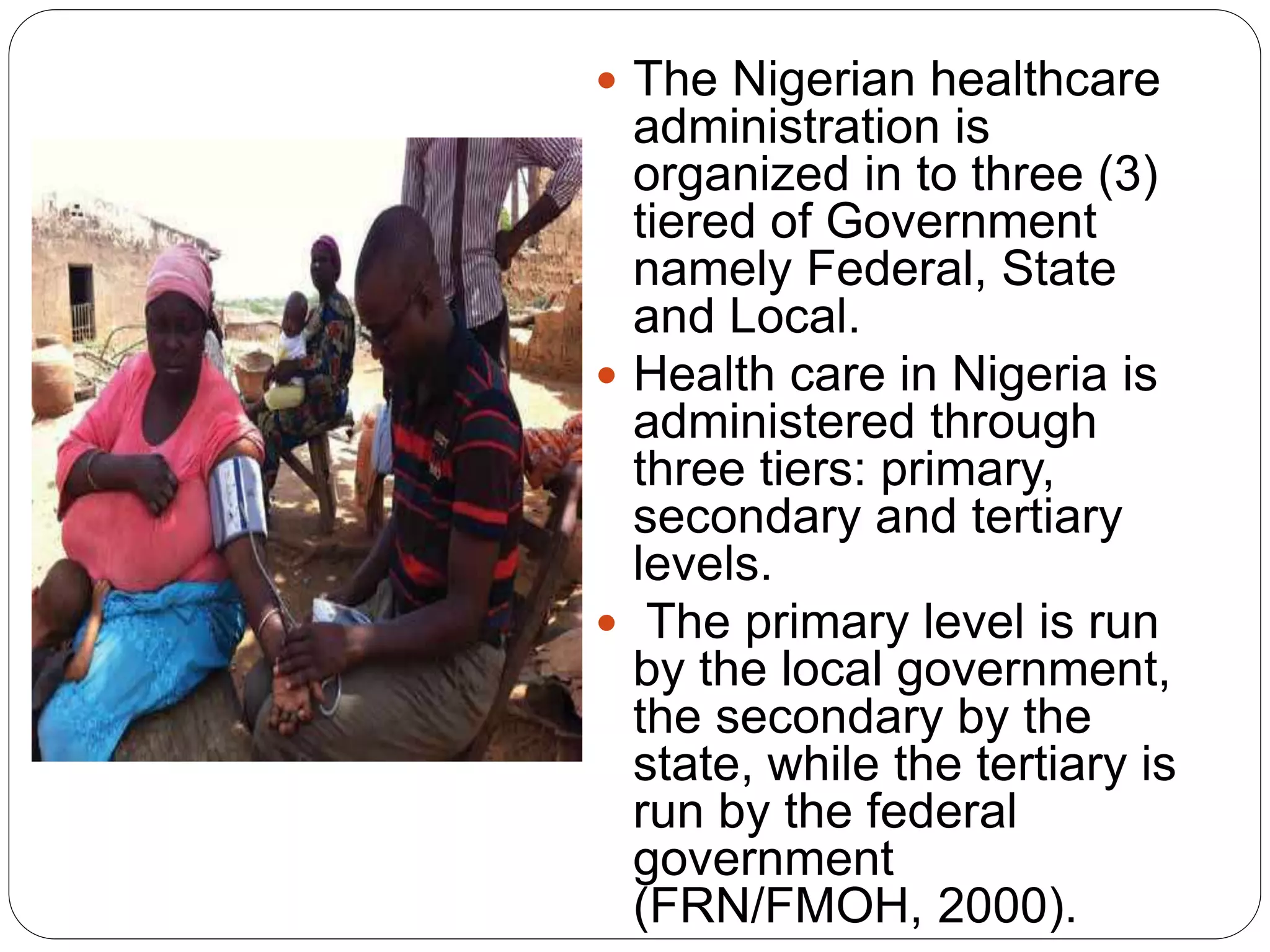
 The Nigerian healthcare
administration is
organized in to three (3)
tiered of Government
namely Federal, State
and Local.
 Health care in Nigeria is
administered through
three tiers: primary,
secondary and tertiary
levels.
 The primary level is run
by the local government,
the secondary by the
state, while the tertiary is
run by the federal
government
(FRN/FMOH, 2000).
Organizational Pyramid of the Nigerian Health Services
Structure
ADMINISTRATIVE
LEVELS
SERVICE STRUCTURE PERSON IN
CHARGE
Federal
Government
Tertiary Health
Services
Federal Ministry
of Health
Secondary
Health Services
State Ministry of
Health
State
Government
Local
Government
Areas
Primary Health
Services
Private Sector Private Services Private
Providers
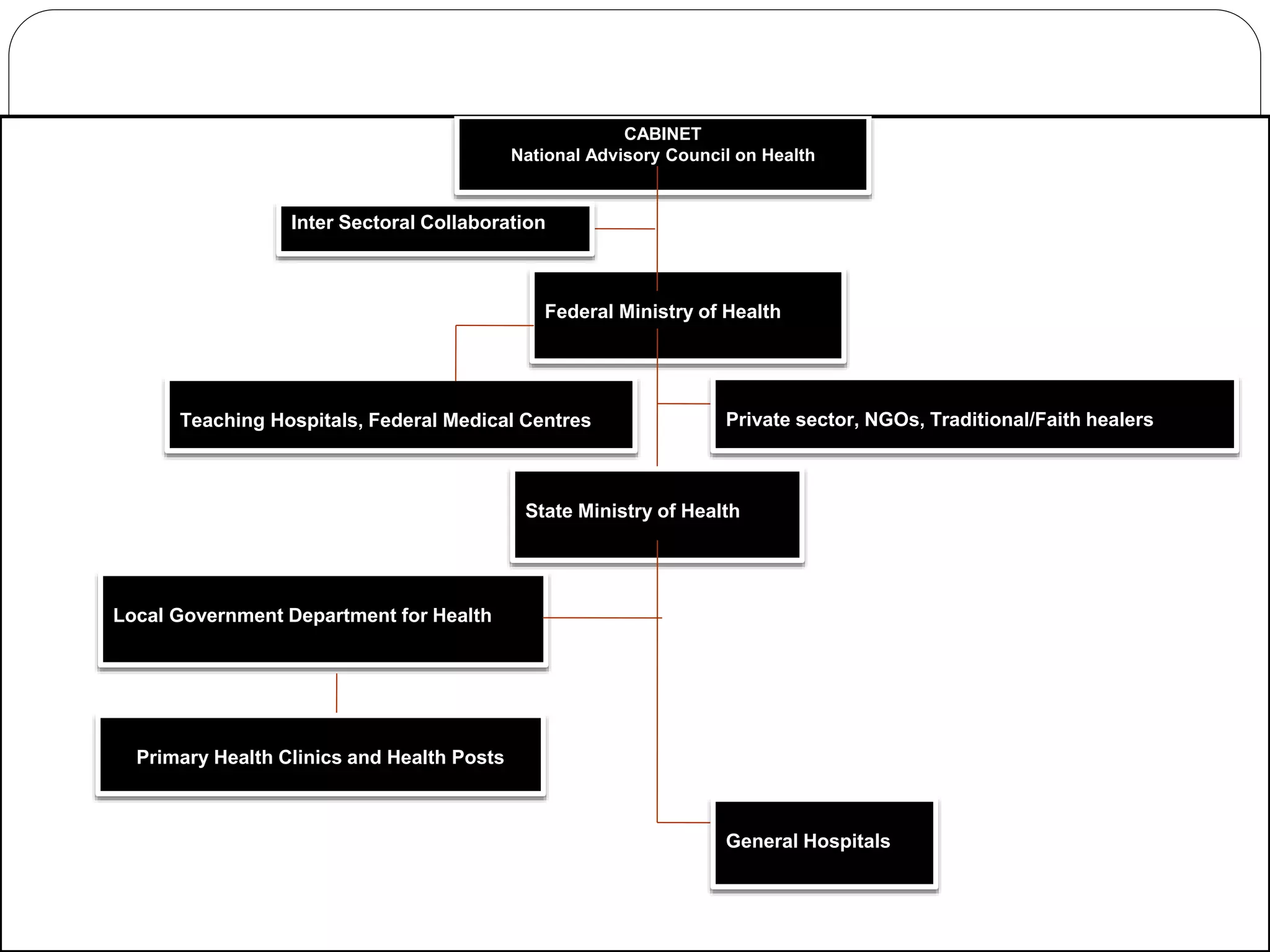
CABINET
National Advisory Council on Health
Inter Sectoral Collaboration
Federal Ministry of Health
Private sector, NGOs, Traditional/Faith healersTeaching Hospitals, Federal Medical Centres
State Ministry of Health
General Hospitals
Local Government Department for Health
Primary Health Clinics and Health Posts
Service delivery
 Nigeria has one of the largest
stocks of health workers in Africa
comparable to Egypt and South
Africa.
 About 60% of the states in Nigeria,
provide rural incentives to health
workers that volunteer to serve in
the rural areas, while others make
rural service a condition for some
critical promotion.
 National Youth Service Corps
Total health workers and densities in 2008
Categories Number
Density per 1000
population
Physicians 55 376 0.37
Nurses and midwives 224 943 1.49
Dentists and technicians 3 781 0.02
Pharmacists and technicians 18 682 0.12
Environ, and public health 4 280 0.03
Laboratory technicians 22 683 0.15
Other health workers 2313 0.02
Community health 19 268 0.13
Total 351 326 2.32
Health financing
 Health care in Nigeria is financed by a
combination of:
 Tax revenue from the sale of oil and gas
 Out of pocket payments
 Donor funding
 Health insurance (private, public, social and
community).
 The TGHE as % of GDP in 2011 was 5.3
 Per capita GGHE (2012) was US$ 29.2
 Per capita THE (PPP int. $) was 139.3
 NHIS in Nigeria covers only the formal sector
employees (mandatory). 90% coverage has been
 NHIS contribution represent 15% of basic
salary
 The employer pays 10% and the employee
pays 5%
 The package covers the contributor, a spouse,
and four (4) biological children below age 18.
 Services under the NHIS are:
Out-patient care including necessary consumables.
Prescribed drugs.
Maternity care up to four (4) live births.
 preventive care.
Hospital care up to 15 days per year.
Consultations with specialists
Eye examinations
A range of prostheses (limited to artificial limbs
produced in Nigeria)
Thank you

HEALTH SYSTEMS IN NIGERIA

  • 1.
    HEALTH SYSTEMS INNIGERIA Presented by: WINFRED AKPLAGAH GLOBAL HEALTH
  • 2.
    OUTLINE  Introduction  Keyhealth indicators  Health needs  Healthcare in Nigeria  Service delivery  Health financing
  • 3.
    Introduction – Political background Nigeria is a Federal Republic composed of 36 States, and a Capital Territory, with an elected President and a Bi-cameral Legislature.  The Senate President is the Head of the Federal Legislature.  There is a National Assembly made up of the Senate and House of Representatives.  At the State level, the Legislature
  • 4.
    Introduction-Demographics  Demographic characteristics Population(millions) UN, 2012, total 166.6 Population annual growth rate (%), 2011 2 Crude death rate, 2011 14 Crude birth rate, 2011 40 Life expectancy, 2011 52 Total fertility rate, 2011 5 Urbanized population (%), 2011 50 Average annual growth rate of urban population (%), 2011 3 Population density (per sq. km), 2010 173.94 Adult literacy rate (%), 2011 61
  • 5.
    Key Health Indicators Under-5mortality rate (U5MR), 2011 124 Probability of dying b/n 15&60 m/f per 1,000 pop. 393/360 Total expenditure on health as % of GDP 5.3 Total expenditure on health per capital (US$) 139 Deaths due to HIV/AIDS, 2012 210,000 HIV prevalence (%), 2011 3.7 Annual no. of under-5 deaths (thousands) 2011 756 GNI per capita (US$) 2011 1200 Life expectancy at birth ( m/f years) 2011 52/53 GNI per capita (PPP US$) 2300
  • 6.
    Health needs Malaria HIV/AIDS Influenza &Pneumonia Diarrhoeal diseases Tuberculosis Stroke Coronary Heart Disease
  • 7.
    Health risks  Alcohol/drinking Tobacco/smoking  Obesity  Sanitation  Access to portable water
  • 8.
    Healthcare  Nigerian healthsystem is pluralistic. It includes orthodox, alternative and traditional health care delivery systems operating alongside each other.  The Government recognizes and regulates these three systems.  A world health report ranked Nigeria 177 out of a total of 191 countries, on its degree of responsiveness to healthcare
  • 9.
     The Nigerianhealthcare administration is organized in to three (3) tiered of Government namely Federal, State and Local.  Health care in Nigeria is administered through three tiers: primary, secondary and tertiary levels.  The primary level is run by the local government, the secondary by the state, while the tertiary is run by the federal government (FRN/FMOH, 2000).
  • 10.
    Organizational Pyramid ofthe Nigerian Health Services Structure ADMINISTRATIVE LEVELS SERVICE STRUCTURE PERSON IN CHARGE Federal Government Tertiary Health Services Federal Ministry of Health Secondary Health Services State Ministry of Health State Government Local Government Areas Primary Health Services Private Sector Private Services Private Providers
  • 11.
    CABINET National Advisory Councilon Health Inter Sectoral Collaboration Federal Ministry of Health Private sector, NGOs, Traditional/Faith healersTeaching Hospitals, Federal Medical Centres State Ministry of Health General Hospitals Local Government Department for Health Primary Health Clinics and Health Posts
  • 12.
    Service delivery  Nigeriahas one of the largest stocks of health workers in Africa comparable to Egypt and South Africa.  About 60% of the states in Nigeria, provide rural incentives to health workers that volunteer to serve in the rural areas, while others make rural service a condition for some critical promotion.  National Youth Service Corps
  • 13.
    Total health workersand densities in 2008 Categories Number Density per 1000 population Physicians 55 376 0.37 Nurses and midwives 224 943 1.49 Dentists and technicians 3 781 0.02 Pharmacists and technicians 18 682 0.12 Environ, and public health 4 280 0.03 Laboratory technicians 22 683 0.15 Other health workers 2313 0.02 Community health 19 268 0.13 Total 351 326 2.32
  • 14.
    Health financing  Healthcare in Nigeria is financed by a combination of:  Tax revenue from the sale of oil and gas  Out of pocket payments  Donor funding  Health insurance (private, public, social and community).  The TGHE as % of GDP in 2011 was 5.3  Per capita GGHE (2012) was US$ 29.2  Per capita THE (PPP int. $) was 139.3  NHIS in Nigeria covers only the formal sector employees (mandatory). 90% coverage has been
  • 15.
     NHIS contributionrepresent 15% of basic salary  The employer pays 10% and the employee pays 5%  The package covers the contributor, a spouse, and four (4) biological children below age 18.  Services under the NHIS are: Out-patient care including necessary consumables. Prescribed drugs. Maternity care up to four (4) live births.  preventive care. Hospital care up to 15 days per year. Consultations with specialists Eye examinations A range of prostheses (limited to artificial limbs produced in Nigeria)
  • 16.