By: Dickson Lo @ IVE(TM)
Worldskills Mechanical Engineering Design – CAD
Hong Kong Team Training
Technical Drawing Standards (ISO)
1
2
Content
- Introduction of ISO 128 ----------------------------------------------------------------------------------- P.3 - 4
- Lines on Mechanical Engineering Drawing --------------------------------------------------------- P.5 - 14
- ISO Drawing Rules
- Decimal Marker -------------------------------------------------------------------------------------- P.15
- Lettering (ISO 3098) -------------------------------------------------------------------------------- P.16 - 19
- Dimensioning (ISO 129) --------------------------------------------------------------------------- P.20 - 36
- Representation of Common Parts and Features -------------------------------------------- P.37
- References ------------------------------------------------------------------------------------------------- P.38
Technical Drawing Standards (ISO 128)
ISO 128 consists of the following parts:
• Part 1: Introduction and index
• Part 15: Representation of shipbuilding drawings
• Part 20: Basic conventions for lines
• Part 21: Preparation of lines by CAD systems
• Part 22: Basic conventions and applications for leader lines and reference lines
• Part 23: Lines on construction drawings 3
- ISO 128 is an international standard issued by International Organization for Standardization (ISO)
- General principles of presentation in technical drawings
- describes basic conventions for lines, views, cuts and sections, and different types of engineering
drawings, like mechanical engineering, architecture, civil engineering, and shipbuilding
- Applicable to both manual and computer-based drawings
Technical Drawing Standards (ISO 128)
ISO 128 consists of the following parts:
• Part 24: Lines on mechanical engineering drawings
• Part 25: Lines on shipbuilding drawings
• Part 30: Basic conventions for views
• Part 34: Views on mechanical engineering drawings
• Part 40: Basic conventions for cuts and sections
• Part 44: Sections on mechanical engineering drawings
• Part 50: Basic conventions for representing areas on cuts and sections
• Part 71: Simplified representation for mechanical engineering drawings [TS]
4
SI System:
- Millimeter (mm)
- Gram (g)
- Degree (°)
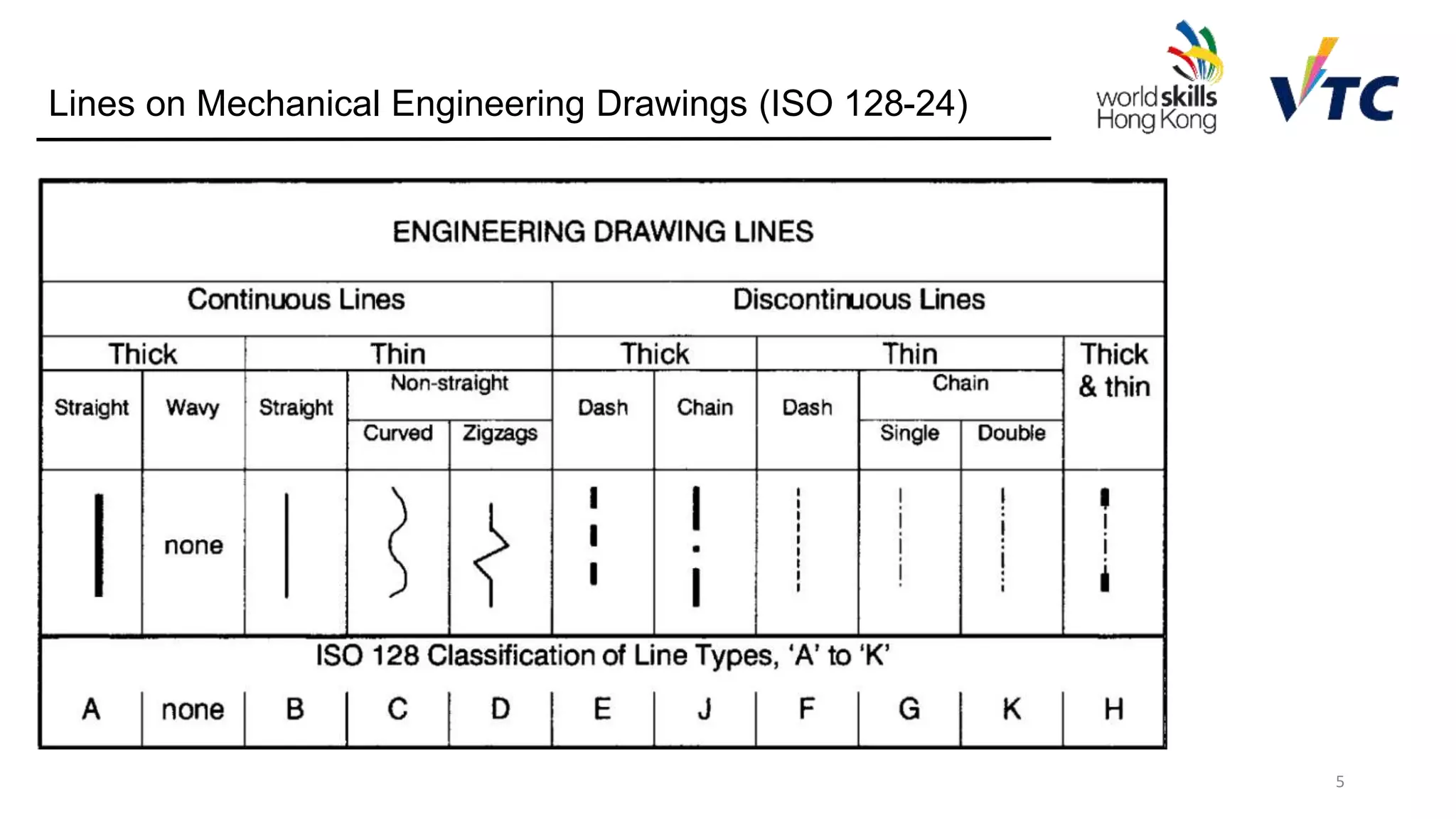
Lines on Mechanical Engineering Drawings (ISO 128-24)
5
6
Lines on Mechanical Engineering Drawings (ISO 128-24)
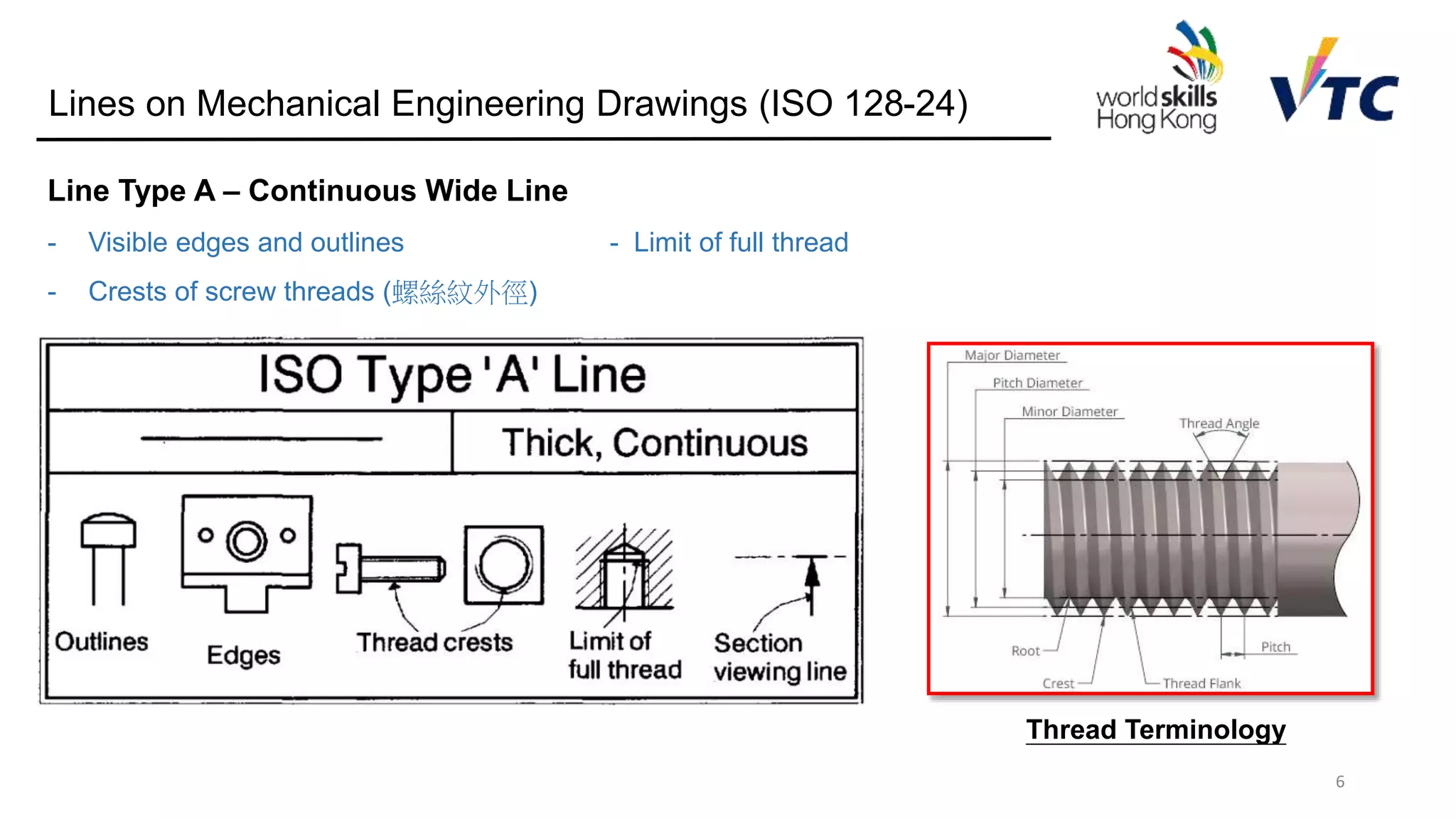
Line Type A – Continuous Wide Line
- Visible edges and outlines - Limit of full thread
- Crests of screw threads (螺絲紋外徑)
Thread Terminology
7
Lines on Mechanical Engineering Drawings (ISO 128-24)
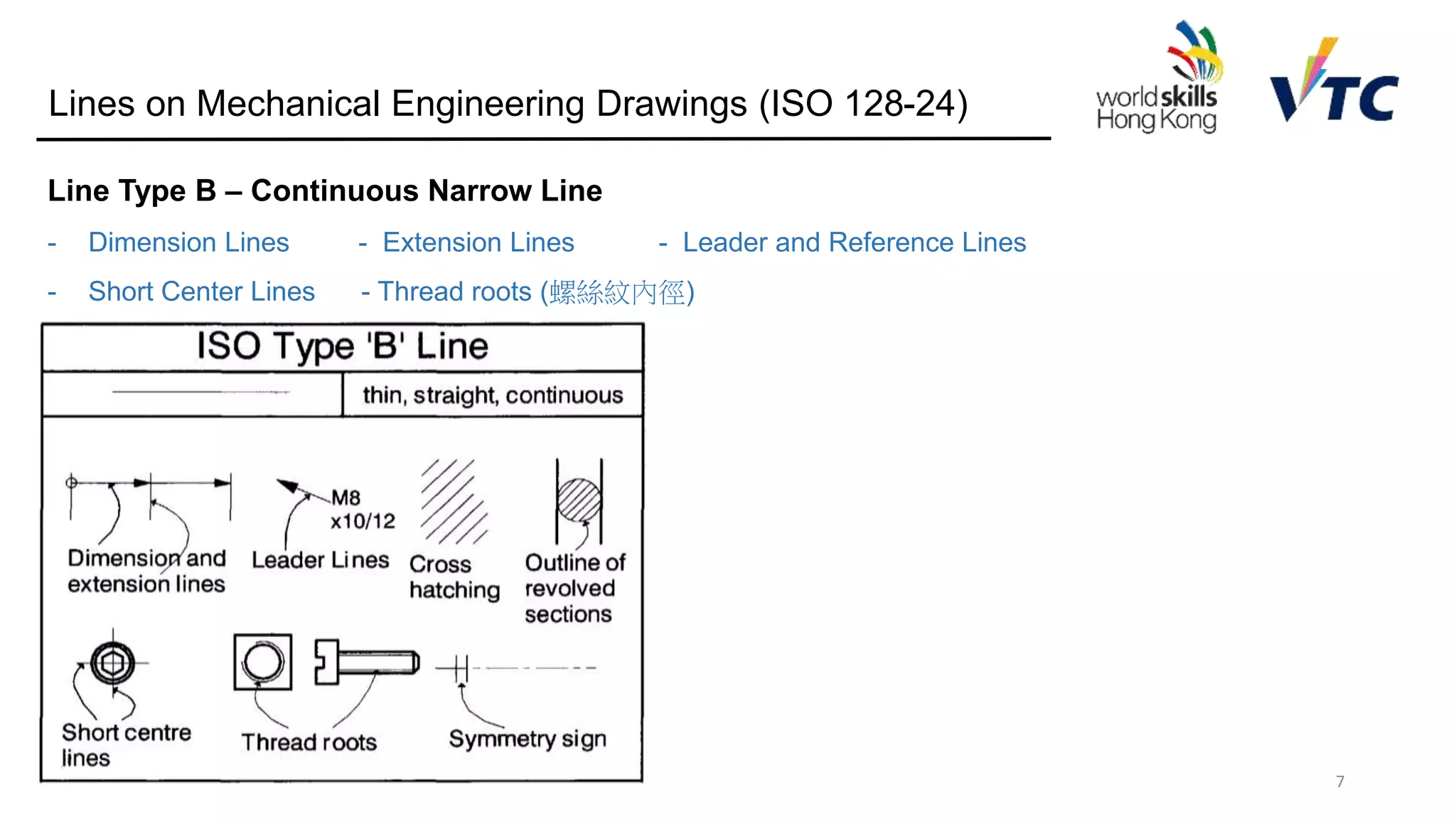
Line Type B – Continuous Narrow Line
- Dimension Lines - Extension Lines - Leader and Reference Lines
- Short Center Lines - Thread roots (螺絲紋內徑)
8
Lines on Mechanical Engineering Drawings (ISO 128-24)
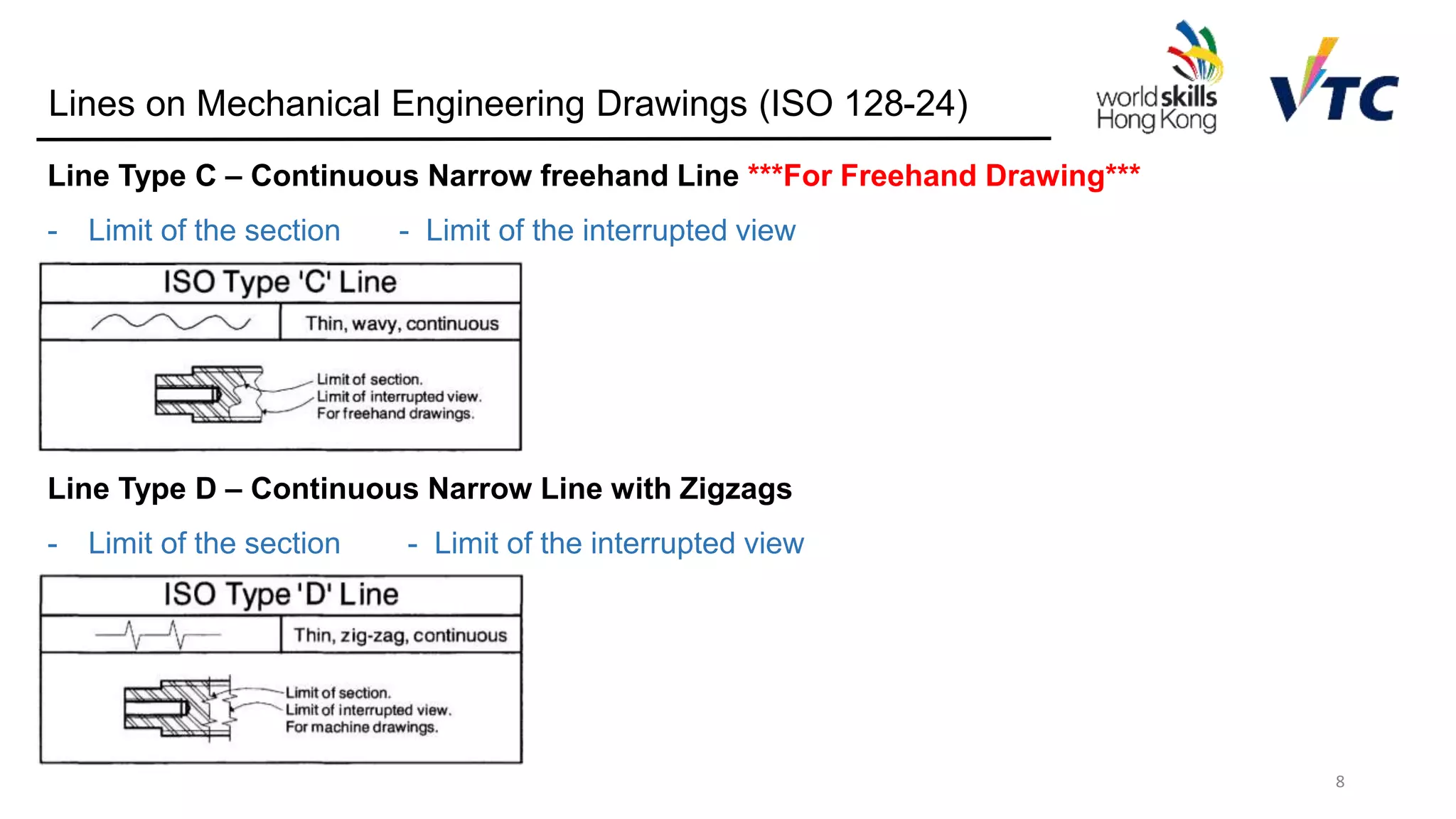
Line Type C – Continuous Narrow freehand Line ***For Freehand Drawing***
- Limit of the section - Limit of the interrupted view
Line Type D – Continuous Narrow Line with Zigzags
- Limit of the section - Limit of the interrupted view
9
Lines on Mechanical Engineering Drawings (ISO 128-24)
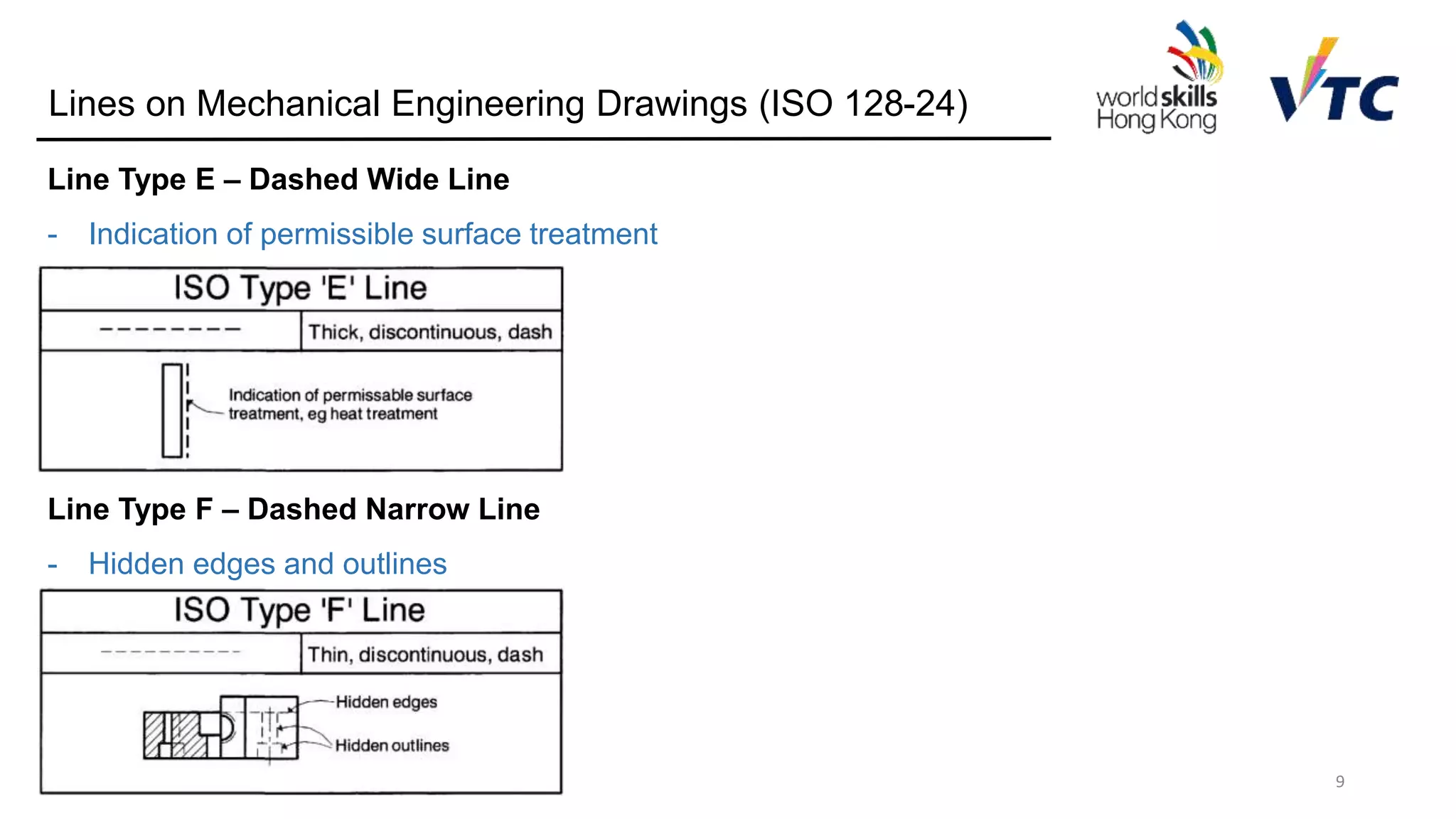
Line Type E – Dashed Wide Line
- Indication of permissible surface treatment
Line Type F – Dashed Narrow Line
- Hidden edges and outlines
10
Lines on Mechanical Engineering Drawings (ISO 128-24)
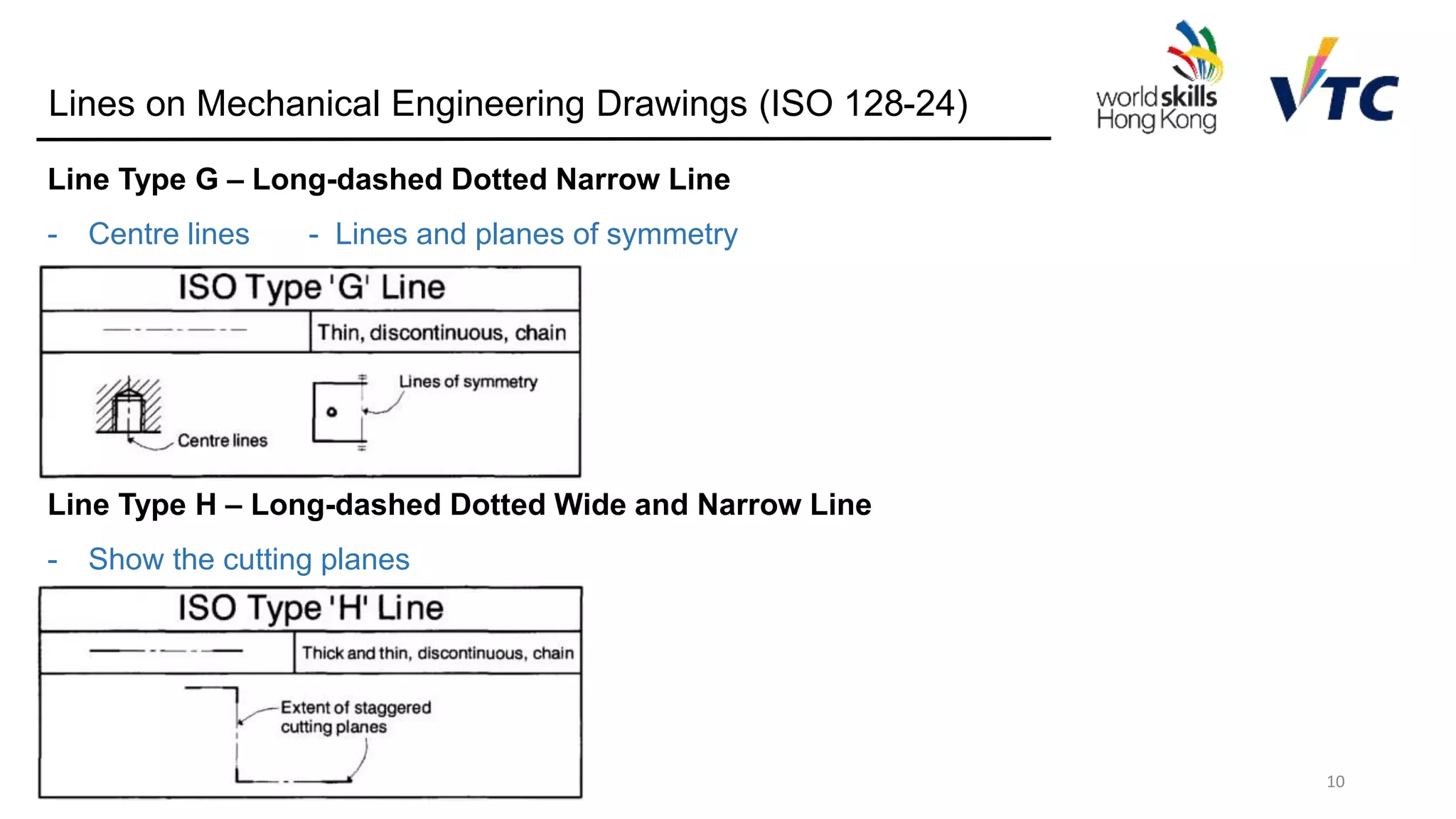
Line Type G – Long-dashed Dotted Narrow Line
- Centre lines - Lines and planes of symmetry
Line Type H – Long-dashed Dotted Wide and Narrow Line
- Show the cutting planes
11
Lines on Mechanical Engineering Drawings (ISO 128-24)
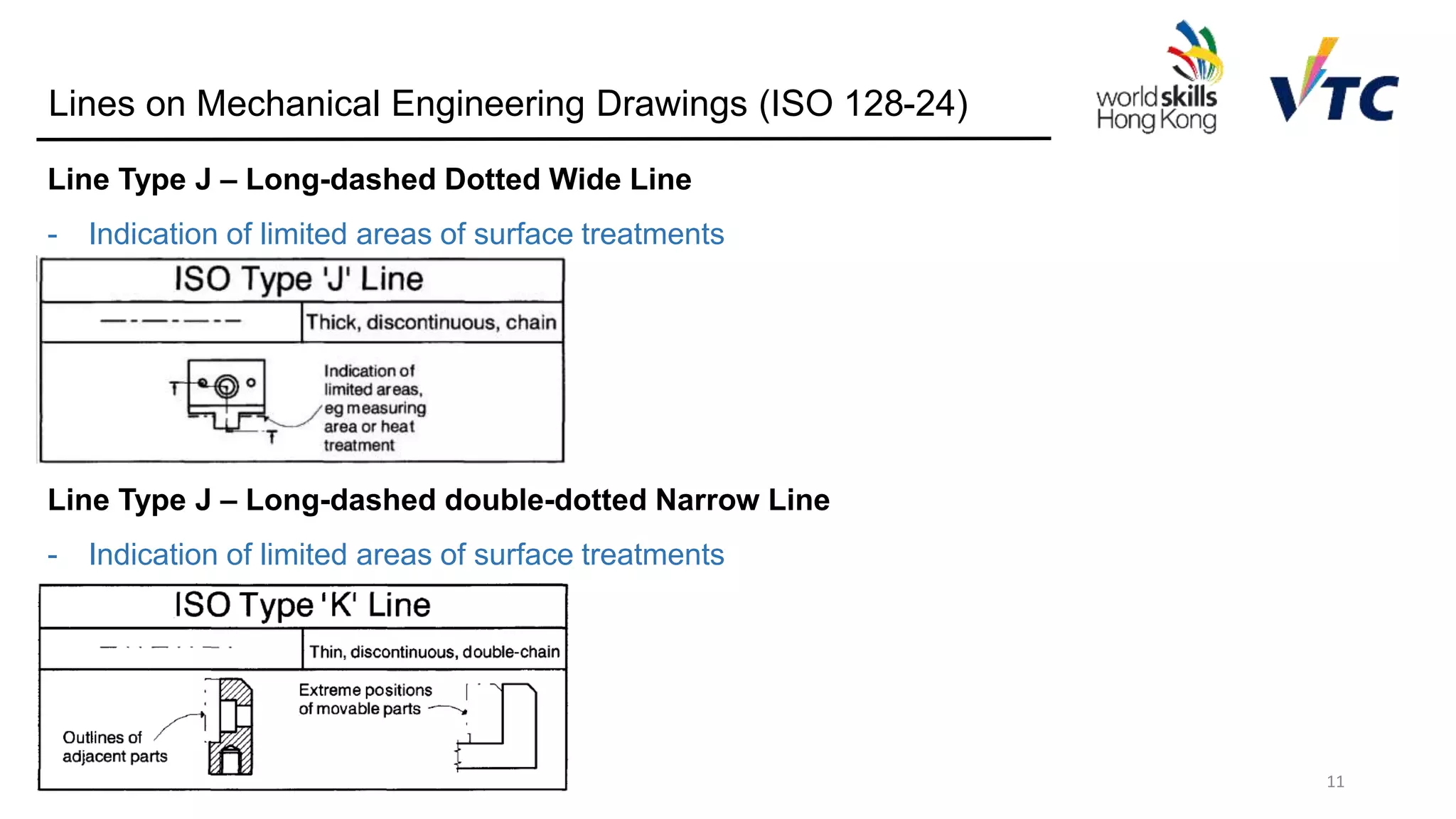
Line Type J – Long-dashed Dotted Wide Line
- Indication of limited areas of surface treatments
Line Type J – Long-dashed double-dotted Narrow Line
- Indication of limited areas of surface treatments
12
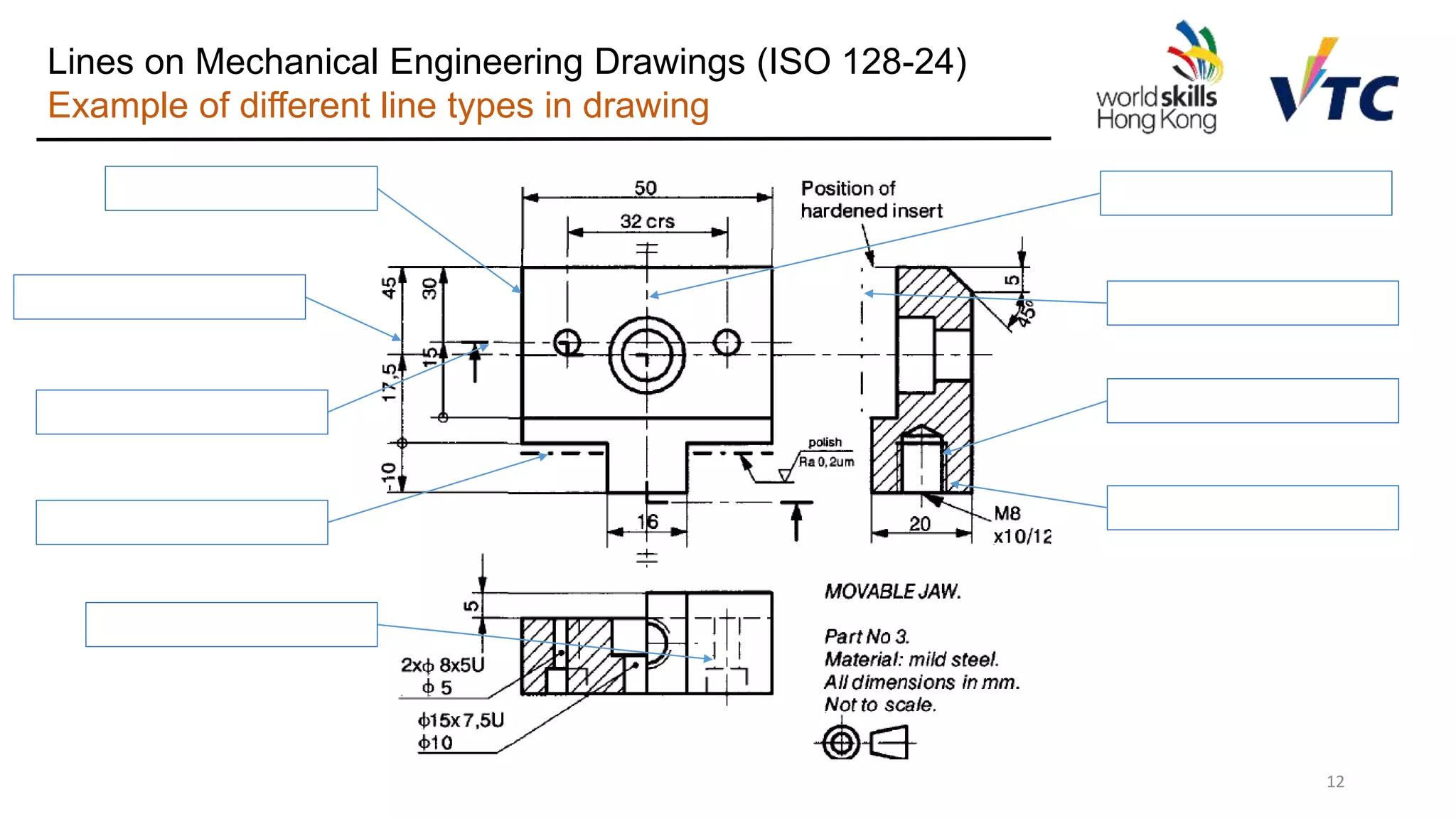
Lines on Mechanical Engineering Drawings (ISO 128-24)
Example of different line types in drawing
13
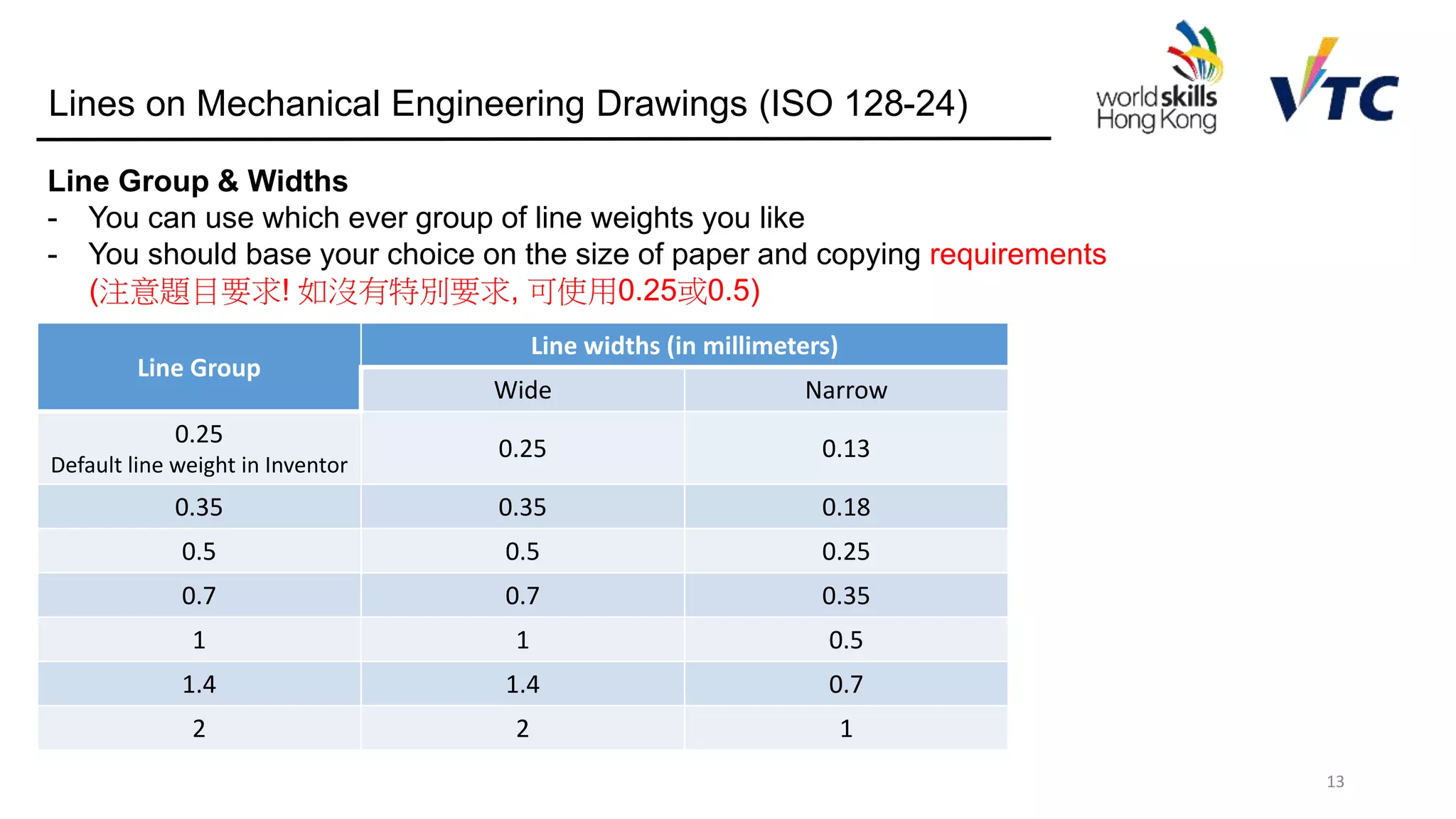
Line Group
Line widths (in millimeters)
Wide Narrow
0.25
Default line weight in Inventor
0.25 0.13
0.35 0.35 0.18
0.5 0.5 0.25
0.7 0.7 0.35
1 1 0.5
1.4 1.4 0.7
2 2 1
Lines on Mechanical Engineering Drawings (ISO 128-24)
Line Group & Widths
- You can use which ever group of line weights you like
- You should base your choice on the size of paper and copying requirements
(注意題目要求! 如沒有特別要求, 可使用0.25或0.5)
14
Lines on Mechanical Engineering Drawings (ISO 128-24)
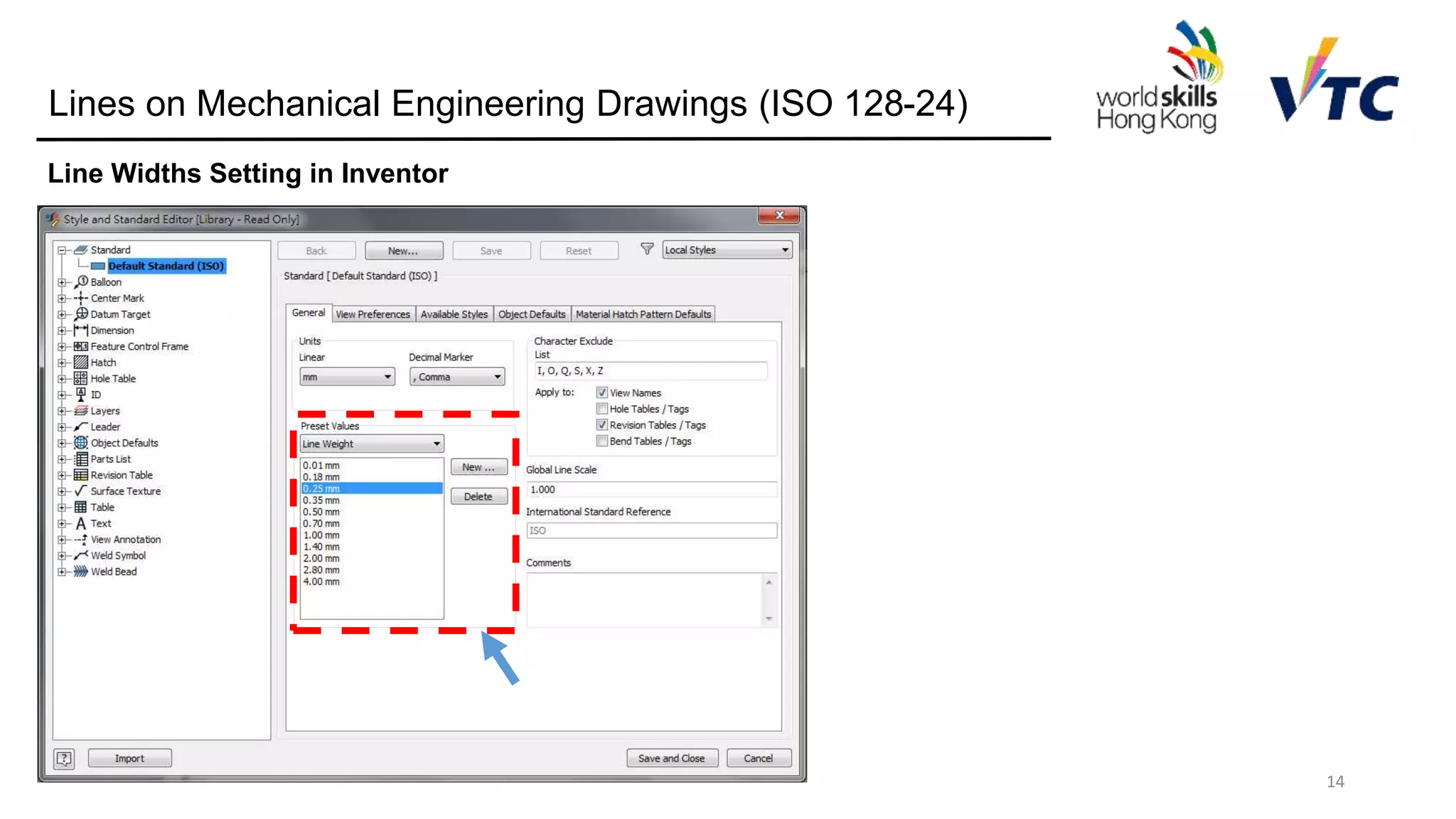
Line Widths Setting in Inventor
15
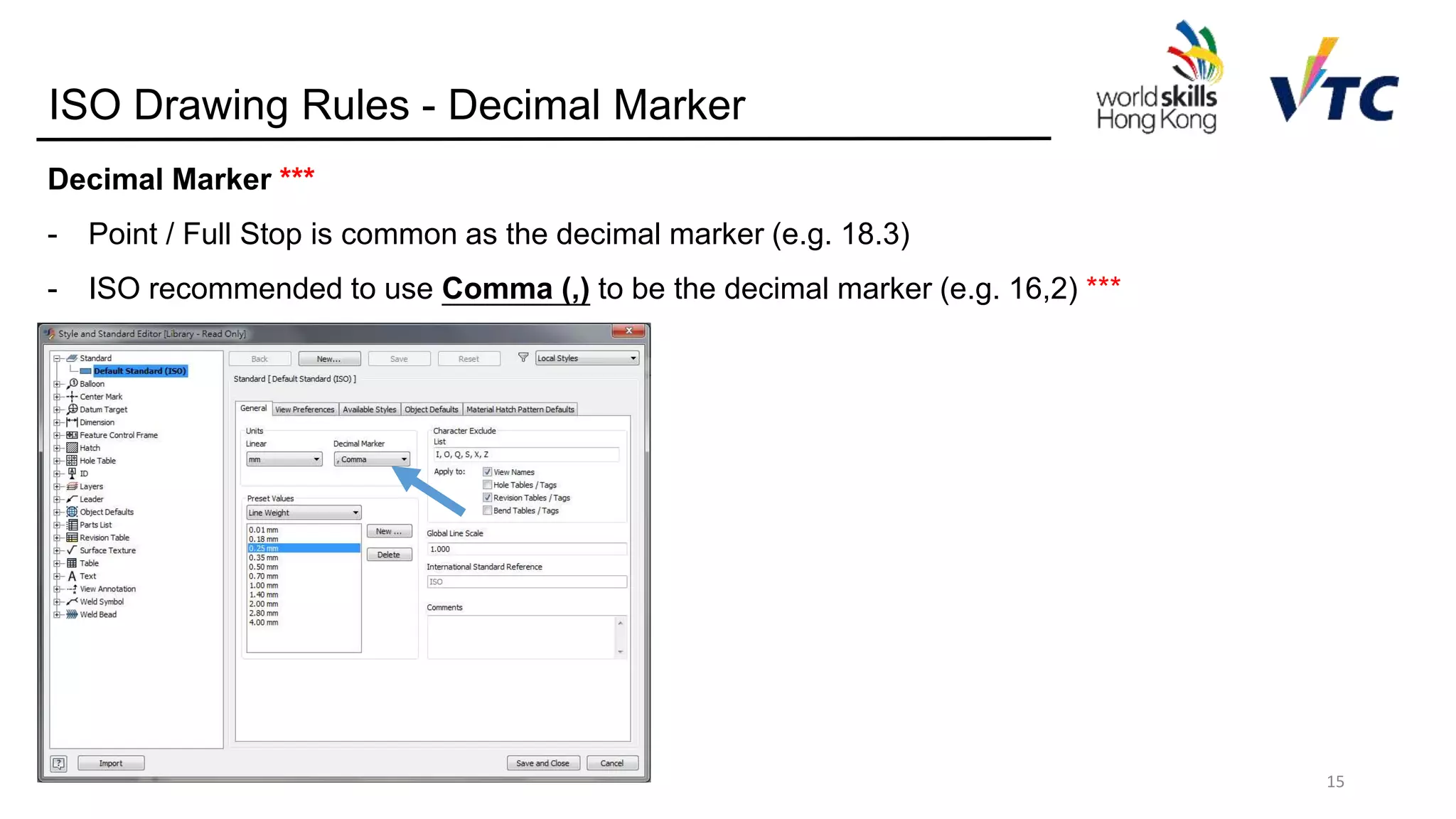
ISO Drawing Rules - Decimal Marker
Decimal Marker ***
- Point / Full Stop is common as the decimal marker (e.g. 18.3)
- ISO recommended to use Comma (,) to be the decimal marker (e.g. 16,2) ***
16
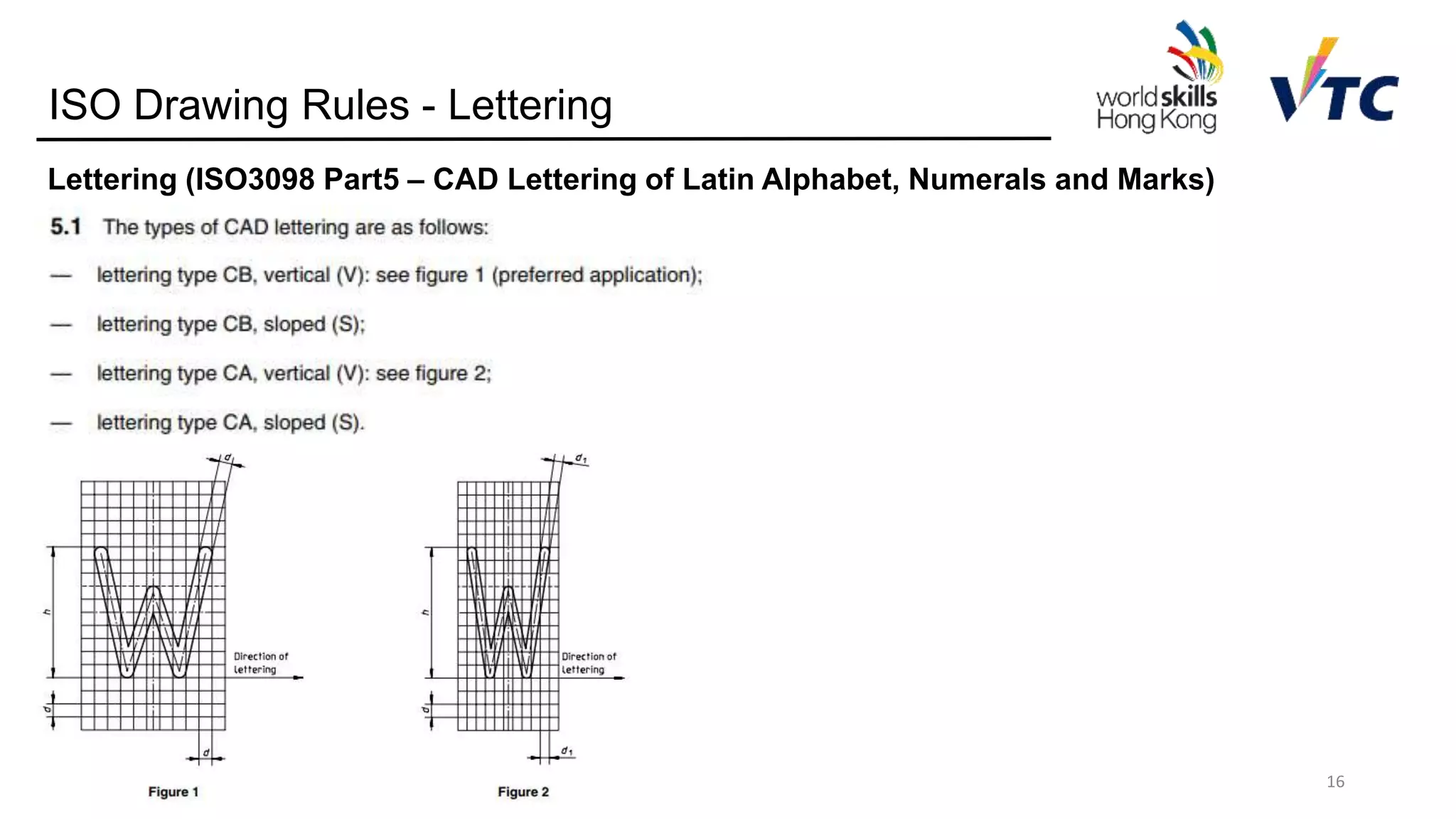
ISO Drawing Rules - Lettering
Lettering (ISO3098 Part5 – CAD Lettering of Latin Alphabet, Numerals and Marks)
17
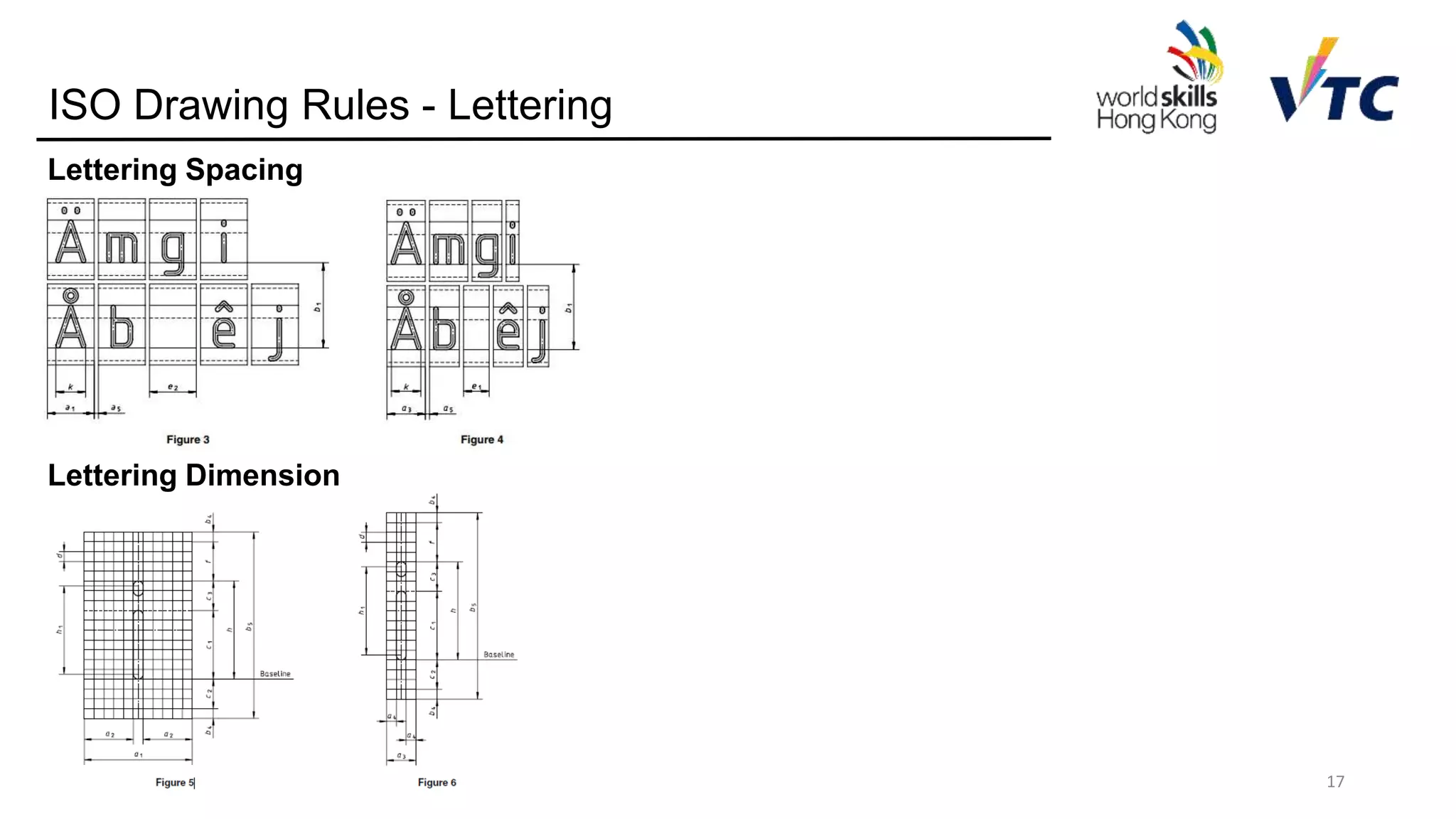
Lettering Spacing
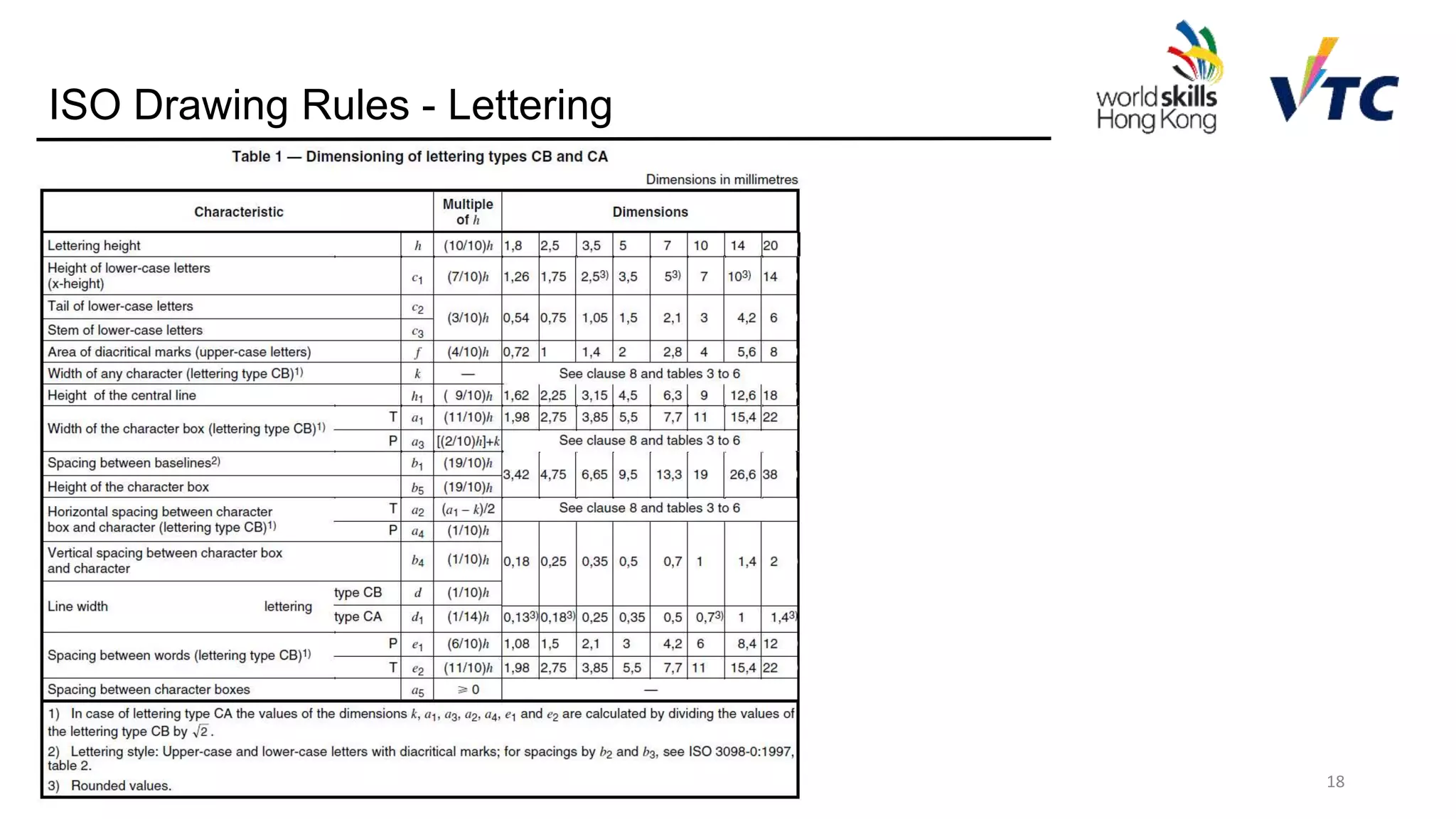
Lettering Dimension
ISO Drawing Rules - Lettering
18
ISO Drawing Rules - Lettering
19
ISO Drawing Rules - Lettering
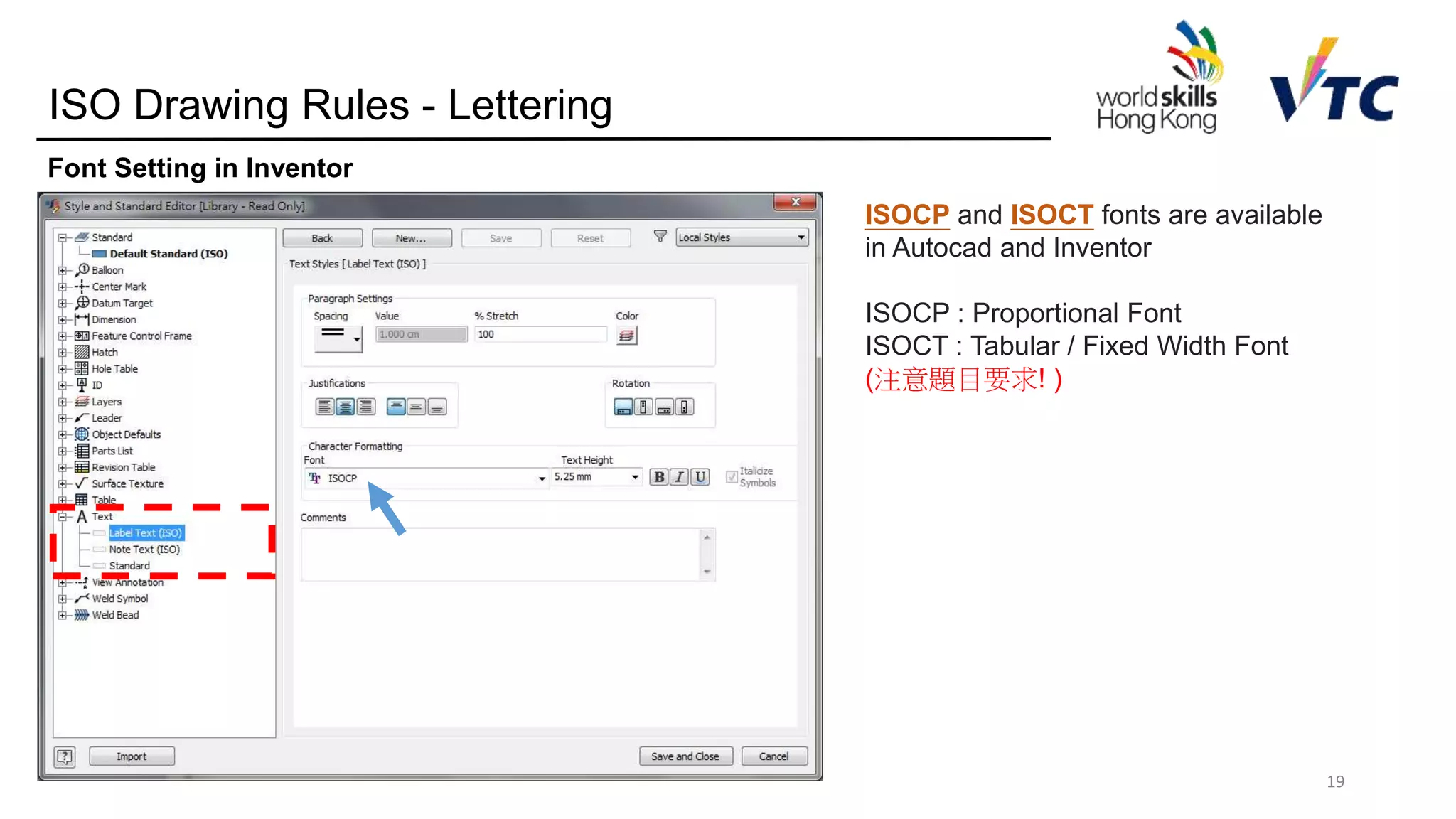
Font Setting in Inventor
ISOCP and ISOCT fonts are available
in Autocad and Inventor
ISOCP : Proportional Font
ISOCT : Tabular / Fixed Width Font
(注意題目要求! )
20
ISO Drawing Rules – Dimensioning
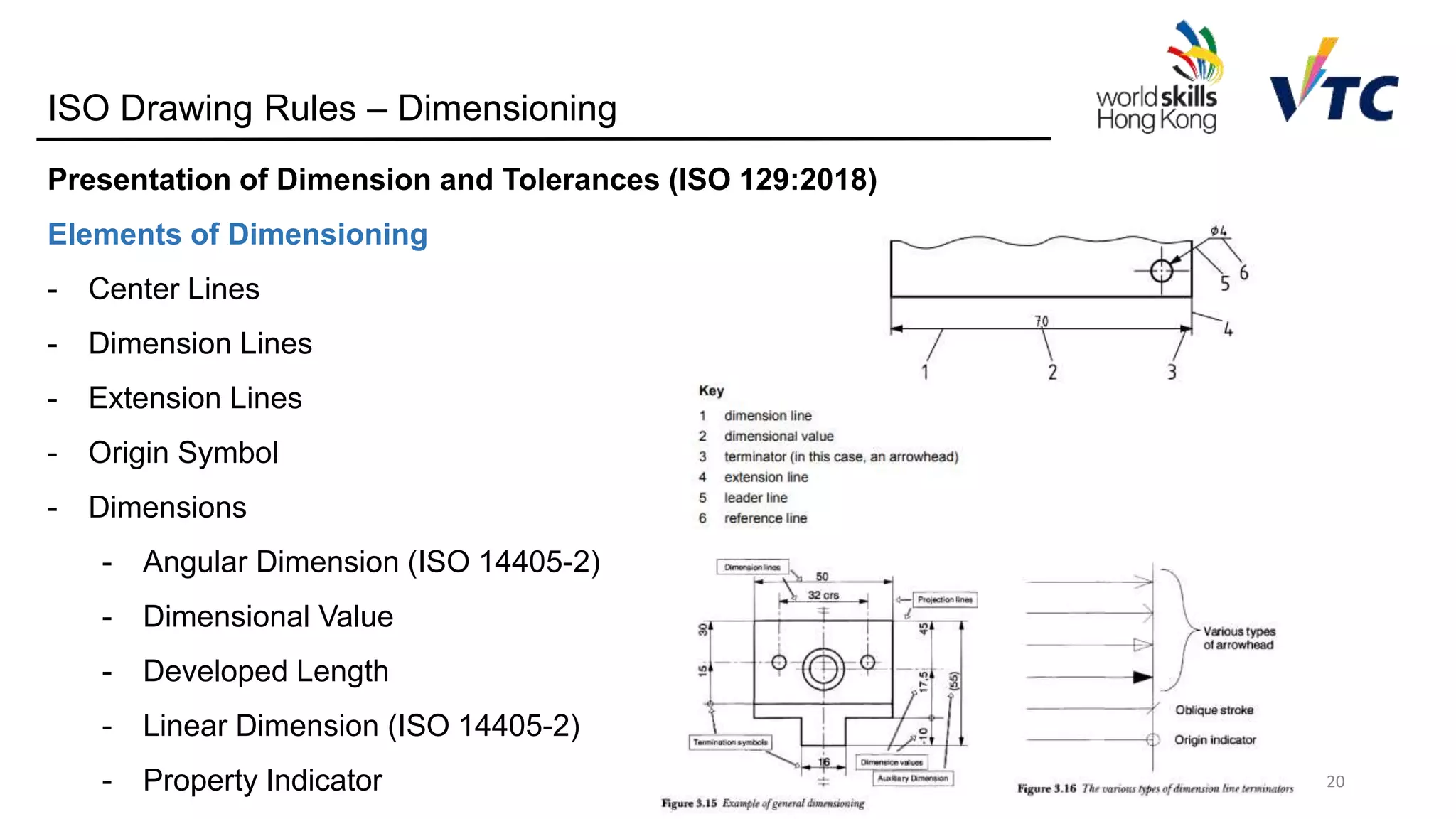
Presentation of Dimension and Tolerances (ISO 129:2018)
Elements of Dimensioning
- Center Lines
- Dimension Lines
- Extension Lines
- Origin Symbol
- Dimensions
- Angular Dimension (ISO 14405-2)
- Dimensional Value
- Developed Length
- Linear Dimension (ISO 14405-2)
- Property Indicator
21
ISO Drawing Rules – Dimensioning
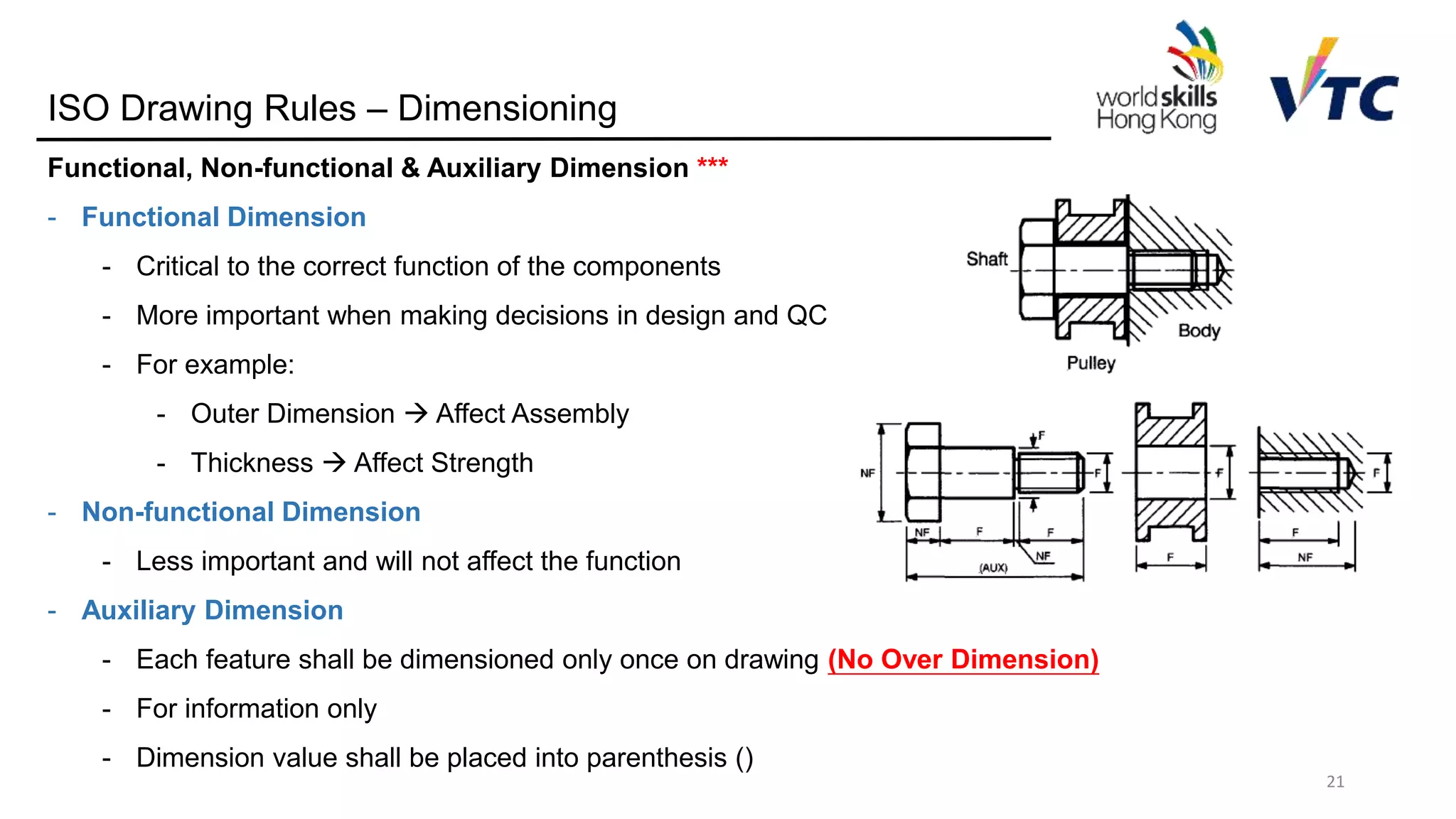
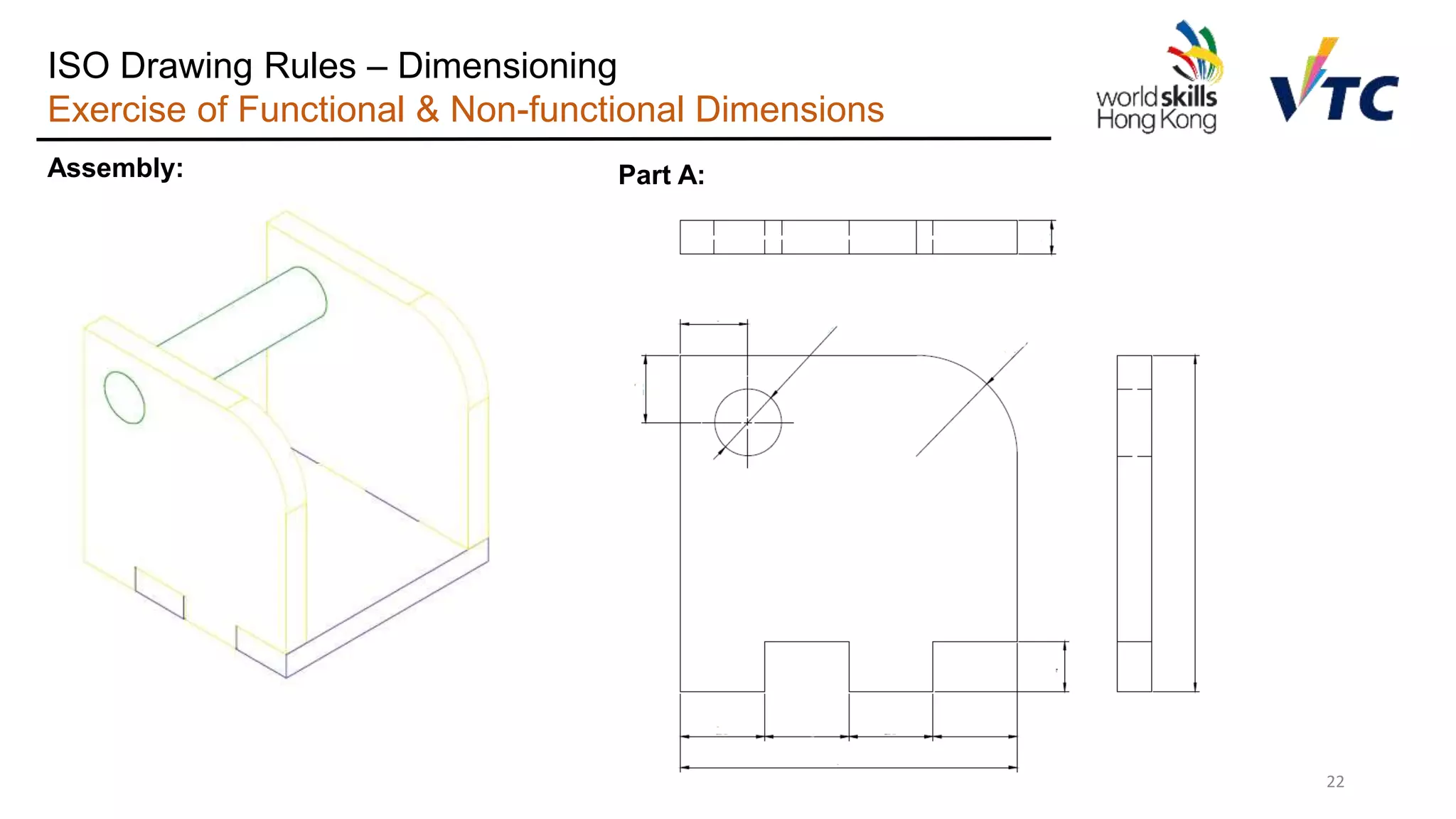
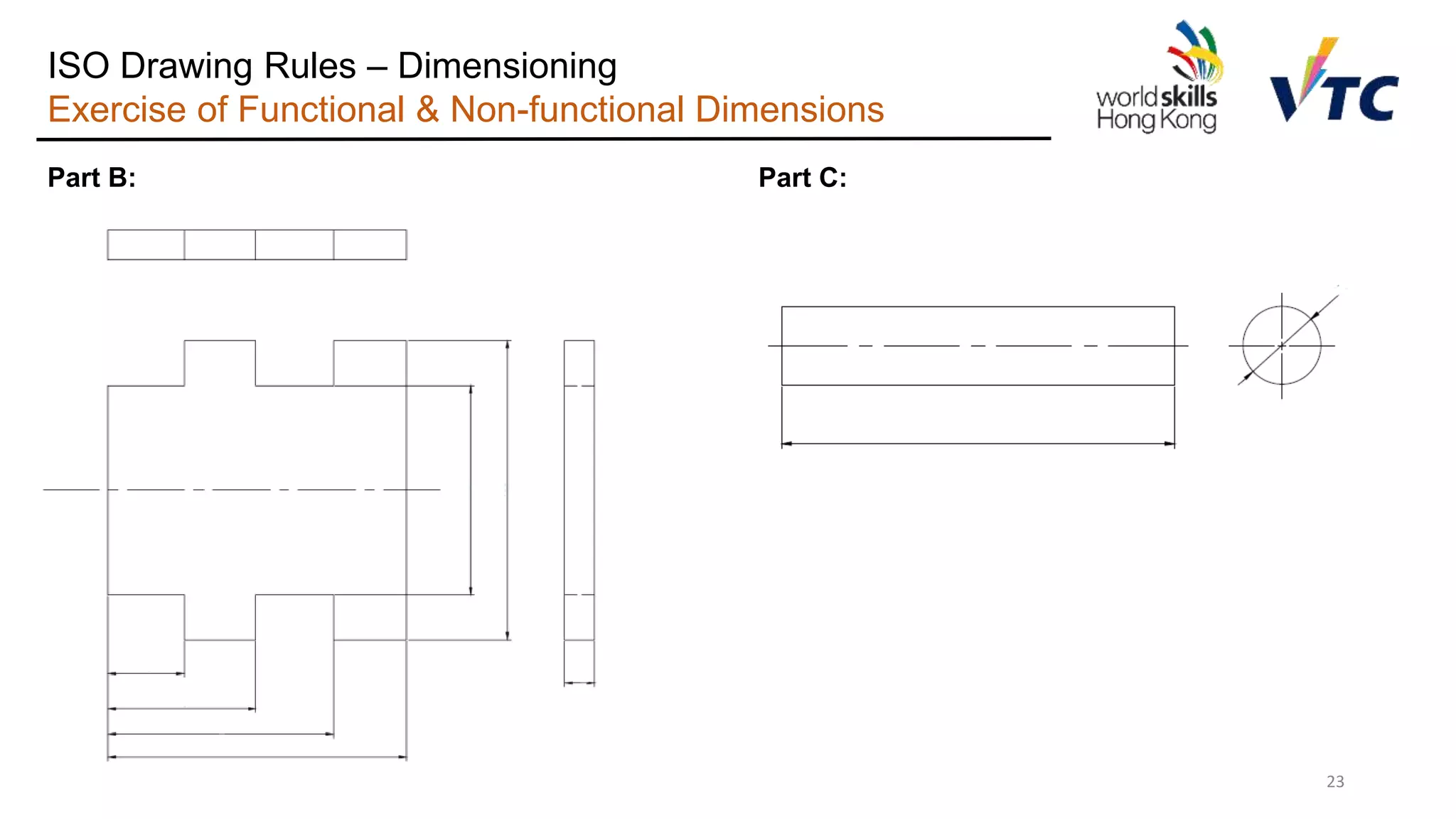
Functional, Non-functional & Auxiliary Dimension ***
- Functional Dimension
- Critical to the correct function of the components
- More important when making decisions in design and QC
- For example:
- Outer Dimension  Affect Assembly
- Thickness  Affect Strength
- Non-functional Dimension
- Less important and will not affect the function
- Auxiliary Dimension
- Each feature shall be dimensioned only once on drawing (No Over Dimension)
- For information only
- Dimension value shall be placed into parenthesis ()
22
ISO Drawing Rules – Dimensioning
Exercise of Functional & Non-functional Dimensions
Assembly: Part A:
23
ISO Drawing Rules – Dimensioning
Exercise of Functional & Non-functional Dimensions
Part B: Part C:
24
ISO Drawing Rules – Dimensioning
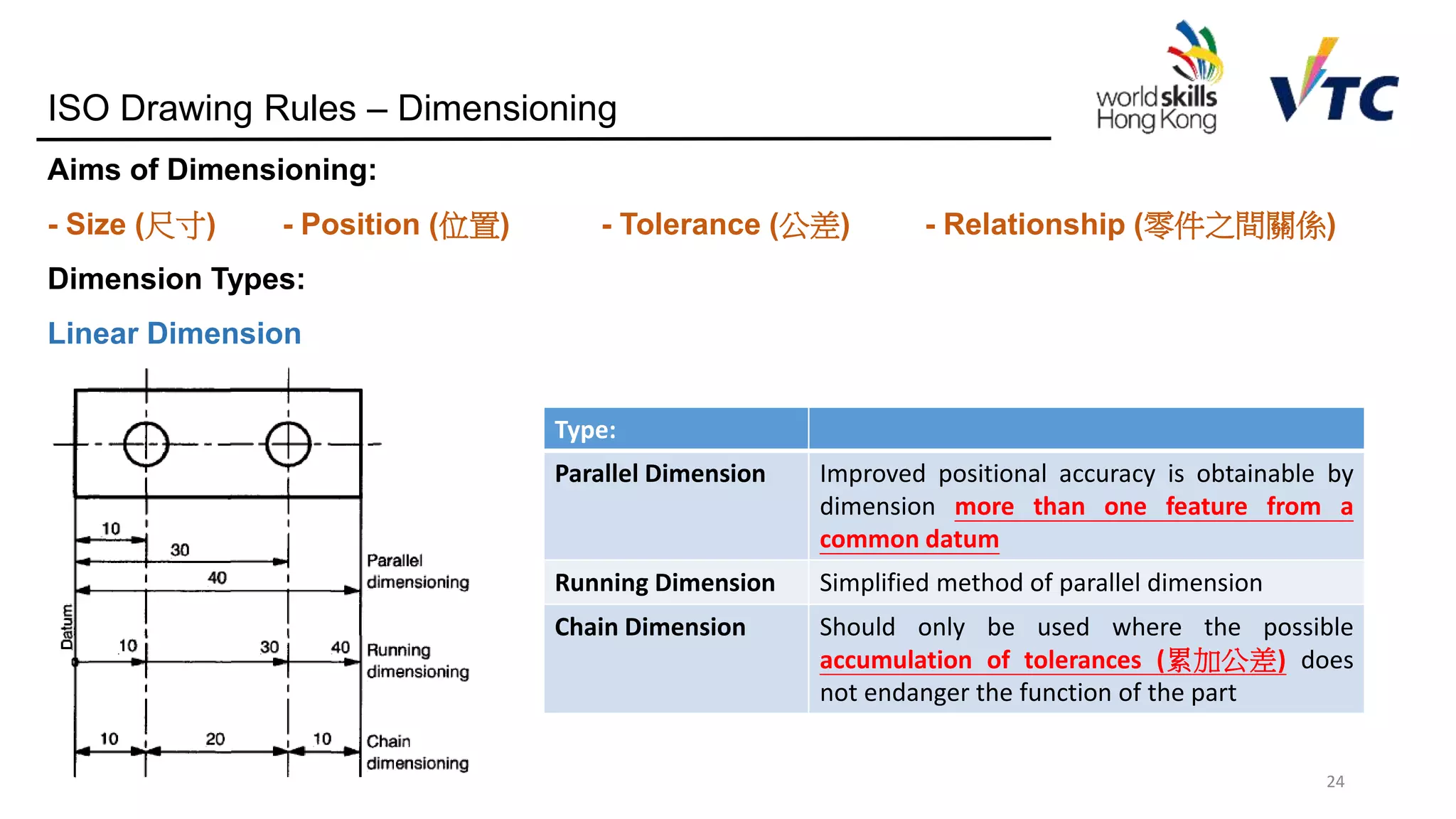
Aims of Dimensioning:
- Size (尺寸) - Position (位置) - Tolerance (公差) - Relationship (零件之間關係)
Dimension Types:
Linear Dimension
Type:
Parallel Dimension Improved positional accuracy is obtainable by
dimension more than one feature from a
common datum
Running Dimension Simplified method of parallel dimension
Chain Dimension Should only be used where the possible
accumulation of tolerances (累加公差) does
not endanger the function of the part
25
ISO Drawing Rules – Dimensioning
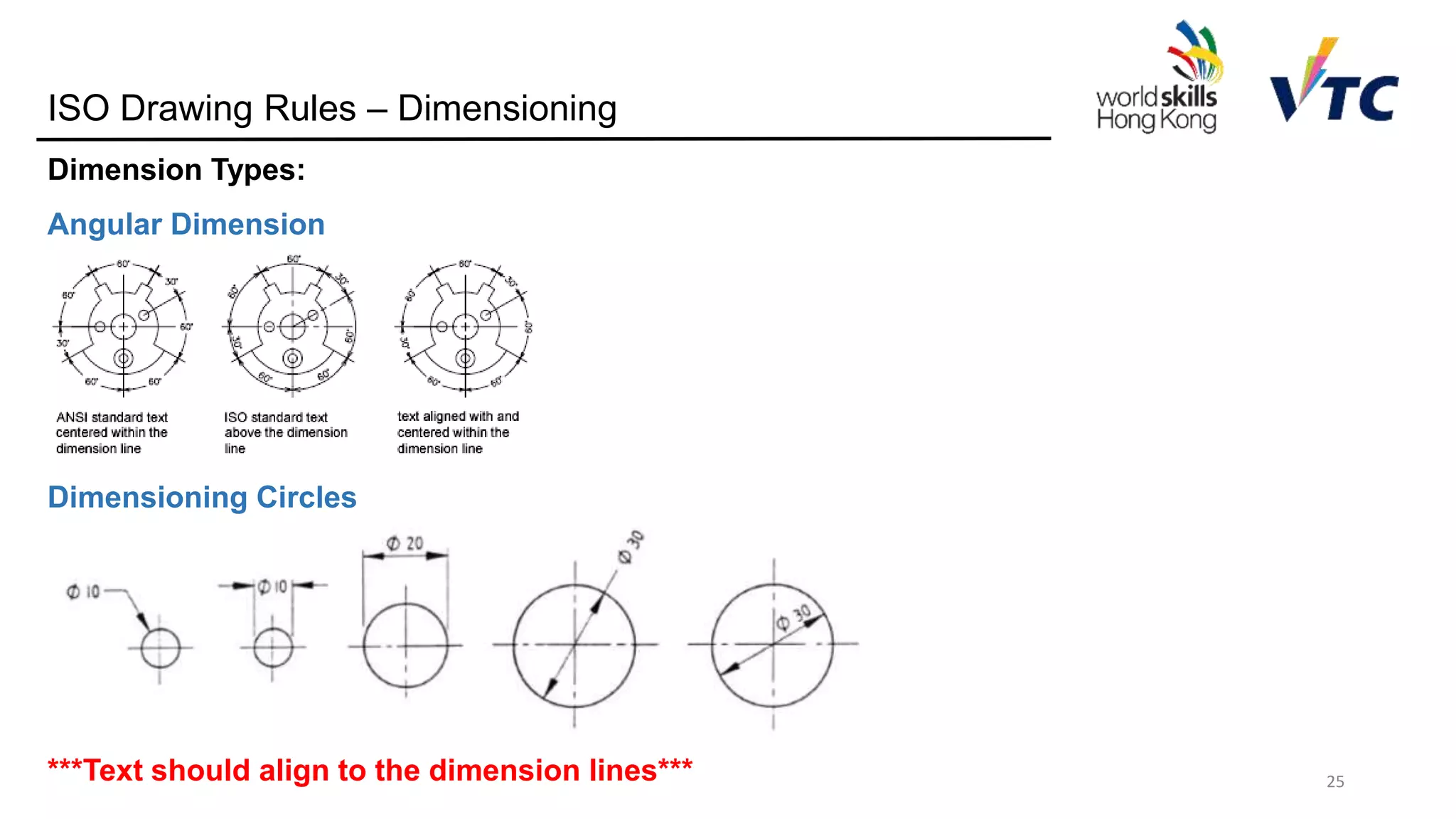
Dimension Types:
Angular Dimension
Dimensioning Circles
***Text should align to the dimension lines***
26
ISO Drawing Rules – Dimensioning
Dimension Types:
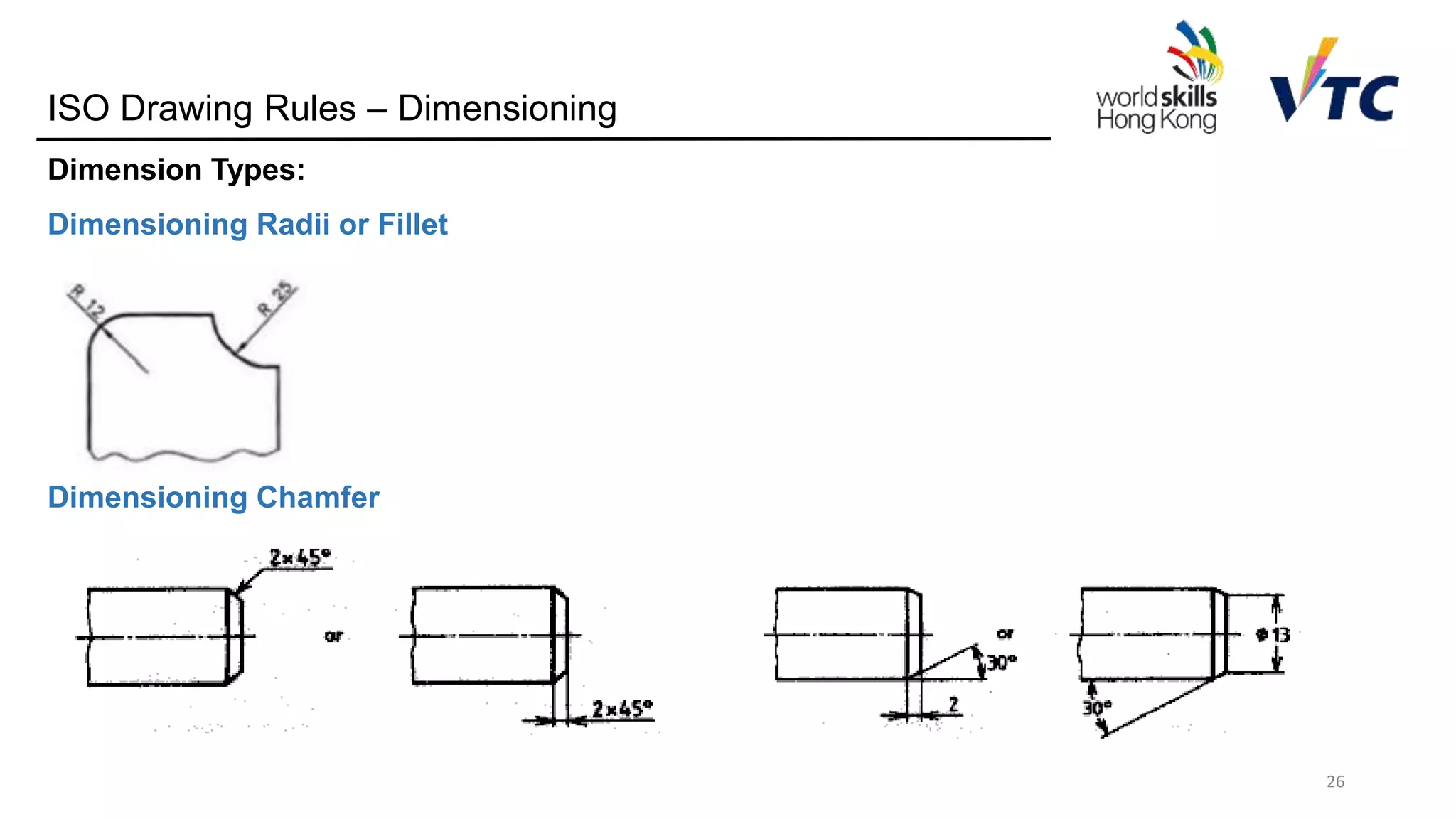
Dimensioning Radii or Fillet
Dimensioning Chamfer
27
ISO Drawing Rules – Dimensioning
Dimension Types:
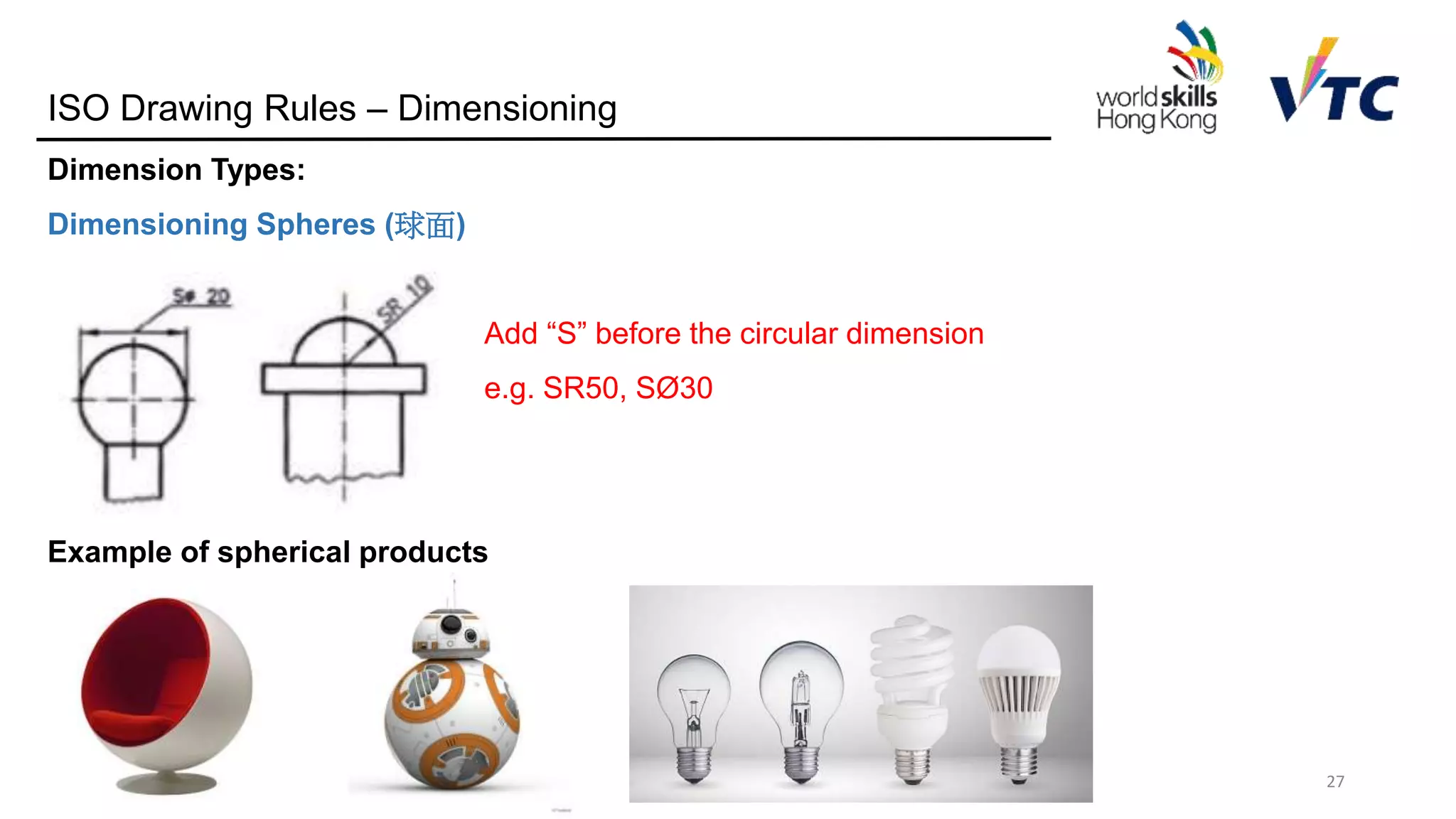
Dimensioning Spheres (球面)
Add “S” before the circular dimension
e.g. SR50, SØ30
Example of spherical products
28
ISO Drawing Rules – Dimensioning
Dimension Types:
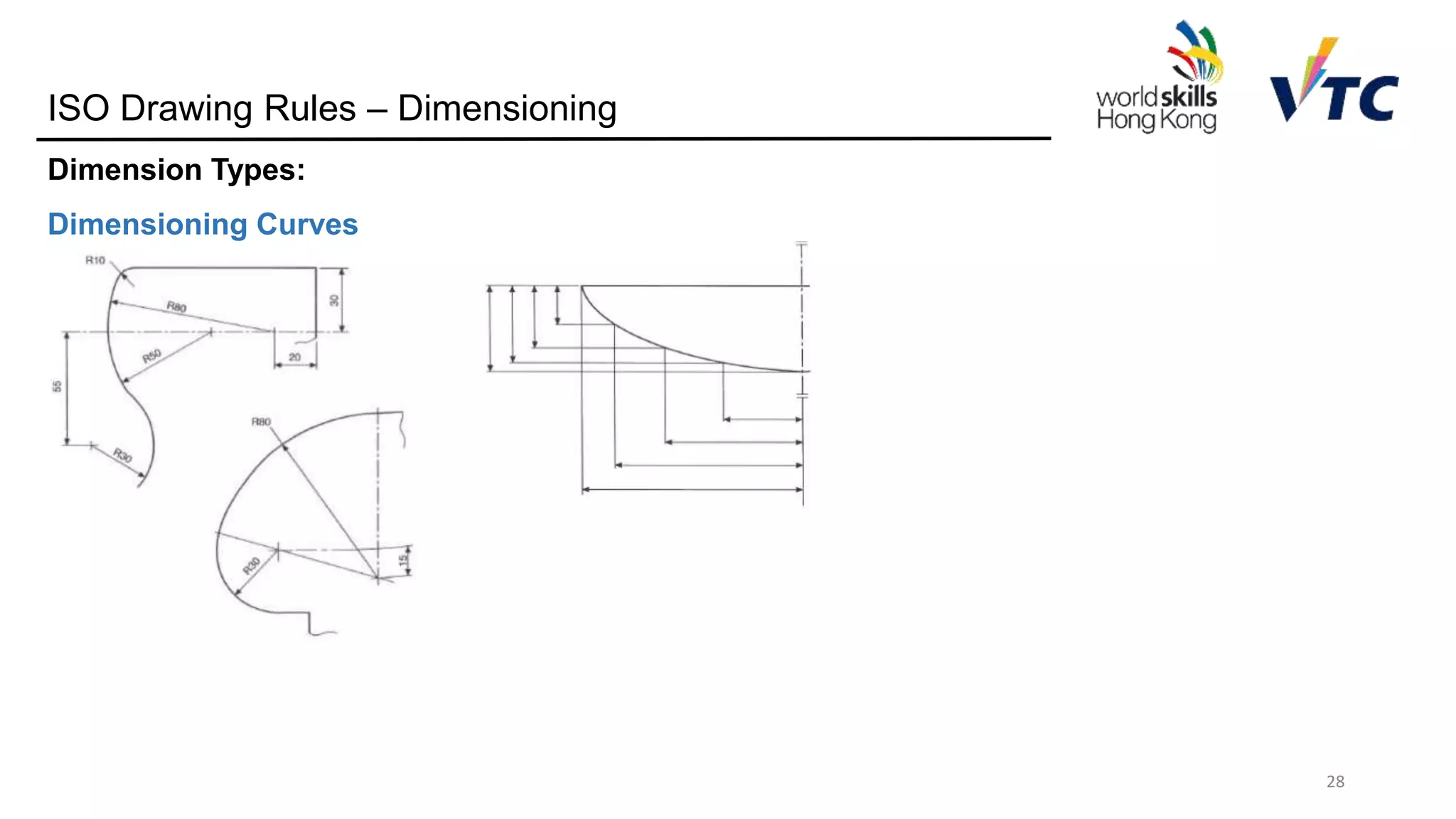
Dimensioning Curves
29
ISO Drawing Rules – Dimensioning
Dimension Types:
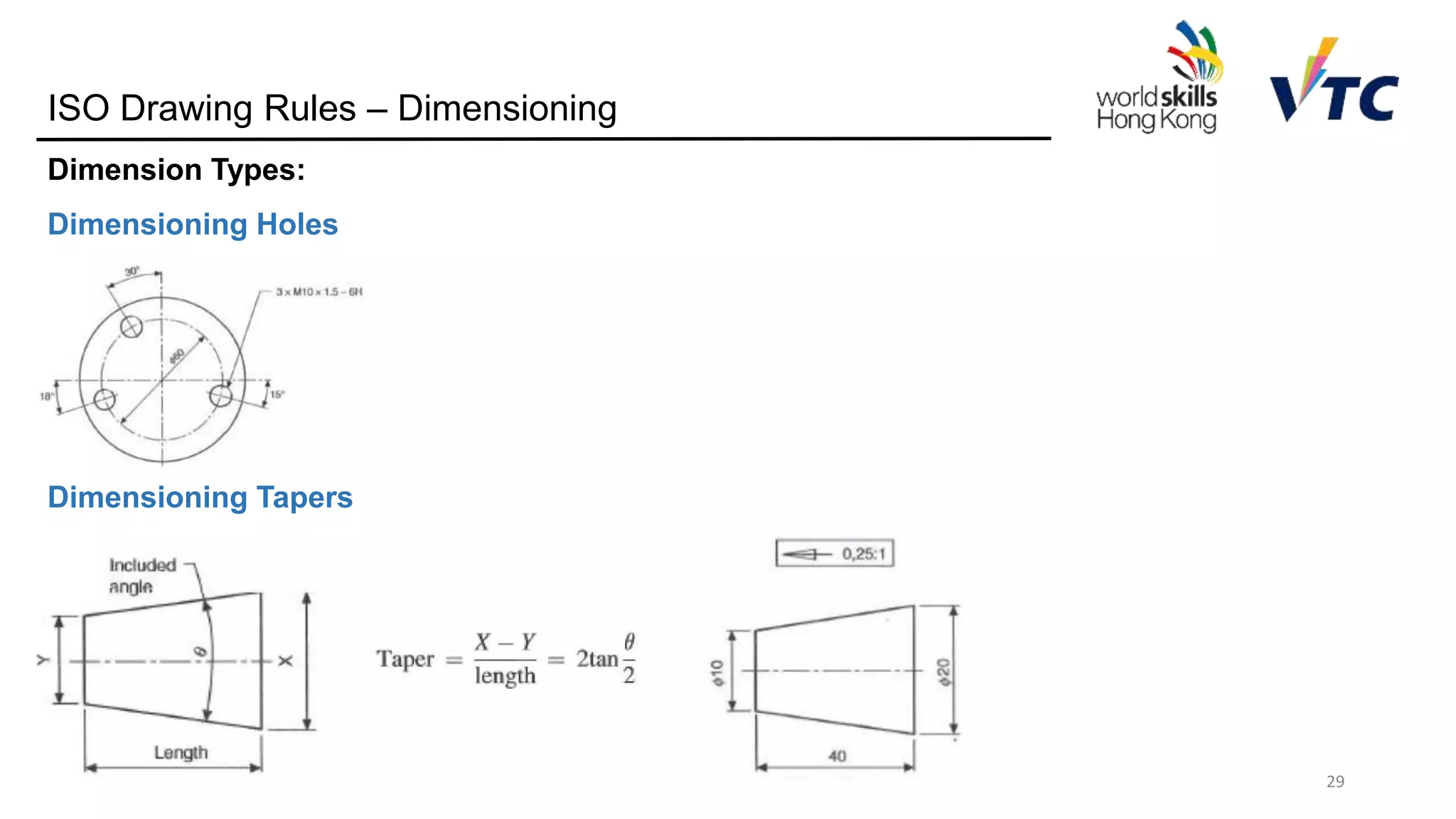
Dimensioning Holes
Dimensioning Tapers
30
ISO Drawing Rules – Dimensioning
Dimension Placement:
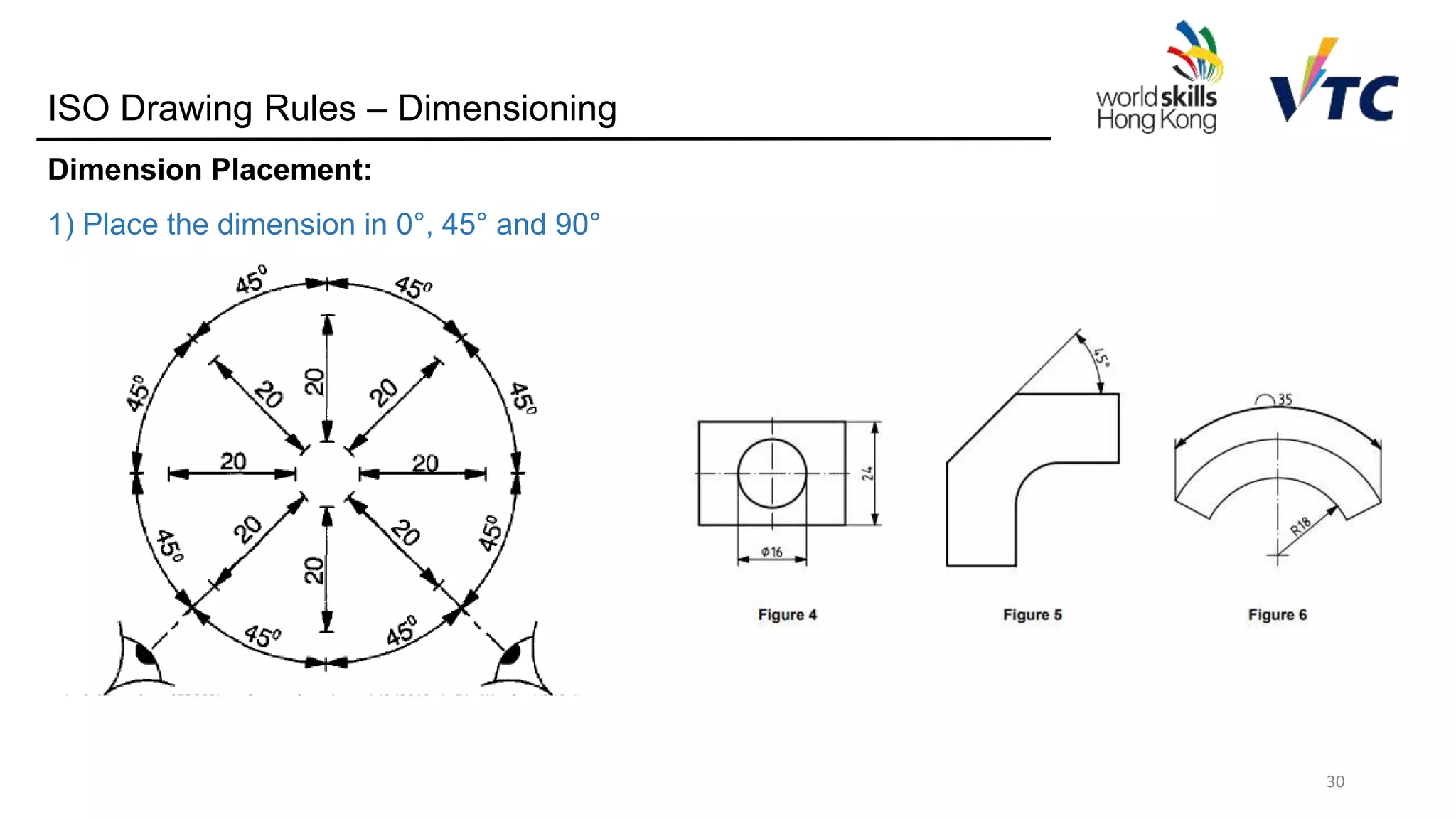
1) Place the dimension in 0°, 45° and 90°
31
ISO Drawing Rules – Dimensioning
Dimension Placement:
2) Dimension lines should not cross extension lines
3) Dimension should be line up and grouped together
32
ISO Drawing Rules – Dimensioning
Dimension Placement:
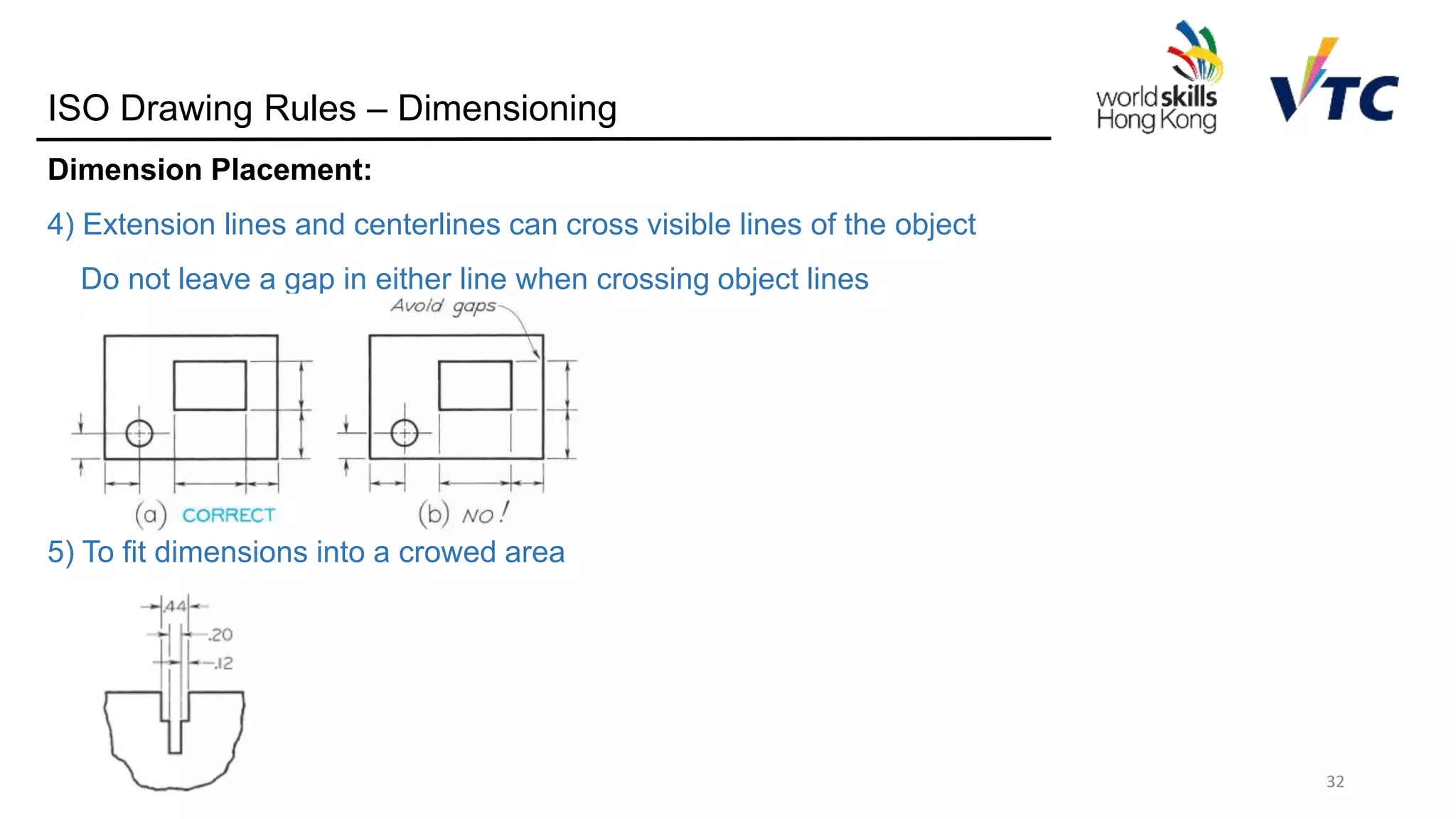
4) Extension lines and centerlines can cross visible lines of the object
Do not leave a gap in either line when crossing object lines
5) To fit dimensions into a crowed area
33
ISO Drawing Rules – Dimensioning
Dimension Placement:
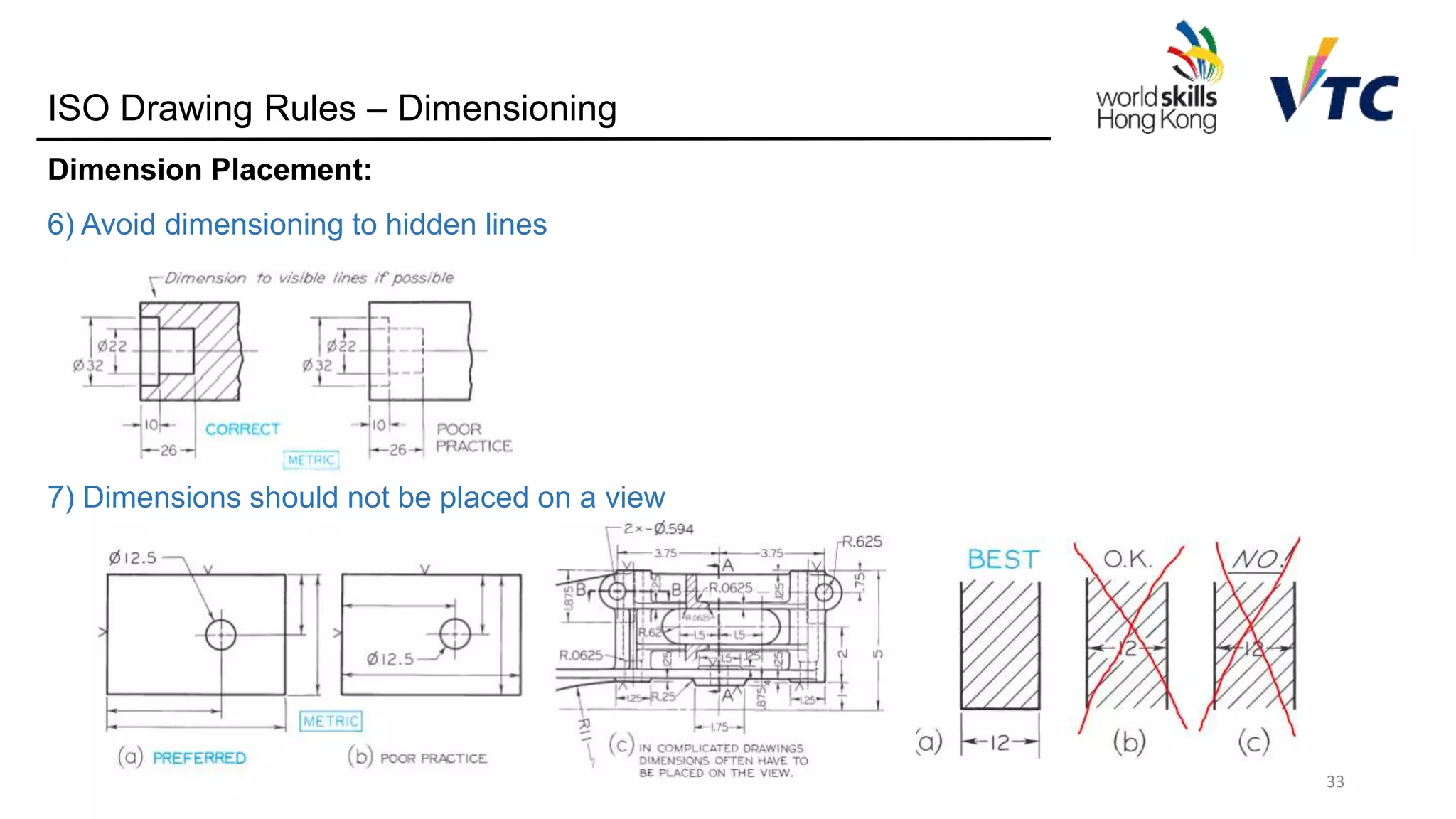
6) Avoid dimensioning to hidden lines
7) Dimensions should not be placed on a view
34
ISO Drawing Rules – Dimensioning
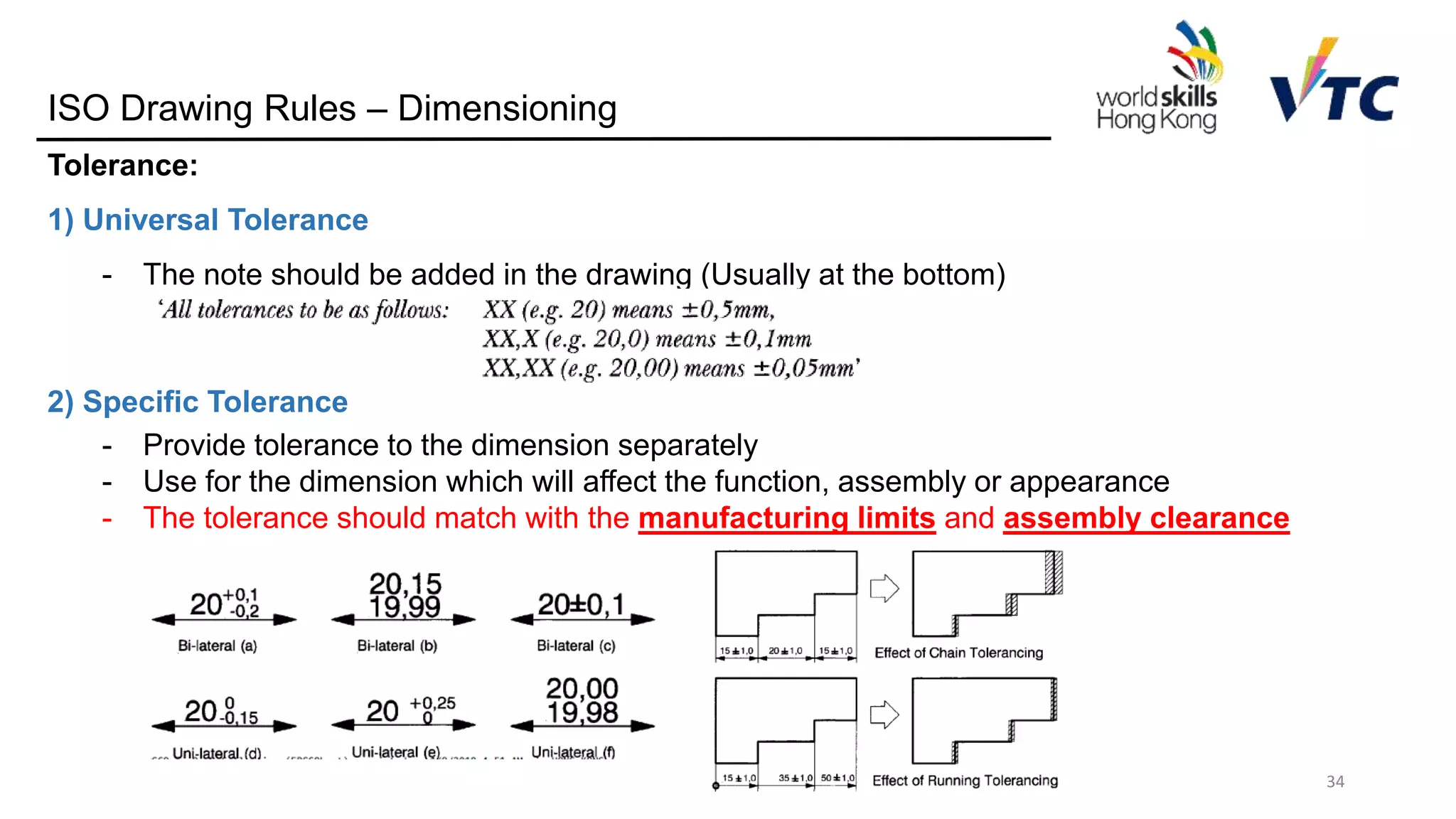
Tolerance:
1) Universal Tolerance
- The note should be added in the drawing (Usually at the bottom)
2) Specific Tolerance
- Provide tolerance to the dimension separately
- Use for the dimension which will affect the function, assembly or appearance
- The tolerance should match with the manufacturing limits and assembly clearance
35
ISO Drawing Rules – Dimensioning
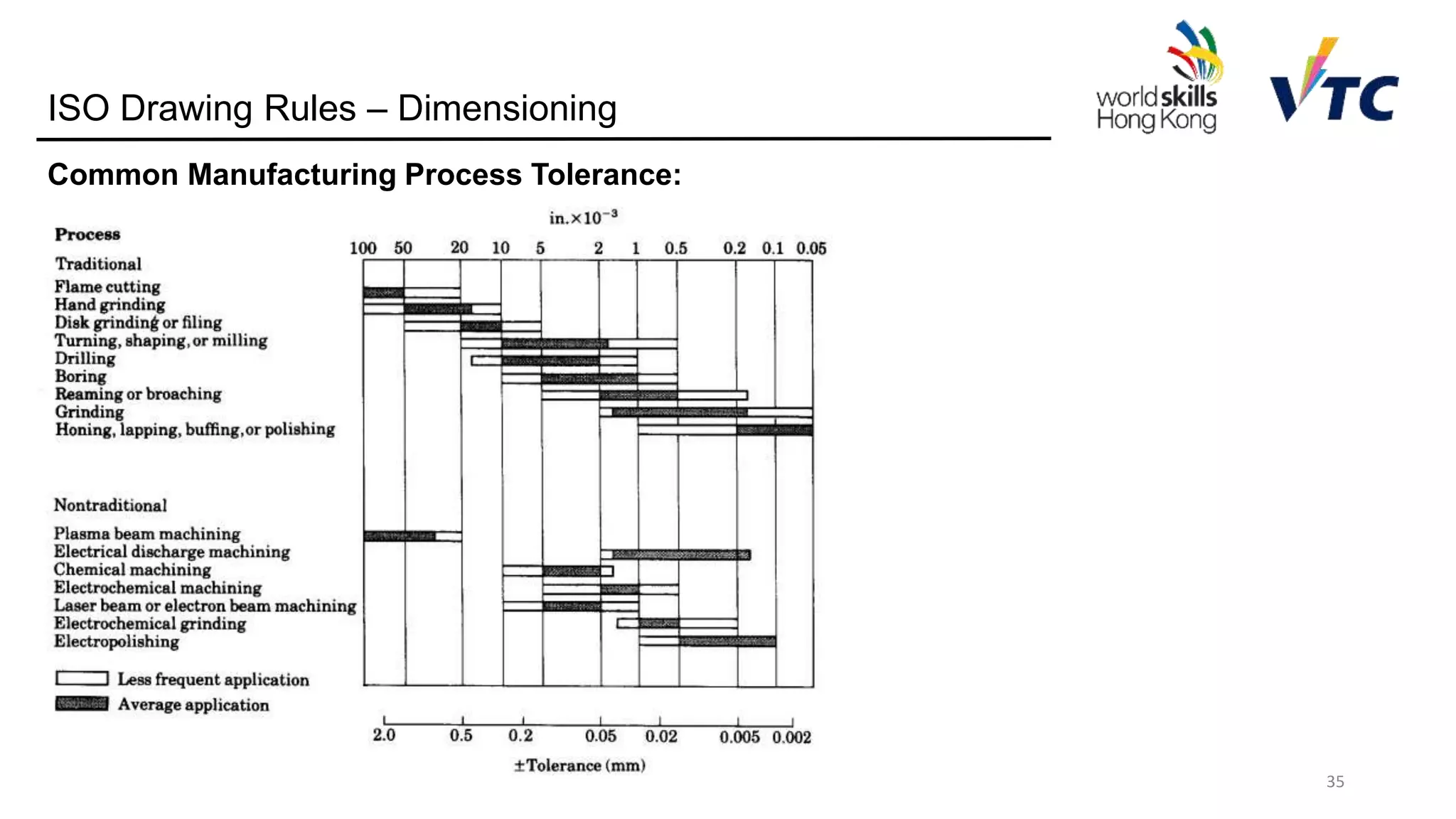
Common Manufacturing Process Tolerance:
36
ISO Drawing Rules – Dimensioning
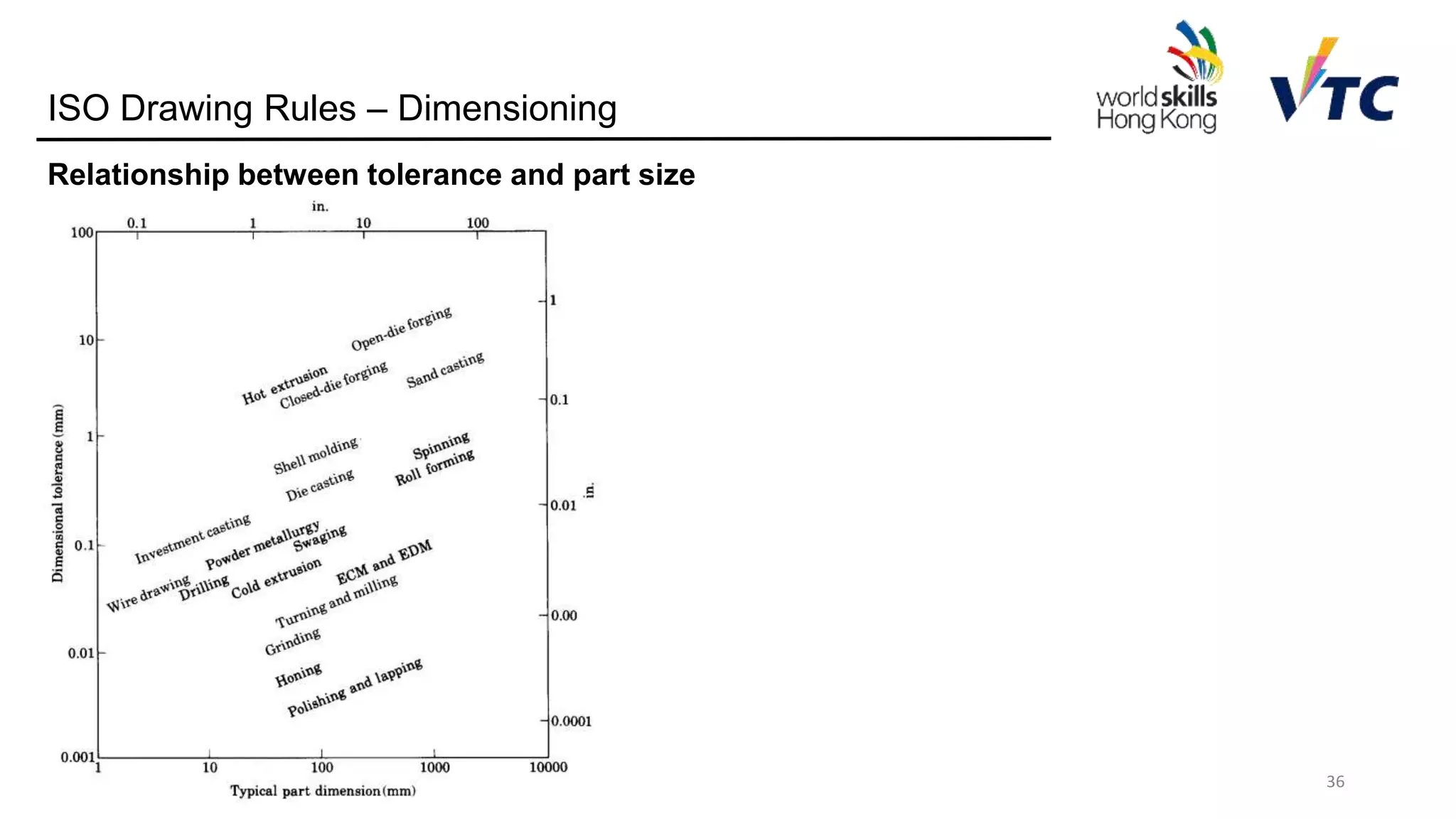
Relationship between tolerance and part size
37
ISO Drawing Rules –
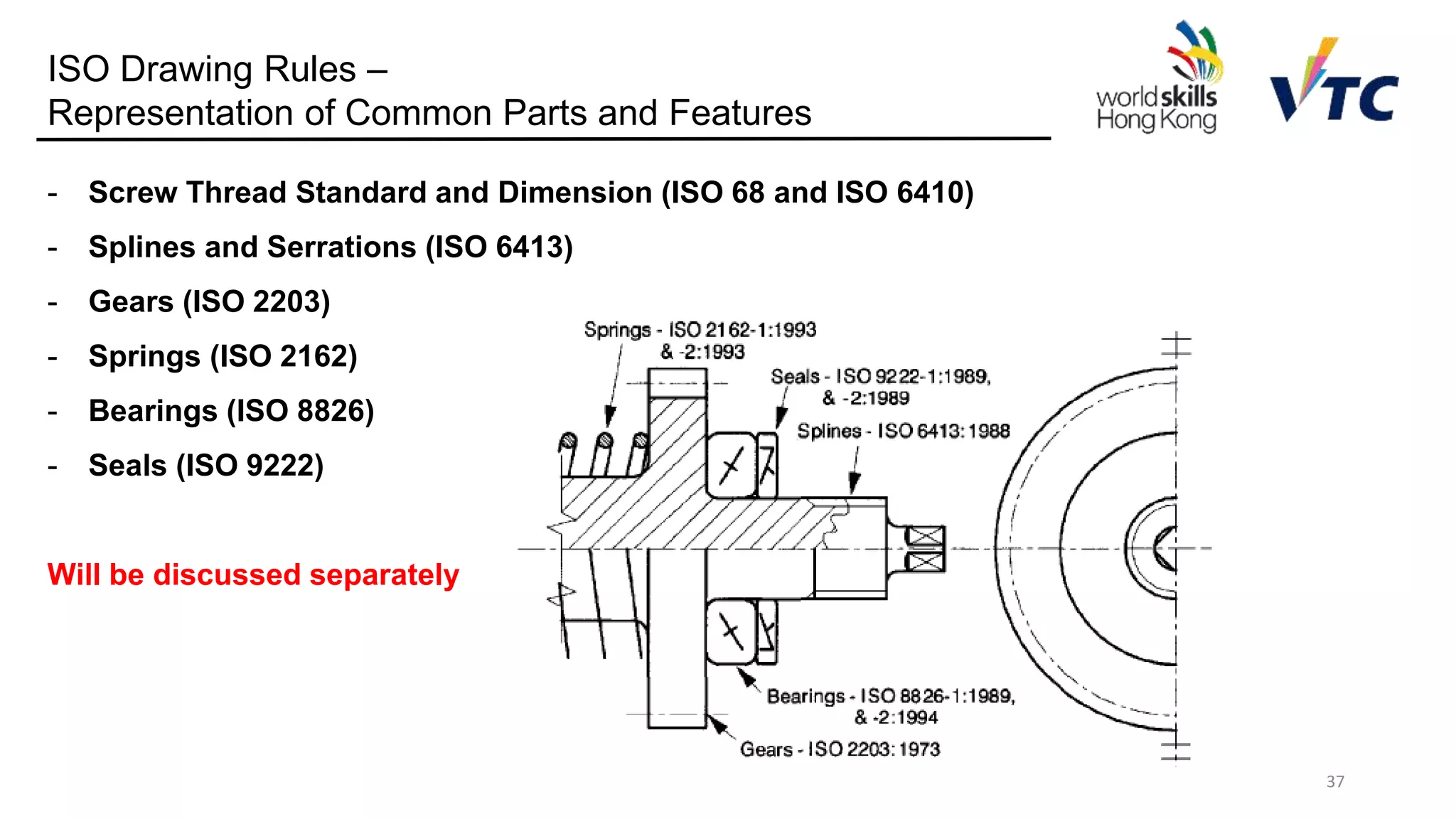
Representation of Common Parts and Features
- Screw Thread Standard and Dimension (ISO 68 and ISO 6410)
- Splines and Serrations (ISO 6413)
- Gears (ISO 2203)
- Springs (ISO 2162)
- Bearings (ISO 8826)
- Seals (ISO 9222)
Will be discussed separately
38
References
- Griffiths, B. (2002). Engineering Drawing for Manufacture. Elsevier Science.
- ISO 128-24:2014, Technical Drawings – General Principles of Presentation -
Part 24: Lines on Mechanical Engineering Drawings, 2014.
- ISO 129-1:2018, Technical Product Documentation(TPD) – Presentation of
Dimensions and Tolerances – Part 1: General Principles, 2018.
- ISO 3098-5:2000, Technical Product Documentation – Lettering – Part 5:
CAD Lettering for the Latin Alphabet, Numerals and Marks, 2000.

Introduction of ISO standards for technical engineering drawing

  • 1.
    By: Dickson Lo@ IVE(TM) Worldskills Mechanical Engineering Design – CAD Hong Kong Team Training Technical Drawing Standards (ISO) 1
  • 2.
    2 Content - Introduction ofISO 128 ----------------------------------------------------------------------------------- P.3 - 4 - Lines on Mechanical Engineering Drawing --------------------------------------------------------- P.5 - 14 - ISO Drawing Rules - Decimal Marker -------------------------------------------------------------------------------------- P.15 - Lettering (ISO 3098) -------------------------------------------------------------------------------- P.16 - 19 - Dimensioning (ISO 129) --------------------------------------------------------------------------- P.20 - 36 - Representation of Common Parts and Features -------------------------------------------- P.37 - References ------------------------------------------------------------------------------------------------- P.38
  • 3.
    Technical Drawing Standards(ISO 128) ISO 128 consists of the following parts: • Part 1: Introduction and index • Part 15: Representation of shipbuilding drawings • Part 20: Basic conventions for lines • Part 21: Preparation of lines by CAD systems • Part 22: Basic conventions and applications for leader lines and reference lines • Part 23: Lines on construction drawings 3 - ISO 128 is an international standard issued by International Organization for Standardization (ISO) - General principles of presentation in technical drawings - describes basic conventions for lines, views, cuts and sections, and different types of engineering drawings, like mechanical engineering, architecture, civil engineering, and shipbuilding - Applicable to both manual and computer-based drawings
  • 4.
    Technical Drawing Standards(ISO 128) ISO 128 consists of the following parts: • Part 24: Lines on mechanical engineering drawings • Part 25: Lines on shipbuilding drawings • Part 30: Basic conventions for views • Part 34: Views on mechanical engineering drawings • Part 40: Basic conventions for cuts and sections • Part 44: Sections on mechanical engineering drawings • Part 50: Basic conventions for representing areas on cuts and sections • Part 71: Simplified representation for mechanical engineering drawings [TS] 4 SI System: - Millimeter (mm) - Gram (g) - Degree (°)
  • 5.
    Lines on MechanicalEngineering Drawings (ISO 128-24) 5
  • 6.
    6 Lines on MechanicalEngineering Drawings (ISO 128-24) Line Type A – Continuous Wide Line - Visible edges and outlines - Limit of full thread - Crests of screw threads (螺絲紋外徑) Thread Terminology
  • 7.
    7 Lines on MechanicalEngineering Drawings (ISO 128-24) Line Type B – Continuous Narrow Line - Dimension Lines - Extension Lines - Leader and Reference Lines - Short Center Lines - Thread roots (螺絲紋內徑)
  • 8.
    8 Lines on MechanicalEngineering Drawings (ISO 128-24) Line Type C – Continuous Narrow freehand Line ***For Freehand Drawing*** - Limit of the section - Limit of the interrupted view Line Type D – Continuous Narrow Line with Zigzags - Limit of the section - Limit of the interrupted view
  • 9.
    9 Lines on MechanicalEngineering Drawings (ISO 128-24) Line Type E – Dashed Wide Line - Indication of permissible surface treatment Line Type F – Dashed Narrow Line - Hidden edges and outlines
  • 10.
    10 Lines on MechanicalEngineering Drawings (ISO 128-24) Line Type G – Long-dashed Dotted Narrow Line - Centre lines - Lines and planes of symmetry Line Type H – Long-dashed Dotted Wide and Narrow Line - Show the cutting planes
  • 11.
    11 Lines on MechanicalEngineering Drawings (ISO 128-24) Line Type J – Long-dashed Dotted Wide Line - Indication of limited areas of surface treatments Line Type J – Long-dashed double-dotted Narrow Line - Indication of limited areas of surface treatments
  • 12.
    12 Lines on MechanicalEngineering Drawings (ISO 128-24) Example of different line types in drawing
  • 13.
    13 Line Group Line widths(in millimeters) Wide Narrow 0.25 Default line weight in Inventor 0.25 0.13 0.35 0.35 0.18 0.5 0.5 0.25 0.7 0.7 0.35 1 1 0.5 1.4 1.4 0.7 2 2 1 Lines on Mechanical Engineering Drawings (ISO 128-24) Line Group & Widths - You can use which ever group of line weights you like - You should base your choice on the size of paper and copying requirements (注意題目要求! 如沒有特別要求, 可使用0.25或0.5)
  • 14.
    14 Lines on MechanicalEngineering Drawings (ISO 128-24) Line Widths Setting in Inventor
  • 15.
    15 ISO Drawing Rules- Decimal Marker Decimal Marker *** - Point / Full Stop is common as the decimal marker (e.g. 18.3) - ISO recommended to use Comma (,) to be the decimal marker (e.g. 16,2) ***
  • 16.
    16 ISO Drawing Rules- Lettering Lettering (ISO3098 Part5 – CAD Lettering of Latin Alphabet, Numerals and Marks)
  • 17.
  • 18.
  • 19.
    19 ISO Drawing Rules- Lettering Font Setting in Inventor ISOCP and ISOCT fonts are available in Autocad and Inventor ISOCP : Proportional Font ISOCT : Tabular / Fixed Width Font (注意題目要求! )
  • 20.
    20 ISO Drawing Rules– Dimensioning Presentation of Dimension and Tolerances (ISO 129:2018) Elements of Dimensioning - Center Lines - Dimension Lines - Extension Lines - Origin Symbol - Dimensions - Angular Dimension (ISO 14405-2) - Dimensional Value - Developed Length - Linear Dimension (ISO 14405-2) - Property Indicator
  • 21.
    21 ISO Drawing Rules– Dimensioning Functional, Non-functional & Auxiliary Dimension *** - Functional Dimension - Critical to the correct function of the components - More important when making decisions in design and QC - For example: - Outer Dimension  Affect Assembly - Thickness  Affect Strength - Non-functional Dimension - Less important and will not affect the function - Auxiliary Dimension - Each feature shall be dimensioned only once on drawing (No Over Dimension) - For information only - Dimension value shall be placed into parenthesis ()
  • 22.
    22 ISO Drawing Rules– Dimensioning Exercise of Functional & Non-functional Dimensions Assembly: Part A:
  • 23.
    23 ISO Drawing Rules– Dimensioning Exercise of Functional & Non-functional Dimensions Part B: Part C:
  • 24.
    24 ISO Drawing Rules– Dimensioning Aims of Dimensioning: - Size (尺寸) - Position (位置) - Tolerance (公差) - Relationship (零件之間關係) Dimension Types: Linear Dimension Type: Parallel Dimension Improved positional accuracy is obtainable by dimension more than one feature from a common datum Running Dimension Simplified method of parallel dimension Chain Dimension Should only be used where the possible accumulation of tolerances (累加公差) does not endanger the function of the part
  • 25.
    25 ISO Drawing Rules– Dimensioning Dimension Types: Angular Dimension Dimensioning Circles ***Text should align to the dimension lines***
  • 26.
    26 ISO Drawing Rules– Dimensioning Dimension Types: Dimensioning Radii or Fillet Dimensioning Chamfer
  • 27.
    27 ISO Drawing Rules– Dimensioning Dimension Types: Dimensioning Spheres (球面) Add “S” before the circular dimension e.g. SR50, SØ30 Example of spherical products
  • 28.
    28 ISO Drawing Rules– Dimensioning Dimension Types: Dimensioning Curves
  • 29.
    29 ISO Drawing Rules– Dimensioning Dimension Types: Dimensioning Holes Dimensioning Tapers
  • 30.
    30 ISO Drawing Rules– Dimensioning Dimension Placement: 1) Place the dimension in 0°, 45° and 90°
  • 31.
    31 ISO Drawing Rules– Dimensioning Dimension Placement: 2) Dimension lines should not cross extension lines 3) Dimension should be line up and grouped together
  • 32.
    32 ISO Drawing Rules– Dimensioning Dimension Placement: 4) Extension lines and centerlines can cross visible lines of the object Do not leave a gap in either line when crossing object lines 5) To fit dimensions into a crowed area
  • 33.
    33 ISO Drawing Rules– Dimensioning Dimension Placement: 6) Avoid dimensioning to hidden lines 7) Dimensions should not be placed on a view
  • 34.
    34 ISO Drawing Rules– Dimensioning Tolerance: 1) Universal Tolerance - The note should be added in the drawing (Usually at the bottom) 2) Specific Tolerance - Provide tolerance to the dimension separately - Use for the dimension which will affect the function, assembly or appearance - The tolerance should match with the manufacturing limits and assembly clearance
  • 35.
    35 ISO Drawing Rules– Dimensioning Common Manufacturing Process Tolerance:
  • 36.
    36 ISO Drawing Rules– Dimensioning Relationship between tolerance and part size
  • 37.
    37 ISO Drawing Rules– Representation of Common Parts and Features - Screw Thread Standard and Dimension (ISO 68 and ISO 6410) - Splines and Serrations (ISO 6413) - Gears (ISO 2203) - Springs (ISO 2162) - Bearings (ISO 8826) - Seals (ISO 9222) Will be discussed separately
  • 38.
    38 References - Griffiths, B.(2002). Engineering Drawing for Manufacture. Elsevier Science. - ISO 128-24:2014, Technical Drawings – General Principles of Presentation - Part 24: Lines on Mechanical Engineering Drawings, 2014. - ISO 129-1:2018, Technical Product Documentation(TPD) – Presentation of Dimensions and Tolerances – Part 1: General Principles, 2018. - ISO 3098-5:2000, Technical Product Documentation – Lettering – Part 5: CAD Lettering for the Latin Alphabet, Numerals and Marks, 2000.