INTRODUCTION OFINTRODUCTION OF
ROBOTICSROBOTICS
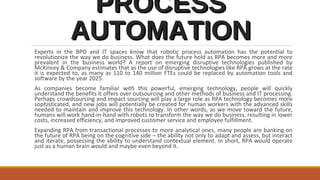
PROCESSPROCESS
AUTOMATIONAUTOMATION
Experts in the BPO and IT spaces know that robotic process automation has the potential to
revolutionize the way we do business. What does the future hold as RPA becomes more and more
prevalent in the business world? A report on emerging disruptive technologies published by
McKinsey & Company estimates that as the use of disruptive technologies like RPA grows at the rate
it is expected to, as many as 110 to 140 million FTEs could be replaced by automation tools and
software by the year 2025.
As companies become familiar with this powerful, emerging technology, people will quickly
understand the benefits it offers over outsourcing and other methods of business and IT processing.
Perhaps crowdsourcing and impact sourcing will play a large role as RPA technology becomes more
sophisticated, and new jobs will potentially be created for human workers with the advanced skills
needed to maintain and improve this technology. In other words, as we move toward the future,
humans will work hand-in-hand with robots to transform the way we do business, resulting in lower
costs, increased efficiency, and improved customer service and employee fulfillment.
Expanding RPA from transactional processes to more analytical ones, many people are banking on
the future of RPA being on the cognitive side – the ability not only to adapt and assess, but interact
and iterate, possessing the ability to understand contextual element. In short, RPA would operate
just as a human brain would and maybe even beyond it.
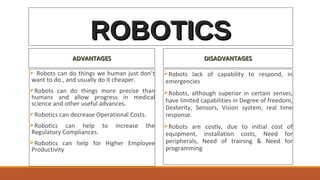
ROBOTICSROBOTICS
ADVANTAGESADVANTAGES
 Robots can do things we human just don’t
want to do , and usually do it cheaper.
Robots can do things more precise than
humans and allow progress in medical
science and other useful advances.
Robotics can decrease Operational Costs.
Robotics can help to increase the
Regulatory Compliances.
Robotics can help for Higher Employee
Productivity
DISADVANTAGESDISADVANTAGES
Robots lack of capability to respond, in
emergencies
Robots, although superior in certain senses,
have limited capabilities in Degree of freedom,
Dexterity, Sensors, Vision system, real time
response.
Robots are costly, due to initial cost of
equipment, installation costs, Need for
peripherals, Need of training & Need for
programming

Introduction of robotics

  • 1.
  • 2.
    PROCESSPROCESS AUTOMATIONAUTOMATION Experts in theBPO and IT spaces know that robotic process automation has the potential to revolutionize the way we do business. What does the future hold as RPA becomes more and more prevalent in the business world? A report on emerging disruptive technologies published by McKinsey & Company estimates that as the use of disruptive technologies like RPA grows at the rate it is expected to, as many as 110 to 140 million FTEs could be replaced by automation tools and software by the year 2025. As companies become familiar with this powerful, emerging technology, people will quickly understand the benefits it offers over outsourcing and other methods of business and IT processing. Perhaps crowdsourcing and impact sourcing will play a large role as RPA technology becomes more sophisticated, and new jobs will potentially be created for human workers with the advanced skills needed to maintain and improve this technology. In other words, as we move toward the future, humans will work hand-in-hand with robots to transform the way we do business, resulting in lower costs, increased efficiency, and improved customer service and employee fulfillment. Expanding RPA from transactional processes to more analytical ones, many people are banking on the future of RPA being on the cognitive side – the ability not only to adapt and assess, but interact and iterate, possessing the ability to understand contextual element. In short, RPA would operate just as a human brain would and maybe even beyond it.
  • 3.
    ROBOTICSROBOTICS ADVANTAGESADVANTAGES  Robots cando things we human just don’t want to do , and usually do it cheaper. Robots can do things more precise than humans and allow progress in medical science and other useful advances. Robotics can decrease Operational Costs. Robotics can help to increase the Regulatory Compliances. Robotics can help for Higher Employee Productivity DISADVANTAGESDISADVANTAGES Robots lack of capability to respond, in emergencies Robots, although superior in certain senses, have limited capabilities in Degree of freedom, Dexterity, Sensors, Vision system, real time response. Robots are costly, due to initial cost of equipment, installation costs, Need for peripherals, Need of training & Need for programming